



Abstract
The fourth Industrial Revolution is upon us. Yet not many students understand its evolution or impacts. This teaching case looks at socio-technical evolution from 1IR (First Industrial Revolution) to 4IR (Fourth Industrial Revolution). The teaching case concludes by exemplifying 4IR’s promises and perils with a mini case on how 4IR that quietly helped the COVID-19 vaccine development can also pose cyberthreats and erode privacy.
Keywords
Introduction
The confluence of globalization and technology is currently being rewritten as a post-COVID-19 21st-century story. But our story began more than three centuries ago. It is an incredible tale of innovation and upheaval.
Today, we live in the fourth industrial revolution (4IR) era. Well, it’s called 4IR because we’ve gone through four specific, punctuated industrial revolution (IR) phases.
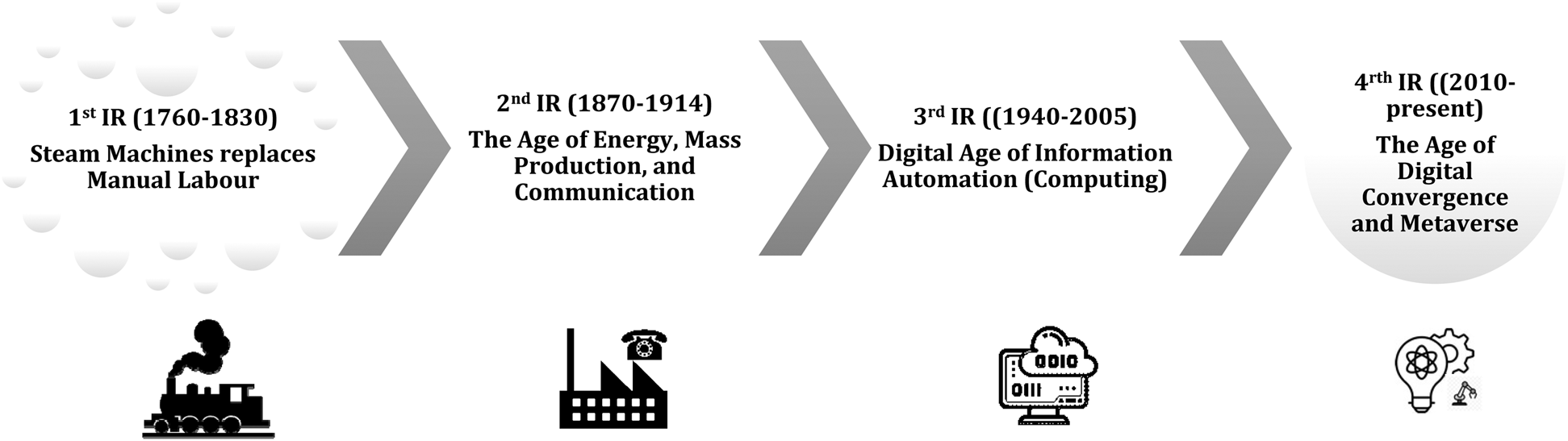
The first IR (1760–1830): The coming of machines over men
The first industrial revolution (1IR) began with steam-powered machines replacing people and horses, as industrial economies and societies broke away from handmade goods and agrarian livelihoods. Technology, society, and politics defined 1IR, just the way the socio-politics and technologies define and will define the 4IR. 1IR began in the 1770s, around the same time that the US was declaring its independence from Britain. The whole world was changing rapidly and dramatically. The baroque age of aristocracy and intricate manual labor was waning, and the modern age was rising. The 1isr IR was beginning in earnest. The first IR (1760–1830): In 1760, the famous Scotsman James Watt’s Steam Engine invention kickstarted the first Industrial Revolution. Instead of using horses and humans to move things, a combination of coal, fire, and water “automatically” moved pistons to generate power. Machines had arrived. More durable, cheaper, and more efficient steam-powered machines emerged, replacing horses and manual labor, creating social friction from lost jobs and incomes. James Watt’s steam engine used coal to convert water into steam. The steam pressure would be released to rotate a machine wheel that could print, press, mold, dig, cut (among many other functions), and do many other things. Suddenly, production was revolutionized (for the first time?). In a few years, George Stevenson, a brilliant and self-taught engineer, came up with the steam engine locomotive that could pull carriages of heavy coal faster than horses. At a galloping speed of 36 mile/h, Stevenson’s steam engine, Rocket, would go on to be the speediest engine-powered vehicle in the world, showing how using machines could be more efficient and more humane than using animals. The age of Enlightenment, with its emphasis on free, innovative thinking over tradition, fueled the first IR. The first IR had become the talk of the town, led by famous mathematicians and philosophers such as Newton, Descartes, Kant, Hobbes, Locke, Rousseau, Voltaire, and Adam Smith. It was the age of reason, independent thinking, and innovation. Newton redefined the universe as a fragile but stable system where gravity holds us together, where actions create reactions, and where certain forces cause us to move or stay in place. Descartes, the French philosopher, and mathematician redefined the need for reason and logical thinking over obeying commands with his famous phrase “cogito ergo sum” (I think, therefore, I am). Relatedly, The German philosopher Immanuel Kant’s Sapere Aude (dare to know) challenged tradition with curiosity. 1IR saw the waxing of Republicanism over Monarchism over the need for human dignity and quality of life. The British philosopher Locke used reason, democracy, and human dignity to decry tradition, superstition, and to challenge the divine authority of kings. To Locke, a government had to be just and representative of the people it governed—the same idea that ignited the 1776 American revolutionary war based on “taxation without representation.” The French philosopher Rousseau’s Theory of Social Contract defended human freedoms and individual rights. Rousseau’s social was a contract between the government and the people, where people would trade some of their liberties for stability, safety, and laws. The 1789 French revolution overthrew the French monarchy and aristocracy, led by Voltaire’s “enlightenment” thinking on the theme of liberty, equality, and fraternity (brotherhood/sisterhood). The revolutionaries attributed Voltaire’s phrase “Those who can make you believe absurdities can make you commit atrocities” to the French aristocracy that had let France go bankrupt from trying to help the American revolution. So, as machines became a part of the economic landscape, power shifted from aristocracy to businesses and entrepreneurs that used innovative machines to generate wealth over aristocratic landowners. 1IR saw governments becoming more powerful than monarchies. But too much government power needed to be checked. Hobbes’ worried that powerful governments might become as tyrannical as monarchies. Hobbes called such large and powerful governments Leviathan, where powerful and armed states could trample individual freedoms and privacy. So, even governments needed checks and balances, to ensure limiting their plenipotentiary powers. The principles developed in Hobbes’ Leviathan became the central pieces for the US constitution based on term limits, separation of the executive, legislative, and judiciary, and their checks and balances. During the same period, the Scottish economist Adam Smith’s book, notably The Wealth of Nations, laid the groundwork for Capitalism. In capitalism, money needs to flow freely, allowing entrepreneurs to borrow capital and innovate. In capitalism, prosperity depends upon clever, innovative thinking and hard work—creating specialized “divisions of labor,” where an individual’s ability to specialize and be good at something increases individual prosperity and benefits society. 1IR with its mechanized innovations afforded capitalism the chance to flourish
The first IR introduced a socioeconomic sea change of revolutions, democracy, and capitalism marked by an industrial sea-change of 1IR mechanical power generation. Then came the second IR.
The second IR (1870–1914): The age of energy, mass production, and communication technologies
A century after 1IR, the Second Industrial Revolution (2IR) arrived. Steam engine railroad networks were cross-crossing countries like motorways and interstate highways.
Steam was a good start foe machine technologies, but steam generation took a lot of water, a lot of coal, and a lot of heat to boil water and build pressure in order to turn steam turbines. 2IR replaced steam power with other modes of power generation, mainly petroleum and electricity. Gasoline, from petroleum, is extremely combustible. The internal combustion engine (ICE), the engine commonly used in cars, produced much more energy within a space a fraction of the size of a steam generator. Gasoline, when mixed with oxygen and ignited, creates an internal explosion powerful enough to move pistons to turn the turbine. Smaller and more efficient gasoline engines dominated the economy, from automobiles and tanks to lorries and aircraft.
Electricity was the other 2IR game-changing invention. Electricity generation is easy, with a small dynamo that converts mechanical/physical work into energy distributed over wires at the speed of light. Of course, we know of the two behemoth inventors, Edison and Tesla, each promoting their separate types of electricity generation. While Edison promoted direct current (DC), the type of electricity used in batteries, Tesla promoted alternating current (AC) that run our household appliances and our electricity grids.
But electricity had disadvantages. Gasoline is difficult and environmentally dirty to extract from petroleum but easy to store and refill in gas tanks. Electricity generation is clean and easy to distribute but difficult and expensive to store in batteries. Have you seen how quickly batteries deplete? So, electricity became a popular choice for fixed machines (such as factories machinery) while gasoline became a popular choice for mobile machines (such as vehicles).
2IR was also the age of communication, fed by electricity. The electric telegraph was a 2IR game-changing innovation, paving the path to information and communication networks connecting the world. In 1844, Samuel Morse, in the US, invented the telegraph and sent the first message “What hath God wrought?” Harnessing telegraph’s powers, private companies such as the British East India Company were becoming the first global brands by stretching their businesses across the world, using electric telegraphs to communicate across their multinational divisions.
To support private businesses, the UK started controlling telegraph communications by laying the telegraph lines across the world. With electricity powering telegraph communications, passing quietly under the seas and oceans, the first trans-Atlantic telegraph (sent as Morse Code) message read: “Directors of Atlantic Telegraph Company, Great Britain, to Directors in America:—Europe and America are united by telegraph. Glory to God in the highest; on earth peace, good will towards men!” followed by a text from Queen Victoria to US President Buchanan to congratulate his election victory.
Bell’s Telephone invention in 1876 quickly followed the telegraph, allowing voice, not just text to travel around the world. Two decades later, in 1897, another technological innovation changed communication. Marconi, an Italian inventor in the UK, invented wireless communication, called Radio. International communication technologies were relaying messages across the world at unprecedented speeds. With wired and wireless communications, the UK and the US knew that building and controlling networks and communication would give them a global advantage in military and trade.
2IR technology innovations of electricity, gasoline, and communications were making the world smaller, ushering in more mechanization and mass production. 1. Suddenly, machines became more powerful, more automated, and efficient. Steel was produced faster using the Bessemer process, oil could be extracted from the ground in millions of barrels, and electricity could be generated in megawatts to run thousands of factories and power entire cities. 2. 2IR revolutionized business as we know it. On the factory floor, interchangeable parts reduced production costs (e.g., Ford’s Assembly Line) and led to mass production. Rail networks offered mass distribution, sewage networks built communities, electric lines supplied energy, and telegraph networks and radio spurred mass communication. To top it off, like wireless radio, the Wright brothers’ airplane proved human ability to take flight with a mechanized engine and wings, untethered to the ground 3. Society became more organized. With rail and communication networks, cities and countries built electricity, water, and sewage networks. Life became cleaner and more convenient. With fewer diseases and better quality of life, people started living longer. Factories arrived, replacing farmlands with urban cities and farmhands with factory workers. 4. The confluence of communication, electricity, and petroleum brought about an innovation: better, faster, and cheaper ways of producing things! Europe and the US experienced their belle epoque (beautiful age) of wealth and affordances, creating a middle class. Henry Ford, an American car manufacturer, invented a brilliant process called an assembly line, using interchangeable parts to build things faster and cheaper. Henry Ford’s assembly line churned out affordable, mass-produced cars like the Ford Model T in the early 1900s. Suddenly 2IR inventions became accessible across industry and society and life changed for good. 5. But with faster and cheaper mechanization came a lot of social and political turmoil around the world. People left farms and started overcrowding cities. Colonial powers fought for resources, from petroleum in the Middle East to rubber in China and Malaysia, to feed their machines. In Europe, the seeds of regional hatred were being sown. Napoleon’s conquests across Europe a hundred years ago, from Austria and Italy to Portugal, had left a bitter taste in everyone’s mouth. European countries unified into nation-states, often paying a price in blood. The warring Italian states unified in 1861. In 1871, the Prussian general Bismarck led the Franco–Prussian war to unify Germany and Prussia against France’s Napoleon III and annexed Alsace, France’s industrial heartland. Thus, began Germany’s rise as an industrial power. 6. The newly unified, albeit fragile, European nation-states simmered with long-lasting suspicions and resentment between themselves. The pressure pot burst into flames in 1914 with World War I, consuming all of Europe, from the Balkans to Britain. World War I became the first war to use large-scale mechanization, laying the stage for the US to gain industrial supremacy by supplying its allies with its 2IR industrial-production might. The same mechanizations that defined 2IR were now being turned into machine guns, tanks, and military aircraft to unleash terror, leading to 40 million deaths.
The third IR ((1940–2005): The digital age of information automation (computing)
The 1940s opened with shadows of war. The first world war, meant to be “the war that ended all wars,” rather became the linchpin for World War II. The “roaring” 1920s was euphoric, with stock markets opening access to capital and ownership. The 1929 “black Tuesday” collapse punctuated the frenzied speculation and euphoria, leaving a dreadful financial depression in its aftermath. In the middle of a worldwide economic downturn began World War II, with Nazi Germany invading Poland, marching their jackboots across Europe, and systematically planning a Jewish holocaust.
Several 3IR military events and innovations followed: 1. To counter the axis powers, that is, Germany to the West and Japan to the east, the allied powers, especially UK and the US ramped up their 2IR mass production infrastructure to build for the war effort. Axis and Allied countries started inventing faster and deadlier solutions to wreak havoc on the enemy, from Germany’s V2 rockets to the USA’s atomic bomb. But it was not just physical technologies that were changing the tide of war. Rather, it was but “information” that was becoming the competitive advantage and the harbinger of the times. In 1940, when Nazi Germany’s air force, the Luftwaffe, began bombing Great Britain, the only country left fighting against the Nazi blitzkrieg (lightning warfare), the British realized that information was key to preempting Luftwaffe bombardments. So, building on 2IR radio technology, the British invented Radar as a war-time necessity. Radar could echo-locate German aircraft from far away and allowed the British to prepare offensive and defensive solutions slightly ahead of time Not only did Radar offer strategic information to save Britain from the German Blitz but also brought the RAF (Royal Air Force) victory over the Luftwaffe in the Battle of Britain, giving Nazi Germany its first taste of defeat. In addition to Radar, Britain needed to crack German military communications by decoding German encryptions in the early 1940s. Nazi Germany was using a sophisticated encryption machine called Enigma. Even when the essential Enigma encryption process was discovered, manually processing the complicated cipher encryptions would have taken months on end. Alan Turing, a brilliant British scientist, built the first modern computer called the Turing machine that could run thousands of computations needed to break the Enigma code. The age of the computer was had arrived! 2. Once World War II concluded in 1945, the world started rebuilding. Many of the innovations that grew out of the war were harnessed to revive economies. Radar became a key part of civil aviation and the computer became a part of business operations. Meanwhile, the US and the USSR (Union of Soviet Socialist Republics) became the two superpowers with very different strategies. While the USSR pushed its communist ideals to build a world order based on government control of resources, the US, western Europe, and Japan used capitalist market economics to privatize companies and innovations. Some countries aligned themselves with USSR and some with the US and Western Europe. This superpower competition became known as the Cold War, each threatening the other’s destruction. As the Cold War intensified, the US and USSR entered the space race. Both countries knew that space race success depended on computing and remote wireless communication. Computers would calculate rocket trajectories and velocities and relay changes wirelessly, controlled by command centers on Earth 22,000 miles away. On 12 April 1961, Russian Sputnik rockets helped Yuri Gagarin become the first cosmonaut in space in 1961, winning the space race. Less than a month later, on 5 May 1961, Alan Shepard became the first US astronaut in space. With the space race underway, Valentina Tereshkova became the first Russian woman cosmonaut in space in 1963 and Sally Ride the first US woman astronaut in space in 1978. Doggedly, the US took the chalice with its 1969 Apollo mission carrying Armstrong, Collins, and Aldrin to finally land on the Moon. Although computing and wireless communications were helping explore the edges of space and beyond, the Cold War had a more ominous. Computer-controller rockets were not only being built to explore space but also carry devastating nuclear weapons. Growing out of Nazi Germany’s V2 rocket program, both the US and the USSR stockpiled their nuclear intercontinental ballistic missiles (ICBMs) and aimed them at one another. The US had already used two atomic bombs, Fat Man and Little Boy, in Hiroshima and Nagasaki in 1945, to force Japan to surrender. The world knew the incredible devastation atomic bombs wrought. Nearly every country prepared itself for a nuclear holocaust during the Cold War. But nuclear holocaust concerns prompted a unique 3IR innovation. Facing fears of not being able to communicate with its and allied military during a nuclear strike, the US Military’s ARPA (Advanced Research Projects Agency) sponsored building a global digital network. This global digital network “digitized” information linked across thousands of decentralized computers, creating an “internet.” This digital internet was globally widespread like a spiderweb, undersea, and overland. If one part went down from a nuclear strike, the other parts would maintain communication. It was called the DARPANET. But, as history would have it, the USSR collapsed in 1989. The Cold War was over and suddenly ARPANET became a moot military advantage. But ARPANET had built a globally decentralized and distributed digital network that linked the world together. Accordingly, the US made an altruistic move and opened ARPANET to the global public. The ARPANET became the Internet that we use today. Instead of 2IR telegraph lines carrying morse code, the Internet was the digital network that would carry Instagram pictures, FaceBook posts, TikTok videos, and Wikipedia pages in milliseconds around the globe. 3. 3IR was an information revolution led by computers and networks, leading to a slew of commercial and personal computing. Computers, once large mainframe computers occupying entire rooms and running magnetic tapes, were getting smaller and faster. Smaller and faster microchip innovations doubled processing power every 18 months (called Moore’s law). Faster wireless networks burgeoned information access over the Internet, allowing entrepreneurship and Ecommerce to flourish across the work. Computers started being used for complex engineering, architecture design, and machine operations. As computers got smaller in size, there was, remarkably, a place for computers in the home to replace the typewriter, the pocket calculator, and even the phone. Large mainframe computers became smaller and smaller. The 1974 Altair became the first home computer, followed by famous models such as the 1977 Apple II, 1983 Apple Lisa, and 1984 Apple Macintosh. Meanwhile IBM introduced their PC architecture (called ×86) packaged with Microsoft DOS and Windows operating systems (OS). IBM’s ×86 architecture was easily buildable around the world using available parts, and simple installation of Microsoft DOS and Windows operating systems made PCs the single most popular computer in every global corner. During 3IR, smaller computers and wireless, remote communications grew in reach and range. Laptops, cell phones, wireless networks, technologies, the Internet, along with better information organization in “databases” proliferated globally—starting the 3IR “Digital Revolution.”
The fourth IR ((2010-present): The age of digital convergence and the MetaVerse
The computer, high-speed wired and wireless networks, and the Internet, started the 3IR digital revolution. The Internet was meant to be the great equalizer, linking everyone and everything via the cloud, allowing people to share inventions, ideas, and content. Today, with billions of globally connected devices (computers, smartphones, cameras, supermarket scanners, and payment systems), petabytes of data are created and consumed every hour. That paved the oath for the fourth industrial revolution (4IR).
The fourth Industrial Revolution (4IR) is the age of digital convergence. With a proliferating Internet around the world, high-speed 5G wireless networks, cheap computing, 4IR is connecting various devices, databases, and a variety of digital networks over the Cloud.
The 4IR began with on-demand access to different resources on the Cloud, a virtual place for an on-demand way to access and store computing and information resources. Think movies on the cloud (Netflix, Hulu, Amazon Prime, and Disney+), Cloud storage (iCloud, Microsoft OneDrive, and Amazon S3), or complex analytics and computing (Google App Engine, Microsoft Azure, and Amazon Elastic Compute (EC2)). Individuals and companies no longer require expensive computer updates to store large data or process complex software codes. Instead, we can watch shows, listen to music, access storage, and run complicated computer code and applications from Cloud servers whenever we want, on-demand.
4IR is seeing companies rapidly migrate a lot of their services to the Cloud. We have Software as a Service (SaaS) (e.g., banks’ cheque deposits, investments, payments, and location-services), Platform as a Service (PaaS) such as Alibaba in China where you can buy things, pay for services, do banking, and invest), and even Infrastructure as a Service (IaaS) such as Amazon Web Services (AWS) or Microsoft Azure where you can tackle all your computing needs such as servers, databases, high-powered processing, and even AI.
With services, platforms, and infrastructures becoming on-demand services and managed remotely on the cloud, all we need is a laptop, a smartphone, or tablet to run the most complex of systems.
In 4IR, technology is poised to run everything, from genomic code cracking, drug discoveries, and health and shopping prediction, to drone deliveries, autonomous-driving vehicles (AVs), and smart devices (called IoT (Internet of Things)) to remotely control cameras, lock doors and turn on lights!
IoTs and Blockchains are probably two of the definitive 4IR technologies. 4IR uses IoT sensors and Blockchains to track and trace the movement of goods and people by assigning unique digital IDs to everything and tracking these IDs’ movements over time and space. Blockchains create digital ledger entries (called blocks) for every event and movement on decentralized databases, creating long, immutable, and irreversible transaction chains. Because blockchains are immutable, no one can tweak or revise any transaction, ensuring tremendous transparency in tracking goods, money, and even people.
During 4IR, technology is becoming and will become a part of our everyday lives, embedded into the smallest of devices, interconnecting everything. Our postboxes might notify us when and what mail is delivered, our fridges might send a grocery store request to order eggs and milk in short supply, our cars might drive to where we stand, automatically open doors, and carry us autonomously (well, some of Tesla’s software does that already), and we might even be notified if our wine or tomato shipment were spoiled en route because of too much heat or light exposure.
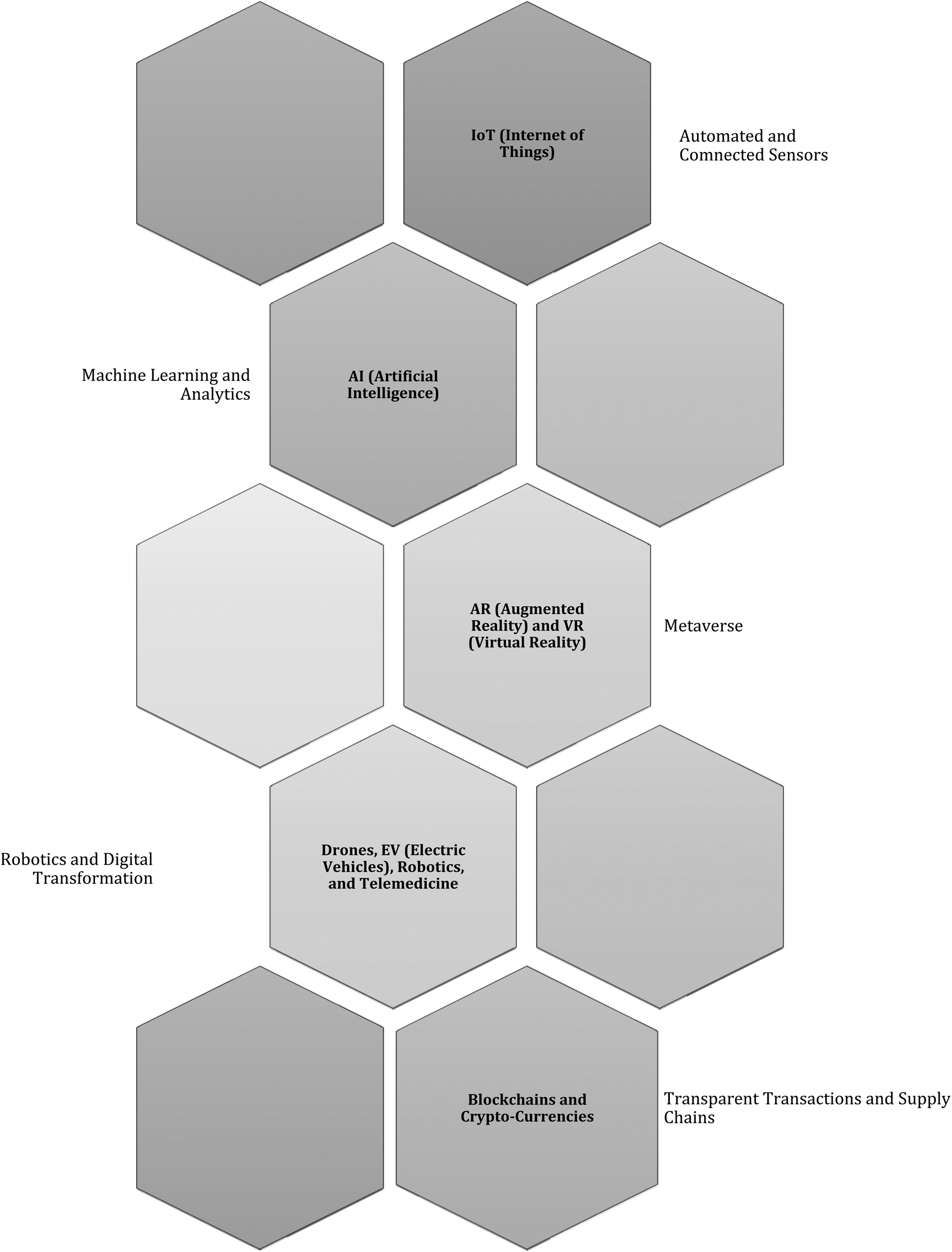
4IR is marked by the following technological highlights.
Automated and connected sensors
One could argue that IoT (Internet of Things) kickstarted the 4IR. But what are IoTs? As the name signifies, IoTs are a group of common, everyday “things” that are connected to the Internet—not just our computers, tablets, and smartphones, but a panoply of devices, making them “smart.” Smart devices range from lightbulbs, plugs, thermostats, door locks, garage openers, to mailboxes, drapes, and fridges. To make a device “smart” IoTs simply add sensors, motors, and WiFi. For example, a “smart” window might have a climate sensor (heat, light, and rain/snow) that would activate a connected motor to open or close a window if the weather is warm and sunny and close it if cold and rainy.
Today, an IoT sprinkler system can measure soil moisture level, weather patterns, and decide on whether, when, and for how long, to run a sprinkler system to water yards, saving properties from over or underwatering, large water bills, while increasing environmental sustainability.
IoT “smart” fridges might have specific placeholders for milk, eggs. Anytime the milk weighs less or sensors detect eggs fewer eggs, a smart fridge can place a milk and egg order refill from your preferred grocery store without requiring constant human monitoring.
Smartphone app-based Car insurance startups like Noblr and Root use our smartphone’s location tracking and accelerometer IoT sensors to quietly track our driving. When do we drive? Where do we travel? How good are our braking, accelerating, and turning? Do we text while driving? These new IoT-based car insurance companies are implementing clever ways to charge “custom” individual insurance based on monitoring “actual” driving. Riskier drivers pay a premium while safer drivers save money. These IoT companies use 4IR technologies to lower overheads, challenging large, incumbent insurance companies that still rely on aggregate “guesstimate” pricing and high overheads.
Machine learning and analytics
Artificial Intelligence (AI) is perhaps one of the most significant 4IR advances. AI is a system of sophisticated software algorithms and statistical models that mimic human thinking. Think of Facebook’s AI. Facebook’s AI knows a lot about you: Where you walk, what music you play for certain days, and moods when you post messages about feeling elated or depressed. Linked to your IoT data, AI uses machine learning to train itself on when you are leaving work to turn on your house climate control and shut down the climate control when you leave for work.
Think of Tesla’s Autonomous Vehicle (AV) Driving AI. Tesla’s AV AI uses light bursts (called LIDAR) and/or Video to constantly scan the environment like human eyes and ears. The AI learns from its scans to figure out other cars, buildings, pavements, pedestrians, and traffic lights, among others. The AV AI synthesizes the environment every millisecond, predicts movements, and changes its driving accordingly: turning, braking, accelerating.
Simply put, AI does not just automate; it thinks like a human with the efficiency of a computer.
AI trains itself just like human beings do. When we learn something such as, “what is a book?” we learn by looking at different types of books and then using that collective information to create our own interpretation of what a book looks like. Our brains learn from looking, hearing, touching, and smelling various things to “learn” about things in the world.
Our sensory inputs allow us to gain information about things and thus learn about the world around us. AI does that, exactly. Using neural nets, a sophisticated statistical software, AI systems are fed millions of pictures and sounds as sensory input data into an AI’s artificial neural networks (ANNs) to “learn” from the information fed to it. This is oftentimes referred to as machine learning and deep learning. That is how Apple’s iPhone/iPad facial recognition AI logs you in or Siri’s AI is used to recognize your voice.
Often, when we visit websites, we are often asked to verify ourselves by choosing the correct pictures of cars, trains, animals, etc. Our choices are then fed or input to help AI learn (called training) on what we choose as cars, trains, animals, etc. For example, as more people choose a specific picture as a picture of a car, their image selection information is fed into a training database which trains AI to learn from our choices on how to “interpret” a car.
Technically, this is how AI’s deep learning works. AI deep preferential learning minimizes ŷ based on, for example, deep-preferential learning heuristic shown below. AI’s neural network relies on weights W (W1 and W2) assigned to choices b (b1 and b2) to predict the outcome ŷ.

AI uses the output ŷ as a “feedforward” to predict, learn, and estimate an outcome. If the estimated outcome is not correct, more, and varying input are added to help AI reweigh choices for re-estimation. That is how humans learn—by unlearning and relearning from reassigning weights to our choices.
AI models and algorithms are a function of their users’ inputs. AI algorithms learn based on what is input to decipher user preferences. In the wake of the 2019 Hong Kong protests against Chinese mainland control where news media was vastly divided and partisan, AI created a different preferential deep learning profile. A user that predominantly clicked on and read mainland China news had a different profile from a user that predominantly clicked on and read Hongkong and western news sites and news. AI uses each candidate’s profile to deliver custom content that matches each individual’s proclivity as a way to mitigate their news information uncertainty. Deep learning AI would learn individual proclivities and send the user interested in mainland China news information about mainland China’s tolerance towards Hong Kong and China’s attempts at maintaining unity under the “One Country-Two Systems” policy. On the other hand, AI would send the user interested in western news information decrying Chinese aggression towards Hong Kong protests and the unnecessary oppression and violence being meted out by mainland China under the pretense of control.
In a 2018 interview Vox (2018) about AI-based preferential learning on search histories and social media postings, the interview noted that AI on Search and Social Media sites are not meant to be paternalistic, ideal neutral platforms, but as a platform that treats its users as customers. “There is safety in saying the consumer is going to make the decision. Yes, there is an algorithm here….The algorithm is just saying, What do you want? Okay, we’re going to give you more of that.”
During 4IR, companies and governments are feeding AI detailed images from X-Rays, GPS, and space telescopes to remotely discover things we had never found—from archaeological sites under the ground, far-flung galaxies, and black holes around the universe, to the faintest heart murmur. Billions of images are fed into AI systems for deep learning. Now, AI is being used to spot everything radiology reports to track the smallest hint of cancer, a faint nebula, or an archaeological discovery. In the 4IR age, AI is being trained to learn how to write poetry, compose music, and even paint. A 2018 AI painting sold on Christie’s Auction House for $432,000.
Metaverse
What is a metaverse? Well, a metaverse is a multi-dimensional, immersive environment where you experience digital content as we do in real life. These include video, audio, text, 3D, augmented reality (AR) (e.g., taking a picture of a product on your iPhone and “virtually” placing it in your room), and virtual reality (VR) (such as virtually transporting yourself to a different place such as a walking the corridors of the British Museum or the Louvre).
In a metaverse, you can virtually walk through a city, learn about sites, take pictures, and share them on social media, take without even leaving your room. Of course, you say, is not that what the Oculus 3D virtual reality headset does? Yes, to a certain degree. But the 4IR metaverse will reduce our 3D immersive experience into a simple pair of glasses by bio-physically integrating multiple worlds.
Robotics and digital transformation
4IR is, single-handedly, the dawn of the robotic age. When COVID-19 came to town and social distancing became mandatory, companies needed to keep running. So, companies, especially factories, heavily invested in robots to fill in for missing workers in factory assembly lines. Tesla’s production robots became very popular during California's lockdown, when people were not allowed to walk into a production facility. Tesla invested heavily in robotics for the production of its Model three car, utilizing the fact that robots weren’t subjected to quarantine, social distancing, and do not require overtime or health benefits.
A famous Japanese company called FANUC manufactures a lot of these sophisticated assembly line robots. FANUC operates something called a Light’s-Out factory, where robots run the entire factory with no human presence, running themselves for more than a year. In FANUC’s lights-out factory, robots pull other robots from the line for predictive robot maintenance.
4IR Robotics are also playing a part in environmental sustainability. With electronic products becoming more miniaturized and sophisticated, 4IR robots helping recycle and reuse electronic components to reduce environmental impacts. Electronics require a lot of mining for metals and minerals. 4IR robots are helping dismantle and recycle electronics so that we do not have to constantly mine them in dirty open pits and leave large energy footprints from transporting them across the world.
Apple uses completely automated Lisa and Daisy robotic recyclers to dismantle and disassemble iPhones and iPads in order to reuse electronics and metals such as gold and cobalt, thus reducing mining and electronic fabrication.
Similarly, Amazon uses thousands of KIVA robots in its warehouses to process orders. Whenever an order is placed, KIVA robots, that look like Roomba vacuum cleaners with a lifting screw-on top, quietly move to find the right shelves with the ordered items, lift them, and bring them to the person filling the order. The person does not move. Instead, the KIVA robot does the heavy lifting for them. Because KIVA robots are small and can effortlessly slip between moveable shelves, Amazon warehouses can pack many more shelves in their factory. So, using electric robots, Amazon efficiently increases its warehouse capacities while lowering carbon footprints from having hundreds of people driving forklifts and working within closed quarters.
On the delivery side, COVID-19 has ushered in delivery robot and delivery drone innovations.
When Boris Johnson, UK’s PM declared strict lockdown, people still needed food and groceries. But delivery drivers were not available. In Milton Keynes, a town close to London, a new company called Starship Technologies innovated, using small delivery robots to deliver food and groceries from stores and restaurants to people. These delivery robots armed with a QR code and an ID drove up to your doorstep where only your unique app code (matching you and your address to the order) would open the delivery container.
4IR drones, using location-based GPS, AI-based autonomous flying, high resolution imaging, and high-speed computing, are becoming more and more common in both military and civilian operations. Internationally, an American company called Zipline Drones is using drones to bypass dangerous neighborhoods in developing countries facing conflict and a lacking proper road infrastructures to deliver medicine and even organ transplants. Amazon Prime Air is experimenting with drones to deliver small packages within 30 min in parts of the US and the UK. With the USA’s FAA (Federal Aviation Authority) opening up the airspace for drone operations, it is just a matter of time before drones become the next generation of delivery logistics transformation. Similarly, military unmanned drones (called Unmanned Aerial Vehicles (UAV)) are replacing pilots and striking enemy targets (e.g., US Predator, UK’s Taranis, China’s Rainbow).
Finally, it would be remiss not to mention the growth in 3D printing. 4IR technologies are using 3D printers to feed bio-organic and synthetic materials into a 3D printer to print everything from repair parts in space stations, prosthetic ears, noses, and skins, and complex architectural models. 3D printing is adding to environmental sustainability by reducing the need to run large machines and long supply chains in order to manufacture customer components and products. Instead, 3D models are fed into local 3D printers to build precise pieces—sprayed, etched, and extruded, using a variety of materials.
Of course, 4IR is experiencing the next generation of more sustainable space flights, benefiting space exploration. SpaceX and Blue Origin reusable rocket boosters are replacing costlier NASA and Russian Soyuz disposable rocket boosters to save hundreds of millions of dollars, delivering satellites and humans to and beyond orbit.
4IR technologies are digitally transforming medicine, building telemedicine, and telesurgery solutions to increase global access to healthcare. Physicians and scientists can remotely offer medical advice, create vaccines, edit genes, and perform surgeries, to assist patients in rural and underdeveloped areas and countries. COVID-19 increased virtual consultations, using AI-based telemedicine to diagnose common symptoms and problems. At the same time, thanks to 5G networks, telesurgery using robotics is becoming a reality.
While 4IR’s digital transformation is smoothing lives, it is creating a different type of global friction. China, realizing that the world is becoming more and more technology and digital transformation dependent, has focused on controlling the 4IR logistical supply chain. One of China’s strategic goals is to dominate the technology supply chain, from controlling Rare Earth Elements (REE) (elements from 57 to 71 on the periodic table) that are imperatives for 4IR components, from semiconductors to electric car batteries. In order to control the REE supply chain, China operates multiple REE mines around the world, building huge logistical networks from Africa to the poles, and from China right into the Eastern and Southern European doorsteps, the latter known as China’s Belt and Road initiative, or “The New Silk Road.”
Transparent transactions and supply chains
Right after the 2008 global financial crisis, countries needed to recoup their economic losses and collect internal revenues from taxes. But tax fraud is a common corrupt occurrence in many countries, leading to lackluster government revenues.
Around the world, corrupt financial dealings rely on cash, increasing counterfeiting, graft and corruption. Even in higher-income countries such as Italy, cash bribes for tax evasion are commonplace. In a culture of “only fools pay,” Italy created a cash-based shadow economy, with under-the-table cash exchanges and people driving Ferraris and Porsches without declaring any income. In 2014, the Italian government lost €300 billion per year to tax cheats—a sum that could pay off Italy’s €2.2 trillion debt in 2014 in less than 8 years (Datta, 2020).
The first step towards financial transparency is replacing traditional cash-based financial transactions processes with payment digitization for cost savings and efficiency from fewer middlemen or intermediaries. So, using 4IR technologies, the Italian government started a digital payments platform called PagoPA in 2018 to digitize all government payments, including taxes, utility payments, car payments, and traffic fines. Breaking away from conventional cash transactions, the PagoPA app allowed people to pay over the phone, therefore reducing chances of under-the-table exchanges and cash extortions (Datta, et al., 2020).
Bitcoins (BTC) and Blockchains are two of the most innovative 4IR financial and supply chain digital transformations. Financial digital transformation is likely to be the largest 4IR paradigm shift in the next five to 10 years as countries compete to shift from a physical currency to a digital currency. If there are no paper currencies or coins, every transaction is digital and transparent, and traceable.
Nowadays, we invest in and hear about cryptocurrencies such as Bitcoins, Litecoins, Dogecoins, and Ethereum. Cryptocurrency popularity became particularly palpable in September 2021, when El Salvador, the Central American country, adopted Bitcoin as one of its country-wide currencies.
Invented by Satoshi Nakamoto, Bitcoin is a digital currency not controlled by any government. Rather, Bitcoins operate like a real currency, maintaining scarcity, with a maximum of 21 million Bitcoins that can ever remain in circulation. By late 2021, the world had created (or mined) 90% of the allowable 21 million Bitcoins.
But how do Bitcoins work?
Bitcoin uses a “blockchain” technology process to create and manage the cryptocurrency. Bitcoin mining creates Bitcoins by adding a “verified” 1 Megabyte Block to a long Chain, essentially called a Blockchain that mimics a distributed, chain-linked database. A Blockchain is a verified set of digital blocks, each with its unique ID, chained together so that any break in the chain is transparent and traceable.
Bitcoin miners create Bitcoins. A Bitcoin miner uses powerful GPU or ASIC microprocessors to solve a simple mathematical problem (coded as a 64-digit hexadecimal hash) where the result has to be less than the target hash (a hash is an encrypted function). The mathematical problem is not difficult but the process of arriving at the hash is extremely computing resource-intensive, with current odds of solving the problem being one out of 5.9 trillion.
The Bitcoin miner that can solve this hash has to include the “Proof-of-Work” (PoW) as a part of the Bitcoin block ID to show that the miner has really solved the problem. Once a Bitcoin miner creates a new, verified block, the miner is paid in Bitcoins. The first miners in 2009 were paid 50 BTC, with payments halving every 4 years. In 2021, a successful Bitcoin miner is paid 6.25 BTC for each new Bitcoin, expected to be halved in 2024.
Every new BTC is a new block on the chain and registered across a decentralized network of computers or “nodes” around the world. The computers periodically check each BTC's validity and authenticity. The process is similar to creating an accounting ledger entry, periodically audited and verified by many different auditors. Every time you mine, transfer, sell or buy BTC, the transaction is verified as another PoW across all the nodes. Only when there is consensus about the PoW across nodes, the ledger registers that transaction as legitimate and adds it in chronological order. Any attempt to counterfeit (change, tweak a transaction) or remove a transaction is impossible as the blockchain would deny the attempts.
Insofar as blockchains are concerned, transactions are trustworthy and verifiable. But, given that Bitcoins can be anonymously traded has made BTC a preferred hacker- and ransomware-currency, creating uncertainty and volatility.
So, international governments are jumping onto the blockchain bandwagon to create their own digital currencies. These digital currencies use blockchain verifications and ledgers but are not decentralized. Instead, these digital currencies are managed by individual governments. China’s Digital Yuan is the first national cryptocurrency. US’ Digital Dollar, the UK’s Digital Sterling, and Europe’s Digital Euro are all vying to become 4IR’s digital currency.
Blockchain-based digital currencies are particularly useful for the following reasons: 1. Immediate access to money internationally without any fees or transaction costs with no brokers or middlemen. 2. Smartphone apps can replace banks, allowing anybody to be able to bank (there are billions of unbanked people in the world that have to rely on cash transactions and shady cash dealings). 3. Transparency with no counterfeiting or double charging. 4. Income and expenditure transparency with lower tax evasion.
Blockchains and supply chain transparency
In 4IR, Blockchain use encompasses more than Bitcoins and financial transactions. Blockchains in 4IR are equally effective for supply chain transparency. With container ships moving around ports carrying food, cargo, and medicine, open to pilferage and spoilage, companies are using blockchains to track the movement of items throughout the entire supply chain.
Blockchains linked to IoT sensors can detect ambient temperatures, location, mishandling (drops and shocks) and immediately register these events to create supply chain transparency. Was the wine exposed to heat or sunlight and for how long? Was a product removed from its packaging? Did the egg carton drop? Did the COVID-19 vaccine delivery maintain a cold supply chain (a very low temperature throughout the entire transportation system to maintain vaccine efficacy)?
The following mini-case highlights 4IR technological confluence during the COVID-19 pandemic.
The pandemic, vaccines, and 4IR (fourth industrial revolution)
The pandemic preface
Whether it was a bat sold for food in a Chinese wet market or whether a peasant captured a poor pangolin for its scales, apocryphally touted as a traditional-Chinese medicine super drug, remains the realm of conjecture. What is known is that, in Wuhan, a wild virus crossed the wildlife-human threshold, called a zoonotic transfer, and attacked the human respiratory system.
That virus was the 2019 SARS-CoV-2.
The viral infection killed the person, but the Chinese government tabled the autopsy results to avoid a panic. By early January 2020, strange Pneumonia-like cases were spreading in Wuhan. A young doctor mentioned the growing number of this curious respiratory illness to the public. The local government chastised him, and he succumbed to their pressure and, thereafter, to his death. COVID-19 began painting Wuhan red, but nobody knew it.
Yet!
Globalization became the catalyst for the pandemic as the virus followed trade routes.
Like the 1918 Spanish Flu pandemic that started in World War I trenches, carried overs by steamers, and spread across the continent on newfound railways, COVID-19 followed the trade and humanity feverishly moving across a shrinking globe.
Wuhan’s textile factories regularly dealt with Italian clothing designers. Unsurprisingly, on 21 February 2020, Italy registered its first death in this extremely contagious, aggressive, and potentially fatal 2019 novel Coronavirus. The world took notice. China reluctantly releases the SARS-CoV-2 genetic sequence.
The Wuhan endemic quickly turned into an epidemic and then a pandemic. Millions have died since and continue to die. Countries went into immediate lockdowns. Businesses closed their operations. Unemployment increased, markets tumbled, reeling from potential uncertainty.
The US doubled down with a tariff war with China! China reciprocated, closes its borders, and invested in viral tracking technologies to isolate cases and get its economy back on track.
4IR sets the stage
China had uploaded the SARS-CoV-2 genetic signature to the cloud and, in milliseconds, various groups (doctors, scientists, agencies, and pharmaceuticals) around the world started working on a vaccine, as a large worldwide collaborative project! Relying on 4IR technologies.
4IR is the age of digital and bio-physical convergence. With a proliferating Internet around the world, high-speed wireless networks, fast and cheap computing, 4IR interweaves large IoT (Internet of Things) sensor and genomics data from and across millions of smart devices over the cloud.
4IR affords us the ability to create complex collaborations and sophisticated control over long distances.
This was the case with COVID-19 vaccine development.
Truly, at warp speed, 4IR technologies helped create the COVID-19 vaccine.
Vaccine developments have traditionally taken years, if not decades. 4IR changed the entire dynamics. By mid-July 2020, Moderna, Oxford AstraZeneca, and Pfizer BioNTech had announced potential vaccine breakthroughs.
Initial vaccine strategies were designed, and their actions and effects simulated using sophisticated supercomputers and shared over high-speed networks. Globally networked supercomputers were fed complex epidemiological models to replicate viral attacks on the human body. Artificial Intelligence (AI) algorithms that were being used to discover cancer responses and treatments were retrained to discover immune responses to the SARS-CoV-2 virus.
China’s SinoVax (Sino for China), Russia’s Sputnik-V (V for the vaccine and Sputnik for the Russian rocket to carry Gagarin, the first human being into orbit), UK’s Oxford-AstraZeneca, US’ and Germany’ collaborative Pfizer-BioNTech, US’ Moderna, and Johnson and Johnson, all leaped into action. COVID-19 vaccine developments relied on vitual, collaborative project efforts, from real-time vaccine design, testing analyses, clinical trials data, production, and cold supply chains across global locations and teams.
The COVID-19 vaccine effort
Instead of the traditional mechanism to inject a tiny germ into our bodies and then allowing the body to create its antibodies to combat the germ, the scientists did something very clever. The scientists used a molecule called messenger RNA (mRNA). The synthetic mRNA was first developed by Dr Kariko, a female University of Pennsylvania scientist and the Senior VP at BioNTech. Her clever idea was to fool the body’s RNA by injecting (or doping) one of our four RNA nucleotides with reprogrammed mRNA.
This reprogrammed mRNA would instruct the body to create its defenses.
The Pfizer-BioNTech vaccine used this clever concoction to send instructions and taught our immune cells to create a harmless “spike protein” mimicking the coronavirus. Our bodies look at this alien, albeit harmless, “spike protein” and prepared immunity to combat it. So, the mRNA strategy vaccinated us without even injecting a single germ!
While Pfizer and BioNTech were collaborating in real-time across the Atlantic with mRNA to simulate and tweak the human genomic code, Oxford University and Astra Zeneca were trying another clever way to deliver antibodies against the COVID-19 antigen (the part of a virus that adversely reacts in our body).
Oxford AstraZeneca, instead of using mRNA to reprogram our body’s defenses, used a weakened version of the common cold adenovirus. Remember that it was the common cold virus that finally killed the indestructible aliens in H.G. Wells’ War of the Worlds.
Because the common cold adenovirus infects us all, the scientists cleverly used the adenovirus as a viral vector to deliver antibodies to bolster our cell defenses. So, the vaccine trained our defensive T-cells to block the COVID-19 virus from infecting other cells.
The WHO (World Health Organization) COVAX (Collaborative Vaccine) and Russia’s Sputnik-V used the Oxford Astra Zeneca vaccine model for lower-cost vaccine production.
Clinical trial results data collected and loaded in the Cloud from various populations in the UK, US, Brazil, Japan, Kenya, and South Africa allowed independent researchers and agencies to spring into action. Independent researchers and agencies across the globe accessed the results and performed complex statistical analyses using machine-learning algorithms and complex analytical engines to figure out vaccine efficacy.
Once vaccines were cross-referenced, checked for safety and efficacy, and green-lighted, some companies shared the complex molecular designs via the Cloud, collaborating virtually across production teams spread across the globe, from Russia to India.
Vaccine specifications were uploaded to shared Cloud servers. Robotic systems were fed vaccine specifications as they remotely whirred to life, producing and packaging vials following the minutest of specifications.
4IR and vaccine delivery
Now that COVID-19 vaccines were ready, they needed to be distributed around the world. That is where 4IR came to help in the vaccine delivery effort.
COVID-19 vaccines require storage and transportation at very low temperatures. Pfizer-BioNTech needs to stay at −70 degrees F while Oxford-AstraZeneca is a bit more forgiving at 36 degrees F. Still, that requires constant refrigeration when transported, also known as a “cold supply chain.”
To prevent vaccine spoilage, cold supply chains require constant monitoring across transport carriers crisscrossing the globe. 4IR technologies, notably IoT (Internet of Things) sensors and blockchains were used to monitor global vaccine transportation. IoT and blockchains increased supply chain transparency with constant monitoring and digitally distributed immutable ledgers, respectively.
As noted earlier, blockchains create a ledger entry for every event, creating a long, immutable (unchangeable), and irreversible chain made of transaction blocks. With vaccines, blockchains monitored and recorded every single state—the ambient temperature, the location, the carrier, the time, and even the movement, as vaccines moved from one location to another. Every vaccine case had an ID, whose every move was recorded as a transaction chain - from vaccine production to the jab. Any break in the chain, from tampering, a temperature rise, or a fall, is traceable, ensuring tremendous transparency.
4IR: Damocles’ Sword
But 4IR’s bright powers come with their dark parables.
One is the cost to privacy and the other, the speed of misinformation.
Seizing the opportunity to monitor its citizens, China heavily invested in 4IR AI-based proximity-tracking apps, IoT sensors such as thermal and facial scanners, cornering the market!
China implemented AI, IoT, and required that all Chinese residents use location-tracking apps. Thermal and facial scanners, placed at nearly every corner, constantly registered body temperatures, using high 100+ degree F temperatures as COVID-19 infection evidence.
AI-facial recognition immediately tracked the individual, matching the person to one’s national ID. The information would automatically update the person’s smartphone location-tracking app, giving Chinese authorities the ability to monitor where the person was traveling and alerting everyone the person met (as a function of the meeting length and closeness). High-speed 5G networks immediately relayed all movement information, prompted the person to self-isolate, and denied the person any travel privileges until the infection was under control.
Draconian, perhaps to the world, but for China, with teeming masses packed in urban enclaves, 4IR use for monitoring became existential, to prevent the spread of contagion and to get its factories running once again to satisfy global demand for cheaper goods.
4IR also became a misinformation linchpin, capitalizing on fears and pushing scams at the speed of light (Datta et al., 2021). Even though Russia later ended up using the Oxford AstraZeneca vaccine model, Russia wanted to discredit UK’s Oxford AstraZeneca vaccine at the onset in order to promote its own Sputnik-V vaccine. Using a slew of anonymous social-media accounts registered around the world, Russia posted memes remarking how the Oxford AstraZeneca vaccine would turn humans into monkeys. The misinformation went viral! In order to calm fears, in April 2020, Facebook removed multiple of these misinformation posts.
The same 4IR lightning speed information sharing that helped vaccine design and development also contributed towards spreading doubt by fear-mongering, leading to echo chambers (where people only like to hear what they believe in), conspiracy theories, and, subsequently, vaccine-hesitancy.
Indeed, 4IR is Damocles’ sword. It offers both power and peril, as exemplified by how China often leverages 4IR advances
4IR privacy threats: Jaywalking in China
Suppose you jay-walk on a Chinese street.
Street IoTs, linked to traffic signals, sense a pedestrian crossing when the “Walk” sign is off (for computers, something off is read as 0 and on as 1). It is a pedestrian violation!
The pedestrian violation triggers IoT cameras linked to the Cloud.
IoT cameras zoom in and take a series of pictures or a video of the jaywalker and upload it to the Cloud.
In seconds, Chinese government supercomputers in the Cloud run their AI facial recognition software on the video, running complex facial and movement (gait) analytics to recognize the pedestrian’s identity.
The AI identity match immediately connects to the government database over the cloud. The pedestrian identity is automatically checked across hundreds of millions of national ID card pictures until they match. With movement and facial geometry, the government makes a match in seconds, based on its database of national ID cards with pictures.
The Chinese government uses the digital identity match to pull the pedestrian’s national ID card.
The pedestrian’s ID picture and name are digitally plastered on digital billboards across the motorway and the city, with a sign that might read “Bad Citizens Jaywalk!” It is Digital Shaming.
The government blacklists the pedestrian. An immutable blockchain (like a credit history) is created for the specific ID. Instead of only looking at the person’s credit, the blockchain will also look at social behaviors (do you jaywalk? do you get drunk and fall? do you double park your car? do you post negative comments about the Chinese Communist Party on online forums? did you join an anti-government protest group?)
Using blockchain ID information, a person determined by the authorities to be a less-than-stellar Chinese citizen can be penalized and denied certain social and economic privileges, such as joining a university, a club, government housing, or even a loan.
4IR cybersecurity threats: Mirai and colonial pipeline
4IR’s technological confluence has increased connectivity, predominantly with IoTs and smart devices. Systems that were once isolated are suddenly talking to each other, relaying information, and setting up notifications. A single response such as, “Good Evening” to Amazon Alexa or Google Home can start a routine. The routine automatically closes your garage door, switches on your foyer, driveway, and living room lights, streams specific music via a connected speaker, shifts the Climate Control thermostat (AC or Heat) to a comfortable setting, ignites the fireplace, and even turns on your favorite on-demand TV show.
Wondrous, yet worrisome!
Connected systems propose incredible conveniences, but open doors to cyberattacks. Anytime a device is linked to the Internet, the device can be publicly discovered and accessed. Every IoT sensor, every smartphone, every Wi-Fi TV or fridge, openly communicates over your Wi-Fi network connected to the public Internet.
In doing so, 4IR multiplicity of interconnected 4IR “smart device” opens itself to hacking—like a fort with many doors. Even the most formidable fort can fall prey if only one single door is vulnerable. And cybercriminals always go for the weakest link in the chain.
In August 2016, users around the world suddenly were unable to access Twitter, Netflix, and AirBnB. The culprit—a large-scale, worldwide DDoS (Distributed Denial of Service) attack called Mirai. A Denial-of-Service attacks simply shut down access to online services by overwhelming. A DDoS attack mimics a situation where thousands of people try to enter through a door that can only admit two people at a time, creating a traffic jam and denying access.
The Mirai malware was the issue! The Mirai malware attacked IoT “smart” cameras by logging into them using a common set of 61 factory-default usernames and passwords that their owners had never reset.
Using the openly available 61 factory-default usernames and passwords, the hackers were able to compromise nearly 400,000 IoT devices around the world. Once compromised, the hackers uploaded the Mirai malware and infected these 400,000 IoT devices, creating an enslaved Botnet. An enslaved Botnet is a large group of infected devices that act as zombies used for distributed attacks without the IoT owners’ knowledge.
Because 4IR IoT devices are interconnected, hackers could compromise other devices and systems that were part of each home network. Hackers then used the enslaved IoT Botnet to send millions of requests and incapacitate parts of Twitter, Netflix, and AirBnB’s servers.
All because of 4IR interconnectedness and customers forgetting to change the factory default passwords in their IoT devices.
In May 2021, Colonial Pipeline, a large oil distribution company with a 5500-mile pipeline connecting southwest US refineries to northeast US gas stations, suddenly shut its operations, leaving gas stations dry. DarkSide, a Russian hacking group, had used a compromised employee access password to hack into Colonial pipeline’s billing system and encrypt data in order to deny the company access to its customer billing.
DarkSide demanded 75 Bitcoins (around $4.4 million at the time) as a ransom for not releasing the company’s private billing information on the Internet and for a decryption key required to restart billing system access. From USA’s Colonial Pipeline to Brazil JBS, the 4IR era has seen a precipitous rise in ransomware cybersecurity attacks.
Even the most sophisticated 4IR technologies can succumb to human errors. And hackers abuse human errors, unsecure business processes, and technological vulnerabilities to disrupt critical systems, steal information, and encrypt information for a ransom.
Conclusion
To summarize, the same watchful 4IR technologies that can protect can also intrude!
4IR beckons a brave new world of interlinked systems, meant to upend non-value-added activities, and create a new portfolio of 4IR innovations. Yet, today, the 4IR world faces a similar quandary on checks and balances with powerful countries like China monitoring and controlling their citizens and powerful companies like Google and Facebook monitoring and controlling information. How should companies, governments, and humanity take note?
Footnotes
Declaration of conflicting interests
The author(s) declared no potential conflicts of interest with respect to the research, authorship, and/or publication of this article.
Funding
The author(s) received no financial support for the research, authorship, and/or publication of this article.
