



Abstract
Grocery purchases via e-commerce channels have risen substantially within a few months as a consequence of the COVID pandemic’s influence on consumer behavior. Traditional commerce has been transformed by the internet, benefiting both businesses and buyers. A rise in the number of people using the internet and their smartphones has been a major driver for expansion in the e-commerce sector. To accurately gauge the future of online grocery shopping, it is important to have a firm grasp on the factors that have contributed to its rise in popularity. This case study attempts to investigate and asses consumers adoption of e-grocery platforms by using the Unified Theory of Acceptance and Use of Technology model (UTAUT) and is distinctive in that it incorporates a situational factor-COVID and a customer centricity component into the UTAUT 2 model in order to determine the drivers of users’ behavioral intention toward e-grocery purchase in India.
Introduction
The Indian e-commerce business has been seeing rapid expansion in recent years. It was clear from the outset that e-commerce would transform the way the average person purchases. Even though there were concerns about digital payments and privacy, the ease, opportunities for personalization, and potential cost savings were all appealing. The term “electronic commerce” refers to a method of doing business that enables the purchase and sale of products and services over the Internet. Computer systems, smartphone, tablet devices, as well as other smart devices may all be used to execute e-commerce transactions. Nowadays, improved technology is making information technology more widely available than ever before. Practically in today’s world, anything could be purchased online; it may be utilized in lieu of traditional stores, while some businesses prefer to have both. The e-commerce industry in India is predicted to develop at the quickest rate, over the next 2 years, India’s e-commerce market will expand at a compound annual growth rate of 19.24%, with grocery and apparel expected to be the primary drivers of further development (Indian E-commerce Industry Analysis, 2022). There are predicted to be 900 million internet users in India by the year 2025, an increase of 45% from the current 622 million, according to the assessment by IAMAI and Kantar (Bhattacharjee, Pansari and Dutta, 2020).
The recent increase in digital literacy has led to a boom in funding for online businesses. When analyzing Indians’ internet utilization, it is necessary to evaluate the urban and rural distribution. India’s internet consumption continues to expand, in urban India, active internet users climbed by 4% year on year to 323 million, whereas in rural India, they increased by 13% year on year to 299 million (Bhattacharjee, Pansari and Dutta, 2020). The mobile phone has been the primary engine of internet expansion in India.
The internet has evolved beyond its original aim of connecting people or providing a convenient way to do business. Additionally, the IAMAI and Kantar investigation discovered that out of all the activities performed using the internet about 45% of the users engaged in some kind of net commerce (ICUBE, 2020). Purchasing on the Internet is one of the most rapidly growing modes of commerce (Ramus and Nielsen, 2005). As a consequence, there has been an increased interest in researching customers’ purchasing activity. Online grocery, popularly known as e-grocery, is the newest addition to the world’s burgeoning e-commerce industry.
In recent years, e-grocery purchasing has demonstrated significant innovation, besides being able to place orders from a wide variety of devices through applications. The range of grocery products available online is equivalent to that seen in the conventional outlets. The world’s largest supermarket retail firms are all developing online platforms as an additional channel to capitalize on additional sales possibilities globally. While conventional grocery stores remain prominent, online grocery is slowly but steadily gaining headway into the mindset of the consumer, who may eventually convert entirely to online grocery services.
In 2020, the online grocery shopping industry in India was valued USD 2.9 billion, and experts anticipate it will expand at a CAGR (compound annual growth rate) of 37.1% between 2021 and 2028 (India Online Grocery Market Size Report, 2021).The statistic demonstrates the tremendous potential of online groceries as an e-commerce endeavor, and e-grocery purchases are projected to increase significantly in the coming years. e-commerce websites are highly favored by modern consumers because they enable them to purchase whenever and wherever they choose, from the comfort of their own homes, provided that they have access to a stable internet connection and the sufficient funds. The omnichannel experience enables businesses to collect data about their consumers in a variety of contexts in order to provide personalized and unique purchasing experiences that retain long-term customers. Retailers may enhance the shopping experience for their consumers by understanding their buyer habits, such as their favored day and time to purchase, typical dietary preferences, most favored brands, as well as other data.
E-grocery gaining momentum
Lives have been profoundly altered as a result of the coronavirus outbreak. Many e-commerce companies might benefit from COVID-19; in fact, online buying has surged in prominence, owing mostly to the lockout conditions. As a consequence, it wasn’t until the outbreak that the majority of people recognized the crucial importance of shopping for groceries online. Consumers may purchase anything, at any time, and from any location with e-grocery shopping; there are no geographical or operating hours restrictions. People throughout the globe have been compelled to utilize an e-grocery service or to depend on it more than earlier due to COVID-19. Rather than scanning through the store shelves to select their products, buyers are increasingly concerned with quick purchases and getting on with their next task. Factors such as low consumer spending, a slowing economy, and the instability caused by COVID-19, yet e-commerce companies anticipate significant sales growth in 2022. Given the potential of e-groceries platforms, it’s crucial to assess if there has been a lag or widespread adoption of such services among the Indian populace. The potential for online grocery shopping to solve the present global sustainability dilemma was highlighted by studies undertaken in other parts of the world, which found that it was more sustainable than conventional offline shopping owing to substantially lower emission rates (Jaller and Pahwa, 2020; Siragusa and Tumino, 2021). Therefore, it is essential to investigate why certain consumers readily embrace e-groceries while others remain reluctant; research into the incentives and hurdles will aid to establish how purchasing e-groceries as a practice can thrive and flourish.
Background of TAM, UTAUT, and UTAUT 2 Model
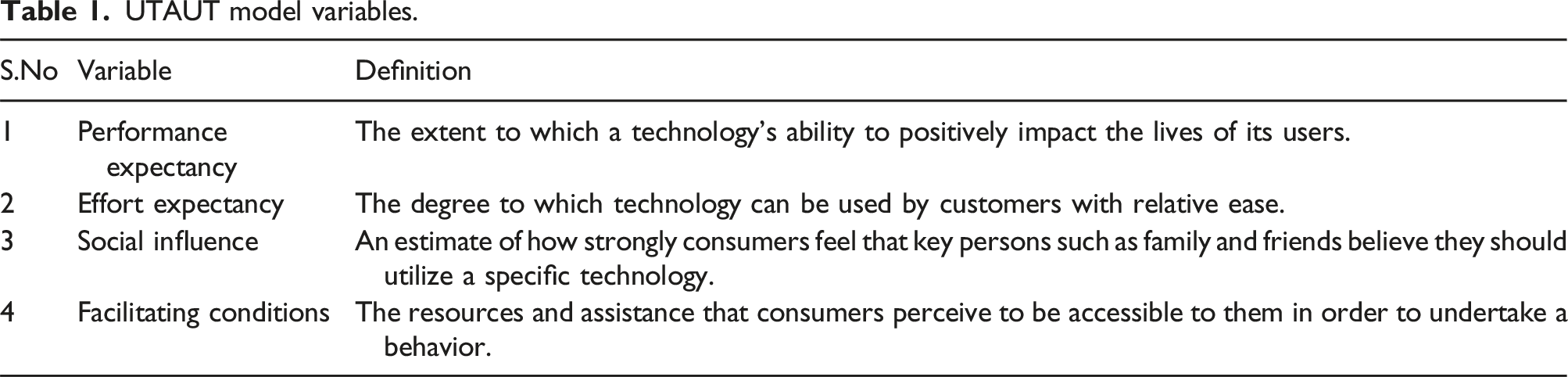
The UTAUT 2 model was employed in this research to examine the variables that influence online grocery buying; the UTAUT 2 method’s historical context is offered.
Users’ buy-in is essential to the effective rollout of any information technology. Recent years have seen the development of a number of conceptual models in the disciplines of psychology and information systems, all with the goal of explaining and forecasting the rate at which new technologies are adopted by end users. Davis defined behavioral intention as the actual use of a technology in 1989, stating that it is what determines technological acceptability (Davis, 1989). In the field of information technology and computer systems, the Technology Acceptance Model (TAM) is often cited as a prominent theoretical framework. The Technology Acceptance Model is a customer-attitude–based tool for assessing the uptake of new technology. This was during the early days of computer use in the office, and investigators were seeking for a means to forecast and explain system use for both suppliers and IT administrators. With perceived ease of use and perceived usefulness as the two primary aspects determining a person’s willingness to adopt new technology, the paradigm has been one of the most influential models of technology acceptance (Davis, 1989). Numerous diverse investigations have utilized the TAM as a foundational framework, either in its fundamental or extended version; yet, the model lacked coherence, necessitating the quest for a more cohesive model. Concurrently, different models of technological adoption emerged, which includes Theory of Reasoned Action (TRA), Diffusion of Innovation Theory (DIT),Theory of Planned Behavior (TPB), The Model of PC Utilization (MPCU), Social Cognitive Theory (SCT), Matching Person and Technology (MPT), Decomposed Theory of Planned Behavior (DTPB), Innovation Diffusion Theory (IDT), The Motivational Model (MM).
UTAUT model variables.
UTAUT 2 model variables.

The final word: Shifting dynamics and the road ahead
Customers’ primary expectations will be for simple, hassle-free shopping, a huge variety, and quick access to information throughout their ever-changing online purchase experience. Customers will continue to prefer and rely significantly on e-commerce and e-grocery to meet their everyday necessities as we return to our old normal and hectic lives. If consumers perceive that online grocery shopping would be straightforward, understandable, and simple to use, their behavioral intentions to use will increase, this is in line with previous studies conducted (Bauerová and Klepek, 2018; Shukla and Sharma, 2018).
COVID-19 has impacted lives and transactions. As a result of COVID’s quick expansion, many individuals choose to shop from home (www.ET Retail.com, n.d.). Notwithstanding the easing of laws, a recent research showed an increase in internet purchases due to the pandemic (Grashuis et al., 2020; Sharma and Jhamb, 2020; Yadav et al., 2021; Dinesh and MuniRaju, 2021). This may be attributed to the convenience of internet shopping. 80% of Indian customers now prefer purchasing through their smartphones, while 53% of people outside of the metro areas say the epidemic has influenced their shopping habits. Because of this trend, the internet is increasingly where consumers encounter a brand for the first time (Shinde, 2023).
One of the biggest challenges in e-grocery is when starting an e-commerce company is that the grocery market seems saturated with bigger players. It’s indisputable that well-established supermarket chains and CPG firms have a substantial resource edge over their upstart rivals. Consumers crave variety and diversity in nourishment, regardless of the competition. With the advancement of e-commerce, there is always room for innovation, with the potential to reach global heights.
The majority of consumers will continue to augment conventional grocery shopping with e-commerce. Adapting to developing technologies, studying consumer patterns, and collaborating with local businesses to earn customer confidence will thus fuel the expansion of e-grocery in the foreseeable future “pragati har disha mein.”
Discussion questions
1. Why has e-commerce, particularly e-grocery, gained traction? 2. Describe how the technology acceptance model UTAUT and its version are effective tools for gaining an understanding of technology adoptions. 3. How has the purchase of e-groceries affected conventional marketers in the present and how might it be in the years ahead?
Tasks for students
Please get acquainted with the theoretical principles. The case is amenable to three 15–25 min sessions of discussion and analysis.
Footnotes
Declaration of conflicting interests
The author(s) declared no potential conflicts of interest with respect to the research, authorship, and/or publication of this article.
Funding
The author(s) received no financial support for the research, authorship, and/or publication of this article.
