



Abstract
We present an analysis of terrorist propaganda using Al-Qaeda (AQ) between 1998 and 2008 as a case study using semiotic and propaganda analytic approaches. Our findings suggest AQ position themselves using a variety of propaganda techniques, especially on the notion of a global conspiracy, an existential threat, against Islam. Their key contribution to the evolution of conflict has been to emancipate the political marketing/public relations component and, thus, to redefine the essence of conflict. AQ design sophisticated propaganda, use segmented message design and have improved their production values over time. They have also crudely attempted to influence Western European and US elections. The authors conclude that AQ’s positioning strategy is based on framing a death-centred militant worldview as its precise opposite, a pious life of struggle with rewards in the afterlife. This article makes descriptive and methodological contributions to the interdisciplinary literature on propaganda. It makes a contribution by explaining how AQ’s positioning strategy evolved between 1998 and 2008, an analysis which will be of particular interest to those who seek to understand the wider societal applications of terrorist use of propaganda and who seek to counter its effects. It makes a further methodological contribution by providing an integrated method by which to evaluate propaganda, using a combination of semiotic, content and propaganda analysis approaches.
By the skilful and sustained use of propaganda, one can make a people see even heaven as hell or an extremely wretched life as paradise.
Introduction
From 1998 until 2008, Al-Qaeda (AQ) central (not including its regional and affiliated groups) is thought to be responsible for killing 3625 people and injuring more than 5000 (START, 2012). The 9/11 bombings of the United States were specifically designed by AQ leadership to exemplify propaganda of the deed (Bolt, 2011; Bolt et al., 2008). The acts, undertaken simultaneously causing mass casualties and maximum hysteria, ‘spoke for themselves’. The idea, therefore, that terrorists seek to communicate and persuade through shocking acts of terrorism is widely accepted (see McClennon, 1988; Richards, 2004; Richardson, 2006). For Wilkinson and Barclay (2011), terrorist groups communicate in three ‘languages’, including (1) the act of violence itself (propaganda of the deed), (2) the narrative they supply as justification for the attack and (3) the messages describing the way the organisation intends to achieve its goals. In this article, we seek to evaluate the second and third of these ‘languages’, evaluating how AQ developed their narrative over time to justify their terrorist attacks. There have always been fashions in terrorist symbolism, from the anarchist’s bomb of the 19th century to hijacking in the 1970s and 1980s (e.g. the Achille Lauro). But AQ is qualitatively different, going far beyond the propaganda of the deed, to amplifying that deed through films, blazing symbols and computer-generated graphics. What AQ managed to do, which no other terrorist group previously had managed to do, was leveraging the power of the Internet to build a global following.
Over the last decade, we have witnessed terrorist bombings and terrorist spree killings globally (e.g. New York, Madrid, Bali, London, Mumbai, Islamabad) often later accompanied by, and sometimes preceded by, the use of propaganda, designed specifically to enhance the feeling of terror in target audiences and to recruit new supporters to their cause. AQ propaganda frequently exhorts would-be supporters to undertake martyrdom operations (i.e. to kill themselves and others in suicide bombings) in return for a feeling of Muslim piety and heavenly reward. To take Hitler’s words from the opening quote from Mein Kampf, AQ truly understands the power of propaganda: to seek to make an extremely wretched life offer the hope of paradise. However, a key question arises: how is this possible and how are target audiences induced to perceive this way?
Most governments, including those in the Middle East, are extremely concerned that propaganda, particularly from radical Islamist groups, has an important role in the radicalisation of their own Muslim populations and have launched major counter-radicalisation initiatives accordingly (International Centre for the Study of Radicalisation and Political Violence (ICSR), 2010). Radical Islamist groups, particularly AQ and its various regional franchises (Islamic Maghreb, Arabian Peninsula, Iraq) seek to recruit supporters by developing and projecting the idea of a battle of civilisations (Dar al-Islam versus Dar al-Harb), particularly via the Internet (Salama and Bergoch, 2009). We refer to ‘franchises’ because it is a more accurate descriptor than ‘zone’ of the reality of AQ practice, where affiliated groups borrow AQ branding and ideology but operationalise these locally within their own cultural setting. Baines et al. (2010) argued that Islamist propagandists use political marketing methods to promote their ideological causes, partly by appearing to offer an exciting life, particularly to bored young men, in search of meaning and adventure.
In this article, we seek to illustrate how propaganda analysis techniques can be used to evaluate how terrorist groups seek to position themselves and the messaging content and style associated with their persuasion strategies, using AQ as a case in point between the years of 1998 and 2008. This article, therefore, seeks to define a new sub-genre of research, namely, the study of the positioning of terrorist groups. In so doing, we also seek to resurrect the previously strongly researched, but abandoned, topic of propaganda analysis (see Lee, 1986; Schick, 1985; Smith, 1941).
Propaganda, psychological operations and marketing
In (political) marketing, the process of biasing a target audience’s perceptions is termed positioning. Positioning in political marketing is the creation of coherent and consistent images and messaging designed to appeal to target audiences to encourage their participation despite adversaries’ attempts to undermine those messages/images (see Baines et al., 1999). The concept of political positioning (particularly how groups seek to frame messages rather what impressions end up in the minds of target audiences), we posit, is a useful concept to understand terrorist narratives. Nevertheless, there remains a limited understanding of political positioning (Smith, 2005) and an even more limited understanding of how terrorist groups position themselves. There are, however, tentative steps being taken: Edward Bernays, the father of public relations, wrote a far-sighted article on how America should use marketing and public relations techniques to position US democracy against Fascism and Nazism over 70 years ago (Bernays, 1942). A RAND Corporation study in 2007 (Helmus et al., 2007) illustrates the direct application of marketing in the military and counter-terrorism setting in the subtitling of its study, The Marketing Approach To Earning Popular Support in Theatres of Operation, as did a conference held at Wilton Park, the UK Foreign and Commonwealth Office’s conference centre, in March 2008 titled ‘Al Qaeda: Challenging the brand’ (The Stationery Office (TSO), 2008). Various other authors have also advanced the notion that terrorists use narratives to persuade their target audiences in order to recruit supporters and shape perceptions (for example, see Forrest, 2009; Neumann, 2008; Stout et al., 2008). Given this context, a deeper understanding of the power and potential of propaganda is required more than ever.
In this article, the term positioning is used from the perspective of how a concept is communicated for advertising purposes (intended positioning) and how it becomes represented in the minds of members of the target audience (actual positioning) (see also Ries and Trout, 1972, 2006). For a detailed discussion of the distinction between intended and actual positioning, see Baines et al. (2014). In public relations, related concepts include agenda-setting, priming and framing (see Iyengar and Simon, 1993 for a study of public opinion in a military context). Framing is a particularly relevant concept here. Hallahan (1999) defines framing as a ‘potentially useful paradigm for examining the strategic creation of public relations messages and audience responses’ (p. 205), explaining that framing works by biasing our perceptions so that we cognitively process a message according to the communicator’s interpretation. He usefully divides framing into seven types, including the framing of issues, choices, responsibilities, attributes, news, actions and situations. Because of the nature of propaganda and its call to action, we would expect AQ’s communications to frame choices, responsibilities and actions in particular and issues in general.
It is important to study propaganda today because, despite its use over millennia, it remains poorly defined and ill understood. Various definitions exist but its principal aims are ‘To provoke action … to make the individual cling irrationally to a process of action. It is no longer to lead to a choice, but to loosen the reflexes … to arouse an active and mythical belief’ (Ellul, 1973: 25). A recent definition stresses the manipulative intent behind propaganda: regarding propaganda as ‘the deliberate and systematic attempt to shape perceptions, manipulate cognitions and direct behaviour to achieve a response that furthers the desired intent of the propagandist’ (Jowett and O’Donnell, 2012: 7). The military use of propaganda is referred to as psychological operations (particularly, but not exclusively, those used by Western agencies) and defined as follows: ‘Planned psychological activities designed to influence attitudes and behaviour affecting the achievement of political and military objectives’ (Ministry of Defence (MOD), 2002).
Propaganda has a potentially strong role to play in the radicalisation of target audiences given its traditional imperative to violence and dissent. At its most effective, it appears able to bring about profound attitudinal shifts in target populations (cf. German public opinion against the Jews after the rise of Hitler). Yet, such attitude changes typically go unnoticed by the subjects themselves. They are often unaware of the depth of their shift, and if they are, they regard their original attitudes as somehow wrong (see Festinger (1957) for a more detailed consideration of cognitive dissonance and Sykes and Matza (1957) on neutralisation). AQ’s production of propaganda is a bid to enhance its global support base (Hoffman, 2011). Propaganda has been used to inspire actions in loosely organised groups of supporters. Given its limited military capacity after the wars in Afghanistan and Iraq, there is a subjugation of military operations to propaganda although AQ is now resurgent militarily in North Africa, notably Mali and its offshoots in Somali and Yemen (McCants, 2011). Schleifer (2006) explains how Hezbollah similarly subjects military operations to propaganda considerations. In this way, a small band of fighters can achieve substantial effects against much larger adversaries. For example, Schleifer argues Hezbollah’s approach achieved the Israeli withdrawal from Southern Lebanon in 2000, partly because it managed to induce feelings of guilt in the Israeli population over civilian casualties.
Positioning (and countering) the AQ brand
Kimmage (2008) suggests most Jihadist material connecting AQ and associated movements to their audiences is provided through three media entities: al-Fajr Media Centre, the Global Islamic Media Front and as-Sahab Institute for Media Production. The three organisations clearly understand branding (Magnet, 2001). Until 2008, there was public recognition that the West was failing to provide an effective response to extremist propaganda (Dombey, 2008). For example, George W. Bush’s branding of the military operation to capture Bin Laden and the Taliban leader, Mullah Omar, a ‘crusade’ in a press conference created a propaganda own-goal (Taylor, 2003: 316), helping to cement AQ’s desired positioning of the West as aggressor against Muslims of all kinds. Nevertheless, after 2008, the West fully realised it was fighting an ideological battle against AQ. The problem was partly exacerbated because the United States reduced its public diplomacy capability after the Reagan Administration (Brown, 2002; Taylor, 2003), and a previous effort to improve public perceptions of the United States in Muslim countries (‘The Shared Values Initiative’) was perceived to, but may not have actually, backfired (see Fullerton and Kendrick, 2006; Kendrick and Fullerton, 2004).
One might ask the question, why has AQ devoted so much time and energy to their positioning campaign and how has it helped their effort? (Tatham, 2008). Part of the answer might lie in the fact that terrorists seek revenge, renown and reaction (Richardson, 2006). Therefore, AQ might well have focused on the use of propaganda because it provides a beguiling rationale for revenge (legitimising it by linking it to religious piety), builds renown through interpersonal and mass media networks (propaganda of the deed, violent imagery) and creates an impetus for action via moral outrage. Actions seemingly suggested by the propaganda could then take the form of either suicide bombings (and/or spree killings) by supporters or over-stretch by the enemy (e.g. by North Atlantic Treaty Organization (NATO) and individual country members) who might restrict civil liberties or perpetrate reprisals damaging to their cause. AQ’s Madrid bombings are a case in point: the Spanish prosecutor, Olga Sanchez, explained that they were inspired by AQ propaganda, ‘in a speech inspired by Bin Laden in 2003 in which he threatened prompt and severe actions against the countries that participated in the War in Iraq, including Spain and Britain’ (Burke, 2007: 269). This statement foreshadowing an attack thereby sought to legitimise future AQ terrorist actions when Spain failed to pull its troops out of Iraq. Its approach, of seeking to interfere in the political process of Western countries is in fact an aberrant form of political public relations. AQ’s attack, carried out just before the 2004 Spanish General Election, in March, led indirectly to the defeat of the incumbent government and the surprise election of the Socialist Party. The Socialist Party promptly pledged to withdraw their armed forces from Iraq (although it could be argued that they would have done this anyway). AQ’s influence strategy appeared to achieve its objective. The worry about AQ is that, as a proponent of cyberspace Jihad, it permanently mutates, seeking out fresh casus belli after the original ones such as Iraq and Afghanistan become defunct. After wreaking havoc, but ultimately failing, in Iraq and Afghanistan, AQ seeks out other failed or failing states from which to launch their military and propaganda campaigns.
AQ’s focus on the media campaign allows it to project a force far greater than it really is to recruit foot-soldiers and financial supporters. Kilcullen (2011) argues that AQ took long running disputes and blended them using the Internet so that its product looked like a global insurgency. The media campaign sustains both their insurgencies and terror campaigns. Consider the fact that AQ has no standing army; it must continually recruit, and to recruit, it must continually inspire what are often isolated individuals or galvanised local groups. We postulate that no one is born a terrorist; rather, a terrorist is – at least partly – created as a response to a process of persuasion. This, of course, may be in addition to other factors such as overexposure to trauma and reaction to suppression of human rights, for example. The media message, when received by would-be supporters, exploits or creates a personal crisis, then encourages subjects to internalise the movement’s religious or political doctrines, and then justifies violent action (Neumann, 2008: 43). A case in point is Roshonara Choudhry in the United Kingdom, who stabbed the British MP, Stephen Timms, for voting for the War in Iraq in the UK Parliament. Analysis of her computer indicated that she had no links with Islamist groups but had watched extensively propaganda disseminated by Anwar Al-Awlaki of AQ in the Arabian Peninsula (AQAP) (Dodd, 2010).
Jordán et al. (2005) argue that terrorists deliberately use emotion to change target audiences’ public and personal attitudes. The objective of AQ’s propaganda has been to establish Islamic regimes in Muslim states and the restoration of the Caliphate, to help to depose corrupt ‘apostate’ governments, to defeat ‘Crusaders and Jews’, to fight the oppression of Islam, and to mobilise the world to join the Jihad, which from AQ’s perspective is a war ‘in defence of their religion’ (Jordán et al., 2005: 34–38). Yet, AQ’s brand of Muslim theology is a death-centred ideology (Khosrokhavar, 2009). The question arises as to ‘why their warped vision is so attractive to so many?’ (Burke, 2007: 311). Part of the reason why AQ supporters might choose to believe in such a ‘twisted worldview’, from the Western perspective, is because according to Pyszczynski (2004), cultural worldviews help manage existential terror by providing a comforting concept of the world to help us understand death and mortality, giving us self-esteem and a sense of meaning in life. For Richardson (2006), religion facilitates terrorist recruitment by providing legitimacy and rewards in the afterlife, for those prepared to pay in this life. Would-be AQ supporters are made to feel that they belong to a special religious order that provides them with meaning in their lives. Given this considerable menace to societies in the East and West, it is important that we analyse how AQ has sought to persuade would-be supporters of the legitimacy of their mission. This is important as understanding the means by which they seek to persuade is central to winning the ideological battle and in rebutting AQ’s death-centred militant ideology (O’Shaughnessy and Baines, 2009).
Our central argument therefore is that the genre of propaganda analysis needs to be resurrected because societies in countries around the world are under attack by terrorist groups mounting sophisticated propaganda campaigns. While the main threat over the last 15 years has been AQ and militant Islamism in general, other ideologies (e.g. the fascist ideology of the far right) could also be used to incite people to violence in future. In the next section, we consider the process used to evaluate the methods used to assess AQ’s intended positioning approach.
Methodology
Research questions and process
Our review of the literature reveals that AQ faces an astonishing positioning challenge: to frame suicide bombings and other terrorist activities in the minds of would-be terrorists as the final act of the pious Muslim. The research, therefore, sought to investigate exactly how AQ attempted to achieve this by considering the following:
What symbolisations, themes and messages exist in AQ video clips?
How have these symbolisations, themes and messages changed over the period from 1998 to 2008?
The research project incorporated eight stages as follows:
A literature review, including academic reports and articles, newspaper stories, RAND and think-tank reports on AQ, was undertaken to identify how AQ communicates and the way this has changed over time.
Next, a judgmental sample of 37 audio-visual clips was selected from http://www.intelcenter.com and specifically those clips produced by as-Sahab Institute for Media Production. The clips selected were the unclassified clips IntelCenter makes available to public researchers rather than the classified material made available to government researchers. The researchers were also granted the permission of a UK government department to purchase the videos and undertake the analysis.
To be eligible for analysis, the clips had to satisfy several criteria as follows: They had to be from AQ or make significant mention of AQ in terms of policies, messages and/or key AQ personnel (e.g. Al-Zawahiri, Bin Laden, etc.). They had to have been originally distributed after August 1998, the date of the first US military strike against AQ in Sudan and Afghanistan. They had to have discernible propagandist production values, for example, Islamic polemic, incitement to violence, preaching of hatred. They had to be in English, Urdu or Arabic (and have English or Urdu subtitles). The spoken content had to be clearly audible and the visual content discernible. To understand the nature of evolutionary change in the design of the clips, they were divided into three distinct time phases as follows: Pre 9/11 (August 1998–August 2001) War begins in Afghanistan and Iraq (September 2001–June 2006) The Renaissance of AQ in Afghanistan (post July 2006)
An interpreter fluent in Urdu was used to translate Urdu-only clips into English and provide some guidance on symbolisations for those clips.
The researchers watched the pre-translated clips (with translations provided either originally by AQ or by IntelCenter) and the clips with Urdu translations.
The researchers viewed and reviewed the clips and completed an analysis for each of the 37 clips, comparing their categorisations for the propaganda and semiotic analyses in cases where there was a discrepancy and agreeing on final categorisations.
An analysis of the spoken and visual content of the clips using the qualitative software package, NVivo 8, was undertaken.
An integrated analysis was then produced from the spoken and written content and the propaganda and semiotic analyses.
The semiotic and propaganda analysis approaches
Semiotic analysis uses culture as the unit of analysis, to identify how people communicate based on the signs they use (Lawes, 2002). It is able to identify intended and unintended meanings. According to Floch (2001), semiotic systems occur where no conformity exists in a communication between what that communication expresses and what content it contains. As-Sahab AQ clips are semi-symbolic systems since there is some, but not total, conformity between expression and content. For this reason, expression and content are studied separately. As per Eco (1979), visual and linguistic dimensions of the clips are taken largely, but not exclusively, as constituting its expression while the interpreted meaning constitutes its content. Semiotic analysts refer to notions of denotation – what is described – and connotation – what that described means culturally or how it is interpreted. For example, Hall (1980), in his encoding/decoding model of communication, argues that audience deconstruction of a message (i.e. decoding) is undertaken either by assimilating the message as intended by the encoder, by negotiating its content and assimilating a moderated version, or by deconstructing it in opposition to what was intended. In marketing terms, this final decoded version, the symbols and associations existing in people’s minds as a result of the messaging, is referred to as ‘positioning’ (Ries and Trout, 1972) or to be more precise, actual positioning (Baines et al., 2014). One semiotic technique often used to identify intended positioning is deconstruction, where the researcher revisits what a communication attempts to convey, specifically looking for underlying ‘absences’ in the communication and breaking the text down into privileged themes by determining ‘binary opposites’ (Derrida, 1967). This is one of the forms of semiotic analysis we undertake in this study.
To complement our semiotic analysis, a propaganda analysis procedure was also undertaken. Propaganda analysis is an approach originally developed by the Institute for Propaganda Analysis in the United States in the late 1930s and 1940s to counter domestic propaganda from demagogues like Father Charles Coughlin and international propaganda from Nazi Germany and Stalinist Russia (see Lee, 1986). The Institute of Propaganda Analysis developed a number of publications designed to help study groups recognise and critically evaluate propagandist communication techniques (see Lee and Lee, 1939). The US army also characterises various propaganda techniques (see DoA, 1979). As a consequence, the researchers identified and agreed 16 different techniques commonly used in AQ video clips (see Key to Analysis matrix in Appendix 1). The AQ clips were viewed in order to ascertain which of these 16 techniques occurred and how the incidence of these techniques changed over time.
Findings
Sample analysis and comparison
The sample of 37 clips selected was compared with the first 97 AQ clips outlined in the IntelCenter catalogue. IntelCenter provided a content analysis of the first 97 clips in terms of whether or not they contained operational footage, training examples, statements, last wills/tributes of suicide bombers and media footage. This analysis provided a source of comparison to determine whether or not our sample corresponds with the population of videos available. The population of 97 videos stretches from pre 9 September 2001 until September 2007 (while our last sample clip was disseminated in January 2008). The average length for the videos was determined by rounding each video length to the nearest half minute (see Table 1).
Comparison of sample and population clips by content and length.
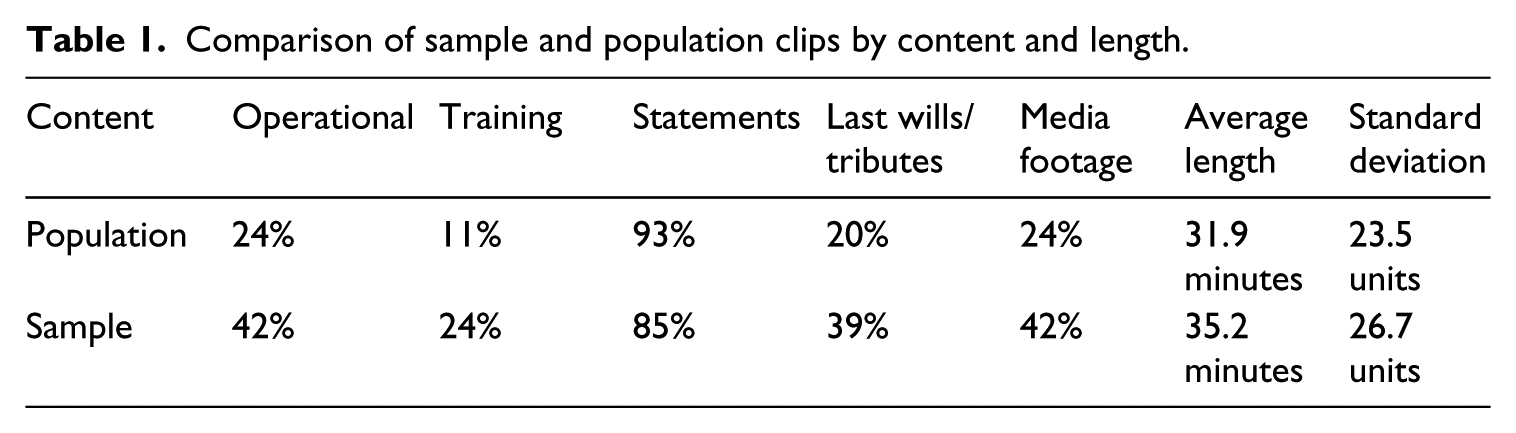
Table 1 indicates that the sample videos were slightly longer on average; were over-represented by those containing media footage, last wills/tributes, training footage and operational attacks; and slightly under-represented by those containing statements.
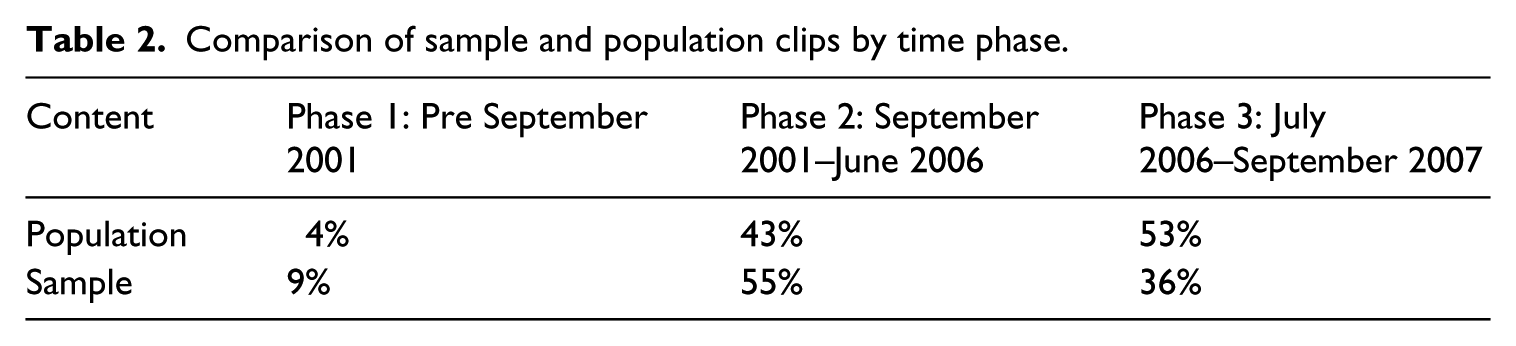
Table 2 indicates a further comparison of the sample versus the population videos based on the analysis period. Table 2 indicates that nearly one in every two video clips was from the period from July 2006, while our sample under-represented the later clips and over-represented those from Phase 2. There were actually relatively few AQ videos prior to 11 September 2001, but our sample over-represents videos from that phase. Overall, our sample includes videos from all three phases, containing all the forms of content identified in the IntelCenter content analysis. The total time length for the sample clips was nearly 24 hours, representing over 3 days of non-stop viewing. The authors analysed circa 10 and 14 hours of clips, with one focusing on analysing visual components and the other focusing on analysing written and visual components and comparing the results, respectively.
Comparison of sample and population clips by time phase.
Content and propaganda analysis
After 1998, AQ’s video production approach has become increasingly sophisticated, in terms of production values, symbolic/rhetorical argumentation and in its global reach. For example, AQ video clips are available in Arabic with English subtitles typically but some volumes also come with Urdu, Pashto and German subtitles depending on their target audiences.
Various propaganda techniques were identified to determine whether any of up to 16 forms were present in the videos (see Table 3 and Appendix 1 for full details of the AQ videos used and the propaganda techniques identified therein). Techniques such as character assassination, appeals to prejudice, the presentation of the world in black and white terms, the incorporation of half-truths, labelling and stereotyping remained dominant in AQ messaging up to 2008. AQ continued to justify their actions through association with, and claimed endorsement from, the Qur’an. Throughout, AQ released their messaging appeals either to commemorate specific attack events (mainly in Afghanistan) or to commemorate anniversaries of the 9/11 attacks. AQ’s later messaging material aimed to destabilise Pakistan, emphasising secular, rather than religious appeal. Much of AQ’s verbalisation is secular in content, exploiting Pakistanis’ foreboding about India and the concept of ‘strategic depth’ (i.e. Afghan-based) defence. AQ also targeted communications at Western electorates prior to elections in a bid to influence their results, for example, elections in the United States in 2004, Spain in 2004, Pakistan in 2007 and Germany in 2008.
Propaganda technique presence by proportion of total sample by time phase.

Table 3 indicates that over the period from 2001 to 2008, the videos were less hysterical, by making less use of constant repetition, appeals to frighten the audience by instilling fear or anxiety, the appeal to prejudice, use of the ‘big lie’ – the idea of the mythical global conspiracy against Islam – intentional vagueness, labelling (calling Westerners and Jews, ‘pigs’, ‘swine’ and ‘monkeys’, for example), stereotyping (against America, Israel and Britain) and the use of virtue words (e.g. use of epithets for Bin Laden such as the ‘Lion of Islam’, for example). The use of character assassination (e.g. attacking specific personalities), the appeal to prejudice, the black and white fallacy (e.g. use of extreme categorisations such as good and evil), half-truths, labelling and stereotyping all occurred in half of the clips in each case.
The pre-9/11 tapes were substantively different because they tended to be Bin Laden sermons with consideration/citation of Sura in the Qur’an, followed by a diatribe against America and a call for Muslims to act in Jihad; deliberately labelling Jihad as armed struggle, rather than the internal peaceful struggle to be a believer which is the conventional and orthodox application of the term (see Baines et al., 2010). Not all the tapes are for public consumption, some are self-referential and part of AQ’s internal dialogue. For example, they create a kind of cyberspace necropolis, celebrating dead warriors with footage of their lives, with sentimental, pseudo-mystical reminiscences from comrades. Such an approach seeks to position the afterlife as an attractive, sought-after place to be. The development of film techniques can be seen such as use of the split screen (cf. Andy Warhol) and later the use of computer-generated video graphics (e.g. to recreate the King’s Cross underground train explosion). There is an evolution from a loose rambling structure, with poorly sequenced film segments, to a tighter more coherent and integrated structure akin to the way party election broadcasts shifted in Britain from 10-minute rambling films to fast-paced 2½-minute sequences spliced into five 30-second political commercials from the 1996 British general election. There is a marked increase in the use of the ‘talking head’ used in political marketing spots and broadcasts during elections. These AQ clips are themselves released often just before elections, aimed over the heads of adversary leaders in an attempt to speak directly to foreign populations. This is a very significant evolution. Hence, there is a general tripartite structure to the tapes, ‘talking head’ sermons, ‘battle’ (attack) films and ‘martyr’ tapes (the rituals of martyrdom and then self-detonation). From 2006, the ‘talking head’ category inflates astonishingly from around 5 per year to about 30 from then onwards. There is an overt attempt to influence the domestic politics of individual NATO member countries, to drive a wedge between them.
Propaganda depicting or implying evidence of atrocities, of a very crude nature, is the core of early tapes from 1998 to 2003. Richardson (2006) portrays the terrorist not as amoral but as hysterically moral, carrying all of the accumulated burdens of his people and seeking to avenge them. It is what she calls the ‘dead babies’ scenario, and indeed a remarkable amount of the focus in early AQ material is on injured and dead children. This element is played down subsequently. The themes of AQ propaganda change according to political flux in the international scene. AQ is flexible and entrepreneurial, finding new enemies when old ones become defunct; Israel was never part of their original chronicle of infamy, but later became AQ’s public enemy number 1. For example, the war in Chechnya is substituted by the Gaza conflict, and after 2006, there is a new focus on the iniquity of the Pakistani regime and the inertia of Hamas. Whatever the latest international crisis involving Muslims, AQ mobilises it for its imagery, sometimes within days of the event. For example, Al-Zawahiri released a tape after the Pakistani earthquake, made the next day and released by Al Jazeera after only 15 days. Throughout the videos, the notion of a great conspiracy against Islam – ‘the big lie’ – is ever present, although somewhat less so post-2006. AQ charts its movement backward in time, despite the fact that AQ itself only emerged in the late 1980s. The cast of villains portrayed is not the same: the place of the Russians is subsumed by the Indians in videos aimed at destabilising Pakistan. The role of America is always central. A slight toning down of the rhetoric observable over the period of study is in evidence: from labelling Westerners and Jews as the harshly pejorative ‘swine’, ‘pigs’ and ‘monkeys’, the ‘Zionist-Crusader’ (and sometimes ‘Hindu-Zionist-Crusader’) alliance, to the less vicious ‘polytheists’. Target audience analysis would indicate that AQ tapes are aimed at a variety of audiences including the following:
Internal audiences – to rally ‘troop’ morale, external audiences (to recruit suicide bombers and sympathisers)
Enemy publics – to influence their political stance on foreign policy on Iraq/Afghanistan
Western political elites – to goad, to sap their morale and to force over-reaction
AQ video structure also changes over the period studied. Videos become shorter in length from 53 minutes on average in Phase 1 to the slightly more watchable 32 minutes in Phase 3. This shortening in time also parallels the shortening of the British documentary-type party election broadcasts of yesteryear (circa 20 minutes) to the 5-minute advertising-type ‘spots’ of today.
Semiotics: Binary thematics
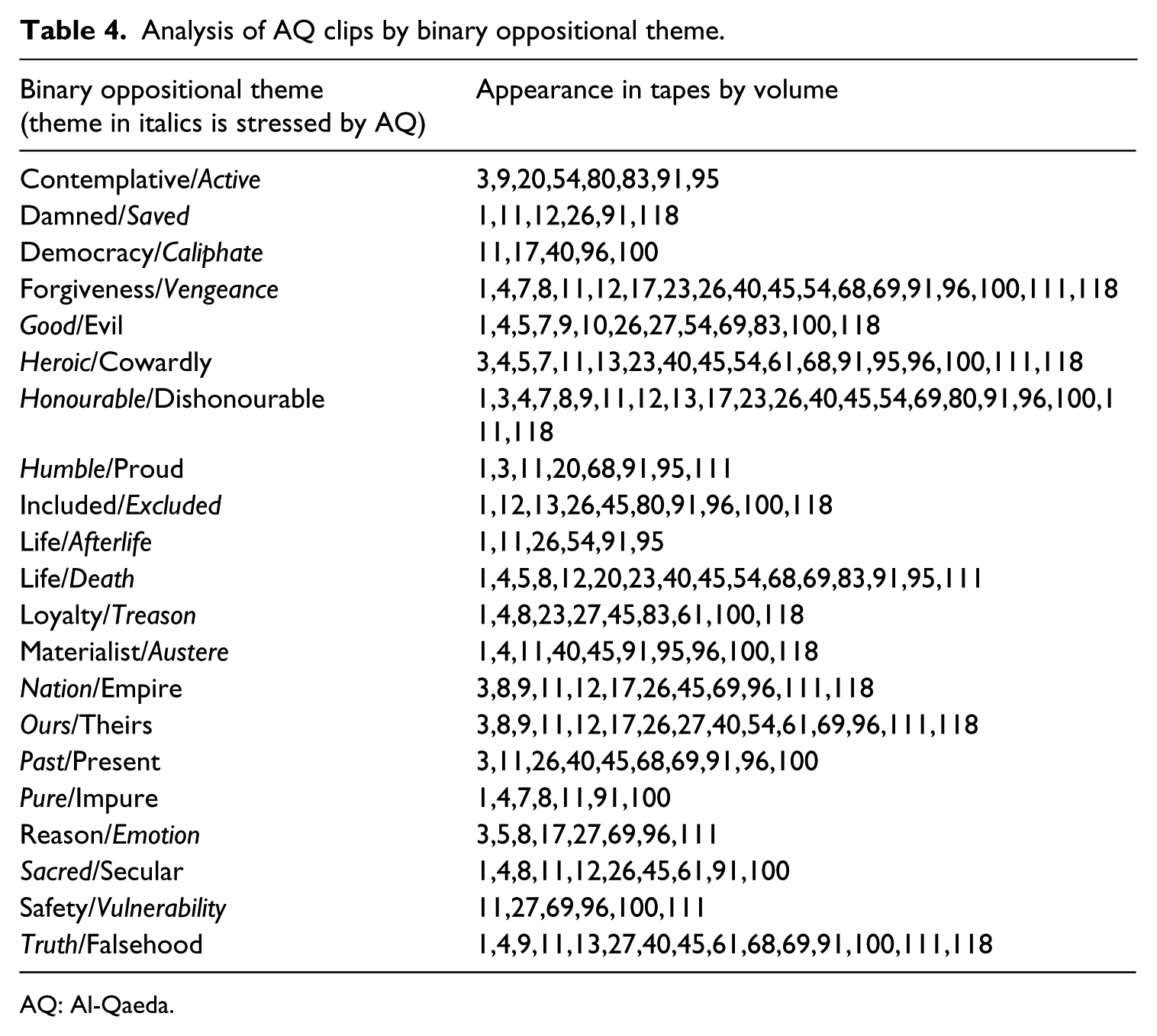
An analysis by binary oppositional theme indicates that AQ has a strong tendency to focus on particular messaging approaches (see Table 4). A common methodological approach in linguistic analysis is to identify not only what is said in a specific ‘text’ (namely, video) but what is not said. Suicide bombing is labelled as the saviour of Islamic piety. Democracy is actively attacked as un-Islamic in favour of a Caliphate. Suicide bombers are encouraged to be good, by seeking vengeance for the wrongs done unto Muslims around the world, and their exclusion from sharing Western world riches. Taking action in this way is proposed as heroic and humble (showing humility to Allah). AQ clips are noticeable in their referral to notions of life and afterlife. They propose that the Ulema 1 commit treason by denouncing AQ missives and directives. AQ frequently talks of Western and Arab governments as materialistic while stressing their own credentials of austerity. They also speak of the Umma (the nation of Muslims around the world) and of Western, particularly American, empire, but it is AQ that speaks of Caliphates in the Middle East, Spain, Africa and elsewhere.
Analysis of AQ clips by binary oppositional theme.
AQ: Al-Qaeda.
AQ continuously distorts history, for example, alleging that the Ottoman Empire was deliberately destroyed by the British out of Islamophobic malevolence. Their a-historical focus fails to consider theological advances made in the Middle East to reconcile Islam and democracy. Excluding Afghanistan under the Taliban, there has never been an Islamic state ruled by Sharia Law in the history of Islam. The AQ message is focused around the sacred: the purity, and sanctity, of their faith and belief in Allah. It stresses the need for an emotional response from its target audience and their spiritual superiority, thereby framing choices and actions, according to Hallahan (1999). The most coherent overarching theme in the clips is the framing of Muslims as victims of Western aggressions, designed to instil audience sympathy and trigger affiliation to AQ and aggressive reaction. A frequent co-message in this notion of the Western conspiracy against Islam is the idea that Muslims must awaken from their slumber and recognise their vulnerability, distinguish truth from falsehood, particularly that propounded by Western media.
Rhetoric, myth and symbolism
According to O’Shaughnessy (2004a, 2004b), propaganda is frequently structured through the trinity of myth, symbolism and rhetoric. Myth, symbolism and rhetoric constitute an imagistic grammar undergirding mere verbal exposition, not only in their own right but in terms of a product which is greater than the sum of its parts. Each of the three components interacts with others, myth-symbolism is represented by the emotive coded images, myth-rhetoric by the persuasive narrative of ‘the big lie’ and Symbolism-Rhetoric by argument through coded images (see Figure 1). We consider each of the three main elements separately below.
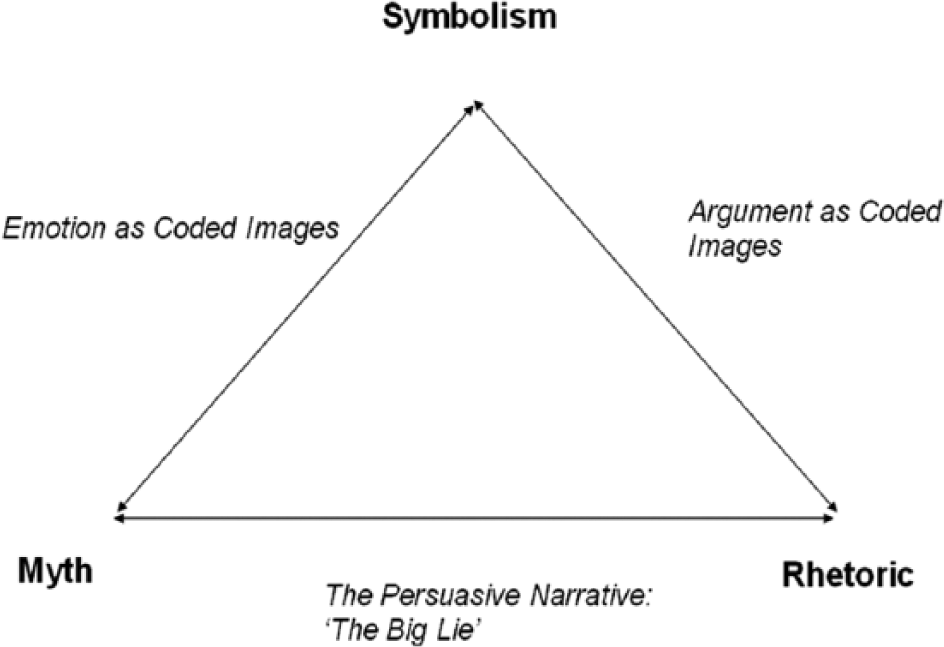
AQ Propaganda Trinity.
Trinity component 1: Rhetoric
People often accept packaged opinions and language can structure experiences. Rhetoric is important in all the AQ videos deconstructed. The rhetoric is frequently supported by testimonials, often taken completely out of context, from the Qur’an or the Hadith literature. In marketing terms, these authoritative references bestow the clips with source credibility (see Hovland et al., 1953). There is an explicit attempt to regenerate the kind of reverence given by many Muslims to the Qur’an, to the statements made by AQ – what is called associative transfer.
Part of the purpose of rhetoric is to create phrases which resonate because they express so concisely what we feel, or embody a burning image or metaphor. This is the key function of repetition. Repetition is recognised as especially effective in propaganda (see Ellul, 1973; Hitler, 1925 [2009]), in order to ensure ideas remain in the minds of the target audience. The rhetoric of AQ seeks this end, for example, by dehumanising references to ‘Zionists and Crusaders’ (and Hindus when the target audience is Pakistani). The bogeymen created here are Israel, the United States, the United Kingdom, ‘The West’ and India. Rhetoric is a weapon of thought-control, making formal persuasion less necessary. Part of the function of AQ’s rhetoric is to give vivid definition to fluid situations. In particular, Al-Zawahiri and Bin Laden – as AQ ideologues – frequently provide commentary on contemporary events, for example, Bin Laden denounces Bush and US foreign policy shortly before the 2004 American Presidential Election and, after the 2005 Pakistani earthquake, Al-Zawahiri releases a clip offering help to the Pakistani people and urging Islamic relief organisations to help in Kashmir. Frequently, the rhetoric involves half-truths or deliberately vague images or statements: for example, the recurrent images of Israeli soldiers beating or dragging Palestinian men and women (without offering any understanding of the context) or shaky attacks on purportedly American bases in Afghanistan. By magnifying these events, AQ makes them seem recurrent rather than episodic or even isolated events. Elements of non-verbal communication become critical to persuasive style and act as a frame for the verbal rhetoric. The AQ product can be perceived as an intensely visual and linguistic experience. The rhetoric is often deceitful with standard tricks such as taking unexceptionable passages from the Qur’an such as, for example, that Allah does not approve of unbelief, and surrounding it with incendiary language, so as to completely transform its meaning.
Trinity component 2: Myth
Myth is a core component of propaganda. ‘The big lie’ – the global conspiracy against Islam – is invoked by all the tapes. Another theme is the ubiquity and omnipotence of the United States and the notion that Israel is its puppet. AQ grossly exaggerates America’s power, either over Arab governments (as we saw in the Arab Spring) or over the government of Israel (e.g. when Israel defied Barack Obama’s request to stop building West Bank settlements). Another myth is the unity of all Muslims and the notion that Muslims do not fight each other, despite the obvious Shia–Sunni enmity which has existed for a millennium and more. The tapes perpetuate these falsehoods, that is to say, they suggest a monolithic global Islam fighting off a conspiracy by its enemies. This is a coherent integrating perspective, providing a universal explanation for all the political phenomena of a perplexing world. Mythmaking is a permanent activity, and deft propagandists construct new myths. One of these is the death of Muhammad al-Durrah. This is a centrepiece of AQ propaganda. Muhammad was a child killed while sheltering from Israeli soldiers and his death was captured on camera. Mohammad Siddique Khan (in Vol. 40), the leader of the London 7/7 cell, imitates Palestinian suicide bombers in the Intifada, and their formal ritualised farewell wherein the martyr-elect declaims his reasoning behind becoming a martyr and denounces the targets of his self-detonation. But the tapes also make reference to one myth that is very venerable indeed, that is, the tale of the fighting underdog. Victory for AQ is presented as a fait accompli, something pre-ordained by Allah, a propaganda approach called the ‘bandwagon’ technique (see Appendix 1).
The point about these myths, and propaganda, is not that they really ask for belief (although they should have some plausibility), but rather, they represent an invitation to share a fantasy, a hallucination of enmity, and this is a powerful drive to act (Walton, 1997). Solidarity is derived from the construction of mutual foes. AQ’s global conspiracy against Islam argument has seemed plausible given the conflicts in Bosnia and Kashmir, for example. Muslims have been the losers, but these are separate struggles with separate causations. The genius of AQ has been to elide them. AQ has successfully constructed the idea of an existential threat so profound that it seeks to destroy the religion itself. Through the construction of existential threats, one can persuade people to forget their humanity and suggest they are engaged in a final struggle for their very survival. There is, moreover, the attraction of the darkly powerful; AQ as a universal and dangerous force can attract young men keen for adventure, keen to identify with negative power. The alleged injustice against which AQ rails is, therefore, a convenient alibi for the deluded, the disillusioned and the daring.
Trinity component 3: Symbolism
The third component of propaganda is symbolism. Symbols condense meaning and allow visualisation of ideas. This is particularly relevant in the context of AQ’s videos: a symbol has a flexibility of meaning to which the viewer can bring his or her own imagination. In terrorism, the symbol is the terrorist deed and frequently the victims, and terrorists seek out victims rich in symbolic meaning. We analyse AQ’s symbolism in terms of aural, linguistic and visual symbols, next.
Aural symbolism
Because much of the singing on the videos was in Arabic, this component was not specifically analysed (and Western Muslim audiences might also not have understood it). Nevertheless, we can note a number of elements in the aural symbolism of the videos. In Vol. 10, there is frequent use of chanting as background music. There is some delight over the capture of an American SEAL team and their weapons. The mood and music is triumphant, and frequently euphoric. In Vol. 11, there is a distinction between message and tone. The tone appears wrong. Siddique Khan comes across as an arrogant, sneering bully who antagonises: the Afghan martyrs, on the other hand (particularly Hafiz Usman in Vol. 91), come across well by speaking in softer, more kindly tones. In Vol. 80, an armed band travels in daylight through stony, mountainous terrain in Afghanistan. There is emphasis on prayers before the attack, thereby establishing either moral superiority or humble piety. There is much singing in this clip, as in others (e.g. Vol. 54 with Mullah Dadullah). The point of the singing, perhaps like that of hymn singing in a Christian church, is to engender a sense of unity, solidarity and euphoria in praising Allah. The singing voice-over accompanies many of the tapes and is particularly noticeable in the attack tapes depicting AQ military operations.
Linguistic symbolism
There are continuous references to Knights and knighthood in the linguistic (and visual) elements of the AQ tapes. Such labelling elevates, even dignifies, martyrs and Mujahidin fighters, connecting them with their spiritual ancestors, the Arab Knights who fought against the Crusaders. This is illustrative of the way AQ reassembles tradition, bedecking its message with heritage elements to create an ostensible continuity and a resonance backwards. AQ seeks to redefine history, creating its own imaginary past. AQ synthesises for a global audience, sandblasting out local traditions and reducing a complex religion to a limited, essentialist framework. The curiosity of this is that AQ draws from a stock bank of mythological properties shared with the west. The concept of knighthood is one example, but there are many others. Importantly, the language of AQ is replete with testimonials from the Qur’an or the Hadith literatures, translated into its own, often harsh, interpretations to transfer the authority of Allah and the Prophet, to directives and statements made by AQ.
Visual symbolism
Visual symbolism is the heart of AQ propaganda: computer-generated images of the Qur’an as opening clips; sunlit mountain terrain on operational videos; the rifle in ‘talking head’ videos (e.g. when Al-Zawahiri or Bin Laden appear replete with rifle in the background); media footage of defenceless Muslims being bullied by Israeli or American soldiers; the image of Muhammad al-Durrah attacked by Israeli soldiers; the imagery of 9/11 as planes fly into the twin towers; and, in the two main British martyrdom videos (Volumes 11 and 40), the computer-generated imagery of an underground train being blown up at Kings Cross station are all examples. Some tapes refrain from showing 9/11 imagery, while others are festooned with it. AQ recognises that 9/11 is the most significant attack it has ever planned and the imagery of it is precious to them. Their conception of the afterlife, rendered in computer graphics, is Hollywood-esque kitsch (palm trees, beaches, etc.). The symbols of AQ are often as much Western as they are Eastern.
AQ amplifies its deeds, suicide bombing and vehicle bombing attacks by developing propaganda video around those events and distributing the images particularly on the Internet and through other channels, for example, Al Jazeera. They use attack events, particularly ‘spectaculars’, to give their propaganda resonance, and the propaganda justifies the act. To project a greater sense of potency, AQ attempts to shroud the event with a cloak of religious pre-ordainment, that is, it was Allah’s will. In this way, they attempt to persuade (potential) followers of their position. To amplify their events and propaganda, symbols of significance, religious and non-religious, are used. There is a clear attempt to instil in target audiences a hatred for Christians, labelling them as ‘infidels’, but also in one case using Christian targets in operational training (see Appendix 2, Exhibit 1). The World Trade Centre was attacked because of its resonance as a symbol of capitalism (called an ‘economic fortress’ in AQ Vol. 1). King’s Cross, according to the narrator of the video, was selected for attack because of its Christian connotations (see Vols 11 and 40 outlined in Appendix 2, Exhibit 2), although AQ might have claimed the attack only after it happened to appear omnipotent and for propaganda value.
Bin Laden played an intensely symbolic role, or rather he elaborated a series of roles, warrior, scholar, mullah, statesman. He was the charismatic in a dual leadership as compared with the dour Al-Zawahiri and appearing pseudo-mystical. The dramaturgy of his appearances was a significant source of his persuasive power and the tenacity of the movement he symbolised and led. But the greatest symbol is the suicide bomber himself, for this is the symbolic core of AQ imagery. The fact that suicide is expressly forbidden by the Qur’an has limited or no effect. In this sense, AQ comprises pure post-modernists, the Qur’an being interpreted and co-produced licentiously to fit AQ’s own purposes.
Limitations and criticism
Our analysis of the as-Sahab’s videos (clips from only one of three of AQ’s media production houses, provided by IntelCenter) provides an understanding of AQ intended positioning themes and messaging approaches. It is important to acknowledge that the semiotic analysis approach is subjective and that the (Western) researchers themselves, although aided by a Muslim interlocutor, bring their own worldviews to the analysis. This does not invalidate the analysis per se, but it does delimit it. Nevertheless, such reflexivity is common in qualitative approaches of this kind (Haynes, 2012).
Criticism of the persuasion perspective
One other potential criticism of our thesis is that this entire exercise represents an imagined AQ and not the real one. Such a perspective would view AQ as concerned exclusively with retribution, with inflicting outrage and embodying their hatred of the West in supreme acts of terror. The idea of persuasion would be very alien to them under this view, which would suggest that we are attributing to AQ motives which they do not possess. Under this view, the AQ is a two-dimensional organisation with no interest at all in persuasion, only punishment. We would argue that this view is reductivist of the terrorist. Other terror movements such as Front de Liberation Nationale (FLN) in Algeria during the war with France (1945–1962) have certainly thought formal communications essential to their task; the FLN ran a radio station, Radio Free Algiers. It could also be plausibly argued that AQ’s persuasion approach occurs post hoc, claiming in some cases their responsibility for attacks after the fact, purely for propaganda value, when in fact they have limited or no direct involvement. While this could indicate some element of duplicity in their approach, it does not necessarily dampen their persuasiveness. Further research is necessary to ascertain how different target audiences respond to such propaganda and its credibility.
A symbolic language
AQ, or indeed an organisation like the Irish Republican Army, for example, may well appear to conform prima facie to 19th century anarchist Mikhail Bakunin’s notion of terrorism as propaganda of the deed. The targets of terror organisations are freighted with symbolism and are forms of communication per se, not just expressions of hatred, for example, of the city commuters in Madrid, or the shopping mall in Kenya. There would be no point in just being ‘nasty’ for its own sake, vengeance gratified; the violence is perceived as instrumental, as a language of persuasion.
Who is the target?
It could be argued that AQ offers no differentiated message to no particular target audience or an undifferentiated target audience. In our view, this perspective is highly unlikely, not least because the clips reveal explicit messages for different audiences including requests for finance from those with wealth and for mothers to support their martyr sons. They seek potential sympathisers like military recruiting advertising in any community, offering action, adventure and comradeship. But the role of self-radicalisation is critical, and this is something which can only be achieved by persuasion and propaganda. Organisations and cells can be penetrated by Western security services, but the self-radicalised are more immune from state influence.
Speaking to themselves: Critique of the self-validation hypothesis
It could potentially also be argued that terrorists and other extreme groups are really only speaking to themselves via deeds and rhetoric which are self-gratificatory. However, such a self-validation hypothesis offers no explanatory richness (as to why terrorists become terrorists in the first place and the role media plays in their radicalisation). Many do see terrorists as merely visceral, and it is tempting to deny terrorists a mind or a rationale. Should one therefore, as we do here, credit them with any level of strategic competence or capacity for conceptual or abstract thinking? For example, suicide bombing itself results in the death of the bomber, and it is preceded by a filmed ritual, the reading of the ‘will’ and wearing of the bandana. It is not a mere self-referential expression of hatred; there is a utility in its communication. We can infer the motives of the organisation from the totality of its actions which is much more than just mere bombing. AQ puts great effort into the visual and rhetorical elaboration of their acts, and therefore, this must give us some insight into its essentialist nature as an organisation. There are limits to how many attacks AQ or its proxies can launch. Many have failed. When AQ does succeed, it therefore seeks to use the event more effectively through its cyberspace articulation in a deliberate attempt to increase its support. The idea of increasing the Umma – the worldwide nation of Muslims – is central to AQ theology.
Further research
Future research should determine whether or not there are any differences in positioning and symbolisation vis-a-vis other branches of AQ media, such as that of the al-Fajr Media Centre and the Global Islamic Media Front and by specific grouping, for example, AQ in the Islamic Maghreb or the Arabian Peninsula. For example, do differences exist in the styles and tones used or the target audience sought in each case, for example? The analysis presented here was based on a distinct time period up to January 2008. Further research should determine whether or not the content of more recent AQ videos is markedly different from previous periods and how specific media vehicles (e.g. YouTube, Facebook, specific Jihadi social networking sites and fora) for the dissemination of propaganda affect their uptake. It is important to analyse Jihadist microblogs (e.g. Twitter and various specific own-country variants), especially given that Al Shabaab (the Somali Islamist group with links to AQ) had until recently amassed 20,000 followers on its English language Twitter account (BBC, 2013).
Research should also be undertaken into the positioning of other dangerous groups, such as far right extremists, and other militant organisations (e.g. the United Kingdom’s Animal Liberation Front). The analytical approach presented here provides a template by which propaganda can be evaluated and identified. Our approach, developed for AQ, might not necessarily be appropriate for other societal menaces, and further research should be undertaken to ascertain its usefulness, therefore, in other spheres.
Conclusion
In this article, a semiotic, content and propaganda analysis of AQ video messaging from 1998 until 2008 was presented. It can be concluded that AQ seeks to position itself using a variety of propaganda techniques, based on the myth of the West as an aggressor of Muslims and that pious Muslims must fight Westerners by, among other acts, self-detonation. AQ has designed sophisticated propaganda to make death look attractive to would-be supporters, in effect, to convince them that the afterlife is more important than this life, partly by appropriating and transforming rhetoric from the Qur’an and Hadith literatures for their own persuasive ends. But the phenomenon of AQ is conceptual as well as methodological. They have understood, as few public pressure groups (let alone terrorist organisations) have ever understood, that the exalted core of the task is persuasion to multiple constituencies (including internal and external audiences and sub-groups within them), a persuasion achieved primarily by the generation of public imagery. The terrorist act itself is subordinate to the communications goal and exists primarily as a dramaturgic narrative device rather than an end in itself.
We hope that the template for analysis presented here (combining semiotic, content and propaganda analyses) will be of use as a first step in this regard, particularly in understanding how terrorists seek to frame and position their arguments in order to persuade potential followers. Our propaganda analysis framework makes a contribution to the literature by updating techniques developed in the 1930s at the Institute for Propaganda Analysis in the United States for the modern age. The semiotic analysis presented here illustrates the potential for developing a cultural understanding of narratives, regardless of the subject matter. Finally, the use of the propaganda trinity of myth, symbolism and rhetoric as an analytic tool serves to help us understand how propaganda can be as persuasive as it is. Consequently, the authors urge the public relations community to research terrorist, and indeed any other, propaganda to assess its effectiveness and identify counter-narratives. Although propaganda analysis as a technique was born in times long past, and has since fallen out of repute, propaganda analysis has unfortunately become as necessary a task today as it was then.
Footnotes
Appendix 2
Appendix 1.
Propaganda analysis matrix by technique used.
| No. | AQ Vol. | Al-Qaeda video title | Production date | A | B | CNP | D | E | F | G | H | I | J | K | L | M | O | Q | R | Note |
|---|---|---|---|---|---|---|---|---|---|---|---|---|---|---|---|---|---|---|---|---|
| 1 | 106 | Osama bin Laden: Eid al-Fitr Address 1999 | January 1999 | x | x | x | x | x | x | x | x | x | x | x | x | |||||
| 2 | 70 | Osama bin Laden Tarnak Farms Address and Last Wills of 9/11 Hijackers Ziad Jarrah and Mohammed Atta | January 2000 | x | x | x | x | No audio available | ||||||||||||
| 3 | 7 | The Destruction of the Destroyer USS Cole: Preparation & al-Jihad | Pre-9/11 | x | x | x | x | x | x | x | x | x | x | x | ||||||
| 4 | 8 | The Destruction of the Destroyer USS Cole: Umma, Cause, Migration | Pre-9/11 | x | x | x | x | x | x | x | x | x | x | x | x | x | x | |||
| 5 | 4 | Wills of the New York and Washington Battle Martyrs | April 2002 | x | x | x | x | x | x | x | x | x | x | x | x | x | ||||
| 6 | 1 | The Nineteen Martyrs | September 2002 | x | x | x | x | x | x | x | x | |||||||||
| 7 | 5 | Osama bin Laden: message to the Americans and Muslims in Iraq | August 2003 | x | x | x | x | x | x | x | x | x | x | x | x | x | x | x | ||
| 8 | 2 | American Hell in Afghanistan and Iraq | September 2003 | x | x | x | x | x | x | x | x | x | x | x | x | |||||
| 9 | 3 | Badr al-Riyadh | February 2004 | x | x | x | x | x | x | x | x | x | x | x | x | x | ||||
| 10 | 69 | Osama bin Laden 29 October 2004 Address to Americans | October 2004 | x | x | x | x | x | x | x | x | |||||||||
| 11 | 10 | War of the Oppressed: Part 2 | June 2005 | x | x | x | x | x | Arabic interview not included | |||||||||||
| 12 | 9 | War of the Oppressed: Part 1 | August 2005 | x | x | x | x | x | x | x | x | x | x | x | x | |||||
| 13 | 11 | London Claim – Mohammad Siddique Khan Martyrdom Video | September 2005 | x | x | x | x | x | x | x | x | x | x | x | x | x | x | x | ||
| 14 | 12 | Azzam Al Amriki Statement on 11 September 2005 | September 2005 | x | x | x | x | x | x | x | x | x | x | x | x | |||||
| 15 | 13 | Ayman Al-Zawahiri: Message to the Muslim Pakistani People After the Earthquake | October 2005 | No code identified | ||||||||||||||||
| 16 | 20 | American Incinerator in Khorasan Series: Set 1 | October 2005 | x | x | x | x | x | x | x | x | x | x | x | x | x | x | |||
| 17 | 17 | Ayman Al-Zawahiri: Letter to the Americans | January 2006 | x | x | x | x | x | x | x | x | x | x | x | ||||||
| 18 | 23 | Ayman Al-Zawahiri: Bajawr Massacre | February 2006 | x | x | x | x | x | ||||||||||||
| 19 | 26 | Osama bin Laden: Oh People of Islam | April 2006 | x | x | x | x | x | x | x | x | x | x | x | x | |||||
| 20 | 27 | Ayman Al-Zawahiri: A Letter to the People of Pakistan | April 2006 | x | x | x | x | x | x | x | x | x | x | x | x | |||||
| 21 | 51 | American Incinerator in Khorasan Series: Set 2 | April 2006 | x | x | x | ||||||||||||||
| 22 | 31 | Abu Yahya Al Libi on 17 June 2006 | June 2006 | x | x | x | x | x | x | x | x | x | x | x | x | x | x | x | ||
| 23 | 40 | Wills of the Knights of the London Raid (Part II) | July 2006 | x | x | x | x | x | x | x | x | x | x | x | x | |||||
| 24 | 68 | Holocaust of the Americans In the Land of Khorasan, The Islamic Emirate: Martyrdom Operation Against an American Convoy in the State of Baktika | July 2006 | x | x | x | x | |||||||||||||
| 25 | 45 | Knowledge is for Acting Upon: The Manhattan Raid | September 2006 | x | x | x | x | x | x | x | x | x | x | x | x | x | ||||
| 26 | 54 | Interview with Mujahid Commander Mullah Dadullah | December 2006 | x | x | x | x | x | x | x | x | |||||||||
| 27 | 61 | Holocaust of the Americans In the Land of Khorasan, The Islamic Emirate: Capture of an American Post, Arghandab | February 2007 | x | x | x | x | x | x | |||||||||||
| 28 | 63 | Holocaust of the Americans In the Land of Khorasan, The Islamic Emirate: Martyrdom Operation Against an American Convoy in Argon Area | February 2007 | No coding | ||||||||||||||||
| 29 | 80 | Holocaust of the Americans in the Land of Khorasan, The Islamic Emirate: Attack on an Apostate Base, Dabgay, Khost Province (English Subtitles) | June 2007 | x | x | |||||||||||||||
| 30 | 81 | Holocaust of the Americans in the Land of Khorasan, The Islamic Emirate: Firing of BM Rockets on a Base in Lwara, Hitting it Directly | June 2007 | x | x | Qur’anic singing not analysed | ||||||||||||||
| 31 | 83 | Holocaust of the Americans in the Land of Khorasan, The Islamic Emirate: Ambush of a Police Motorcade on the Kabul–Kandahar Highway in Zabul Province | June 2007 | x | x | x | x | x | x | x | ||||||||||
| 32 | 91 | The Will of the Martyr Hafiz Usman | August 2007 | x | x | x | x | x | x | x | x | x | x | x | x | x | x | x | x | |
| 33 | 95 | The Wind of Paradise, Part 1 | September 2007 | x | x | x | x | x | x | x | ||||||||||
| 34 | 96 | Osama bin Laden: The Solution | September 2007 | x | x | x | x | |||||||||||||
| 35 | 100 | Osama bin Laden: Come to Jihad | September 2007 | x | x | x | x | x | x | x | x | x | x | x | x | |||||
| 36 | 111 | Osama bin Laden: To the European Peoples | November 2007 | x | x | x | x | x | x | x | x | x | x | x | x | |||||
| 37 | 118 | Adam Gadahn: An Invitation to Reflection and Repentance | January 2008 | x | x | x | x | x | x | x | x | x | x | x | x | x | x |
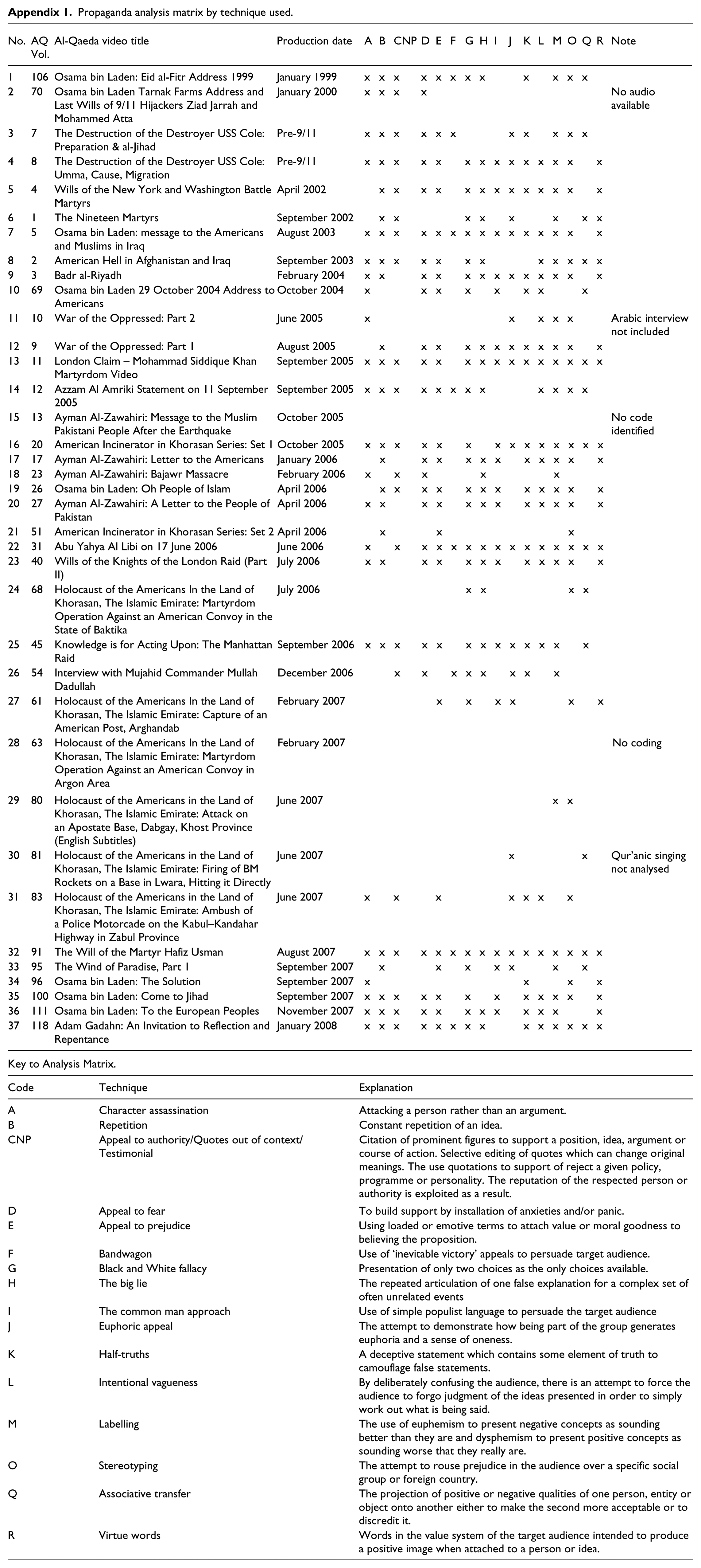
| Key to Analysis Matrix. | ||
|---|---|---|
| Code | Technique | Explanation |
| A | Character assassination | Attacking a person rather than an argument. |
| B | Repetition | Constant repetition of an idea. |
| CNP | Appeal to authority/Quotes out of context/Testimonial | Citation of prominent figures to support a position, idea, argument or course of action. Selective editing of quotes which can change original meanings. The use quotations to support of reject a given policy, programme or personality. The reputation of the respected person or authority is exploited as a result. |
| D | Appeal to fear | To build support by installation of anxieties and/or panic. |
| E | Appeal to prejudice | Using loaded or emotive terms to attach value or moral goodness to believing the proposition. |
| F | Bandwagon | Use of ‘inevitable victory’ appeals to persuade target audience. |
| G | Black and White fallacy | Presentation of only two choices as the only choices available. |
| H | The big lie | The repeated articulation of one false explanation for a complex set of often unrelated events |
| I | The common man approach | Use of simple populist language to persuade the target audience |
| J | Euphoric appeal | The attempt to demonstrate how being part of the group generates euphoria and a sense of oneness. |
| K | Half-truths | A deceptive statement which contains some element of truth to camouflage false statements. |
| L | Intentional vagueness | By deliberately confusing the audience, there is an attempt to force the audience to forgo judgment of the ideas presented in order to simply work out what is being said. |
| M | Labelling | The use of euphemism to present negative concepts as sounding better than they are and dysphemism to present positive concepts as sounding worse that they really are. |
| O | Stereotyping | The attempt to rouse prejudice in the audience over a specific social group or foreign country. |
| Q | Associative transfer | The projection of positive or negative qualities of one person, entity or object onto another either to make the second more acceptable or to discredit it. |
| R | Virtue words | Words in the value system of the target audience intended to produce a positive image when attached to a person or idea. |
Funding
This research received a grant from the UK government.