



Abstract
This conceptual article explores the role of international corporations as non-state actors in the process of public diplomacy as the global environment for diplomacy becomes increasingly multi-directional and networked. It provides an operational definition of the concept of corporate diplomacy and depicts potential contributions of the private sector, particularly the role of corporate social responsibility, in public diplomacy outcomes. The private sector has vast resources to contribute to public diplomacy, but corporations may be more willing to support, rather than to directly engage in public diplomacy in order to protect their economic self-interest. Key issues for research about the role of the private sector in public diplomacy are motives and intentionality of corporate efforts and strategic coordination between business and governments.
Introduction
Governments are still at the center of public diplomacy, but there is increasing support for the contention that non-state actors, including international corporations, can play a role and contribute to public diplomacy outcomes (Fitzpatrick, 2010; Goodman, 2006; Gregory, 2005; Reinhard, 2009; Wang, 2006b). The government-to-people model of public diplomacy does not accurately reflect the rapid changes in the global public sphere, nor the multi-lateral nature of 21st century diplomacy where governments are part of a network rather than always on top of a hierarchy (Hocking, 2004). The purpose of this article, therefore, is to explore the role of international corporations as non-state actors in the process and functions of public diplomacy to contribute to the critical debate about the role of non-state actors, and to offer suggestions for research to spur inquiry about how global corporate communication may contribute to the overall goals of public diplomacy. The article includes research about public diplomacy written by scholars from an array of countries. However, as Gilboa (2008) notes, much of the scholarly and professional literature about public diplomacy is based on the study, experiences, and observation of the United States and Western Europe. Nonetheless, this article reflects on the role of non-state actors from a perspective that could be used by different countries with different public diplomacy goals.
The article considers the rapidly changing nature of public diplomacy in an environment of globalized communication networks and political and commercial entities that transcend the borders of nation-states. It looks at the growing role of non-state actors, with particular focus on the corporate sector. Non-state actors in public diplomacy include a variety of organizations, from both the private and non-profit sectors, and much has been written about the role of transnational non-profit organizations and non-governmental organizations (NGOs) in public diplomacy, particularly in regard to global health and human rights issues. However, little research has looked at the role that private-sector corporations can play. This study, therefore, looks specifically at the corporate sector and considers the concept of corporate diplomacy, defined as the role of private-sector corporations as non-state actors in public diplomacy. While there is a smattering of articles about corporate diplomacy in the business literature, very little attention has been given to corporate diplomacy in public relations scholarship, despite the overlap in functions between corporate diplomacy and international public relations.
The conceptual convergences between public relations and public diplomacy are many. Both involve strategic, dialogic communication as well as relationship-building to create favorable environments for maintaining good will and achieving goals (Fitzpatrick, 2007, 2010; Fitzpatrick and Vanc, 2012; L’Etang, 2009; Signitzer, 2008; Signitzer and Coombs, 1992; Wang, 2006a; Yun and Toth, 2009; Zaharna, 2010). The contention of the current essay is that public relations scholarship may contribute more than theories for the study of public diplomacy; corporate communication and public relations, particularly activities that fall under corporate social responsibility (CSR), may be a part of the process of public diplomacy that contribute to the public diplomacy of a nations. The article goes beyond describing similarities in the theories and functions of public relations and public diplomacy, and moves toward exploring a role for public relations and corporate communications that increasingly may be an integral part of the process of public diplomacy as the nature of public diplomacy evolves.
It is recognized, however, that while the private sector has vast resources to contribute to public diplomacy, corporations exist first and foremost to make a profit and have nuanced relationships with governments. They may be more willing to support rather than to directly engage in public diplomacy in order to protect their economic self-interest. They also may have reasons to disassociate themselves from their home country for political purposes or in order to establish themselves as international entities with global brands. Key issues for research about the role of the private sector in public diplomacy are motives and intentionality of corporate efforts and strategic coordination between business and governments.
The changing environment of globalized public diplomacy
Melissen (2011) believes public diplomacy can only be understood if analyzed in the context of change. The profound effects of globalization and transnational horizontal communication networks, including social media, have transformed the nature of public diplomacy. The publics of public diplomacy messages often are not citizens of a particular country, but are global audiences composed of a variety of interest groups based on national origin, values, religion, and other ideologies that can transcend the boundaries of nation-states. Globalized technologies and institutions, including NGOs and international corporations, transcend geographic boundaries and diminish the power of individual nation-states (Schwab, 2008). Information that affects perceptions of different countries comes from a variety of sources, and receivers of the information do not necessarily discern differences among sources. Globalization has made the boundaries of diplomacy porous (Saner and Yiu, 2003) and has created a power shift in international relations with a greater interdependence between global business and international politics that has transformed the relationship between state and non-state actors in public diplomacy (Ban and Dutta, 2012; Muldoon, 2005). Often, sources outside government have more influence on policy and diplomatic activities than do governments (Snow, 2006). Governments no longer are the only actors in public diplomacy, and governments can no longer control messages.
The growing role of non-state actors in public diplomacy
According to Fitzpatrick (2010), Whether one believes that public diplomacy encompasses the actions of non-state entities or is an inherently government enterprise, the reality is that non-state actors have become more involved in efforts to influence foreign publics’ views of nation-states and therefore require the attention of public diplomacy professionals. (p. 198)
A growing number of definitions of public diplomacy acknowledge the role of non-state actors. Gregory (2008) defines public diplomacy as the ‘ways and means by which states, associations of states, and non-state actors understand cultures, attitudes, and behavior; build and manage relationships; and influence opinions and actions to advance their interests and values’ (p. 276). Scholars at the Center on Public Diplomacy at the University of Southern California believe public diplomacy includes not only government-sponsored cultural, educational, and informational programs, but also citizen exchanges, private media broadcasts, and corporate communications used to promote the national interest of a country by informing and influencing foreign audiences. It defines public diplomacy as a country’s efforts, through official and private individuals and institutions, to communicate with publics in other countries and societies (http://www.uscpublicdiplomacy.com). Multinational corporations hold economic power, media have power over public opinion, and interest groups hold power in policy implementation.
Corporations as non-state actors in public diplomacy
International corporations play a role in defining the reputation and image of their home country whether or not that role is intentional. There often are more business people in other countries than diplomats, and multinational corporations spend more money on communication than do many governments (Reinhard, 2009; Zaharna, 2010). Business people overseas from all countries constitute an important diplomatic contingency that can have a sizeable impact. Brands and products, CSR practices, and corporate communication in host countries affect how the country with which the international corporation is associated is perceived (Goodman, 2006; Lee et al., 2008; White, 2012). Corporations hold great symbolic power and have the resources to influence public opinion. They also seek to influence political decisions and to affect policy and media agendas in foreign countries, in consort with their own government, or independently. Hocking (2004) notes, for example, that Shell Oil has developed its own task-defined diplomatic structure in Nigeria that rivals diplomatic services of developed nations. However, while participation of international corporations in public diplomacy has been endorsed by government entities, non-profit organizations, political think tanks, and academics, there is no clear understanding about how it is, or should be, done.
There is no doubt the private sector has the potential to play a role in public diplomacy. Businesses have vast soft power resources, expertise in consumer research about international audiences, as well as global worldviews that can be advantageous to public diplomacy. Global problems require multi-lateral, global solutions that international companies can help provide (Hocking, 2004). A report from the US Council on Foreign Relations notes that in the United States the private sector is the leader in key strategic areas required for effective public diplomacy: technology, film and broadcast, marketing research, and communications, while the government lags behind (Peterson et al., 2003). In Switzerland and the United Kingdom, the corporate sector increasingly plays a role in public diplomacy through direct interactions with foreign governments (Lee, 2004; Saner and Yiu, 2005). Furthermore, in some political environments, government communication is often perceived as political propaganda while business is more credible and trusted than governments (Szondi, 2008).
Obviously, the private sector cannot be involved in all aspects of public diplomacy and governments will always be at the center. Nonetheless, public diplomacy is becoming a cooperative process, which can be described as a network of public and private actors using diplomatic channels and processes (Lee, 2004). The private sector has access to research, extensive networks and locals on the ground, the propensity to listen to markets and become indigenous, and the ability to be nimble and efficient (Reinhard, 2009). International corporations have enormous communication budgets, global impact, and sensitivity to intercultural communication, all of which could be of great value to governmental diplomacy.
Defining corporate diplomacy
Many of the global challenges confronting international business are issues and matters of diplomacy, and corporate survival depends on diplomatic negotiations with governments, global social movements, and other institutions (Muldoon, 2005). The term corporate diplomacy has been used previously in a number of contexts. In 1966 Christian Herter, then general manager of government relations for Socony Mobil Oil Company, noted that the increase in international business called for ‘corporate diplomacy’ between American and foreign corporations and between American corporations and foreign governments. He stated that ‘corporate and political diplomacy are virtually indistinguishable to build an enduring feeling of good will for the United States, its people, its economic system, its business organizations, its political institutions, and the validity of its culture’ (Herter, 1966: 409).
In business literature, the terms corporate diplomacy and business diplomacy have different or overlapping definitions. Steger (2003) contends that business diplomacy means to manage the business environment in such a way that ‘business is done smoothly’ (p. 6). De Vries (2014) defines business diplomacy as a function of business to communicate and negotiate internationally, between firms, and with the governments of their home countries. Amann et al. (2007) define corporate diplomacy as the attempt to manage the business environment systematically and professionally … that leads to mutual adaptation between corporations and society (p. 34), which is synonymous with the definitions of business diplomacy provided by Steger (2003) and De Vries (2014).
Asquer (2012) also defines corporate diplomacy in the same sense as business diplomacy, which is a corporate function to strategically manage relationships to achieve corporate objectives. Other scholars have extended the concept of business/corporate diplomacy to include communication and negotiation with foreign governments and publics since the globalized business environment means corporations have a greater need than ever to communicate with international stakeholders. Saner et al. (2000) define corporate diplomats as trouble shooters of multinational structures, as liaison persons in the various head offices, or as temporary managers for new ventures, who need the same skills as government diplomats (and who may indeed be former ambassadors). While the authors argue for training in diplomatic skills for the function of business diplomacy, they place the concept of business diplomacy, the purpose of which is to achieve business goals, apart from the public diplomacy function that benefits a nation-state.
The commonality among the definitions discussed above is they refer to corporations (non-state, corporate actors) behaving in a diplomatic manner, internally and with external constituents, in order to implement favorable conditions to achieve their business goals because corporations realize they cannot leave their international interests to government diplomats alone. Business diplomats manage relationships between global companies and multiple stakeholders, which might include NGO’s, other business, and governments. In this sense, the sole concern of business diplomacy is the welfare and interests of the corporation. Asquer (2012) contends, however, there is little evidence that companies acknowledge the peculiar role of business diplomacy. It is carried out through various activities and is rarely a well-defined function.
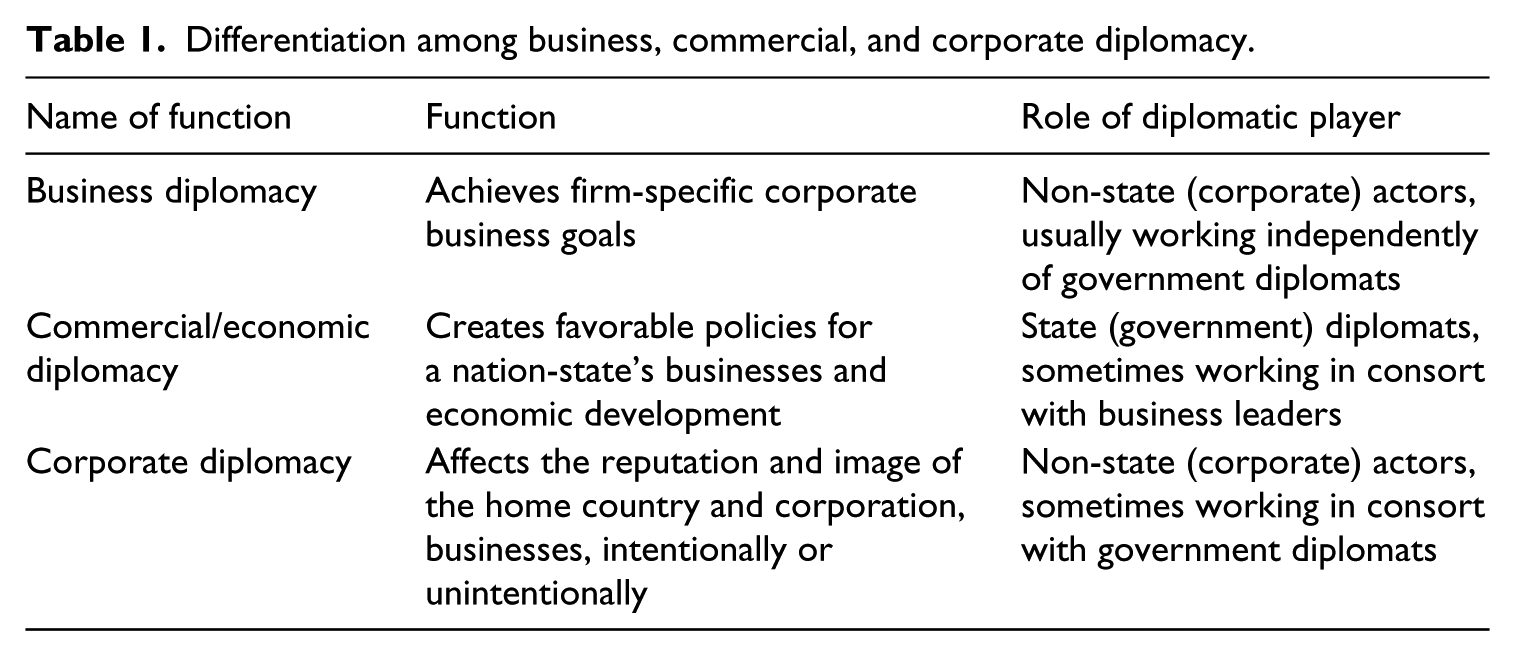
Saner and Yiu (2003) further differentiate the concept of business diplomacy from the concept of economic or commercial diplomacy. Economic diplomacy is concerned with governmental negotiations of economic policy and legal issues, and commercial diplomacy supports a country’s business and finance sectors with the objective of increasing a country’s commercial development, which includes investments and trade. Commercial and economic diplomacy are performed by state (government) actors for the overall benefit of the nation-state.
Ordeix-Rigo and Duarte (2009) define corporate diplomacy as the process to develop a corporation’s power and legitimacy within society, using public relations tools, equating the process to the public diplomacy goal of image management to global publics. The influence stemming from power and legitimacy would allow corporations to directly influence decision-making in diplomacy and to even take over some roles of the state. They argue that corporations engaged in corporate diplomacy should actively add new roles to the traditional role of the corporations, and noted the role that corporations could play in a government’s public diplomacy. According to Saner and Yiu (2003), corporate diplomacy includes influencing policy to achieve corporate goals while taking into account the needs of other stakeholders, working with rule-making international bodies, forestalling potential conflicts with governments, using international media to safeguard image and reputation of the corporation’s home country, sustaining credibility and legitimacy, and creating social capital through dialog with stakeholders who might be impacted by the process of economic development and globalization. This, of course, parallels the function of global public relations. L’Etang (1996) also articulated the intersection of public relations and corporate diplomacy and recognized the political role of public relations practitioners as organizational diplomats. However, she noted the fine line that corporations walk in order to protect their own interests.
While the terms corporate diplomacy and business diplomacy have been used somewhat interchangeably, this article differentiates the two concepts. Both are performed by non-state, corporate actors, but for different goals. Business diplomacy is for the sole purpose of achieving corporate business goals. Corporate diplomacy, on the other hand, can benefit both the corporation and its home country through promoting good will. Corporate diplomacy, in this sense, can be implemented by various means, including CSR programs, cultural diplomacy, and other strategically based initiatives, which may include intentional coordination of effort with governments. Thus, corporate diplomacy differs from business diplomacy (and commercial diplomacy) in that corporate diplomacy can have a purpose beyond increasing profits and serving the interests of business. Table 1 sorts the conceptualizations of business diplomacy, commercial/economic diplomacy, and corporate diplomacy.
Differentiation among business, commercial, and corporate diplomacy.
Conceptualizing corporate diplomacy
Corporate diplomacy, in this article, is operationally defined in the sense it was used by Ordeix-Rigo and Duarte (2009) and Herter (1966), which is to build good will for the business organization as well as for its home country through corporate citizenship and other activities that serve a role in public diplomacy. Corporate diplomacy, or the involvement of the corporate sector in public diplomacy, can occur when a corporation acts independently of its government, or in consort with government(s). There are a number of business activities that contribute to the process of public diplomacy that could be considered corporate diplomacy.
Figure 1 shows that both government and business contribute to foreign investment and seek to influence economic policy, as previous scholars have noted (Goodman, 2006; Hocking, 2004; Saner and Yiu, 2003; Wang, 2006b). Cultural diplomacy, another sub-set of public diplomacy, includes not only government-sponsored cultural exchanges, but also corporate-sponsored cultural activities and other non-governmental exchanges (Melissen, 2011; Zaharna, 2010), thus providing another avenue for private-sector involvement in public diplomacy that is a ‘tender-minded’ approach that can foster good will (L’Etang, 1996; Signitzer and Coombs, 1992). Popular culture, including music and games as well as news and entertainment, are produced and exported by the private sector and also greatly contribute to a country’s soft power, which plays a role in public diplomacy. Nation branding and its components (place and destination branding) are often activities of non-state, private-sector actors such as resort developers and chambers of commerce (Szondi, 2008; Wang, 2006b). Corporate brands, products, and exports also affect national reputation (Lee et al., 2008; White, 2012). Additionally, there is interaction between governance organizations and the private sector that includes public–private contracts as well as corporate actors in advisory roles and partnerships (Gregory, 2011).
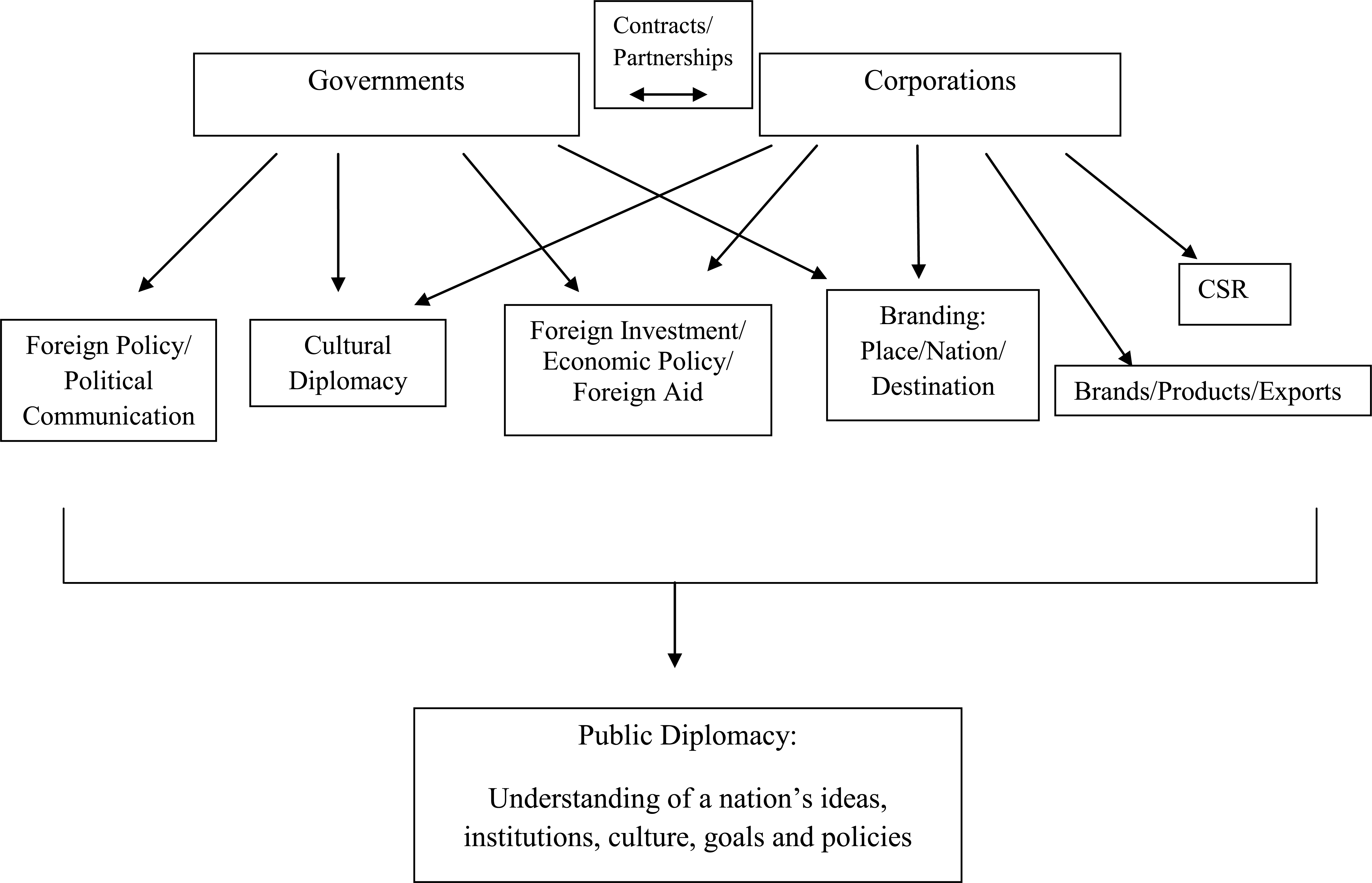
Corporate contributions to public diplomacy.
CSR activities can also affect the national reputation of the corporation’s home country, contribute to international understanding, and even affect public policy. CSR can have the effect of public diplomacy, whether or not that is its primary purpose; successful CSR can greatly contribute to a nation’s public diplomacy efforts, which may be especially valuable to small and developing countries. CSR activities are a form of cultural or ‘soft’ diplomacy as described by L’Etang (2009) and Signitzer (2008). The concept of soft power, developed by Joseph Nye, is the ability to influence other political entities through attraction based on the appeal of culture, values, and institutions, rather than through coercion or payments (Nye, 2004). The role of soft power in public diplomacy is to shape the environment for policy acceptance, and the dimensions of soft power include trust and community and relationship-building, which are also critical components of CSR. Muldoon (2005) notes the soft power of the private sector in the world economy and world politics has clearly expanded (p. 342). The globalization of economies has increased the power of international corporations, and power and political influence comes with an increased obligation for social responsibility.
CSR includes such things as corporate governance, workplace standards, environmental sustainability, corporate philanthropy, and corporate citizenship (Blowfield and Frynas, 2005; Dalsrud, 2006), all of which require international negotiation. Garriga and Melé (2004) categorize four theoretical approaches to the study of CSR: instrumental theories of CSR based on profits and economic results, ethical theories based on the values of corporations and their responsibility to society, integrative theories that posit that businesses act in response to social demands, and political theories that recognize the power of corporations in society and the responsible use of power in the political arena. Scherer and Palazzo (2007) position CSR at the interface of management and political theory, noting that corporations, through socially responsible actions, can play a role in regulating global issues.
Political theories of CSR include the concept of corporate citizenship, which as a component of socially responsible behavior implies that businesses are citizens in the communities in which they operate, and like individual citizens, have a responsibility to be politically involved. Schwab (2008) describes global corporate citizenship as the conviction that companies not only must be engaged with their stakeholders, but are themselves stakeholders alongside governments and civil society. A global perspective of public relations places the process in a transnational public sphere in which international corporations seek legitimacy through responsible corporate citizenship. The most effective way to achieve stature on corporate citizenship is for companies to proactively link their initiatives that demonstrate CSR. While businesses will always conduct their own diplomacy outside governments, the willingness to cooperate with governments is a component of corporate citizenship.
Figure 2 depicts the intersection between government public diplomacy and corporate activities that contribute to public diplomacy, which includes intentional cooperation between state and non-state actors in such things as business diplomacy, corporate diplomacy, partnerships and contracts, as well as CSR activities that may not be intentional contributions to public diplomacy but that have positive effects for a company’s home country. Corporations also hold soft power that contributes to nation branding and to building the reputation of the corporation’s home country. Many activities in the intersection could be considered components of corporate citizenship that impact public diplomacy outcomes. Gregory (2011) notes, however, the need for some sort of analytical line between public diplomacy and corporate efforts that carry the effect of public diplomacy.
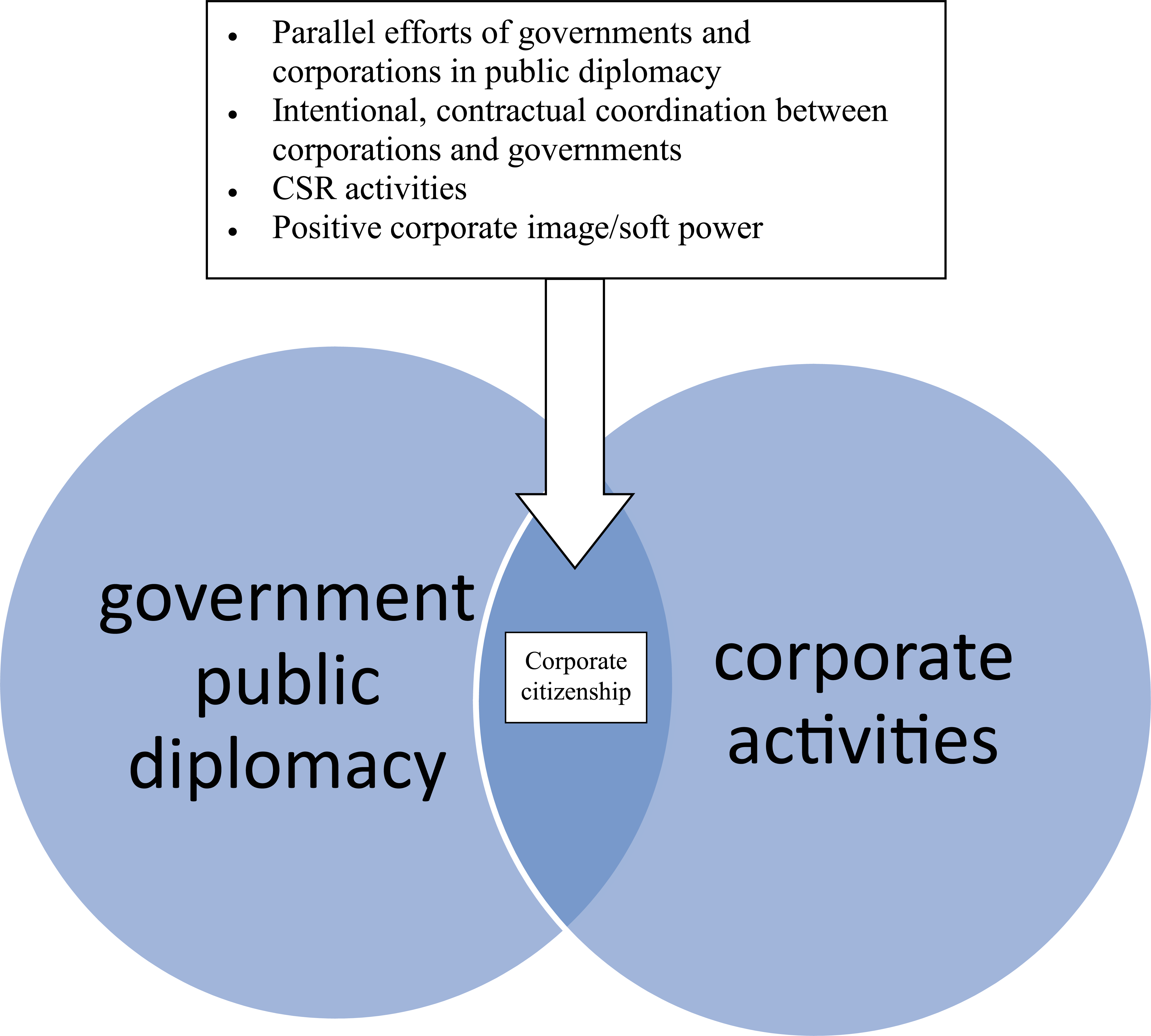
Corporate citizenship: Overlap of corporate and government activities that contribute to public diplomacy.
While all of the components of private-sector involvement depicted in the figures and described above contribute to a nation’s public diplomacy, it should be noted that private-sector involvement in public diplomacy is not the same as privatizing public diplomacy. Privatization implies outsourcing the implementation of governments’ public diplomacy initiatives to private entities. Hocking (2004) explains that the reality of private-sector involvement lies somewhere on the continuum between outsourcing and government control of public diplomacy. He notes that the diplomatic milieu is inhabited by a growing diversity of actors including activist groups, NGOs, and business interests, which compose a complex web of international interactions. State functions can be shared with non-state actors to manage complex issues in partnership.
Key issues: Intentionality and strategic coordination
As scholars study the role of the private sector in public diplomacy, key concepts to examine are the intentionality of corporate efforts in public diplomacy and strategic coordination of efforts between governments and non-state actors, research about which will have practical value as well as open new avenues of inquiry that can contribute to theoretical development. Intentional involvement of the private sector in public diplomacy includes strategic and direct involvement with government entities for the purpose of affecting policy, and includes private/public sector partnerships. Unintentional activities, which indeed affect perceptions of the home country of the corporation, include activities such as practices related to CSR that may have the effect and impact of public diplomacy, but that are not carried out primarily for diplomatic purposes. Political leaders and many foreign policy experts are in agreement that governments must find ways to benefit more fully and strategically from the talents and imagination of the private sector. However, in most countries, there is no implementation plan or road map for putting recommendations for changes in public diplomacy into effect (Gregory, 2005). The concepts of intentionality and strategic coordination are discussed more fully in the following sections.
Intentional corporate involvement in public diplomacy
The private sector is and can be involved in public diplomacy through specific actions that are intended to serve diplomatic purposes. In a personal interview, Bruce Gregory 1 cited examples of intentional private-sector involvement in public diplomacy, such as US corporations generating philanthropic organizations such as the Carnegie Endowment and Ford and Rockefeller Foundations that were created for cultural exchanges. The private sector also contributes technological advancements such as sponsored private broadcasts and social media platforms that led to government involvement and become part of diplomacy (Gregory, 21 October 2011, personal interview).
Other ways the private sector is intentionally involved in public diplomacy is through partnerships and contracts with government agencies, such as private-sector research companies conducting public opinion polling and research for the public sector. Corporate leaders play an advisory role in diplomacy on commissions and boards for government and governance organizations such as the presidentially appointed US Advisory Commission on Public Diplomacy (Gregory, 21 October 2011, personal interview). In the United Kingdom, business interests have been formally integrated into diplomatic structures, particularly for the function of commercial diplomacy (Lee, 2004).
Corporations in different countries often become intentionally involved in diplomacy episodically for specific projects. For example, in March 2011, three Estonian companies opened a Skype station in Tallinn Airport as a reminder that Skype originated in their nation (Landler, 2005). Swiss multinational corporations have entered into direct negotiation with the European Union and other countries to benefit the economy of Switzerland (Saner and Yiu, 2005). In the United States, there is a history of government officials inviting chief executive officers (CEOs) to play a role in diplomatic endeavors, such inviting CEOs to fly to Pakistan to help with earthquake relief. However, Gregory (21 October 2011, personal interview) notes the role self-interest plays for the corporation in such endeavors: Corporate actors are quite interested in doing this if it is project-oriented and a high profile issue that is good for the image of the corporation as well as good for the company. They are happy to do it for the country, but they also see that it is quite good for the corporation, or they wouldn’t be doing it.
Barriers to intentional corporate involvement in public diplomacy
While many business and government leaders have called for international corporations to make diplomacy an intentional component of their business strategy, there are challenges to this call. Efforts to encourage intentional, on-going (rather than episodic) involvement in public diplomacy have had only moderate success. In 2002, Keith Reinhard, chairman emeritus of DDB Worldwide, founded Business for Diplomatic Action (BDA) 2 in response to growing anti-American sentiments worldwide that he believed could have a negative effect on business and the economy of the United States. His aim was not only to improve the global business environment for American companies, but also to encourage the private sector to use resources intentionally to help improve the international reputation of the United States. Although BDA was successful in garnering support from a number of large, international corporations, Reinhard found that many of them wanted to be indirectly, rather than directly, involved in public diplomacy. US corporations were willing to contribute to the efforts of BDA, but did not want to be aligned with any government bureau (Reinhard, 19 October 2011, personal interview).
Although corporations in every country have resources and expertise valuable to public diplomacy, it may be that ‘in their pursuit of commercial interests, corporations naturally shy away from engaging in discourses and activities deemed political and do their utmost to maintain their neutral status’ (Wang, 2006b: 45). Businesses, first and foremost, operate to make a profit, but also may have other reasons to disassociate themselves with the government or political actions of a particular country. In countries transitioning from communism to democracy, there may be a desire for companies operating in the global free market economy to distance themselves from previously authoritarian governments (Szondi, 2008). For some international corporations based in the United States, the existence of anti-American sentiments throughout the world has caused them to distance themselves from the US government. Furthermore, international corporations often want to position themselves as global institutions and international brands. They often seek to establish a transnational identity by developing different brands for different countries, and maintaining an array of corporate websites in different languages in an attempt to make their products and CSR activities seem indigenous to their markets. They are far more concerned with their corporate identity than their national identity. Therefore, as an intentional activity, corporations may be more willing to support, rather than to directly engage in, public diplomacy in order to protect their profit-driven self-interests.
Unintentional involvement in public diplomacy
BDA identified many positive activities of US companies, which no doubt increased positive sentiments toward the United States overseas, but were not done solely for that purpose. Examples are Chevron’s efforts to provide health care for the communities in which it operates, and IBM’s Corporate Service Corp through which IBM executives use their expertise to solve social problems throughout the world. White et al. (2011) found evidence that CSR activities of US companies contribute to the diplomatic process by positively affecting the image and reputation of the United States. Some CSR activities of US companies in Romania were conducted in direct cooperation with the Romanian government, but without formal coordination with the US government. Examples include companies’ direct involvement in national health issues, and ALCOA’s assistance to the Romanian government to improve water quality standards that helped Romania reach compliance needed to join the European Union. While these activities may have the effect of public diplomacy, they are carried out to benefit the companies through maintaining relationships with the governments of the countries in which they are operating and with the communities upon which they rely for healthy workforces and resources.
Whether intentional or not, corporate communication and CSR activities can play a role in building relationships, promoting trust, cultivating positive public opinion, and affecting the image of a corporation’s home country, which affect public diplomacy outcomes. Many global companies are engaged in business practices that promote understanding of national values through CSR practices that include cultural exchanges and sponsorships as well as an array of other activities that have the impact of diplomacy, that are, however, unintentional involvement in public diplomacy. Previous research has found that brands and products, CSR activities, and corporate communications in host countries affect how the country with which the international corporation is associated is perceived, regardless of whether or not the activity was done for the purpose of national reputation building. For example, Lee et al. (2008) found consumption of products from South Korea caused people to perceive the reputation of the country as ‘high technology’ and ‘advanced economy’. Knowing the country of origin of a company or product about which consumers have positive perceptions (e.g. IKEA) can enhance the image of the country (Sweden) in which the brand originated, which is the inverse of country-of-origin effect that posits the reputation of the country affects the reputation of the brand (White, 2012). The contention of these studies is that well-regarded companies can contribute to a favorable national reputation.
Strategic coordination of state and non-state actors in public diplomacy
Public diplomacy is a function of governance above, below, and around the state (Gregory, 2008). Corporate endeavors could be viewed as around or beside the state, but not necessarily under the state since public diplomacy is increasingly a function of networks, rather than a hierarchical function with government at the top. Saner and Yiu (2003) note that new times call for modifications of traditional roles in public diplomacy. Ministries of Foreign Affairs are no longer the sole guardians of diplomacy, and must share the diplomatic ‘space’ and learn to constructively engage with non-state actors (p. 37). Gregory (2011) agrees that public diplomacy is ripe for a transformational change as global trends and changes in the role of the state give new actors increasing power in shaping diplomatic practices. The challenge for diplomats, he contends, will be to loosen their control habits, adopt different mind-sets and embrace new practices in a world of networks and transnational challenges (p. 372) since for many issues, there are actors on both the governance side and the private side (Gregory, 21 October 2011, personal interview). As public diplomacy becomes a more dialogic and relational activity that involves more than foreign policy goals, the strategic goal will be to coordinate information and activities from a variety of sources, from both the public and private sectors.
Strategic coordination of state and non-state players in public diplomacy efforts will be essential as the nature of public diplomacy becomes increasingly networked and multi-directional, but it will be a complex process. At present, international public relations in many multinational corporations include a component of business diplomacy (diplomacy to further corporate goals). Corporations already recognize the need for business diplomacy conducted by managers trained to communicate, negotiate, and lobby to foreign governments. One possibility for strategic coordination would be the identification of existing business diplomats by political (government) diplomats, at least as a first step toward cooperative efforts, as has been done in the United Kingdom that has a unit at the center of government that identifies and formally includes business leaders in diplomacy (Lee, 2004). Another possibility is to expand the role of international public relations and CSR managers to include corporate diplomacy, which differs from business diplomacy, the function of which would be more concerned with deliberate corporate citizenship and broader societal goals as suggested by Ordeix-Rigo and Duarte (2009). However, such efforts may be difficult to achieve.
Saner et al. (2000) acknowledge that business and governments need each other’s expertise to be effective in the globalized environment, but they also acknowledge that ‘this realization is not shared by most global companies’ (p. 83). While businesses may be interested in episodically assisting their home governments with diplomacy goals and have the diplomatic skills to do so, their central concern will always be the interests of their companies. Nonetheless, just as there are mixed motives for engaging in CSR (competitive advantage as well as social good), there may be mixed motives for corporate involvement in public diplomacy since improving national reputation can also improve the environment for business success. Reinhard (2009) believes corporate involvement with governments in public diplomacy could be a win–win situation since businesses have resources and communication expertise that are advantageous to public diplomacy, and building favorable country-to-country relationships in the global society is in the self-interest of business. However, corporate self-interests will always be the priority of the private sector.
How non-state actors, particularly international corporations, will fit a new public diplomacy strategy remains to be seen and will be of interest to global public relations and strategic communication scholars and practitioners. Operating structures that allow for coordinated roles between state and non-state actors to utilize the resources and expertise of business that are of value to public diplomacy need to be explored. Such structures might include new roles inside corporations, or expansion of existing roles to include intentional public diplomacy efforts. As such structures evolve, it will be important to take a comparative perspective to look at how those structures may vary among countries that may have different public diplomacy goals.
Barriers to coordinated efforts between governments and corporations
The area of overlap, depicted in Figure 2, between government public diplomacy and corporate activities that are beneficial to public diplomacy is small. Outside the intersection on the public diplomacy side are the many activities in which governments engage that do not involve non-state actors, or that involve non-state actors other than corporate actors such as private citizens and the non-profit sector (NGOs). Outside the intersection on the corporate side are the majority of activities in which corporations engage that are done for the purpose of growth and profit. Many profit-motivated activities contribute to a corporation’s value creation by providing jobs, useful products and services, and profits for stakeholders. The 2007 Pew Global Attitudes survey found overwhelming support for economic globalization (international trade, multinational corporations, free markets), but also worldwide concern for the inequality that it will bring, concern for its effect on the environment, and concern that economic globalization will decimate local cultures and traditions (Kohut and Wike, 2008). In addition to the positive contributions of corporations, the fact remains that corporations often abuse their power and create harm, particularly in third-world countries, including harm to the natural environment (pollution, waste, habitat destruction, deforestation), human rights and labor abuses at all points in a corporation’s supply chain (unfair treatment of women, children, vulnerable and indigenous populations), as well as corruption and the encouragement of hyper-consumerism and wasteful consumption (Carrigan et al., 2013; Prieto-Carrón, et al., 2006). Such harmful corporate activities can have a detrimental effect on public diplomacy, and can therefore mitigate intentional, strategic involvement with the corporate sector by government public diplomatic structures.
Furthermore, corporations are sometimes positioned on the opposite side of government on some issues and also find themselves in opposition to the missions of NGOs and third-party monitoring. Muldoon (2005) notes a dilemma facing international business is how to maintain autonomy and legitimacy in the global economy, while at the same time blunting efforts by NGOs and governments for environmental and social responsibility (p. 348). As previously mentioned, the enormous communication budgets of many international corporations exceed the communications budgets of some nation-states, and certainly of NGOs; therefore, large corporations can have considerable influence in shaping communication and political agendas in their favor (L’Etang, 1996). Their first concern always will be to use their resources to maintain their own power and position.
Conclusion and avenues for future research
This article sets forth a different avenue of research apart from the study of the convergence of public diplomacy and public relations as dialogic communication and relationship-building processes. In addition to the obvious theoretical, communicative links between the fields that have been noted by many scholars previously, there may be a role in international public relations for corporate diplomats who could play an integral part of the process of public diplomacy as the nature of public diplomacy evolves. There is literature as discussed above that, (1) defines private-sector entities as non-state actors in public diplomacy; (2) calls for more private-sector involvement in public diplomacy; (3) acknowledges that international corporations have an effect on image-building for their home country, which has diplomatic effects; and (4) notes that the private sector has resources and expertise that are valuable and important to the process of public diplomacy. However, research is needed to respond empirically to the normative and descriptive assertions found in scholarly literature as well as in policy papers and think-tank reports, that private-sector companies can play a part of the process of public diplomacy. Many questions remain about how involvement in public diplomacy can be strategically coordinated between business and governments, and particularly how government/corporate partnerships will be managed by different nation-states.
The motives of corporations for intentional involvement in public diplomacy and the analytical line between deliberate corporate citizenship and activities that carry the effect of public diplomacy but are not done for that purpose are key issues to address. More research is needed to look at the effect of CSR and corporate soft power on public diplomacy although arguably CSR efforts are separate from public diplomacy. The positive, albeit unintentional effects of CSR beg the question: Is public diplomacy a by-product of CSR?
Finally, a very important issue to be considered is the unintended effects of corporate activities that can be detrimental to the public diplomacy efforts of a corporation’s home country. From a critical perspective, the imbalance of power between multinational corporations and the countries in which they operate, the potential for great environmental and societal harm that can co-exist with CSR activities, and the profit-driven reasons that can obfuscate the motives for strategic coordination with governments in public diplomacy warrant analytical attention. Such inquiry will contribute to theoretical development in both public diplomacy and global public relations.
Footnotes
Declaration of Conflicting Interests
The author(s) declared no potential conflicts of interest with respect to the research, authorship, and/or publication of this article.
Funding
The author(s) received no financial support for the research, authorship, and/or publication of this article.