




Abstract
This article offers an account of the institutional entrepreneurship behind the formation of the UK charity for military veterans, Help for Heroes, along with an analysis of the symbols, narratives and rhetoric that made up its organizational discourse. Tracing the development of the charity since its launch in 2007, the inquiry considers the means of transmission used by Help for Heroes to diffuse its organizational discourse, arguing that a dualistic promotional approach across elite and mass media – narrative through a network of support from mass media outlets as well as individual actors, such as members of the Royal Family, politicians and celebrities – helped to propagate a new national orthodoxy of veterans as heroes. The conclusion is that 10 years after its foundation, Help for Heroes’ discursive legacy has reinvigorated the veteran charity sector in a way not seen since the end of World War I and established a wide and deep level of support among civic society for veterans as a social cause, regardless of the level of support for the underlying military operations.
Introduction
This article traces the development of the UK charity for military veterans, Help for Heroes, since its foundation in 2007 and reflects on the effect of its organizational discourse on civic perception of the military. Alongside the increased visibility of military motifs, symbols and rituals in the civic sphere around 2007, the project contends that the organizational discourse of Help for Heroes made a significant contribution to the emergence of a new orthodoxy of veterans as heroes, and that this discursive legacy (Coy et al., 2008: 61) permeated society to exist as part of a wider metanarrative. Because of the project’s interest in the societal and institutional effects of Help for Heroes’ discourse, theoretical work in the fields of organizational institutionalism and institutional work was used to frame the inquiry and also informed the methodology adopted. An investigation into the public relations (PR) aspects of veteran culture and its effect on civic-military discourse is timely because of its relation to nationalistic politics. An unquestioning approach to supporting the military was explicit in the policy statements of the United Kingdom Independence Party (UKIP) which branded itself ‘the party of defence’ and, in a 2015 election campaign poster headlined ‘Don’t make our heroes beg for more’ promised the services ‘more funds, more respect and more support’ (UKIP, 2015). Ahead of the UK’s 2016 European Union membership referendum, the Veterans for Britain group campaigned for Brexit with shrewdly organized media relations outreach, such as photo opportunities of Battle of Britain veterans who urged readers not to give away ‘what we fought for’ (Cole, 2016). This level of veteran visibility in mainstream politics was novel for Britain, but was eclipsed by the Veterans for Trump coalition in the 2016 US Presidential election. Veterans appeared at many Trump campaign events and Donald Trump committed ‘to make the VA (Department of Veteran Affairs) great again by firing the corrupt and incompetent VA executives who let our veterans down’ (Rein, 2007). Looking beyond this recent example of the annexation of veteran welfare by nationalistic politicians, what follows is an inquiry into how a complex and multi-faceted representation of the military has been communicated by Help for Heroes. In particular, the aim is to examine how support for Help for Heroes’ organizational discourse from celebrities, the British Royal Family, political elites, the media, veteran charities and military itself led to the widespread social acceptance of a new orthodoxy of veterans as heroes at a time when public support for the wars in which veterans were fighting was in decline.
Military veterans and civic society
The increased visibility of veteran campaign groups in the United States and United Kingdom reflects the role of both countries as the largest and second largest contributors, respectively, of troops to the US-led invasion of Afghanistan in 2001 and the 2003 coalition invasion of Iraq. In the years following these two operations, aspects of military life become more visible in civic society, through physical incursions such as tributes to the armed forces at sporting events and the increased presence of military personnel in uniform as guests in sports stadia (Fischer, 2014). Public support for both operations eroded as casualties rose and the financial cost increased. In a 2009 opinion poll, 47 percent opposed the war in Afghanistan (BBC, 2010) with a similar split over timing of the withdrawal of British troops. In the same period, the popularity of Prime Minister Tony Blair fell to below 30 percent from over 60 percent for much of the time before the wars (BBC, 2009). This fall was against a background of a sustained level of casualties not seen by the UK military since the Korean War, with troops surviving terrible injuries as a result of ‘improved trauma management and resuscitation with blood products’ (Penn-Barwell et al., 2015).
The widening gap between public opinion and politicians on military deployments was matched by a sense of disconnection between the military commanders and their political masters. General Sir Richard Dannatt used his first newspaper interview on appointment as Chief of the General Staff in 2006 to reveal how he had told defence secretary Des Browne that ‘the Army won’t let the nation down, but I don’t want the nation to let the Army down’ (Sands, 2006) and made a series of warnings of a ‘growing gulf between the Army and the nation’ (BBC, 2007). The issue was personalized by journalists who used individual case histories in emotional appeals that showed the human cost of the campaigns in Afghanistan and Iraq. In May 2006, Andrew Gilligan presented a Channel 4 Dispatches documentary on the Iraq war’s effect on the forces, followed later in the month by the British Broadcasting Corporation’s (BBC) When our boys come home which showed the varying treatment of injured veterans after medical repatriation to the United Kingdom. Both documentaries claimed the government was breaching the Military Covenant between the nation and the soldiers, which was being used by veteran welfare campaigners ‘against the government and the MOD in a partisan and highly politicised way’ (Foster, 2012: 277). As a result, veteran advocacy, which had been ‘minimally present’ in the United Kingdom swiftly became a ‘routinised component of British public discussion’ in relation to Afghanistan (Millar, 2016: 10) as a new type of veteran culture emerged from around 2006 onwards. This activity was nuanced in that it differentiated between support for military personnel and the operations they were undertaking. The resulting public discourse was simultaneously ‘fragmented and collective’ (Stahl, 2009: 57) with a separation between ‘opinions regarding military operations from attitudes toward military personnel’ (Hines et al., 2015: 695). Yet, despite this disconnect in the logic, a fresh appraisal of serving and veteran servicemen and women led to new public displays of support in the ensuing period, such as the first Veterans Day (later re-named Armed Forces day) in the United Kingdom in 2006, The Sun newspaper’s Millies Awards and The Invictus Games organized by Prince Harry for disabled servicemen at London’s Olympic Park in 2014, in 2016 at Orlando, United States and in 2017 at Toronto in Canada.
As the issues surrounding veteran affairs became more politicized, veteran welfare campaigns began to engage more openly with civic society in their fundraising and in communicating their cause through media coverage. Yet, the military charity landscape remained relatively detached from civilian life with several run by retired officers and fundraising almost solely from the services community. The sector was dominated by institutions dating back to the aftermath of the World War I. The biggest was the Royal British Legion, founded in 1921 with annual income of £161 m (Royal British Legion, 2015). The second largest was the Soldiers, Sailors, Airmen and Families Association (SSAFA) with income of £58 million (Green, 2015: 201). Others, such as Haig Housing and The Earl Haig Fund, include names which need historical knowledge in order to appreciate their meaning. Support for veterans is presented by these charitable proponents as an offer of help that is non-political, altruistic and unconditional (Gronemeyer, 2010: 56), but it can also be seen as a manifestation of power and a vehicle for creating new social knowledge using modes of promotion including PR. Away from high-profile events such as the Invictus Games, the period from 2005–2011 saw the number of UK military charities grow threefold as numerous micro organizations were launched at a time when the armed forces were promoted in the media as a politically neutral ‘area of conscience’ (Tidy, 2015) with donations to military charities increasing by 25 percent between 2008 and 2013. Alongside charitable campaigns, media coverage and expressions of solidarity with veterans led to a more assertive military presence in civic society. Prominent examples were acts of public mourning at the Wiltshire town of Wootton Bassett – ‘the town that cried’ – where bodies from the Afghanistan and Iraq campaigns were re-patriated via the nearby Brize Norton air base (Gillan, 2010) and the stridency or ‘poppy mania’ relating to remembrance of war dead in the United Kingdom on Remembrance Sunday in November each year, which has resulted in those who fail to overtly support the Royal British Legion’s campaign by wearing a poppy being branded ‘traitors’ (Steel, 2015).
Organizational institutionalism and organizational discourse
In their editors’ introduction to a special section of Public Relations Inquiry on neo-institutionalism, L’Etang et al. (2013: 122) pointed out that considering the dynamics of public relations practice and its societal effects through the lens of neo-institutional theory offers a perspective on the field in which ‘public relations acts as a carrier and translator of institutions shaping the context of social interaction drawing upon the tradition of research that understands communication as organization’. One contributor to the Special Issue, pointed out that while the centrality to organizations of establishing and maintaining legitimacy means it ‘makes sense to study public relations through the theoretical framework of neo-institutionalism’ the use of corporate reputation as a unit of measure in research has led to ‘sparse interest in organizational legitimacy’ (Merkelsen, 2013: 243). DiMaggio (1988) offered a persuasive explication of a process whereby ‘new institutions arise when organised actors with sufficient resources (institutional entrepreneurs) see an opportunity to realise interests they value highly’ (p. 14). The resulting effort by such entrepreneurial actors and their supporters has been conceptualized as institutional work (Lawrence and Suddaby, 2006: 215). This work can be dissected into nine categories most of which – such as advocacy, for example – have a communicative dimension (Lawrence and Suddaby, 2006: 221) which can be used to frame public relations case studies (Fredriksson, 2014). There were further refinements with the emergence of organizational institutionalism, which has been defined as the application of the institutional perspective to ‘how and why organizations behave as they do and with what consequences’ by Greenwood et al. (2008: 1–2).
The communicative dimensions of organizational institutionalism were developed in the field of organizational rhetoric quite separately from Heath’s (1992) treatment of public relations as rhetoric. The field of organizational rhetoric encompasses classical definitions and theories of argumentation, as well as the symbols and narratives which underpin the cultural-cognitive pillar of organizations and may include varied representations of the past present and potential future in a process of myth making (Barthes, 2009). In organizational rhetoric, ‘organizational identities emerge and are sometimes transformed through communicative interactions among multiple parties’ (Conrad, 2011: 194) – itself arguably a process of two-way symmetrical public relations (Grunig, 2001). While these communicative interactions may be classified as public relations by communications scholars, for writers on organizational institutionalism, they are a means of transmission or the ‘circulation of ideas’ by which narratives are diffused (Sahlin and Wedlin, 2008: 218). Such representations of organization in rhetorical and symbolic form may adopt societal metanarratives or mean organizations create their own set of ‘rational myths’ or discourses (Meyer and Rowan, 1977) that are in turn adopted by sections of society.
This dimension of organizational formation and projection was reflected in Fairclough’s (1993: 134) explication of discursive practice as both ‘socially shaping or constitutive’ as well as ‘socially shaped’. In this reading, discourse is constitutive of organizational forms in that it defines situations and programmes of action, an idea derived itself from Foucault’s notion of discursive formation or regimes of truth (Foucault, 1978) that constitute organizations. The result is a two-way interaction between societal metanarratives or ‘supra discourses’ and organizational discourse in generating ‘fateful socio-material consequences for social action’ (Reed, 2010: 416).This constitutive effect was explored more fully in examinations of organizational discourse which rests on the notion that ‘organizations only exist in so far as their members create them through discourse’. This should not be taken as a claim that organizations exist only in the discursive, rather that ‘discourse is the principle means’ by which organizations create a coherent social reality (Mumby and Clair, 1997: 81). An organization’s discourse is said to consist of ‘structured collections of texts and writing (as well as a wide variety of visual representations and cultural artefacts)’ and the way they are produced, disseminated and consumed (Grant et al., 2004: 3). In this way, texts can be considered both as a manifestation of discourse and a ‘discursive unit’ (Chalaby, 1996) while – from a social constructionist viewpoint – a new organization will only emerge when there is a ‘change in the underlying discourses initiated by interested actors who engage in the writing and re-writing of various documents’, (Zilber, 2009: 207) since the process is primarily a ‘textual affair’ (Munir and Philips, 2005: 1669).
‘Rich, detailed case studies’ have been recommended as an important empirical contribution to understanding the work of individual and organizational actors in creating and maintaining institutions through visible and dramatic entrepreneurship (Lawrence et al., 2009: 2). Motivated by this call for empirical studies in the field of organizational institutionalism, the purpose of this inquiry was to investigate the origin, maintenance and means of transmission behind the acceptance of Help for Heroes’ organizational discourse as a new orthodoxy and its relationship to wider metanarratives in UK society around veterans’ affairs. What follows pursues the following research aims: To offer an interpretive account of the institutional entrepreneurship behind the formation of Help for Heroes and the organizational rhetoric and symbols underpinning the ‘heroes’ narrative. To trace the discursive dynamics and the means of transmission that helped the organizational discourse of Help for Heroes travel across different levels of UK society to leave a discursive legacy of veterans as heroes.
Methodology
In making the case for a multi-levelled and multi-disciplinary approach to researching organizational discourse, Broadfoot et al. (2004: 194) argue that the ‘complex and vivid picture of discourse and organising life’ involves a focus on the ‘techniques and vocabularies’ behind discursive formations at the organizational and institutional level, which can in turn generate fresh and mutually constructive ‘societal discourses’. This project’s focus on the institutional entrepreneurship behind the formation of Help for Heroes and transmission of its organizational discourse led methodologically to an investigation of the institutional work of the founders alongside semiotic and rhetorical analysis of the charity’s textual outputs, including analysis of the narratives used to influence supporters (Cooren, 2015: 59). The starting point in terms of the texts examined was an interpretive analysis of the eight annual reports produced by Help for Heroes since its launch in 2007 alongside press releases, promotional material, website content and the visual symbols of the organization. Particular attention was paid to the chairman’s reports, founders’ letters and chief executive’s reports in order to discern the narratives and rhetoric used by the founders to explain the creation of the organization. These texts were subjected to discourse analysis, as defined by Fairclough (2003: 26) in order to better classify the way language was used as a means of representing Help for Heroes and identifying the type of organizational action it sought to achieve.
Consideration of the discursive dynamics was operationalized through a combination of discursive institutionalist methodology and narrative analysis of the organizational discourse (Cooren, 2015: 39). Through narrative analysis of Help for Heroes texts such as annual reports, press statements and the resulting press coverage, it was possible to trace the structures and sequences of the charity’s story as advanced by the founders and the institutions and elites that supported it. Operationally, the work here looked beyond the existing national narratives on veteran welfare to identify how these were adopted by Help for Heroes into a more specific and selective version using Zilber’s (2009: 206) thoughtful methodology (used in a study of a single charity in Israel) that sees institutional maintenance as ‘narrative acts that involve the travel of institutional stories across social levels’. Discursive institutionalism was used to consider the discursive dynamics – that is the alignment (or not) of societal, institutional and organizational discourses – in a methodologically coherent manner, taking account of how the relevant actors ‘use language and symbols to structure their environments through discourse practices or language systems’ including specialized ‘discourse kits’ which can ‘represent connectedness to a particular discourse community’ (Atkinson, 2008: 361). This aspect of inquiry was operationalized through repeated readings of texts in order to identify and record examples of recurring narratives and textual fragments where elements of Help for Heroes organizational discourse kit (such as the words blokes and heroes, for example) appeared.
In addressing the means of transmission, the focus of inquiry was to understand what processes contributed to the widespread social acceptance of the new orthodoxy of veterans as heroes. Methodologically, this involved seeking out textual evidence of endorsement from political elites, the media, non-governmental organizations (NGOs), the military itself and others in order to understand how a multi-faceted representation of the armed forces as heroes was diffused. This part of the investigation was two-fold and included searching out textual elements in primary material produced by Help for Heroes and in secondary material such as press coverage. Analysis of this internally produced material was supplemented with a review of media coverage in UK national newspapers undertaken using the Nexis (2016) database to search for the phrase ‘Help for Heroes’ from June 2007 to June 2016. The aim of this study of secondary texts was to identify to what extent the organizational discourse and styles of language of Help for Heroes fed through into the wider media and also what role supporters played in achieving wider distribution of its narratives.
Help for Heroes: A new organization and a new civic-military discourse
In October 2007, Bryn Parry and his wife Emma, launched an £80,000 fundraising campaign for a swimming pool at the Headley Court rehabilitation centre for veterans in Surrey. Bryn Parry, a cartoonist, had served as an officer for 10 years in the Royal Green Jackets (RGJ), a socially smart and operationally elite infantry regiment. Parry himself devised the name of the charity, the logo and the ‘Support for our Wounded’ tagline. The initial target of £80,000 was increased to £5 million after a meeting with the Chief of the General Staff, General Sir Richard (later Lord) Dannatt, which was arranged by Sarah-Jane Shirreff, wife of General Sir Richard Shirreff, who knew the Parry family. As the fundraising project became a charity, General Dannatt agreed to become a trustee alongside Richard Benyon, Conservative Member of Parliament (MP) for Newbury, who had served as an RGJ officer. Bryn and Emma Parry played critical roles as founders of Help for Heroes in 2007 and were recognized with Order of the British Empire (OBE) awards in the Queen’s Birthday Honours list in November 2010 for services for charity. As well as being key actors in the institution until the end of 2016 when Bryn Parry stood down as chief executive, the couple were active recruiters of high-profile founder patrons among serving senior military officers such as General Lord Dannatt and retired officers, including two trustees with experience of the public relations (PR) sector, Richard Constant, chief executive of Gavin Anderson and Alex Northcott who founded the Gorkana media database. At the outset, the founders laid out a list of ‘Initial Key Decisions’ relating to the running of the organization, which were summarized in the 2008 annual report: 1. To be strictly non-political and non-critical 2. To target specific fundraising projects 3. To use the internet as the preferred method of communication 4. To ask Jeremy and Francie Clarkson to become founder patrons 5. To keep costs to a minimum 6. And be as ‘light’ as possible. (Help for Heroes, 2008: 4)
The first point relates to Help for Heroes’ tone of voice as an organization and this explicitly non-political genre of discourse was picked up in the early press coverage which stressed that it was possible to support the troops despite having doubts about the war and the politicians ordering the operations. The point explicitly distances the charity from politics in an ‘affective logic’ that claims supporting the troops is ‘not a matter of politics’ (Millar, 2016: 12). Help for Heroes has consistently applied this language in its promotional material: ‘H4H is strictly non-political. We accept that wars happen under any government […] we can’t prevent this’ (Help for Heroes, 2016a). Points 2, 5, and 6 establish points of difference from the established military charities, which were focussed on longer term support rather than specific time-bounded projects. Points 3 and 5 are related and indicate that the Internet was the priority channel for Help for Heroes and was part of its attempt to be light and keep costs to a minimum. Despite the stated enthusiasm for web-based campaigning, it was press coverage in the politically conservative News International titles The Sun and The Sunday Times that drove traffic to the website and got the public involved by buying wristbands, car stickers and other merchandise or signing up for fundraising projects in what Bryn and Emma Parry described as a cascade of support: There was no masterplan beyond a simple desire to do our bit: that desire was communicated to friends and relatives and we discovered that everyone we talked to felt the same but had no outlet for their feelings. The word, with the help of Jeremy and Francie Clarkson spread to the media, then to the Royal Family and finally to the general public, who embraced the idea of ‘doing their bit’. (Parry and Parry, 2008: 5)
The narratives, rhetoric and symbols of Help for Heroes
Help for Heroes broke with the obscure, historical and institutional naming systems of the established military charities with a clear nomenclature that enabled it to say on collecting tins that ‘Help for Heroes does exactly what it says on the tin’ (Help for Heroes, 2016a). In discursive terms, this purposive definitional rhetoric was a point of difference with the rest of the sector although the charity did adopt the tri-service colours which were a category generic for military charities. The visual symbols of Help for Heroes branding include a logo of a medal with the colours of the three UK services alongside the tagline, ‘Support for our Wounded’. Separate from this core branding, stickers, posters and websites include a graphic of a wounded soldier giving a thumbs up sign while carried on a stretcher by two colleagues. The language used in the promotional materials, on the website and in the annual reports was accessible with a quiet patriotism in its rhetorical tone, of which this extract from the Chief Executive’s Report of 2009 is typical: What started in 2007 as a simple appeal to help support those members of the Armed Forces injured in the service of our country has continued to catch the zeitgeist of the moment and the nation has continued to respond. All across the country, people have done their bit by taking part in fundraising events such as cake sales, bike rides, runs, swims, sponsored tattoos, leg shaving; anything in fact, that is legal, safe and decent. (Parry, 2009)
The rhetoric and visual symbols both emphasized the foundational proposition that Help for Heroes’ reason for existence as an organization is to help the ordinary ‘blokes’ of the UK’s armed forces. The organizational discourse at launch and the more reflective annual reports of Help for Heroes that followed both used the recurring narrative motif of the ‘blokes’ as the focus of the new charity – a word that in the British Army has a particular meaning of the ordinary soldiers as opposed to the commissioned officers. In terms of discursive style, the recurring textual motif of the ‘blokes’ was an important differentiator that defined Help for Heroes as a classless and more casual institution than, say, the Royal British Legion, with its more formal structure, nationalist naming and Royal patronage from HM Queen Elizabeth II. By contrast, the narrative style of Help for Heroes lacks formality and celebrates the ordinary soldier while simultaneously transmuting their service into heroism and establishing involvement through the connection of the soldiers being ours: It’s about the blokes, our men and women of the Armed Forces. It’s about Derek, a rugby player who has lost both his legs, it about Carl whose jaw is wired up so he has been drinking through a straw … it’s about them all. They are just blokes but they are our blokes; they are our heroes. We want to help our heroes. (Help for Heroes, 2008: 4)
The blokes narrative was reinforced visually with case studies in pictorial form on the website and in literature that told the story of each soldier, his injuries and heroic struggle to overcome them. These cases with accompanying photography were shared with the newspapers, particularly The Sun in the early years, in a media relations outreach that personalized the Help for Heroes message. Although the long form of the text was dropped by 2012, Haydn Parry, brother of Bryn and a life-sciences entrepreneur, used the same motif in his Chairman’s Statement in the Annual Report that year: ‘It’s all about the blokes’. Since its inception, Help for Heroes has sought to do all it can to support the blokes. (Help for Heroes, 2012: 6)
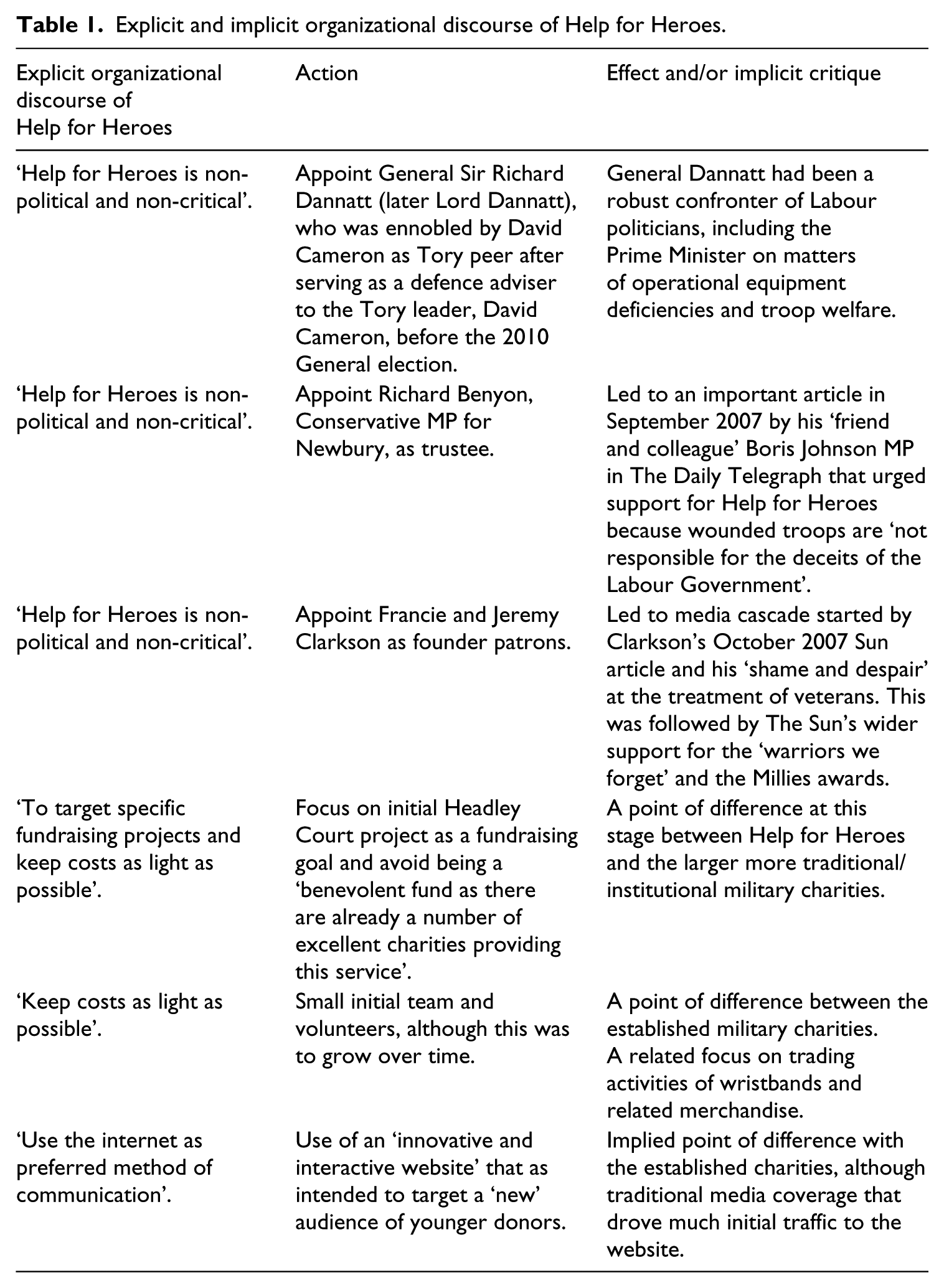
Lieutenant Colonel Tim Collins’s (2016) criticism of ‘Blair’s wars’ is a reminder that despite claims of political neutrality by veteran advocacy groups, the policy area of veteran affairs is a political arena. So while the explicit organizational discourse of Help for Heroes was non-political and non-critical, statements by its supporters and some actions by the charity itself suggest a more nuanced reality, as summarized in Table 1. The recruitment of patrons such as Conservative MP Richard Benyon and General Dannatt, the latter of whom had been criticized by media and retired officers for his outspoken approach, was implicitly political. It also generated an implied organizational discourse that was critical of the Labour government in veteran affairs and its overall competence in the military domain. General Dannatt had a track record of robustly confronting Labour ministers – including the Chancellor and Prime Minister – and had shown a well-developed media literacy in continuing his campaign beyond the corridors of Whitehall through interviews with the press. Similarly, the decision to recruit the vocal Jeremy Clarkson had political dimensions and breached Help for Heroes claim to be non-critical. Presenter of BBC TV’s Top Gear show, known for his conservative politics and a personal friend of Conservative Party leader, David Cameron, Clarkson wrote a column in The Sun, which had just installed Rebecca Brooks as editor with a mandate for a more campaigning approach to make the paper a more vital part of the national debate as part of its commercial strategy. When the paper supported a September 2014 fundraising drive, it ran a front page story criticizing Labour leader Ed Miliband for not offering a photograph of himself wearing a Help for Heroes wristband and failing to provide endorsement for the campaign. The story contrasted Miliband’s lack of support ‘for fear of offending Lefties’ with summaries of how the other leaders responded, who included Prime Minister David Cameron, Deputy Prime Minister Nick Clegg and UKIP’s Nigel Farage (Newton Dunn, 2014). So while Help for Heroes presented itself as explicitly non-political and non-critical, its supporters (both individual actors and institutions) used veteran campaigning as a platform to show Labour politicians in an unfavourable light.
Explicit and implicit organizational discourse of Help for Heroes.
Means of transmission
The first press coverage for Help for Heroes was a comment piece on 9 September 2007 in The Observer, which criticized the Labour government for indulging the Police while underfunding the Army’s equipment and care of returning wounded. The article detached support for military action from the personnel undertaking them: Whatever views you have on NATO’s involvement in Afghanistan – I happen to believe it is essential – the service that the soldiers are giving should not be ignored What is astounding in a rich society like ours is the failure to look after the young men coming home with brain injuries and terrible mutilations. (Porter, 2007)
The second mention appeared 2 weeks later and was written by Daily Telegraph columnist, Conservative MP for Henley on Thames and candidate for London Mayor, Boris Johnson. The piece seems to have been written with the encouragement of Help for Heroes patron ‘my friend and colleague Richard Benyon’ (Johnson, 2007), whose outing with injured veterans to Newbury races was the focus of the article. Like The Observer piece, Johnson, under the headline ‘You don’t have to support the war but do support our troops’, concluded with a call for civic-military engagement that does not confront specific policy failings (such as doubts over legality and the failure to find weapons of mass destruction in Iraq): I am sure the activities of this organisation will be well supported. People have no difficulty in making a distinction between the rights and wrongs of a war, and the heroism of the troops we send out to fight it. (Johnson, 2007)
Jeremy Clarkson used his column in The Sun on 6 October 2007 to launch Help for Heroes and appeal for support. The language is typically blokeish, as Clarkson laments the servicemen coming home limbless to find ‘almost no one in Britain could give a toss’ (Clarkson, 2007) and 3 weeks later, ‘The Sun Manifesto to Help our Heroes’ called for changes in society’s behaviour towards veterans alongside a promotional push encouraging readers to buy a Help for Heroes wristband for £2: TURN out for homecoming parades when you know your local battalion is back. We will publish times, dates and locations of every new parade. FIRMS should issue ‘heroes’ passes’ which guarantee troops free entry to entertainment parks and cut-price public transport. IF you see a serviceman or woman let them know you value what they do. Shake their hand or buy them a pint. And if you know one who is serving overseas drop them a line. (Newton Dunn, 2007)
Next day, The Sun reported that Prince William was ‘swatting aside the usual Royal protocol’ to support what was now ‘The Sun’s Help for Heroes Appeal’, by wearing a wristband, proving that ‘where there’s a Wills there’s a way’ (Newton Dunn et al., 2007) in an article that included a quotation of support from Conservative opposition leader David Cameron and others. These first two articles in The Sun were followed by a further 186 mentions of Help for Heroes in UK newspapers in the last 2 months of 2007 (Nexis, 2016). Jeremy Clarkson’s columns and supporting pieces accounted for the 23 mentions in The Sunday Times, the second largest set of coverage, with The Daily Mail covering the charity six times and The Daily Telegraph in five articles. The Sun’s supportive coverage grew over the next two years to 303 articles in 2008 (of a total of 465) and peaked at 672 (of 932) in 2009, or around two mentions a day. Then the blokes narrative of Help for Heroes’ discourse kit became flesh with the decision to invite Jeremy Clarkson to become patron in 2007, when Bryn Parry reported that ‘his blokeish approach was ideal to lead the appeal’ (Parry, 2008: 7). The Sun went on to create The Sun Military Awards (or Millies) with sponsorship from defence contractor, BAE Systems, and hosted an annual awards ceremony, which included booklets of printed case histories of injured veterans along with support from entertainers such as the ex-cavalry officer and singer James Blunt. In a note included in the 2008 Annual Report (Help for Heroes, 2008: 4), Harvey Grenville of the UK’s Charity Commission commended Help for Heroes for changing the ‘Armed Forces charities landscape’ and drawing in ‘new money which would otherwise not have been available to benefit the Armed Forces community’. The Sun’s defence editor used the same language and stressed his paper’s support: Help for Heroes has smashed all recent records for a newly launched British charity – and The Sun has backed it all the way. Since it began just 18 months ago it has raised more than £1 million a month. Together Help for Heroes and The Sun, the Forces’ favourite paper, have also changed the landscape for troops - winning them all the recognition they deserve. (Newton Dunn, 2009)
Media support for veterans as forgotten heroes was rarely questioned, although there was a warning that readers were being manipulated by the more sensationalist elements as publishers used veterans in a promotional strategy in which they adopted a ‘strident and intrusive approach’ to sell newspapers but which they will pursue only until the next big story appears (Tipping, 2008: 15).
Discussion: The discursive legacy of Help for Heroes
After less than 10 years of existence, Help for Heroes had annual income of £41 million and reserves of £45 million making it second only to the Royal British Legion in the military charity sector, which has been in existence for almost 100 years (Help for Heroes, 2015). By 2011, awareness of Help for Heroes was at 37 percent among members of the public able to name at least one veterans charity (just under 45 percent of the total sample of 3311 gathered through the British Social Attitudes Survey) with the Royal British Legion at 40 percent and the SSAFA at 9 percent (Gribble et al., 2014: 15). Help for Heroes organizational discourse reinvigorated veteran welfare in a way not seen since the end of World War I. As the organizational discourse became accepted as a societal supra-discourse or metanarrative, it left a discursive legacy in the form of a widely accepted orthodoxy of veterans as heroes, which was endorsed by mainstream politicians and also by challenger nationalistic groupings such as UKIP and Leave.eu. The charitable appeal of Help for Heroes was based on a simple organizational narrative inviting practical support but also included an emotional and patriotic proposition that could satisfy the public’s sense that something must be done for wounded veterans at a time when people were ‘unsure of how to help’ and had ‘no outlet for their feelings’ (Help for Heroes, 2008: 5). In considering the dynamics between Help for Heroes’ organizational discourse and societal metanarratives, the organization was founded just after Tony Blair stood down as UK Prime Minister in June 2007 amid poor poll ratings associated with UK involvement in the wars in Afghanistan and Iraq. At a time of national distaste for Blair and concerns over wasteful wars, the successful launch of Help for Heroes reflected the wide and deep acceptance of an organizational discourse that advocated support for veterans while maintaining national pride in the heroic veterans. In the terms of institutional maintenance through narrative (Zilber, 2009: 205), the success of Help for Heroes in a crowded field of military charities at a time of unpopular wars can be explained as a result of the synchronicity of its organizational discourse with social narratives of underlying sympathy for individual soldiers and pride in the UK armed forces but distaste for politicians and the military campaigns to which they had committed the country. Yet while the emotional and patriotic appeal of Help for Heroes proved effective in fundraising terms, elements of the message proved problematic to the Armed Forces because the hero-victim dichotomy (with the implication that soldiers have been treated badly by the state) resulted in ‘public sympathy towards the military [that] can undermine morale and support’ for future deployments (based on fear of casualties) (Hines et al., 2015: 700). Similarly, the portrayal of ‘veterans as damaged victims in marketing campaigns’ has been identified as a risk to Army recruitment that could ‘deter young people from joining up and make the job less attractive to those already serving’ (Farmer, 2013).
The means of transmission deployed by Help for Heroes to diffuse its organizational discourse can be theorized as dualistic in the way it targeted the mass market, or C2, D, E demographics in the National Readership Survey (Ipsos Mori, 2009) and the professional classes, or A,B,C1, as illustrated in Figure 1. This arrangement of the mechanisms of support reflects the socio-military class system of the British Army, with its distinction between officers and the other ranks or blokes. Jeremy Clarkson was an inspired choice for patron as he wrote columns both for The Sunday Times, a newspaper read by the professional classes and The Sun, the best-selling mass market daily. So, Help for Heroes was promoted through editorial links across two News Corporation titles, featuring as The Sunday Times Christmas Charity Appeal in 2007, raising £674,000 (Sunday Times, 2008) and aligning as The Sun’s Help for Heroes Campaign throughout that year. For the ABC1 demographic (and the upper classes), General Sir Richard Dannatt, Richard Benyon MP and Lady Victoria Leatham were recruited as patrons, with support from the Royal Family. When Help for Heroes won the inaugural The Sun’s Millie awards for the Best Support to the Armed Forces in early 2008, Prince William and Prince Harry sent a joint message of ‘warmest congratulations to Bryn, Emma, Jeremy and Francie’ (Help for Heroes, 2008). While the Princes were an example of elite support for Help for Heroes, they are boundary-spanning supporters like the Clarksons who appeal to both demographics. For the mass market, several patrons got involved through connections with The Sun newspaper, such as the glamour model Peta Todd, who appeared on the page three slot in the newspaper regularly and went on to become ‘truly the forces’ pin-up’ (Help for Heroes, 2016b). This dualistic approach contributed to wide and deep distribution of Help for Heroes organizational discourse in ways that cut through political affiliations, anti-war sentiment, social class and media consumption patterns.
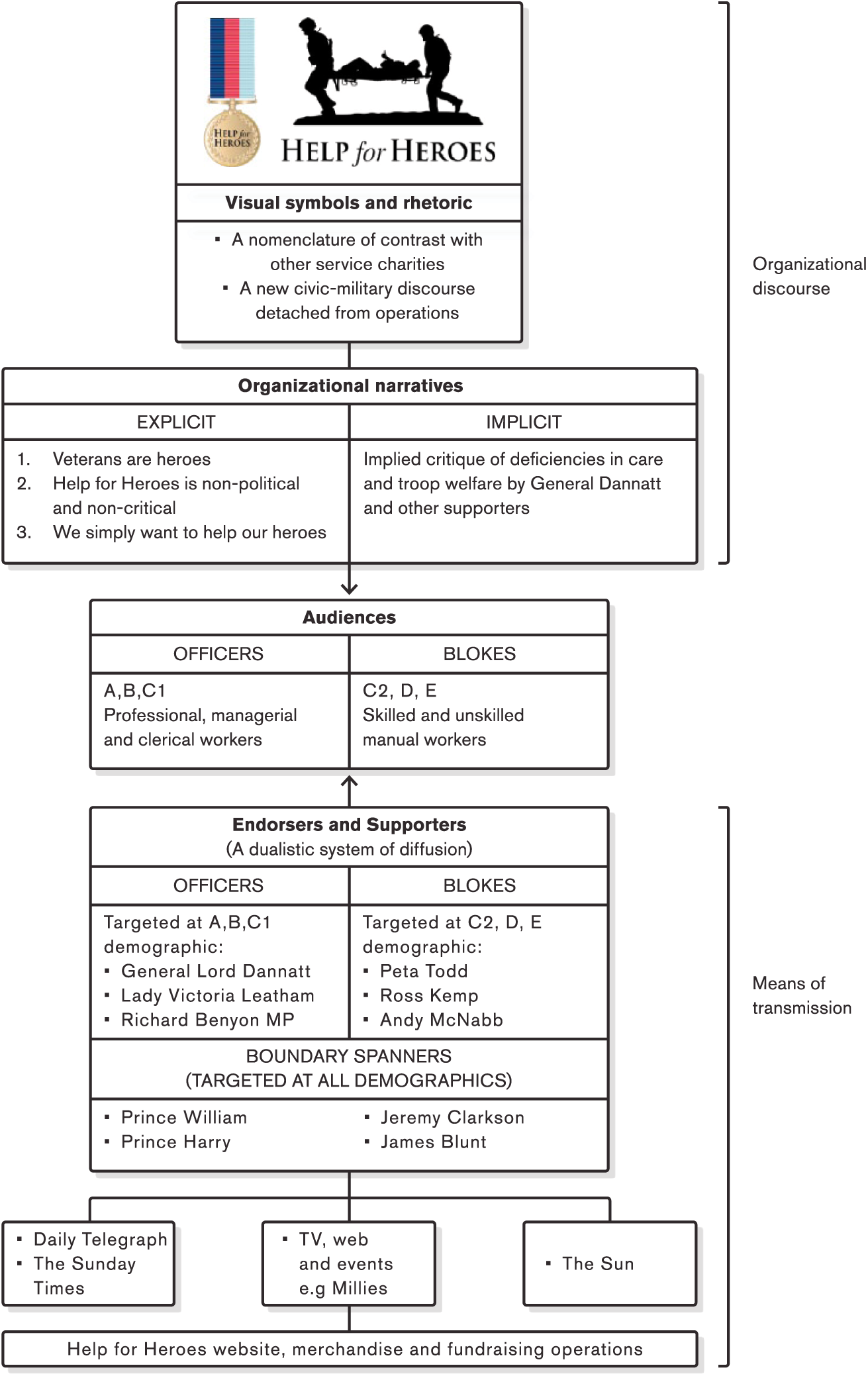
A conceptual model of Help for Heroes’ organisational discourse and means of transmission.
Conclusion
Help for Heroes organizational discourse combined distinctive visual symbols with distinctive language in a rhetoric that was accepted because of its synchronicity with societal supra-discourses on veterans. After 10 years of sustained transmission of its heroes discourse via a dualistic arrangement of celebrities and institutions such as the Monarchy, politicians and the media, there is widespread public acceptance of military veterans as a valid focus of social benevolence. However, the question of where the line should be drawn between charitable and governmental duty of care for veterans remains a contested issue. Patrons of Help for Heroes have voiced implicit and explicit criticisms of poor support from the Ministry of Defence, particularly under the Labour government until 2010. Help for Heroes itself has been criticized for overstepping the boundaries of accepted charitable support and relieving an unwilling state of its obligation to provide first class care, and has defended itself against accusations that it is ‘doing the Government’s work for them?’ (Help for Heroes, 2016a).
The project attempted to define and interpret the organizational discourse of Help for Heroes using the theoretical frames of institutional studies and in particular the concepts of institutional entrepreneurship at launch followed by institutional maintenance, in order to better understand the social and institutional contexts in which this charity operated. In diagnosing the communicative dimensions of organizational institutionalism, the object of analysis was Help for Heroes’ organizational discourse, which was evaluated using the synthesis of narrative, rhetorical, semiotic and critical discourse perspectives proposed by Cooren (2015: 59). This approach proved both practical and comprehensive as a research approach as well as offering a way of building an interpretive and comprehensive view of organizational discourse. In view of this methodological promise, the author encourages future work considering public relations cases at the level of organizational discourse. Considering the narrative elements of the organizational discourse, the project adopted elements of Zilber’s (2009: 233) case study methodology for examining ‘institutional maintenance as narrative acts’ in which societal and institutional metanarratives are carried into organizations, with the organization over time feeding back an ‘organizational version’ of the metanarrative back to the institutional/societal level. This theoretical perspective and the resulting methodology was also effective in addressing the discursive dynamics and means of transmission of Help for Heroes and offers potential for future case studies of this type. At the theoretical level, Zilber’s (2009) insight on the interdependence of the organizational discourse with the condition and nature of societal metanarratives or supra-discourses is a useful concept, which reflects some elements of Grunigian (Grunig, 2001) symmetry in public relations but with less emphasis on balance between the two sides and more emphasis on the bi-directional discursive dynamics and an element of translation as the discourse travels.
One limitation of this paper is a lack of engagement with the senior managers of Help for Heroes and a reliance of public statements, press coverage and promotional materials. If a more in-depth history was to be attempted, gathering source material from senior figures and the founders in particular would be an important priority in understanding the explicit and implicit thinking behind the organizational discourse. Discussions with regional co-ordinators and volunteers suggested there are social history possibilities to build a richer picture of Help for Heroes and the nature of the civic outreach undertaken on its behalf. While the background research and literature review did examine other veteran charities and some of their activity in the United States, the narrowness of the investigation into to one UK charity is a limitation in drawing broader conclusions on the way communications by veteran organizations affects wider civic-military relations and any relationship with nationalist politics. Future work in the form of comparative international studies that inquire into the organizational discourse of veteran groups in different countries would be welcome in addressing these matters.
Footnotes
Funding
The author(s) received no financial support for the research, authorship, and/or publication of this article.