



Abstract
This study explores responses to the culture jamming of Victoria’s Secret’s by a feminist activist organization called FORCE. Using social media, FORCE was able to troll Victoria’s Secret by masking themselves as part of the brand and community through the campaign Pink Loves Consent. This act of dissensus disguised as consensus created an entry point into conversation with followers of Victoria’s Secret, spurring an online dialogue about creating a consent-based culture. This study provides recommendations for activist organizations wanting to use social media culture jamming to create culture change.
Rape and sexual assault, often viewed as taboo subjects, have been insufficiently addressed in public relations literature. While Dimitrov (2008) addressed issues of fan activism surrounding gendered violence and sport, this article is the exception rather than the rule in public relations scholarship as it advocates for cultural and policy changes surrounding these issues. More frequently, when issues of sexual assault are addressed in public relations, it is from an image repair perspective for organizations (e.g. Fortunato, 2008; Xifra, 2012), although the positive role that public relations can play in sexual assault prevention is beginning to be more fully considered (e.g. Briones, 2010; Madden, 2016). The lack of engagement with sexual assault in public relations scholarship, along with the privileging of organizational reputation and brand, contributes to the perpetuation of rape culture, where occurrence of rape is normalized and excused in the media and popular culture (Burt, 1980). Thus, to combat rape culture and advance public relations scholarship, there is a need to consider the power that organizations have in perpetuating these ideals. One way to begin further introducing these topics into public relations scholarship is to explore how activists confront organizations believed to be contributing to rape culture.
In December 2012, a Baltimore, Maryland-based feminist activist organization called FORCE: Upsetting Rape Culture decided to spoof Victoria’s Secret’s PINK line of underwear. The activists chose to target this brand because of its primary market of young women and past products that included underwear with phrases such as ‘Unwrap Me’, ‘No Peeking’, and ‘Sure Thing’ on it, which were viewed as disempowering to women’s sexual agency and promoting access to women’s bodies without consent (Pink Loves Consent, n.d.). FORCE created a website that showed a variety of models and asked users to ‘join the consent revolution’ by engaging in a verbal agreement with a potential sexual partner about how and when they would be comfortable having sex (pinklovesconsent.com, 2012). Within 2 days, the website had more than 200,000 hits and was discussed in a variety of mainstream and feminist publications (FORCE: Upsetting Rape Culture, 2012). Furthermore, FORCE’s hashtag, #loveconsent, trended more than the generic #victoriassecret on Twitter during the company’s annual fashion show (FORCE: Upsetting Rape Culture, 2012).
While social media users positively received the Pink Loves Consent campaign, Victoria’s Secret was unhappy about the appropriation of its brand for these purposes. On 4 December 2012, lawyers from Victoria’s Secret forced the pinklovesconsent.com website to come down, citing ‘confusion’ to customers who could mistake it as an actual Victoria’s Secret campaign (Adams, 2012). The campaign’s Twitter handle, @loveconsent, was also suspended. In a press release, FORCE responded to Victoria’s Secret’s actions by saying, ‘By shutting down pinklovesconsent.com, Victoria’s Secret is shutting down an important outlet for information about healthy sex’ (Correction: Victoria’s Secret HATES Consent, n.d.). Ultimately, the pinklovesconsent.com website could remain.
FORCE’s desire to subvert a popular corporate brand and raise awareness to an often-silenced issue embodies traditional culture jamming as an activist tactic (Harold, 2004). Although activist groups have typically been treated as external publics to organizations, they are also public relations actors in and of themselves (Ciszek, 2015). This type of activism offers a place for scholars to move away from notions of collaboration within public relations and focus on theorizing about conflict and resistance (Holtzhausen, 2007). One of the primary goals of this article is to examine the ways in which culture jamming as a form of dissensus, especially in a social-mediated world, can be used to empower online publics to become active around an issue. We begin by covering the literature in the areas of public relations and activism, culture jamming, and social media that lead to our research question that guides this study. Then, we will describe the methodology that allowed us to answer this research question, followed by the findings that emerged. We then conclude by discussing the implications of these findings, as well as our limitations and avenues for future research within this area of research.
Literature review
This literature review begins by engaging with research in the forms of activism studied in public relations, including the understudied tactic of culture jamming. Finally, literature on social media and culture jamming is reviewed.
Public relations and activism
Although no consensus exists, one often cited definition of activism is ‘a process by which groups of people exert pressure on organizations or other institutions to change policies, practices, or conditions the activists find problematic’ (Smith, 2005: 5). Not all activism is created equal, though, with the choice of activist tactics varying from conventional to radical approaches. The primary distinction between conventional and radical activism is the choice to work within or outside of the system to enact change. Coombs (1998) described conventional activism as ‘a mix of lobbying to change public policy and agitating management to alter organizational policies’ (p. 290). In contrast, radical activism focuses on working ‘outside of the system to express … objections, influence social goals, or both through means such as agitative communication with key organizations that contribute to the phenomenon they oppose’ (Derville, 2005: 528). While more conventional activist approaches have been researched in public relations for decades (e.g. Grunig, 1992; Reber et al., 2010), there has been less focus on radical activism in public relations scholarship.
Historically, activism within public relations research has been viewed from the two-way symmetrical model, which presumes compromise between organizations and activists is the desired outcome (Grunig, 1992). However, Stokes and Rubin’s (2010) analysis of the conflict between Philip Morris and the anti-smoking grassroots organizations GASP showed that some activist organizations’ goals are to see the downfall of the organization they are against. In this case, compromise is not an option as there is no common middle ground. More recently, Kennedy and Sommerfeldt (2015) called for public relations scholarship that explores fostering conditions for dissensus and embracing resulting tensions, rather than privileging the ideas of consensus and compromise. Ciszek (2016) answered this call by exploring the tensions that exist between gay rights activists and Chick-fil-A’s staunch position against gay marriage, specifically how social media dissensus can provide an opportunity for listening and learning about diverse perspectives that can still inform public relations practice.
Radical activism often utilizes unconventional and imaginative tactics to draw attention to various causes. Boyd and VanSlette (2009) called such tactics outlaw discourse, which reflect different ways of thinking and espouse alternative logics or ways to approach a problem that might seem simply disruptive. Power and legitimacy are core issues of activism (Smith and Ferguson, 2010), and for activists who lack power and legitimacy, ‘outlaw discourse provides, if not a quick fix, at least a potentially high-reward opportunity to take advantage of changes in the practice of communication in the twenty-first century’ (Boyd and VanSlette, 2009: 339). The lack of power and legitimacy therefore allows radical activists to experiment with ways of communicating and raising awareness.
Culture jamming
One common and often-studied form of radical activism outside of public relations is culture jamming. Culture jamming, sometimes known as guerilla communication, is a form of rhetorical protest situated within anti-consumerist movements that utilizes the tools of marketing and mass media to subvert hegemonic, often mediated, messages (Harold, 2004). Klein (1999) defined culture jamming as ‘the practice of parodying advertisements and hijacking billboards in order to drastically alter their message’ (p. 280). Although public relations scholarship has engaged with radical activism (e.g. Derville, 2005; Stokes and Rubin, 2010; Weaver, 2010), no research to date has utilized the concept of culture jamming to understand this type of activist tactic as it is more commonly associated with advertising.
FORCE’s actions are not the first time feminism and culture jamming have joined forces. In 1989, a group known as the Barbie Liberation Organization (BLO) pranked Mattel, makers of Barbie (Harold, 2004). The BLO switched the voice chips of G.I. Joe and Barbie to upset the gender stereotypes perpetuated by these toys, causing Barbie to say ‘Eat lead, Cobra!’ and ‘Dead men tell no lies!’, while G.I. Joe exclaimed ‘Let’s plan our dream wedding!’ (Harold, 2004). This act created dissonance in the reversal of gender expectations, revealing the way children’s toys perpetuate gender-based stereotyping (Harold, 2004).
By engaging with negative images and ideals sent to young girls through mass media, culture jammers have also tried to counteract passive consumption rather than solely focusing on active empowerment. For example, Carly Stasko, a Canadian culture jammer, created a collage that depicts a supermarket checkout lane filled with ‘Girl Power’ products, but the slogan reads ‘Warning: for best results don’t buy girl power. Grow your own!’ (Harris, 2004: 168). Culture jamming offers young feminists a ‘DIY subculture of creative resistance’ (Stasko, 2008: 195). Within a patriarchal society, feminists must continually confront issues of power and legitimacy, and radical activism as enacted through culture jamming is one way in which this has been accomplished.
The creation of fake websites, such as the one created by FORCE, is also a popular culture jamming tactic. Deleuze (1995) argued that if marketing is an instrument of social control, then engaged publics (in this case, the culture jammers) can learn to manipulate that instrument to different ends. For example, the Yes Men, a culture jamming activist group, has received attention for its work pretending to be spokespeople for large organizations such as McDonald’s, Dow Chemical, and Exxon Mobil (Lee, 2010). The Yes Men creates fake websites for the organizations, waits for invitations to speak on behalf of these organizations, and then uses the time to make outrageous statements that the organizations are forced to deny (Lee, 2010). By subverting traditional public relations tactics, the Yes Men forces a response from the corporations that would otherwise stay silent on issues raised by more conventional activist groups.
Social media and culture jamming
Activists have long been employing the Internet to ‘foster affiliations and stage events’ against those with whom they disagree (Kahn and Kellner, 2004: 87) through the ‘electronic repertoire of contention’ available online (Rolfe, 2005: 66). Beyond the particular tactic of fake website creation, there is little research on how culture jammers use social media to emphasize issue salience.
Robinson and Bell (2013) critiqued the novel approaches of culture jammers as momentarily attention-grabbing but often lacking in their ability to build sustained media attention. One way that social media allow activists to bring awareness to and build dialogue around salient issues is through the use of hashtags – tags or identifiers that help to categorize conversations (Stache, 2015). Hashtags can work as a cue to ‘continually predicate renewed attention’ (Warner, 2002: 61) for culture jamming messages. Meyer (2014) wrote briefly about a hashtag campaign as a ‘cultural Trojan horse’ (p. 1108), where magazine headlines were rewritten on Twitter to remove sexist language and challenge dominant cultural norms without calling those issues out by name. Darts (2004) noted that the culture jamming research also pays minimal attention to how media portrays or covers culture jamming, leading to a belief that the biggest impact of culture jamming actions might be on the instigators (and a few direct participants) themselves.
Therefore, research on culture jammers relies upon contextualizing and improving moral actions, building community, and attempting to understand how jammers work to create sites of change (Milstein and Pulos, 2015). An article about Banksy, a famed and unnamed graffiti artist and social commentator, culture jamming Disneyland discussed the idea that people who saw the artifact and took pictures of it or in some way talked about it on social media gave it, and the idea behind it, an ‘eternal online presence’ (Harzman, 2015: 18). This article, then, looks to broaden our research-based understanding of culture jamming via social media and to see what sort of impact social media exposure might have in countering problematic mainstream narratives. Thus, based on the review of literature on public relations and activism, culture jamming, and social media activism, the following research question guided this study: How can activist organizations utilize social media culture jamming culture tactics to create social change?
Method
We employed a case study approach to answer the research questions using multiple sources of evidence to result in the triangulation of information (Yin, 2009). A qualitative case study method in particular is appropriate for this study because it allows for meanings and understandings to emerge revolving around the case explored (Berg, 2009).
Data collection
This particular case study relied on a variety of data collection methods, with qualitative content analysis of various social media platforms (where blog posts and tweets were the units of analysis) as the main data collection method. The content analysis technique was further strengthened by combining this analysis with interviews and participant observation to complement the data gathered. Original FORCE campaign visuals, namely, those included in the fake website and other promotional materials, were also viewed, analyzed, and discussed.
In all, 55 blog posts were collected using Google Blog Search and BlogSearchEngine.com, containing URLs for blogs published between 3 December 2012 and 8 February 2017. Posts were written from a variety of perspectives, including FORCE members, public consumers of the campaign, and bloggers. Feminist media scholars have noted the potential of blogs to serve as spaces for feminist rearticulations (Harp et al., 2014). For coverage of sexual violence, the blogosophere is a place where mainstream rape narratives such as victim blaming are often contested. Furthermore, it allows for an expansion of voices, particularly on issues where people are very often silenced (Harp et al., 2014).
The search terms ‘Pink Loves Consent’, ‘Victoria’s Secret prank’, and ‘FORCE Victoria’s Secret’ were used. A total of 545 tweets were gathered using both the social media search engine Topsy.com, which, in 2013, was the largest searchable index of Twitter data, and Twitter’s own search function. In both cases, #loveconsent, the hashtag established by FORCE, was the only one searched. In all, 11 Tumblr posts from the FORCE Tumblr website 1 and 34 posts from the FORCE Facebook page were collected that were relevant to the Pink Love Consent case and posted by the organization.
In addition, we conducted three semi-structured interviews lasting from 22 to 45 minutes with leaders of the Pink Loves Consent campaign to explore their unique perspectives surrounding the case; they were contacted through the email address listed on their main website. The research was Institutional Review Board (IRB) approved and participants gave informed consent as well as permission to be audio-recorded. The interviews were fully transcribed and analyzed. Finally, one researcher attended a 2-hour public lecture given by FORCE where creators of the Pink Loves Consent campaign discussed culture jamming and their overall strategies for mainstreaming the concept of consent.
Data analysis
Using the research question to guide the analysis, we used constant comparative and line-by-line coding to establish emergent themes (Corbin and Strauss, 2008). This analysis was inspired by Glaser and Strauss’ (1967) grounded theory approach, and Excel spreadsheets and Word documents were used to record observations. Each researcher independently coded the data collected. Then, we met together to determine how findings were coded and subsequently created a code sheet of these initial themes. Using the initial themes that emerged to focus the following round of analysis, we continued to analyze the data, noting new themes that emerged that further explicated previous themes.
For the visuals, an iconographic qualitative approach was used in order to provide a deeper understanding of the cultural, political, and/or social context and impact (Müller, 2011). Müller and Özcan (2007) argue that visual messages can be clear, and the viewer can generally make sense of what is going on in the visuals; however, the meaning of visuals is only gleaned when a deeper ‘social, cultural, and political context’ (p. 289) is used for analysis.
Throughout the process, we discussed the results through in-person meetings and electronic correspondence, statements, phrases, and visuals in the social media data and transcripts that allowed for an inductive process that led to a final set of themes (Glaser and Strauss, 1967). We also took a deductive approach, contextualizing the data within the larger body of scholarship on public relations, social media, and culture jamming.
Results
Four themes emerged regarding the ability of social media culture jamming tactics to create opportunities for dissensus from online publics, which included the sharing of visual counterdiscourses, the creation of a feminist Facebook army, shifting and sustaining the conversation, and speaking directly to the organization.
Visual counterdiscourses
FORCE demonstrated through the Pink Loves Consent campaign how traditional public relations, marketing, and advertising tactics can be adapted to look like legitimate promotional materials made for audiences to not tell the difference. FORCE organizers were very thoughtful in making this strategic choice, claiming in an interview that they wanted to use ‘the same tools of advertising that people are used to being communicated through’. By hijacking Victoria Secret’s already existing brand, FORCE used culture jamming to tackle the organization through integration.
The Pink Loves Consent campaign used social media to create both image-based and written discourses that focused on oppositional interpretations of identities, needs, and interests of women that were previously not found in Victoria’s Secret messaging. The inclusion of diverse women was one of the primary ways that those discussing the campaign online recognized this as a non-traditional Victoria’s Secret campaign. The main image on the Pink Loves Consent website is of a Black woman, larger than the size of a typical Victoria’s Secret model. She is wearing a visible hot pink bra and underwear, plus an off the shoulder shirt that says ‘love’, with her hair and makeup done, smiling and looking down, next to language including ‘Pink [heart]s Consent’ and ‘Join the Consent Revolution’. The model is clearly a visual counterdiscourse, since Victoria’s Secret models tend to be white, very thin, unsmiling, and not wearing anything that might cover their bodies in any significant way. One blogger highlighted that this campaign was highly suspect straight off the bat – Victoria’s Secret is hardly known for cultural sensitivity or for promoting healthy body images (just look at the difference between a Dove and Victoria’s Secret model) – some people bought into the alleged marketing shift and actually liked it better. (Stampler, 2012).
Twitter user @authenticali (2013) commented on both the body type and racial diversity of the images associated with Pink Loves Consent in that ‘#LoveConsent @VictoriasSecret finally showing that gorgeous comes in all sizes and colours #respect’.
Other visuals help enforce these ideas of counterdiscourse as well. One of the main pages of the Pink Loves Consent website is called ‘THEN and NOW’, featuring four images of underwear, two from THEN and two from NOW. The THEN underwear have phrases written on them that say ‘no peeking’ and ‘sure thing’; the NOW underwear have phrases that say ‘no means no’ and ‘ask first’. The pictures are interspersed with copy talking about how ‘when it comes to sex, words like “no” are for setting boundaries – NOT flirting’ (Pink Loves Consent, n.d.). These images powerfully expose the messaging women are constantly exposed to through Victoria’s Secret’s merchandise, and the potential attitudes regarding consent and their bodies that may emerge as a result of this constant exposure.
Through visual counterdiscourses, Pink Loves Consent gave customers the chance to imagine what it would be like if Victoria’s Secret did support the push for consent. As one FORCE co-founder said, ‘the Internet pranks were modeling the alternative by pretending that it’s already happened and that these big brands are already kind of adopting consent into their message’. By allowing consumers to imagine a culturally responsive brand and see what those images would look like, there is a hope that the real organization will follow suit and become more engaged in cultural issues. @MajoritySpeaks (2013) tweeted a quote from the #LoveConsent campaign founder at a conference: ‘it made people think, “what if I lived in that world? And why don’t I?”’ These users decided to work toward making this world a reality by becoming more directly involved with FORCE’s cause through groups such as the ‘feminist Facebook army’.
Feminist Facebook army
FORCE had approximately 100 people in their network of friends who were in on the prank and made up what they termed their ‘feminist Facebook army’ to get the ball rolling on online conversations about the campaign. In an interview, one of the cofounders of FORCE discussed how culture jamming was different from their other projects that focus more specifically on building relationships and networks. Specifically, we try and really intentionally build leaders with [projects] and have the model of peer leadership, which is harder to do with culture jams just because they’re secret. So having a really broad base is hard when you’re trying to keep a secret.
The surprise element of culture jamming was initially limiting for participation, but the perception of authentic responses to the campaign on social media helped to drive further participation after its launch.
In an interview with Bitch Media, the FORCE cofounders discussed the first stage of this ‘feminist Facebook army’ as people posting on Victoria’s Secret’s Facebook saying things like ‘Oh my god!! Can’t believe you’re doing this! Love the new line!’ We had people tweeting with Victoria’s Secret’s hashtags and also our hashtags, so if people search for Victoria’s Secret, our tweets would show up in the feed’ (Mirk, 2013). On the night of the Victoria’s Secret fashion show, models from the Pink Loves Consent website responded to tweets from girls complaining that they disliked their bodies after watching the fashion show and also disseminating uplifting anecdotes about safe sex (Sidell, 2012). The campaign utilized this feminist Facebook army to create buzz around the issue to gain attention from journalists and other key influencers online, creating a shift in online conversation focused on Victoria’s Secret that FORCE and their volunteers/supporters worked hard to maintain.
Shifting and sustaining the conversation
By appropriating the tools of public relations, advertising and marketing used by Victoria‘1s Secret, FORCE was able to adapt the language of the behemoth organization in a way that shifted the conversation from disempowerment of women by the brand to empowerment of women. Nagle and Brancato (2012) noted that after commercial campaigns like Dove Real Beauty, activist efforts like Slutwalk … it is clear that there is a public demand, and a need, for a different attitude about rape culture and sexuality. Right now, there is a market for consent.
On the night of Victoria’s Secret’s annual fashion show, FORCE’s Tumblr page said that ‘tonight we are continuing the prank by subverting [Victoria’s Secret] social media to promote a national conversation about consent!’ (FORCE: Upsetting Rape Culture, 2012). In the interview conducted with one of the campaign organizers for this study, she said that a key way in which they worked to shift the conversation was in not just focusing on one small thing, but instead ‘thinking about branding a movement and creating messaging [for it]’. Importantly, though, on FORCE: Upsetting Rape Culture’s (2012) Tumblr, they made it clear that they were ‘not about taking Victoria’s Secret down’ but instead focused on ‘changing the conversation’.
By using social media, more people can participate in the conversation, adding to that pressure for change. This movement was meant to come from the ground up; as FORCE described, ‘[t]he flash attention the project got didn’t come from us. It came from somewhere deeper and more important’ (FORCE: Upsetting Rape Culture, 2012). In addition, FORCE organizers saw hijacking the brand as a way to bring new individuals into the conversation. As one blogger relayed from an interview with FORCE, ‘[they] did the prank to get new people talking about consent and avoid preaching to the choir. Basically [they] thought, “We want to have a conversation with Victoria’s Secret consumers, so let’s pretend to be Victoria’s Secret”’ (Bizik, 2016).
The engagement with audiences did not end when the hijacking was revealed. As Bizik’s (2016) interview with the organizers stated, ‘people’s frustration wasn’t directed at us for having done the prank but more at Victoria’s Secret like, “Why wouldn’t you do this?”’ Adams (2012) relayed a similar reaction in the Huffington Post: ‘… customers began to come out in droves, requesting that the mass retailer produce the feminist undies using the hashtag #loveconsent’. Using social media as a tool, these customers were able to take these concerns into their own hands and directly engage with Victoria’s Secret.
Speaking directly to the organization
Culture jamming through social media allowed supporters to directly communicate with Victoria’s Secret through the same digital channels. Publics used Twitter to directly engage with Victoria’s Secret, by either sharing their disappointment that the new line of panties was a prank or by telling Victoria’s Secret that this needed to become a reality. For example, Twitter user @thehannahgold (2014) tweeted that ‘discovering the #loveconsent line from @VictoriasSecret was a prank definitely ruined my week’. Other users more directly told VS that they needed to support, rather than hinder, the campaign. Twitter user @katesiegfried (2012) wrote that ‘@VictoriasSecret should take the critique offered by #loveconsent seriously. Stop promoting rape culture’. Similarly, user @Eeds_Is_Love (2013) wrote ‘@VictoriasSecret, I was in happy tears thinking #loveconsent was real, let’s make it a reality!’ Other Twitter users noted that Victoria’s Secret should utilize the positive support the campaign was generating. @HallieGammon (2012) said that ‘@VSPINK Take note of @loveconsent – you’re seriously missing the boat. I would buy any and all of their products bc I #loveconsent’.
Discussion
The digital silencing of the Pink Loves Consent campaign by Victoria’s Secret is highly symbolic of the way that open discussion of rape is typically avoided in US culture (Briones, 2010; Madden, 2016). Rather than focusing solely on those who already supported FORCE’s mission, culture jamming through social media allowed for conversations with outside audiences. This included everyone from those who had never encountered messages of consent and rape culture before or had never engaged with those messages in any meaningful way. Through this social-mediated contact, the FORCE organizers were able to add to their ‘feminist Facebook army’, which already included individuals connected to the issue and desiring another way to spread the word. Social media empowers greater participation in culture jamming, expanding the pool of both instigators and direct participants (Darts, 2004). Because of its relationship-building potential, Table 1 provides specific suggestions for activist public relations practitioners who may want to add social media culture jamming to their strategic arsenal.
Social media culture jamming recommendations.
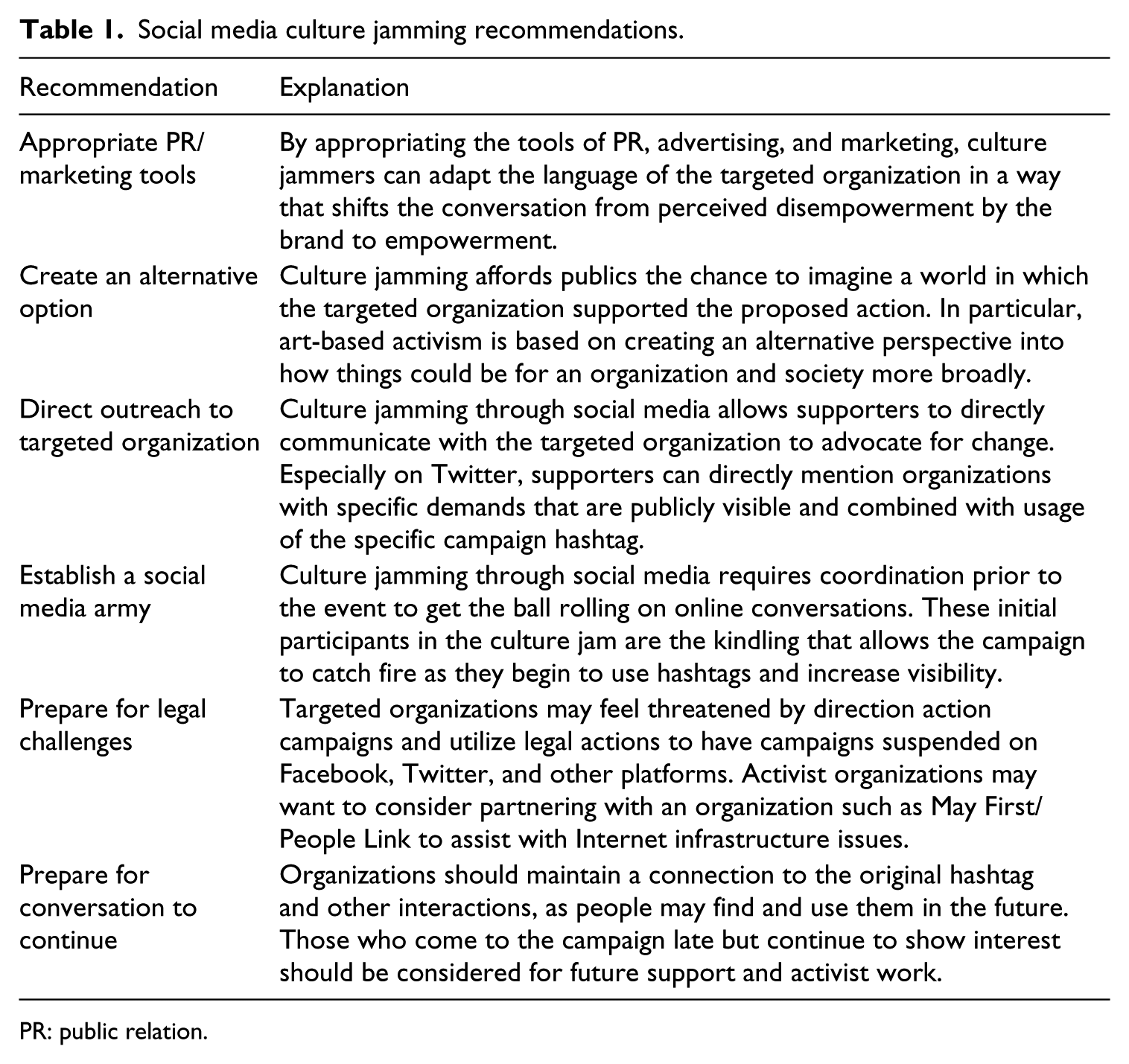
PR: public relation.
Although past research into public relations activism has focused on the distinction between conventional and radical activism (Derville, 2005), the case of FORCE highlights more of a continuum than a dichotomy between dissensus and consensus. As in many cases of radical activism, FORCE faced a corporate giant and tackled a taboo topic in an unconventional way through both visual and textual content. However, FORCE did not see the existence of Victoria’s Secret as incompatible with the goals of disrupting rape culture, instead preferring to use the brand as a powerful tool with influence over a large population. While social media culture jamming was a tool for dissensus, it also opened up an opportunity to show that a reimagined future was possible. For those who thought the Pink Loves Consent campaign originated from Victoria’s Secret, the dissensus was consensus because they believed in this new approach by the organization. Culture jamming fostered a space for this tension to emerge (Kennedy and Sommerfeldt, 2015). Individuals whose voices were gathered for this project frequently mentioned how glad they were to see a large and powerful organization like Victoria’s Secret taking a stand for the cause and showcasing a diversity of publics. Rather than dismantling the system, FORCE attempted to co-opt the establishment to demonstrate how even simple changes, such as what words are on underwear, and who is seen wearing that underwear, can have a major impact on public perceptions of rape culture.
Based on the Pink Loves Consent campaign, we argue that culture jamming through social media is a form of pro-social trolling. While trolling behavior is most often associated with abuse and harassment online, at its very essence is creating dissensus within a community to elicit a reaction. As Barney (2016) wrote, ‘the troll in the proper sense is one who speaks to a community and as being part of the community; only he is not part of it, but opposed’ (p. 1). Pink Loves Consent and its feminist Facebook army were able to troll Victoria’s Secret by masking themselves as part of the brand and community. FORCE chose to enact dissensus masked as consensus as an entry point into conversation with followers of Victoria’s Secret (Kennedy and Sommerfeldt, 2015). As Ciszek (2016) had noted, social media dissensus can provide an opportunity for listening and learning about diverse perspectives, which can inform public relations practice. Once the hoax was identified, Victoria’s Secret could also have used this opportunity to employ their power as a major retailer with a brand identity consisting of sexual undertones to make a statement in support of the ideals of consent. Victoria’s Secret did not have to conform to FORCE’s goals; it was only in refusing to engage and listen to the concerns of a public that Victoria’s Secret missed the opportunity to improve their relationships. Social media afforded activists the ability to speak directly to the organization even if the targeted organization did not respond. Because of the public manner of these interactions, social media may facilitate other relationships that may help to build greater momentum for the activist cause, and in turn, better build upon the idea of activist relations.
Moreover, for a campaign focused primarily on women and the issue of consent, dissensus is a form of empowerment. Women especially may not feel like they have the agency to object to unwanted sexual advances in accordance with ‘traditional gender ideologies of feminine passivity’ (Muehlenhard et al., 2016: 460). FORCE has provided a model that says it is not only okay to object to this type of culture, but it is possible to change it by telling Victoria’s Secret that women will not stand for this anymore. Importantly, though, Victoria’s Secret’s ultimate compliance with the demands is not the point. Instead, the ability of people to criticize an overarching ideology, start to consider different ways of doing and being, and use social media to more effectively share these ideas are where empowerment can be derived.
Finally, in broadening the scope of our content analysis into 2017, this project also allowed us to make some observations about the functionality of a popular hashtag over time and to see how well Harzman’s (2015) idea of an ‘eternal online presence’ (p. 18) held up or did not. While Victoria’s Secret did engage in digital silencing of FORCE’s work, the original Twitter, Tumblr, Facebook, and blog conversations still exist and are available for someone to either search for or serendipitously discover on their own at any point in time. Thus, this type of social media–based campaign offers benefits to the discussion at two distinct points in time – during the immediate unfolding and aftermath of the initial campaign, and then, the interaction of people later who come to the hashtag/project and become just as excited about the idea as those who watched it happen in real time. Because of this sustained online presence, social media can enhance culture jamming by helping to create more sustained media attention (Robinson and Bell, 2013). This is likely only for campaigns that do not have a clear, time-based conclusion; something like #Kony2012, for example, which focused on immediate action to stop an African warlord by the end of 2012, would likely not benefit nearly as much from late-coming activists who are drawn to the cause long after the launch of the campaign.
In addition, as an activist public relations tactic, the next time FORCE has a new campaign to promote, they have an entire repository of individuals to reach out to who supported their campaign, are now part of the growing ‘feminist Facebook army’, and might be interested in supporting future work. The ability of social media content to essentially be eternal, where platforms hold onto and make their content searchable, makes finding those publics easier in the future and gives the organization a previously established relationship to build upon. Individuals who are coming to the campaign for the first time can also use this repository to educate themselves on how the content has been discussed previously, or what arguments and counterarguments have been established, and to offer a feeling of community and connection from the very beginning. In that way, the constant, continuing nature of social media offers opportunity and support for continuing to develop and galvanize that group repeatedly over time.
Limitations and future research
One of the primary limitations of this study was only interviewing the activists involved in creating the campaign. Given the importance of the ‘feminist Facebook army’ to the campaign’s success, it would have been fruitful to interview more involved activists to understand what motivated them to join and how this online activism may have translated offline. Rather than solely focusing on those who masterminded the campaign, the ways in which more people were brought into the fold should be explicated. In an interview, a FORCE co-founder discussed how much of the current success of these campaigns can be attributed to the groundwork laid by young activists, especially on college campuses, over the past several years. Other research should delve deeper into the idea of how social media campaigns build and add to their audience over time, and how people who find it later react, and whether they can be moved to action for a campaign resurgence.
Conclusion
FORCE used culture jamming and public relations–based activist techniques to start a conversation with Victoria’s Secret, and the public at large, about the importance of consent in sexual relationships. There are also lessons for activist organizations in terms of using social media to create productive dissensus and provide counterdiscourses in unexpected ways. FORCE and Victoria’s Secret have provided an excellent case for furthering understanding of social media–based activism in public relations, the impact of both visual and written discourse, and how culture jamming can be used as an effective tactic to spark conversations on issues that warrant discussion.
Footnotes
Funding
The author(s) received no financial support for the research, authorship, and/or publication of this article.