



Abstract
This article focuses on the motivational and structural dynamics of the online communication of political interest organizations. Instead of describing political interest organizations as fully rational players, we develop a theoretical framework that establishes an alternative view of political interest organizations by characterizing them as actors that are also dependent on their institutional environment. The basic assumption of this framework is that there is no unidirectional relationship between motives and structures and the online communication activities. Instead, there is a dynamic interplay of motives, structures, environmental conditions, and online communication. Against this theoretical framework, we discuss the findings from an interview study with communication executives of political interest organizations. The aim of this study was not to resolve the debate on whether political organizations communicate ‘strategically’ or not. Instead, we examined the motivational and structural dynamics that constitute the organizations’ online communications efforts.
Keywords
Political interest organizations and their limited strategic abilities
In political communication research, it is often regarded as fundamental or ‘the normal case’ that political organizations and political actors communicate strategically. Questions concerning the motivational and structural dynamics in their decisions are thus not further addressed. The reason for this might be that the term ‘organization’ is often not discussed as a concept but is deemed to be known. Only in the (elderly) literature on party organizations do we find critical comments on the question of whether political parties should be regarded as unitary actors or as a bunch of organizations with many faces (Katz and Mair, 1993; Mair, 2004). Other political organizations are normally seen as homogeneous collective actors that make decisions, act, and communicate like an individual person. In other words, the ‘rational’ system perspective as Meyer and Scott (1983) and Scott (2003) labeled it is dominant. From this point of view, communication is a strategic tool for achieving certain goals. Although the framing of politics in media coverage as a game or strategy is an issue in political communication research (Aalberg et al., 2012), thus far, there has been no intensive debate on the possibly limited strategic abilities of political interest organizations. However, some arguments in this study are reminiscent of the debate about the professionalization of political communication at the turn of this century. Similar to the term strategic communication now, the term professionalization was described then as a ‘self-defining, catch-all buzzword employed to explain the recent changes in political communication’ (Negrine and Lilleker, 2002: 305). The problem with terms such as ‘professional’ or ‘strategic communication’ is that they are so highly positively connoted that empirical analyses or rethinking of possible non-professional and non-strategic communication practices is almost impossible, because no professional communicator would admit that he acts unstrategically and does not know what he does.
With this in mind, strategic practice can be interpreted as storytelling by practitioners (see Fenton and Langley, 2011). It is important to note that the rational systems perspective understands strategies as intentional strategies that are based on some kind of ‘strategic will’. Mintzberg (1985) contrasted those intentional strategies (he called them ‘deliberate strategies’, which we think can be used as a synonym) with emergent strategies, which emerge from actions and are not planned. When he introduced his concept, Mintzberg suggested that the traditional way of thinking about strategies, in science as well as in daily life, focuses only on intentional strategies. We think this bias on intentional strategies can also be observed in the current research on a phenomenon that is said to be one of the biggest strategic challenges for political interest organizations: the shifting media landscape and especially the rapid spread of the Internet and online media (Bimber et al., 2012). The Internet provides new communication opportunities to interest organizations but it also puts organizations under social pressure to use in a way that is consistent with higher-level strategies. Thus, it is the aim of this study to focus attention on the bias toward the idea of organizations as rational actors and organizational online communication as based on intentional strategies. In this study, we develop a theoretical framework that establishes an alternative view on political interest organizations by characterizing them as actors, which are also dependent on their institutional environment. We develop this framework based on data that were collected in the “Political Organizations in the Online World (see Funding)” research project. The basic assumption of this framework is that there is no unidirectional relationship between motives and structures and online communication activities. Instead, there is a dynamic interplay of motives, structures, environmental conditions, and online communication.
The study is structured as follows: First, we briefly contrast the intentional and emergent strategy approach and show how they correspond with the idea of organizations as rational systems and the process-oriented view on organizations. Second, we define the term ‘political interest organization’ and give an overview of the current research on their online communication activities. In the main theoretical section, we develop the alternative framework that characterizes political interest organizations as dependent on their institutional environment. Afterwards we condense this framework into three analytical dimensions. The three analytical dimensions then guide the analysis and discussion of the findings from an interview study with communication executives of political interest organizations.
Intentional and emergent approaches to strategies and organizations
In contrast to political communication, organizational or management studies have engaged intensively with the concept of strategy (for a current review of the literature see Holtzhausen and Zerfass, 2015; Van den Steen, 2017). In his seminal paper, Mintzberg (1987) argues that it is not possible to formulate a single definition of strategy. Instead he gives five definitions and describes it as the ‘5 Ps’ for strategy (plan, ploy, pattern, position, and perspective). For the purpose of this study, we rely on the works of the German political scientists Raschke and Tils (2013). According to them, strategies are success-oriented constructs that are based on cross-situational goal-means-environment calculations (Raschke and Tils, 2013: 127). Moreover, strategies serve as principles that guide actions and practices. What is essential about Rasches and Tils’ definition is that they use the term ‘construct’ on purpose, because strategies can exist on a continuum of different grades from loosely notional drafts to comprehensive and precisely formulated conceptions (Raschke and Tils, 2013: 127). In their definition, there is a clear parallel to Mintzberg’s (1985) model of deliberate and emergent strategies, though Raschke and Tils emphasize the continuum, while Mintzberg emphasizes the differences between the two forms of strategy formation (Raschke and Tils, 2013: 236). As mentioned before, Mintzberg (1985) suggested that the traditional way of thinking about strategy implementation focuses only on intentional strategies. Intentional strategies are understood as formulated by organizations carefully specifying their missions, goals, and third factor variables (such as actions of competitors) to settle on a course of action. The concept of intentional or, in Mintzberg’s terminology, deliberate strategies is connected to the rational system perspective in organization theory (Meyer and Scott, 1983; Scott, 2003) that views organizations as actors. In this perspective, organizational structures and organizational actions are conceptualized as a function of organizational goals and organizations are defined by their ability to act as corporate actors (see also Donges and Jarren, 2014: 182).
However, Mintzberg (1985) claimed that there are also emergent strategies, meaning that some organizations simply engage in actions before they clearly articulate missions, goals, or objectives. The idea of strategies as emerging from actions or actual practices is at the core of the newer research field of strategy-as-practice (Jarzabkowski and Paul Spee, 2009; Johnson et al., 2007). In this research field, strategy is defined ‘as a situated, socially accomplished activity, while strategizing comprises those actions, interactions and negotiations of multiple actors and the situated practices that they draw upon in accomplishing that activity’ (Jarzabkowski et al., 2007: 7–8). The strategy-as-practice theory is a part of the constructivist shift in organization studies, which relies on broader social theories such as new institutionalism (for a comprehensive overview see Greenwood et al., 2008), Berger and Luckmann’s (1966) idea of the social construction of reality or Giddens’ (1984) structuration theory. Other theories that are based on the same basic idea are, for example, the Communication Constitutes Organization (CCO) theory (for an overview see Schoeneborn et al., 2014) or subfields of new institutionalism such as translation or institutional logics theory (for overviews see Sahlin-Andersson and Wedlin, 2008; Thornton et al., 2015). In contrast to the organizations as rational actor perspective, all these approaches and theories share a process-oriented view on organizations and conceptualize organizations not as corporate actors, but as structures in and through which individuals (e.g. staff and members) communicate. In this perspective, organizations are made up by interactions and thus products of communications processes. Our study is based on this process-oriented perspective on organizations and the concept of emergent strategies. Following from that and in accordance with Raschke and Tils (2013), we conceptualize strategies as constructs because they go back to interactions and processes that are not intentionally planned.
Online research on political interest organizations
In this section, we give a short overview of the research on the online communication of political interest organizations. However, before we do that we define the term ‘political interest organization’ and clarify which organizations are covered by this term. Two interconnected issues plague the research field of political interest organizations. First, there is a lavish quantity of terms that are used to define organized interests (just to name a few: interest groups, special interest groups, interest associations, organized interests, pressure groups, public interest groups, NGOs, and SMOs). Second, the interest group landscape comprises very diverse types of organizations that vary with respect to the type of interest, campaigning styles, lobbying strategies, size, and resources.
However, one commonly used definition is suggested by Beyers et al. (2009), who define political interest organizations based on the three components of organization, political interests, and informality (p.1106). The first component ‘organization’ relates to the nature of an organization as a collective actor and differentiates it from broader social movements, such as the lesbian, gay, bisexual, and transgender (LGBT) community or the women’s movement. ‘Political interests’ means that the organization pursues the aim of influencing policy outcomes and tries to influence political decisions. This feature differentiates interest organizations from pure self-help groups. The feature of informality differentiates interest organizations from political parties and means that these organizations do not participate in elections and are not exclusively funded by or subject to the state (see also Klüver, 2013: 5–6). Examples for the type of organization covered by this definition that are included in our study are environmental organizations, industry associations, and professional organizations.
When we look at the current state of research in the online communication of political interest organizations, we see that most of the research asks whether online media do help organizations to achieve predetermined political aims or whether online media are leveling the playing field of the interest organization landscape. This means that much of the research conceptualizes online communication as a strategic tool to achieve aims or as means to improve the organization’s position compared to competitors. As a result, political communication and public relation research has focused on the publicly visible online communication outputs by organizations, for example, content distributed through websites or social media platforms (see Chadwick, 2011). In terms of method, most studies have used different types of content analysis that categorize different types of web content under different communication dimensions or functions and measure to what extent the organizations use those functions (see, for example, Bortree and Seltzer, 2009; Guo and Saxton, 2014; Lilleker et al., 2011; Lovejoy and Saxton, 2012; Merry, 2011; Nitschke et al., 2016; Stein, 2009). These studies implicitly postulate that online communication proceeds intentionally and strategically. Alternative explanations for the use of online media, such as imitating other organizations in order to appear modern, or to meet the ‘state of the art’, are rare. However, some studies examined organizational structures and tried to explain how they influence the style and intensity of publicly visible communication outputs. Those studies showed that the type of membership or the number of available resources has an influence. Well-resourced political interest organizations with a broader range of members show more of an online presence than resource-poor organizations with no such membership base (see Merry, 2011; Nitschke et al., 2016; Schweitzer, 2008; Stein, 2009). However, what we still do not know is to what extent online communication, in turn, affects organizational structures and what consequences result from the interplay of online communication, the motives for online media use, organizational structures, and environmental conditions. This study picks up where these studies left off and contributes to answering the questions of how motives and organizational structures affect the online communications of political interest organizations and how motives and structures are influenced by the institutional environment. At the same time, we take into account that the relationship can also exist the other way around, and online communication practices influence motives and organizational structures. In other words, we assumed that there is no unidirectional relationship between motives and structures and online activities. Instead, there are motivational and structural dynamics in the online communications of political interest organizations.
A theoretical framework for organizational dynamics
In this study, we examine the interplay between motives, structures, and online communication from a process-oriented perspective which conceptualizes organizations as dependent on their institutional environment. For this purpose, we mainly rely on the main theoretical concepts of new institutionalism and combine it with other process-oriented theories such as Giddens’ (1984) theory of structuration and Weick (1979) and Weick et al.’s (2005) approach to sensemaking and organizing. In contrast to a rational system perspective, which postulates and does not question the existence of specific objectives and strategies in organizational communication, new institutionalism states that the structures and actions of these organizations primarily originate in their striving for legitimacy. Legitimacy as a key term of new institutionalism was defined by Suchman (1995) as a ‘generalized perception or assumption that the actions of an entity are desirable, proper, or appropriate within some socially constructed system of norms, values, beliefs, and definitions’ (p.574). This definition shows that legitimacy represents an attribution that emerges outside organizations. The source point for legitimacy, and thus, the central reference point for organizational actions, is the institutional environment of an organization, represented by the socially constructed system consisting of values, ideas, and definitions mentioned by Suchman (for original statements on new institutionalism see DiMaggio and Powell, 1983; Meyer and Rowan, 1977).
In the following, we develop our theoretical framework by transferring these fundamental assumptions of new institutionalism to the online communications of political interest organizations. We understand the increasing prevalence of online media as a change in the institutional environment of organizations, which, in turn, unsettles organizational actors and creates uncertainty in organizations about their communicative actions. This uncertainty results from the fact that online communication has a positive image: It provides organizations with numerous communication opportunities, and is said to be modern and ‘state of the art’ in the communication industry. However, the organizations are pressured to react appropriately to the media change and to use these new communication technologies in the right way. This feeling of uncertainty is intensified by exclamations from scientists and practitioners, such as ‘the potential [of online communication] is by far not fully exploited yet’ (Zerfass and Pleil, 2012: 39). Based on the concept of isomorphism (in the original by DiMaggio and Powell, 1983; see also Boxenbaum and Jonsson, 2008), we assume that organizations try to resolve their uncertainty by imitating and orienting themselves to the structures and communication practices by other organizations. This can lead to mimicking communication practices of organizations perceived as successful without undertaking goals-means-environment calculations in terms of intentional strategies. Therefore, there are two types of motives for the use of online media, which are connected to the idea of intentional and emergent strategies, respectively. Following Alfred Schütz’s types of motives for human behavior, we distinguish between in-order-to motives and because motives (see Schütz, 2004: 80ff). In-order-to motives are a part of intentional strategies, and because motives are a part of emergent strategies. In the case of in-order-to motives, there is a unidirectional relationship between the communication objectives and the actual practice. According to this model, the goal definition is at the beginning of online communication. In accordance with this goal definition, communicative means are chosen and online activities are carried out. In this model, the organizational environment is relevant only as a third variable that can have a beneficial or obstructive influence on achieving the goal.
In the case of because motives, we rely on the theoretical concept of sensemaking that postulates motives can be developed as retrospective rationalizations of behavior (see Weick et al., 2005). For the present case, this means that there is no unidirectional relationship between the motives for use and the communicative actions; the relationship is dynamic. In this model, online media are first disseminated within the organizational environment, which has been perceived by the organizational actors. This diffusion causes uncertainty within the organization. To dissolve this uncertainty, the organizational actors imitate other organizations and take up their means of communication. During the period that follows, the new communication channel is tested, and only after a while, the organization either defines its goals to sanction their communication practice in retrospect, or reverses the new practice. When the goal definition is constituted in retrospect, this, in turn, leads to changes within the practice of communication, and the process starts again.
Following Giddens (1984), we conceptualize organizational structures as resources and rules that facilitate, as well as restrict, organizations’ communication. Structures influence the style and content of an organization’s communicative practices (see also McPhee and Canary, 2008). Giddens’ concept of structure is complex and subdivides structures into a complex of rules and resources, which again are divided into different partial aspects. Giddens’ (1984) rules or codes of signification are important for this study. Signification codes are rules by which meanings can be coded and decoded into signs. This means that signs are not only the medium of communicative processes but also their result because the rules for signs and their meanings are mediated inevitably via communication. Usually, those rules are known to the actors because they are a part of actors’ practical knowledge. By taking signification codes into account, the level of language and language practice can be incorporated into an analysis of online communications by political interest organizations. Talking about strategies, goals, and means of online communication has structure-forming effects in the sense of Giddens’ (1984) work. This is because concepts and narratives can change signification codes at the structural level, which, in turn, shapes communication at the practice level. Signification also addresses the constitution of sense. Actors recall signification codes as an interpretation scheme in order to ‘make sense’ out of what other actors (or even themselves) are saying or doing.
Three analytical dimensions
To make our theoretical framework manageable for analysis, we differentiate three analytical dimensions, each including a set of associated questions.
Types of motives for the use of online media
The first analytical dimension deals with the types of motives for the use of online media and examines the occurrence and specific manifestation of in-order-to motives and because motives. In-order-to motives appear when organizations explicitly formulate specific goals before they launch social media activities (e.g. expanding networking activities with important journalists). When there are no explicitly formulated specific goals, only a vague desirable state of affairs was formulated, because motives (e.g. being state of the art also in the online world) appear. The second criterion for differentiating the types of motives is the question of which person or group initiated the social media activities and how the process of implementation took place.
Substantial aims of communication and recipient groups
The second analytical dimension also regards communication motives, but focuses on substantial communication aims for concrete content. In this dimension, communication aims are related to different media (website, social media) and the question addressed is which recipient groups the organizations want to reach (e.g. politicians, administrative employees or media representatives) and which groups they actually reach.
Signification codes
Finally, the third analytical dimension deals with the relationship of online communication and structures, which we understand as signification codes. Referring to Giddens, those signification codes are rules of transforming and converting meanings and signs (Giddens, 1984: xxxi). By considering them, we can include the level of language and language practice in our analysis. We take the metaphorical expressions, verbal figures, and speech routines that the interviewees use to talk about online communication, as indicators for the signification codes, which are relevant for the online communication of political interest organizations.
Method
Empirically, the study was based on interviews with communication executives of 28 German-based political interest organizations. In four cases, double interviews were conducted so that a total of 32 people were interviewed. All organizations were active on the national political level. Some of them additionally operated subunits on the level of federal states or were a part of bigger, international networks. However, the interviews concentrated on the online activities that were performed by the staff in the headquarters of the national organizations. Organizational size ranged from small organizations with 3–10 employees to bigger organizations with around 100 employees. The organizations were selected based on the results of an analysis of the online communication by political interest organizations from the healthcare and environmental policy fields that was conducted earlier (this analysis is not the subject of this article but is described in detail in Nitschke et al., 2016). In this analysis, in a first step, we checked whether the organizations operate a website and are present on Facebook and, in a second step, we conducted a structural content analysis of the identified pages. A structural content analysis categorizes the features of web platforms under different communication functions (e.g. information, interaction, or resource generation) and measures the activity level in the different dimensions. Since we wanted to capture a variety of motivational and structural dynamics, we selected organizations that were rather reluctant to the use of online media as well as organizations that were more open. Thus, we created two groups. In the first group, we included organizations that only operate a website. In the second group, we included organizations that also operate a Facebook profile in addition to the website. From each of the two groups we selected high performers that show high activity levels as well as low performers.
The communication executives were selected based on formal job descriptions on the organizations’ websites. More precisely, we chose heads of communications departments or, in cases in which such a position existed, the heads of online communication. In the cases in which there was no communication department or person in charge of communication, we selected the managing directors as interviewees. The interviews were carried out as semi-structured interviews. In addition to the interview guide, the results of the structural content analysis (which we used to select the organizations) were used to focus the conversations with the representatives. We explained the results of the content analysis to the interviewees and asked for the genesis and background of the publicly visible online communication outputs. The interviews were conducted over a 15-week period from March until June 2013. The interviewees were warranted anonymity, so that no information and quotes can be related to a particular organization. We recorded and transcribed the interviews using a simple transcription system. The total amount of recorded interview material included 1.517 minutes of talking of which 1.296 minutes were transcribed. Thus, a textual corpus of 693 pages and 210,313 words was collected. To handle this extensive corpus we used the qualitative data analysis software MAXQDA for analysis.
We used a type of content analysis suggested by Kluge (2000) that combines subsumptive and abductive coding. Before we started the actual coding, we used the three analytical dimensions to reorganize the data. When necessary parts of the text were assigned to more than one analytical dimension, the first step of the actual content analysis was the subsumptive coding in which we used prepared categories that were deduced from the three analytical dimensions. According to Kelle and Kluge (1999), such prepared categories are ‘empirically empty’ because they do not give information about the specific case. A prepared category was, for example, ‘aims related to website’. In the second step we used abductive coding, which creates new subcategories out of the data material. These subcategories ‘enrich’ the prepared categories empirically by dimensionalizing them (see Kelle and Kluge, 1999: 61). For example, the category ‘aims related to website’ was further dimensionalized in the subcategories ‘information-factual information/information about organization itself’.
For the third analytical dimension, ‘signification codes’, we also used the dictionary function in MAXQDA to retrieve all specific terms or verbal figures that belong to an identified signification code, for example, ‘Unique Selling Proposition (USP) or variations of the term ‘marketing’.
Findings for the motives and structures within the online communications of political interest organizations
Within the first analytical dimension, we were interested in the types of motives for the use of social media platforms. We asked for the occurrence and specific manifestation of in-order-to motives and because motives. The results showed that both types of motives were found. In 9 out of 28 organizations, in-order-to motives were found. In these cases, the implementation of social media communication was tied to specific goals that were explicitly formulated before the social media activities were launched. In addition, employees who were already in charge of communication practices initiated the launch of social media or the initiative came from the organizations’ management. For 11 organizations, we detected because motives (out of the remaining 8 organizations, 4 did not use any social media at all, and for the other 4, no clear allocation could be made). In these cases, no clear communication goals were formulated before social media were launched. Moreover, the initiative came from persons who were not primarily responsible for communication, such as temporary staff members, interns, and volunteers. The following two quotations are examples of statements in connection with because motives. A respondent stated: I have to admit, I have NEVER thought / worried about that so much. I thought somehow / someday / it was clear that we have to do this, everyone is doing this. And then I said okay, the young folks should do this/ yeah, well they/ and they have a great deal of freedom. (interview 6)
Another respondent stated: Well, before we start I would like to say that we never sat down and made out an online strategy. We started with Facebook, I have to admit, because everyone back then was doing it. You HAD to do this somehow. This became established then. (interview 2)
These quotations illustrate an additional aspect. Both the interviewees stated that the introduction of social media communication was a ‘must’ because ‘all’ or ‘everyone’ was using these communication channels. This point refers to isomorphism within new institutionalism: organizations tend to orient themselves not ‘strategically’ toward their own organizational goals, but instead toward other organizations. The organizations perceive pressure or compulsion to adopt elements from the organizational environment and orient themselves toward other organizations, which they perceive as successful in order to obtain legitimacy for their own actions.
In the second analytical dimension (substantial aims of communication and recipient groups), concerning communication goals and recipient groups, there were significant differences between the websites and social media. For websites, the respondents named clear objectives and had relatively clear impressions of the targeted recipient groups, whereas the answers provided for social media were less definite and consistent. Actually, the respondents had problems formulating clear aims and recipient groups.
For all respondents, for websites, the primary substantial communication aim was to provide ‘information’. However, when we conducted an in-depth analysis of all answers, we saw that the interviewees’ understanding of ‘information’ did not refer to factual information about a certain topic. Instead, ‘information’ referred to information about the organization itself, its aims, achievements, and activities. Often, the metaphor a ‘business card on the Internet’ was mentioned, and websites were described as important platforms for the organization’s self-presentation. Furthermore, information was closely connected to the quick and easy discovery of the organization on the Internet. Being quickly connected to a certain topic, and being identified as the most important source of information for this topic, is particularly important for organizations. For this purpose, they work with several techniques connected to search engine optimization. Five organizations explained they used AdWords or other fee-based Google applications. Respondents also claimed that search engine optimized writing is an important technique.
Concerning the websites’ recipient groups, the organizations’ own members are the most important group, followed by the vague term ‘general public’. Other recipients, such as the press and media, politicians, and professional expert communities, were also named as recipient groups, but they clearly followed after the group of organizational members. As mentioned above, answers and ideas about social media communication were less precise than the answers about websites. This tendency was also manifested for the Facebook recipient groups. The vague term ‘broad public’ was used to describe the most important recipients for Facebook. Organizational members and the group of ‘young folk’ were also mentioned.
However, there were substantial differences between the most frequently used applications, Facebook and Twitter. Regarding communication goals, Facebook was described as a medium for image building that shows the ‘relaxed face’ of the organization which is used to publish photos and videos. Altogether, Facebook was characterized as a less political or even apolitical channel. However, Twitter was described as a political or news medium that was especially relevant due to its topicality. The objective for using Twitter was to read and write current news that apply to politics, the press, and professional expert communities. In comparison with Facebook, Twitter as a communication tool was regarded as more attractive because it is easier to manage and requires fewer resources. In addition, online media were regarded consistently as unsuitable for addressing the political administrative sector. The interviewees were also consistent about forecasting the increasing relevance of online media. This is true as well for online media’s relative relevance compared to other communication tools as for addressing the political administrative sector.
In the third dimension of analysis (signification codes), the analysis revealed one consistent pattern. This significant pattern of metaphorical expressions, verbal figures, and speech routines stemmed from the sense province of corporate marketing communications. The interviewees used terms and referred to practices that are assignable to marketing, market research, and advertising. Especially when the motives and aims of online communication were described, the respondents borrowed marketing-specific terms. For example, online communication was characterized as being part of a ‘marketing mix’, or the respondent referred to the unique selling proposition (USP). In the following quotation, the interviewee talked about difficulties in properly evaluating the results of communication practices and helps oneself with a direct analogy about classical marketing techniques: Let’s say with our service / for now I call it our product / means: if one wants to evaluate a CD, you can attach a coupon to your advertisement, e.g., go to an electronics market and you get a discount of five bucks / and then you have the results. Or a railway company can say: By using this website, you can save 10% per ticket. In our case, this is a bit more difficult to measure / well, also for the target group … That is / Yeah, you move with the times and well, the target groups that you select do. You always have to look / well, the old saying, the ‘bait must be tasty for the fish’. (interview 12)
This quotation combines a description of the organizational services as a product with the topic of addressing target groups. Thus, the communication activities are characterized as a product competition in which the motto is to deliver as quickly and successfully as possible. The interviewees who are responsible for political interest organizations’ online communications, described their work with the help of interpretative patterns tied to the logics of competition and competitive markets. The word cloud that is pictured in Figure 1, gives an overview of the terms that are part of the identified marketing-jargon and of the relative frequency of their occurrences.
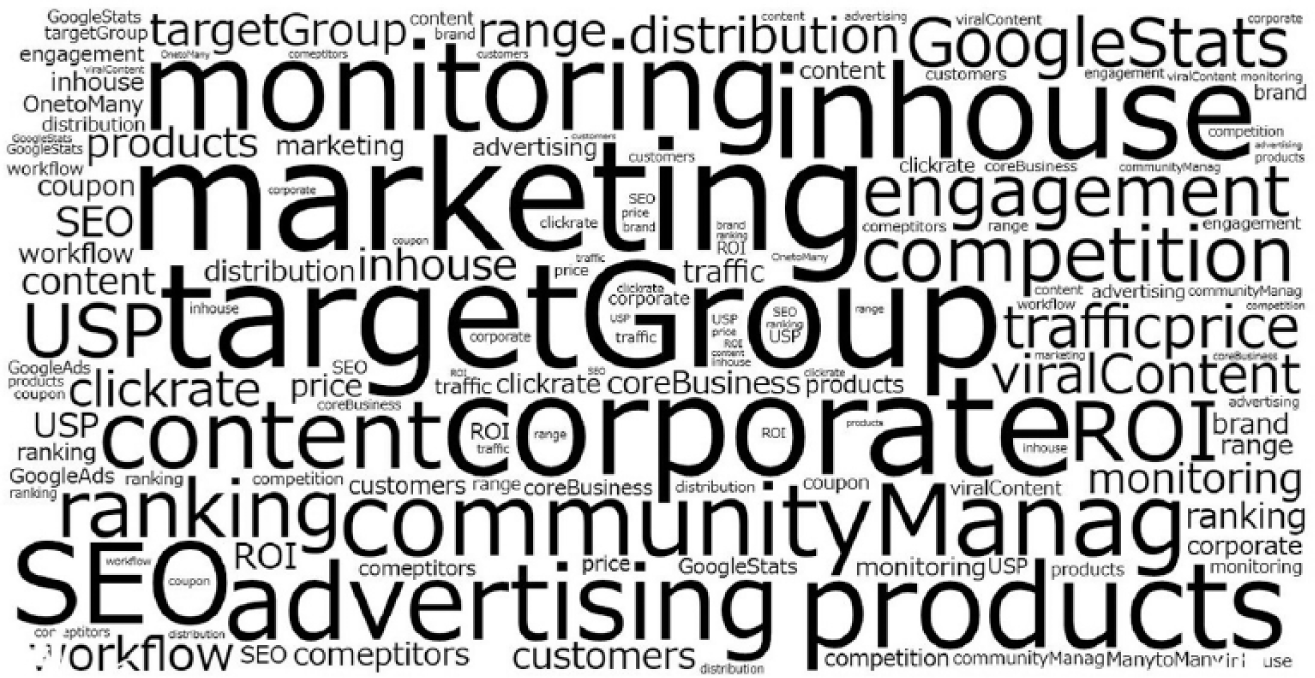
Word cloud.
Another indicator of the relevance of this market-oriented logic within the online communications of political interest organizations was the respondents’ focus on the importance of search engine optimization and the boosting of posts by paying for them.
Discussion and conclusion
In conclusion, the empirical findings highlight three aspects which are relevant in this context: processes of isomorphism, the importance of visibility and legitimacy, and language structures in the form of the marketing-jargon. In the following, we discuss those findings in light of the basic assumption of this article, which was that there is no unidirectional relationship between motives and structures and online communication activities in political interest organizations. Instead, their intentional and emergent strategies result from a dynamic interplay of motives, structures, environmental conditions, and online communication.
Concerning the debate on the differences between intentional and emergent strategies, the distinction of in-order-to and because motives illustrated that the online activities of interest organizations are not exclusively based on explicit goal-means-environment calculations but also on processes of isomorphism. We see that interest organizations act in reaction to the perceived requirements of the organizational environment. This involves that rational motives for using online media are developed retrospectively, after the medium has already been used for communication. Thus, within the online communications of political interest organizations, there are many elements of Weick et al’.s (2005) concept of sensemaking. This aspect has received little attention in political communication research, because the dominant perspective of intentional strategies and online media as a strategic tool to achieve predetermined aims makes it complicated to work with alternative approaches. This leads us to the estimation that concepts from new institutional theory combined with elements from process-oriented theories can help to understand the issue of strategic communication between the poles of intention and emergence. This is in line with newer developments in new institutional theory where institutionalization is no longer regarded as a simple stimulus-response model of organizational adaption to institutional requirements. Instead, the literature now highlights the dynamic relationship between organizations, institutional rules, and their meaning (see Fredriksson et al., 2013).
Likewise, the perceived differences between websites and Facebook concerning communication aims and recipient groups can be more easily interpreted, when we rely on isomorphism as a possible explanation. Regarding the use of Facebook, the interviewees had difficulties stating clear aims and recipient groups. This is easy to explain when we presume that in those cases, the launch of Facebook simply was an imitation of the environment and that the communication via Facebook is not yet as institutionalized as the communication via websites. A greater deal of institutionalization would mean that the individual actors do not only possess tacit knowledge about their own communication practices, but are able to talk about their practices conclusively and give consistent explanations for their motives and objectives. Whether communication via Facebook becomes as institutionalized as communication via websites remains to be seen. However, the comparatively clear communication aims and recipient groups that the interviews were able to give for Twitter lead us to the conclusion that the comparatively low institutionalization of Facebook is due not only to the novelty of the communications channel, but also to its functionality. The Facebook interface allows more variation in communication activities, and users can add applications or deactivate functions. Compared to that, activities on Twitter are more restricted because of its simple focus on reading or writing a maximum of 140 characters.
The dominance of the substantial communication aim ‘information’ concerning websites is consistent with existing research on the online activities of political organizations. In a 10-year reflective survey on the dialogic Internet principles introduced by Kent and Taylor (1998), McAllister-Spooner (2009) finds that websites are used to disseminate useful information, but are very poorly used dialogic tools. Others came to similar conclusions with regard to political parties (Lilleker et al., 2011; Schweitzer, 2008), SMOs (Stein, 2009), or public sector organizations (Macnamara, 2015). However, the findings that ‘information’ is above all to be understood as self-presentation and closely connected to the aspired visibility has not been discussed in those studies. We think this finding also points to the fact that the organizations in our study use online media to obtain legitimacy for their actions. Combined with the result that the most important target group are organizational members, we see that legitimacy is not primarily awarded by external publics, but by the organizational members as internal public. This finding is consistent with the concept of a membership-logic in interest group research (Berkhout, 2010, 2013). The concept describes that interest organizations orient their actions not only toward journalists and toward political actors (such as politicians and administrative officials) but also toward their members and supporters (for different logics see also Jentges et al., 2012).
The result that political interest organizations use signification codes that originate in marketing is another aspect that has not attracted much attention in political communication research. It is possible that the actors use signification codes from marketing and corporate communications because the actors evaluate this field as more strategically oriented and thus more appropriate. This would emphasize the argument that we should put the striving for legitimacy as the motivation for organizational practices at the center of our analyses. However, what does it mean when representatives of interest organization use signification codes that emphasize the economic and competitive side of communication activities? One possible interpretation is that interest organizations are becoming more business-like due to the use of online media. The mission-market tension that especially interests organizations and nonprofit organizations experience has more recently been discussed in the context of the professionalization and managerialization (Maier et al., 2014; Sanders, 2015). But we should be careful not to overinterpret the possible consequences of the marketing-jargon. From our data, we do not know whether the jargon is specific to online communication. Since this aspect has not received much attention in political communication research, it is also possible that the marketing-jargon is widespread in the field of political communication, due to the competitiveness of the political arena. Therefore, we think it is profitable to intensify research efforts in this direction and to combine the research field of organizational online communication with the linguistic analysis of signification codes.
This issue is also interesting for new institutionalism as organizational theory: it seems obvious that organizational actors are oriented not only to other organizations in their ‘organizational field’ (for more in the concept of organizational fields see DiMaggio and Powell, 1983) but also beyond the borders of these fields. This should also overtly expand the theoretical concept of organization fields. Today, actors look more at the organizations in other organizational fields, as it was the case at the beginning of the 1980s when the isomorphism concept was first formulated. Since online media increase the observability of all kinds of organizations, they broaden the range and frames of reference for processes of mimetic isomorphism. Therefore, the possible role models in online communications are becoming much broader and manifold than before (see also Donges and Nitschke, 2016).
Footnotes
Acknowledgements
This manuscript has not been published elsewhere and has not been submitted simultaneously for publication elsewhere.
Declaration of Conflicting Interests
The author(s) declared no potential conflicts of interest with respect to the research, authorship, and/or publication of this article.
Funding
The author(s) disclosed receipt of the following financial support for the research, authorship, and/or publication of this article: This work was supported by the German Research Association, research group ‘Political Communication in the Online World’, subproject 5, Grant number 1381.
