




Abstract
Despite persistent gender inequalities, the public relations (PR) industry in the United Kingdom has historically reflected unease with feminism. However, indications of a ‘new feminist visibility’ raise significant questions. Do these feminist moves reflect a blossoming of feminist practice in the PR industry? Or rather, in an occupation that is strongly intertwined with neoliberalism and promotional culture, is the PR industry emblematic of a highly individualised ‘neoliberal feminism’ and a postfeminist sensibility in which ‘multiple and contradictory ideas’ coexist? Adopting Edley’s discourse analysis framework, data drawn from interviews with seven senior female practitioners, supported by observational data, were critically explored in relation to the literature in gender sociology, cultural studies and feminist literature in PR. While the online presence of women’s networks in PR provide evidence of a feminist visibility to address inequalities, the ‘subject positions’ and ‘interpretative repertoires’ in the data were characteristic of neoliberal feminist individualism that calls upon women to provide for their own needs and aspirations through ‘self help’ measures. Furthermore, while sex discrimination in the PR industry featured prominently within the discursive repertoires of some participants, inequalities in everyday agency practice were either left unchallenged in response to client expectations or tackled through individual actions. Contradictory repertoires, including the repudiation of sexism, were indicative of entrepreneurial discourse and a postfeminist sensibility. Senior PR women providing client services appear to have limited scope beyond individualised, performative strategies to challenge the structures that perpetuate inequalities in PR and bring about transformative change. Although findings are limited to a small-scale study, this article contributes a unique perspective of the intersections between neoliberalism, third wave feminism, postfeminism and performativity within the UK PR industry.
Introduction
The central question which provides the starting point for this research is whether, in light of the ‘extraordinary visibility’ (Gill, 2016: 617) of feminism in the media and popular culture, a new feminist consciousness is emerging among a generation of senior women in the UK public relations (PR) industry? This question is relevant now because historically, the PR industry in the United Kingdom has been characterised by a denial of sex discrimination and gendered work and the absence of a feminist consciousness among female PR practitioners (L’Etang, 2015; Yaxley, 2013).
I argue that a ‘new feminist visibility’ is perceptible in the UK PR industry. This perception is based on the higher profile of women’s networking organisations on social media (e.g. Women in PR (WIPR), 2018), gender pay policies of professional associations (Chartered Institute of Public Relations (CIPR), 2018a; Public Relations and Communications Association (PRCA), 2018) and the surrounding discourse of pay inequalities between women and men (‘gender pay gap’) in the media (Gill, 2016).
Drawing on the literature in gender sociology, cultural studies and feminist literature in PR, the aim of this article is to explore senior female practitioners’ discourse in relation to feminism and gender equality. The assumptions underlying this study are that, while a new feminist visibility might be perceptible in the UK PR industry, feminist practice may be constrained when PR itself, particularly PR consultancy/agency practice, embodies the ideas of neoliberal capitalism, and is tasked with promoting those ideas (Cronin, 2018). Neoliberal capitalism, as discussed, has a tendency to appropriate ideas of equality (e.g. female empowerment), turning them into highly individualised assets, while emptying them of their original potency in arguments for collectively driven social change (Rottenberg, 2014). Furthermore, the notion of a ‘postfeminist sensibility at work’ (Gill, 2016; Gill et al., 2017) enables the study of multiple, contradictory ideas that coexist within contemporary discourse. Postfeminism is thus complementary to neoliberalism when it comes to interpreting the discourse of senior female PR practitioners.
In this article I adopt a reflexive, qualitative and interpretive approach which is consistent with feminist inquiry. Reflexivity in feminist research involves ‘attending systematically to the context of knowledge construction, at every step of the research process’ (Eriksson and Kovalainen, 2016: 276). I do this by acknowledging my position as a White British, heterosexual feminist PR researcher working within a critical-interpretivist paradigm. In acknowledging my own feminist stance, which advocates for social change, my interest is in how female practitioners construct their identities as PR agency directors and entrepreneurs and how they position their practice in relation to feminism and gender equality. Qualitative, interpretive work is important and necessary because, in revealing the subject positions of senior female PR practitioners, we can begin to understand how social structures are reproduced. In this article, discourse is understood as ‘social action that is mediated through language’ (Eriksson and Kovalainen, 2016: 232), and the specific cultural meanings, or ways of talking about a topic (i.e. gender), that structures the PR profession. Specific patterns of talk are referred to as ‘interpretative repertoires’ drawing on Edley’s (2001) discourse analytic approach in social psychology. The discursive repertoires of senior female PR practitioners, in turn, are shown to resonate with theoretical categories in the literature.
In focusing on feminism and PR, this article responds to calls for PR studies that offer critical insights into the ‘ways feminism is simultaneously embraced and rejected’ within postfeminism (Fitch, 2015:58) as well as how postfeminism intersects with neoliberalism (Edwards, 2018). It also responds to L’Etang’s (2015: 366–367) call for studies that contextualise ‘women’s labour in public relations with broader socio-economic factors’, the relevant factor in this article being neoliberalism and how neoliberalism has tamed feminism in the 21st century.
The paper begins with an overview of the limited literature on historical discourses of gender within the UK PR industry (L’Etang, 2015; Yaxley, 2013). While two papers provide limited historical evidence of attitudes towards gender within the UK PR industry, they contribute a suitable rationale and reference point for the work presented in this article. The paper then moves on to define and discuss neoliberalism and its relationship with PR since the early 1980s, drawing on work in urban geography (Harvey, 2005), political economy (Eagleton-Pierce, 2016) critical PR (Moloney, 2006) as well as Miller and Dinan’s (2000) and Cronin’s (2018) sociological analyses of PR and neoliberalism. A discussion of postfeminism, neoliberal feminism and third-wave feminism follows, based on conceptualisations largely found in cultural studies (e.g. Gill, 2007, 2016; McRobbie, 2009; Rottenberg, 2014) and in gender sociology and organisational studies (e.g. Budgeon, 2013; Gill et al., 2017). This literature is useful in examining the complex relationships between neoliberalism and feminism, as well as neoliberalism and postfeminism, and offers ways to analyse women’s discourse.
A brief examination of feminist theory in PR and postfeminism follows. Some of this literature argues that PR’s postfeminist cultural identity, for example, found in representations of the profession in TV shows, has shaped practitioner subjectivities and performativity (Edwards, 2018). The notion of ‘a new feminist visibility’ (Gill, 2016) in the PR industry is then explored, focusing on senior women’s networks and their activities, as represented on websites and social media. A discourse analysis of semi-structured interviews with seven senior-level female PR practitioners is presented. From analysis of this data, supported by field notes of personal observations in three agencies, I draw out patterns or ‘interpretative repertoires’ of talk about gender in PR, linking them to earlier theoretical discussions of neoliberalism, postfeminism and feminism. From this analysis, I then go on to discuss the discursive repertoires from this research and draw conclusions based on the central question concerning a new ‘feminist visibility’ in the UK PR industry. What does a new feminist visibility in the PR industry look like? Are women’s networks a manifestation of ‘neoliberal feminism’ (Rottenberg, 2014) and thus a means for senior women to realise highly individualised career goals? Or do they also represent collective efforts for change on behalf of all women in PR practice (and beyond)? Furthermore, do senior-level female PR practitioners discursively construct their identities as feminists and/or agents for change in achieving gender equality? Or are repertoires more indicative of neoliberal feminism (Rottenberg, 2014) and a ‘postfeminist sensibility’ (Gill, 2007) characterised by the coexistence of ‘multiple and contradictory ideas’ (Gill, 2016: 622) which, ultimately, do not threaten the status quo?
PR practice’s unease with feminism: Historical discourses
PR studies that combine history with gender are few (L’Etang, 2015). L’Etang notes that within the context of 1960s Britain, the work of female PR practitioners was often invisible and ‘backstage’, with men fronting the profession. Some of L’Etang’s male and female interview participants, who were active in the 1950s and 1960s, before the advent of second-wave feminism, viewed PR as a ‘sexless trade’ where being a man or a woman ‘didn’t matter’. Consistent with the ‘denial of gendered work’ was ‘denial of any sexism’ (L’Etang, 2015: 364), despite the structural conditions at the time of women being employed ‘largely in subordinate roles and restricted to the domestic economy and the gendered fields of beauty and fashion’ (L’Etang, 2015: 366). The denial of gendered work among those who were practitioners at the time suggests that PR in the 1960s, was not only a ‘force for conservatism’ in its promotional practices, but that ‘professional’ expertise based on binary gender ideologies were a part of this (L’Etang, 2015: 366).
Further insights into the career experiences of a later generation emerge from Yaxley’s (2013) oral histories study. Her female subjects, who were employed as PR practitioners in the United Kingdom during the 1970s and 1980s, revealed high levels of personal agency and ‘feisty’ self-efficacy in overcoming career barriers such as misogynistic colleagues and gender inequality. However, six out of the seven ‘successful’ women interviewed did not see themselves as change agents opening up opportunities for younger generations: indeed these participants were critical of subsequent ‘girly’ generations, who they perceived did not have to fight for their positions. The lack of a ‘feminist consciousness’ (Yaxley, 2013: 161) among those interviewed, alongside an apparent alignment with masculine professional identity (Yeomans, 2013), provides evidence, albeit limited, that have historically pursued an individualistic pathway, while supporting the patriarchical ordering of the profession. Thus, it may be argued that the historical gender hierarchy of PR observed in the demarcation of gender roles (managerial/technical skills), and specialisms (e.g. corporate affairs/consumer sectors) continue to resonate (Fitch and Third, 2013).
In the United Kingdom, despite women being overrepresented in PR (at 64%), only 36 percent of women are at board level and there is a ‘gender pay gap’ of £6,000 (CIPR, 2018b). As a consequence of these conditions, gender pay and the problem of ‘unconscious bias’ (CIPR, 2017) in the hiring and promotion of women to senior-level jobs are policy priorities for two professional membership associations, the CIPR (2018a) and the PRCA (2018). While inequalities prevail, it is important to sketch out the neoliberal political-economic context relevant to this article. An understanding of neoliberalism is essential to examining the context within which PR has flourished within the past 40 years.
Neoliberalism and PR
Neoliberalism is characterised by an institutional framework in which ‘strong private property rights, free markets, and free trade’ are advocated (Harvey, 2005: 2). Within this framework, human well-being is considered best served by ‘liberating individual entrepreneurial freedoms and skills’ (Harvey, 2005: 2). As a result of the widespread adoption of neoliberal ideas, neoliberalism has become ‘hegemonic as a mode of discourse’ in that it has become taken-for-granted in our way of understanding the world (Harvey, 2005: 3). Some of the key concepts associated with neoliberalism include freedom, choice, entrepreneurship, flexibility and networking (Eagleton-Pierce, 2016). Indeed, as Eagleton-Pierce (2016) demonstrates, the lexicon of neoliberalism is extensive and pervasive. However, each of the concepts referred to, while ostensibly positive in tone, is problematic on further examination. Some of these concepts will be explored in this article.
A crucial turning point for PR growth in the United Kingdom was the ‘tilt to the market in government policy’ arising from the election of a Conservative government in 1979 (Miller and Dinan, 2000: 12). To enable the new market-orientation to develop, PR expertise of various kinds was required: first to support policies that would privatise the national utilities; second to provide promotional support that would enable the newly privatised companies to compete in national and international markets; and third to support deregulation of city financial institutions and their associated professions such as law and accountancy (Miller and Dinan, 2000). In subsequent decades, the PR industry continued to expand to become part of a broad ‘promotional culture’ which is linked to the ‘intensive and extensive development of the market as an organizing principle of social life’ (Wernick, 1991: viii). This has led some critical PR scholars, such as Moloney (2006), to critique PR’s pervasiveness in society, given that ‘[it] pours a Niagara of persuasive attitudes, words, visuals and events on liberal democracies’ (p. x). The erosion of liberal democracies is a critique taken up by Cronin (2018), who argues that the process of neoliberalisation rearticulates relationships, including political institutions’ and charitable organisations’ relationships with the public, as consumer-citizens. This process, in turn, reconfigures promotional culture as of greater social and political significance, displacing conventional democracy as representation with a ‘commercial democracy’ that creates market-orientated forms of social contract. As both Western and non-Western democracies have become imbued with market ideologies, so has feminist politics, which I now go on to discuss.
Postfeminism
Postfeminism is a term used by the cultural theorist Angela McRobbie (2004), to describe a ‘double entanglement’ of coexisting beliefs and values about gender, sexuality and family life that emerged around 1990. Her oft-cited conceptualisation of postfeminism as ‘a process by which feminist gains of the 1970s and 1980s are actively and relentlessly undermined’, is based on the notion that feminism had achieved its aims and was ‘no longer needed’ (McRobbie, 2009: 11–12). This notion has been consistently reinforced due to the ‘mainstreaming’ of feminist values (‘liberal, equal opportunities feminism’) in institutions such as government, law and education. Indeed, postfeminist culture is powerful because, as a ‘feminist substitute’, postfeminism takes feminism ‘into account’ by appropriating words such as ‘empowerment’ and ‘choice’, converting them into a ‘much more individualistic discourse’ which has entered popular culture (McRobbie, 2009: 1). In turn, such processes have produced a model of female success based on ‘female individualism’ rather than feminist politics (McRobbie, 2009: 16). McRobbie’s ideas underpin much recent theorising on postfeminism in organisations (e.g. Adamson, 2017; Gill et al., 2017; Lewis, 2014).
In contextualising postfeminist culture, McRobbie (2009: 29) cites the work of Lisa Duggan (2003), who argued that the ‘undoing’ of social movements was a ‘priority within the discourses of neoliberalism’. Here, neoliberalism is identified as ‘the implanting of market cultures across everyday life’, while championing apparently ‘non-racist and non-sexist language of self-esteem, empowerment and personal responsibility’. ‘Neoliberal feminism’, in turn, ‘forges a feminist subject who is not only individualized but entrepreneurial in the sense that she is oriented towards optimizing her resources through incessant calculation, personal initiative and innovation’ (Rottenberg, 2014: 422). Furthermore, neoliberal feminism has increasingly become embedded in popular culture. Rottenberg (2014: 426) critiques Sheryl Sandberg’s (2013) best-selling ‘manifesto’ Lean In as particularly emblematic of neoliberal, individuated feminism (conjuring up a ‘discrete and isolated feminist consciousness’) that replaces mainstream liberal feminist ideas of social inequality. Therefore, far from pursuing collective equality, women’s journey to the top is highly atomised: ideas of solidarity give way to ‘own particular development’ and ‘own self care’ (Rottenberg, 2014: 426–428).
Turning to the organisational context of postfeminism, gender theorists Gill et al. (2017: 228), argue, following McRobbie (2009), that to equate postfeminism with anti-feminism, overlooks the current ‘gender regime’ which entangles ‘feminist and anti-feminist ideas’ (Gill et al., 2017: 229). Thus, they argue, there is a need to adopt a broad ‘postfeminist sensibility’, particularly when examining contemporary discourses in organisations (Gill, 2007; Gill et al., 2017), as summarised below:
There are a number of broadly agreed upon features of postfeminism as a distinctive sensibility: a focus upon empowerment, choice and individualism; the repudiation of sexism and thus of the need for feminism alongside a sense of ‘fatigue’ about gender; notions of make-over and self-reinvention/transformation; an emphasis upon embodiment and femininity as a bodily property; an emphasis on surveillance and discipline; a resurgence of ideas of sexual difference. (Gill et al., 2017: 228)
Gill (2016) concludes that despite recent attention to feminism heightened in the media and popular culture, which she identifies as a ‘new feminist visibility’ (e.g. the United Nations’ HeforShe campaign; Hillary Clinton’s campaign for the US presidency; the Hollywood gender pay gap and ‘New Gen Fem’ and its association with the ‘millennial’ generation), postfeminism retains its potency as a category for critical examination of these developments. However, interrogating the discourses of senior female PR practitioners in PR presents definitional as well as interpretative challenges, as I go on to demonstrate in the following discussion of third-wave feminism.
Third-wave feminist contradictions
It is important to draw distinctions – if that is indeed possible – between third-wave feminism and postfeminism, particularly in attempting to identify which ‘brand(s)’ of feminism have gained ground in contemporary PR. Like postfeminism, third-wave feminism is associated with the post-1990 era. Similarly, third-wave feminism is ‘a contested term’ and difficult to define (Budgeon, 2013: 279). Third-wave feminism rejects the presumed dogmatism of second-wave feminism; it instead allows emerging generations of women to define their own relationship with feminism within an increasingly complex world in which ‘difference’ and multiple gender identities and subjectivities are expressed: there is no one right way of being a feminist (Budgeon, 2013). Furthermore, Thwaites (2017: 56) argues that the ‘inspiring, positive and welcoming’ messages of freedom, opportunities and choice offered by popular third-wave feminism lends particular significance to the notion of ‘choice’. While ‘choice’ is a potent narrative that suggests the exercise of personal agency in women’s decision-making about their lives (e.g. whether to work or to stay at home; to marry or not marry), the absence of political engagement in these decisions undermines feminism’s purpose as a force for change. Rather, ‘choice feminism’ (coined by Hirschman, 2006) supports ‘patriarchal relations and norms’ (Thwaites, 2017: 66). Furthermore, Sørensen (2017) argues that the ‘vocabulary of choice’ represents a ‘double entanglement’ of neoliberalism and postfeminism, rendering ‘choice’ as performative. True choice is not always available, but the expression of individual choice, is. Therefore, in analysing women’s discourse in regard to feminism and gender equality, it is important not only to examine women’s identity construction but also how women deal with gender inequalities in their practice.
PR, performativity and postfeminism
Critical PR scholars note the dominance of liberal feminist, and to some extent, radical feminist theory-building in PR, arguing for research to address gaps that look beyond second-wave’s focus on equity towards broader social justice goals, not only in the lives of PR women, but among those communities that are influenced by PR (Daymon and Demetrious, 2014; Fitch, 2015; Fitch et al., 2016; Golombisky, 2015; Rakow and Nastasia, 2009, 2018).
Feminist PR scholars, in general, have side-stepped postfeminism, despite its utility in analysing, for example, narratives of acceptance of gendered divisions of specialism in PR (Yeomans and Mariutti, 2016). Rodgers et al. (2016) and Edwards (2018) argue that PR has a postfeminist identity which is reinforced through popular representations of PR work in two television series Absolutely Fabulous and Sex and the City; therefore to overlook postfeminism is to underestimate how cultural narratives have shaped and continue to shape contemporary feminine subjectivities. In contrast to feminist critiques of Sex and the City (McRobbie, 2004) including the postfeminist individualism of Samantha Jones (Johnston, 2010), young female professionals interviewed by Rodgers et al. (2016) spoke in admiration of the character of Samantha Jones as being ‘strong’ and ‘authoritative’. One early career participant related, in performative terms, about actively playing up ‘to the PR girl stereotype’ promoted in Sex and the City when talking to friends:
You never talk about the day [job] doing coverage reports, or doing content calendars or any of this kind of stuff. Or writing press releases. You talk about the amazing campaign you are about to launch; the event I went to last month.
The concept of gender as performativity (rather than as a cultural marker of biological difference), which originates from the work of Rakow (1986, 1989) and Butler (1990) ‘explains the way people are hailed to enact their multiple identifications, as visible and invisible’: in other words, gender as performativity is a communicative act (Golombisky, 2015: 408). Gender as performativity in PR (e.g. Tindall and Waters, 2012; Yeomans, 2013), alongside postfeminism, as already discussed, are powerful frameworks for interrogating practitioner identities and experiences within the industry. Gender as performativity in PR demonstrates ‘how approaches to gender and feminist theory that depart from the liberal and radical models can open up the theoretical landscape’, thus prompting questions concerning ‘the alignment of neoliberalism and postfeminist discourses in public relations industry narratives’ (Edwards, 2018: 193).
A new feminist visibility? Women’s networks in PR practice
I argue that a ‘new feminist visibility’ is perceptible in PR. This perception is based on the increasing prominence of women’s networking organisations and their activities on websites and social media (e.g. WIPR, 2018), gender pay policies of professional associations (CIPR, 2018a; PRCA, 2018) and the surrounding discourse of pay inequalities between women and men (‘gender pay gap’) in the media (Gill, 2016). Beyond these observations, it is worth looking a little deeper at senior women’s networking organisations as sources of women’s individual empowerment narratives that circulate within the professional sphere.
The websites and social media accounts of two senior women’s networking organisations in the United Kingdom present a range of initiatives that could be described as narratives of successful female empowerment. WIPR, which is affiliated to the international network Global WIPR (GWPR), was re-launched in 2015. It is also affiliated to the PRCA, one of the two main professional associations in the United Kingdom. WIPR has two membership categories: senior level and associate level, the latter aimed at mid-career women who aspire to senior level within the industry. WIPR administers the PR Week (2013) mentoring scheme and holds networking events. In a similar move as the UN’s HeforShe campaign (itself attracting criticism for ignoring patriarchy), one of WIPR’s initiatives involved appointing 10 male and female ambassadors to act as change agents to ‘help accelerate WIPR UK’s mission to increase the number and diversity of women in leadership roles and promote greater equality and diversity in the industry’ (Harrington, 2018).
A second women’s network, WACL, founded in 1923, ‘is an industry networking organisation that brings together the most senior female leaders in marketing and communications’. As a more established organisation, WACL’s website details a ‘future leaders’ bursary scheme for professional development, a calendar of events, including inspirational talks and meetings, and charity fund-raising. In addition, workshops are offered to provide inspiration for younger women in the industry (WACL, 2018). To commemorate the 100th anniversary of women’s suffrage in the United Kingdom, WACL’s (2018) Twitter account bore the banner of the women’s suffrage movement and the slogan ‘deeds not words’.
Nonetheless, similar to WIPR, WACL’s membership of ‘160 of the most senior women from the fields of advertising and communications, marketing, media and associated trade bodies’ suggests an exclusive club of individual, senior women who are largely engaged in networking for reasons of mutual support and personal advancement, rather than encouraging the progress of women in PR general. As Eagleton-Pierce (2016) remarks, ‘networking as the process of intentionally pursuing contacts for personal gain, is […] distinctly neoliberal’ (p. 127). Reviewing the visual imagery on women’s networking websites, one might observe that such networks represent exclusive ‘in-groups’ (Tajfel and Turner, 1979) that admit women who not only meet the elite status requirements for admission, but also share the attributes of ‘aesthetic entrepreneurs’: those who meet specific standards of beauty, ethnicity, class and demeanour set by the self-governing requirements of neoliberalism (Elias et al., 2017).
This short review of two women’s networks in PR, suggests an emerging feminist visibility in the UK PR industry. However, following scholarly analyses of Sandberg’s Lean In and other women’s leadership texts (Adamson, 2017; Rottenberg, 2014), the type of feminism suggested by the narratives of these networks is more aligned to neoliberal feminist and postfeminist notions of women’s individual enterprise, empowerment and advancement that does not extend much beyond the ‘discrete and isolated feminist consciousness’ (Rottenberg, 2014: 426) of senior practitioners.
Methodology
A qualitative study drew on a discourse analysis of semi-structured interviews of 1 hour in length, conducted with a purposive sample of seven senior-level, White British female PR professionals, mostly London-based, interviewed between February 2016 and January 2017. The original study from which this analysis developed was titled ‘the emotion management of professional relationships in the PR firm’ of which gender was a sub-topic. Five out of seven participants were recruited as industry contacts via my LinkedIn network. A sixth participant was recruited through a third party. All six were directors or partners of PR agencies. A seventh participant, whose involvement was central to understanding the objectives of a women’s networking organisation, was recommended by one of the six participants. As a development of the original project, new topics emerged during the data creation process. I was propelled by curiosity about women’s experience in PR, since, in common with the women in Yaxley’s (2013) research, I was among the generation recruited to a communication role in the 1980s who benefitted from 1970s equality legislation. In common with Yaxley’s participants, I found few obstacles to promotion in my twenties and thirties but at the same time, I learnt that I had to work within patriarchal structures (which included adopting a more masculine style of communication in some contexts) in order to progress. Later, in my academic career, I learnt to conceal my identity as a parent should I not be regarded as ‘serious’ enough about my career. Were women still caught up in masculine or gender neutral identity performance, or had third-wave ideas found their way into women’s professional discourse?
The purposive, small sample size was driven by a phenomenological ‘lifeworld’ approach (Kvale and Brinkmann, 2009) for which small, homogeneous samples are selected in order to generate rich understandings of intersubjective phenomena (Creswell, 2007). Given the problems of recruiting busy, senior-level industry participants, as well as negotiating access in order to conduct observations, I regard my access as privileged based on existing acquaintance, as well as sharing similar attributes to the participants. Nonetheless, my self-disclosure and performativity as a former practitioner, a parent and as a researcher were necessarily invoked in different situations with participants in order to establish empathic, trusting relationships. For example, one interview called upon a specific feminine identity performance as ‘busy woman’ in order to build rapport, considered important in conducting a meaningful interview (Eriksson and Kovalainen, 2016; Lindlof and Taylor, 2017).
Most participants identified as entrepreneurs, asserting a strong client focus. Five identified as parents and six appeared to be in hetero-normative relationships. That said, I did not seek out participants who identified with any particular class, gender, sexual orientation or ethnicity. Such characteristics could have provided more nuanced responses. However, given that the majority of senior women in the PR agency sector in the United Kingdom are White, the sample is typical of the PR field (CIPR, 2018b; PRCA, 2018).
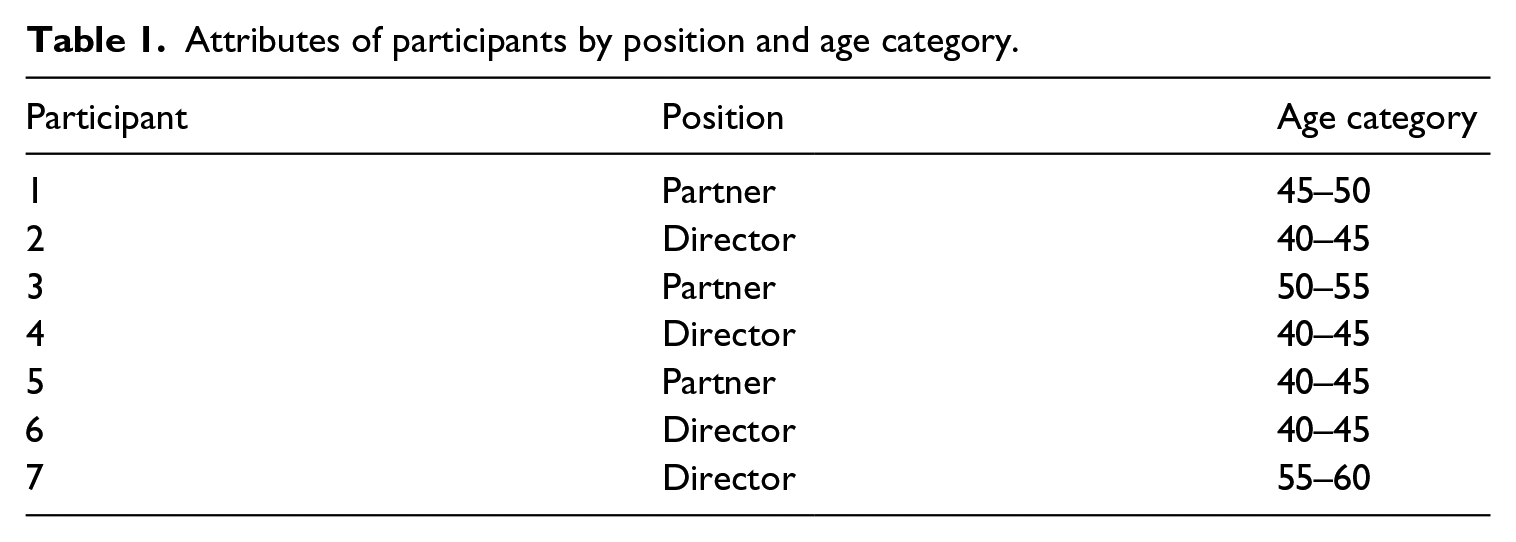
All participants were educated to first degree level and aged approximately between 40 and 60 (see Table 1). Six participants were based in London, and one was based near to my location in the north of England. I sought out London-based participants to enable a mix of career experience of small, medium-sized and large agencies. In addition, I spent a total of 18 hours in three London PR agencies, where I attended meetings and took notes based on observations and informal discussions with a further 12 employees. The purpose of the periods of observation was to further understand the day-to-day work of participants. Relevant notes were brought into this article to support and reflect on interview data. The anonymity of participants, their colleagues, organisations and contacts was agreed from the outset. To protect participants’ anonymity, some data are summarised.
Attributes of participants by position and age category.
My interest was in the identities that women PR practitioners claimed through ‘subject positions’ and ‘interpretative repertoires’, a framework advocated by Edley (2001) and adopted by Gill et al. (2017) in their analysis of ‘recurring interpretative repertoires that occurred in talk about gender inequalities at work’ (p. 232). Sørensen (2017) notes that the term ‘subject position’ ‘does not point to a personally defined and complex identity but rather to common ideas about how one can identify as a certain category of self’ (p. 302). ‘Interpretative repertoire’ refers to distinctive ways of talking about, or constructing, objects and events. The discourse analytical method involves reading and rereading transcripts to identify patterns across participants’ talk, including recurring metaphors or figures of speech (Edley, 2001). A third concept used by Edley (2001) is ‘ideological dilemmas’, which refers to lived ideologies or ‘common sense’ understandings. This is particularly relevant to interrogating postfeminist discourses as common-sense understandings characterised by ‘inconsistency, fragmentation and contradiction’ (Edley, 2001: 203). Combining Edley’s framework of subject positions, interpretative repertoires and ideological dilemmas with that of performativity, captures the situation in which discourses are produced. Furthermore, the discourse analytical approach outlined is common to feminist organisation studies as well as postfeminist analyses (Sørensen, 2017).
Most of the participant responses on gender issues in the workplace were co-created through one interview question: ‘When does being a woman influence the way in which you interact with colleagues/teams/clients’? Given that gender-related responses emerged across the interview transcripts, texts were inductively and openly coded, generating 50 coded statements that could be clustered according to theoretical categories identified in the literature. Observational data (recorded in note form) was analysed to question my own assumptions as well as the interactions I observed. For example, during the ‘crisis’ meeting called to discuss the departure of a female director, I questioned my subject position which I expand on later in the article.
Research questions
How do senior-level women in PR agencies, when discussing their career experiences and professional relationships, construct identities in relation to feminism and gender equality? Does the emerging feminist visibility in PR, discussed in relation to women’s networking, signal potential for transformative change (Golombisky, 2015: 409)? Or, is PR characterised by an individualistic ‘neoliberal feminism’ (Rottenberg, 2014) and postfeminist identity (Edwards, 2018; Rodgers et al., 2016) which limits strategies for change?
The interpretative repertoires of senior agencies
Seeking balance in the PR firm
The dilemma of ‘balance’ was a distinctive pattern across the interviews, but was manifested in different ways, with the most obvious association being that of balancing running a business with home life, usually interpreted as work-family conflict (Sørensen, 2017). Three participants constructed identities as women with parental responsibilities and the need to achieve a balance. Here, Participant 4 illustrates her dilemma as MD of her own successful PR firm as well as a parent and household manager:
As a woman, being a mum I think has definitely altered my outlook on flexible working […] at home I am still the primary carer and so I shoulder a lot more of the household responsibilities, despite my continual efforts to adjust that balance. (Participant 4)
While Participant 4 is explicit about the splitting of her attention and time across work and home life, her solution for achieving balance, is through flexible working, about which she has ‘altered her outlook’. This suggests a possible previous lack of tolerance for flexible working (i.e. for herself and for others), but now, flexible working is her way of managing her responsibilities. Flexibility is part of the neoliberal canon; however, as Eagleton-Pierce (2016) notes, the onus is always on the individual to be ‘ready to act and move in response to the needs of the market’ (p. 81). Participant 4 talks about her freedom to choose: ‘I am choosing to be at work rather than being a mum; spending time away from my children, so actually I really want a nice environment to work in’. Echoing Sørensen (2017), it would seem that Participant 4 was in a privileged situation in that she felt able to express individual ‘choice’ about working or being at home with her children.
Other participants talked about balance in different ways. For example, the lack of a gender balance at the most senior level of her agency generated feelings of isolation for Participant 2. While she did not expand on the ‘rough time’ she had experienced before going on maternity leave (this disclosure in itself was cautious), such an experience warranted the need for support upon her return to work:
I’d had quite a rough time before I went on maternity leave and I felt like I needed … my organisation’s quite male at senior level, in fact all my bosses are men and I just felt like … […] sometimes I didn’t really have an outlet to talk to anyone, so Women in PR, through PR Week, were doing this kind of mentoring scheme and I applied and got accepted. (Participant 2)
The discourse of tension between work and home life also underpinned two directors’ ‘crisis’ meetings that I attended at one agency, which were called to discuss the sudden departure of a highly experienced female board director. The business discourse of reputational risk with certain clients (in that they might see the departure of a high-profile individual as leaving a gap in expertise) was interspersed with intensive speculation about the former colleague’s personal, domestic circumstances, including her parental responsibilities, and possible reasons for her sudden resignation, such as the competing demands of her husband’s job. While no clear reasons for resignation had been given by the director herself, the unspoken issue was that balancing two high achieving careers with parenthood had proven too challenging. From this account, one is left to question whether such speculation would have taken place had the director been a man. Reflecting on my own career experience, I found myself judging the departed director through the lens of liberal feminism: did she not take her career responsibilities seriously enough? A researcher adopting the neoliberal ‘choice feminist’ position might have supported the director’s right to pursue her individual desires: perhaps choosing to be at home with her child, albeit from a possible position of privilege that may offer actual choice (Sørensen, 2017).
Seeking support: Networking in PR
Networking was discussed in relation to some participants’ personal need for career support, echoing Rottenberg’s (2014: 426–428) critique of neoliberal feminism as being concerned with ‘own particular development’ and ‘own self care’. As discussed earlier in this article, networking is a neoliberal concept, which involves intentionally pursuing contacts for personal gain (Eagleton-Pierce, 2016: 127). Participant 2 discussed a women’s networking organisation in positive terms for what it could offer both her and her team.
We found it so inspiring and so every year now, we send six to 10 girls on that, it’s like a one day conference and there’s like speed dating sessions and things like that around that as well. (Participant 2)
‘Speed dating’ refers to a business networking approach that enables professionals to attend an event in which they are introduced to new contacts every 2–5 minutes, until they have gradually built up a network (CareerVision, 2018). Such practices are part of individualised, commodifying practices (including personal branding) that constitute neoliberal careers, which Lair et al. (2005 328) argue have particular implications for women in terms of promoting a ‘feminine surface identity’: playing into postfeminism’s ‘notions of make-over and self-reinvention/transformation’ (Gill et al., 2017: 228). Nonetheless, Participant 2 associated this performativity with confidence-building. As an avowed feminist she wanted to ‘bring that out’ in her team: ‘I have got a lot of girls on my team and I like that; I really want them to do well and I want to inspire them and make them feel like there’s a future in it for them’. The use of ‘girls’ in this context is seemingly deliberate: Participant 2 enjoys that she is well placed to shape her colleagues’ careers, even ‘bring out’ the feminist in each one to help them challenge patriarchal structures.
Networking was not discussed in an equally positive light. Participant 6, also at mid-career, could not see any benefit from a popular women’s networking organisation in her sector:
[networking is] not my cup of tea because it’s just a load of women moaning about this glass ceiling and you just look around and think ‘you all own your own companies. What are you complaining about?’ But a lot of them have sold their agencies to big companies and then they’re not allowed to join the board. So you just think ‘well why did you sell it then?’ (Participant 6)
Here, the discourse is particularly individualised: ‘not my cup of tea’ expressing a lack of common ground with women in similar positions (i.e. owners of PR firms). Repudiation of the need for collective support in tackling the glass ceiling: ‘just a load of women’, aligns with the postfeminist notion of ‘gender fatigue’ which corresponds to a postfeminist ‘commonsense’ that gender equality is no longer an issue (Gill et al., 2017: 228). Nevertheless, the discourse presents a contradiction, which is indicative of a postfeminist sensibility (Gill, 2016). The comment ‘they’re not allowed to join the board’ hints at the recognition of patriarchal structures. Thus, the discourse moves on to blaming women for a loss of power in relinquishing control of their own businesses, because the penalty for doing this is all too obvious.
‘There is a generation of men’: Corporate sexism and giving women a voice
Patriarchal attitudes and openly sexist cultures were discussed as prevalent across the PR industry among four participants. The elevated positions and remoteness of some male actors from the lives of women drew the most criticism:
there is a generation of men – the ‘Boomasaurs’ – more in the city/financial side of PR who need to go with the times. Until they do we won’t see real change. They have a house in the city and country and no idea what it’s like for women working in an environment that continues to operate under male norms and ideas of equality. (Participant 1) Even in the most modern company, there still is this almost, like, unconscious bias. ‘Oh well this woman is of an age’, or ‘she’s just got married’ … and it shouldn’t even be part of the conversation and it still is. Whether you have a family or not … your career is coloured by that, I think. (Participant 3)
Agency boards were depicted as the sites of deeply entrenched beliefs and attitudes, rooted in gender and class structures: ‘a house in the city and country’, as well as divisions between generations, with reference to post-war generations: ‘Boomasaurs’, whose ideas were viewed as behind the times. ‘Unconscious bias’ in hiring and promotion practices meant that ‘people tend to gravitate towards and sponsor people who mirror them; meaning male leadership could be reproduced in senior management’ (CIPR, 2017:11). ‘Your career is coloured by that’ suggested that all women, irrespective of family responsibilities, were ‘marked’ (Puwar, 2004), since a woman’s marital status or age could be the basis of ‘unconscious bias’; and beyond that, perhaps, ethnicity and sexuality.
Unconscious bias was not limited to the hiring practices of PR agencies. A further comment ‘why are we focusing on people who are just talking about corporate affairs?’ (Participant 2) referred to the tendency for a select group of men to regularly raise their profiles as invited guest speakers of professional associations. Participant 2’s reference to ‘corporate affairs’ echoed that of Participant 1 when referring to the ‘city/financial side of PR’, suggesting not only a vertical gendered hierarchy in PR (i.e. by level of responsibility), but also segregation according to sector specialism. While gendered sector specialisms have historical roots in the post-war era, when women in PR were recruited to work with fashion clients (L’Etang, 2015), it would seem that little had changed.
‘Millennials’ working in PR were frequently described by participants as highly confident and ‘bright, questioning people’ (Participant 7); nonetheless, finding ways to deal with senior, male-dominated corporate behaviour was discussed as one way of supporting younger female employees. Participant 3 included herself when she talked about ‘a tendency to give way to our male colleague who maybe will speak a bit louder’. Therefore, as a board member, she made a point of giving younger people, often women, ‘a voice’ at meetings by deliberately including them in conversations. Participant 2, who self-identified as an avowed feminist, focused on encouraging an outward-looking approach to build social capital and personal visibility among her teams: ‘so I’m encouraging the girls to get involved in a lot of the organisations that are out there, to go and meet new people and network a bit more’. Repertoires of ‘giving younger women a voice’, enabling women to be heard both within the agency as well as outside it may be interpreted as deliberate, feminist acts, for, according to Rakow and Wackwitz (2004: 9), ‘to have voice is the opportunity to speak and the respect to be heard’, including situations where men dominate the conversation.
Not all participants in this study recognised the prevalence of discrimination. Gill et al. (2017) draw attention to a further discursive repertoire, which is that of consigning discriminatory behaviour to the past as a consequence of ‘gender fatigue’, noted earlier. When I questioned participant 7 on how being a woman might influence her interactions, she rejected the suggestion:
Maybe when I started in PR: in a way, that comment, ‘go and become a secretary, dear’ sort of summed it up, and I think it was a little bit more chauvinist then and there was definitely an expectation that you should be a little bit of a dolly and chat up everyone, but I don’t think that’s the case anymore at all. (Participant 7)
What is noticeable here, is that individual career experience of sex discrimination ‘go and become a secretary dear’ is not only consigned to the past in the belief that sex discrimination is no longer an issue, but that continued structural discrimination is unrecognised: ‘I don’t think that’s the case anymore at all’ (Gill et al., 2017). While I shared Participant 7’s past experience as a young woman in the workplace, I was puzzled that she did not appear to recognise the ‘gender gap’ debate in the PR industry. Yet Lewis (2006) argues that a gender-blindness, as well as a strong belief in merit and the neutrality of business among women entrepreneurs, may function as defences against possible questions of business competence and explain the ‘repudiation of sexism’ repertoire in this study. As noted earlier, entrepreneurial identities were strongly enacted in this study and entrepreneurship itself is gendered masculine or ‘gender neutral’ (Hamilton, 2013; Lewis, 2006).
‘I need a bloke in the room’: Performativity in accepting the status quo
The discourse of corporate sexism, however, raises the question of just how ‘empowered’ senior PR women can be to effect change in their professional interactions? While Participant 5 emphasised the instilling of feminist values through her agency’s in-company training, she also carefully balanced this with ‘my reality’, of handling clients, particularly ‘senior comms men’ and the requirement for gendered performance in the consulting/client relationship:
I’m setting up a meeting now because I need a bloke in the room, so I’m taking my CEO […] to be the bloke and the grey hair in the room […] you can see it’s inbuilt in their DNA, they’re far more comfortable working with or being around a balance of men [in consulting teams]. (Participant 5)
The conscious performativity presented in this discourse, ‘I need a bloke in the room’, is part of a repertoire of acceptance of the status quo (Gill et al., 2017), in that clients, here in the shape of ‘senior comms men’ are ‘far more comfortable working with or being around a balance of men’ a situation that appeared resistant to change, echoing earlier discourse surrounding the ‘Boomasaur’ generations. Therefore, in spite of the progressive ethos of the firm and the potential for overturning gender hierarchies, teams are ‘balanced’ to reflect the client’s expectations of gender scripts and gender displays enacted within the contexts of agency-client relations (Yeomans, 2013).
Sex difference: Women as the advantaged sex
The repertoire of sex difference, which positions women as the advantaged sex, is a further postfeminist repertoire highlighted by Gill et al. (2017). Participant 6 observed that women were attracted to the communications industry because it is ‘more of a female skill. We like to talk’. Participant 3 supported the notion of an ‘intuitive’ female management style: ‘some male colleagues would argue that they have, or try to have, a consultative, inclusive style. But it comes more intuitively to a woman’. Another participant referred to her female employees as ‘better organised’ than their male colleagues, compelling her to offer her male employees a book on stress-free productivity (itself indicative of the neoliberal requirement to work on the self). Here, the stereotype of woman as ‘natural born communicator’ (Fröhlich, 2004) is sustained. While women assert their superior communication skills above those of their male colleagues, in doing so they ‘essentialise’ communication and other PR skills such as organisation and time-management as inherent to female biology, thus potentially positioning themselves as limited in other ways. Critiquing Grunig et al.’s (2000) feminist values theory, Golombisky (2015: 398) argues that while the ‘strategic essentialism’ of feminist/feminine values theory in PR may not intend to position women as naturally feminine, these values can easily be read as biological destiny. The repertoire of sex difference is therefore indicative of a postfeminist sensibility in which contradictions are inherent (Gill, 2016).
Discussion and conclusion
In questioning whether there is a ‘new feminist visibility’ (Gill, 2016) in PR this article has employed an interdisciplinary perspective that draws on gender sociology, cultural studies and feminist PR literature in order to open up new avenues for researching neoliberalism and postfeminism in PR, hitherto underexplored. Although a ‘new feminist visibility’ is emerging in the UK PR industry, evidenced by the activities of networking organisations such as WIPR (Harrington, 2018), together with gender pay policies developed by professional associations (CIPR, 2018a; PRCA, 2018), we must interrogate these apparently progressive moves. While it is plausible to suggest that PR is experiencing nascent feminism, missing from historical accounts in the United Kingdom (L’Etang, 2015; Yaxley, 2013), such an assessment may be optimistic in terms of feminist, transformative change proposed by Golombisky (2015).
The PR agency sector, which is the focus of this article, is deeply intertwined with neoliberal capitalism and promotional culture (Cronin, 2018; Miller and Dinan, 2000). Therefore, it is perhaps unsurprising that ‘seeking balance in the PR firm’ and ‘seeking support: networking’ reflected the popular discourse of neoliberal feminism (Rottenberg, 2014) and ‘choice feminism’ (Sørensen, 2017; Thwaites, 2017). These modes of feminism call upon women to provide for their own, individualised needs and aspirations: to achieve a balancing act that does not threaten the status quo either at work or at home, which Gill (2016: 618) refers to as the ‘acceptable face of feminism’. Furthermore, even though sexism within the PR agency sector was recognised, inequalities in everyday agency practice were left unchallenged in response to client expectations (‘I need a bloke in the room’) or tackled through relatively low-key individual actions (‘giving younger women a voice’). Perhaps the most emphatically ‘feminist’ action was that of supporting young women’s networking activities. While performative networking practices are inescapably part of the ‘self-help’ philosophy of personal branding (Lair et al., 2005), they are perhaps a logical step for those working in the PR agency sector, in which branding strategies are offered as a core service to clients.
In providing this critique, my purpose is not to undermine women’s efforts in tackling inequalities in PR but to expose the limitations in doing so. Female PR entrepreneurs running their own businesses face a double bind of balancing their own work-home conflicts, as well as striving for harmonious, equitable workplaces for their employees, yet they are constrained by the prevalence of popular self-help narratives on ways to be a feminist in a leadership position (Adamson, 2017; Gill, 2016; Rottenberg, 2014; Sørensen, 2017). While there exists the potential for enacting structural change among some senior PR women, this potential is subject to continuing compromise within existing patriarchal and neoliberal structures. Thus, the ideal of a collective, transformative change remains elusive when professional conduct in PR, including its ‘network of accountabilities’ to key actors, including clients (Fournier, 1999), is self-regulated by the ‘internalised’ norms and values of the market. Despite third-wave feminism’s acceptance of intersecting identities and different ways to be a feminist (Budgeon, 2013), it seems that modes of feminism are necessarily constrained by the ‘disciplinary logic of professionalism’ (Fournier, 1999) within the UK PR agency sector. Contradictory repertoires, including the refutation of sexism in PR, were indicative of entrepreneurial discourse (Lewis, 2006) and PR’s postfeminist and performative identity (Edwards, 2018; Rodgers et al., 2016).
This article contributes a unique perspective of the intersections between neoliberalism, third wave feminism, postfeminism and performativity within the UK PR industry. The findings of this study are limited to a small, purposive sample of senior female agency practitioners in the United Kingdom. Therefore, more research is required to substantiate these findings and interpretations from the PR agency sector, as well as to explore women’s discourse in different contexts including the corporate, public and third sectors. Further research should also seek participation from a more diverse sample of women to open up conversations about PR’s potential to address not just PR women’s individual career advancement but social justice issues for women globally, including those women who are the targets of PR campaigns (Golombisky, 2015; Vardeman-Winter et al., 2013).
Footnotes
Acknowledgements
The author thanks two anonymous referees and the editors for their highly constructive comments which helped to shape this paper. A special thank you to the women who participated in the study and facilitated the field visits.
Funding
The author(s) disclosed receipt of the following financial support for the research, authorship, and/or publication of this article: The author received financial support for the research in this article from Leeds Beckett University.
