



Abstract
Issues managers have power over defining issues and legitimizing their importance. While discussion has increased about organizations taking a stand on polarizing social issues, there remains a gap in the issues management literature on how to address stigmatized issues, particularly those with a gendered component. This article offers a revised set of issues motivators that better encompass the gendered and emotional components of issues and guiding questions to assist issues managers in ensuring that organizational policies and practices are more inclusive. Finally, the emotional underpinnings of all phases of the issue life cycle are considered.
The past 2 years have increasingly brought to light issues of sexual assault and harassment. From the #MeToo movement to the Larry Nassar scandal, organizations are being held accountable for their inaction in such cases. One of the most damning revelations is how far back many of the warning signs were in these cases, and the lack of proactive response by any of the multitude of organizations under investigation for their complicity in allowing abuse to continue. Organizations often do not want to or know how to deal with issues of sexual assault and harassment in part because these issues are gendered, emotional, and complex, meaning they are only dealt with at the point that they have become a crisis and legal issue for the institution.
However, public relations offers little theoretical or practical guidance for how communicators can most effectively deal with the gendered and emotional dimensions of issues. Yet, as public relations continues to define itself as a realm of academic inquiry, I argue that public relations scholars have a moral imperative to fully consider gender and emotion, and concomitant issues of power and inclusivity, in our theories in a way that can provide guidance to the practitioners in our field. One area of scholarship that has the potential to assist practitioners in the handling of gendered and emotional dimensions of issues is issues management, described as ‘the strategic core’ of public relations (Botan and Taylor, 2004: 654). However, current issues management approaches are not without limitations. With a focus on the rational assessment and prioritization of issues, aspects of issues management have been positioned as ‘value-neutral’ (Logsdon and Palmer, 1988: 192). As Harding (2004) posited, ‘the more value-neutral a conceptual framework appears, the more likely it is to advance the hegemonous interests of dominant groups’ (p. 6). Expanding upon social issues management (Coombs and Holladay, 2018), this research interrogates the need to better account for the gendered and emotional dimensions of issues. By using the example of sexual assault on college campuses, this article demonstrates how considering emotion and gender in defining an issue can alter approaches to management in ways that forefront empathy and inclusivity.
Defining issues
Issues do not simply exist out in the world waiting to be discovered. Rather, issues are socially constructed, created through a process of meaning making and discursive negotiation (Hallahan, 2001; Heath, 2006). While problems are experienced at the individual level, issues emerge from the sharing of these problems (Hallahan, 2001). Because of this, communication plays a vital role in the construction of issues, identification, and shared meaning making ‘as people analyze, define, delimit, and label problems’ (Hallahan, 2001: 28). Typically, people are motivated to address issues that are related to them in some way.
Writing primarily in relation to a corporate context, Heath and Palenchar (2009) argued that there are four primary motivators for how issues are defined and shaped: (1) security: the extent to which business practices or products are thought to pose unreasonable risks to publics, (2) equality: assessment that all persons are treated the same, (3) environmental quality: value judgment on environmental regulation, and (4) fairness: the value on the product or exchange. Distilling issues down to their core can help with issue monitoring and ‘sharpen strategic planning and shed light on how publics recognize and define issues’ (Heath and Palenchar, 2009: 32). These issue motivators are important to recognize because they are at the heart of the legitimacy gap – the difference between what companies are thought to be doing and what publics expect them to be doing (Sethi, 1977). Legitimacy is considered central to issues management, and differences of fact, value, and policy between publics and organizations contribute to this gap (Heath and Palenchar, 2009). Given the social construction of issues, it is understandable that an organization and various publics perceive issues in a multitude of ways (Jaques, 2004). How an issue is defined can impact its perceived legitimacy.
Importantly, though, issues are rarely unidimensional and simply defining an issue requires a ‘thorough, cross-functional understanding of the problem’ (Jaques, 2004: 192). Yet, because of the various professional and personal experiences people bring to bear on an issue, even figuring out what an issue is can be difficult. This becomes even more challenging when we consider social issues – problems that affect a large portion of society, which often have a high degree of polarization related to political ideologies (Coombs and Holladay, 2018). The next section considers the evolution of issues management over the past several decades to respond to and subsequently shape issues.
The role of issues management in defining and legitimating issues
As the executive function of strategic public relations, issues management frequently works to identify and handle ethical issues for an organization (Bowen, 2005). Jones and Chase (1979) offered the first model of issues management as a proactive public relations venture. This model proceeds in five steps: (1) issue identification; (2) issue analysis; (3) issue change strategy options – reactive, adaptive, dynamic; (4) issue action program; and (5) issue evaluation. Subsequent models were developed from this, most notably the catalytic issue management model (Crable and Vibbert, 1985). Crable and Vibbert (1985) argued that the Jones and Chase (1979) model, although discussed as proactive, was still highly reactive to external conditions. Instead, they posited that the goal of issues management was to take an issue through its life cycle, based on situational assessment and goal-establishment for issues on which an organization can catalyze change. Therefore, Crable and Vibbert (1985) advocated for a fourth strategy, which is the catalytic strategy of change. Beginning earlier in the issues management cycle than even the dynamic strategy of change, rather than focusing on trends in the environment, the catalytic strategy of change first tasks an organization with determining ‘what it is, what it wants to be, and how the environment could be altered to the advantage of the organization (which still seeks to be a responsible part of society)’ (Crable and Vibbert, 1985: 10). Unlike earlier models, the catalytic model emphasized organizations creating an issue to influence their operating environment (Coombs and Holladay, 2018).
Organizations that wish to catalyze an issue work to move it through each phase of the life cycle. Crable and Vibbert (1985) offered a five-stage life cycle of issues: (1) potential, (2) imminent, (3) current, (4) critical, and (5) dormant. Potential status occurs when a person or group demonstrates interest in an issue. Imminent status means that the potential of the issue is accepted by others. Current status has a two-part meaning: (1) the issue is of present interest and (2) it is an accepted topic of conversation or concern, often receiving widespread media coverage. Critical status emerges when people or groups identify with some side of the issue, making it a moment of decision or when the issue reaches fora of decision-making. Finally, the dormant stage occurs when issues are ‘resolved’ or have been dealt with in some way. However, ‘the dormancy of a resolved issue can be disturbed when someone – at a later time, under new circumstances – sees the potential of the issue again’ (Crable and Vibbert, 1985: 7).
Importantly, these earlier models of issues management were focused more specifically on policy issues, although over time have expanded to focus on a proactive strategic communication function more broadly (Heath, 2005). We now see an increasing interest in the management of social issues as described previously. To catch up theory with practice, Coombs and Holladay (2018) proposed the social issues management model as an update to the catalytic issues management model. Specifically, this model attempts to recognize the increasing call for corporate social advocacy in the current digital media environment (Coombs and Holladay, 2018).
One of the primary differences between the issue catalyst model and the social issues management model is the removal of the public policy making process. Instead, social issues management focuses on the private politics space, meaning that change is advocated for at the organizational level rather than the public policy level (Coombs and Holladay, 2018). Organizational leaders, rather than politicians, become the decision-makers for many issues. Furthermore, the social issues management model moves away from stages of issues management to focus on the communicative tasks (Coombs and Holladay, 2018). Importantly for this project, a key communicative task of this model is defining an issue and building legitimacy (Coombs and Holladay, 2018). Because of the polarization of social issues, this becomes critical not just at the beginning of issues management but throughout the process. Coombs and Holladay (2018) noted that ‘there is power in definitions and by controlling the definition of the issue, issues managers gain an advantage in the process’ (p. 83). This is an incredible amount of power for organizational leaders – many of whom occupy spaces of privilege – to shape how social issues are understood by public.
While there has been increasing discussion about organizations taking a stand on polarizing social issues, there remains a gap in the issues management literature on how to address stigmatized issues, particularly those with a gendered component. So how can issues that a society does want to or know how to talk about be defined and legitimized?
Stigmatized issues
Goffman (1963) defined stigma as a label that attaches discrediting characteristics to a person’s identity. Stigma is associated with blame, shame, social exclusion, discrimination, secrecy, and isolation (Crowe and Murray, 2015). Link and Phelan (2001) further explained that ‘stigma exists when elements of labeling, stereotyping, separation, status loss, and discrimination occur together in a power situation that allows them’ (p. 377). When thinking about issues management, we must consider how those in positions to define issues may confer stigma either knowingly or unknowingly by perpetuating silence and invisibility around certain issues (Dimitrov, 2015).
Many stigmatized issues are researched in the context of health and interpersonal communication, such as HIV prevention messages (Campbell and Babrow, 2004), mental health (Smith and Cashwell, 2011), addiction (Corrigan et al., 2009), and domestic and sexual violence (Murray et al., 2016). There is a small but growing body of literature that ties together stigma with research into organizational contexts. This has focused primarily around stigma management for organizations in the aftermath of scandals (e.g. Warren, 2007) and using public relations to overcome stigma related to certain professions (e.g. Pressgrove et al., 2019).
In 2008, a special issue of the Academy of Management Review looked specifically at stigmatization in and of organizations (Paetzold et al., 2008). Stigmatized individuals may face discrimination within organizations and develop negative self-identities as a result (Ragins, 2008). Furthermore, stigmatization can undermine the cohesiveness and morale of an organization (Kulik et al., 2008). However, stigmatization can have some overlooked positive effects as well, such as collective action to combat the validity of the stigma. Paetzold et al. (2008) wrote that ‘a stigma can be a call to action to overcome discrimination and restore justice’ (p. 191). More work needs to be done to understand stigma as part of the issues management process. Individuals and organizations that are stigmatized can lose legitimacy (Paetzold et al., 2008), which relates back to the legitimacy gap that is foundational to issues management. Furthermore, stigma can be a catalyst for activism, another foundational impulse of issues management. One challenge of stigma is silence and secrecy, causing issues to be perceived as a personal failing, or in the case of an organization one bad actor, rather than symptoms of a systemic problem. These issues cannot and should not be separated from an organization and issues management context. It is beyond the scope of this study to consider all stigmatized issues, so the focus here will be aspects of stigmatization that result at the intersection between emotion and gender.
Drilling to the gendered and emotional core of issues
While emotionality has been broadly included in issues management (Leitch and Neilson, 2001), there is little to no explicit focus on how emotion and gender may play into our understanding of issues. In short, we have not been drilling down far enough to the core of many issues. While gender and emotion may be implicit to current understandings of issues, without explicit definitions and guiding language public relations scholars and practitioners may be overlooking or assuming people’s experiences of issues based on their own backgrounds and biases. Issues cannot be properly managed unless they are comprehensively understood, and a privileging of masculinity and rationality in issues assessment provides an incomplete understanding of issues.
Historically, public relations research has measured and defined gender as binary (male/female), although queer and feminist public relations scholars have fought against this limited understanding of gender (e.g. Ciszek, 2018; Daymon and Demetrious, 2013). Building off the work of Derrida, Wilchins (2004) argued that ‘gender is a language, a system of meanings and symbols, along with the rules, privileges, and punishments pertaining to their use – for power and sexuality’ (p. 35). It is sexual hierarchy that produces and consolidates gender (Butler, 2008). The construction of gender is about the construction of power, which matters when we consider how issues are defined and legitimized.
Within public relations, Demetrious (2013) argued that the idea of gender is an ‘imposition on subjects engaging with the politics of repression as a means of legitimizing and silencing discussions about sexual dominance and inequality’ (p. 20). Specifically, if public policy is highlighted as an area in which to resolve issues, the ways in which politics can repress and suppress gender must be considered. As the public policy focus for resolving issues has diminished (Coombs and Holladay, 2018), organizational policies, politics, and advocacy stances must be interrogated for the ways gender is and is not considered. In a review of feminist theory in public relations, Golombisky (2015) found that scholarship has mostly focused on practitioners and to a lesser extent on the organization, with little to no research on internal policies and practices. Typically, feminist theories have sought to explain ‘the causes and conditions in which men are more powerful and men’s production, ideas, and activities are seen as having greater value and higher status than women’s’ (Kolmar and Bartkowski, 2010: 2). Yet, this binary focus on gender limits the full spectrum of possibility, so Golombisky (2015) recommended that we shift our goals from gender equality to social justice to be more encompassing of public relations as a practice, discipline, and social phenomenon.
Emotions, like gender, are not excisable from issues – they characterize and inform them (Fineman, 2000). Jaques (2004) wrote that it has long been known that issues are hardest to manage when they are centered on emotions and feelings and other less ‘objective’ attributes. Emotions are typically interpersonal or group-based responses (Harlos and Pinder, 2000). Because of this, ‘[e]motions are intersubjective, a product of the way systems of meaning are created and negotiated between people’ (Fineman, 2000: 2). Put another way, emotions hold together social structures, serving as a relational ‘glue’ that binds people together (Turner and Stets, 2005: 1). Emotions are a core part of action and decisions (Fineman, 2000).
Emotions contain a temporal dimension and have been defined as states that last a limited amount of time (Harlos and Pinder, 2000). Jasper (2011) argued that there has been an overemphasis on reflex emotions, which are reactions to the physical and social environments, often quick to appear and subside. Reflex emotions include anger, fear, joy, surprise, and shock, among others (Jasper, 2011). We can see this emphasis reflected in a bulk of emotions research in public relations related to crisis communication (e.g. Jin, 2010; Kim and Cameron, 2011). The focus on reflex emotions created a paradigm for all emotions, exaggerating ‘the intensity, suddenness, and disruptive capacity of emotions’ (Jasper, 2011: 287). In contrast to reflex emotions, there are two types of relatively stable, long-term emotions: (1) affective loyalties and (2) moral emotions (Jasper, 2011). Affective loyalties are attachments or aversions, such as love and hate, liking and disliking (Jasper, 2011). Moral emotions are feelings of approval and disapproval based on moral intuitions and principles, such as compassion, shame, guilt, disgust, and pride (Jasper, 2011). It is with moral emotions that we see a direct connection to stigma.
Emotion is inextricably linked to the politics of gender as it has traditionally been bifurcated along the masculine/rational, feminine/emotional lines (Bridgen, 2011). Masculinity is viewed as rational, whereas femininity is viewed as emotional, irrational, and mostly undesirable. Although Fineman (2000) argued that emotions influence and shape all human activity, there is still a tendency to subordinate emotion to logic and rationality. As feminist researchers have argued, the subordination of emotions works to subordinate the feminine (Ahmed, 2004). Because of this, Jasper (2011) argued that ‘[f]eminism inspired a broader critique . . . for ignoring, denying, and denigrating the role of emotions in social and political life’ (p. 288). Due to this, the intersection of emotion and gender is stigmatization (Jasper, 2011). Stigmatization and subordination are reflected in erasures from dominant structures where ‘knowledge is articulated, debated, circulated, and reified’ (Kim and Dutta, 2009: 148) – this can range from governmental decision-making bodies to organizational leadership.
This erasure has devasting implications for issues that get labeled as ‘women’s issues’, effectively turning half of the population into a special interest group. The phrase ‘women’s issues’ can also be problematic as it most often connotes the concerns of cisgender, often white, women (Rubin, 2018). When the leadership of organizations is predominantly straight, white men, it becomes clearer how issues that less often affect those groups become stigmatized. Successful, and ethical, issues management will require a more inclusive approach to making sure that stigmatized issues are being fully considered in a way that does not rely on labels and stereotypes, and actively considers the viewpoints and perspectives of those experiencing the stigma.
An inclusive approach to issue definition and legitimacy
In line with the call from Golombisky (2015) to focus on social justice within public relations, I argue that our field can take a step in that direction by focusing on inclusivity within issues management. Although diversity and inclusion are little more than buzzwords in various organizational contexts, inclusion is necessary within the issues management process. I focus specifically on issue definition and legitimacy because it is necessary for building an inclusive foundation of issues management. Because everyone has biases and different lived experiences, this is meant as a starting point for issues managers to consider the multiple dimensions of issues.
Diversity and inclusion are often discussed in tandem, but the distinction between the concepts deserves explication. Diversity in organizations often focuses on demographic differences (Guillaume et al., 2017; McGrath et al., 1995), with focus on recruitment, education and training, career development, and mentoring (Cox, 1993; Morrison, 1992). Inclusion, however, can be understood at the extent that people can access information and resources, be involved in groups, and can influence decision-making (Mor Barak and Cherin, 1998). Public relations scholarship has focused primarily on diversity related to gender, race, and culture (e.g. Aldoory, 2005; Sha and Ford, 2007; Tindall, 2009) at the expense of fully considering inclusion. As Sison (2017) wrote, ‘a focus on diversity while valuable is not sufficient’ without inclusion because inclusion ‘ensures that people have a voice in decisions which affect their lives’ (p. 131). Inclusion focuses on the degree to which individuals feel a part of the organization’s critical processes (Mor Barak and Cherin, 1998). This begins with how issues are defined and prioritized within organizations.
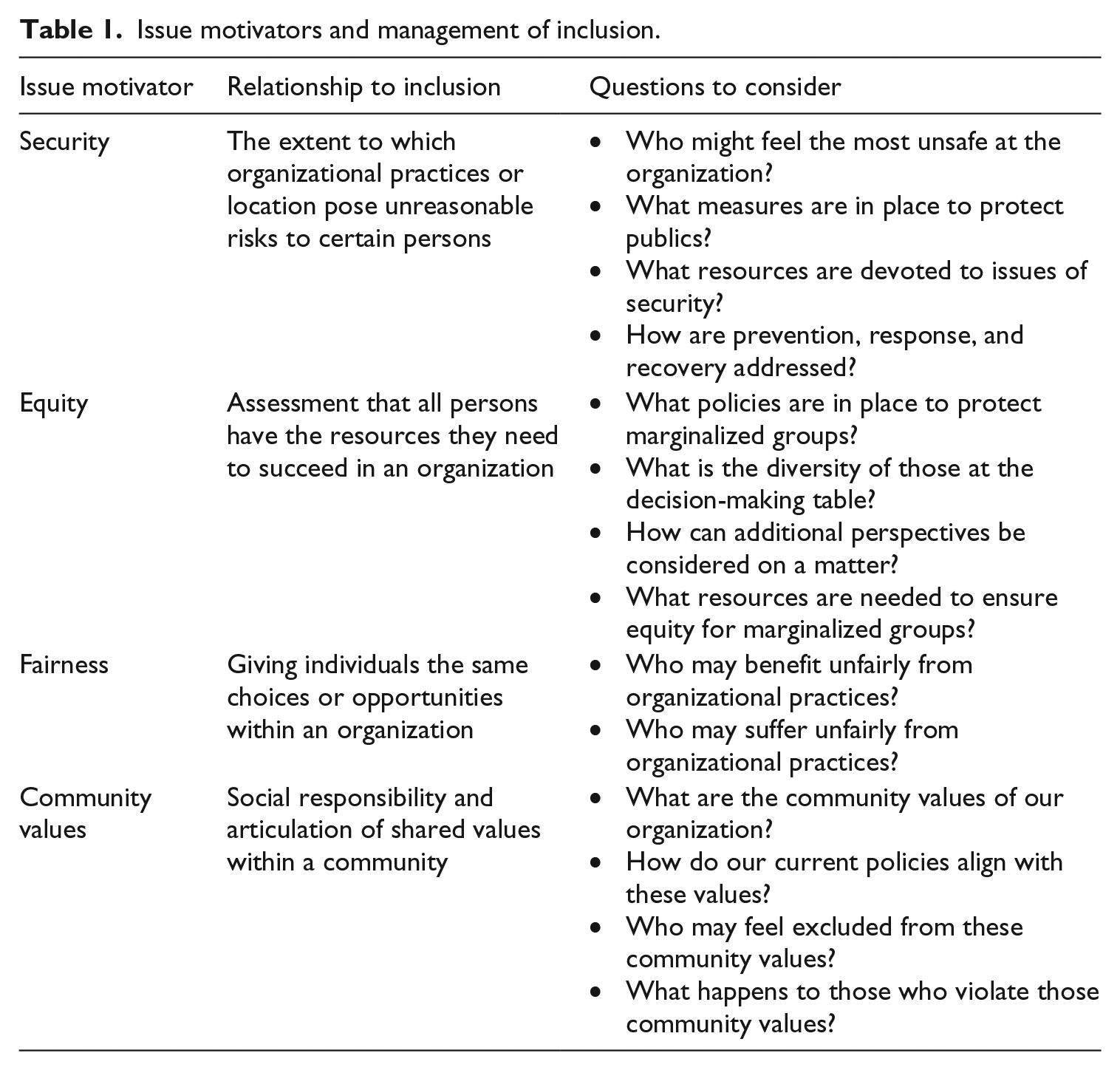
Given the foundational role that issue motivators play in how issues are framed and articulated (Heath and Palenchar, 2009), I argue revising these issue motivators can serve as a useful starting point for more inclusive issues management practices. Understanding how issue motivators differ for emotional and gendered issues is important for considering how to effectively manage and communicate with publics. With this in mind, I propose four revised primary issues motivators: (1) security, (2) equity, (3) fairness, and (4) community values. Table 1 includes an overview of the revised issue motivators, their relationship to inclusion, and questions to determine what may motivate issues at an organization.
Issue motivators and management of inclusion.
I use the example of sexual assault on college campuses as a stigmatized issue (Madden, 2018) to show how the revised issue motivators can help better define and legitimize such issues.
Security
It is necessary to consider the extent to which organizational practices or location pose unreasonable risks to certain people. In addition to specific organizational practices, though, there needs to be recognition of the sociopolitical environment outside the organization. Women and other marginalized groups, such as racial minorities and gay and lesbian communities, are disproportionality affected when it comes to issues of security (personal safety) and equality of opportunity and movement (Sokoloff and Dupont, 2005). According to Grabosky (1995: 8), ‘gender is the most consistent factor’ in explaining who fears crime, and for women and gender nonconforming individuals there is greater concern about sexual assault. Therefore, risk is inherently gendered and not easily universalized as is implied in current issues management approaches. Geographic location is also important to consider in terms of who may or may not feel like they have freedom of movement at the organization. Therefore, questions to consider for security are as follows: (1) Who might feel the most unsafe at the organization? Why? (2) What measures are in place to protect publics? Are these different for certain publics? and (3) What resources are devoted to issues of security?
Security and campus sexual assault
In the early days of campus sexual assault prevention efforts, the installation of the ubiquitous campus blue lights and campus walking escort programs were signs that the university was taking measures toward campus security (Jackson, 2019). While these resources are rarely used at most universities, they ‘give the campus the feeling of safety’ (Jackson, 2019: para. 8). This feeling of safety is important when we take seriously the emotional underpinning of issues. Yet, too often this feeling of safety does not apply to the most marginalized groups. If we consider who might feel most unsafe at an organization, though, we must consider how certain publics may not be comforted by security efforts tied to policing. Black students frequently have law enforcement called on them for simply existing on college campuses (Huelsman, 2018). Transgender students risk being questioned or even arrested by police for using gender-specific facilities (Beemyn et al., 2005). Issues managers must work backward from who is most at risk at an institution. If policies and procedures do not help make those publics safe, then issues managers are not fully considering the issue.
Devoting resources to security must be considered for prevention, response, and recovery. For sexual assault, this includes investing in educational programs for students, faculty, and staff, as well as campus safety officials in areas like trauma-informed policing (Rich, 2019). Victim advocates must also be available for survivors. Investing in these sorts of efforts helps to deal with emotions surrounding the issue, including moral emotions of shame, guilt, and embarrassment that people often report as barriers to reporting (Sable et al., 2006).
Equity
While Heath and Palenchar (2009) discussed equality and fairness within a business context, these are key components of social justice work (O’Brien, 2011) – an important area for considerations of inclusion. Craig (2002) defined social justice as the following: A framework of political objectives, pursued through social, economic, environmental and political policies, based on an acceptance of difference and diversity, and informed by values concerned with: achieving fairness, and equality of outcomes and treatment; recognising the dignity and equal worth and encouraging the self-esteem of all; the meeting of basic needs; maximizing the reduction of inequalities in wealth, income and life chances; and the participation of all, including the most disadvantaged. (pp. 671–672)
Equality is premised on everyone starting from the same place and having the same needs. Therefore, fairness is giving individuals the same choice and opportunities. However, not everyone has the same needs and marginalized groups are not starting at the same position as those with privilege. As Sun (2014: para. 5) wrote, ‘treating everyone exactly the same actually is not fair. What equal treatment does do is erase our differences and promote privilege’. In contrast, equity is about giving everyone what they need to succeed, which may appear unfair on the surface. Equity assessments attach different meaning to fairness and justice (Espinoza, 2007).
Although some legal protections are in place to ensure equality of opportunity, these are not always adhered to, and there can be subtler ways that certain groups are excluded from decision-making processes. Furthermore, equity requires ‘a subjective moral or ethical judgement that might bypass the letter of the law in the interest of the spirit of the law’ (Espinoza, 2007: 346). As Coombs and Holladay (2018) highlighted, organizational leaders rather than politicians become the decision-makers for many issues and have an opportunity to use ethical judgment in considering issues. The following questions can provide a starting point for issues managers to understand what how inequity shapes and motivates issues: (1) What policies are in place to protect marginalized groups? How are these policies enforced? (2) What is the diversity of those at the decision-making table? (3) How can additional perspectives be considered on this matter? and (4) What resources are needed to ensure equity for marginalized groups?
Equity and campus sexual assault
Although listed separately, it is important to recognize that there is overlap between issue motivators. For example, the above examples of how students of color and transgender students may not be served by a one-sized-fits-all security approach focused on policing is an issue of equity. Sexual assault disproportionality effects trans people, queer people, and people of color on college campuses (Coulter et al., 2017; Coulter and Rankin, 2017). Yet, headlines and discussion of the issue seems focused on cisgender, heterosexual white women. Policies and practices that focus on equality (providing everyone with the same resources) rather than equity (giving people the resources they need) only leaves marginalized groups more vulnerable and less secure at institutions. It is imperative that issues managers have relationships with marginalized groups on campus to determine what those resources are and examine policies to ensure they are inclusive.
Fairness
Equity and fairness are intimately related. Previous research has shown that attention to procedural fairness, as well as outcome fairness, is crucial for efforts to maintain or rebuild trust with public (Lofstedt, 2005; McComas et al., 2008). The belief that policies are not being implemented fairly leads to high degrees of organizational distrust. Rather than only thinking of who might be disadvantaged by organizational policies, reframing this to consider who may unfairly benefit is just as important. But, this shift can be difficult for those in power who do not want to consider the ways that they have been unfairly advantaged, which is often tied to gender, race, and class (Acker, 2006). Therefore, the following questions can be considered to understand fairness as an issue motivator: (1) Who may benefit unfairly from organizational practices? and (2) Who may suffer unfairly from organizational practices?
Fairness and campus sexual assault
The question of fairness and sexual assault became a critical issue in late 2018 as Secretary of Defense Betsy Devos sought to ‘restore fairness and rebalance the rights of the accuser and accused in the increasingly contentious arena of campus sexual assault’ (Watanabe, 2018: para. 3). In particular, Devos’ proposed regulation codified a number of rights for the accused, including the right to a live hearing with an attorney or adviser and the ability to cross-examine the accuser (Meckler and Svrluga, 2019). Advocates for sexual assault survivors quickly rallied against this change because of the way it unfairly disadvantages survivors, in large part because it takes away the emotionality of the issue. A recent example from Marshall University comes from a survivor who felt betrayed by the universities handling of her sexual assault case, including the accused perpetrators access to a private attorney who aggressively cross-examined her at a student conduct hearing (Izaguirre, 2019). Not only does this type of ‘fair’ hearing potentially retraumatize victims but also it unfairly privileges those with money and access to the legal system. Instead of focusing on fairness as preventing the loss of something, it is also necessary for issues managers to consider what people may unfairly gain due to organizational practices. This also has long-term impacts regarding the affective loyalties of public toward these institutions.
Community values
Although Heath and Palenchar (2009) described the issue motivator of environmental quality in the literal sense of the natural environment, I argue that we can add complexity to prior approaches with the addition of community values. Community value is a more encompassing motivator of which environmental quality can fall under. Several public relations scholars have argued for community as a foundational concept for public relations theory and practice (e.g. Hallahan, 2004; Kruckeberg and Starck, 1988; Wilson, 2001). At the heart of community is the feeling of belonging (Cooper, 2009). Part of effective community relations involves ‘establishing practices and procedures that anticipate and respond to community expectations, concerns, and issues’ (Hallahan, 2004: 222). There is a direct connection, then, to centering community expectations and values at the core of issues motivators. Therefore, the following questions can be considered for community values as an issue motivator: (1) What are the community values of our organization? (2) How do our current policies align with these values? (3) Who may feel excluded from these community values? and (4) What happens to those who violate those community values?
Community values and campus sexual assault
Organizational value statements are often so vague as to be meaningless on issues of diversity and inclusion. Yet, they can form an important starting point for thinking about the legitimacy gap that exists between an institution like a college campus and the experience of publics. Going back to the motivator of fairness, a violation of community values on a college campus often leads to a student conduct hearing. Yet, as indicated for the issue of sexual assault those hearings are often unfair and can contribute to feelings of further exclusion from the community. Universities must consider the ways they are enacting their values rather than simply stating them. For sexual assault, this requires a commitment to a holistic culture change that does not occur just from adopting new policies. It comes from mobilizing all stakeholders, including students, survivors, Greek life, the LGBTQIA+ community, campus police, employees, and administrative staff. Universities also must provide tangible support in the form of financial resources, a diverse range of prevention programming that includes the needs of marginalized groups, and a defined leadership team for the issue that includes representatives from marginalized groups (Korman, 2015). Community values are not just statements but must be actions.
Emotions and issues life cycle
Figure 1 shows how the core of the revised issues motivators must be considered within the context of emotions and the cycle of issues. Contrary to the social issues management model proposed by Coombs and Holladay (2018), I argue there is still a place for the issues life cycle within issues management. There is a ripe opportunity to better understand the issues life cycle by considering the underlying emotional aspects to each stage. Because emotions hold together social structures and are relational (Turner and Stets, 2005), insight into the emotional basis of the issues life cycle can further help issues managers better assess and manage issues at various stages of development.
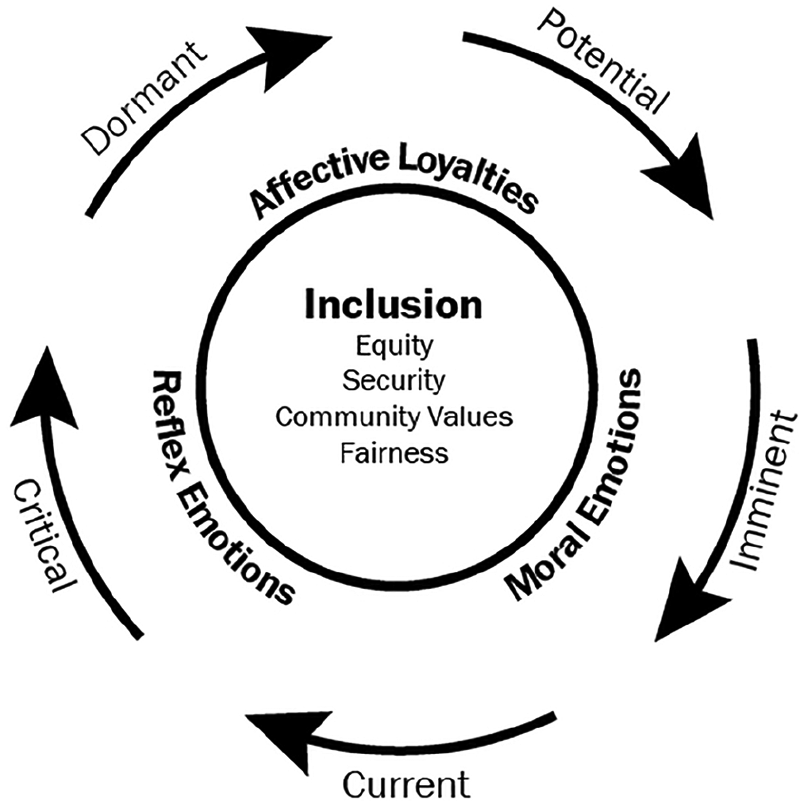
Inclusion and emotion in the issues life cycle.
Emotions, like issues, are not static (Harlos and Pinder, 2000). We can understand why issues in the current and critical stages receive the most attention by the emotional reaction that accompanies them. Considering Jasper’s (2011) argument that there has been an overemphasis on reflex emotions, I argue that such emotions characterize the current and critical stages. These emotions are often quick to appear and subside and include anger, joy, surprise, and shock, among others (Jasper, 2011). Because of this focus, emotions are seen as intense, sudden, and disruptive (Jasper, 2011). However, there is often an underlying basis to these emotions that reflects the long-term orientation of the potential and dormant stages. In contrast to the current and critical stages, I argue that potential and dormant stages are characterized by affective loyalties and moral emotions. As defined previously, affective loyalties are attachments or aversions, such as love and hate, liking and disliking (Jasper, 2011). Moral emotions are feelings of approval and disapproval based on moral intuitions and principles, such as compassion, shame, guilt, and pride (Jasper, 2011). The imminent phase offers an interesting liminal space that bridges the affective loyalties and moral emotions. Given that emotions are a core part of action and behavior (Fineman, 2000), as well as a function of relational processes, it makes sense the temporal turning point for both issues and emotions would occur at the imminent phase.
Understanding the progression of emotions that occurs leading up to the outrage and activism that earlier models of issues management worked to avoid can help issues managers more proactively manage issues (Heath and Palenchar, 2009). Feelings of outrage and anger often have a basis in emotions that can be recognized earlier in the process. For example, affective loyalties focus more generally on feelings of like or dislike, which can help issues managers gain an indication of overall sentiment of dormant and potential issues on campus. As issues begin to tap into and reflect moral emotions, such as guilt and compassion, issues managers can recognize the issue is transitioning to an imminent phase. If issues are then not addressed, issues managers are then faced with reflex emotions at the current and critical stages, which can become more disruptive as public have not had the emotional basis of the issue addressed previously. Therefore, it is important for issues managers to both assess and legitimize the emotional underpinnings of issues.
Addressing stigmatization by engaging with emotion and gender
As discussed previously, stigma research in public relations has primarily focused on stigmatization related to professional identity (e.g. Pressgrove et al., 2019) or crises that occur in organizations due to stigma (e.g. Warren, 2007). Public relations must consider how stigma is silencing the inclusion of certain issues in our field and further marginalizing certain publics. Too often, organizations only do the bare minimum required by the law to address stigmatization in the form of discrimination (Tetlock and Mitchell, 2009). But, as we have seen recently, legal protections against discrimination are precarious and can be rolled back depending on who controls political institutions (Meckler and Barrett, 2019). This is where the increasing advocacy role that organizations are playing on social issues can help set an ethical example and go beyond public policy requirements (Coombs and Holladay, 2018). While not idealizing the social justice orientation of most corporations, we must consider the ways that issues management can positively impact the internal diversity and inclusivity of organizations that are in alignment with these advocacy stances.
This study takes a more public-focused orientation toward issues management that can ultimately benefit the organization by fully engaging with emotions and gender. Since gender is about sexual hierarchies and power (Wilchins, 2004), this newly proposed figure and accompanying set of questions seek to help issues managers be more reflexive about their positions within such hierarchies. This approach is meant to be guided by empathy to the experiences, emotions, and perspectives of groups that issues managers may not be part of because it is the right thing to do. This is not to use the potential emotional trauma of marginalized publics in the service of keeping an organization out of trouble. Stigmatization is often a slow burn, and activism that can result from this is often the outcome of years of discrimination and feeling a lack of cohesiveness or morale at an organization. By keeping a finger on the pulse of moral emotions and affective loyalties, issues managers can proactively work with people to develop more inclusive policies and practices. Importantly, this is not meant to stifle or vilify reflex emotions, such as anger, which can be a necessary agent of change for an organization. Internal activism can play a key role in striving for social justice at an organization (McCown, 2007) and helps organizations continually reflect upon issue definition and legitimacy.
Conclusion
This article focused on issues management as the ‘strategic core’ (Botan and Taylor, 2004: 654) of public relations because truly inclusive organizations must begin at this level. It is not enough for organizations to issue public relations statements about diversity and inclusion, but they must demonstrate this through action and policies. An inclusive issues management approach begins at the most foundational level of defining and legitimizing issues. To be inclusive, though, we must consider how emotion and gender influence the way in which issues are defined and what issues are legitimized. Public relations continues to be a ‘lily white field of women’ (Vardeman-Winter and Place, 2017: 326), though, so a focus on gender is only a start.
By adding depth to current understandings of issues in issues management, I hope to usher in a paradigm shift in issues management that mirrors broader shifts in public relations theorizing toward intersectionality (e.g. Vardeman-Winter et al., 2013; Vardeman-Winter and Place, 2017). Various oppressions intersect and create additional barriers for those at the margins, such as Black women (Crenshaw, 1991). Even the example of campus sexual assault used to discuss the revised issues motivators engaged heavily with issues of race and sexual identity, in addition to gender, because they cannot be separated. An intersectional approach to issues management can only help strengthen the core of the public relations field.
Footnotes
Funding
The author(s) received no financial support for the research, authorship, and/or publication of this article.
