




Abstract
This is a conceptual essay that explores the concept of knowledge as it relates to public relations (PR). It suggests an ecological knowledge architecture as a lens through which to understand the theories and concepts that support practice. It does so by drawing on the work of Zygmunt Bauman and his reflections on liquid modernity to inform and shape thinking and uses it as a thread to help synthesise scholarship from knowledge, competency and career scholarship and debates around professionalisation. It argues that by subdividing knowledge into explanatory, interventionist and practice principles greater clarity can be given to the know-how (functional skills) and know-that (theoretical knowledge) of PR. In addition, by overlaying a postmodernist and liquid concept to this tripartite division of knowledge, PR can be well placed to take advantage of the change in careers and capabilities necessary for work in the 21st century.
Introduction
This is a conceptual essay that takes as its starting point the work of Zygmunt Bauman as a way to explore the theories and knowledge that underpin public relations (PR) in the postmodern age. It picks up the challenge of Pieczka (2018), who argues that Bauman’s work has largely been ignored in PR scholarship, partly because the idea of postmodernity has already been absorbed into PR literature. This essay explores the concept of what Bauman (2000) calls liquid modernity and re-visits his work on education and knowledge, whereby knowledge is explored through the prism of adaptability and change. To aid clarity, this essay views education as a formal and informal transfer process of knowledge enabling a theoretical and practical understanding of a subject. In other words, knowledge is acquired both formally and informally through experience.
Sarid (2017) suggests limited discussion has taken place on the implications of liquid modernity on knowledge, education and occupations compared to knowledge in postmodernity generally and this needs to be addressed. Consequently, this essay synthesises reflections on Bauman with literature drawn from knowledge, work and professions that itself suggests a changed understanding of what is meant by knowledge. It is important for PR to do so because it cannot be divorced from wider trends affecting the notion of what constitutes professional work.
The aim is to identify a structure of knowledge that underpins the professional capability of PR practitioners against this changing landscape. It does not intend to provide absolutes as to what this structure contains but to offer suggestions and an approach to stimulate debate and encourage professional bodies and academia to develop integrated knowledge and competency frameworks appropriate for a 21st century practice. This could then inform professional development and formal curriculum, as well as illustrate how theory and practice connect. In doing so, this article addresses a suggested lacuna in the literature to help address the dual questions of what is the knowledge that underpins practice and how can this be understood in a postmodern world.
At first glance, Bauman’s views on theory and education seem at odds with the importance of knowledge. For Bauman, the world is no longer a solid place where norms and social institutions are constantly being dismantled and re-embedded but instead is characterised by fluidity with certainty obsolete. Liquid modernity is characterised by random connections, unpredictability and change; it is the ‘unholy trinity’ of uncertainty, insecurity and unsafety (Bauman, 2000: 181). Consumerism predominates with knowledge another commodity to be used and disposed of when it has no value. In many respects, Bauman’s work has similarities to Lipovetsky’s (2005) views on a hypermodern society and a world in overdrive where there is an obsession with change and the new. As Bauman suggests, liquid modernity undermines a ‘stiff curriculum and predetermined succession of learning’ (Bauman, 2005: 316). However, a review of his writings indicate that there are more solid elements to his thinking (Sarid, 2017).
This essay suggests that despite society being in a state of perpetual motion and supercomplexity, an improved understanding of the knowledge that supports PR is possible, as is a more nuanced view of what constitutes a profession. Such an understanding puts forward the concept of an ecological knowledge architecture that combines transversal knowledge that works across the PR field, while allowing implementation to be discipline-specific and culturally orientated. The model allows for various forms of knowledge to be captured while simultaneously allowing movement and fluidity in line with postmodernist knowledge scholarship (Wallis, 2010). The model embeds the concepts of contestable boundaries and adaptability (Savin-Baden, 2007), and in this it allows the integration of knowledge from elsewhere, such as management and leadership, supporting the views of McKie and Willis (2015) that PR needs to be more outward facing in its theory. It also integrates ideas from the Socialisation, Externalisation, Combination and Internalisation (SECI) knowledge model (Nonaka and Takeuchi, 1995) that addresses how knowledge is transferred and shared. In this way, the model attempts to blend modernist and postmodernist views of knowledge.
Taken together, the model re-orientates PR as a liquid profession, one that reflects looser and a more varied understanding of the term profession, that better equips PR practice for the 21st century. The model allows greater connectivity with the latest thinking around knowledge and meta-competencies and how these are transforming the nature of work. In doing so, the model seeks to demonstrate how PR can be at the forefront of these career transformation debates. In this new, complex and liquid world, ‘images of professionalism are difficult to clarify, as professional fields will undoubtedly become more varied and heterogeneous’ (Noordegraff, 2016: 803). This does not mean that PR knowledge cannot be understood better, but it is argued that a static and uniform view of knowledge is unhelpful. First, this essay examines the literature and identifies key themes that inform the knowledge debate. The essay then uses the conceptual lens of Bauman and his thinking on liquid modernity and educational challenges to reflect on these themes before suggesting how PR’s knowledge base can be illustrated.
Literature: Themes and metaphors
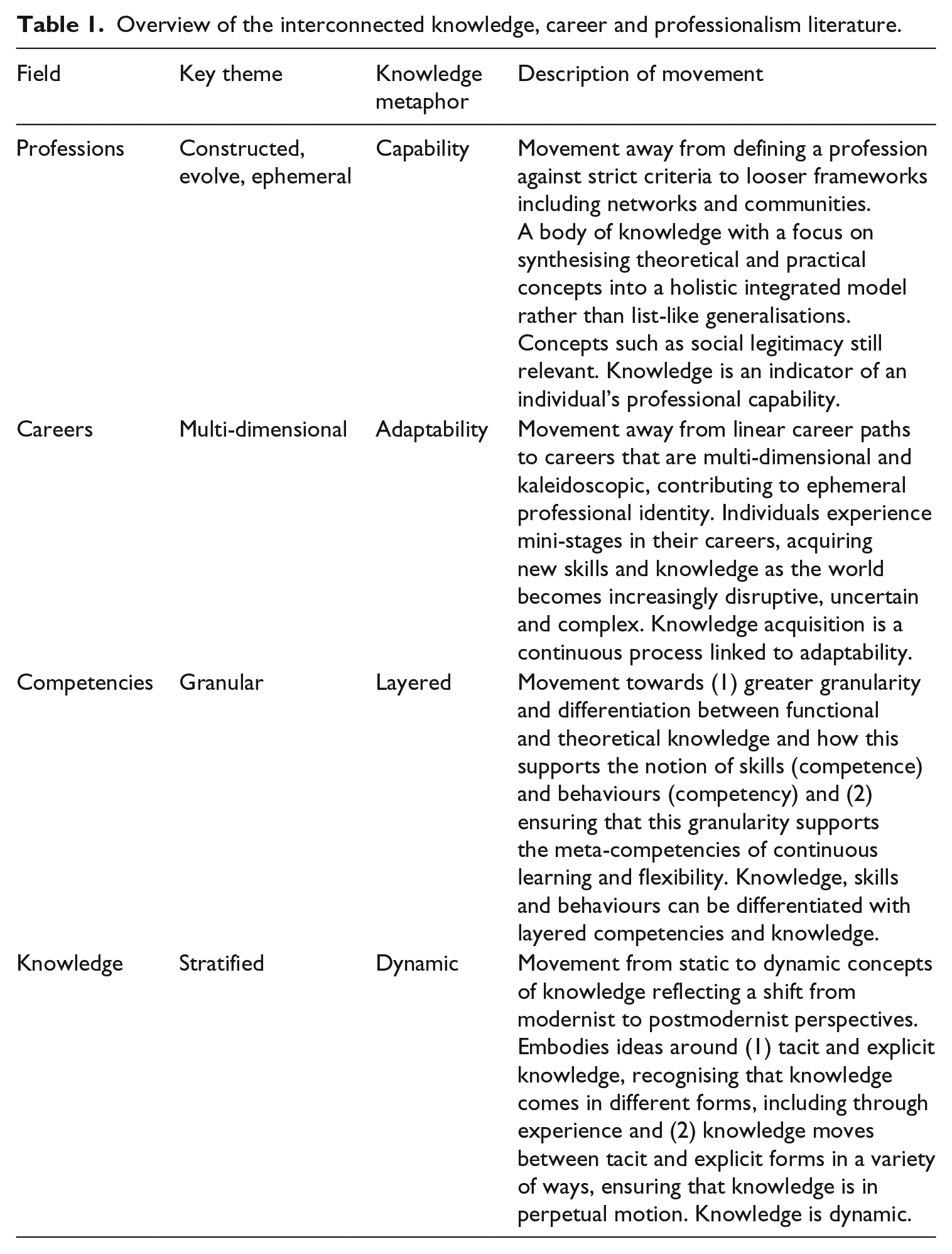
Various discussions have been identified in the literature, as shown in Table 1. These inform the relationship between knowledge and the notion of professions, careers and competencies (or skills and behaviours). This is important because it provides a backdrop to PR’s desire for professional recognition and career status. What is clear is that, without exception, these four areas have witnessed a shift towards greater flexibility and a ‘meta’ approach.
Overview of the interconnected knowledge, career and professionalism literature.
A profession and its relationship with knowledge
What makes a profession distinctive is problematic, with some arguing that a profession must serve the public good (Downie, 1990); others suggest it needs autonomy (Freidson, 1970); or that it should exhibit certain traits and jurisdiction (Abbott, 1988). Hoyle (1995) argues that a profession is contextual and shifts along a hypothetical continuum. An occupation moves along this continuum as its function and place in society is accepted. This includes obtaining sufficient quality and representation (Yang and Taylor, 2013), as well as education and training, professional associations, regulatory and legal protection and codes of ethics (Nessmann, 1995).
This mirrors the thinking of PR scholars regarding the parameters necessary for PR to be considered a profession (e.g. Molleda, Moreno, and Navarro, 2017; Niemann-Struweg and Meintjies, 2008). As Pieczka and L’Etang (2006) suggest, it is the familiar troika – a body of knowledge, ethics and certification – that is understood as the defining characteristics of a profession. Flynn and Sevigny (2009) argue that the need for an internationally agreed-upon body of knowledge providing a cognitive base for the field is a key requirement. In this context, without a body of knowledge PR can be viewed as only a semi-profession.
Recently, looser frameworks concerning networks and communities have been suggested as better ways to view a profession (Furbey et al., 2001) with a greater focus on fluidity, capability and value creation through knowledge rather than jurisdiction. In other words, a postmodernist profession that is better placed to deal with chaotic times. Such an approach opens up PR to be responsive to dealing with supercomplexity rather than being constrained by terminology. A narrow and reductive view of a profession it is argued would be problematic to Bauman given the need for individuals and organisations to urgently respond to environmental change.
Nonetheless, whatever view you take of a profession, Timmermans (2008) argues it requires conceptual knowledge that forms part of its expertise, together with appropriate application of that knowledge. Even if one focuses on being professional (rather than being in a profession), the concept still embeds knowledge, skills and attributes, with knowledge as an indicator of professional capability.
PR and a body of knowledge
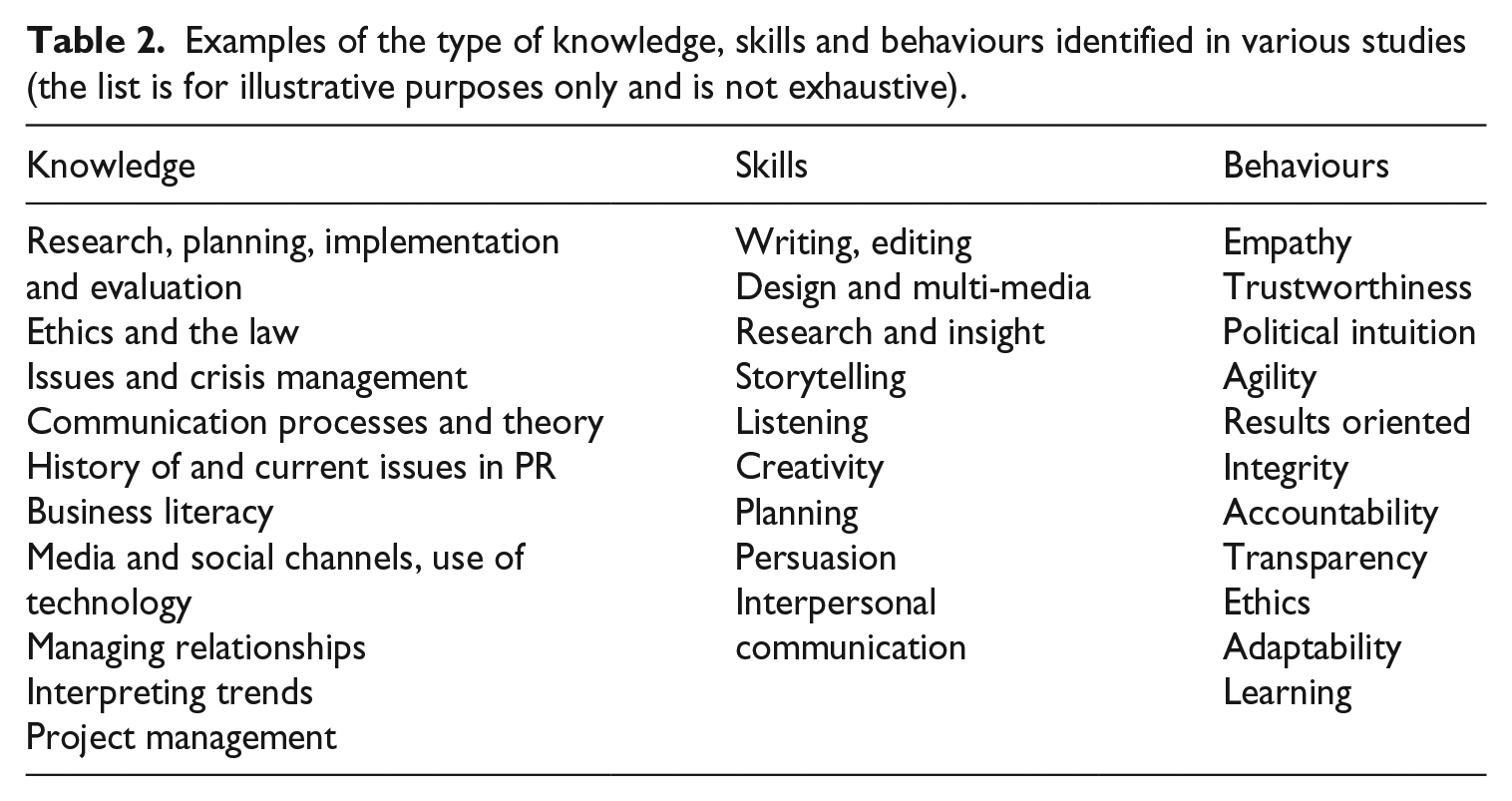
Manley and Valin (2017) argue that a body of knowledge is possible, pointing to the Global Alliance for Public Relations and Communications Management (2015), which has established an inventory of knowledge, skills and behaviours known as the Capabilities Framework. This continues in the tradition of other scholars (e.g. Cernicova, Dragomir and Palea, 2011; Jeffrey and Brunton, 2011; Tench et al., 2013) which although helpful use the words knowledge, skills and behaviours interchangeably. An example is shown in Table 2.
Examples of the type of knowledge, skills and behaviours identified in various studies (the list is for illustrative purposes only and is not exhaustive).
Much of the knowledge in these inventories is working knowledge, the know-how or procedural knowledge. However, it is abstract knowledge that is one of the distinctive features of a profession (Pieczka, 2006), or being professional, the know-that or the know-what. Often, the abstract knowledge explores the conceptualisation of a field, the justification for its existence and the principles that guide it. In addition, these inventories often disguise theoretical and abstract concepts focusing on how these are translated into practice. For example, excellence theory references persuasion (of which theory exists such as the elaboration likelihood model; Petty and Cacioppo, 1986) and also relationships (of which theory exists including stakeholder mapping techniques; Ledingham and Bruning, 1998).
Such studies support L’Etang (2008) who asserts that PR draws on many forms of working knowledge, but this does not equate to a system of knowledge. These are frameworks of linked concepts that form theories to explain the world in which the practice operates and helps to understand problems. A view supported by Corley and Gioia (2011) a ‘theory is a statement of concepts and their interrelationships that show how and/or why a phenomenon occur’ (p. 12). It is argued that any body of knowledge must integrate and connect abstract and working knowledge. Inventories do not do this. Indeed, inventories suggest a level of stability that it is argued would appear constrained to Bauman, whereas a framework that link concepts while allowing flexibility would be more relevant in liquid times. However, Bauman maintains the importance of capturing knowledge that is embodied in the individual so applied knowledge has relevancy.
Work has also been undertaken exploring the theoretical base of PR. Scholars (Edwards, 2016; Jelen-Sanchez, 2017) suggest early thinking focused on practicality and the search for a unifying paradigm or grand unification theory (Botan and Hazleton, 2006). This has stimulated studies in areas such as systems, excellence theory, relationship and stakeholder management and PR as a management function. Recently, Wehmeier (2009) and Jelen-Sanchez (2017) talk about sociocultural and critical scholarship including complexity, postmodernism, power, diversity, activism, feminism, society and culture. Indeed, Heath (2006) proposed a ‘fully functioning society theory’ as an inclusive framework to describe PR’s role in society. Consequently, PR now has a pluralistic, multi-paradigmatic and theoretically diverse knowledge base (Coombs and Hollady, 2012; Curtin, 2012; Jelen-Sanchez, 2017).
Such diversity sits well with Bauman’s thinking as it allows the ongoing re-evaluation of knowledge and for knowledge to be outward facing. Although Dühring (2015) points out that PR often imports theories and concepts from elsewhere, while building little theory itself, this should not be viewed as problematic as often theory straddles a number of domains. Schneberger, Watson and Pollard (2007) suggest a theory scale from big T theories (highly developed) to little t theories (less complete). They argue big T theories can be broad, apply to multiple disciplines and have high acceptance. It is right that PR draws on these big T theories, such as systems or wider management concepts. Putting up unnecessary barriers to knowledge would be at odds with Bauman with knowledge drawn from elsewhere viewed as strength and not weakness in unpredictable times.
In summary, work has been done to capture PR’s knowledge base, but often it lacks interconnectivity, blurs into skills and behaviours and tends to be list-like. Although helpful, it does not create a framework to showcase the knowledge underpinning professional capability though suggestions exist as to what should be included. The fact PR has limited theory of its own is largely irrelevant. To move forward, PR needs to embrace trends from other domains in terms of knowledge being adaptable, layered and dynamic.
Insights from careers
In line with Bauman, scholars (Beck, 1999; Lo Presti, 2009; Richardson, 2002) argue that globalisation and digital disruption have transformed work. Careers are more boundary-less (Arthur and Rousseau, 1996; Defillippi and Arthur, 1996), more protean (Hall, 1996) and more interdependently and kaleidoscopically driven (Mainiero and Sullivan, 2005, 2006). Individuals need to take control over their careers (Betz and Hackett, 1987; Inkson, 2004), focusing on adaptability (Savickas, 2005) and employability (Fugate et al., 2004).
Careers are no longer linear but spiral, multi-directional, dynamic and fluid (Baruch, 2004), even chaotic (Pryer and Bright, 2007). No longer do people go through major career transitions over a lifespan (Super, 1980), but rather they experience mini-stages (Hall and Mirvis, 1995). These are shorter cycles of learning with exploration, trial, mastery and then exit, though this varies between fields. This reflects some of the provocative and controversial thinking of Bauman concerning knowledge (and, by implication, careers) having an expiration date before moving on to the next opportunity with knowledge being adapted and new knowledge acquired.
This postmodern work environment requires identity growth and adaptability (Hall and Mirvis, 1995; Lo Presti, 2009). Individuals need to understand their own professional capability but be prepared to adopt other skills and improve self-awareness. PR careers are no different and rather than put up barriers, PR’s system of knowledge needs to be expansive, showcase capability and embed continuous professional development.
Insights from competencies
Scholars (e.g. Boyatzis, 1982; Cheetham and Chivers, 1998; Kuijpers, 2001) suggest typologies that blend competence (skills) and competencies (behaviours) into holistic framework underpinned by knowledge. One example is by Delamare Le Deist and Winterton (2005) shown in Table 3. Knowledge (and understanding) at a conceptual level is captured by cognitive competence; skills relate to the functional competence, suggesting the application of knowledge; and competencies (behaviours and attitudes) are tied to the social competence that enables knowledge to be applied successfully.
Recreated typology of competence (Delamare Le Deist and Winterton, 2005: 39).

There are also meta-competencies (learning to learn, adaptability) that are different from the other three, as they are concerned with supporting the acquisition of the other competencies. Meta-competencies reflect a less solid view of knowledge and work in line with Bauman and link to the Organisation for Economic Cooperation and Development (OECD) (2005) competencies report, which stresses that the capacity for change is critical for 21st century employability.
Competency scholarship suggests that knowledge can be better understood in terms of it being a cognitive process – the know-that. This is distinct from (though supports) the know-how of functional skills and can be disentangled from behaviours. This points to knowledge (along with skills and behaviours) being layered and meta-competencies that explore change, agility, learning and resilience in a world that is in flux. These are terms that would be familiar to Bauman and deconstructing knowledge using such typologies, although having the appearance of being solid, allow for different ways of knowing that are critical in times of unpredictability.
Insights from knowledge
Here scholars (Nonaka and Takeuchi, 1995; Polanyi, 1983) suggest knowledge is explicit and tacit. The explicit is objective and codified, whereas tacit is subjective, experiential, contextual and difficult to formalise. It is often argued that tacit knowledge is more important, as it is experience that enables individuals to judge situations. However, Cowan, David and Foray (2000) suggest too much knowledge is defined as tacit when, in fact, it can be codified. Codification may seem too solid for Bauman, but it does open up ways for knowledge to be re-evaluated which is fundamental. Nonaka and Takeuchi (1995) also point to knowledge movement involving:
Socialisation: tacit-to-tacit – knowledge is passed on through practice, guidance, imitation and observation;
Externalisation: tacit-to-explicit – knowledge involves codification into documents that can be spread and used;
Combination: explicit-to-explicit – pre-existing codified knowledge is updated and re-evaluated to create new knowledge;
Internalisation: explicit-to-tacit – knowledge is internalised as explicit sources are used and learned, modifying the users’ existing tacit knowledge.
Knowledge in perpetual motion is an idea that would appeal to Bauman given environmental unpredictability and uncertainty, as is the concept of permeable boundaries and dynamic knowledge flows.
A stratification of knowledge, developed by Bogo et al. (2013), draws these ideas together. Here there are explanatory theories that underpin a practice, interventionist knowledge that supports the reality of the job and practice principles that inform everyday work. This clarifies the different type of knowledge between the conceptual and the more practical, the explicit and the tacit and draws on the concepts from competencies. This takes a meta-theoretical approach allowing different theories to be combined in line with the requirements of a system of knowledge. Modernist approaches to meta-theory strive for objective knowledge or truth, but postmodernist approaches suggest knowledge is much more contextual, disordered and fluid (Law, 2010; Wallis, 2010). The key is usefulness and it being grounded in practice (Chia, 2005; Law, 2010), practical concepts in keeping with Bauman.
This mirrors the thinking of those who talk of an ‘ecological calling’ (Barnett, 2011: 33) to help make sense of the complex, networked and interdependent world of the modern professional. This interconnectivity is a key component of Bauman’s understanding of why knowledge can never be static. In addition, organisational scholars (Malhotra, 2002) argue that environmental turbulence and discontinuous change requires better anticipation, with a faster cycle of knowledge-creation and action based on new knowledge. Here, knowledge is a dynamic evolutional process being created and recreated in various contexts. Organisations should adopt a knowledge ecology approach that focuses on networks of individuals, relationships and exchanges to share, shape and reinvigorate knowledge. Just as natural ecologies require diversity and adaptation, so do knowledge ecologies to ensure survival and relevancy when facing a rapid pace of change.
Conclusion to the literature
A number of key themes emerge. A body of knowledge is distinct from inventories, and it must reflect integrated concepts incorporating abstract, theoretical and applied knowledge. This is important for both a profession (in any of its forms) and being professional. Substantial work exists on capturing practical and abstract knowledge in PR, but there is terminological confusion with a focus on skills. However, knowledge can be made more granular and distinct reflecting the concept of layering. Knowledge is dynamic, yet it can still be captured and given visibility to encourage adaptability against changing career structures. Together, these trends suggest that an ecological approach to establishing PR’s body of knowledge has value. This article has pointed to the relevancy of Bauman to a more nuanced understanding of a profession and knowledge, and this is now addressed in more detail.
Conceptual insight: Liquid modernity and Bauman’s view on knowledge
According to Bauman (2010) liquid modernity is ‘the divorce of power from politics, and the shifting of functions once undertaken by political authorities sideways, to the markets, and downward, to the individual life-politics’ (p. 398). In this liquid modern era, Bauman argues, many individuals have become obsessed with happiness through consumption and in many instances lack any ability to resist these external forces through personal agency.
This liquid form also impacts organisations, although Bauman primarily uses it to describe the world of consumption (Clegg and Baumeler, 2010), while paying limited attention to what Lee (2005) argues are enablers of liquidity. Organisations are demonstrating liquid elements – liquid towards individuals (e.g. short-term contracts) and individuals are becoming liquid towards organisations (e.g. decline in loyalty). In many respects, a liquid organisation animates ideas around careers and professional work becoming fluid.
There are three central themes that emerge from Bauman’s writing on education (Sarid, 2017): the transition from teaching to learning; the nature of knowledge, with its focus on know-how; and, finally, accountability and individual responsibility. For Bauman, the concept of a teacher relates to modernity, as this new, liquid age requires the skills of a counsellor. Given the idea that knowledge can be short-lived, learning must be personalised and tailored to individual, short-term life projects, and each learner must regulate his or her own learning (Schunk and Zimmerman, 1998). These life projects, it is argued, have parallels to the idea of mini-stages (Hall and Mirvis, 1995). This reinforces the view that the one-size-fits-all learning approach is no longer relevant and continuous professional development needs to become central.
According to Best (2017), for Bauman, education used to provide the knowledge that reflected modernity. As Bauman (2003) said, ‘Knowledge was of value since it was hoped to last, and education was of value in so far as it offered such knowledge of lasting value’ (p. 19). Bauman argues in the new, liquid age, this is no longer the case. Now only one body of knowledge and skill-set is frightening, as it limits the ability of an individual or a society to respond to change. Knowledge has an expiration date (Lippi, 2013), with individuals needing the ability to forget and unlearn as argued by Bauman (2005), so that they can acquire new knowledge quickly to address the challenges presented by the rapid pace of modern life.
In addition, Best (2017) points to the quantity of knowledge produced in the digital age, and for the nonexpert learner, this is overwhelming. It becomes difficult to assign more importance to some aspects of knowledge than to others. Bauman (2005) puts forward the controversial concept of the mind needing to forget in order to assimilate new information based on the individual’s changing needs. The brain no longer stores information but instead processes and acquires what it needs when it needs it.
This may sound like a negative view of knowledge, not least given the brain’s enormous capacity to process and acquire information; however, a re-reading of Bauman’s work reveals contradictions. Sarid (2017) argues that Bauman uses the words forgetting and unlearning interchangeably, but in fact, they are different. To forget, one first has to memorise, so to unlearn, one first has to learn. Sarid (2017) also suggests, that although Bauman focuses on practical knowledge rather than theoretical knowledge, his writing suggests that practical knowledge must help individuals improve self-awareness and understand the world around them. This alludes to a place for abstract and theoretical knowledge even in liquid times.
Also, Sarid (2017) argues that individual responsibility in an age of constant change becomes important. As such, there are elements of re-embedding or, perhaps, as Beck et al. (1994) suggest, reflexive modernity. Thus, against a backdrop of fragmentation, individuals must make choices, which forces individuals to re-engage with their own frames of reference and, importantly, their own prior knowledge and values to invigorate their own agency. Consequently, an alternative reading of Bauman’s work, in line with that of Sarid (2017), suggests that prior or core knowledge is vitally important but that individuals must be receptive to adapting knowledge and acquiring new thinking.
This is supported by Savin-Baden (2007) asserting that Bauman’s concept of knowledge and education leads us to the idea of ‘liquid learning’, as underpinned by freedom, reflexivity and adaptability and that ‘knowledge boundaries are contestable and always on the move’ (p. 8). This does not mean that core knowledge does not exist but that previous knowledge should always be engaged with and re-evaluated. Therefore, the creation of a lens or architecture through which to engage with PR knowledge would help with re-evaluation in our liquid age. Such a concept of knowledge being fluid and contextual connects strongly with postmodernist scholarship, ecological approaches and themes emerging from other domains.
PR: An archetypical liquid profession underpinned by an ecological knowledge architecture
Reflecting this move into liquid times, Revell and Bryan (2018) use the term liquid professionalism. This is a form of professionalism in which agency and independent judgements based on an engagement with a body of professional knowledge and skills are unstable. This essay argues that this is not to be feared, as instability does not mean professional capability and the knowledge that supports it is weakened. Instead, instability should be embraced as a key strength and an ecological approach of adaption developed, with agency reinvigorated. Kantola (2016) argues that although Bauman’s writings seem pessimistic with uncertainty seen negatively, his work can also be viewed positively, as it opens up possibilities for individuals and occupations to be freer, embracing new opportunities presented by the changing face of work. Here, PR can adapt and seize the opportunities presented by disruption and take advantage of the blurred boundaries between communication processes and stakeholder fragmentation.
It is suggested that adaption of the tripartite view of knowledge (Bogo et al., 2013) could provide a way forward to understand the knowledge that supports PR. Such an approach provides a way to create a framework or architecture of interconnected ideas that capture the diversity of PR knowledge moving beyond inventories, allowing for all forms of knowledge to be made visible, shared and debated including those from beyond PR. Indeed, movement should be encouraged, for example, between tacit and explicit forms, thus encouraging the wisdom and applied knowledge to be more clearly articulated, not least when practice evolves.
Such an approach embeds core knowledge but allows instability to reflect the changing face of practice. This can be done by integrating the SECI model more fully – using socialisation, externalisation, combination and internalisation – through networks and communities of PR professionals. Here, practitioners can take ownership of knowledge rather than knowledge being distinctive to academia. In addition, new scholarship can have visibility by connecting to different layers within such a framework to stimulate debates about usability, relevance or conceptualisation of the field. There is a role here for professional bodies to create an integrated knowledge and competency framework in line with other professional fields and occupations (rather than lists) that embed agility and draw on the breadth and depth of competency scholarship and human resource practices.
A well-articulated body of knowledge could be used to underpin a more detailed competency framework that showcases professional capability. This could then be used to support a qualification structure and various routes into the field including university programmes, apprenticeship schemes and continuous professional development. Such an approach should not be reductive and static but take a postmodernist stance to reflect the working lives of practitioners. A framework should allow individuals to bring their capabilities into PR and for these to be developed, and for PR practitioners to move into other fields with well-articulated and evidenced capabilities.
Returning specifically to a proposed PR knowledge architecture, it is suggested that this should take the form of a pyramid as outlined in Figure 1. The model suggests that there are explanatory theories that help contextualise PR practice and fall more broadly into the conceptual or the abstract. These sit at the base of the pyramid and provide justification for the domain, for example, social constructivism as argued by De Lange and Linders (2006), or structuration theory (Schlichting, 2014). Heath’s (2006) concept of a fully functioning society could sit here. This provides deeper understanding, but for practitioners, it might seem remote.
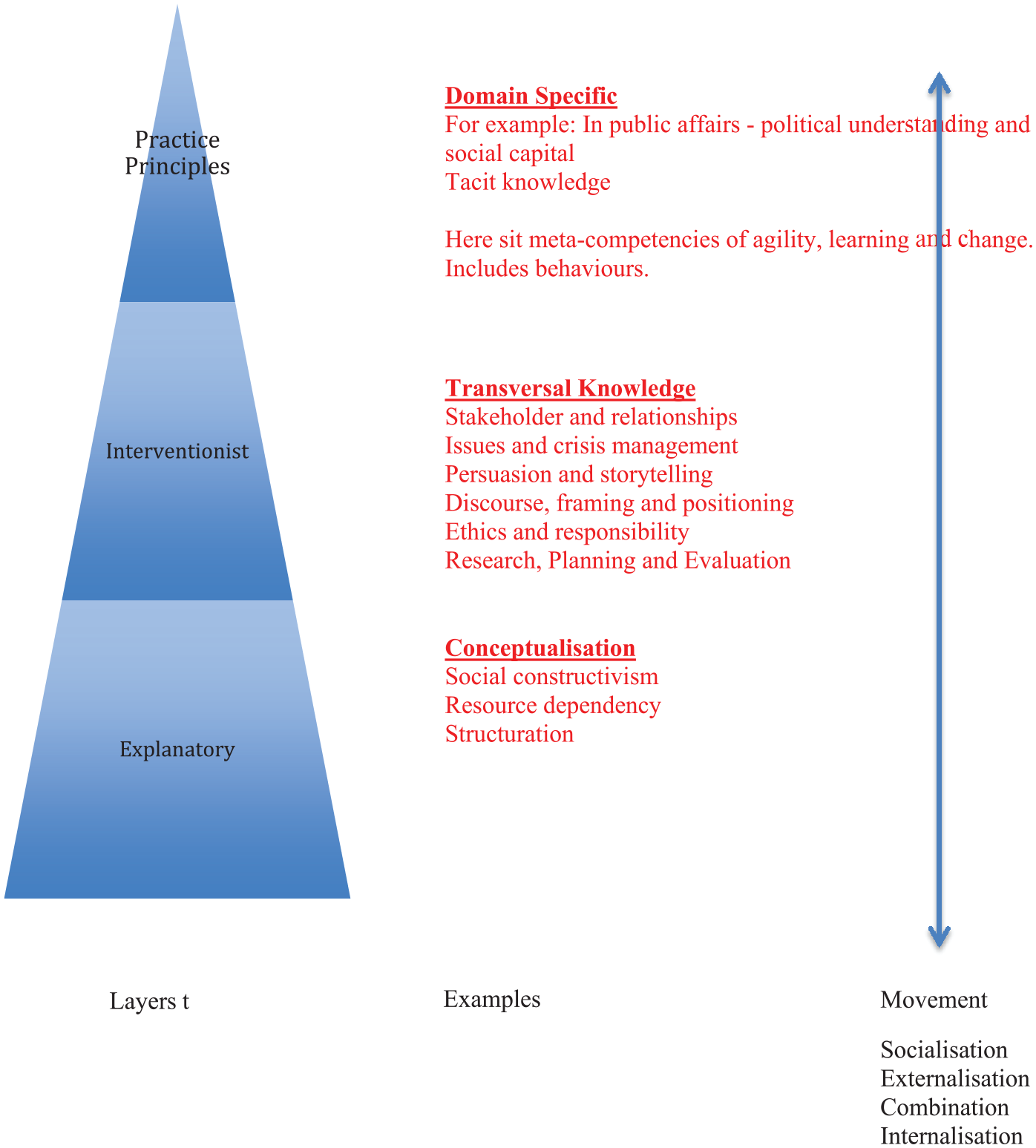
An example of an ecological knowledge architecture for PR and its associated domains.
Then, there are intervention models (concepts and theories that might support certain types of daily practice – including both big T and little t theories). Here sit many of the applied communication concepts, such as stakeholder theories, persuasion, discourse, framing and positioning, branding theories, issues and crisis management models. Indeed, practitioners could draw on knowledge from a variety of sources depending on their roles, such as management and leadership. These areas are often vocalised by practitioners as ‘skills’ or ‘functional’ competencies in studies but have a knowledge base that deepens and enhances the ability to perform these well. Indeed, these could be taught and codified to help validate what practitioners already do and add more depth. This supports the view of Cowan et al. (2000) that too much knowledge is tacit when, in fact, it could be codified. However, codification itself is not a static process.
Finally, at the top of the pyramid there are practice principles (the way the job is done) that relate to the daily practical delivery of different discipline areas. Often, this can be considered the tacit knowledge – for example, understanding the political system and social capital for public affairs (though there are elements of explicit knowledge, such as understanding the legislative process). Even if tacit knowledge cannot be codified in a traditional sense, it can be articulated using the language of practice. Here, it is the ability to apply, translate and adapt knowledge that becomes critical, along with exhibiting appropriate behaviours, including adopting a mentality of personal development. It also, perhaps, includes little t theories that could be developed and explored further, especially against changing landscapes.
It is suggested that the explanatory and interventionist concepts apply, to a greater or lesser extent, to all PR functions even though practitioners may not always realise they are being used. It is the practice principles that become more discipline specific, where there may be a particular emphasis on key strengths and attributes that are supported by specific knowledge areas. This may make the quest of some sort of single theory remote for PR, but given the pluralistic nature of the field, meta-theory (Wallis, 2010) is helpful. Meta-theory allows connectivity and visibility between knowledge areas to be revealed and layered to provide a macro view of knowledge – in other words, to establish a body of knowledge. Although it is recognised that knowledge can be disordered (Law, 2010), an architecture can capture the eclectic nature of PR theory and link it firmly to practice. In doing so, more insightful ways of understanding knowledge, skills (functional competence and applied knowledge) and behaviours (competency or attributes) can be explored. It can also help practitioners identify where their own strengths lie and help shape their own career choices.
This ‘layering’ may appear to be solid in line with the modernist era of order and structure. In reality, this is not the case. Layering by using meta-theory has structure so that it can be articulated, but importantly, it should be used to stimulate debate and encourage movement so that knowledge can be re-shaped, reinvigorated and shared with enduring knowledge or threshold concepts of PR identified. In other words, knowledge must be learned in order for it to be deconstructed, reconstructed or modified. An ecological orientation that embraces the unholy trinity of uncertainty, insecurity and unsafety in our liquid age could be a way forward. In addition, such an orientation incorporates Bauman’s recognition of the human experience, the practice principles. There should be no fear articulating the tacit knowledge and codifying explicit knowledge if it showcases professional capability and if it gives full recognition to the different ways of knowing and if codification is itself dynamic.
Conclusion and limitations
This article asks two questions: what is the knowledge that underpins practice and how can this be understood in a postmodern world. The body of knowledge that underpins PR is well researched, but it is disorganised and reflects terminological confusion. An ecological knowledge architecture reflecting the idea of meta-theory provides a way to bring ideas together to demonstrate professional capability built around practice principles, interventionist and explanatory knowledge. It can be used to provide structure and visibility for existing work in this area, and a mechanism for continuous professional development, in particular if it is used to underpin agile competency frameworks. In a postmodern world, knowledge needs to be understood differently. An ecological approach allows knowledge to be constantly reinvigorated, debated and developed as the practice matures and changes.
This is a conceptual article, and the ideas contained within it need further exploration with practitioners and professional bodies. As Law (2010) points out, the key to meta-theory is its workability and its usefulness (Chia, 2005) and that means its usefulness in practice. This also includes working together as academics and professional bodies to identify the types of knowledge in different layers of the pyramid but recognising that will change. It is meta-theory that is fluid that can help the practice modify and re-shape how different forms of knowledge can be connected, while theory contained within the framework can be more solid or fluid, depending on how PR responds to the disruption around it.
A revisiting of Bauman’s thinking (Best, 2017; Sarid, 2017), adds weight to such an ecological approach, though this interpretation may be disputed. In particular, the number of solid elements contained within Bauman’s writing and the possible conflicting views of agency it evidences. In addition, scholars from careers and competencies suggest that individuals need to take more ownership of career choices, yet Bauman suggests that agency can be limited in liquid times. There is a possible conflict here between the two domains. Best (2017) makes the point that without agency it is impossible for individuals to engage with education and knowledge if they are self-obsessed with concepts such as happiness, and Bauman never really addresses this. However, there is a suggestion in Bauman’s (2012) later writing that personal agency is important, as he talks of the need for ‘individual self-awareness, understanding and responsibility’ (p. 213). Therefore, further research and analysis is warranted.
This essay attempts to take an interdisciplinary approach (Aram, 2004; Lattuca, 2001) rather than a multi-disciplinary one, striving for greater integrative synthesis; in particular, it demonstrates how knowledge is being reinterpreted in other domains. This supports the case that PR must look at its own body of knowledge differently. There are opportunities for further research in these areas, in particular, looking at establishing holistic competency and strengths typologies and frameworks that are in line with other fields.
The concept of ecology is also worthy of development. As Williams (2006) states, ecology is a thick concept that makes us think about the world from the perspective of interconnectedness and interdependencies. This does stray into systems that may feel ‘solid’, but adaption is part of any system. In particular, Williams (2006) points out the role of humanity in sustaining or injuring those interdependencies and this leads to ethical reflections and responsibility. Ecological concepts could be a way of looking at professional responsibility (Barnett, 2011) that adds to the literature exploring the ethical dimension of PR. This could supplement debates exploring Bauman’s contribution to postmodern ethics in PR (Pieczka, 2018).
Finally, although there are many challenges affecting the nature of work, this essay hopes to show that a better understanding of PR’s body of knowledge can equip the practice to seize the opportunities presented by liquid times.
Footnotes
Funding
The author(s) received no financial support for the research, authorship and/or publication of this article.
