




Abstract
This article suggests we live in a neo-Baroque era of communication between organizations and publics. The 17th and 18th centuries are particularly rich in literature about the importance of building a reputation to get and retain power. These authors consider communication management, a key factor in how monarchs, princes, and governments must relate to their constituencies to make their power sustainable. A chief minister to the French kings Louis XIII and Louis XIV, Cardinal Mazarin’s Breviary of Politics offers a solid representation of Baroque thought on communication and power. A critical analysis of his book shows that many of the elements associated with Baroque art, a style born with a propagandistic purpose that appeals to irrationality and primary emotions through a combination of dramatic visual elements, could be found to have profound resemblances with the way public relations is practiced in our current post-truth era. This era shows how communication managers and leaders have been able to reach their objectives by being irrational, thanks to the echo chamber provided by both social media and mainstream media with their multiplicity of truths, where a community of like-minded individuals, sort of a correlate of the ‘believers’ in the Baroque period, are looking to confirm their preconceptions. The resemblances between Mazarin and Baroque’s simulation art, privileging appearances, the visual and emotional over facts, squares surprisingly well with how recent or current leaders such as Donald J. Trump, Boris Johnson or George W. Bush connect with the masses. Perhaps these political leaders are being irrational, but there is a rationality in using irrationality to their advantage.
Examine each part of your body: Are you looking too insolent? Are your legs stiffy or your head more upright than is convenient? Do you have wrinkles on your forehead, your lips are too tight, your step too slow or too fast?
Introduction
How to achieve and retain power was a popular topic in the 17th and 18th centuries. This period is rich in authors that consider reputation management the most appropriate relational strategy for forging a reputation. Through a number of works, especially Elements of law, Thomas Hobbes (1969 [1640]) became the first philosopher to consider recognition and reputation to be a critical element for human beings in a conflictive society where gaining power was a main goal (Xifra, 2017). Baltasar Gracián’s Pocket oracle (1647) looked for a way to reconcile the idea of attaining reputation and power, while maintaining solid moral principles (García, 2017). Torquato Accetto’s (2018 [1641]) On honest dissimulation argued that advancing one’s reputation is a problem of dissimulating what one is (Eco, 1985).
A number of these books and treatises were motivated by an attempt to counterattack the influence exerted by Machiavelli’s The Prince (1532). They are written in Spanish and Italian, as Spain’s empire and Rome were key Counter-Reformation bastions. Cantarino (1996) argues that the Church had condemned The Prince as an example of secular thought that subordinated Church morals to state needs. Machiavelli’s abrasiveness and invitation to princes to put morals aside in order to achieve political goals was thoroughly condemned by the political thinkers of this era.
Cantarino (1996) notes at least 26 authors whose works exalt princes who follow Christian principles, such as Politics of God, Government of Christ (Política de Dios y gobierno de Cristo) by Francisco de Quevedo (1894 [1626]), Juan Santa Marías’ Treaty of Republic and Christian Police for Kings and Prince, and for those who have their turn in the government (1615), and Destroyed Machiavellism by the Christian wisdom of Spain and Austria. Political-Christian discourse to the Catholic majesty of Philip IV, King of Spains (1628) by Claudio Clemente, which praises the Spanish monarchs and makes an effort to reconcile pragmatism and Christian principles. Nonetheless, aware of Machiavelli’s success, a number of these Baroque authors, such as Gracián, end up using a pragmatic rhetoric not unlike the Florentine philosopher’s (García, 2017).
The Baroque and Breviarium Politicorum
Through an analysis of Cardinal Mazarin’s Breviarium Politicorum (Breviary of politics) treatise, this article argues that there exist similarities between the Baroque period and public relations in our current post-truth era. This article does not, however, aim to exhaust the subject or remove objections. It does not even pretend, acknowledging epistemological modesty, to ignore that there may be alternative or opposite points of view about this topic, but rather it aims to initiate a fruitful dialogue with other scholars.
Mazarin’s emphasis on appearances and the generation of perceptions as the best method for gaining a solid reputation can be considered a good representation of Baroque thinking applied to communication management. The Baroque is often labeled as a propagandistic period during which the Catholic Church and Catholic monarchs used artistic media to sustain and expand doctrine and values. Although the Baroque was centered in Rome, its influence radiated out formidably to Spain, Portugal, France, Central Europe, and Latin America.
Like Gracián’s Pocket oracle, Mazarin’s style is based on maxims and sentences, but unlike the Spanish Jesuit, his writing is more direct, less condensed, polysemic and aphoristic. Like Gracián, and really all Baroque authors, Breviarium Politicorum is infused with a pessimistic sentiment in which the world is a hostile place where the most important element is appearances. Human beings are described as elemental and manipulable. For Mazarin, as for his contemporary the playwright Calderón de la Barca and the author of the famous sacramental auto The great theater of the world (1655), life is a theater and each person plays a role in it. All that individuals pursuing power need to do is manage their appearances. This is a vision of the human being as superficial, volatile, and untrustworthy.
Maravall (1986) notes that it is a characteristic of the Baroque period to appeal to emotions, exploiting ‘the efficacy of the visual image’ (p. 251), a typical resource of societies where a guided mass culture develops. Baroque art emphasizes that we cannot have direct access to reality, whereby ‘we do not experience the world directly, but must have some form of mediation. That is why we read, write, listen, look, pray, think, paint, sculpt, build – even sleep and dream’ (Hyde, 1999: 39). This access to reality would be controlled by appearances as deceptive as they can be. For that reason, ‘the Baroque makes a theater out of truth, by incessantly demonstrating that truth can only ever be an effect of the appearances from which we seek to free it’ (Egginton, 2010: 2). A perfect representation of a Baroque conception of appearances is the Baroque church, which ‘as symbol of Heaven does not merely point to another reality, it is saturated with it, so that in a metaphorical but powerful sense, when setting foot in a church one enters heaven’ (Hyde, 1999: 75).
Life and legacy
Mazarin was ‘a Romano di Roma, a true Roman of the baroque age’ (Dethan, 1977: 11). For him, appearances were everything: ‘Mazarin was perhaps the best-dressed man of his day, and his wardrobe was remarkable for the number and richness of the suits which it contained’ (Hassall, 1923: 168). An Italian in France, his personal circumstances contributed as much as his concern for appearances. Soon after his arrival to Paris, Giulio Raimondo Mazzarino (sometimes Mazarini) took the name of Jules Mazarin when he was naturalized French in 1639. His foreign condition in the French court harmed his existence: ‘What was the background of this Italian, to whom de Retz and madame de Motteville gratuitously ascribed sordid origins and obscure beginnings?’ (Dethan, 1977: 164). He had to face the questioning of a number of figures of the French noblesse, who entertained aspirations to succeed Richelieu as principal minister, ‘Mazarin was a parvenu who had appeared, as it were, from nowhere’ (Sturdy, 2004: 92).
Born into a well-established Roman family, Mazarin studied in the Jesuits and studied canon and civil law for 3 years in Spain between 1619 and 1622. When he returned to Rome, he opted for a military career and joined the Colonna regiment in the service of the Pope. Between 1623 and 1626, Mazarin served in the army where he acquired his first experience of negotiation and diplomacy (Sturdy, 2004). Mazarin served for almost a decade as a diplomat for Pope Urban VIII, where he avoided a war between France and Spain in 1630. An admirer of his diplomatic feats, Cardinal Richelieu asked the Pope to send Mazarin to France as nuncio papal in 1640 (indeed, Mazarin became cardinal, a requisite to be nuncio, without ever being ordained a priest). After serving the Pope in France, Mazarin offered his diplomatic services to Cardinal Richelieu. He became a protégé of Richelieu, also a statesman and ‘a master of PR for France’s image’ that ‘can be regarded as a pioneer in PR for nations as a whole’ (Kunczik, 1997: 159). After Richelieu’s death in 1642, Louis XIII took Mazarin into the conseil d’etat. There Mazarin remained after the demise of the king in 1643, and he was retained by the Queen Mother and Regent, Anne of Austria, as principal minister. He acted as well as educator of Louis XIV, who was only 4 years old when Louis XIII passed away, and instructed the future monarch in the art of dissimulation, lying when needed and always leaving a way out when signing an agreement (Mongrédien, 1959).
Like his mentor Richelieu, Mazarin left a legacy of amorality and Machiavellism. His political realism was Machiavellian. Under his rule, government ‘was ever concerned with broad principles and issues, and almost exclusively concerned with pressing realities of a day-to-day kind’ (Bonney, 1988: xiii). Both were hungry for success, ‘they were first and foremost pragmatic politicians, seeking to cling to power, not above exploiting the fruits of office’ (Bonney, 1988: xiv). Umberto Eco (1985) argues that while Machiavelli’s book was a treatise on imprudence, putting in the public eye all the Prince should do for the common good, Mazarin sets forth the programme of a man who, by learning the ways to win favour with the powerful, to gain the love of his subjects, and to eliminate his enemies, uses techniques of simulation to keep the reins of power firmly in hand. (p. 4)
A product of a place and an era, the Rome of the Barberinis, a place where architecture was used to convey the religious and political message of the Church, Mazarin’s way of thought was architectural, ‘with its emphasis on the theatrical, the colourful and thing that was new and innovative in the visual arts; it implied a regime which was committed to change and modernity’ (Sturdy, 2004: 141). His love for the esthetics and perceptions generated by architecture led him to boost the construction of several buildings, such as Le Palais Mazarin and The Académie Royale de Peinture and the Collége des Quatre Nations. The former one, a reflection of the importance given by Mazarin to the idea of status and being physically close to the king. The latter one, an academy to enhance the competitiveness of young French artists by giving them a rigorous art training, with the objective of educating the sons of noblemen from France-conquered border regions in order to provide them with an education which would reconcile them to being ruled by the King of France (Sturdy, 2004). Both buildings, of course, were stocked with a magnificent collection of statues, paintings, tapestries, and art from Baroque Italian masters.
Baroque and post-truth
The Baroque is a term traditionally associated with the arts in the 17th and 18th centuries. In the Oxford English Dictionary, it appears as an adjective that denotes something ‘irregularly shaped; whimsical, grotesque, odd’. The origins of the word, though debatable, lie in Italian (barocco), Spanish (barrueco), Portuguese (barrocco) terms. The word has Latin, Mediterranean connotations. The Baroque is ‘believed to lack the reason and discipline that came to be associated with neoclassicism and the era of the Enlightenment’ (Ndalianis, 2005: 7). Ndalianis (2005) also notes in the 19th century, critics and historians considered the baroque as a degeneration or decline of the classical and harmonious ideal epitomized by the Renaissance era. This conception still persists today.
A number of art scholars argue that, because of its propagandistic approach, the Baroque opened a new style of communication that resembles the use of communication in the 21st century. Egginton (2010) notes that George W. Bush was a clear case of a Baroque manipulator of appearances for the purpose of political gain in ‘the use of the media to rally support behind policies that would founder without that support’ (p. 3). This visual hypertrophy reached one of its peaks when Bush was photographed during a Thanksgiving visit to the American troops stationed in Iraq carrying a perfect roasted turkey that was never served to the soldiers. The turkey’s perfection led a number of media, such as The New York Times and The Boston Globe, to claim it was fake and made of plastic. In other words, in a mistrustful environment, the turkey looked too real to be real, and ‘the turkey report became a surrogate for all of that, and for a growing sense among reporters that the administration was stage-managing the news to try to put the best face possible on Iraq’ (Dinan, 2013).
With the Baroque focus on how the media (art, literature, or politics) are themselves as real as reality and at the same time make us believe their reality, ‘many see this despair as going hand in hand with postmodern cynicism, relativism, and the denial of truth’ (Egginton, 2010: 7). Hyde (1999) acknowledges that contemporary media and entertainment culture play the same role as the visual arts during the Baroque era: today the media, travel, sports, and that growing area known as ‘leisure activities’ mediates between us and reality. In the seventeenth and eighteenth centuries, the visual arts (along with other aspects of culture, and the pressing needs of daily life) provided much the same function. (p. 39)
In recent times, a number of authors have suggested we live in a post-truth era. ‘As a catch-all phrase, “post-truth” seemed to capture the times’ (McIntyre, 2018: 1). Block (2019: 70–71) regards mendacity and a cynical intention to deceive as part of the political landscape using the Brexit referendum in the United Kingdom and Trump’s presidential election as examples of post-truth. Cheng and Lee (2019) note fake news such as rumors, hoaxes, and misinformation are also prominent on social media (30,000 fake news were reported in China in 2016).
The term ‘bullshit’ is used also profusely. Bullshitters are to be blamed, those who ‘say what works to get the outcome they want, and care little whether it’s true or not’ (Ball, 2017: 6). Taking into consideration the Oxford Dictionary definition of post-truth as ‘circumstances in which objective facts are less influential in shaping public opinion than appeals to emotion and personal belief’, we can equalize the Baroque artist to some public relations practitioners in our post-truth society because ‘public relations has to acknowledge its own complicity in muddying the waters between truth and non-truth’ (Ihlen et al., 2019: 2). While the men and women of the Baroque came to understand his or her relation to the powers of the political, religious, and social systems through paintings, statues, and buildings, 21st century publics, accustomed to the idea that they live in a relativistic world, approve incorrectness or fallacies that fit with their values and confirm their preconceptions. The post-Trump cultural landscape would be one of the summits of this state of things, ‘where truth increasingly seems to be in the eye of the beholder, facts are fungible and socially constructed’ (Kakutani, 2018: 44).
Overall, their emphasis on the visual culture (visual arts in the Baroque and television, film, and social media in Postmodernity), as well as the value that both periods place on the subjective response of the individual to stir their emotions actively, emphasize the similarities between the Baroque period and the 21st century in terms of how organizations relate to their publics. As outlined earlier, the purpose of this article is to explore similarities between the Baroque emphasis on appearances and public relations in a post-truth era using Mazarin’s Breviarium Politicorum as a touchstone.
Communication as the art of simulation
Although relatively forgotten in the English-speaking world, where only facsimile editions of the original work in Latin are currently available, Mazarino’s Breviarium Politicorum enjoys a solid reputation in the field of political science in a number of other languages. Indeed, there are recent editions of the book in Italian (Mazzarino, 2014), French (Mazarin, 2011), and Spanish (Mazarino, 2016). Mazarin is presented as a sort of Machiavelli from the Baroque and an amoral master of how to gain and maintain power.
This book can be read from a number of perspectives. Although Cardinal Mazarin has been called an ‘odious’ character (Eco, 1985: 3) due to his lack of moral scruples, his work can be regarded simultaneously as a political science treatise, a management book, a self-help book, and a book on strategic communication and public relations. Its main topic is how to build a strong reputation through perceptions and appearances management. Breviarium Politicorum is much more connected to this post-truth era of public relations than other Baroque books, such as A pocket oracle, because of his amorality and lack of appreciation for substance. We rarely find in its pages examples of when looking is not superior to being.
Like many of his contemporaries, who also theorize on politics and prudence, Mazarin argues that only simulation and the building of a beautiful façade can help the individual to survive in (Baroque) times of simulation, dissimulation, cunning, and hypocrisy (Croce, 1993). ‘Friendship does not exist, it is just simulation’ (Mazarino, 2016: 140), Mazarin writes. In this environment, the capability to generate any given appearance is the desired goal: ‘Mazarin is what he succeeds in appearing to be to others’ (Eco, 1985: 4). It is a world where everybody is an actor, prudence requires knowing how to act, to ‘proclaim that you have never hurt anyone and say that this is why you only wait for the crown of God; cite invented examples for the occasion’ (Mazarino, 2016: 42) or not to act, ‘do not speak much, do not put in risk your money or life just for chatting’ (p. 122).
Building a reputation
All that we appear (less so than what we do) builds our reputation, something that any person of power already knows. Sending the right signals requires being alert 24 hours a day, ‘because often a mere gesture ends building a reputation forever’ (Mazarino, 2016: 42). But it is worth it, because a good reputation is a protection in difficult times, ‘once one has made a good reputation, even his mistakes will contribute to his glory’ (Mazarino, 2016: 43). Reputation building also requires knowing who we are, a specialization, to be aware of our limitations: ‘your occupations must be in line with your condition; for example, if you are a prelate, do not mix with weapons; if noble, with palmistry; if religious, with medicine; if you are a priest, do not be a swordsman’ (Mazarino, 2016: 47). Sometimes, Mazarin emphasizes good qualities, such as modesty, but only with the purpose of generating the right perceptions among others: ‘do not use too many luxuries for your personal use, for example weapons, horses or rings; you can make magnificent gifts with the minimum expense’ (Mazarino, 2016: 52). Likewise, he advises personal respect not per se but in order to avoid enemies, watch that there is nothing that can be offensive to anyone in your behavior, your gestures, your way of walking, your jokes, in the tone in which you say things, in how you say them or in your laughter and enthusiasm. (Mazarino, 2016: 66)
Deep inside, when friendship does not exist, enemies should be treated like friends and vice versa: ‘make all your accusations come not legally and officially, but in the most emotional tone of friendly confidence’ (Mazarino, 2016: 129).
Mazarin also dedicates ample space to pleasing the boss (the treatise seems to be written for a parvenu, somebody who was not born in a position of power). Bosses are to be celebrated for their presents, ‘celebrate the gifts you receive, however minimal, as if they were extraordinary gifts, if your lord has made them to you; he proclaims and proclaims that you like them very much’ (Mazarino, 2016: 72), as well as their achievements, ‘praise in writing the exploits of others, even if you have to erect huge monuments, for their glory will fall on you, earning their sympathies and without awakening envy in them’ (Mazarino, 2016: 74). That does not mean that, to avoid envy and resentment, good relationships with bosses have to be hidden, ‘show yourself in public as little as possible with whoever holds the power’ (Mazarino, 2016: 64). In sum, we cannot build a good reputation just pleasing the rich and powerful or the poor. Therefore, Mazarin counsels, ‘speak well of everyone’ (Mazarino, 2016: 141).
Audience research
As a good persuader, Mazarin’s love for appearances does not exclude a careful, in-depth observation of others. Studying the people that surround us, without revealing information about us, is required to affect their behavior, ‘do not tell anyone where you are going, but always ask others and get all kind of information from them’ (Mazarino, 2016: 121). If we understand their taste and expectations, we will be able to please them, gain their affect, and influence them. This precept applies to publics, ‘. . . You must take note, because it can be very useful for you, what seduces each people, that is, what their weak point is, in order to subdue it’ (Mazarino, 2016: 134), as well as individuals, ‘observe closely the friend whose favour you want to obtain’ (Mazarino, 2016: 39).
Mazarin is certainly not a man of principles. For him, these must be subject to the maintenance of the façade, the part of the Baroque church exterior where all the creative power of the artist is concentrated (Riegl, 2010), or in other words, to the showcase of the building. Hence, Mazarin advises on the importance of understanding the climate of opinion before expressing our own opinions: ‘if you want to get close to someone, first find out who, in their circle, are those who enjoy their favor, who are the most intriguing and who are the most scathing’ (Mazarino, 2016: 35). Although that means contradicting oneself, as people’s memory falls short, ‘always speak well of the citizens of the country you are visiting and badly of their enemies’ (Mazarino, 2016: 134). Likewise, he prevents us from sustaining opinions against the majority: ‘do not censor what people like, be vices or simple traditions’ (Mazarino, 2016: 59), ‘show yourself affable especially with those men that the masses like’ (Mazarino, 2016: 69). These sentences sound like the spiral of silence and two-step theory thoughts.
Patronage relationships
Mazarin believes in appeal to self-interest much like it is taught today in public relations textbooks. In his use of sarcasm, he conveys a cynical conception of human beings: ‘use arguments in accordance with the way people are: to the greedy, talk about gains and losses, to believers, to the glory of God, to young people, to success or to humiliation among their friends’ (Mazarino, 2016: 55). But overall Mazarin uses patronage relationships. His strategic menu, based on gifting, may look unsophisticated but, learned from Richelieu and, especially, Pope Urban VIII, it is proper to an era and a place, the Baroque and France, where techniques of patronage were considered ‘of inestimable importance to the creation and preservation of political power’ (Sturdy, 2004: 140). For Mazarin, deeds do not have an intrinsic value per se, only when they contribute to developing the reputation of the subject and are appreciated by the public, ‘do not advertise your projects, however fair they may be: talk only of those you know will be welcome’ (Mazarino, 2016: 61). Therefore, Mazarin encourages the individual hungry for power to ‘find out what things interest your friend and make him gifts according to his character’ (Mazarino, 2016: 33). Indeed, princes, popes, kings, aristocrats, and others had associated patronage and power for centuries. Mazarin patronized learning and the visual arts and left a fine architectural heritage to gain the respect of kings, noblemen, or cities (Sturdy, 2004), ‘ask yourself with insight what they like and what they do not like . . . be the first to honor them’ (Mazarino, 2016: 36).
Although manners are important, patronage relationships are here to be used, ‘if you seek the favor of the people, promise them material advantages that benefit each person in particular’ (Mazarino, 2016: 38), but in small doses in order to enlarge the relationship as ‘no father should give his son so much that he feels he no longer needs any sign of his kindness and that he cannot expect anything more from him’ (Mazarino, 2016: 51). And also with subtlety, looking disinterested because appearances are more important than deeds, if it is you who is in charge of favoring the interests of others, treat them as if you did not know them and maintain very little relationship with them, so that it seems that an honorable and public interest moves you, and not a private one. (Mazarino, 2016: 54)
The ultimate purpose of all these actions is the voluntary servitude of the people that guarantees the maintenance of power, ‘. . . you must take note, because it can be very useful, what seduces each people, that is, what is their weak point, to be able to subdue them’ (Mazarino, 2016: 134). For Mazarin, patronage relationships work with the poor and the rich: ‘be ready to talk even with men of low social extraction, with this sample of condescendence you will earn their respect and, if you also smear them with gold, they will tell you everything . . .’ (Mazarino, 2016: 67).
Proactive communication
On some occasions, Mazarin assumes active communication is necessary to make sure our publics contribute to forging a good reputation for us: put in writing the glorious facts of your lineage without worrying about the criticisms that some can do of you at that time, because the writing ends up being read in the future as if it was the pure truth. On the other hand, words die with those who pronounce them, even before. (Mazarino, 2016: 44)
He argues the need for developing narratives, stories that ‘let people know that with your good and wise advice you have found a way to carry out many things for them, without the need of people’s contribution’ (Mazarino, 2016: 89). Mazarin is also aware that less is more, short texts permeate better than long ones and contribute more effectively to forging a good reputation. Therefore, he advises to publish short works: . . . if you want to spread your good name by publishing a panegyric of yours, limit yourself to a short work, that anyone can buy and that can be liked in every corner of the world . . . They will be able to spread your fame much better than a thick volume that nobody will want to buy neither read. (Mazarino, 2016: 114)
More prosaic, Mazarin emulates Gracián when says ‘good things, if brief: twice good’ (aphorism 105; Mazarino, 2016: 58).
Crisis management
A crisis has been defined as an unpredictable event that threatens the expectancies of stakeholders and affects the organization’s performance (Coombs, 2012). Crisis is, ultimately, about image and reputation. Benoit (1995) argues, ‘perceptions are more important than reality’ (p. 178). The use and consequences of apology (Hearit, 2001, 2006), rhetoric and frames (Millar and Heath, 2004) hold a privileged position in crisis management. Mazarin, who does not trust the human condition, knows that reputation is fragile and recommends being prepared for the worst scenarios as prevention: ‘never expect someone to justify one of your actions if it is questionable, rather interpret it in the worst sense; therefore, never let your guard down in public, even if there is only one witness’ (Mazarino, 2016: 41). His crisis management strategies, as usual, advise focusing on exterior behavior. In some occasions, Mazarin recommends being absent and, therefore, silent, ‘the best thing will be that you miss a season so, with your silence, everything ends up being forgotten’ (Mazarino, 2016: 60). Other times, he advocates for mere contempt: ‘take care of all the libelos written against you, read them yourself, give them to read and laugh at them. You will despair its author’ (Mazarino, 2016: 115). Maintaining a solid appearance is always preferable to the truth when it benefits the general character of the subject: if you have to respond to several accusations, do not lose credibility by denying them all. Recognize yourself guilty of some, even if it is not true, to demonstrate a certain docility and not give the impression that you intend to be perfect in everything. (Mazarino, 2016: 131)
Although immoral, small inculpatory lies are a way to prevent deep scrutiny.
Relationship building
When Mazarin talks about relationship building with people, we find tips not dissimilar to the ones we can find in any current social media manual for engaging our publics. While in our times qualities such as generosity and authenticity are emphasized by social marketing experts (Fouts, 2016), Mazarin focuses on the management of appearances to gain public appreciation. His language may sound too abrasive for our contemporary tastes, but the goals are essentially the same. Mazarin is in favor of false promises that sustain the interest of our audience: ‘it is better to promise than to give, in order to maintain the desire of the other person’ (Mazarino, 2016: 37). He believes in being approachable, ‘explain them personal things’ (Mazarino, 2016: 34); communicating on a regular basis with empathy, ‘write to him regularly. Never hold an opinion contrary to theirs, or take it away, and, if you dare to do so, let them convince you, make you change your mind, pretend that has been that way’ (Mazarino, 2016: 34); treating everybody the same and well, ‘treat well to all, work on behalf of your friend, even the humblest ones’ (Mazarino, 2016: 37); faking to share confidential information, ‘invent secrets and, as if they were of maximum importance, confess them’ (Mazarino, 2016: 37); and being attentive, ‘no matter how you got somebody’s favor, maintain it the same way, with much attention, as if you still pretended it’ (Mazarino, 2016: 39).
In sum, although Mazarin’s transactional and cynical mentality is not new and we can also find it in the Prince, Gracián or even today, he presents it in a much rawer version.
Mazarin, Baroque, and post-truth
What does the Baroque period, and more precisely Mazarin, have in common with the post-truth era? What are the differences? The Baroque is a time where (absolute) monarchs figured out that centralization of power around their figures was a good way to maintain control over their potential enemies among the aristocracy and nobility. This is a period of discovery and expansion of colonical empires. First, Spain and Portugal expand mainly in Central and South America during the 15th and 16th centuries; second, France, England, and the Netherlands start establishing colonies in America and Asia during the 17th century. The dominion of new people by old powers required, beyond military force, legitimation through communication strategies. ‘The Baroque is an enormous apparatus of propaganda deployed by an alliance of entrenched interests in early modern Europe and the colonial world’ (Maravall, 1986: 3). In our post-truth era, in turn, power is decentralized. Soft power has gained traction. Terrorist groups and bands of insurgents rivalize stable armies, small start-ups compete with large corporations, and governments can be questioned by large concentrations in public squares: ‘. . . long established, big players are increasingly being challenged by newer and smaller ones. And those who have power are more constrained in the way they can use it’ (Naim, 2013: 1).
The importance of simulation and appearances is, however, common to both periods. There is not in Mazarin ‘a single maxim that does not contain a verb having to do with appearance’ (Eco, 1985: 5), because, as discussed earlier, appearances shape reality, and its proper management is the only way to survive in a difficult world. Likewise, in our post-truth era, where the strong distinction between appearance and reality is never quite resolved, the strongest appearance can replace reality (Fuller, 2018). Keyes (2004) argues, ‘a desire to be better than real’ (p. 61) as a sign of our times, because in the post-truth digital era, ‘cyberhood is essentially an ethics-free zone’ (p. 200), where being dishonest or lying is a valid option for constructing a good image. From a PR standpoint, in our times ‘the public realm is that PR acts to obscure the truth, to manipulate information, or to present outright lies in clients’ interests’ (Cronin, 2018: 63). This is just what Mazarin suggests in his breviary through a wise management of appearances.
The Baroque spirit is the spirit of propaganda to proclaim the truth of the counter form or to maintain the power of the monarch. Emotions, hyperbole, and lies are ultimately permitted for the cause of God or the monarch. The post-truth spirit does not have absolute truths, ‘in its purest form, post-truth is when one thinks that the crowd’s reaction actually does change the facts about a lie’ (McIntyre, 2018: 8). When Mazarin advises, ‘do not give too much credit to what the wise say’ (Mazarino, 2016: 57), and Michael Gove, a member of former British Prime Minister David Cameron’s Cabinet, says, ‘people in this country have had enough of experts’ (Mance, 2016), they are arguing the same essential point that truth is what the masses, or at least a majority of people, believe. In both cases, there is intentionality in questioning the truth as an obstacle to pursuing pragmatic interests. In this sense, Baroque thinkers, such as Mazarin, and post-truth practitioners, such as Govin or Trump, show a predilection for cultivating different audiences. While Mazarin writes a treaty from the perspective of a parvenu trying to survive and climb the staircase of power in a hostile environment, post-truth advocates search for the support of the so-called popular classes as their main public, lacking the support of the experts, and there is a numerical factor that legitimates their arguments such as the millions of citizens that vote for Donald Trump or Brexit.
In both cases, content creation and storytelling are crucial. In the Baroque, when talking about building a reputation, content creation is mainly based on books, such as The politician (1640), a sort of hagiography where Gracián portrays Ferdinand the Catholic as the ideal politician. When trying to convey a religious message of faith in the Catholic Church, absolute monarchs and popes use art in all its manifestations, mainly through intensely dramatic paintings, such as the Martyrdom of Saint Andrew by José Ribera, and sculptures, such as the Ecstasy of Saint Therese by Lorenzo Bernini, exhibited in churches and public places to demonstrate the miracles and sufferings of the Saints and generate emotions and a positive response among the audience.
Martyrdom of Saint Andrew (1628), José Ribera. The Ecstasy of Saint Teresa (1652), Lorenzo Bernini.
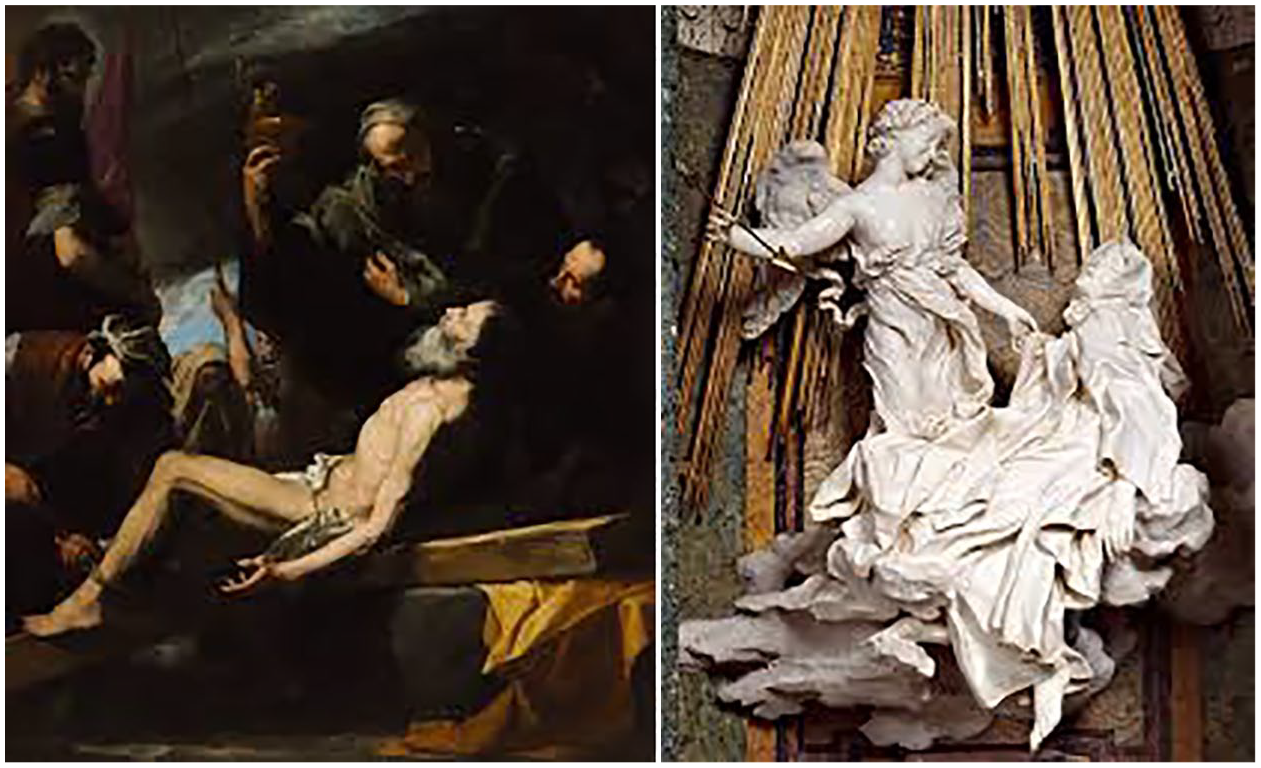
McIntyre (2018) suggests that, like the Church, post-truth leaders have the main purpose not only of spreading out propaganda but also of demonstrating that they have authority over truth itself. Gaining authority requires challenging reality, ‘to lie and get away with it’ (McIntyre, 2018: 114), which is the first step toward political control. In a context of overabundant information, offering alternative or opposing views to the mainstream media, that releases non-stop anti-hero narratives (let’s say anti-Trump), being ‘odious’ paradoxically works better than praise because ‘people believe what they want to believe’ (McIntyre, 2018: 115). Trump has tweeted more than 45,000 times since he opened his account in 2009, and more than 25,000 since he became president. In a liquid, digital era, dissonant tweets inflame the masses and generate emotions as much as a Bernini sculpture during the Baroque period.
And last, as said before, Mazarin preached with the example of the use of patronage relationships to consolidate his reputation as a statesman. He was a patron of the arts and was able to influence the view of the critical nobility in his future. When BP, the oil and gas company, sponsors the National Gallery or the National History Museum, it is clearly a form of manipulation (Miller, 2014). L’Etang (2008) suggests that any Corporate Social Responsibility (CSR) effort has as its main objective controlling the public’s will and avoiding public interference in an organization’s plans. Patronage sort of buys protection and prevents crisis in times where perceptions are everything. In both cases, hegemony and power are the most appreciated outcomes.
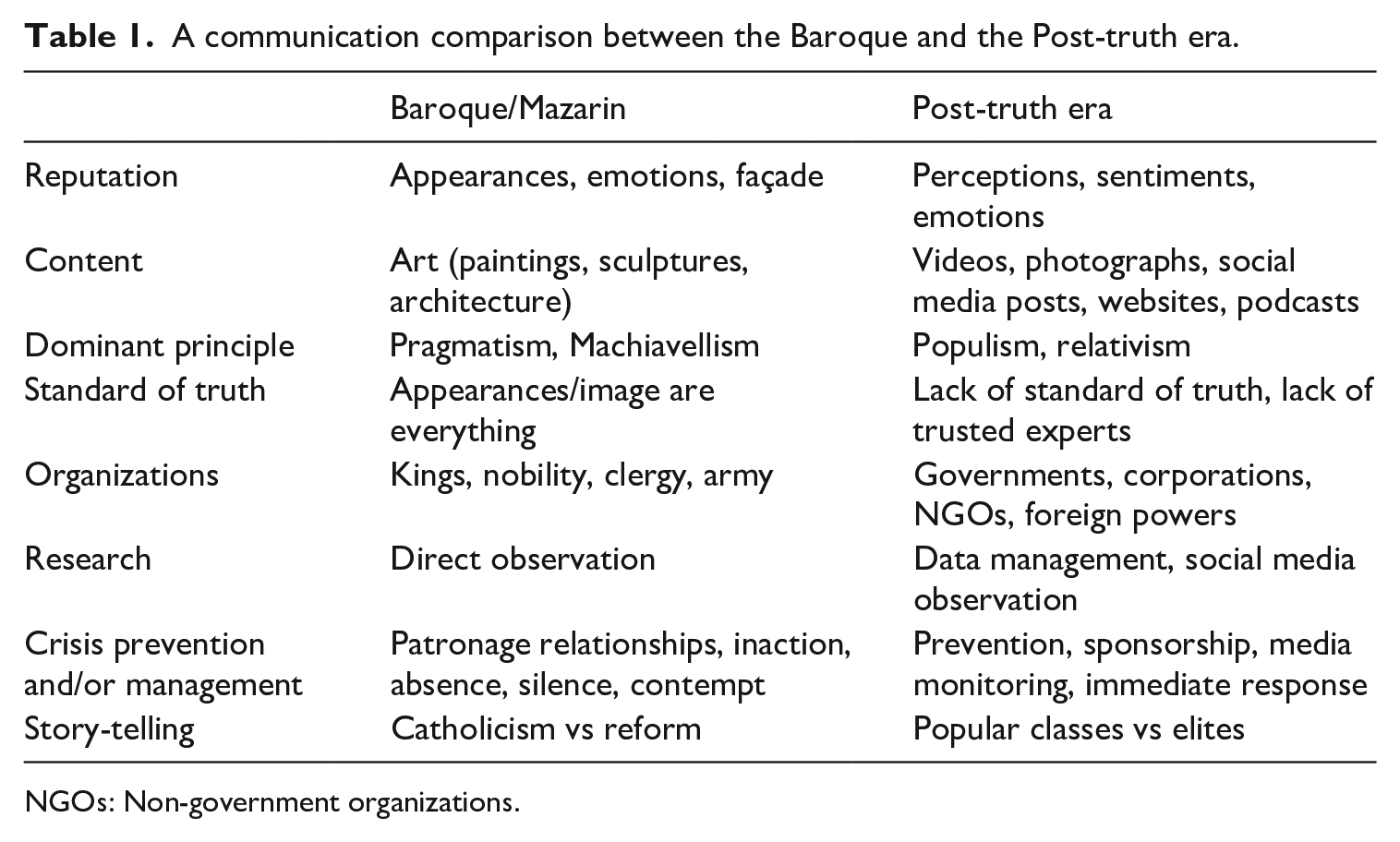
Table 1 represents a communication comparison between the Baroque and the Post-truth era.
A communication comparison between the Baroque and the Post-truth era.
NGOs: Non-government organizations.
Conclusion
The emphasis on the visual element, emotions and sentimentality, as well as the priority given to the mise en scene, all favored by a world in which social media have built a parallel society, may suggest we live in a neo-Baroque era of communication between organizations and publics. The resemblances between Mazarin’s simulation art, privileging appearances upon facts, squares surprisingly well with how current leaders such as Trump, Boris Johnson or George W. Bush connect with the masses.
Moreover, both the Baroque and the postmodern show a contempt of rationality that has been accentuated in the digital era: ‘social media are spaces for emotionally laden political expression in the form of posts and comments’ (Weeks and Garrett, 2017: 241). Both periods are on the same page. ‘The baroque is seen as resisting the coming age of rationalism, while the postmodern [ergo post-truth] revisits the emergence of modern subjectivity as source of knowledge of both self and world’ (Dimakopoulou, 2006: 11). In theory, the Baroque is modern, because kings, princes, and the clergy understood that centered communication management had the capacity to achieve their organizational objectives and enhance their power. A postmodern conception of communication should be the opposite, that is to say, a rejection of the communication manager as a rational being capable of achieving corporate objectives through communication (Holtzhausen, 2007). Mazarin won his reputation, in part, thanks to that. And, while this view of postmodernity may be true, the post-truth era shows communication managers and leaders have been able to reach their objectives by being irrational, thanks to the echo chamber provided by social media and mainstream media with their multiplicity of truths, where a community of like-minded individuals, sort of a correlate of the ‘believers’ in the Baroque period, are looking to confirm their preconceptions. Although in theory, the exposition to many ‘truths’ make it that much more difficult to influence publics, some ‘truths’ resound more than others, especially when there is the impulse of a ‘government communication apparatus’ that appeals to people’s preexisting viewpoints and prejudices. President Trump’s success using the term ‘fake news’ to label the legacy media is an example that leaders and managers in postmodern times do not compete at the same level as their competitors: publics or activists. Perhaps, these political leaders are being irrational, but there is a rationality in using irrationality to their advantage.
This is not a job that organizations with integrity that adhere to public relations ethical standards can resolve alone. It requires a backbone of media organizations that prioritize public interest over business and a public that is able to distinguish and, if needed, punish leaders and organizations that use this panorama of confusion for their own benefit.
Overall, the analysis of the works and acts of Cardinal Mazarin and other Baroque philosophers (Gracián, Hobbes) can help us understand the motivation and impact of today’s politicians and spin doctors. We should not forget that the Baroque, despite its fertility in the world of arts, was a period shaped by inequality, religious fundamentalism, absolutism, and nationalism – a number of features that can be found, to a certain extent, in today’s societies. Without trying to sound moralistic, the public enthronement of politicians such as (though not only) Trump and Johnson, after all, confirm that still today a number of political communicators consider façade, appearances, and manipulating the truth to be efficient and legitimate means to achieve power. Furthermore, the study of expression and changes in public relations ideas across history, through the study of authors and/or historical periods, showcase the way organizations (governments, empires, churches, etc) have connected with their constituencies, acted as an engine of history, and changed people’s behaviors and ideas, on a regular basis. The embracement of quantitative and empirical analysis should not be at the expense of an agenda of historical analysis.
So far, historical research on what Xifra (2017) calls the ‘intellectual history of PR’ (p. 579) has been implemented by a number of scholars (García, 2017; Moore, 2014; Xifra, 2017), generally working in isolation, who have seen the importance of certain ideas and authors in the PR history. Since ideas are usually generated in a certain historical context and do not just come from one specific author, future research should be conducted in a more systematic way studying government propaganda and a broad range of authors (including politicians, thinkers, philosophers, but also even fiction writers) looking at specific historical periods (Roman Empire, Middle Ages, Chinese dynasties, etc), across cultures.
Footnotes
Funding
The author received no financial support for the research, authorship, and/or publication of this article.
