




Abstract
Media use and talking with others have been found to have positive effects on citizens’ civic participation according to Wyatt, Katz, and Kim (2000). Recent research links informational uses of the mobile phone to increased involvement in civic and political life. Building on this line of research, this study explores the effect of smartphone use on civil discourse engagement in China, with its nearly 900 million mobile phone users. Results reveal the smartphone’s role as an outlet of public information, which fosters political talk with others, but also suggest use of government-controlled traditional media stifles open civic discourse. Hierarchical regression analyses show that talking politics in private, extensive use of the smartphone, and mobile tweeting were positive predictors of engagement in online civic discourse.
The influence of emerging new media on civic and political participation has attracted a great deal of scholarly attention (Kenski & Stroud, 2006; Xenos & Moy, 2007). Past research (Wyatt, Katz, & Kim, 2000) has established the positive role of media use as well as interpersonal communication in facilitating civil and political participatory behaviors. According to Kim, Wyatt, and Katz (1999), news-media use and political conversations have significant associations with political participation after controlling for the effects of socioeconomic resources and political interest. Recent research suggests that informational uses of the mobile phone were associated with increased involvement of citizens in civic and political life (Campbell & Kwak, 2010, 2011, 2012). Thanks to its converged functionalities, the mobile phone enables individuals to be engaged citizens.
With a total of nearly 900 million subscribers, there are more mobile phone users in China than in any other country in the world. China also has the world’s largest Internet population of 564 million. Nevertheless, Chinese citizens suffer low information availability due to the Chinese government’s strict control of traditional media and restrictions on access to information originated from new media. For instance, Google and Facebook were banned in the country. As Wallis (2011) explained, the contradictions reflect “the government’s desire to simultaneously expand new media technologies and control what are perceived as a ‘harmful’ influence” (p. 406).
Under such a circumstance, relatively more leeway has been given to mobile media for the benefit of China’s economic development. Consequently, Wallis (2011) argued that mobile media technologies in China have opened up new spaces for multiple modes of expression. For example, the mobile phone enables users to get information and distribute unofficial versions of event (known as duan zhi) via mass text messaging (He, 2008). Additionally, the majority of breaking-news was reported first in China on the uncensored platform of Twitter-like microblogs, called Weibo, supported by smartphones (Yu, 2011).
What are the broad implications of widely adopted smartphones on civil and political life in mobile-phone saturated China? This study attempts to shed light on this question by addressing the following concerns: Do Chinese citizens use mass texting and mobile microblogs (tweeting) to skirt the government’s information control? Furthermore, to what extent do use of mobile phones for news-getting and reading mobile tweets relate to talk about politics? And will talking politics privately predict engagement in open civic discourse in the online domain?
To address these concerns, the study examines the different role of government-controlled traditional media and unrestricted mobile telephony in political discourse—especially whether the latter contributes to positive citizen involvement in civic life.
Research design
The media landscape in reform China highlights a mix of official old media and new, commercial-driven media. The official media include those government-controlled old media, which are characteristic of a command and control system (Lee, 2000; Zhang, Shao, & Bowman, 2011). They coexist with emerging new media ranging from the Internet, satellite broadcasting, digital TV, to mobile telephony. Under the command and control system, government-controlled traditional media function as instruments of political and social control (Liu, 1982), the Chinese government routinely engages in gate keeping and censoring the flow and exchange of information and news produced and disseminated on mass media. Therefore, this study compares use of China’s government-controlled sector of traditional media and market-driven new media to ascertain if new media make a difference in participation in civic discourse in China’s burgeoning civic society.
Based on two continuums (control and command and restrictions on information availability), China’s media can be distinguished by four broad types (see Figure 1). Type 1 media are characteristic of tight government control and tend to confine information to the party line. State-run traditional media are examples. Type 2 includes media that are also under state control but which tend to provide broader types of information for commercial gains. Mobile data services, including mobile news and mass texting, offered by state-owned wireless telephone companies are examples. Type 3 refers to media that are market-driven and provide all sorts of information to users. Mobile Internet, including mobile Twitter-like microblogs offered by mobile telephony companies, is an example. Type 4 media are also market-driven but are low in information. Websites and online versions of the government-controlled newspapers such as People’s Daily online, are examples.

A typology of media types on China’s media landscape.
Some critical differences exist between news produced and disseminated by Types 2 and 3 media and by Type 4. The online news of government-controlled new media basically reproduce almost the same content of traditional media (Type 1). In comparison, mass texting messages, mobile news, or mobile tweet posts are primarily created and distributed by users via the Internet or wireless telecommunications networks. Therefore, it is expected that use of Type 2 and Type 3 media in China will have positive effects on talk about politics among private citizens and their engagement in open civic discourse via the Internet, but use of Type 1 and Type 4 media will not.
Literature review, research questions, and hypotheses
Mass texting
Text messaging or simply texting refers to the exchange of text messages of up to 160 characters between senders and receivers via a mobile device over a wireless telecommunications network. When voice calling was costly, text messaging became the most commonly used mobile service. Text messaging remains popular despite the falling cost of voice calls. In China, it is extremely popular. A total of 26 billion text messages were sent during the Chinese New Year in 2011.
Also known as text blasting and bulk texting, mass texting refers to a type of text message that is sent from one sender to multiple receivers simultaneously. Massive bulk texting is effective for reaching a large audience similar to traditional media. It resembles a type of one-to-many and many-to-many communication, as compared to the one-to-one model in texting between two persons who know each other.
Because of its efficiency, anonymity, and low cost, mass texting has become a popular outlet to disseminate political satire in the form of what is called “duan zhi” (jokes in texting) in China. Mass texting features a sort of user-generated content. He (2008) characterized mass texting as “an alternative discourse” to official discourse carried in the controlled media. To explore the extent to which mass texting is used among Chinese urban residents, the first research question is raised:
RQ1: How popular is mass texting among Chinese urban residents? And what factors predict mass texting behavior?
Mobile tweeting
In the era of 3G, smartphones enable users to connect to the Internet anywhere any time. As a result, common applications such as web browsing, blogs, and the Twitter-like microblogs are rising among smartphone users. Mobile Internet use grew rapidly in China between 2008 and 2010. The growth was accompanied by a phenomenal adoption of microblogging, a Twitter-like social media commonly known as “weibo” in Chinese. Within a year, the number of microblog users in China grew from 63.11 million to 195 million. An estimated 200 million microblog users in 2012 accounted for 65.5% of total weibo users (China Internet Network Information Center [CNNIC], 2011).
Two factors contributed to the widespread use of mobile microblogs (Wei, Lo, Xu, Chen, & Zhang, 2013): the technical attributes of the mobile platform for sharing and disseminating information quickly (in 140 characters) in text or multimedia format and its function as a social networking service to connect with friends, families, and fans. A user can follow any microblog of his/her choice. Likewise, anyone with a microblog account can be followed by anyone without clumsy approval steps like those of Facebook. A celebrity’s microblog can attract millions of followers/fans. As an emerging platform for news dissemination and information sharing (mostly user-generated content), mobile microblogs provide a novel outlet of uncensored news in China’s tightly controlled media environment. According to Yu (2011), mobile microblogging has become a new tool for Chinese journalists, who tend to publish their uncensored stories first through microblog posting. A number of breaking news stories, such as the collision of China’s fast-rail trains in 2011, were first reported on microblogs by witnesses (Wei et al., 2013). In short, the microblog has emerged as a news medium that remains relatively free of official control in China. Accordingly, this study explores the behavior of using mobile tweeting in the second research question:
RQ2: How popular is mobile tweeting among smartphone users in urban China? And what factors predict mobile tweeting?
Effects of media use on political talk
The media play a key role in informing citizens of public affairs and issues in politics and facilitating the democratic deliberative process and political participation (Kaid, 2004). Empirical research in Western democracies suggests that media use has played a positive role in political participation (Chaffee & Schleuder, 1986; Perloff, 1998). Specifically, media use enhances the public’s awareness and knowledge of political issues (Drew & Weaver, 1990; Weaver, 1996). Furthermore, the positive impact of media use on political participation has been found to be greater when well-informed individuals engage in discussions about political news with others (e.g., elaboration and talk with others). The positive relationship between news-media use and political conversations was theorized by scholars (Bryce, 1973; Kim et al., 1999) as follows: media use informs individuals about politics; well-informed individuals freely discuss politics, form political opinions, and then participate in the political process. This process model highlights interpersonal discussions as a mediator of media use’s effect on civic and political participation. As Barber (1984) put it, “At the heart of a strong democracy is talk” (p. 174).
Empirically, Koch’s (1994) experiments showed a significant association between newspaper reading and political talk. The experimental group that was required to read The New York Times every day showed a significant increase in political communication activities. Similar results were reported by Katz and his associates (Kim et al., 1999; Wyatt et al., 2000). Research on mobile communication by Campbell and Kwak (2010) suggested that use of the mobile phone for news and information leads to talk about public affairs in public locations.
These generalizations concerning the positive effect of news media use on triggering political talk cannot be readily applied to a nondemocratic society like China. As explained earlier, the media are part of the Chinese state apparatus. Government-controlled newspapers and TV stations have been instruments of political and social control in the form of propaganda (Bishop, 1986). Although China boasts the world’s largest broadcasting TV service with one billion audiences, traditional mass media face a wide range of constraints, such as ideological control, bureaucratic hierarchy, inefficiency, and self-censorship. As gatekeepers, they block horizontal communication among private citizens and make vertical communication with government officials difficult due to its hierarchical nature. As new media rise since the 1990s, traditional media in China as a government mouthpiece with a top-down paradigm face serious competition as source of information. They lag further behind new media as channels of interaction. For example, Zhu and He (2002) found that online chatting had a positive effect, while use of traditional media had no effect, on Chinese citizens.
Based on the previous review, use of government-controlled news media in China is not expected to be conducive to political talk.
H1a: Use of government-controlled news media will be negatively related to the frequency of political talk among Chinese urban smartphone users.
On the other hand, as emerging platforms for news dissemination and information exchange, mass texting messaging, news delivered to the screen of mobile phones, and user-generated content originated from social network sites such as tweet posts are less controlled in China, they provide news reports and information typically not available on government-controlled traditional media. Therefore, use of these new media will likely have a positive effect on the frequency of talk about politics. Based on the described rationale and the typology of media in China (see Figure 1), it is further hypothesized that:
H1b(1): Use of mass texting will be positively related to the frequency of political talk among Chinese urban smartphone users.
H1b(2): Reading mobile news will be positively related to the frequency of political talk among Chinese urban smartphone users.
H1b(3): Mobile tweeting will be positively related to the frequency of political talk among Chinese urban smartphone users.
Effects of political talk on online civic discourse participation
Cognitively, talk or discussion functions as a sort of elaboration of news and information learned from the media. Following news exposure, an elaboration process is critical to turn the information into long-term knowledge (Eveland & Hively, 2009; Wei & Lo, 2008). As discussed earlier, discussing politics with family or friends was considered an important factor in positively affecting the level of political participation (Eveland & Scheufele, 2000; Lemert, 1984; Walsh, 2004). At the core of democratic theory, Kim and Han (2005) argued that it is a necessary condition that the public actively participates in the process of politics, and that participatory behavior requires citizens to talk and discuss politics and public affairs openly in public settings.
In the literature, talk between individuals included two types: political talk and sociable conversations (Scheufele, 2000). Schudson (1997) argued that political talk is a goal-oriented discussion about political issues for solving conflicts, deciding public policies, or simply protecting one’s own interests. Others defined political talk as a rational exchange of various arguments about public issues among some knowledgeable and interested individuals (Scheufele, 2000, 2001; Walsh, 2004). Sociable conversation, in contrast, is characteristic of casual communication that focuses on personal issues or social chats.
Empirically, J. Kim et al. (1999) reported that political discussion and news use enhanced one another in generating participation among citizens. Wyatt et al. (2000) also reported that frequency of political conversation was positively associated with political participation. Ikeda and Boase (2011) showed that talking about politics positively affects political participation, irrespective of whether politics is the main subject of conversation or merely a by-product of conversation.
It is worth noting that past studies have linked political discussion with citizen participatory behavior in the context of use of traditional media (Kim et al., 1999; McLeod, Scheufele, & Moy, 1999; Wyatt et al., 2000) and new media as well (Price & Cappella, 2002). Findings from a large survey conducted by Bakker and de Vreese (2011) revealed that a variety of Internet uses are positively related with different forms of political participation. Parallel to the relationships between offline discussion and participation, positive associations have been reported between online discussion and participation (Hardy & Scheufele, 2005). Recent research has examined how mobile telephony affected those outcomes (Hampton, 2011). Campbell and Kwak (2011) explored how patterns of mobile phone use are linked to civic and political involvement. Their findings revealed that use of the technology for information exchange and recreation is a positive predictor of participation in civic life.
In sum, current research on the effects of new media use suggests new media have broadened the scope of political participation (di Gennaro & Dutton, 2006) for the politically engaged public who have acquired Internet access thanks to the rapid diffusion of Internet and Web 2.0 technologies. As di Gennaro and Dutton (2006) argued, the Internet lowered the cost of involvement in politics and created new mechanisms that facilitate the exchange of information. More importantly, the interactive and asynchronous attributes of the Internet have made it possible for Internet users to engage in politics by expressing one’s voice or interact with government officials with a click of the mouse. Therefore, this pattern—discussion as an elaboration process that leads to greater engagement (Tewksbury & Rittenberg, 2012) —should hold true in China where government-controlled media restrict information and offer limited interaction. Given the centrality of the mobile phone to access news unavailable in the official news media, it is anticipated that political talk will predict participation in online discourse:
H2: Political talk with others will be significantly and positively related to participation in online discourse.
Finally, previous studies have demonstrated that news media use has a positive effect on political participation (e.g., Martin, 2000; Wolfinger & Rosenstone, 1980). However, the process model proposed by Bryce (1973) and Kim et al. (1999) underscores interpersonal discussions or political talk as a mediator between news media use and political participation. That is, news media use generates talk about politics with others, which in turn triggers political participation. This model appears to be superior to a direct effect approach in theorizing the effects of new media use on civil and political participation. Accordingly, to test the role of political talk in bridging use of mobile media and discourse engagement, the third hypothesis was formulated:
H3: The effects of new media use (e.g., reading mobile news, mass texting, and mobile tweeting) on participation in civic discourse will be mediated through political talk.
Method
Sampling
A probability sample of Beijing residents was drawn using RDD (random digit dialing). A total of 2,645 household telephone numbers were generated using computer-assisted telephone interviewing (CATI). Trained interviewers of a marketing research firm conducted the interviews in the first week of July 2011. Respondents at age 18 or older of selected households were interviewed. They were assured of anonymity and participation was voluntary. A total of 416 interviews were successfully completed, yielding a response rate of 15.84%.
Of the sample, 48.6% were male and 51.4% female. The mean age was 40.54 (SD = 16.95, ranging from 18 to 84). In terms of education, 11.1% finished middle school, 21.9% were high school graduates, 21.4% were college graduates, and 36.1% had graduate education (6.5% did not answer this question). In terms of occupation, employees of the government and other public institutions made up 14.2% of the sample while employees of businesses, including managers and small-business owners, accounted for 18.1%. For the rest, 13.2% were professionals, 9.1% were students, and 1.4% were homemakers. Unemployed were 2.6% and retired were 19.2% (4.1% did not answer this question). In terms of income, the median category was a monthly income of $3000−4000.
Operationalization
Use of smartphones for mobile data service
Respondents were asked whether they had used the mobile phone to browse websites, access social media sites, blog, email, play video games, tweet, and text. The scale was 4-point (1 = never; 4 = often). Results of an exploratory principal component factor analysis of the nine items showed a single factor-solution (eigenvalue = 3.93, variance explained = 43.79%). The results provided evidence that the items measured a single underlying concept of using the smartphone for multiple functionalities through various data services. Accordingly, they were averaged to create an index of using smartphone for mobile data services (M = 1.84, SD = .64, alpha = .83).
Reading mobile news
Respondents were asked how often they used the mobile phone (a) to read news on websites, (b) to read news on mobile versions of websites, (c) to read news apps for the mobile phone, (d) to watch TV news, and (e) to listen to radio news. The response categories ranged from 1 “never” to 4 “often.” Results of a principal component factor analysis showed that these items were grouped in a single factor. The single factor solution explained 62.55% of the variance (eigenvalue = 2.41). The five items were averaged to form a composite measure (M = 1.59, SD = .67, alpha = .72).
Frequency of mass texting
On a scale of 1–4 point where “1” meant “never” and “4” meant “often,” respondents were asked to indicate how often they (a) received mass texting, and (b) forwarded mass text messages. The two items were combined as a measure of frequency of mass texting (M = 2.62, SD =. 74, r = .38, p < .001).
Use of mobile tweeting
This refers to use the smartphone to post or view a tweet on one’s microblog. Use of mobile tweeting was also measured by frequency of sending and posting mobile microblogs per week. The two items were combined to generate an index frequency of mobile tweeting (M = 2.96, SD = .64, r = .49, p < .001). Second, respondents were requested to report the number of mobile microblog posts they received and forwarded per week. They were combined into a single measure labeled as “amount of mobile tweeting” (M = 17.12, SD = 98.36, r = .47, p < .001). A composite scale of “intensity of mobile tweeting” was created by multiply frequency of mobile tweeting with amount of mobile tweeting.
Use of government-controlled traditional media
Respondents reported the number of days per week they read newspapers, news magazines, and watched TV news. Results of a factor analysis of the three items using principle component extraction with varimax rotation showed a single-factor solution (eigenvalue = 1.51, explaining 50.17% of the variance). The three items were averaged to as a scale of “use of state-controlled traditional media” (M = 2.65, SD = 1.02, alpha = .50).
Frequency of talk with others
Following the approach of Kim et al. (1999), political conversation as communicative action included a wide range of topics, such as education, economy, crime, and foreign policy. Respondents were given a list of topics and asked how often they engaged in face-to-face conversations about them on a 1–4 point scale (1 meant “never” and 4 meant “often”). Results of an exploratory principal factor analysis using varimax rotation produced a factor, which included offline talk about the government, international events, the economy, crime, and education (eigenvalue =1.36, explaining 39.62%). They were averaged to construct an index called “political talk” (M = 2.73, SD = .74, alpha = .80).
Freedom to talk
The respondents were then asked to indicate their agreement with the statement whether they enjoyed freedom in talking about the nine topics. A 5-point Likert scale was used (where 1 = “not free at all” and 5 = “totally free”). Results of an exploratory factor analysis showed a single-factor solution (eigenvalue = 5.08, 56.25% of variance explained). A summated scale was constructed (M = 3.38, SD = 1.02, alpha = .90).
Engagement in civic discourse
Because truly democratic elections do not exist in China, political participation focused on civic discourse engagement (e.g., participative behavior in expressing one’s views in various media). Operationally, respondents were asked to report how often they had engaged in the following activities in the previous 12 months: (a) write to the press (b) participate in radio talk shows; (c) participate in TV talk shows (d) post on bulletin board system (BBS) or forums, (e) participate in opinion polls on the Internet, and (f) post tweets. The scale ranged from 1 to 4, where 1 meant “never” and 4 meant “often.” A two-factor solution emerged from an exploratory principal factor analysis of the six items using variamax rotation. Three items (4–6) loaded on the first factor (eigenvalue = 2.06, explaining 33.32% of variance). They were combined into a new variable called “online discourse engagement” (M = 1.69, SD = .78, alpha = .74). The other three items (1–3) loaded on the second factor (eigenvalue =1.50, explaining 26.28% of variance), which was labeled “offline discourse engagement.” The average was used to generate a summative scale (M = 1.07, SD = .14, alpha = .45).
Political efficacy
Campbell, Gurin, and Miller (1954) introduced the concept of political efficacy in their first U.S. national election survey. Others expanded the concept by distinguishing between “internal” and “external” efficacy. Two items, one external and one internal efficacy, were adapted from the literature (Kenski & Stroud, 2006) to measure political efficacy: “people like me have no say over who gets to be president” and “sometimes elections seem so complicated that a person like me cannot really understand what is going on.” Correlated, the two items were combined into a composite scale (M = 2.98, SD = 1.15, r = .49, p < .001). This variable was used as control in the regression analyses based on previous literature.
Findings
RQ1 explored the popularity of mass texting among urban residents in China and predictors of mass texting behavior. Among the 416 surveyed respondents, the frequency of receiving and sending mass texting (duan zhi) averaged between “rarely” and “sometimes.” On average, they received five mass text messages (SD = 12.54) per week. They forwarded an average of 2.17 such messages in a week (SD = 4.12). This result confirmed He’s (2008) finding that mass SMS has emerged a medium for unofficial discourse.
A hierarchical multiple regression analysis predicting the frequency of mass texting was run with predictors being mobile phone use and control variables being demographics and political efficacy in the equation. Previous research (Kenski & Stroud, 2006; Verba & Nie, 1972) has documented the important role of political efficacy in affecting a range of media effects such as knowledge, interest, and participation. Therefore, to ascertain the relationship between use of smartphone and frequency of mass texting, the influence of political efficacy was controlled. Results show that use of mobile data (beta = .25, p < .001) and political efficacy (beta = .10, p < .05) were significant predictors. As shown in Table 1 (first column), a total of 8.2% of variance was accounted for by the two significant predictors. These results indicate that respondents who used the smartphone extensively and had a higher level of political efficacy tended to send and receive mass texting messages more frequently.
Hierarchical regressions predicting mass texting and mobile tweeting.

Note. Beta weights are from final regression equation with all blocks of variables in the model. Variables recoded as follows: gender (0 = female, 1 = male); N = 416.
p < .001; **p < .01; *p < .05.
RQ2 explored the popularity of mobile tweeting among urban residents in China and factors that would predict mobile tweeting behavior. Among the 416 respondents, the frequency of posting on mobile microblogs (M = 2.87, SD = 1.02) and forwarding such posts (M = 2.42, SD = 1.2) fell between “rarely” and “sometimes.” On average, they posted 12 tweets on mobile microblogs (SD = 21.57) and forwarded 17 tweets per week (SD = 30.30). These results validate the view that mobile microblog thrives in China as a user-centered unofficial public opinion.
Results of a hierarchical multiple regression (Table 1, third column) show that extensive smartphone use (beta =. 17, p < .05) and reading mobile news (beta = −.19, p < .01) were significant predictors of intensity of mobile tweeting. That is, the more the respondents used the smartphone for various mobile data services, but the less they read news on the mobile screen, the more they used their smartphone to tweet. It seems use of mobile microblogging displaces reading mobile news because the two may carry the same content.
H1a proposed that use of traditional media would be negatively related to frequency of political talk with others among Chinese urban smartphone users. To test it, a hierarchical regression was conducted with frequency of political talk as the dependent variable. The first block that entered into the equation were demographics, followed by use of traditional media and frequency of mass texting, reading mobile news, and mobile tweeting. The last two blocks were political efficacy and freedom to talk; as reviewed earlier, past research (e.g., Kim et al., 1999) has identified freedom to talk as a major predictor of political talk. As results in Table 2 show (first column), after controlling for the influences of demographics, exposure to the government-controlled traditional media was a significant but negative predictor of talking of politics with others (beta = −.22, p < .001). H1a was supported.
Hierarchical regression analysis predicting political talk.

Note. Beta weights are from final regression equation with all blocks of variables in the model. Variables recoded as follows: gender (0 = female, 1 = male); N = 416.
p < .001; **p < .01; *p < .05.
Three hypotheses under H1b proposed that (a) use of mass texting, (b) reading mobile news, and (c) mobile tweeting will be positively related to the frequency of political talk among Chinese urban smartphone users. Results of the previous regression analysis (see Table 2, first column) show that after the influence of all significant predictors were taken into consideration, reading mobile news (beta = .12, p < .05) and mass texting (beta = .09, p < .01) were significant predictors of the frequency of political talk, but mobile tweeting was not. Accordingly, H1b(1) and H1b(2) were supported, but H1b(3) was not.
Taken together, these results suggest that the more respondents used traditional media, the less often they talked about politics with others. On the other hand, the more they read news delivered on the screen of the mobile phone, the more they sent and received mass texting, and the more they believed that they were free to talk, the more frequently they engaged in political talk with others.
H2a proposed that political talk would be significantly and positively related to online discourse engagement. To test it, more hierarchical regressions were run treating online discourse engagement as the dependent variable. The first block that entered in the equation was demographics, followed by use of traditional media, and use of mobile telephony technologies. The last two blocks were respectively political efficacy and freedom to talk, and political talk. As Table 3 shows, after controlling for the influences of demographics, three significant predictors of online discourse engagement emerged: use of the smartphone for mobile data (beta = .46, p < .001), the amount of mobile tweeting (beta = .117, p < .01), and political talk (beta = .137, p < .001). These results supported H2a, indicating that the more extensively the respondents used the smartphone for various services, the greater the amount of mobile tweets they posted, and the more they talked about politics with others, the more often they engaged in online discourse. The total variance explained by the equation was 43.9% (adjusted R2).
Hierarchical regression analysis predicting engagement in civic discourse.
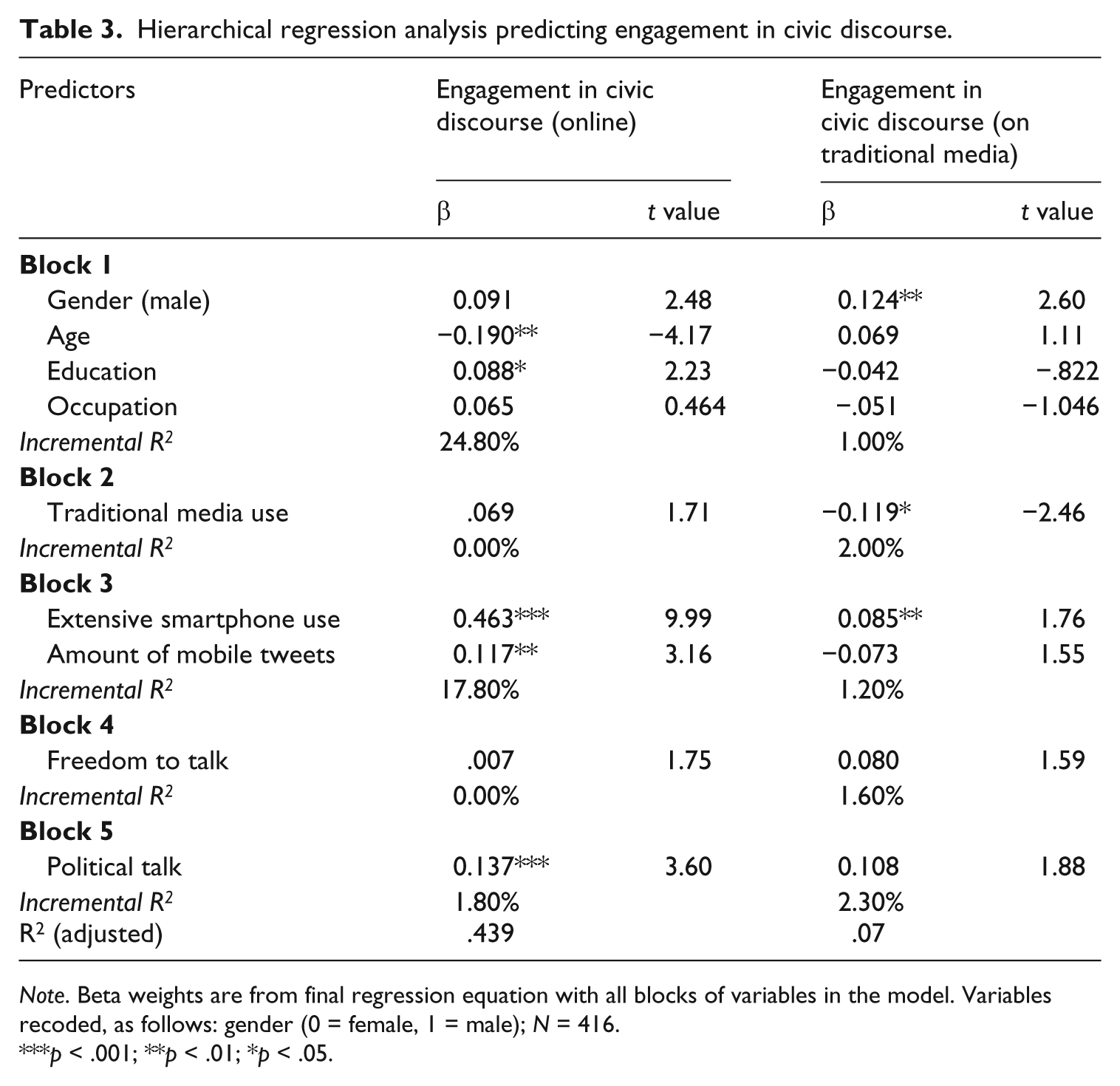
Note. Beta weights are from final regression equation with all blocks of variables in the model. Variables recoded, as follows: gender (0 = female, 1 = male); N = 416.
p < .001; **p < .01; *p < .05.
Finally, to address H3, which hypothesized the mediating role of political talk between use of new media and online discourse engagement, a path model was built using beta coefficients generated from the multiple regression runs presented in Tables 2 and 3, which respectively treated political talk and online discourse engagement as the dependent variable. Entered in the path were only those significant predictors of either political talk or online discourse engagement. The solid straight line indicates direct effects. As Figure 2 shows, the effects of reading mobile news and amount of mass texting on political talk were positive and direct (significant at the p < .05 level or greater), but such effects on online discourse engagement were nonsignificant. The exceptions were the paths of amount of mobile tweeting and extensive use of smartphone to online discourse engagement, which have a direct effect. Furthermore, the effect of political talk on online discourse engagement was positive and direct (significant at the p < .05 level). Taken together, these results validate the mediating model, suggesting that the effects of mobile phone use for news and mass texting on civic discourse engagement work through talk about politics with others.

Path analysis predicting discourse engagement online.
Discussion
The literature on new media and political participation is growing but mostly in Western societies and advanced democracies. This study is the first empirical study in a non-Western context that attempts to ascertain the role of smartphones in fostering political talk, which leads to civic discourse engagement online among China’s urban residents. Specifically, this exploratory study examines whether and how smartphones facilitate discourse engagement via the Internet in China where such widely adopted new media as mobile news, blogs, and Twitter-like microblogs provide alternative outlets for news dissemination and consumption. In attempting this analysis, the mediating role of political talk in linking news media use and civic discourse engagement online was explored. It was anticipated that as a personal technology, the smartphone would facilitate the distribution of user-generated content (such as mass texting and tweet posts); exposure to such content would trigger private talk about politics with other, which in turn leads to civic discourse engagement in the online domain.
The contribution of this study conducted in a non-Western context comes from the key findings that exposure to less regulated mobile news and user-generated mobile tweets were conducive to political talk with others publicly. That is, reading mobile news and higher frequency of mass texting were positively related to increases in talking politics with others. This finding is consistent with the literature (Bryce, 1973; Kim et al., 1999) that theorizes a positive relationship between news media use and interpersonal communication in the form of political conversations. However, the effects of news media use on political talk cannot be attributed to government-controlled traditional media in China. Findings suggest that use of state-run traditional media appears to reduce the frequency of political talk. Thus, this study pieced together some empirical evidence ascertaining the role of mobile media in fostering civic life in an authoritarian country like China.
Moreover, Kim et al. (1999) argued that through conversations citizens can bridge their personal experiences with the political world. Findings of this study underscore the mediating role of political talk in linking use of mobile media for news and civic discourse engagement—political talk was positively related to online discourse engagement. Specifically, smartphone users who discussed politics with others and those who used smartphones for news-getting and for posting mobile tweets were more likely to post on BBS, to blog, and to participate in online polling. This finding is consistent with other studies conducted in Western democracies (Bakker & de Vreese, 2011; Shah, Cho, Eveland, & Kwak, 2005), which reported a positive relationship between noninformational uses of the Internet and political participation in the online domain.
In summary, the empirical findings of this exploratory study indicate that by disseminating uncensored news and information originated from users, the smartphone technologies have opened up a new sphere for public expression and civic discourse participation in an authoritarian country. This study contributes to the growing research in mobile communications in terms of underscoring how specific mobile technologies help discourse engagement among Chinese urban citizens when traditional media still function as a state propaganda apparatus and freedom of the press is out of the question. New mobile media seem to fill the void and fulfill the information needs of millions of Chinese middle-class citizens who aspire to active participation in China’s transformation into a democracy. The smartphone in China plays what Campbell and Kwak (2011) described as a positive role in expanding spheres of public discourse.
The limitations of the study should be acknowledged. The sample size was relatively small and the response rate was low. In addition, some of the measures, such as use of government-controlled traditional media, are low in reliability. Future research can build on the exploratory findings of this study and test a full causal model of use of new media and political participation using a national sample.
Footnotes
Funding
Thanks to the College of Mass Communications and Information Studies at the University of South Carolina for funding this study.