




Abstract
A mobile contingency model is introduced and used to guide hypotheses about how the strength of people’s habits for using an incumbent medium (here, print newspapers), their degree of adoption of a newer medium (mobile devices), and their attitudes about the importance of professional news sources, influence their use of mobile devices for communication functions including entertainment, interpersonal communication, following news, financial transactions, and e-commerce. Secondary analysis of a 2012 U.S. national phone survey is employed. Older respondents use mobile devices less for all functions, including following news, tend to be loyal print subscribers, and highly agree that it is important for news to be produced by professional news sources. However, when the effect of age is controlled, higher levels of education, and to a lesser extent, income, still significantly predict agreement about the importance of professional news sources. The results demonstrate the crucial impact of news attitudes, and are largely supportive of the mobile contingency model. The most important practical implication is that newspaper companies should be targeting their mobile applications not to their subscribers, but rather to nonsubscribers who have adopted mobile devices, are highly educated, and have higher incomes.
Keywords
The goal of this paper is to further develop theory about the antecedents of communication uses of mobile devices, and how use of mobile devices for news is related to other mobile communication functions as well as to print news use. The theory is tested with secondary analysis of a 2012 U.S. national phone survey. The applied rationale for the study is the quandary newspaper companies are experiencing as they attempt to create mobile access to their content in a way that increases audience use, but does not cannibalize audience and revenues generated by their print and web traffic businesses. Westlund (2012) provides an overview of how mobile devices morphed from being “phones,” into multifunctional instruments that offered complete access to the Internet, served as music players, cameras, and GPSs. As mobile technology developed touch screens and more sophisticated operating systems, it became clear to news organizations, including newspapers, that gaining mobile news consumers would be critical to their business.
The present study is about how people use mobile devices for communication functions, including news, and how this relates to their use of print newspapers, as well as other variables that have been identified as predictors of the relationship of “traditional” news sources, like print newspapers, and “new” media, like mobile-based news. We first address theories about how people choose among media to fulfill various communication functions, and how introduction of new media affects the choice of incumbent media. We then look at recent empirical research and its implications for theory. Based on this exercise, we articulate a model that combines features of prior theories, and that guides analysis of the data addressed here.
The foundational approach to which most modern theories of media choice are related is uses and gratifications (U&G; Blumler & Katz, 1974; Levy & Windahl, 1984; Ruggiero, 2000). It suggests that people have communication needs, they employ a channel or device to fulfill them, continuing to employ that choice until they discover a medium that does a better job of fulfilling the particular communication need. Under the simplest interpretation, the theory suggests that when a new communication technology becomes available and is tried, it is likely to substitute for or “displace” media currently being used. Displacement refers to the degree to which use of one medium reduces the use of another, even to the extent of completely replacing it (Waldfogel, 2002; Westlund & Weibull, 2013).
About the same time U&G theory was being introduced, McCombs (1972) articulated the “principle of relative constancy.” This principle suggested that media time is limited and thus, when a new medium begins to be used to fulfill a particular function, the prior medium of choice will be displaced. However, research (e.g., Dutta-Bergman, 2004) commonly shows that under some circumstances the introduction of a new medium has no displacement impact on an older one, that is, the use of the two is “complementary.” As a possible explanation for lack of displacement patterns, Dimmick and Rothenbuhler (1984) introduced the concept of “niche.” A niche is a time, location, or functional position of a medium in a communication ecology. So, for example, TheNew York Times cell phone app may be used by people whenever they are commuting or are somewhere without Internet access (i.e., a “transit niche”; Dimmick, Ramirez, & Feaster, 2007). The print New York Times delivered to homes in the morning may be read at the breakfast table, or in a more leisurely way after the late-night local television news. Because the mobile app and the print newspaper fill different time/location niches, the time spent with one channel may have no impact on the time spent with the other. The most recent research, in fact, has shown that both displacement and complementarity relations can occur between media. For example, Westlund and Färdigh (2011) showed that evening print tabloids were displaced by their online versions for younger, higher income males, while older consumers showed no displacement of their print use by their digital access use.
At least two theories have elaborated processes beyond U&G and the concept of niche. Each brings important insights to the complexity of media choice.
The technology to performance chain (TPC; Goodhue & Thompson, 1995) was designed to be applied to any technology, not just communication technologies. Like U&G, it posits there is a task to be accomplished (e.g., need to answer questions about a brand), there are technologies (tools for accomplishing tasks), and there is a perceived fit between the two (a company’s information management system organizes the answers about brands and is able to respond automatically to customers). An analogue of this concept of “fit” specific to mobile use is Chyi and Chadha’s (2012) finding that a major determinant of a technology being used for news is its “newsfulness,” that is, its “fit” with what is desirable for news consumption.
TPC also posits the importance of the individual choosing the technology. That individual has specific abilities, adheres to certain social norms and has beliefs about the technology (Fishbein & Ajzen, 1975), as well as particular habits vis-à-vis the task and the technology. Task, technology, fit, and attributes of the decision-maker are antecedents of adoption of a technology. The last stage of the technology–performance chain is its performance impact, that is, how well a task is accomplished by using the technology. Evaluation of performance feeds back into the decision-making chain, helping to determine whether the technology will continue to be used or the decision-maker will revert to a prior technology, or search will ensue for yet another new technology. Habits and beliefs of the decision-maker may prevent trial of a new technology (e.g., Atkin & LaRose, 1994), but social norms may place pressure on the decision-maker to experiment with innovative technologies. Diddi and LaRose (2006; also see McQuail, 2005) found that habit was the most consistent predictor of college student use of media for news. Van der Wurff (2011), after failing to show consistent impact of niche theory’s predictions about media choice, did an additional analysis that showed that habit (“I use the medium out of habit”) was one of the two strongest and most consistent predictors of media choice (accessibility of the technology was the other predictor). It should be noted that TPC echoes Dervin’s (1989) sense-making approach, and Renckstorf, McQuail, and Jankowski’s idea (1996) that media use is shaped by people’s behaviors, beliefs, and perceptions.
The contingency model (Bouwman & van de Wijngaert, 2002) starts from the same basic set of concepts as TPC. There are “tasks” that “technology” can be used to accomplish, and both of these variables are socially constructed, that is, perceptions of them come from individuals with different beliefs, abilities (Bouwman & van de Wijngaert, 2002), and habits, and who exist in different norm environments. Individuals also have different access to technologies. Thus media choice for Bouwman and van de Wijngaert (2002, p. 333) is contingent on task, “user context” (which is defined as all the variables related to the individual), and technology.
What does this mean for understanding antecedents of mobile technology use? First, it predicts that demographics like age, education, gender, and income will be important. It also suggests the importance of current technology habits of decision-makers. For example, if a person acquires daily news from subscribing to a print news product, the strength of that habit may reduce the likelihood of using mobile devices for news. Access to mobile devices, on the other hand, will probably increase the likelihood of using them for news. Access may also increase the likelihood of adopting mobile devices for a variety of other functions, including entertainment, financial transactions, and e-commerce. Because mobile devices can be used for a variety of functions, and the more functions they encompass, the greater their degree of adoption, this present paper treats all functional uses of mobile devices as dependent variables.
The theories also suggest that “beliefs” will be important. In the present study we look at beliefs people have about the importance of news sources. Of course, the theories would also recognize that other beliefs might be predictive; for example, whether mobile devices are convenient to use for acquiring news. To capture these processes specifically for application to mobile device use, the contingency model shown in Figure 1 is introduced. It is especially useful for thinking about what the relationships will be between print news and mobile news.
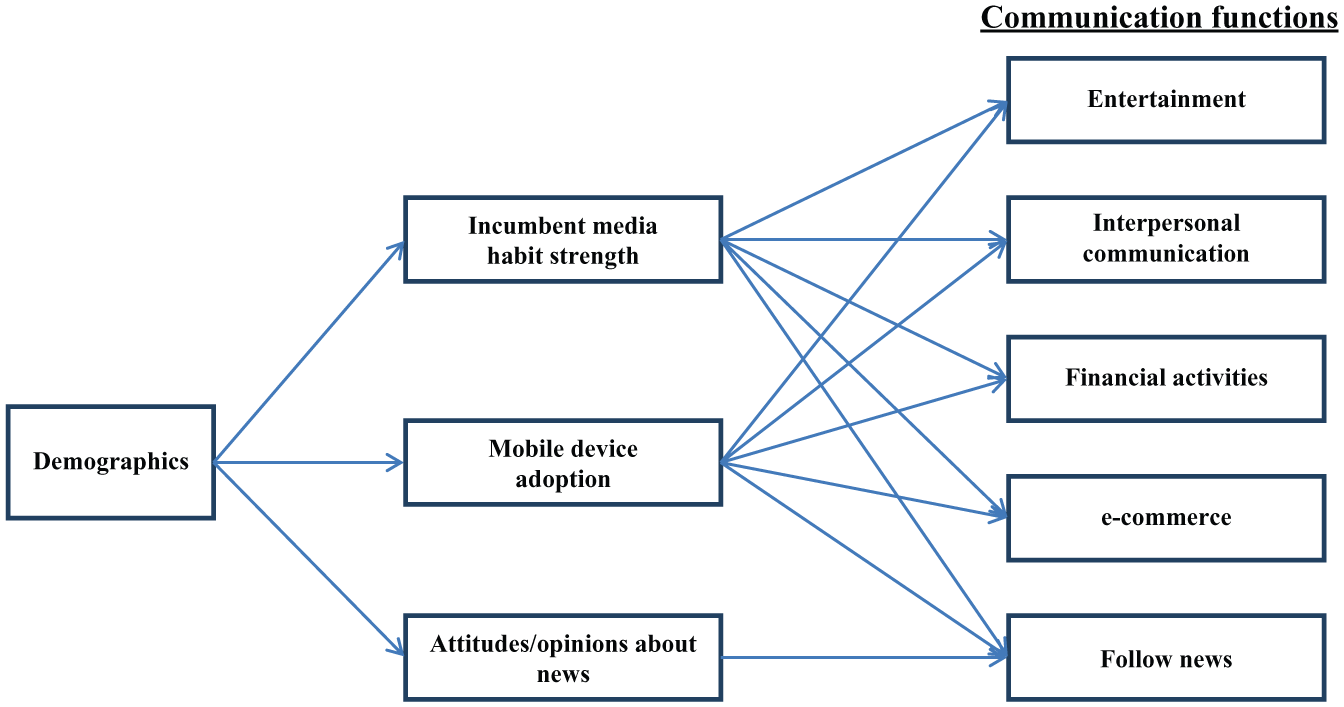
Mobile news contingency model.
As can be seen in Figure 1, the process of choosing mobile media starts with individual demographics. These demographics are predictive of three important conceptual variables. The first is incumbent media habit strength. This variable should be indexed as some measure of how loyal people are to nonmobile media like television news or print newspapers. In the data analyzed here, the variable was indexed in terms of whether people were or were not paying for a subscription to a print newspaper, whether national, metropolitan, daily, or weekly.
The next variable in the model is mobile device adoption. As operationalized here, the measure is based on both access (own the mobile devices) and time spent with all of one’s mobile devices (in hours per week). The third variable in the model involves attitudes/opinions about news. As noted before, there are many possible operationalizations of attitudes/opinions about news, but here, answers to questions about the importance of type of news source were employed.
The final stage in the model represents the communication tasks that the mobile medium is used to fulfill, here measured in terms of total time in the last 7 days people used all of their mobile devices for each communication function.
It should be noted that although the concept of “niche” is not overtly represented in the mobile contingency model, the concept is actually located within the unique features of the context in which the individual makes a technology choice. For example, Bouwman and van de Wijngaert (2002) look at how media choices are made at home versus at the university and as a function of the nature of the task (finding a movie to go tonight while talking with friends at the university vs. helping one’s mother find a train departure time while at home). Thus, like Dimmick and Rothenbuhler (1984), media are chosen within the context of time, location, and functionality, and those features reside in the individual decision-maker.
Furthermore, and closely related to niche, is the idea of “media clusters.” Vishwanath and Chen (2006) showed that iPods are perceived as compatible and interchangeable with personal computers and in that sense the devices belong to the same technology cluster. A common finding is that when people use one technology to accomplish a function in a cluster, they are more likely to use the other technologies in that cluster for that same function. Vishwanath and Chen (2006) showed that people who owned a personal computer were more likely to buy an iPod than a person who did not own a personal computer. Westlund (2008) showed that use of mobile devices for news was higher for those who often went online for news, suggesting computer and mobile devices belong to a single cluster. Consistent with this notion of media clusters, Chyi and Chadha (2012) showed that use of laptops, netbooks, smartphones, e-readers, and tablets for news were all positively intercorrelated with each other.
What is important about this is that when two technologies are used in different niches or when they belong to a cluster of technologies, they are unlikely to displace each other. If they have no relationship to each other, then their use is “complementary.” There are, however, alternative explanations for complementarity (Dutta-Bergman, 2004). One is that the total time spent with media may increase so that new media use time does not subtract from incumbent media use time. Empirical support for this comes from the fact that mean media exposure time per day is clearly increasing for Americans (Roberts, 2000; Schulten, 2010). Increasing daily media time is not a new pattern. Newell (2007) returned to the small town in Canada previously visited by Schramm and his team (Schramm, Lyle, & Parker, 1961) and discovered that overall media usage had expanded significantly. He found that media were characterized by ubiquity (many media devices and services in almost every home), proximity (media devices and services were located in almost every room), and continuity (at least one media device was “on” almost all of the time). In fact, Newell suggested that “media time increases to approach waking time” (p. 14).
Even if total time does not increase, there may be increased levels of multimedia processing, for example, television viewers may watch “American Idol” while texting on their cell phones, and voting their favorites on their iPads (e.g., Foehr, 2006; Roberts, 2000). Time- sharing would then protect old media from loss of time spent with new media, leading to complementarity.
In a third possible pattern, a newly introduced technology might encourage people to actually increase the total amount of time they spend with incumbent media. In this paper, we refer to this phenomenon as “amplification.” Scholarly studies early on showed this kind of pattern when, for example, the more people reported using the Internet for news, the more they reported using both newspapers and radio for news (Stempel, Hargrove, & Bernt, 2000). Phillips (2010) showed that increased use of the Internet since 2008 is associated with increased use of television and mobile media (it should be noted, however, that radio, newspaper, and magazines appeared in the study to be at least partially displaced). Westlund and Färdigh (2011) reported in their study of print and online evening tabloid use that between 1998 and 2002, the two channels “reinforced each other and it seemed like the online news site contributed to increased reading of the printed paper” (p. 184). This would be an amplification relationship.
De Waal and Schoenbach (2010) provide a good example of all three kinds of relationship between print newspaper use and web newspaper use (2010, p. 487, Table 4). The more time those younger than 25 spend with web newspapers, the less time they spend with print newspapers (displacement). There is no relationship between use of web newspapers and local free print newspapers (complementarity), and the more those younger than 25 use other news sites than newspaper sites, the more they use print newspapers (amplification, although it should be noted that both the latter cases are referred to in the article as “complementarity”).
Having constructed and rationalized the mobile contingency model of Figure 1, it is now possible to test the relationships it predicts, and to examine patterns of displacement, complementarity, and amplification among print and the various mobile media. We overview the data to be addressed here, and hypothesize, based on the model, rationalizing each prediction with prior relevant research. In the phone survey examined here (both landlines and cellular phones were sampled), adults were asked detailed questions about all the mobile devices they owned/used, and how much time per week they estimated they used these devices for the communication functions shown in Figure 1. They were asked how important they perceived various news sources, about what print news products they subscribed to, and their own demographics.
Hypothesis 1 suggests that demographics will account for significant variance in the contingency variables themselves, that is, print habit strength, mobile device adoption, and attitudes about news sources. There is ample evidence that age is associated with high print use (De Waal & Schoenbach, 2010; Westlund & Färdigh, 2011). Higher education (De Waal & Schoenbach, 2010) and income levels (Edmonds, Guskin, Mitchell, & Jurkowitz, 2013) are also associated with higher print use. Men make more use of print news than women (Edmonds et al., 2013). Age is consistently shown to be associated with mobile adoption (Chan, 2015; Westlund & Färdigh, 2015). Prior research does not provide much guidance about the news attitudes, but it might be expected that higher education and income are associated with greater agreement that professional news producers are a superior source of news and it is important to use those sources.
Hypothesis 2 suggests that demographics will account for significant variance in how much mobile devices are used for the various communication functions. De Waal and Schoenbach (2010) showed that age and education determined whether newspaper websites, print newspapers, and nonnewspaper news websites displaced, were complementary, or amplified each other. Chyi and Chadha (2012) showed that age decreased use of mobile devices for news, and higher education levels enhanced it. In their overtime studies of print and online tabloid newspapers, Westlund and Färdigh (2015) showed major differences in pattern of media use and whether single or multiple media were used, as a function of age. Here, we examine the data for demographic effects, and then treat them as controls for testing the impact of the contingency variables on the functional uses of mobile devices.
Hypothesis 3 suggests that the greater incumbent media habit strength is, the less the use of mobile for any of the communication functions. As noted before, habitual attachment to incumbent technologies has been frequently shown to reduce adoption of new technologies (e.g., Atkin & LaRose, 1994; van der Wurff, 2011). Westlund and Färdigh (2011) showed that use of two evening tabloid newspaper websites displaced the purchase of the print versions of the tabloids. The displacement effects were highest for the highly educated and smallest for the oldest respondents. There was, however, no test specifically of mobile news access to the websites.
A fourth hypothesis derived from the mobile contingency model is that, given that mobile devices have been demonstrated to belong to a single technology cluster (e.g., Chyi & Chadha, 2012), the more respondents use any one of the devices, the more they will use the others. Schmitz Weiss (2013) showed that this was the case for college students using their mobile devices for news; 85% of students who claimed to own three to five technological devices (desktop, laptop, smartphone, e-book reader, tablet) used their mobile devices for news. Chyi and Chadha (2012) showed that there was a positive relation between the use of any one mobile device for news with use of all other mobile devices for news. To the extent that Hypothesis 3 is supported, there is support for the concept of “amplification” relations among media.
Hypothesis 5 is that more “adoption” of mobile devices, here operationalized as total time spent on all mobile devices per week, will positively predict all functional uses of mobile devices, that is, entertainment, interpersonal communication, news use, financial transactions, and e-commerce. This prediction is also consistent with the cluster findings of Chyi and Chadha (2012).
Although the mobile contingency model posits importance of beliefs about news values, prior research did not provide clear support for the direction of their impact on mobile news use. Thus Research Question 1 asks how beliefs about news values will be related to the use of mobile devices for the communication functions. Will those with strong beliefs in traditional qualities of news—like it is best produced by professional journalists, and news source is an important consideration—be more likely to follow the news provided by news organizations on mobile devices? Will the news attitudes have any effect on use of mobile devices for the other communication functions? Or will those with such strong beliefs eschew mobile news, perhaps because its functionality is not conducive to depth news processing (Chyi & Chadha, 2012)? Journalism research on what makes quality news has taken many approaches, from asking news professionals (Gladney, Shapiro, & Castaldo, 2007), to asking news consumers (Bogart, 1989; Stone & Boudreau, 1995), to evaluating the costs of different types of news (Hamilton, 2004). Regardless of methodology, however, a common denominator in the findings is that professionals and consumers agree that quality news comes from professionals who are highly trained and proficient in describing events and issues according to clear objectives of depth, fairness, and relevance (Kovach & Rosenstiel, 2007). News credibility is a function of quality sources that are known and have been proven trustworthy (Meyer, Marchionni, & Thorson, 2010: Newhagen & Nass, 1988). We accessed this fundamental attitude with three items: “I prefer to get news stories produced and selected by professional journalists”; “Professional journalists play a crucial role in our society”; and (reverse coded) “News is news; it doesn’t matter to me who produced it.”
Method
The hypotheses and research question were addressed with secondary analysis of data from a 2012 national phone survey “Mobile Media News Consumption Survey,” sponsored by Reynolds Journalism Institute (http://www.rjionline.org/news/2012-rji-mobile-media-news-consumption-survey-executive-summary). Respondents included 1,035 adults 18 years of age or older from all 50 states. They were surveyed between January 17 and March 25, 2012, and randomly selected using the random digit dialing method. The sample included both landline (83%) and cell phone (17%) contacts. The Troldahl–Carter–Bryant respondent selection method was used to randomly select the participant from a household in which there was more than one adult whenever a landline phone number was identified. The response rate was 44%. For the purposes of the survey, mobile media devices were defined as electronic display devices that (a) can wirelessly connect to the Internet without attaching to a personal computer; (b) are designed primarily for consuming and interacting with mixed-media content; (c) are lightweight and relatively easy to carry and hold. Mobile media were grouped into five general categories and these categories were explained to all respondents: Smartphones—Internet-enabled mobile phones that incorporate features associated with portable digital assistants (e.g., Apple iPhone, Android, and Blackberry). Large media tablets—tablets with 9-inch or larger full-color displays (e.g., Apple iPad, Amazon Kindle HD, Samsung Galaxy Tab 10). Mini Media tablets—tablets with full-color displays smaller than 9 inches (e.g., Apple iPad Mini, Amazon Fire, Barnes and Noble Nook Tablet). Wireless e-readers—single purpose devices intended for reading that mostly employ gray-scale electronic paper displays (e.g., Amazon Kindle, Barnes and Noble Nook, Sony Reader).
People were asked about all mobile device ownership. Seventy percent of the respondents owned two or more mobile media devices. Across the whole sample, 85% owned smartphones, 21% owned large media tablets, 13% owned e-readers, 8% owned small media tablets, and 21% owned one of the other mobile devices. Men were more likely to own smartphones (60%) than women (40%); more likely to own large media tablets (64% vs. 36%), about equally likely to own small media tablets (48% vs. 52%), and less likely to own e-readers (45% vs. 54%).
Among mobile device users, 18–34 year olds were most common (45%), 35–54 year olds made up 32% of mobile device owners, and 23% were 55 or older. Fully 93% of 18–34 year olds had a smartphone, 81% of 35–54 year olds owned a smartphone, and 73% of those 55 and older owned a smartphone. Twenty-eight percent of 18–34 year olds owned a large media tablet, 39% of 35–54 year olds, and 28% of 55 and older. The higher use for the young was reversed for e-readers. Only 16% of 18–34 year olds owned an e-reader, 18% of 35–54 year olds, and 28% of 55 and older owned an e-reader.
For each of the mobile devices, respondents were asked, “In the past 7 days, approximately how many hours in total did you spend using your [device]?” If people owned only one mobile device they were asked In the past 7 days how many hours in total did you use the device to do the following activities: Entertainment such as playing games, watching movies or videos, listening to music, leisure reading such as books, magazines, journals; interpersonal communication such as voice, email, texting, tweeting; financial transactions such as banking, paying bills, checking market activity, managing investments; electronic commerce such as shopping, ordering, making reservations; and following news (local, national, or international, mostly provided by news organizations using Web browsers, smartphone or table apps, Twitter, RSS feeds).
If a person reported owning more than one mobile device, they were asked the same set of questions in terms of “all the mobile devices you used.”
Print loyalty, the operationalization of incumbent media habit strength, was measured by whether respondents currently subscribed to printed editions of a national newspaper, a local daily or Sunday newspapers, or a weekly community newspaper. If they subscribed to any one or more of these, they were coded 1; if none, 0.
Respondents were asked a number of attitude questions, with the response scale varying from 5 (strongly agree) to 1 (strongly disagree). Editors and publisher members of a digital media consortium were queried about what they thought most useful to know about how Americans perceived the value of news. They then discussed the proposed questions and decided on what they thought the most important ones were. Three of these items were employed in the present study: “I prefer news stories produced and selected by professional journalists,” “Professional journalists play a vital role in our society,” and “News is news; it doesn’t matter to me who produced it.”
Last, respondents were asked demographic questions including gender, age, education, race, and income (from less than $10,000 to more than $125,000 in $25,000 increments). Thirty-three percent of the sample were 18–32; 38% were 33–55, and 29% were 56 or older. Income levels were distributed slightly higher than U.S. 2012 levels (Elwell, 2014). Twenty percent made $25,000 or less (compared with 24% nationally), 25% made from $25,001 to $50,000 (compared with 25% nationally), 33% made $50,001 to 100,000 (compared to 34%), and 26% made over $100,000 (compared to 17%). In terms of education, 21% had high school or less, 55% had some college or a degree, and 24% had an advanced degree.
Results
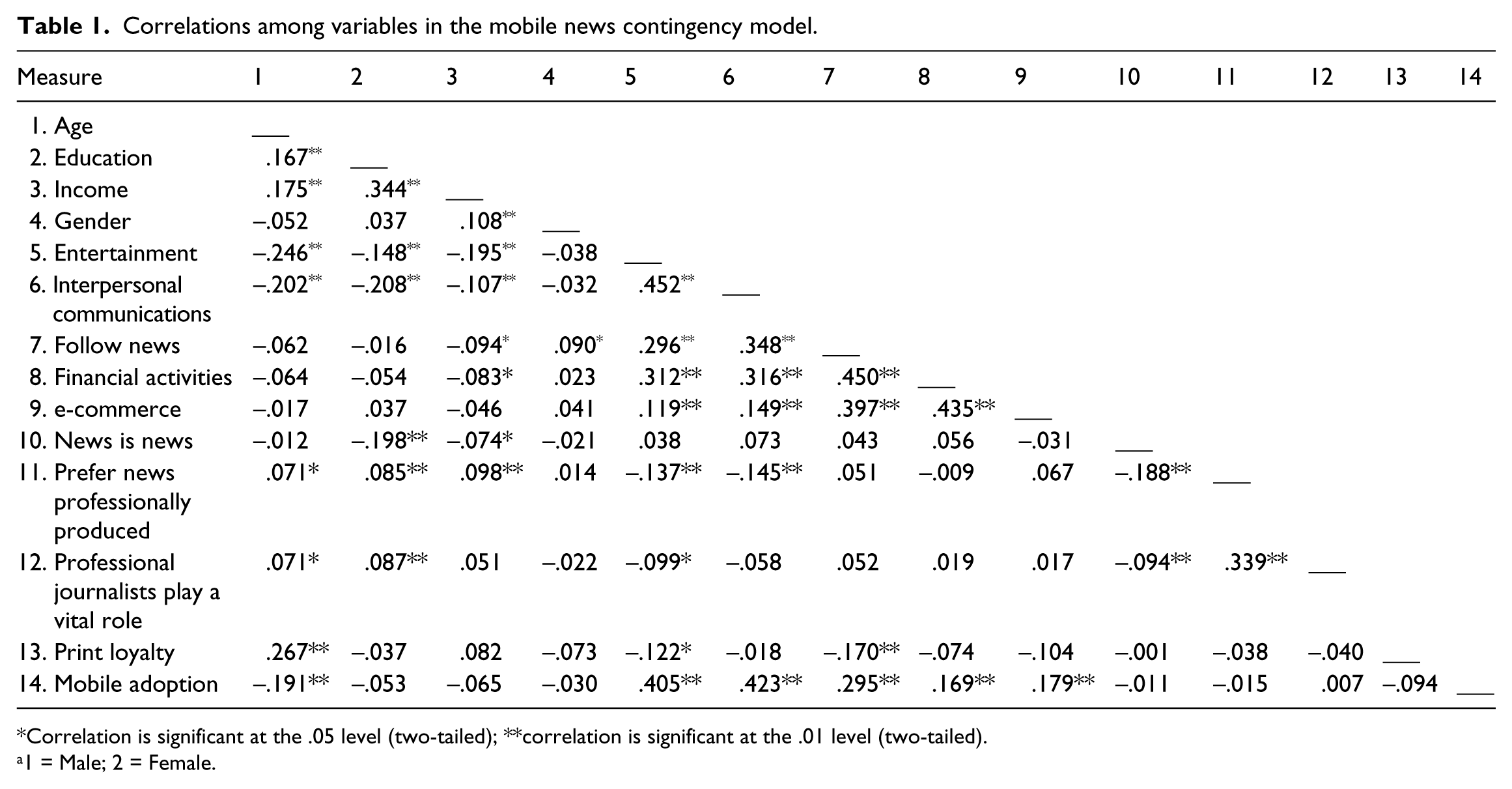
Table 1 shows the first order correlations among all the variables in the mobile contingency model. The three news attitude items were intercorrelated (“News is news” was negatively correlated with “Prefer news professionally produced” and “Professional journalists play a vital role”; and the latter two were positively correlated with each other). Nevertheless the three items did not form a reliable scale and therefore are treated individually in the analyses.
Correlations among variables in the mobile news contingency model.
Correlation is significant at the .05 level (two-tailed); **correlation is significant at the .01 level (two-tailed).
1 = Male; 2 = Female.
Hypothesis 1 suggested that demographics would predict print loyalty, mobile adoption, and attitudes about news sources. As shown in Table 1, age was positively correlated with print loyalty (r = .267, p< .001), agreeing that professional journalists play a vital role (r = .071, p< .05), and preferring professionally produced news (r = .071, p< .05). Age was negatively correlated with mobile adoption (r = −.191, p< .001). Older respondents being more loyal to print and showing less use of mobile media is consistent with prior findings (De Waal & Schoenbach, 2010; Westlund & Weibull, 2013). Lesser agreement with professional journalism values by younger respondents could have negative consequences for legacy news organizations and will be discussed next.
Education was positively correlated with agreeing that professional journalists play a vital role (r = .087, p< .001), and preferring professionally produced news (r = .085, p< .001). Education was negatively correlated with “news is news” (r = −1.98, p< .001). Thus those with more education were more likely to agree that professional journalistic sources are more important. This may also have major implications for news companies and will be further discussed in what follows. Given these findings, it was decided to control the effects of age on the news attitudes, and ask whether education was still a significant predictor. For “Professional journalists play a vital role,” education remained a significant predictor even after age was controlled (β = .047, t = 2.34, p< .02). For preferring professionally produced news, education remained only marginally significant (β = .036, t = 1.69, p = .10). Age did not correlate with “news is news,” and in the regression, education was the single highly significant predictor (β = −.15, t = −5.76, p< .0001).
Income was negatively correlated with agreeing that news is news (r = −.074, p< .05) and positively with preferring professionally produced news (r = .098, p< .001). Gender was not correlated with any of the model’s variables. In general, however, the correlations of demographics with the three contingency variables were consistent with expected patterns and prior studies. The correlations of demographics with attitudes about news sources are unique to the present study and have potentially important implications.
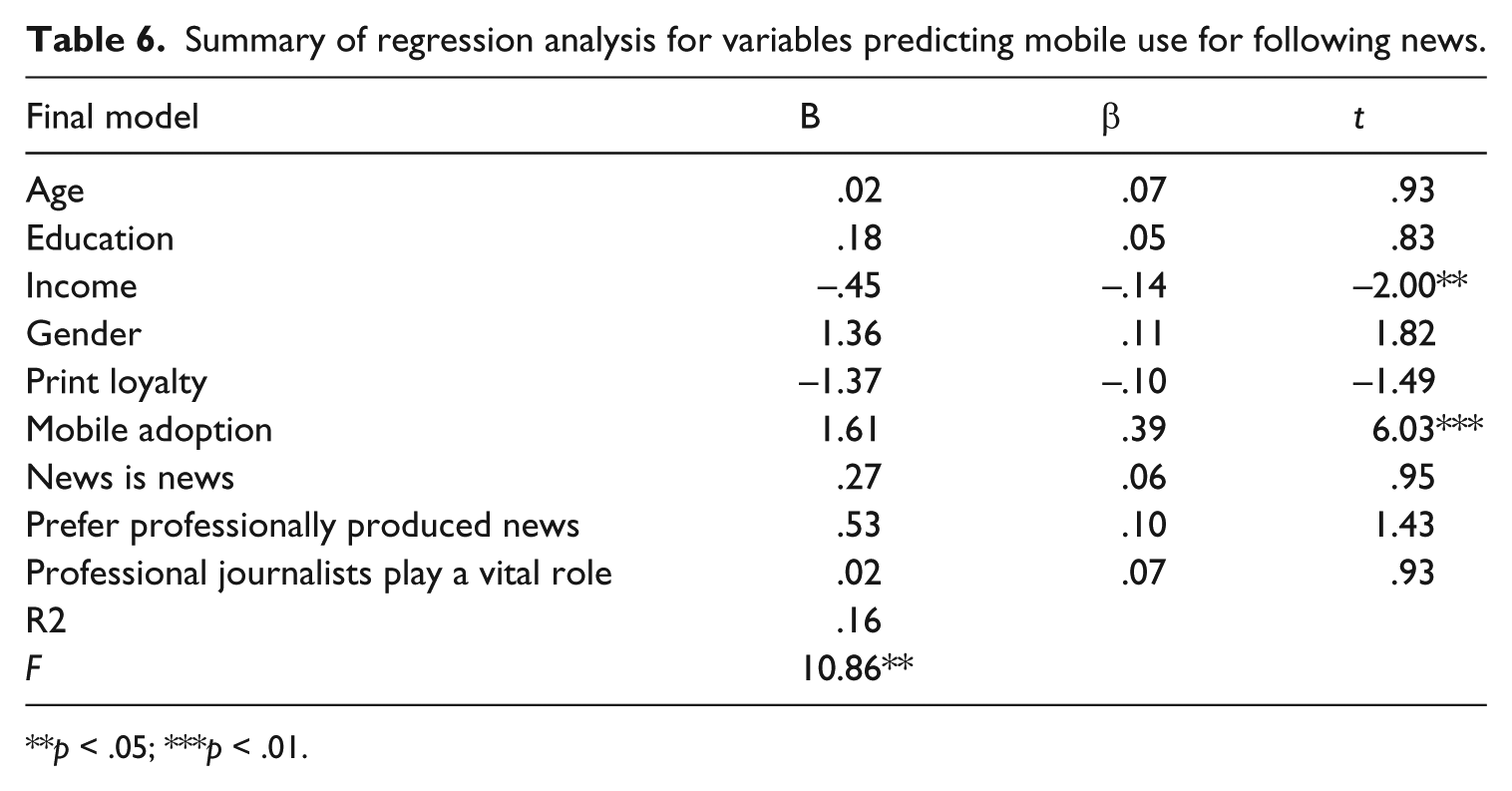
H2 suggested that demographics would account for significant variance in how much mobile devices are employed for the various communication functions. H5 suggested that greater adoption of mobile devices would predict more use of mobile devices for all communication functions. These hypotheses were tested with hierarchical regressions in which demographics were entered in the first block and newspaper loyalty and mobile adoption in the second block. Demographics accounted for 7% of the total variance for entertainment and 2% for interpersonal communication. Age had a significant, negative effect on entertainment (β = −.26, p< .01) and interpersonal communication (β = −.19, p< .01). Demographics were not significant in the first block for the rest of the variables (following news, financial activities, and e-commerce). However, as can be seen from the final models shown in Tables 2 through 6, the regressions showed that income was negatively related to e-commerce (β = −.26, p< .01), financial activities (β = −.14, p< .01), and following news (β = −.14, p< .05). Thus, H2 was partially supported. Mobile adoption strongly predicted various communication functions: entertainment (β = .48, p<.01), interpersonal communication (β = .49, p<.01), following news (β = .39, p< .01), financial activities (β = .36, p< .01), and e-commerce (β = .27, p< .01). Thus, H5 was supported.
Summary of regression analysis for variables predicting mobile use for entertainment.

p< .10; **p < .05; ***p < .01.
Summary of regression analysis for variables predicting mobile use for interpersonal communication.

p< .10; **p < .05; ***p < .01.
Summary of regression analysis for variables predicting mobile use for financial activities.

p < .01.
Summary of regression analysis for variables predicting mobile use for e-commerce.

p < .05; ***p < .01.
Summary of regression analysis for variables predicting mobile use for following news.
p < .05; ***p < .01.
Hypothesis 3 suggested that greater incumbent media habit strength, here operationalized as print loyalty, would be negatively associated with use of mobile devices for the communication functions. As can be seen in Table 1, print loyalty was negatively associated with using mobile devices for entertainment and following news, which supports Hypothesis 3. However, print loyalty was not a significant predictor in any of the regressions of Tables 2 through 6, probably because of the much stronger effect of mobile adoption.
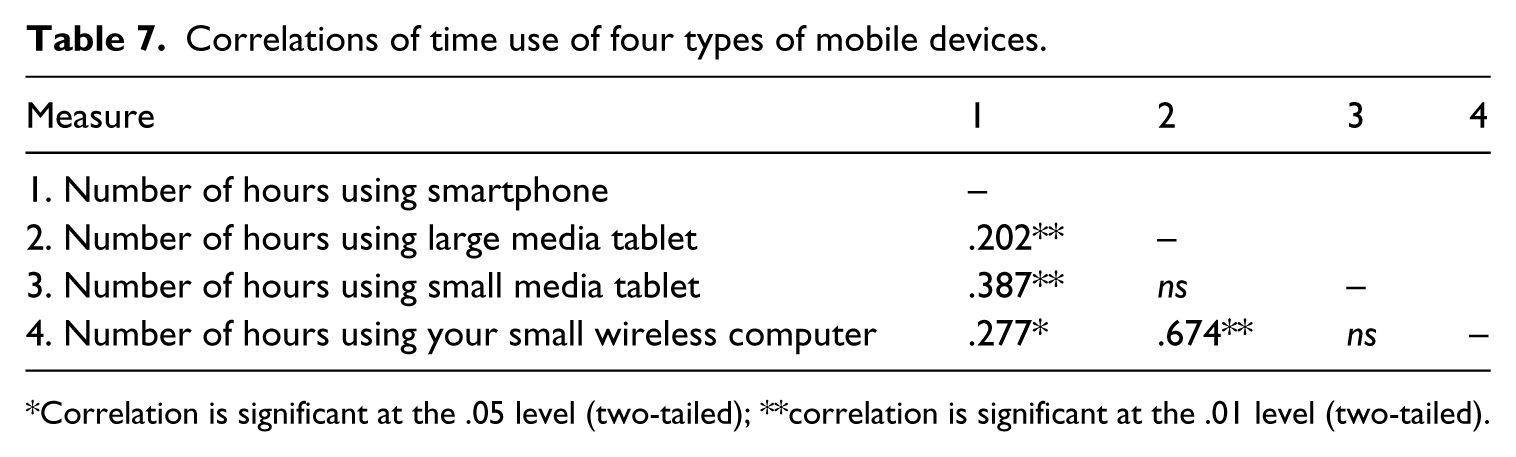
Hypothesis 4 suggested that times spent with mobile communication devices would be positively correlated with each other (amplification) rather than negatively (displacement) or having no significant correlation (complementarity). Table 7 shows the first order correlations of time spent per week using each of the five types of mobile devices. H4 was mostly supported, with the majority of pairwise correlations significant and positive. Only the correlations of large and small media tablets, and small media tablets and small wireless computers were not significant, which would support complementarity, although it should be noted that the lack of significant correlation may have resulted from the small numbers of respondents owning these devices.
Correlations of time use of four types of mobile devices.
Correlation is significant at the .05 level (two-tailed); **correlation is significant at the .01 level (two-tailed).
Research Question 1 asked how news values would be related to the use of mobile devices for communication functions, especially following news. As shown in Table 1, “news is news” was not related to any of the measures of mobile use for communication functions. “Prefer news professionally produced” was negatively correlated with entertainment and interpersonal communications use of mobile devices. “Professional journalists play a vital role” was negatively correlated with entertainment use of mobile devices. However, none of the news attitude variables were significant in any of the regressions. Table 6 shows that the news attitudes had no significant impact in the regression predicting “follow news.”
Discussion
The mobile news contingency model follows the approach of the technology to performance chain (Goodhue & Thompson, 1995) and the contingency model (Bouwman & van de Wijngaert, 2002). Like them, it posits that choice of communication devices depends on demographics, attitudes about content held by the decision-maker, and the functions or tasks that are desired. To those variables are added the concepts of habit strength of traditional media, in the case tested here, operationalized in terms of subscribing to a print newspaper. The correlations among the model’s variables and the regressions attempting to predict use of mobile devices for entertainment, interpersonal communication, e-commerce, financial activities, and follow news provide initial support for the model. In the regressions the impact of mobile adoption often swamps the effects of demographics, newspaper loyalty, and news attitudes. However the first-order correlations support the role of news attitudes and print news loyalty.
Respondents were asked about all the mobile devices they owned and used, and the positive correlations among the self-reported time they spent with these devices suggest that they are not substitutes for each other, but that use of any one of them tends to amplify use of the others. The data, unfortunately, did not allow comparison of the use of the devices by task or function, and thus that relationship remains for future research.
This study joins those that attempt to understand how news consumption via mobile devices relates to other tasks accomplished with mobile devices (e.g., entertainment and interpersonal communication). There is strong support for the idea that use of mobile devices for any one task relates positively to using them for other tasks, that is, mobile use for entertainment, interpersonal communication, e-commerce, financial activities, and following news are highly intercorrelated. This finding is consistent with the suggestion that mobile devices are perceived as a cluster and that as a result they will not substitute for each other (e.g., Chyi & Chadha, 2012).
The findings here are also supportive of the suggestion (Westlund & Färdigh, 2015) that individual differences, especially age, are an important moderator of whether media choices displace, complement or amplify uses of each other. Here, age is associated with greater loyalty to print and less use of mobile media for entertainment and interpersonal communication. Age is also positively related to agreeing with “prefer news professionally produced” and “professional journalists play a vital role,” and these two attitudes are negatively related to mobile use for entertainment and interpersonal communication. Older respondents are not as dependent on mobile devices as younger ones. The younger respondents who do make greater use of mobile devices not only are not print loyal, they do not agree that professional sources of news are most desirable. That likely means that when they do choose a news source with their mobile, whether it comes from traditional news sources like newspaper and television news companies will make little or no difference to them. Thus the news attitudes are important variables to examine, and traditional media will need to attempt to change those attitudes. Fortunately, higher levels of education are shown to have a great impact on agreeing that news sources are important, and thus may help ensure that even for the younger generations, those with higher education levels will turn to traditional news sources on their mobile devices. As was shown, when age is controlled, education remains a strong predictor of news values.
The most negative findings in this study from newspaper companies’ point of view is that the values that would drive mobile users to newspaper mobile apps or to newspaper websites are not held by younger respondents, the group that makes heaviest use of mobile for all communication functions. Further, subscribing to a newspaper is negatively related not only to entertainment use of mobile devices, which would be predicted by such models as prior’s relative entertainment preference theory (Prior, 2003, 2005), but also to following news from traditional news sources via mobile devices (follow news). Thus the group to whom newspapers most heavily promote their mobile products (that is, their subscribers) is the group least likely to use mobile for news. The present results, in contrast, suggest that mobile products should be promoted to those with higher education and income levels who do not subscribe to a print newspaper. Of course, the ideal target market would include higher education, higher income, nonsubscribers who are heavy users of mobile devices. This pattern of findings explains why one of the biggest problems for newspaper managers is that only half of their subscribers ever use any of their digital formats, and the percentage is even lower for smartphone access (Edmonds, 2014; Mitchell, Rosenstiel, Santhanam, & Christian, 2012).
Limitations and future research
As with all secondary analyses and certainly with a survey largely designed by practitioners, the measurements weaken how well variables in the model can be operationalized. Future tests of the model should embrace scholarly measurement. Examination of correlations and regressions, while instructive, does not allow causal inferencing.
The mobile news contingency model remains at an early stage of development, but could be more robustly tested with more sophisticated and theory-driven measurement. The results reported here, however, suggest some encouraging directionality for future theorizing and testing.
Footnotes
Funding
Roger Fidler was given funding for the survey by the Reynolds Journalism Institute at the School of Journalism, University of Missouri.