



Abstract
The problems of distracted driving and distracted pedestrian accidents have attracted the attention of public health officials, transportation and psychology researchers, and communication scholars. Though public safety campaigns intended to curb dangerous texting behaviors have been implemented, relatively little is known about the psychological processes involved in these behaviors. Our study integrates emerging research on automatic behavior, self-control, and mindfulness in an attempt to explain why many individuals believe that such behavior is dangerous but engage in it anyway. Our survey study (N = 925) of college students (n = 313) and adults (n = 612) revealed that texting automaticity, trait self-control, and the “acting with awareness” facet of trait mindfulness were all uniquely predictive of texting while driving as well as texting while walking. Further, we observe that texting automaticity is more strongly related to the frequency of texting while walking than driving. Together, the findings synthesize disparate strands of research on cognition and media use and demonstrate the importance of distinguishing among types of consciousness to understanding mobile communication behavior.
Over the past decade, distracted driving due to mobile phone use has become a significant public safety concern. In 2011 alone, 21,000 people were injured in auto crashes involving distracted driving due to mobile phone use (“Distracted Driving 2011,” 2013; “The Danger in the Next Lane,” 2013). Controlled studies of distracted driving confirm the deleterious effects of phone-related activities on driver performance (McEvoy et al., 2005; Strayer, Drews, & Crouch, 2006). Of the many types of mobile device use, text messaging continues to be the most popular (“CTIA’s Annual Survey”, 2013). Texting while walking in public has also been shown to be hazardous (Nasar & Troyer, 2013). Both texting while driving and texting while walking have been shown in experimental simulation, field, and survey studies to be associated with increased risk of accidents (Drews, Yazdani, Godfrey, Cooper, & Strayer, 2009; Hosking, Young, & Regan, 2009; Nasar & Troyer, 2013; Reed & Robbins, 2008). These activities (which we refer to as “dangerous texting behaviors”) can cause significant harm, yet they are also quite common (Atchley, Atwood, & Boulton, 2011; Cook & Jones, 2011).
It is thus essential to know more about why individuals engage in these risky behaviors. One possibility is that people underestimate the riskiness of the behavior, but studies of risk perceptions suggest this is unlikely. Specifically, 89% of a general population sample agreed that texting while driving impairs driving performance (Hallett, Lambert, & Regan, 2012) while 67% of a young adult sample perceived reading text messages while driving to be more dangerous than talking on a cell phone while driving (Atchley et al., 2011). Studies also show that this belief does not affect the likelihood of engaging in the behavior (Atchley et al., 2011). Thus, it is unclear why people say one thing “and text another”. Recognizing this inconsistency between beliefs and behaviors is essential to developing interventions to curb dangerous texting behaviors.
In the present study, we build upon emerging lines of research and theory that view texting as a social practice that has become an embedded expectation, to the extent that it is now commonly done with little thought (Bayer & Campbell, 2012; Ling, 2012). Of course, other media are also used relatively unconsciously (e.g., channel surfing on the TV; LaRose, 2010), but texting—as a form of mobile communication—is distinctive in that it can be done virtually anywhere, anytime, and thus can be triggered by an expanded, if not limitless, set of cues (Bayer, Panek, Dal Cin, & Campbell, in press; Campbell, Ling, & Bayer, 2014). We argue this reflexive orientation toward texting can influence behavior—depending on the role of the media device in a user’s everyday life (e.g., the extent to which texting is performed habitually) and dispositional traits relating to consciousness (e.g., mindfulness). Integrating separate strands or research, we examine texting automaticity as well as two personality traits, mindfulness and self-control, that support executive attention (i.e., conscious awareness of actions) over automatic or impulsive behaviors. The paper concludes with a discussion of the findings and provides guidance for researchers and policy makers.
Literature review
Texting and attention
Texting presents a greater risk to drivers and pedestrians than other media uses due to its technical attributes and role in users’ information environments. Texting is neither an entirely synchronous or asynchronous mode of communication, but rather one that allows for variation in the amounts of time elapsed between messages sent and received. This temporal flexibility of texting lends the activity to situations in which one is already engaging in another activity, one which fills the temporal gaps that are part of most text message exchanges (Ling, 2012). This particular quality may explain its continued popularity in an era in which multiuse smartphones offer users many other options for communication and stimulation. This results in an intermittent, rather than sustained, attention to the mobile device.
Texting is dialogic, as opposed to monologic, in nature. That is, texting requires individuals to engage in the mutual creation of an imagined shared social space (Gergen, 2002). Such an act necessitates dividing attention between one’s immediate physical surroundings and the imagined shared social space. This division of attention in and of itself makes driving more difficult; even hands-free mobile communication systems have been shown to be distracting to drivers (Strayer et al., 2006). In sum, the attention required by text messaging is intermittent, focused, and visual, and at the same time requires individuals to divide attention between the immediate physical space and an imagined social space. It is easily embedded in daily activities that fail to fully engage individuals’ attention with novel stimuli, such as driving or walking, while drawing attention away from important aspects of those activities.
Automaticity
Contemporary psychologists researching consciousness and its relationship to behavior assert that behaviors can be a consequence of conscious will, an unconscious response to internal or external conditions, or (most often) some combination of both (e.g., Bargh & Chartrand, 1999). Novel behaviors and repeated behaviors enacted in novel contexts are likely to require conscious thought on the part of the actor, whereas repeated behaviors enacted in unchanging contexts are more likely to become automatic, requiring less conscious thought upon repetition (Verplanken, 2006). “Automaticity” refers to limited conscious attention, awareness, and control of one’s actions, intentions, or psychological processes.
Automaticity requires a learned or conditioned response to stimuli; learning and conditioning, in turn, require repetition (Gardner, 2014). Though frequency is a necessary criterion for the formation of automatic behavior, it is not a sufficient one by most theoretical accounts. Whereas frequency is equivalent to the performance of behavior itself, automaticity is a cognitive process underlying certain behaviors of individuals (Gardner, 2014). Some deliberate, conscious behaviors can be performed frequently without ever becoming automatic (Ajzen, 2002; Gardner, 2012; LaRose, 2010; Verplanken, 2006). For example, a surgeon who has performed over 100 open-heart operations would (hopefully) remain conscious of his or her actions and responsive to new stimuli in the environment each time he or she engaged in this repeated behavior. Conversely, there are certain behaviors that are enacted very automatically but not especially frequently, such as recalling the lyrics to Christmas carols. For these reasons, we treat automaticity and frequency as distinct from one another.
Additionally, measures of behavior frequency often do not take context into account. Context and context-dependent stimuli are known to be instrumental in the formation of automatic behaviors (Gardner, 2012). To address the question of how automaticity and exposure to contexts relate to dangerous texting behaviors, we must consider what types of behaviors become automatic and how they become automatic. To that end, we now discuss the role of goals in the process of automaticity.
Goal pursuit and automaticity
Unconscious behavior is not random, nor is it necessarily driven indiscriminately by cues in the environment. Rather, unconscious behavior (like conscious behavior) is often goal-directed, and goal pursuit can operate independent of conscious thought (Dijksterhuis & Aarts, 2010; Moors & De Houwer, 2006). 1 According to Bargh, Gollwitzer, Lee-Chai, Barndollar, and Trötschel (2001), automatic behaviors arise when a goal is repeatedly activated by a cue in a particular situational context. Repeated activation establishes an association between goal, goal-directed behavior, and context. The salience of a goal and the goal-directed automatic behavior both depend on subtle or explicit environmental cues to be activated.
According to studies of the uses and gratifications of mobile communication, the primary goals of individuals engaging in text messaging are to maintain a sense of social connection, to alleviate boredom (i.e., to satiate the need for novel stimuli), or to facilitate coordination among individuals (Leung & Wei, 2000; Ling & Yttri, 2002; Liu, Liu, & Wei, 2014). As discussed before, desires to meet the standards or expectations of others or society at large also contribute to the regular use of texting. These personal and social goals are, at times, achieved by making the conscious decision to send, read, or reply to a text message, but it is also possible that the goals could be activated by environmental cues (e.g., seeing another person who is texting) or mental cues (e.g., a lack of stimulation) below the threshold of consciousness. Indeed, research suggests that environmental cues do play a key part in prompting individuals to initiate texting behavior (Oulasvirta, Rattenbury, Ma, & Raita, 2012).
Alternatively, the goals of drivers and pedestrians are, in most cases, to get from one place to another in a timely and safe fashion. The decision to engage in a particular instance of driving and walking behavior is typically a conscious one, but upon repeated successful achievement of their goals, experienced drivers and walkers both require less conscious thought to complete these tasks once they are initiated, resulting in the “automation” of both behaviors (Canning, Ada, & Paul, 2006; Charlton & Starkey, 2011; Ranney, 1994). Once driving and walking become automatic, they are not activities that require full executive control to complete. 2 The “automation” of driving and walking leaves individuals susceptible to distracting cues in the environment, including cues to initiate texting behavior. Thus, the act of initiating texting behavior while driving/walking is a case in which two goals requiring attention conflict. Both of these goals can be (and often are) pursued without conscious effort. Regardless of which behavior is chosen, it is likely to be performed unconsciously once triggered by mental or environmental cues within these contexts.
Texting-specific automaticity
Automaticity can also be used as a means of differentiating among individuals who are more or less likely to engage in particular behaviors automatically (Lally, van Jaarsveld, Potts, & Wardle, 2010). Previous research demonstrates a link between the tendency to engage in texting automatically and the rate that college students report texting while driving, controlling for texting frequency and other conscious factors such as attitudes and norms (Bayer & Campbell, 2012). The present research assesses this established link between texting-specific automaticity and dangerous driving, while also extending the investigation to additional outcomes and broadening the sample to include college and adult populations. It is hypothesized that individuals who exhibit signs of texting-specific automaticity will report frequently texting while driving and texting while walking, even while accounting for the frequency with which they engage in texting.
H1a: Texting-specific automaticity will be positively related to the frequency with which individuals report texting while driving, controlling for overall frequency of texting.
H1b: Texting-specific automaticity will be positively related to the frequency with which individuals report texting while walking, controlling for overall frequency of texting.
The role of mindfulness
If texting while driving/walking can become an automatic behavior, then the ability of individuals to resist the lure to do so may depend on their abilities to consciously interrupt or avoid unconscious temptations activated by mental cues or cues in the environment. Mindfulness can be defined as the awareness that is derived from intentionally paying attention to particular experiences in the present (Kabat-Zinn, 2003). The practice of mindfulness involves filtering out competing environmental cues and focusing on one’s immediate experience. The concept has its origins in religious and spiritual thought (Kabat-Zinn, 2003), though recent explorations by psychologists of mindfulness’s positive relation to the abilities to regulate emotion and attention have proven fruitful (e.g., Hill & Updegraff, 2012). Relevant to the current study, mindfulness has been shown to negatively predict the frequency with which individuals text and drive (Feldman, Greeson, Renna, & Robbins-Monteith, 2012). This negative association between mindfulness and texting while driving suggests that those who do not text while driving may possess an ability to filter out competing goal-activating cues and concentrate solely on the task of driving. The present study seeks to replicate Feldman and colleagues’ findings while extending it to predict texting while walking.
Though it is clear mindfulness denotes conscious awareness of the present moment, the concept can still be construed in a variety of ways. It could refer to one’s ability to merely observe the state of one’s self and one’s surroundings, but could also refer to one’s ability to refrain from having one’s attention become preoccupied with judgments of the situation, one’s ability to be aware of what one is doing, or one’s ability to focus attention on an inner state by tuning out irrelevant stimuli. Lastly, mindfulness could manifest itself in (or be contingent upon) one’s ability to fully articulate what one is experiencing. To account for these distinctions, we use a measure of trait mindfulness (Baer, Smith, & Allen’s (2004) Five Factor Mindfulness Questionnaire) that allows us to differentiate among several facets of the mindfulness construct: acting with awareness, nonreactivity to inner experience, attending to thoughts and feelings without judgment, observing internal and external experiences, and describing experiences with words. These facets describe self-reported tendencies of consciousness rather than particular individual instances of mental states. Knowing what particular facet of mindfulness relates to the tendency to engage in dangerous texting behaviors is essential in order to tease apart the underlying causes of risky activity. Therefore, we include an extra research question in order to compare the predictive power of five separate components of mindfulness.
H2a: Mindfulness will be negatively related to the frequency with which individuals report texting while driving, controlling for overall frequency.
H2b: Mindfulness will be negatively related to the frequency with which individuals report texting while walking, controlling for overall frequency.
RQ1: Which facets of mindfulness will relate to dangerous texting behaviors?
The role of self-control
In addition to these two established psychological predictors of dangerous texting behaviors, self-control—the conscious ability to resist temptations—may help predict the frequency with which people text while driving or walking. Self-control has been shown to be negatively associated with college students’ amounts of social media use (Panek, 2014). With a few exceptions (Billieux, 2012), there is a dearth of evidence linking self-control to the frequency of texting in daily life. It is possible that texting has become so commonplace (Campbell et al., 2014) and so deeply embedded in American social life that its overall frequency is no more likely to be associated with deficient self-control than any other form of communication (e.g., talking). However, texting in contexts in which one knows that one should be paying attention to something else in order to achieve a goal may be indicative of a lack of self-control (Wei, Wang, & Klausner, 2012). It is possible that goal-activating cues related to texting are not filtered out but rather are assimilated, understood, and then resisted via an exertion of conscious self-control. Billieux, van der Linden, and Rochat (2008) demonstrated a positive correlation between trait impulsivity—the dispositional inverse of self-control—and using one’s phone while driving. Thus, there is theoretical reasoning to suspect that self-control may modulate the occurrence of texting while driving. The likelihood of engaging in dangerous texting behaviors is, we hypothesize, subject to both less conscious (texting-specific automaticity) and more conscious (mindfulness and self-control) factors.
H3a: Dispositional self-control tendencies will be negatively related to the frequency with which individuals report texting while driving, controlling for overall frequency.
H3b: Dispositional self-control tendencies will be negatively related to the frequency with which individuals report texting while walking, controlling for overall frequency.
Assessing the unique contributions of automaticity, mindfulness, and self-control
In an effort to gain a better understanding of the relative contributions of more or less conscious processes to the likelihood of engaging in dangerous texting behaviors, we assess the extent to which automaticity, mindfulness, and self-control uniquely contribute to variance in the frequency of such behavior. We do so by constructing and testing a path analysis, yielding a more accurate reflection of variance explained than would be possible through other means of analyses. Though we believe that all three are related to dangerous texting behaviors, we have no a priori belief regarding which of these will explain a greater proportion of the variance in our outcomes of interest.
Methods
Participants
To maximize the generalizability of our findings, we conducted two online surveys. The first survey was given to college students enrolled in an undergraduate communications class and the second to a general adult population. College student participants were offered course credit for participation while the adult sample were recruited via Amazon Mechanical Turk (Paolacci, Chandler, & Ipeirotis, 2010) and were offered monetary compensation for their participation. Though the means by which participants were recruited and compensated differed between adult and student samples, there was no a priori reason to suspect that either means of recruitment or compensation would be more likely than the other to systematically bias the results. The total sample consisted of 313 college students and 612 adults (overall mean age = 28.90; SD = 12.32). Fifty-seven percent of the total sample is female.
Measures
Automaticity
Survey measures of automaticity ask respondents to report the extent to which individuals perform actions without thinking or without intending to do so. The original scale designed to assess automaticity (Verplanken & Orbell, 2003) was adapted to a four-item scale in line with the criticisms of LaRose (2010) and Gardner (2012). Specifically, LaRose and Gardener both recommend excising the items of Verplanken and Orbell’s scale which pertain to the frequency with which an action is performed, thereby treating automaticity as distinct from frequency. Additionally, we sought to isolate the extent to which a lack of conscious awareness was associated with the behavioral outcomes, and this focus guided the decision to leave out items from the original scale that pertained to self-identity and frequency (Gardner, 2014). Participants are asked to report the extent to which they engage in texting behaviors (starting a text, sending a text, checking for texts, and reading texts) “without thinking,” “without meaning to do it,” “doing it before I realize I’m doing it,” and whether they “find it hard to stop myself from doing it.” Responses range from 1 (“Not at all”) to 5 (“Completely”).
Mindfulness
To assess mindfulness, a shortened, 15-item version of the previously validated Five Factor Mindfulness Questionnaire (Baer, Smith, & Allen, 2004) was used (example item: “I perceive my feelings and emotions without having to react to them”). The 15 items selected were the three highest loading items within each of the five factors. Baer et al.’s version of the scale was shown to differentiate among the following factors: observing internal and external experiences, describing experiences with words, acting with awareness, nonjudging of inner experiences, and nonreactivity to inner experiences. Use of this scale permits further analysis of how particular facets of mindfulness relate to dangerous texting behaviors. Participants rated each statement/item on a scale of 1 (“Not at all like me”) to 7 (“Just like me”).
Self-control
To assess trait self-control, an updated version of the Brief Self-Control Scale (Maloney, Grawitch, & Barber, 2012) was utilized. The newer scale is the product of a recent measurement study on the widely used Brief Self Control Scale (BSCS) (Tangney, Baumeister, & Boone, 2004) that shortened the scale to two factors (restraint and impulsivity) consisting of four items each (example item: “I do certain things that are bad for me, if they are fun”). Participants rated each statement/item on a scale of 1 (“Not at all like me”) to 7 (“Just like me”).
Dangerous texting behaviors
To assess the frequency with which individuals engaged in dangerous texting behaviors, we asked participants to report how frequently they checked, read, started, or sent texts while walking down the sidewalk, while crossing the street, while driving a moving vehicle, and while driving a car stopped at an intersection. Answers ranged from 1 (“Never”) to 5 (“Almost always”). At the time the data was collected, texting while driving was illegal in the state in which the majority of student participants resided (www.michigan.gov) as well as the vast majority of states in which adult participants resided (www.distraction.gov).
Overall texting frequency
To determine the frequency with which individuals engaged in texting, we asked participants to report on average how frequently they use their mobile phones for texting. Answers ranged from 1 (“Never or less than once a day”) to 9 (“About every 10 minutes”). The average frequency with which college students in the sample engaged in texting was between “hourly” and “2–3 times an hour” (M = 7.42; SD = 1.08) while the average frequency with which adults in the sample engaged in texting was between “daily” and “2–3 times a day” (M = 5.71; SD = 1.66).
Overall walking and driving behavior
Individual differences in the frequency of texting while driving or walking may be explained by individual differences in how much people walk or drive (those who drive or walk more often have more opportunity to text while doing so). To control for the frequency with which individuals drove or walked, we asked them to report the number of days per week they typically drive and walk in urban areas as well as how much time they spent driving or walking on an average day. These two measures were multiplied to form overall measures of average driving and walking frequency.
Procedure
Participants in both the college student sample and the adult sample were provided with a URL to access the online survey. After completing a consent form, they filled out the survey which included items used as control variables in the analysis relating to gender and age. Participants were presented with measures in the following order: texting behavior, texting-related automaticity, self-control, and mindfulness.
Analysis
Before testing our hypotheses, we constructed composite variables relating to two outcomes: texting while driving and texting while walking. Each of these composite variables was constructed by averaging the items assessing the frequency with which participants started, sent, checked, or read text messages while engaged in these activities. Each composite variable exhibited acceptable levels of reliability (texting while driving α = .95; texting while walking α = .94). We also combined the four items relating to the extent to which participants experienced starting, sending, checking, and reading to be automatic experiences (α = .87). The five dimensions of mindfulness were tested for reliability. All factors were deemed reliable: observing internal and external experiences (α = .69); describing experiences with words (α = .90); acting with awareness (α = .78); nonjudging of inner experiences (α = .76); and nonreactivity to inner experiences (α = .72). The reliability results for the self-control dimensions were .82 (restraint) and .81 (impulsivity). The two factors were highly correlated with one another beyond what was expected from Maloney et al. (2012) measurement models, so we combined the measures into a one composite measure (α = .88).
We then conducted six hierarchical regressions (see Tables 1, 2, and 3). Control variables (overall frequency of texting, overall frequency of walking/driving) were entered in the first step of the regressions. The predictor variables (the composite measure of automaticity; the five mindfulness facets; self-control) were entered into the second step of the regressions. To explore the extent to which each of the predictor variables contributed to the variance in dangerous texting behaviors, we constructed and tested a path analysis including the aforementioned two composite outcome variables. Control variables (overall frequency of texting, driving frequency, and walking frequency) were included in the model along with automaticity, mindfulness, and self-control.
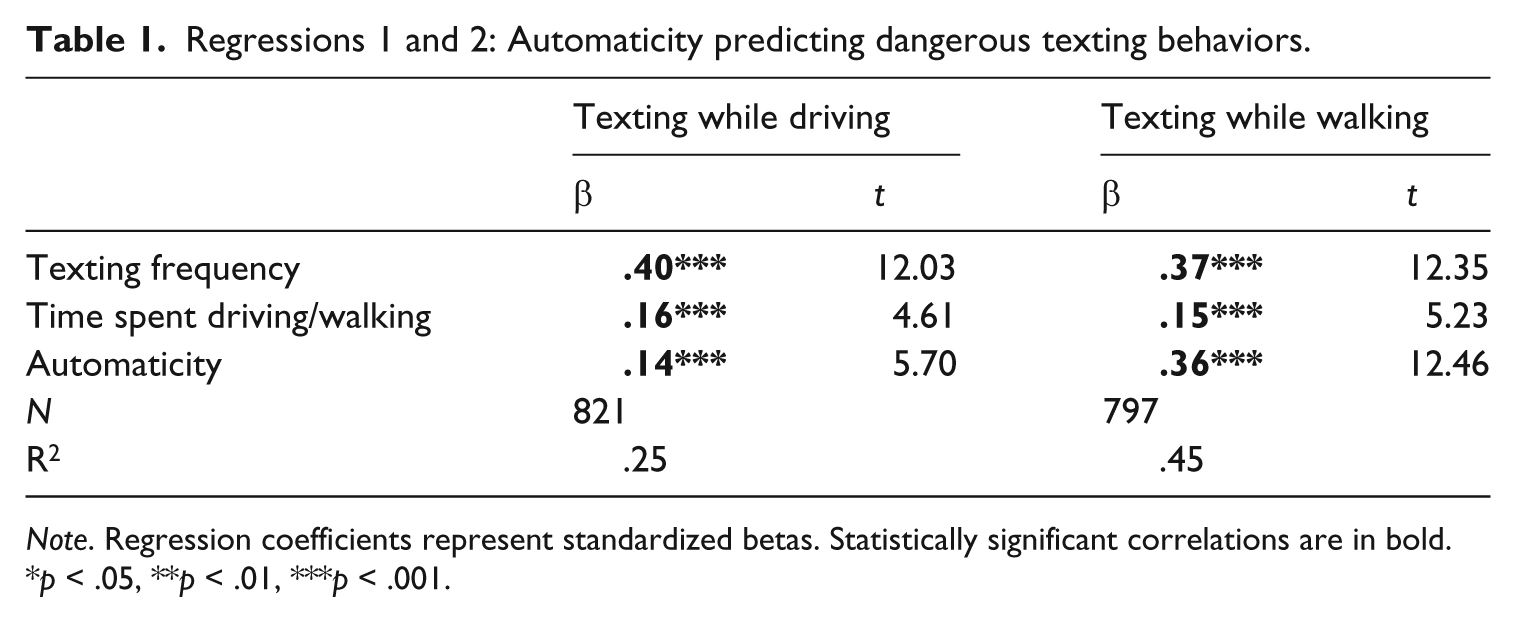
Regressions 1 and 2: Automaticity predicting dangerous texting behaviors.
Note. Regression coefficients represent standardized betas. Statistically significant correlations are in bold.
p < .05, **p < .01, ***p < .001.
Regressions 3 and 4: Mindfulness predicting dangerous texting behaviors.

Note. Regression coefficients represent standardized betas. Statistically significant correlations are in bold.
p < .05, **p < .01, ***p < .001.
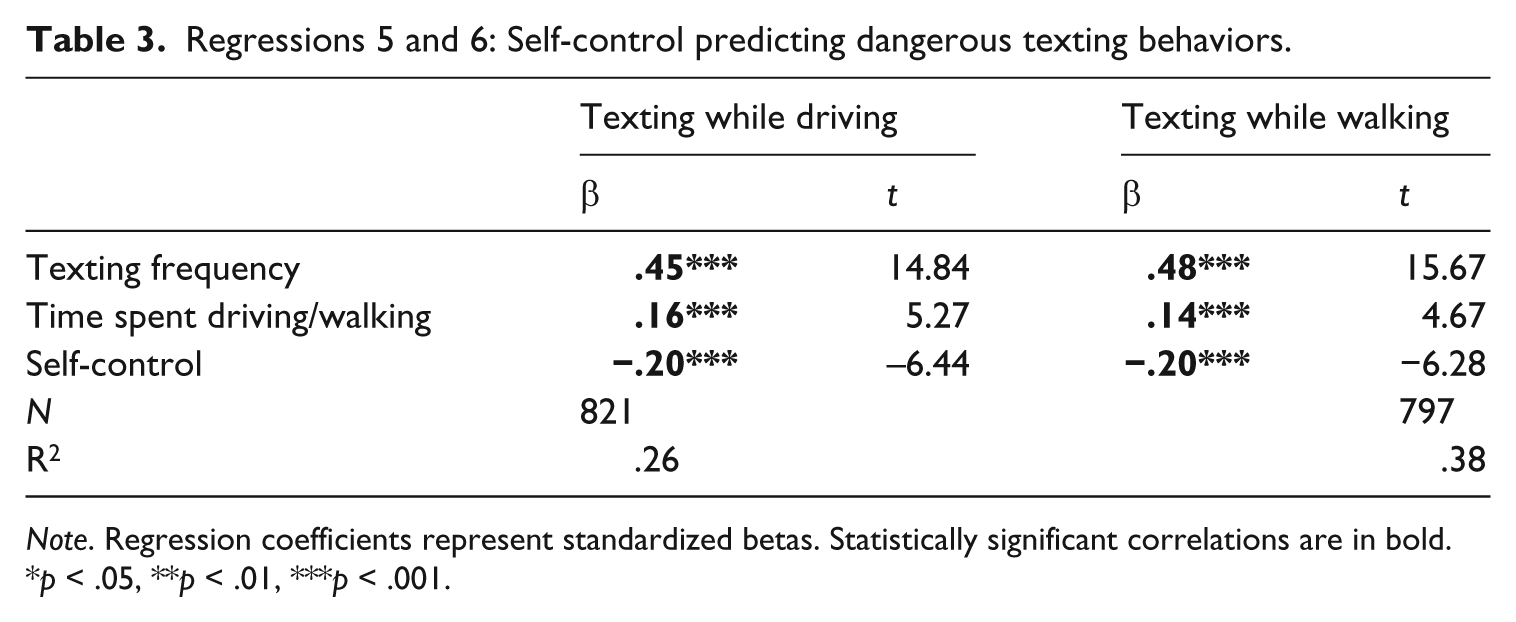
Regressions 5 and 6: Self-control predicting dangerous texting behaviors.
Note. Regression coefficients represent standardized betas. Statistically significant correlations are in bold.
p < .05, **p < .01, ***p < .001.
Results
Results of the six regressions are presented in Tables 1, 2, and 3. The first table displays results relating to Hypotheses 1a and 1b; the second table displays results relating to Hypotheses 2a and 2b; the third table displays results relating to Hypotheses 3a and 3b. Hypothesis 1a, that automaticity would positively predict the frequency with which individuals report texting while driving, was confirmed (β = .14, p < .001). Hypothesis 1b, that automaticity would positively predict the frequency with which individuals report texting while walking, was confirmed (β = .36, p < .001; see Table 1). Hypothesis 2a, that mindfulness would negatively predict the frequency with which individuals report texting while driving, was partially confirmed. Of the five mindfulness facets, “acting with awareness” was the one facet that most clearly related to texting while driving (β = −.24, p < .001). 3 Hypothesis 2b, that mindfulness would negatively predict the frequency with which individuals report texting while walking, was partially confirmed as well (β = −.22, p < .001 for the “acting with awareness” mindfulness facet; no other mindfulness facets predicted texting while walking). Hypothesis 3, that self-control would negatively predict the frequency with which individuals report texting while driving, was confirmed (β = −.20, p < .001). Hypothesis 3b, that self-control would negatively predict the frequency with which individuals report texting while walking, was confirmed (β = −.20, p < .001).
The path analysis (see Figure 1) presents a comparison of the relative contribution of automaticity, mindfulness, and self-control to variations in the frequency with which individuals engage in dangerous texting behaviors. Rather than use the overall 15-item measure of mindfulness in this analysis, we included only the “acting with awareness” facet of mindfulness, as the third and fourth regressions showed this to be the most robust predictor of dangerous texting behaviors (see Table 2). The path analysis reveals that the “acting with awareness” facet of mindfulness, is the best predictor of the frequency with which individuals report texting while driving, and that automaticity is the best predictor of the frequency with which individuals report texting while walking.

Path analysis of the unique contributions of automaticity, mindfulness, and self-control to dangerous texting behavior frequency.
Discussion
By combining three threads of past research on distracted driving—all tied to consciousness—our study meets the need for integration of theoretical approaches to dangerous texting behaviors. In a broader sense, our study underlines the importance of considering the automaticity of a specific behavior and self-regulatory personality traits concurrently. Taken together, the findings support the notion that dangerous texting behaviors are related to a lack of awareness of one’s behavior (e.g., Campbell & Bayer, 2012; Feldman, Greeson, Renna, & Robbins-Monteith, 2011) while further specifying the nature of that relationship.
More specifically, our results replicate Campbell and Bayer’s (2012) observed relationship between automaticity and texting while driving as well as Feldman et al.’s (2012) evidence for a connection between mindfulness and texting while driving in a mixed student and adult sample. Further, the negative relationship between dispositional self-control and dangerous texting generalizes Billieux et al.’s (2008) findings for trait impulsivity to trait self-control. The similar relationships seen across the various behaviors, despite very different levels of danger, demonstrate the importance of understanding processes as opposed to isolated outcomes. As a whole, the present study suggests that such behaviors result not only from an automating or routinizing of particular media-specific behaviors, but are also behaviors that are common to those who lack awareness of their behaviors in general.
Comparing consciousness
We found that two forms of low behavioral awareness (the “acting with awareness” facet of mindfulness and texting-related automaticity) were highly correlated with dangerous texting. Self-control was a somewhat weaker predictor of dangerous texting behaviors based on a comparison of the coefficients in the path analysis. Thus, our findings support the idea that the individual tendency toward less conscious behavior plays a stronger role than an individual tendency toward consciously overriding unwanted behaviors. Further, the separate variance explained by automaticity, mindfulness, and self-control supports a multifaceted view of consciousness that influences risky behavior.
The observed relationships illuminate several conceptual differences among trait forms of consciousness. Both mindfulness and self-control assume greater trait consciousness, yet the two constructs still differ in important ways. From an operationalization point of view, mindfulness was presented as acting less automatically, whereas self-control was presented as acting more controlled. From a more theoretical vantage point, mindfulness represents a general engagement with the world—that is, how much one behaves with simultaneous awareness of those behaviors. Alternatively, self-control represents a general ability to be consciously disciplined—how successful one is at choosing “good” behaviors over “bad, but tempting” behaviors. The theoretical framing of high consciousness for self-control is assumed on the part of the researcher (and perhaps the participant). Therefore, mindfulness, or at least the “acting with awareness” component of mindfulness, appears closer to “trait consciousness” in a pure behavioral sense. Mindfulness is a generalized version of automaticity. Self-control, however, attaches a moral label to the behavior; acting with self-control is not just about being aware, it is about doing the right thing when conflicted. The smaller relationship with dangerous texting for self-control, as opposed to mindfulness, may reflect this disparity. Research moving forward should keep these conceptual issues in mind to clarify the underlying mechanisms.
The study also advances the idea that researchers studying any kind of habitual behavior should account for traits such as awareness of actions in general when approaching behavior-specific automaticity. The ability to self-monitor, rather than simply the ability to avoid temptations, may help explain other kinds of habitual behavior. Such traits may not explain variance in all cases but the results of our study suggest that assessing their role in problematic media use is worthwhile.
Texting while driving versus walking
Beyond integrating the separate lines of research on consciousness, the current study pushes forward theory by comparing texting while driving to texting while walking. In spite the differences between the two activities, we find similar relationships across all three of the primary predictors. As noted earlier, texting while walking across the street would seem to be less dangerous to one’s self and less dangerous to others. Yet, the underlying processes associated with its occurrence appear to be quite similar as those for driving while texting. The significance of these parallel relationships is that the unfortunate public health outcomes of distracted driving and walking are likely a product of automatic processes formed and maintained outside of these transportation contexts that continue to operate independent of one’s current location or activity.
Unexpectedly, texting-related automaticity exhibited a stronger relationship with texting while walking than with texting while driving. Although we cannot determine the cause of this difference, several possible explanations exist. Perhaps walking is more commonly performed along familiar routes with familiar obstacles, allowing greater texting automaticity (e.g., more repetitive cues) to develop while walking. Additionally, the physical act of performing texting—ranging from taking one’s hands off of a steering wheel to pulling one’s hands out of pockets—differs greatly across the two behaviors. In turn, the simpler of these two physical acts may be easier for the mind to automate than the other. It is also possible that the observed difference may be due to discrepancies in perceptions of risk involved with texting while walking/driving. Lastly, the difference may represent a methodological artifact due to the slight difference in measurement of the two behaviors.
Toward safety
Our study provides evidence for the utility of cultivating an awareness of one’s actions through mindfulness interventions as a means for curbing texting while driving. Researchers have been able to successfully train others to become more mindful (see Baer, 2003, for a review). Self-regulatory strategies that attempt to change bad habits can be applied to this context in a more specialized manner. As opposed to reducing the act of texting altogether, strategies designed to curb dangerous texting behavior must focus on the high level of media automaticity associated with texting.
One promising direction for application of our findings is the use of implementation intentions, a cognitive strategy to help individuals self-regulate their unwanted behavior (Gollwitzer, 1999). Essentially, implementation intentions work by training individuals with personalized if-then instructions—“if X happens, then do Y.” The “ifs” identify the precise cues related to the individual’s habit, and the “thens” supplant undesired behavior with a more desirable one. Despite its relative simplicity, research (e.g., Holland, Aarts, & Langendam, 2006) shows that doing so repeatedly can reprogram detrimental automatic behavior (e.g., texting while driving after being cued by a lack of stimulation) with new beneficial or benign automatic behavior (e.g., changing the car radio station). Thus, future research should test the feasibility of this established strategy in the cases of texting while driving and walking.
In recent years, a large share of attention has turned to developing technological answers to curb texting while driving. These include software apps that can be loaded onto a mobile device or inside the vehicle itself (e.g., CellControl). As of now, there is minimal empirical evidence of their effectiveness (Funkhouser & Sayer, 2013). From a consciousness perspective, technological options counteract texting automaticity by blocking all activity, but they do not change the underlying cognition. Reliance on the technology leaves an individual open to the same level of risk if the technology fails. Future changes to technology may yield more success if designed to work in conjunction with cognitive processes like automaticity. In doing so, these strategies will help to reprogram texting automaticity rather than block texting in a temporary manner.
The strategies recommended before focus on changing the behavior of an individual through a personalized technique. These can be contrasted with current strategies in the distracted driving domain. While mass media campaigns for texting while driving have become common, evidence of the efficacy of campaigns implementing emotional appeals remains scant. One study (Lennon, Rentfro, & O’Leary, 2010) found that exposure to public service announcements using fear appeals can increase young viewers’ intentions to engage in distracted driving behaviors. Still, the challenge of changing behavior as common as texting while driving means mass media campaigns are essential to successful change. Public campaigns, such as AT&T’s It Can Wait campaign, must do more than convince people that texting while driving is dangerous. Several campaigns have diversified behavior change approaches by emphasizing the surprising level of distraction that texting causes. However, current messages do not directly address the automaticity problem.
Limitations
In considering the impact of our findings on knowledge of the psychological underpinnings of dangerous texting behaviors, it is essential to recognize the limitations of our approach. As with all surveys that rely on self-report measures of media use, our study is subject to over- or underreporting of actual behavior. This may be particularly likely to happen given that texting is, to a large extent, an automatic behavior. Prior research has established a pattern of underreporting frequency of mobile phone use (Boase & Ling, 2013). However, evidence in this research suggests trends observed in self-report data are likely to hold in data obtained through objective observation.
Our measure of texting-related automaticity has limitations as well. Asking participants to report how frequently they do something without awareness assumes they are retroactively aware of their behavior. It is possible that one may text without awareness with great frequency and never become aware of it. However, experimental research using more implicit techniques (e.g., the Stroop task) has successfully validated the current automaticity measure (Orbell & Verplanken, 2010).
Conclusion
Evidence from our study provides an empirical basis for further research on the automatic nature of dangerous texting behaviors. The study demonstrates the utility of differentiating among these behaviors as well as more conscious and less conscious processes when trying to understand the psychological mechanisms implicated in such behaviors. Texting while driving and walking are not just products of carelessness in the contemporary world. They are outcomes of multiple strands of the unconscious, a combination of new forms of media use, and existing personality tendencies. This study provides a theoretical framework for further research on the consciousness of mobile communication as well as an empirical foundation for the creation of new public safety initiatives.
Footnotes
Funding
This research received no specific grant from any funding agency in the public, commercial, or not-for-profit sectors.