




Abstract
Recent research has reported negative consequences, such as increased anxiety, associated with restricting people’s access to their mobile phones. These findings have led researchers to suggest that mobile phone use may pose a legitimately addictive behavior for some people. Other research has suggested negative effects of mobile phones on academic outcomes. To study the effects of phone separation on both anxiety and attainment of academic study goals, we randomly assigned participants (N = 93) to a restricted mobile phone access condition or a control condition. After setting a list of goals for a study session, participants worked on their own, self-chosen class materials for 60 minutes. Anxiety was measured before and immediately following the study session. Attainment of study goals was assessed through a self-report estimate of the percent of study goals accomplished at the end of the session. We predicted that those who classified as high on a problematic mobile phone use scale and who had their phones taken away would show the greatest increases in anxiety over the session as well as the greatest deficits in attainment of study goals as compared to all other participants. While there was a general tendency for participants who scored higher on the problematic use scale to be more anxious, anxiety did not differ between participants with phone access and those without it. Participants without phone access self-reported attainment of 12% more of their study goals than those who had phones. This study qualified the conditions for which restricting mobile phone access increases anxiety and provided further empirical support for detriments to attainment of study goals when mobile phones are present.
Mobile phones have become an essential part of modern life for many people. As of October 2015, 92% of American adults reported owning a mobile phone and 68% reported owning a smartphone (Anderson, 2015). High amounts of mobile phone usage accompany this widespread ownership. Roberts, Yaya, and Manolis (2014) found that female college students spent an average of 10 hours per day on their mobile phones, and males were not far behind with an average of 8 hours. In a recent survey, 18- to 24-year-olds reported sending or receiving 3,200 text messages on average within a single month (Smith, 2011), and nearly half (46%) of smartphone users claimed that they “couldn’t live without” their device in a recent poll (Smith, McGeeney, Duggan, Rainie, & Keeter, 2015). Field studies have expanded upon the results of survey reports. Oulasvirta, Rattenbury, Ma, and Raita (2012) presented data from a study that logged phone usage and activity, and their results showed that smartphones were used for a median of about 160 minutes per day. An additional experiment showed that usage increased when frequently updating (i.e., dynamic) content was available on the smartphone, and a diary study showed that participants engaged in a variety of habitual checking behaviors—defined as “brief, repetitive inspection of dynamic content” (2012, p. 105)—on their smartphones.
Mobile phones and addiction
In the context of behavioral psychology, the tendency to check one’s mobile phone in excess is a textbook example of the effects of a variable-ratio schedule of reinforcement. Variable-ratio schedules operate such that reinforcers—events that increase the future likelihood of their instigating behavior—occur unpredictably. The reinforcers for mobile phone use are the novel pieces of information obtained from checking one’s mobile phone, and they arrive on an irregular schedule and vary in their importance. With mobile phones, a new and potentially important piece of information might arrive at any time; the only way to know is to check the phone. This schedule of reinforcement is powerful in contributing to repetitive, sometimes debilitating behaviors (for a review of these issues, see Greenfield, 2011). Receiving a text, an email, or a notification on social media are all examples of social rewards, and social networking may be an especially important reason that people check their phones frequently (e.g., Salehan & Negahban, 2013).
A growing body of psychological research on addiction has categorized behaviors other than substance abuse as addictions. Gambling, sex, video gaming, exercise, and Internet use have all been analyzed in the context of addiction (Griffiths, 2005), and both “gambling disorder” and “Internet gaming disorder” have been included in the Diagnostic and Statistical Manual of Mental Disorders (DSM-5; for a critical analysis, see Billieux, Schimmenti, Khazaal, Maurage, & Heeren, 2015). Further, Griffiths posited six components common to all addiction types as part of a biopsychosocial process: salience, mood modification, tolerance, withdrawal, conflict, and relapse, all of which could apply to mobile phone use. Salience implies that users’ thoughts are consumed by their mobile phones and that they think about using their phones with great frequency. Mood modification could occur if people engage with their phones to boost spirits. Tolerance would entail that a person uses their mobile phone increasingly over time and has difficulty curbing their level of use. In the case of withdrawal (as this study investigated), being denied access to one’s phone could cause negative emotional reactions. One might experience conflict if overuse of the mobile phone interferes with interpersonal relationships and work. Finally, relapse may occur if an addict abstains from using their phone for a period of time but then returns to the same level of use. Thus, problem mobile phone use could possibly satisfy all of Griffiths’s criteria for a behavioral addiction.
Still, there is some debate as to whether problematic use of mobile phones is actually a clinical disorder. Some researchers have used the term “addiction” more loosely than others, which could be problematic in that it may trivialize the severity of clinical addictions. Billieux, Schimmenti, et al. (2015) argued that the practice of using anecdotal evidence to link behaviors (especially those that are assumed to be problematic) to the diagnostic criteria from substance abuse models has created an atheoretical dragnet for new disorders that threatens to label many normal, everyday behaviors as “addictions.” Billieux, Maurage, Lopez-Fernandez, Kuss, and Griffiths (2015) further argued that there is little direct evidence to qualify mobile phone overuse as a clinical behavioral addiction; instead they used the term problematic mobile phone use (PMPU), which we adopt here. Specifically, they cited the lack of sound evidence to support the requirement that mobile phone overuse results in lack of control, tolerance, and withdrawal. Regarding withdrawal, for example, they suggested that more experimental studies should examine whether symptoms of withdrawal manifest during periods of restricted mobile phone access for potentially problematic users.
Accordingly, some recent experiments have begun to examine the consequences of restricting users’ access to their mobile phones. Cheever, Rosen, Carrier, and Chavez (2014) showed that participants exhibited withdrawal-like symptoms when asked to either turn off their phone or hand their phone in to the researchers and sit quietly in a classroom for an hour. Participants who classified as heavy mobile phone users, in particular, became increasingly anxious over the course of the study. Elevated anxiety was also evident for moderate mobile phone users who had to relinquish their phones to the experimenters during the hour. A similar study (Wilson et al., 2014) requested that participants “do nothing” for 15 minutes and found that in general, participants struggled to concentrate and did not enjoy the experience. Many participants also reported having “cheated,” where 32% engaged in some outside activity, one of which included checking their phone. Another recent study by Clayton, Leshner, and Almond (2015) suggested negative effects of restricting mobile phone access on anxiety and cognitive performance. Participants were unable to answer their ringing smartphones while completing a word search task. Subsequently, their heart rate, blood pressure, and anxiety increased, and cognitive performance also suffered.
Mobile phone use and academic deficits
Though separation from one’s phone seems to be related to unfavorable outcomes, especially for heavy users, a body of research also has shown negative impacts of the presence and use of mobile phones (and the related tasks that phones enable) on performance of concurrent academic- and work-related tasks. Fox, Rosen, and Crawford (2009) examined the impact of concurrent instant messaging on a reading comprehension task and found that participants who messaged took significantly longer to complete the task. Further, those who spent the most time on the task tended to exhibit lower scores on reading comprehension. Rosen, Carrier, and Cheever (2013) observed students in their study environments and explored their studying habits during a 3-hour session. The researchers took note of off-task technology use like texting and calculated the number of computer windows open at various time intervals. Participants who tended to switch between tasks had more distracting technologies in front of them and tended to engage in more off-task behaviors than others. Interestingly, in both the professional and academic sphere, we can now download software that purposefully locks us out of the Internet or specific websites like Facebook for a certain number of hours to increase attainment of study goals. Programs like these are a testament to the distracting power of the Internet and the phones that make it constantly available (Croxall, 2010).
Further, some studies (Fox et al., 2009; Lepp, Barkley, & Karpinski, 2015; McDonald, 2013; Rosen et al., 2013) have found a negative correlation between Internet/mobile phone use and self-reported grade point average (GPA), which suggests that those who use such technologies in excess struggle academically. Kuznekoff and Titsworth (2013) suggested a causal link between excessive mobile phone use and poor academic performance. They explored the impact of active mobile phone usage during a video lecture and subsequent test performance. As compared to those who did not use their phones, participants who engaged with their phones during the lecture wrote down significantly fewer notes, wrote less detailed notes, remembered much less about the lecture, and scored a full letter grade lower on a posttest.
The present study
A dilemma exists, then, in that mobile phones seem to detract from performance of other concurrent tasks, particularly in academic and work domains, yet when mobile phone usage is restricted, anxious feelings (possibly indicative of withdrawal) could negatively impact academic goal attainment and learning. In the context of attentional control theory, worrisome thoughts can cause people to allocate attentional resources widely rather than on the primary task (Eysenck, Derakshan, Santos, & Calvo, 2007). Due to this reduction in attentional control, anxious thoughts can impair processing efficiency and working memory functioning. Any anxiety induced by restricting mobile phone access has the potential to allocate attentional resources away from the academic or work task.
Feelings of negative affect may also induce significantly more self-interruptions in participants than positive feelings, and greater self-interruptions have been shown to reduce participants’ accuracy on tasks (Adler & Benbunan-Fich, 2013). Moreover, in observing students in a study environment, other researchers have found a link between participants’ negative affect and longer duration multitasking behaviors, which suggested that negative affect contributed to an inability to concentrate on one task (Calderwood, Ackerman, & Conklin, 2014). It is possible that when participants are deprived of their mobile phones, this could induce negative affect that could in turn increase the likelihood of self-interruptions. Thus, almost paradoxically, restricting mobile phone usage might impair students’ learning capabilities and attainment of study goals if restricting mobile phone access produces anxiety and negative feelings.
If a mobile phone has the power to interfere with work and academic life by inducing distraction when access is granted and anxiety when access is limited, the implications are immense. Since mobile phones provide a prevalent means of communication in both professional and personal spheres, complete abstinence is nearly impossible. Research has not fully explored the connection between symptoms of mobile phone addiction (e.g., anxiety) and outcomes like attainment of study goals. Cheever et al. (2014) assessed how participants reacted to being without their mobile phones when they had nothing else to do; their results suggested the potential for restricting mobile phone access to result in withdrawal-like symptoms of anxiety. The study, however, did not examine the more ecologically plausible scenario where mobile phone access is restricted during a secondary work or academic task, and it did not compare restricted access to the case in which participants were allowed to use their phones.
The present study compared the effect of restricting mobile phone access to a control condition that was allowed access. While mobile phone use appears to directly distract people and decrease attainment of study goals, it is important to understand whether the alternative—restricting mobile phone use—could produce the same, unintended result, particularly for potentially problematic heavy users who may become anxious in the absence of their mobile phones. We used a true independent variable, mobile phone access, where participants either had access to their phones during the study session or did not, and a quasi-independent variable, degree of PMPU. For the quasi-independent variable, participants were divided into high- and low-PMPU groups based on their responses to a questionnaire. The two main dependent variables were anxiety and attainment of study goals. Changes in anxiety were assessed using two administrations of an anxiety inventory. Attainment of study goals was measured using participants’ self-evaluations of what percentage of their goals they accomplished during the 60-minute session and their self-rated perceptions of performance during studying.
Hypotheses
Method
Participants
Ninety-three participants (64 females) completed the entire study. Most participants were enrolled in a psychology or neuroscience course and were compensated with extra credit. Five participants volunteered for the study when asked by the researcher; they were not compensated. Six participants were dropped from the analyses because they did not bring their phones to the study session, so data from a total of 87 participants (61 females; Mage = 19.48, SD = 1.17) were analyzed. The Lafayette College Institutional Review Board approved all procedures and materials.
Materials
An online questionnaire was created to capture PMPU tendencies and to later categorize participants as high or low in PMPU. Participants were asked to rate the degree to which they agreed or disagreed with a series of statements regarding their personal mobile phone use on a scale of 1 (strongly disagree) to 7 (strongly agree). The 30-item questionnaire included items (some adapted) from various empirical studies, and many were chosen to reflect the six components of addiction as proposed by Griffiths (2005). Questions adapted from Elphinston and Noller’s (2011) eight-item measurement of Facebook intrusion, for instance, assessed cognitive salience (“I often think about my mobile phone when I am not using it”) and withdrawal (“The thought of not being able to use my mobile phone makes me feel distressed”). Items were also selected from Bianchi and Phillips’s (2005) Mobile Phone Problem Use Survey, which assesses the degree to which mobile phone use interferes with daily activity and interpersonal relationships. Examples of items on this scale included “I have attempted to spend less time on my mobile phone but am unable to” and “I have been told that I spend too much time on my mobile phone.” The last three items were from the Mobile Phone Addictive Tendencies Scale, which assesses withdrawal, loss of control, and salience (Ehrenberg, Juckes, White, & Walsh, 2008). Internal consistency across all items of our PMPU questionnaire was high (Cronbach’s α = .94).
The state scale of the State-Trait Anxiety Inventory for Adults (STAI; Spielberger, 1983) was used to measure anxiety at the beginning and end of the study. The state scale asked participants to assess “how you feel right now, that is, at this moment.” This self-report measure included 20 brief statements in the present tense such as “I am jittery” and “I feel nervous,” and test takers were asked to indicate the degree to which they agreed with each statement on a 4-point Likert scale with points and anchors 1 (not at all), 2 (somewhat), 3 (moderately so), and 4 (very much so). Cronbach’s α for the STAI at the first administration was .92, and at the second administration it was .93.
Participants brought their own personal study materials. They were told not to bring a laptop computer and were limited to study materials that did not require Internet access. An open-ended attainment of study goals assessment form was created to help participants clarify their goals and later to determine how much they accomplished. Participants were given a half sheet of paper and asked to list homework tasks that they hoped to accomplish during the 60-minute study session. The sheet was blank, save for the instructions, so participants could write as much or as little as they wished.
At the end of the study, a final questionnaire included self-report measurements of attainment of study goals, mobile phone use (for the mobile phone access group), impulsiveness, and demographics. To measure attainment of study goals, we returned the sheet with participants’ self-identified list of study goals for the session, and they assessed what percentage (0–100) of their outlined goals they felt they had completed during the session. Participants’ self-rated performance during the hour was assessed with three additional questions about: (a) their level of concentration, (b) the level of effort put into their work, and (c) the quality of the work they accomplished. Each of these three questions was on a scale of 1 (very poor) to 7 (excellent). Participants in the phone access condition also were asked a series of questions about their phone use during the hour. They first were asked if they brought their phone to the experiment, and those who said “no” to this question were dropped from analyses. If participants answered “yes” they were asked how many times they used their mobile phone during the session to text, check social media, email, and aid in doing their homework, respectively.
As part of an exploratory analysis, the eight-item Barratt Impulsiveness Scale-Brief (BIS-Brief) was used to examine participants’ impulsiveness (Steinberg, Sharp, Stanford, & Tharp, 2013). Participants indicated how often they act in accordance with impulsive behaviors on a 4-point Likert scale with points and anchors 1 (rarely/never), 2 (occasionally), 3 (often), and 4 (almost always/always). Examples included “I say things without thinking” and “I plan tasks carefully.” In this study, the BIS achieved a Cronbach’s α of .86. The final questionnaire items assessed demographic characteristics (age and gender) and self-reported GPA.
Procedure
Participants completed the online PMPU questionnaire upon enrollment via an online research recruitment system. Informed consent was obtained online prior to the questionnaire. At the end of the questionnaire, participants were instructed to sign up for a homework/study session that took place on weekday and Sunday late afternoons and evenings. Study sessions for the phone access group and no phone access group took place at different times. We generally had two time slots per day, one for the group with phone access and the other for the group without access. We counterbalanced the times that the access groups took place by alternating their assigned time slot for each day of the week over several weeks. Prior to participants’ scheduled study sessions, a researcher notified all participants via email to bring only homework and study materials that did not require Internet access. They were also reminded to bring enough materials to fill an hour.
When participants arrived for the study session, they completed the STAI anxiety survey and the list of study goals they hoped to accomplish prior to beginning their homework. After turning in the two questionnaires, half of participants (the experimental group) were asked to turn their phone on silent and turn it in to the experimenter “to minimize distraction,” whereas the other half (the control group) were not told anything regarding their phones. Those in the experimental group were told explicitly that the researcher would not tamper with nor look at their phones. Phones were placed in a shoebox and left with the experimenter at a table just outside of the study room. The experimenter always sat in the hall outside the study room regardless of condition. All participants were told to work as they normally do and to work individually without talking to others in the room. The researcher then started a 60-minute timer.
After 60 minutes passed, participants completed a second STAI anxiety survey and the final questionnaire, which included attainment of study goals, impulsiveness, and demographic items. The entire study lasted about 75 minutes. Those in the restricted phone access condition had their phones returned immediately after turning in their questionnaires. All participants were debriefed via email after all data collection was completed.
Results
Distributions of dependent variables were visually assessed and satisfied the assumption of normality. To create the quasi-independent variable PMPU, a median split from scores on the PMPU questionnaire divided participants into a high PMPU group and a low PMPU group (see Endnote 2). The high PMPU group (n = 43) included those with scores above the overall median of 3.20, while the low PMPU group (n = 44) included those with scores at 3.20 and below. Note that “high” and “low” here are shorthand for our analysis categories and have no diagnostic or clinical significance. An independent-samples t test showed that those who classified as high on the PMPU scale had significantly higher scores (M = 3.95, SD = 0.62) than those who classified as low (M = 2.51, SD = 0.48), t(85) = 12.16, p < .05. There were 22 participants who scored low in PMPU with mobile phone access, 22 low in PMPU without access, 20 high in PMPU with access, and 23 high in PMPU without access. Across all between-groups analyses, the highest ratio of the highest variance to the lowest variance was 1.62, so we concluded the homogeneity of variance assumption was met.
There were 20 people (not included in the overall N = 93) who completed only the first part of the study (the online PMPU questionnaire) but did not sign up or show up for the study session. An independent-samples t test showed that there was no significant difference in PMPU scores—the only data available for drop-out participants—between those who did not complete the study (M = 3.60, SEM = 0.25) and those who completed the study (M = 3.22, SEM = 0.10), t(105) = 1.61, p = .11.
Hypothesis 1: Anxiety
A 2 (time: beginning, end) x 2 (condition: mobile phone access, no phone access) x 2 (PMPU: high, low) mixed factorial analysis of variance (ANOVA) was conducted for the anxiety dependent variable. There was no significant difference in anxiety scores for participants who did (M = 1.77, SEM = 0.07) versus did not (M = 1.76, SEM = 0.07) have phone access, F(1, 83) = 0.01, p = .93, η2p < .001, M difference = 0.008 (on scale from 1.00 to 4.00), 95% CI of the difference [−0.20, 0.18]. There also was no change in anxiety over time from the beginning (M = 1.77, SEM = 0.05) to the end (M = 1.75, SEM = 0.05) of the experiment, F(1, 83) = 0.13, p = .72, η2p = .002, M difference = 0.015, 95% CI of the difference [−0.07, 0.11]. Our interpretation was that the range of these CIs precluded the possibility of meaningful differences for these effects. There was a main effect of PMPU level on anxiety such that high scorers on PMPU generally tended to be more anxious overall (M = 1.89, SEM = 0.07) than low scorers (M = 1.63, SEM = 0.07), F(1, 83) = 7.79, p < .05, η2p = .09, 95% CI of the difference [0.08, 0.45]. The interactions of time with phone access condition, F(1, 83) = 0.13, p = .72, η2p = .002, time with PMPU, F(1, 83) = 0.16, p = .69, η2p = .002, and phone access condition with PMPU, F(1, 83) = 0.84, p = .36, η2p = .01, were not significant, nor was the three-way interaction, F(1, 83) = 0.34, p = .56, η2p = .004. For the simple main effect hypothesized for the anxiety dependent variable (those high in PMPU who had their phones taken away would show increased anxiety over time), the observed mean difference at the end of the study as compared to the beginning was 0.045 (on a scale from 1.00 to 4.00), 95% CI of the difference [−0.21, 0.13]. Our interpretation was that the range of this CI precluded the possibility of meaningful differences for this effect.
Hypotheses 2 and 3: Attainment of study goals
A 2 (condition: mobile phone access, no phone access) x 2 (PMPU: high, low) between-subjects ANOVA was conducted for the two study goal dependent variables. Average percent accomplished was assessed separately from scores on the self-rated study performance Likert items (concentration, effort, quality of work). There was a significant main effect of phone access condition, F(1, 83) = 9.50, p < .05, η2p = .10. Participants without phone access attained a significantly higher percentage of their study goals (M = 77.81% of goals accomplished, SEM = 2.65) than participants with phone access (M = 66.06%, SEM = 2.74), 95% CI of the difference [4.17, 19.32]. There was no significant difference in percent accomplished for low (M = 75.60%, SEM = 2.68) as compared to high (M = 68.27%, SEM = 2.71) PMPU participants, F(1, 83) = 3.70, p = .058, η2p = .04, M difference = 7.33, 95% CI of the difference [−0.25, 14.91]. This confidence interval included differences that could represent meaningful changes in productivity, so we interpreted this nonsignificant effect to be less conclusive. The interaction also was not significant, F(1, 83) = 2.91, η2p = .03, p = .092. Hypothesis 2 predicted that participants high in PMPU who had their phones taken away would experience decreased productivity. For those who had their phones taken away, the simple main effect comparing those high in PMPU to those low in PMPU showed a mean difference of 0.84 (on a scale from 1 to 100), 95% CI of the difference [−9.69, 11.36]. Although this analysis was adequately powered and the mean difference was small, the confidence interval arguably included differences that could represent meaningful changes in productivity, so we interpreted this nonsignificant effect to be less conclusive.
Scores on the Likert scale items were averaged for each participant into a composite perception of performance score. There was no significant difference in perception of performance for participants without phone access (M = 5.70, SEM = 0.12) compared to those with phone access (M = 5.63, SEM = 0.13), F(1, 83) = 0.16, p = .69, η2p = .002, M difference = 0.07 (on a scale from 1.00 to 7.00), 95% CI of the difference [−0.28, 0.42]. Our interpretation was that the range of this CI precluded the possibility of meaningful differences for this effect. There also was no significant difference in perception of performance for low (M = 5.82, SEM = 0.13) as compared to high (M = 5.50, SEM = 0.13) PMPU participants, F(1, 83) = 3.18, p = .078, η2p = .04, 95% CI of the difference [−0.04, 0.67]. This confidence interval included differences that arguably could represent meaningful changes in productivity (i.e., a difference up to .67 points on the scale was not refuted by the CI), so we interpreted this nonsignificant effect to be less conclusive. The interaction also was not significant, F(1, 83) = 0.61, p = .44, η2p = .007.
Mobile phone use patterns with unrestricted access
Frequency of mobile phone use during the study session among those with phone access was also examined (see Table 1). The number of times participants texted, checked or sent emails, and checked social media sites was combined into one summative score, where the mean for the phone group was 2.17 (SD = 2.57) with a median of 1.50 and a mode of 0. For texting in particular, the average number of times participants used their phones to text was 1.30 (SD = 2.03) with a median of 0, mode of 0, and range of 0 to 10 times. About half (52.4%) of participants never texted during the session, and 95.2% of participants texted four or fewer times. For email (M = 0.24, SD = 0.58), 83.3% never checked or sent email with a range of 0 to 2 times. Participants checked social media sites an average of .57 times (SD = 1.09) with a range of 0 to 5 times; 69.0% never checked social media. Seven participants (16.7%) used their phones at least once to aid in doing their homework, and this category showed a range of 0 to 8.
Phone activity among the phone access group (n = 42).
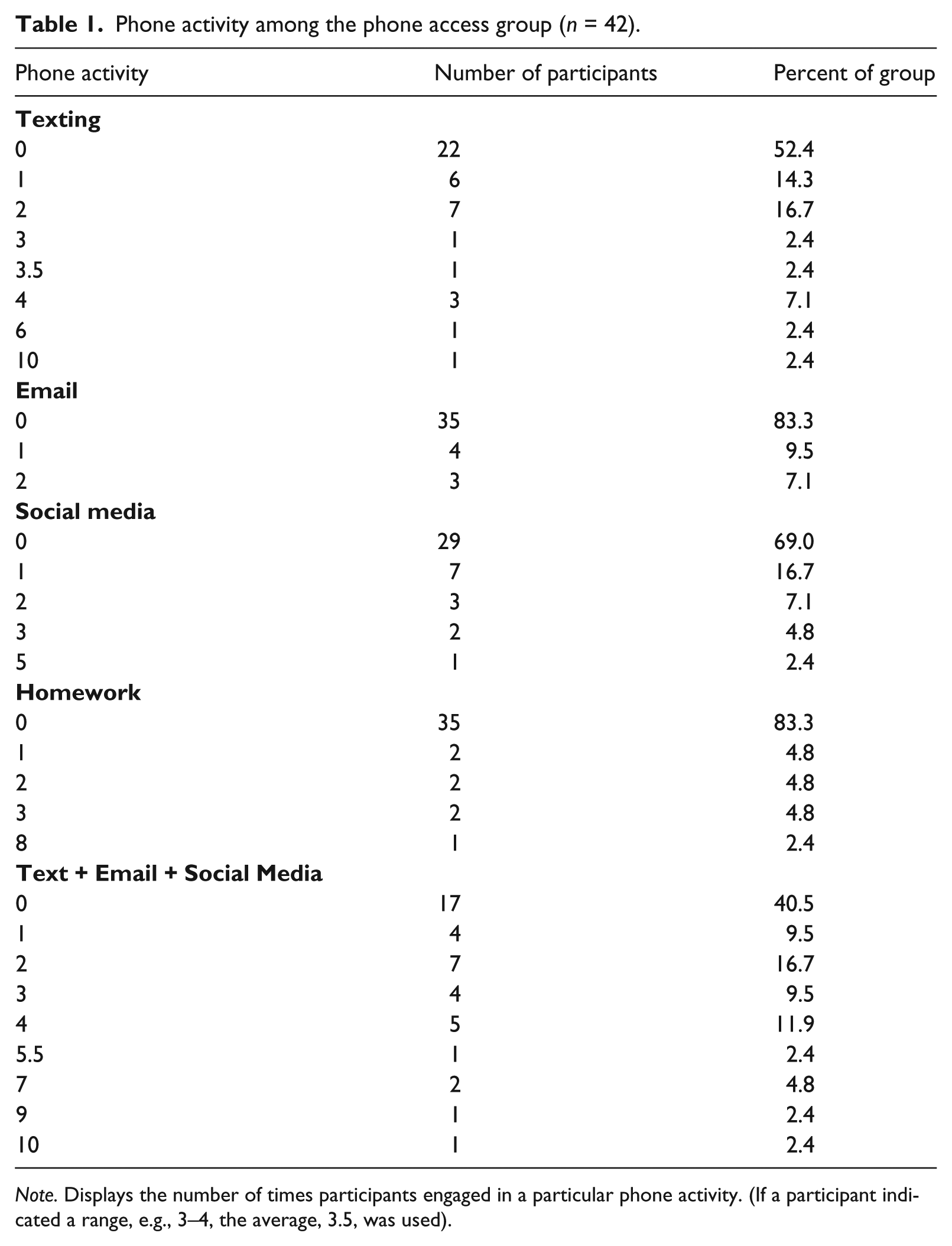
Note. Displays the number of times participants engaged in a particular phone activity. (If a participant indicated a range, e.g., 3–4, the average, 3.5, was used).
Exploratory correlational analyses
Exploratory analyses found no significant correlation between GPA and PMPU scores, r(87) = .03, p = .78. There also was not a significant correlation between PMPU scores and impulsivity ratings, r(87) = .04, p = .71. Each of these nonsignificant correlations would have accounted for less than 1% of the variance in the observed relationships even in the event of a Type II error, thus we interpreted these relationships to not be meaningful. The full matrix of correlations between variables is shown in Table 2.
Correlation matrix for dependent variables of PMPU, anxiety, attainment of study goals, GPA, and impulsivity.

Note. Correlation coefficients that reached significance at the 0.01 level are bold and include **. Correlations with * are significant at the 0.05 level. PMPU = problematic mobile phone use; GPA = grade point average.
Discussion
We predicted that participants who showed higher tendencies for PMPU and had their phones taken away would become more anxious over the course of an hour-long study session. This hypothesis was not supported by the data. We also predicted that participants who showed higher tendencies for PMPU and had their phones taken away would show lower attainment of study goals, but this difference, although not significant, was interpreted as less conclusive due to the possibly meaningful differences included in the range of the CI. Further, the data showed no significant differences in anxiety between the restricted phone access condition and the condition for which participants had access to their phones. There was evidence to suggest, however, that those who showed higher PMPU tendencies also generally tended to be more anxious during the experiment.
Construct validity of mobile phone “addiction”
Given our finding that restricting mobile phone access did not significantly affect anxiety levels over time, this study did not support the construct validity of mobile phone addiction, since an expected symptom of withdrawal—increased anxiety—was not observed when phone access was prevented. Our results also seemed to qualify Cheever et al.’s (2014) findings. Participants in this study were given a homework and studying task whereas Cheever et al.’s participants had nothing to do (which was the intentional focus of their research and a different focus from our experiment). Perhaps participants in their study became anxious over the course of an hour out of boredom, as Wilson et al.’s (2014) experiment showed that people tend to become uncomfortable and restless even within a span of 15 minutes of inactivity. Recent data (Smith et al., 2015) showed that 77% of smartphone users (and 93% of 18- to 29-year-olds) reported using their mobile phones as a source of stimulation to avoid boredom, and mobile phones are almost constantly available for most people. In our study, participants were given a task they presumably were motivated to accomplish, and, even in participants with relatively higher PMPU scores, increased anxiety did not emerge when their phone access was restricted.
Moreover, given the current study’s finding that those high in PMPU tended to be more anxious, it is perhaps unsurprising that heavy mobile phone users in Cheever et al.’s (2014) study showed the greatest increases in anxiety over the hour. When tasked with doing nothing for an hour, these heavy users may have exhibited greater anxiety than others even if they had been allowed to use their phones. Their growing anxiety may not have necessarily been due to a lack of mobile phone access; an alternative explanation is that a higher susceptibility to boredom results in both greater phone use in general and increased anxiety while sitting quietly in a room.
It is possible that some past studies that have supported the mobile phone addiction construct may have inflated the notion of mobile phone dependency (for a similar argument, see Billieux, Maurage, et al., 2015). For instance, Clayton et al.’s (2015) study—in which participants could not answer their ringing smartphones—introduced a situation that was perhaps less about mobile phone addiction than about general anxiety over the inability to communicate. The researchers created a specific circumstance in which anxiety may have been a natural response regardless of a person’s degree of mobile phone dependency. A generation ago, for instance, people likely would have grown anxious if they were restricted from answering their ringing home landline phones. An interesting and open question is whether the increased use of mobile phones has impacted anxiety over communications in a way that previous technologies have not.
Past research has suggested that Internet-related disorder—a construct related to PMPU—could be considered an “impulse control disorder” (Young, 1998), and phone use has been linked empirically to impulsivity (e.g., Billieux, van der Linden, & Rochat, 2008). But PMPU scores in this study were not significantly correlated with impulsivity. Billieux, Maurage, et al.’s (2015) recent theoretical model of PMPU, however, posited that impulsivity was but one of three potential pathways to addiction-like symptoms of PMPU. An excessive need for reassurance and/or extraversion were posited as independent mechanisms that also could result in the behaviors assessed by our PMPU questionnaire. As such, the lack of a relationship between PMPU scores and impulsivity could be interpreted to mean that a mechanism other than impulsivity drove the PMPU scores in our study. Any tendencies toward PMPU in our study instead may have been driven by a need for excessive reassurance—a mechanism linked to general anxiety in previous research (see Billieux, Maurage, et al., 2015). We indeed found that those who scored high on the PMPU scale tended to be more anxious than those who scored low on the scale.
Effects of mobile phone access on attainment of study goals and academic performance
We found some evidence that working without mobile phone access benefited attainment of study goals. Those without their phones attained about 12% more of their study goals on average than those with their phones. At the same time, participants’ self-rated perceptions of their study performance showed no significant difference between phone access conditions, which suggested that benefits to their attainment of study goals were imperceptible. This result supported the notion that mobile phone access while studying may impair academic performance by decreasing attainment of study goals and complements previous studies regarding the distracting effects of mobile phones in a classroom or homework setting (Fox et al., 2009; Kuznekoff & Titsworth, 2013; McDonald, 2013; Rosen et al., 2013).
It is interesting, however, that reported mobile phone usage seemed relatively low among those who had access to their phones. For each type of presumably distracting mobile phone activity (texting, emailing, checking social media), a large proportion of participants never performed these tasks during the study session. The small amount of phone activity reported may have accumulated to the point that it produced differences in percent of study goals attained, but this may not necessarily have been the case. Thornton, Faires, Robbins, and Rollins (2014), for instance, have suggested that the “mere presence” of a mobile phone diminishes attention and reduces cognitive performance regardless of active phone usage. One possibility is that restricting mobile phone access in this study subtly manipulated the mindset of participants, thereby encouraging productive, efficient work strategies. In a way imperceptible to participants, the lack of a mobile phone presence may have reduced the temptation to procrastinate and indirectly induced better attainment of study goals.
Many studies have suggested that greater mobile phone usage predicts lower GPA (Fox et al., 2009; Lepp et al., 2015; McDonald, 2013; Rosen et al., 2013), but a link between mobile phone addiction and GPA was not evident in our data. Our data showed a restriction of range with regard to GPA; most GPAs clustered around the higher end of the scale. In fact, this sample showed an average GPA of 3.45 (SD = 0.40), which is approximately equivalent to a B+ letter grade. Perhaps a ceiling effect reduced our ability to find a significant correlation between GPA and addiction scores.
Limitations and conclusions
Whereas a strength of this study was the ecological representativeness of the homework task, this also introduced some limitations. Since all participants were allowed to bring personal studying materials, we could not devise objective measures of attainment of study goals. We believed that it was important to try to study restricted mobile phone access in a scenario representative of actual academic tasks in which participants presumably had some vested interest, but this required a self-report measure of attainment of study goals. Future studies could assess cognitive performance or attainment of study goals in a more objective manner with standardized tasks, yet this approach will bring its own, different set of limitations. Since the current study did not allow students to use computers during the study session, more research will be required to disentangle whether or not distracting effects are a function of mobile phones per se, or rather attributable to the connectivity that all mobile Internet-enabled devices can provide.
In conclusion, this study showed that anxiety did not increase significantly during a studying/homework task with restricted mobile phone access. Participants did not show symptoms of mobile phone withdrawal in tasks they were completing for their own gain, at least within the span of an hour. The presence of a mobile phone, however, negatively impacted attainment of study goals, perhaps by virtue of its directly distracting qualities. In light of our findings, it seems reasonable to suggest restricting access to one’s mobile phone, at least for short periods of time, in order to maximize one’s attainment of study goals. Future studies could apply a similar procedure to a classroom lecture setting to see if students perform better on a final test, for instance, after phone access is restricted during class.
Mobile phones are neither solely a means of distraction nor only a source of problematic behaviors. Phones can be used as a tool for attainment of study goals, for instance, as was evidenced by the approximately 17% of participants within the phone access group who reported using their mobile phones to aid in doing their homework. The danger with mobile phones as tools for attaining study goals, though, is that they simultaneously provide a means for diversion. While a person may start using their phone with the intent of being productive, their attention could be diverted to any number of other distractions. Understanding how problematic mobile phone behaviors impact our lives and defining the contexts in which problem behaviors are likely to occur will ultimately inform educational policy and the design of future technologies.
Footnotes
Acknowledgements
This experiment partially fulfilled requirements for the first author’s honors thesis. We thank Nandini Sikand and Jennifer Talarico for their helpful comments on a previous version of this manuscript.
Declaration of Conflicting Interests
The author(s) declared no potential conflicts of interest with respect to the research, authorship, and/or publication of this article.
Funding
The author(s) disclosed receipt of the following financial support for the research, authorship, and/or publication of this article: The Lafayette College Academic Research Committee generously funded the purchase of the STAI instrument for this experiment.