




Abstract
In this article we take the novel step of bringing together recent scholarship about mobile media and communications with new ethnographic research and scholarship about mobile self-tracking. The correspondences and entanglements between mobile media and self-tracking technologies, and scholarship, we argue, are usefully considered in relation to each other both empirically and theoretically. Indeed, we propose that the convergence between self-tracking and mobile media means that we will increasingly need to account for their entanglements in mobile media research, and that there is therefore a need to explore the implications of taking the new step of approaching self-tracking research through the prism of mobile media scholarship.
Introduction
While there is growing interest in digital self-tracking across human–computer interaction (HCI), medical, sociological, and some anthropological research, the topic has received little attention amongst scholars in mobile media studies. Yet, questions relating to how people use locative and wearable technologies to create, share, and communicate about personal data as digital content sit at the core of issues that mobile media scholars have the expertise to comment on. Indeed, some locative apps and platforms for checking-in and location-aware posting to social media already entail elements of self-tracking but have conventionally been analysed through other lenses. Approaching self-tracking through mobile media studies scholarship situates it as part of and emergent within contemporary mediated and mobile worlds and lives, and in relation to media content, communication, and presence. Simultaneously acknowledging how self-tracking is implicated in how people use and engage with mobile media and technologies, throws new light onto how mobile futures are emerging. This is, we suggest, a pertinent preparation for how we will need to research in the immediate future since we are already in a contemporary and emergent context where tracking and data producing are increasingly ubiquitous as aspects of everyday mobile devices.
Humphries recently called for Mobile Media & Communication to “become a home for exploring the boundaries and practices regarding many different kinds of mobile media and communication” (2013, p. 22). Opportunities for this proliferate as mobile media and communication and wearable technologies/devices are increasingly entangled across everyday life and technological systems. They invite us to consider the implications, possibilities, and potentials that emerge as these entanglements progress in relation to uses, qualities, and affordances of mobile media and technologies. In this article we engage three contemporary concepts from ethnographic scholarship in mobile and digital media studies: digital wayfaring, which refers to the movement through digital-material environments as we live everyday life (Hjorth & Pink, 2014; Pink & Hjorth, 2012); digital copresence (Beaulieu, 2010), including the visual intimate copresence related to sharing digital photography (Goggin & Hjorth, 2009; Gómez Cruz, 2016; Ito & Okabe, 2005), of being able to be “with” others online through locative media when they are not physically present; and the notion of emplaced visuality (Hjorth & Pink, 2014). We use these concepts to create correspondences between existing literatures about mobile media and our ethnographic research into self-tracking technologies. We examine how the relationship between self-tracking and mobile media has implications for how self-tracking is experienced and performed, while simultaneously self-tracking has implications for how mobile media routines and activities are situated and experienced. We propose that the significance of conceptualising self-tracking as a mobile media (related) practice goes beyond theoretical and empirical reflection on how mobile media are emerging as part of everyday life. Rather, it has implications for how mobile media and technologies may be engaged for interventions in applied research and design contexts; in this article we create a theoretical and methodological basis for such future developments.
Self-tracking: A mobile pursuit
There is a growing academic and applied research interest in self-tracking technologies as they spread through a range of areas of everyday life (Lupton, 2016; Neff & Nafus, 2016; Ruckenstein & Pantzar, 2015a, 2015b). Like Lupton, we define self-tracking as involving “practices in which people knowingly and purposively collect information about themselves, which they then review and consider applying to the conduct of their lives” (Lupton, 2016, p. 3). Social science research and scholarship about self-tracking has often focused on the Quantified Self (QS) movement or has treated it as a key reference point (e.g., Barta & Neff, 2016; Lupton, 2016; Neff & Nafus, 2016). Through QS (http://quantifiedself.com/about/), serious self-trackers meet, discuss, and collaborate online and offline. There are also many users of self-tracking technologies who do not participate in QS, and who use the technologies in relation to other elements of their (everyday) lives (Ruckenstein, 2014), which is discussed in literature and critical debates regarding self-tracking as a health technology, across medical sociology (e.g., Lupton, 2015) and in design research (e.g., Purpura, Schwanda, Williams, Stubler, & Sengers, 2011).
In media studies “wearable fitness trackers” have been defined as a type of mobile media by Gilmore (2015) who proposes they are a kind of “everywear”—a concept that builds on Greenfield’s (2006) idea of “everyware” which refers to ubiquitous technologies. For Gilmore, everywear—wearables and mobile smartphone apps—are continuously present and become part of the routines of everyday life. This concept like those of digital and intimate copresence as developed in mobile media research (Goggin & Hjorth, 2009; Ito & Okabe, 2005), and digital presence (Pink & Leder Mackley, 2013) discussed in what follows, implies how a layer and infrastructure of code (Kitchin & Dodge, 2011), technology, and data create new forms of everyday presence. These elements make the environments we live in and move through feel different (Pink, Lupton, et al., 2016). As Jason Farman has put it “As mobile phones have become globally pervasive, they exist alongside an array of other mobile technologies, from wearables to smart watches, from tablets to RDIF cards,” in this “increasingly complicated technological landscape” the boundaries between mobile and nonmobile technologies become unclear (Farman, 2016). Mobile technologies, smartphones, and wearables are the devices through which both the automated and human activities of self-tracking emerge as part of the digital materiality (Pink, Ardevol, & Lanzeni, 2016) of everyday worlds. In such environments, the everyday is a context where the digital and material are not separated out into different spheres of activity, object, or domain, but instead become entangled and inseparable as part of the environments people move and navigate their lives through. Thus technologies can be seen as “mobile” in more complicated ways, as our definitions of the technologies themselves and their capacities for mobility expand to acknowledge that movement is not restricted to a material physical world as distinct from a digital world. Instead, being mobile itself is distributed across humans, apps, data, and mobile devices, and traverses the online–offline simultaneously in inextricable entanglements.
Theories of movement and place are fundamental to human geography and phenomenological anthropology approaches that understand everyday environments as constituted through continually changing or shifting constellations of things and processes, and theories of place and space in human geography (e.g., Massey, 2005) that inform recent mobile media research (Wilken & Goggin, 2012). They imply that everyday spatialities are the ongoingly emergent outcomes of movement, thus situating the movements of tangible and intangible manifestations of people, mobile technologies, and content as relational to and part of a world in movement. As the media scholar Elizabeth Ellsworth has suggested, media in use have the ability to enhance and give body to this relationality as “facilitators of flows” that put diverse ideas and people in circulation and relation with each other and have therefore “the potential for catalyzing new forms of corporeality, new embodiments new ways of knowing and being human” (Ellsworth, 2005, p. 126). Here, we understand the everyday world as being constituted through movements of different things of different qualities and affordances, at different speeds, some not even visible to the human eye; in the following lines we focus on the routes through and forward in the world that are taken by people as they move with mobile media and self-tracking technologies.
The related field of mobilities research in human geography has also connected to mobile media studies. For instance, to discuss how mobile technologies enable mobile lives while simultaneously—from a psychology perspective—suggesting they contain the anxieties that are generated through such lifestyles (Elliot & Urry, 2010, pp. 27–28). As Sugiyama and Vincent have argued, “mobile communication studies are pivotal” for understanding the relationship between people and technology since “mobile media can be considered as the ICTs that are closest to the human body and central to human emotional experiences” (2013, p. 3). More recently Licoppe (2016, p. 100) has suggested a concept of “digital mobilities,” which “account for the fact that mobile bodies will increasingly be connected bodies,” whereby “Mobile digital connectivity allows getting access to any kind of information on the move.” An instance of this, he suggests, is “typical of locative media,” involves “situations in which mobile bodies are able to connect digitally to surrounding people, places, and things, and in a way which change dynamically in the course of their mobility” (2016, p. 100) and,
a common feature of locative media, which is to provide a layered experience of mobility, in which the connected mobile individual may experience people, places, and things around her with her own sensorium, but also through the mediation of screen-based connected mobile devices and applications. (Licoppe, 2016, p. 100)
While Licoppe does not specifically account for self-tracking in this description, as we show in what follows, self-tracking devices, apps, and platforms precisely enable such forms of digital–material relationality in ways that expand this characterisation.
We next outline how our approach to ethnographic scholarship shapes the discussion in this article, before considering ethnographically how self-tracking plays out as a form of digital mobile technology and media in a world of movement.
Understanding self-tracking through ethnographic scholarship
The ethnographic materials discussed here are part of the “Sensing, Shaping, Sharing” project that we participate in with two other colleagues across Sweden and Australia. The wider project investigates the past, present, and imagined future of self-tracking through historical and contemporary ethnographies of users and developers/designers of self-tracking technologies. We emphasise that this article is not a research study report, as might be expected in some disciplines; rather, we interpret particular findings in order to create a specific set of dialogues with mobile media research.
The element of our research discussed here has focused on how everyday users of self-tracking technologies experience, imagine with, talk about, and reenact their relationships with them. It refers to an ethnographic study carried out with 20 participants divided across Sweden and Australia. All were professional employed people and were selected because they actively self-tracked, with smartphone apps, wearables, or both. We intentionally ensured as part of this stage of our research that most participants were not QS members, since we wished to understand what self-tracking meant for those who did not publically share their data or experiences, while they did integrate it in private, intimate, or mundane everyday routines and relationships.
Our digital ethnography approach accounts for human relationships to technologies while acknowledging “the intangible as a part of digital ethnography research, precisely because it invites us to consider the question of the ‘digital intangible’ and the relationship between digital, sensory, atmospheric and material elements of our worlds” (Pink, Horst, et al., 2016, p. 6). Our ethnography was also guided by principles that underpin a sensory ethnography approach (Pink, 2015): understanding how people move through the world, spatially and temporally; working collaboratively with research participants so they can show as well as verbalise their everyday experiences, activities, and imaginations; and developing empathetic modes of learning and knowing about other people’s lives. This approach is distant from observational and holistic approaches associated with some fields of ethnography, since it focuses on our being in the world with participants and technologies and emphasises doing ethnography with rather than about people. It accounts not only for the representational aspects of self-tracking by attending “to the dimension of self-tracking that is characterised by the flow, ongoingness and usually unspoken elements of our encounters with its technologies and data, to make them both visible or verbalised, and accessible to us as researchers” (Pink & Fors, 2017, p. 6).
We developed tailored ethnographic encounters from methods that had already been successfully engaged in existing projects. With each participant we undertook one in-depth “sensory ethnography” interview, defined through our attention in the interview to the sensory and affective ways we could share contexts, technologies, and experiences with participants, and engage these for learning about their technology uses. We also asked participants to show/perform examples of how they used their apps, devices, and data while, when they agreed, we video recorded them, following their activities as they were enacted and asked questions when relevant. The interviews and enactments/performances were encounters through which our conversation and shared activities coproduced ways of knowing about experiences of technologies with participants. Video recorded reenactment methods do not record objective accounts of what people do with technologies (or other things), but coproduce abstractions of what participants “usually” do (Pink & Leder Mackley, 2014) through attending to participants’ incrementally learned embodied ways of knowing and remembering. We were concerned with how these articulations came about in the context of the digital, material, sensory, and affective environments, relationships, and activities connected with self-tracking. In this spirit the research process also included an element of auto-ethnography, whereby the researchers used self-tracking technologies and participated in a small group over approximately 5 months, sharing our own data in our group of four coethnographers. Thus we draw our own experiences into the research process to share in discussions with participants and to better develop empathetic understandings of the stories and performances that participants revealed to us.
Ethnographic analysis does not entail a distinct separation between theory and research practice; ethnographic ways of knowing and practice are embedded in a theory of knowledge that is coherent with our understandings of how participants in research know and understand in the world. As is played out in the following sections, ethnographic ways of knowing are continually in dialogue with and generative of theory, as we interpret participants’ and our own experiences of actions in, and movement through, the world in relation to existing empirical and theoretical ways of knowing.
The digital wayfarer in a data world
The notion of the digital wayfarer was developed (Hjorth & Pink, 2014) to conceptualise how people move through a digital-material world (Pink, Ardevol, et al., 2016). It draws on Hine’s understanding of how we move through the Internet (Hine, 2000) and Ingold’s notion of wayfaring whereby:
[T]he path of the wayfarer wends hither and thither, and may even pause here and there before moving on. But it has no beginning or end. While on the trail the wayfarer is always somewhere, yet every “somewhere” is on the way to somewhere else. The inhabited world is a reticulate meshwork of such trails which is continually being woven as life goes on along them. (Ingold, 2007, p. 84)
Pink and Hjorth have proposed that “the digital wayfarer meanders through the Web and through the world. She or he moves between platforms and between localities, pausing, and learning as she or he goes” (Hjorth & Pink, 2014, p. 491). Such movement does not have a “concrete end or destination, and may involve moving through interrelated digital and face-to-face contexts” (2014, p. 491). There the concept is used to understand the “texture” of the world that people move through as they make and upload camera-phone images to social media platforms—a way of being in the world that involves traversing the online–offline as they go and indeed in which the digital and material are not necessarily separate, but entangled inextricably. The concept of the digital wayfarer also helps us to think about how people (as digital wayfarers) navigate through the digital materiality of the everyday. Digital materiality, as conceptualised by Pink, Ardevol, et al. does not make an “a priori definition about what is digital and what is material” (2016, p. 10). As such it does not see the digital and material as two separate things that are set alongside each other and become a defined or finished artefact, but instead focuses on the emergent and processual nature of the relationality of the digital and material as entangled within the same “process of becoming.” As such, they argue, “digital materiality refers to the making and to what emerges of these entanglements, not to a state or a quality of matter” (2016, pp. 10–11). What has been referred to as digital wayfaring can therefore be seen as part of this process of emergence, and is a way in which to think about how humans move through a digital material world. Self-tracking, like camera-phone photography (Pink & Hjorth, 2012), is an example par excellence of digital wayfaring, since it precisely entangles the categories of digital and material, and indeed obliterates the binaries that might be assumed between the online/offline, digital/material, and human/technological.
Exactly how people wayfare through this digital-material environment that self-tracking helps to constitute varies from person to person. Some participants rarely checked their data, they waited until they received an alert from the app, or looked at their data within regular daily social media and app-checking routines, which in turn help create the mobile routes people take through their everyday environments—for instance, when getting up in the morning or going to bed at night. Some talked about how they would “play” with an app or experiment with a wearable to see what would happen to their data. For example, one Melbourne participant had experimented with his heart rate monitor to learn how it would go up or down if he walked around, had a shower, a coffee, or sat still, and enjoyed making its display change intentionally. Such apps played a role in how memories of movement could be relived through the data. A participant in Sweden (discussed in the next section), described how her running app enabled her to remember her different runs through her naming them in the app, and how this topographic data subsequently made sense to her in relation to these names. Another Swedish participant used the app’s map features to go through the embodied feeling of the run “just for fun.” This involved seeing how the feeling and memory of the run and the technologically gathered data from the same run corresponded with each other.
However, as our work has shown, wayfaring through and constituting digital materialities through self-tracking is not necessarily about making accurate representations of the material through the digital, or vice versa, but about something beyond this. For example, David, in Melbourne would put his wristband in his pocket when cycling, in order to record the movement of his legs so that it would contribute to his step count (even though this did not give accurate data this was not important to him). However, while his everyday cycling was to work and back, when he did longer rides he would also use a cycling app, which he described as follows:
When you go for a long ride, you can turn it on, and it gives GPS and at the end of the ride it tells you how far you’ve gone and how fast you’ve gone . . . so that’s quite good and it saves your rides so I’ve started to do that for cycling . . . I bought a second bike which is like a road bike, and so like when I go for like pleasure rides I do that, and then just commuting I don’t bother because it would just be boring . . . I quite like this thing of the elevation data, that’s quite sort of fun.
When he went on these rides however David still put his wearable in his pocket. He pointed out that during these rides it did not collect accurate data. It would register a certain number of steps, based on his pedalling. However this was not important to him, since he was simply happy to have registered steps for his activity. Here therefore physical activity and digital data production become activities that are coimplicated in moving through the world. The production of mobile data is not necessarily the making of accurate factual information about the individual’s physical activity, but rather a facet of how people move through digital-material environments. Wayfaring here happens in such a way that the digital and material are inseparable, indeed they have little meaning if torn apart. Instead, they can be seen as part of the texture of an environment that our participants moved through and in which their relationships with the mobile technologies and media that move with them are central.
These different ways of moving through a digital-material world create direct correspondences between the affordances of mobile media and self-tracking. They imply that we need to consider self-tracking as being about more than just collecting (digital) data about our physical activities in the (material) world. Instead, they demand that we collapse any distinctions between the digital and material and that we understand self-tracking as an increasingly ubiquitous mode through which ordinary people navigate the digital materiality of the everyday through habitual and mobile activities. By seeing the self-tracker as a digital wayfarer we can consider how she/he does not simply record in the background what was already happening, but instead makes tracking part of a route of movement through the world, encompassing moments of engagement with it, for instance enjoying an improvised form of play with a heart rate monitor, relive the data as a an embodied personal diary, intentionally using the technology to produce data that do not represent actual activity, or dipping into data while sitting on public transport, as another participant described. Such activities in turn shape how the digital materiality of people’s movement through the world is constituted and experienced.
In the next section we explore these relationships further through a discussion of mobile apps and data visualisation.
Self-tracking and mobile algorithmic visuality
As signalled before, a key way that self-trackers engage with their own experiences through mobile technologies and media, and how they encounter each other is through sharing visualisations of their data, made accessible to them and others through algorithmic processing. We now probe these encounters further through a consideration of the relationship between this algorithmic visuality and camera-phone photography to examine how it can be considered specifically in relation to this aspect of the experience of and theoretical approach to mobile media.
Data visualisation and digital photography have an increasing number of overlaps as forms of algorithmic visuality emerge in aesthetic approaches to data visualisation as a representational format (Manovich, 2011), photosynth (Uricchio, 2011), and in new automated video-editing software (Hight, 2014). Thus, as contemporary photographic images become increasingly algorithmically constituted, existing scholarship concerning the status of camera-phone photography as a representational trace through the world offers a companion literature for the study of mobile self-tracking data visualisations. Here, to situate more recent uses of self-tracking data visualisations, we build on earlier understandings of digital photographs as being produced in movement, that is, as made by people as they go through the world, rather than being of the world (Pink, 2011). We first explain this approach to the making of camera-phone photographs, which like self-tracking data creates a digital trace through digital-material environments. We highlight some of the correspondences that the concept of the digital camera-phone trace has with our understanding of self-tracking. We then use this understanding as a framework through which to interpret self-tracking data visualisations in relation to the affordances of mobile media.
Camera-phone photographs made as people move through everyday environments, do not stop in the location (spatiality) and moment (temporality) of their production, but instead they move forward with people (see Pinney, 2009), accompanying people and configuring or assembling with other things to become meaningful. They can be understood not as images of the world but as images that are emergent from the world, in it and part of it (see Fors, 2015; Pink, 2011). In common with self-tracking data, “images are implicated in corporeal relationships through which persons can continue to move forward (in both physical environments and affective and imaginative domains), but also to think of the circumstances of their production as being ‘in movement’” (Pink, 2011, p. 7). Conceptualising camera-phone images as the outcomes of particular configurations of things in movement, and corresponding experiential and imaginative narratives, is aligned with nonrepresentational (Thrift, 2008) or more-than-representational (Lorimer, 2005) approaches (see Pink & Hjorth, 2012, p. 145) since here images are interpreted as a trace rather than as representations. However, as Pink and Hjorth argue, “In camera phone photography, the experience and representation of movement cohere” (2012, p. 146) because camera-phone images are also shared and posted online as representational and communicative artefacts. Indeed, as Gómez Cruz argues, contemporary photographic practice is not constituted by a mere resemblance between an object and in image, but it is “increasingly being used as an interface” (2016, p. 229) for shared agencies, and as such embedded in “sociotechnical practices in constant flux” (2016, p. 240). Similar points can be made for the visualisations that are algorithmically generated from self-tracking data, but simultaneously are treated as representational graphics. The algorithmic visuality of mobile self-tracking data can therefore be understood as configuring images that punctuate the process through which we move through the world. This happens at different rates and scales, depending on the type of app being used; however, the general principle that we are interested in here remains. That is, that these data visualisations are sites where experience and representation cohere for participants. While they are produced differently to camera-phone images (which are composed aesthetically in relation to the choices of the photographer), data visualisations are nevertheless not to be understood as necessarily objective renderings of physical activity. Indeed, examples such as Christian Nold’s Biomapping project generate what he calls “a new type of knowledge combining ‘objective’ biometric data and geographical position, with the ‘subjective story’ as a new kind of psychogeography” (2009, p. 5). In the case of self-tracking, for instance, in practice, the actual visualisations in the apps do not necessarily represent the information that users later view in order to recall their physical activity. For example, Josefine showed us how part of her routine for checking her saved running data when browsing through her different self-tracking apps, did not explicitly involve viewing the visualisations as body measurement data (Figure 1). Rather, when she read the data, she did so according to place and person names she had given to the specific running activities, so that she could remember what the data had meant to her when it was produced. She also added these to the different runs so she could easily reconnect to the meaning of the activity. She described one of her runs and its naming as follows:
I have named it “[the name of the place where they had run] with [person run with],” because that was a very nice moment with my husband. I am sure that is something I will be able to remember. I could also have written down that it was 25° and sunshine. For me that gives me a double reward for myself, I feel that am good at something and also that I enjoyed it, it was the best thing yesterday that we did that together.
So that was why you wrote that you did it with your husband?
Yes, in that way I remember it afterwards—I think it is connected with some memories—when I scroll through [the list of named running activities] it works more like a photo album.
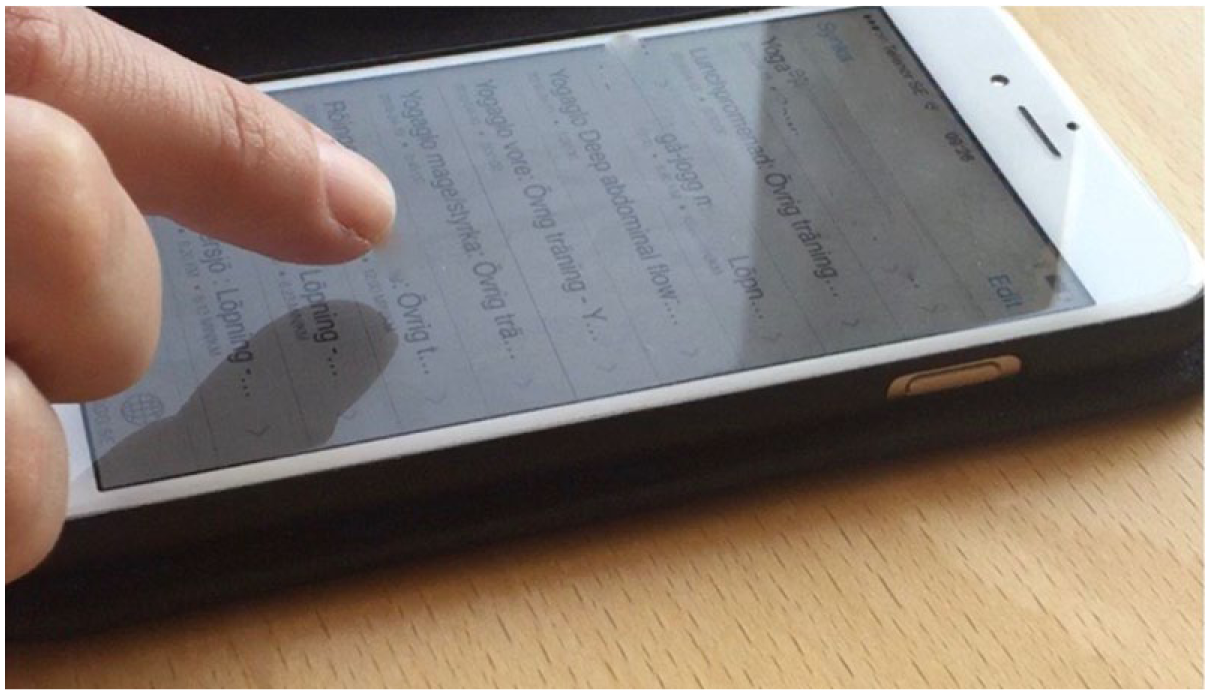
Josefine shows how she has given her running activities personal names and scrolls through the list to evoke the feelings she has connected with these activities and their data (photo anonymised).
The connection between the data visualisations and the real-life experience is further used by the participants as something to play with to enhance the experience of the data. Another participant, Eva, (Figure 2) talked about how she went through the visualisations of her runs to see how well “the inner body watch and body compass match with what the technology presents.” She explained that if the reality and the map did not match, then the map became obsolete. She mentioned that she liked to “play around” with the visualisations that made it possible to go through her runs afterwards (the pace, topography, and length), and then make sense of how those matched her memories.
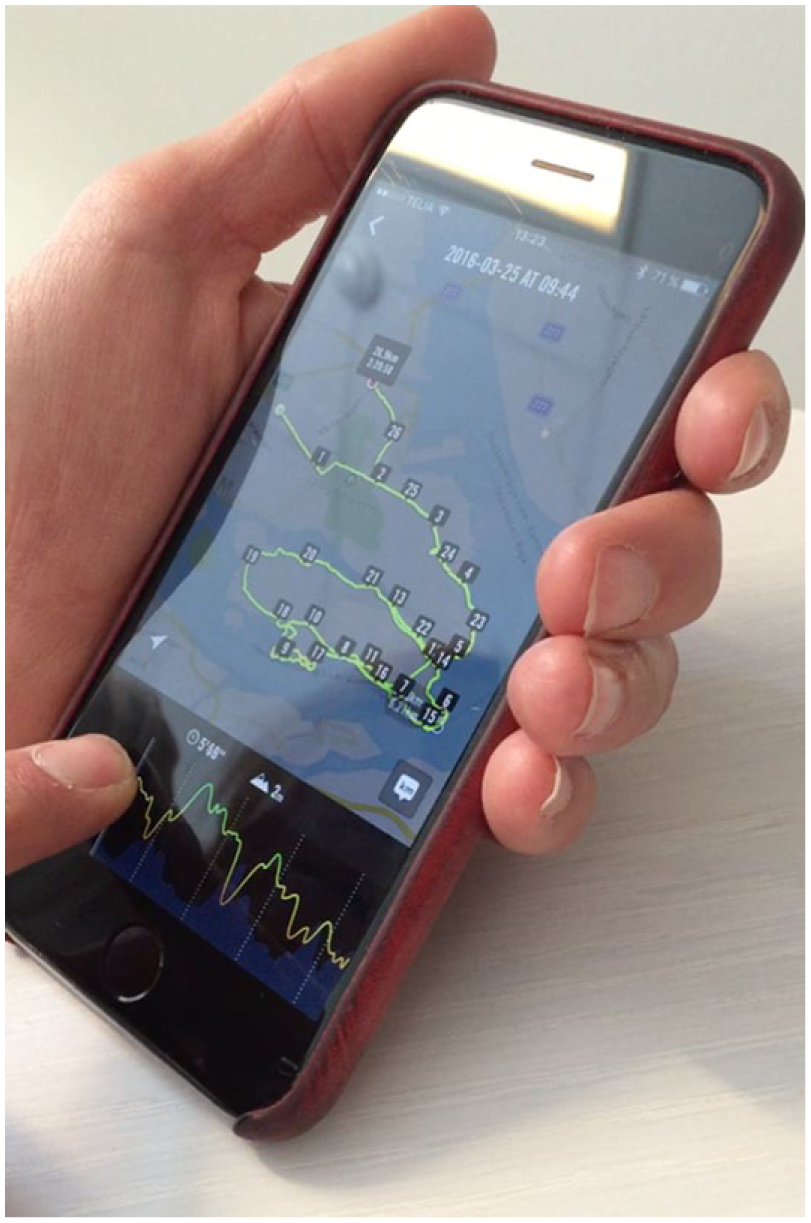
Eva shows how she “plays around” with the visualisation to see how it matches her memories of the activity.
Another example is shown by David’s comments discussed before. He was unconcerned that his steps data were not wholly representative of his actual steps. While in some cases such intentional production of inaccuracy can be interpreted as forms of resistance in the context of anxieties about surveillance (see e.g., Pink, Ruckenstein, et al., 2016), it is also important to appreciate these instances where users’ everyday priorities are played out in a more pragmatic way. Because he felt his everyday cycling should be represented in his step count, he believed he was justified in including this (by putting his wearable in his pocket while cycling) as steps data, even though it neither accurately represented his cycling effort nor his steps. Thus, the data visualisation which presented this to him was a graphical image that he had worked on composing, through his use of the wearable (Figure 3).
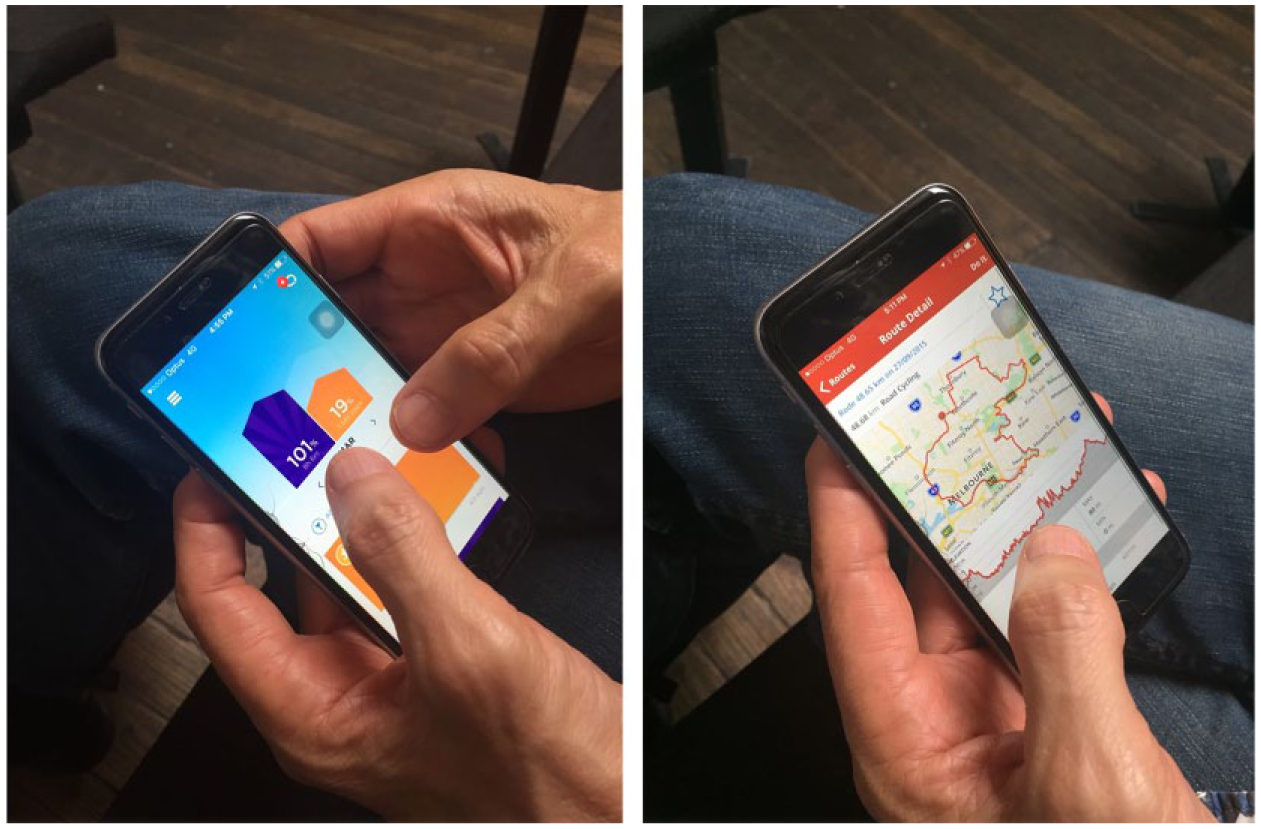
David showed his self-tracking steps and sleep data (left) and the visualisation of one of his longer rides (right).
Such images cut across our experience in the world to visualise an aggregated state of affairs but they do so in sequence, making them images not of our activity, but images that we can use to tell ourselves, and others, stories about our activity. They are moreover images that we “go forward with” (Pink, 2011), and in being so correspond with the notion of “corpothetics” that Pinney has distinguished from aesthetics in that “image and beholder” are separated in the latter concept whereas, as he put it “‘corpothetics’ entails a desire to fuse image and beholder” (Pinney, 2009, p. 422; see also Pink, 2011). There are also very literal ways that the algorithmic visuality of self-tracking goes forward with us, in that the graphical images are stored and accessed through the smartphone apps that accompany us in everyday life. Their meanings—or the stories we tell or imagine with them—change as we scroll back and forth through them. Neither meaning nor data are static, but rather this form of algorithmic visuality is something through which, as Ingold has put it in his discussion of art, we should not assume that “images represent, on another plane, the forms of things in the world” (Ingold, 2010, p. 16). Rather, they should be seen as “place-holders for these things,” suggesting that “Could it be that images do not stand for things, but rather help you find them?” (Ingold, 2010, p. 16). One of Ingold’s conclusions is that “we must recognise in the power of the imagination the creative impulse of life itself in continually bringing forth the forms we encounter, whether in art, through reading, writing or painting, or in nature, through walking in the landscape” (2010, p. 23). If we see this as a parallel to the way we move/walk through a digital-material landscape of which self-tracking data visualisations—and a range of other mobile media affordances, including camera-phone images—are part, we can understand how self-tracking data are not an additional thing to our everyday lives with mobile media. Instead, they become part of the digital materiality of everyday life in ways that have close theoretical and practical correspondences with other aspects of mobile media use and experience, such as camera-phone photography.
Presence and mundane intimacy
In the previous two sections, we have discussed how people move through the digital-material world with self-tracking technologies and we have examined how the algorithmic visuality of self-tracking data visualisations forms part of the landscape of such a world. We now examine how this relates to the everyday socialities and social relationships that scholars have associated with mobile media.
Media scholars have defined digital media and technologies in everyday life through the concepts of digital copresence (Beaulieu, 2010; Goggin & Hjorth, 2009; Ito & Okabe, 2005) and digital presence (Pink & Leder Mackley, 2013). These concepts explain how people use digital mobile media as they go through the world living out everyday life, and refer to elements of everyday worlds that the digital wayfarer (discussed above) might encounter. The notion of copresence is used by mobile media scholars to refer to how mobile media enable “being together” online while physically separate, with reference to maintaining intimate relationships (but may also imply a sense of surveillance; see Pink, Horst, et al., 2016). Self-tracking technologies offer people ways to experience this intimate copresence through continually sharing data with a friend, a group, or publically on platforms accessed through mobile apps, or in more private or circumscribed ways.
The concept of digital presence was coined to explain the on-ness of the digitally mediated home. Here, digital technologies were found to be ongoingly present in two ways. First, through their material and sensory affordances, whereby they were lit up, buzzed, or emitted incidental heat. Second, since they were in various states of on/standby/sleep modes (Pink & Leder Mackley, 2013). Self-tracking technologies here are similarly understood as being in this state of continuous on-ness or potential on-ness, which resonates with how Gilmore’s (2015) concept of everywear, discussed before, conceptualises their presence. They ongoingly track, maintaining a presence, and sometimes surfacing into being actively used or alerting users to their presence. Even though they did not necessarily consult their data continually, participants described how they knew, felt, and cared that the technologies were there, were “on,” and were placed on their moving bodies. Self-tracking technologies therefore become present as part of digital-material, sensorially perceived environments that are experienced differently by different people. Those who measured their heart rates with special monitors strapped around their chests for training, present one version of the way that a self-tracking technology becomes part of the way the moving body is sensed and senses for very specific purposes. For one participant this meant that he was able to then look down at the data reported from this device when he needed to during particular stages of his run. An example of how this might play out in everyday contexts is demonstrated by the experiences described by Adam, a participant who worked for an IT company in Melbourne, Australia. Adam, in his thirties used a Fitbit, however unlike the wrist wearable version, his was a small device that he carried in his pocket. He explained the sensory and practical reasons for this, which were specifically about being mobile:
What I like about my particular Fitbit is that it’s just in my pocket so I don’t have something on my wrist . . . you can clip it onto your belt and it does have a strap that you put against your wrist when you’re asleep . . . basically I just don’t like having stuff on my hands and I know there’s a couple of people at work who do have the wristband on and I know that when they move their arms that counts as a step, whereas mine, my entire body has to move . . . and I want it to be accurate, there’s no point in just measuring how much I wave my arm.
Likewise, worn on the wrist, in a pocket, or a bag, wearables and smartphones continually generated data, which could be dipped into at relevant moments.
This ongoing presence of a data-collecting technology that is therefore felt and also consulted forms part of the way that self-tracking accompanies people and indeed coconstitutes the specific experience of moving through everyday worlds. By combining this with the concept of digital copresence developed in mobile media research, we can consider how the specificities of self-tracking impact on the emergence of being together through mobile media. The concept of digital copresence is often used to refer to the social or communicative affordances of digital and social media, and has been associated particularly with the use of the mobile phone, spoken communication, and SMS, and subsequently smartphones, which invoked the notion of being together through social media. In this field of research, “multiple forms of presence, or ways of being together” have been identified (Pink, Horst et al., 2016, p. 84). These include what Gergen (2002) calls the “absent presence” of people who are not in the same physical space or the “connected presence” Licoppe (2004) refers to, through which people are connected through “a continuous flow of small communicative acts” (2004, p. 154; as summed up by Pink, Horst, et al., 2016, p. 84). Here we are interested in how people develop intimate forms of copresence in small groups or duos, rather than the collective sharing of self-tracking data with large numbers of others on online platforms. Most of our participants, who were purposefully selected to include people who did not belong to the QS movement, often did not share their data with others. Those who shared did it with one or few people in purposeful ways, since the person, activities, and the forms of copresence generated were important to them.
For example, Adam recalled how he began self-tracking with a friend, with whom he embarked on a shared exercise programme. However his friend stopped using the Fitbit because, he explained,
[S]he forgot about her Fitbit for 2 weeks because she charged it and forgot where she left it, she didn’t seem to care, but I was distraught for her because I couldn’t see her stats, I couldn’t see where she was up to, she didn’t really care, but I cared.
For Adam, the presence, data collection capacity of his device, and the copresence associated with it had become a way to connect, communicate, share, and understand his relationship to people and his environment—although this was not so for his friend. This was, however, something he understood as impacting on others, telling me that
It’s funny like I had another friend that lost their Fitbit and you kind of lose all motivation to go for a run . . . because you get into this thing where if you’re measuring everything, if you can’t measure it, it feels like there’s no point in doing it.
This absence would be felt, even if he continued exercising, since for Adam “If I forget to bring my Fitbit to soccer it doesn’t stop me from playing soccer but I’m annoyed about it all the time, it just feels like waste.”
There has also, in the literature about copresence and mobile technologies, beyond the focus on how sociality or connectedness emerge through digital copresence, been interest in the forms of intimacy that are generated in and through these relationships. In existing work, the idea of intimate copresence has been exemplified in relation to the use of visual images to generate forms of presence, for instance in Hjorth’s discussion of a girlfriend sending her boyfriend a photo of her eye for his smartphone screen saver (in Pink, Horst, et al., 2016, p. 89). When extended to self-tracking, the notion of intimate copresence inspires further ideas of how looking into and being close to other people’s lives and feelings might be invoked, in particular in relation to the sharing and imagining of intimate moments through self-tracking data. In our auto-ethnography self-tracking group we knew (or at least assumed we did), via our mobile Jawbone Up apps, when each other had gone to bed, when we had got up, how much sleep we had had, and how many steps, calories, and more we had taken or burned. While these were simply graphic data representations they meant more than this. They generated a sense of closeness to and knowing about each others’ lives that we had not experienced before, but that were contextualised through our having known each other for several years. Such sharing does not necessarily mean that data sharers can know the actual experiences or feelings of digitally copresent others, but it creates the possibility for them to imagine or interpret these experiences. In our auto-ethnography group we shared data as part of a research experiment, in which we all also reflected separately on our experiences of self-tracking. Significantly, it was the experiment that motivated us to share data, rather than because we wished to know about each other’s activities, thus creating a research context where we also experienced proximity from a novel perspective. However, it provided us with the chance to reflect on how sharing mobile data entangles the everyday routines of people who might also be implicated physically with these intimate moments of each others’ lives. The possibility of accessing other people’s data visualisations while on the move, also brings to the fore how digital wayfaring is part of how self-trackers become implicated in each others’ lives, and in their own data trails. However, such forms of copresence, generated through self-tracking, are not only intimate but can also be very mundane. This is precisely because self-tracking data capture and visualise those moments in our lives which may not usually be shared or spoken about, but that might at the same time be integral to our everyday sense of wellbeing. For example, one participant discussed with us how the data he received about his wife’s sleep and physical activity provided him with clues on how to anticipate the mood she would be in when she came home from work. Low physical activity and a high degree of low-quality sleep in his wife’s shared statistics would make him prepare himself for being gentle and forthcoming when he met his wife at home.
When we bring together self-tracking with mobile media research into copresence, the concept of mundane intimacy enables a focus on how mobile self-tracking intervenes in the everyday. However, it also invites us to reflect back on the concept of digital copresence and to consider how it can be used to refer to a sense of the fusing of the digital and the physical. This implies the need for a revised understanding of digital physicality that accounts for more than digital presence in the face of physical absence. This is because the algorithmic visuality of self-tracking data and the imaginative activity it inspires generate not only a sense of affective being together online, but also forms of physical empathy and proximity that can only be explained when we understand them as being part of the digital materiality of the everyday. We next draw together the discussions in this and the preceding two sections to examine their theoretical implications further.
Refiguring the affordances of mobile media through self-tracking
We have shown how existing theoretical and empirical research has developed understandings of the embodied, emplaced, and affective affordances of mobile media which attend to movement, visuality, and sociality. These approaches are particularly suited to ethnographic analysis because they specifically focus on following people, images, technologies, and communications as they move through their everyday lives and environments. It is not surprising that self-tracking is enacted and can be theorised in ways that have continuity with existing mobile media practices, since self-tracking apps are inevitably designed within existing ecologies of possibilities regarding mobile media, social media platforms, and digital mapping. Rather, the significance is that: first, the affordances and practices involving self-tracking technologies can be interpreted to support the phenomenologically inspired theorisation of mobile media we are advancing; and second that new developments in self-tracking technologies imply new social, visual, and physical engagements with and experiences of mobile media, which push the perspectives discussed here further towards a theory of digital materiality (Pink, Ardevol, et al., 2016). This understanding of mobile media blurs further distinctions between the digital and the material, the online and the offline, and forms of digital presence and physical absence.
From the perspective of self-tracking research, our discussion demonstrates the relevance of analysing self-tracking through the prism of mobile media research. We have shown how self-tracking develops a particular version of what Licoppe describes as “The common and constitutive feature of mobile locative media, irrespective of their technical or functional differences” whereby,
Surroundings become simultaneously accessible through the embodied sensorium and through the mobile terminal, with both versions being somehow referred to an ego-centered ‘here and now,’ so that the issue of correspondence between both experiences of the surrounding world becomes salient. (Licoppe, 2016, p. 101)
Self-tracking is certainly part of mobile media in this sense. Our agenda has been to establish how such correspondences can be understood as emerging theoretically and with reference to ethnographic examples. Yet, self-tracking also goes beyond mobile media, and future research that connects self-tracking and mobile media technologies will benefit from considering how these entanglements continue to emerge and what they imply as mobile technologies become further implicated in everyday life.
Conclusion
In this article we have outlined areas where mobile media research and self-tracking research can fruitfully be combined to inform each other theoretically and through empirical research. To close, we propose ways forward for future collaboration.
Scholars working in non-media-centric media studies, such as David Morley (2009), Nick Couldry (2012), and Shaun Moores (2012, 2014) treat media as situated and relational, in ways coherent with the approach we propose here. This resonates strongly with our findings about self-tracking; it is often not the technologies themselves that participants are interested in, but the activities and life trajectories in which they become embedded, thus making a case for de-centering self-tracking technologies in the research design in order to investigate how they are situated within everyday life activities and environments; to unpick the contingencies through which digital media are used, appropriated, and improvised with, as these uses unfold within the context of everyday activity; and asking how their specific qualities and affordances might have applied potentials in those contexts. One way to achieve this involves seeing self-tracking as an element of mobile media and technologies, and exploring how this implicates self-tracking as part of how these technologies get entangled in everyday worlds. The ethnographic examples we have discussed in this article have been focused on showing how self-tracking and mobile media practices and research overlap and on implying how they will be increasingly part of shared research agendas in the future. The examples also collectively demonstrate some of the complexities of how the entanglements of technologies within everyday worlds occur. They suggest that these entanglements are inevitable and that future research needs to be mindful of how the data-related and tracking elements of mobile technologies and our relationships with them are implicated in both contemporary everyday worlds and in near and more distant futures where these technologies and our experiences of them will take different forms.
As noted in the Introduction, there is a growing interest in using mobile self-tracking technologies for applied interventions. We cannot engage with the details of such applied research fields here, however, bringing together research and scholarship in mobile media and self-tracking studies has significant implications for applied fields including in the use of mobile technologies and communications for health interventions or for worker safety (Pink, Morgan, & Dainty, 2014). For such applied uses of mobile media and self-tracking to be beneficially developed, theoretical and empirical understandings of self-tracking as mobile media and communication that are tailored to applied research fields are urgently needed. Here we have established a basis for discussion and development of such an approach. We have demonstrated a set of initial connections between mobile media and self-tracking research and scholarship, and shown how such connections might be forged. This, we propose, is a starting point for both future academic scholarship and applied and future interventional research in this field.
Footnotes
Funding
The author(s) disclosed receipt of the following financial support for the research, authorship, and/or publication of this article: The research discussed in this article is part of the ‘Sensing, shaping, sharing: Imagining the body in a mediatized world’ project, funded by Riksbankens Jubileumsfond, the Swedish Foundation for Humanities and Social Sciences.