




Abstract
Travellers have long inhabited a liminal position between home and away. Now they also have a bridging foot in cyberspace, as Internet-enabled smartphones mediate their travel experience. Social-web-assisted mobility means that gazing down at a smartphone screen can either enhance or hamper a traveller’s movement through a destination and their interaction with place and its inhabitants, either distancing them from local people or offering new means to connect with hosts and enhance the travel experience. An Internet-linked smartphone is like a portal through which the traveller can gaze into different directions. Further, it is not just a question of which direction they choose; the choice will impact on the gazer and the performance of the gaze, potentially compromising attempts to view a place through independent eyes as the traveller’s imaginings of the foreign sphere are influenced by the social web. This paper reviews the literature on how travellers use the Internet before, during, and after a trip, and suggests the concept of the liminal gaze—in which an individual chooses between different directions to look at and different spheres to focus on—as a tool to examine smartphone-mediated interaction between people, and between people and place.
Today’s tourist gaze is often mediated by Internet-enabled mobile technology in a “convergence of travel and communication” (Mascheroni, 2007, p. 528), raising questions about the effects that the social web accessed through smartphones can have on travel. For example, the 2016 Pokémon Go craze made it clear that when an individual moves through a public space while gazing down at the screen of a smartphone, it dramatically alters their interaction with place and people—it can either enhance or hamper the traveller’s movement through a destination and their interaction with place and its inhabitants. On the one hand, the smartphone screen—connected to the social web—offers the potential to open new ways of seeing and being for travellers. For example, they can engage more with local people in a destination via translation apps, map apps, or Airbnb and CouchSurfing. Yet, on the other hand, the social web equally offers the potential for travellers to venture overseas in a bubble of virtual connectivity with a familiar in-group at home, reducing or altering their contact with foreign people and places, since “if individuals spend more time on ICT-based activities . . . it stands to reason . . . that they are spending less time on non-ICT-based activities” (Mokhtarian, Salomon, & Handy, 2006, p. 274). The mobile communication technologies that connect them to the familiar sphere of home can equally disconnect them from the foreign sphere when they are away (Germann Molz, 2012), as they are “toggling back and forth between mediated and corporeal co-presence with distant social networks” (Germann Molz & Paris, 2015, p. 174).
Munar, Gyimóthy, and Cai (2013, p. 7) note that “interactive digital technology is dramatically changing tourism encounters and relationships,” leading to the central theme of this paper: as smartphones, linked to the social web, present travellers with new ways to maintain contact with the familiar sphere of home and friends and at the same time enhance the possibilities for contact with local people in the foreign sphere, it is timely for scholars to examine the choices they make between those two possibilities. This paper contributes a theoretical framework—the liminal gaze—to examine these choices afforded to travellers by smartphones and the social web. Alongside this framework, the paper proposes an agenda for future research and suggests some appropriate questions. For travellers with a roaming data plan, the smartphone is like a portal through which they can gaze into different directions. Further, it is not just a question of which direction the gazer chooses: the choice will impact on the gazer and on the performance of the gaze.
This paper uses the word “familiar” to indicate the home sphere, the everyday world from which travel is different (Urry, 1990), while “foreign” refers to that which is different, to the sphere of travel experience. Naturally, such distinctions are not observed by all travellers; for example, Germann Molz (2008) studied round-the-world travellers—“citizens of the world” for whom “home” becomes a way of being rather than a place. Yet, for the majority of travellers, home is a place they will return to, here labelled with the term “familiar.” The social web, accessed through smartphones while travelling, opens up a potential space between these two spheres—familiar and foreign—offering opportunities to connect with either of them. So while it may appear that the traveller looking down at a smartphone screen is engaging with the home sphere, cut off from the foreign sphere of life that surrounds them, it is equally possible that they are looking up local information or building relationships with local people in order to enhance their travel experience.
Given that travel is a major context or venue of interaction with people who are “other” (Hanusch & Fürsich, 2014), the way travellers use smartphones and the social web to engage (or not) with local people in a destination is significant. It reveals a sense of mastery of a place and its inhabitants by choosing how to view them, how to react to them, how to behave while among them, and how to report about them. To make those choices is in itself an exercise of privilege. This framework, then, offers a means to examine underlying structures of power, privilege, and mastery implicit in travellers’ choices of where and how they gaze.
To examine the choices afforded by the use of Internet-enabled smartphones while travelling, I review the literature on the use of the social web in travel contexts and its implications for engagement with people and place; the use of the concept of “gaze” in travel scholarship; and the evolution of the term “liminal” and its use in travel and tourism studies. Combining these topics, the concept of the liminal gaze applied to travellers offers a framework to interrogate how the use of smartphones to access the social web when travelling creates potential spaces for engagement—or otherwise—with a destination and its inhabitants. Beyond travel, the concept of the liminal gaze has implications for all situations in which the phone user chooses between different spheres.
The social web
The social web is “the array of tools and technologies that link individuals over the Internet, allows them to post their thoughts, pictures and comments in a [sic] public online forums, and enables their aggregation across forums” (Appleford, Bottum, & Thatcher, 2014, p. 29). Its use is increasing among travellers (MacKay & Vogt, 2012), which impacts on their activities. The portability of smartphones makes them convenient for the traveller to access their social web—which includes Facebook, Instagram, WeChat, Twitter, Weibo, Renren, online user review sites (OURS) and blogs, as well as socially centric travel sites such as Airbnb and Couchsurfing (Amersdorffer, Bauhuber, & Oellrich, 2012).
The social web has been widely studied in travel research. Scholars have looked at how travellers use it to plan (Cox, Burgess, Sellitto, & Buultjens, 2009; Tham, Croy, & Mair, 2013; Xiang & Gretzel, 2010); to choose destinations (Di Pietro, Di Virgilio, & Pantano, 2012); to exchange information (Parra-López, Guitérrez-Taño, Díaz-Armas, & Bulchand-Gidumal, 2012; Tatsioupoulos & Boutsinas, 2010); and to build relationships by creating, sharing, and consuming social media content (Kang & Schuett, 2013; Munar & Jacobsen, 2014). In one survey, most travellers felt that the social web impacted their plans (Yoo & Gretzel, 2012).
What is less clear is how the social web accessed on smartphones while travelling affects interaction with foreign people and places; this paper suggests an agenda for research into this, based on the framework of the liminal gaze. For example, smartphones and the social web allow travellers to change plans. It is no longer essential to be in a place at a certain time to meet someone; a phone call or text message can change the time or the place (Dickinson et al., 2014). The destination becomes less important, while familiar relationships become more so. On the other hand, smartphone apps can enrich the traveller’s experience of the destination by offering “host knowledge,” which leads to a sense of security and a novel form of interaction with the place as travellers engage with it at a closer level, such as walking instead of driving because they feel confident (Dickinson et al., 2014).
This is not to suggest that in the days before smartphones, travellers used to become enmeshed in local life and culture. Many travelled, and still travel, with friends and family, bringing the home sphere with them. These relationships have not been changed by the emergence of the smartphone and the social web as factors influencing traveller behaviour. For years, too, travellers have been guided by media content such as Baedeker or Lonely Planet guidebooks, which have similarly both opened up fresh vistas of new sights to see, and also created well-worn paths through “what-to-see” listicles (Bender, Gidlow, & Fisher, 2013; Duffy, 2015). Additionally, journalists and bloggers offer advice on what to see and do (Duffy, 2016). These blogs are often written as if for friends—a form of familiar home sphere—rather than for a global audience (Bosangit, McCabe, & Hibbert, 2009). Social web representations of travel and tourism also depict the foreign sphere in terms that appeal to and connect with the familiar sphere, describing it according to cultural reference points from the writer’s home sphere, for example (Duffy, 2017).
All this underlines the idea that “social media have taken on an important role in shaping the attitudes and behaviours of travel consumers” (Yoo & Gretzel, 2012, p. 189). Yoo and Gretzel’s focus was on how online user-generated content impacts on the next wave of travellers. Beyond that, however, the use of smartphones when travelling offers another feedback loop; the traveller is aware of how their travels are viewed by people following them on the social web (Wang, Park, & Fesenmaier, 2012). As a result, they create content—and perform travel—in such a way that pleases that audience (Magasic, 2014). This has an impact on their engagement with place. Smartphone-induced changes in the interaction between traveller and place/people are therefore not merely a matter of looking down at a screen rather than up at the sights—although anecdotes on this subject abound and “popular accounts often depict backpackers glued to their laptop computers rather than engaged with a host community” (Germann Molz, 2013, p. 214). Rather, as Wilken (2008) observes, place is dynamic rather than fixed, and is altered by the way people interact with it. The notion of mobility is therefore challenged by the social web, which moors travellers to the life of their familiar in-group even when overseas among a foreign out-group, so that “laptops, digital cameras, mobile phones and other devices, along with related social media practices like blogging, are redefining what the tourist gaze means and how it operates” (Germann Molz, 2012, p. 62).
The gaze in travel
“Gazing” involves structures of power that define and create the way people look at something. It “refers to the ‘discursive determinations’ of socially constructed seeing or ‘scopic regimes’ . . . Gazing is a performance that orders, shapes and classifies” (Urry & Larsen, 2011, p. 2). The starting point for the concept of gaze was Foucault’s notions of how the way doctors viewed patients had changed, shifting to the more powerful position of seeing them as a series of symptoms which they had the institutional authority to deal with (Foucault, 1973). It was “a way of seeing which privileges certain values over others” (Magasic, 2016, p. 173). Based on this, Urry coined the term “tourist gaze,” which is “socially organised and systematised” (Urry, 1990, p. 1). Urry and Larsen defined the concept of gaze as not unitary but rather as taking several forms, such as romantic, collective, spectatorial, reverential, anthropological, environmental, mediatised, and family gaze (2011). Thus, it is flexible. But all these types of gaze have one commonality: they are based on assumptions of what is “normal” for the tourist and thus what is “different” in the destination—and that distinction implies a relationship of power.
This differentiation finds a parallel in this paper in the distinction between a familiar in-group (which is, to the traveller, “normality”) and a foreign out-group (that which is “different” to the traveller). Yet, these differences are blurred by the social web accessed by travellers via smartphones. Before people travel, they can interact with “different,” foreign people even while in a familiar home setting; and when they are travelling in foreign places, they stay in touch with familiar life. The lines become less clear and, updating his seminal book, Urry (2002) observes that rises in global travel and communications technology use effectively de-differentiated the familiar and the foreign that had been a hallmark of his original tourist gaze. Travel, he argues, is less separated from everyday life—as he described it in The Tourist Gaze (1990)—than it is a part of it. Familiar and foreign become conflated as leisure and business travel become more a part of everyday existence (for the wealthy classes of developed nations, that is) rather than being separate or distinct from it (Urry, 2007).
Internet technology has aided this conflation in what Hannam, Sheller, and Urry (2006, p. 4) call a “convergence between transport and communication.” This convergence, I argue, creates new potential spaces that can be interrogated by the liminal gaze. Rather than the distinctions between everyday and different, familiar and foreign, home and away that lie at the heart of travel according to The Tourist Gaze, it is now the choices that they afford which become more salient. A liminal gaze allows the individual to look in either direction; hence the direction chosen and the motivation for choosing it become important.
Connected to these choices, Magasic (2016) has described the “selfie gaze,” which considers how people use social media to record and share their travel experiences, and the impact this has on their perception of travel and behaviour overseas, as “participating in these different social media platforms while on the road changes the travel experience” (Magasic, 2016, p. 174). Rather than gazing passively at sights, following ways of seeing laid down by others, as in Urry’s iteration of the gaze, the “produser” or “prosumer” traveller (Bruns, 2008; Toffler, 1980) actively contributes to manufacturing the meaning found in the sight, building a narrative that guides future gazes. The selfie places the traveller at the centre of that narrative, at the same time as developing the traveller’s online identity as someone of status who can afford to travel. Finally, most scholarship on the distancing effect of social media considers leisure travel; others have extended it into business travel where, similarly, “through the business tourist gaze, the boundaries between the everyday and the exotic are dissolved and the business traveller is disconnected from the destination, simultaneously absent while present both at the destination and at home” (Willis, Ladkin, Jain, & Clayton, 2017, p. 48). Business travellers, then, also exercise choices through their liminal gaze, and may favour connection to the familiar sphere to overcome the melancholy and anxiety they feel when encountering the touristed foreign-ness of a destination which their status as business travellers discourages them from accessing.
Liminality in travel and tourism
The word liminal has two related meanings: concerning a transition, and occupying a position on both sides of a boundary, each from the Latin root limen, meaning threshold. Its use depends on whether one is referring to movement from one state to another (its transitional meaning) or stasis in one position allowing for bi-directional action—as it is used here in connection to the liminal gaze. In earlier anthropological scholarship, van Gennep used liminality in his work on rites of passage, transitions between states such as adolescence into adulthood (1909/1960). Bridging the two meanings, Turner’s ideas about liminality, while still referring to rites of (one-way) passage between states, also referred to it as an “interstructural situation”(1967/1987, p. 4). Turner’s later article “From Liminal to Liminoid” (1974) applied the concept to leisure activities which create “life in the conditional,” implying choices and potential implicit in liminality (Thomassen, 2009, p. 15). Similarly, Bhabha (1994) uses it to refer to a space of uncertainty and ambiguity, containing the potential for choice or change.
In travel and tourism, liminality has primarily been applied to space and what people do there. It is associated with the beach, a space between land and sea where normal social rules do not apply, for example (Pritchard & Morgan, 2006). Liberation from social structures as a feature of tourism’s appeal was also noted by Cohen (1988); the freedom and ludic fun associated with liminality are also what make tourism restful. Andrews and Roberts (2012) similarly associate liminality with being on the margins—geographically, politically, sexually, and culturally—allowing for nonconformism and transgression, as well as inactivity, stasis, and dislocation. Others have also seen the liminality of hotels in terms of transition and transgression (Pritchard & Morgan, 2006). One contribution of this paper is to disassociate the term from more literal applications, and to use it as a metaphor for the possibilities afforded to the individual, who has a choice of which sphere to direct their attention to.
Recently, the term “liminal gaze” has been used when two related cultures gaze upon each other, for example, Chinese restaurant workers and Chinese tourists in London’s Chinatown (Moufakkir, 2017). Moufakkir uses “liminality” as it is conceived by Turner—as a space between spaces, neither here nor there (Duffy, 2017; Moufakkir, 2017)—or as a third space of cultural hybridity (Bhabha, 1994) where two states meet. This paper builds on this, moving liminality from being a space of stasis to one of choice, having the potential to be either here or there, or of being “Janus-faced,” as the Roman god of doorways who stood at thresholds (limina) gazing into both directions at once.
The liminal gaze
The basis of the liminal gaze is that, thanks to the social web, a traveller can direct their attention (via the screen of a smartphone) in one of two directions, creating choices of focus between the sphere of a familiar in-group and the sphere of a foreign out-group. This yields what Winnicott called a “potential space,” an area between two spheres or people, which contains possibilities for experience—such as a place for play, a therapeutic relationship, or a zone of creativity (Ogden, 2015; Winnicott, 1971). In each instance, the potential of the space is for choice—in this case, tourists stand in a potential space either for involvement with a foreign out-group or entrenchment within a familiar in-group.
This goes beyond smartphone use and speaks to all situations of such choice between spheres. The choices made in a potential space reveal which values are favoured, the agendas behind those choices, and how alternatives are reconciled. It opens up space for the question of which direction the liminal gaze privileges, and the impact of that choice on the direction that is not favoured. Assessing what is valued illustrates the assumptions behind the gaze. Which social constructions are favoured? What attitudes gain advantage? Above all, the liminal gaze privileges choice—for the gazer—over ways of seeing. It is therefore an exercise in the power of choice and of control over both the familiar and the foreign, as the gazer chooses which direction to favour. In the context of travel, it encompasses three potential spaces in which the traveller can make choices and which are created by the interaction between three elements: familiar factors from home; a gazer influenced by these and their own experiences; and the foreign sphere in which the gaze occurs (Figure 1).
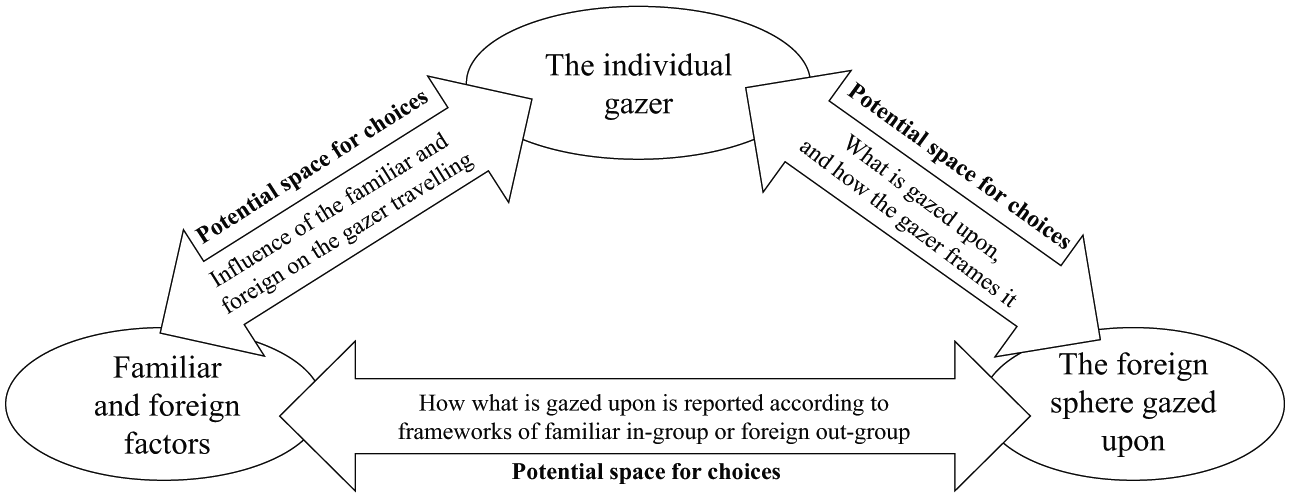
Diagrammatic representation of the liminal gaze: traveller choices created by the smartphone and the social web.
Three potential spaces
Urry’s tourist gaze (1990) looks outwards, towards the host nation, and directs how it is seen by the traveller. Magasic’s selfie gaze (2016), by contrast, looks inwards, but is still concerned with how the traveller views the host nation: it becomes a backdrop for their own performance of travel centred on their place within a destination. For both, the gaze is socially constructed. The liminal gaze takes this further, to incorporate the social influences from the familiar sphere which affect both tourist and selfie gazes, and to see them in terms of choices made in potential spaces. The first of these involves the interplay between familiar factors from home which drive choices made by the gazer of how they gaze upon the foreign sphere; the selfie gaze involves an interplay between the gazer and the foreign sphere, and the choices of how to respond to it; this in turn creates a third potential space in which the gazer’s reaction to the foreign sphere is fed back into the familiar sphere. The liminal gaze can be seen as three separate gazes or as an observation–reaction loop. This can be simplified as: how do we choose to gaze; what effect does that have on what we see; and how do we then report what we have gazed upon? These questions are explored in what follows as an agenda for future research.
1. Choices concerning the influence of familiar and foreign spheres on the gazer when travelling.
To what extent will a traveller gaze and behave according to the familiar norms of the home sphere or to novel norms from the foreign sphere, influenced by the social web? The former is certainly a powerful influence which starts before the trip (Cox et al., 2009; Kang & Schuett, 2013; Leung & Bai, 2013; Vermeulen & Seegers, 2008; Xiang & Gretzel, 2010). Travellers use the social web to learn about destinations (Di Pietro et al., 2012), traveller-generated media content that is circulated online and is used by others to plan their trip (Månsson, 2011). Other studies have suggested that familiar is favoured over foreign. Hampton, Livio and Sessions Goulet (2010) observed people using Wi-Fi Internet connection in U.S. public spaces and reported that their interaction with people immediately around them was less than it was for other people in the same space who were not accessing the Internet. Hampton, Lee, and Her (2011, p. 1036) point out that “the mobile phone is used primarily to maintain close social ties, which suggests that it does not have a direct effect on diversity.” Similarly, however, the social web affords more independence for travellers who want it. That autonomy translates into the choices implicit in the liminal gaze, which raises questions of how and when social-web-assisted travellers prefer input from a familiar in-group and when they value information from a foreign out-group.
Harwood (2015) notes that when people are in a diverse environment but have little interaction with diversity because they prefer to interact with their own in-group (such as backpackers preferring the culturally heterogeneous but still in many ways tribal company of other backpackers over that of local people), that tends to have a negative effect. Germann Molz and Paris (2015) recount one backpacker’s dismay that other backpackers prefer to keep in touch with one another online at the expense of interacting with fellow travellers who are in their dorm or on the bus with them. In a similar vein, other scholars suggest that the use of the social web on mobile communication devices can lessen the likelihood of encounters with strangers: “While generally we must be open to both intimates and strangers when we interact in daily life, the mobile phone tips the balance in favor of the intimate sphere of friends and family” (Ling, 2008, p. 159).
Given that people favour information from socially similar others (Cialdini, 2001; Deutsch & Gerard, 1955), the likelihood of being “open to strangers” is weak and the liminal gaze therefore appears to privilege the familiar in-group. Further, mobile communication creates rituals—calling home, texting, posting on Facebook, writing a blog, sharing photographs on Instagram—resulting in social solidarity which once again favours (absent) family and friends over (present) foreign inhabitants of the travel destination. According to Urry’s revisionist ideas about his tourist gaze (2002, 2007), the social web brings the familiar sphere into the foreign and vice versa, blurring the lines between the two, which “results in further inequalities that are important to understand within the context of tourism, particularly for host–guest interactions” (Hannam, Butler, & Paris, 2014, p. 178). As Ling (2008, p. 3) observes: “mobile communication seems to strengthen communication within the circle of friends and family . . . it supports better contact within the personal sphere, sometimes at the expense of interaction with those who are co-present.”
Equally, however, the social web accessed via smartphone affords “increased contextual awareness” (Dickinson et al., 2014, p. 84) and enhances travel by providing information or suggesting new avenues to explore (Wang & Fesenmaier, 2013). Travellers can access many and varied information sources during a trip, which can change their behaviour by guiding them to unplanned locations, for example (Hwang, 2011).
Nevertheless, that can also be a distraction; travellers can be drawn to stay in contact with the familiar home sphere by those who remain there, simply because they can: “constant connectivity enhances the sense of obligation for travelers to maintain a normative level of presence, attention, and intimacy with their friends and family” (Paris, Berger, Rubin, & Casson, 2015, p. 804). A further effect is that engaging with friends at home lessens the likelihood of or the need for encounters with locals in the travel destination (Hannam et al., 2006; Sutko & de Souza e Silva, 2011). N. White and White (2007, p. 95) report that when travellers messaged people at home they found it was reassuring to have them as “virtual travelling companions” on their journey.
Another effect of smartphones as travel companions is to soften the normal time- and place-related constraints and afford more spontaneous negotiation of meetings with people and places. Such liberation increases the choices encompassed in the liminal gaze, raising questions about relative influences: what is the effect of first-hand experience of a destination, compared to the influence of the familiar, on information sought and subsequent activity? The choice may be less between the influence of absent but familiar expectations and present but foreign experience and more about how much to allow familiar influences to hold sway over behaviour and what is gazed upon.
2. Choices made by the gazer about travel behaviour: what is gazed upon and how the gaze is framed.
Travellers move through a physical space. This, too, can be compromised or directed by choices made to stay connected to a familiar virtual network based in the home sphere, which requires travellers to stay “on-grid.” Particularly when travelling in developing countries, travellers have the choice to go to off-the-beaten-track locations where they cannot access the social web to share their experiences quickly, or to remain close to Internet access at the expense of having such an adventure (Germann Molz & Paris, 2015). Disconnecting appears to be particularly hard for the young; Pearce and Gretzel (2012) talked to backpackers who described it in terms of losing one of their senses. In his auto-ethnographic study, Magasic (2014) argues that the act of travel blogging challenges liminality by creating structures (such as the requirement to be online) that interfere with the practice of travel, and by obliging the blogger to write in ways that conform to audience expectations and typical travel blog discourse. Magasic (2016, p. 176) further cites studies that show that sharing is considered a vital part of a trip, which leads to specific behaviour when travelling: The tendency of our online self-presentation to maximize benefit and minimize risk . . . means that we are likely to try and appease the crowd with our online representations of travel. Thus, as our journeys are increasingly uploaded within the eyes and scrutiny of others, we will seek out elements of the landscape which we think will be approved by the imagined online audience.
Tourists’ performances, too, are done under the gaze of coparticipants and onlookers, and this surveillance is a feedback loop allowing the performer to change their performance (Magasic, 2014). But their reaction to a performance may be superseded for the tourist by feedback from the familiar world. To offer an example, a drunken holidaymaker may not gain much approval from local people, but will continue to behave in a loutish way if rewarded by positive feedback from friends admiring the antics shared on Instagram.
Similarly, the social web presupposes regular status updates, posts, photographs, and public sharing, which obliges travellers to take on certain roles and identities as they report back. In Goffman’s terms (1959), the social web can change the roles travellers perform when interacting with a destination. The liminal gaze offers potential to perform different roles, and the traveller chooses based on what predominates in their gaze and what has influenced it. A traveller’s performances may take a certain turn if their guides to a destination are not the foreign local people they meet there, but instead their friends from their home sphere contacting them on the social web: a friend sees on Facebook that a traveller is in Cape Town, for example, and recommends sights to see and places stay—and the traveller follows these suggestions.
So when a familiar audience is a constant presence in a foreign place via smartphone connectivity, it is plausible to imagine travellers altering their performances to conform to this audience. Backpackers, for example, create an identity and performance based on and fortified by peer reactions rather than the people they meet (Hofstaetter & Egger, 2008; Jayne, Gibson, Waitt, & Valentine, 2012). Edensor (2000, p. 327) calls this “role distanciation,” in which the performer critically reflects on the performance and becomes self-conscious about it as opposed to being immersed in the performance. What effect would this awareness of audience have on the traveller—do they feel compelled to perform according to their idea of the audience’s expectations? Are they less immersed in the moment and the destination? And how will this alter the way they perform, the roles they assume, and the activities they undertake? If the performance of travel is driven from afar, via the social web, will this lead to new kinds of travel performance and identity, and what form might those take?
3. Choices made to report what is gazed upon according to the framework of the familiar or the foreign.
Completing the circuit, travellers’ identities, performances, and choices feed back into the social web so that any interaction with a foreign culture becomes grist to the social web mill to be reported for consumption by a familiar home audience, guided by travellers’ ideas of the expectations of that audience (Magasic, 2016). Others have noted that travel demands certain ways of describing what is gazed upon—as well as what travellers choose to see—so that they reproduce and reinforce existing attitudes and behaviour. The social web “keep[s] tourists connected with the world at home and reproduces in virtual spaces traditional communicative practices about travel experiences” (Munar, 2013, p. 40). All that has changed are the new technological skills to share photos on Flickr or videos on YouTube.
Travellers report back—letters and postcards in earlier days, emails and travel blogs in the digital era—because it is part of enjoying travel. Reporting back reproduces social relations and helps travellers maintain relationships in the home sphere while they are away from the familiar (Munar & Jacobsen, 2013). Munar and Jacobsen also distinguish between self-centred and community-centred motivations for sharing. The former include increased respect, recognition, social ties, self-esteem, and social capital, while the latter include solidarity, a sense of belonging, helping a group achieve a goal, helping others succeed, and a sense of being valued. But whatever the motivation for sharing (Lampel & Bhalla, 2007; Yoo & Gretzel, 2008), the act of posting reports on the social web provides content for future travellers. This is the third of the liminal gaze’s potential spaces in which the traveller has the choice to report sympathetically on foreign, out-group life in the destination, for example, according to their norms; or to report it in terms that conform to frameworks set by the familiar in-group. This raises a question for future research: how does the focus on reporting experiences, valuing memories, and obtaining souvenirs reproducible for and deliverable to a familiar, domestic audience affect the way the traveller interacts with the host nation?
Conclusion
This paper proposes the liminal gaze as a framework to examine the effects of travellers’ access to the social web via smartphones on their engagement with the foreign sphere. Just as new technologies of mobile communication test existing bonds of connectivity with person and place (Dickinson et al., 2014; Wilken, 2008), the liminal gaze is a tool to interrogate the choices raised when these bonds are tested, and even severed. It offers a means to identify, on the one hand, the circumstances under which mobile communication technologies change the way people travel, choosing to limit their connection with the foreign sphere; and on the other hand, the circumstances under which the social web can direct travellers’ liminal gaze so they do connect with the foreign sphere.
Travellers with Internet-enabled smartphones juggle their gaze onto the foreign sphere and their gaze towards their in-group of family and friends in the familiar home sphere via the social web. The choices they make reveal influences, attitudes towards travel and host nations, and the relative value ascribed to familiar in-groups and foreign out-groups. In terms of hidden structures of power, the liminal gaze indicates three forms of mastery by the traveller. First, a mastery of place based on defining travel among the foreign according to the norms of the familiar. Second, a mastery of the foreign based on engagement with the foreign, in which place is internalised into behaviour following the choices made. And third, a wide-reaching mastery of travel and place based on having the power to choose which agenda to follow and which values to privilege. To do this, the framework probes the choices made in three potential spaces: between familiar and foreign factors and the gazer; between the gazer thus influenced and the foreign sphere they gaze upon; and how that is then represented by the gazer for the familiar home audience. It allows for the scrutiny of assumptions of the relative value of familiar or foreign that drive the choices in these potential spaces.
Future fieldwork might focus on answering the questions suggested by the three areas for choice outlined before. Ethnographic interviews with travellers using smartphones to access the social web would be a natural starting point, as well as looking into what their use entails and discussing how it might impact their behaviour. P. White and White (2005) conducted an ethnography of how travellers used phone, SMS, and email to stay in touch with people, which could be updated to include the social web—particularly as it relates to apps and affordances that connect the traveller with the foreign sphere. White and White’s interest was in the emotional salience of each medium; future studies could also look at the impact of social media use on traveller behaviour. Additionally, focus groups of travellers—backpackers, independent travellers, holidaymakers, or any other group—would unearth shared attitudes towards the familiar and the foreign. Netnographies of travel blogs might look at how reporting for an audience affects travel behaviour and attitudes towards both foreign places and the performance of travel itself for a social-web audience.
Further, the liminal gaze can be engaged to assess many communication choices enabled by mobile connectivity, such as “phubbing” or the vexed question of whether to pick up a phone call or check a text message when talking to someone else (Abeele, Antheunis, & Schouten, 2016). It thus extends beyond travel and tourism, and speaks to all situations of mobile connectivity which invite an individual to choose between an in-group which is corporeally absent and an out-group which is physically present. One of the earliest scholars to look at this was Gergen (2002, p. 227), who coined the term “absent presence” to describe people using mobile phones to be physically present but socially absent, “absorbed by a technologically mediated world of elsewhere.” He noted that this was not specific to the mobile phone and applied it to many forms of media; but phones are dialogic and encourage a two-way flow of information so that “the present is virtually eradicated by a dominating absence” (Gergen, 2002, p. 231). Campbell and Kwak (2011) further hypothesised that dialogic media have a stronger effect of disengaging people from those around them.
This may compromise attempts to view a place through independent eyes as the traveller’s imaginings of a foreign culture are influenced by the immediacy and ubiquity of social connectivity via the Internet. On the other hand, however, Germann Molz (2007) points out how the social web keeps hospitality alive, using CouchSurfing as an example and making the point that the reward of hosting a traveller is to experience difference. She adds, however, that it can also create a group of likeminded cosmopolitans further separating digital haves and have-nots. The effect of the traveller’s social web on the liminal gaze thus also depends on the nature of the traveller. Jansson (2002) speaks of “symbiotic” travellers who want to engage with life in the foreign sphere and not be seen as tourists, and who challenge the line between familiar and foreign and want to capture what is authentic and everyday rather than what is scenic and “nice.” While such travellers may be expected to make a greater effort to interact with local people, their liminal gaze may still be done with a view to how that interaction will play on the social web.
Whatever the effect, the social web accessed on smartphones can “give rise to new communication practices that may significantly reshape travel experiences, as they call into question the meaning of proximity, distance, presence and mobility” (Mascheroni, 2007, p. 536). Communication technologies affect and are affected by the existing predispositions in any social system so that “the information environment is shifting and potentially forming new, perhaps unrealized, biases” (Dimmick, Feaster, & Hoplamazian, 2010, p. 24). How that will play out, mediated by the traveller’s liminal gaze, offers a rich agenda for research.
Footnotes
Funding
The author(s) received no financial support for the research, authorship, and/or publication of this article.