




Abstract
In recent years, usage of text messages sent by political parties and candidates to potential voters has been on the rise. Such messages may also offer response options, which create bilateral communications with potential voters. This article examines responsiveness to political text messages during election campaigns and the factors that affect such responsiveness, using a natural experiment in which the campaign headquarters of 3 municipal candidates sent text messages to the residents of 3 municipalities. Findings indicate that response rates ranged from 4% to 18%, which approximate the response rates to marketing campaigns and other forms of text-based political participation. Age and gender did not have a significant effect on response rates, but message personalization (texts that include recipient identity) and response mode (text reply/landing page) did. These findings offer new empirical evidence of certain patterns of mobile interactions that encourage political participation.
Theoretical background
Political participation and new media
Political participation refers to individuals’ involvement in activities designed to influence government policy or to elect representatives (Verba & Nie, 1972). The range of political participation options is broad, and includes communications to elected public officials, voting in elections, donations to political parties or candidates, party activity, signing petitions, and participating in demonstrations and in violent and nonviolent protests (Andolina, Keeter, Zukin, & Jenkins, 2003; Verba, Schlozman, & Brady, 1995; Weitz-Shapiro & Winters, 2008).
Numerous studies have focused on the variables associated with political participation. A strong association has been found between political participation and socioeconomic status (Grossman, Humphreys, & Sacramone-Lutz, 2014; Schlozman, Verba, & Brady, 2010; Verba & Nie, 1972; Verba et al., 1995). Political participation is also affected by education, where more educated individuals tend toward greater political participation (D. E. Campbell, 2006; Verba et al., 1995; Walter & Rosenberger, 2007). In terms of age, participation in elections is more prevalent among individuals above age 50 (Schlozman et al., 2010), while younger individuals prefer other forms of political participation such as protest participation and signing petitions (A. Martin, 2012). In terms of gender, although voter turnout rate in most democratic countries is almost equal for men and women, in general, women show less interest and involvement in politics than do men (Coffé & Bolzendahl, 2010; Karp & Banducci, 2008; Portney, Niemi, & Eichenberg, 2009). Furthermore, men tend to participate more extensively in more “active” types of political participation such as demonstrations (Coffé & Bolzendahl, 2010, 2011; Portney et al., 2009). These trends are also prevalent in Israel (Atmor & Friedberg, 2015; Organisation for Economic Co-operation and Development [OECD], 2016).
Voting in parliamentary elections is one of the most popular forms of political participation. Still, in the past 50 years, voting turnout in parliamentary elections in most Western democracies has gradually declined (Franklin, 2004; Pintor, Gratschew, & Sullivan, 2012; Putnam, 2000). The average voting turnout in OECD countries was 68% in 2014, down 10% from 50 years ago (OECD, 2016). The decline is even stronger in municipal elections. In several Western democracies, voting turnout in local elections is lower than the voting turnout in general elections, and has gradually declined. For example, in the US, voting turnout in municipal elections in large cities is a mere 27% (Holbrook & Weinschenk, 2014).
One method to promote political participation is to develop a political campaign: a series of actions taken by a party or a candidate designed to persuade voters to vote for them. In the past two decades, political campaigns have adopted new media technologies, including the Internet and online social media (Anderson, 2015; de Zúñiga, 2015; Mossberger, Wu, & Crawford, 2013; Valenzuela, Correa, & Gil de Zúñiga, 2018). Digital media have become popular for political information and discussion; researchers also found that exposure to calls for mobilization online is positively correlated with political engagement (Vaccari, 2017; Valenzuela et al., 2018). The Internet facilitates a conversation between politicians and potential voters in times of elections, and expands the ways in which people can participate (McNeal & Bryan, 2015; Segesten & Bossetta, 2017). Contacting potential voters by email, publishing banners, and uploading clips to YouTube (McNeal & Bryan, 2015) are some of the propaganda tactics that campaign managers and candidates use regularly.
Although theoreticians heralded the Internet as a means of bridging differences in knowledge and political participation, others have argued that the political use of the Internet was and remains related mainly to socioeconomic status. Individuals with high levels of educational attainment and income who tend to be more extensively involved in political participation outside the Internet, also tend to participate in the online sphere as well (Best & Krueger, 2005; McNeal & Bryan, 2015). A source of encouraging evidence related to bridging differences, however, is age, another important factor that affects online political participation. Since new technologies are more extensively used by younger people, the Internet can encourage the younger population to engage in political participation (Schlozman et al., 2010). Online social media platforms—such as Facebook, LinkedIn, and Twitter—highlight the Internet’s ability to recruit younger populations, such as individuals in the 18–29 age group, who typically are less engaged in political participation but use social networks more extensively.
Yet, some of the social media platforms are somewhat more popular among individuals with high income and education (Greenwood, Perrin, & Duggan, 2016). Consequently, the differences in political participation evident offline and on the Internet, in general, may also exist in online social media platforms.
Penetration of mobile technology and smartphones
Alongside the adoption of the Internet and social media, distribution of short text messages (SMSs) on mobile platforms in general, and during political campaigns in particular, has also increased in the past decade. This phenomenon is facilitated by the penetration of mobile phones and in particular smartphones. In 2014 (shortly before the data collection phase of the current study), one half of the world’s population owned a mobile phone. Of 3.7 billion mobile phone subscribers, 2.6 billion use a smartphone (Global System for Mobile Communications Association [GSMA], 2015).
Mobile phones are recognized as direct, personal, and inexpensive means of marketing, and are considered to play a supremely important role in the contemporary marketing world. Marketing companies perceive text messaging as an excellent strategy for motivating consumers to take action. The opening rates of SMSs range from 95% to 99%: 90% of all text messages are opened within 3 minutes, and most are opened within 1 minute from receipt (Tatango, 2014); when the message contains an Internet link (typically a link to additional information, survey, etc.), 33% of all readers on average will click the link (Fun Mobility, 2015). A study on the responses to 26 SMS campaigns in the UK found similar rates. Approximately 89% of the respondents in the study noted that they read the texts they received on their devices, and 5% forwarded the text to their friends or family. The average call-to-action click-through rate (either visiting a website, a virtual store, or making an online purchase) is 31%, and the average text message response rate is 15% (Rettie, Grandcolas, & Deakins, 2005).
Mobile text messages have several important advantages with respect to disseminating and creating exposure to political information, compared to “traditional” online messages (conveyed by email or through social networks, for example). First is the personal character of mobile media. In contrast to traditional media and the “static” Internet as accessed through PCs, mobile phones are held and “worn” on the body, and consequently users tend to perceive them as highly personal (Pick, 2010; Verclas, 2008), which results in short response times (Dale & Strauss, 2009). Second, in most cases, mobile phones are more convenient to use than the Internet as accessed through PCs. Receiving or sending SMSs does not require that the user connect to a computer or be located in a specific place (Pick, 2010). Third, mobile phone use may diminish participatory inequality typical of the more “static” Internet access, as SMSs are easily accessible by populations with different education and income levels (Grossman et al., 2014; Suarez, 2006). Fourth, SMSs are not distributed with adjacent content, overriding the “noise” existing in other online advertisements such as sponsored content on Facebook or Twitter, or online video commercials. This allows the recipients to better focus on the message (Corasaniti, 2015). Fifth, SMSs have no social element, in contrast to responses on public pages in forums and social media platforms, which might mitigate political organizations’ fears of negative publicity. Interactions are visible solely to recipients and senders, and political organizations may prefer mobile communications over communications on social media such as Facebook for this reason (Lev-On & Rosenberg, 2017). Finally, compared to the Internet, mobile phones have diffused to a large proportion of the world population and mobile phone users are directly accessible at all times and locations (Suarez, 2006). Thus, texts allow a campaign to accurately segment its target audience and personally reach its potential voters (Pick, 2010; Suarez, 2006; Verclas, 2008).
In view of such affordances, mobile phones and smartphones have become an effective arena for political campaigning. Nonetheless, studies on the use of technologies in political campaigns have mainly focused on websites and social media (e.g., Bond et al., 2012; Jimenez, Mossberger, & Wu, 2011; Mossberger, Wu, & Jimenez, 2010; Norrander, 2015; Valenzuela et al., 2018), and little literature has been devoted to mobile platforms and their potential to motivate individuals to engage in political action. More explanation is needed of how and why people use mobile media and whether mobile media differ from other ICTs in factors that predict political participation such as socioeconomic status and efficacy in using the technology (J. A. Martin, 2014).
The few studies that explored the socioeconomic profiles of text message senders and receivers indicate that one third of mobile phone owners prefer to send text messages rather than conduct voice conversations, and this preference is significant among women (Hale, 2011; Reid & Reid, 2005), young people between the ages of 18 and 29 (Smith, 2011), and especially teenagers, for whom texting and using text apps such as Whatsapp are considered the main modes of communication, while voice conversations and emails are considered secondary modes of communication (Lenhart, Ling, Campbell, & Purcell, 2010; Ling, 2010). Although attitudes toward marketing SMSs are not affected by gender (Zabadi, Ahmad, & Elsayed, 2012), they are affected by age, as younger people have more positive opinions about marketing SMSs (Barwise & Strong, 2002; Ünal, Ercis, & Keser, 2011).
Mobile participation in political campaigns
The Internet-triggered phenomenon of electronic democracy has also expanded to mobile phones in recent years, since the penetration of smartphones intensifies information flows between citizens and governments (de Zúñiga, 2015; Evangelopoulos & Visinescu, 2012; Mossberger et al., 2013; Stieglitz & Brockmann, 2013).
Mobile media and SMSs make it easy to disseminate information and create a political dialogue between citizens and their national and local governments, during ordinary times and emergencies (S. W. Campbell & Kwak, 2011; Lev-On, 2012; Lev-On & Steinfeld, 2015; Lev-On & Uziel, 2018). Mobile media also play an important role in information provision in mass street protests as they help activists mobilize others (Neumayer & Stald, 2014). In the US, for example, citizens were requested to suggest, using SMSs and the Internet, how to generate a financial balance in the state budget. The 20 most popular responses were implemented in the 2010 budget plan (Evangelopoulos & Visinescu, 2012).
Politics is present in mobile phones during elections as well. In the US, 14% of voters in 2010 used their phones to inform others when they voted, 15% used their phones to access election-related news, and 18% sent a text message about the elections to their friends and family (Rainie & Smith, 2010). This is a growing trend: In 2014, 28% of voters used their mobile phones to access news on election-related issues. For young voters between ages 30 and 49, this figure increased to 40% (Smith, 2014).
Scholars argue that informational use of mobile media is positively associated with political participation. Individuals who use their mobile phone for informational exchange and report higher levels of comfort with mobile telephony, tend to be more politically engaged (S. W. Campbell & Kwak, 2010). Another study found that exposure to mobile election news correlates with political participation (J. A. Martin, 2015). Despite these findings, it seems that participation inequality also exists in mobile media, as mobile election news consumers tended to be better educated and wealthier women (J. A. Martin, 2015). Findings also indicate that the Internet can encourage younger populations to engage in political participation, and that racial minorities find mobile media as more effective means of consuming news in election times than other ICTs (J. A. Martin, 2015).
Studies of nonprofit organizations found that the rate of political participation in response to a call-to-action text message (to sign a petition, make a telephone call, etc.) ranged from 4% to 14% (Verclas, Amoruso, & Bosanko, 2010).
Text messages are an effective tool in GOTV (Get Out the Vote) efforts, which are tactics used on voters shortly before and on election day to encourage potential voters to vote (Green & Gerber, 2004). Studies on text-based GOTV efforts report various additional voting turnout effects: 1.81% (Bhatti, Dahlgaard, Hansen, & Hansen, 2014) or 3% (Dale & Strauss, 2009; Malhotra, Michelson, Rogers, & Valenzuela, 2011). It was also found that text messages using the recipient’s first name did not necessarily have an additional positive impact on voting (Malhotra et al., 2011).
Personalization
Personalization—making reference to details relevant to the recipients in media messages—is a tactic used in mobile campaigns. Personal appeals are designed to attract customers’ attention in the manner desired by the advertiser (Malin, 2012). The effectiveness of personalized content has been discussed in many fields, including healthcare, psychology, and marketing (Kalyanaraman & Sundar, 2006). Underlying this practice is the belief that increasing the personalized aspects of a message enhances the sense of interpersonal communication (Beniger, 1987), and recipients’ subsequent willingness to process the message (Hawkins, Kreuter, Resnicow, Fishbein, & Dijkstra, 2008).
There are three personalization strategies: identification (using the recipient’s personal details such as name, birthday, or personal photograph), customization (creating an expectation that the recipient is about to view a message that was tailored especially for her, using phrases such as “Special offer only for you”), and contextualization (framing the message according to information relevant to the recipient, such as her city or ethnicity; Hawkins et al., 2008). Note that further references to personalization in the article refer to the first type specified here (identification).
The effect of personalized appeals has been studied mainly in the context of emails, and only few studies have focused on text messages. Several studies have shown that personalization does not contribute to calls to action (Malhotra, Michelson, Rogers, & Valenzuela, 2011; Maslowska, Smit, & van den Putte, 2011) and may even trigger consumers’ resistance (White, Barnett, Debra, & Shavitt, 2008). In contrast, email marketing firms claim that the opening rates of personalized emails (18.8%) are higher than the opening rates of nonpersonalized ones (13.1%). Hence, when content personalization is added to a message, exposure rates may increase (Statista, 2016). Mobile phones may heighten these effects, as the opening rates and engagement with content are 4 times higher than opening and engagement rates of emails (Rettie et al., 2005).
The significance of studying municipal campaigns
The current study examines mobile-triggered political participation at the municipal level. Examining text-message-triggered political participation at the local level is important for several reasons. First, issues that have a direct impact on citizens’ lives, such as education and welfare, are determined at the local level. Therefore, in the context of information or calls to action, text messages may be appealing tools for conducting local conversations with and making direct appeals to residents.
Second, the number of residents targeted in municipal campaigns is much smaller than in national campaigns, and local elections are frequently determined by a small number of votes. Therefore, text messages that target and facilitate cooperation with residents can make a significant impact on election campaigns and results.
Third, the visibility of municipal campaigns is much lower compared to national campaigns, and in most cases, voting turnout is also lower. Therefore, text messages may be an effective tool for candidates to raise awareness of their campaign, and for citizens, a simple, quick means of accessing information and raising issues on the agenda during the elections. Moreover, when political marketing budgets are relatively small, and candidates are sometimes forced to use their personal funds to finance their campaigns, text messages constitute an inexpensive, rapid, and reliable tool that reaches the mobile phones of almost all residents, and exposure to these messages is in most cases independent of socioeconomic profiles (see Lev-On, 2013, 2014, 2018).
The case of Israel
The current study was conducted in Israel. Due to the extensive penetration of mobile phones in general, and specifically smartphones, in Israel, the country is a promising field for the study of text-based political campaigns and the participation that they generate. Israel is one of the leading countries in the adoption of mobile technology: 95% of the population own a mobile phone (Peretz-Silberman, 2014). A survey conducted by Google determined that Israel is in second place in the world in smartphone penetration (Mizrahi, 2013). A survey by the Smith Institute among individuals over age 18 found that 64% of the population own a smartphone (Druckman, 2014), while a study by TGI (Target Group Index) found that smartphone penetration is 72% (Wolfson, 2015). Studies also show that smartphone use is higher among the younger population (Druckman, 2014).
In line with other Western democracies (Franklin, 2004; Pintor et al., 2012; Putnam, 2000), Israel is also experiencing a decline in political participation and voting turnout rates in parliamentary elections. In 2015, voting turnout in the general elections was 72%, 4 percentage points higher than the average voting turnout in OECD countries (Atmor & Friedberg, 2015). Despite these data, the majority of Israel’s Jewish population describe themselves as being interested in politics and frequently discuss political issues with their friends (Hermann, Heller, Cohen, & Bublil, 2015). The decline in voting turnout is greater at the municipal level, reaching 51.1% in 2013.
Texting has been used in election campaigns in Israel for the last decade. In the general and municipal elections of 2013 and 2015, parties and candidates sent millions of informative text messages, and election polls used the interactive features of text messages (Crystal, 2013; Nachmias, 2015). The growing number of text messages sent during the elections and the recipients’ displeasure about it triggered a public debate (Kellner, 2014). In Israel too, opposition to political texts was an additional expression of the resistance evoked by marketing text messages (Drossos, Giaglis, Lekakos, Kokkinaki, & Stavraki, 2007; Liu, Sinkovics, Pezderka, & Haghirian, 2012; Zabadi et al., 2012).
It is difficult to estimate the scope of SMS campaigning in Israel as no comprehensive research on this topic has been conducted. Also, SMS campaigning typically takes place outside public view, in contrast to campaigns based on websites and Facebook pages, and candidates and campaign managers are not eager to share information about it.
Hypotheses
H1 (scope of participation): Message-based political participation in local elections will be within the scale of nonprofit and marketing messages (4–15%; Rettie et al., 2005; Verclas et al., 2010).
H2 (personalization): Personalized messages (using the recipient’s name) will elicit a higher response rate than nonpersonalized messages (Kalyanaraman & Sundar, 2006; Statista, 2016).
H3 (response mode): Due to the convenience and simplicity of sending a response text message versus filling out a form on an online landing page, and the fact that only 64% of individuals over age 18 own a smartphone (Druckman, 2014)—which affords them more sophisticated functionalities, such as the possibility of filling out forms on online landing pages, compared to regular mobile phones with traditional functionalities—we hypothesize that a higher percentage of recipients will reply with a text message.
H4 (gender): A gender effect in the response rate to political text messages will be found, and women will account for a greater proportion of landing page respondents than men (Hale, 2011; J. A. Martin, 2015; Reid & Reid, 2005).
H5 (age): Response rates to political text message will decrease with age (A. Martin, 2012; Schlozman et al., 2010; Smith, 2014).
Methodology
To test our hypothesis, we conducted a natural experiment. Compared to lab experiments, the generalizability of findings of natural experiments is greater and may be more reliable (Green, Calfano, & Aronow, 2014). The study of political campaigning in natural experiments has typically focused on GOTV efforts and voting turnout, and in most cases such studies are adjusted to the needs of the political campaigners whose cooperation is required (Jacobson, 2015). In contrast, the current study focuses on the dialogue between candidates and citizens during an election campaign, specifically on citizens’ political participation prompted by political text messages that offer them an option to respond. Note that a minimal form of participation emerges even as the text message is being read, while responding represents a more active level of participation.
This research was conducted in the special local elections that were held in three local authorities in Israel in 2015: Arad municipality, Eshkol regional council, and Gilboa regional council. Elections were held after the former heads of the local governments were elected to the national parliament in the national elections and thus were unable to continue to serve as head of the local government. Notably, in such special elections, no candidates have an incumbent advantage. Therefore, it is especially interesting to explore political participation in elections of this type.
A few words about the local governments in which data were collected:
Arad is a city with a population of 24,000. Mr Nissan Ben-Hamo, who ran against Mr Wald Sandlersky, participated in this study. Total voting population in these elections was 21,324 and voting turnout was 49.4%. Mr Ben-Hamo received 7,560 votes (71.74%) and was elected mayor.
The Eshkol regional council has 12,000 residents in 21 settlements, including 15 moshavim (agricultural settlements), 14 kibbutzim, and three rural/community towns. In this local council, Mr Uri Naamati ran against two candidates: Mr Gadi Yarkoni (who was elected head of the local council) and Mr Ran Goita. Total voting population was 10,280 and turnout was 45.6%. Mr Naamit received 2,098 votes (44.5%) and was not elected.
The Gilboa regional council has 28,000 residents in 31 settlements. Mr Motti Cohen, who participated in our study, ran against two candidates: Mr Ovad Nur (who was elected head of the local council) and Mr Gili Oz. Total voting population was 20,294 and turnout was 37%. Mr Motti Cohen received 3,377 votes (24.8%) and was not elected.
Study design
Data collection took place separately in each local authority. First, preliminary contact was established with all eight candidates in the three local authorities to provide an equal opportunity to all of them to participate. After several conversations and correspondence with candidates and their campaign managers, in which the aims of the study and its procedure were explained, one candidate in each local authority agreed to provide a list of mobile phone numbers of potential voters, which had been developed by his campaign. The candidates who did not agree to participate stated concerns that such a procedure would divert their campaign from its original plan, or concerns regarding negative effects due to multiple messages sent to residents during the election campaign, as reasons to avoid participation in the experiment.
Second, all candidates who agreed to participate approved the content of the text messages that were subsequently sent to the phone owners on the list. Candidates furnished the researchers with a list of mobile phone numbers and first names. Telephone numbers that were irrelevant to this study were eliminated. Access to first names later allowed an examination of the effect of personalization.
In the third stage, the lists obtained from the candidates were divided into several groups. Due to the relatively small number of participants in the Ehskol and Gilbos regional councils, we decided to divide the lists of participants in these councils into two groups only, and perform a single manipulation to examine the effects of first name personalization. The number of participants in Arad made it possible to perform a greater number of divisions and also examine response format (landing page or text response).
Overall, 9,500 text messages were sent on behalf of the three participating candidates, and 977 responses were received.
In Arad, 4,514 text messages were sent to mobile phones and received by participants. The list of participants was randomly divided into four groups and two manipulations were performed on each group. To examine the impact of type of appeal, some residents received a personalized message that included the recipient’s first name, while others received a generic message. Some residents were requested to respond to the text message via text, while others were requested to respond on a landing page only. A total of 1,167 participants received a personalized message and were requested to respond on a landing page, 1,041 received a generic message and were requested to respond on a landing page, 1,171 participants received a personalized message and were requested to respond in a text message, and 1,135 participants received a generic text message and were requested to respond by text message.
In Eshkol, 2,610 messages were sent to mobile phones and received by participants. Participants were divided randomly into two groups and a manipulation involving type of appeal was performed. Both groups were requested to respond by text message only. A total of 1,312 participants received personalized text messages and 1,298 participants received generic text messages.
In Gilboa, 2,376 messages were sent to mobile phones and received by participants. Participants were divided randomly into two groups and a manipulation involving type of appeal was performed. Both groups were requested to respond on a landing page only. A total of 1,183 participants received personalized text messages and 1,193 participants received generic text messages.
Similar text messages were sent to the participants in all three local authorities. See Figure 1 for examples of personalized message with text response option, generic message with text response option, personalized message with landing page response option, and generic message with landing page response option.

Political text messages.
In the local authorities in which participants were given the option of responding on a landing page (Gilboa regional council and Arad), respondents also had the option of entering his or her age and gender (see Figure 2). This information made it possible to examine the association between age and gender with the text message response rate, by comparing the distributions of respondents’ self-reported 1 age and gender to the distributions of age and gender in the general population of each local authority (based on 2013 figures from the Central Bureau of Statistics [CBS]). Age distributions are published by age group and appear in percentage points, and as CBS data also include the number of residents in each local authority, we calculated the average age of the voting age population (over age 18) in each local authority. However, due to the measurement methods used by the CBS at the municipal level, it was not possible to use income or education data for the current study, and therefore participants were not requested to note their income or education on the landing page (see Table 1 for number of participants by group, local authority, manipulation, and response rate to the text messages).
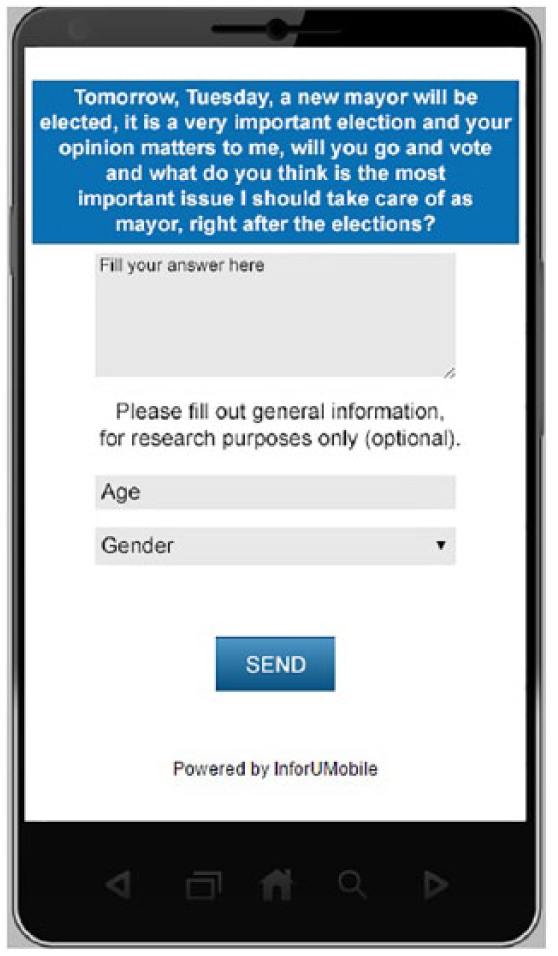
Landing page.
Respondents and manipulations, by local authority.
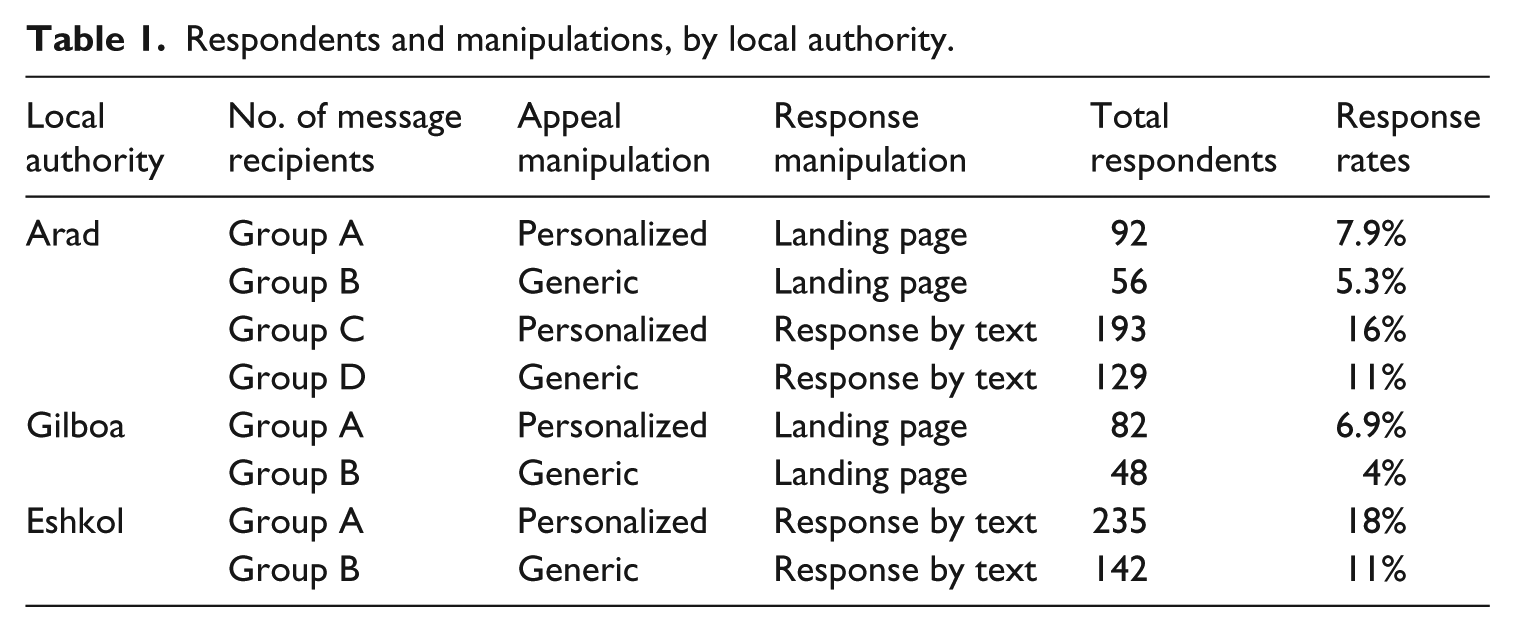
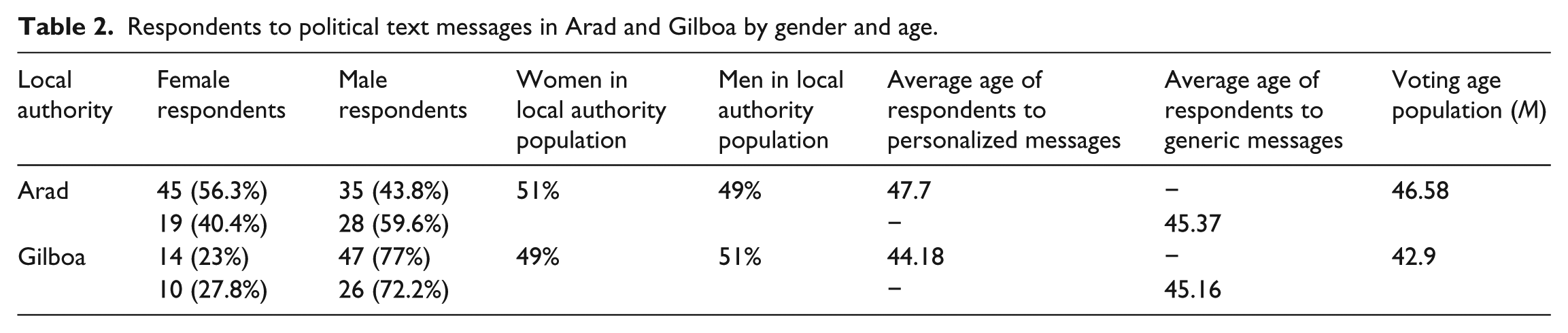
Table 2 presents the age and gender distributions self-reported by participants on the landing pages in the Arad and Gilboa local authorities, and the gender distribution and average age of the voting age population in each local authority, which were collected to examine the association between these variables and the response rate to political text messages.
Respondents to political text messages in Arad and Gilboa by gender and age.
For the purpose of this research, a large Israeli text messaging firm provided access to a text messaging and interaction system. To enable the response option, the firm also provided virtual mobile phone numbers to which incoming text responses would be directed. A specific landing page was created for each local authority (Gilboa regional council and Arad). The landing page technology made it possible to collect biographical self-reported data of respondents as well. Researchers were given access to data concerning text messaging, text responses, and landing page responses. For each message that included a link to a landing page, we examined the conversion rate from landing page viewing to response, that is, whether recipients clicked the link, completed the response form on the landing page, and sent the response. After collecting the data, R software was used for statistical analysis. According to the character of the research questions and the available data, we used chi-square tests, confidence interval proportion tests, and significance tests using MCMC (Markov chain Monte Carlo) simulations to test the study hypotheses.
Limitations of the study
Several limitations emerged in the course of the research. First, this work is a natural experiment conducted in real time in special elections and was limited to the three local authorities in which such elections were conducted. Therefore, the study did not compare these local authorities, but focused on the response rate in each local authority separately.
Second, in line with political participation studies, the current study also sought to examine the effect of biographical and sociodemographic variables on participation in political text messages. However, the study was limited to the data collected and published by the Central Bureau of Statistics. Therefore, the current study examined the associations between political participation and the biographical data published by the CBS for the entire population—gender and age. Education and income were not examined in the current study despite their significance, because CBS does not collect these data in the required granularity at the municipal level.
Third, this study required the cooperation of candidates’ campaign headquarters. Only a small portion of the candidates who were offered to cooperate did in fact do so. Therefore, this study does not purport to represent all the electoral campaigns in these elections, but only the campaigns of the candidates who agreed to participate in the study and who sent text messages as part of their campaign activities. In the three local authorities in which the study was conducted, only one participating candidate (in Arad) was elected.
Fourth, the lists of mobile phone numbers provided by the candidates did not contain all mobile phones in each local authority and therefore may have been skewed. Nonetheless, the fact that the research did not use all the mobile phone numbers in each local authority does not bias the results of the study because the aim of the experiment was to simulate actual election campaign behaviors. Therefore, the lists to which the political text messages were sent in the current study are the lists to which candidates were effectively able to send text messages during their campaigns.
Findings
Data presented in Table 1 indicate that the average response rate to political text messages was 13.5%, 14%, and 5.5% in Arad, Eshkol, and Gilboa, respectively. These findings support H1.
Strong and significant associations were found between response rate and form of appeal in all three local authorities: χ2 = 16.43, p < .01 in Arad; χ2 = 9.71, p < .01 in Gilboa; and χ2 = 25.66, p < .01 in Eshkol, supporting H2 (see Table 1). In Arad, personalized text messages triggered 1.5 times more responses than generic text messages; in Gilboa, personalized text messages triggered 1.7 times more responses that generic text messages; and in Eshkol, personalized text messages triggered 1.65 times more responses than generic text messages. These findings demonstrate that personalization of text messages has a significant impact on response rates, supporting H2.
H3 was examined only on the Arad sample. Data presented in Table 1 indicate a strong association between response mode and rate of response, χ2 = 63.82, p < .01. The hypothesis was supported and it appears that messages that contain a request to respond using a text message prompted a higher (twice as high) response rate than messages containing a request to respond on a landing page.
H4 and H5 relied on self-reported data regarding gender and age. As the lists of mobile phone owners that we obtained from candidates’ campaign headquarters did not include all the mobile telephone owners in the local authority, the distribution of men and women in these lists differed from the distribution in the general populations of the local authorities in the study based on CBS figures. Therefore, in order to examine H4, we performed a confidence interval proportion test, designed to examine whether, based on the findings in the sample, we can conclude that a significant difference exists in the response rates of men and women in the general population of each local government as well. The hypothesis was tested in the groups that were requested to respond to the text message on a landing page (Arad and Gilboa) and therefore respondents could also note their gender: Group A received a personalized text message and Group B received a generic text message. In these two local authorities, no significant differences were found in the response rates of the general population. Therefore, H4 was rejected.
For H5, as the lists of mobile phone owners that we obtained from candidates’ campaign headquarters did not include all the mobile telephone owners in each local authority, it was not clear whether the lists reflected the age distribution of the general population in each local authority. Based on CBS figures, we obtained the distribution percentages of residents in each local authority by age group, which we used to calculate the average age of the voting population in each local authority. To test H5, we performed significance tests using MCMC (Markov chain Monte Carlo) simulations. The hypothesis was tested in the groups that were requested to respond to the text message on a landing page (Gilboa and Arad), on which they could also state their age. In both local authorities, the average age of respondents to the messages was not significantly different from the average voting age. Consequently, H5 was not supported.
Discussion and conclusions
This paper examines the extent of citizens’ political participation in response to political text messages sent in an election campaign with the option to respond, and the variables that may influence it. Overall, this study emphasizes the significance of mobile media and political text messaging as phenomena of emerging importance in democratic processes. It also adds to the small literature regarding mobile media use and political participation as it focused on the effectiveness of interactive text messages during elections in encouraging political participation, as opposed to previous studies that mainly investigated the effectiveness of text messages in voter turnout (Bhatti et al., 2014; Dale & Strauss, 2009; Malhotra et al., 2011).
Findings indicate that political interactive text messages encourage mobile political participation. Response rates to political text messages ranged from 4% to 18%, which approximates the response rate to other text-message-based forms of political participation (Verclas et al., 2010). In the majority of local authorities examined, the response rate also approximated the response rate to marketing text messages (Rettie et al., 2005). This finding supports previous literature that deals with other forms of mobile political participation indicating that informational use of mobile media is positively associated with political participation (S. W. Campbell & Kwak, 2010; J. A. Martin, 2015; Neumayer & Stald, 2014).
A strong association between response rate and form of appeal emerged in all local authorities participating in the current study. Response rates to personalized political text messages were 1.5, 1.7, and 1.65 higher than response rates to generic messages in Arad, Gilboa, and Eshkol. These findings are in line with the argument that increased personalization enhances recipients’ perceived sense of interpersonal communication (Beniger, 1987), which in turn increases willingness to process the message (Hawkins et al., 2008). Our findings underscore the significance of personalized appeals in political text messages. Although promotional and political text messages have become more common in recent years, and some recipients are aware that the messages are sent through an automated service, personalization of text messages creates a sense of interpersonal connection and helps increase text-message-based political participation.
Findings also indicate that response rates to political messages are affected by the response options offered to recipients. Text messages that contained the option to respond in a text message triggered 100% more responses than messages that contained the option to respond on a landing page. This finding suggests that response rates increase when recipients can respond in a text message that does not require cellular Internet connectivity. As noted before, in Israel, at the time of data collection, the penetration of smartphones—which offer cellular Internet access and thus allow users to access links to visual content, landing pages, complete forms, etc.—ranged between 60% and 70% (Druckman, 2014). Therefore, it is reasonable to assume that a portion of the recipients of text messages containing a landing page response option were unable to respond. Another explanation for these findings is related to the fact that a response on a landing page requires more effort and actions compared to a text message response. To respond on a landing page, the user must click on the link, type his or her response, and send the data. This action is also less intuitive than sending a response text message. Future research should investigate the effect of factors such as efficacy in using mobile technology on mobile participation (J. A. Martin, 2014). As mobile media devices always offer new functionalities, it is important to understand why citizens choose to use some functionalities more than others and how it can effect mobile participation.
Gender and age were not correlated with text-message-based political participation. Compared to global patterns of political participation and the use of other forms of mobile media for political participation purposes (S. W. Campbell & Kwak, 2010; J. A. Martin, 2015), it appears that in the participating local authorities women do not show more interest or involvement in politics with respect to actions related to text messages. Furthermore, in contrast to the differences in voting turnout between younger and older adults (Schlozman et al., 2010) and the evidence found for the advantage of younger citizens in the use of other forms of mobile media for political participation (A. Martin, 2012), no association was found between age and text-message-based political participation. In general, it appears that in relation to text-message-based political participation, participatory inequality is absent, and just as all age population groups and genders use mobile phones, they also commonly use them to respond to political text messages.
This study indicates that candidates or organizations that wish to increase citizens’ engagement and create a dialogue with them should offer simple response options to text message recipients, specifically the option of responding by text. Creating an atmosphere conducive to the receipt and sending of text messages may increase political participation and transform this platform into an effective tool for involving the public both during elections and in nonelection periods.
To conclude, the current study is the first attempt, to the best of our knowledge, to examine the extent of citizens’ political participation in response to a political text message sent by an election campaign containing the option to respond. It offers new empirical evidence that certain patterns of mobile communication encourage political participation, and indicates that the unique qualities of mobile devices contribute to the formation of new pathways of political participation. The findings of this study present the smartphone as a communication channel that can contribute to braking the decline in political participation. Although this study did not examine the impact of the mobile phone on voting, it seems that, at least during campaigns, it provides opportunities for participation that can encourage more citizens to take part in the democratic process.
The findings of this study are significant and have implications for the effective use of political text messages by candidates, elected public officials, and political parties. The findings demonstrate that the mobilization potential of political text messages is of significant importance in local politics, where the issues on the agenda, such as education and welfare, directly affect voters’ lives. Therefore, the conversations and direct appeals to the target audience that political text messages embed may transform them into attractive tools for generating dialogue, raising issues to the agenda during election campaigns, giving voice to residents in relation to their local governments, and recruiting residents for specific purposes.
Future studies may examine response rates to interactive political messages during nonelection periods. Another issue that is relevant for future studies is whether interactive political text messages motivate recipients to vote. To date, mobilization studies have examined the effectiveness of sending text messages that contain a voting reminder. Future studies are required to examine the effectiveness of calls to vote in the form of text messages sent by candidates or political parties that also contain response options.
Footnotes
Acknowledgements
The authors would like to thank Prof. Sam Lehman-Wilzig and Dr. Hananel Rosenberg for their useful comments, and InforUMobile for their technological assistance and support.
Funding
The author(s) received no financial support for the research, authorship, and/or publication of this article.
