



Abstract
In this article, I discuss camera drones as mobile media that help access, collect, and shape physical, digital, and social spaces. As such, consumer drones afford “communication on the fly” in their medium-specific configuration of aerial navigation, visual production, and networked communication. Drawing on in-depth interviews with drone users and auto-ethnographic drone practices, I first highlight what physical-material conditions the flying camera mediates. An analysis of what digital-intangible formations the sensor medium collects and creates follows, before I turn to the sociospatial relations the buzzing mobile interface can establish and disrupt. I show how these conditions of communication on the fly shape user practices of place-sensing and place-making. Through the lenses of mobile communication research, media ecology, and mobilities studies, I ultimately illuminate how the ambiguous aerial system helps expand our thinking of and with notions of communication on the move.
Keywords
Introduction
I am super fascinated by the technology that I felt had this much potential impact on my life and society similar to when the first iPhone came out. It was like “Oh, this changes everything.” I feel the same way about drones. This has the potential to change a lot of the things that we do every day.
Consumer drones are here to stay, not only initiating a variety of applications in commerce and science, but also inspiring a growing number of hobbyists to fly for recreation (Bender, 2018; Choi-Fitzpatrick et al., 2016). Those hobby “pilots” playfully navigate through and above urban and rural landscapes, collecting frequently breathtaking aerial imagery. This newly gained access to the sky for leisure and creative expression is further manifested online in thousands of drone-generated still and moving images collected in and circulating across social media platforms (Bender, 2018). While the smartphone continues to reign supreme as “personal, interactive, internet-enabled and user-controlled portable platform” (Wei, 2013, p. 52), consumer drones as an increasingly popular and similarly personal, interactive, Internet-enabled, and user-controlled portable platform raise questions about how we think of and with the concept of communication on the move.
Besides taking visualization practices to the skies in novel ways, consumer drones offer communication on the fly with affordances for networked communication, connected presence, and mobile place-making. With this expression, I am alluding to both the literal sense of communication during flight and the more specialized meaning of swift computing in the communicative processes between people, technology, and space. Moreover, my use of the expression includes the informal meaning of “on the fly” as doing multiple tasks simultaneously when users engage in aerial navigation, visual production, and virtual communication at the same time across multiple layers of space.
Drawing on literature from mobile communication, media ecology, and mobilities research, I ethnographically analyze recreational drone flying and image-taking to illuminate how the aerial technology conceptually aligns with but also goes beyond more traditional mobile media such as smartphones. Instead of showing how mobile media such as smartphones are drone-like in contemporary contexts of always-on monitoring, sensor-based data capture, and mediated locational tracking (Andrejevic, 2015), I discuss the extent to which consumer drones are mobile-media-like in creative hobby practices.
This approach has multiple benefits: First, scholarly attention to the personal drone as medium advances the current discourse on mobile media by expanding key definitions to account for emerging mobile interfaces. This widening of the field beyond mobile phones is imperative in light of the growing mobile autonomy or “motility” of communication platforms such as drones (McCosker, 2015). Equipped with sophisticated capacities for “self-sustaining vertical and lateral movement” (McCosker, 2015, p. 3) and for automatically sensing and avoiding obstacles among other functions, consumer drones epitomize early stages of mobile autonomy in both their remote operation and their independent flight maneuvers and adjustments. Secondly, approaching camera drones as mobile media also broadens their current official conceptualization as “small unmanned aircraft systems” (Custers, 2016; Federal Aviation Administration [FAA], n.d.). This language obscures the role and impact of the communicative affordances of consumer drones as aerial visualization tool, social media interface, and augmented reality platform, which are key factors in the popularity of personal drone use. A better understanding of how hobby pilots use the aerial device for technical mastery, creative expression, and spatial exploration can positively shape regulatory decision-making and currently ambiguous public perceptions of the practice. Finally, I seek to clearly situate the aerial camera and its adoption by hobby pilots in mobile communication research to extend the limited scholarly literature discussing personal drone uses in everyday spaces (Bartsch, Coyne, & Gray, 2016; Bender, 2018; Jablonowski, 2015, 2017; Klauser & Pedrozo, 2015; Rothstein, 2015). In the recreational domain—with roughly 878,000 registered drone hobbyists estimated to hold over 1.5 million camera drones in U.S. households (U.S. Department of Transportation, 2018; Chavers, 2018)—usage continues to increase with the potential to reconfigure such everyday spaces and practices.
Methodologically, this analysis is informed by participant observations in the Philadelphia area and in-depth interviews with 25 U.S. consumer drone pilots. Those findings are complemented with auto-ethnographic reflections on personal drone piloting and aerial image-taking. Learning to operate a drone myself enabled me to fill “a first-person experience gap” (Luvaas, 2016, p. 98) and self-reflexively attend to mobile practices and networked processes that make up communication on the fly. In the following, I examine the interview data and ethnographic findings for how personal drones align with mobile and “locative media” (Frith, 2015), and how hobby drone practices can be understood as communication on the move. The analysis draws on notions of mobile media providing spatial knowledge and experience (Özkul, 2014), of carving out “social spaces out of physical spaces” (Jensen, 2013, p. 26), of managing public space as mobile interface (de Souza e Silva & Frith, 2012; Katz, 2007; Sheller, 2014), of articulating and disrupting shared spaces (Campbell, 2013), as well as producing place via “performative cartography” (Verhoeff, 2012) and “emplaced visuality” (Hjorth & Pink, 2014). Drones confirm such logics as mobile media but also complicate them in their spatial extension into the air. In the following, I will discuss how camera drone flying and image-taking mediate physical-material conditions, digital-intangible formations, and sociospatial relations in processes I approach as communication on the fly. Ultimately, I adopt Sheller’s mobile mediality (2014) framework to explore how the consumer drone assemblage enhances our perception of hybrid spaces, infrastructures, and networks (Hildebrand, 2017). As avenues for future research, I conclude with key questions about the powers and potentials of camera drones as and beyond mobile media.
Mobile media and space: Theoretical considerations
Before demonstrating how and why personal drones both align with but also expand contemporary notions of mobile media, I briefly outline the theoretical lenses that shape my explorations of everyday drone adoption. Critical frameworks from media ecology, mobilities research, and mobile communication allow for a worthwhile conceptual combination in the example of camera drones, which configure mediation, movement, and space in unique ways. Central to media ecology is the study of media—that is, any human-made artifacts—as environments and the study of environments as media. Inspired by the work of Mumford (2010), Innis (1999), and McLuhan (1964) among others, media ecologists explore what biases and effects are discernable in media (Strate, 2017). Those formal biases or affordances (Gibson, 1977) can inform how people engage with, relate to, and behave around the technology. Here, the intellectual tradition, which emphasizes the immersive, often invisible, environmental nature of media, shares relevant common ground with mobilities research (Hildebrand, 2018) focusing on,
the spatial mobility of humans, nonhumans, and objects; the circulation of information, images and capital; as well as the study of the physical means for movements such as infrastructures, vehicles and software systems that enable travel and communication to take place. (Sheller, 2011, p. 1)
Mobilities researchers recognize the close relations between forms and processes of communication and mobility, and point to the increasing hybridization of physical and informational mobility systems across space. This development is again of crucial interest in mobile communication studies, which focus on changing social and spatial practices (Goggin & Hjorth, 2009; Ling & Campbell, 2009) in relation to technology uses “that alter how people relate to space in ways that connect to both people and places while on the go” (Campbell, 2013, p. 11). Smartphones, in particular, serve as a paradigmatic example of the shifts in our management of and relation to communication, mobility, and space. However, “they exist alongside an array of other mobile technologies, from wearables to smart watches, from tablets to RDIF cards” (Farman, 2016, p. xi) that shape and support such developments in mobile communication. Bridging the frameworks media ecology, mobilities research, and mobile communication, my use of the term “mobile media” broadly includes both analog and digital technologies that shape the way we relate to space on the move (Farman, 2011). According to Farman, mobile media “are becoming interfaces” that help us “connect with each other, with objects, and with data across material and digital landscapes” and thus transform “the ways we conceive of embodied space” (2011, p. 15). As I will discuss, personal drones can be understood as such mobile interfaces to public spaces that can connect us with each other across hybrid spaces and shape the ways we conceive them. Moreover, while consumer drones follow in the footsteps of a host of aerial media such as camera-equipped balloons, helicopters, and airplanes as well as remotely controlled (RC) model airplanes, they also differ in the degree and extent that they afford nonspecialist users recreational and artistic flying, image-taking, and online video-streaming across such digital and material infrastructures and networks. As such, the genealogy of this aerial media ecosystem can itself be understood as “on the move” towards increased physical and virtual access into vertical spaces by a growing number of user groups (from established institutions and corporations to communities and individuals) on the ground.
Those sociospatial potentials and uses of camera drones are starting to receive increasing scholarly attention regarding their methodological purchase (Birtchnell & Gibson, 2015; Fish & Garrett, 2016), their sociopolitical implications (Birtchnell & Gibson, 2015; Klauser & Pedrozo, 2015), their visual potentials (Jablonowski, 2017), their unruly motility (McCosker, 2015), and evolving cooperative practices (Bender, 2018). Similar to other mobile communication technologies (Goggin & Hjorth, 2009; Ling & Campbell, 2009), drones generate novel social and spatial practices in public and private spaces, blurring those boundaries further (Sheller & Urry, 2003). In my theorization of communication on the fly, I discuss how camera drones show characteristics of locative mobile media, albeit pushing the conceptual boundaries regarding drone users’ collection and production of locational information in everyday life.
Drone spatiality and communication on the fly
If camera drones are mobile media, then what exactly do they mediate, communicate, and mobilize in recreational contexts? In their combination of visual and mobile affordances, consumer drones provide special ways of relating to space. The aerial camera enhances ways of accessing, collecting, and carving out physical-material spaces. Moreover, as a networked interface (Andrejevic, 2015; Bender, 2018), consumer drones allow for accessing, collecting, and creating digital-intangible spaces. In the sharing of visual space online and offline (sometimes simultaneously), the unmanned aircraft system also opens up social spaces. Nevertheless, similar to other mobile media, consumer drones can equally disrupt those physical, digital, and social spaces as I will show.
Consumer drones serve as mobile locative media but also stretch the definition of the concept. Parallels exist in how drones rely “on spatial dispersion in order to pin sensor data to time–space location” (Andrejevic, 2015, p. 196). Visual and telemetric place-specific information guides remote pilots as they navigate through horizontal and vertical space (Bender, 2018). Similar to how users of locative media “are able to log and share their locations with others as they move about from place to place” (Campbell, 2013, p. 11), drone users can livestream their aerial explorations to social media platforms, even providing real-time commentary on the ground, as I will detail later. While it is not the physical location of the user on the ground that is being visually shared with a social network, it is the drone’s perspective from the air and merely the visual mobilities of the user that are made available to online audiences.
In uniquely distributing user and technology within space, the drone presents a diverging kind of location-aware medium. In drone practices, users become aware of geographical spaces beyond their typical visual and physical reach. The flying camera, moreover, makes users aware of their own locational positioning in the top-down aerial gaze directed back at the remote pilots (Jablonowski, 2017). When linked to social media, the drone’s communicative potentials can also make aware any audiences of these distributed and differential positionalities of the highly mobile drone and comparatively immobile pilot on the ground. Here, the drone also complicates notions of “mobile” as a remotely controlled device that is portable, mobile, and motile, that is, capable of moving independently from a user’s corporeal mobility (McCosker, 2015). Beyond the users’ thumb operations on the remote control, their and the drone’s physical mobility are separate. Nonetheless, the drone system can visually and virtually mobilize users by extending into physical-material and digital-intangible spaces. As a special kind of mobile and locative medium, then, drones provide dynamic locational information and a medium-specific sense of place.
Similarly, personal drones can be understood as aerial interfaces to public spaces. De Souza e Silva and Frith describe mobile interfaces to public spaces as systems that “enable people to filter, control, and manage their relationships with the spaces and people around them” (2012, p. 6). As I will show in the following, the unmanned aircraft system allows users to inscribe space with personal meaning creating personalized aerial spaces and senses of place. As mobile and locative media, the technology not only helps filter, control, and manage relationships with spaces and people but also allows users to enhance and remake existing relationships while accessing, creating, and sharing novel spatial ways of relating on the fly.
Mediating physical-material conditions
Contemporary consumer drone models excel in the combination of aerial navigation and image-taking. Thus, the drone medium enables users to access, collect, and carve out physical-material spaces in ways that exceed those of other visual mobile media by extending into the sky. Drone pilots tap into those potentials using the visual reach into the air for various purposes. Mike, a drone pilot in his 30s, for example, employed his drone to increase his familiarity with a holiday location and drew from the visual, aerial, and mobile resources when planning his morning running route.
I would fly up and then BOOM. I could see exactly how big the island is, I could see where we were on the island in relationship to all this other stuff. And then the next morning, I want to go on a hike, and I’m sitting there with the drone in the sky, and I’m like “Ok there’s the hiking path, it goes over to this archipelago and here I can go down this spot here and hook up with this trail over here. Ok, let me bring this around a little bit to see the other side of the mountain. Ok good, yeah, that trail connects along the backside, I can go down over here and loop back around.” So, I mapped out my whole running path the next morning just because I sent my drone up and I was kind of like circling around the island a little bit.
The aerial vantage point gave Mike a literal overview of the location. Here, the camera drone joins other mobile and locative media “as a means of exercising control over one’s local environment” (Katz, 2007, p. 392). Since Mike uses the drone to gather information for the conquest of space, the practice alludes to a growing culture of surveillance understood as data collection and processing. However, instead of associating this routine with a hawkish intelligence-gathering exercise contributing to the increasing militarization of society, Mike’s drone use is closer to a visual and mobile extension and enhancement that centers on the self and its engagement with space as opposed to exercising control over others.
In addition, Mike’s narrative illustrates the kind of multidirectional “performative cartography” that the temporal collapse of image production and image reception affords (Verhoeff, 2012; see also Bender, 2018). As the smartphone frequently serves as the drone system’s remote control and app interface, similarities to the navigational practices with smartphones more generally are evident (Bender, 2018). In fact, when Mike elaborates on his mapping approach, he compares this visual and spatial navigation by drone as reminiscent of using Google Maps with his phone.
You can see from 500 feet up. It’s like the first time you used Google Maps on your phone, and you’re like “oh I know how to navigate Google Maps.” I remember the first time I used Google Maps. You don’t need to tell me to turn left on this street and turn right here. I just have this phone that is guiding me along the way. It was that revelatory type of totally transformative experience where I . . . the closest thing I can say is that I kind of have a superpower. It was like when I first had my smartphone and everyone else had their flip phones and yeah, I’m like “I have smartphone superpowers. So, I got this.” You really do feel like “I’m a little more capable than the average person because I have this thing.” Same thing with the drone. I can learn things, I can see things, I can do more recon. I can get to places.
As a technological superpower, the aerial self-extension enhances Mike’s sense of place and potential for inscribing personal meaning into the location. Despite the militaristic lingo (“recon”), Mike’s sense of empowerment is akin to “the self-referential feeling of power” that Jablonowski’s (2015) hobby drone research discusses; a sensation not to be confused with the “unearthly powers” of military drones (Jablonowski, 2015, p. 12). Comparing his drone superpowers with “smartphone superpowers,” Mike points to the ways the aerial medium allows him to connect with spaces, people, and information, making him feel “a little more capable.” This virtual extension of his capabilities lies closer to a sense of emancipation than militaristic fetish. In the same spirit, Diego, a drone pilot in his late 20s, tells me about an experience of spatial self-empowerment, when he heard fireworks from his backyard:
So I was sitting in my backyard, talking to my roommate, and all of the sudden I hear fireworks. And I’m like “Oh, that’s cool, there is fireworks. I’d love to see them, but by the time I get there. . .” and then I went “wait a second.” I took out the drone and put it maybe three, four floors above my house. And there you go. That was the right spot to see the fireworks. And I was like “wow this is pretty cool, I am in my backyard, I have the drone up, and I am seeing the fireworks from my backyard with my screen.”
The drone view allowed Diego to remotely yet quickly witness the fireworks from his backyard. Similarly to Mike, who can remotely “learn things” and virtually “see things” with his drone, Diego was able to get virtual access to the fireworks via the drone’s combination of aerial mobility and real-time visual streaming.
By providing immediate visual impressions of the space and affording pilots the sensation to “get to places” on the spot, consumer drone affordances exceed those of Google Maps and other related location-based tools and services. Annie, a hobby pilot in her 60s, explains: “When you’re looking on the [drone] app, you can actually see where it’s flying, and it’s like you’re actually traveling to that place, and I can take pictures.” Instead of the drone bringing the location to her, she understands the aerial practice as taking her to that place. Furthermore, Annie concludes that the spatial drone practice “makes me more observant of my world.” Just like other modes of mobile communication “have distinctive implications for how users relate to space” (Campbell, 2013, p. 10), the visual and mobile affordances of camera drones affect how users observe, understand, and manage their “world.” Mike even speaks of seeing the world differently now that he flies drones:
This is like a whole other different type of experience that opens itself up to me. I go to different places, I look at things differently. I’m into different things because I have a tool that allows me to capture images in this way.
This quote exemplifies the impact of drone ecologies as mediated environments that affect human perception, understanding, feelings, and values (Postman, 1970). For Annie and Mike, along with many others, the physical-material world becomes visible and accessible in novel ways, thus shaping their views and practices. This kind of “performative cartography” then does not initially centralize Verhoeff’s “three principles of locative media practices” which encompass “tagging, plotting and stitching” (2012, p. 133). With Mike, Diego, and Annie reaching out into three-dimensional space in real time, this recreational media practice begins with spanning, traversing, and observing. The drone allows the pilots to visually span, aerially traverse, and remotely observe familiar and unfamiliar territory. To what extent the renewed attention—whether accurate or speculative—to everyday spaces as suggested by Annie and Mike is an enrichment to ways of thinking, observing, and being in the world, remains open for discussion.
From my own year-long practical engagement with a DJI Mavic Pro Platinum consumer drone, I can confirm this superpower quality of having access to vertical space as well as the enhancement of my aerial sensibilities, which further my own location awareness. Like Mike, I too have learned to understand places and my own mobilities within them differently once the drone extended my eyesight into the air. Like Diego, I remotely witnessed 4th of July fireworks that were a few hundred feet away from my doorsteps. As my neighbors watched the spectacle live on television, I felt a different sense of “liveness,” visual control over, and active engagement with the event space from afar. Finally, similar to Annie, my drone’s mediation of space in the aerial navigation and image-taking processes have made me adopt a drone camera lens onto the locations I pass through on a daily basis. Attuned to my geographic environment, I more readily notice locations that would make for interesting aerial shots and maneuvers and speculate what other perspectives would open up to me by drone. In addition, I have become attentive to local air space restrictions, weather and wind conditions, and aerial traffic when visiting unfamiliar or revisiting familiar places (even without the drone). This recent mental orientation is induced by both the drone’s mediation of physical-material but also digital-intangible spaces, as I will explain now.
Mediating digital-intangible formations
Along with providing almost instantaneous visual access to aerial spaces, consumer drones tap into and open up digital-intangible spaces. In the intermedial crossover of vertical mobility, image production, and sensor capacities, the consumer drone supplies both visual and digital information about the surrounding geographies and infrastructures relevant for safe and reliable drone use. These data are displayed onto the smartphone screen as interface between drone, remote controller, and drone app. Depending on the drone model and app, the aerial imagery on the screen is overlaid with a range of telemetry: height and distance of the aircraft; the number of connected satellites; the status of the batteries for the aircraft; a two-dimensional map of the area along with an indication of where the drone is facing and the launching coordinates as “home” location; the settings of the drone camera; the settings of any automated flight features; and the occasional warnings about wind speeds, signal interference, local air space restrictions, and so on (see Figure 1). This wealth of drone-related micro and macro data can be accompanied by smartphone-specific information about new text messages, incoming phone calls, or online push notifications if the smartphone is not appropriately set to “airplane” mode.
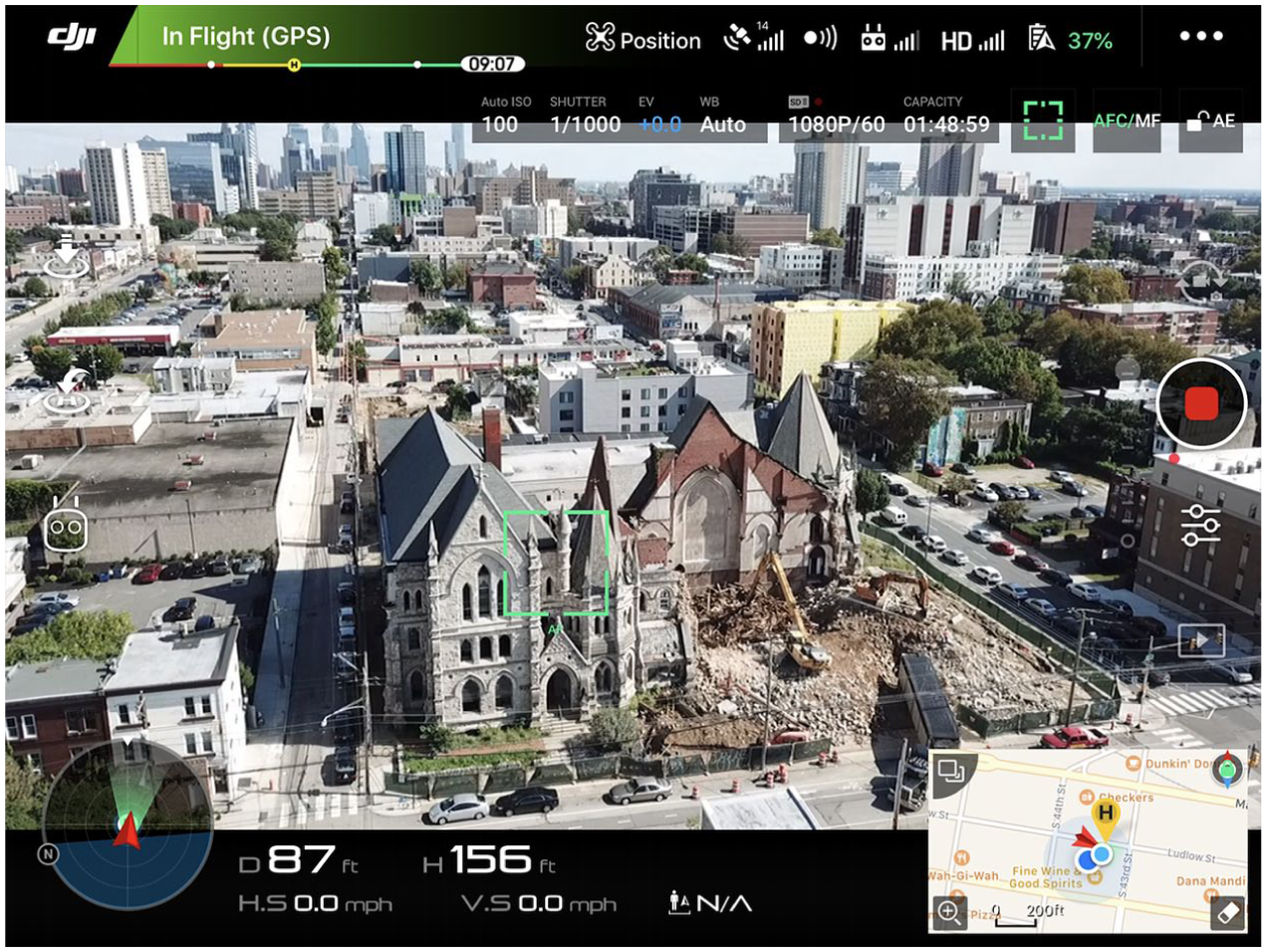
DJI Mavic Pro app interface with image live-stream and telemetric information on flight distance and height, camera settings, flight mode and connectivity, etc.
The combination of aerial-visual and informational-digital space displayed on the interface speaks to a range of concepts related to mobile communication, such as “hybrid space” (de Lange, 2009), “networked place” (Varnelis & Friedberg, 2006), “augmented space” (de Lange, 2009, p. 59), and “remediated space” (Bolter & Grusin, 1999). Drone-mediated space is hybrid space, a framework that refers to the diminishing “distinction between the physical and the digital through the mix of social practices that occur simultaneously in digital and in physical spaces” (de Souza e Silva, 2006, p. 265; see also de Lange, 2009, p. 60). The drone interface illuminates and relates visual, locational, digital, and infrastructural information that may otherwise be invisible: the connections to satellites, wind conditions, local regulations, interfering signals, and so on. As such, the camera drone also provides access to “networked place” meaning,
[T]he everyday superimposition of real and virtual spaces, the development of a mobile sense of place, the emergence of popular virtual worlds, the rise of the network as a socio-spatial model, and the growing use of mapping and tracking technologies. (Varnelis & Friedberg, 2006, para. 2)
With this superimposition of real and virtual formations along with the near-instantaneous mapping and tracking functions, the aerial system can enhance “mobile senses of place.” As such, consumer drones are “sensor media” in more than one way: They illuminate otherwise invisible networked sensor activities and engender personal mobile sensibilities toward the respective physical location.
In how the app presents the additional digital layer of information on top of the drone-generated visuals, the remote aircraft system also produces “augmented spaces” as the physical environment “layered with informational augmentation of spaces and infrastructures” (Sheller, 2013, p. 310; see also Bender, 2018). Ultimately, the combination of the aerial live-stream, digital sensor data, and virtual connections speaks to Bolter and Grusin’s (1999) framework of “remediated space”: The drone combines the logics of transparency and multiplicity in the overlay of physical-material conditions and digital-intangible formations. In this simultaneous collection, arrangement, and mediation of digital information, aerial visuality, and multidirectional mobilities, camera drones afford communication on the fly. The busy communicative processes occur in different forms between space and drone system, drone system and user, user and space (Hildebrand, 2017). Here, the user’s space can signify both offline and online environments and their respective infrastructures.
Moreover, drone users not only provide access to those hybrid, networked, and remediated spaces, but they also produce them. On one side, hobby remote pilots create a visual record of their flight sessions when taking aerial photos and videos. On the other, drone apps such as the one provided by consumer drone market leader DJI, create an animated record of the flight path, drone maneuvers, camera operations, and warning messages (Figure 2). This drone flight animation traces the mobile and visual practices on a two-dimensional map. The flight is thus carved onto digital-intangible space, allowing pilots to revisit where the drone travelled vertically and horizontally along with where images were taken in comparison to their own position and other geographical conditions.
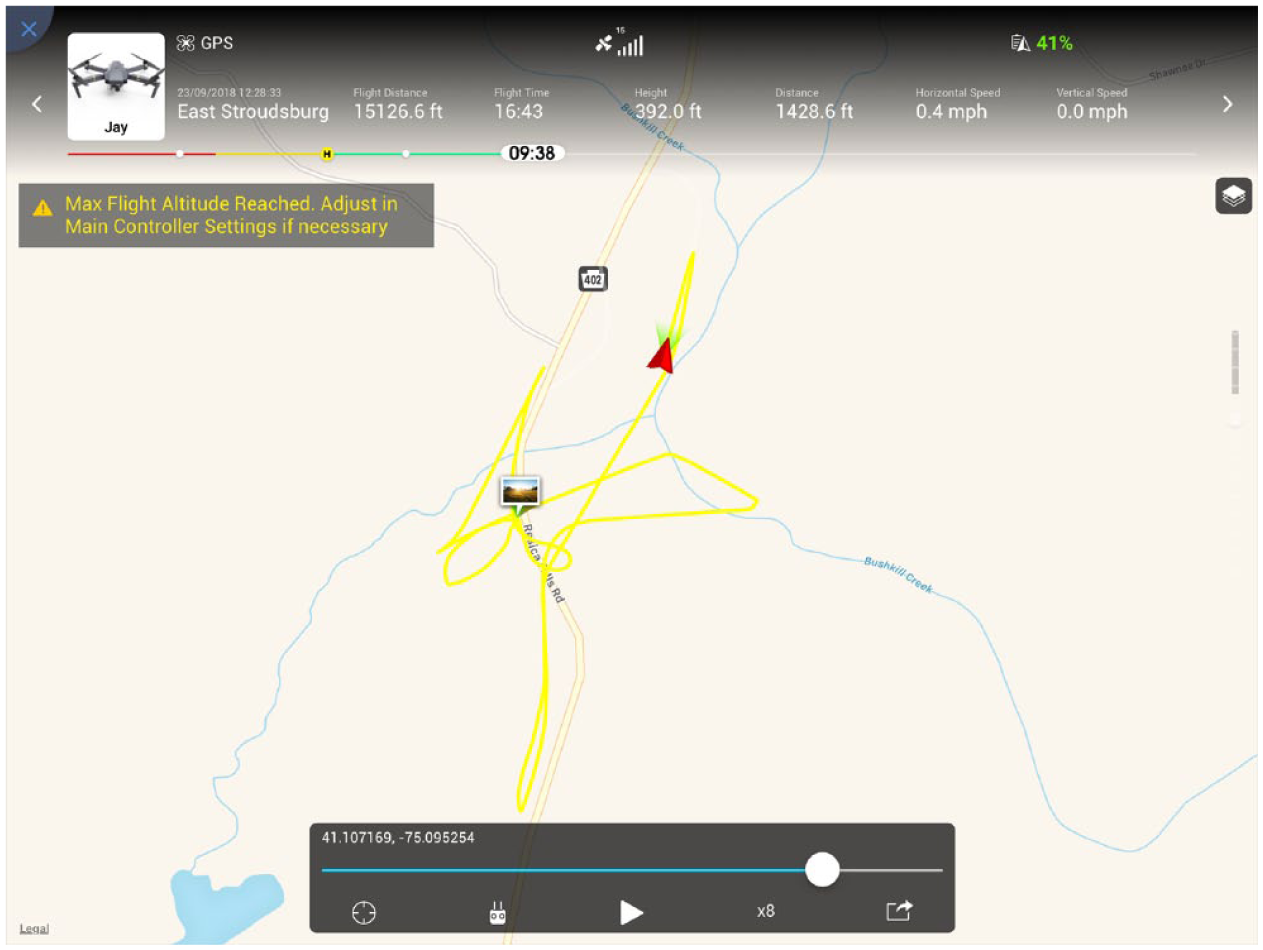
Example of a DJI flight record showing the aerial maneuvers of the drone on a two-dimensional map.
Those automated flight records are reminiscent of creative practices that engender “emplaced visuality”: “That is, a visuality that is part of place and makes place, and in this case traverses and connects the material-physical with the digital-intangible” (Hjorth & Pink, 2014, p. 46). The automatic post-hoc flight animation particularly speaks to this concept of temporal, spatial, emotional, and geographic emplacement which situates “movement at the centre of our understanding of contemporary media practice” (Hjorth & Pink, 2014, p. 44; see also Hjorth, 2016). As mobile medium, the camera drone both substantiates but also complicates this theory of movement. It is emplacing but also displacing the user in its operation at varying distances. As a result, the flying camera distributes mobile and communicative features of locative media, such as mobile phone photography and geo-tagging, across different temporalities, spatialities, and subjectivities.
Mediating sociospatial relations
Next to mediating physical-material and digital-intangible spaces, consumer drones also shape social spaces in distinct ways. The flying camera can create social environments in the physically copresent activities of drone flying and image-taking (embraced and encouraged by drone communities), in the subsequent sharing of aerial imagery offline and online, and the virtually copresent practices of live-streaming the drone imagery onto social media platforms (Hildebrand, 2017). However, consumer drones equal other mobile devices that “introduced new seams to the social fabric in the forms of disturbances, disruptions, and distractions for users and co-present others in shared space” (Campbell, 2013, pp. 10–11). As can be taken from the polarizing discourse surrounding consumer drones as “unruly aerial objects” (McCosker, 2015, p. 3), their presence disrupts social spaces in light of their noise, their appearance, and the implications for locational privacy and physical safety.
With respect to the mediation of social space, the live-streaming of drone-generated videos onto social media platforms such as Facebook or YouTube make for an interesting case of mobile communication. When users live-stream their visuals onto a selected platform, they can see the number of people watching along with any comments they may leave. Moreover, the videos can be juxtaposed with the audio the smartphone microphone picks up on the ground. Hence, users have the opportunity to not only see who is watching the live feed and what feedback they receive in the comments section, but they can also narrate the images and verbally respond to the social media comments. Diego has developed a habit of narrating his flight sessions to his virtual audiences:
Now when I do my livestream video . . . pretty much I just talk about what I am doing. So the last time I did livestreaming was on a sunrise. So, I was like “Good morning guys, let’s see what’s going on over here by the water,” etc. Almost like a blog you know? . . . The app gives you the option to turn it [the microphone] off. But to be honest with you, once I found out, I never turned it off. I just use it. I use it for my benefit. And whenever I go live, I just talk with the microphone and I explain what I am doing. And the return is unbelievable. People love it. And it is something that is so new that people are like “Oh my God.” But you know, I also have friends that are pilots, then it’s all constructive comments. You’re not gonna get the one that hates and is like “Oh no you shouldn’t be doing this,” etc.
Occasionally, the audio record from the ground will include Diego responding to his audience’s reactions, emphasizing the communicative character of the mobile medium. Moreover, this example speaks to “an essential idea behind locative social media” enabling users to share their whereabouts with a network and thus “communicating something about [their] identity and the fabric of [their] everyday life” (Farman, 2011, p. 14). Camera drones operate as such mobile interfaces that, according to Farman, have “the fundamental attributes necessary for social engagement across mobile networks” (Farman, 2011, p. 14). As remote aerial media, socially networked drones allow for distinct embodied productions of social spaces distributed across hybrid geographies.
Diego’s comment also points to the disruptive character of drones in the crossing of flight, camera, and communication. While this young pilot is alluding to potential negative or critical reactions to drone flying on social media, numerous interviewees point to negative encounters they have face-to-face while operating the drone. Next to the stigmatization of drones as “Peeping Tom” technology, drone opponents point to the noisy nuisance drones present in public. Interestingly, this quality is what pilots point out when rebuking accusations of privacy violations. In his rebuttal of drones as spying technology, Elliott, a professional drone pilot in his 30s, elaborates on how detectable the flying camera is not only visually but also acoustically:
When it comes to the privacy concern . . . spying and Peeping Tom, that argument is absolute nonsense. Have you heard a drone? You know what a drone sounds like? . . . You cannot be inconspicuous with a drone. It’s loud, it’s noisy. And it is obvious to look at. No one is using a drone to be a Peeping Tom. It’s not happening. It’s just not.
According to Elliott, consumer drones make for an unlikely amateur spying tool because they are acoustically and visually detectable as well as temporally limited by battery life. While he dismisses claims of drones serving as everyday spying tools, he indirectly confirms their otherwise disruptive noise and optics. Here are alignments with military drones such as the Predator or Reaper who can similarly signify their threatening presence via their buzzing sounds (Graham, 2016). However, Elliott’s observation implies that everyday sociospatial structures are subject to different cultural codes than the extremely uneven power hierarchies in remote warfare. Hence, while the affiliations of personal drones with warfare and surveillance are undeniable, the sociospatial adoption of camera drones for recreation as analyzed here seems to withhold an automatic militarization of culture and society. That said, cases of drone spying have been reported (Bilton, 2016), falling in line with other pernicious practices with visual technologies such as binoculars, telescopes, or selfie sticks.
In light of the potential intrusiveness of the aerial gaze along with its noisy mobility, several users report adjusting their drone practices so as to not disturb others. Laura, a hobby pilot in her 60s, describes it as the “golden rule” of droning: “Drone unto others as you would want them to drone unto you” (Hildebrand, 2017, p. 212). She elaborates further that,
I’m a real early in the morning flier because I don’t like to bother people and I like the light in the morning, but I really—I don’t wanna be the one that makes it difficult for others to fly. I try to fly when people aren’t around.
In my own autoethnographic engagement with drones, I can relate to this sociospatial sensibility. Highly aware of how audible my practice is, I prefer locations that have only a few or no bystanders and inhabited buildings nearby. Moreover, I notice turning the drone camera away from people that have entered the camera’s visual frame when I don’t have their explicit permission to record them. Flying on a beach right after sunrise on one occasion, I learned how disruptive the mere aerial presence of my drone might have been. The waves drowned out the propeller’s buzzing sound and my drone camera was facing toward the ocean. After I spent 10 minutes spanning, traversing, and observing the wide-open space above the sea within the permitted parameters of the Federal Aviation Administration, a police car parked behind me. The officer watched my activities from a distance without ever stepping outside of the car. After a few more minutes, my battery was drained, and I landed the drone. The police car left the lot. It remains unclear to me what triggered the police presence and what halted a potential interaction. The incident made apparent, however, that the drone enhances not only my reach into aerial space but also made me and my drone play highly visible on the ground. As I remotely explore drone-mediated spaces and create emplaced visualities, my own geographic emplacement is visually and acoustically enhanced to myself and potentially others.
In the mediation of physical-material, digital-intangible, and sociospatial relations within personal drone use, Sheller’s framework of “mobile mediality” as a “new form of flexible and mediated spatiality” applies (Sheller, 2014, p. 201; see also Hjorth, 2016). Referring to mobile art more generally, Sheller notes that such creative practice,
[I]nvolves phenomenological experiments with experiential happenings and performative interactional events that intensify and focus attention on the current spaces of mobile mediality in ways that potentially destabilize the everyday and deepen our perception of the conditions of the premediated real. (2014, p. 201)
In the interplay of aerial navigation, visual production, and digital communication, the drone medium furnishes such mobile mediality. The drone triggers experiential happenings and performative interactional events between user, technology, and space. As hobbyists confirm, tapping into this flexible and mediated spatiality ultimately prompts a tuning into everyday horizontal and vertical environments that can even impact behavior. Hence, camera drone use parallels mobile art practices that, according to Sheller, extend “beyond relational aesthetics and beyond mobile gaming, effectively by re-spatializing and re-mediating our experience of embodied mobility and communication” (2014, p. 203). Consumer drones then present a multimobile interface to differential spatialities that has potential for shaping the way we relate to space, movement, ourselves, and each other.
Conclusion
Consumer drones present an opportunity for expanding conceptions of mobile media along with how we can think of and with notions of communication on the move. In this article, I argued for the value of approaching camera drones as mobile and locative media by discussing some of their unique spatial affordances. With attention to the multidimensional spaces drones operate in and depend on, I discussed how users access and manage physical-material conditions; how they access and create digital-intangible formations; and how they shape and disrupt sociospatial relations. The visual and informational data available via the drone interface bring attention to relevant hybrid, networked, augmented, and remediated spaces. Yet, the sensor medium also extends those concepts in the ambiguous arrangement of user and system in the vertical and horizontal, the geographic and geometric, the remote and proximate. In addition, the aerial camera can create and disturb social spaces. While the drone-generated imagery can bring together physical and virtual bystanders alike, drone presence can also be disruptive. The potentially nosy camera and certainly noisy aircraft count as key factors for why the drone hobby encounters criticism. At the same time, drone uses are similar to other mobile art practices in how both involve “mobile mediality” (Sheller, 2014), and ultimately produce different attention to and awareness of personal emplacements.
As such, creative drone practices align with mobile communication practices in how they form physical-material, digital-intangible, and sociospatial relations. Drones are multimobile interfaces that afford performative cartography, emplaced visuality, and mobile mediality. However, camera drones also go beyond such communication in motion by extending human faculties and senses into the sky. As such, communication on the fly requires simultaneous attention to the vertical and horizontal, the immediate and hypermediate sociospatial conditions and relations. On top of that, personal drone use not only furnishes certain ways of making and sensing space but also making and sensing early degrees of mobile autonomy in drone–user interactions with respect to the increasing integration of intelligent flight modes. Consequently, understanding camera drones as mobile media along with the medialities, spatialities, and mobilities they engender, allows for critically assessing such and other emerging, generative appropriations of aerial media and other sociospatial technologies which will continue to transform dimensions of visual culture, recreational mobility, and remote communication.
In this article, I have only begun to describe the mobile and medial character of personal drone use, with much work left to be done. In reference to her work on mobile mediality, Sheller poses important questions that are equally relevant for the growing day-to-day uptake of consumer drones:
What are the potentials of mobile mediality to afford new sites for creative interventions, public participation, and social interaction? On the other hand, what problems of privacy, surveillance, secrecy, and uneven accessibility are emerging out of the new patterns of mobile mediality? (2014, p. 278)
Research into camera drones shares the same questions over power, control, participation, interaction, privacy, surveillance, accessibility, and experience that occupy scholars in critical media studies, mobilities research, and mobile communication. This article presents an effort to open up the conversation on mobile media to sociospatial technologies and practices beyond mobile media such as the smartphone. With this widening of the field, we can then address such pressing questions with critical attention to the full spectrum of mobile communication on the fly.
Footnotes
Acknowledgements
I am grateful to Mimi Sheller, Ernest Hakanen, and Brent Luvaas for their valuable comments on a previous draft of this article. I also thank the participants of the Annual Conference “Media in the Wild” organized by the Collaborative Research Center "Media of Cooperation" at the University of Siegen, for their generous feedback on a presentation of this paper as well as the anonymous reviewers for their thoughtful suggestions.
Author’s note
Julia M. Hildebrand is now affiliated with Eckerd College.
Funding
The authors disclosed receipt of the following financial support for the research, authorship, and/ or publication of this article: This project received financial support through the 2018 Emerging Scholar Research Grant awarded by the Mobile Communication Interest Group of the International Communication Association.
