




Abstract
In organizational meetings, mobile media are commonly used to hold multiple simultaneous conversations (i.e., multicommunication). This experiment uses video vignettes to test how manager policy (no policy, pro-technology, anti-technology), device use (notepad, laptop, cell phone) and task-acknowledgment (no task-acknowledgment, task-acknowledgment) affect perceptions of meeting multicommunication behavior. US workers (N = 243) who worked at least 30 hours per week and attended at least one weekly meeting rated relevant outcomes: expectancy violation, communicator evaluation, perceived competence, and meeting effectiveness. Results reveal manager policy and device use both affect multicommunication perceptions, with mobile phones generating the highest expectancy violation and lowest evaluation of the communicator and meeting effectiveness. Surprisingly, there was no effect for task-acknowledgment; however, a match between manager policy and task-acknowledgment affected evaluations. This paper unifies past evidence about multicommunication under the expectancy violations framework, extends theoretical understandings of mobile media use at work, and suggests practical implications for technology use in unfamiliar workplace situations.
Introduction
The average company in the United States faces an attention challenge whereby employees’ attention is pulled between face-to-face conversations and digitally mediated conversations (e.g., participating in a meeting while texting a friend). Employees use Information Communication Technologies (ICTs) as both a backchannel to communicate with those who are co-located and to communicate with a wide variety of communication partner(s) elsewhere. Engaging in multiple simultaneous conversations at once is a common practice called multicommunication (Reinsch et al., 2008; Turner & Reinsch, 2007). Formally, multicommunication is the process of “engaging in multiple conversations” simultaneously, often through ICTs (Turner & Reinsch, 2007, p. 37). Experts agree that the practice of multicommunication still significantly affects the workplace more than a decade after the concept was introduced (Anderson & Raine, 2018; Stephens, 2018).
Eighty-seven percent of companies expect employees to access a mobile application daily and 77 percent expect this need to increase (Syntonic, 2016). ICTs also expand the number of people employees communicate with outside of the organization, and two-thirds of US workers say phones positively affect their work (Smith & Anderson, 2017). Despite the ubiquity of mobile media, several studies suggest multicommunication is considered impolite, uncivil, or a signal of incompetence (Cameron & Webster, 2011; Jarvenpaa & Lang, 2005). However, multicommunicating through ICTs also has the potential to aid conversation (Reinsch et al., 2008) and can signal competent communication (Turner & Reinsch, 2007). It is not surprising that retrospective accounts position multicommunication as both beneficial and detrimental to workplace conversations (Turner & Reinsch, 2007, 2010). While on-task communication (e.g., “I’m emailing the vendor”) may be viewed positively, off-task communication (e.g., “My sister won’t stop texting me”) might be viewed as a distraction (Cameron et al., 2018). Still, perceptions of those engaging in multicommunication to compliment face-to-face communication remains understudied. Given the ubiquity of ICT use for work, the current study explores perceptions of multicommunicators in a meeting environment.
To test the competing outcomes of multicommunication, we leverage expectancy violations theory (EVT; Burgoon & Hale, 1988; Burgoon & Walther, 1990) and generate hypotheses about how different positive and negative expectancy violations might be interpreted by a meeting newcomer. Specifically, this experiment tests how manager policy preferences (no policy, pro-technology, anti-technology), device use (cell phone, laptop computer, notepad), and task-acknowledgment (acknowledge multicommunication as task-related, no task-acknowledgment) prompt evaluations of the multicommunicator and perceived meeting effectiveness. Below we present competing multicommunication findings, then introduce EVT to generate hypotheses for the experiment. Next, we discuss our method and results before we present the theoretical and practical implications of these findings.
Multicommunication
Research on multicommunication has primarily focused on retrospective or hypothetical accounts of multicommunication behavior. Multicommunication varies in terms of task-relatedness (Dennis et al., 2010), attentional focus (Cameron et al., 2018), and normative preferences (Stephens, 2018). Unlike phubbing, the general use of a mobile phone during interpersonal conversations (Kadylak, 2020; Roberts & David, 2016), multicommunication specifies that the communicator is engaging in multiple conversations at once, usually via an ICT (for a review, see Reinsch & Turner, 2019).
Multicommunication is a complex construct because it can be perceived as both helpful and harmful to a conversation depending on the situation. When multicommunication is perceived as helpful it is hypothesized to lead to a positive evaluation; in contrast, it may be negatively evaluated if ICT use distracts from the interaction (Turner & Reinsch, 2010). This is consistent with mobile media research suggesting mobiles both afford contact and create demands on users’ time (Mannell, 2019; Mascheroni & Vincent, 2016). If conversation is disrupted by multicommunication, the behavior is perceived negatively; however, if a communication partner extends the conversational scope or generates new information, this behavior can be perceived as useful. Therefore, multicommunication is dynamically capable of enhancing or detracting from communication in meetings.
Negative outcomes of multicommunication
Executives and workers both see mobile device usage as potentially problematic to work processes (Reinsch & Turner, 2019; Syntonic, 2016). Respondents recalling multicommunication episodes perceived multicommunicators as inattentive (Stephens & Davis, 2009), uncivil, less trustworthy (Cameron & Webster, 2011), and disengaged (Dennis et al., 2010). Retrospective survey data suggests off-topic multicommunication leads to less-effective meetings (Cameron et al., 2018). Additionally, engaging in multicommunication creates more errors in the focal and secondary conversations (Cameron & Webster, 2011; Cameron et al., 2018). Stephens (2017) summarizes, multicommunication “increases cognitive demands, impacts work quality, and affects working relationships” (p. 1654).
Positive outcomes of multicommunication
However, when multicommunication is task-related, the multicommunicator has been evaluated more positively (Cameron et al., 2018; De Bruin & Barber, 2019; Dennis et al., 2010). There is a positive association between multicommunication and topic-relatedness, as perceptions of meeting effectiveness are driven by the ability of the group to focus on the topic (Cameron et al., 2018). Multicommunication can increase feelings of team effectiveness (Dennis et al., 2010) and perceived availability (Turner & Reinsch, 2010). In sum, multicommunication can increase one’s availability, enable access to a wider variety of resources, and improve decision quality (Stephens, 2017).
Meeting participants face a tension between demonstrating attention to their colleagues and engaging in multiple conversations in both work and personal domains (Mascheroni & Vincent, 2016). Given the prevalence of multicommunication and competing outcome evaluations, expectancy violations theory (EVT) offers a framework to integrate disparate multicommunication findings.
Expectancy Violation Theory (EVT)
EVT serves as a useful theoretical framework to understand multicommunication behavior. Expectations are “cognitions about the anticipated communicative behavior” of others (Burgoon & Walther, 1990, p. 236). Expectations are normative and frame behavior for those interacting in a given situation, serving as the basis for evaluating communicator effectiveness.
Violations represent deviation from expected behaviors and can be positively or negatively valenced depending on the interpretation of the receiver (Burgoon & Walther, 1990). Valence is assigned to communication based on interpretation, relative to norms, and desirability of behavior. Valence is also impacted by how rewarding the behavior is considered to be. Positively and negative valenced violations are seen as rewarding and nonrewarding, respectively.
Burgoon (1993) theorizes that expectancy violations can be attributed to three normative judgments: context, relationship, and communicator reward. Context-based expectancies include the content-focus of interaction, task-orientation, and any other situational factors that “prescribe or proscribe certain interaction behaviors” (p. 32). Relationship expectations are based on power dynamics, similarity, or attraction between partners. Communicator sources of expectations are based on interpersonal evaluations of the partner including “demographics, personality, physical appearance [and] communicator style” (p. 32). The present test of multicommunication focuses on expectancy violations related to communicator- and context-driven expectations (i.e., manager policy expectations, device use, and communicator behaviors).
Existing research suggests that communicator’s traits, situational norms, and expectations all affect evaluations of multicommunicator behavior (De Bruin & Barber, 2019). Individuals who multicommunicate with technology appear competent or incompetent based on their allocation of technology in a meeting (Jarevenpaa & Lang, 2005). Further, multicommunication behavior affects perceptions of both the multicommunicator and the meeting effectiveness (Paskewitz & Beck, 2019). EVT provides an ideal framework for exploring competing behavioral perceptions; following EVT, we expect the valence of an expectancy violation to generate evaluations of both the communicator and the meeting more broadly. Competent meeting behavior evaluation is contingent on communicators appropriately allocating attention during the interaction (Turner & Reinsch, 2007). Together EVT and multicommunication research suggests relevant dependent variables to test meeting-related multicommunication: expectancy violation, communicator evaluation, perceived competence, and meeting effectiveness.
Making norms
Meeting multicommunication is the common organizational practice where “one is simultaneously engaged both in an organizational meeting and in one or more technology-mediated secondary conversation(s)” (Cameron et al., 2018, p. 306). Multicommunication is socially constructed, and thus affected by perceived norms and expectations set by managers and peers (Stephens & Davis, 2009). Stephens (2018) contends managers ought to discuss preferences for technology use in the workplace and employees may benefit from increased transparency about technology usage. Of course, laptops, cell phones, and other ICTs can be both distracting and beneficial to meeting participants.
Reinsch et al. (2008) contend multicommunication is a structuring process: multicommunication is understood as both the process and outcome, shaping and being shaped by organizational expectations and norms. For example, the decision to engage in multicommunication is based on perceived organizational norms and accounted for 40% of variance in the decision of working adults to engage in multicommunication during meetings (Stephens & Davis, 2009). A person’s expectations about the acceptability of multicommunication guides both their willingness to engage in the behavior and their evaluation of others who do. Managers give meaning to the multicommunication by (not) communicating their view on using ICTs during meetings (Stephens, 2018). Therefore, we propose that when managers articulate a policy about technology use:
Breaking norms
Overall, technology use in meetings is nearly ubiquitous (Anderson & Raine, 2018), but there are also strong normative forces counteracting this behavior (see Reinsch & Turner, 2019). Organizational norms promote “continual connectivity, vigilant availability, and responsiveness” (Mazmanian et al., 2013, p. 1350). Yet, engaging in multiple simultaneous conversations via ICTs often results in more errors and reduced accuracy (process loss; Cameron et al., 2018). Though this tension is obvious to organizational members, many still multicommunicate, prompting researchers to ask: “Are the thousands of frequent (even avid) multicommunicators blind to the effect of their own behavior?” (Reinsch & Turner, 2019, p. 164). In short, multicommunication can be normative or counter-normative, depending on the situation.
Evidence suggests task-related multicommunication generates positive evaluations (Cameron et al., 2018; Dennis et al., 2010; De Bruin & Barber, 2019). EVT predicts the valence of the expectancy violation ought to drive assessments of the communication outcomes (Burgoon & Hale, 1988). This may explain why on-task multicommunication behaviors are perceived as more engaged, compassionate, and less rude (De Bruin & Barber, 2019). When it is clear that multicommunication supplements conversation, the act is welcome (Reinsch et al., 2008).
However, evidence suggests that perceptions of multicommunication are introspectively biased: while people tend to think of their own use of phones during meetings as productive, they see others’ use of devices as disruptive (Böhmer et al., 2013). This introspective bias might be alleviated when others justify their actions (e.g., “I’m sorry, I was just IMing with marketing about this project.”). Simply put, when individuals’ motives are more transparent, their multicommunication behavior ought to be less of an expectancy violation. Thus, we predict that multicommunicators who acknowledge their secondary conversation are task-related will be evaluated more positively than those who do not (Burgoon & Hale, 1988; Cameron & Webster, 2011). Formally we hypothesize:
Mobile phone-use
Stephens and Davis (2009, p.66) point out that “portability, device size, and integration” of devices all relate to the likelihood that an ICT will be used to multicommunicate in meetings; however, ICT use may be associated with detrimental interpersonal and organizational effects. Evidence suggest mobile phubbing (snubbing someone in favor of a mobile device) promotes conflict and reduces relational satisfaction among romantic partners (Roberts & David, 2016), and violates expectations in family contexts, reducing well-being in older adults (Kadylak, 2020). Further, the use of cell phones is perceived as more inappropriate than the use of a laptop in meetings (Bajko, 2012). Phone use in meetings also reduces attention, creates more errors, delays responses, and prompts confusion in meetings and secondary conversations (Cameron et al., 2018). The pattern is clear, phone use in social situations is an expectancy violation and is associated with negative outcomes.
When asked about the appropriateness of technology use during meetings, three-in-four participants reported laptop use was acceptable, whereas only one-in-four approved of cell phone use (Bajko, 2012). Though cell phone use is ubiquitous, most professionals still consider mobile device usage during meetings inappropriate (Washington et al., 2014). While discrete, the mobile phone tends to be seen as less acceptable than a laptop device. Given this evidence, we predict that the use of a cell phone will constitute a greater expectancy violation than the use of a laptop or notepad. Formally, we hypothesize:
Interaction between manager expectations and employee behavior
Finally, we propose that manager’s policy and employee’s task-acknowledgment interact. Logically, if a manager encourages technology-use during meetings and an employee uses technology to supplement the topic of the meeting, that employee ought to be perceived positively (Stephens, 2018). Restated, when a manager’s expectation that technology use is (un)acceptable matches an employee’s use of technology to benefit the group in a meeting, that employee is not likely to violate expectations, and ought to be positively evaluated for following their manager’s instructions. Thus, we propose:
Method
Participants
Participants were recruited from Amazon Mechanical Turk (MTurk) in return for US$1.30. We followed MTurk best practices: using the platform ourselves, setting reasonable pay rates, setting a threshold for completed tasks (>500), soft-launching the survey, and including attention- and manipulation-check questions (Rouse, 2015; Sheehan, 2018). A total of 363 participants completed the experiment.
Participants were shown a picture of the multicommunicating actor and told that they had been randomly assigned to answer questions about that person, a female character named Pat. The other meeting participants were 25–35 years old with a mixture of males and females. The manager, played by the first author, was a male (see Figure 1). We chose not to manipulate communicator gender, based on recent evidence that communicator gender has no effect on multicommunicator perceptions; however, we do include participant gender as a covariate (Paskewitz & Beck, 2019). The order of manipulations was consistent: manager policy, device use, then task-acknowledgment. The videos were filmed to be nearly identical in length and content, with the exception of the manipulations. Participants were required to watch the entire video before they could advance the survey. The full scripts are in the online Appendix with manipulations in brackets.

Screenshot of meeting showing Pat using the computer.
Measures
All measures were based on pre-existing scales. Unless otherwise noted, scales were measured on a 1 to 7 Likert-type scale where 1 = strongly disagree, 7 = strongly agree. Table 1 presents correlations among dependent variables and covariates. Means by condition are presented in Table 3 and Table 4. Instructions and measure targets were adapted to suit the meeting context.
Correlations among Key Study Variables.
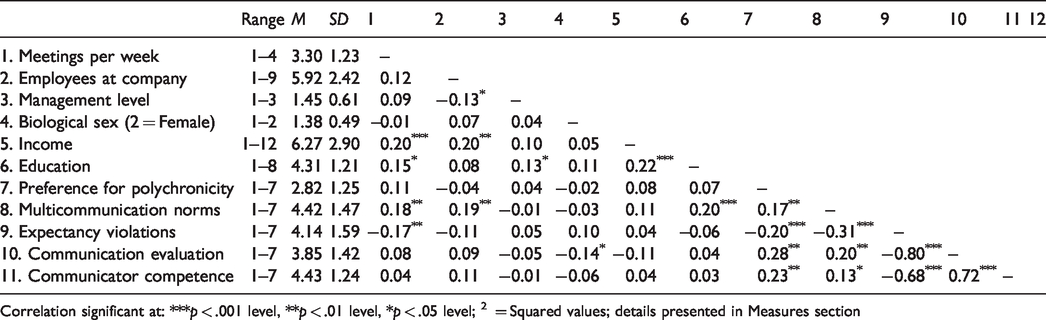
Correlation significant at: ***p < .001 level, **p < .01 level, *p < .05 level; 2 = Squared values; details presented in Measures section
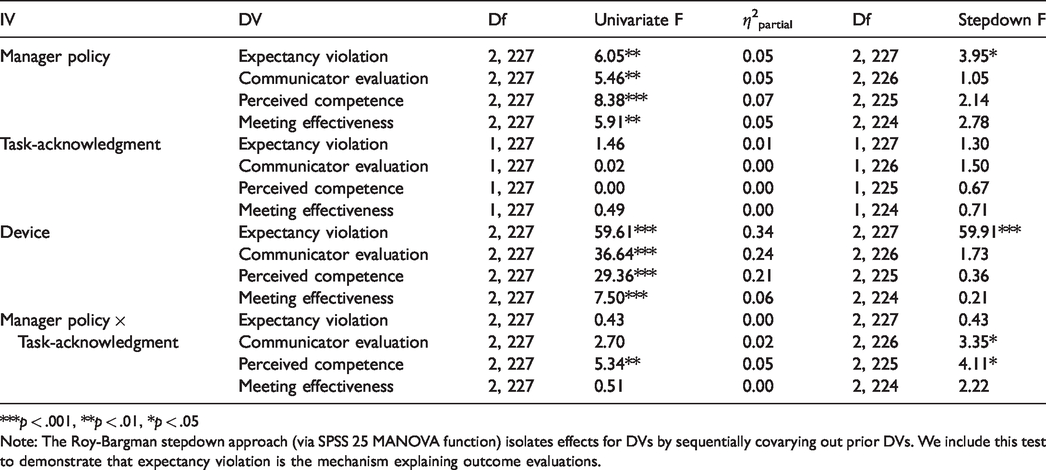
MANCOVA Results.
***p < .001, **p < .01, *p < .05
Note: The Roy-Bargman stepdown approach (via SPSS 25 MANOVA function) isolates effects for DVs by sequentially covarying out prior DVs. We include this test to demonstrate that expectancy violation is the mechanism explaining outcome evaluations.
Means and Standard Deviations by Manager Policy and Device.
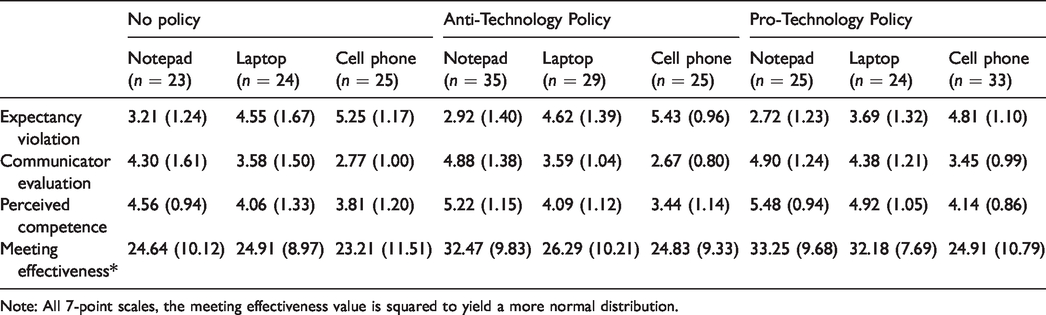
Note: All 7-point scales, the meeting effectiveness value is squared to yield a more normal distribution.
Dependent measures
Covariates
Results
In line with the hypotheses, we conducted a three (manager policy: none, pro-technology, anti-technology) by three (device use: notepad, phone, laptop) by two (no task-acknowledgment versus task-acknowledgment) multivariate analysis of covariance (MANCOVA) using the SPSS 25 GLM procedure. The relevant dependent variables were as follows: expectancy violation, communicator evaluation, perceived competence, and meeting effectiveness. Results of the assumptions of normality, homogeneity of variance, and multicollinearity/singularity were tested using recommendations by Tabachnik and Fidell (2013). The meeting effectiveness scale was negatively skewed and leptokurtotic; however, the distribution was made normal by taking squared values of the variable (Fink, 2009). Levene’s test was significant for communicator evaluation; however, the ratio of largest to smallest variances did not exceed the 7:1 so we proceeded with the analysis (Tabachnik & Fidell, 2013). There were no problematic univariate or multivariate outliers. Results for the full MANCOVA are show in Table 2.
Because one’s perceptions of normative behavior and workplace experiences affect perceptions of multicommunication, we included several covariates in the MANCOVA. Specifically, we included the average number of meetings per week, company size, managerial status, biological sex, income, education, as well as normative scales of preference for polychronicity, and perceived workplace multicommunication norms (Paskewitz & Beck, 2019; Turner & Reinsch, 2007). Finally, we computed a step-down version of the MANCOVA (rightmost column, Table 2) for the interaction hypotheses (H4a–H4d); this model covaries out dependent variables (DVs) in order of entry. The Roy-Bargman stepdown model allows us to isolate the relative importance of expectancy violations and subsequent evaluations in the model (see Discussion).
Covariates
The MANCOVA showed the combination of DVs was significantly predicted by the covariates, F(32, 828) = 2.60, Wilks’ λ = 0.70, p < .001, η2partial = 0.09. In the univariate decomposition, three covariates were significant. Expectancy violations were significantly affected by multicommunication norms (B = −0.29, t = −5.17, p < .001, η2partial = 0.11). The more normative multicommunication was in one’s workplace, the less of an expectancy violation. Communicator evaluation was significantly related to income (B = −0.64, t = −2.32, p = .021, η2partial = 0.02), multicommunication norms, (B = 0.14, t = 2.59, p = .010, η2partial = 0.03), and preference for polychronicity (B = 0.21, t = 3.18, p = .002, η2partial = 0.04). Those with higher income evaluated the communicator more negatively; whereas, those whose workplace had multicommunication norms and who engaged in polychronicity practices rated the multicommunicator higher. No covariates were significantly related to perceived competence or meeting effectiveness. Covariate-adjusted results are presented below.
Manager policy
H1 proposed manager policy articulation would significantly affect expectancy violation, communicator evaluation, perceived competence, and meeting evaluation. Manager policy was significant, including covariates: F(8, 448) = 3.16, Wilks’ λ = 0.90, p = .002, η2partial = 0.05. Univariate analysis revealed significant effects for expectancy violations: F(2, 242) = 6.05, p = .003, η2partial = 0.05, supporting H1a; communicator evaluation, F(2, 227) = 5.46, p = .005, η2partial = 0.05, supporting H1b; competence, F(2, 227) = 8.38, p < .001, η2partial = 0.07, supporting H1c; and perceived meeting effectiveness, F(2, 227) = 5.91, p = .003, η2partial = 0.05, supporting H1d.
Means across these conditions are presented in Table 3. Post hoc contrasts comparing the manager policy conditions to the mean reveal that the manager policy in favor of technology usage uniformly generated lower expectancy violations (p = .001), higher communicator evaluations (p = .001), competence ratings (p = .001), and meeting effectiveness ratings (p = .012). However, the anti-technology policy was not significantly different from scale means. Thus, as hypothesized, the pro-technology policy is the important source of variance in expectancy violations. H1a through H1d were all supported.
Task-relatedness
H2 proposed that acknowledging one’s multicommunication as task-related would reduce expectancy violations and increase evaluations of the communicator, the communicator’s competence, and the meeting effectiveness. Against our hypothesis, task-acknowledgment was not multivariate significant: F(4, 224) = 0.83, Wilks’ λ = 0.99, p = .51, η2partial = 0.02. Thus, H2a – H2d were not supported. There was no significant effect for task-acknowledgment.
Device
H3 predicted that there would be a significant main effect for device such that the use of a cell phone would prompt higher expectancy violations along with lower communicator evaluation, competence, and meeting effectiveness ratings. After controlling for covariates, device generated a significant main effect: F(8, 448) = 13.91, Wilks’ λ = 0.64, p < .001, η2partial = 0.20. Univariate tests reveal that device affected ratings of expectancy violations, F(2, 227) = 59.61, p < .001, η2partial = 0.34, supporting H3a; communicator evaluation, F(2, 227) = 36.64, p < .001, η2partial = 0.24, supporting H3b; competence ratings, F(2, 227) = 29.36, p < .001, η2partial = 0.21, supporting H3c; and meeting effectiveness, F(2, 227) = 7.50, p = .001, η2partial = 0.06, supporting H3d.
The means for device ratings are shown in Table 3. Post hoc contrasts comparing devices to the mean show that the notebook generated a significantly smaller expectancy violation (p < .001) and higher communicator evaluations (p < .001), competence ratings (p < .001), and meeting effectiveness ratings (p = .002). Contrasting laptop computers against the mean showed ratings were not significantly different from the mean across dependent variables. As shown in the means, phone use solicited the highest expectancy violation and the lowest outcome evaluations (all p < .001). Overall, this test supports H3a–H3d.
Interaction between manager policy and task-acknowledgment
Finally, H4a–H4d predicted an interaction between manager policy and task-acknowledgment such that policy match with technology use in task-related ways would yield the highest communicator evaluations, competence, and meeting effectiveness ratings. Because this hypothesis seeks to isolate the effects of expectancy violation (i.e., H4a) and the outcome measures, the Roy-Bargman stepdown approach was used to enter the DVs sequentially (see rightmost columns in Table 2; Tabachnik & Fidell, 2013). Manager policy by task-acknowledgment yielded a significant multivariate effect, controlling for covariates: F(8, 448) = 2.53, Wilks’ λ = 0.92, p = .011, η2partial = 0.04. H4a predicted expectancy violation would not vary based on the policy and task-acknowledgment interaction and this effect was not significant (p = .654). H4b through H4d predicted policy and task-acknowledgment would interact affecting: communicator evaluation, F(2, 226) = 3.35, p = .037, η2partial = 0.03; competence ratings, F(2, 225) = 4.11, p = .018, η2partial = 0.04; and, meeting effectiveness (p = .111). Overall, H5a, H5b, and H5c were supported, while H5d was not.
Table 4 shows means and standard deviations for manager policy by task-acknowledgment. When the manager articulated a policy, those who acknowledged their multicommunication were evaluated higher and seen as more competent. In the absence of a policy, the pattern is reversed. Finally, the means for communicator evaluation and competence were highest in the pro-technology policy condition. In all, when the manager’s policy is matched by employee’s behavior outcome means tend to be higher.
Means and Standard Deviations by Manager Policy and Task-Acknowledgment.
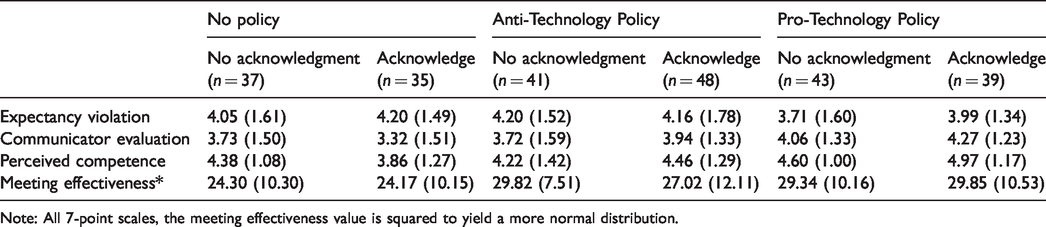
Note: All 7-point scales, the meeting effectiveness value is squared to yield a more normal distribution.
Discussion
EVT is a powerful framework for understanding how multicommunication behavior is perceived. Our results reveal the importance of manager policy and device use in multicommunication perceptions. Against a robust set of findings (Cameron et al., 2018; De Bruin & Barber, 2019; Reinsch et al., 2008), task-acknowledgment was unrelated to expectancy violations, communicator evaluation, competence, or meeting evaluations. It appears that the act of multicommunicating supersedes the subsequent explanations of behavior, which informs EVT and mobile media theorizing. One exception is the match between manager policy and meeting behavior improved evaluations. This discussion presents theoretical and applied implications focusing on a mobile introspective illusion, the importance of manager policy-sharing, and the importance of expectations.
Though meetings require less focused attention than dyadic conversation (Paskewitz & Beck, 2019), engaging with mobile devices during meetings generates attributions by communication partners. These attributions are partially driven by the perceived capabilities of technology and materiality (i.e., physical presence) of the devices (Mannell, 2019). In other words, there is a tension between a phone’s capabilities (e.g., facilitating communication with experts) and the perceived use of devices (e.g., used for distraction rather than on-task activities). In this way, the materiality of a phone, laptop, or notepad evokes perceptions of the person, the context, and the opportunities for action (Mannell, 2019). Device perceptions are tied to expectancy violations (Burgoon, 1993).
Mobile introspective illusions
Meaning inference for mobile use differs between users and perceivers (Reinsch & Turner, 2019) like many self-other perceptual processes (Pronin et al., 2004). When comparing their own mobile behavior relative to norms, people estimate their own behavior is more normative than a partner’s (Hall et al., 2014). This is an introspection illusion whereby our own thoughts and motives are easy to interrogate and understand, but the thoughts and motives of others are at odds with our own cognitions (see Pronin et al., 2004). Multicommunication practices in one’s own workplace and preferences for engaging in multiple conversations at once both increased communicator evaluations—but neither eliminated the effects of perceiving a meeting member engage in multicommunication. There seems to be a tension between one’s own use of a device (which meeting participants believe improves decision outcomes and personal performance; Dennis et al., 2010) and the use of a device by others (which meeting participants evaluate negatively; Cameron & Webster, 2011; De Bruin & Barber, 2019). While phones are perceived to generally improve work outcomes (Smith & Anderson, 2017) this belief is biased toward our own work, not the work others are doing.
The strength of articulating technology policies
Our findings validate Stephens’ (2018) contention that managers clearly communicating technology use expectations has meaningful implications for how technology use is perceived. Managers can structure technology use norms for meetings, and likely other work domains, in ways that affect communicator evaluations (Reinsch et al., 2008). Thus, well-articulated policies may represent a powerful intervention in making multicommunication (un)acceptable in meetings and ought to be leveraged by researchers and practitioners alike.
Only the technology-embracing policy differed significantly from the mean. This may signal that in the absence of a policy, workers assume that technology ought not be used during meetings. However, we also know that creating workplace structures, like culture and norms, is difficult work. In aggregate, a reinforced technology policy and peer expectations are important tools that leaders can use to change behaviors regarding technology usage (Stephens & Davis, 2009). Managers should take time to set (and model) clear policies for technology use (Stephens, 2018). Further, EVT is prescriptive for interacting in unfamiliar meeting environments (and likely other workplace environments): technology use, even when it is related to the task, should be assumed to counter norms until other evidence (e.g., manager policy, peer use) suggests otherwise.
EVT and multicommunication
The final contribution is the utility of EVT as a framework to integrate disparate multicommunication findings. Specifically, past studies have used social exchange theory, incivility (Cameron & Webster, 2011), politeness theory (Cameron et al., 2018), media richness theory (Turner & Reinsch, 2007), and the social influence perspective (Stephens & Davis, 2009). We leverage these findings and fit them concisely in the EVT framework. Thus, EVT proved a particularly pointed explanation for participants’ assessments of the multicommunicator, media use, and the meeting. As shown in the rightmost columns of Table 2, using the stepdown approach to assess the DVs, changes in these outcome evaluations were almost entirely driven by expectancy violations.
This study tests how a meeting outsider might perceive multicommunication in a meeting. In other words, our experiment is akin to seeing a new person meeting with a group, in or out of one’s regular workplace, and seeing attendees (not) engage in multicommunication. Results show that an onlooker can quickly catch on to norms (e.g., manager policies), have their expectations violated, form impressions of a communicator who engages in multicommunication and assess meeting effectiveness. Picking up or putting down a device during a meeting is a powerful cue in work and interpersonal relationships (Hall et al., 2014).
Limitations and future directions
This sample is limited: it is more white, educated, and male than the average US worker. Further, age was not collected in the survey. Future research might conduct stratified sampling to see how race, gender, age, and other demographic attributes relate to the perceptions of technology use in meetings. Future research can use EVT to refine how communicator reward (e.g., homophilous communicators) and order of events might affect perceptions of mobile users.
This experiment focuses on a zero-history meeting context. While this affords control, it cannot account for multicommunication in established teams. Future work might explore how team-norms and individual personalities interact to explain multicommunication in more complex contexts. Additionally, both the quality and amount of communication between the multicommunicator and the team in the meeting was low (one line in each condition). Teams with more established relationships and richer communication might see differing outcomes than those found here. Both polychronicity and multicommunication norms related to outcome evaluations; logically, there is a relationship between one’s workplace norms, established relationships, and perceptions of multicommunication behaviors. In the EVT framework additional expectancies based on relationship and context require researchers’ attention (Burgoon, 1993).
One important relational structure theorized to determine the acceptability of ICT use during meetings is power and status (Reinsch & Turner, 2019). Given the added design complexity, this study was unable to manipulate the status of the multicommunicator. Future research should explore how power dynamics affect perceptions of multicommunication, in context. For example, how does the multicommunication of a manager or leader differ from that of an administrative assistant or front-line worker?
Though our experiment gives us control over the causal mechanism under investigation, it is also limited by our ability to call participants’ attention to manipulations. Though we included attention and manipulation checks, we could certainly have had much more robust and overt manipulations. Instead, we opted for a study with higher ecological validity. We suspect our findings represent a realistic encounter in a new work context, but they are still based on actors seen in a video. Though this study challenges the retrospective approach that has dominated multicommunication research (cf., De Bruin & Barber, 2019; Paskewitz & Beck, 2019) it is still less robust than situated interaction in an established work environment. Future research may benefit from using EVT as a framework to explain multicommunication behavior, in situ. EVT is especially useful as the variance in outcomes was contingent on expectations.
Conclusion
This experiment used video vignettes to test how multicommunication was perceived under three varying conditions: manager technology policy (none, pro-technology, anti-technology), device use (notepad, laptop, cell phone), and task-acknowledgment (no task-acknowledgment, task-acknowledgment). Results showed that manager policy and device both served as informative cues for the perception of multicommunication in meeting contexts. There was not an effect for task-acknowledgment, but acknowledgment did interact with manger policy such that policy alignment with employee behavior during the meeting generated the highest outcome ratings. These results reveal the importance of managers setting expectations for device usage and multicommunication behaviors in organizational contexts. This experiment ties mobile materiality (Hall et al., 2014; Mannell, 2019) and device perceptions to classic literature about expectations (Burgoon & Hale, 1988). The behavior of the participant, rather than the verbal acknowledgment of task-relatedness, drove expectancy violations and outcome evaluations. Results also show general negative evaluations of technology use during meetings, especially the use of mobile phones. Certainly, additional research tying expectations, media, and materiality are warranted. EVT may be useful for understanding mobile media expectations and this study suggest that in the absences of a pre-existing relationship, new meeting members would be best served by taking social cues or avoiding technology use altogether.
Supplemental Material
sj-pdf-1-mmc-10.1177_2050157920927049 - Supplemental material for Expectations of technology use during meetings: An experimental test of manager policy, device use, and task-acknowledgment
Supplemental material, sj-pdf-1-mmc-10.1177_2050157920927049 for Expectations of technology use during meetings: An experimental test of manager policy, device use, and task-acknowledgment by Cameron W. Piercy Greta R. Underhill in Mobile Media & Communication
Footnotes
Acknowledgements
The authors wish to thank Drs. Norah Dunbar, Joann Keyton, and the two anonymous reviewers for valuable feedback on this manuscript. Thanks also to Drs. Michael Ault and Kathryn Lookadoo for assisting with the manipulation vignettes.
Funding
The author(s) disclosed receipt of the following financial support for the research, authorship, and/or publication of this article: This manuscript was supported by the University of Kansas College of Liberal Arts and Sciences Research Mini Retreat Grant and start-up funding.

Author biographies
Note
Supplemental material
Supplemental material for this article is available online.
References
Supplementary Material
Please find the following supplemental material available below.
For Open Access articles published under a Creative Commons License, all supplemental material carries the same license as the article it is associated with.
For non-Open Access articles published, all supplemental material carries a non-exclusive license, and permission requests for re-use of supplemental material or any part of supplemental material shall be sent directly to the copyright owner as specified in the copyright notice associated with the article.
