




Abstract
Mobile media is a chief driver of digitizing locational information, geotags, and photos that are produced and collected as we communicate with and exist within our networks. But when these data are stored and recorded—in quantities that far exceed any of our abilities to manage—mobile technology denies our ability to actively forget. This article argues that digital ephemerality via mobile applications (i.e. Snapchat, Signal, Confide, and Facebook Messenger Secret) has emerged because of the granular possibilities for data retention enabled by mobile devices. Together these applications move towards a practice of preventing data from being stored and shared. In response, “data prevention” is proposed as an ethical framework for ephemeral mobile media, and is theorized with an eye toward the distributed agency inherent to networks. This ethics is positioned within a framework of distributed agency across stakeholders that draws most directly from actor–network theory, and three commonly articulated values—trust, transparency, and privacy—are proposed. These values help to define a system of networked practices within ephemeral mobile media that requires consideration of both human and non-human actors. Building sustainable ephemeral technologies necessitates aligning shared values amongst divergent stakeholders. The article concludes by motioning to LIMITS research, where data prevention might be included, linking and further intensifying shared values across technical and social concerns.
Introduction
Mobile technology has become the dominant method of day-to-day communication, in part because its temporal and spatial nature allows for the capture of ephemeral moments and movements. Media scholars have shown how locative media can capture and digitize what may have been once inherently ephemeral experience (Frith and Kalin, 2016; Urry, 2012). Farman (2012) argues that mobile devices allow a user to gather up the ambient ephemerality that makes up an identity, connecting us to “ephemeral histories and narratives of place” (2012, p. 116). Untethered from the desktop, this digitization of ephemera that becomes possible through our devices, allows us to move through the world to say to our networks “I am here” (Farman, p.75). Mobile media is a critical component of engaging the past through the locational information, geotags, and photos that are produced and collected as we communicate with and exist within our networks (Özkul and Humphreys, 2015). But when these movements and locations are stored and recorded—in quantities that far exceed any of our abilities to manage—mobile technology captures this ephemerality and denies the experience of ephemeral presentness. Much like the ways we move through a physical world that cannot always broadcast our existence, some of us no longer want to be located through data’s infinite evidence. In response to the initial joy of capturing, posting, and sharing the ephemera of our daily lives, we are now developing values for letting ephemera go again. Users are seeking out ethical preservation practices from organizations, but also ways to prevent data collection within the devices they have come to rely on. Users, designers, and developers should be asking how can we prevent data, and how can we do so ethically?
The answer to this question is responded to most effectively by mobile applications (apps) that recreate an occasion of ephemerality. Snapchat, Signal, Confide, and Facebook Messenger Secret are the apps I have chosen for this article, but there are many others. These apps and features have surged in popularity for users who want to avoid their data from being collected while also prompting corporate interest in design, scholarly interest, and legal questions about disappearing records. Typically, when we share anything online, those data are linked to entire networks of people “both familiar and unknown” (Eichhorn, 2019, p. 23). That is, data we might claim as private or that we wish to remain as such, always emerge and exist in multiples. Ephemeral apps have responded to a desire for mobile communication that momentarily captures ephemerality but then leaves no trace. These practices are what I will refer to as data prevention, which requires an explicit articulation of values that can allow us to move about the world within smaller digital footprints.
This article begins with a literature review that attends to the interplay of memory and forgetting necessary to theorizing ephemerality, and in so doing proposes “data prevention” as an ethical practice. This ethics is positioned within a framework of distributed agency across stakeholders that draws most directly from actor–network theory (ANT), and three commonly articulated values—trust, transparency, and privacy—are proposed. These common values are drawn from research on values in the design of mobile and social computing by Shilton, Koepfler, and Fleischmann (2013, 2014), and others. Trust, transparency, and agency help to define a system of networked practices within ephemeral mobile media that requires consideration of both human and non-human actors. I conclude by pointing to a brief example that can serve as a model for future practices of ephemerality in mobile communication, posing a few open questions to consider along the way towards making those practices more ethical. Ultimately, I argue that building sustainable ephemeral technologies necessitates aligning shared values amongst divergent stakeholders, but particularly: users, corporate interests, designers and developers, technical infrastructure, and other non-human actors. Without aligning these shared values, there is no way we can build into our social and mobile media an ephemerality that (ironically) lasts.
Literature
In a blog post, Mark Zuckerberg argued that users are gravitating toward ephemerality due to a desire for intimacy, less permanent records, and secure payments (Zuckerberg, 2019). Users are choosing smaller networks because social media has been taken over by mobile media, where connectivity and preservation have intensified through captured ephemerality. Mobile technology has become the dominant platform, creating its own social networks that are irreducible to traditional social platforms and their user-generated content. But mobile apps designed to engineer ephemerality have developed in response to a need for forgetting. Social media platforms have become “global repositories of our digital memories” (Mayer-Schönberger, 2018)—memories rife for data harvesting, and mobile technology is one of the first places where a kind of antidote was found. What Zuckerberg identifies (closeness, ephemerality, security) is a desire to prevent the collection or creation of data in the first place—more than just privacy, this is a system of communication and interaction that protects users outside of their own desires or Facebook’s profits. Ephemeral mobile apps and functions address these needs. This literature review shows how the interplay of memory and forgetting is necessary to understand the desire for ephemerality, reviews the benefits of engineered ephemerality, and moves toward a data prevention model.
Memory has always been understood as a primary function of media (Bossewitch and Sinnreich, 2012; Smith-Rumsey, 2016) because digital technology has been designed to discourage forgetting—as accidental deletion, crashes, hardware failures, and so forth—to protect what has been stored. But forgetting has value alongside memory (Ricœur, 2004), and so deletion has become an ethical goal that is called for in networked systems (Mayer-Schönberger, 2010). However, what is deleted is not necessarily forgotten, especially when what already existed online can be easily saved and shared: forgetting always “encompasses portions of knowledge or consciousness” (Abbt, 2018, p.125). As such, the systematic deletion of content is a practical yet imperfect way to replicate forgetting, which requires transforming mere “data” into meaningful knowledge (Abbt, 2018). Abbt also points to the European Court of Justice’s “right to be forgotten” as an example of the disconnect between forgetting and deletion, where the law does not mean someone has the right to be deleted, but rather has the right to be “buried” in search results, thus enforcing a weaker memory.
In this article, I am concerned with systems that remember too much, through mobile media and otherwise. With this in mind, productive and ethical forms of forgetting can help ameliorate concerns brought about by this abundance of memory: invasions of privacy, breaches of trust, non-consensual intimate images that persist on Google, etc. To support the dynamic interaction between memory and forgetting, Bannon (2004) argues that we should design ephemeral technologies that replicate the inherent ephemerality of events—of course, as Chun (2008), van Dijk (2004), and others have pointed out, all media is inherently ephemeral. Ephemeral mobile apps such as Snapchat promise a return to an ephemeral nature of communication (Bayer et al., 2016; Handyside and Ringrose, 2017; Xu et al., 2013), making room for real ephemeral mobile experiences by preventing the collection of data. And although computers extend our capacity to recall information in many ways that are beneficial, without design that better supports the symbiotic relationship between memory and forgetting, we are facing the potential of losing loss (Durham-Peters, 2015, p. 376).
Just as forgetting does not always mean deletion, the promise of privacy via purported transparency (“Facebook values your privacy”) means that data can still be accessed, breached, and distributed by parties who have access. Indeed, as Zuckerberg suggests in his ephemeral vision, ephemeral apps have gained popularity at a time when corporations such as Facebook have continuously exploited user trust. Ephemerality as a value has inspired technological functions (He and Kivetz, 2016; Morlok et al., 2018) that have become a practical way to prevent data from accumulating in mobile communication and social media. Ephemeral media is defined as media that disappears after being displayed for a limited amount of time (Bayer et al., 2016; Chen and Cheung, 2019), but the state of being ephemeral is also experienced as a result of online anonymity (Schlesinger et al., 2017) and can be used as a way to counteract digital privacy concerns (Reynolds et al., 2011; Shein, 2013; Waddell, 2016). Although it does have many benefits, ephemerality also creates legal problems because it complicates the notion of evidence (Faklaris and Hook, 2016; McPeak, 2018) and, like all varieties of forgetting, puts certain kinds of knowledge at risk.
The benefits of ephemeral apps and forgetting require some attention to nuance: they are of course not always used for good purposes, just as data are not. Boyd and Crawford (2012), Mayer-Schönberger and Cukier (2013), Vaidhyanathan and Bulock (2014), and Kitchin (2014) have all pointed to some of the ways big data are a disruptive innovation that reframes questions about knowledge: although these data can be leveraged for surveillance, they can also be used to solve problems. Similarly, the variety of data collected from our mobile phones is extensive, and not all mobile phones are created equal. Case studies about freedom of information and public figures are some of the most vexing in terms of an ethical ephemeral media. For instance, Special Counsel Robert Mueller’s extensive report on possible interference in the 2016 U.S. presidential election points to the problem of encrypted and ephemeral messaging deleting evidence of governmental communications (Mueller, 2019, p. 10). Using ephemeral apps—likely Confide, Signal, or Dust (Shaban, 2018)—the Trump Campaign may have been able to obfuscate records of communication that were potentially incriminating. In another politically charged case, evidence against former U.S. congressman Eric Greitens was crafted around the absence of evidence itself (Hancock, 2018). Although in our daily lives we should all have the opportunity to have in-person conversations “off the record,” these examples point to how the desire to not be located by our mobile devices or represented by our communications raises questions of ethical use. At the same time, the possibility of ephemerality is valuable for users because disappearance often seems impossible when our devices have been designed to record and store everything we say.
Ephemeral apps work against widely held notions of preservation as an archival goal, as an act of custody, of protecting the "stuff" of culture, and a means of saving the “material that builds evidence and memory” (Conway, 2010, p. 64). Like Bannon (2004), Jurgenson (2013) argues that the promise of ephemerality opens up a space for forgetting, but also of being present (Bayer et al., 2016; Grieve, 2017), where in opposition, the seeming permanence of the data trace allows a user’s data to be vulnerable. But as Chun and Friedland (2008) ask, what if we fought for the right to be exposed, instead of the right to privacy? Elsewhere, Chun argues that the premise on which we accept memory to operate in our systems also means we accept those systems to make decisions for us (Chun, 2016, p. 79). In conceiving of a different internet, we should develop “new habits of connecting that disrupt the reduction of our interactions into network diagrams that can be tracked and traced” (Chun, 2016, p. 160). This approach works towards a symbiosis with the systems we have, which in turn is a different kind of fight against them.
This (brief) literature review has outlined some of the theoretical rationale for why ephemeral mobile media has developed and its popularity has intensified. In part, ephemeral apps have responded to an overemphasis on memory in design, and thus the forgetting of the importance of forgetting. The literature also points to some ethical concerns that are both intensified and solved by disappearing records of communications. Although it is slowly being built into desktop apps, ephemeral media began on mobile apps that allow users to communicate untethered from a traditional archival social media model. This traditional collection of data that is integral to the business models of companies such as Facebook, Google, Apple and others, along with a lack of shared values in either design or corporate responsibility, has led to the desire for models of data prevention.
Towards Data Prevention
Although ephemerality and privacy are valuable for mobile media and information and communication technologies (ICTs) writ large, what I have adopted as “data prevention” allows for a way of thinking about the creation of systems that refuse to create data in the first place. This term can be traced to a short manifesto found on dataprevention.net, which begins: “The privacy discourse sputtered out of steam.” This manifesto suggests results of data prevention that are more comprehensive than what privacy offers: autonomy, financial freedom, and minimalism. “What’s the best way to protect one’s self if not prevent to transmit data in the first place?” How might we enact social networking “without being aggregated” into profitable data silos? This manifesto is loosely affiliated with researcher Denis Roio, whose work involves decentralizing data governance, for which he proposes some innovative technical solutions (Roio, 2018).
Within the parameters I have set in this article, data prevention does not mean “digitalization prevention” or “data elimination,” but still allows for the creation of media, communication within mobile environments, and the protection of our information within certain contexts. Ephemerality does not always mean data prevention and vice versa. Rather, data prevention encompasses a set of practices that require a look at a wider network of activity than just users, and if ephemerality is involved, an ethics needs to attend to the whole network. In ephemeral media, as in all digital media, and digital social interaction, it is not just one user deleting their own files, or one corporation using some data, but a wide network of interrelated activity all depending on the symbiosis of actors (both human and non-human).
Outside of this tersely worded manifesto we are seeing practices of data prevention emerge, chief among them mobile media apps that offer to prevent the collection of data by corporations or other users through ephemeral functions and experiences. The apps that I have chosen to focus on in this article are Snapchat, Signal, Facebook Messenger Secret, and Confide. Snapchat is the first mobile application with ephemeral functionality, in part because the company’s founder saw a value in data protection (Newton, 2018). Facebook Messenger Secret is an option available within Facebook Messenger that prevents the creation of records of communication only on your mobile device. When this article was in its early stages, all apps were only available on mobile, but now Signal and Confide can be operated on multiple devices. Rather than just offering privacy solutions to existing data, these platforms are creating environments—systems that are irreducible to a user—that allow for data prevention and thus circumnavigate certain privacy concerns. Table 1 illustrates these popular ephemeral apps, what content passes through the app, and how data prevention is programmed. 1
Some ephemeral mobile apps and their functions.
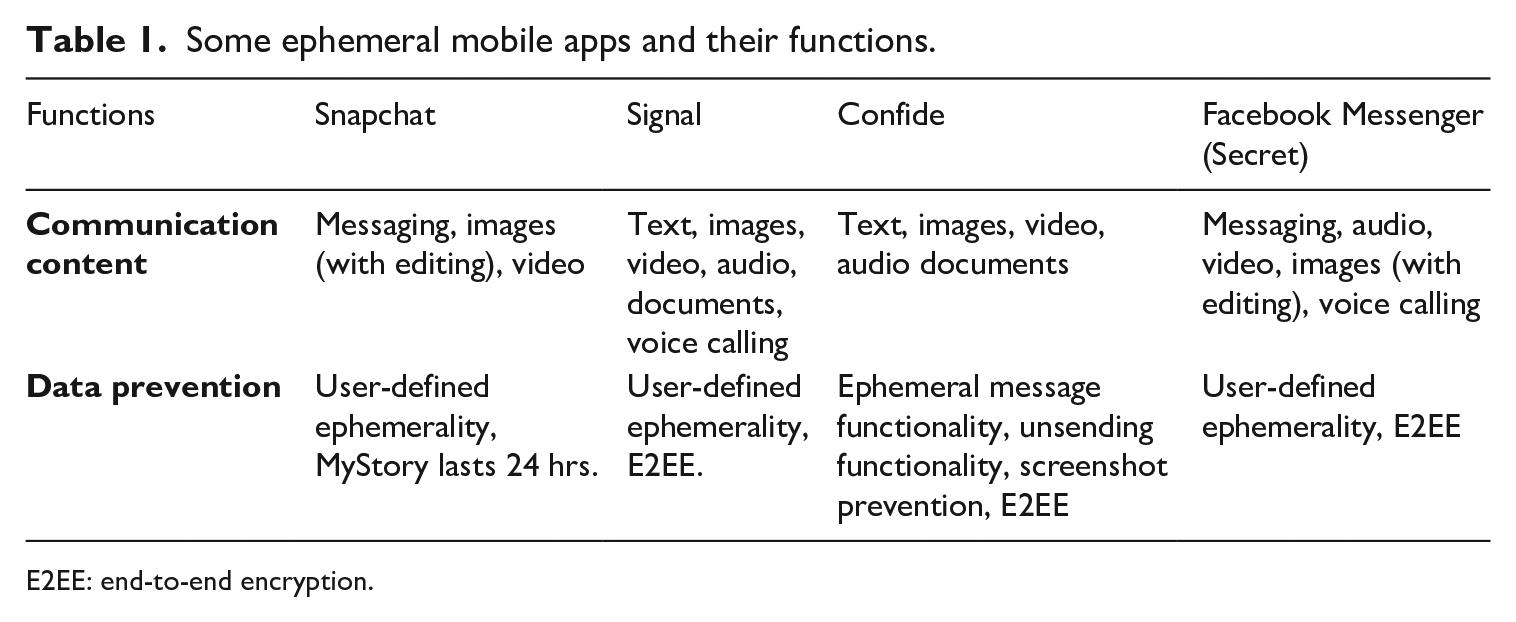
E2EE: end-to-end encryption.
Although it is important to situate the user in technological systems, doing so can also trouble the concepts from which we understand those systems. Eichhorn (2019), Angwin (2015), and Mayer-Schönberger (2009) have diligently attended to forgetting by centering the user, and in so doing respond to the issue of data retention by trying to override the systems we have (though Mayer-Schönberger does suggest a kind of ephemerality in expiration dates as a design functionality). Brunton and Nissenbaum (2015) introduce obfuscation as a means to privacy via the creation of misleading or ambiguous information that obscures personal data. Obfuscation is posed as potentially benefiting a variety of stakeholders who all use technology and have similar values (users, designers, government agencies)—this is because users are not the only participants in these systems, although it often feels as though we are on the receiving end of technology via silent overlords. Users have the potential to influence these systems along with designers, programmers, corporate figureheads, and so on, and all of these actors in one sense or another require each other.
To work with these networked systems, we need to turn to concepts that help us recognize the agency distributed throughout their mechanisms. This task is something we can think through with the distributed agency offered by ANT. ANT has its critics, but it is novel in the way it rejects the subject/object binary and includes people, objects, and organizations as actants with equal agency (Latour, 2005, p. 50). With this symmetry among humans and nonhumans, the emphasis is on associations rather than human actors. This networked relationship does not negate the importance of human interactions and perspectives, rather, it further reinforces its importance because it is another integral part of a network. Such networks are also different from technical and social networks (Latour, 1997, p. 369), where ANT instead helps map systems of relations.
A perspective of ephemeral systems of relations drawn from ANT could include not only the user’s actions, but also: communication(s) between users, the app itself and its functions, the physical hardware that supports it, the companies that manage the app, undersea cables, servers, and so on, where all of these nodes make mobile functionality—and data prevention—possible. Bennett (2010) emphasizes a similar idea of assemblages, where nonhumans are seen as acting positively alongside humans and even regulations, and van Dijk (2012) has shown how ANT can elucidate the dynamic nature of agency in social platforms. Boyle (2018) argues that human/non-human divisions can omit necessary transindividual connections (p. 160), and similarly, Shilton et al. (2014) show that thinking about humans as subjects and non-humans as objects can be limiting in technology design (p. 428). Distributed agency can help us consider how data prevention shifts supreme power from corporations (and users): two points from which conversations about digital communication often diverge. If these nodes were seen as having equal acting power along with the rest of the systems that they needed to function, spheres of influence might shift. Specifically, it would be more difficult to talk about “control,” which is often used to describe ethical technological systems or the ways humans can or should act: systems also have agency, and we can only act through events (Latour, 1999, p. 281). Data prevention still allows information to be distributed among various actants without being collected, retained, or archived.
Such a distributed view of agency allows for an ethical orientation that involves all actors in the system (Adam, 2008), as required by a nuanced and non-traditional framework such as engineered ephemerality. In a data-prevention model, values in design (Shilton et al., 2013, p. 260) are constantly negotiated by all actors, where for instance, values are “shaped endogenously by their designers and exogenously by their users and use contexts” (Shilton et al., 2013, p. 260 as cited in Friedman, 1997). At the same time, these values are shared across contexts, beliefs, systems, and stakeholders.
Shared Values for Data Prevention
Communication technologies are not just tools that we can choose to use, but systems that fundamentally shape who we are and what we experience. As Latour (2002) notes, tools are not just utensils but potential catalysts to a flux of moral possibilities (p. 250). And although tools can and do have agency, that is not to say that we cannot also value the user. In a way, this makes the user more integral to a network’s functioning and at the same time means values are distributed, as no actor exists in a vacuum and each influences another. Krontiris et al. (2014) argue that social computing researchers should look for shared central values across contexts, rather than simply in the values of individuals, because values are shared among core beliefs, contexts, systems, and policies (p. 426). Ephemerality, end-to-end encryption, and screenshot proofing are all means to data prevention that illuminate shared values across stakeholders (users and organizations in particular). Recognizing these shared values can also help information professionals and developers make better and more ethical design decisions (Fleischmann, 2013).
To begin the conversation about an ethics for data prevention, and in response to a networked understanding of communication technologies, I propose three values that help foster an ethical ephemeral experience: trust, transparency, and privacy. These values show that what is important to users is also important to organizations, which means the company can evolve for profitability. If we have learned anything from ANT methods, we have to agree that aligning benefits to all the actors in any given system is important for making lasting and ethical change. As such, perhaps counter-intuitively, organizations ideally have an incentive to be ethical—to clearly and effectively communicate what data the application does or does not collect (transparency), to ensure that sensitive information is secure from exploitation (privacy), and to repeat and maintain these practices (trust). When these values are in place, data prevention helps foster smaller networks as opposed to the larger networks necessary for data retention and recall.
Trust
In mobile technology, trust and privacy are inexplicably linked (Krontiris et al., 2014). Trust is also linked to transparency, as ephemeral mobile apps such as Snapchat were developed in part to supply privacy that users were seeking as refuge from platforms such as Facebook (Newton, 2018). This also signals a lack of trust evident in public frustration due to insufficient transparency by companies that should describe how their apps work and what data are collected. Interestingly, even though evidence and records of communications are usually automatically deleted, encrypted, or otherwise destroyed in ephemeral apps, trust provides the motivation for “users to share and seek information and disclose themselves,” and serves as a critical component of satisfaction or gratification (Chen and Cheung, 2019), even more so than privacy (Waddell, 2016). Trust is a foundation on which privacy and transparency are built and broken.
Trust requires the repetition of functions, of expectations being met, of allowing ourselves to be known and to know, and maybe most importantly in the context of ephemeral apps—to know something or someone is reliable. But trust also requires a shared world that Latour (2018) argues in many ways we have lost despite how “connected” we are. As such, the breakdown of trust also signals a breakdown of networks, relationships, and assemblages. Trust in mobile and social media platforms is repeatedly broken when there are privacy breaches or failures of transparency. These incidents break down trust in networks of assemblages, where also for Latour, there is an inherent morality in our technologies, which help ensure the continuity and “trustworthiness” of our actions (2002, p. 254). Trust is already complicated online because human users have to trust non-human actors and digital proxies where “communication is depersonalized identities can be easily hidden” (Yeo, 2013). Google’s ranking algorithm, key authentication and public key infrastructure, Twitter’s verification system, and Amazon and Yelp reviews are just a few instances of ways non-human agents attempt to build trust throughout networks. These are also examples of non-humans that require humans to act a certain way: to rise to the top of search results, to have a verified website, to have enough followers so that an algorithm recognizes you as “real.” If you meet the requirements of these algorithms, you also build trust of other humans (and non-humans) throughout networks.
Trust remains until something fails to repeat or come back the way we want it to. In a data breach, trust becomes a public-relations operation more than anything else, where transparency through public trials, public addresses, and apologies helps to earn trust back. Because these breaches have become so common, and corporate profits have exploded through advertising built from people simply visiting websites, public scrutiny and skepticism of apps that collect data have risen, and the desire for data prevention has increased. This has manifested most clearly in the rise of ephemeral apps, which also require trust that the application and all of its networks will permanently erase records of communication. To put it another way, the promise of forgetting requires trust among all agents that the communication will not somehow be reproduced and widely distributed. Especially because ephemeral apps are meant to discourage or disallow “traditional” records, or often ad-hoc records such screenshots—there is still room for trust to be built and broken. The use of any application that facilitates data prevention might presuppose a lack of trust between the user and the world at large, because when something is difficult to save, that generally means it cannot be easily shared.
Shannon Vallor (2019) argues that the “technomoral” virtue of honesty is linked to trust where the habits fostered by ICTs shape our truths (p. 122). For Vallor (similar to Latour, 2018), how to discern the truth through what we trust depends on availability of information. But what happens when records are never created in the first place? Data prevention would allow a healthy and generative communication network, or what Floridi (2014) calls the infosphere, to flourish in that it rebuilds sustainable communication practices where trust has broken down in the network. But to engineer an ethical, ephemeral digital experience, a profound amount of trust is required between users within (and outside of) the mobile app, between users and organizations, and between users and corporate transparency. Because the inner workings of ephemeral apps are not understood in depth by everyone who uses these apps, users must rely on what corporations purport about transparency, then assume a certain level of risk. And for a user to trust an ephemeral app, they must also trust the corporation that built it, the user on the other end of the communication, and the wider networks or lack thereof.
Privacy
Although we value something like privacy, privacy in the context of digitization is complicated because digital relations are inherently social. This means that every person who shares a piece of information (such as a photo in a private Google account) depends on not only on someone else to help them keep it secure, very much like how a bank operates, but also a network of digital infrastructure that does not leak that data. As Esposito (2017) suggests, the problem of forgetting is not one that can be solved by requiring companies such as Google to delete or obfuscate data alone, because these solutions do not address the problem of computer “memory” as fundamentally different from the way humans understand it. Just as we cannot untie memory from forgetting, we need a new response that asks us to think about something other than a user or a company being individually ethical.
Privacy in the context of digitalization requires a new theoretical orientation that considers the individual in addition to social relations (Matzner and Ochs, 2018, p.7). That is, any subject in a network is both socially and technically embedded, which makes such a distributed view of privacy highly compatible with ANT. This view of privacy is relevant to non-consensual image sharing, where reducing privacy to an individual act leads to victim blaming (Matzner and Ochs, 2018, p. 7). Matzner has also shown that privacy problems do not only come from individual data or an individual piece of data, but more often result from aggregations of huge amounts of information. Nissenbaum (1998) argues that privacy in public is threatened online because the way information circulates through networks is irreducible to any individual user—for instance, records of communication that are distributed through multiple channels. There is a seemingly infinite amount of data floating around and collecting in various places, rendering itself unforgettable, which Farman suggests it will continue to collect because users seek out movement and progress in the form of more connections (Farman, 2012, p.136).
There are many proposed responses to relentless social circulation, data retention, and losses of privacy through organizations, the platforms they operate, and the networks therein (Gehl, 2013; Karppi, 2018; Nissenbaum and Brunton, 2015; Mayer-Schönberger, 2010). What these approaches suggest is a need to develop a practice that preserves a user’s desire to be forgotten while also accounting for the various financial, legal, and political claims on data. This has been achieved by organizations that allow users access to ephemeral mechanisms for data prevention, but at the same time admit they will respond to legal requests to access those data or traces of them as legal needs demand. For most users of ephemeral mobile apps, this creates a situation where they feel as if they can live in the moment, “privately,” even though some traces inevitably remain. To go back to Farman (2012), ephemeral mechanisms allow us to say “I was here, but I am no longer.” This is still a kind of trace, but with no metadata attached when messages are encrypted and obscured from the organizations and mechanisms that govern them. However, as Vallor (2016) notes, privacy is placed “in a profound tension with the new digital ideals of ‘transparency’” (p. 122) and other imperatives to openness and sharing.
Transparency
Ephemeral mobile apps respond in part to privacy and trust concerns that are interwoven with questions of transparency. Transparency is also often used to signal the way a user does not have to bother with or understand the underlying machinery, but is also defined as an ideal that holds systems accountable (Ananny and Crawford, 2018), a sign of organizational openness (Albu and Flyverbom, 2016), and to signal information disclosure, clarity, and accuracy (Schnackenberg and Tomlinson, 2014). But when we recognize that agency is distributed throughout a system, transparency becomes a negotiated opacity or translucency. The desire for something to be transparent means that we are given and are able to see (truthful) information so we can make informed decisions. But if transparency is distributed and cannot be reduced to one actor, transparency is less about being seen than about being open to change. This new definition of transparency with regard to distributed agency means that transparency is about having the ability to be intervened in (something that can be influenced within the networks). With regard to a data-prevention framework, transparency becomes a capacity to be fluid and dynamic. For example, because ephemeral apps necessitate a kind of closedness and invisibility (that is, inaccessibility on the part of non-disclosed parties or governing organizations), transparency in data prevention looks more like what Stephens et al. (2014) describe as translucency. Complete transparency or openness is impossible because of the way these apps are designed to obscure and prevent records.
For Latour, to look for transparency in technology is a paradox (2002, p. 258) because accountability, describability, and traceability of operations implicit in transparency means that morality is always in conflict with “the openness to history that technology constantly suggests” (p. 258). To not be open, accountable, or traceable often signals a reason for hiding, but in transparency all the inner workings and mechanisms are on display. And although transparency should theoretically facilitate access to all information, it has been criticized as an errant virtue for the same reason: visibility, openness, and traceability can be extolled for both the gatekeepers and those who are kept (Brin, 1998; Lessig, 2009; Vallor, 2018). But even though there is no way to “see” everything that is going on behind the curtains of an organization (and often even from inside when there are so many actors), it is much easier for users to be traced and tracked by organizations within their communication networks, than vice versa. This complaint of openness is often solved at a user-facing level through transparency reports, promises written through website copy, and public apologies and addresses when trust is broken.
To draw out Latour’s transparency paradox, although verbal or written information about the mechanisms of ephemeral apps is required to promote trust in users, the use of ephemeral apps can also signal a lack of transparency. In many cases, a lack of transparency should be ethical because ephemeral apps are often employed in reaction to the way long-term surveillance can “short-change moral and cultural growth” (Vallor, p. 192). But apps such as Signal and Confide are also useful for communication that circumnavigates the Freedom of Information Act and facilitate what former Federal Bureau of Investigations’ director James Comey has called “going dark” (Stewart, 2017). As such, ephemerality is often posed as a challenge to the legal profession because preservation is an ethical obligation for lawyers (McPeak, p. 61). In cases such as these, choosing transparency may mean not using an ephemeral app for communication in the first place.
Ephemeral mobile apps are useful for preventing records of our movements, communications, and data. In any medium, total “transparency” is impossible, and ephemeral apps are helping users to be less transparent to the wider networks from which they want to disentangle their data. Choosing to use an ephemeral app can imply that users are hoping to be less transparent to their wider networks, but this is not always a bad thing. In fact, it is a huge reason why digital ephemerality was developed, and the desire for private citizens to elide transparency but demand it from their systems should be celebrated. Transparency as a value works best only when it is demanded by public bodies from their governments and corporations, but not vice versa, and even then it must still be open to change and interpretation.
To help conceptualize an ethics of data prevention and show how values can be aligned, Table 2 lists the three values highlighted in this article and four common functionalities that help promote those values. These are of course not all the values possible, all the functions, or all the ways humans, non-humans, organizations, and other stakeholders rely on each other. Rather, it is meant to help start a conversation about how ephemeral functionality can promote ethical use and operation with regard to data prevention.
How values are shared across stakeholders in ephemeral applications for data prevention.
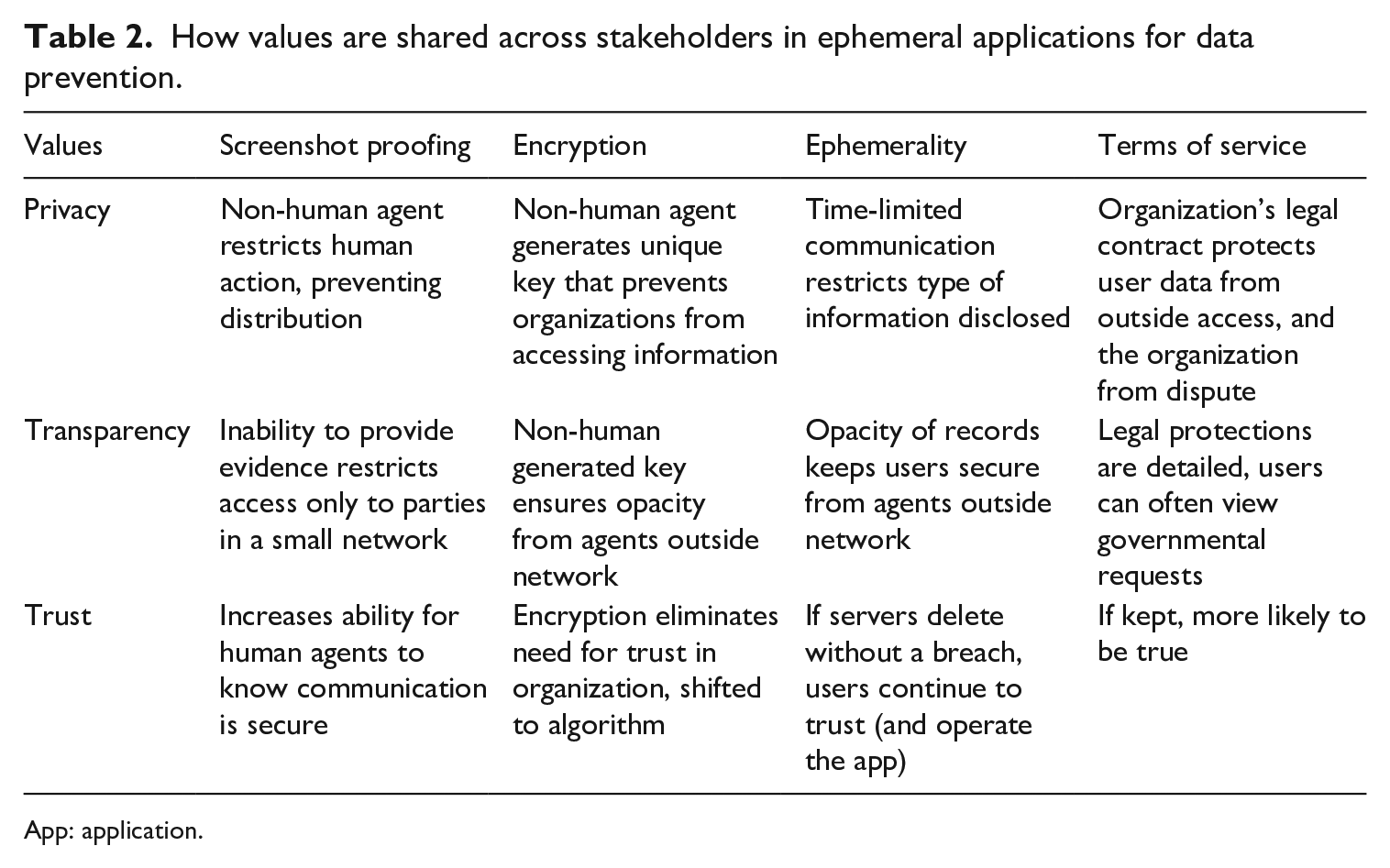
App: application.
Conclusion
In 1948, Claude Shannon famously identified the problem of communication as one of “reproducing at one point either exactly or approximately a message selected at another point” (Shannon, 1948, p. 1). Today, it is fair to say that our problem of communication is too much exact reproduction. Mobile devices have begun to show us some of the limits of preservation because of their ability to collect, store, and monetize the ephemera that make up our daily lives. Beginning with Snapchat’s playful mobile application, ephemerality has become a powerful way to prevent users, platforms, networks, and governing bodies from remembering too much. Mobile communication is a critical component of mediated communication, and ephemerality allows us the opportunity to engage with smaller networks, and thus to limit the data that is shared, stored, collected, and circulated.
The future of technology is intimately connected to the future of data—data that are continually being produced and need a place to be stored. But our storage is not infinite, nor are our resources. This seemingly ethereal “storage” (just like “data”) actually requires physical components, and on a planet reaching full capacity, storage has environmental constraints. Data prevention can be situated within the broader umbrella of LIMITS research, which assumes that although “current trajectories of ever-increasing production and consumption will continue,” they are not sustainable (Nardi et al., 2018, p. 86), and imagines a sustainable future both for technology and the planet. LIMITS suggests three principles for sustainability: questioning growth, considering models of scarcity, and reducing energy and material consumption. These technical principles are all addressed by data prevention’s social principles, which inherently resist expansion, and require less storage space and thus less energy when practiced ethically. Data prevention is a scarcity model that honors the limited resources of the natural world, and when ethically practiced can be a sustainable and economical model for mobile media platforms, for users, for designers, and for the servers our data inhabits.
In this article, I have argued that data prevention requires aligning shared values. I outlined three values that are important for making ephemeral digital processes happen, and in so doing have motioned towards an ethics for ephemerality. Mobile digital ephemerality has helped to design this ethic, which gives users the opportunity to create data through communication while still allowing the possibility of those data to be forgotten across physical networks—a forgetting that inhabits LIMITS. But as with any destruction of records, this also comes with its risks, which is why affirming values across users, organizations, and networks is so important. An ethical data prevention is situated across networks and must constantly be open and responsive to change as needs evolve across human and non-human actors. Data prevention provides a sustainable model that can be cultivated in the technologies we have now, but also in the technologies yet to come.
Footnotes
Declaration of conflicting interests
The author declared no potential conflicts of interest with respect to the research, authorship, and/or publication of this article.
Funding
The author received no financial support for the research, authorship, and/or publication of this article.
