



Abstract
The power of app-driven mobile phones was first unleashed in 2011 when they were used to mobilize protesters and gain support for political movements in the United States and abroad. Mobile devices have since become the bedrock of political activism. To examine the influence of app reliance on offline and online political participation, this study builds on the Orientation-Stimulus-Reasoning-Orientation-Response (O-S-R-O-R) model by (a) applying the model to mobile apps, (b) testing whether trust in, and reliance on political discussion are mediators between reliance on apps and political participation, and (c) using trust in both offline and online discussion as measures of cognitive elaboration. This study’s path model suggests that app reliance is related to online political discussion, which, in turn, is related to online political participation, but not offline participation. Although both offline and online discussion are linked to offline and online trust in political discussion, trust in political discussion does not influence either offline or online political participation.
It might seem a misnomer to call a smartphone a “telephone” especially because they are rarely used to make voice calls and, instead, are most frequently used to send text messages, check emails, and access the internet (Smith, 2015). Smartphones have morphed from a convenient way to make a call into handheld mobile information devices. The widespread adoption of smartphones and tablets has led to the creation of “applications” (apps) (Purcell et al., 2010; Shaul-Cohen & Lev-On, 2020), which are computer software programs especially designed for displaying websites and other digital information on a small screen. Apps are different from most digital tools in that they are neither a medium nor a content provider, but rather an information acquisition tool (Stephens et al., 2014).
The power of apps and mobile devices, both smartphones and tablets, was first unleashed in 2011 when they were used extensively to mobilize protesters and gain support for the Occupy Wall Street movement in the United States and the Arab Spring uprising in the Middle East (Groshek, 2012; Martin, 2014). Mobile devices help jump-start political activism (Shaul-Cohen & Lev-On, 2020) and spur offline and online political discussion and political participation (Groshek, 2012; Ohme, 2020; Park & Gil de Zúñiga, 2019).
To understand the role of apps as providers of political information better, this study applies the Orientation-Stimulus-Reasoning-Orientation-Response (O-S-R-O-R) model to mobile apps to investigate the nature of the indirect connection between app reliance and political participation. The O-S-R-O-R model is an extension of the communication mediation model (McLeod et al., 2001; Shah et al., 2007: Shah et al., 2017), the citizen communication mediation model (Shah et al., 2005), and the cognitive mediation model (Eveland, 2001; Eveland et al., 2003). In the O-S-R-O-R model, the first “O” (orientation) includes the “structural, cultural, cognitive, and motivational characteristics the audience brings to the reception situation that affect the impact of the message” (McLeod et al., pp. 146–147). In this study, orientation includes demographics and political dispositions. The “S” represents a stimulus, in this case, reliance on mobile apps for political information. The O-S-R-O-R model can be distinguished from the campaign communication model by the addition of the first “R” after the stimulus, the R representing reasoning behavior. This study measures reasoning through offline and online political discussion. The second “O”, which signifies orientation after reasoning, represents “what is likely to happen between reception of the message and the response of the audience member” (McLeod et al., 1994, pp. 146–147). For this study, the second “O” refers to trust in offline and online discussion. The final “R” represents audience response, which in this case reflects online and offline participation.
The O-S-R-O-R model is appropriate for studying the complex relationship between app reliance, trust in and reliance on offline and online political discussion, and political participation (offline and online). Studies of the efficacy of mobile devices in relation to mobilization and political participation primarily assert a direct effect of reliance on mobile devices on offline and online participation (Campbell & Kwak, 2011; Martin, 2014, 2015; Ohme, 2020; Yamamoto et al., 2015, 2018). The O-S-R-O-R model (Cho et al., 2009), however, indicates that media reliance indirectly affects political participation. It shows that political discussion, in conjunction with news consumption, amplifies the influence of media reliance.
This study makes use of the O-S-R-O-R model in four important ways by (a) applying the model to mobile apps, (b) examining the indirect effects of app reliance on political participation, (c) testing whether trust in, and reliance on political discussion are mediators between reliance on apps and political participation, and (d) using both trust in offline and online discussion as measures of cognitive elaboration. Data for this study of mobile apps were collected during the first week of November 2016 from a nationwide representative sample (N = 644) created by Survey Sampling International.
Orientation-Stimulus-Reasoning-Orientation-Response (O-S-R-O-R) model
The O-S-R-O-R model recognizes that media reliance plays a central role in helping citizens interpret and make sense of political events. Media reliance is the degree to which individuals psychologically depend on information to learn about their cultural, social, and political world (Becker & Whitney, 1980; Miller & Reese, 1982). Although communication and cognitive mediation models have typically employed media use (behavior) rather than media reliance (attitude) (Beaudoin & Thorson, 2004; Rimmer & Weaver, 1987), reliance provides a better measure of news consumption than media use. The more heavily news consumers rely on a medium, the more capable they become of extracting information from that source (Miller & Reese, 1982; Moy et al., 2005).
The O-S-R-O-R model contends that media reliance does not directly influence political participation but does so indirectly through offline and online discussion of political news. Specifically, the effects of media reliance are mediated by political discussion (offline and online) and cognitive elaboration in which users logically assess mediated information (Cho et al., 2009; Jung et al., 2011; Yamamoto & Morey, 2019).
Offline and online political discussion
Political discussion has been described as the “soul of democracy” (Kim et al., 1999), the chicken soup that heals the body politic. The act of discussing politics helps people interpret and make sense of political news and gain a deeper understanding of the political world; thereby, it increases political participation (Cho et al., 2009; Shah et al., 2017).
O-S-R-O-R researchers suggest that discussion is also a key to understanding the relationship between media reliance and political participation. Discussing the news improves people’s ability to process information by helping them interpret, make sense of, and connect world events to what they already know and believe (Hardy & Scheufele, 2005; Nisbet & Scheufele, 2004). Also, the more frequently people take in the news, the more intense their discussion and, thus, the more involved and interested they become in various issues (Shah, 2016; Shah et al., 2007). The connection between media reliance and discussion is valid regardless of whether the conversation is offline (Shah et al., 2005; Yoo et al, 2015) or online (Boulianne, 2009, 2015; Shah, 2016; Shah et al., 2005; Yoo et al., 2015).
Studies suggest that because mobile apps enable people to interact with each other, increased reliance on them for political information will lead to more political discussion (Yamamoto et al., 2015, 2018). Thus, the first part of this study’s path model predicts that reliance on apps (the stimulus in the O-S-R-O-R model) has a strong influence on political discussion.
H1: Reliance on mobile apps for political information directly and positively influences reliance on (a) offline and (b) online discussion.
Reliance on discussion as a mediator
Many studies have found a direct connection between news consumption and political participation, and it follows that individuals who rely heavily on mobile apps for news are also likely to participate in both offline and online political activities (Gil de Zúñiga et al., 2017; Kaye & Johnson, 2019; Ohme, 2020; Yamamoto & Nah, 2018; Yoo et al., 2016). Further, app users who express their political views are also more likely to participate in political activities than those who use apps simply as a way of finding information (Valeriani & Vaccari, 2018; Yamamoto et al., 2015, 2018).
However, although media reliance might directly influence political participation, O-S-R-O-R researchers contend that political discussion mediates this relationship (Boulianne, 2009, 2015; Shah, 2016: Shah et al., 2017). When testing to see whether discussion is a mediator between mobile app use and political participation, several studies found that online discussion is a stronger mediator than face-to-face communication (Chan et al., 2016; Yoo et al., 2015).
This study, however, examines the indirect relationship between mobile app reliance and political participation through offline and online political discussion, and its path model next puts forward the supposition that app reliance influences political participation through discussion (“reasoning” in the O-S-R-O-R model) with the following two hypotheses:
H2: Reliance on offline political discussion mediates the relationship between mobile app reliance and (a) offline participation and (b) online participation.
H3: Reliance on online political discussion mediates the relationship between mobile app reliance and (a) offline participation and (b) online participation.
Mobile app reliance and trust in political discussion
Reliance on mobile apps not only promotes discussion, but also strengthens trust within a discussion network, whether this is comprised of close family and friends (strong ties) or consists of networks of loosely connected individuals (weak ties) (Campbell, 2015, 2019). However, the mere act of discussing politics is not enough to bring about political participation without having deep trust in the discussants. Perceived political trustworthiness and expertise make discussants appear believable and, thus, influential (Huckfeldt & Sprague, 1995; Kenny 1998).
The O-S-R-O-R model is centered on the deliberative nature of interpersonal discussion, noting that engaging in conversation requires cognitive evaluation to understand the points made by others, weigh the arguments, and organize thoughts to make an articulate response (Cappella et al., 2002; Jung et al., 2011). The mediated effects of cognitive elaboration are typically assessed by how deeply consumers evaluate news stories and the degree to which they connect new content to what they already know based on their beliefs and prior experiences (Cho et al., 2009; Eveland et al., 2003; Yamamoto & Morey, 2019). Other studies, however, have measured cognitive elaboration more directly, assessing it in terms of political knowledge, political efficacy, or media efficacy, that is, the perceived helpfulness of a news medium for understanding complex issues (Jung et al., 2011; Kim et al., 2018).
Positive perceptions of trust and credibility are integral components of information processing (e.g., Chaiken, 1980; Petty & Cacioppo, 1986). Moreover, offline and online networks that are intimate, emotionally supportive, and politically reinforcing, as characterized by many mobile apps, are highly effective in swaying individuals to participate in both offline and online political activities (Campbell, 2015; Campbell & Kwak, 2011; Valenzuela et al., 2018). Scholars who have studied the role of social ties in political activism have noted the importance of reciprocity (Gouldner, 1960). Individuals derive benefits from being a part of a social network and take “certain actions and obligations for benefits received” (Gouldner, 1960, p. 1997). For instance, members of a social network might pass on a particular message because they are asked to do so out of obligation to the group or to derive psychological benefits from the action (Duffy et al., 2020; Gouldner, 1960; Liu, 2017). In other cases, members may fear repercussions for not acquiescing, and could share information, even if they suspect it is false, because they feel a duty to the social network (Duffy et al., 2020).
Trust in offline and online discussion (the second orientation in the O-S-R-O-R model) serves as a measure of cognitive elaboration in this study, and as a predictor of offline and online political participation. The path model next tests the direct relationship between reliance on mobile apps and trust in political discussion with the following hypothesis:
H4: Reliance on mobile apps for political information directly and positively influences (a) trust in offline discussion, and (b) trust in online discussion for news and political information.
Trust in discussion as a mediator
Studies have not directly explored whether trust in discussion serves as a mediator between mobile app reliance and political participation, but they do suggest that political discussion builds interpersonal trust, which creates bonds between discussants and motivates them to participate in political activities. Because interpersonal trust is a mediator between mobile app use and political participation (Chan et al., 2016), this study next extends the O-S-R-O-R model by analyzing the indirect relationship between reliance on apps and political participation (the final “R” for audience response in the O-S-R-O-R model) with trust in offline and online discussion as mediators.
H5: Trust in offline discussion mediates the relationship between reliance on mobile apps and (a) offline participation and (b) online participation.
H6: Trust in online discussion mediates the relationship between reliance on mobile apps and (a) offline participation and (b) online participation.
Method
Data were collected by a survey that was administered between October 31, 2016 and November 2, 2016 to a national online panel assembled by the polling company Survey Sampling International. Panel members were sent an email link to the survey. Quota sampling for gender, age, and political party affiliation was used to mirror the U.S. population based on census data. The quota sampling process continued until the quota was reached for each group. This technique has been validated by previous research (e.g., Bode et al., Iyengar & Hahn, 2009; Kim & Chen, 2015; Shah, 2013; Shahin et al., 2020). The survey was completed by 644 adults who were compensated for their participation.
Study variables
Reliance
This variable was adapted from Beaudoin & Thorson (2004) and assessed on a (1) never rely to (5) heavily rely scale. Respondents were asked to consider reliance as how strongly they depend on mobile apps such as those provided by CNN and Associated Press for political information per se (M = 2.6, SD = 1.4), and then offline discussion (M = 3.1, SD = 1.17), and online discussion (M = 2.5, SD = 1.30) for obtaining political information.
Trust in discussion
Trust was assessed on a scale that ranged from (1) not at all trustworthy to (5) very trustworthy. Respondents indicated how strongly they trust offline (M = 3.2, SD = 1.01) and online (M = 2.8, SD = 1.10) information relating to political discussion.
Offline and online political activity
Respondents entered the number of times they participated in five offline and five online political activities over the last 12 months. They were asked the number of times they tried to persuade someone to vote for or against a candidate or issue online (M = 2.7 times per month, SD = 9.49) or in person (M = 1.8 times per month, SD = 5.42), contacted government officials by phone (M = 2.4 times per month, SD = 5.83) or online (M = 2.2 times per month, SD = 5.63), informed someone about an event as it was happening using an online source (M = 1.5 times per month, SD = 3.85) or by phone (M = 1 time per month, SD = 2.99), or signed or distributed an online petition (M = 1.7 times per month, SD = 4.73). These offline and online activities were combined into separate indices: offline political activities (α = .85, M = 4.3 times per month, SD = 10.8), and online political activities (α = .78. M = 6.8 times per month, SD = 14.8).
Political predispositions
Respondents indicated their interest in politics on a scale that ranged from (1) not at all interested to (5) very interested (M = 3.5, SD = 1.10). Strength of political party ties ranged from (0) no party ties to (6) very strong party association (M = 3.2, SD = 1.65). Respondents judged their political ideology from the following choices: very liberal (9.8%), liberal (21.4%), moderate (42.5%), conservative (19.3%), very conservative (7%).
Self-efficacy and trust were both assessed on a scale that ranged from (1) strongly disagree to (5) strongly agree, and each was combined into its own index. The statements were taken from the Craig et al. (1990) study, which examined the 1987 National Election Studies pilot study.
Self-efficacy was assessed by “I consider myself well qualified to participate in politics,” “I feel I could do as good of a job in public office as most other people,” “I think that I am better informed about politics and government than most people,” and “I have a pretty good understanding of the important political issues facing our country.” Reliability for the self-efficacy index is .77 (M = 3.6, SD = .81, range 1–5).
Trust in the government is comprised of the following five statements: “Most of our leaders are devoted to the service of our country,” “I can trust the government most of the time to do what is right,” “Politicians never tell us what they really think,” “I don’t think public officials care much about what people like me think,” and “The government is pretty much run by a few big interests looking out for themselves.” The polarity was reversed on the last three statements. Reliability for the trust index is .71 (M = 2.4, SD = .70, range 1–5).
Demographics
Respondents marked their age as of their last birthday (M = 44 years, SD = 15.5 years) and their gender (male = 49.1%, female = 50.9%). They selected their highest level of education from a list that ranged from “less than high school” to “terminal degree” such as PhD, MD, or JD (median = four-year college degree). They also entered their estimated income for 2016 (median = $50,000).
Analyses
To test the predicted mediated relationships proposed in this study, structural equation modeling with full information maximum likelihood procedure was conducted. The comparative fit index (CFI), the chi-square to degrees of freedom ratio (χ2/df), the root mean square error of approximation (RMSEA), and the standardized root mean square residual (SRMR) were used to determine the goodness-of-fit of the model. The analyses control for respondents’ gender, age, education, income, party ties, ideology, political interest, efficacy, and government trust. Figure 1 illustrates the theoretical model hypothesized in this study.

Mediated Model to Predict Political Participation.
Findings
Correlations
Before formally testing and answering the hypotheses and research questions posed by this study, partial-order Pearson’s correlations were run to identify how the variables of interest relate to each other, controlling for political predispositions and demographics. Results indicate reliance on mobile apps for political information is positively correlated with all the variables in the study: offline political discussion (r = .21, p < .001), online political discussion (r = .37, p < .001), trust in offline political discussion (r = .19, p < .001), trust in online political discussion (r = .28, p < .001), offline political participation (r = .16, p < .001), and online political participation (r = .12, p < .01). The correlation between offline and online political participation is the strongest (r = .74, p < .001), indicating that those who engage in participatory behaviors in person also do so in online environments (see Table 1).
Partial-Order Pearson’s Correlations.
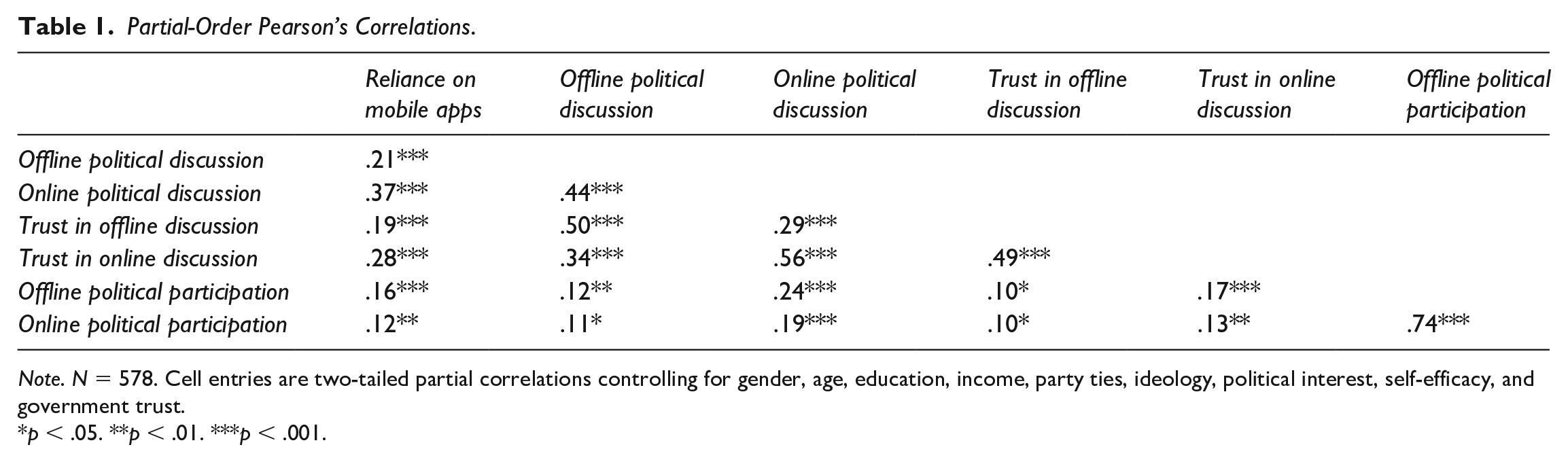
Note. N = 578. Cell entries are two-tailed partial correlations controlling for gender, age, education, income, party ties, ideology, political interest, self-efficacy, and government trust.
p < .05. **p < .01. ***p < .001.
Model testing
Figure 2 illustrates SEM with full information maximum likelihood procedure to predict offline political participation. Goodness-of-fit indices revealed an acceptable model fit: CFI = .89; χ2/df = 5.4, p < .001; RMSEA = .087, 90%-CI [.075; .099], SRMR = .07. Results in Figure 2 show both H1a and H1b are supported – relying on apps for political information directly increases reliance on both offline (H1a, b = .34, p < .001) and online (H1b, b = .53, p < .001) political discussion. Similarly, both H4a and H4b are supported – relying on apps for political information increases trust in both offline (H4a, b = .06, p < .05) and online (H4b, b = .07, p < .05) political discussion. However, most of the mediation analyses were not significant, indicating that reliance on offline political discussion (H2a), and trust in offline (H5a) and online (H6a) political discussion do not mediate the relationship between reliance on apps and offline political participation. Consequently, H2a, H5a, and H6a are rejected. The analysis shows the only significant mediation (see Table 2) is the one suggested by H3a – reliance on online discussion mediates the relationship between app reliance and offline political participation (H3a, b = 1.7834, p < .001). As such, H3a is supported.

SEM Model to Predict Offline Political Participation.
Sobel Test. Mediating Effects of Reliance on Online Discussion on the Relationship between Reliance on Mobile Apps and Political Participation (Online and Offline).
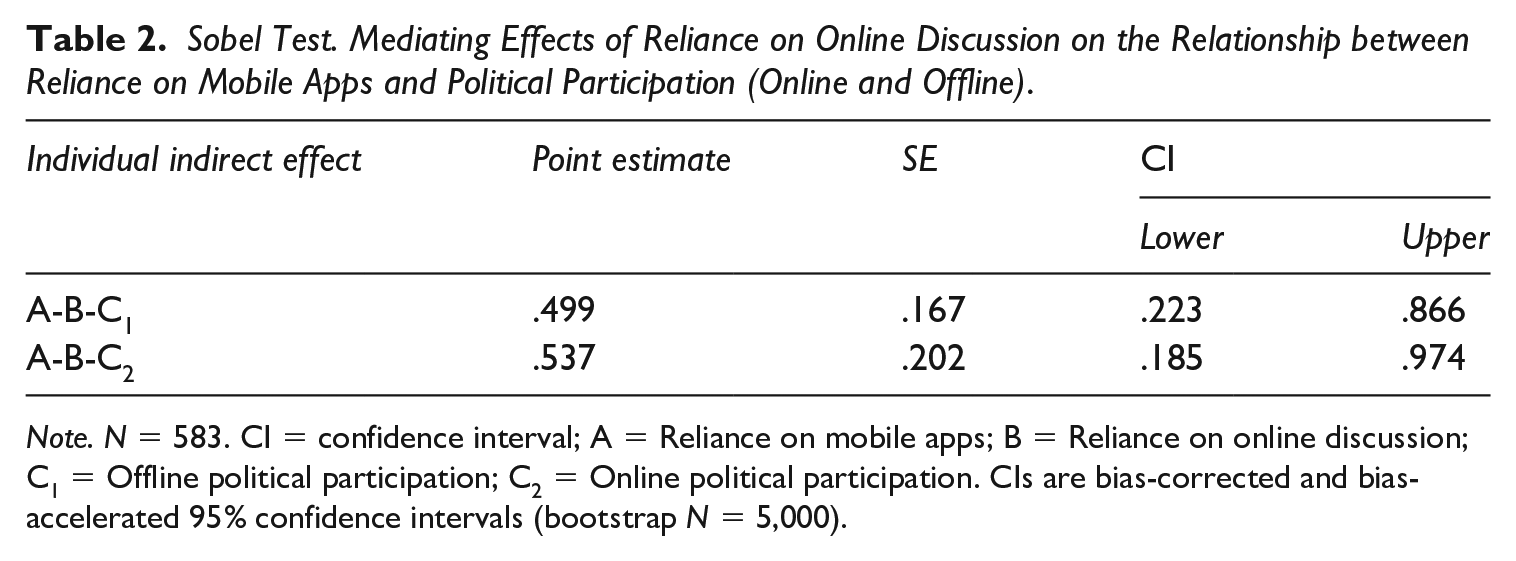
Note. N = 583. CI = confidence interval; A = Reliance on mobile apps; B = Reliance on online discussion; C1 = Offline political participation; C2 = Online political participation. CIs are bias-corrected and bias-accelerated 95% confidence intervals (bootstrap N = 5,000).
The model presented in Figure 3 replicates the model presented in Figure 2 to predict online political participation. Goodness-of-fit indices revealed an acceptable model fit: CFI = .89; χ2/df = 5.5, p < .001; RMSEA = .088, 90%-CI [.076; .100], SRMR = .07. The mediation analyses (see Table 2) indicate reliance on online political discussion mediates the relationship between reliance on apps and online political participation (H3b, b = 1.96, p<.01). However, reliance on offline discussion (H2b), trust in offline discussion (H5b), and trust in online discussion (H6b) do not mediate the relationship. Based on these results, H3b is supported, whereas H2b, H5b, and H6b are rejected.

SEM Model to Predict Online Political Participation.
Discussion
The number of mobile device users across the globe reached about 4.5 billion (about 62% of the world’s population) in 2016, and grew to 5.2 billion in 2020 (67%) (We are Social, 2020). Although on-the-go information is accessible through a device’s browser, apps are the prime gateway to information with users spending 90% of their mobile time on apps (Saccomani, 2020). Indeed, there are an estimated 4.4 million apps available for Apple and Android devices (Clement, 2020), underscoring the truth behind the saying “There’s an app for that.”
The explosive proliferation of mobile apps has spurred academic inquiry into who uses them and how they are used. Although there is evidence that reliance on apps for political news directly influences both offline and online political participation (Martin, 2014, 2015), more knowledge about how trust in discussion might alter or mediate that direct relationship is required. This study, then, adds reliance on mobile apps for political information to the O-S-R-O-R model, explores whether reliance on, and trust in political discussion are mediators between app reliance and political participation, and uses trust in offline and online discussion as a cognitive elaboration measure. With the O-S-R-O-R model as a baseline, the predictor variables and their relationships with participatory behaviors are addressed in the next sections. Moreover, this study shows that the O-S-R-O-R model (Cho et al., 2009) can be applied to mobile apps.
Reliance on apps, political discussion, and political participation
Users are attracted not only to the portability of mobile devices but also to the apps, which pop open with a tap on the screen. Apps are a quick and easy way of staying on top of political news, and interactive social features facilitate conversation about political events.
The direct relationship between reliance on mobile apps and political discussion was examined as part of this study’s path model. With the rise of mobile devices, media reliance and discussion have become more intertwined, especially as consumers who heavily rely on the media are also likely to discuss news with others. Discussion helps people process and understand political issues (Hardy & Scheufele, 2005, Nisbet & Scheufele, 2004) and, in turn, increases interest in them (Shah, 2016; Shah et al., 2007). The conversation is amplified when users share, post, and comment via both closely and loosely connected networks (Campbell, 2015, 2019).
In addition to the direct relationship between app reliance and reliance on political discussion, this study’s path model also tested the indirect effect of app reliance on political participation through offline and online political discussion. The results largely support an indirect effect of app reliance on both offline and online political participation through online discussion. However, reliance on offline discussion does not mediate the relationship between app reliance and either offline or online political participation.
These results could be explained by the differences between offline (face-to-face) and online app discussion. Offline discussion usually takes place among friends or family members who might not offer the same broad perspectives as an online network. Agreeable information coming from intimate discussion does not require deep thought to process and, thus, does not give people a strong impetus to become politically active. Mobile device apps, on the other hand, have the potential to expose users to a wide range of perspectives. As learned from the Occupy Wall Street movement and the Arab Spring, communicating through mobile device apps strongly encourages political participation, both offline and online.
Reliance on apps, trust in discussion, and participation
To explain more fully the relationships between reliance on apps, political discussion, and political participation, this study’s path model examined trust in discussion as a mediator and as a measure of cognitive elaboration. Reliance on mobile apps is directly and positively linked to trust in offline and online discussion for obtaining political information. This finding reflects other studies that suggest reliance and trust are strongly correlated (Campbell, 2015, 2019). Yet, this study found that neither trust in offline discussion nor trust in online discussion mediate the relationship between reliance on apps and political participation. Although the act of talking about politics increases trust in discussion (Campbell, 2015, 2019), and trust in discussion is a mediator between discussion and participation (Huckfeldt & Sprague, 1995; Kenny, 1998), this study does not offer the same conclusions.
A possible explanation for finding that neither trust in offline nor online discussion is a mediator is the extent to which individuals trust political discussion. As indicated in the respondent profile, trust in face-to-face discussion is higher than trust in online political conversation, and both are deemed moderately trustworthy with small variance. Offline and online mobile app networks that are trusted are seen as emotionally supportive (Campbell, 2015; Campbell & Kwak, 2011; Valenzuela, et al., 2018), thereby reinforcing participants’ political viewpoints and, thus, presumably giving them a comfortable space for deliberation. However, those undertaking research on information processing indicate there is little need to challenge trusted discussion; as a result, trust could encourage heuristic thinking, thereby short-circuiting systematic processing and reducing cognitive elaboration (Metzger & Flanagin, 2015). As this study found, even moderate levels of trust in discussion could reduce the impetus to take on the political world and participate in activist movements.
In sum, this study discovered that mobile apps are worthy of study as a source of political information. Its importance lies in its consideration of mobile app reliance as the stimulus in the O-S-R-O-R model, because reliance is a more powerful predictor of attitudes and behaviors than frequency of media use (Miller & Reese, 1982; Moy et al., 2005). As this study shows, reliance on mobile apps is strongly connected to reliance on offline and online political discussion, trust in offline and online discussion, and political participation. Moreover, online discussion is a more effective mediator than offline discussion for assessing the effect of mobile apps on political behaviors. The path model also advances the study of cognitive elaboration from some earlier works (Jung et al., 2011; Kim et al., 2018) by gauging it in terms of trust in online discussion.
Limitations
Although the quota sample used in this study was representative for most demographic measures, it was not random. In addition, the cross-sectional nature of the study limits causal claims. Further, although using single-item measures of reliance and trust might be limiting, studies show that broad single questions can potentially produce more robust results than multidimensional measures that may leave out important elements or include unimportant ones, thus reducing their efficacy (Nagy, 2002; Wanous et al., 1997).
Future research
This study focused on using mobile apps for political news, but a broader analysis could determine whether participation is influenced in a different way by accessing political information other than that obtained from apps, such as from a mobile device’s internet browser, or by texting, emailing, or using social media. Future studies could focus on the most-used apps for obtaining political information, and could shed light on the persuasive role of some apps over others. Perhaps future studies could explore what nature online networks would have to display to inspire trust. The dependent variables in this study are offline and online discussion for obtaining political information; however, Shah et al. (2017) provide a roadmap of other variables to test in future O-S-R-O-R studies, for example, what constitutes “facts,” institutional confidence, and faith in basic democratic outcomes.
Although mobile app reliance is the stimulus in this study, future studies could directly compare mobile app reliance with mobile app frequency to determine which is the superior measure. They could also include motivations for relying on mobile apps, particularly political surveillance, as a key independent variable.
Footnotes
Funding
The author(s) received no financial support for the research, authorship, and/or publication of this article.
