




Abstract
Research demonstrates that phubbing—the act of snubbing someone in a social setting by looking at one's mobile phone—interferes with the quality and satisfaction of social interactions. This article examined how observations of an adult's phone use during a social interaction impact different social judgments. Adult participants (n = 331) watched a 3-min video showing four speakers having a discussion around a table. One speaker looked at their phone intermittently during the meeting (five times for 2–3 s each) while not interacting with the other speakers. Participants were asked to rate characteristics (e.g., attentiveness) of all four speakers and evaluate who they could trust both epistemically (e.g., for knowledge) and interpersonally (e.g., for social connection). Participants also provided information about their own technology use. Results indicated that participants’ judgments, ratings of interpersonal trust, and epistemic trust toward the phone user were significantly lower when compared to their ratings toward the non-phone users in the video, especially among female participants. Additionally, the more participants reported using their own phones during group interactions, the more leniently they rated the phone user in the video. This research provides evidence that overseeing acts of co-present mobile phone use are negatively evaluated. This has implications for how adults view technology use during social engagements.
Introduction
The use of technological devices has increased in the past 20 years. Today, over 80% of Americans own smartphones (Pew Research Center, 2019), which have become an inextricable part of people’s daily lives (Jones, 2014; Oulasvirta et al., 2011; Roberts et al., 2014). Although there are several benefits arising from the rise in access to smartphones, one consequence is a relatively new phenomenon called phubbing. Phubbing, a blend of the words “phone” and “snubbing,” describes the act of snubbing someone in a social setting by looking at one's phone instead of engaging in a face-to-face communicative exchange (Chotpitayasunondh & Douglas, 2018). Given the rise in smartphone use and increased prevalence of phubbing, there is growing interest in studying the effects of phubbing on a variety of outcomes.
Phubbing
A relatively new and burgeoning literature investigates the use of media during social situations. Several terms have been used to describe disruptive phone use. Technoference (McDaniel & Radesky, 2018), or media-related interruptions during social interactions, is one, and phubbing (Karadağ et al., 2015), or looking at one's phone instead of others in same space during a social situation, is another. Indeed, the array of conceptualizations and the interchangeable use of terms to describe this phenomenon make it difficult to coalesce around a central definition of the term and its associated behavioral outputs (Frackowiak et al., 2023b). Co-present mobile phone use, a term offered by Kelly and Miller-Ott (2022), has been offered as a useful way of conceptualizing phubbing behavior.
Phubbing—or co-present mobile phone use—has been studied across interactions among friends (Brown et al., 2016; Miller-Ott & Kelly, 2017), conversations between romantic partners (McDaniel & Coyne 2016a; McDaniel et al., 2018; Miller-Ott & Kelly, 2015, 2016; Roberts & David, 2016), talk between coworkers (Roberts & David, 2017), trainer–trainee communications (Cameron & Webster, 2011), and communication among family members and children (Hiniker et al., 2015; Kushlev & Dunn, 2018; McDaniel & Coyne, 2016b; McDaniel & Radesky, 2018). Co-present mobile phone use represents a violation of what is expected during a conversation: that one would have the full attention of the other person (Miller-Ott & Kelly, 2015). In work investigating phubbing, research with adults suggests that phubbing occurs frequently (Al-Saggaf & O’Donnell, 2019; Vanden Abeele et al., 2016) and negatively impacts interaction quality, producing feelings of social exclusion and lower conversational intimacy (Chotpitayasunondh & Douglas, 2018; Dwyer et al., 2018; Kushlev & Dunn, 2018; McDaniel et al., 2018; Vanden Abeele et al., 2016). Moreover, phubbing has been shown to produce less interactional enjoyment, more strained interactions, lower feelings of connectedness, and missed non-verbal cues and communication (Frackowiak et al., 2023a, 2023b; Ochs & Sauer, 2023). For example, Vanden Abeele and colleagues (2016) found that phubbing negatively affected impression formation, social attraction, and overall interaction quality. In the workplace, a supervisor's phubbing behavior has been shown to impact workplace culture, producing feelings of rejection and social exclusion amongst employees (Yasin et al., 2023). Cameron and Webster (2011) found that during a professional training session, new trainees rated trainers who phubbed as inattentive, rude, and disrespectful. Thus, phubbing has been found to result in negative social evaluations about the phubber in both personal and professional contexts.
Several determinants of phubbing have been explored, including gender and age. Historically, gender has played an important role in behaviors related to mobile devices, such as preference for online versus face-to-face interactions (Harrington & Loffredo, 2010; Harris & Gibson, 2006), mobile phone and Internet addiction (Chiu et al., 2013; Koo & Park, 2010; Pawłowska & Potembska, 2011), and communication etiquette (Forgays et al., 2014). There is evidence suggesting that gender differences may exist for phubbing (Al-Saggaf & O’Donnell, 2019). For example, in one study, females were found to engage in phubbing toward companions more often and for longer durations than their male counterparts (Chotpitayasunondh & Douglas, 2016). Alternatively, a study surveyed college students and found higher rates of phubbing by male students compared to female students (Escalera-Chavez et al., 2020). Gender has also been found to moderate relations between mobile device behaviors (i.e., phubbing) and Internet use frequency. For example, Karadağ and colleagues (2015) found that increased phubbing amongst females was predicted by addictions to text messaging and social media, whereas phubbing amongst males was better predicted by Internet and gaming addictions.
Like gender, age-related differences are also well established in the technology domain. One reason may be that older adults lived during a period when access to technology was more limited; therefore, they may have established different phone manners about the use of technology (Al-Saggaf et al., 2019; Turkle, 2016; Turner et al., 2008). In general, research finds that older adults tend to view others’ smartphone behavior as more negative compared to their own (Al-Saggaf & O’Donnell, 2019; Hakoama & Hakoyama, 2012; Schneider & Hitzfeld, 2021). For example, Forgays et al. (2014) found that adults aged 18–34 years held more favorable views about cell phone usage when compared to adults over 50 years. Indeed, other work supports that young adults aged 18–34 years use smartphones quite differently from adults over 50 years. Young adults, and less so older adults, often use smartphones to signal their social affiliation, build social relationships (Guazzini et al., 2019; Hall & Baym, 2012; Quan-Haase, 2007), and manage romantic relationships (Duran et al., 2011). As it relates to phubbing, a study by Al-Saggaf and colleagues (2019) found a negative association between self-reported frequency of engaging in phubbing and age. Taken together, research shows that gender and age likely impact how adults engage with technology and their dispositions to engage in phubbing-related behaviors.
Impression formation
A distinct literature focuses on impression formation. Based on a large body of work on person perception, we know that adults form impressions of others frequently and for a variety of reasons. In as little as 100 ms, adults form impressions about others’ intelligence, trustworthiness, and benevolence (Willis & Todorov, 2006). For example, a large-scale study of adult implicit and explicit attitudes and stereotypes found that adults held stereotypes and social preferences for strangers based on several demographic categories and social domains (Nosek, 2007). These judgments of others based on characteristics or behaviors have been shown to have practical implications. In the workplace, for example, stereotypes can result in discriminatory decisions regarding who to hire, promote, or even provide a raise to (Coffman et al., 2017, 2021). Of course, further research is needed, but a behavior like phubbing may mean the difference between a job offer and a dismissal. Considering the speed with which adults form impressions, several questions arise regarding how phubbing might impact these types of workplace decisions.
First impressions have also been shown to impact trust (Winkielman & Nowak, 2022; Yu et al., 2014). Trust is an important construct that binds people together, is essential to maintaining romantic and professional relationships (Krot & Lewicka, 2012), and fosters social behaviors and collective action (Hakanen & Soudunsaari, 2012; Hattori & Lapidus, 2004; Holton, 2001; Putnam, 1993). Trust also encourages individuals to seek company, share resources, cooperate (Fukuyama, 1995; Tyler, 2001; Yamagishi & Yamagishi, 1994), take appropriate risks, and expose vulnerabilities (Rousseau et al., 1998; Schoorman et al., 2007; Schul et al., 2004, 2008). Furthermore, trust increases the likelihood that individuals will share information and communicate openly (Politis, 2003). Given the ubiquitous role that trust plays in human life and societal functioning, it has received a wealth of empirical attention from scientists across multiple disciplines. Here, in line with previous work in psychology, we conceptualize trust as a multifaceted construct composed of two distinguishable types: epistemic trust and interpersonal trust (Johnson & Grayson, 2005; Pesch & Koenig, 2021). Epistemic trust has to do with how likely people are to trust someone as a source of information; interpersonal trust is how likely people are to trust someone as a source of comfort or connection (Pesch & Koenig, 2021). Distinguishing these two trust types and measuring them separately allows for a more nuanced assessment of how co-present mobile phone use might impact trust.
The consequences of phubbing use on impression formation merit empirical investigation, since this type of behavior has been shown to have repercussions in personal and professional environments. Indeed, phones are now ubiquitous, and conventions associated with their use may be in flux. There are many unanswered questions about how phubbing might impact adults’ perceptions of the individuals who engage in this behavior. For example, if phubbing promotes poor trust of both an intellectual and interpersonal nature, how long do these effects last for the viewer? Would they show similar responses to these individuals if brought back after one week? And finally, are there things a phubber can say to mitigate these negative effects?
While there are a host of additional questions to tackle in light of the phubbing phenomenon, the present study offers an initial investigation that bridges work on phubbing with work on adult impression formation to understand how disruptive media behavior impacts how adults perceive those who engage in it. In particular, the present investigation is the first to our knowledge to ask whether overseeing co-present mobile phone use behavior is viewed negatively, which would provide initial evidence that phubbing, and the negative feelings associated with it, transfer beyond direct experiences of being phubbed.
Research questions and hypotheses
We investigated adults’ impressions of another individual looking at their phone during an in-person social interaction. Looking at one's phone, thereby foregoing engagement with others in a social exchange, is a definition of phubbing offered by Karadağ and colleagues (2015). Measuring how adults view this type of behavior when it is overseen, rather than directed toward them, allowed us to investigate the extent to which the phubbing phenomenon generalizes beyond direct impact. Thus, we asked the following research questions:
How does repeatedly looking at one's phone during an in-person meeting impact adult observers’ character judgments about that individual? How does repeatedly looking at one's phone during an in-person meeting impact adult observers’ impressions of epistemic (knowledge-based) trust and interpersonal (social-based) trust of that individual? What role does self-reported technology use in the workplace play in adult observers’ ratings of an individual who repeatedly looks at their phone in the presence of others?
We made several predictions. First, we predicted that if observing this type of behavior (that of looking at one's phone during a social exchange) is considered an act of phubbing, then participants would rate the phone user more severely across measures of judgment and trust compared to their other three companions in the video. Second, based on work investigating phubbing moderators, we anticipated that if observations of others’ co-present mobile phone use are considered acts of phubbing, then our participants’ evaluations of phone users would differ based on age and gender. Specifically, we predicted that participants older than 50 and females would evaluate phone users more negatively compared to participants younger than 40 and males. Finally, we included a measure of self-reported technology use to evaluate how participants’ own technology use relates to their ratings of adults they observe looking at their phone during an in-person meeting. We predicted an inverse relationship between the frequency of self-reported technology use and ratings of phone users on our dependent measures.
Method
Procedure
We recruited 331 adults using the Amazon Mechanical Turk platform (hereafter mTurk). The task was posted on the platform under the title “Video Study” and was available between November 16, 2020 and November 30, 2020. Participants had to be over the age of 18, live in the United States, and had to achieve a 95% completion rating. When they clicked on the study, participants were asked to provide their gender (i.e., male, female, and prefer not to answer), age range (i.e., 18–35, 36–50, and over 50), and their Amazon Worker Identification Number. They were then told that the task involved viewing a short video and answering a series of questions.
If participants chose to continue, they clicked the provided link, which redirected them to the experiment on Qualtrics. Participants read a university IRB-approved consent form explaining the study procedure, compensation, and any risks or benefits of the study. Participants then had the choice to click “yes,” to participate in the study, or “no,” which ended the experiment. Participants were given a total of one hour to complete the experiment on Qualtrics and the average respondent took 15 min to do so.
Participants were randomly assigned to view one of four videos (described below) and were then asked a series of questions about each of the adults they saw in the video, as well as measures of their own mobile phone use. Participants were then debriefed and compensated for their time.
Materials and measures
Phubbing videos
Participants were randomly assigned to see one of four videos. Each of these videos lasted 180 s and was recorded with a standard video camera in a 12 × 12 ft room. Each video included the same group of four young adults talking casually, in English, while sitting around a table with one sheet of paper in front of each discussant. The group consisted of two men (one African American, one White) and two women (both White). All videos were recorded on the same day, with the same four adults, who spoke for about 40 s each. The video was then converted into an .mp4 and the content of the conversation was masked using a low-pass filter, which distinguished between individual voices, but made the words unclear. The adults sat in the same location in each video and did not alter their appearances across videos. The four videos differed regarding which of the four people could be observed looking at their phone during the conversation (see Figure 1 for an example). In each video, one of the adult speakers picked up a smartphone five times throughout the conversation. During these pick-ups, the speaker disengaged from the conversation and looked at their smartphone for approximately 3–5 s. Due to the randomization, one-quarter of the participants saw each of the four speakers engage in this behavior. Participants received no information about any of the speakers they were asked to evaluate. Thus, the only novel behavior in the video was that of looking at one's phone, and the speaker who engaged in this behavior was counterbalanced across participants in four conditions in a between-participants design.

This image depicts the type of co-present mobile phone use behavior that participants observed. Note that the speaker who looked at their phone was counterbalanced across participants.
Judgments
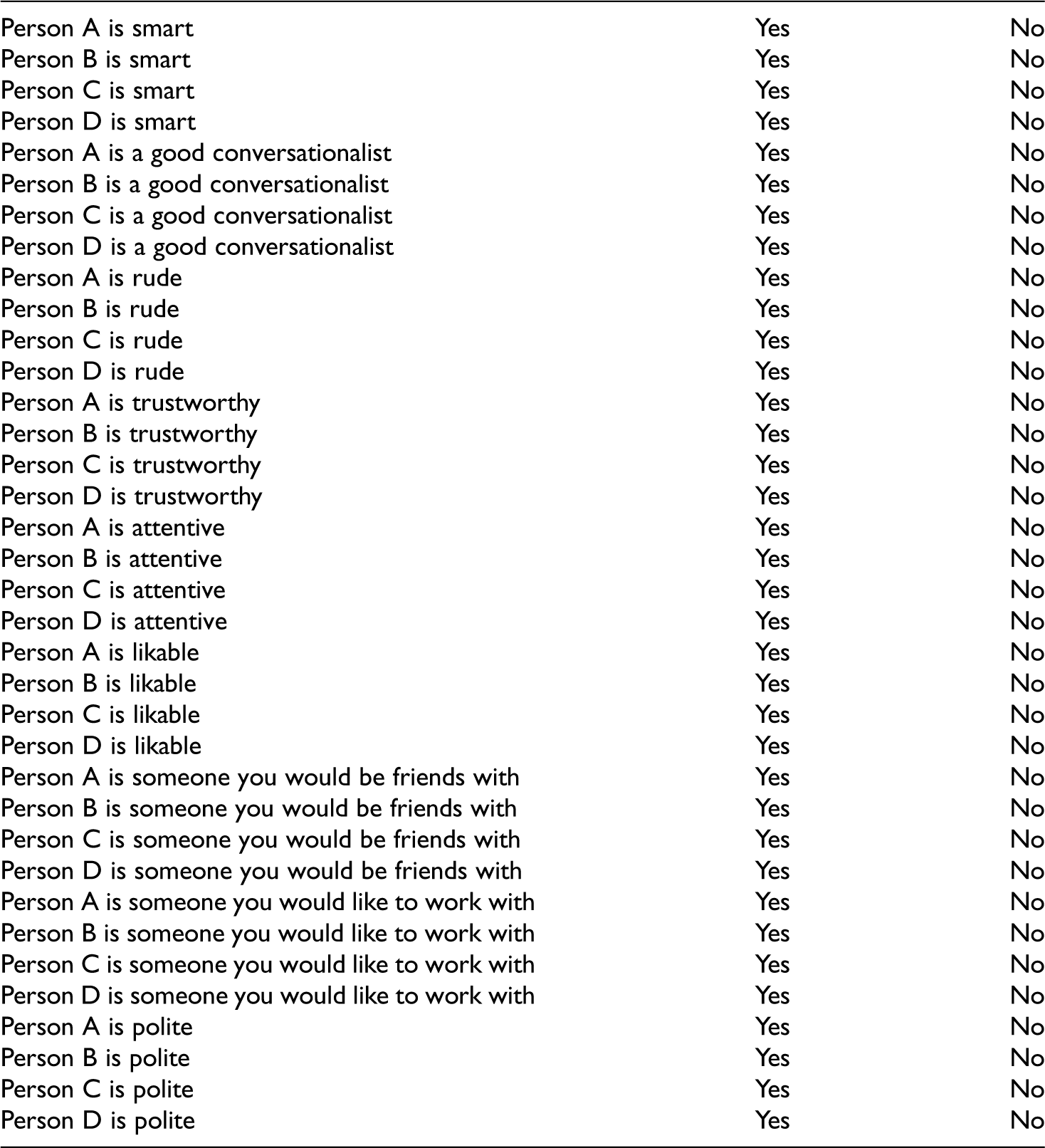
Immediately following the video, participants in all conditions were shown a still photo that assigned each speaker with a letter (A–D). None of the speakers were shown with a phone in this photo. Participants were first asked to complete one 10-item judgment assessment about each adult from the video. Two of the questions were adapted from a previous study investigating the role of phubbing on incivility (i.e., rudeness) between trainers and trainees (Cameron & Webster, 2011). Three questions were adapted from another study assessing students’ explicit judgments toward their teacher (Pesch & Koenig, 2021). Five additional items aimed to capture participants’ judgments of each speaker's traits, rating each on attentiveness, likability, trustworthiness, good conversationalist, and being someone with whom they would like to work. Participants were asked to indicate either “yes” or “no” for each judgment question about all adults in the video (e.g., “Is Person A polite?”). Full question wordings and response scales are shown in Online Appendix A. An overall score was calculated by averaging the number of times the participant indicated “yes” (“no” for judgment question 4) on the set of questions for each person in the video, yielding four scores for each participant (Range: 0–1).
Epistemic trust and interpersonal trust
Next, participants were asked to provide their impression of how epistemically trustworthy and interpersonally trustworthy the adults in the video were. To assess epistemic trust, participants were asked to indicate how much each speaker knew about different things (e.g., plants, animals, cars, fruit, cooking), with response options nothing (0), a little (1), and a lot (2). To assess interpersonal trust, participants were asked to indicate how often each speaker engaged in different behaviors (e.g., keeps promises, listens to others, helps others), with response options never (0), sometimes (1), and all the time (2). Full question wordings and response scales are shown in Online Appendix B. An epistemic trust and interpersonal trust score was calculated for each speaker by averaging across the 10-item scale (Range: 0–2), yielding four epistemic trust scores and four interpersonal trust scores for each participant.
Self-reported technology use
Finally, participants provided information about their own technology use during workplace meetings (Online Appendix C). Participants were asked if during face-to-face meetings and meetings held on a video conferencing application, they had ever used their mobile devices to engage in the following tasks: work-related tasks, checking or responding to messages, using social media, reading news or articles, playing games, other. Frequencies of engaging in these activities were measured by prompting participants to recall how many times they engaged in these activities on mobile devices and on their computers during in-person meetings in a typical week before lockdowns caused by the COVID-19 pandemic. Participants used a 6-point Likert scale, responding with have not done (1), 1–2 times (2), 3–4 times (3), 5–6 times (4), 7–8 times (5), and more than 8 times (6). In addition, participants were asked how often they had engaged in unrelated tasks on both mobile devices and computers during virtual meetings taking place on video conferencing applications in the seven days prior to participation. For both in-person and online meetings, it was made clear that collaborative tasks, such as editing a document together, and activities related to the meeting's agenda, including presentations, were not to be included in their responses.
Demographics
During recruitment to the study, participants were asked about their gender identification and age category. A total of 166 identified as female (51.2%) and 3 said they preferred not to answer (0.01%). Participant ages were coded into three categories: 163 young adults (49.2%; whose ages ranged from 18 to 35 years old), 106 middle-aged adults (32.0%; 36–50 years old), and 62 older adults (18.7%; > 50 years old). Due to terms of service associated with the use of mTurk, we were prohibited from asking about race. Demographic distributions by condition can be found in Online Appendix D. Thirty participants had partial data. To mitigate any possible biases due to the influence of missing data, multiple imputation was conducted using the MICE package in R (van Buuren & Groothuis-Oudshoorn, 2011).
Results
Judgments
We first examined participants’ judgments of the speakers. Multilevel mixed effects linear regression was conducted in R using the lme4 package (Bates et al., 2015). Judgment score was predicted from the fixed effects of speaker evaluated (speaker A, B, C, or D), phone use status (phone user vs non-phone user), age group (young adult, mid-aged adult, older adult), gender (male vs female), and their interactions. In all models, a random effect was included to account for participant differences, which accounted for any residual differences in typical ratings across respondents. To determine both whether there was an overall effect of phone use and whether age or gender moderated that effect, we first tested a baseline model including only phone use status, speaker evaluated, and an interaction between the two. We then examined whether including interactions with participant age category or gender improved fit. All interactions were assessed using Wald tests to determine whether the presence of the interaction improved model fit.
Regardless of the identity of the phone user, participants rated that speaker more harshly than the other speakers in the video on the judgment scale. This was apparent from a significant two-way interaction between speaker evaluated and phone use status in the baseline model (Wald χ2 (3) = 28.51, p < 0.001). That is, speakers were rated differently when looking at their phone versus when they were not. For all pairwise comparisons where a non-phone using speaker could be compared to a phone user, the individual who looked at their phone was evaluated more negatively (Bonferroni adjusted ps < 0.0001). Additionally, when comparing non-phone users to each other, person C was evaluated more negatively compared to persons A (p = 0.001) and B (p < 0.05). By contrast, when comparing phone users to each other, person A was evaluated more negatively compared to person C (p < 0.001).
Regardless of age group, participants rated phone users more harshly. This was apparent from a significant two-way interaction between phone use status and age group (Wald χ2 (2) = 8.09, p = 0.01). For all pairwise comparisons where a phone user could be compared across age groups, they were rated worse (Bonferroni adjusted ps < 0.0001). Finally, participants rated phone users more harshly by gender, evidenced by a significant two-way interaction between phone use status and gender (Wald χ2 (1) = 20.33, p = 0.001). Again, for all pairwise comparisons where phone users could be compared across gender, they were rated worse (Bonferroni adjusted ps < 0.0001). In addition, whereas female participants rated non-phone users more positively than male participants (p < 0.01), they rated phone users more negatively (p < 0.01). That is, when compared to male participants, female participants had more favorable views of individuals who did not look at their phone, and more severe condemnation of those who did (see Figure 2).

Judgment scores by gender, phone use status, and age group.
Epistemic trust and interpersonal trust
Next, multilevel mixed effects linear regression was conducted to predict trust from the fixed effects of speaker evaluated (speaker A, B, C, or D), phone use status (phone user vs non-phone user), age group (young adult, mid-aged adult, older adult), gender (male vs female), trust type (epistemic vs interpersonal), and their interactions. In all models, a random effect was included to account for participant differences. To determine both whether there was an overall effect of phone use status and whether age or gender moderated that effect, we first tested a baseline model including only phone use status, the speaker evaluated, trust type, and their interactions. We then examined whether including interactions with the respondent age category or gender improved fit. All interactions were assessed using Wald tests to determine whether the presence of the interaction improved model fit.
Significant main effects of person evaluated (Wald χ2 (3) = 11.55, p < 0.01), phone use status (Wald χ2 (1) = 204.64, p < 0.001), and trust type (Wald χ2 (1) = 266.07, p < 0.001) emerged from the baseline model. Participants indicated less trust in person A compared to persons C and D (Bonferroni adjusted ps < 0.001). Participants also indicated less trust in person B compared to person C (Bonferroni adjusted p < 0.05). Second, participants indicated less trust in phone users (M = 0.93, SD = 0.44) compared to non-phone users (M = 1.15, SD = 0.43). Third, participants’ interpersonal trust (M = 1.20, SD = 0.43) was higher than their epistemic trust (M = 0.99, SD = 0.43).
The following interactions emerged from the baseline model. First, a significant two-way interaction between phone use status and speaker evaluated indicated that regardless of the identity of the phone user, participants rated them as being less trustworthy than non-phone users (Wald χ2 (3) = 14.31, p < 0.01). Where a non-phone using speaker could be compared to a phone user, the individual who looked at their phone was less trusted (Bonferroni adjusted ps < 0.0001). In addition, participants’ trust in the speakers did not differ when comparing conditions in which they did not look at their phone (ps = ns). By contrast, when they did look at their phone, trust in Person A (M = 0.91, SD = 0.44) was significantly lower compared to when Person C (M = 0.99, SD = 0.44, p = 0.003) and Person D (M = 0.95, SD = 0.46, p = 0.04) looked at their phone. In addition, when they looked at their phone, trust in Person B (M = 0.88, SD = 0.42) was also significantly different from Person C (M = 0.99, SD = 0.44, p = 0.002). Next, there was a significant two-way interaction between trust type and phone use status (Wald χ2 (1) = 46.99, p < 0.001). Epistemic and interpersonal trust was lower when participants evaluated phone users compared to non-phone users (Bonferroni adjusted ps < 0.001).
Finally, there was a three-way interaction between person evaluated, phone use status, and trust type (Wald χ2 (3) = 12.23, p < 0.01). To explore the three-way interaction, separate linear mixed effects models were conducted for each trust type: epistemic trust and interpersonal trust. The model on epistemic trust revealed a significant effect of phone use status (Wald χ2 (1) = 50.74, p < 0.001) and person evaluated (Wald χ2 (3) = 15.83, p < 0.01). Epistemic trust was significantly impacted by phone use (phone user: M = 0.90, SD = 0.43; non-phone user: M = 1.02, SD = 0.43). In addition, person A was rated less epistemically trustworthy compared to persons B and C (Bonferroni adjusted ps < 0.05). The model on interpersonal trust revealed a significant effect of phone use status (Wald χ2 (1) = 232.99, p < 0.001) and a significant two-way interaction between phone use and speaker evaluated (Wald χ2 (3) = 18.73, p < 0.001). Interpersonal trust was significantly impacted by phone use status (phone user: M = 1.28, SD = 0.39; non-phone user: M = 0.96, SD = 0.46). In addition, whereas interpersonal trust did not differ across the speakers evaluated when they did not look at their phone, persons C and D were less harshly rated when they looked at their phone (see Figures 3 and Figure 4).

Epistemic trust scores by gender, phone use status, and age group.

Interpersonal trust scores by gender, phone use status, and age group.
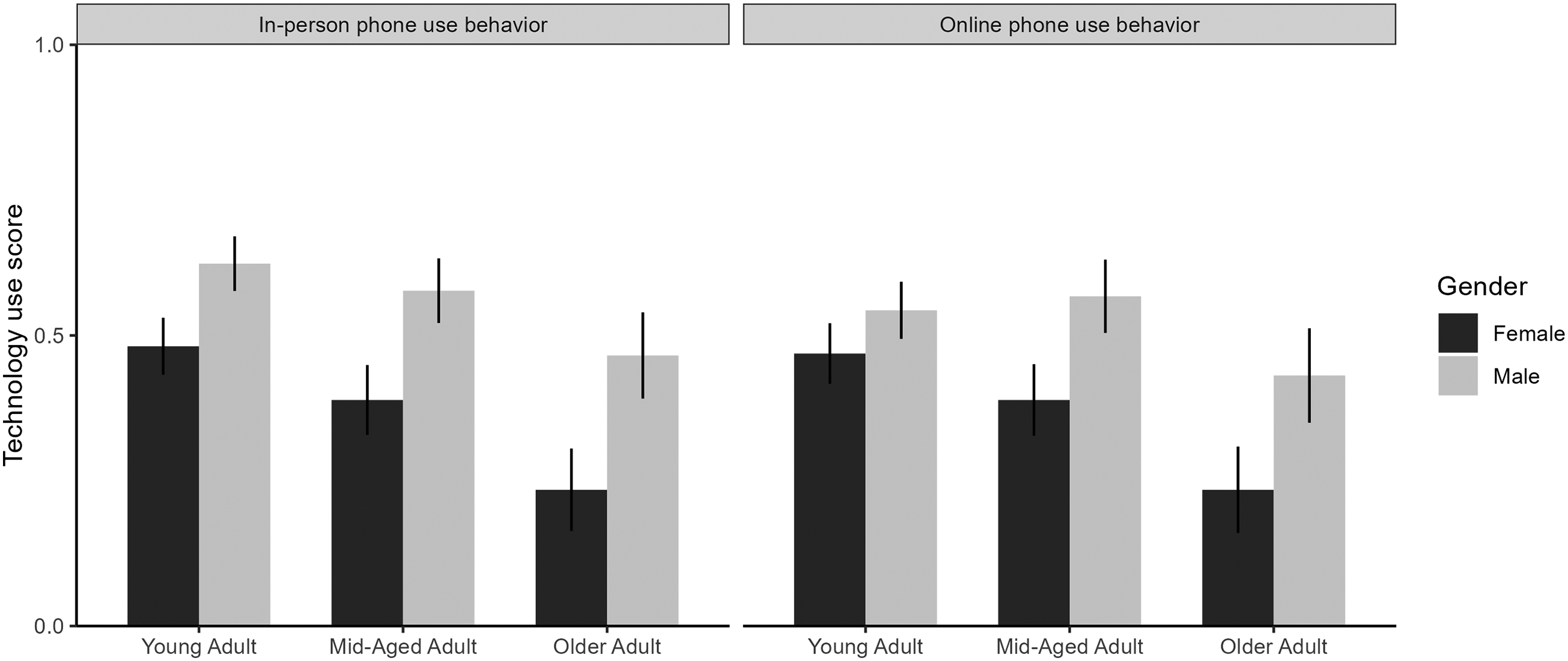
Self-reported technology use separated by in-person vs online behaviors, gender, and age group.
In the next step, we examined the effect of age group (young adult, mid-aged adult, older adult) to trust score. The model was not significant (χ2 (32) = 37.37, p = 0.23), suggesting that age did not explain any additional variance in trust score above and beyond speaker evaluated, phone use status, and trust type. In step 3, we examined gender. The model with gender was significant (χ2 (16) = 31.51, p = 0.01). The model revealed a significant two-way interaction between gender and phone use status (Wald χ2 (1) = 15.29, p < 0.001). For all pairwise comparisons where phone use status could be compared across gender, phone users were rated worse than non-phone users (Bonferroni adjusted ps < 0.0001). The effect of phone use was different for each person depending on whether they looked at their phone or not.
Self-reported technology use
Participants’ own technology use during workplace meetings was examined. Participants were asked to indicate whether they have used technology in in-person meetings (2 items: computer use and mobile phone use) and virtual meetings (2 items: computer use and mobile phone use). Two scores were calculated, one for in-person meeting technology use and a second for virtual meeting technology use by averaging across the two items. A repeated measures ANOVA was conducted with age group and gender entered as between-subjects factors and meeting type (in-person vs virtual) entered as a within-subjects factor, and score entered as the dependent variable. The analysis revealed a significant main effect of age group (F(2, 322) = 5.295, p = 0.005, ηp2 = 0.032). Follow-up pairwise comparisons with a Bonferroni adjustment confirmed higher rates of technology use among young adults (M = 0.52, SD = 0.44) and mid-aged adults (M = 0.46, SD = 0.44) compared to older adults (M = 0.32, SD = 0.43), (all ps < 0.05). In addition, there was a significant main effect of gender (F(1, 322) = 13.194, p = 0.0003, ηp2 = 0.039): male participants (M = 0.55, SD = 0.43) reported higher rates of technology use compared to female participants (M = 0.38, SD = 0.44) (see Figure 5).
Relations between participants’ technology use, judgments, epistemic and interpersonal trust
We were interested in exploring the relationship between self-reported technology use and participants’ judgments of and trust in the speaker they observed looking at their phone. To this end, a series of multiple linear regression models were conducted to examine contributions of self-reported technology use during workplace meetings controlling for age, gender, and speaker who used their phone (condition 1: speaker A; condition 2: speaker B; condition 3: speaker C; or condition 4: speaker D). Since the previous analysis found no effect of meeting type (face-to-face vs online), these questions were collapsed to form one technology use score (M = 0.47, SD = 0.40). The results are shown in Table 1. Participants’ self-reported technology use during meetings emerged as a significant predictor of judgment (b = 0.113, SE = 0.048, p = 0.019) above and beyond age, gender, and condition, indicating that more self-reported engagement in technology during workplace meetings was associated with more positive judgments of the phone user.
Results of linear regression models predicting judgments, epistemic trust, and interpersonal trust in the phone user by age, gender, condition, and self-reported technology use.

Note: The reference group for age group was young adult, female for gender, and condition 1 for condition. Condition differences reflect which speaker looked at their phone.
* p < .05, ** p < .01, *** p < .001.
Discussion
While a growing body of work investigates how phubbing impacts human interactions, we still know very little about the impressions adults draw about those whom they merely observe using technology in the presence of others. In the present study, we examined this by asking adult participants to rate characteristics (e.g., attentiveness) and evaluate whom they could trust both epistemically (e.g., for knowledge) and interpersonally (e.g., for social connection) of four speakers (one of whom repeatedly looked at their phone) in a group meeting.
To achieve this, adult participants watched a short video clip of a group meeting where one individual in the group repeatedly looked at their phone. Adults then responded to a set of judgment questions about each of the four speakers and indicated how much they trusted each speaker to be a source of information (epistemic trust) and a benevolent social partner (interpersonal trust). Participants also completed a technology questionnaire assessing their own technology use. We expected that if observing this type of behavior (that of looking at one's phone during a social exchange) is considered an act of phubbing, then participants would rate the phone user more severely across measures of judgment and trust compared to their other three companions in the video. Given previous research on phubbing moderators, we also predicted that if observations of another person's co-present mobile phone use are considered acts of phubbing, then our participants’ evaluations of phone users would differ based on age and gender. Finally, we predicted an inverse relationship between the frequency of self-reported technology use and ratings of phone users on our dependent measures.
The impact of phone use on observers’ judgments, epistemic trust, and interpersonal trust
In line with our predictions, adult participants rated phone users lower than non-phone users on our judgment and trust assessments. These findings align with previous research on adults’ reported perceptions and attitudes toward phubbing when they are the recipient of the behavior, and extend beyond this prior work to suggest that even overseeing acts of co-present mobile phone use are negatively evaluated.
Specifically, we found that participant gender was a significant moderator of judgments and interpersonal trust. Female participants rated phone users lower when asked to make character judgments about them, whereas male participants demonstrated less severe condemnation when making the same assessments. Similarly, female participants indicated less interpersonal trust in phone users compared to male participants. Our findings align with extant research on phubbing that suggests females experience being phubbed more frequently than males and report experiencing more negative feelings toward it (Chotpitayasunondh & Douglas, 2016). Given this, one interpretation of female participants' condemnation of phone users in the present study is that females view co-present mobile phone use more negatively than males due to their frequent and negatively valanced direct experiences with it. Indeed, this may be due to male participants reporting higher rates of technology use compared to female participants in online and in-person social interactions. Here, we found that adults who reported high rates of technology use did not rate individuals who looked at their phone as harshly as those with lower rates of self-reported technology use. Future work is needed to understand how frequently individuals experience phubbing in daily social exchanges, their perceptions of it, and how this impacts attitudes of others who engage in this type of behavior.
In addition, while we found that phone use impacted participants’ extensions of both types of trust, this finding is qualified by a greater impact on extensions of interpersonal trust. That is, when participants were asked to indicate how much they trusted each speaker from the video as a source of support, comfort, and friendship (interpersonal trust), they indicated high levels of interpersonal trust in speakers who did not look at their phone and low levels of trust in speakers who did. By contrast, when asked to indicate how much they trusted each speaker as a source of information (epistemic trust), scores were significantly lower for all speakers regardless of phone use status relative to interpersonal trust. This pattern of results supports theoretical accounts of trust (Lewis & Weigert, 1985) as well as work with children (Pesch et al., 2018), which suggest that certain violations of trust can be particularly damaging to interpersonal or affective attitudes and behaviors. Although preliminary, this finding points to the possibility that adults’ initial impressions of others who engage in co-present mobile phone use reflect more prominently on their interpersonal trust than epistemic trust. This has implications for who adults are likely to socially connect with and offers evidence that overseeing co-present mobile phone use behavior may have important consequences for social functioning and social interactions.
Relations between participants’ own technology use, judgments, and trust
Another aim of this study was to understand how participants’ own technology use during workplace meetings impacted their judgments of phone users. In line with our prediction, participants older than 50 reported significantly fewer technology-related behaviors such as using a mobile device to respond to messages or checking social media than participants younger than 50 in both online and in-person interactions. These findings align with other work. For example, a study investigating age differences indicated a generational divide between younger (adults born between 1986–1998) and older (adults born between 1946–1985) adults’ perspectives toward phubbing, suggesting this may be due to younger adults’ heightened exposure to phones, technology, and phubbing (Loh et al., 2021). A Pew Research report (Rainie & Zickuhr, 2015) also found that millennials (born between 1981–1996) demonstrated more tolerance of smartphone use in public places than individuals from prior generations. This is consistent with research reporting that older adults are more likely to consider phone use in public settings (class, restaurants, church) as rude (Pinchot et al., 2011). Our findings build on this literature, suggesting that cultural norms about the use of phones may be changing. Indeed, although we found broad condemnation of co-present mobile phone use in the current study, it will be important for future work to examine the prevalence and opinions of co-present mobile phone use among younger generations who have had more exposure to technology than older generations.
Future directions and limitations
The present study is not without limitations. Although the phone user in each video was rated lower across all outcomes, there were differences in the severity of these ratings depending on which speaker was being evaluated. The study was designed such that the same four speakers appeared in the study stimuli and across participants we counterbalanced which one of the four was the phone user. Thus, half of our participants viewed a female phone user and half viewed a male phone user. In addition to gender differences, the ethnic and racial backgrounds of the four adult speakers differed: three were White and one was African American. In our case, one of the White female speakers and the African American male speaker were rated more negatively overall compared to the other two speakers (White male and White female). This suggests that people who disengage from social interactions to look at their phone may be rated more harshly depending on certain characteristics. Indeed, recent empirical work found that race impacted adult perceptions of trustworthiness, which was one of our dependent measures (Hutchings et al., 2024). Thus, it will be important for future research to consider how such factors contribute to observers’ evaluations of disruptive media use.
It may also be useful to see how participants’ explicit attitudes toward phone use during in-person social interactions (as either “good” or “bad”) and perceptions of the situations under which it is acceptable influence their social evaluations of people who engage in co-present mobile phone use. Notably, the degree of offense associated with co-present mobile phone use may be highly contextual and culturally dependent (Yousaf et al., 2022). Recent investigations of phubbing report cultural differences in acceptability of phubbing based on prevalence of phone use (Błachnio et al., 2021). Phubbing may be considered more violating across cultures and contexts that require mutual involvement and emphasize personally meaningful conversation (Przybylski & Weinstein, 2012). The present study recruited participants who indicated that they currently lived in the United States, so we are restricted in our ability to interpret how individual differences in culture or values (beyond the demographic information collected) impacted responses.
While the current study sought to understand how participants view co-present mobile phone use without context, future work should also explore how different reasons for phone use impact evaluations and trust. For example, an act of co-present mobile phone use may be perceived differently if the phone use occurs during a lag in the conversation or when the user is not engaged by their peers (Dwyer et al., 2018). The extent to which the phone use behavior is overt might also differently impact judgments and trust. An individual who attempts to be surreptitious in their phone use by checking their phone under a table may be perceived less harshly than a more blatant phone user, as in the current study. In addition, it is possible that what participants viewed in the present study was not considered phubbing at all. Since the conversation was masked during the 3-min video, one possibility is that participants viewed the phone user to simply be checking their phone for a purpose relevant to the meeting. Indeed, recent theory about the phenomenon of phubbing argues that this behavior is viewed negatively when phubbees feel that the behavior violates expectations about expected behavior in a social situation, that the behavior ostracizes them from their interaction partner, and that phone use creates attentional conflict (Abeele, 2020). It is also possible that while phubbing was recognized, judgments about the severity of the disruption were inferred with little context (Miller-Ott & Kelly, 2015). It appeared that the four speakers in our stimuli were at a meeting, but there was no information, for example, about their hierarchy (if any), or if the topic might have warranted looking at one's phone. Factors such as these should be explored in future research on the co-presence of mobile phone use in social interactions.
Conclusion
The present study offers preliminary evidence that overt forms of co-present mobile phone use may impact workplace culture. A body of extant work documents the benefits of establishing positive workplace environments (Braithwaite et al., 2017; Cravens et al., 2015) which can engender better relationships among employees as well as foster collaboration, communication, and critical thinking (Golinkoff & Hirsh-Pasek, 2016; Karl & Peluchette, 2006; Men & Yue, 2019). Therefore, if co-present mobile phone use in the workplace carries negative consequences, there may be detrimental effects on workplace culture, functioning, and productivity. More work is needed to better understand the prevalence of co-present mobile phone use in workplace environments and the effects it has on various outcomes, such as employee well-being, trust, social engagement, and creativity.
This work also builds on the phubbing literature in two important ways. First, we measured adult participants’ judgments, epistemic trust, and interpersonal trust in a speaker they observed looking at their phone during a meeting with other individuals. Our findings provide supporting evidence that looking at one's phone in the presence of others is not only damaging to those directly involved, but also impacts how adults perceive others they simply observe engaging in this type of behavior. Although more work is needed to better understand the nuance in evaluations of co-present mobile phone use and technology use during interactions, the present study offers the first evidence to our knowledge that adults form negative impressions of others they observe using their phone in the presence of others. Given the ubiquitous presence of technology in everyday life, engaging in phubbing and being phubbed may be inevitable. These findings suggest that phubbing may have detrimental effects on trust and quality of social interactions.
Footnotes
Declaration of conflicting interests
The authors declared no potential conflicts of interest with respect to the research, authorship, and/or publication of this article.
Funding
The authors received no financial support for the research, authorship, and/or publication of this article.

Author biographies
Annelise Pesch is a postdoctoral research fellow working with Dr. Kathy Hirsh-Pasek at Temple University. Her research investigates social cognitive development in the preschool years including social learning, trust, play, and the impact of technology on learning and development. She leverages her research to inform the design of high-quality informal learning spaces through the Playful Learning Landscapes initiative. She earned her PhD in Developmental Psychology from the University of Minnesota's Institute of Child Development.
Rachael Todaro worked as a postdoctoral research fellow at Temple University Infant and Child Laboratory and science, where her research included how early developmental skills, such as language, literacy and creativity, can be fostered through informal play opportunities. Other research interests included understanding the role of technology on playful interactions, examining the relationship between creativity and curiosity, and evaluating the impact of community co–created playful learning installations on adult/child interactions. She spearheaded evaluation work for the City of Philadelphia from 2019 – 2022. She currently serves as the City of Philadelphia's Playful Learning Fellow where her mission is to increase children and families' access to educationally enriching playful learning opportunities throughout public programming and community spaces across the city.
Douglas Piper is a psychology PhD student at Georgetown University with a concentration in Human Development and Public Policy. He studies children's early interactions, play, and digital media usage with Dr. Rachel Barr in the Georgetown Early Learning Project. This work builds on his experiences at the Temple Infant and Child Lab, where he supported the Playful Learning Landscapes Action Network. Doug is a graduate of the University of Michigan with bachelor's degrees in psychology and music. He also earned a Master of Public Policy from Georgetown's McCourt School of Public Policy.
Natalie S. Evans is a postdoctoral research associate working with Dr. Jamie Jirout at the University of Virginia. She works on projects investigating how educational experiences impact the development of curiosity and creativity in elementary school aged children and undergraduate engineering students. She received her PhD in Developmental Psychology at the Temple Infant and Child Lab working with Dr. Kathy Hirsh-Pasek.
Roberta M. Golinkoff, PhD, H. Rodney Sharp Professor at the University of Delaware, studies language development and emerging literacy, the effects of media on children, spatial development, and learning through play. Elected to the National Academy of Education, she has won numerous awards for her research and has held many grants from federal agencies and foundations. She developed the QUILS (Quick Interactive Language Screener) to identify children with language issues as well as Playful Learning Landscapes, a way to bring developmental science to the streets. Her book, Becoming Brilliant reached the New York Times best-seller list and Making Schools Work: Bringing the Science of Learning to Joyful Classroom Practice, received excellent reviews.
Kathy Hirsh-Pasek is the Lefkowitz faculty fellow in Psychology at Temple University and a senior fellow at the Brookings Institution. Her research examines the development of early language and literacy, the role of play in learning and learning and technology. She is the author of 17 books and hundreds of publications, has won numerous awards in her field including being inducted into the National Academy of Education and the Association of Children's Museum's Best Friend to Kids Award. Vested in translating science for lay and professional audiences, her Becoming Brilliant, released in 2016 was on the NYTimes Best Seller List in Education. Her newest book Making Schools Work was released in November of 2022.
Appendix A: Explicit judgment Items
| Person A is smart | Yes | No |
| Person B is smart | Yes | No |
| Person C is smart | Yes | No |
| Person D is smart | Yes | No |
| Person A is a good conversationalist | Yes | No |
| Person B is a good conversationalist | Yes | No |
| Person C is a good conversationalist | Yes | No |
| Person D is a good conversationalist | Yes | No |
| Person A is rude | Yes | No |
| Person B is rude | Yes | No |
| Person C is rude | Yes | No |
| Person D is rude | Yes | No |
| Person A is trustworthy | Yes | No |
| Person B is trustworthy | Yes | No |
| Person C is trustworthy | Yes | No |
| Person D is trustworthy | Yes | No |
| Person A is attentive | Yes | No |
| Person B is attentive | Yes | No |
| Person C is attentive | Yes | No |
| Person D is attentive | Yes | No |
| Person A is likable | Yes | No |
| Person B is likable | Yes | No |
| Person C is likable | Yes | No |
| Person D is likable | Yes | No |
| Person A is someone you would be friends with | Yes | No |
| Person B is someone you would be friends with | Yes | No |
| Person C is someone you would be friends with | Yes | No |
| Person D is someone you would be friends with | Yes | No |
| Person A is someone you would like to work with | Yes | No |
| Person B is someone you would like to work with | Yes | No |
| Person C is someone you would like to work with | Yes | No |
| Person D is someone you would like to work with | Yes | No |
| Person A is polite | Yes | No |
| Person B is polite | Yes | No |
| Person C is polite | Yes | No |
| Person D is polite | Yes | No |
Appendix B: Epistemic and Interpersonal Trust Items
Appendix C: Technology Use Questionnaire
Have you ever used your computer during an in-person meeting for tasks unrelated to the meeting?
Yes No
Have you ever used your mobile device during an in-person meeting for tasks unrelated to the meeting?
Yes No
Have you ever used your computer during a meeting on video conferencing application (e.g., Zoom, Google Hangout, Skype) for tasks unrelated to the meeting?
Yes No
Have you ever used your mobile device during a meeting on video conferencing application (e.g., Zoom, Google Hangout, Skype) for tasks unrelated to the meeting?
Yes No