



Abstract
This article analyses the contested adoption of electric lights by the Spanish Catholic church during the Bourbon Restoration era (1874–1931). Through a careful reading of primary sources, namely Catholic popular magazines, and official documents, it will show how Catholic authorities and practitioners resisted, negotiated and, ultimately, engaged with electricity in religious spaces. The article argues that electric light contributed to wider exchanges in a non-monolithic Spanish Catholicism on the observance of traditional values or the possibilities of the church’s modernization. However, amid a particularly tense moment regarding the secular–clerical relations, the systematic use of electric lights in churches at the turn of the twentieth century—but also in other public ceremonies—contributed to the making of religious sensations aimed at attracting new believers and reasserting the presence of the institution in a disputed public space.
Keywords
Introduction
In May 1926, the Spanish Catholic journal La Hormiga de Oro (The Golden Ant) published a short story titled “The Light of the Lamp.” There, readers were introduced to the old priest Fulgencio, a pious and devoted “follower of tradition” who, for more than fifty years, had been lighting the oil lamp of the Virgin’s chapel. When the electric light came, Fulgencio expressed his discontent to a young colleague: No, Brother Leon, forgive me, but I do not like this innovation, I do not deem it appropriate in the house of our Lord. One prays badly, Brother Leon, one prays very badly with this new light… It is brighter, yes, much more splendid; but look at it, Brother, as it is cold and even ignoble… It would seem as if it comes from a private world. (La Hormiga de Oro 1926, 192) It is not fair, my Brother, as you have done, to attribute more or less fervor to the prayer that is made depending on the kind of light that illuminates us. It is within us, in our soul, where the flame of love to God must burn, alive and inextinguishable. (192)
This article offers a re-reading of traditional accounts on the deployment of electric light, bridging the gap between cultural histories of light, technology, and electricity, on the one hand, and the study of religion, on the other. Histories of light have frequently described the unfolding of artificial lighting systems as a form of cumulative and linear technological progress. These accounts tend to associate artificial light and certain visual cultures—characterized by the abundance of light—with the rhetoric of a western-dominated industrial modernity (O’Dea 1958; Schivelbusch 1998; Bowers 1998; Nye 2018). As a result, these modernist approaches tend to neglect or underestimate the overlap and negotiations between previous visual cultures, as well as the presence of ideas, rituals, and cultural practices embedded within the social use of new technologies. As current developments in the historiography have shown, the triumph of electric light in the nineteenth century was not inevitable, but happened in different ways and places involving several historical actors. Rejections and negotiations around electric light occurred in distinct scenarios (both urban and domestic) and even turning electricity into a commodity was anything but straightforward (Bazerman 2002; Kline 2003; Otter 2008, 173–214; Gooday 2008; Harrison Moore and Gooday 2016; Sayer 2017). 1
Therefore, a closer examination of how electric light evolved in religious scenarios will contribute to this literature by stressing the cultural impact of religious practices and beliefs in technology, which granted specific qualities and attributes to light and light-bearing technologies (Apelian 2012; Meyer and Stolow 2020; Pentcheva 2020). Additionally, this theme provides a fruitful complementary approach to re-analyzing the dynamics of electrification by showing the contested visions of electrical modernity and the evolving meanings and possibilities of electrical technologies, including the variegated cultures of electric light use. Finally, an exploration of Catholic engagements with electrical technologies will also encourage historians of technology to move beyond binary conceptions marked by the eternal dichotomy between “science” and “religion,” “modern” and “anti-modern” forces (Lagrée 1999; Cantor and Brooke 2000; Dixon 2010; Stolow 2013).
In what follows, I will show how Spanish ecclesiastical authorities tried to ban, reduce or “tame” electric lights in churches. Theological understandings of light within the Christian tradition granted specific meanings to light-bearing technologies and their deployment in liturgy. Accordingly, authorities feared the potential disruption that electric light entailed to the traditional meaning of sacred luminaries and, moreover, the dignity of sacred spaces. Furthermore, given the cultural status of electric light in the nineteenth century and its celebration in secular culture, conversation around its use in churches also intersected with wider exchanges on how to engage with the “modern world.” Along these lines, some conservative sectors articulated their anti-modern narrative around the new lightning. However, others saw the possibilities that electric light offered in the Church’s wider attempts to regain social influence in a secularizing context. Along these lines, clerical activism converged with popular piety since electric light upgraded and extended what I shall later describe as a (neo) baroque sensibility which particularly appealed lay practitioners. Therefore, I will argue that the systematic use of electric lights in Spanish churches at the turn of the twentieth century—but also in other public ceremonies and religious settings—contributed to the making of religious sensations (Meyer 2008). This was instrumental for reasserting the presence of the institution within a disputed public space and, most importantly, attracting new believers.
The evidence in this article comes from the Bulletin of the diocese of Madrid-Alcalá (Boletín eclesiástico de la Diócesis de Madrid-Alcalá) which followed the debates prompted by the advent of electric lights in churches. However, at a time when there was no such thing as a national episcopal conference, this article also utilizes a selection of Catholic popular magazines from the late nineteenth and early twentieth century to reflect the complexity of Spanish Catholicism. 2 The list includes La lectura dominical (1894–1936)—which gather lay Catholics of different tendencies and members of religious orders—; España y América (1903–27)—published by the Fathers of the Order of St. Augustine—; or magazines associated with ultramontane and anti-modern circles (La Ilustración Católica (1877–94) or La Hormiga de Oro (1884–1936). 3 These publications represented the spread of a new Catholic press in tune with the demands of modern journalism aimed at capturing larger audiences on a national scale and countering the influence of the liberal press. Accordingly, in these publications discussions on scientific ideas and technological devices were frequent along with the usual religious, moral or doctrinal sections.
The contested reception of electric lights in churches
Light is fundamental to religious experience, evoking varied responses and representations within particular belief systems (Kapstein 2004; Meyer and Stolow 2020). In Christianity, light is a theme that pervades biblical history and the idea of light appears intertwined with the idea of God (Torrance 1989). In the New Testament, Christ also appears as “the true light that enlightens every man” (John 1:9) so “whoever believes in me may not remain in the darkness” (12:46). Additionally, Christ’s resurrection implied the defeat of the darkness, hence illuminating humanity’s path to salvation. In sum, light “has a rich, positive, analogical meaning” in Catholic theology “that embraces a wide range of realities culminating in the affirmation of the Trinitarian God” (De Marco 1996; Whidden 2014).
Sacred spaces have carefully guarded the symbol of light as a materialization of Christian theological concepts. Art and architecture, for example, are designed to induce religious experiences of light, including creating a sense of awe or communion with the divine. 4 Liturgical elements such as oil lamps and candles—especially around the altar—also show an obvious connection with the symbolism of light in Christian theology. They evince Christ’s eternal presence, mirror the journey of the believer to eternal life or embody the Church’s light of refuge (Vincent 2004).
Given the distinctive meanings of light in Catholic theology and their impact on liturgy, Catholic authorities throughout the nineteenth century regarded with suspicion any material change that could harm an environment full of symbolism (Sayer 2017, 134). Indeed, the decrees of the Sacred Congregation of Rites—a Vatican institution promoted by Pope Sixtus V in the sixteenth century—provided the canonical guidelines to interpret the accepted and unaccepted uses of any innovation. By the end of the century, for example, only beeswax candles or olive oil lamps were allowed on altars, rejecting “any other oil lights, sperm whale oil or plant-based fuels” (Boletín eclesiástico de la Diócesis de Madrid-Alcalá 1887, 543). In the tabernacle, regulations were stricter and only beeswax candles were admitted (decree of 3 April 1821) (544). This sacred area contained the lamp of the Holy Sacrament, a light full of metaphors: the flame represented Christ as the light of the world, the heat evoked his love and its consumption his Calvary reenacted constantly at the altar. The fuel had to be virgin olive oil, a symbol of Mary’s chastity, but also of the Holy Spirit which, like oil, penetrated all substances (Lagrée 1999, 210).
With the emergence of new sources of illumination, namely gas and electricity, the Vatican Curia soon developed a stand, given the repeated requests on their use coming from parishes around the world. On 8 March 1879, for example, the Congregation of Rites responded negatively to the installation of gas lighting on altars. In the following decades, similar inquiries on electric lights were received, the majority from the US. Local priests and bishops inquired about the appropriateness of deploying electric bulbs on the nave to reduce darkness (“dissipandas tenebras”) but also to increase the magnificence of services (“ad pompam exteriorem augendam”). The 1895 Congregation’s response (decree no. 3859 of June 4) banned electric lights in all forms of worship (“Ad cultum, Negative”). However, there seemed to be no inconvenience in their use outside liturgy albeit cautiously and for strict functional purposes (“ad prudens Ordinarii iudicium permittitur”). (Boletín eclesiástico de la Diócesis de Madrid-Alcalá 1895, 453). Indeed, the 1895 decree outlines the general approach of the Vatican Curia towards innovation since Catholic authorities maintained a delicate balance between respecting tradition and tolerating (even recommending) the installation of electric lights in other spaces of the church, as long as liturgy was left undisturbed.
Spanish Catholics eagerly participated in the debates triggered by the advent of electric lights. An article published in the conservative journal La Ilustración Católica (The Catholic Illustration) echoed in 1888 the rigor of certain sectors. The anonymous author vilified the “use of light bulbs and other effeminate objects” to “adorn altarpieces and chapels,” accusing electric light of “turning effigies and niches into jewelry shop windows” (Tordesillas 1888, 73–74). Certainly, preventing “theatricality” was the most repeated argument against electric lights in temples, as expressed in the 1895 Vatican decree (“cauto tamen ne modus speciem praeseferat theatralem”). Although the use of light in elaborated and spectacular religious performances had been part of a long-standing Catholic tradition, “theatre” began to be used as a term of denunciation at a time when industrial lights where rearranging urban space. Moreover, the liturgical renewal proposed by the Roman curia at the end of nineteenth century supported the return to medieval and monastic sobriety (Lagrée 1999, 205). In Spain, for example, National Eucharistic Congresses held across the 1890s stressed the need to “proscribe abuses at altars,” including the use of “profane elements” such as electric bulbs (Boletín eclesiástico de la Diócesis de Madrid-Alcalá 1891, 710). In this sense, the 1895 decree not only banned electric light in liturgy but also stressed the need to avoid any exaggerated displays in the nave.
Despite the 1895 decree, however, successive Roman regulations recalled the validity of prior prohibitions on the use of gas and electricity in worship, revealing the low respect for these guidelines. In June 1902, for example, the Bulletin of the Madrid-Alcalá diocese published a new statement from the Congregation of Rites after an enquiry from the Bishop of Natchez (Mississippi). The bishop of Madrid-Alcalá himself, Victoriano Guisasola (1852–1920), commented on this news by emphasizing the need to ensure “true piety” by excluding electric lights from liturgy while illuminating churches soberly. In fact, Guisasola’s recommendations accentuated some prohibitions, such as the display of electric light in processions and in services “that include exhibitions of the Blessed Sacrament.” He was even stricter with its use around images, relics, altarpieces, and the tabernacle “that should not be decorated with arches of electric lights or colored bulbs” (La lectura dominical 1903, 699). Guisalola embodied the inflexible stand of some Spanish clerks, denouncing once again “theatricality” within a narrative that confronted traditional Catholic ascetism with modern materialism, “that fever of gold and pleasures,” to which “we should oppose magnificent yet restrained services” (Boletín eclesiástico de la Diócesis de Madrid-Alcalá 1903, 195).
However, the Spanish Catholic press offers a glimpse of the lack of consensus among Spanish authorities. In November 1907, a subsequent Vatican decree responded to a new flood of demands on the use of electric lights, recalling the rigor of the 1895 rules. Yet, even the Bulletin of the Madrid-Alcalá diocese recognized the need to follow “the spirit of these [Vatican] decrees,” but also “the current practice in the churches of Rome,” where installations were under way. Similarly, the Madrid diocese’s interpretation of the 1907 decree allowed some uses of electricity and gas in liturgy, but only “in less solemn services or for other uses, such as lighting chapels, images, aisles” (Boletín eclesiástico de la Diócesis de Madrid-Alcalá 1908, 78–80). Vatican regulations were ambiguous and left enough room for interpretation. Accordingly, despite the great Roman centralization which characterized nineteenth century Catholicism, these guidelines would be adapted to the various national Catholic spaces.
Another example of this interpretative flexibility came from the Catholic journal España y América (Spain and America). In April 1908, father Rodriguez discussed the decree of 1907 backing progressive views on the adoption of electric lights in services, although he admitted that pre-electric devices and their “breath-taking half-light” was more conductive “for retreat and contemplation.” However, he criticized opinions against electricity as “unsustainable and simply based on a lack of habit.” Notwithstanding this, the priest recognized that electric light must first undergo a process of adaptation to sacred spaces by hiding it behind pre-electric lamps, using false candles or blending it in with the architecture: “Surely, many may feel that mingling some gas or electric lamps with candles on the altar could not be considered to be in contradiction with Vatican decrees” (Rodríguez 1908, 538–539). Given the luminous power of electric lights and the obligation of avoiding any dazzling use—thus “theatrical,” it was also necessary to use small voltage bulbs or to veil them to obtain indirect lighting.
Subsequently, this case seems to prove that simple and linear adoption of technological innovation was not possible, at least theoretically. As a result, some Catholic authorities tried to “tame” electric light so that it could fit into the traditional meanings of religious luminaries in a process where available lighting technologies negotiated with theological understandings of light.
Of course, such compromises were rejected by the most intransigent authorities. In 1921 another article published in España y América by father José Mouriño denounced what seemed to be an accomplished fact. Along these lines, Mouriño condemned the widespread use of electric lights in temples as a “profanation of churches” proving the “degradation of our religious customs.” For him, electric lights were one among other “mundane accessories” and “excessive adornments” deemed inappropriate, as they harmed the “gravity and dignity of the sacred liturgy and the decency of God’s house.” Mouriño’s rejections were even articulated on gendered grounds since he vilified those “feminine, superfluous, and sensible” artefacts and adornments as the embodiment of an “erotic sentimentality” that were turning sacred spaces into “ballrooms.” By contrast, he defended modest yet “masculine” services that had prudent and functional illumination (Mouriño 1921, 139).
In sum, electric light seemed to represent a particular threat to the theological richness of light in Catholicism; one which came from a mundane, soon-to-be commodified industrial light. Its display harmed both the valences of liturgical luminaries but, moreover, the sacrosanct dignity of the house of God. However, the lack of consensus among Spanish clerics proves that the advent of electric lights in churches converged with wider issues within a non-monolithic Spanish Catholicism. Therefore, prohibitions and the subsequent decisions to incorporate and adapt electric light reflected ongoing conversations about the observance of traditional values or the possibilities of Catholic aggiornamento. Most importantly, debates around electrical technologies involved further discussions on how to deal with the technological dimension of modernity and the “modern world.”
“Electricity is an Evil Thing”: Conversations around electrical modernity in Spanish Catholicism
Histories of light and technology have barely analyzed the arrival of electricity in churches. These places were also mechanized. However, as discussed in the previous section, the introduction of modern technologies raised the question of how to modify an environment subjected to symbolism rather than functionality. In this context, even the incorporation of safety devices raised suspicions. In 1889, for example, the Bulletin of the Madrid-Alcalá diocese commented on an electric fire alarm invented by a local seminarian. Although the novelty was praised as an example of the compatibility between “Catholicism and technical modernity,” its implementation in churches was problematic: In churches it should not be installed, because it would distract believer’s piety, and the indispensable wiring would have a bad effect, which never would accommodate with the gravity of the holy temple as it reminds us of other profane buildings. (Boletín eclesiástico de la Diócesis de Madrid-Alcalá.Madrid 1889, 351)
This example encapsulated one of the key subtexts underlying those opinions against the introduction of electric lights in churches, namely the association of this innovation with secular modernity. It should not be forgotten that science and technology—as well as religion—are not universal categories but are situated in history and society. In the nineteenth century, the ideological confrontations between secular and religious groups granted specific meanings to techno-scientific achievements since they were mobilized as ammunition in a wider conflict defined as “culture wars” (Clark and Kaiser 2003, 1–11). In Spain, science and technology were not isolated from the ideological struggles and secularizing attempts of the nineteenth and early twentieth centuries, since liberals and progressive groups were thoroughly convinced that the Church was blocking the breakthrough of the country into a modern and industrialized society. However, far from plain rejection, Spanish Catholics were especially concerned over the secular attempts at weaponizing techno-scientific developments. The result would be a public struggle to define the cultural values of science and technology which explains the intense science popularization campaigns in the Catholic popular press (Herrán 2012; Kessler and Lenk 2020). 5
In this sense, from early on even traditionalist journals such as La Hormiga de Oro accommodated the main advances in electricity via specific scientific sections. Since the goal was to demonstrate the compatibility between “material progress” and Christian ethics, the magazine also included illustrations of priests blessing generators or lists of Catholic inventors. However, some articles did not hesitate in vilifying electric lights, as in April 1885, when an unknown writer wrapped up a discussion on “modern scientific advances” with the remark: “Pity that all these scientific developments and all these lights do not open one’s eyes to the true light: God, given how many now live in darkness!” (La Hormiga de Oro 1885, 263).
Given the profoundness and richness of the theological language of light in Christian tradition, some of these rhetorical criticisms of electric lights—which partially explains their rejection in churches—can be interpreted as the counterpart to the celebration of this innovation in secular culture. As some recent histories of light have shown, the link between industrial modernity and artificial light in the nineteenth century (particularly electric light) was socially constructed and deployed through widely read publications (Sayer 2017). Moreover, since the eighteenth century, the Enlightenment coopted the language of light for rhetorical purposes so that those relying on revelation were deemed to remain in the dark, while those who supported reason were the ones who were truly enlightened (Roche 1999, 134; Koslofsky 2011, 236–276). Thus, cultural representations of light entwined its meanings with those willing to advance a secularizing agenda. As a result, the advent of the visual cultures of electricity conveyed distinct political emotions expressed through the abundance of light.
Yet, in the Catholic theology of light, all forms of illumination (including intellectual) came from God (Whidden 2014). Hence the affirmation that all luminescence (including the light of science and reason) paled when compared to God as the source of all light in the universe. Moral darkness occurred when humanity closed their eyes to the true light notwithstanding the abundance of mundane artificial lights. 6 Along these lines, some anti-modern narratives in the most conservative tabloids celebrated pre-electric devices which embodied identifiable traditional values. In 1880, for example, an article titled “History of the Greatness and Decadence of the Candles” published in La Ilustración Católica (The Catholic Illustration) associated the Spanish Church with the “sobriety, seriousness, and firmness” of pre-industrial lights. The article also followed the unfolding of the old candles throughout the Reconquest of the Iberian Peninsula and the battles against the Moors. Hence, traditional lighting devices were cast as an apology of the Middle Ages that entwined Catholicism with the idea of Spain. However, the French Revolution instigated the “total decay and ruin” of candles before the emergence of “new and unknown invaders” (gas and electricity) identified with foreign un-Spanish traditions, namely “the light of modern Philosophy” (La Ilustración Católica 1880, 186–187).
Another line of criticism, explored in the previous section, assimilated the visual experience of electric light with modern materialism. The 1900 Paris World’s Fair, for example, fueled and propagandized opinions against an electric light identified with republican and secular France. The journal La lectura dominical (The Sunday Reading) in an article titled “Paris and Rome” decried the “extravagant” objects of the Exhibition, the deafening noises of industry, the “orgy of colours” and the “squandering of light” which all celebrated “materialist civilization.” Against the luxury, concupiscence, and sensualism of the modern bourgeois society, the Church opposed the eternal values represented by the pious and sober lights of Rome: Thee, in the distance, Paris shines with its thousands of electric lights, like a mountain on fire … There, in the distance, Rome shines with its hundreds of silver lamps, like the star that marks its paths to the sailor… The light that Paris gives is so intense that it forces us to close our eyes. The light that comes from Rome is soft and penetrates the soul. Yes, when this splendid and materialistic civilization would be entirely consumed in the fire of its own lust, Rome, the immortal city, will continue to shine with the light of hope and with the light of charity. (Cesaldo 1900, 259–260) Very well done. Electricity is an evil thing and should not enter places of prayer and seclusion. … And so I like Bishops: evangelically humble and modest like the apostles. As to the modernizing bishops, I do not trust them. (El progreso de Asturias 1903, 1)
Appropriating electric lights
Despite the contested reception of electric lights among Spanish authorities analyzed in the first section and some of the intransigent anti-modern voices visualized in section two, several clues corroborate early displays of electric lights in churches. The scientific journals and technical press were the first in covering these installations for obvious reasons. For example, the journal La Electricidad (The Electricity), edited in Barcelona between 1883–89 by the nation’s first electrical society (the Spanish Electricity Co.) eagerly publicized these endeavors. In March 1883, an article titled “Electric Lighting in Spain” mentioned the setting of five voltaic arcs in the Basilica of San Francisco el Grande, Madrid, by the Matritense Electricity Society, a branch of the Spanish Electricity Co (La Electricidad 1883a, 63). In June 1883, this company inaugurated a new installation in the Church of Santa Ana (Madrid) where illumination exceeded “functional” purposes, as the journal described “dazzling services,” where the statue of the Virgin, “appeared illuminated from the outside by the rays of electric lights” (La Electricidad 1883b, 134).
The important technical journal Revista Minera, Metalúrgica y de Ingeniería (Mining, Metallurgical and Engineering Magazine)—official newsletter of the Corps of Mining Engineers—also reported in 1895 of the deployment of the first incandescent lamps in the Church of La Concepcion (Madrid). The unknown author praised the “eagerness of our clergy to adopt all that represents real advancement and solid progress,” emphasizing the role of churches as key institutions to contemplate technological innovation: “So those who wish to see incandescent electric lights do not need to travel abroad.” Additionally, the informant recounted that this church had set an example for “all the buildings in Madrid dedicated to Catholic worship whose surroundings are crossed by electric wires.” As in previous cases, electric light use did not necessarily follow the guidelines for functional display, illuminating images and the forbidden territory of the altar: “These lights were not unveiled to bring brightness to the temple, but only to the tabernacle and the image of the Virgin to whom those reverent services were consecrated” (Revista Minera, Metalúrgica y de Ingeniería 1895, 24).
Another pioneering installation came from the pivotal monastery of El Escorial (Madrid) in 1887, during the commemorations of the fifth centenary of Saint Augustin’s conversion (Boletín eclesiástico de la Diócesis de Madrid-Alcalá 1887, 387). A report published in 1893 in the technical journal Gaceta Industrial y Ciencia Eléctrica (Industrial and Electrical Science Gazette) by the science journalist, writer, and telegraphist José Casas Barbosa reflects on this case. Barbosa, who had been involved in the installation, noted that the initiative had come from the monastery’s “enlightened friars”—particularly from the Rector—who, in his reading, established “both their culture and their religiousness” as the source of their ability to combine “the splendor of modern civilization with the severe forms of the ritual” (Barbosa 1891, 67–69).
It is clear, therefore, that some of those authors writing in the technical tabloids praised the progressive stance of some clergy who were willing to embrace modern technologies. However, although these sources represent a privileged point of entry to the initial spread of electric lights in Spanish churches, they tended to overlook the complex debates that electric light was generating among Spanish Catholicism. 7 A closer examination of the Catholic press is essential to double-check how these pioneering deployments were received. Interestingly enough, for example, the aforementioned displays at El Escorial were even praised by a traditionalist journal such as La Ilustración Católica (The Catholic Illustration) in 1891. Here, electric light was described as part of a scheme to bring back pomp to the old monastery, so that the new light would reinforce “a worship worthy of the golden days of the House of Austria” (La Ilustración Católica 1891, 187). Tellingly, the subjective experience of common believers reveals a shared sensibility that made electric light desirable, even if it contravenes prohibitions on the liturgical use of electric lights. Indeed, the Catholic press expressed practitioners’ gratitude towards priests who were laying bulbs on their own during the 1890s and early twentieth century (Figure 1). 8

The appeal of light. Display of pre-industrial lights on the festivities of the Virgin of Mercy in the church of Our Lady of Bethlehem (Barcelona, October 1888).
Installing electric lights in churches did offer certain advantages. The technical press was especially interested in promoting the alleged safety improvements of the new light. 9 Economic advantages were also mentioned by some authorities in a context where many churches were struggling to “cope with their most indispensable necessities” (Boletín eclesiástico de la Diócesis de Madrid-Alcalá 1895, 182). However, the display of electric light also had a strategic value in the context of growing anti-clericalism. In this vein, discussions on the need to “bring back dignity to services” through sobriety (which had encouraged the contentious protest over electric light use analyzed in the first section of this article) clashed with the paradoxical “re-conquest” of Spanish society. This operation involved captivating worshipers through the senses, even if that contradicted the provisions of Rome or the opinions of the most rigorous priests. 10
Catholic practices in the nineteenth century were indeed divided between an almost “rational” piety, partially exempt from ritualism—practiced by the urban and qualified middle classes—and the lower middle class and popular sectors, with a much more heterodox piety. Certainly, nineteenth-century Catholic revival would generate a more baroque devotional culture, which emphasized the immediacy of sensory experience—especially visual—through collective, highly demonstrative—even provocative—acts of devotion. These manifestations drew on extra-sacerdotal forms of worship, although the Church knew how to respond to these demands. Therefore, clerical activism converged with a revitalized popular piety in the new “culture wars” era (Clark and Kaiser 2003, 14–18). 11
Along these lines, this (neo)baroque sensibility could accommodate electric light rather easily, reinforcing a type of liturgy that intersected with the expectations of lay practitioners. By creating dramatic scenarios and the almost theatrical atmosphere of space, electric lights empowered the personal experience of popular believers. Therefore, the emerging visual features of the electric light converged with a Tridentine theology of light, already present in the Christian tradition, that emphasized the more immediate, sensory experience of the incarnate God (Sokol and Gojnik 2018, 367).
In the northern Spanish region of Asturias, for example, personalities such as bishop Ramón Martínez Vigil (1840–1904) quickly understood how electric lights could participate in the making of religious sensations and how these could be instrumentalized. At the beginning of his rule, he specifically complained about the “little splendor” of services, amid a pronounced dechristianization of Asturian society. He was therefore aware of the need to attract potential believers, hence recovering the social presence of the Church. This endeavor also implied reinforcing the visualization of ecclesiastical power via meticulously planned protocols to reassert its public presence. Consequently, Vigil issued strict guidelines for ecclesiastical ceremonies including his public appearances in the Cathedral of Oviedo. During the festivities of the catechism, for example, the spectacular visualization of ecclesiastic majesty included services which appealed to all the senses. Smells intervene through the abundant use of incense and the profusion of flowers. Color, light, and sound—especially the vibrations of the organ—also created a profound direct impact on practitioners. This sensuous celebration of the divine even included the fiery flashes of nitrocellulose, conveying the image of a triumphant Catholicism: Around four o'clock in the afternoon, after the children were placed in their seats, the most zealous Mr. Bishop made his entrance. He came … to honor that act of Catholic worship with his presence; suddenly the flame of nitrocellulose [or ‘flash cotton’, a highly flammable substance] flooded the presbytery, leaving at one point lit the countless bulbs scattered here and there in harmonic ensemble. (La Santa Obra del Catecismo 1899, 62)
The systematic display of electric lights in processions became an essential feature within the same process of attracting believers through a more direct, bodily experience of the divine by creating a sense of awe to impress and move the viewer. The first uses of electricity in processions are indeed quite early. La Ilustración Católica reported some displays in 1892 during Holy Week in Cadiz (Andalusia). There, “for the first time in our country, electricity has been applied to external worship, and the pasos [elaborated structures carried by Easter mourners] were illuminated with powerful spotlights, causing a surprising effect” (La Ilustración Católica 1892, 114). Nevertheless, this trend gained momentum around the turn of the twentieth century, coinciding with the escalation of anti-clerical pressure through a varied repertoire of street protest. At a time when other political actors—including civil authorities, republicans, or trade unionists—were going out into the streets, showing their force through demonstrations or civic parades such as the May Day, Catholic processions provided a strategic opportunity to reaffirm the presence of the Church in a contested public space.
Therefore, electric lights were used in religious celebrations that were turned into political rituals. A magnificent example of this was the Marian Jubilee commemorating the anniversary of the Immaculate Conception in 1904. La Hormiga de Oro followed these celebrations in Barcelona describing “magnificent illuminations” inside the churches during services but also on the outside of the buildings. Following a witness, light seemed to overcome “the darkness of the night with the Church’s magnificent luminaries,” celebrating how the city, until then “packed with industrial roars, smoke and anarchist attacks,” was reconquered by the Church through light (La Hormiga de Oro 1904, x). 12
The same occurred in 1912–13 during the Constantinian Festivals. In Barcelona, celebrations at Mount Tibidado, a hill overlooking the city, included a mass that ended with the inauguration of a twenty-meter-high cross outside the building. The cross was placed on the highest part of the hill and was illuminated with two-thousand electric bulbs “artistically … adorned with foliage.” In its arms “was the following inscription made up of electric lights: In hoc signo Vinces” (La Hormiga de Oro 1912, 716) (Figure 2).
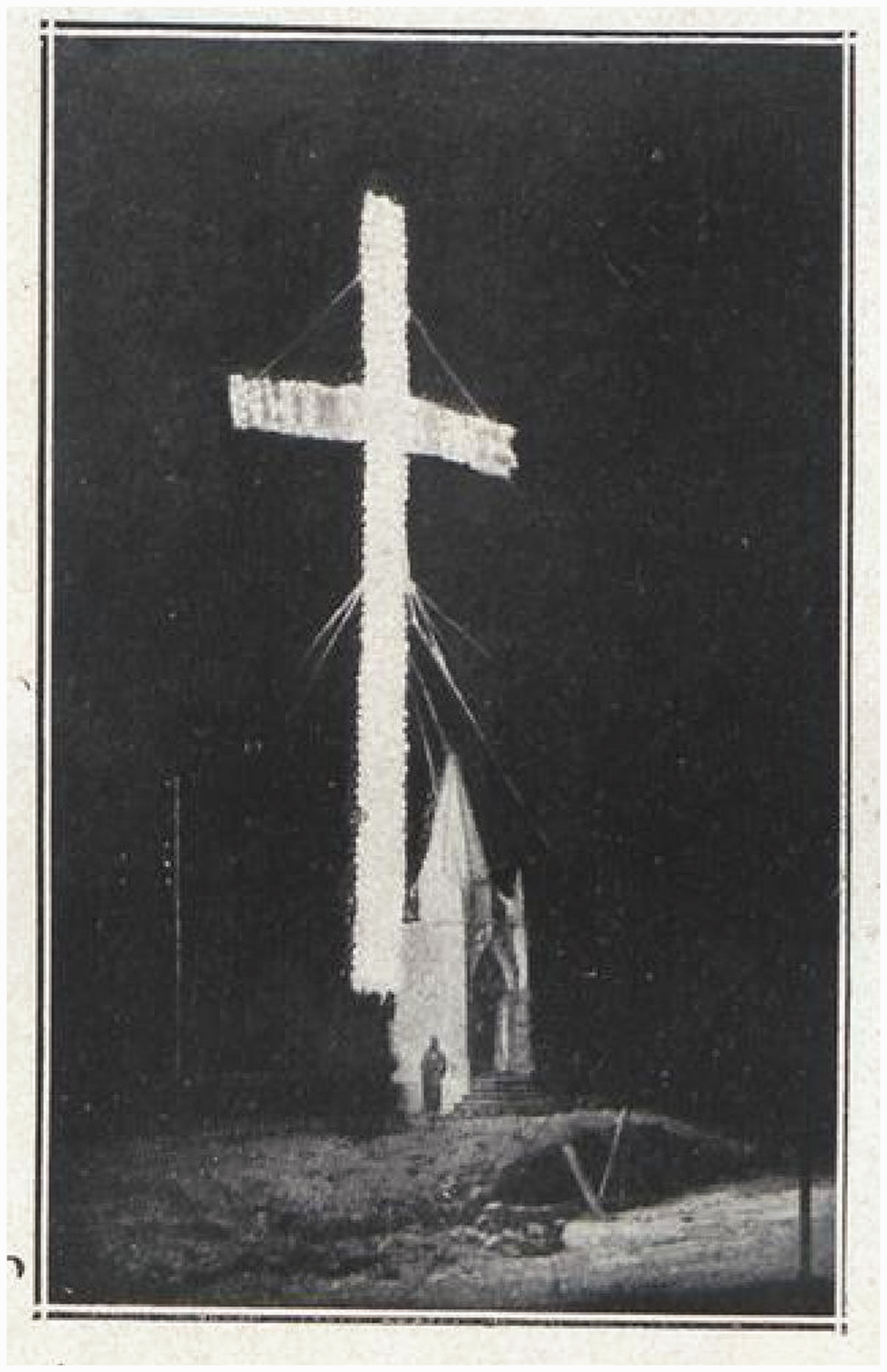
Electric cross of two-thousand bulbs.
As the aforementioned examples suggest, electric lights were also instrumental in the political struggles to reclaim spatial hegemony, something that, of course, did not contradict prohibitions on the liturgical uses of electric light. It is true that the spectacular urban development of the late nineteenth century in Europe led to what has been defined as one of the most spectacular periods of church construction in the history of Christianity (Solans 2015, 439). However, the symbolic hegemony of the Church was repeatedly challenged by other civil buildings or factory chimneys that started to dominate cities. Accordingly, superb displays of electric lights outside temples but also the illumination of religious monuments—whose construction proliferated during the first decades of the twentieth century—expressed the same urge for symbolically affirming Catholicism in a disputed urban landscape (Figure 3). In 1903, for example, the statue of the Sacred Heart of Jesus was inaugurated in Manresa (Catalonia) at the top of the Monastery of the Visitation. The inauguration was an “act of reparation” after the “serious offense” committed by civil authorities the previous year, when the image of the Sacred Heart was removed from the city council. Anti-clericalism had indeed moved from street protest into institutional policy with the progressive liberal governments that between 1901–13 carried out timid secularizing attempts. Hence, electric lights played a major role in enhancing the monument (four meters high) located at one of the highest points of the outskirts of the city, “visible not only from all areas around that municipality, but also from the greater radius of the region.” At night, the image appeared “splendidly illuminated by a gleaming halo of electric light” (La Hormiga de Oro 1903, x).
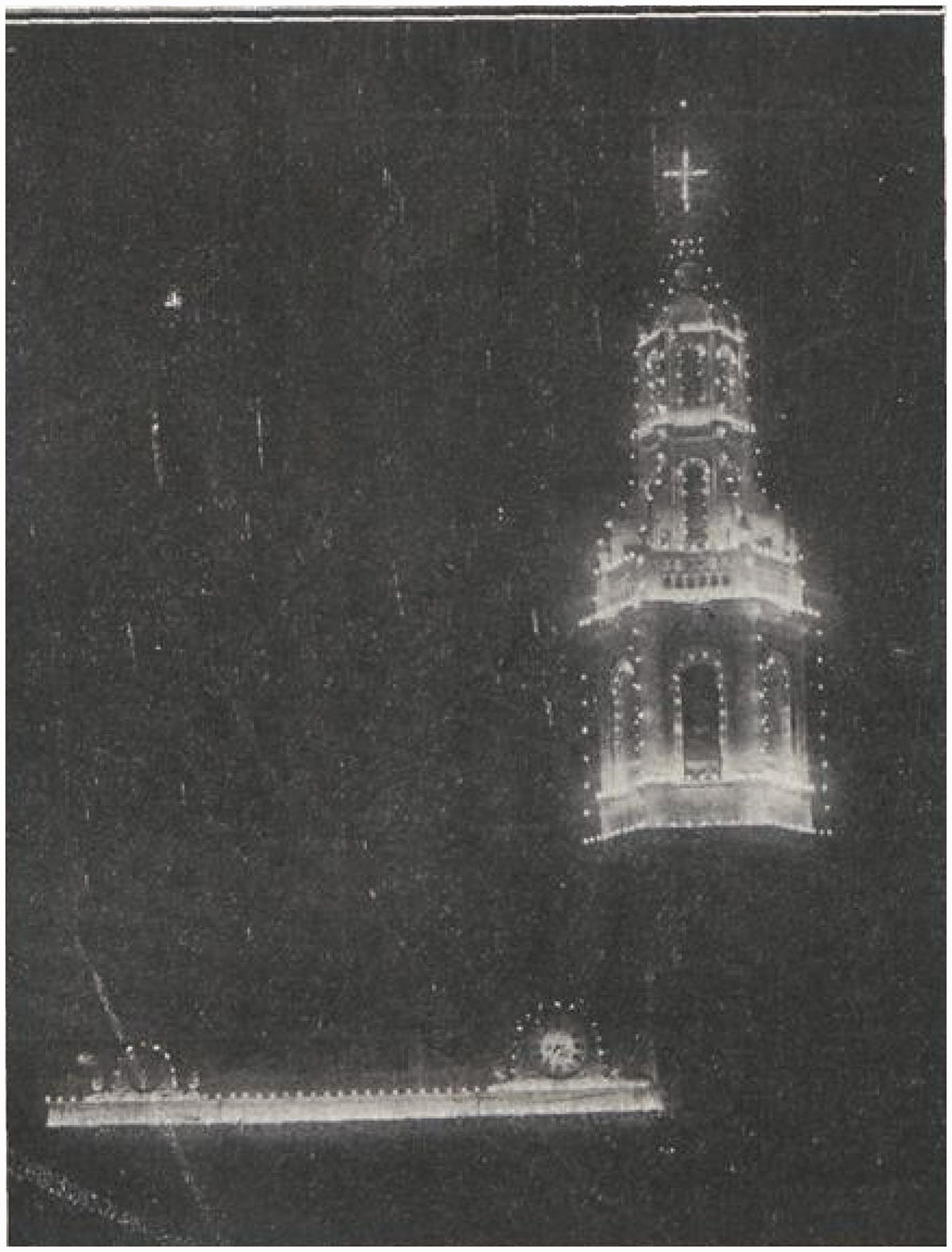
Inauguration of the Church of the Nativity of Our Lady in Alcoy (Alicante). The tower of the church illuminated at night.
Almost two decades later, in 1920, the colossal statue of the Sacred Heart of Jesus was inaugurated in Gijón, crowning the Church of the Society of Jesus. Sculpted in the Bilbao workshops of the artist Serafin Basterra, it stood forty-two meters above the church with his right hand blessing the city, thus extending Christ’s “sovereign power over it.” In what would become the first “skyscraper” of Gijón, the image was aimed at dominating this industrial core, full of smoke and the chimneys of large workshops. Gijón was, indeed, a deeply polarized city which exemplified the social and political tensions that traversed Spanish society and that would explode during the Civil War of 1936 (Radcliff 1997). Conservative and Catholic sectors usually vilified the strong socialist and anarchist movements that were pushing workers away from God. The statue, illuminated at night “with the powerful spotlights of 14,000 electric bulbs,” symbolized then that the “people of Gijon, of such deep Catholic sentiments” remained on the correct side (Godiel 1920, 14). This church would be burned down during the Republican and anti-clerical revolts of the late 1930 (Figure 4).
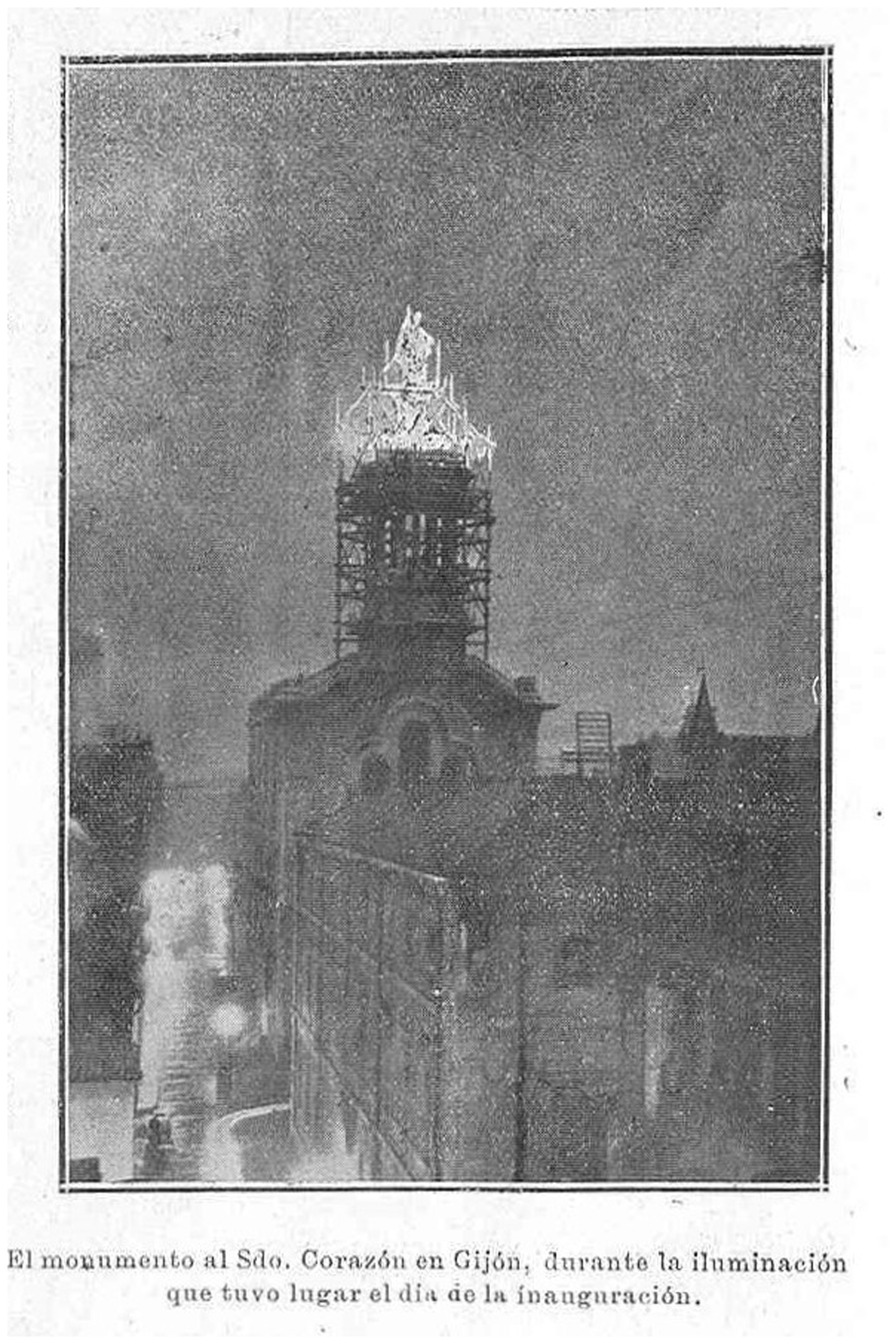
The Basilica of the Sacred Hearth of Jesus (Gijón, Asturias), with its statue on top dominating the urban landscape.
Conclusions
This article has analyzed the complex incorporation of electric lights in churches in Catholic Spain (1874–1931). There were many initial responses to electric lights, resulting in contradictory attitudes since Spanish Catholicism was not homogeneous. In this regard, far from linear adoption, electric light was not celebrated at first but contested. Given the profoundness and richness of the theological language of light in Christian tradition, electric light threatened the traditional contents of religious luminaries and, moreover, the dignity of religious spaces—especially given its associations in secular culture—in a moment where the Vatican curia supported the return to monastic sobriety. However, negotiations in churches did occur, despite guidelines from Rome and the recommendations of the most inflexible bishops. Moreover, the emerging visual features of electric light converged with a Tridentine theology of light that emphasized the affective, bodily, and sensory experience of the revealed Truth. Accordingly, electric lights reinforced a type of liturgy that intersected with some forms of popular piety which privileged spectacular and affective acts of worship. Amid wider anti-clerical offensives and struggles over public space, electric light was then instrumental to counter secularization via the fabrication of religious sensations to attract (and mobilize) potential believers, maintain the Church’s hegemony and publicly visualize its power.
In short, this article has shown how the Spanish Catholic church decided to participate in the public cultures of electric light and electricity display. Rather than simply denouncing or defending the deployment of electric lights in religious spaces, Spanish Catholics negotiated their meanings with specific purposes in a particular historical setting—one marked by the repeated secularizing attempts of a wide range of political forces. Accordingly, the Spanish case opens a fruitful ground to understand the diverse and multifaceted languages of electric light, the variegated cultures of electric light use and the evolving meanings and technological possibilities of electricity in distinct historical, religious, cultural, and national settings.
Footnotes
Funding
The author(s) disclosed receipt of the following financial support for the research, authorship, and/or publication of this article: This work was supported by the Foundation for the Promotion of Applied Scientific Research and Technology in Asturias (FICYT) under the Clarín-Marie Curie COFUND post-doctoral scheme (2017 call).
