




Abstract
Background
A challenging working environment discourages younger generations from pursuing a surgical career, contributing to the decline in the number of surgeons in Japan. However, current surgeons’ perceptions of their work environment remain poorly understood. To address this gap, an exploratory qualitative study was conducted.
Methods
Two semi-structured interviews were conducted in person or via email: (i) focusing on surgeons’ primary interests, career goals, and perceptions of daily workloads, and (ii) focusing on issues affecting work–family balance. A total of 24 interview transcripts were collected across two interviews (12 participants in Interview 1 and 12 in Interview 2, with partial overlap between them). Participants were recruited through purposive and snowball sampling. Data were analyzed using reflexive thematic analysis to identify patterns across datasets.
Results
In the first interview, participants showed diverse priorities: approximately one-quarter prioritized pursuing professional mastery, one-quarter prioritized family life, and a similar proportion reported aiming to balance both domains. Half of the participants accepted multitasking as part of their daily role, although many preferred to limit it to tasks directly related to surgery. More than half expressed frustration with workload disparities and indicated that salaries did not always correspond to actual duties. In the second interview, two-thirds of participants reported strong concern about night and weekend calls while raising children, and several described feelings of guilt regarding limited family time.
Conclusions
Many participants described efforts to balance professional achievement with work–family considerations, while highlighting multitasking, workload disparities, and unpredictable after-hours calls as challenges. These findings provide insight into factors affecting surgeons’ work experiences in Japan and may inform strategies to support work–life balance and surgical workforce sustainability in similar contexts.
Introduction
An ageing population is a major issue in many developed countries and shrinking labour forces are a serious concern. 1 In Japan, the country with the world’s oldest population, the government has implemented interventions to enable as many workers as possible to work longer and in good health. In the surgical field, this demographic shift is particularly pronounced, with an ageing and declining surgeon workforce. 2 The average age of Japanese surgeons has been rising and almost 70% of them are over 40 years old, and the total number of surgeons is declining. This unbalanced age distribution is likely to pose a serious challenge to future healthcare due to current surgeon retirements.3,4 The Japan Surgical Society has announced this issue nationally and has attempted several interventions to address the issue, including public campaigns promoting the appeal of a surgical career; however, it remains an ongoing concern. 5
Several structural factors contribute to this trend. One of the most important is that young medical students and trainees are discouraged from pursuing a surgical career by factors such as heavy workloads, long training periods, and a male-dominated hierarchical system. 5 The heavy workload of surgeons, especially general surgeons, involves performing long surgeries. They also spend time on various tasks such as terminal care, cancer treatment, and general medical care beyond the surgical domain. In addition, they are frequently and unpredictably called for patient emergencies or urgent surgeries at night or on weekends, often without adequate incentives.
In Japan, where dual-income households are increasingly the norm, balancing professional demands with family responsibilities has become increasingly complex. For surgeons in particular, demanding working conditions may create tension between professional roles and family life. This study does not focus on policy solutions alone, but seeks to understand how surgeons themselves perceive and make sense of these competing demands.
An exploratory qualitative study was conducted to capture the real voices of surgeons regarding their career motivations, daily workload, and work–family challenges, which are often underrepresented in official statistics and surveys. While similar workforce pressures exist in other high-income countries, this study focuses on a context-specific understanding within the Japanese surgical context rather than cross-national comparison.2,6
Methods
Study design
A qualitative study was conducted using two semi-structured interviews: (i) focusing on surgeons’ primary interests, career goals, and perceptions of daily workloads, and (ii) focusing on issues affecting work–family balance. A total of 24 interview transcripts were collected across two interviews (12 participants in Interview 1 and 12 in Interview 2, with partial overlap between them). The exploratory nature of the study meant that the aim was to gain in-depth understanding rather than achieve statistical generalizability. Although the two interviews had different foci, findings were synthesized thematically across datasets to identify overarching patterns in surgeons’ narratives. This study is reported in accordance with the COREQ (Consolidated Criteria for Reporting Qualitative Research) checklist 7 (Supplementary file 1).
Participants
Participant characteristics.

(Interview 1) The 12 participants were general surgeons at different career stages (30s: n=4, 40s: n=5, 50s: n=3) who performed a wide range of daily tasks despite having subspecialties such as gastrointestinal surgery. The presence of children or cohabitation status was not part of the inclusion criteria.
(Interview 2) The 12 participants included general, orthopaedic, and cardiac surgeons (30s: n=4, 40s: n=5, 50s: n=3), with partial overlap with Interview 1 participants; all Interview 2 participants were living with children.
Data collection
Interviews were conducted in person or via email. Semi-structured face-to-face interviews took place in private rooms at hospitals with no strict time limit, lasting approximately 20 minutes. Non-participants were not present during interviews. Interviews were not audio-recorded; instead, detailed field notes were taken immediately after interviews. For the email method, a questionnaire with open-ended email and follow-up communications was used.
The interviews were conducted by a male researcher (MD, PhD), who was a practising general surgeon at the time of the study. The researcher was a board-certified surgeon with over 10 years of clinical experience. He had prior experience in both basic and clinical research, including authorship of multiple clinical research studies. The researcher also had personal experience of balancing surgical practice and family life, which was relevant to the study topic. Reflexivity was considered throughout the research process. Participants were informed of the researcher’s professional background and the purpose of the study prior to the interviews.
Interview 1: Primary goals and perceptions about daily tasks
Interviews were conducted for 10 participants and email was used for 2 participants. Participants were asked about their age range, marital status, and future career goals. For the question on career goals, several options were provided as prompt examples: (i) becoming a highly skilled surgeon, (ii) obtaining a high managerial position, (iii) pursuing an academic career, (iv) maintaining a well-balanced family life, and (v) engaging in business opportunities outside surgery.
Participants were also asked about their perceptions of the wide range of daily time-intensive tasks performed by general surgeons. Questions explored how they viewed workload distribution within departments and whether they had concerns or dissatisfaction related to workload differences. These questions were inspired by the theme “There should be as many role models as there are surgeons” presented at the 79th General Meeting of the Japanese Society of Gastrointestinal Surgery (2024).
Interview 2: Issues affecting surgeons’ family life
Open-ended interviews (in person, n=3; via email, n=9) were conducted, aiming to collect the issues that surgeons encounter daily and how these issues affected their family life. Participants were asked about the strategies they employed to manage issues such as prolonged surgeries, overnight hospital duties, or unscheduled emergency calls during nights or weekends. In Japan, such emergency calls are not necessarily based on a formal on-call duty system; surgeons are contacted simply because they are the primary physician in charge.
The original interview guides were developed and attached as Supplementary file 2. All data were collected between 03/03/2023 and 16/07/2024.
Data analysis
Interviews and email responses were treated as a single dataset and analysed using reflexive thematic analysis following Braun and Clarke. 8 Data were managed and organized using Microsoft Excel during iterative coding. Interviews were conducted and initially coded in Japanese, followed by researcher-led translation into English for reporting. Translation consistency was checked by comparing interpretations during analysis.
All transcripts were read multiple times and coded manually by a single researcher. Themes were developed inductively into subthemes and overarching themes. Data saturation was approached after approximately 10 interviews and achieved at the 12th interview, when no new themes or codes emerged. Participant checking was not performed. Percentages and counts are presented as descriptive summaries to support interpretation.
Results
Three main themes were generated from the qualitative data: (1) balancing professional mastery and family life, (2) accepting multitasking as part of surgical identity, and (3) struggling with family responsibilities under unpredictable work.
Theme 1: Balancing professional mastery and family life (Interview 1)
Career goals of surgeons (Interview 1, n=12).
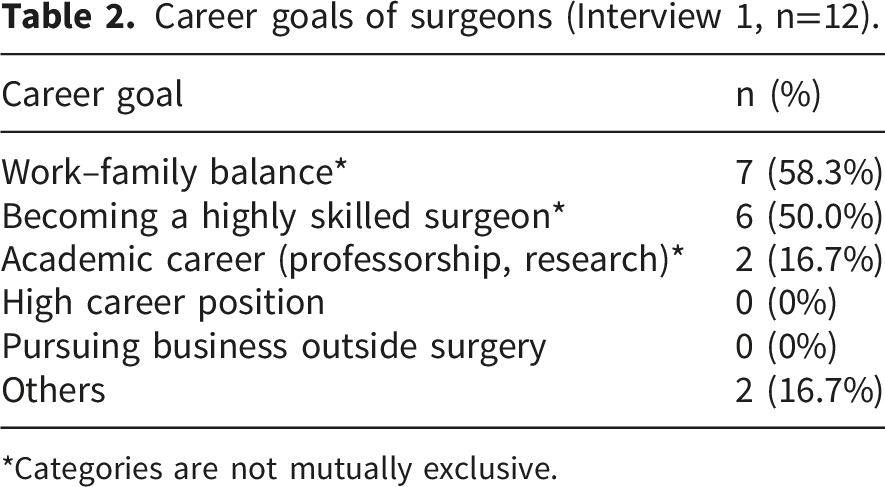
*Categories are not mutually exclusive.
Theme 2: Accepting multitasking as part of surgical identity (Interview 1)
Perceptions of daily multitasking and workload among surgeons (Interview 1, n=12).

When work was varied and unevenly distributed among surgeons in the same department, it resulted in workload disparities. Over 50% of the surgeons expressed frustration with these disparities and suggested that salaries should better reflect actual duties, as the current salary system in Japan does not provide sufficient compensation.
Theme 3: Struggling with family responsibilities under unpredictable work (Interview 2)
Work–family concerns (Interview 2, n=12).

To manage calls outside work hours, surgeons asked colleagues to cover for them or relatives to take care of their children. When they could not find any support or time, they sometimes brought their children to their hospital, even though no on-site child-care was available.
Discussion
1. Meaning of this study
This study aimed to explore how Japanese surgeons perceive what they value in their careers, their diverse and wide-ranging daily duties, and how they manage work–family balance. Surgeons are often seen as self-sacrificing, prioritizing patients and work over personal or family needs. However, how they navigate this challenging situation has not been sufficiently examined.
2. Relation to previous literature
Previous research on surgeons’ work-life balance has often focused on burnout.9,10 In Japan, however, existing reports differ somewhat from these international trends. They have tended to address workforce shortage and gender disparities, while burnout and broader aspects of work–family balance have received less attention.
For example, a comparative study of women surgeons reported that Japanese female surgeons expressed a stronger desire to invest in their surgical careers, whereas counterparts in the United States and Hong Kong tended to prioritize work–life balance. 11 This pattern may be related to strong professional expectations within surgical training and practice environments. Overall, Japanese reports emphasize institutional or structural factors such as long working hours and strategies to maintain professional productivity.
Aside from public surveys conducted by surgical societies, very few studies have explored how surgeons themselves perceive and give meaning to their work–life balance and family life. The present study contributes to this gap by highlighting how Japanese surgeons interpret and internalize these challenges.
3. Core insight
The study found that many participants described improving proficiency as their goal. At the same time, many expressed a desire to maintain good relationship with family under challenging circumstance, although the circumstances often require family sacrifice. Some reported feelings of guilt toward their family. Rather than framing these sacrifices as complaints, some participants viewed their family responsibilities as part of their role within the constraints of their professional and family contexts. In some cases, this included limiting their spouses’ career choices.
Multitasking beyond surgery was accepted as inevitable. However, the phrase “as long as it does not interfere with my main duty” appeared frequently in participants’ accounts. This may conceal subtle fatigue beneath quiet pride. Some said “bothersome,” but never “this is not my job.”
4. Reflexive conclusion
Contemporary Japanese surgeons continue to work under intense psychological pressure, standing between professional pride and family responsibility, often without relying on institutional support. This dedication reflects professional norms, but it may raise concerns about long-term sustainability. The ongoing shortage of new surgeons may already reflect early signs of a quiet yet growing systemic strain.
5. Implications for practice and policy
Practical measures may help mitigate some of these challenges. Financial motivations were not reported as a prominent career goal among participants. While this may reflect social norms, it may also indicate that financial incentives alone are unlikely to fully address the problem. Rather, the excessive multitasking structure must be addressed, for example, by introducing better support staff and task-sharing systems. The adoption of technological aids, including artificial intelligence, may improve workflow efficiency. 12
Laulan et al. proposed a novel framework for assessing surgeons’ mental fatigue and cognitive load. 13 This framework may help to visualize otherwise unrecognized occupational stress and facilitate earlier identification of burnout risk.
6. Limitations and future directions
This study included a limited number of mid-career surgeons in Japan, with particularly low representation of female surgeons; therefore, the findings may not be fully generalizable to all institutions or specialties and may have influenced the interpretation of gendered perspectives. The use of both face-to-face and email-based interviews may have influenced data depth, as email interviews did not allow for real-time probing. The use of an interview guide may have influenced the range of responses.
The study could have several biases. The researcher’s characteristics (male surgeon with family responsibilities) may have introduced researcher bias in interpretation. In the second interview, participants were recruited with an emphasis on surgeons with child-rearing responsibilities. This may introduce selection bias towards a specific subgroup of family situations, potentially limiting the diversity of work–family conflict experiences captured.
Future research should include broader and more diverse samples and consider more systematic cross-cultural comparisons to examine how cultural narratives shape surgical professionalism globally. Nevertheless, this work could provide some insight into how Japanese surgeons construct meaning within demanding work–family conditions and professional constraints.
Conclusion
Participants described efforts to balance professional achievement with work–family considerations, alongside challenges such as multitasking, workload disparities, and unpredictable after-hours calls. These findings provide insight into factors affecting surgeons’ work experiences in Japan and may inform strategies to support work–life balance and surgical workforce sustainability in similar contexts.
Supplemental Material
Supplemental Material - Surgeons’ pursuit of professional achievement and work-life balance in a demanding working environment: An exploratory qualitative study in Japan
Supplemental Material for Surgeons’ pursuit of professional achievement and work-life balance in a demanding working environment: An exploratory qualitative study in Japan by Kenji Fujiwara in Sage Open Medicine
Supplemental Material
Supplemental Material - Surgeons’ pursuit of professional achievement and work-life balance in a demanding working environment: An exploratory qualitative study in Japan
Supplemental Material for Surgeons’ pursuit of professional achievement and work-life balance in a demanding working environment: An exploratory qualitative study in Japan by Kenji Fujiwara in Sage Open Medicine
Footnotes
Acknowledgements
I thank all participants for taking part in this study. I am also grateful to Dr. Hiroshi Kimura, Chairman of the Board, Kimura Hospital, for providing institutional support for conference presentation. I also acknowledge the Department of Surgery and Oncology, Kyushu University, for providing access to academic resources during the research process. An earlier version of this manuscript was available as a preprint on ResearchSquare ( ). Different aspects of literature searching, English language editing, and drafting of descriptive text in the Methods and Discussion sections were assisted by the AI tool ChatGPT (OpenAI). All AI-generated text was reviewed, revised, and approved by the author, who takes full responsibility for the content.
Ethical considerations
Ethical approval was obtained from the Institutional Review Board of Kimura Hospital (Ref No. R2304), which approved data collection using questionnaire-based interviews conducted via email, telephone, and in-person formats.
Consent to participate
Verbal or email-based informed consent was obtained from all participants prior to participation in accordance with the approved study protocol and institutional requirements. The study was conducted in accordance with the Declaration of Helsinki.
Consent for publication
All participants consented to the publication of anonymized data.
Author contributions
KF designed the study, collected and analyzed data, and wrote the manuscript.
Funding
The authors received no financial support for the research, authorship, and/or publication of this article.
Declaration of conflicting interests
The authors declared no potential conflicts of interest with respect to the research, authorship, and/or publication of this article.
Data Availability Statement
The datasets generated or analyzed during the current study are available from the corresponding author on reasonable request.
Supplemental Material
Supplemental material for this article is available online.
References
Supplementary Material
Please find the following supplemental material available below.
For Open Access articles published under a Creative Commons License, all supplemental material carries the same license as the article it is associated with.
For non-Open Access articles published, all supplemental material carries a non-exclusive license, and permission requests for re-use of supplemental material or any part of supplemental material shall be sent directly to the copyright owner as specified in the copyright notice associated with the article.
