




Abstract
There is no evidence for a closed OT canon before A.D. 70. Our various sources indicate a high degree of fluidity and gradual accretion, closely related to politico-historical developments and the exigencies of new religious communities. The text collection of one such community, near Qumran, can be investigated for the comparative rating of biblical books, including those in the Tanakh as we know it, others which may have had ambiguous status, and a number of different types of Scripture-based works. This picture may serve to relativize modern Christian conceptions of canon where they have been based on accidents of history such as the language in which texts have been available or the media in which they have been transmitted. As a result, the Bible Societies may need to engage with a wider range of concepts of canon.
Introduction
The scholarly consensus is that, As nearly as we can tell, there was no canon of scripture in Second Temple Judaism [516 B.C.–A.D. 70]. (VanderKam 2002, 91) . . . prior to 100 CE absolutely every source of evidence we have for the nature of the biblical text shows us that the biblical text was pluriform and dynamically growing [several authors prefer the term “fluid”] . . . there were variant literary editions of many of the biblical books. There is no indication of a standard text form. . . . There is no strong evidence for the MT [Masoretic Text] as “the standard text” before the First Revolt [A.D. 66]. (Ulrich 2000, 79-80, cited in Elwolde 2006, 31)
The Dead Sea Scrolls (DSS) are a collection of 930 manuscripts discovered in the period 1946–1956 in ten of a series of eleven caves near Qumran, on the northwest shore of the Dead Sea (though the term may also be used more broadly to include twenty-six scrolls found in several other locations along the western shore). Most are made of parchment, though some are papyrus and one copper. Most are in Hebrew (including twelve in the pre-exilic paleo-Hebrew script), whilst some are in Aramaic and a few in Greek. Some 210–212 of them (22 percent of the entire collection) are Tanakh texts; the remainder are minor biblical texts such as tefillin, “deuterocanonical” and “pseudepigraphical” texts, and documents of the Qumran community. 1
Since the DSS date from 250 B.C. to A.D. 68, it might have been hoped that they would present clearer evidence than we had previously had of a Second Temple period “canon.” However, the opposite is the case. The DSS came early to be understood as adding a further textual tradition to those already known—in Frank Moore Cross’s “local texts theory,” the Palestinian Qumran and Samaritan Pentateuch traditions stand alongside those we know in the Babylonian Masoretic Text (MT) and the Egyptian Septuagint (LXX; Cross 1975, 306–20, following Albright 1955). And what is more, today, the DSS are understood as attesting multiple traditions: a distinctive Qumran tradition (25% of the biblical DSS), MT (46%), LXX (5%), and Samaritan (5%), with another 19% of the biblical DSS non-aligned (see Fig. 1). 2
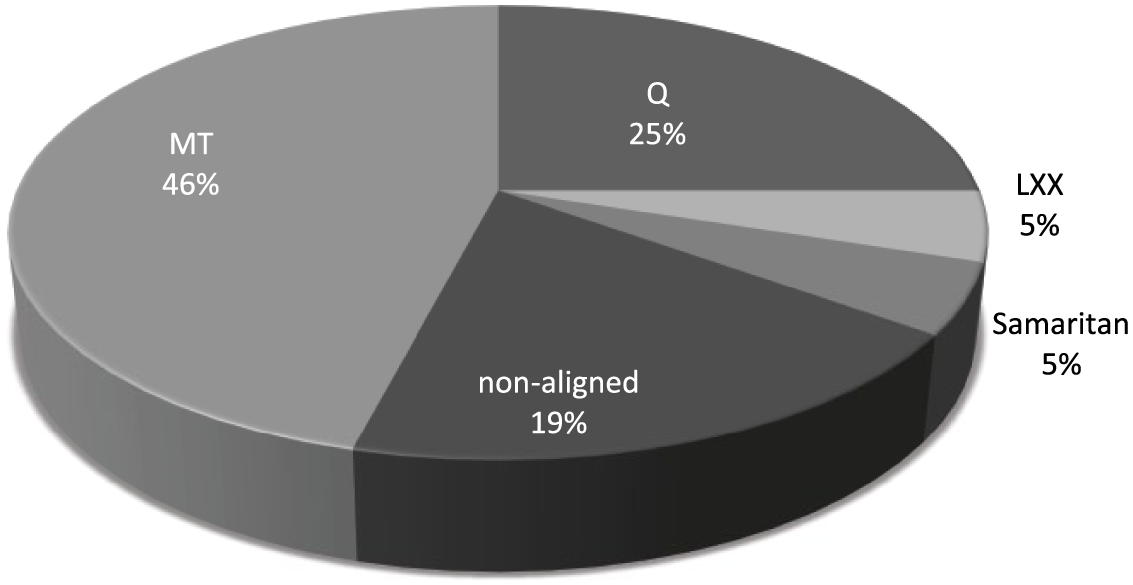
Textual traditions at Qumran.
As a result, though by no means a “canon,” nor even a coherent “corpus,” this collection has much to tell us about the distribution and status of biblical texts in the Second Temple period. It marks, in fact, the end of an era, since post-A.D. 70 collections of biblical manuscripts from the region (e.g., Murabbaʿat, Naḥal Ḥever, Masada) attest much greater uniformity with the MT.
In this article, we first survey some of the most explicit evidence for “canon” in the intertestamental period, then look at the range of manuscripts found in Qumran and evaluate what they tell us about canon in their historical context. Finally, we suggest some recommendations for UBS policy in the light of this history. 3
Context
The process of canon formation may be understood as a series of five historical shifts (Ulrich 2002, 24–25):
“from the national literature of Israel to the sacred scriptures of Judaism” (e.g., the putative “Yahwist” source, Psalms, Prov 10–31)
“from a temple-based religion to a text-based religion” (after A.D. 70, though a similar dynamic had certainly occurred earlier after 586 B.C., too)
“from the fluidity, pluriformity, and creativeness in composition of the text of the books of scripture to a ‘frozen’ (not ‘standardized’) single textual form for each book”
“from viewing revelation as dynamic and ongoing to viewing it as verbal and recorded from the distant past”
“from individual scrolls, usually containing one or two books, to the codex, which could contain many books.”
In the course of these processes, comments appear in ancient texts, suggesting how particular books or collections were viewed. There are a number of indications of distinct Jewish sacred corpora in the Second Temple Period.
The תורה Torah, “Law,” whether in the form of Deuteronomy, Exodus–Deuteronomy, or Genesis–Deuteronomy, is the first biblical “canon” attested. Chronicles–Ezra–Nehemiah (ca. 400 B.C.) refers several times to the authority of (ספר) תורת משה “(the book of) the Law of Moses” (2 Chr 23.18; 30.16; Ezra 3.2; 7.6; Neh 8.1). The account of Jewish history by Hecateus of Abdera (ca. 300 B.C.) exhibits detailed knowledge of Exodus–Deuteronomy but complete ignorance of Joshua–Kings (he states, for example, βασιλέα µὲν µηδέποτε τῶν Ἰουδαίων “the Jews have never had a king”! 4 ). And the Letter of Aristeas (170 B.C.[?], in any case at least before Philo and Josephus—Sundberg 2002) refers to the translation only of the Law.
Second, the tripartite תנ״ך Tanakh, “Law–Prophets–Writings,” is referred to relatively early. Sirach (ca. 180 B.C.) is read by some as claiming to stand alongside the other wisdom books in serving πᾶσιν τοῖς ζητοῦσιν παιδείαν “all seekers of education” (Sir 33.16-18); this would suggest a relatively open view of at least that part of the canon. However, by the time of his grandson, who wrote the Preface (ca. 132 B.C.), his work is more clearly distinguished from the Tanakh (οὐ µόνον δὲ ταῦτα, ἀλλὰ καὶ αὐτὸς ὁ νόµος καὶ αἱ προφητεῖαικαὶ τὰ λοιπὰ τῶν βιβλίων “Not only this book, but even the Law itself, the Prophecies, and the rest of the books”). The Preface refers three times to: ὁ νόµος καὶ οἱ προφῆται / αἱ προφητεῖαι καὶ . . . “the Law and the Prophets/Prophecies and . . .” τῶν ἄλλων τῶν κατ᾽ αὐτοὺς ἠκολουθηκότων “the others that followed after them” τῶν ἄλλων πατρίων βιβλίων “the other ancestral books” τὰ λοιπὰ τῶν βιβλίων “the rest of the books”
He thus makes the first attested reference to the tripartite Tanakh, but thereby indicates also the rather vague nature of the third section.
Second Maccabees opens with two letters from the Jewish community in Jerusalem to their people in Egypt, urging the restoration of Hanukkah. The second (purportedly 164 B.C., but perhaps a forgery from 103 B.C.—Goldstein 1983, 157–64) describes the preservation at the exile of three things—the fire from the altar (and Nehemiah’s recovery of it in the naphtha miracle; 2 Macc 1.18-36), the temple furnishings (by Jeremiah hiding them in a cave; 2 Macc 2.1-8), and the Scriptures: ἐξηγοῦντο δὲ καὶ ἐν ταῖς ἀναγραφαῖς καὶ ἐν τοῖς ὑποµνηµατισµοῖς τοῖς κατὰ τὸν Νεεµιαν τὰ αὐτὰ καὶ ὡς καταβαλλόµενος βιβλιοθήκην ἐπισυνήγαγεν τὰ περὶ τῶν βασιλέων βιβλία καὶ προφητῶν καὶ τὰ τοῦ Δαυιδ καὶ ἐπιστολὰς βασιλέων περὶ ἀναθεµάτων. ὡσαύτως δὲ καὶ Ιουδας τὰ διαπεπτωκότα διὰ τὸν γεγονότα πόλεµον ἡµῖν ἐπισυνήγαγεν πάντα, καὶ ἔστιν παρ᾽ ἡµῖν· ὧν οὖν ἐὰν χρείαν ἔχητε, τοὺς ἀποκοµιοῦντας ὑµῖν ἀποστέλλετε. The same things are reported in the records and in the memoirs of Nehemiah, and also that he founded a library and collected the books about the kings and prophets, and the writings of David, and letters of kings about votive offerings. In the same way Judas also collected all the books that had been lost on account of the war that had come upon us, and they are in our possession. So if you have need of them, send people to get them for you. (2 Macc 2.13-15 NRSV)
5
Thus the preservation at the exile of the former and latter prophets (τὰ περὶ τῶν βασιλέων βιβλία καὶ προφητῶν), the Psalms (τὰ τοῦ Δαυιδ), and Ezra–Nehemiah (ἐπιστολὰς βασιλέων περὶ ἀναθεµάτων) is referred to without mention of the Torah, which is surely simply assumed. This 164 B.C. collection of books is argued by Young to mark an early point in the canonization process, a fact which he connects with the increased conservatism of Qumran manuscripts after this date (Young 2002; Elwolde 2006, 32–39).
In the New Testament, we find of course several references to “the Law/Moses/Law of Moses and the Prophets,” but only one to a tripartite Tanakh: ἐν τῷ νόµῳ Μωϋσέως καὶ τοῖς προφήταις καὶ ψαλµοῖς “in the Law of Moses and the Prophets and the Psalms” (Luke 24.44).
Finally, we find numbering and naming of the books of the Tanakh. Jubilees (161–140 B.C.) is believed to have been a product of the Qumran Essene movement, though it was known in Geʿez and in Greek fragments before the discovery of Hebrew fragments among the DSS. After describing God’s twenty-two works of creation, it uses the same figure in reference to “chief men between Adam and Jacob” and “kinds of works” (Jub. 2.23). Reading “twenty-two” as the later standard “twenty-four” with perhaps Judges–Ruth and Jeremiah–Lamentations combined, this may be the first reference to the number of works in the canon (however, this text is attested only in the later Ethiopic version). Other references to the number of books all post-date A.D. 68, and all cite twenty-two or twenty-four (Josephus, Contra Apionem 1.8 [ca. A.D. 100]; 4 Esdras 14.37-50 [ca. A.D. 100]; Talmud b. B. Bat. 14b [6th century A.D.]).
None of these “canon” statements, nor the use of the term αἱ γραφαί “the writings/Scriptures,” can be shown to include any work not included in the Tanakh. This evidence thus forces us to the conclusion that the frequent attestation of other books in this period must be understood as representing, at most, a secondary, or “deutero-” canon.
Types of evidence
Among the 930 DSS manuscripts, a little over a third are Tanakh or related texts, a little under a third are deuterocanonical, and also a little under a third sectarian. However, there are local (not properly sectarian) distinctives in the biblical scrolls and biblical influence in the sectarian scrolls, so in trying to assess the status of particular works, we need to look at a range of features of this corpus.
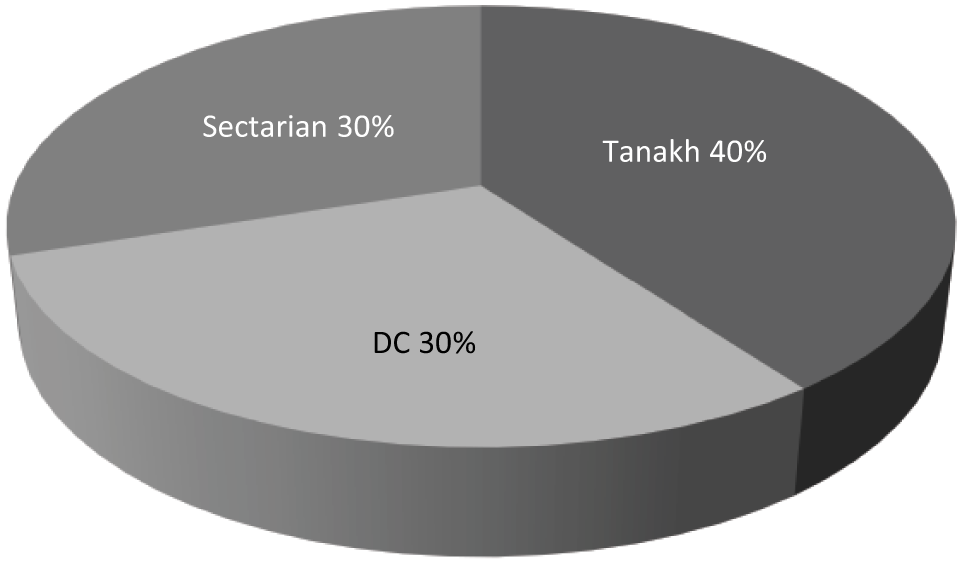
Texts attested at Qumran.
Nearly all twenty-four books of the Tanakh are attested at Qumran, but also several others, which may therefore be argued to have had equivalent status. On the basis of frequency of manuscripts, we might list the relative importance in Qumran of what are today considered scriptural books as follows (non-Tanakh works italicized; see in graph form in Fig. 3): 6
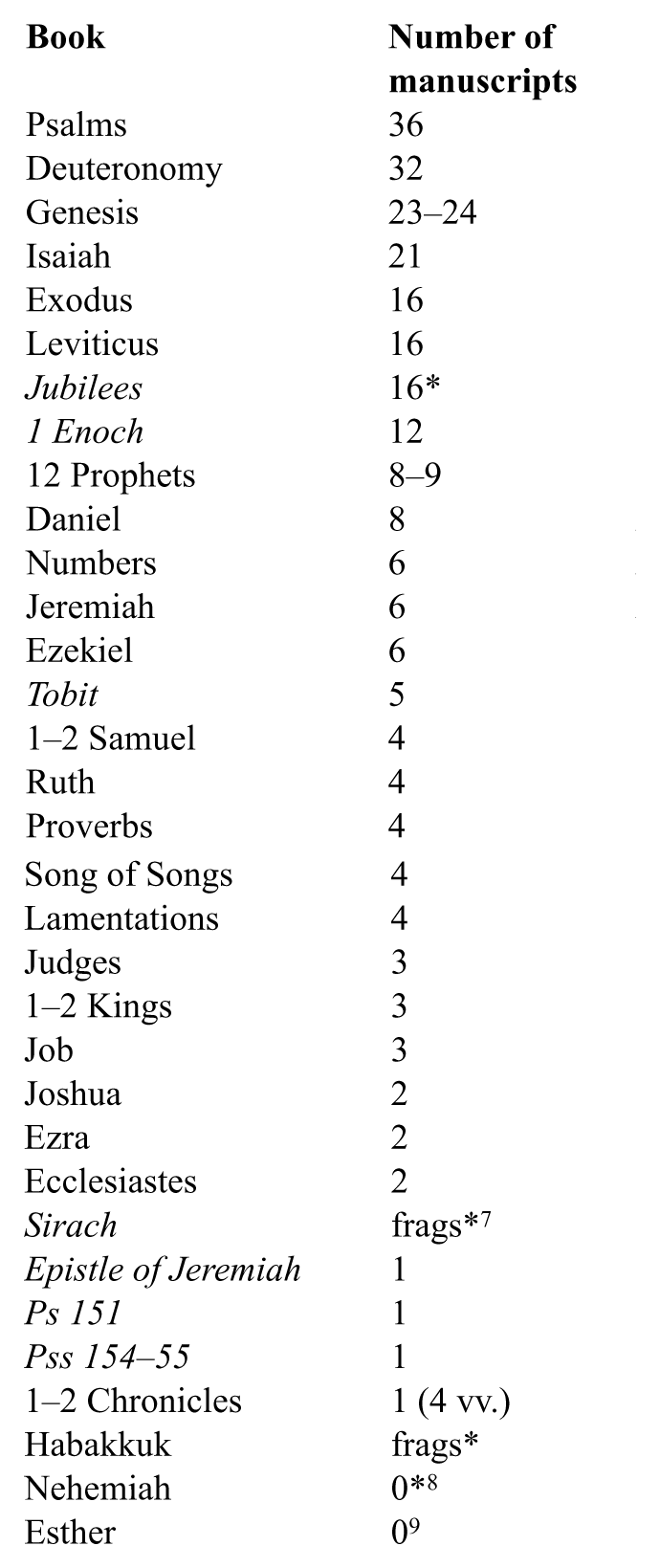
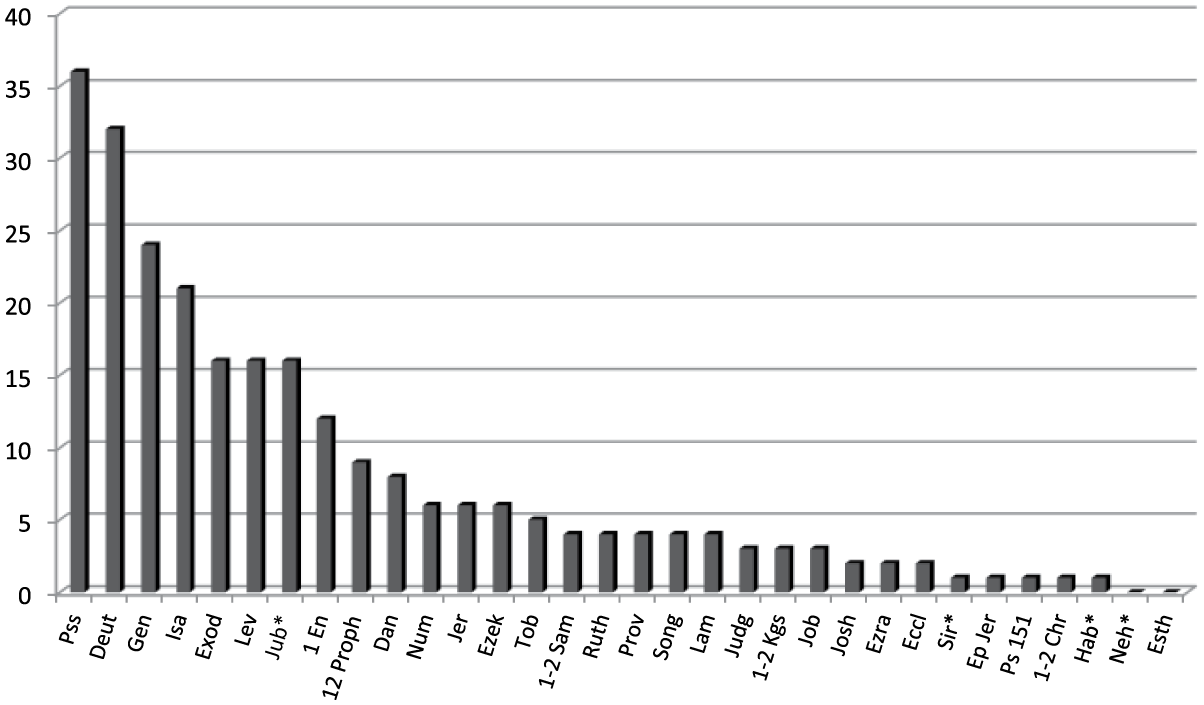
Number of manuscripts for each book.
This ranking is reflected also in a number of other criteria:
the size and quality of manuscripts
the frequency of citation (although in this respect Leviticus ranks more highly, reflecting the Qumran community’s interest in issues of ritual purity)
textual consistency between manuscripts and their agreement with MT and LXX
frequency of pesher treatments (although in this respect Deuteronomy and the non-Tanakh works rank lower, whilst Hosea, Nahum, and Habakkuk higher, reflecting the community’s interest in their own place in the fulfillment of biblical prophecy), 10 and
the absence of “rewritten Scriptures” based on them (with the exception of Genesis, esp. Gen 1–11).
This ranking corresponds noticeably also to NT citation and allusion preferences (though in the New Testament, Jubilees ranks lower, whilst Sirach, Wisdom, 1–2 Kings, 1–2 Chronicles, and 1–2 Maccabees all rank higher). 11 For both the Qumran and early Christian communities, one may suggest why certain books were of particular importance, reflecting interests in ritual, the fulfilment of prophecy, history, eschatology, and so forth. Authorship by prophets was certainly not the governing issue for perceptions of inspiration or canonical status.
Awareness of a tripartite Tanakh canon appears to be explicitly present in two Qumran texts:
(1)
[כתב]נו אליכם שתבין בספר מוש[ה ו]בספר[י הנ]ביאים ובדו[יד … ] דור ודור ובספר כתוב “we [have written] to you who understand the book of Mos[es and ]the book[s of the Pro]phets and Dav[id … ]generations and written in a book” (4QMMT 10-11)
This reconstruction is quite uncertain (Weissenberg 2009). Even if accepted, a number of scholars have taken this as classing David among the prophets in a bipartite canon (Elwolde 2006, 10). However, the use of the name of David as metonymous for the Psalms or Writings is attested in 2 Macc 2 (above), and the Psalms are apparently metonymous for the Writings as a whole in Luke 24.44. We should further note that among the Qumran-attested Writings (i.e., excluding Esther), only Lamentations and Daniel (both perhaps among the Prophets, Lamentations with Jeremiah, as in Josephus and Jerome, and Daniel as cited in כתוב בספר דניאל הנביא “written in the book of Daniel the prophet,” 4QFlorilegium 1 II, 3) have no explicit connection to David (as Ruth, Psalms, Chronicles–Ezra–Nehemiah) or his son Solomon (Proverbs, Song of Songs, Ecclesiastes). As for the lack of the term ספר “book of” with דויד “David,” 12 this use of a personal name to refer to a corpus of texts associated with a named biblical character is attested elsewhere. 13 The most open question is perhaps, in fact, the expression דור ודור ובספר כתוב “generations and written in a book”—might this refer to yet more recent writings than “David,” a fourth “canonical” element?
(2)
ספרי התורה … ספרי הנביאים … דורש התורה “books of the Law . . . books of the Prophets . . . interpreter of the Torah” (Damascus Document VII, 15-18)
In this case, the latter term has been understood from its context to refer to David as Messiah (Law–Prophets–David as at the NT transfiguration; Elwolde 2006, 12–13), but it might equally refer to the Book of Psalms, divided into five books like the Law, and prefaced by Ps 1 (בתורת יהוה חפצו ובתורתו יהגה יומם ולילה “he takes delight in YHWH’s Law, and murmurs his Law day and night” v. 2); in either case, it is surely metonymous for the כתובים “Writings.” The term has alternatively been read as referring to Ezra, but this seems unlikely, since even if, as some think, the Qumran community’s self-designation as a יחד “community” derives from Ezra 4.3, Ezra remains one of the most poorly attested canonical books at Qumran (Elwolde 2006, 14 n. 62).
We saw in our discussion above of the Sirach preface the possibility that the Writings might have been considered an open class. At Qumran, we read in a pesher on Hab 2.2: פשרו על מורה הצדק אשר הידיעו אל את כול רזו דברי עבדיו הנבאים “The interpretation: It is about the Teacher of Righteousness to whom God has revealed all the mysteries of the words of his servants the Prophets” (1QpHab VII, 4–5); this may indicate that at least inspired interpretation remained open, if not also inspired authorship. And the New Testament itself refers to Paul’s letters as comparable to τὰς λοιπὰς γραφὰς “the other writings/Scriptures” (2 Pet 3.16), which may indicate a preparedness to accept additions to the third section of the canon.
Those non-Tanakh works which, on the basis of attestation, distribution, citation, and so forth at Qumran, have been claimed to have had a canonical status (Jubilees, 1 Enoch, Tobit, etc.) were most probably understood as belonging to the כתובים (however named—see the range of terms used in the Sirach preface, 2 Macc 2, and Luke 24.44 above). Meanwhile, rewritten Scriptures such as Jubilees, though clearly closely related to the Torah, seem so clearly interpretative, in line with the Qumran community’s distinctive pesher tradition, that it is hard to imagine their having anything approaching “canonical” status, without the community being conscious of its own divergence on this issue from other contemporary streams of Judaism, evidence for which is completely lacking (see, however, the discussion below).
“Canonicity” and “fluidity”: issues arising
The custodians of these scrolls, though quite dogmatic—indeed censorious—in some domains, were not so on issues of inspiration or canonicity. There is no evidence in their writings of anything like later rabbinic discussions of טמאת ידים “defilement of the hands” (related perhaps to the hand-washing tradition reported in the Letter of Aristeas), lists of approved canonical works as at the great councils, or arguments on the basis of a text’s being in Hebrew or Greek (as in Jerome and Luther). Rather, we find a fluidity of the sacred corpus, textual traditions (there is even evidence in the pesharim of commentators using multiple textual traditions simultaneously—Elwolde 2006, 7–8, 26–32), and interpretive approaches (pesher, rewritten Scriptures, liturgical adaptation—Warren 1994). There is no evidence that this was perceived as problematic. The title of a key article is telling: “The Fluid Bible: The Blurry Line between Biblical and Non-Biblical Texts” (Crawford 1999).
This perspective on sacred text is surely similar to that held by NT writers; it is one which is much more credible to postmodern people within and outside the church; and it has increasing support in some sections of the UBS constituency, including more academically inclined denominations and the emergent church. (Meanwhile, it will of course be strongly resisted by anti-intellectual and “fundamentalist” elements in our constituency.) We may therefore venture some comments on the relevance of the Qumran data on “canon” to our various audiences.
Bible as product
The contents page of the popular volume, The Dead Sea Scrolls Bible, reads (highlighting of non-Tanakh works is mine):
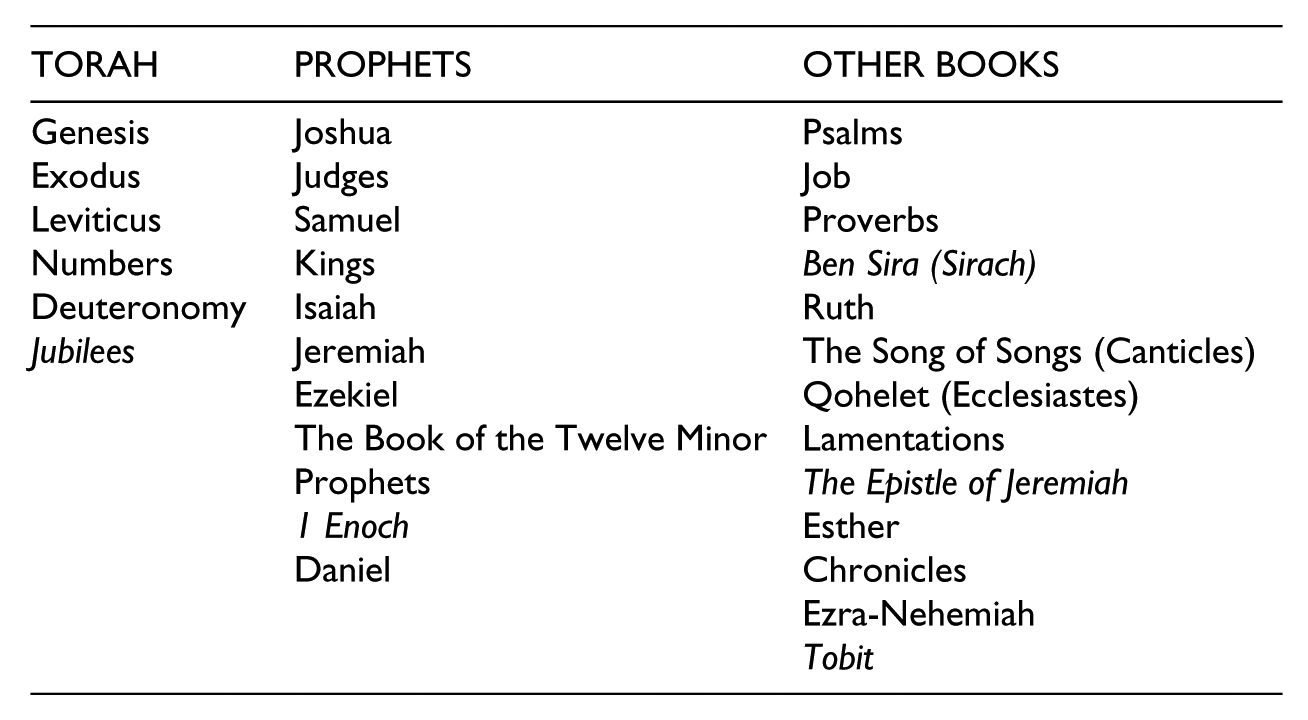
As the reflection of a de facto corpus, this is, of course, in line with the texts available. However, the product is marketed, citing Christianity Today, as “the nearest thing to having ‘the Bible Jesus read,’” and as “The Oldest Known Bible.” This is clearly misleading.
Thus we may propose that if UBS does begin publishing a wider range of canons, they should be just that—canons historically recognized by parts of our broad church constituency, not accidental collections like The Dead Sea Scrolls Bible, nor, equally, modern collations such as Berger and Nord’s Das neue Testament und frühchristliche Schriften.
Creeds and canons
In the “Son of God” or “Divine Familial Terms” controversy which has shaken our SIL colleagues in recent years, one critical issue was whether certain translation strategies involved a biblicism/historicism predating the creeds, that is, interpretations of NT texts on a purely exegetical basis unconstrained by later credal formulations. 14
The current research project may risk being perceived as doing something rather similar—pursuing a biblicism/historicism predating the canons. In both cases, the issue is not the clash between our knowledge of history and our constituents’ ignorance of it, but our readiness to submit to their creeds and canons—the loyalty of UBS to the church.
Scriptures and rewritten Scriptures
A significant issue in discussion of the DSS is the classification of a number of works as “rewritten Scripture.” 15 Is a “Reworked Pentateuch” in fact “rewritten Scripture” (so Tov) or simply “Scripture” (so Ulrich), like, for example, 4QSama with its longer text at the start of 1 Sam 11 (VanderKam 2002, 96–100)? The Temple Scroll (ca. 400 B.C.?) may have been understood as relating to Deuteronomy in the same way that Deuteronomy itself related to Exodus–Numbers (that is, it is a “Tritonomy”), 16 or even “conceived by its author as the sixth book of the Torah. The entire work is to be joined to the five books of Moses as of equal rank” (Stegemann 1998, 96). 17 Similar arguments apply to Jubilees (third century B.C.) and perhaps also the Genesis Apocryphon. As one scholar writes, “how far could these texts deviate and still be considered biblical? Or authoritative?” (Crawford 1999; Young 2005, 105–6).
The last century has seen an explosion of functional Bible translations, paraphrases such as The Living Bible, expansions such as The Amplified Bible, and highly contextualized renderings such as those in children’s Bibles. 18 And all of these may be referred to as “the Bible” and cited by modern Christians as having authority for their lives. This question may invite further research.
Sirach
Finds at Masada and Qumran have proven the originality of the shorter Hebrew version of Sirach (previously known only in a longer medieval version from the Cairo Genizah [tenth to twelfth century]). This has resulted in the inclusion of the Hebrew texts of Sirach in the big Dictionary of Classical Hebrew, and a lively discussion of its relation to the several new Hebrew Bible projects (Biblia Hebraica Quinta, the Hebrew University Bible, and especially the Hebrew Bible Critical Edition [formerly called the Oxford Hebrew Bible] and the Qumran Bible).
Since the Protestant relegation of this book to the deuterocanon (of which it constitutes approximately a third by length) has been based largely on its not being in Hebrew (following Jerome and Luther), the discovery of this Hebrew original and its appearance in standard reference works must affect Protestant attitudes towards it. (The same might also be said of the even earlier work, Tobit, discovered for the first time in a fragmentary Aramaic original at Qumran.)
Technology
Eugene Ulrich describes the effect of the invention of the codex as follows: “With scrolls, the table of contents of the scriptures was a mental notion, but it became a physical object when a codex contained those books included in that table of contents and no others” (Ulrich 2002, 25). Harold Scanlin cites Mark Slouka as describing the effect of the invention of the internet in a remarkably parallel way—as the marriage of deconstruction and computer technology—a mating of monsters if ever there was one. . . . While the deconstructionists could only argue that nothing exists outside us . . . the cyberists had machines that could make it so. (Scanlin 2004, 188)
This must be one key prospective of the current research project. It is well known that the use of the codex by Christians contributed much to the concept of a closed canon (since it permitted the inclusion of so much more text in one physical item than had a scroll). And the maintenance of this technology has contributed much to Christian concepts of canon for two millennia. Today, digital media have blown that tangible delineation of canon wider open than ever before, and we must expect significant shifts in attitudes, if not also policies, in our church constituencies.
Publishing
The study of the canon question in Qumran alerts us to a form of distortion inherent in our work which UBS Global Bible Translation, or probably even the Committee on Scholarly Editions, rarely considers. The ancient scrolls found at Qumran are probably what we would agree is, at base, “the Bible.” But these have already been deeply reinterpreted by the process of collection into the Codices Vaticanus (A.D. 300–325), Sinaiticus (A.D. 325–360), and Leningradensis (A.D. 1008), which form the principal bases for modern critical editions of the Bible such as Biblia Hebraica Stuttgartensia and the Nestle–Aland Novum Testamentum Graece, and hence modern translations.
If the work of the Bible Societies involves processing texts from (SCROLL >) COLLECTION > EDITION > TRANSLATION, then we should be equally as conscious of the misrepresentation involved in the production of editions as we are of that involved in translation. The several new editions of the Hebrew Bible and the related questions of the inclusion of Sirach in these and other scholarly reference works, should, I would hope, draw from us at least as much attention as we have devoted in recent years to the potential for translation to betray. We often say, traddutore traditore, but perhaps it is not in the end the traddutore but the editore that is the ultimate traditore! So as we investigate the ancient formation of collections, as the German Bible Society and the Committee on Scholarly Editions produce scholarly editions, and as Global Bible Translation produces translations, we should certainly be looking for ways to communicate our work to our colleagues in Global Bible Publishing—both digital and print—since they may be the ultimate betrayers!
Conclusion
These early stages of formation of what we know as “canon” are those perhaps with which our generation can feel most comfortable—not “splitting and joining,” “defining and excluding,” but accretion in dialogue, all the while inviting and recognizing God’s rule over the processes. In response, Harold Scanlin urges the need for “respecting [the Bible’s] authoritativeness even among a diversity of ways to articulate that authority. Otherwise we are in danger of descending the slippery slope into a deconstruction of irrelevancy” (Scanlin 2004, 191).
In the coming years, the Bible Societies will need to engage with the churches over these questions, and in some cases provide a lead, as we formulate a new vision for what the Bible is to us. As I wrote in an earlier paper, In our postmodern age, the church honours the Bible not because we have decided in some arbitrary, spiritual or traditional way that it is “a faithful record” of the past,
19
but because it is part of our past—because, in its canonical form, it is a product of the most crucial 1,000 years in the history of God’s people, from the formation of Israel to the formation of the church, and because its Hebrew formulations and phrases, songs and proverbs from as early as the 2nd millennium B.C.; its letters and serifs (“jots and tittles”), histories and tales from at least as early as the 10th century B.C.; its prophecies and laments from the 8th–7th centuries B.C.; its wisdom, revisions and first canons, Psalm superscriptions and doxologies from the post-exilic period; its Aramaic and Greek apocalypses, martyrologies, legends and commentaries (“pesharim”), its first translation into Greek and earliest surviving manuscripts from the intertestamental period; its Greek gospels and epistles, Aramaic, Syriac and Latin translations, canons, vowel letters (“matres lectionis”) and tiqqune sopherim from the first centuries A.D.; its Greek accents and breathing marks, Hebrew cantillation marks, vowels and full stops (“sof pasuq”), and first full OT manuscripts from the 9th–10th centuries A.D.; its chapter numbers from the 13th century and verse numbers from the 16th; and even its section headings, illustrations and footnotes in our modern translations . . . because all of these—all this “texture” of the texts—are, like the scars on our bodies or the scratches in our wedding rings, marks of an ongoing life and relationship. In the film Shall We Dance? a neglected modern American housewife, when asked why it is that people get married, replies, “Because we need a witness to our lives.” These texts to which the church is joined, which shape and are shaped by her, which define her, are a witness to God’s people’s walk with him. And their form is witness to his people’s engagement with them in each generation. They testify not just through what they communicate to each generation, but through how they have taken shape and what they physically are, and are still becoming in our Bible Societies and in the church. The challenge of Bible translation and the production of editions in whatever medium is to represent faithfully what these texts are, not just what they say—their identity, not just their message.
20
(Warren-Rothlin 2008, 4)
Footnotes
1.
3.
4.
Reported in Diodorus Siculus’s Ἱστορικὴ Βιβλιοθήκη 40.3 (ca. 60 B.C.; Davies 1998, 102–6); Greek text available at  .
.
5.
These three “preservation” stories may be compared with those in Vita Adae et Evae and 2 Enoch (first century A.D.) on the preservation of antediluvian history; see Warren 2003, .
6.
Figures from Tov 2012 , 95–98; cf. VanderKam 1994 , 30, inter alia; figures may differ, but the order of frequency is fairly clear.
7.
8.
This may be misleading, as Nehemiah would likely have been part of an Ezra–Nehemiah scroll, which is attested.
9.
11.
“Appendix IV. Loci citati vel allegati” in Nestle–Aland, Novum Testamentum Graece.
14.
Abernathy 2010, 178–79; , 190–91, esp. n. 40.
15.
16.
18.
This is not entirely a modern phenomenon—witness for example medieval mystery plays and renaissance humanist tragedy such as the Protestant Théodore de Bèze’s Abraham sacrifiant (1550) and the Roman Catholic Robert Garnier’s Les Juives (1583) .
19.
Nor, indeed, because it is a faithful interpreter of the past or the present—in our age, interpreters are those most susceptible to being interpreted!
20.
In the more expressive German terms, their Wesen, not just their Aussage.