



Abstract
God made an incredible promise to Hagar in Gen 16.12; however, the beauty of the promise gets lost in translation. Our English Bibles typically render this promise in a pejorative manner, which has led to centuries of stigmatizing Arabs, primarily Muslim Arabs. The polyvalence of the Hebrew in the verse opens the door for significantly different renderings of God’s promise. Thus, the assumptions translators bring to the text can easily shape their understandings. This paper works through the Hebrew and proposes a suitable alternative to traditional renderings, one that is sensitive to the immediate narrative context and to the broader biblical record. Fresh reflection on this verse can lead to corrected translations and the intentional elimination of any sacred justification for this stigmatization.
God made an incredible promise to Hagar in Gen 16.12; however, the beauty of the promise gets lost in translation. This is because our English Bibles typically render this promise in a manner that carries negative associations. 1 I will show why there is reason to question the traditional manner of translating the verse in English and propose an alternative, one that seeks to be sensitive to the immediate narrative context and to the broader biblical record.
This trend in English translations likely began due to a misunderstanding of the metaphor used in the first part of the promise, possibly being influenced by the wording in the Latin Vulgate. This misunderstanding has persisted in part due to the checkered history Western nations have had with Middle Eastern Muslim nations. What increases the potential for misunderstanding is that Hebrew words can be polyvalent in meaning. This polyvalence is particularly evident in this verse, so the assumptions translators bring to the text can easily shape their understanding. 2 This is why paying attention to the immediate context and the broader biblical record (in contrast to historical assumptions) is essential.
The promise
In the narrative context Hagar, the slave, has run away from Sarai and Abram. Hagar is pregnant and alone in the desert; God appears to her and tells her to return to and be reconciled with Sarai. To motivate her to do this God gives Hagar a wonderful promise. He tells her that he will greatly multiply her descendants. This word is particularly striking because one would expect such a word to be spoken only to a male. The Lord proceeds to tell her she will have a son and then gives her this promise in Gen 16.12: וְהוּא יִהְיֶה פֶּרֶא אָדָם יָדוֹ בַכֹּל וְיַד כֹּל בּוֹ וְעַל־פְּנֵי כָל־אֶחָיו יִשְׁכֹּן
Wǝhûʾ yihyeh pereʾ ʾādām / yādô bakkol / wǝyad kol bô / wĕʿal-pǝnê kol-ʾeḥāw yiškon
He shall be a wild ass of a man, / with his hand against everyone, / and everyone’s hand against him; / and he shall live at odds with all his kin. (NRSV)
Since God wants Hagar to return to her status as a slave under Sarai, one would think God’s word to Hagar would be encouraging and consoling. However, this is not how it is typically understood, because of the metaphor that the promise begins with: God says, “He will be a pere’ ’ādām,” that is, “a wild donkey of a man.”
Past renderings
In most Western countries, donkeys are not viewed in a positive light; 3 modifying the metaphor with the word wild only serves to accentuate the perceived negative qualities of the donkey. Consequently, this metaphor casts a dark shadow over Ishmael’s character. Most English translations seem to align with this negative association. 4 Since this is Hebrew poetry, each subsequent line parallels or builds upon the meaning of the first. If the first line is seen as being negative in association, the subsequent ones will likely be as well. The poem in key English translations of Gen 16.12 develops from this negative association:



However, a footnote in NIV offers an alternative rendering for the last line: “live to the east of all his brothers.” This alternative rendering can be seen as neutral.
NASB makes this footnoted reading the preferred rendering, not the alternative one. Thus, the last line breaks with the predominantly negative connotations of the previous lines of the poem:

KJV, reflecting the Septuagint (LXX), drops the word “donkey” from the first line while retaining the negative image of “wild” but renders the last line of the poem in a positive manner:

By translating the verse in this manner, the KJV translation resembles the rendering of the Vulgate:
hic erit ferus homo
manus eius contra omnes et manus omnium contra eum
et e regione universorum fratrum suorum figet tabernacula. 5
he will be a wild man,
his hand against everyone, and everyone’s hand against him,
and in the region of all his brothers he will pitch his tent. 6
The Vulgate coheres with the LXX, which reads as follows: οὗτος ἔσται ἄγροικος ἄνθρωπος· αἱ χɛῖρɛς αὐτοῦ ἐπὶ πάντας, καὶ αἱ χɛῖρɛς πάντων ἐπ᾽ αὐτόν, καὶ κατὰ πρόσωπον πάντων τῶν ἀδɛλφῶν αὐτοῦ κατοικήσɛι.
7
And he shall be a country-dwelling man, and his hand (will be) over everyone and everyone’s hand (will be) over him, and before
8
all his brothers he will dwell.
The LXX did not render pere’ with a direct equivalent in Greek but substituted agroikos, which means “rustic” or “country-dwelling” (that is, referring to dwelling in open areas in contrast to settled areas). The wording of the LXX reflects the freedom of the open desert areas that the pere’ enjoyed. Agroikos, however, can also have a negative connotation of being boorish. The Vulgate rendered pere’ with the word ferus, which can be translated as “wild” but also has the negative connotation of savage and fierce. The semantic range of agroikos and ferus unfortunately opens the door for a negative implication.
If the Vulgate and the above English translations accurately convey the meaning of the divine pronouncement, Hagar’s positive response is incongruous. It is as if God says, “Hagar, I have some good news for you and some bad news. The good news is you will have a son. The bad news is he will be a wild donkey of a man and his disposition will be so bad that he won’t get along with anyone and no one will get along with him. His descendants will be just like him and they will live in perpetual conflict with everyone around them.” 9
That promise certainly does not sound like good news; yet, Hagar’s joy over God’s hearing and seeing her suffering and responding to it is perplexing. Her reaction should cause us to pause and ask ourselves if we have lost something very significant in the translation. In this light, Yairah Amit, professor emerita of Hebrew Bible at Tel Aviv University, asserts, “I am convinced that the summary statements about Ishmael, which are often translated negatively, are actually positive in nature” (2019).
A metaphor of freedom
Emily Chase points out that in ancient Egypt wild donkeys destroyed crops, so they were portrayed in a negative light in their literature. However, she goes on to point out that in the Hebrew mindset, the pere’ was viewed in a positive light (1999, 215–16). Gordon Wenham concurs, and asserts that the first line in the poem has a positive connotation. This is because the pere’ was likely a Syrian onager, a specific type of wild donkey that ran free in the desert.
10
It is spoken of in Job 39.5-8: Who has let the wild donkey go free? / Who has loosed the bonds of the swift donkey, / to whom I have given the arid plain for his home / and the salt land for his dwelling place? / He scorns the tumult of the city; / he hears not the shouts of the driver. / He ranges the mountains as his pasture, / and he searches after every green thing. (ESV)
The pere’ (see Figure 1) is now extinct in most regions of the Middle East. It was actually quite stately, appearing more like a horse. Reference to this animal appears in Bedouin poetry because of the freedom it enjoyed in the harsh desert environment.
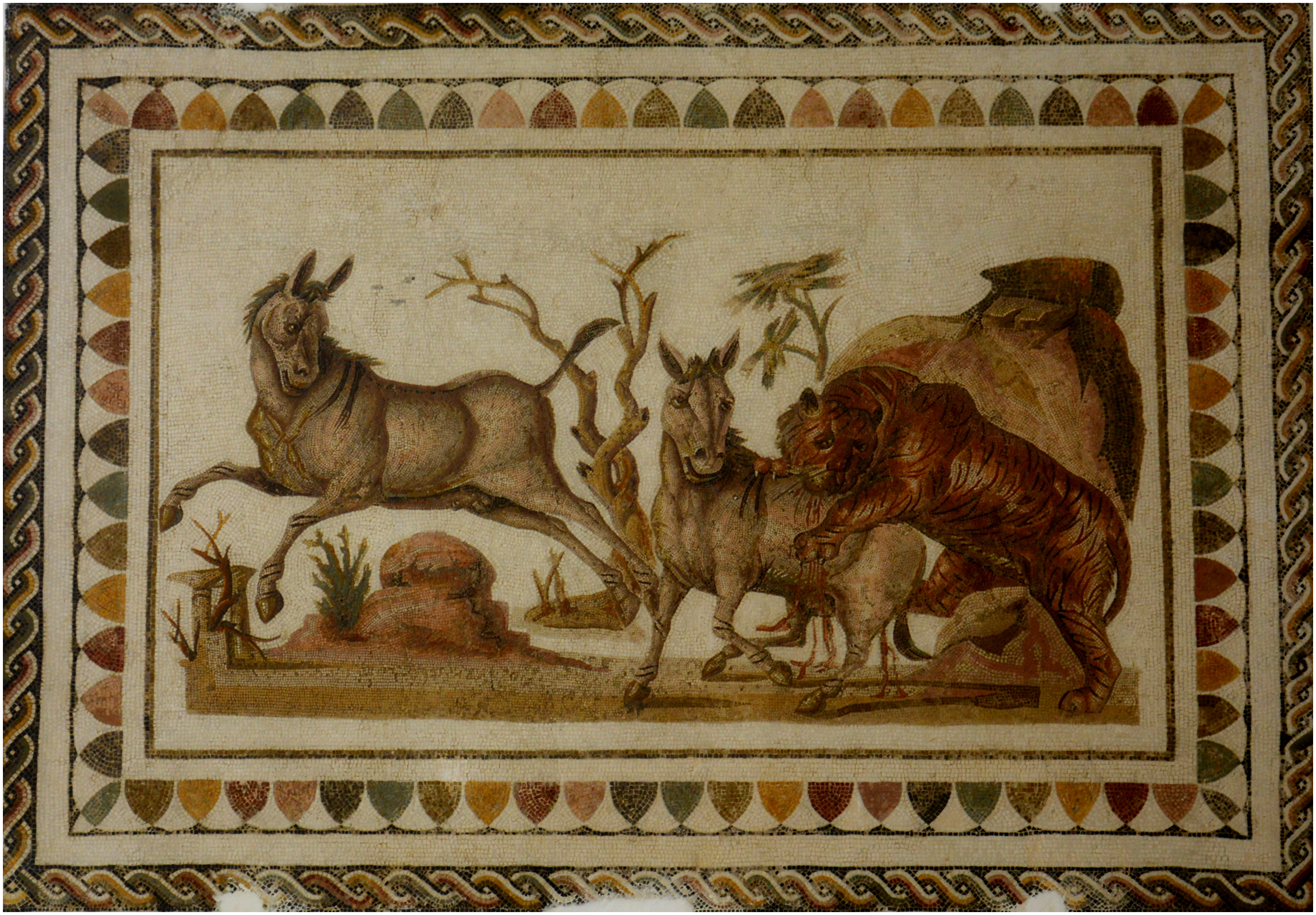
Pere’, pictured in a Roman mosaic (Archaeological Museum, El Jem, Tunisia; photo by IssamBarhoumi, CC BY-SA 4.0, via Wikimedia Commons).
What has been largely overlooked in the modern translations is that this metaphor of Ishmael being a pere’ of a man is drawing from the imagery of these free-roaming animals. The imagery was meant to convey to Hagar that Ishmael would be a free man even though his mother, Hagar, was a slave (Culver 2001, 48). 11 For modern-day US English speakers, comparing the pere’ to a wild mustang enables the beauty of the metaphor to surface.
This promise was wonderful not only because slavery had shaped Hagar’s life; Chase points out that Hagar undoubtedly knew of God’s word to Abraham in Gen 15.13 that his descendants would be slaves in Egypt for 400 years. God was also assuring Hagar that this word did not include her descendants (1999, 216).
This positive nature of the first line should shape the way the subsequent lines are understood and rendered. They too should carry a positive meaning.
The absence of conflict
In the second and third lines of the poem, the inseparable preposition בּ (bǝ) is used. Waltke and O’Connor note that bǝ is the second most common preposition in Hebrew and “the diversity of the senses of בּ is remarkable” (1990, 196–99). 12 Translators of English Bibles have consistently chosen to render it in this verse as “against,” which falls within its range of meaning and makes sense due to its proximity to the word “hand” (see Waltke and O’Connor 1990, 197): “His hand (will be) against everyone and everyone’s hand (will be) against him.” Since the first line of the poem has been understood to have a negative implication, the remaining lines have been translated accordingly. This follows the rules for determining meaning in Hebrew poetry. The Vulgate appears to interpret the first line of the poem in a negative manner, so the word contra (against) is used in the second line.
In contrast, the translators of the LXX captured the ambiguity of bǝ by using epi. Epi, when used with the accusative, can have a wide range of meaning. “Against” falls within that range; yet the use of epi does not require a negative connotation.
Is this second line in the poem meant to function as a prophetic description or as a neutral, etiological description of continual hostility? If we were to think of it in an etiological manner, this line would simply describe the future realities of the nomadic lifestyle of the Ishmaelites at the time when the Israelites were settled in the land. With the Ishmaelites living a wandering life on the edges of settled life, they would naturally from time to time come into contact with their settled, agrarian relatives, and on occasion those times of contact could result in conflict. 13 Yet, if this is an etiological or a prophetic description, why are incidents of this kind of conflict absent from Genesis and the other books of the Pentateuch? The Ishmaelites lived in the Sinai Peninsula (Gen 25.18). 14 The Israelites wandered around that area for forty years, and not once is there a mention of them having any conflict with the Ishmaelites during that time.
The term “Ishmaelite” appears to be used in two ways in Genesis and in Judges. It refers ethnically to the descendants of Ishmael (as in Gen 25.12-18), and it functions as a non-ethnic, generic category for Midianites, Amalekites, and other tribes who lived to the east of Israel. 15 We see this generic use surface in Gen 37.25 and 37.36, where the Midianites are referred to as Ishmaelites, and we also see the term “Ishmaelites” used to refer to the Midianites, Amalekites, and the people of the east in Judg 8.24 (compare Judg 8.24 with Judg 6.3 and 7.12; and Judg 8.10 with 6.1-2, 11, 16; 7.1, 8, 15, 23, 24, 25; 8.5, 12).
The Ishmaelites appear only once by name in all the lists of the enemies of Israel in the First Testament, and that is in Ps 83.5-8. This usage could be a non-ethnic, generic use of the term encompassing those living in Bedouin-like encampments south of Israel (see VanGemeren 2008, 629; contra Tate 1990, 347) in order for the psalmist to achieve literary symmetry. By categorizing all those living in tents to the south of Israel as one generic group, the psalmist was able to put the Lord’s enemies into ten groups surrounding Israel.
Also listed in Ps 83 are the Hagrites, who likely were a subset of Ishmaelites who had settled in Gilead. They appear in conflict with King Saul in 1 Chr 5.10 and in conflict with the Reubenites, Simeonites, and the half-tribe of Manasseh in 1 Chr 5.18-22. It appears that the Hagrites had become very prosperous in Gilead and did not want the Israelites encroaching upon what they saw as their land. After this time period, with the exception of Ps 83, the Hagrites do not reappear as being in conflict with Israel.
Two clans of the Ishmaelites appear in the prophets under the names of Ishmael’s sons, Kedar and Nebaioth (see Isa 21.16-17; 42.11; 60.7; Jer 2.10; 49.28-33; Ezek 27.21; also Ps 120.5). These verses portray them primarily as traders, not as enemies of Israel. 16
Observing this minimal level of conflict in the First Testament, Nahum Sarna notes, The image of Ishmael in the Bible, as distinct from later Jewish literature, is by and large not a negative one. He is not an inveterate enemy of Israel. In fact, there seems to have been some intermingling between the tribe of Simeon and the Ishmaelites, for the clans of Mibsam and Mishma are associated with both, as proved by Genesis 25:13 and 1 Chronicles 4:25. The Ishmaelites do not appear among the victims of David’s raids into the south lands, even though these incursions encroach upon their habitat, as is clear from 1 Samuel 27:8 and Genesis 25:18. David’s sister married “Jether the Ishmaelite,” according to 1 Chronicles 2:17, and among the administrators of crown property under David were “Obil the Ishmaelite” and “Jaziz the Hagarite,” according to 1 Chronicles 27:30f. (Sarna 1989, 122)
Looking at the totality of the biblical record, Christopher Heard notes, “Although Christians commonly claim that Isaac’s and Ishmael’s descendants have fought constantly since Isaac’s birth, it is hard to sustain that claim with biblical evidence” (2014, 279).
Building upon the metaphor
In the second and third lines in the poem, we not only encounter the Hebrew preposition bǝ, we also encounter the word yād (hand). As already noted, bǝ encompasses a wide range of meanings. Yād symbolizes the ability to exercise one’s power and authority. Bǝ and yād surfaced earlier in the chapter when Abraham said to Sarai, “Behold, your servant is in your hand [בְּיָדֵךְ]; do to her as you please” (Gen 16.6). Abraham recognized that Hagar was in Sarai’s hand, meaning, Hagar was under Sarai’s authority.
The LXX models the use of these two Hebrew words by using epi with cheir (hand). This usage in the LXX opens the possibility for viewing epi as indicating “exercising authority over,” reflecting their sense in Gen 16.6. 17 Thus, the LXX can read, “and his hand (will be) over everyone and everyone’s hand (will be) over him.” This reading seems to indicate an ongoing struggle with one’s neighbors; but the struggle is one in which neither party gets the upper hand. This translation serves as a model for the Vulgate and English translations. The notion of ongoing freedom in the pere’ metaphor is carried forward, yet the Ishmaelites are somewhat stigmatized as being boorish and pugnacious.
Although bǝ can carry the senses of “in,” “over,” “upon,” “against,” it can also carry the sense of “with” or “from,” either of which removes the adversarial implication in the words “over,” “upon,” and “against.” 18
Context determines the meaning of polyvalent words. Viewing bǝ as meaning “in” would be confusing. What could Ishmael’s hand being in everyone’s hand and everyone’s hand in his possibly mean? Mutual submission? That is unlikely. The use of hand leads one to think of conflict. When bǝ is used “with a nuance of hostility it has the (frequent) meaning of against” (Joüon and Muraoka 1996, 486). Therefore, drawing upon the assumption of conflict, viewing bǝ as meaning “against” makes sense—that is, if God intended to communicate that conflict would shape Ishmael’s and his descendants’ future. This assumption would line up with how people have tended throughout history to narrate the lives of Arab tribes, whom they assume reflect the kind of lives the Ishmaelites would have lived. Yet, we should be cautious about allowing historical, reified perceptions of Bedouin life to shape our understanding; rather, we should take our cues from the First Testament. As we have seen, the First Testament does not cast the Ishmaelites in a predominantly adversarial light. Therefore, if hostility and conflict is not intended to be conveyed, what is?
It appears that the intent of the promise is to assure Hagar that her son and his descendants would live independently and thrive despite living in a hostile environment. Recognizing the positive nature of this promise, Amit proposes rendering bǝ as “with.” Rendering it in this manner would communicate that the Ishmaelites would have positive relationships with the tribes around them so that they could live and trade securely (2019).
There is much to be said for Amit’s proposal. The caution I have is that the use of “with” may connote greater intertribal allegiance and cooperation than intended, just as “against” connotes greater conflict. In the search for a more suitable alternative, Sarna notes that the boundary of meaning between bǝ and min is somewhat porous (1959, 310–11). Rendering bǝ as “from” coheres with the concept of freedom in the initial metaphor and clarifies how God’s blessing on Ishmael and his descendants would be manifested. The Ishmaelites would keep their hand from their kin and neighbors, indicating that the Ishmaelites would not seek to dominate anyone, and their neighbors would keep their hand from the Ishmaelites, indicating that they would live free from the fear of being dominated. The Ishmaelites would be able to live as a distinct people, independent, while coexisting with their neighbors. This is not to assert the Ishmaelites would have no conflict with anyone; it is simply to assert that conflict was not going to characterize their relationships with Israel and other neighboring tribes, as conflict characterized other tribes like the Edomites and Midianites.
A position of honor
This positive meaning in the second and third lines seems to be affirmed and expanded upon in the last line of the poem. The line begins with a prepositional phrase, עַל־פְּנֵי. The preposition ‘al can mean “on/upon/above/against.” Pǝnê means “face (of).” When combined, this prepositional phrase can communicate “before/in front of/in the face of/apart from/across from.” 19
ʿAl-pǝnê can take on an adversarial sense and can express hostility and defiance. This is why NIV translates it as, “he will live in hostility toward all his brothers,” and why NASB2020 translates it as, “he will live in defiance of all his brothers.” These renderings are unmistakably pejorative and unnecessarily so, because ʿal-pǝnê does not require an adversarial sense. It can simply mean “in front of” or “in the presence of.” 20 For example, ʿal-pǝnê is used in Exod 20.3, where God told the Israelites that they were not to have any other gods “before” (ʿal-pǝnê) him, that is, in his presence. 21 This is why KJV renders this final line of the poem as, “and he shall dwell in the presence of all his brethren.” 22
This final line builds on the idea of the Ishmaelites living independently and states that while they live independently, they will live in view of their kin (this would include the Israelites and the Midianites). 23 This line affirms viewing independent coexistence as the intended meaning of the second and third lines and takes it one step further. Given that honor–shame dynamics were in play at the time of Hagar, this final line seems to indicate that not only will Ishmael and his descendants live near to their kin, they will also live free of any shame derived from having descended from a slave woman. They were to live with honor in the presence of their kin. 24
Consequently, the immediate context of v. 12 indicates that the writer did not intend this poem to carry a pejorative meaning, predicting that boorishness, pugnaciousness, and perennial conflict would characterize Ishmaelites, a view which sadly leads many people of Judeo-Christian origin to view Arabs in a negative light. To the contrary, it appears that the promise was intended to be a consolation and encouragement to Hagar. The writer indicates that God was encouraging her to return to Sarai and Abram because God loved and cared for her. Due to his love, God was not going to allow slavery and its shame to define her son or his descendants. They would be blessed by God, have a distinct identity, and live free with honor (Gen 17.20).
Ishmael and Isaac
Hagar and Ishmael’s freedom from slavery came about in Gen 21 when Sarah saw Ishmael laughing during Isaac’s weaning (Gen 21.9). Ishmael’s laughter has been understood as being either negative or neutral. Some have viewed Ishmael’s laughter as mocking Isaac, as per NASB. Others have viewed his laughing as simply being playful with Isaac, as per NRSV. The wordplay between Ishmael’s laughter and Isaac’s name (which means “he laughs”) is not meant to indicate maliciousness on Ishmael’s part or cast a pall over Ishmael’s (or his progeny’s) character. 25 Abraham’s reluctance to send him away indicates that this was not the case. The wordplay directs us to view the laughter as the action that alerted Sarah to Ishmael being on equal footing with Isaac. Since Ishmael had been recognized by Abraham as a legitimate son (Gen 17.23), Ishmael had a right to a portion of the inheritance. When Ishmael laughed, Sarah realized that having two heirs could lead to a nasty competition over the inheritance. 26 To eliminate that potential threat Sarah demanded that Hagar and Ishmael be sent away (Gen 21.10). 27 Sarna notes that Sarah’s demand was justifiable, as it was rooted “in a clause in the laws of Lipit-Ishtar where it is stipulated that the father may grant freedom to the slave woman and the children she has borne him, in which case they forfeit their share of the paternal property” (1989, 147). Sarah implored Abraham to exercise this legal right. In accordance with God’s guidance, Abraham conceded and sent them on their way (Gen 21.12-14). As Hagar and Ishmael left the camp that day, they were finally free.
Conclusion
A principle in meaning-based translation is, if the form distorts the meaning, change the form and keep the meaning. We have seen that the meaning of pere’ in Gen 16.12 gets distorted by the use of its direct equivalent in English and the intent and beauty of the promise is lost in the translation of the subsequent lines. As we seek to ameliorate this conundrum, this is one proposal towards capturing the positive aspects of God’s promise: He (will be) a free man, his hand (will be free) from everyone and everyone’s hand (will be free) from him, and he will live in the presence of all his kin.
The promise to Hagar was intended to comfort and encourage Hagar because God had seen and was responding to her suffering (Gen 16.11). Being told she was to have a son would fulfil Hagar’s aspiration for this pregnancy. In addition, her son would have many descendants, and they would live under the blessing of God (Gen 16.10; 17.20). They would live free from the threat of being dominated by the peoples living around them, and those peoples would not fear being dominated by them. Finally, though Hagar was a slave without honor, her son and his descendants would live with honor. We see this promise realized as we read further in Genesis. Ishmael stood with honor with Isaac at the burial of their father, Abraham (Gen 25.9). 28 In addition, Ishmael had twelve sons just as Jacob did, and the Ishmaelites lived as a free and distinct people, settling in the Sinai Peninsula, in an area described as being from “Havilah to Shur which is before (ʿal-pǝnê) Egypt on the way to Asshur” (Gen 25.18). Genesis 25.18 closes by saying the Ishmaelites settled in the presence of (ʿal-pǝnê) all their kin.
The time has come for us to acknowledge that the traditional manner of translating Gen 16.12 has led to centuries of stigmatization of Arabs, primarily Muslim Arabs. Fresh reflection on this verse can lead to corrected translations and to the intentional elimination of any sacred justification for this stigmatization.
