




Abstract
When a translation of a text is complete, the presentation of the text should, as much as possible, avoid any influence that could reduce the impact or acceptability of the contents of the text. This is especially true of faith-critical texts, whether they are of Christian or Islamic origin. The study and comparison of different art traditions can help us reduce the possibility of such unfortunate influences. Since Christians and Muslims have very different assumptions even about the nature of God (or Allah) as he reveals himself through sacred writings, it is not surprising that Christians and Muslims also have very different art traditions. The paper first introduces the principles of classical Western Christian art and of classical Islamic art, since these traditions were approximate contemporaries. It then compares differences in color symbolism, important symbols in each faith tradition (including Islamic calligraphy), and in the forms and functions of traditional architecture.
In Muslim-idiom Bible translation, the translator is concerned to preserve both the accuracy and impact of the original text while simultaneously reducing as much as possible the use of terms and expressions which might unnecessarily hinder the understanding of the contents of the text. There are similar issues to be faced in the presentation of translated texts, especially in the presentation of faith-critical texts, whether they are of Christian or Islamic origin. Just as concerns about naturalness and acceptability are important when assessing the quality of translated texts, so similar concerns are important when we consider how the translated material is to be presented. If those responsible fail to understand the art traditions of the communities into which these texts are being translated, they can severely restrict the acceptability of translation products and thereby unnecessarily hinder the reception of the translated message.
One of the ways we can avoid these hindrances is through the study and comparison of different art traditions. However, in doing this we quickly encounter a challenge: cultural expressions of art are not always easy for an outsider to understand, just as a language learner discovers that learning a language cannot be divorced from study of the culture in which that language is spoken. Different art traditions may start with very different assumptions, each embedded deeply within their own faith tradition. Since Christians and Muslims have very different assumptions even about the nature of God (or Allah) as he reveals himself through sacred writings, it is not surprising that Christians and Muslims also have very different art traditions.
This paper attempts, in broad strokes, to help those who are presenting a faith-based message across the Christian–Muslim divide by discussing some of the assumptions governing traditional art in both contexts. The paper begins with a brief discussion of the principles of classical Western Christian art and of classical Islamic art, since these traditions were approximate contemporaries. With this basis, the discussion broadens to compare differences in color symbolism and important symbols in each faith tradition. In the case of Islam, particularly, this necessitates a brief look at Islamic calligraphy. The paper ends with an introduction to the forms and functions of traditional architecture in each faith tradition. We demonstrate that both faith traditions have well-established connotations arising from the use of colors, symbols, and architectural forms.
Principles of classical Western Christian art
To make any progress at all in our introduction to Western Christian art, we need to limit the scope of our observations. In the modern era, Christian art has taken many forms and many media of expression have been developed, and so it is appropriate to state more explicitly our range of observations.
The exemplar of Christian art in this analysis will be Western Christian art of the period from approximately the eleventh century to the eighteenth century. This period included such cultural upheavals as the rise of Protestantism, the Renaissance, the Inquisition, and the heralding of the Age of Reason. It also included a period of codification of Christian symbolism and realism in presentation that was not a feature of Western art either beforehand or afterwards. This period may be referred to as a period of “classical” art or “Renaissance” art or “classical Western Christian” art. Towards the end of this period, Christian art followed a Baroque tradition, which we will illustrate as needed.
We can also consider this period as being bracketed by different artistic concerns. For example, prior to this period, Western Christian art was concerned with delivering an interpretation of a specific message or story but did not emphasize accuracy of perspective in illustration (see King 2023 for the story of the Book of Kells, an example of this). Thus, the period of classical Western art introduces a departure from previous matters of interest with its concentration on realism.
Further, since the end of this period, Western art has seen fit to abandon more of its Christian associations, and previous assumptions (for example about color symbolism) are no longer universal. (See, for example, Meyer 2023 for the rise of impressionism in French art, and Paul 2004 for the rise of abstract impressionism.) This, then, tends to limit the latter end of the period we are considering herein.
To a large extent, therefore, this analysis will concentrate on comparing classical Western Christian art, as is found in static displays, with comparable Islamic art forms. Nonetheless, such boundaries as this are often somewhat arbitrary and we will discover at various places a need to refer to other Christian art traditions. In particular, this work would lack significant relevance without reference to the Eastern center of Christian influence in Constantinople (contemporary Istanbul) during about the same period of history, and thus this will be referred to as necessary.
We start this analysis by making two assertions about the God of the Bible as depicted in classical Western Christian art, (i) that God reveals himself through his creation (Ps 19.1-6) and (ii) that he is therefore pleased when his people rejoice in his creation (1 Tim 6.17). Flowing out of this assertion are several natural consequences which influence the Christian art tradition we will be studying:
Art often reflects contemporary cultural concepts of beauty and form.
There is an emphasis on naturalness, shown in anatomical and scientific accuracy in presentation.
Artists often attempt to evoke both a sensual and a psychological response to their work, often through attention to both color and composition.
The subject matter dealt with in the art is often intended to tell a story, and that story is often religious (usually biblical) in nature.
There were, of course, other influences on the art of this period that we will not be investigating in this paper, including:
The patronage system which supported the creation of art and influenced the nature of the art produced. Typically, the artist intended to imply that the patron was a good or faithful person.
The way that much of the art of this period builds on previous Greek and Roman traditions.
Factors such as this are part of the context of the art; we will refer to them as needed.
Principles of Islamic art
Just as in the creation of Christian art, the principles of Islamic art stem from a basic assumption about the nature of Allah as revealed in the Qur’ān. We may state this assumption as Allah being above all comprehension (Q Al-Anʿām 6.103), non-representable, inexpressible, and ultimately very different from his creation (Q Aš-Šūrā 42.11). Since, therefore, it is not appropriate to represent Allah in terms of his creation, the artist or creator of art must look to the Qur’ān itself for the acceptable model of aesthetic creativity.
Simply put, Islamic art is built on the principle of توحيد tawhid, the oneness and transcendence of Allah. Some consequences of this principle, as explained by al Faruqi (2013), are:
توحيد tawhid precludes representing Allah through sensory means, including depiction of man and nature.
توحيد tawhid is best expressed through patterns with no beginning and no end, since Allah himself has not beginning and no end (often this is referred to as “infinity-art”).
Like Christian art, Islamic art also needs to be understood in context. Some important parts of this context include:
The art of Islam is influenced by various dynasties that emerged through history. Nonetheless, even contemporary Islamic art tends to show strong derivative links to its historical past.
The sectarian Sunni–Shia divide. We will make some limited reference to this but will mostly avoid peripheral influences on art expression (for example, the art of Spain during the period of the Moors, or the influence of the more mystical expressions of Islam).
Here again, we will make reference to some aspects of the cultural context of Islamic art, as needed, but these will not be comprehensive in nature.
Color symbolism
An ancient rhyme often repeated by mariners goes something like this:
Red sky at night, sailors’ delight. Red sky at morning, sailors take warning.
In other words, the observed color of the sky at either sunset or sunrise was considered to carry a connotation about the weather to come. This was intended to allow the sailor to make appropriate plans to respond to the future weather, perhaps by taking full benefit of the favorable winds or by seeking shelter to avoid dangerous weather patterns. This is an indication that color itself can carry meaning within a cultural heritage.
However, color symbolism goes deeper than this. The peripatetic, sixth-century Greek poet and scholar Agathias Scholasticus is reputed to have said, “art can convey by colors the prayers of the soul” (Paton 1970, 23).
Various faith traditions have assigned specific meanings to certain colors; this is referred to here as color symbolism. This allows particular artistic creations to send a message to the intended audience, irrespective of the form or nature of the particular creation, based on a shared symbolic understanding. Of course, the message is only effectively conveyed if the intended audience is using the same system of color symbolism as that used by the original creator or artist. This chapter outlines some of the major symbolic meanings of various colors in both Christian and Islamic traditions. Before we begin this, however, we note important aspects of the context of these traditions.
There are at least two main traditions of classical Christian thought, which we shall refer to for convenience as the “Western Christian” and the “Eastern Christian” traditions. These two traditions stem from the division of the Christian church into (at least) two distinct segments, one centered in Rome and the other in Constantinople (the Byzantine tradition). This “East–West Schism” is often dated from 1054, when the patriarch of Constantinople (Michael Cerularius) and Roman Pope Leo IX mutually excommunicated each other. However, the estrangement of these segments of the Christian church had been growing for about 500 years previously.
In the same way there were significant variations, during the classical period, in color symbolism across nations and cultures dominated by Islam. These variations are often rooted in upheavals such as the Sunni–Shia schism. The color palette presented here for Islamic art, then, makes generalizations only, and much local variation is to be expected (see, for example, Bloom and Blair 2011).
Western Christian color symbolism
Many Christian color symbols have origins in the Holy Bible. For example:
White is clearly the color of purity, for we are told (Rev 3.4, 18) that the redeemed will “walk with God, dressed in white, for they are worthy.” This purity can be restored to forgiven sinners (Ps 51.7; Isa 1.18).
Purple is the color of the royal robe they dressed Jesus in when they mocked him before his trial and crucifixion (Mark 15.17-19). Purple was the color that the contemporary government associated with royalty and it became a Christian symbol also.
Green describes the places where God leads his people so that they may flourish and live (Ps 23.2).
The most influential attempt to formalize color symbolism in Western Christian art and practice is attributed to the efforts of Pope Innocent III. This powerful pope is remembered for many acts: he greatly expanded the scope of the crusades and he produced many of the foundational documents on which the Inquisition was later based. Further, in about 1200, he promoted a system of color symbols which survived for many centuries.
Renard (2021) explains the derivation of color symbolism among Christians as follows:
It seems that white made its appearance from the 4th century and was used until the 9th century for the liturgy … Over the centuries, several other colours appeared, without there being any global harmonization by the Church. … [We have the recommended proclamation] on the initiative of the future Pope Innocent, De sacro altaris mysterio, which effectively defines a first rule of liturgical colours made up of white, green, red and black. Violet is added, perceived as a variation of black in its symbolism of penitence … He explained the choice of each of the colours with a spiritual and symbolic meaning to a corresponding day or time of the liturgical calendar. … The Pope’s codex began to circulate, and then the Rationale divinorum officiorum by Guglielmo Durando (1230–1296), bishop of de Mende, stimulated the process, leading to a more widescale adherence to the guidelines within the fourteenth century.
Thus, the four-color symbolism indicated by Pope Innocent, with associated liturgical usages (usually in the color of vestments worn), was:
White, which the church used on feasts of confessors, virgins and on other joyful days;
Red, used for martyrs, of the Holy Cross, and at Pentecost;
Black, used in penitential seasons and for Masses for the Dead; and
Green, used on common days because it was “midway between black and white.”
Pope Innocent also regarded violet as a variant of black to be used on the feast of the Holy Innocents.
The color coding developed from his proposals is summarized in Table 1.
Classical Western Christian color symbolism (following Pope Innocent III).
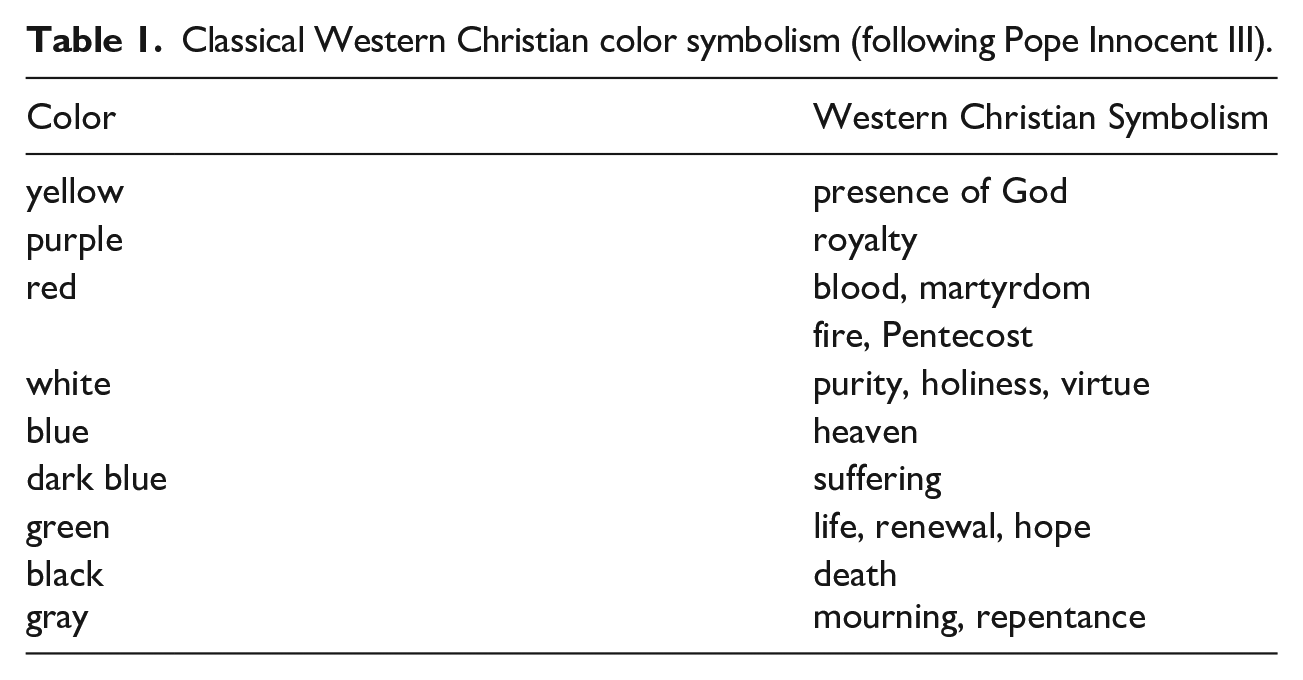
This system of color symbolism was applied in various ways throughout Western Christian tradition. To illustrate some of the ways in which this was done, we note two very different examples.
The first example comes from an account of an 1680 “Auto de Fe” procession, a large, public display during which prisoners of the Spanish Inquisition received the punishment of their heresy convictions. (These typically culminated in the burning of heretics who refused to recant.) Miguel Aviles (2001, 124–25) describes the pageantry of these processions and includes the following observations:
The green cross on the coats of arms of the Inquisition (the important symbol in the procession on the day, preceding the formal arrival of dignitaries, the carrying out of the death sentences, etc.) agrees with the popular perception of the color green as meaning hope.
The green cross was initially covered with a black cloth (later slowly removed if heretics recanted and were reconciled to the church) as a sign of mourning and sadness of the Christian community and a reminder of their impending deaths.
The green cross was followed in the procession by a white cross, symbol of the shining of triumphant faith and a last symbolic invitation to obdurate defendants to obtain salvation through personal contrition.
This shows that, over a period of more than four hundred years, the color symbols promulgated by Innocent III had been adapted by those responsible for the Spanish Inquisition, but they still retained their basic meanings.
The second example is from a stained glass window in a cathedral, shown in Figure 1.
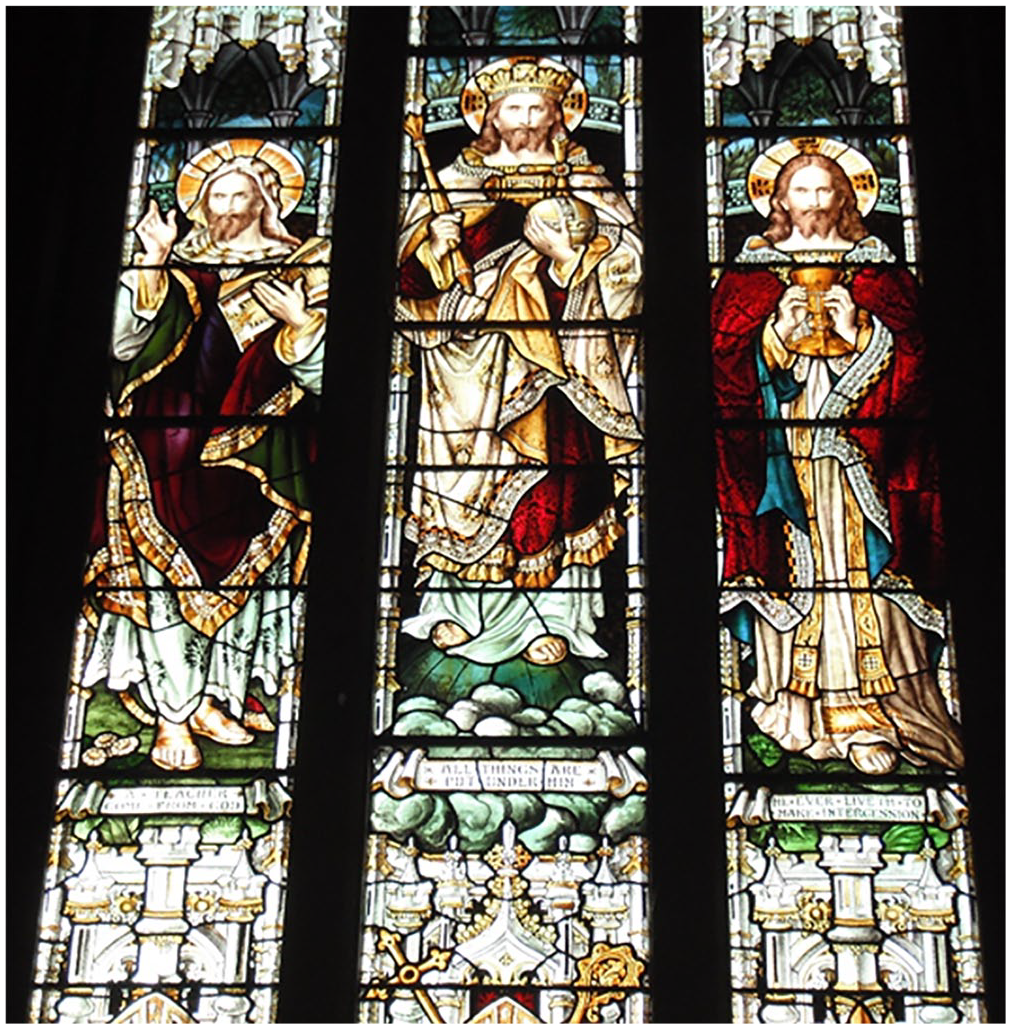
Stained glass window, St. Mary’s Cathedral, Auckland, New Zealand, ca. 1850.
The window depicts Christ as prophet (with book), priest (with chalice), and king (central pane, with orb). The window was built around 1850 and is part of St. Mary’s Cathedral in Auckland, New Zealand, a Church of England house of worship. Note the color symbolism in the window:
Blue = heaven (looking upward), with dark blue (of suffering) underneath.
Yellow = presence of God (all three pains).
Red = blood/martyrdom (priest and king).
Blue/violet = royalty (prophet and king).
White = purity, holiness (robes of three figures).
Green = life, renewal (under the feet of all three figures).
These two examples are not comprehensive, but they do serve to illustrate the far-reaching effects of the color symbolism promoted by the edict of Innocent III. Many years removed in time and a great distance from the seat of power in Europe, this edict of Pope Innocent III continues to exert a significant influence on Western Christian art.
Eastern Christian color symbolism
As we consider the color traditions of Eastern Christian art, we will use examples from iconology. Of course, iconology is much more than merely color combinations, but colors are part of the interpretation of the art. Figure 2 is a mosaic of Christ (center) with emperor Constantine IX (left) and empress Zoe (right), 1042–1055, in the Hagia Sophia, Constantinople (Istanbul). Note the color symbolism:
Gold = divine nature of God, splendor of celestial kingdom (upper portion of icon), also on Bible.
Purple = Christ’s robe.
Brown = robes of Constantine, Zoe.
Blue cushion = Christ’s dwelling place, heaven.
Implied holiness (white) and life (green) in robes of Constantine, Zoe.
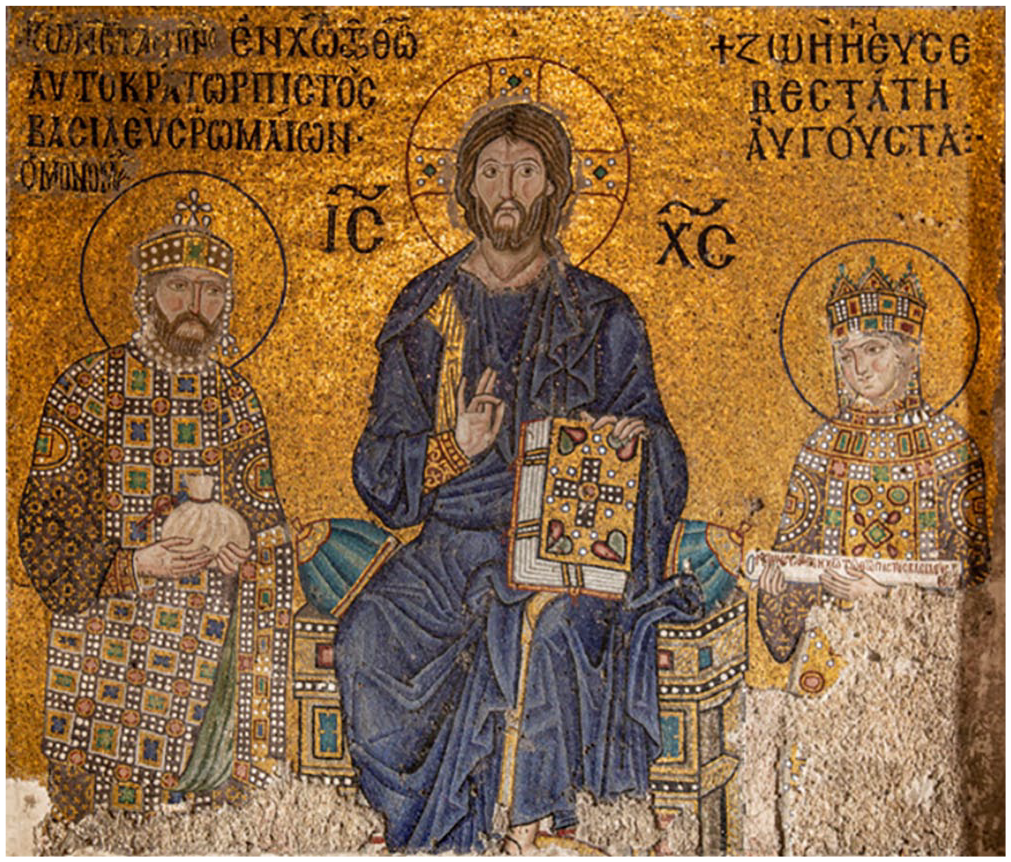
Icon mosaic. Hagia Sophia, Constantinople, Istanbul, 1042–1055.
Table 2 summarizes some of the basic color symbols assigned by classical Orthodox Christian art (for details, see Anonymous 2003) and compares these with those already discussed in traditional Western Christian art. A cursory glance at the table indicates both aspects of a common heritage and also significant divergence in the symbolic meanings associated with the various colors.
Comparison of color symbolism in classical Western Christian and Eastern Christian traditions.

Islamic color symbolism
We begin this discussion with the color green. This color has a number of symbolic meanings in Islam, but the primary meaning is that of identification with Islam itself. Green is used often in Islamic art and architecture. Thus, for example, green is the principal color of the national flags of both Pakistan and Saudi Arabia, as well as featuring prominently in the flags of other countries. Green also symbolizes balance, harmony, life, and nature.
While the sacred color of Islam itself is usually considered to be green, gold is associated with God’s heavenly kingdom, a place of perfect balance and harmony. When the faithful finally reach paradise in the afterlife, the Qur’ān states, “ornaments shall be given to them therein of bracelets of gold, and they shall wear green robes of fine silk and thick silk brocade interwoven with gold” (Q Al-Kahf 18.31) and they will be “reclining on green cushions and beautiful carpets” (Q Ar-Raḥmān 55.76). Thus green and gold together have come to be associated with paradise. Note the combination of green and gold in Figure 3.
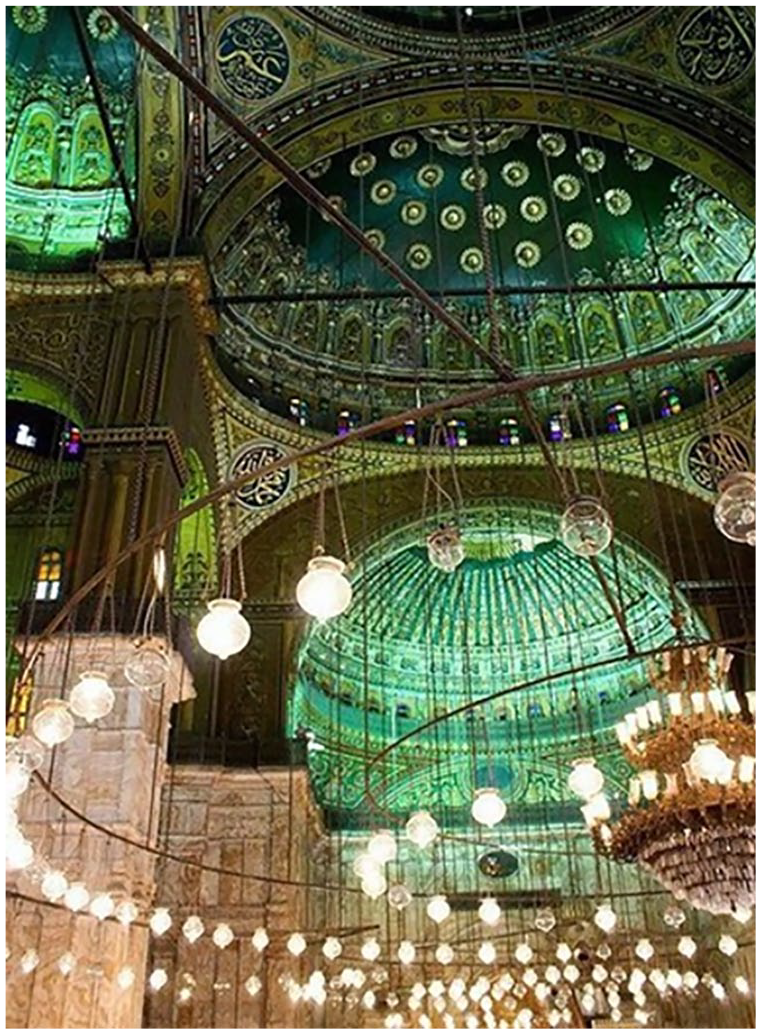
Interior decoration of the Mosque of Muhammad Ali Pasha, Cairo, Egypt.
Through its identification with Islam, the color green often also infers other highly valued characteristics of Islam, such as balance, harmony, and life.
The colors black and white should be initially considered together, as they represent opposites in Islam. As Siraj Islam (2016) explains:
The words “white” and “black” in the Quran mainly describe states of minds reflecting or lacking light of spiritual awareness. … While “white” in the Quran represents the mental state of enlightenment, i.e., the awareness of God’s oneness (24.35), and “black” does the opposite (24.40), the word “colours” describes the states in-between (35.27-28).
However, these colors have also taken on additional connotations. The color white was also reputedly the favorite color of Prophet Muhammed, and so it has become connected in Islamic thought with the ideas of purity and peace. Even today, wearing white clothing is seen, among some, as an indicator of the wearer as a pure and good Muslim. White is the preferred color of clothing worn at Friday prayers and in clothes (Ihram) for performing the hajj. This is the color second-most associated with Islam and also features on many national flags.
The color black has different symbolism for different Muslims. Sahih Al-Bukhari (Hadith 7.713) tells of the Prophet Mohammed giving a black outer garment, accompanied by a blessing, to a small girl.
Several traditions have grown up around the practice of wearing black clothing:
In general, scholars agree that black clothing is permissible for both men and women.
Many would say that wearing black clothing is inappropriate at times of bereavement.
For many Muslims black is the color of death, but for pious Shia Muslims it represents modesty, and is therefore appropriate for clothing.
Bahari and Hassan (2014) discuss the use of black flags by various political groups associated with Islam, including the Taliban, Islamic State, Al Qaeda, and Hizb ut-Tahrir. These groups often display black flags with some white writing on them. Bahari and Hassan note that “there is not even a single intimation in the Quran that promoted the use of the black flag or regards it as holy or sacred” (2014, 17). They go on to note references to black flags in the Hadith, including a reference which indicates that a victorious army will come from the east with a black flag. However, they claim that none of the references usually noted in this context are included in the official Hadith (although they have been referred to by Islamic scholars historically), and thus the demands of allegiance from such groups are specious.
Siraj Islam (2016) also comments on the color blue:
Blue is used once in the Quran, in an allegory about the hereafter, to denote “blurred (blue) vision.” (The day the horn is blown, and we gather the offenders on that day blue 20.102; cf. 20.124, 17.71-72.) Here blue, as the least distinct in the visible spectrum, represents blurriness or relative blindness, spiritual blindness in this occasion. It may also imply “blueness” (cyanosis) related to the panic felt by a convict in the face of divine judgment.
However, the color blue has also come to be associated with the idea of protection. Some would allow these two different understandings to arise by considering two different shades of blue (a dark blue and a lighter blue). An example of blue as an indicator of protection is the Sultan Ahmed Mosque (Figure 4), also known as the Blue Mosque, in Istanbul, the interior of which is covered with thousands of blue tiles. Fakharany (2023) makes the following comment on this mosque: “Associated with protection from the evil eye and a reminder of the eternal sky, this specific use of blue is correlated with the Ottoman architectural style of the 17th century.”
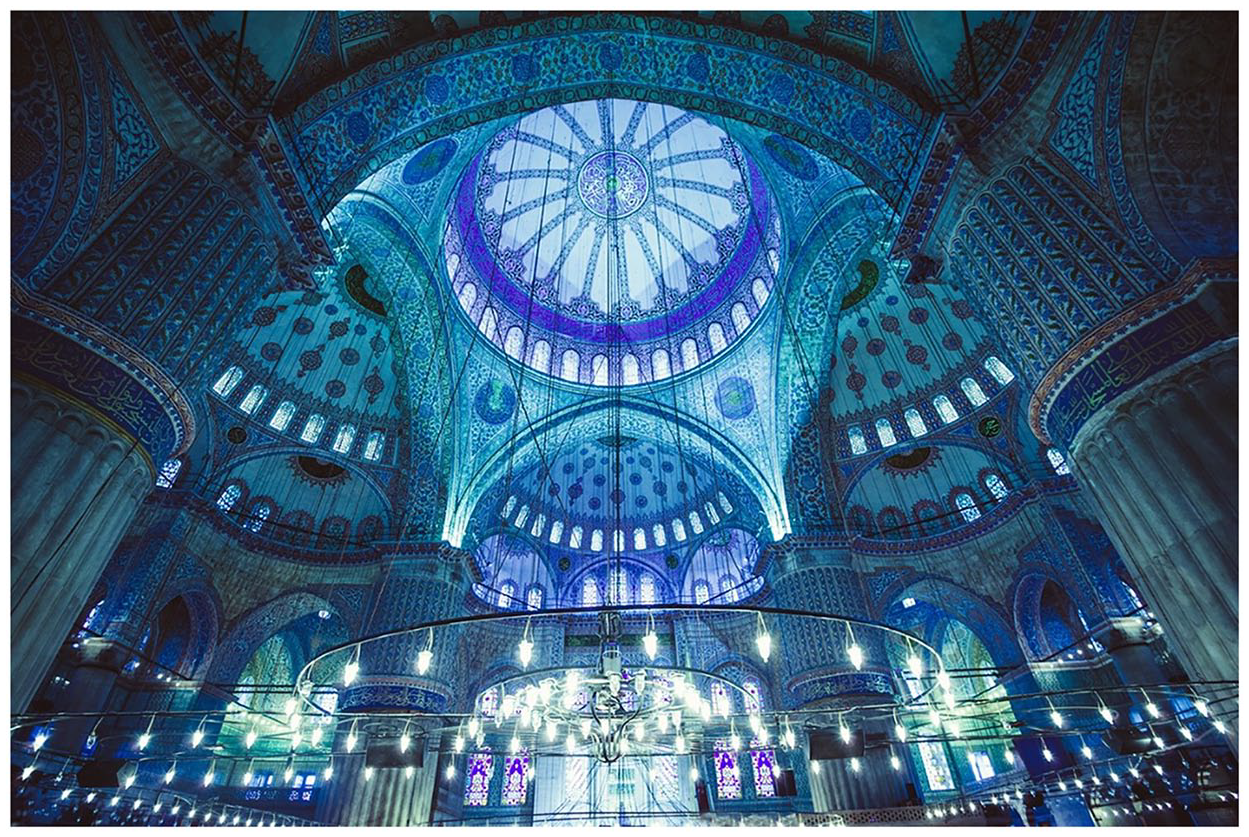
Sultan Ahmed Mosque (Blue Mosque), Istanbul, Turkey.
It should be noted also that the Hadith generally forbids men from wearing certain specific colors: saffron/yellow, orange, and plain red.
With these examples, we can begin to build a chart depicting the major symbolism of colors in Islam while recognizing that this is an overview only and does not account for localized variations in time or location (Table 3).
Overview of color symbolism in Islamic tradition.

For centuries, Islamic artists and creators avoided the use of red (with certain exceptions), but with the ascendancy of the Ottoman empire in the sixteenth century, red became a color popularized by, and identified with, that tradition. Even today, the color red dominates the Turkish flag.
Color symbolism summary comparisons
From the discussion thus far, we can assign specific meanings to specific colors in Western Christian, Eastern Christian, and Islamic art traditions.
An examination of Table 4 shows that most colors carry different symbolism in the three traditions, and this is a major conclusion of this section. Beyond this we note similar symbolic interpretations of a minority of colors, including:
White: normally indicating purity or holiness (the favorite color of the Prophet Muhammed)
Black: normally indicating death (but interpreted as indicating modesty by Shia Muslims)
Green: normally indicating life (but treated as a special color of Islam)
Comparison of color symbolism in classical Western Christian, Eastern Christian, and Islamic traditions.

In one sense we can think of color symbolism in art appreciation as analogous to “implied information” in Bible translation. In the translation process we recognize that behind every text there is a great deal of implied information, but only some of that information is critical to the correct understanding and interpretation of the text. However, we often have a significant problem when a language community receives a newly translated text and then interprets that text using implications coming from its own culture and history. It is likely that the “implied information” the new reader brings to the text does not match the implied information accessible to the original writer (and audience), and derivation of a meaning other than that intended by the author is a probable result.
Likewise, an observer of an art object may have some appreciation of the object without a deep understanding of the color symbolism, and yet may gain a much greater appreciation of the work with a basic understanding of the symbolism assumed by the creator of the art. In this case, the observer merely misses some of the richness of the meaning intended by the creator. However, we have a significantly different challenge if observers (from a different community) try to understand the art object by reference to their own native understanding of color symbolism. As we can see above, these observers are highly likely to misinterpret the object of observation.
Symbols and symbolism
In addition to color symbolism, much faith-based art includes appropriate symbols that remind the reader/viewer of the message behind the art. When including any of these symbols in religious art, the publisher needs to be aware of the connotation of these symbols for the intended audience.
Common symbols in Christian art
In this section we explore some of the common symbols of the Christian faith and show examples of how these symbols have been employed in Christian art.
The cross
Originally the cross was perceived as the most terrible and humiliating form of execution that the Romans had at their disposal, and the Roman government chose this form of execution for Jesus (Matt 27.26). It is therefore interesting to trace how this symbol of execution became a treasured symbol of identification for Christians. Cavendish (2012) provides us with an account of this change, attributing it to an event in 324 while Constantine was fighting his brother-in-law Maxentius for control of the Roman empire:
The story, or a story, of what happened was told by Eusebius of Caesarea, a Christian biblical scholar and historian who wrote the first biography of Constantine soon after the emperor’s death. He knew Constantine well and said he had the story from the emperor himself. Constantine was a pagan monotheist, a devotee of the sun god Sol Invictus, the unconquered sun. However before the Milvian Bridge battle he and his army saw a cross of light in the sky above the sun with words in Greek that are generally translated into Latin as In hoc signo vinces (“In this sign conquer”). That night Constantine had a dream in which Christ told him he should use the sign of the cross against his enemies. He was so impressed that he had the Christian symbol marked on his soldiers’ shields and when the Milvian Bridge battle gave him an overwhelming victory he attributed it to the god of the Christians.
Certainly, this identification of Christians with the cross happened before the sixth century. By this time, as can be seen in Figures 5 and 6, images of the cross often included precious jewels in a profusion more commonly reserved later for royal crowns.
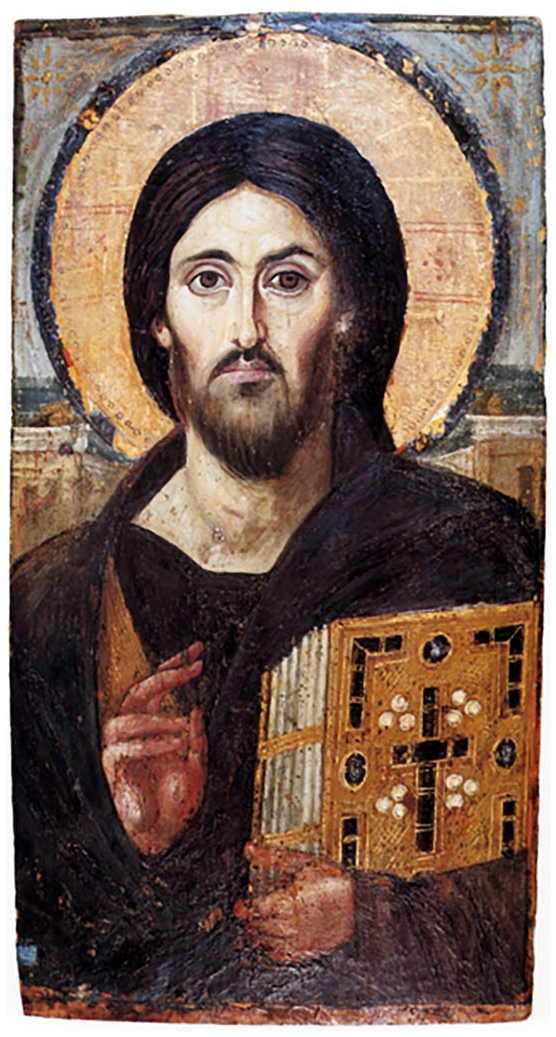
Christ Pantocrator (sixth century).
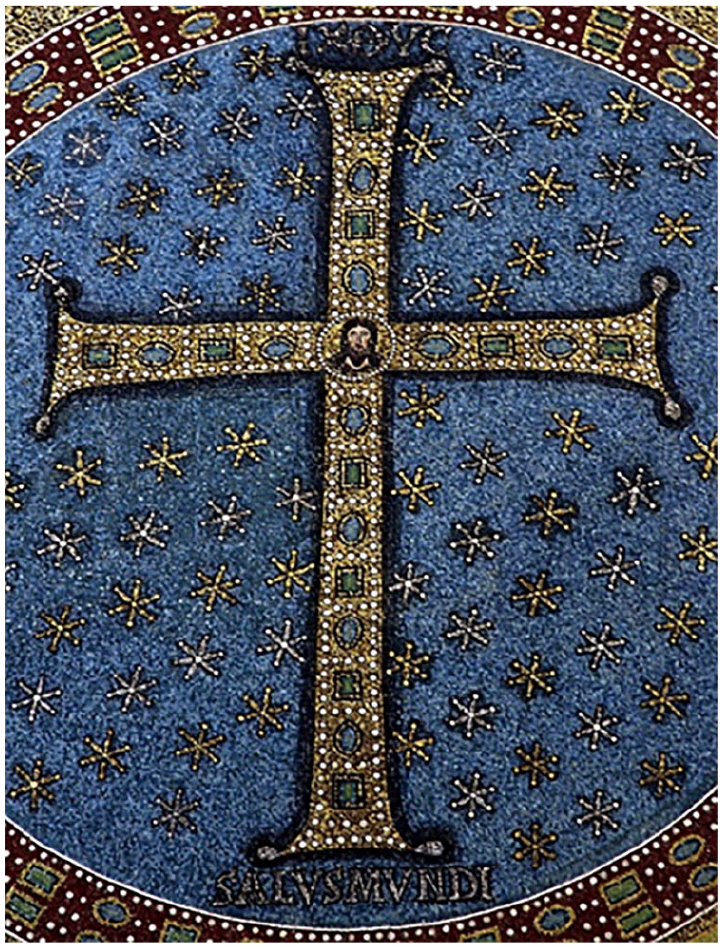
Latin cross.
However, the cross symbol has, in some instances, become a mixed Christian-pagan symbol. A good example of this is the Celtic cross (Figure 7), often referred to as the Celtic High Cross. The form of the Celtic cross is that of a Latin cross with a circle or halo intersecting it. A popular Irish legend credits St. Patrick with the design of the Celtic cross, claiming he joined a cross with the sun or moon, important Celtic symbols of life (IrishCentral Newsletters 2017). These crosses were popular during the eighth, ninth, and tenth centuries, but by the twelfth century, production of Celtic crosses had largely ceased.
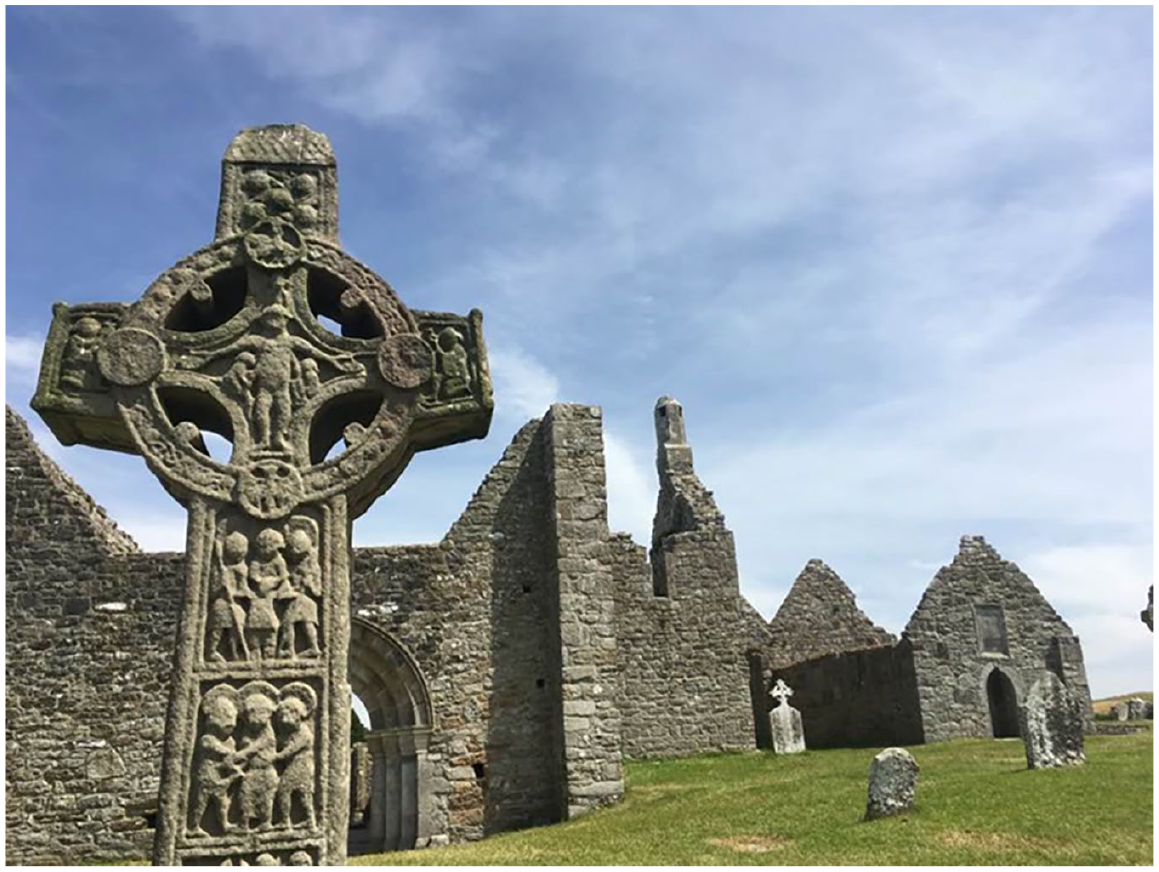
Celtic cross.
We thus see that, by the time of the Renaissance, the cross symbol was associated explicitly with the crucifixion of Jesus, although when the cross became a purely Christian symbol is somewhat murkier. The example shown in Figure 8 is a detail from the Isenheim Altarpiece where clearly the cross has pride of place. The Christ on the cross is intended to show vividly his suffering in agony: his body is marked with pox (many pilgrims suffering from the plague came to the monastery seeking healing).
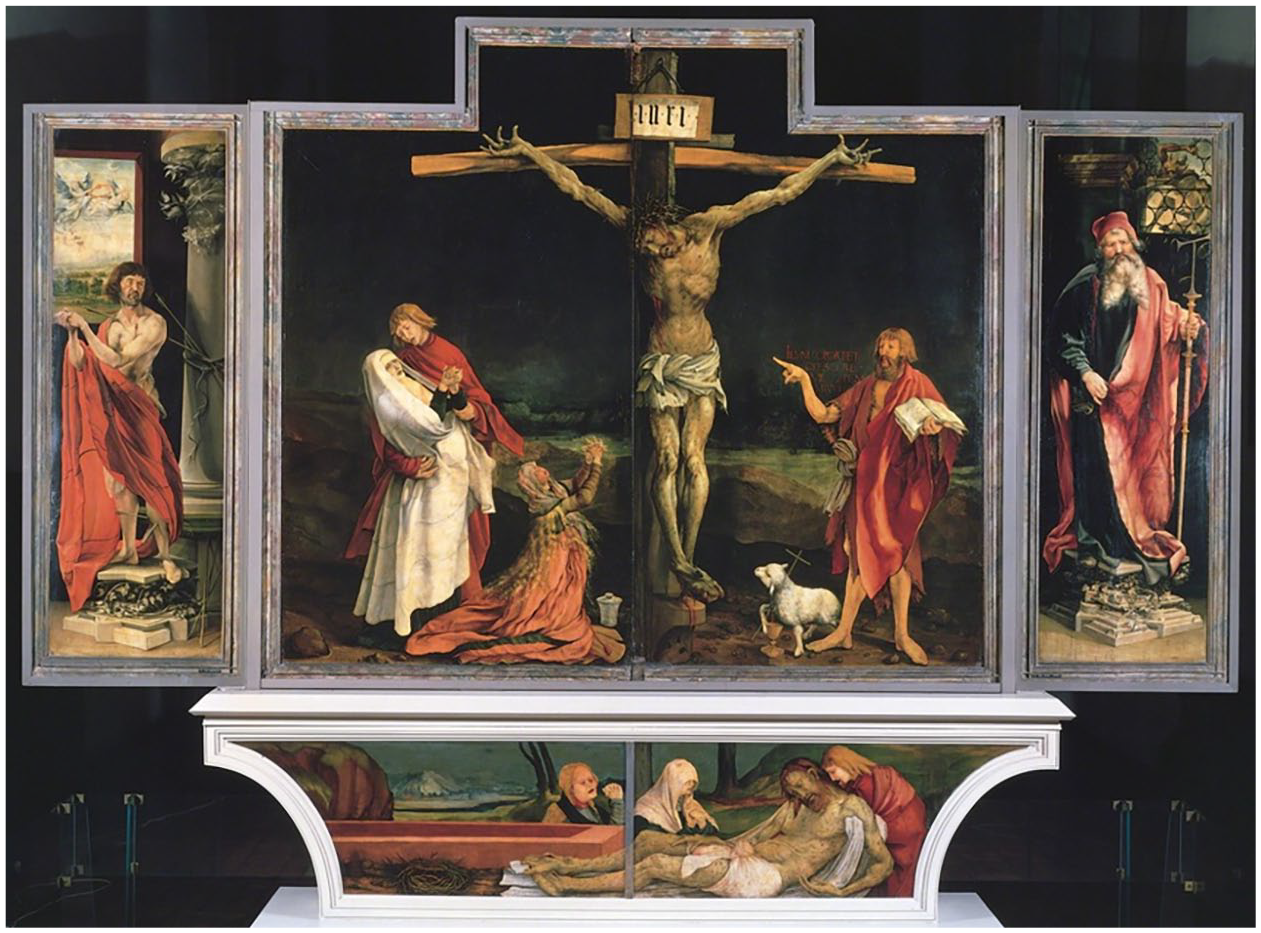
Detail of Isenheim Altarpiece.
The depiction of Christ on the cross incorporates many other symbols as well. To the left, the Virgin Mary (in white, symbolizing purity) swoons in the arms of John the Baptist, a historical impossibility since John had been beheaded before Jesus was executed on the cross (Mark 6.14-29), but the red marks John as a martyr. On the right of the cross, a pure white lamb—the “sacrificial lamb” is another symbol of the Messiah—is bleeding into a goblet.
The fish
The Koine Greek word for “fish” is ΙΧΘΥΣ ICHTHYS, which is also an acronym or acrostic for Ἰησοῦς Χριστός, Θεοῦ Υἱός, Σωτήρ Iēsous Christos, Theou Huios, Sōtēr “Jesus Christ, Son of God, Savior.” Perhaps for this reason, this symbol also has a long history within Christian tradition. During the second, third, and fourth centuries, the fish symbol (Figure 9; note also the anchor symbol) was used by Christians to recognize churches and other believers at a time of persecution.
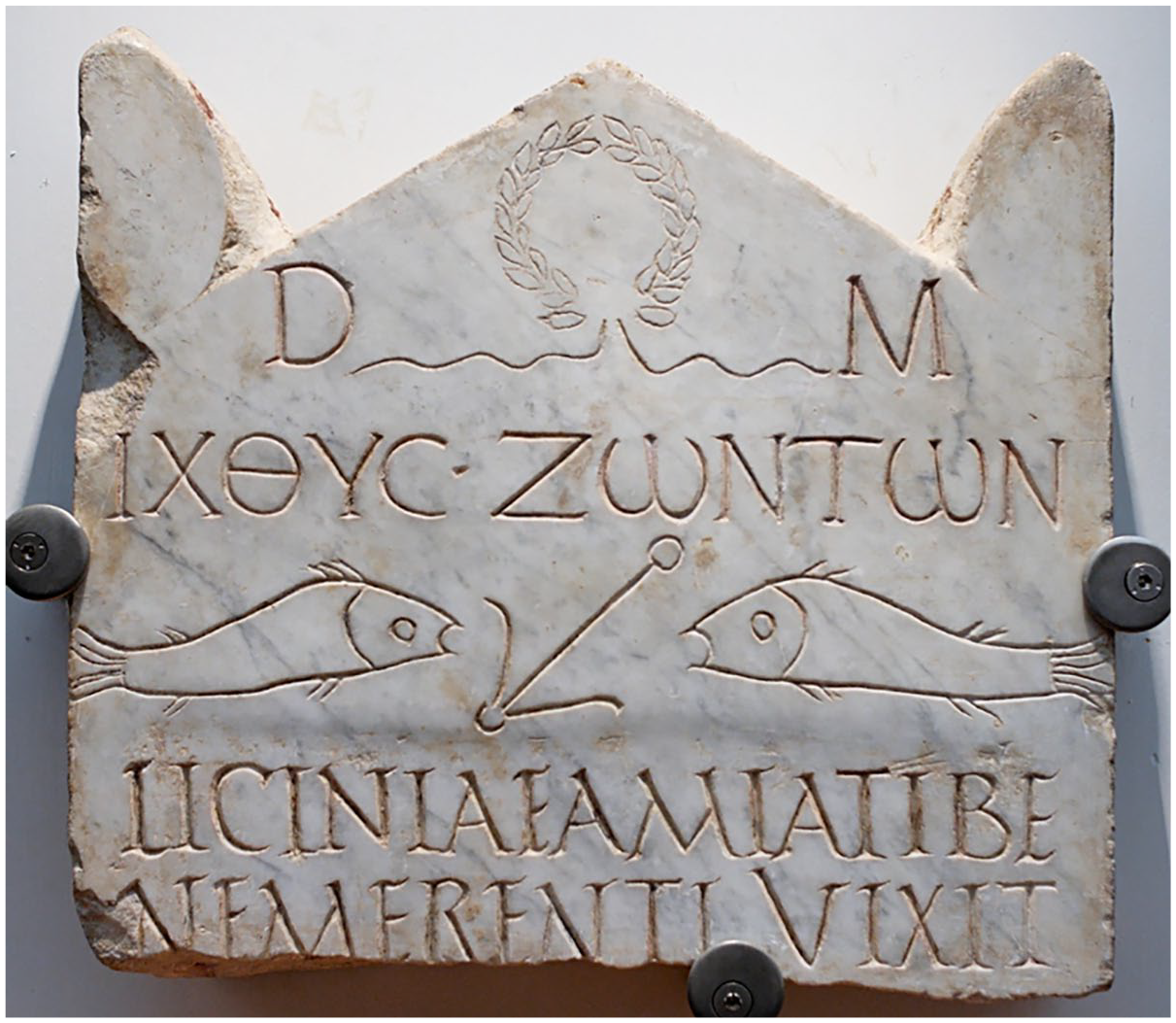
Funerary monument with the inscription ΙΧΘΥϹ ΖΩΝΤΩΝ ICHTHYS ZŌNTŌN “fish of the living.”
By the time of the Renaissance, the fish symbol in art was typically part of an illustration of Jesus feeding a large crowd (beginning with five small loaves and two fish, Matt 14.15-21), or of the disciples as fishermen, as in Figure 10 (with a large miraculous catch, Luke 5.1-10).
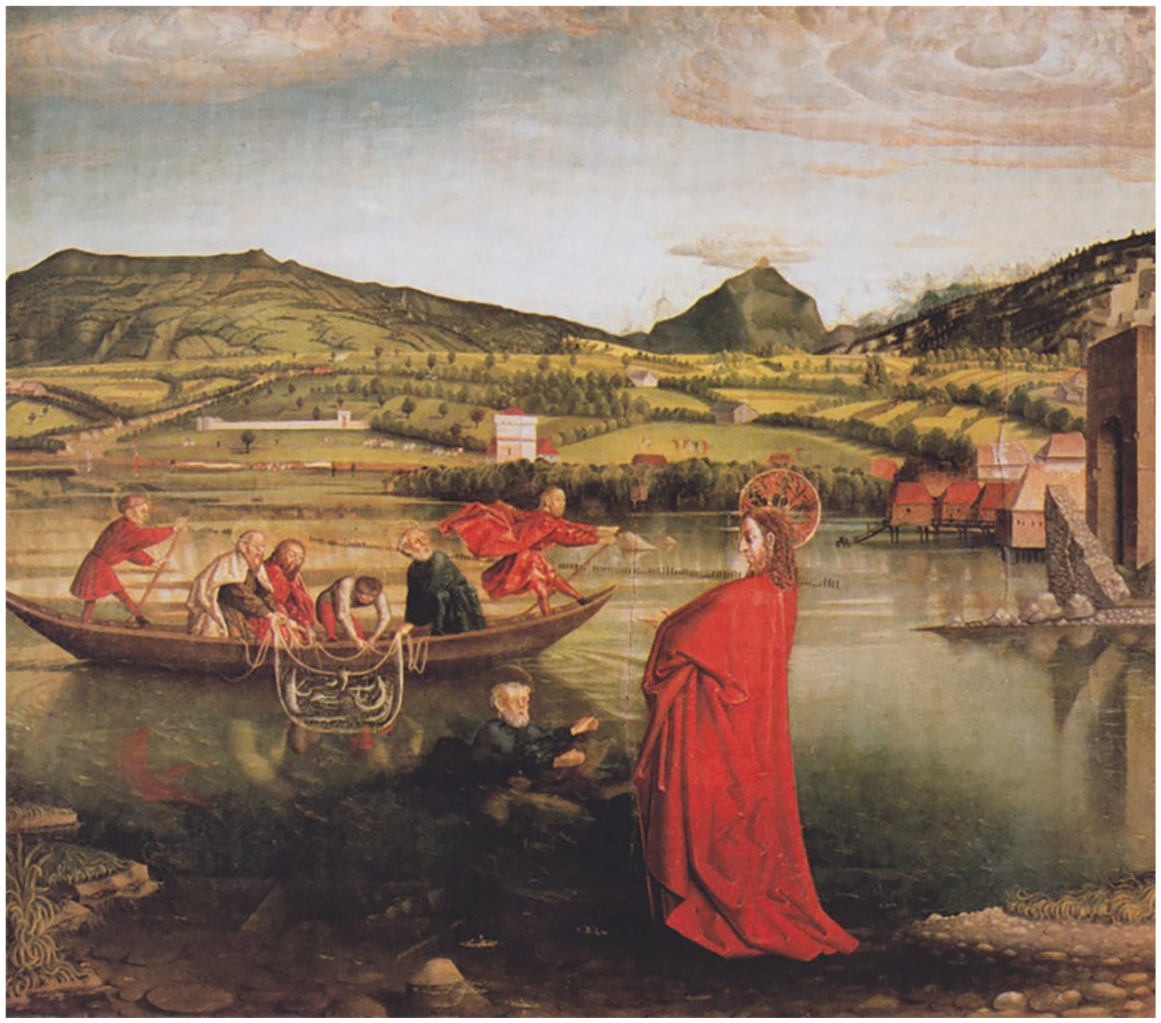
The Miraculous Draught of Fishes (Peter’s altar table).
The anchor
Since ancient times, the anchor has been regarded as a symbol of safety. Perhaps it is only natural, then, that it became known to Christians as a symbol of hope in a future existence, based on the sacrifice Jesus made of himself. “We have this hope as an anchor for the soul, firm and secure” (Heb 6.17). As Hassett (1907) explains:
The rare appearance of a cross in the Christian monuments of the first four centuries is a well-known peculiarity; not more than a score of examples belong to this period. Yet, though the cross is of infrequent occurrence in its familiar form, certain monuments appear to represent it in a manner intelligible to a Christian but not to an outsider. The anchor was the symbol best adapted for this purpose, and the one most frequently employed.
The anchor symbol could be very obvious (as in Figure 9) or more discrete in its inclusion (as in Figure 11). By the time of the Renaissance, the anchor symbol had been largely forgotten.
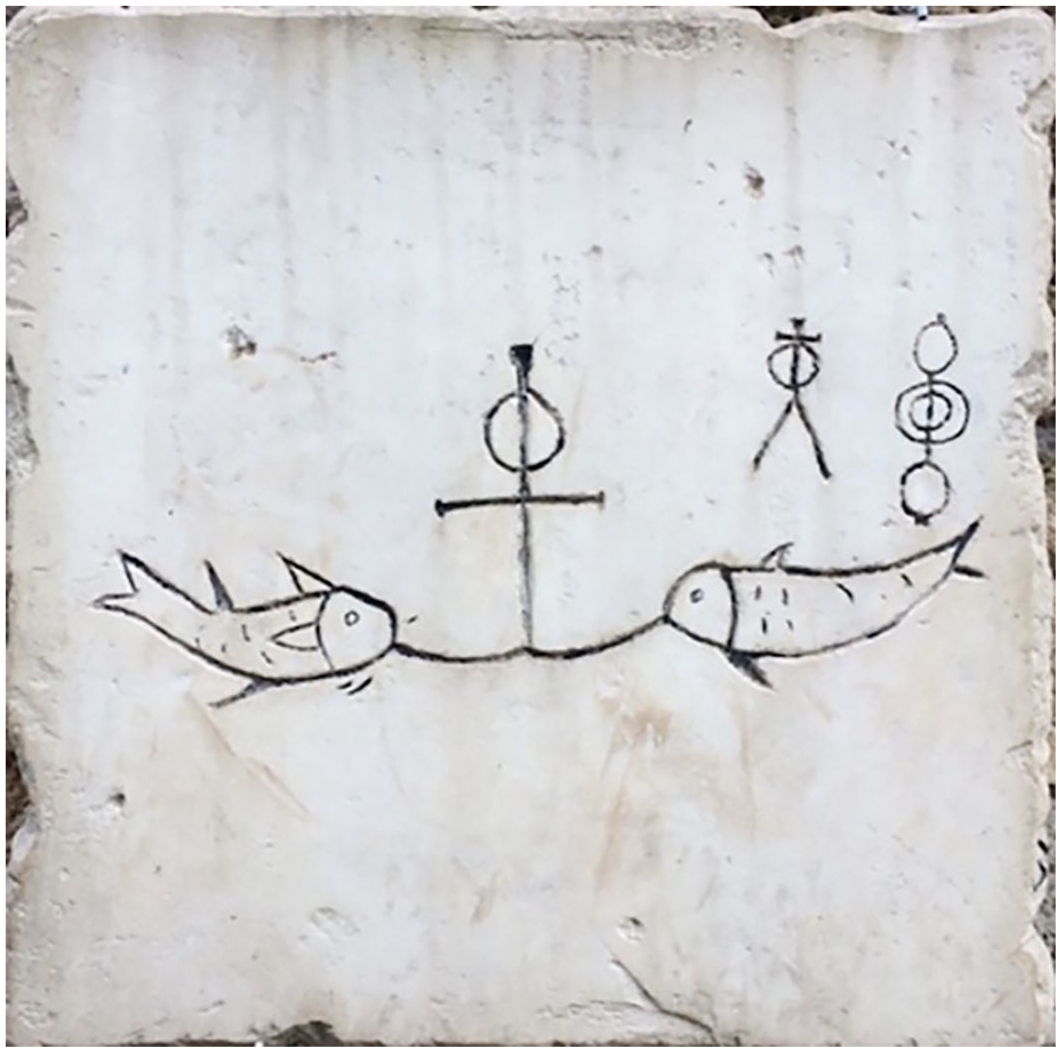
Piece of marble with a very early depiction of the cross blended into an anchor, and flanked by two fish—three symbols in one Christian carving.
The dove
The dove symbol was originally used to connote peace, particularly when connected with an olive branch as in Figure 12. The dove is a symbol of the Holy Spirit (as in Figure 13), recalling the incident of the baptism of Jesus by John the Baptist, when, we are told, the Holy Spirit descended on Jesus in the form of a dove (Matt 3.16). The dove with an olive branch is also reminiscent of the actions of Noah in sending out doves to determine when the land was drying after the flood (Gen 8.6-12).
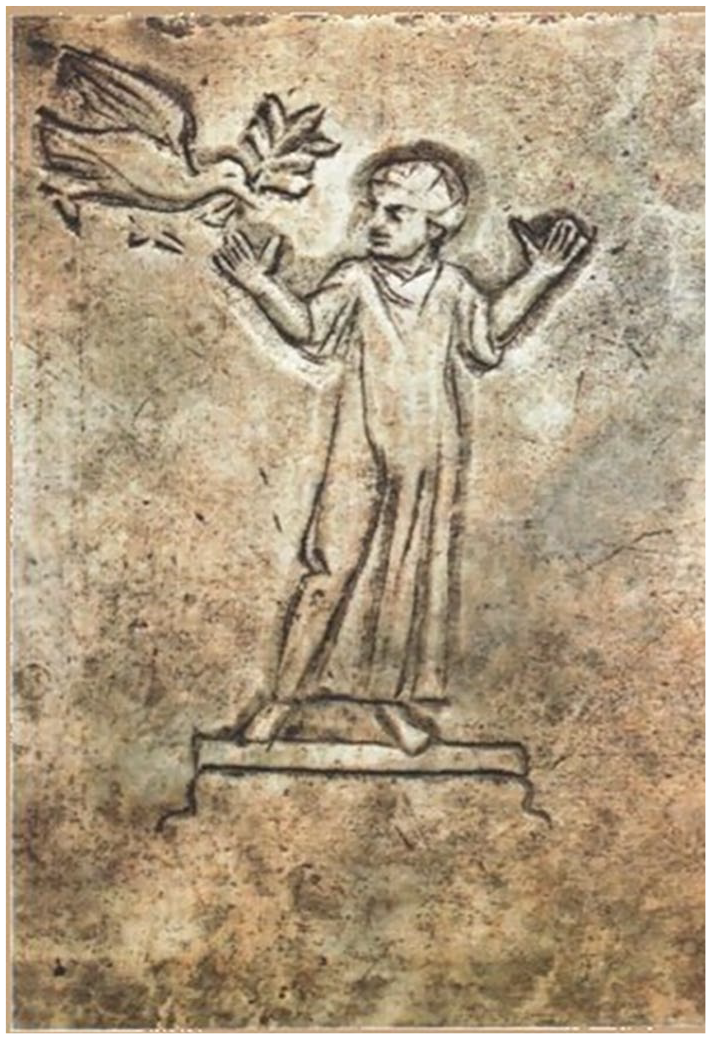
A grave plate depicting the dove of peace bringing an olive branch to a child.
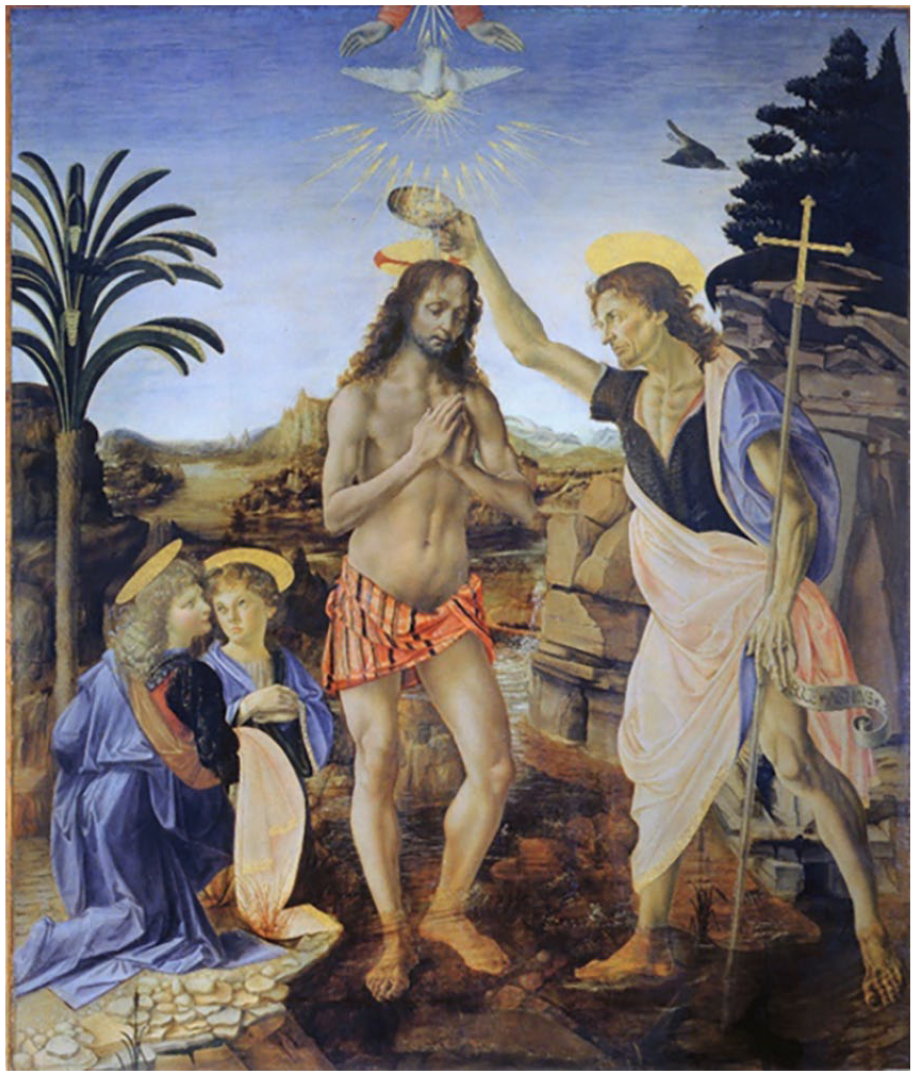
The Baptism of Christ.
Other Christian symbols
This brief survey is not intended to be a comprehensive list of symbols used in Christian art. Table 5 also shows other traditional Christian symbols without illustration.
Function of common symbols in Christian art.
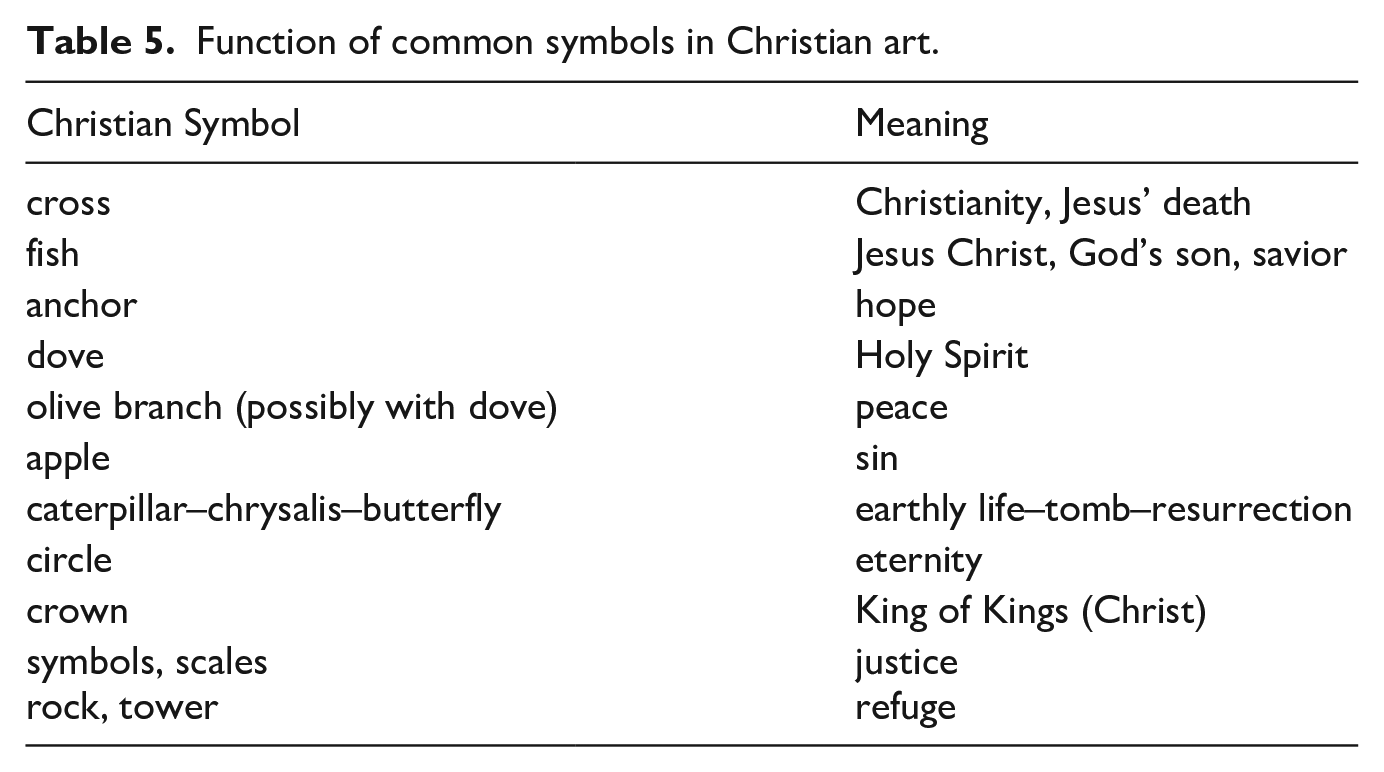
Clearly, some of these symbols are more widely understood (or recognized) than others. However, the overall impression is that Christianity has a profusion of symbols.
As an introduction to the next section, we note that some Christian symbols also are formed from specific letters of the Greek alphabet. For example, chi and rhō are the first two letters (ΧΡ) of “Christ” in Greek, ΧΡΙΣΤΟΣ Christos.
The Chi-Rho (XP) is often shown with the Greek letters alpha (A) and ōmega (lower case ω or upper case Ω), the first and last letters of the Greek alphabet, as in Figure 14. Jesus refers to himself in the following terms: “I am the Alpha and the Omega, the First and the Last, the Beginning and the End” (Rev 22.13).
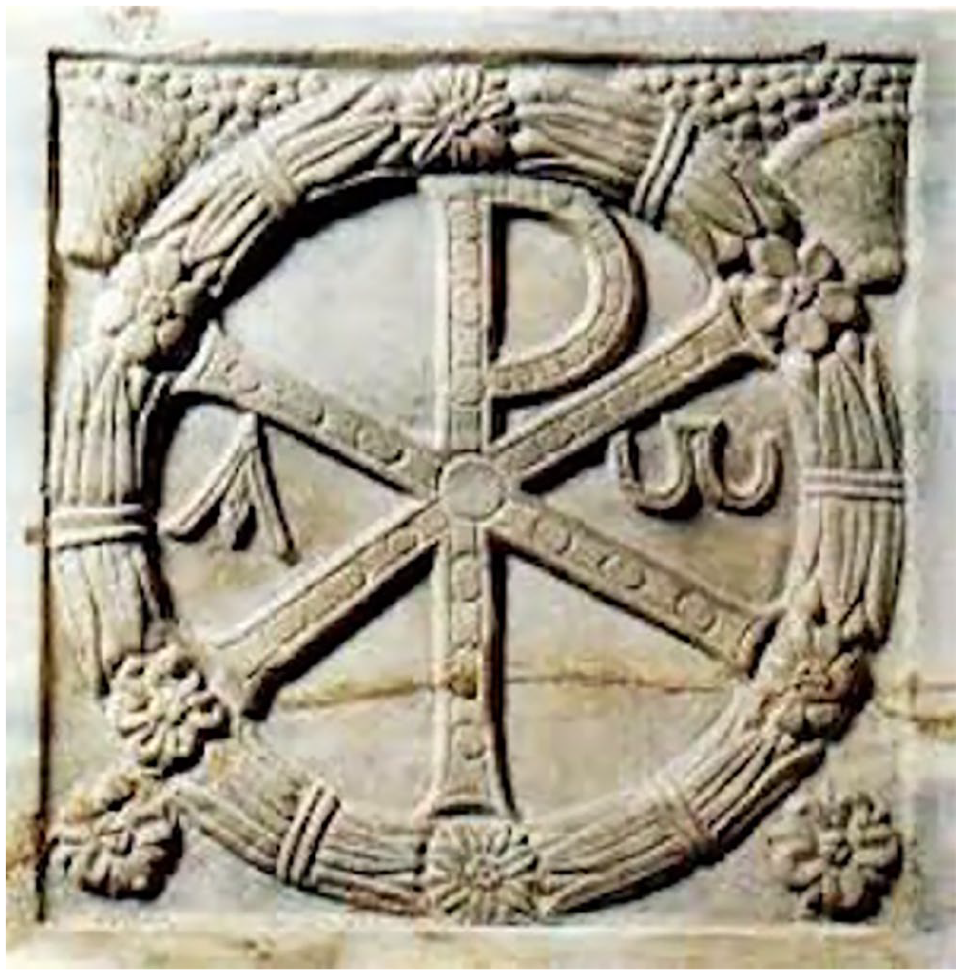
The Chi-Rho Symbol, flanked by Alpha and Omega.
Common symbols in Islamic art
Compared to Christianity, Islam has a much more limited set of widely accepted symbols, and several of these are in the form of calligraphy, as can be seen in Figure 15. While these may not be symbols in the sense that the Christian symbols mentioned above mean something other than their basic form, they nonetheless serve as powerful reminders to the faithful of Islam.
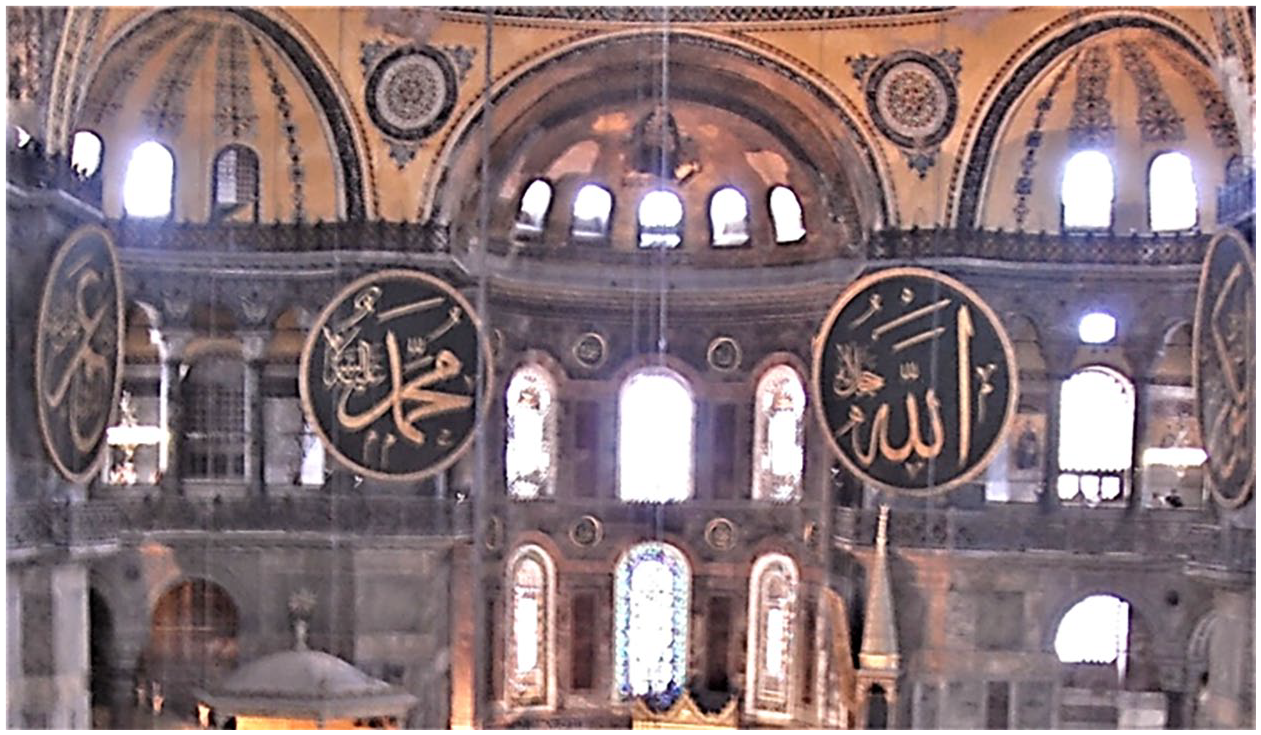
Calligraphy of Allah (right) and the Prophet Muhammad (left), Hagia Sophia, Istanbul, Turkey.
Generally the symbols of Islam are not recognizable as “things,” out of respect for the principle of توحيد tawhid.
Star and crescent
The crescent and star, taken together, are probably the best-known symbol of Islam, generally considered to represent Islam. While there is some discussion concerning the origin of this symbol, and it is not supported by any qur’ānic teaching, it does feature on many national flags, including those of Turkey, Algeria, Pakistan, Malaysia, and Azerbaijan. It seems likely that the symbol began to be recognized during the ascendancy of the Ottoman empire, and thus is of relatively recent acceptance.
Rub-al-Hizb
The symbol ربع الحزب rubʿ-al-ḥizb “quarter of a section” is an eight-sided figure ۞, represented as two overlapping squares with a circle at its center. The most common use of this symbol is in the Qur’ān, where it is included to facilitate recitation and memorization, appearing at the quarter-mark of a section and the end of a chapter in Arabic calligraphy.
Once again, there is discussion about the origin of this symbol, but the eight-pointed star has a long Islamic history, and the Rub-al-Hizb may be derived from the eight-pointed star. Figure 16 is an example of the eight-pointed star (Rogers 2010, 195), but this symbol, while readily allowing repeating patterns, does not intrinsically have a meaning of its own.
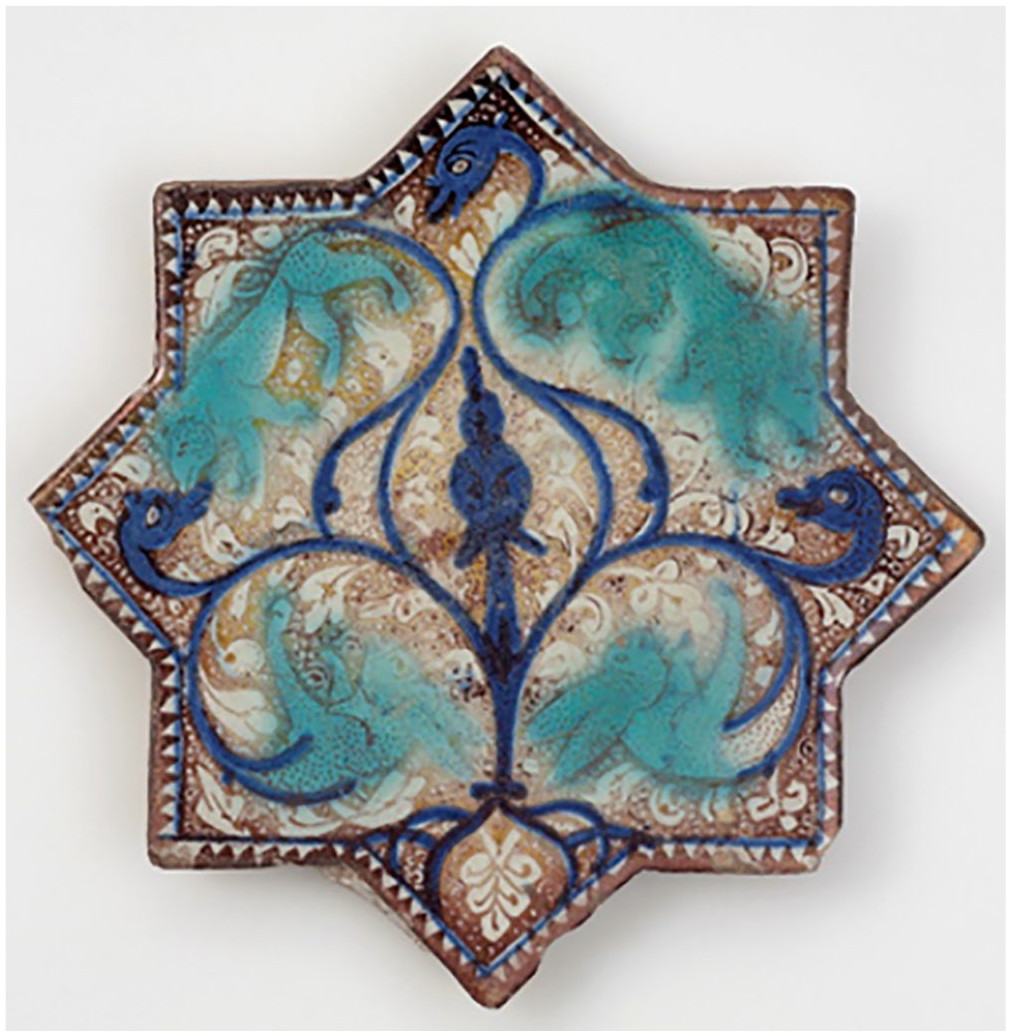
Eight-pointed star tile.
Hanging lamp
The hanging lamp is often a theme in Islamic art, where it is intended to convey the idea of divine light being shed in some manner. The hanging lamp image is evident in the Anatolian prayer rug of Figure 17.
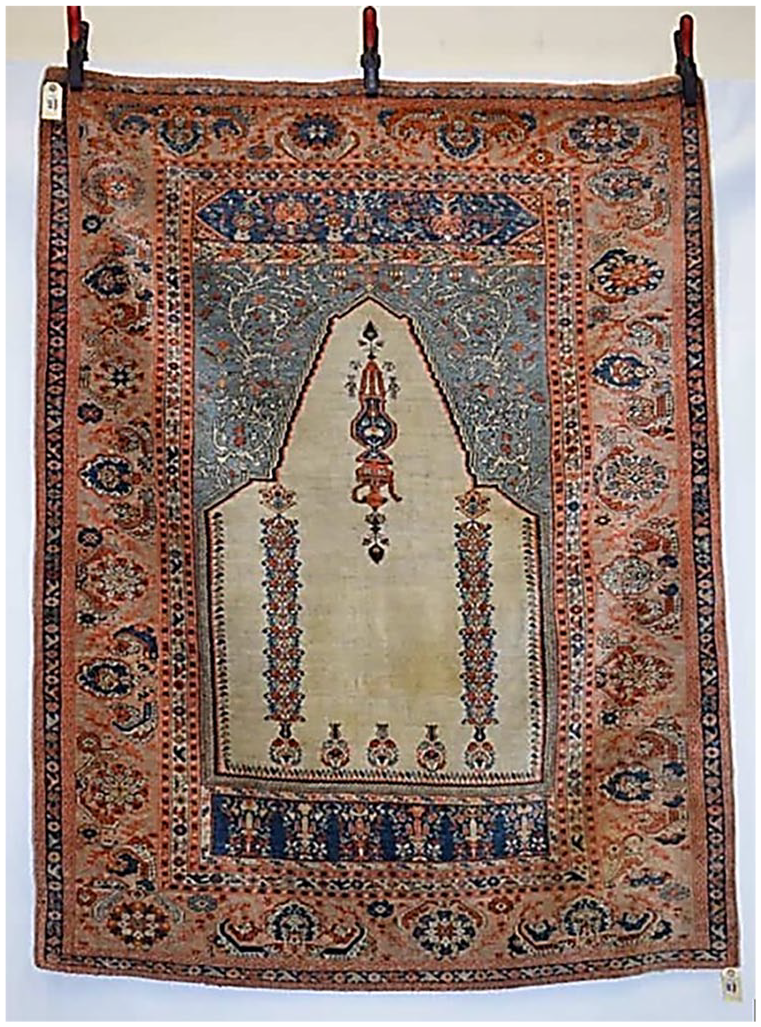
Anatolian prayer rug featuring hanging lamp.
Repeating patterns
Repeating closed designs or themes usually represent the infinite power of Allah, since they have no beginning and no end. Stylized foliage is a common repeating theme but sometimes the repeating pattern is more abstract. The prayer rug shown in Figure 17 has several layers of repeating patterns in its border, some loosely representing foliage and others more abstract.
Perhaps a clearer example of the use of repeating stylized foliage (especially leaves) is on the ninth-century Iraqi bowl of Figure 18.
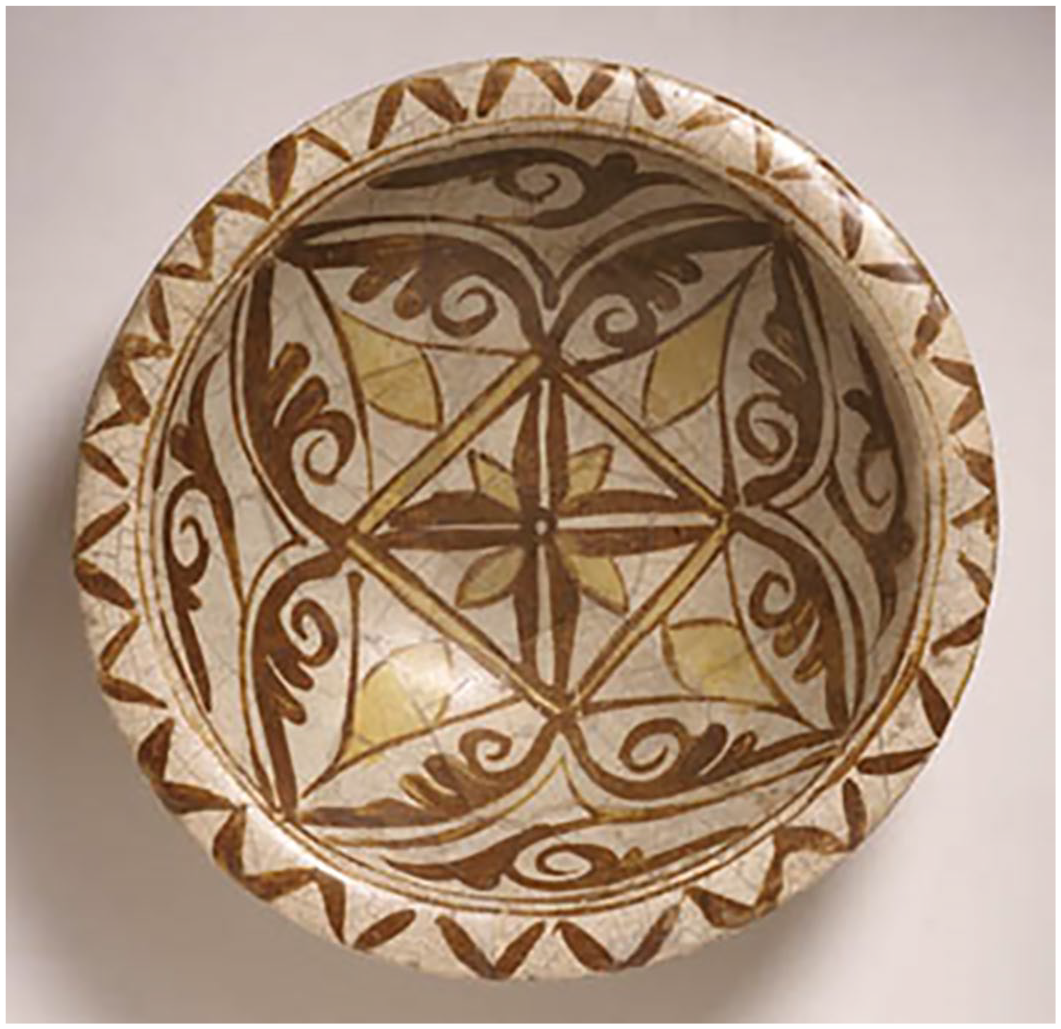
Bowl with repeating, stylized foliage.
Calligraphy in Islamic art
We have noted above that calligraphy is a significant part of Islamic art, and so this next section is a brief introduction to this topic. We approach this topic with a brief history of Islamic calligraphy and note that there are at least five Arabic-based, cursive script styles in contemporary use.
The earliest known Qur’āns (Hijazi Qur’āns dating to around 650–700) were written in an informal, sometimes-sloping Arabic script, illustrated in Figure 19.
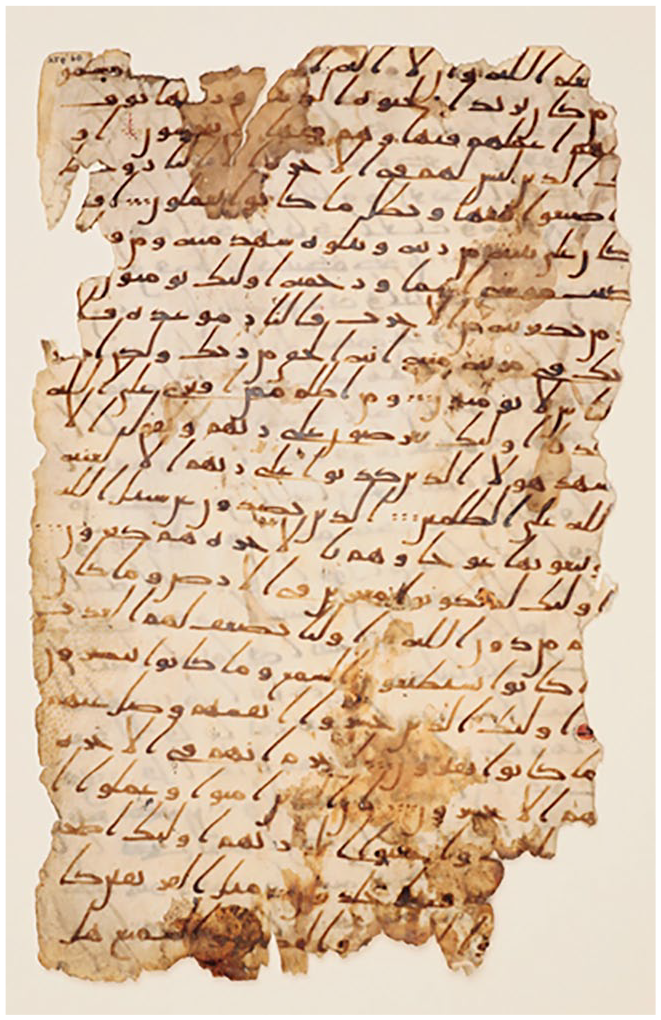
Folio from a Hijazi Qur’ān (recto).
In the seventh or eighth century the Kufic script was developed in Al-Kufa, Iraq. A particular form of this script was employed by professional copyists for copies of the Qur’ān until about the eleventh century. Figure 20 illustrates some of the features of this script, characterized by straight, angular forms.
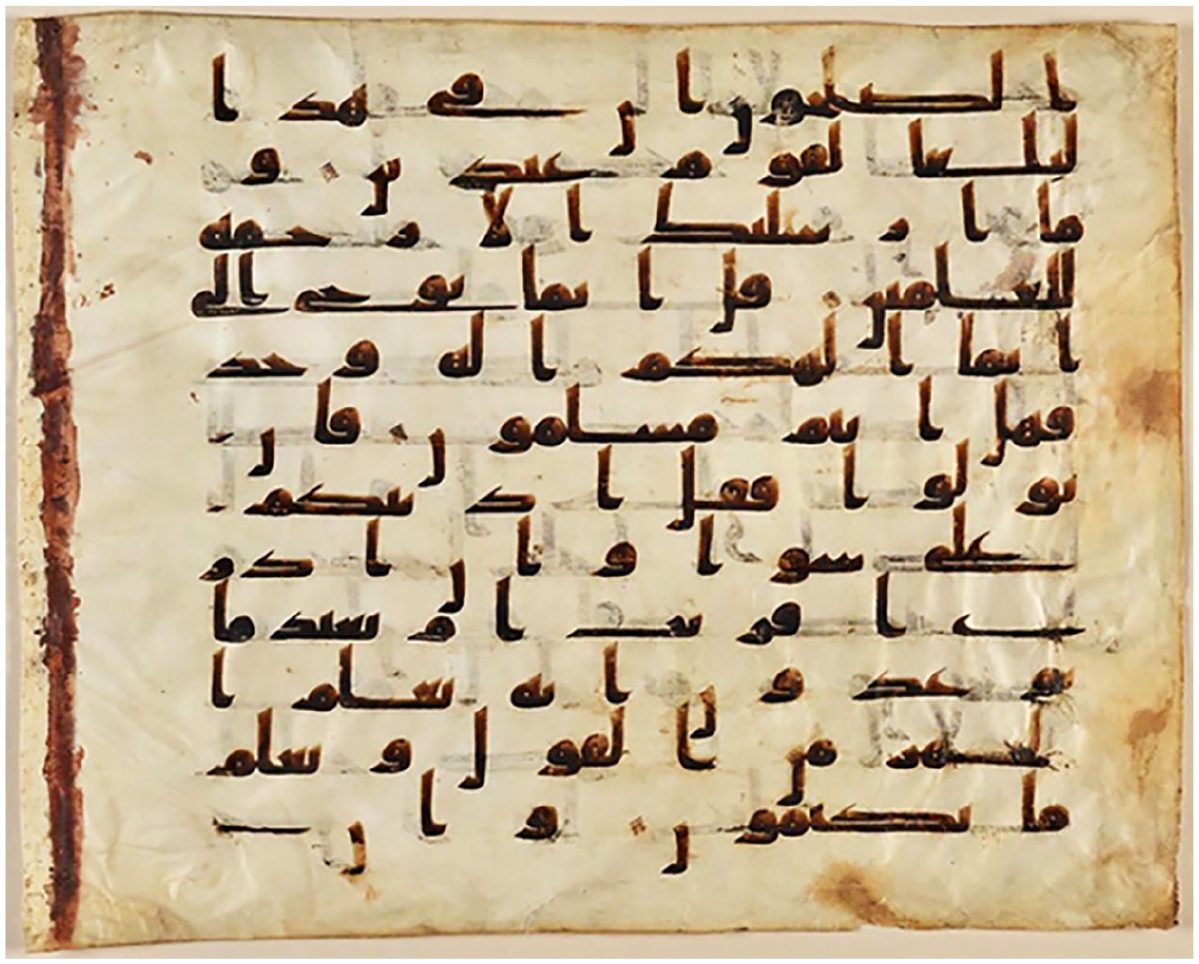
Kufic script.
In the eleventh century (fourth century Hijri), the Thuluth script (Figure 21) made its first appearance. The straight angular forms of Kufic script were replaced in this new script by curved and oblique lines. Letters in this script are characterized by long vertical lines, often with barbed tops. (The word thuluth means one-third, but there is some discussion about why the script got this name.)
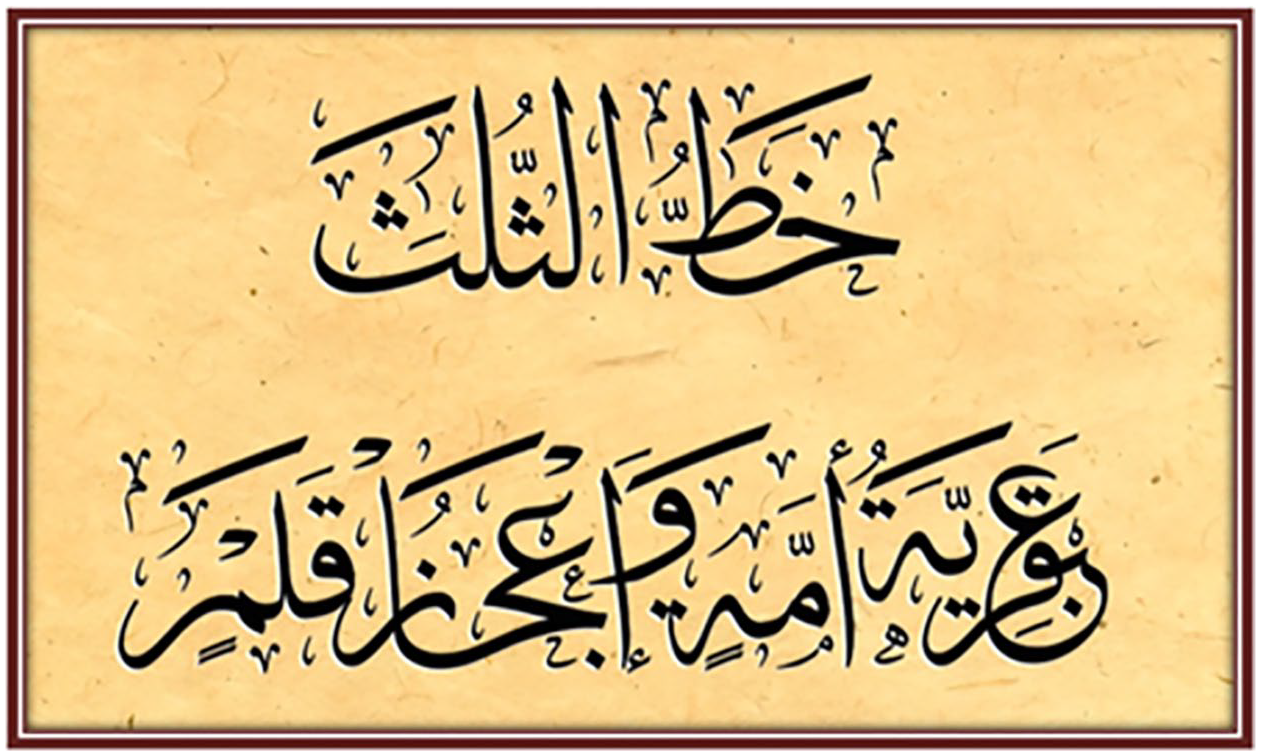
Thuluth script in black ink with diacritics and vowel points in black.
Representation of vowels in the Thuluth script usually follows the conventions of other Arabic scripts, but there are also certain other stylistic marks, intended to beautify the script. These stylistic marks have their own rules regarding placement and grouping which allow for great creativity as to shape and orientation. Thus, a single sentence can be written in several forms, depending on the structure of the letters. It is known as a script of great beauty and perfection, but also as a script difficult to learn.
Thuluth script is often associated with the Ottoman empire since many important stages in its evolution occurred during this period. For a while, copies of the Qur’ān were rendered in Thuluth script, but after the fifteenth century, Naskh script came to be used exclusively for copies of the Qur’ān. The flag of the Kingdom of Saudi Arabia is a contemporary example of Thuluth script.
The Naskh script (Figure 22, left side) was derived from Thuluth, but the letters are typically smaller and rendered in greater delicacy. It is written using a small, very fine pen known as a cava pen, which makes the script suitable for faster copying in book production, hence the origin of the name naskh which means “to copy.” One of the benefits of Naskh script is its easy readability.
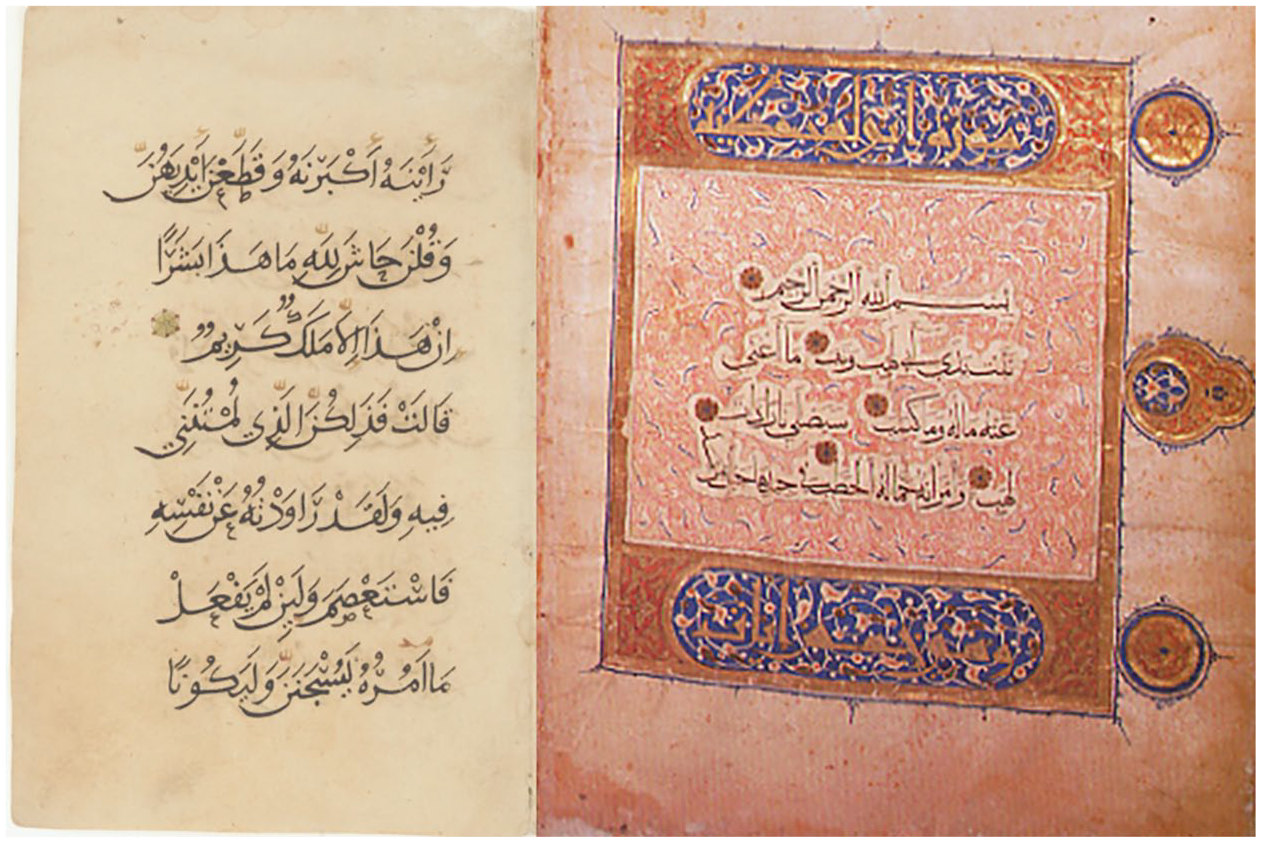
Naskh script (left). Thuluth script with Kufic script headings (right).
Very often a Qur’ān manuscript will include more than one calligraphic style. The example in Figure 22 (right side) was produced during the Mamluk dynasty and features the Qur’ān text in a flowing Thuluth script, while the surah headings are in Kufic script.
It is outside the scope of this paper to show details of the many contemporary calligraphic cursive styles used in various parts of the Islamic world. Suffice it to say that these styles include the following:
Naskh نسخ
Nasta‘liq نستعلیق
Diwani ديواني
Thuluth ثلث
Ruq‘ah رقعة
While these represent major script traditions in Islam, they are by no means the only scripts. Figure 23 features the Bihari script, said to resemble a sword or a ship, dating to the eighth century.

Bihari manuscript.
This example also shows some creative artistic features: most of the script is written in black except for the word “Allah” which is in red ink throughout. Further, the exegetical comments in the margins take the form of abstract geometrical designs.
We close this discussion with a fascinating example of calligraphic art in the Sufi tradition (Figure 24). This entire piece of art is less than two inches high. In the process of its manufacture, a delicate inscription was first stenciled and then covered with wax. The leaf was laid on top of this stencil and covered in an alkaline solution which ate away almost all of the leaf structure, leaving only the veins of the leaf. What remains is a delicate creation, held together by the veins in the leaf. The intricate inscription on a very small leaf, calligraphed in gold, is said to evoke the beauty of paradise. These tiny art forms are very delicate and easily destroyed, giving some indication of the high value of paradise!
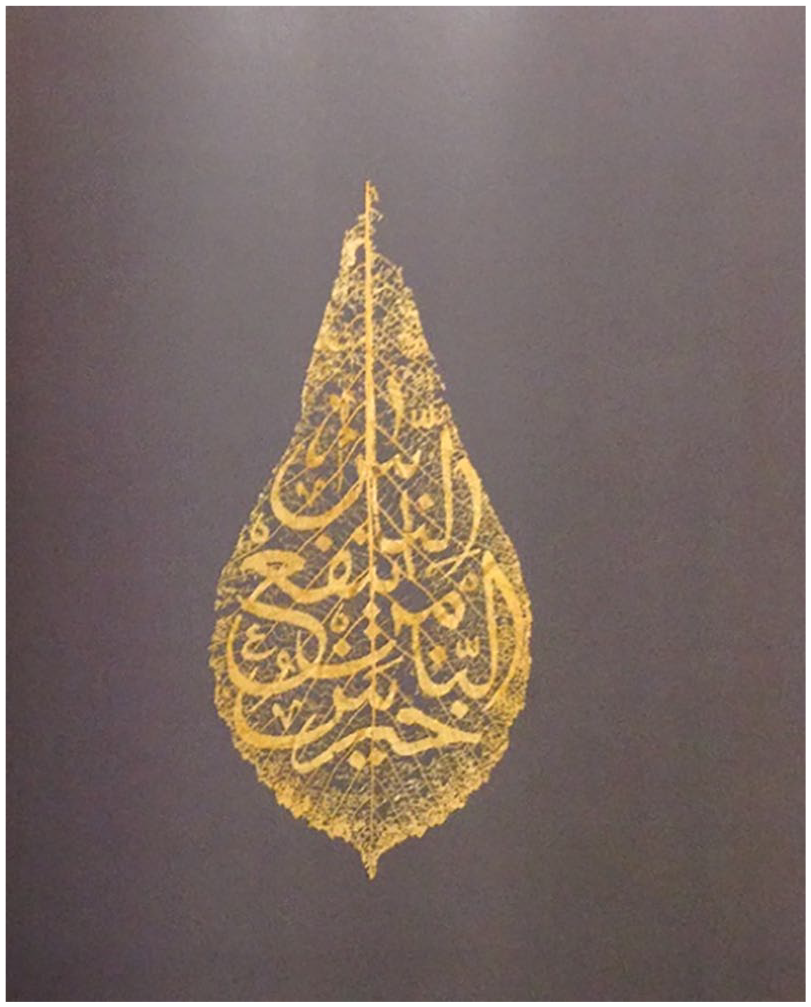
Natural leaf with Thuluth calligraphy.
Reflections on symbols in Christian and Islamic art
As we have seen, there is a tremendous difference between the way Christian art views symbols and the way Islamic art views symbols. The contrast between the Christian preference for depicting real situations (including people and things) and the Islamic preference for avoiding such depictions is very real. Yet we also notice that both traditions have a respect for written, symbolic representations of faith, with Christians often using Greek calligraphy and Muslims often using Arabic calligraphy. (Presenting a similar account of the development of Greek calligraphy is beyond the scope of this paper, but the interested reader is referred to the Center for the Study of New Testament Manuscripts [http://www.csntm.org/] for further information.)
We cannot, however, leave this discussion without acknowledging that symbols sometimes become associated with movements or concerns that may or may not be in accordance with the original purpose of the symbol.
In Christian history, we have the example of the Knights Templar dating from the twelfth century and their adoption of the Templar’s Cross (red cross on a white background) on their robes and shields. The Templar’s Cross became a symbol of martyrdom (Barber 1994, 66) as this elite group of warriors fought against Islamic armies in the Middle East. This use of red to connote martyrdom precedes by only a few years the edict of Pope Innocent to this same effect (see above). These Knights Templar may well have been familiar with the history of Emperor Constantine and the event reported by Eusebius (see above).
This symbol of a red cross on a white background has more recently become emblematic of emergency medical services, perhaps by the association of red color with blood. In combination with a red crescent, this has come to signify worldwide emergency medical services.
In Islamic history, we also have the interesting example of the history of black flags. Bahari and Hassan (2014, 17) provide us with a commentary on this based on their analysis of the Hadith. They first note the long history of the black flag in Islam, including its use by the Abbasid revolutionary movement. (After the success of this movement in bringing down the Umayyad caliphate in Baghdad in AD 750, the black flag became the official flag of the Abbasid.)
In contemporary history, Bahari and Hassan note that black flags (often with the Shahada—the creed—superimposed in white calligraphy) have been displayed by ISIS, the Taliban, Al Qaeda, and the Chechen jihadists (among others). They go on to note that there are no qur’ānic references promoting the use of the black flag, nor any indication that it is holy or sacred. The usual justification for this use of the black flag is based upon a Hadith not found in the Book of Hadiths but historically referred to by Islamic scholars, which states (in part),
Abdullah bin Mas’ud narrated that the Prophet said: “A nation will come from the east with a black flag … So if anyone of you finds this nation then you must join them even if you have to crawl over ice.”
However, Bahari and Hassan claim that all Hadith references quoted in defense of the black flag are considered by scholars to be “not reliable or authentic.” They thus reject the legitimacy of these groups and conclude that “the use of the black flag or banner by jihadist groups such as IS has been an act of manipulation of popular folklore among Muslims to support their political agenda” (Bahari and Hassan 2014, 17).
We conclude this brief survey of symbols with the observation that attachment of a symbol to a particular religious tradition is largely arbitrary in the same way that attaching sounds to the letters of an alphabet (in any script) is arbitrary. Linguists use such conventions as the International Phonetic Alphabet to standardize their representations of sounds, but the connection between any symbol and its sound manifestation is assigned. The convention is useful only because a substantial community agrees to recognize the convention.
In the same way, religious symbols have usefulness only because many observers recognize them as having a faith connection. As an example of this, we consider the cross, which has become a symbol of Christian identity. Hengel (1989), quoting sources in Latin and Greek, notes that the practice of crucifixion (in varying forms) appears to have been introduced by either the Phoenicians or the Persians, possibly as early as the eighth century BC. Furthermore, for several centuries after the crucifixion of Jesus, the cross had no recognized connection to Jesus’ life nor any recognized connection to the coming of a Messiah. In fact, early Christians tended to avoid this connection, because they encountered objections to their faith based on their identification with a Messiah who was executed in this humiliating and violent manner (Hengel 1989, 3–5) usually meted out to slaves. Crucifixion was thus a practice introduced well before the time of Jesus’ life and the cross was not identified as a Christian symbol for several centuries after Jesus’ death.
Given this arbitrary connection between symbol and meaning, Islam is fortunate to have largely avoided the use of religious symbols. We note, however, that even the classic script-based representations of the names Allah and Muhammad (as depicted, for example, in Figure 15) function as powerful reminders only because a community has recognized the connection between the script representation and the sounds involved in speaking these names.
Form and function: Art in architecture
We have demonstrated that color symbolism is based on very different assumptions in classical Christian art and in Islamic art. It should come as no surprise, then, to discover that architectural assumptions also vary considerably between these two traditions. As we illustrate this, we will find that appropriate faith connotations are intricately bound with architectural expression.
For the most part, this section will consider the architecture of religious structures—mosques, churches, and so on. However, as we will discover, we cannot do this exclusively, since constructions intended as, for example, royal palaces, also frequently exhibit architectural conventions appropriate to the faith beliefs of the intended inhabitants.
Classical Islamic architectural expressions
The observer of Islamic architecture quickly notes the preponderance of grandiose forms—large domes, towering minarets, large courtyards, and so on. Typically, the central mosque in an area dominated by Islam is an imposing structure, often more imposing than any nearby government buildings or royal palaces. This is no accident; these forms are often somewhat overwhelming, as they are intended to convey the power and majesty of Allah.
There are four iconic features of a traditional mosque (Arabic مسجد masjid): the courtyard (صَحْن ṣaḥn), the niche (محراب miḥrāb), the tower (minaret), and the dome (ﻗُﺒَّﺔ qubbah). Of these features, the two essentials are the courtyard and the niche. Tarrad and Matrouk (2019) explain these features as summarized below.
The concept of the courtyard flows from the requirement that the mosque should be able to hold the entire male population of a town for times of prayer. Thus, in many mosques, there is a large prayer hall, supplemented by an outdoor courtyard to meet this requirement. Often there is a fountain in the courtyard to aid in the ritual ablutions required before prayer.
The niche is another essential part of a mosque, and is a niche in the wall that indicates the direction of Mecca (قِبَلاً qibalan), and thus the direction required for prayer.
The dome is a feature of many mosques, but of lesser importance than the courtyard and the niche. The dome is typically taken as a symbolic representation of the vault of heaven. According to Tarrad and Matrouk (2019), the use of domes in Islamic architecture started from the Umayyad period in Jerusalem in AD 691.
Towers are typically one of the most visible aspects of mosque architecture. The call to prayer is usually announced from one of these towers.
Another principle of Islamic architecture is the tendency towards symmetry, which is held to connote peace, probably by association with harmony and balance; it even seems to be preferrable to have double symmetry if possible. As can be seen from the example photograph of the imposing Alhambra Palace in Spain (Figure 25), the presence of reflecting pools greatly enhances the possibility of symmetry about a horizontal axis, while the construction itself exhibits a strong tendency towards symmetry about a vertical axis. The visitor is left with the impression of an imposing structural complex, in the midst of which it is possible to achieve a state of peace and contemplation.
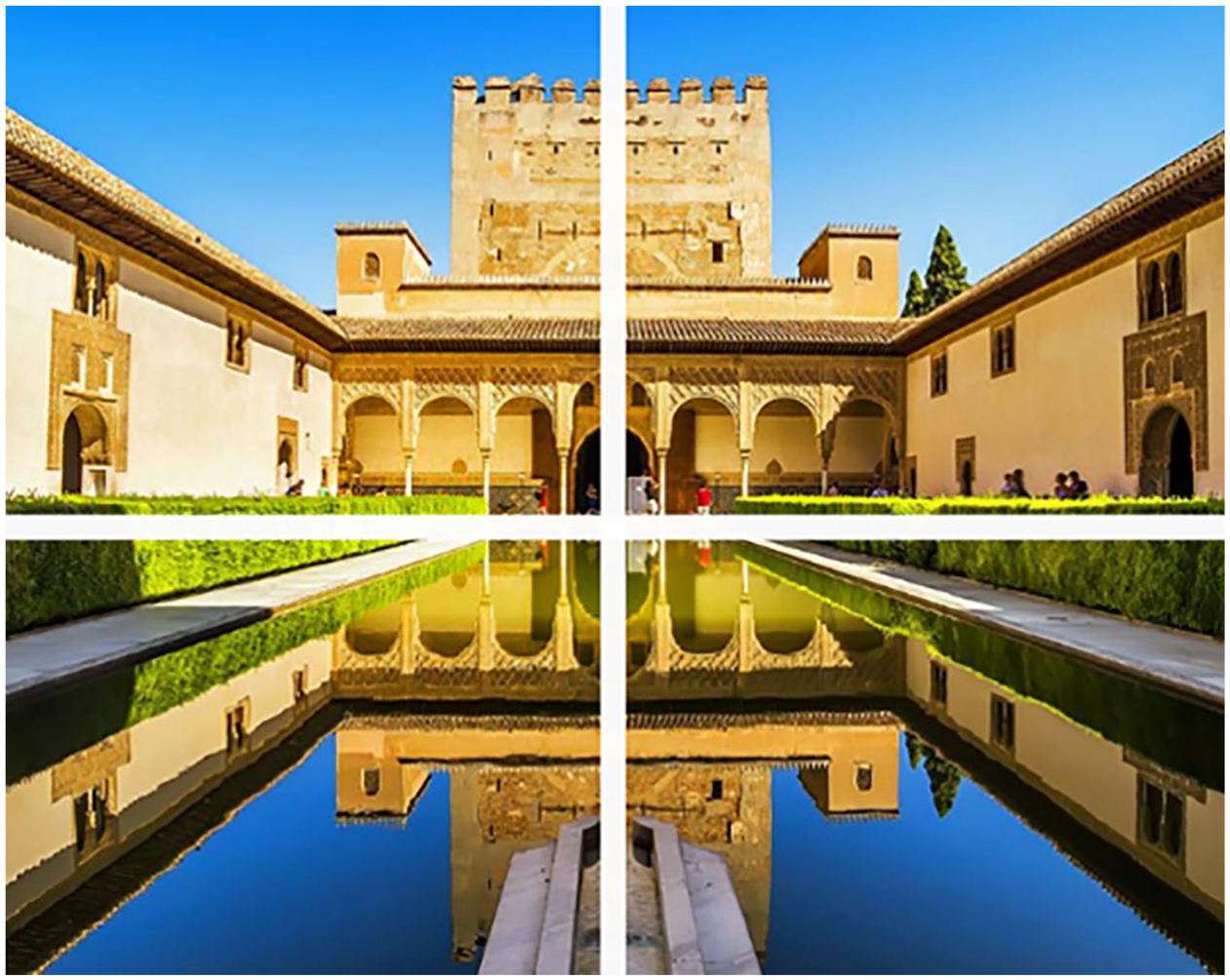
Alhambra palace, Granada, Spain.
One of the “miracles” of Islamic architecture is that, in the very context of grandiose forms and inspiring shapes, the builders have managed to create contemplative space. We recall that the Muslim dream of paradise is a place of peace, balance, and harmony. It is likely that important architecture is intended to remind Muslims of this; at the very least, it evokes the response that such a condition is truly achievable.
The example of the Alhambra Palace also illustrates another common practice in Islamic art. Much of the beauty and majesty of the structure is not visible from outside the property. The beauty is considered to lie in the inner spaces (typically courtyards and rooms) which are not visible from the outside (the street view). This is sometimes referred to as the “architecture of the veil,” the revealing of the true beauty of the structure only to those admitted to the inside.
Of course, we would also expect that any architectural tradition would adapt to its more local environment, and this is readily illustrated in the architecture of significant mosques.
The architecture of the two structures in Figures 26 and 27 is clearly very different, and they are located in very different parts of the world, one in Jerusalem and one in China. Yet both are imposing structures, and, as indicated by the white lines, both structures have preserved the Islamic preference for symmetry in architecture.
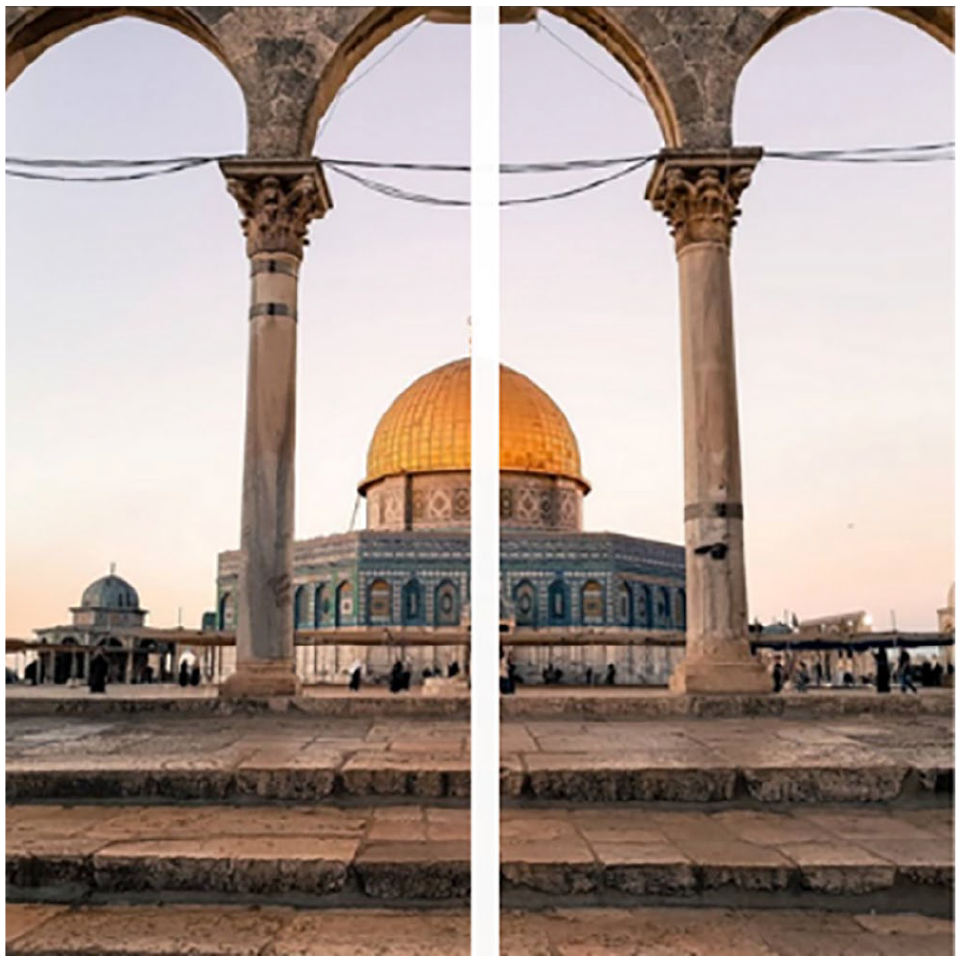
Masjid al-Aqsa, Jerusalem.
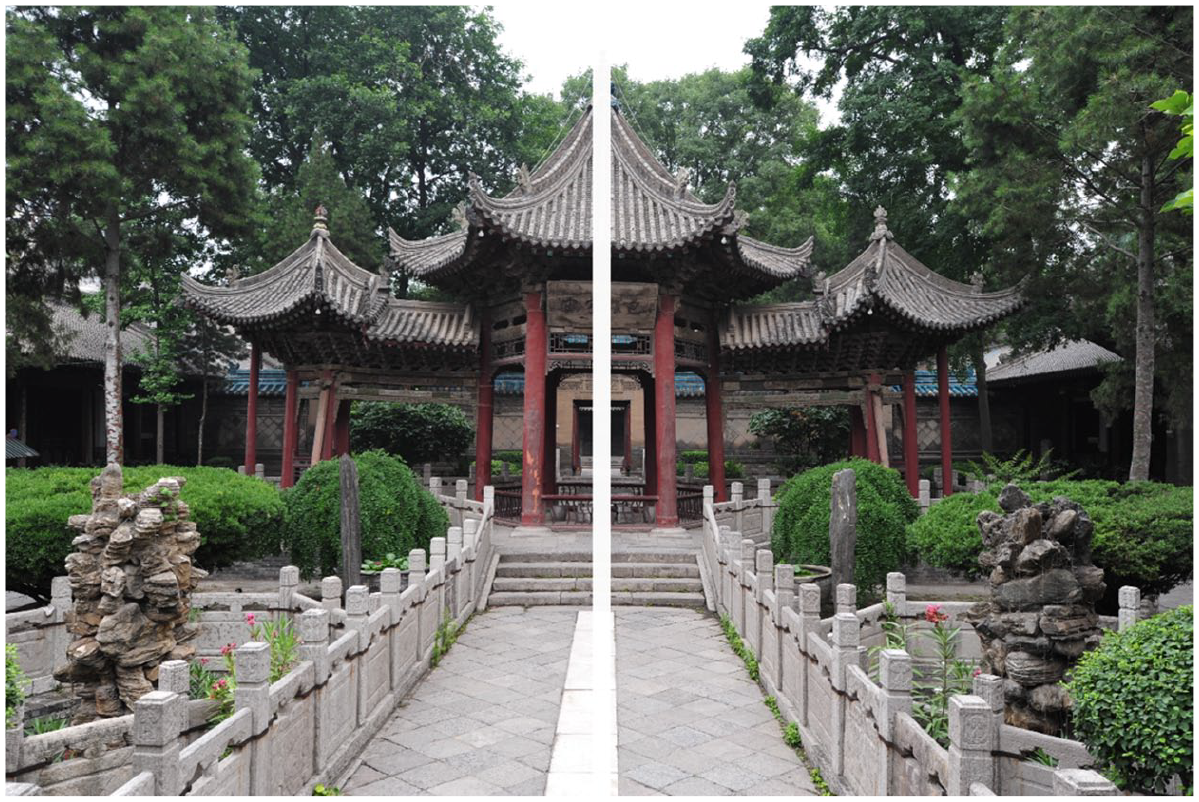
The Great Mosque of Xi’an in Xi’an, China.
The next principles of Islamic architecture are more difficult to illustrate, and yet all three are important: the concept of infinitely repeating symbols and forms, the principle of progressive revelation, and the principle of “impossible engineering.”
We start with the concept of infinitely repeating symbols, intended to remind the Muslim of the infinite power of Allah. We have previously noted (see, for example, Figure 18) that Islamic art likes repeating, endless patterns, and we see this principle in action also in architecture. In Figure 28 from the ancient University of al-Qarawayyin (founded in AD 859), the patterns repeat around the column capital. The white lines remind us of the continuing double symmetry, already noted as a feature of Islamic architecture.
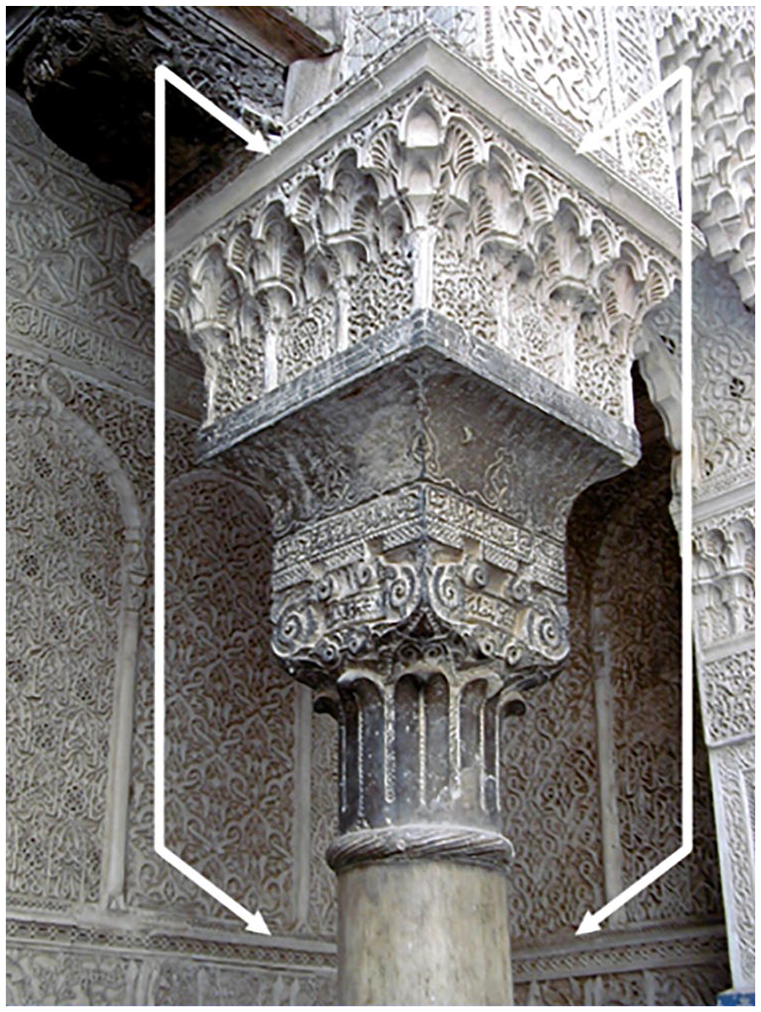
Column capital at the University of al-Qarawiyyin, Fez, Morocco.
As we back away from this column, momentum is maintained by continuing revelation of the pattern of architecture (Figure 29). The column capital we have been examining above (in the white circle) is now only a small fraction of a much larger architectural detail (in this case an internal wall), but the symmetry motif persists. This is the “progressive revelation” concept of Islamic architecture, the idea of the progressive revelation of God to people of faith.
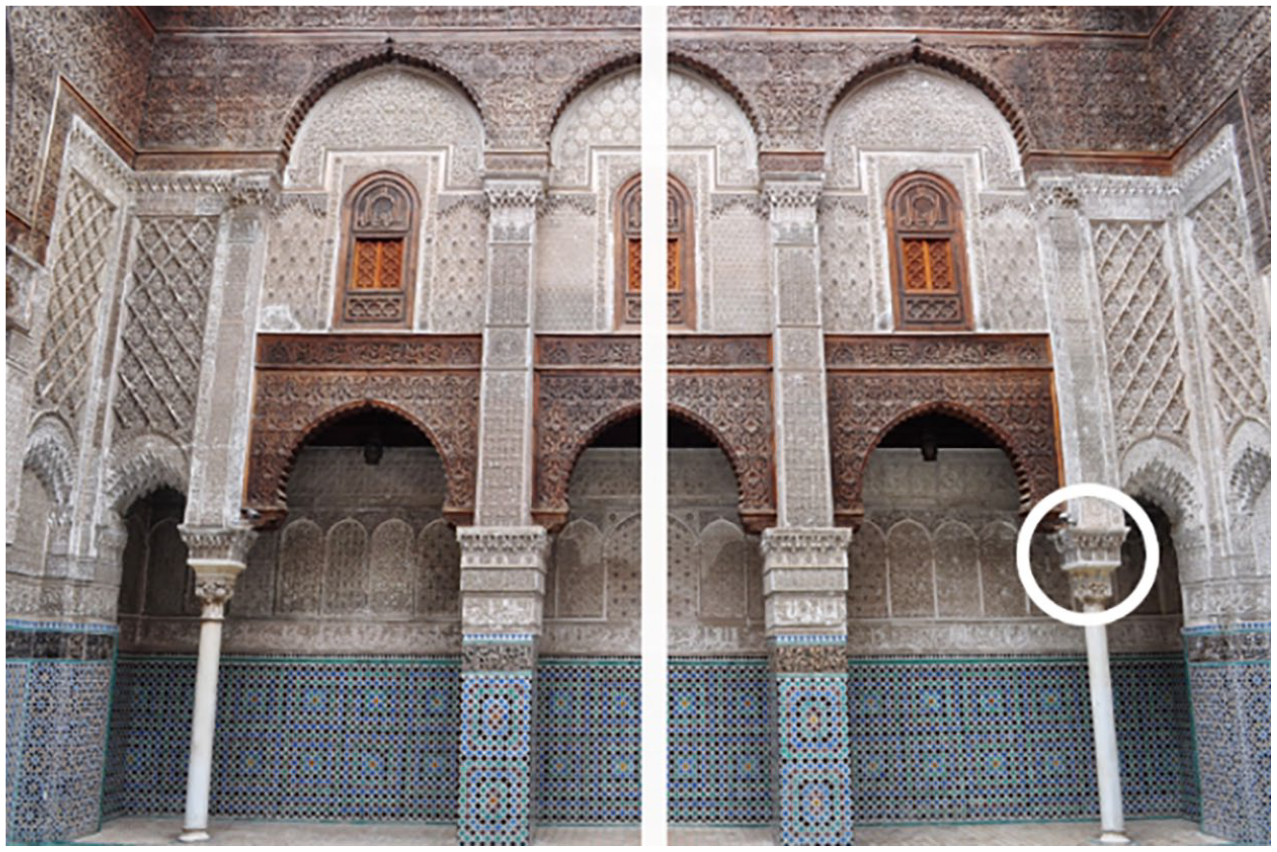
Internal wall at the University of al-Qarawiyyin, Fez, Morocco.
It is even possible to take this progressive revelation example one step further with this example of the interior of the Al-Qarawiyyin Mosque. Figure 29 shows the symmetry of one wall design, but Figure 30 is derived by simply turning 90 degrees to the right. The column capital we started with is highlighted again with a white circle, and the vertical white line indicates yet another axis of symmetry. Thus, internal to one structure, we have many axes of symmetry all progressively revealing themselves as the observer withdraws from considering immediate details.
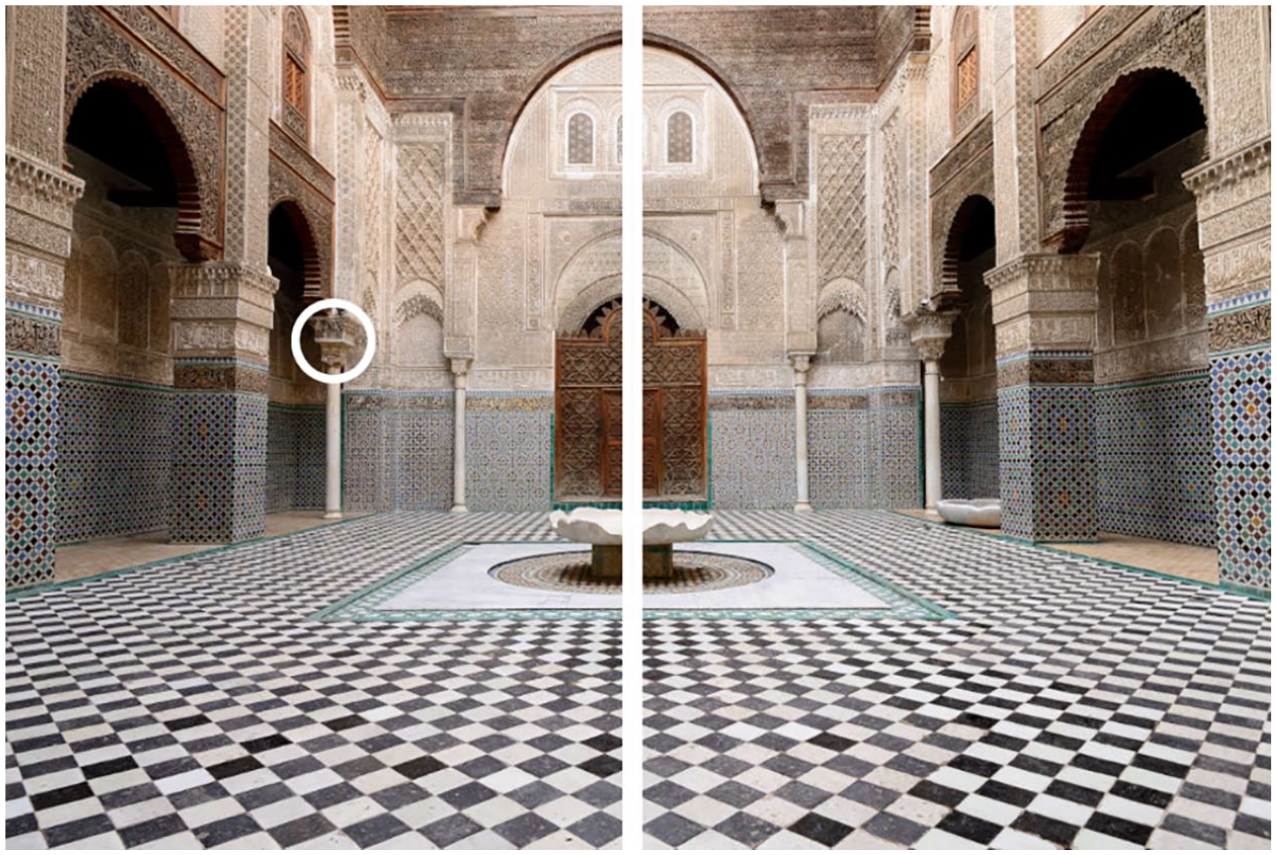
Internal courtyard at the University of al-Qarawiyyin, Fez, Morocco.
One noteworthy aspect of much architecture of this type is the small columns supporting massive superstructure. It seems like an engineering impossibility. The viewer is left with the question: How is it possible for columns of such small cross-section to support all of that weight up above it? This application of “seemingly impossible” engineering/architecture is intended to invoke in the observer reactions of awe and amazement at the power of Allah.
Thus the progression just outlined above—from a column capital, to immediate surroundings, to a much larger construction—illustrates three principles of Islamic architecture: the preference for progressive revelation (or momentum), the preference for symmetry, and the preference for “impossible engineering.”
This brief excursion into Islamic architecture is not intended to be comprehensive, but rather to give a naïve observer some hints about what to look for in Islamic architecture and how to interpret some of the features observed.
We close this discussion with a note that Islamic architecture has a definite color component, but this might not always correspond to the color symbolisms outlined above. Taha and Abdel-Azim (2012), as architectural faculty at Misr International University, Egypt, discuss the implications of colors in Islamic architecture, but this is beyond the scope of this paper.
Classical Christian architectural expressions
We turn now to a similar observation of classical Western Christian architecture. We observe first that, in contrast to the above features of Islamic religious architecture, there are few enduring requirements for the architecture of Christian churches and cathedrals.
For example, we have noted that we are taking as our reference point, in this study, the period from roughly the eleventh century to the eighteenth century. For most churches of this period, the seating arrangements in churches were of the proscenium style where the congregants are all seated (often on wooden benches) and all facing towards the front of the church, essentially passively observing actions performed in front of them. However, more modern church architecture often permits seating arrangements like the segment of a circle, where the center of activity is still on a “stage” at the hub of the segment, but the emphasis is more on the congregation being a community.
Another example of the variability of architecture is in the degree of decoration (or lack of it) associated with a church. Some Christian traditions stress austerity, and thus there are few internal or external decorations visible, while other traditions find that such additions as stained-glass windows, statuary, and carvings may be significant aids to worship and meditation, and may therefore be found in abundance.
Of the many examples of religious architecture we could have chosen, this study will mainly use the example of the Roman Catholic cathedral at Cologne (Köln) Germany as its prototype. Construction of this cathedral was begun in 1248 and the structure was first opened for worship in 1322. There have been many subsequent additions and alterations, most recently in the nineteenth century, and so it cannot be said to follow the customs of any particular period within the timeframe of our study, but it does illustrate many of the common features of classical Western religious architecture.
The primary purpose of classical Western Christian architecture is to point people to God. We will start to illustrate this principle by looking inside the cathedral. Even a casual visitor to Cologne Cathedral is struck by the fact that the main structure is so much taller than its width. The observers’ eyes are drawn upwards towards the light streaming through the stained-glass windows and beyond, just as the architect intended, thereby illustrating the principle of pointing the worshiper to God.
The author has himself been overcome by sitting in a pew and watching a sunbeam shine through a window high up in this cathedral, illuminating the communion table just as a priest clothed in white, accompanied by acolytes dressed in red, was celebrating the Eucharist. The effect was that of direct divine intervention into celebration of a holy sacrament, surely an example of architecture pointing a worshiper to God.
The principle is illustrated not only inside the cathedral (Figure 31) but also on the exterior (Figure 32). We might thus expect to see large churches and cathedrals towering over neighboring structures, and this was undoubtedly true when they were constructed. As modern cities have grown around these structures, however, the skyline effect is not so dramatic, and the cathedrals tend to struggle for visibility among other high-rise structures. Nonetheless, the exterior of this same cathedral still indicates the prominence of the cathedral in civic life. As is typical in similar structures, the tops of the spires are adorned with a cross, a distinctly Christian symbol.
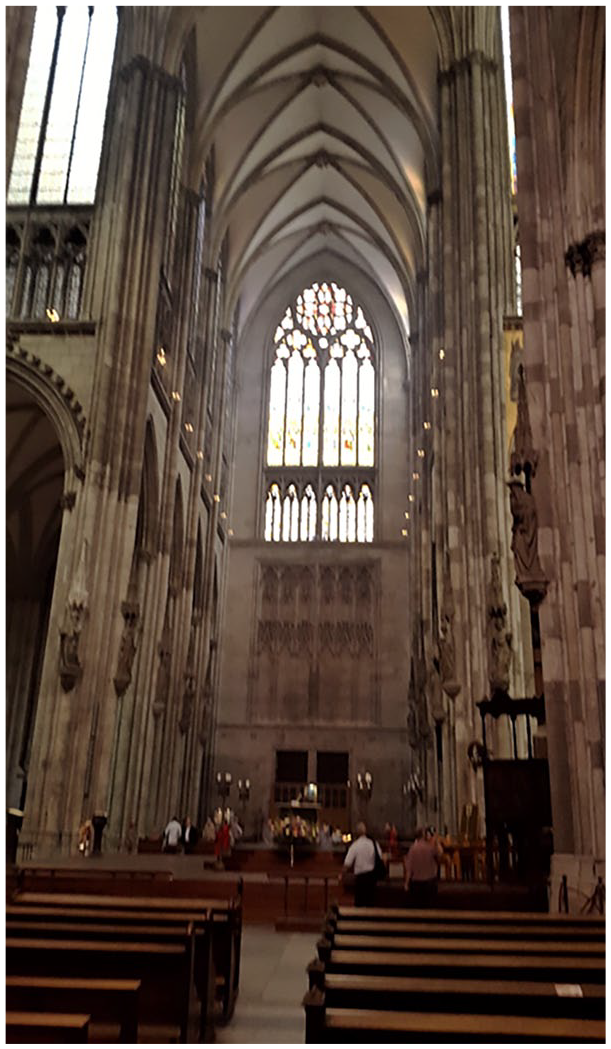
Interior of Cologne Cathedral (Kölner Dom), Germany.
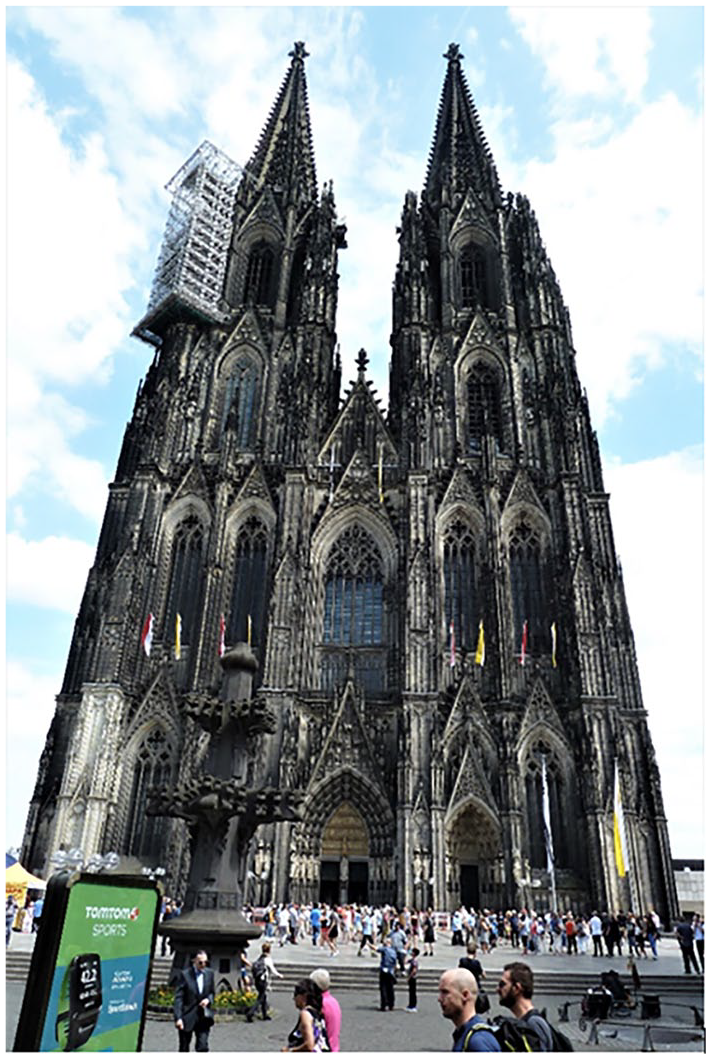
Exterior of Cologne Cathedral.
Cologne cathedral also contains many examples of another Christian tradition: the depiction of recognizable human figures, both inside and outside the cathedral. Before leaving the example of the cathedral in Cologne, we note one more aspect of the architecture of large-scale churches and cathedrals from this period: the plan of the structure is in the shape of a cross. The miniature model of the cathedral pictured in Figure 33 illustrates this well. (Since the cross shape has symmetry, the cathedral also has a line of longitudinal symmetry.)

Miniature of Cologne Cathedral.
Another example of iconic cathedral architecture of this period is the Anglican Salisbury Cathedral, pictured in an aerial view (Figure 34). This cathedral was built rapidly in a period of thirty-eight years, from 1220 to 1258, and thus illustrates a more specific architectural tradition, often referred to as Early English Gothic architecture. Once again we note that the plan of the structure is in the form of a cross. In this example, however, we note the extensive “close,” or green reserved area of eighty acres surrounding the cathedral, which tends to keep an awe-inspiring separation from surrounding structures. One of the features of this cathedral is the tall spire (over four hundred feet high, added in 1320), intending to point the worshiper upwards towards God. Closeup views of this structure would also show ornate decorations, including stained-glass window and statuary (including one of Bishop Richard Poore, who oversaw the early years of construction of the cathedral).
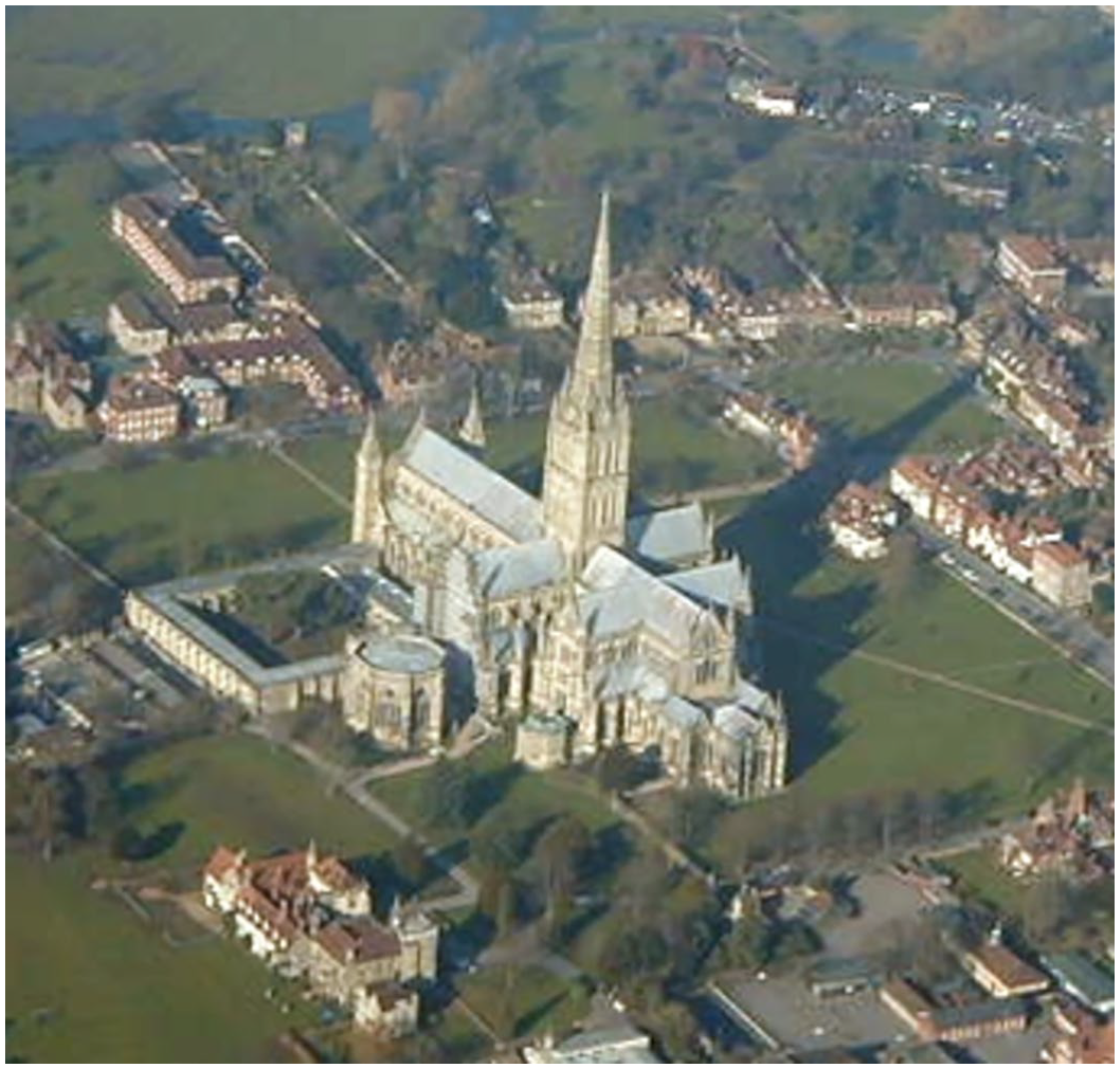
Salisbury Cathedral from the air, near Salisbury, Wiltshire, UK.
Reflections on traditions in architecture
The discussion above illustrates that classical Christian and Islamic architecture have historically and philosophically followed very different paths and their architectural traditions are very different in form. It is noticeable, however, that the architecture of these different traditions tends to be based on certain common architectural purposes, whether it be to point people to God, to reveal the nature of God, to suggest peace, and so on. An understanding of how these traditions represent these purposes helps us appreciate more deeply the inspirations behind the different architectural traditions.
Table 6 attempts to summarize much of what we have observed in the architectural examples discussed above and does so in a way which shows how different functions or purposes are expressed in the architecture. In a manner rather similar to the way that learning a different language helps to build cross-cultural understanding, the ability to appreciate these different architectural functions or purposes helps build interfaith understanding.
Function of architectural forms in religious structures of classical Islamic and Western Christian traditions.
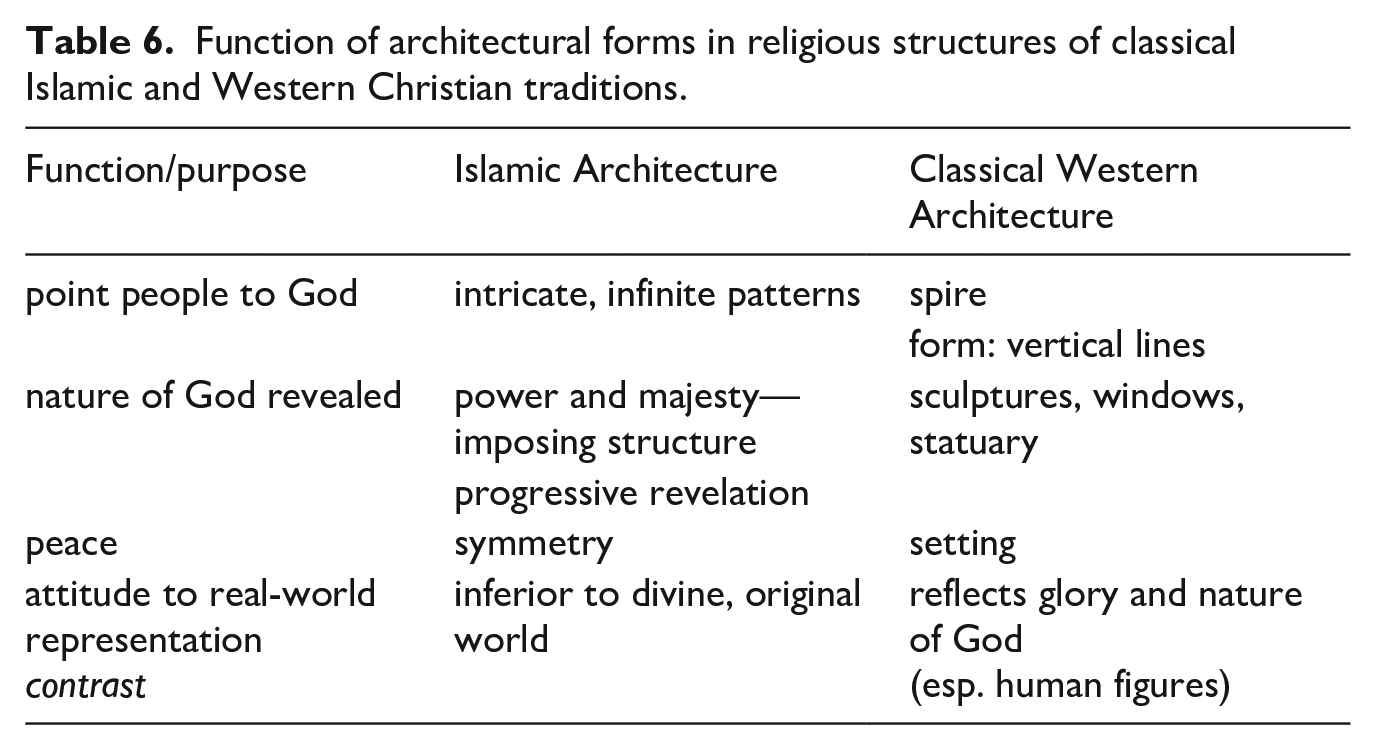
The above description of different architectural traditions may be thought of as analogous to the “context” of Bible translation. Bible translators understand that the context of a text is often vital in order to translate accurately. Specifying the near context of a text (physically and/or historically) allows the reader to derive significant meaning from texts that would otherwise be “opaque.” Likewise, understanding faith-based architecture helps both Muslims and Christians appreciate how each tradition has expressed differently such key concepts as the nature of God and the nature of peace.
Concluding observations
The above introductory comparison of classical Western Christian art and Islamic art is intended to help build a bridge of understanding between Muslims and Christians based on an appreciation of their different artistic traditions. We have pursued this objective by looking briefly at traditional meanings associated with color, symbols, calligraphy, and architecture. As part of this investigation, we have noted that, in many cases, the different faith traditions attempt to express very similar meanings, often concerning the nature of God, but do so in very different ways.
We also need to be aware that, in using a “broad paintbrush” in this analysis, we have lost many of the important localized features of faith-based art, as its expressions have varied through history and also geographically. For example, we have noted above that different artistic expressions developed in Western Christian art and in Eastern Christian art (largely separated geographically). However, this is also demonstrably true in the Islamic world, as art traditions have varied as various dynasties held power in different regions and at different times in history.
We conclude this investigation, therefore, with a warning. The material in this analysis is necessarily broad and introductory. Before using its contents in any specific application, the investigator or publisher should verify that these observations are still valid in the more localized environment.