



Abstract
Scientific-technological knowledge maintains the anthropocentric power-pattern and exploitive attitude with regard to nature, but sustainability science asks for an integration of territorial and decontextualized knowledge systems. Visual participatory methodologies involving diverse local stakeholder facilitate dialogue on environmental and sustainability issues. Inspired by visual ethnography and mediated discourse analysis, the present article uses semiological analysis to reconstruct the depicted narratives on the nature-society system in drawings representing “regional development”. The drawings were elaborated in a series of participatory workshops involving university faculty and students, regional government and non-governmental organizations and farmers from local communities in the northern Amazonian region of Peru. The analysis reveals a prevailing anthropo and technology centered, “colonial” conception of the nature-society system, and a marginalization of alternative narratives. Beyond confirming the potential for visual participatory methods to enhance multi-stakeholder dialogue, it demonstrates how semiological analysis can be used to deepen an understanding of the cultural, organizational and technological constraints facing critical, trans-disciplinary efforts to decolonize the technology-centered, anthropocentric mainstream worldview of nature and society.
Keywords
Introduction
With regard to sustainability concerns, the department of Amazonas at the northern border of Peru, in the occidental part of South America, represents a very challenging geographic, biological, socioeconomic and sociocultural context. The Plan for Regional Development 2009–2021 of the Regional Government (revised in 2016) sets 11 strategic objectives for regional development prioritized as follows: socio-cultural (1-3), natural resources (4-5), disaster management (6), production (7-8), conservation of the family agricultural system (9), promotion of tourism (10); fostering democratic governance and civil society (11) (Gobierno Regional de Amazonas, 2016). However, sustainable development of this ecosystemically vulnerable but crucial region, as the National University Toribio Rodríguez de Mendoza of Amazonas argues in its mission statement (UNTRM, 2016), can only be attained through a coordinated effort between the institutions and civil society.
Based on the results of three workshops each with representatives from different stakeholder groups (Fernández, 2017), the article uses semiological analysis to reconstruct the prevailing and emerging representations of the nature-society system as participants depicted them in collaboratively elaborated graphic illustrations. Committed to an “ecology of knowledge” framework (Santos, 2010), analysis explores the articulation between hegemonic, technology centered and anthropocentric narratives, and alternative representations of nature-society interactions, with regard to sustainability concerns. The results demonstrate that semiological analysis can enhance the understanding, by multiple stakeholders, of contextualized and empirical knowledge so as to enable innovation along more sustainable development paths.
Context
Situated on the oriental flank of the northern central Andes, the territory of the department Amazonas in Peru presents important variations of altitude, hosting at least 16 different micro-climates and exceptional biodiversity including some 19 indigenous vegetative formations (Encarnación Cajañaupa and Zárate Gómez, 2010: 34). Furthermore, 92% of the territory is situated in the watershed of the Marañón river, the largest affluent of the Amazonian region. Part of the southern sub-region of the Amazon rain forest, its singular vegetation bordered by a seasonally dry tropical forest plays an essential role in the hydric cycle due to its capacity for stocking water. It also guarantees the elevated fertility of the soil because of its important ability to retain carbon and sediments (Ministerio de Agricultura y Riego and Ministerio del Ambiente, 2015; WWF, 2016).
The State recognizes the rights of 54 “comunidades campesinas” (farming communities) (17.7%, SICCAM, 2016: 11) and 176 “comunidades indígenas 1 ” (indigenous communities) (36.3% in 2006, COFOPRI, 2006: 15; IBC, 2007) to 54% of the territory. The indigenous communities are populated by descendants of the ancient Awajún, Wampis (North), Baguas (Center) and Chachapoyas people (South) who inhabited the region before the arrival of Spaniards in the 16th century. These communities conserve their sociocultural and organizational heritage, while participating in the national life and hegemonic culture (Gobierno Regional de Amazonas, 2016: 35). 2
Due to the important eco-systemic function of the region, 83.72% of the territory is assessed as particularly vulnerable, but only 15.06–19.39% is presently protected and reserved to conservation (Gobierno Regional de Amazonas, 2016) 3 . Agriculture and livestock farming, the main economic activity in Amazonas 4 , are the main drivers of deforestation (Global Green Institute and SERFOR, 2015). However, the commercial (11.55%) and construction (9.91%) sectors along with public administration (10.05%), banks, transportation and other services constantly gain importance (INEI, 2017: 421). Tourism is considered a sector with high economic potential, due to the historic, cultural, social and ecological patrimony of Amazonas. 5
Notwithstanding its ecological abundance, monetarily, Amazonas is one of the poorest regions of Peru, contributing only 0.6% of the gross domestic product: monetary poverty rates of its seven provinces vary between 33.3% and 36.8%. The region as a whole ranks second nationally with extreme poverty rates between 7.4% and 10.2% 6 (INEI, 2018a). 37.5% of the population had at least one basic necessity unsatisfied in 2012 (Barrantes and Glave, 2014: 17), and its Human Development Index of 0.57 was the seventh lowest for all Peruvian departments in 2007 and the lowest among Amazonian regions (PNUD, 2009: 149) 7 .
Theory
Dealing with sustainability concerns as defined by the Brundtland report (1987) demands interdisciplinary and participatory research strategies, as Kates et al. (2001: 2) stress: “In a world put at risk by the unintended consequences of scientific progress, social trust in scientific knowledge claims and institutions cannot be taken for granted. Participatory procedures involving scientists, stakeholders, advocates, active citizens and users of knowledge are needed to transform knowledge claims into trustworthy, socially-robust, usable knowledge about the realities which matter in social and environmental change and in the transition to sustainability”.
It is the anthropocentric, technology-centered, naturalist, industrial, exploitive and capitalistic oriented hegemonic development path that represents the principal cause for the entrance to the Anthropocene, according to Philipp Descola (2017: 21, our translation): “For the first time in history it defends the affirmation that an essential difference, not level, exists between human beings and non-human beings.” It installs a hypostasis with regard to nature, that White (1967: 51) sums up as follows: “Man and nature are two things, and man is master”. But this “nature-society dichotomy hinders true ecological understanding” (Descola and Pálsson, 1996: 3) by fostering attitudes of “orientalism” or “paternalism” with regard to nature: “In this ‘colonial’ regime, the world becomes ‘a tabula rasa for the inscription of human history’” (Pálsson, 1996: 67); whereas “orientalism” acts via “exploring, conquering, and exploiting the environment”, “paternalism [. . .] is characterised by relations of protection, [. . .] privileging scientific expertise” (Pálsson, 1996: 68, 69).
From the point of view of the ecology of knowledge (Santos, 2010) knowledge needs to be diversified in order to “rethink universality and the issue of moral attitudes towards non-humans” (Descola and Pálsson, 1996: 2). In particular, local action-driven traditional knowledge systems (Quijano, 2001; Walsh, 2012) are conceived of as ways to decolonize ecology. Descola (2017: 27) observes the historical and present existence of alternative views of nature, in which “human beings do not ‘possess’ nature, but are ‘possessed’ by it”. Contrary to the anthropocentric and dualistic naturalist classicist worldview, animist ontology underlying several cultural expressions in America and Asia, considers that all beings, humans and non-humans, are substantially of the same kind, even though their physical appearance might differ (Descola, 2005). The continuity between all beings connected by a shared interiority allows for intersubjectivity and metamorphosis among different forms of existence. This implies that by cutting a plant one is also killing a soul, that in other circumstances might have adopted the physical form of a human being. A totemic ontology as lived by some Australian people, see moral and even physical analogies between human and non-human elements, when they originate from the same prototype and are therefore part of the same category. These categories of beings differ more or less in essence and substance, but are all part of a network of analogies and interact within a system of correspondences (Descola, 2005: 351).
These alternative ontologies legitimate experiential expertise and foster a more contingent and dialogic interaction between human beings and nature, that Pálsson calls “communalism”: “Unlike paternalism, it emphasizes the generalized reciprocity of human-environmental relations, an exchange frequently modeled on close, personal relationships” (Pálsson, 1996: 77). Pálsson further argues that hunting and gathering societies as well as farmers tend more to a communalist view of human-environmental relations. From his perspective all relationships with the land tilled “are modeled on the social bonds among distant relatives characterized by respect and formality, by balanced, not generalized, reciprocity” (Pálsson, 1996: 71).
The studies of Grillo and Rengifo (in Bernex, 2008: 15) as well as Mujica (2016) confirm this tendency in the Quechua culture of the Peruvian Andes that influenced the Amazon region the current research focuses on. Their work demonstrates that people in the Andes consider nature as a sensitive being that interacts with human beings, and so needs to be treated according to the same ethical principles of responsibility: “uyway (care)”, “pukllay (relationship)”, “harkay (protection)”, redistribution and thanksgiving that apply also to inter-personal relationships (Mujica, 2016: 361): “The relations of Andean man and woman with the flora, fauna, soil and water take place in the context of an understating that all are integral parts of a lager whole that includes themselves and their children” (Grillo and Rengifo in Bernex, 2008: 15, our translation). Oral literature registered by Gerald Taylor (2005, 2003, 1996) documents tales that evidence this world view and still circulate in the region of Chachapoyas.
Following Descola (2017) and Santos’ (2010) ecology of knowledge, the article at hand considers that the exploration of alternative ways of conceiving human-nature relations by decolonizing scientific discourse opens the possibility of a necessary paradigm shift (Escobar, 2012).
Methods
Context of data collection
Here we analyze 24 drawings produced by 109 participants in three workshops (63 women, 46 men) representing three regional stakeholder groups: members of farming communities, professionals from regional government and NGOs and the university community (faculty and students). Participants were asked to illustrate their perception of the current as well as an ideal future role of the Universidad Nacional Toribio Rodriguez de Montoya (UNTRM) in the rural development of the region. Two of the workshops took place on the campus of the University and the third at a rural training center in Chachapoyas. Each included participants from different backgrounds, professional training and/or ecosystem space (see attached appendix 1):
Workshop I: University Community (UNI): UNTRM Docents, students, researchers of Earth sciences (16 women, 10 men);
Workshop II: Regional Government and NGOs (ORG): Representatives of Government institutions and non-government development organizations (4 women, 10 men);
Workshop III: Members of Farming communities (FA): Small-farmers, mostly members of legally recognized “comunidades campesinas”, from 18 rural districts in 3 provinces of Amazonas (43 women, 26 men) 8 .
Following the method described in “Farmers Leading Change” (Fernández and Lusembo, 2002), participants from the first workshop used social analysis methods (Chevalier and Buckles, 2008) to identify the stakeholders that should be invited to subsequent workshops (Ramírez and Fernández, 2005). A selective part of the UNI group applied their newly acquired skills with visual participatory methods in the facilitation of the second and third workshops.
In order to allow for the free flow of ideas (Fernández and Lusembo, 2002), participants in the 3 workshops were separated into “interest working groups” of between 4 and 8 participants, according to their training and/or activity (see attached appendix 2). Applying “profile” and “ideal scenario” analysis (Chevalier and Buckles, 2008), each group was asked to answer the following two questions:
What is the contribution of the UNTRM to the rural development of the Region to date?
What should have been its contribution by 2027?
Each group was provided with large sheets of paper and colored felt pens, and asked to graphically illustrate their answer to these two questions during two 60–90 minutes’ sessions. A total of 24 posters were produced during the 3 workshops.
While Workshop I and II were full-day efforts 9 , the small-farmers workshop (III) was only 2 hours long, because of an externally imposed time limit. For this reason, only one of the nine groups of farmers managed to design present and future situations separately (group 12); in the other two workshops, however, 8 groups answered the two questions on one poster each. Both men and women took part in each small group session. At the beginning of the session the question at hand was discussed by the group and ideas were gathered from all. All small groups were encouraged to involve all members to engage actively in the elaboration of their poster. However, each small group organized the process in its own way; some groups had several illustrators working simultaneously on different spaces of the poster while others designated one or two painters on the basis of comments and suggestions from other members of their group. At the end of each of the small group sessions, a representative from each group presented their poster to the workshop plenary in a 5-minute report
Method of data analysis
The technique of “mapping” or graphically representing perceptions was preferred for this exercise because it has been identified as a means of facilitating discussion and joint learning among communities of small-farmers with other stakeholder groups (Lightfood et al., 2000; López Minchán, 2017).
Furthermore, as geography of perception demonstrates, these collaboratively elaborated visual diagnostics of reality are particularly helpful to deal with sustainability issues, since “mental images determine the significance and symbolism of places, and condition the action of individuals when dealing with concrete questions” (Zárate, in Bernex, 2008: 5, our translation). The decodification of diverse ways people perceive and appropriate space using paintings helps to “understand peoples’ action and the functioning of space” (id.). As visual ethnography argues, cultures differ with regard to the pictographic codes they deploy (Pink, 2007), and visual representations also provide insights into the culturally specific ways of dealing with reality. For instance, Descola (2009: 2) reconstructs in graphic illustrations “figurative schemes” that correspond to animist, totemic and naturalist “forms of organization of world experiences that correspond to the diverse manners of interfering qualities to the existing”.
Additionally, the graphics may also be a potent tool for empowering local actors to reflect collectively on sustainability issues by drawing on their contextualized knowledge and singular experience regarding a specific territory, connecting environmental, social, cultural, economic and political issues (Sepúlveda, in Bernex, 2008: 2). It is also a way for farmers to externalize and become conscious of their knowledge (Fairweather and Hunt, 2011), and succeeds in providing non-hegemonic knowledge with a platform, as research with indigenous people has demonstrated in various parts of the world (Feinberg et al., 2003; Roberts, 2012).
The decodification of the “diverse manners of interfering qualities to the existing” in the visual depictions is inspired by mediated discourse analysis (Norris and Jones, 2005), and draws on semiological tools as developed by Barthes (1964) and Peirce (1991). The semiological analysis, categorization and quantification of the painted elements pursue the aim of reconstructing the participants’ representations of their present and desirable future nature-society system. A first description of the graphic elements allowed for the inductive reconstruction of a general underlying categorization system: It distinguishes “natural elements,” “technology,” “knowledge” and “human beings”. The category “natural elements” is represented by plants, animals, geographic, and meteorological phenomena for example; planets, the elements water and air, that do not make explicit any human or technological influence. The category “technology” refers to engineered instruments that extend human agency or “make society durable” (Latour, 1991) such as irrigation canals, architecture, transport, fences, books. The category of “knowledge” groups together symbolic allusions to research, science and education (i.e. “sustainability”, “knowledge transfers”, signs of interrogation and exclamation). The category “human beings” consists of all the elements that allude to the human body and its expressions (heads, hands, bodies, smiles that indicate moods).
In order to make the results of qualitative analysis more accessible, we tried to quantify the relative weight the posters give respectively to these four categories by considering the position and characteristics (i.e. size, color, thickness of traits) of the depicted element with regard to the overall design of the poster and other graphical elements in the illustration. Furthermore, we considered the relationship the drawings establish graphically between the illustrated human figures and other elements, via the relative position of each with regard to the other; graphic or verbal indicators that link or separate them, were also taken into account.
The posters, a selection of which is included in appendix 3, should be read as “works in progress” as they were influenced by interpersonal interaction and the capacity of each small group to reach agreement. The semiological analysis here developed treats the individual graphs as a consolidated product since the available data does not allow for the reconstruction of the exact dynamics of elaboration of each of them. It concentrates on the 24 posters, but draws on the experience of some of the authors during (some of) the workshops, according to the role they played: workshop leaders, participants and/or non/participating observers.
Results
As a result of the collective oral discussions during the workshops, the role of the University has been identified by the participants principally within the domains of ecological conservation (forests, watersheds, biodiversity) and production chains of goods and services implying actors from science and technology. While the university community prioritized the role of capacity building with regard to ecological conservation and production, farmers additionally considered the technological progress and institutionalization of the desired intensity of collaborations between community, regional organizations and the University as a guarantee for future insertion in the market link in the value chain. Representatives of governmental and nongovernmental regional organizations prioritized aspects of governance and civil society as well as more holistic sustainability concerns.
The following paragraphs explore in more detail the roles participants attribute to each element considered as a key for regional development in the posters.
A technology-anthropocentric view of rural development
In a general overview (see Table 1), the posters designed by all groups give central importance to representations of technological elements used to domesticate and organize nature, to exploit natural resources, to transform them into products for commerce and tourism and to transport them. On average, technological elements take over 40% of the occupied space of the posters, with variations from 37.7% to 47.25%.
Percentage of pounded space occupied by visual representations of nature, human beings, technology or knowledge.

On average, the representations of human beings are marginal in most of the drawings (14.25%); however, taking into consideration that there is no technology without humans and that knowledge too is identified as being principally a human category, we can consider that on average, some 75% of the used visual space of the posters is occupied by elements that are part of the human world and culture. Natural elements without human interference only occupy about 24.5% on average, with important variations. In the drawings of the representatives of regional organizations (ORG), natural elements have even less importance (8.33%), whereas the farmers (FA), on average, give natural elements an importance of 33%.
The drawing of FA group 14 (see Figure 1, all the figures are included in Appendix 3) provides an example of the anthropocentric-technological view of rural development. Here, an agronomist and a researcher dressed up formally dominate the scene, presenting an image of common cause that organizes the entire space as indicated by the two red arrows pointing to other pictorial elements. Small figures representing community members execute that suggested by the agronomist and researcher, and on the right side of the drawing, technology organizes the ‘natural’ space in fenced fields of monoculture, and irrigation seems to consume all the water of the river coming from somewhere behind the mountains. The proportions of the picture are very interesting, since the dominating figures are of the same size as the mountains on the right. 10 Nature plays only a marginal role in this nature-society-system, and the relationship between community members, technicians and academics/researchers is alarmingly asymmetric.
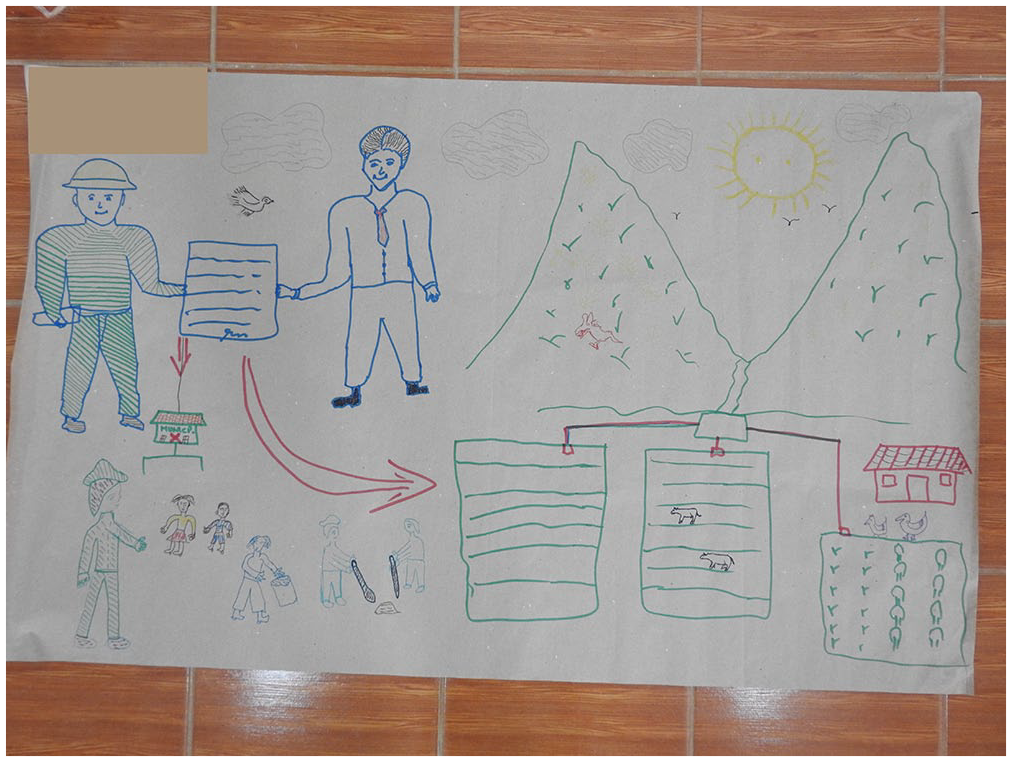
FA group 14.
Figure 2 of FA group 9 does not have human figures, and technology seems to play only a marginal role. A basic irrigation system, a small area of lombri-culture and a fenced protected zone with wild and rare animals and plants are alluded to while the natural elements are all ideally shaped and the plants heavy with fruits and vegetables without pests. In this vision of rural development, nature is optimized by human intervention, but the technology preferred for reaching this aim seems to be a more natural one. However, the poster represents a fragmented and market-oriented view of the nature-society system, since it depicts isolated natural elements in form of optimized “goods”. Environmental elements that are explicitly drawn are soil and water, while air is probably represented by the empty spaces. However, there is no visible information about the systemic interrelation among these elements; for instance, some of the plants depicted are not endemic species (sugar cane, eucalyptus) and because of their high water consumption do not respond in an ideal way to face the regional ecological challenges. Here, too, nature is represented only in view of nearsighted human needs of consumption; conservation of the environment is conceived of as something that happens in specific small, fenced and isolated areas with no human intervention.

FA group 9.
In total, 11 posters adopt an ecosystemic perspective while 13 depict a segmented nature-society system. Whereas the former emphasize systemic totality—for instance, four posters take the stream basin as a point of reference (e.g. Figure 3). However, 50% (FA, ORG) and 62.5% (UNI) of the posters conceive of the nature-society system as a juxtaposition of clearly delimitated and often segregated graphic elements, sometimes loosely connected. Interestingly, in view of future development, three UNI groups (1, 2, 3) and one FA group (12–Figure 4) explicitly demand more connection among presently segregated elements.

UNI group 2.

FA group 12.
Abstract modelling of rural development versus territorial approach
With the exception of ORG group 6 (Figure 5, present and future) that paints a typical local scenery, all the UNI and ORG groups conceive of rural development in a spatially decontextualized or abstract manner The models they design may include elements that are specific of the region, such as locally prevalent species of plants and animals, cultivation technology (e.g. terraces), products or regional monuments (e.g. the archeological site of Kuelap 11 ), landscapes with mountains in the background, or labels that refer to the local university or the administrative boundaries of the department; but they are mainly depicting a typical situation rather than a specific locality.

ORG group 6.
The referential area for the designed ideal future watershed model of UNI group 2 (Figure 3) is ambiguous. It integrates the protection of the environment into almost all represented activities according to the environmental vulnerability of each part of the basin. The activities are limited to conservation and research in the drainage area, whereas agro and sylvi-cultural activities are relegated to second order streams, and followed downstream by the technologically managed urban area. The model may be contextualized in the micro-watershed the capital of the region, Chachapoyas, is situated within. However, not all concrete elements depicted refer necessarily to a desirable local reality since the drawings include rice fields, sugar cane or reforestation with eucalyptus or pine, which are not endemic species and are very demanding in water. Also, the model would be difficult to generalize given the breadth of the Marañón watershed, where large urbanized areas and potentially polluting activities are located uphill, while the most important forest resources are downhill.
The FA working groups are divided with regard to the reference area chosen for their drawings: Four groups chose a rather abstract/decontextualized representation, whereas four others project their vision of rural development onto a local scene (group 8, 10, 12–present and future, 15; see Figures 4, 6, 7, 8). Two other FA groups (group 9, 11; see Figure 2), depict almost exclusively local flora and fauna as well as activities and technology without placing them in a specific space (besides the label of the separated space for the protected area “Tilacancha” in Figure 2).
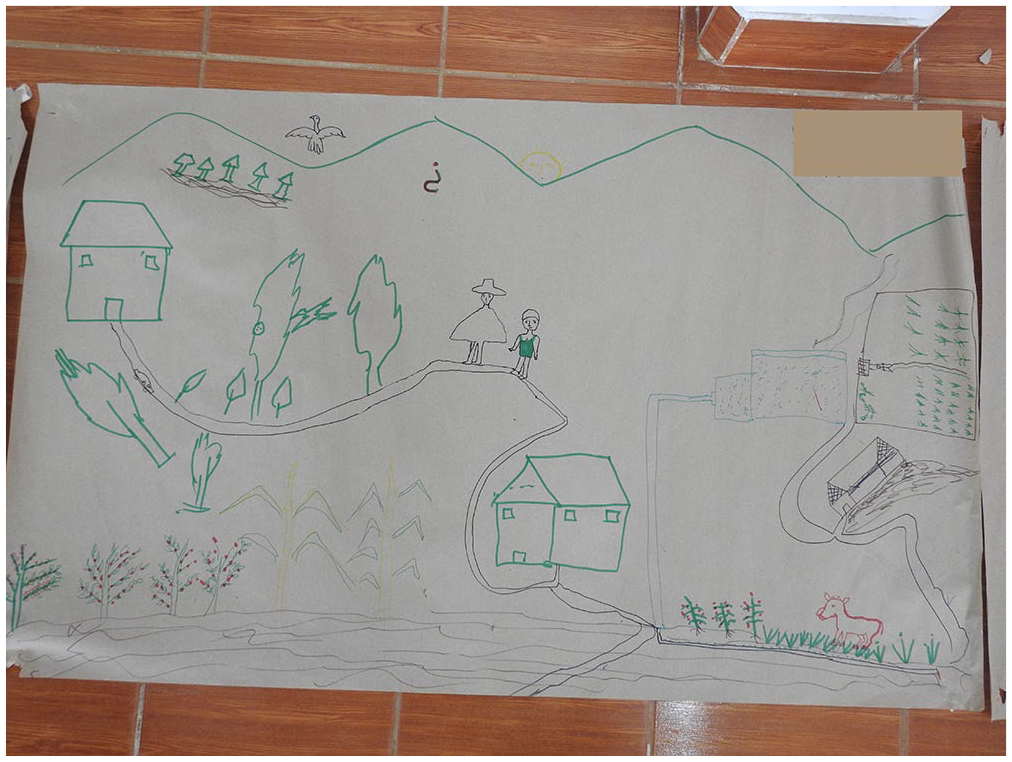
FA group 8.

FA group 10.

FA group 15.
Six posters designed by UNI and ORG groups include explicit allusions to an interaction between the local and the global dimension: Three of them bring other continents into the pictures in view of extending the market via exportation (group 1–future, 4–present, 7–future). Three of them see possibilities for the reciprocal exchange of products, technology and knowledge (group 4–future, 5–future, 7–future). Five posters allude to the arrival of foreign tourists as a strategy for rural development (UNI group 4–future, ORG groups 5, 6, 7–future (Figure 5); FA group 8–Figure 6).
Nature-society interaction
Only three of the 24 posters explore the interaction between nature and society.
As Table 1 sums up, representations of human figures only play a marginal role in the posters, and when they do appear, they are mainly of individual actors who sometimes seem to be interacting with others. Only 4 posters (FA groups 10–Figure 7, 15–Figure 8, 16; ORG group 7–present and future) refer clearly to some kind of organization such as a community; the family is a reference point for ORG groups 5–future and 6–future (see Figure 5). The latter group (6) precisely opposes a desperate individual in the present to a happy family in the future. Its future vision of regional development furthermore mentions “civil society” as an actor linked to public and private initiatives. Other posters allude to institutions such as municipality, school, hospital or a cemetery. Age and/or gender diversity is made explicit in 30% (FA), 50% (ORG) and 37.5% (UNI) of the posters respectively; in the case of the eight groups having opposed future and present situation in two separated posters, gender diversity is more often problematized with regard to the desired future (62.5%) than in the present (12.5%). The ORG group 7 (future) depicts cultural diversity, using dress to distinguish a member of an indigenous community, a lady from a farming community and a man and child from the city. The FA group 8 (Figure 6) makes the rural-urban distinction opposing a poncho to a mini-skirt as a reference to cultural diversity.
A dichotomy is made between nature and society in a majority of the posters and they represent an “orientalist”, sometimes “paternalistic” (Pálsson, 1996) relation between human beings and nature. Nature is managed according to human necessities, either by the people depicted or by an invisible, intervening and organizing hand (group 1, 3, 4, 5, 7, 11, 12 (Figure 4), 13, 14 (Figure 1), 16). Protection is conceived of as a way of ensuring the availability of future resources for human consumption through the creation of protected areas not interfered with by people (see Figure 2–FA group 9; Figure 3–UNI group 2–present; Figure 8–FA group 15). The two posters of UNI group 2 are interesting in this respect since they show an ideal future in which more human-nature interactions exist. In their ideal watershed model represented in Figure 3, the protected area of the headwaters is used for research while the center of the watershed is dedicated to agriculture and the main residential and industrial zones are positioned near the estuary. Here, technology, “green cities”, via “renewable energy” or “wastewater treatment plants” help to reduce the human impact on the environment, as the inserted labels explain.
Posters that depict rural contexts seem to adopt a more integrated view of nature-society interaction, too. For instance, FA groups 8 (Figure 6) and 10 (Figure 7) dedicate only part of the poster to explicitly exploitative and technologically mediated activities while they seem to be in harmony with an ecosystemic equilibrium of the larger environment. In Figure 6, however, tourism, as an additional activity, is conceived only as a contemplative relation to nature, rather than interaction between people and nature. The graphic representation chosen by group 15 (Figure 8) depicts a perfect adaptation of human activities to the environment.
The posters in Figure 5 (ORG group 6) are interesting, because they emphasize the connection among the elements; happiness of one element can only exist if every other element of the system is in equilibrium. Whereas in the present, the isolated person is skinny, vegetation spare, monuments abandoned and the sun angry, in the projected future families of healthy people live surrounded by abundant vegetation and engage in multiple activities interacting with the environment such as paragliding, tourism, agriculture, fishing, hospitals, learning/teaching, commerce. . . and the sun looks happy, too.
Although the majority of the posters adopt an analytical approach emphasizing the relationships, interactions or flows of elements within nature-society systems, the four drawings that represent a rural context (FA groups 8 (Figure 6), 10, 15; ORG group 6) require a metaphorical reading. Here, the depicted elements are not important in themselves and do not allude literally to any existing reality but rather to the idea of happiness, wellbeing (i.e. the smiling sun and the healthy family in Figure 5) and equilibrium (Figures 7 and 8). These drawings do not visually establish any hierarchy among the elements. FA group 15 (Figure 8) stands out even more because of the multiple perspective of its design. It shows clearly the visions of several group members, that makes it possible to “read” from different angles. The poster does not have any top or bottom, no left or right, and somehow translates visually the idea of diversity of perspectives.
Scientific versus experiential knowledge
All groups from the three workshops, treat knowledge graphically as a key to rural development, and most of them consider the University as the cornerstone. The two posters designed by FA group 12 (Figure 4) demonstrate this very clearly by opposing a present situation characterized by isolated and not very successful productive activities and initiatives by an individual actor, to an ideal future in which an educational institution is the center, and the depicted intervention of other actors with book knowledge. According to this illustration and the corresponding oral presentation of the poster, knowledge transmission happens first in a closed space separated from the actual areas of intervention. It seems to deal above all with theoretical knowledge being elaborated in a decontextualized manner while capacity building and learning happen in instructional manner only.
Opposing the present and the ideal future for rural development, the ORG group 7 questions this unidirectional form of learning. Their graph positions University in the center of the model of rural development where the present situation is characterized by outgoing unidirectional arrows, the future situation replaces them by bi-directional arrows, symbolizing a dialogical collaboration between theoretical and practical knowledge among national and international stakeholders from administration, industry, tourism and conservation.
ORG group 5 also uses bi-directional arrows in its future vision of regional development but places university, knowledge and the globe to allude to the international sphere, in a space separated from concrete activities, local actors and context. Here, the arrows symbolize dialogic interaction among actors, but knowledge production is still represented as a decontextualized activity that takes place in an ivory tower.
According to the posters of ORG group 6 (Figure 5) and UNI group 4, rural development depends precisely on the degree of integration of University within the overall system. They depict an unsatisfactory present situation, in which the activities of research/education, production, commerce, administration, industry and tourism are not connected to each other. They confront this situation to an ideal future in which University or scientific and technological knowledge influences all activities. The three other UNI groups’ posters (groups 1-3) stress knowledge application in practice as the clue to rural development. This may happen through the direct intervention of actors who have completed their studies (group 1), or via the application of knowledge via technology (group 2–Figure 3) and/or administrative planning (group 3).
Figure 6 is interesting because it invites a questioning of local knowledge in a globalized world. The only actors represented in this drawing are a locally dressed guide and a tourist in mini skirt, that aside from contemplating the scenery are inactive. The interrogation sign in the top center of the poster gives the impression of disorientation: Both actors are standing together, but they are represented as being spectators, not actors.
The poster of the FA group 15 (Figure 8) represents knowledge as an important factor for rural development, but in the form of rules. The poster depicts the daily activities of the community that appear as explicit elements of the system, but uses knowledge to label the activities and regulate them with warnings such as: “Do not cut the trees”, “Protect the environment” or “Keep our environment clean”. Here, outside knowledge is integrated in the form of behavioral rules to be followed, rather than as practical knowledge regarding the functioning of the ecosystem. The poster in Figure 2 (FA group 9) symbolizes a certain form of integration of local knowledge relating to plant and animal health using bio-technology; for example, the systematic breeding of earth worms for the production of humus.
Surprisingly, daily challenges facing the region are not dealt with in the posters: the difficulties of communication and transport, the absence of disaster management (e.g. recurrent inundations and mountain slides), and the pressure of exploitive industry on water, petroleum and mineral resources in the northern provinces. In general, the point of view and challenges facing the indigenous communities in the northern provinces is almost absent in the posters; with the exception of UNI group 4, that solves the question of rural development by mapping geographically the agro-productive specialization of each of the provinces of the Amazonas department, and ORG group 7 that draws an indigenous lady. More particularly, concerns with what happens to the people who live downhill or to future generations, are only marginally dealt with—although it should be noted that a workshop was not held with representatives from the indigenous lowland communities.
Interpretation and discussion
A naturalist world view (Descola, 2005) clearly predominates the posters. The domains of human beings and of nature are mainly represented as being intrinsically different and humans are in charge of managing, exploiting and/or protecting nature. Academic research and knowledge acquisition, as well as the development and use of an increasing amount of technology is conceived of as a guarantee for ensuring the availability of ecosystemic services. Only few groups (2, 6, 8, 10, 15) represent human activity as part of a larger ecosystem that only works well if there is interaction and reciprocity. In the posters of UNI group 2 (Figure 3) and FA group 8 (Figure 6), this seems more clearly to be inspired by an awareness of human responsibility of the current environmental problems in the Anthropocene, while in group 2, 6 and 15 it requires the development and implementation of more technology, rules of behavior and new language categories, for instance, “green cities”.
The concentration on academic knowledge of “sustainable development” provokes an alienation of local actors as depicted in Figure 6 (FA group 8) that explains the marginalization and abandon of alternative narratives and more reciprocal human-nature interactions as designed by FA groups 10 (Figure 7) and 15 (Figure 8). But these posters as well as those of the groups 2 (UNI, Figure 3) and 6 (ORG, Figure 5) insinuate that local and decontextualized knowledge must not be disconnected, and that the dialogue of both probably would present the most sustainable solutions.
The participatory design of the workshops allowed for revealing ideologies and power relations that sustain the status quo of the ecological crisis in the Anthropocene. In order to promote “simultaneous and continuous processes of transformation and creation, the construction of radically distinct social imaginaries, conditions, and relations of power, knowledge” (Walsh, 2012: 11) are needed. Therefore, many more opportunities for participation as well as freedom with regard to the choice of methods and loci of interaction are necessary (Pereira et al., 2018). Subsequent workshops should actively invest in increasing opportunities to listen to marginalized narratives and actors, in view of local environmental governance (Kleiche-Dray and Waast, 2016).
Once local actors are empowered, it would surely be beneficial to engage the different stakeholder groups in a common dialogue, in order to motivate critical reflection (Knaggård et al., 2018) on the hegemony of the anthropocentric narrative. More work surely also needs to be done in order to stress the gender dimension (Basilio and Fernández, 2013). Furthermore, it would be essential to progressively extend the dialogue, starting by inviting stakeholders from the northern part of the department, since the indigenous communities will have alternative views of a nature-society systems and face other ecological challenges than those represented here.
Conclusion
This article has reconstructed a prevailing “orientalist” and “paternalistic” approach to nature in perceptions of “sustainable development” in the ecosystemically diverse and vulnerable Amazonas region of Peru. Participatory methodologies provided a means of revealing alternative narratives that can contribute to dialogue and action toward a more sustainable relationship humanity-nature. The semiological methodology of analysis of the collaboratively elaborated visions of the society-nature systems proved particularly beneficial for providing opportunities to think about “social innovation” (Olsson et al., 2017). The process that emerges here points to opportunities for the engagement of multiple stakeholder groups in the critical deconstruction and reinvention of the future. It also points to an opportunity for comparative research on the usefulness of the semiological analytic tools developed for this case across geographic regions, ecosystems and socio-cultural contexts.
Supplemental Material
Online_Appendix – Supplemental material for Regional development in Amazonas, Peru: science-society interactions for sustainability
Supplemental material, Online_Appendix for Regional development in Amazonas, Peru: science-society interactions for sustainability by Carola Mick, María E. Fernández, Cástula Alvarado Chuqui, Carlos A. Amasifuen Guerra, Mina Kleiche-Dray, Ana Paula López Minchán and Jhonsy Omar Silva López in The Anthropocene Review
Footnotes
Acknowledgements
We thank the participants of the here analyzed workshops for their collaboration.
Declaration of conflicting interests
The author(s) declared no potential conflicts of interest with respect to the research, authorship and/or publication of this article.
Funding
The author(s) disclosed receipt of the following financial support for the research, authorship, and/or publication of this article: This research has been financially supported by the French Institut for Development Research (IRD), in collaboration with the National Research Institute for Sustainable Development of Cloud Forest (INDES-CES), the Research Institute on Stock Farming and Biotechnology (IGBI) of the UNTRM and the University of Paris (V, René Descartes).

Supplemental material
Supplemental material for this article is available online.
Notes
References
Supplementary Material
Please find the following supplemental material available below.
For Open Access articles published under a Creative Commons License, all supplemental material carries the same license as the article it is associated with.
For non-Open Access articles published, all supplemental material carries a non-exclusive license, and permission requests for re-use of supplemental material or any part of supplemental material shall be sent directly to the copyright owner as specified in the copyright notice associated with the article.
