




Abstract
The daunting crisis of the Anthropocene cannot be adequately addressed without re-envisioning our conceptual approach to knowledge formation. This background essay to the double special issue on the Mississippi River provides an account on the Anthropocene Curriculum (AC) initiative, the general framework in which the Mississippi. An Anthropocene River project was devised and implemented. The AC is an ambitious, long-term attempt to model and test experimental forms of post-disciplinary collaboration in order to come up with sensible and experiential strategies of co-learning and co-producing critical knowledge in a rapidly changing planetary situation. The AC essentially explores the novel epistemic, aesthetic, and educational challenges presented by the transition into the new geo-human epoch, foregrounding collective, constructive and transformative practices of research, and education across the sciences, arts, and humanities that help to interlink and integrate the existing pluralities of earth-bound knowledge forms. Developed by the Haus der Kulturen der Welt and the Max Planck Institute for the History of Science since 2013, the undertaking has grown today into a global network of partner projects, one of which was the two-year project on the Mississippi River Basin. The AC experiment is thus directly tied to the research and teaching contexts of other geographic, cultural, and institutional settings that together map the larger terrain of altered human-Earth relations.
Keywords
Navigating difficult terrain
“I seek the passage that leads from the exact science to the science of the human. Or [. . .] from us to the world. The path is not as easy as the classification of knowledge may make it appear. I think it is much more difficult than the infamous Northwest Passage.” –Serres, 1982: 15, translation by author.
With these words, written more than 40 years ago, the French science philosopher Michel Serres opened his reflections on the profound difficulty of navigating the schism between knowledge cultures. The Northwest Passage, which cuts short the sea route between East Asia and the nation states neighboring the North Atlantic, that is the “Western World,” marks an allegorical space for Serres, a topography of learning that has split into two ostensibly incongruent domains: the sciences of the physical and earthly and the sciences of the historical, social, and mythical. This coarse division between natural and cultural classes of knowledge obscures, in addition, a finer, more complex, often unrecognized, and sometimes conflicting pattern of language, practices, and methods. Serres took the archipelagic geography of the Canadian Far North—with all its complex contours, glacially formed islands and drifting pack ice, fractal coastlines and labyrinthine pathways—to symbolize the cumbersome crossing between the laws of precision and the rules of contingency, between exactitude and empiricism, the abstract and the concrete.
In the early 21st century, as the geographical Northwest Passage becomes navigable due to the alarmingly rapid shrinking of Arctic sea ice cover, the allegorical Northwest Passage will finally have to open up as well. The unfolding Anthropocene presents a 360° crisis that risks pushing life on this planet into the abyss of a sixth mass extinction while also threatening to push human civilization into a new barbarism marked by social conflicts and environmental panic. This super crisis is a result of multiple crises reinforcing one another and it requires a profound response of joint political and transformative action, necessitating, foremost, a fundamental recalibration of the way in which knowledge—arguably the most powerful tool of the modern age—is generated, shared, and put into action. At a minimum, this new territory of knowledge should be as comprehensive and multi-scalar as the crisis itself. What is needed, then, besides a general Anthropocene literacy, is Anthropocene-adequate knowledge: novel epistemic, aesthetic, and educational models that allow us to comprehend and jointly tackle the biggest challenge humanity has ever faced. What is needed is the development of sensible methods and practices of research and dissemination that interlink the existing pluralities of knowledge in a way that is problem-oriented but also broad, bottom-up, and democratic.
The Anthropocene Curriculum project was formed for just these purposes. Initiated in 2013 and since then continuously developed by a project team based in Berlin at the Haus der Kulturen der Welt (HKW) and the Max Planck Institute for the History of Science (MPIWG), the general idea of the project is to incubate, test, and foster cross-disciplinary experimental spaces and self-reflexive frameworks for co-learning and co-producing Anthropocene-competent forms of knowledge. Although today the initiative has greatly expanded into a global platform for like-minded projects and activities, its mandate remains the same: to create and provide experimental educational settings in which it is possible to pursue a free and open-ended exploration and actual establishment of novel forms of knowledge production. The AC is meant to transform scholarly and cultural devices, methods, and institutions in order to better address the current qualitative shift in conceptualizing and framing expertise in the Anthropocene world of today.
The alliance between the HKW, a contemporary arts institution turned forum for critical debate and global discourse, and the MPIWG, a research institute conducting basic research on the historical formation of knowledge in all its variety, provides a unique potential for such an undertaking. In their collaboration, the two institutions have the freedom to openly explore and cultivate a novel, still undefined and somewhat para-academic terrain that lies between research, public forum, theory, and arts curation, allowing another standard of exchange and action to emerge.
Still, as plain and clear as the aim of the AC project might be—namely, to establish new models for researching, teaching, and learning in the Anthropocene—its actual realization is far from simple. As anyone who has been engaged in one, or many, of the meanders of the global Anthropocene conversation knows, the subject can get quite messy once their asymmetrical details get into view. This is not a question of how to more appropriately label the epoch, that is, whether to name it Anthropocene, Capitalocene, Technocene, or any other -cene. What’s in a name when the concept behind it refers to a state-shift in Earth processes that threatens to make much of our vocabulary numb and invalid anyway? More important, it seems, is the question of what, after all, defines common knowledge in our time: How can we establish epistemic sensibility for the many spectra, scales, and interplays on and within a planet in transition? And how can we create or modify the spaces and constellations of research and learning that translate such kinds of knowledge from one method, form, or context to another? How, in short, can we build consensus and then work from that to make a change?
Despite the mountains of expertise the sciences and humanities have amassed over the past decades, each of them stratified and subdivided in their own disciplinary silos, nobody knows how to do that yet. Even with this new setting—the grand, unifying, top-down concept of a geological epoch—it is still hard to find the passage from the exact sciences to the sciences of the human. Without stretching the all-too-modern trope of exploration too far, it seems there is only one way of finding a possible path. One simply has to experiment, propose, test, and work out together the knowledge that can help us to face the Anthropocene challenge: from the bottom up, globally, comparatively, across institutions, and across generations. Thus, in contrast to much of the Anthropocene discourse that has promptly adopted the worn-out posture of destructive critique—sometimes without really grasping the concept behind the term and by misconstruing the motive of many of its proponents—the overall gesture of the project is constructive and welcoming. This existential crisis will either be solved together, or not solved at all.
A space to situate earth-bound knowledge: The Anthropocene Campus
The Anthropocene Campus, the signature tool of the AC, was designed accordingly. This large-scale workshop format operates as a field test in the manner of an experimental summer school, in which a diverse set of topical research projects, methodological approaches, and knowledge practices can be explored in a shared space. The first such Anthropocene Campus took place in 2014 in and around the environs of the HKW in the center of Berlin. Scheduled as the final event of HKW’s two-year Anthropocene Project, it demonstrated the global reach and discursive diversity that the Anthropocene concept had already provoked within and beyond academia. In 2012, HKW and MPIWG jointly held two preparatory workshops for young researchers, followed by a public research forum in January 2013 and an in-camera meeting in which a round of 20 research directors were asked to assemble a “wish list” for future Anthropocene-responsive research. Here, a formative decision was made to focus on education as a productive means to develop and cultivate the new qualities of Anthropocene thinking and practice. In November 2014, after more than a year of intensive preparation, the Anthropocene Campus brought 140 young researchers, educators, artists, and activists from more than 30 different countries to Berlin to “camp” for nine days in the HKW, engaging in a dense series of seminars, discussions, artistic interventions, and public fora on the Anthropocene. Rather than seeking to conclude a crash course of interdisciplinary study, this gathering was designed to usher in a vista for new frameworks for Anthropocene-competent knowledge creation and exchange.
The centerpiece—for this first as well as all following Campuses—was a series of seminars. A total of nine seminars were developed by a unique constellation of scholars and practitioners from the sciences, humanities, arts and design. Thus, for example, an Earth system scientist (Will Steffen), an economic sociologist (Amita Baviskar), and an environmental historian (Marco Armiero), or, as a further example, an ecologist (Erle Ellis), an architect (Arno Brandlhuber), and a cultural anthropologist (Elena Bougleux) were tasked with finding the crucial intersections of their respective work as it revealed a key aspect of the Anthropocene. These experimental constellations already show how an Anthropocene Campus is foremost an improvisational device. Since a common uniform understanding of the larger-than-human Anthropocene is generally missing, negotiation between actors already producing valuable knowledge of the world today is a necessity. Such negotiations require the seminar leaders to rethink their given theories and methods through central educational objectives, thereby helping to devise strategies for post-disciplinary frameworks capable of dealing with Anthropocene matters.
The result of the negotiations within and between each interdisciplinary group of seminar leaders was the composition of an imagined future “Anthropocene curriculum,” a one-week passage—in the Serresian sense—through a set of synthesized and highly transdisciplinary seminars. At the first Campus, participants had the opportunity to actively engage with varied subjects and case studies ranging from the “geo-political” interdependencies between desertification and armed conflict, across the economic valuation of nature, to the analysis of urban metabolisms, or an introduction to the modeling of global socio-economic system trajectories. The seminars were further complemented by a larger public forum that infused discussions with a more reflexive take on knowledge production. Issues such as the limits of knowledge or the role of experience, and key terms such as “agency,” “scale,” “complexity,” or the means of “experimentation” itself helped to contextualize the exercise of the Campus in a more deliberately public way.
To be sure, this curated environment of co-learning and co-producing knowledge does not and cannot strive for a comprehensive, fully-integrated tour d’horizon of the Anthropocene. An Anthropocene Campus is not a proper training camp for future knowledge—at least not yet—but it might be well-described as a playing field for future knowledge creation. Its aim is a resourceful approach to the construction of a knowledge base, broad in its disciplinary perspectives, and out-of-the-box in its form of experimentation. An ultimate curriculum for the Anthropocene would not unify and equalize everything into a global view from nowhere. Instead, it should be composed from localities, drawing connections between contemporary localized concerns and historically resonant processes of knowledge generation. Its inter-disciplinarity is genuine and rests on necessity, mediating between different contemporary or even futuristic approaches and modes of scientific artistry. It rehearses modes of teaching and learning for what will surely become turbulent times for the interdependencies of science, culture, and the habitability of the planet. In the end, the event’s success was measured according to its ability to enable academics and non-academics to fathom the complexity, multi-layeredness, and wickedness of Anthropocene phenomena and problems, while also embracing the possibilities of “un-disciplined” forms of curiosity and unfamiliar perspectives.
The central challenge in creating a curriculum informed by and calibrated for the Anthropocene is therefore not in teaching many different disciplines, at least not as ends in themselves. Rigorous disciplinary training will continue to be indispensable for education, but living up to the planetary scale of our pending crisis demands open approaches and methods, and not the traditional academic formats and their enclosed communities. If nothing else, participation in an Anthropocene Campus certainly conveys a lived, day-and-night experience that demonstrates how another form of learning and teaching is possible.
The success and sense of the achievements of the 2014 Anthropocene Campus led to another such experiment in March of 2016, again at the HKW. This second Campus followed the initial line of practice from the first, but identified and explored a crucial intermediary between natural processes and human culture: the technosphere. The concept of the technosphere represents the hypothetical Earth-scale system of technologies that is comparable to and intermingles with other geospheres, such as the biosphere or hydrosphere. After all, if human activity has become a biophysical force powerful enough to alter even geochemical cycles and the future of evolution, such impacts occur through the agency of technology—ranging from the level of molecular interventions to the vastness of planetary scale systems, or from anthropotechnics to artificial intelligence. With such a fundamental role in today’s world, it seemed essential to draw discourses and debates related to technological agency into the AC project framework to deliberately broaden and enrich the understanding of this epoch.
A mosaic of place-based inquiry: The global Anthropocene Curriculum network
In the process of coordinating and hosting these first two Berlin Campus events, a global network of participants and initiatives began to form around the AC. To build on this momentum, around 2017 the project began to focus specifically on the globally-differentiated understanding of the Anthropocene, and to do so, on more field-oriented approaches that accentuate a situated, on-the-ground and empirical attitude toward the planetary changes underway. As the natural-cultural transitions associated with the Anthropocene concept resonate differently in different corners of the world, so, too, do its respective epistemological cultures, traditions, and localities. Although the Anthropocene is a largely temporal concept—it names the advent of a new epoch in Earth history—place-based inquiry still has a key function, as it foregrounds the different meanings and the varied strategies of addressing the challenges of rapidly changing socio-environmental conditions in situ.
Moreover, the challenge of consensus-making for Anthropocene knowledge-making does not end with meshing (Western) models of science and the humanities. There is also a fundamental need to translate between different geographic contexts and their own knowledge traditions and practices, delineating the different—but in the Anthropocene decisively interdependent—phenomena and power structures that produce the Anthropocene at the local level. A project undertaken by two intellectual powerhouses, located in the heart of Europe, is inevitably biased toward their own models and means of knowledge production, if not in spirit, then at the very least socioeconomically. If the Berlin Campuses had already helped to develop a more nuanced understanding of what the Anthropocene means to different people at different places, the present task was to flip the point of view and to let a wider set of critical geographies, stratified histories, and socio-environmental conditions speak for themselves.
Therefore, several independent initiatives and events at varying scales—full-scale Campuses, thematically-focused summer schools, workshops, walks, screenings, and co-learning hubs—were initiated to autonomously address locally-focused concerns and contexts under the umbrella of the AC. In Lyon, Montreal, Chicago, Melbourne, Philadelphia, New Delhi, Kyoto, New Orleans, Lisbon, and Venice such events have already taken place. Plans are currently made or anticipated for events in Cape Town, Bangalore, Porto Alegre, Daejeon, Dubai, and the German Ruhr region. Together, these initiatives serve as “coring sites” and network hubs in a heterogenous constellation that reflects the global topography of Anthropocene knowledge. Through this new and kaleidoscopic perspective, the AC has been undergoing a transformation of its own: from curating intensive model experiments at the HKW to steering a networked platform that is able to interconnect a diversity of projects and initiatives under a common framework (Fig. 1).
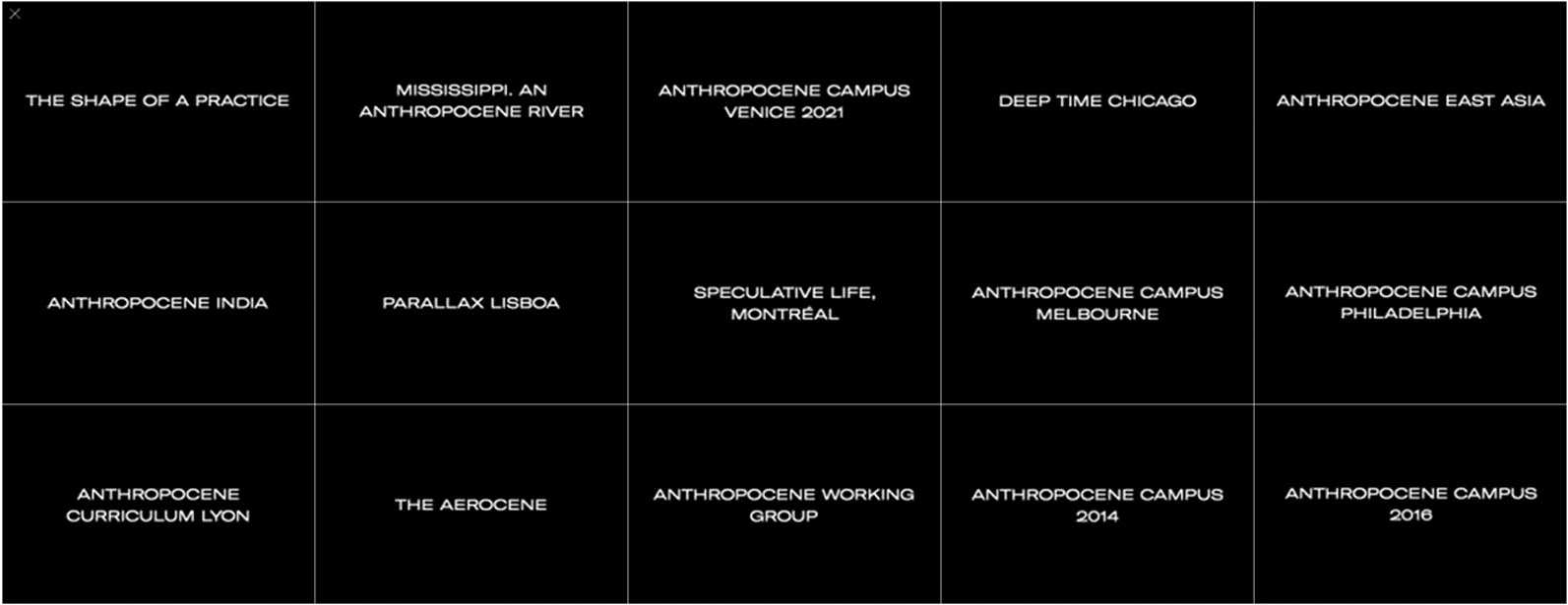
The varied projects, partner groups, events, and outputs of the Anthropocene Curriculum network can all be explored in vertiginous depth at www.anthropocene-curriculum.org.
Tying a multi-dimensional global phenomenon such as the Anthropocene down to its local instantiations and back to general observations necessitates a new form of engagement with globally networked formats, protocols, and tools. A common web platform—anthropocene-curriculum.org—is therefore central to the new framework of the project. This platform essentially tethers all activities together, offering novel ways of navigating the heterogenous contents and experiences and helping to create comparative perspectives, dialog, and a sense of connectedness and of a shared understanding of the Anthropocene. Through critical project features such as community participation, digital narratives, exemplary course paths, data visualization, geolocated mappings, and a user-maintained ontology (“folksonomy”), the website offers an open means of access to the many layers of Anthropocenic research, exchange, and critical activism present in the project. As it does so, the site aims to develop a new aesthetics of collaboration, looping epistemic, and artistic approaches to create a new language of shared concerns and experiences. In addition to the site’s ability to document and archive material, it is meant to connect the globally distributed projects and to facilitate communication between similar initiatives working at the intersection of Anthropocene debate, research, and education around the world. Overall, the web platform aims at highlighting the experimental process of deriving Anthropocene-adequate forms of transdisciplinary education and collaborative research by presenting the intellectual contexts, methodological approaches, and collaborative practices of such an endeavor.
Ground-truthing the Anthropocene: The Mississippi test case
The extensive project on the Mississippi River provided a first test case to model and experimentally interlace transdisciplinary field research with the digital realm. The most ambitious undertaking among the family of AC projects to date, the project took place in the latter part of 2018 and throughout 2019. It involved the curation of another Anthropocene Campus, this time in New Orleans, but was more broadly predicated on an extensive field research and public engagement endeavor traversing the entire Mississippi River and its wider watershed. Entitled Mississippi. An Anthropocene River, the project brought together a large transdisciplinary consortium of institutions, individual researchers, artists, and stakeholders from civil society to investigate the river system as a model region for studying the Anthropocene transformation. 1 Some of its central outcomes are presented in the two special issues of The Anthropocene Review of which this background essay is part.
The Mississippi River was chosen as a test case because it is an all-encompassing example of an immense space being drastically reshaped by human activities. As a central axis through the North American continent and a “catchment” for ecological, industrial, and social realities—both current and historical—it presents a multifaceted Anthropocene topography. The project explored the vast but patchy areas of this landscape in its many changing spatio-temporal formations and dynamics, making it legible as a critical zone of habitation and long-term interaction between humans and the environment. Through connecting distributed research in the field, and with the participation of Indigenous communities as well as local practitioners and activists, the project sought to unravel the dynamic socio-ecological interactions that have historically produced, and continue to produce, the Anthropocene condition in the interplay of local settings, a continental-scale river basin, and the encompassing Earth system.
The project consisted of two phases. In the first phase, various field research activities took place at selected sites along the Mississippi River and in its hinterland. Transdisciplinary teams consisting of scholars, artists, and activists from local communities and nationwide developed different scientific and artistic perspectives on various Anthropocene issues in their respective sub-regions from north to south. Together with community partners, these Anthropocene River Field Stations served as distributed hubs of activity and developed methods, participatory formats, and public events. In the second phase, a three-month long Anthropocene River Journey brought together the explorations of the different Field Stations in a common framework. International “river fellows” joined students of the River Semester program organized by Augsburg University in Minneapolis in paddling and driving down the 3700-km-long waterway, tying together river places, river stories, and river data with their own bodies and senses. Finally, the Anthropocene River Campus in and around New Orleans functioned as a culmination of the year-long in situ project. Taking place in what the project labeled the “human delta,” this Campus marked a conceptual contraction of the specifically local approach and the planetary-scale framework of economic, ecological, material, and social teleconnections of the Anthropocene River.
Toward a topology of Anthropocene knowledge and its practices
As the family of globally dispersed AC projects (including the Mississippi River project) makes clear, it is necessary to think local “Anthropocene topographies” in terms of a mosaic of different practices and concerns which together create a larger picture, that, in the end, has also to be plotted against and correlated with the curves of global Anthropocene dynamics. Rather than emphasizing the socio-geographical and epistemic uniqueness of each local context in isolation, it is important to allow the possibility of comparative exercises, and to understand their critical share as part of a global transition. But how does one bring together local and global dynamics in the trans-scalar nature of the Anthropocene?
The current work of the project is dedicated to this question, finding ways to draw a kind of “topology of Anthropocene knowledge” out of vernacular studies, varied discussions, and ground-based encounters that the AC network has elaborated over the last years. As a science of connections, relationships, and mutual interdependencies, this Anthropocene topology traverses the multiple storied topographies of altered world-relations that will only multiply as the planet below our feet and above our heads is crashing into the unchartered territory of the Anthropocene.
To spur this topography-to-topology approach, another large-scale Anthropocene Campus event took place in 2020, the first year of the COVID-19 pandemic, and therefore appropriately on the web platform only. Facilitated by an interactive map design space, the Campus-styled event The Shape of a Practice focused on the different knowledge practices that provide the backbone for the AC network at the current moment, giving space for negotiating their particularities as well as their translation into other contexts through online seminars and public sessions. Exploring four key practices—archiving, sensing, communicating, and consensus building—the seminars brought together research collectives and activist communities working to bridge experiences and value systems in order to come up with sensible strategies for pairing local and global concerns.
Such strategies have two requirements: first, that the varied localized settings and conditions of the ground-based Anthropocene are simultaneously reconciled with the progress being made on understanding humanity’s relationship to the Earth system writ large; second, that material evidence of the Anthropocene continues to be collected at the global level. For the first, the MPIWG has launched an initiative to establish a new intersectional Max Planck Institute to host a new basic science tentatively labeled “geoanthropology”: the study of human-Earth interactions and transformations with a particular focus on the role of the technosphere. Through analytical and interpretative approaches, the institute will provide a highly interdisciplinary and methodologically inventive environment to collectively study the various drivers, dynamics, and dilemmas that have led the planet onto an Anthropocene path, while also seeking to apply these insights to cope with its further unfolding and rapid intensification.
For the second, both HKW and MPIWG have teamed up with the Anthropocene Working Group (AWG), the international and interdisciplinary group of geologists set up by the Subcommission on Quaternary Stratigraphy of the International Commission on Stratigraphy, in order to assess the reality and possible onset of the Anthropocene as a new geological epoch. Ever since the first physical meeting of the AWG took place at the HKW in 2014, both HKW and MPIWG have maintained a close cooperation with this group. In the year 2022 this partnership will embark in a final public conversation about the geological evidence for the Anthropocene and its repercussion for politics, society, the changing structures of knowledge creation, and, indeed, consensus-making. In a series of publications, public installations, and events the program Evidence & Experiment addresses the tension between material evidence and social experiment at the contemporary, potentially irreversible fault lines of the Anthropocene. Seeking to overcome the separations of scientific assessment and civic as well as educational engagement it will use artistic and documentary methods to publicly activate the chronostratigraphic findings of the AWG, creating a forum to gauge the socio-political and epistemic relevance of the shifting modes, attitudes, and institutions of knowledge production that are now facing the accelerating and multiple crises of the Anthropocene.
Conclusion
So far, what has become clear in all AC activities is that navigating between the multiscalar spatial and temporal dimensions of the Anthropocene demands a new cast of thinkers and actors. “I am not sure that I have reached the end of the passage, but I see a few tiers instruit, a few young people with double education, who could help to think, construct or sense a new archipelago” wrote Michel Serres—in full hope that the solitary journey through the allegorical Northwest Passage would one day become a solidary movement crowded with ideas and solutions (Serres, 1982: 18, translation by author). The AC program is still pursuing this, with many of its sometimes overly-high ambitions remaining unfulfilled, and many of its dead ends as of yet undiscovered. But, if nothing else, the experiences made and the connections drawn by some of the young researchers and artists participating in an Anthropocene Campus have opened up hopeful vistas for thinking and creating in this new archipelago. As these participants become professors, teachers, activists, and institution builders, the Anthropocene Curriculum project might eventually have an impact on how future settings of knowledge production and knowledge transfer will be shaped. It is not least in this indirect way that the project seeks to be transformative. This is an invitation for you to get onboard.
Footnotes
Acknowledgements
The Anthropocene Curriculum project rests on the inventive and nonstop work of an entire team headed by Katrin Klingan and Christoph Rosol under the patronage of Bernd Scherer and Jürgen Renn, coordinated by Carlina Rossée, substantially developed by Nick Houde, Janek Müller, and Neli Wagner, produced by Fiona Shipwright, Jonas Rinderlin, Anna Chwialkowska (-2021), Mira Witte (-2020), Manuela Kölke (2018), Cordula Hamschmidt (-2016), and Roman Brinzanik (-2016), implemented by an armada of invaluable project assistants, and, last but not least, co-created by numerous individual scholars, artists, and organizers around the world who are eager to build up, step by step, a more just and resilient world.
Declaration of conflicting interests
The author declared no potential conflicts of interest with respect to the research, authorship, and/or publication of this article.
Funding
The author received no financial support for the research, authorship, and/or publication of this article.