



Abstract
Nature documentaries often present contradictory images of, on the one hand, a fragile nature that is threatened or already destroyed by humans and, on the other hand, a resilient nature that indifferently survives the human species. Similar ambivalences characterize the public discourse on “nature” in the Anthropocene. From the perspective of cultural and media studies, this essay attempts to disentangle the incoherencies in popular imaginaries of nature by exploring the challenges of narrating and picturing the two opposite qualities of vulnerability and resilience. Tracing the conceptual evolution of documentaries presented by David Attenborough between 1979 and 2020 and their gradual increase in environmentalist rhetoric, I show how different visual motifs undergo a recoding (resilient/fragile) and relate it to paradigm shifts in ecology, earth system science, and environmental protection principles. With an interest in the historical development of multimedia discourses on resilience and vulnerability, I focus on the relationship between visual and verbal representation as well as on the interplay of semantic and aesthetic aspects, while reflecting on whether the observed ambivalences are intentional and how they might influence the perception of the documentaries. This essay is a contribution to Transmedia Ecocriticism and thus situates itself in the Environmental Humanities.
Keywords
Introduction: from edutainment to ecotainment
Nature or wildlife documentaries enjoy great popularity among a broad audience and presumably shape the collective imaginary of “nature” to a far greater extent than scientific communication by and primarily for experts. Without a doubt, they are “a globally significant source of information available to the public about issues in biological and environmental sciences” (Dingwall and Aldridge, 2006, 132). 1 Conceived as edutainment that conveys knowledge about nature in an aesthetically pleasurable and entertaining way, their success story began in the second half of the 20th century as a popular TV format and continues today as they are produced for streaming services like Netflix. Among the world’s most-watched nature documentaries are the productions of the BBC Natural History Unit, presented and in some cases also written by zoologist and long-time program director Sir David Attenborough. He has been the most famous face and voice of nature documentaries for more than half a century and has also become one of the most influential advocates for wildlife conservation. 2 Since Attenborough himself has become a global brand—a report claiming a positive impact on the public coined his influence “the Attenborough effect” (Mahmood, 2019) 3 —this essay focuses on productions in which he visibly plays a central role, but is well aware that every film is the result of teamwork. 4 Of the many series in which Attenborough appeared during his long career at the BBC beginning in the 1950s, only a selection can be considered: the milestone productions Life on Earth (1979)—marking the beginning of a new era in wildlife documentaries thanks to new filming and storytelling techniques—, The Living Planet (1984), State of the Planet (2000), Planet Earth (2006), Our Planet (2019), and A Life on Our Planet (2020). 5 To give an impression of their continuing success: The series Planet Earth: From Pole to Pole (produced by Alastair Fothergill for BBC, 2006/7) and its sequel Planet Earth II (also produced by Fothergill for BBC, 2016), for example, broke records with their ratings 6 and won more awards than could be listed here, including several for “Best Documentary Series” as well as the “Science and Natural History Award.” 7 Since producing the series Our Planet (2019) with Netflix, executives expect to reach one billion viewers in 150 countries. 8
Nature documentaries have by no means always explicitly promoted environmental protection. The seemingly small modification of the title from Planet Earth to Our Planet (and likewise in Attenborough’s film and book A Life on Our Planet. My Witness Statement and a Vision for the Future, which appeared in 2020) signals a noteworthy change in perspective. The possessive pronoun emphasizes that, in the Anthropocene, humans are the dominant force on Earth and must be aware of their responsibility. This indicates a change in strategy from edutainment to “ecotainment,” 9 with the exploration of different kinds of large-scale ecosystems being given a different framing. Accordingly, the promotional texts for Planet Earth (2006) and Our Planet (2019) differ in their concern and tone. At the heart of Attenborough’s foreword in the companion book to the earlier series stands the promise to show “the world as you may never have seen it before,” made possible thanks to “technical virtuosity” (Fothergill, 2006, 6). It suggests that the value of the images produced is increased by the fact that the natural world is threatened by habitat destruction and global warming. In the foreword to Our Planet, there is no more room for the praise of human technology. The series identifies a “global catastrophe,” situates itself at the beginning of a “new geological era” and aims “to reveal nature’s resilience and show how restoration is possible” (Fothergill et al., 2019, 4). 10 Nature’s supposed resilience is persistently invoked in the series, as it is in the book, which I use for comparison because of its more detailed argumentation. The inflationary talk of resilience corresponds to an interdisciplinary discourse that has been flourishing for about a decade. While the concept of resilience spread from ecology to sociology, psychology, and human geography, it has rarely been taken up by the humanities, as my essay does in a close reading of sequences extracted from selected series. 11
In documentaries produced in the recent decades, the assessments of nature fluctuate between the poles of resilience and vulnerability, which is why it is worth taking a closer look at the challenges of representing nature in documentaries, that is, in an audio-visual medium. Before the web of interfering concepts of nature can be disentangled, some preliminary remarks are helpful. A basic problem of documentaries is that “nature” cannot be depicted because it is impossible to make universally valid statements about it. Nevertheless, the obsolete essentialist concept of nature is still very prevalent in mass media. When “nature” is mentioned in the documentaries examined here, it refers to everything that is not human or human-made. Three different modes of representing nature can be distinguished in documentaries (cf. Ingensiep, 2020, 31): They can either present nature as a functioning ecosystem and demonstrate the “laws of nature” or show biodiversity in impressive pictures. The sensual perception of natural phenomena and the perceived immersion are steadily intensified with technological improvement. A third possibility is implemented by historiographic nature documentaries, which depict the diachronic change of species and habitats and reconstruct different stages of evolution or stages of anthropogenic environmental degradation. While most documentaries of the 20th century present a natural history without traces of humans, they now increasingly focus on nature that has been cultivated, marginalized, and reduced by humans. Ever since Attenborough, beginning in the last episode of The Living Planet (1984) and then at length in State of the Planet (2000), took a critical look at human activities, he has implicitly asked who will prove to be more resilient, wild nature or humans? The documentaries I studied cannot be clearly identified with one of these types, but combine the different approaches, even if they alternately emphasize one or the other more strongly. In my view, they owe their enormous popularity among a broad audience precisely to the combination of different perspectives on nature appealing to different interests, and on the other hand to spectacular, technically enhanced visuals.
In the audio-visual discourse on vulnerability and resilience, verbal diagnoses cannot be considered without the corresponding images, and vice versa. The images and their interpretations of them provided by voice-over are stored in our cultural memory. BBC documentaries are indexical media that draw their authority from their claimed reference to reality, but, at the same time, they are “intrinsically artificial,” because they must “obey one imperative: the necessity of spectacle” (Gouyon, 2019, 3). All wildlife documentaries face the challenge of conveying their often ephemeral subject in an “authentic” way while appropriately simplifying the complex ecological knowledge they intend to communicate. 12 Precisely because they are conceived as spectacles, their capacity to communicate complex issues is limited (Dingwall and Aldridge, 2006, 147).
In recent decades, one could observe a “greening of wildlife documentaries” (Richards, 2013a), which now additionally aim to promote solutions to environmental problems. 13 This blurring of the distinctions between classic nature or wildlife documentary and politically engaged environmental documentary has given rise to a new hybrid genre. The difficulty lies in finding suitable motifs that first awaken fascination with biodiversity and later incite commitment to wildlife conservation. We may think we know what kinds of images convey various understandings of nature. However, our ability to decode depends on our individual viewing experiences. When we see ice shelves breaking up today, we read it as a message that nature is fragile, even if huge masses of ice do not per se indicate fragility and have not always done so in the tradition of nature documentary. Only some of the much-used motifs have had the same meaning for more than half a century, such as herds of wild animals crossing lush savannahs, thereby illustrating the “reliable rhythm of the seasons” and implying a meaningful “order of nature.” Other motifs, however, have undergone a change in meaning over the last three decades. Coral reefs were once considered a symbol of immeasurable biodiversity, and tropical rainforests stood for inexhaustible regeneration; today, the first is primarily a symbol of vulnerability, and the resilience of the second is questioned. Uncultivated plants “reclaiming” cultural sites abandoned by humans are in turn interpreted as signs of nature’s resilience. One time nature is the vulnerable party, the other it is considered more robust than humans. Accordingly, mankind is seen as the dominant, destructive force of the planet in one moment, as an endangered species in the next. This ambivalence also shapes the discourse on the Anthropocene. 14
On the one hand, the documentaries’ narration is aligned with the state of knowledge of biology, ecology, and earth system science. On the other hand, it quotes, updates, and substitutes motifs from its own genre tradition. The showing of natural phenomena is still the documentaries’ main task, but a historical overview of BBC productions indicates that the telling, that is, the discursive concern, is becoming increasingly important. This article cannot examine whether all statements expressed in the documentaries are scientifically correct. Rather, the aim is to examine which ideas of “nature” are conveyed and how this is done audio-visually. Both in mass media and in research, there have been calls for “new images” and “new narratives.”
“We must rewild the world”—paradoxical visions of resilience
Looking at the numerous documentaries Attenborough has directed and presented over the last four decades, we notice an astonishing continuity of visual motifs, regardless of the improvements in film technology. The series show us the same examples from flora and fauna again and again: the emperor penguins in Antarctica’s ice landscape, elephants trekking peacefully in Botswana’s grasslands, brightly colored keel-billed toucans on massive rainforest trees, etc. Attenborough’s latest and most personal film A Life on Our Planet (produced by Jonnie Hughes, 2020),
15
however, begins and ends with “new images”: both opening and closing scenes were recorded in Pripyat (Ukraine), a “post-human town” (Figure 1). By beginning his story in this setting, where the ninety-three-year-old wanders through abandoned houses, he certainly breaks with the expectations of his viewers. For decades, the exploded Chernobyl reactor stood unmistakably for the dangerousness of nuclear energy and the vulnerability of human civilization. Attenborough recurs to the technological disaster to set the record straight that it was not the nuclear accident that was the greatest environmental disaster of all time: “The true tragedy of our time is still unfolding across the globe, barely noticeable from day to day. I’m talking about the loss of our planet’s wild places, its biodiversity” (A Life on Our Planet, 2:30–2:44).
16
And he explains in more detail in the companion book: For life to truly thrive on this planet, there must be immense biodiversity. Only when billions of different individual organisms make the most of every resource and opportunity they encounter, and millions of species lead lives that interlock so that they can sustain each other, can the planet run efficiently. The greater the biodiversity, the more secure will be all life on Earth, including ourselves. (Attenborough and Hughes, 2020, 6)
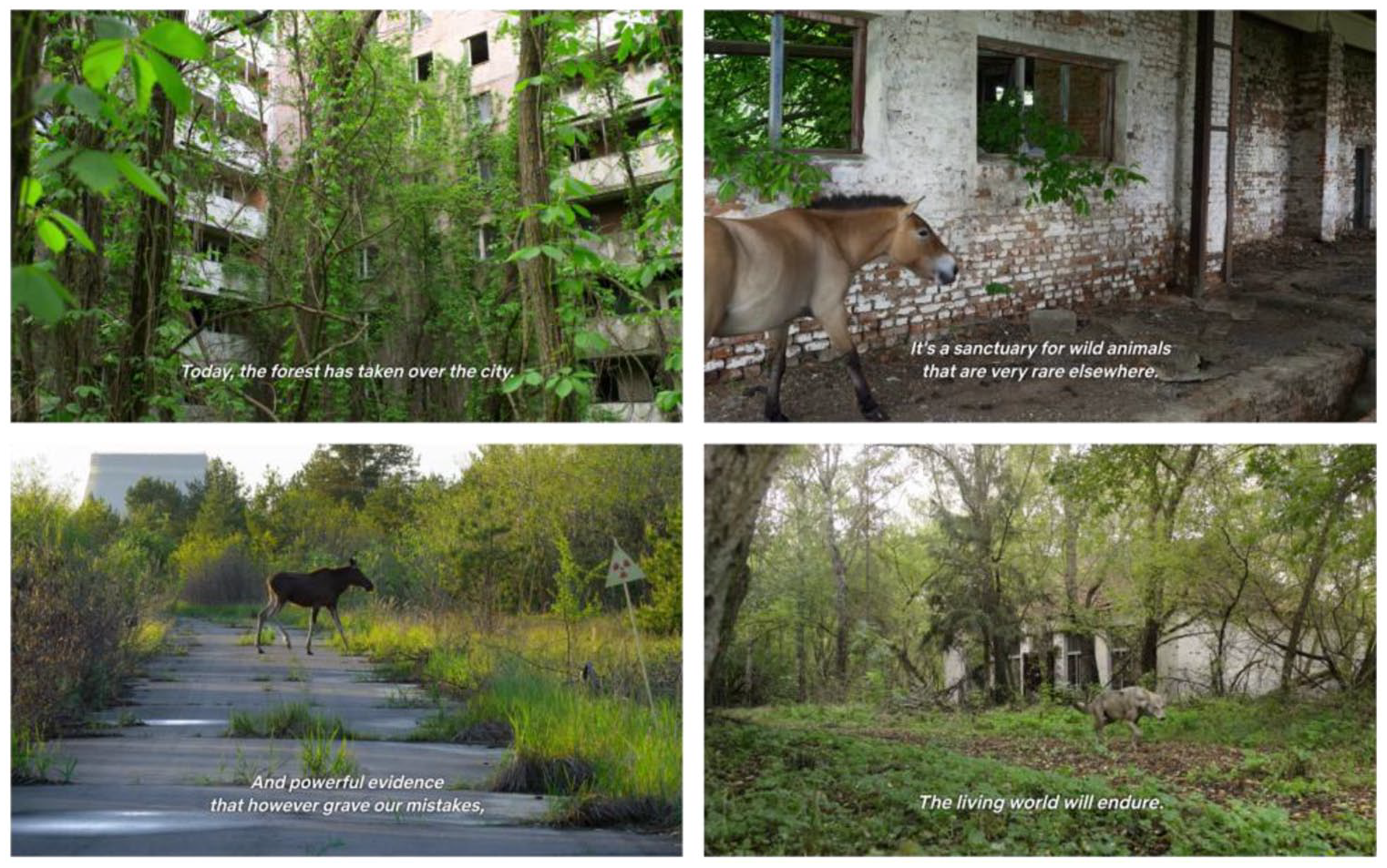
Pripyat. Film stills, A Life on Our Planet, 2020 (01:14:41–01:15:23).
At the end of the film, pictures of the contaminated exclusion zone, of all places, serve to celebrate nature’s resilience.
Since photographers and filmmakers rediscovered the exclusion zone, it has undergone a recoding; the rampant greenery is interpreted as the triumph of nature since the contamination of the site is not visible. What was for decades uncanny terrain has become a phantasm of a world without people.
17
Humans and nature are antagonistically juxtaposed: The truth is, with or without us, the natural world will rebuild [. . .] Today, the forest has taken over the city. It’s a sanctuary for wild animals that are very rare elsewhere. And powerful evidence that however grave our mistakes, nature will ultimately overcome them. The living world will endure. We humans cannot presume the same. (A Life on Our Planet, 01:14:13–01:15:30)
As devastating as the last sentence may be for humans, the nature lover seems to find consolation in the prospect that his object of fascination will survive in some form. But as long as humans still exist, they must help nature along, the paradoxical argument goes: “We must rewild the world,”
18
reads the ecological imperative on the dust jacket of the book on the Our Planet series. Here already, the restricted zone around the nuclear sarcophagus functions as telling proof that “rewilding can happen.” The description of the “Chernobyl Jungle” is worth reading: Human visitors expecting to find a radioactive wasteland or animals glowing in the dark have a surprise in store. Instead, strutting round forests laced with isotopes of strontium, plutonium, americium, and caesium are extremely healthy-looking lynx, grey wolves, Przewalski’s horses, moose, deer, wild boar, foxes, hares, and even a brown bear or two. [. . .] Animals are in greater profusion than in national parks and nature reserves in the two countries. They may be radioactive, but they are having a ball. [. . .] Nobody can be sure there isn’t a downside to this radioactive renaissance. Subtle genetic changes caused by the radiation may escalate in future generations of animals, perhaps with big ecological impacts. But today, nature mostly thrives. In just 30 years, a farming landscape has been transformed into Europe’s largest rewilding zone, a living laboratory of forest resilience in one of the most polluted places in the world. If it can happen here, it can happen anywhere, provided we let it. (Fothergill et al., 2019, 182)
This toxic idyll is accepted with a remarkable mix of irony and naïve confidence—as the best the Anthropocene has to offer. As Attenborough puts it in his book: “The world will never be as it was. Innocence, once lost, can never be regained. [. . .] But nature is not yet broken. We believe its processes can be restored, its assets revived and its wilderness recovered.” (Attenborough and Hughes, 2020, 19) The crux of Pripyat as a model example of rewilding is that it is no great sacrifice to “return to nature” these areas lost to human use. Nature’s regenerative potential is obviously understood here as inexhaustible and thus reliable, while cultural efforts appear risky and often disastrous. But it is not that simple, as this assessment competes with other conceptions of nature within this documentary and in other BBC or Netflix series.
Praising a reliable nature: stability, biodiversity, and resilience
Attenborough’s earlier series (Life on Earth: A Natural History by David Attenborough, 1979, and also The Living Planet, 1984) were primarily characterized by a rhetoric of wonder at an “endless variety” in flora and fauna. The sheer number of species was intended to arouse fascination in viewers. In the 1979 series, the rarely addressed extinction of individual species was explained as a natural, acceptable phenomenon. There is no talk of nature being vulnerable. Episode titles such as “The Hunters and Hunted” signal the neutral observer’s attitude toward a biosphere that is seen as intact and self-sufficient, balanced in its dynamics. 19 The narrator goes on endlessly admiring how everything interconnects perfectly. His perception of nature “like clockwork” has a long tradition, and Attenborough still uses the metaphor today, but now he specifies that such reliability characterized only the Holocene, “our Garden of Eden” (Attenborough and Hughes, 2020, 21), and no longer applies in the Anthropocene (A Life on Our Planet, 00:12:28, 00:52:19). There was still no trace of this narrative of decline in Life on Earth (1979). This is somewhat surprising, considering that the environmental movement was in full swing after the eco-catastrophes of the previous decade, the founding of Greenpeace, and the sensational report The Limits to Growth commissioned by the Club of Rome in 1972.
The approach changes with the series The Living Planet (1984) which shifts its focus from the history of evolution to the present and to the adaptive capacities that make various organisms resilient in inhospitable environments. As heroes of adaptation the episode “A Frozen World” shows us penguins, sea lions, sea elephants, and, as the prime example of resilience, well-fed polar bears hunting on drift ice, effortlessly killing and devouring their prey (Figure 2).
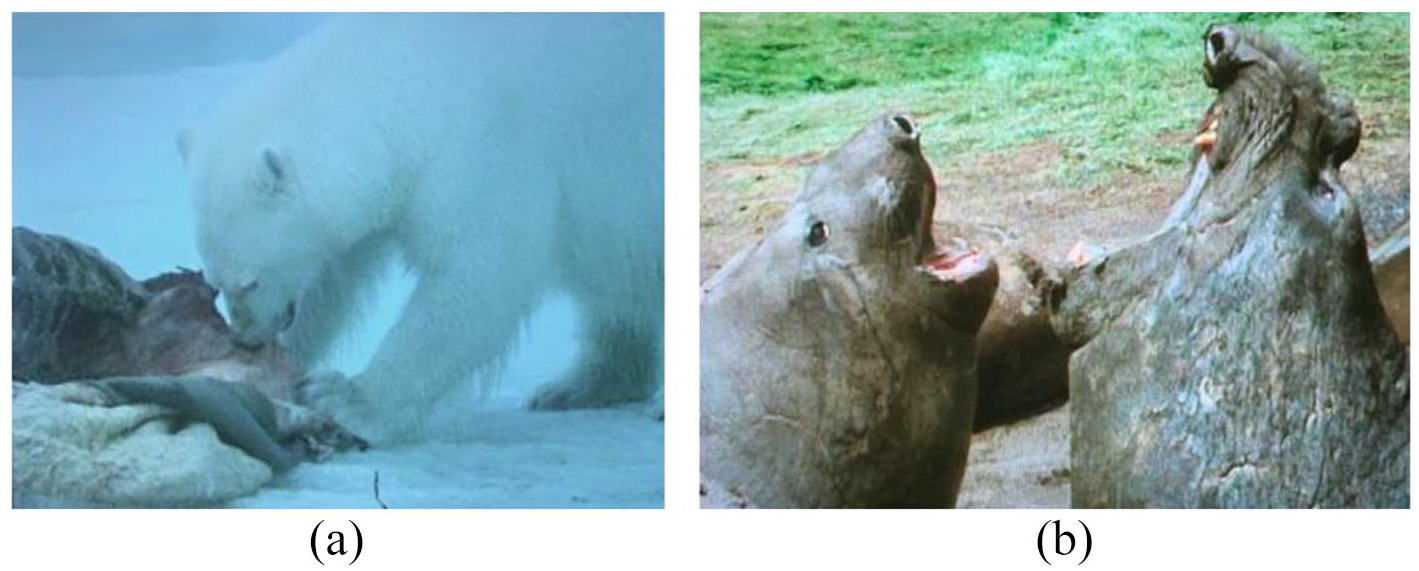
(a) Polar Bear eating its prey, Arctic. Film still, The Living Planet, Ep. 2, 00:35:00.
This is worth remembering because, in the 21st century, the polar bear in particular has undergone a radical recoding into a symbol of vulnerability in climate change campaigns; its checkered career in documentaries would require a study of its own. 20 In the 1984 series, we do not yet find any pictures of global warming. Instead, seasonal changes seem predictable, and the much-praised stability is considered a guarantee of high biodiversity.
It is the tropical rainforest that Attenborough has always held up as a model of climatic stability and high biodiversity, the ideal in all his series to this day. Accordingly, he argues: “To restore stability to our planet, we must restore its biodiversity” (Attenborough and Hughes, 2020, blurb). Since the imperative is not specified, one can only assume that the goal is not static preservation of conditions at a particular point in time. Such an idea would not be compatible with Attenborough’s focus on evolutionary history, whose inherent dynamics essentially include species change. The relationship between diversity and stability has been the subject of controversial debate in ecology for decades (cf. McCann, 2000). The diversity-stability hypothesis, which was influential from 1955 onward, stated that as the number of species in a community increases, the community becomes more stable. Since the beginning of the 1970s, however, it has been assumed that communities with a great diversity of species, such as in tropical rainforests or coral reefs, are comparatively vulnerable to certain disturbances, especially human influence (cf. May, 2001, ch. 7). They would then be not particularly resilient but, on the contrary, particularly fragile (cf. Potthast, 2004, 198). Accordingly, environmentalists, for whom it has never been advantageous to speak of an unbreakable equilibrium, began to point out the threat to the rainforest in their crisis communication. Looking at ecosystems with a revised understanding of stability, recent research suggests that diversity increases the stability of an ecosystem (cf. Cleland, 2011; McCann, 2000). Regarding the crucial question whether the diversity and interdependence of species in tropical rainforests is “a source of strength or weakness for the rainforest as a whole,” Our Planet (2019) cautiously replies that “recent research backs the resilience theory” (Fothergill et al., 2019, 207). Human assaults on rainforests, however, “may be close to smashing their resilience to smithereens” (Fothergill et al., 2019, 211). This example shows the challenge market-oriented productions have in presenting scientific uncertainty. 21
The representations of the rainforest reveal certain incoherencies within the series, which thus conveys a mixed message. Individual episodes portray the situation in the mid-1980s quite differently. In the fourth episode (“Jungle”) it is suggested that the South American rainforest is untouched and intact (Figure 3a and b). Attenborough describes it as “a vast blanket almost unbroken except for the rivers” (The Living Planet, Ep. 4, 3:45) and admires its “stupendous regeneration.”

(a) Rainforest in Latin America (overview). Film still, The Living Planet, Ep. 4, 00:03:53.
As an indication of the rainforest’s “supreme sustainability,” Attenborough observes that areas that cyclically become vacant are reclaimed by the plants as quickly as possible (Attenborough, 1984, 111/Attenborough and Hughes 2020, 70). He refers to ecological debates when describing the regeneration dynamic known as “cyclic succession,” without necessarily using the technical term. In the last episode of the same series, however, Attenborough angrily reports the clearing of the rainforest and states that it will never grow back in the same diversity (The Living Planet, Ep. 12, 00:44:06, Figure 3c). Now he admits the extent of the destruction: “In the world at large, an area the size of Switzerland is being destroyed every year” (00:45:50). Today, we are talking about an area the size of Great Britain, thus five times as large. 22 Judged by today’s viewing habits, these film stills seem anything but spectacular, but at the time they were associated with a shaking of certainties.
The dawning of the Anthropocene-discourse and the limits of resilience
Toward the end of the series The Living Planet, the assessment of nature changes significantly as Attenborough increasingly acknowledges its vulnerability. In the companion book (ch. 12), the considerations that introduce a paradigm shift are more detailed. The celebrated resilience of nature is put into perspective by human intervention: “man is now imposing such rapid changes that organisms seldom have time to adapt to them. And the scale of our changes is gigantic.” (308). Attenborough’s argumentation is remarkable: Man, for the first millennia after his appearance as a new species, showed signs of the same adaptability [. . .] Then, some 12,000 years ago, mankind began to show a new talent. When faced with harsh surroundings, he no longer waited many generations for his anatomy to change. Instead, he changed his surroundings. (Attenborough, 1984, 291)
23
Although today we take it for granted that we adapt our environment to us, it is worth quoting Attenborough’s diagnosis because it allows us to reconstruct the development of an “Anthropocene awareness” in popular media. Sixteen years before Crutzen and Stoermer propose the Anthropocene as a name for our geological epoch (cf. Crutzen and Stoermer, 2000), Attenborough states: “We have to recognize that the old vision of a world in which human beings played a relatively minor part is done and finished. [. . .] We now, whether we want it or not, materially influence every part of the globe.” (Attenborough, 1984, 308) Far from triumphing, he shows aerial shots of monocultures as ugly, unnatural landscapes (Figure 4a)—photographs of the kind now being discussed as “Anthropocene photography.” 24 Attenborough deconstructs the common narrative of progress by questioning images of human achievement. Instead of marveling at the Sears Tower in Chicago, the tallest building in 1984, he describes with disconcertment that 12,000 people work there “in an artificial microclimate [. . .] controlled by computers” (The Living Planet, 00:27:27). He subtly questions our self-made habitats of concrete and steel, “divorced from the natural world” (Attenborough, 1984, 298). As the antithesis of wilderness, he seems to reject the modern metropolis. But he also knows about “the trouble with wilderness” (Cronon, 1996), meaning that the ideal of an untouched wilderness is problematic because it excludes humans and thus does not help to develop responsible behavior (cf. Cronon, 1996, 17; Horn and Bergthaller, 2019, 55). For this reason, he restrains himself from criticizing civilization and surprises the audience when he almost lovingly describes how the yellow ragwort spreads modestly along railway lines (Figure 4b), or how animals resourcefully adapt to human habitats (Figure 4c).
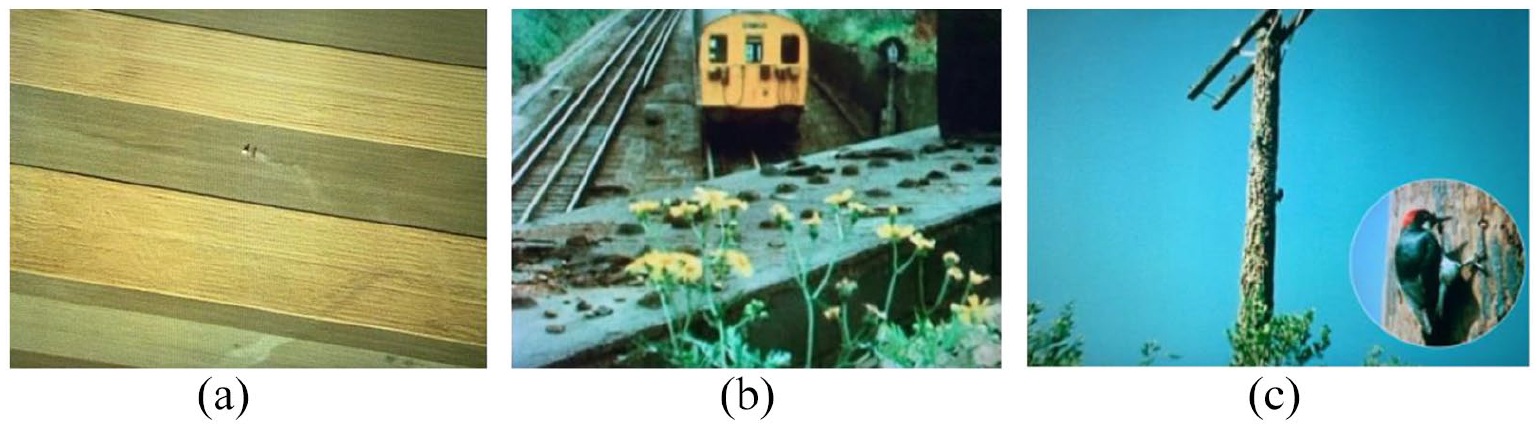
(a) Monocultures. Film still, The Living Planet, Ep. 12, 00:26:19.
Attenborough illustrates the inventive adaptability of all organisms (almost ironically) with ruderal landscapes in which some plant and animal species thrive despite adverse conditions. With these pictures of hybrid “naturecultures” (Haraway, 2003; Latour, 1991), he is ahead of his time but leaves his viewers room for their own interpretation. They might distinguish between a beautiful nature worthy of protection and a less uplifting one. Only now that anthropogenic degradation is shown does the ideal of an untouched wilderness gain significance. At this point, Attenborough warns that it is “a common misconception that there is still a ‘nature’ beyond cities and cultivated land, so resilient that it can recover from any damage” (Attenborough, 1984, 305). This in turn is contradicted by the later narrative that “rewilding can happen,” as demonstrated in Our Planet (Fothergill et al., 2019, 182) and A Life on Our Planet (2020, 01:14:13) with pictures of the Chernobyl Jungle.
Looking back, it is State of the Planet (2000) that clearly marks a turning point (cf. Richards, 2013a, 2013b; 177, 180). Released just in time for the dawn of a new age, the three-part series offers a structured inventory that unapologetically qualifies it as an environmental documentary (in contrast to a classical nature documentary): (I) “Is There A Crisis?“, (II) “Why is there a Crisis?“, and (III) “The Future of Life“. It identifies five disastrous human activities: the overharvesting of both animals and plants, so-called alien introduction, habitat destruction, islandization, and the pollution of the atmosphere with carbon dioxide leading to global warming. Citing experts for biodiversity, the series now explicitly states that the earth is facing a massive extinction crisis (II, 00:45:10) and thus “the natural progress of regeneration will no longer be sufficient” (II, 00:14:11). When Attenborough emphasizes that a great collective effort is needed to slow down mass extinction, he no longer treats biodiversity as a self-evident value. Now he asks: Does the extinction of one species really matter? More explicitly than before, the series draws on systems ecology when it introduces the concept of keystone species, whose disappearance can lead to the collapse of entire ecological systems. Beyond ecosystem services, the ecologist Robert May formulates an ethical imperative to pass the world on to the next generation as diverse as his own generation was allowed to experience it (I, 00:45:45). And the biologist Edward O. Wilson points out that “[t]here is a spiritual value, an aesthetic value, a psychological benefit for having a large diversity of life on earth” (I, 00:47:02).
Picturing vulnerability and fragility
Only a few pictures were found to depict the newly discovered fragility of beautiful nature in The Living Planet (1984). It proved to be a problem for nature documentaries that species extinction in flora and fauna is challenging to visualize. State of the Planet (2000) shows the only surviving black-and-white photograph of the extinct Tasmanian tiger (I, 00:27:46) and experiments with a grotesque re-enactment of the hunt for the dodo featuring a lifeless museum exhibit of the bird (I, 00:28:18). However, such lapses into fictional storytelling are exceptions. In the previous scene, the vulnerability of individual species is visualized by confrontation with the lifeless last specimens in a glass vitrine (Figure 5)—with the glass underlining the fragility of the exhibits and the aged presenter indicating human fragility. Since dodo and man are reflected in each other, the scene implies a similar fate for both.
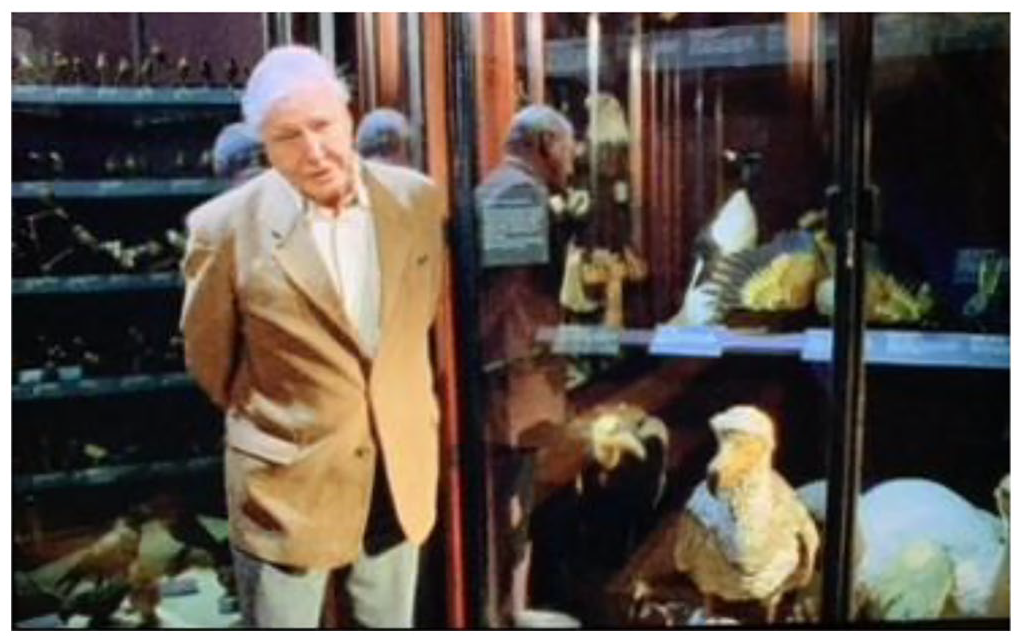
Attenborough and the Dodo. Film still, State of the Planet, I:00:28:18.
The later series (Planet Earth and Our Planet) specialize in capturing the last individuals of endangered species, sometimes with the help of photo traps, thus contributing to the further establishment of the so-called flagship species. Nevertheless, the nature documentaries with Attenborough strive to reconcile two concerns: satisfying the viewers’ preference for the most popular species as well as fulfilling their claim that they surprise viewers with information about what is still largely unknown. The representations of flagship species, presented as particularly vulnerable, cannot be examined in detail in this paper. Suffice it to say that extinction narratives are carefully balanced with positive narratives of a momentary rescue of a species from the highly threatened group called “the living dead.”
In 1984, the degradation of nature was exemplified—even in BBC documentaries—with pictures of the German forest dieback. Since such regional images were not well suited to communicate the vulnerability of “nature as a whole,” the accompanying photo book The Living Planet (also 1984) places the famous photograph Blue Marble (1972) taken by Apollo 17 (cropped and turned upside down) on its final page (Figure 6a). 25 Along with Earthrise (1968), taken 4 years earlier from Apollo 8, this photograph had become an icon of the environmental movement. At least since Al Gore’s choice to use Blue Marble as a key visual in his campaign and his documentary An Inconvenient Truth (2006), we naturally reckon with this image and all too easily forget that it is only in the course of “the greening of nature documentaries” that it has come to be used in this way.
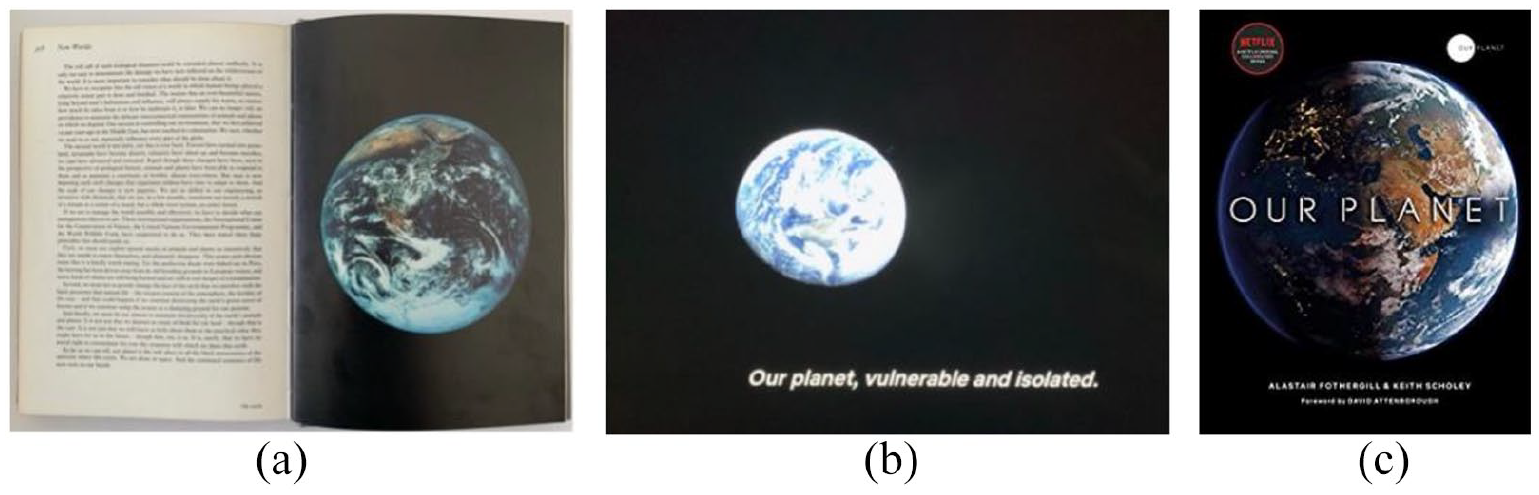
(a) The Living Planet (companion book), 308–9.
The countless contributions to these Apollonian photographs mention a whole bundle of image connotations, which almost always comprise “vulnerability” or “fragility.” 26 This is also the focus of Attenborough’s voice-over commentary (Figure 6b: “Our planet, vulnerable. . .”) in A Life on Our Planet. In this specific context, it is worth taking a closer look once more: Which characteristics create precisely this impression of vulnerability? Several things: the visible isolation of this planet, its beauty (beauty is always considered fragile and endangered; moreover, the planet seems untouched), and the thin atmosphere that makes life possible (cf. Manzo, 2010, 101). Here, the vulnerability of the planet and that of humans converge; the protective ozone layer, for example, reminds us that all life is vulnerable. The photographs of the Blue Planet thus abolish the constructed separation between humans and “nature.” Blue Marble, in particular, evokes associations with both the “whole earth” and the “one world” discourses (Cosgrove, 1994). Even criticism of this picture revolves around vulnerability, arguing that it does not show the varying vulnerabilities of different regions, species, cultures, and social groups (cf. Manzo, 2010, 202–3). 27 Furthermore, the photographs of the Blue Planet showing the “fragility and vulnerability of a corporeal earth” have been said to have an ambivalent effect: they can trigger a vague fear and “feelings of alienation and detachment” (Ingold, 1993), or, contrarily, a sense of “attachment” (Cosgrove, 2001, 263), and the impulse to protect this planet. In the documentaries, of course, the voice-over commentaries influence the images’ effects. In the illustrated book Planet Earth, the caption to the Blue Planet picture reads: “The Lucky Planet” (Fothergill, 2011, 12–13).
In environmental documentaries, Blue Marble, Earthrise, and edited versions of both have a structuring function. When they don’t appear right at the beginning of the film or in the episodes’ intro (as in Planet Earth and Our Planet), they are inserted to move from regional inventories to a synoptic diagnosis and are linked to an ecological imperative. To prevent wear and tear on these iconic images, environmental documentaries since An Inconvenient Truth have staged the contemplation of the photographs as a moment of insight and explicitly reflected on its history of reception. 28 Remarkably, the cover of Our Planet (Fothergill et al., 2019) continues to be adorned with an intact blue planet, rather than the glowing or burning globe that appears at the beginning of Grzimek’s No Place for Wild Animals (1956), 29 for example, as well as on the Covers of Lovelock’s The Vanishing Face of Gaia (2009) or the split earth familiar from Bill McKibben’s Eaarth (2010). 30 The picture (Figure 6c) that was edited to show the human presence through artificially lit parts of the earth does not have a negative connotation but rather signals a One Earth optimism. This book cover is once again ambivalent, as it leaves it up to the viewer to decide whether to see this Blue Planet variant as a symbol of fragility or resilience.
So what distinguishes images of resilience from those of vulnerability? Their relationship is intricate and they are not readily discernible if they are semantically ambiguous. A well-fed polar bear on a massive ice shelf obviously represents resilience because of its excellent physical adaptation to the extreme cold. 31 A polar bear on a small floe drifting on the water, on the other hand, now signals a vulnerability to those who have followed its evolution into the icon of climate change discourse, even if its physique does not appear fragile. In the context of environmental campaigns, the polar bear does not just stand for itself; moreover, it serves as an index for the state of its habitat, the melting of the ice, whose symbolism is itself complex. If one wants to visualize the threat without using pictures of breaking ice shelves, one has to come up with something to make the bear look weak. In Frozen Planet (2011) Attenborough sits next to an anesthetized polar bear lying motionless in the snow (Figure 7). In the naturalist’s Witness Statement, the bear’s possible fate is suggested by placing it next to a photograph of dying coral reefs. 32 The few integrated color pictures (film stills from documentaries and photos taken during their making) are carefully selected.
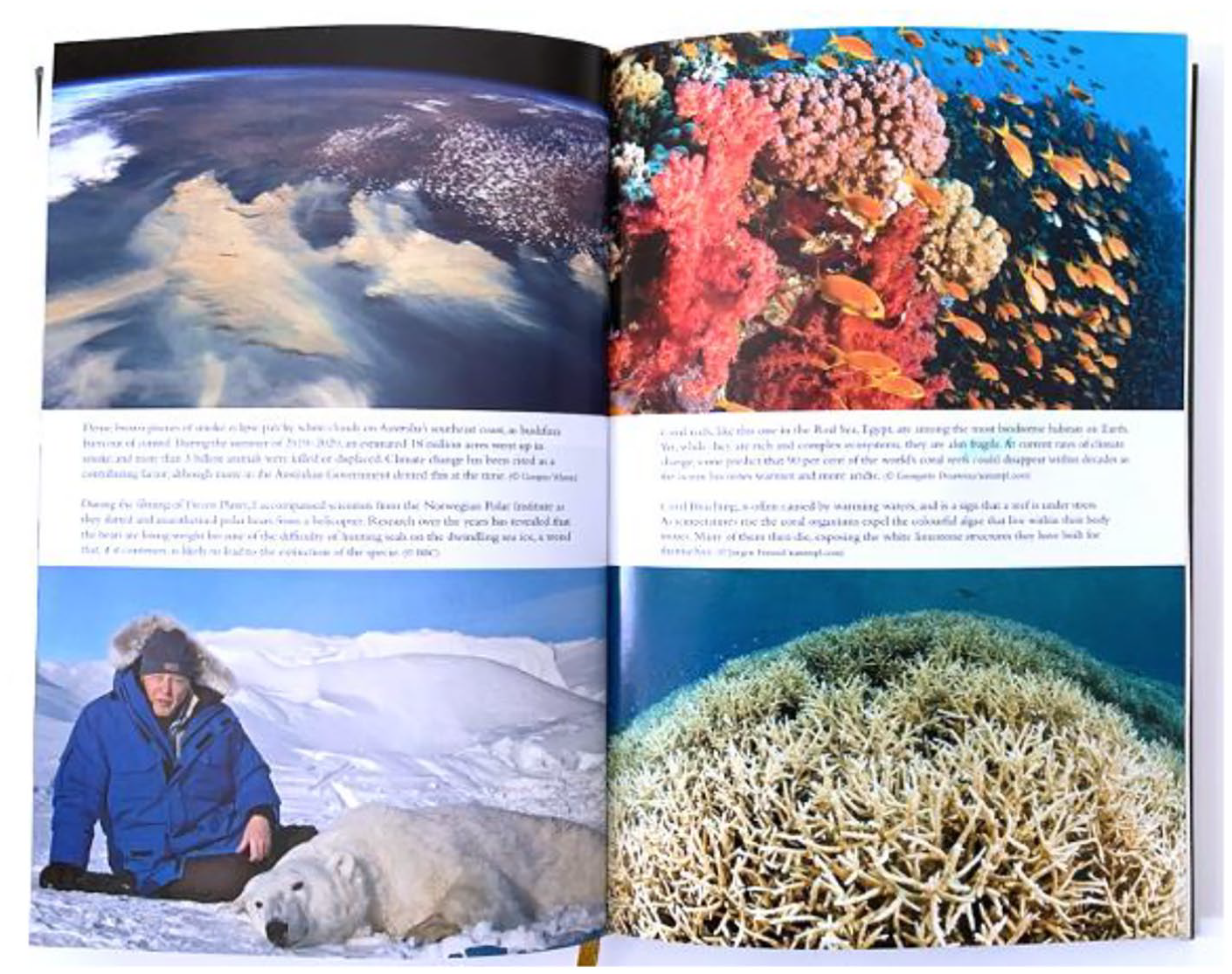
Attenborough and Hughes: A Life on Our Planet, 2020, pp. 94–95.
This double-page spread (Figure 7) brings together ambivalent images referring to the concept of the “tipping point” talked about in relation to global warming and ocean acidification. Recall that Earth system science has introduced “planetary boundaries” as ecological stress limits, which indirectly also indicate the limits of “nature’s resilience” (Rockström et al., 2009). Coral reefs are highly susceptible to the slightest changes in temperature. Attenborough recounts that it was during the filming of The Blue Planet in the 1990s that he saw coral bleaching for the first time: “The bleaching corals were like canaries in a coal mine, warning us of a coming explosion. It was the first unmistakable indication to me that the Earth was becoming unbalanced.” (Attenborough and Hughes, 2020, 89) To avoid the misunderstanding that he still adheres to an outdated notion of a static equilibrium, he refers to coral reefs as a “precarious balance” (Attenborough and Hughes, 2020, 87). Such hotspots of biodiversity rest on “fragile interconnections” (Attenborough and Hughes, 2020, 16). The two photographs of coral reefs on the right (Figure 7) are arranged according to the common before/after pattern, that is, healthy coral reef versus reef under stress. 33 But it would be too simple to associate the upper picture (as a prime example of great biodiversity) with resilience, as in the early documentaries from the 1970s and 1980s, and the lower one with vulnerability. As soon as we know about the threat, we also see the inherent fragility in the upper image of “beautiful nature” (corals), just as with the atmosphere in the picture to the left. We can see them as ambiguous images that oscillate between resilience and fragility.
Finally, recalling climate change communication’s demand for “new images” beyond the polar bear, it is worth mentioning a scene in Our Planet (2019) that has provoked great emotional responses. On the Arctic coast of Russia, the film crew of Our Planet witnessed events that make more effective “images of suffering” (Manzo, 2010, 105) than hungry polar bears. Although the walruses are less suitable for anthropomorphization than a polar bear with its cubs (Our Planet, Ep. 2) and their robust physiognomy gives even less the impression of fragility, they get the main role in the documentary as “climate change refugees” (Fothergill et al., 2019, 37). As early as in the second episode, the audience is confronted with this most dramatic scene of the whole series (Figure 8a and b). We see a hundred thousand ponderous walruses coming out of the water to pause on an overcrowded beach. Between their fishing trips, they once found rest on floating ice. Since the ice has disappeared, they have to climb on the cliffs. As soon as they get hungry and want to rejoin the others in the water, the short-sighted animals underestimate the height, fall off the cliffs and die by the hundreds. 34
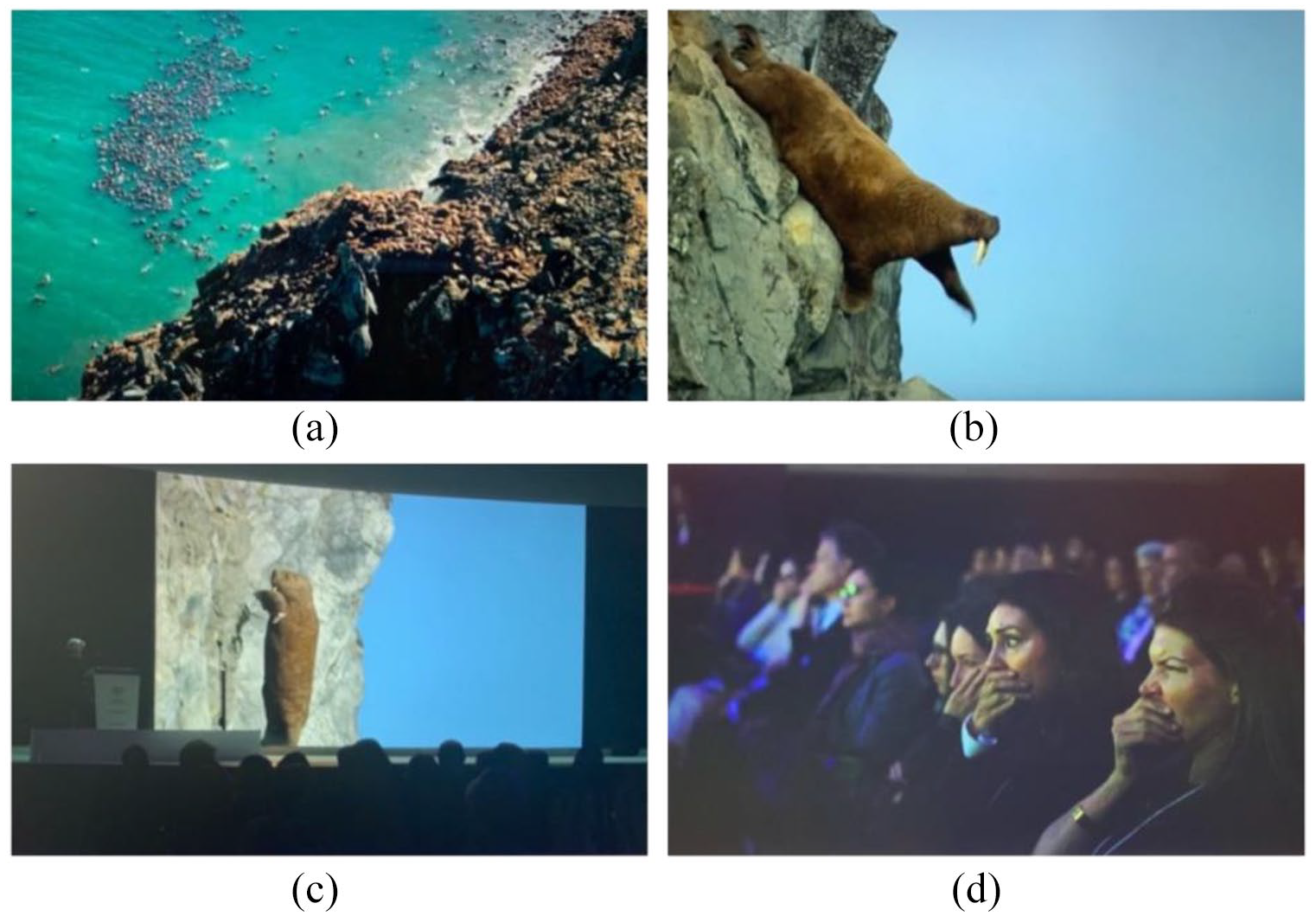
(a) Walruses climbing cliffs in search of a resting place. Film still, Our Planet, Ep. 2, 00:47:33.
In Our Planet, the scene is introduced with mournful violin music, but it falls silent while it repeatedly shows in slow motion how these heavy animals hit the rocks and die. As a new symbol for vulnerability, the walrus suggests that in the Anthropocene even the most robust become fragile.
In the film A Life on Our Planet, the scene is remediated (Figure 8c and d): We see Attenborough presenting a clip from the sequence at the World Economic Forum in Davos 2019 and the audience’s emotional reaction to it. Attenborough resumes in his Witness Statement: “The vision of a three-ton walrus tumbling to its death is not easily forgotten. You don’t have to be a naturalist to know that something has gone catastrophically wrong” (Attenborough and Hughes, 2020, 93). This last example demonstrates a trend toward increasing emotionalization. In order to activate the broadest audience, Attenborough now combines all three modes of persuasion discussed by Aristotle in his Rhetoric: logos, ethos, and pathos. 35
The ecological imperative
In the last episode of The Living Planet, Attenborough formulates an ecological imperative referring to the three principles brought forward by the International Union for the Conservation of Nature, the United Nations Environmental Program, and World Wildlife Found, that should guide us “to manage the world sensibly and effectively”: “First, we must not exploit natural stocks of animals and plants so intensively that they are unable to renew themselves, and ultimately disappear. [. . .] Second, we must not so grossly change the face of the earth that we interfere with the basic processes that sustain life [. . .]. And thirdly, we must do our utmost to maintain the diversity of the earth’s animals and plants.” Noteworthy is the rationale, which not only recalls the benefit of animals and plants to humans but declares that “we have no moral right to exterminate forever the creatures with which we share this earth” (The Living Planet, ep. 12, 00: 51:32–52:30, quoted after Attenborough, 1984, 308). This perspective corresponds to the ecological imperative that Hans Jonas, alluding to Immanuel Kant’s categorial imperative, formulated not only as a guideline to ensure “the permanence of genuine human life on earth” (Jonas, 2015, 36), but also as human responsibility for nature (cf. Jonas, 2015, 245–250).
Apart from a few quietly despairing remarks that man often does not learn from his mistakes, Attenborough consistently promotes trust in human reason. Since State of the Planet (2000), he describes the human task as a “good steward[ship]” (00:45:33), which is also strongly advocated in Our Planet (2019), with the goal of making a “good Anthropocene” (Fothergill et al., 2019, 303). 36
As the companion book explains, this means above all “a great restoration of nature,” which can be achieved in different ways, by means of conventional conservation, rewilding, and unspecified “planetary gardening” (Fothergill et al., 2019, 303–4). Even though the filmmaker in his mid-nineties has recently been fascinated by vertical farming and clean meat, 37 there is no evidence in his work that this could mean unlimited trust in geoengineering. In Our Planet, it is made clear: “Technology cannot replace planetary life-support systems. Our planet is our home. It’s not nature that is fragile, it is us. [. . . We need] to get the housekeeping right before we burn the place down” (Fothergill et al., 2019, 16). 38 Interestingly, the more emphatically the need for action is emphasized, the more vague the proposed solutions are. The chosen metaphors obviously have to sound convincing and have consensus among a wide audience. No attempts are made to promote sufficiency or de-growth.
Instead, after correctly identifying the problems and outlining the enormous challenges, Attenborough ends his “Vision for the Future” preaching his credo “to achieve balance with nature” (Attenborough, 2020, 210). There was no trace of such esoteric rhetoric in his early nature documentaries, but the picture book on Our Planet ends on the same note, with the aim of moving the audience emotionally: “There is no more important task than making us once again part of nature rather than its adversary” (Fothergill et al., 2019, 304).
This ecological imperative resonates with various traditional but also controversial ideas of nature, the combination of which is irritating. Of course, concepts of nature depend on the self-understanding of humans, which fluctuates between the biological and the humanistic understanding—a double role, for which Dipesh Chakrabarty proposes the terminological distinction of anthropos and homo (Chakrabarty, 2015, 156–60). When Attenborough points out the destructive power of humans, he puts into perspective the special place of humans, which he had elaborated earlier in the course of his comparative evolutionary history. Regarding his remarks on the increase in human power, he sets the record straight in his Witness Statement: “I did not want to suggest that humanity was in some way separate from the rest of the animal kingdom. We do not have a special place. [. . .] We are just another species in the tree of life. Nonetheless, we have broken free from many of the constraints that affect all other species.” (Attenborough and Hughes, 2020, 65). More radical was an earlier attempt at relativization in State of the Planet (2000), where he provoked the TV viewers with the statement that humans are only 10% “human,” while 90% of them consist of bacteria (State of the Planet, 00:24:05). Biodiversity and ecosystem researchers readily confirm in this scene: “It’s the little things that make the world work” (00:23:38). This emphasis on the symbioses and dependencies of humans on other organisms builds a bridge to the view of ecological posthumanism that is gaining in popularity today.
What distinguishes Attenborough’s approach from current discourses in cultural and interdisciplinary studies, regardless of where they position themselves between ecomodernism and ecological posthumanism, is his emotionalizing rhetoric that tends to personify nature. He recurs to the metaphor of war, also popular in environmentalism, and imagines humans and nature as hostile opponents, identifying humans as the aggressor. When he speaks of “our blind assault on the planet” (A Life on Our Planet, 00:44:56), he adopts, with almost identical wording, a critique that Michel Serres articulates in his Le contrat naturel (1990) [The Natural Contract] (Serres, 1990, 13). Serres, however, does not see nature as a defenseless victim, but reckons with its revenge, as man has made it his adversary through blind devastation. A battered nature strikes back by no longer being fertile (Serres, 1994, 27). The situation is similarly assessed in the companion book to Our Planet: “if we carry on as we are, nature will take its revenge.” (Fothergill et al., 2019, 16). Therefore, we need to “make peace with our planet” (Fothergill et al., 2019, 227), learn to “work with nature rather than against it,” and realize that “nature is our greatest ally” (A Life on Our Planet, 01:10:59). The idea reminds us of Serres’ contract of nature, which was supposed to establish a regulated coexistence. He describes our current relationship with nature as that of a parasite; the goal, however, is a symbiotic relationship (Serres, 1994, 68–69). 39 When Attenborough tries to explain how this cooperation should work, he remains vague: “We just have to do what nature has always done [. . .] If we take care of nature, nature will take care of us.” (A Life on Our Planet, 01:11:03) With this, he holds out the prospect that we can turn the avenging enemy back into a caring mother—although, in his earlier series, the naturalist never personified his object of fascination. His advice reminds us of Barry Commoner’s credo “Nature knows best,” his “third natural law of ecology” (Commoner, 1971, 41), which had a great influence on nature conservation.
Conclusion and outlook
From the perspective of cultural and media studies, it is appealing to examine the interplay of aethics and aesthetics in Attenborough’s nature documentaries, and specifically to unravel the paradoxes contained within audiovisual constructions of resilient or fragile nature. However, there are other reasons why it makes sense to investigate the concepts of nature that are often implicitly conveyed in popular documentaries: firstly, because our willingness to engage in conservation depends on our understanding of nature, and secondly because it had been found that false understandings of “nature” led to ineffective conservation strategies (cf. Potthast, 2004, 202). This was already shown in Daniel Botkin (1990) book Discordant Harmonies. A New Ecology for the 21st Century, in which he denounces four “false myths”: (1) the idea of a natural balance, (2) the assumption that only humans disturb this balance, (3) the idea that nature is a perfect machine, and (4) that it is a living organism. It is not easy to judge to what extent the documentaries in which Attenborough explains to us “how the natural world work[s]” (Attenborough and Hughes, 2020, 14) affirm or correct these myths. They simplify ecosystem dynamics and use scientific terminology so sparingly that diagnoses often remain vague. In other words, while they do not explicitly adhere to these false myths, they could provide more clarity by correcting obsolete assumptions more explicitly. Arguably, over the decades, they made it clear that ecological systems are not predominantly stable but change in a non-deterministic way. However, coincidence and chaos are hardly ever mentioned. Rather, the documentaries suggest a meaningful order of nature, often referred to as “balance” or even “harmony.” Since this rhetoric is impact-oriented, it should not be misunderstood as an indication of an outdated concept of nature—the series are, after all, supported by a team of natural scientists. However, the emphasis that “we lost our balance”/“we must regain our balance with nature” (e.g. Attenborough and Hughes, 2020, 125–6; 210) implies that only humans disturb this balance. The fact that disturbances also happen without humans, are not always negative and difficult to predict, has become less clear since the “greening” of the “blue chip” documentaries.
Looking at the development of the documentaries presented by Attenborough, it can be summarized that, after decades of communicating the fascination of biodiversity and admiring the resilience of nature, vulnerability is explored as its flip side. Toward the end of the 20th century, impressive images of a beautiful “nature without people” are deliberately contrasted with anthropogenic, contaminated environments. In this context, we can observe how an Anthropocene discourse avant la lettre is developing. State of the Planet (2000) marks a turning point, after which images of destruction are being replaced by “remaining wilderness” on the one hand and “restored wilderness” on the other. The approach pursued since the mid-1980s of showing the damage and thus shocking and shaking viewers awake gives way to the strategy of once again using images of a beautiful, untouched, but also precarious and fragile nature to promote its protection and restoration, as in the series Planet Earth (2006/7) and Our Planet (2019).
Given the goal of engaging the audience in protecting nature, 40 verbal and visual communication becomes a balancing act: Whereas the documentaries first claimed that nature’s resilience was inexhaustible and, later, that it was exhausted, now they communicate that the potential for regeneration is still there, but we must “allow nature to recover” (Attenborough, 2020, 161). This formulation certainly refers to the strategy of process protection (“Prozessschutz”), which in nature conservation replaces the unrealistic, outdated idea that a certain status quo at a certain point in time must be maintained at all costs. The new paradigm grants ecosystems the “potential for future change under the premise of the natural,” accepting supraregional, global human impacts as part of the reality of the Anthropocene (cf. Potthast, 2004, 210). Behind this is the view that nature can only be resilient if it has room for adaptation processes, as in rewilding projects.
The latest documentaries examined purposefully mix images of vulnerability and resilience, which in their function roughly correspond to Manzo’s distinction between “fear-laden” and “inspirational” or “empowering imagery” (Manzo, 2010, 196, 199). Which of the categories has greater potential for impact is a matter of debate among scholars and can only be answered speculatively in this essay that does not involve empirical methods such as surveys. However, the conceptual evolution of the series that Attenborough presented over the past four decades does itself suggest a nuanced answer. Popular documentaries end up relying on a balanced rhetoric: If they did not communicate that we, animals and humans alike, live in fragile ecosystems and are thus vulnerable, the audience would not feel the need for action. But if the vulnerability is illustrated by images of irreversible destruction, it seems pointless from the outset to take action. As this essay has argued, the matter is further complicated by the fact that some images have ambivalent connotations or their meanings fluctuate, depending on the context and prior knowledge of the viewer. It also happens that movie images and voice-over narration diverge, for example when spectacular pictures of biodiversity are verbally commented on with a narrative of decline. 41 The incoherence here detected challenges previous research, which concludes that wildlife programming “may be expected to have impact,” “provided that the messages are consistent” and “unambiguous” (Dingwall and Aldridge, 2006, 134). This demand for unambiguity and consistency, however, is becoming increasingly difficult for popular media to meet, given the enormous complexity of the Anthropocene condition. My observations suggest it could be rewarding for further research to assume that ambivalent images can trigger critical thinking, precisely because they irritate us. Moreover, the effects of the noted visual spectacularization amplified by technological innovations should be further explored. For some viewers, digital aesthetics with all their possibilities of image manipulation may raise doubts as to whether flora and fauna worthy of protection still even exist beyond the cinematic images of nature.
