



Abstract
Objective
The main objective in this systematic review was to analyse herbal medicine interventions for anxiety and depression to detect possible benefits of herbal medicines in peri- and postmenopausal women.
Material and method
The trials published since inception to August 2017 were searched on the databases of MEDLINE, ISI Web of Science, Scopus and Cochran central register of controlled trials
Results
Twenty-one trials were included into systematic review. The anxiety score (standardized mean difference = −1.19; p = 0.04; six trials) and depression (standardized mean difference = −0.952; p = 0.023; five trials) was lower in the phytoestrogen group compared to the placebo. However, the heterogeneity was notably high among trials that assessed anxiety outcome (p < 0.0001; I2 = 97.12%) and depression (p < 0.0001; I2 = 94.51%), and we were unable to reduce the heterogeneity to below 90% after one with one exclusion of the studies; 1000 mg of fenugreek extract on depression and anxiety, 600 mg of Trigonella foenum‐graecum de‐husked seed extract on psychosocial symptoms, 0.4 mg/ml Maca extract on anxiety, 500 mg of Hop plant on depression and anxiety, 80 mg or more than 80 mg of red clover-derived isoflavones on psychological symptoms had significant effect. Non-significant effect was observed in black cohosh on anxiety. However, significant effect of black cohosh was seen on psychological symptoms. Fennel had a positive effect in both patients with anxiety or depression and healthy women. Flaxseed group showed a non-significant effect on psychological symptoms.
Conclusion
The present systematic review found that some of the herbal medicines may have good effect in the relief of the anxiety and the depression.
Introduction
Menopause as a permanent cessation of menstrual cycles occurs after the loss of follicular activity in ovaries, 1 which is characterized as the end of female fertility years.2,3 The risk of subsequent recurrent depression and anxiety is greater in this natural period. 4 Hormone replacement therapy (HRT) and antidepressants are currently common and effective strategies to manage the mood disorders in menopausal women, including depression and anxiety.5,6 However, there are reports on the adverse effects of HRT, 7 such as weight gain and reports of sexual dysfunction with the antidepressants. 8 Accordingly, many researchers and consumers have focussed recently on the use of the phytoestrogens in healing the mood disorders.9,10 Nevertheless, contradictory results are available on the efficacy of phytoestrogens in attenuating the psychological symptoms so that we can see either significant positive effects in some studies or no remarkable impacts of phytoestrogen on the anxiety and the depression in other investigations. Hence, this meta-analysis aimed to evaluate the efficacy of phytoestrogens on the anxiety and the depression in peri- and postmenopausal women.
Materials and methods
The relevant trials published since inception to August 2017 were searched on the databases of MEDLINE, ISI Web of Science, Scopus and Cochran central register of controlled trials to explore the studies assessing the effect of herbal medicines on the anxiety and the depression symptoms in the menopausal women. Hand searching of references from the found trials was performed to find additional relevant trials. The used keywords were depression OR anxiety and complementary treatments OR alternative treatments OR phytomedicine herbal treatments herbs evening primrose oil OR St. John’s wort OR Hypericum perforatum OR Black cohosh OR Cimicifuga racemosa OR Red clover OR Avocado OR Soy or Ginseng or Kava-kava, Trigonella foenum-graecum OR fenugreek or licorice OR Evening primrose oil OR yam OR Flaxseed OR Vitex Agnus Castus.
Inclusion criteria
Randomized controlled clinical trials (RCTs) would be eligible for inclusion in this systematic review if they met the following criteria: (1) including perimenopause and postmenopausal women; (2) assessing at least one of the depression or anxiety symptoms and (3) using monopreparation of herbal medicines as treatment arm.
Data extraction and assessment of study quality
The quality of RCTs was assessed by two separate authors using the Oxford Centre for Evidence-Based Medicine Checklist for RCTs quality. The following data were extracted by two independent authors based on a standardized form: sample size, type of intervention and control, duration of treatment, dosage and methodological quality of RCTs. Disagreements were resolved by third party.
Statistical analysis
The main effect size was measured using standardized mean difference (SMD). Results were reported based on a random effects model (DerSimonian and Laird method) due to high heterogeneity among studies.
Cochrane Q test (p < 0.05 as statistically significant) and I2 index were employed to evaluate the heterogeneity. The I2 index assessed whether the variance across studies was real or not due to sampling errors.
All statistical analyses were performed using Comprehensive Meta-Analysis Version 2 (Biostat, Englewood, NJ, USA).
Results
The process of searching RCTs to include in our systematic review is shown in Figure 1. Thus, 22 trials were included to systematic review. The characteristics of 21 randomized placebo-controlled trials are listed in Table 1.

Search strategy of the study.
Characteristics of 21 randomized placebo-controlled into systematic review.
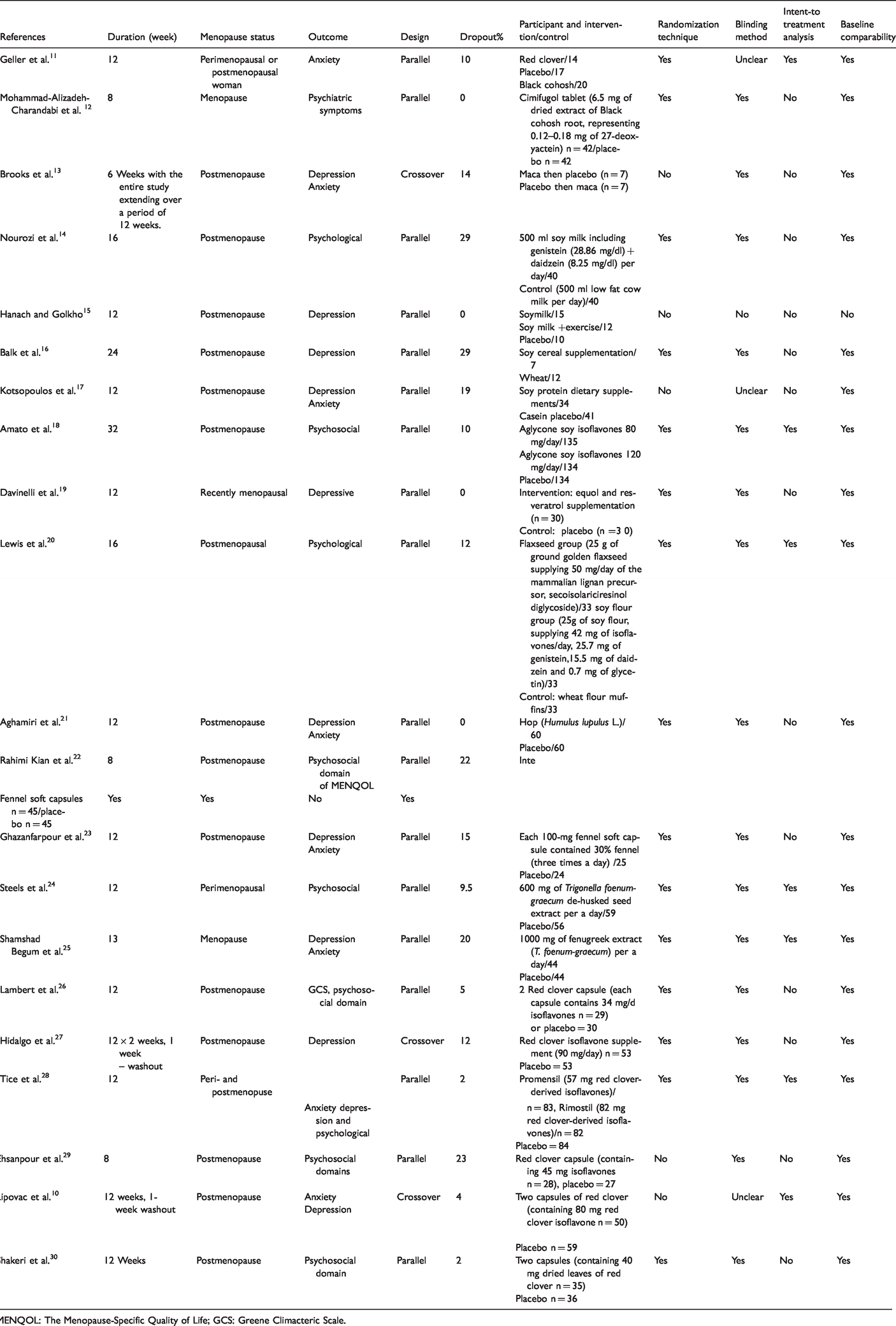
MENQOL: The Menopause-Specific Quality of Life; GCS: Greene Climacteric Scale.
Black cohosh
Two trials11,12 assessed the effectiveness of black cohosh extract on the psychological symptoms among the menopausal women. Geller et al. 11 compared four groups: 0.625 mg of conjugated equine estrogens combined with 2.5 mg medroxyprogesterone acetate, red clover (125 mg), black cohosh (64 mg) and placebo among perimenopausal or postmenopausal woman. No statistically significant difference was observed between the groups black cohosh extract and control regarding Greene Anxiety score at 3 months (p = 0.78) and 12 months (p = 0.56). There were no serious adverse serious adverse events reported in the use of botanical extracts and no significance difference in safety parameters, including hepatotoxicity for black cohosh over the 12-month duration of the study.
Mohammad-Alizadeh-Charandabi et al. 12 randomized 81 early postmenopausal women into two groups to receive black cohosh or placebo. Subjects were included if score on Greene Climacteric Scale (GCS) were between 15 and 45. The psychosocial score of GCS was decreased significantly in black cohosh group compared to the placebo after four weeks (p < 0.001) and eight weeks (p < 0.001).
Lepidium meyenii (Maca)
Brooks et al. 13 in 2008 conducted a crossover study with small sample size (n = 14). The depression score was significantly lower in the patients treated with Lepidium meyenii (Maca) when compared to the baseline (28.9%) and the placebo (26.8%) (both p < 0.05). The anxiety score was significantly lower in the patients treated with L. meyenii (Maca) compared to the baseline (30.8%) and the placebo (27.3%) (both p < 0.05).
Soy
Seven trials studied the effectiveness of soy on the depression and the anxiety. Nourozi et al. 14 randomized 80 patients into equal groups (n = 40) to receive placebo or soy milk. Comparison of two groups showed non-significant difference (p = 0.296).
Hanachi and Golkho 15 assessed the effectiveness of soymilk supplementation in a randomized three-group study involving 37 menopausal women. Their patients were randomized to one of the three groups of soymilk (n = 15) containing 12.5 g of soy protein combined with genistein (13 mg) and Daidzein (4.13 mg); soymilk supplemention and 60 min walking exercise (n = 12) or the placebo (n = 10). Either soymilk supplemention or soymilk +exercise showed 54% and 18% relief in the depresion symptoms compared to the placebo, respectively.
Balk et al. 16 investigated the efficacy of soy flour within a double-blinded randomized placebo-controlled trial. Both soy (p = 0.28) and placebo (p = 0.18) groups were not different at the baseline. The comparison of two groups indicated no significant difference (p = 0.58).
Kotsopoulos et al. 17 conducted a study in which 94 postmenopause women were randomly assigned to soy protein dietary supplement group and Casein placebo for 12 weeks. The depression score was decreased from 0.40 to 0.32 after taking the soy. However, the depression was scored slightly worse (3%) in the placebo group during a three-month follow-up. Both placebo and soy groups revealed a comparable decrease in anxiety (almost 17%).
Davinelli et al. 19 randomized their patients into two groups of fermented soy (containing equol and resveratrol) and the placebo. Percentage of patients affected by mild depression remained unchanged after treament with soy after a month but showed significant improvement at three months (p < 0.001). Comparison of two groups was significant at six months (p < 0.01) but not at one month.
Lewis et al. 20 compared three groups of soy, flaxseed muffins and placebo. The soy and placebo groups had comparable effects as measured by psychosocial domains of menopause-specific quality of life (MENQOL; mean difference (MD): −0.040; 95% confidence interval (CI): −0.869 to 0.789; p = 0.925).
Amato et al. 18 compared three interventions of high-dose soy isoflavones (120 mg), low-dose soy isoflavones (80 mg) and the placebo. The comparison of three groups using analysis of variance showed results similar to baseline across the three groups regarding psychoscoial score of MENQOL during first (p = 0.12) and second (p = 0.63) years.
Flaxseed
Lewis et al. 20 compared three groups of soy, flaxseed muffins and placebo. The flaxseed and placebo groups had a comprable effects as measured by psychosocial domains of MENQOL (MD: 0.22; 95% CI: −0.602 to 1.042; p = 0.6).
Hops (Humulus lupulus L.)
Only one trial by Aghamiri et al. 21 assessed the effectiveness of Hops (Humulus lupulus L.) on the depression and the anxiety. Thus, 120 postmenopauses were randomly divided to hops (n = 60) versus placebo (n = 60) for 12 weeks. The Greene scale was measured once at the baseline and again 2, 4, 8 and 12 weeks after intervention. The depression score showed statistically more significant decrease in the Hop Group at 4 (p < 0.001), 8 (p < 0.001) and 12 (p < 0.001) weeks compared to the placebo. The anxiety score revealed statistically more significant decrease in the Hop Group at 4 (p < 0.001), 8 (p < 0.001) and 12 (p < 0.001) weeks compared to the placebo group.
Foeniculum vulgare (Fennel)
Two trials assessed the effectiveness of fennel on psychological symptoms. The first study by Rahimi Kian et al. 22 was conducted to assess the effect of fennel on the sociopsychological domain of MENQOL. A significant improvement was observed in sociopsychological domain in the fennel group (n = 45) compared to the placebo (n = 45) (p < 0.001). The second study by Ghazanfarpour et al. 23 included 49 Iranian postmenopausal women who were randomized to two groups of fennel (n = 25) or placebo (n = 24) to receive 100-mg fennel soft capsule containing 30% fennel combined with sunflower oil or placebo containing sunflower. Symptoms of the anxiety and the depression were measured using Hospital Anxiety and Depression Scale (HADS) and Zung’s Self Rating Depression Scale (SDS). There was no significant difference between two groups on HADS subscale depression (p = 0.83) and anxiety (p = 0.83) and SDS (p = 0.91). Authors conducted a subgroup analysis to assess the effect of fennel on patients with depression or anxiety. Comparison of two groups in relation to depression subgroup (n = 20) showed a significant borderline decrease (p = 0.057). Also, comparison of two groups in relation to anxiety subgroup (n = 21) showed a significant decrease (p < 0.001).
Red clover
Six trials evaluated the effectiveness of red clover on depression and anxiety. Lambert et al. 26 performed a randomized, double-blinded, placebo-controlled clinical trial on 62 perimenopausal women (aged 40 ± 65 years) who were experiencing two or more hot flashes. The women were divided into two groups: red clover (n = 31) and placebo (n = 31). The subjects in the intervention group received twice daily treatment with bioavailable red clover extract, providing 34 mg/day of isoflavones and probiotics or placebo twice daily. GCS was measured at the baseline and after 12 weeks. The psychosocial domain score was decreased from 8.7 ± 1.06 to 6.8 ± 0.98 (p = 0.12) in the red clover group and from 10.09 ± 1.411 to 7.73 ± 0.9 (p < 0.05) in the placebo group. Comparison of the two groups was non-significant (p = 0.77).
Shakeri et al. 30 in a recent randomized, placebo-controlled clinical trial assessed effectiveness of red clover in alleviating psychological symptoms on 72 postmenopausal women with the mean age of 74 years divided into two groups of red clover (n = 36) and placebo (n = 36). The women received either two capsules containing 40 mg dried red clover leaves, while those in the control group received two capsules containing 40 mg starch. The women in the intervention group had a lower body mass index (20.69 vs. 21.58 kg/m2; p < 0.059). The Menopause Rating Scale was measured once at the baseline and again 12 weeks after treatment. The psychosocial domain score was decreased from 7.50 to 2.69 in the red clover group and from 6.52 to 6.45 in the placebo group. The comparison of the two groups was significant (p < 0.0001).
Lipovact et al. 10 in a crossover, double-blinded, placebo-controlled trial on 109 postmenopausal women randomized to one of the two groups receiving either two red clover capsules (containing 80 mg of red clover isoflavones, n = 50) or placebo (n = 59) for a three-month period. The Zung SDS and HADS were measured once at the baseline and again after treatment. The HADS anxiety score was decreased from 9.98 ± 4.68 to 2.40 ± 2.53 (p < 0.001) in the red clover group and from 9.98 ± 4.68 to 8.05 ± 4.76 (p < 0.001) in the placebo group. The comparison of the two groups showed significant difference (p < 0.0001). The HADS depression score was decreased from 6.91 ± 4.02 to 1.50 ± 2.06 (p < 0.001) in the red clover group and from 6.91 ± 4.021 to 5.23 ± 3.65 (p < 0.001) in the placebo group. The comparison of the two groups revealed significant difference (p < 0.0001). Total SDS scores decreased from 12.24 ± 7.39 to 2.37 ± 3.97 (p < 0.001) in the red clover group and decreased from 12.24 ± 7.39 to 9.57 ± 7.01 (p < 0.001) in the placebo group.
Geller et al. 11 compared four groups: 0.625 mg of conjugated equine estrogens combined with 2.5 mg medroxyprogesterone acetate, red clover (125 mg), black cohosh (64 mg) and placebo among perimenopausal or postmenopausal woman. Of a total of 89 women who were randomized to the treatment group, 80 completed the trials. The anxiety score was measured once at the baseline and again 3 and 12 months after intervention. The Greene Anxiety Score was associated with a significantly greater improvement in the red clover group compared to the placebo at 12 months (p = 0.04), but this reduction was not significant at 3 months (1.14 ± 0.73, p = 0.12).
Ehsanpour et al. 29 carried out a randomized, triple-blinded, placebo-controlled clinical trial to evaluate the efficacy of taking red clover capsules containing 45 mg of isoflavone on the quality of life among 72 menopausal women using Kupperman index >15 for 56 days. An MENQOL was measured once at the baseline and again 56 days after intervention. The psychosocial domain score was decreased from 28.11 ± 7.32 to 23.93 ± 7 (p < 0.01) in the red clover group and from 26.92 ± 7.33 to 23.67 ± 7.73 (p = 0.02) in the placebo group. The comparison of two groups showed no significant difference (p = 0.90).
Tice et al. 28 assessed the effectiveness of red clover on the depression and the anxiety symptoms on 252 menopausal women randomized into three groups of Promensil (57 mg of red clover-derived isoflavones), Rimostil (82 mg of red clover-derived isoflavones) and the placebo. The Greene Climacteric Scale was measured once at the baseline and again 12 weeks after intervention. No statistically significant difference was observed between placebo and both intervention groups (Promensil and Rimostil).
Hidalgo et al. 27 conducted a crossover and double-blinded trial regarding the effect of red clover on 60 postmenopausal with Kupperman index >15. Frequency of depression and nervousness symptoms was decreased by 60% (p < 0.05) and 50% (p < 0.05) in the red clover group and 22% and 11% in the placebo group, respectively. This decrease in the frequency of depression and nervousness symptoms was significant compared with the baseline and the placebo.
Trigonella foenum-graecum L.
Steels et al. 24 examined the effect of T. foenum-graecum L. de‐husked on
The MENQOL questionnaire: The psychosocial domain score was significantly improved by 25% in the intervention group compared to the placebo (3%). A significant difference was seen in the comparison of two groups (p < 0.001).
Fenugreek husk
Only one trial Shamshad Begum et al. 25 compared fenugreek husk with placebo. The anxiety (p < 0.01) and depression (p < 0.01) scores were decreased significantly in the intervention group compared to the placebo group (p < 0.001).
Meta-analysis
The effect of phytoestrogens on depression and anxiety
Six trials10,14,17,21,23,28 had enough information to be included in the anxiety meta-analysis. The anxiety score was lower in the phytoestrogen group compared to the placebo (SMD = −1.19, 95% CI:−232 to −0.053; p = 0.04; six trials; Figure 2). The depression score was decreased in the phytoestrogen group than in the placebo group (SMD = −0.952; 95% CI = −1.77 to −0.132; p = 0.023; five trials; Figure 3). However, the heterogeneity was notably high among trials that assessed anxiety outcome (p < 0.0001; I2 = 97.12%) and depression (p < 0.0001; I2 = 94.51%), and we were unable to reduce the heterogeneity to below 90% after one with one exclusion of the studies.
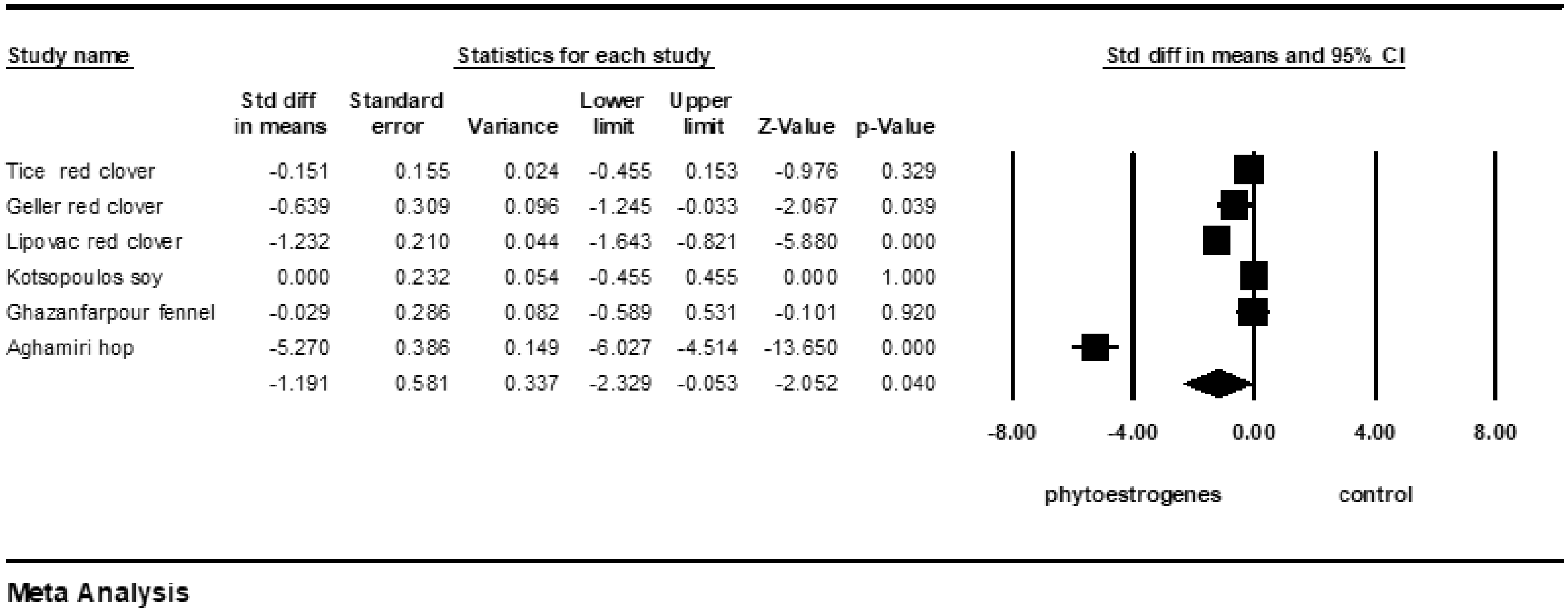
Effect of phytoestrogens on anxiety, ■ point estimate; ♦ combined overall effect of treatment. CI: confidence interval.
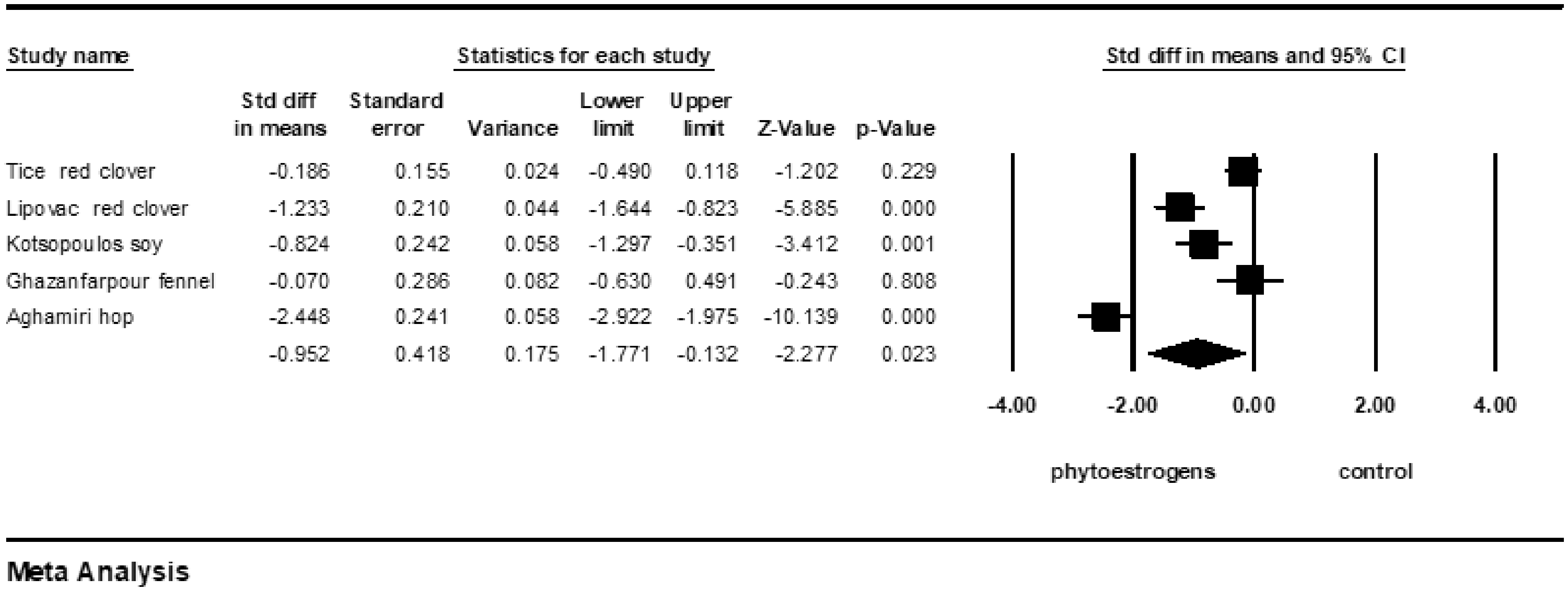
Effect of phytoestrogens on depression, ■ point estimate; ♦ combined overall effect of treatment. CI: confidence interval.
Discussion
To the best of our knowledge, this is the first systematic review to assess the effectiveness of herbal medicine on the depression and the anxiety symptoms in menopausal females.
Only one 19 of the seven trials included to our systematic review demonstrated a significant improvement in the soy group compared to the placebo group. Possible explanation for difference between Davinelli et al.’ study with others’ studies may related to difference dose, methodologic and types of questionnaire. Davinelli et al. assessed specifically depression symptoms using the Hamilton Rating Scale for Depression. Also, improvement was reported as percentage and patients received 200 mg each day of fermented soy containing 10 mg of equol and 25 mg of resveratrol. 19 In sum up, the results on the treatment of menopausal women with soy isoflavones were incongruous. Non-significant effect was observed in dose of 64 mg of black cohosh on anxiety. 11 However, significant effect was seen on psychological symptoms. 12
According to one study, 23 the fennel group demonstrated no significant benefit on the depression and the anxiety score as measured by SDS and HADS in healthy women. Authors carried out a subgroup analysis on patients with depression and anxiety disorder and demonstrated a borderline and significant improvement on both SDS and HADS. Another study showed the significant effect of fennel on the psychosocial domains of MENQOL. 22 Discrepancy between studies may be related to different questionnaires and dosage.
Some of studies11,26,29 showed non-significant positive effect of the red clover on psychological symptoms, while others indicated a significant positive effect.10,27,30 We believe that there are several reasons to interpret discrepancy among studies. These reasons included types of questionnaire, dosages, high placebo effect and menopause status. The high placebo effect seen in two studies.26,29 may mask the positive effect of red clover on psychological parameters. In sum up, 80 mg or more than 80 mg of red clover-derived isoflavones had significant effect on psychological symptoms.
Estrogen status mediates serotonergic function and increases the risk of mood disorders like depression. 31 In Lambert et al.’s study, 26 red clover reveals a non-significant effect on depression among perimenopause. The authors of the study determined that the high placebo response, inter-individual variation in absorption and metabolism of isoflavones and variation of isoflavone components in formulations most likely led to disparity in theirs results with pervious the trials. Also, they administered the isoflavones in conjunction with a probiotic to seed the gut with bacteria beneficial to metabolism of bioactive compounds in order to promote isoflavone metabolites such as equol, which shows greater affinity to estrogen receptors.
In term of types of questionnaire, Lipovac et al. 10 measured the depression and the anxiety levels by specific anxiety and depression inventories. Three studies showed non-significant effect using GCS 26 and MENQOL.28,29
Lipovac et al. 10 measured the depression and the anxiety levels by specific anxiety and depression inventories, while other studies26,28,29 measured the psychological symptoms based on the menopausal symptom questionnaire using GCS and MENQOL.
Limitations and suggestions for future studies
Several limitations were evident in our study. First, the heterogeneity was high among trials in our meta-analysis. The heterogeneity might be related to intervention type, different dosage and treatment duration. Second, several trials had poor methodology (such as intent-to-treatment analysis, inadequate treatment allocation, small sample size and unclear blinding method), low number of studies and high placebo effect. Future trials should be designed with high methodological quality, a clearer explanation of who was blinded, and how. Also, future studies should report the results based on intent-to-treatment analysis if needed. Third, some of studies failured to show significant effect might be due to the significant placebo effect that appeared in some relevant studies.10,26 Therefore, a placebo run-in phase or sequential parallel design might be more appropriate for studies with high placebo effect. Trials with larger size sample should be designed by researchers capable of conducting a subgroup analysis to compare the effect of the red clover on the psychological symptoms between postmenopausal and perimenopausal women. Some of the papers included did not seem to specifically assess the psychological symptoms of anxiety and depression. Future studies should use specific questionnaire such as HADS and SDS.
Conclusion
The present systematic review found that some of the herbal medicines may have good effect in the relief of the anxiety and the depression; 1000 mg of fenugreek extract on depression and anxiety, 600 mg of T. foenum‐graecum de‐husked seed extract on psychosocial domain, 0.4 mg/ml Maca extract on anxiety, 500 mg of Hop plant on depression and anxiety, 80 mg or more than 80 mg of red clover-derived isoflavones on psychological symptoms had significant effect. Non-significant effect was observed in black cohosh on anxiety. However, significant effect of black cohosh was seen on psychological symptoms. Fennel had a positive effect in both patients with anxiety or depression and healthy women. Flaxseed group (25 g of ground golden flaxseed) showed a non-significant effect on psychological symptoms.
Footnotes
Authors’ Contribution
Masumeh Ghazanfarpour: manuscript write up, review, study development and supervision. Afshar Shahmohammadi performed search, extraction data and study development. Yousef Rahmani performed search and extraction data. Rezvan Tahajjodi, Mahsa Mahdavi Siuki, Negar Ramezanpour, Fatemeh Rajab Dizavandi and Masaudeh Babakhanian: study development.
Declaration of conflicting interests
The author(s) declared no potential conflicts of interest with respect to the research, authorship, and/or publication of this article.
Funding
The author(s) received no financial support for the research, authorship, and/or publication of this article.