



Abstract

Free communications Oral presentations
Winner: Laura Currin Salter
Best Free Communication, BMS Annual Scientific Conference 2022
Menopause moments: a workplace wellbeing initiative
“The judges felt the presentation was clear, covered an important subject and showed how support can be provided to colleagues with menopausal symptoms working in a busy NHS hospital.”
Winner: Dana Alsugeir
Best Poster, BMS Annual Scientific Conference 2022
Hormonal replacement therapy in menopausal women in the UK: a descriptive study
“Impressive presentation, clear data, sound methodology and a large sample size, which is useful information for clinical practice”
Abstract 1
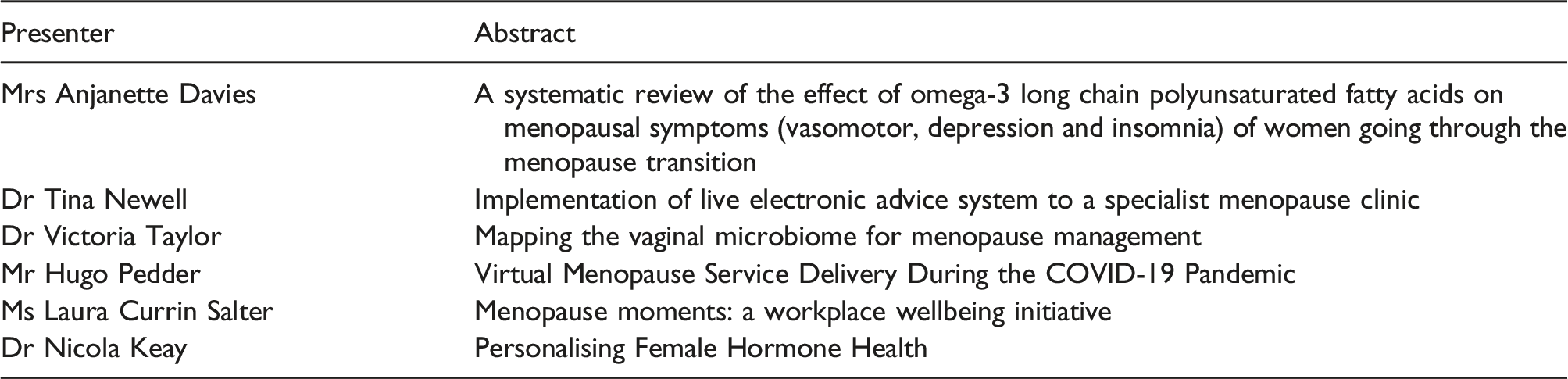
A systematic review of the effect of omega-3 long chain polyunsaturated fatty acids on menopausal symptoms (vasomotor, depression and insomnia) of women going through the menopause transition
Mrs Anjanette Davies
ANutr, MSc Nutritional Medicine
Abstract 2
Implementation of live electronic advice system to a specialist menopause clinic
Dr Tina Newell 1, Dr Siobhan Kirk2 and Dr Joanne McManus3
1ST7, Belfast Health & Social Care Trust
2Associate Specialist, Belfast Health & Social Care Trust
3Consultant Gynaecologist, Belfast Health & Social Care Trust
An audit and satisfaction survey was performed in 2019 to assess the acceptability of written advice to GPs as an alternative to clinic appointments for selected patients referred to a regional HRT clinic. This progressed to the implementation of a live advice response system via the clinical communications gateway (CCG). The advice request and response are integrated into the patient’s electronic care record.
1. Vision for menopause care in UK. BMS. https://thebms.org.uk/wp-content/uploads/2021/08/BMS-Vision-MAY2021-01C.pdf
Abstract 3
Mapping the vaginal microbiome for menopause management
Dr Victoria Taylor , Mr Dave Pye and Dr Jan Rogers
Agile Life Sciences
Abstract 4
Virtual Menopause Service Delivery During the COVID-19 Pandemic
Mr Hugo Pedder 1, Miss Lynne Robinson2, Kathy Abernethy3, Mr Haitham Hamoda4 and Miss Jo Marsden5
1Population Health Sciences, University of Bristol, UK
2Birmingham Women’s & Children’s NHS Foundation Trust, UK
3Director Menopause Services Peppy Health, formerly NWLH NHS Trust, UK
4King’s College Hospital, London, UK
5President, The British Association of Day Surgery, UK
Abstract 5
Menopause moments: a workplace wellbeing initiative
Ms Laura Currin Salter 1, Dr Mrunmayi Gogate2, Ms Heena Mehra,3, Mr Javaid Muglu4, Miss Helen Sheehan5, Dr Kate McCarthy6and Ms Giovanna Leeks
1Consultant Obstetrician and Gynaecologist, Queen Elizabeth Hospital, Lewisham & Greenwich NHS Trust
2GP Vocational Training Scheme – Bexley
3Consultant Obstetrician and Gynaecologist, University Hospital Lewisham, Lewisham & Greenwich NHS Trust
4Consultant Obstetrician and Gynaecologist, University Hospital Lewisham, Lewisham & Greenwich NHS Trust Consultant Obstetrician and Gynaecologist, University Hospital Lewisham, Lewisham & Greenwich NHS Trust
5Specialist Doctor, University Hospital Lewisham, Lewisham & Greenwich NHS Trust
6Associate Director – Staff Wellbeing and Medical, Lewisham & Greenwich NHS Trust
Abstract 6
Personalising Female Hormone Health
Dr Nicola Keay 1 and Mr Gavin Francis2
1Honorary Clinical Lecturer in Medicine, UCL
2Science 4 performance
1. ‘Machine learning for individualised medicine’ Mihaela van der Schaar, Annual Report of the Chief Medical Officer. 2018, Chapter 10. Health 2040 – Better Health Within Reach. Accessed 2021.
2. Van de Schoot R, Depaoli S, King R et al. Bayesian statistics and modelling. Nat Rev Methods Primers 2021;1:1. https://doi.org/10.1038/s43586-020-00001-2
Poster abstracts
Poster 1
A Clinical Audit on Menopausal-Like Symptoms following Anti-hormonal Therapy Compliance for Breast Cancer
Dr Mohammed Omer Anwar1 and Dr Azmy Birdi2
1GPST3, Cookham Medical Centre, Cookham, Berkshire
2GP, Cookham Medical Centre, Cookham, Berkshire
Poster 2
A proposal for a set of eligibility guidelines for HRT that is similar to the UKMEC for contraception
Dr Lindsey Thomas1, Dr Abbie Laing2, Professor Nick Panay3 and Mr Tim Hillard4
1GP, Leeds NHS Menopause Service, Meanwood Medical Centre, Leeds
2GP, Poole Menopause Centre, University Hospitals, Dorset
3Queen Charlottes & Chelsea and Westminster Hospitals, Professor of Practice, Imperial College London, President Elect, International Menopause Society, Director, International Centre for Hormone Health
4Consultant Gynaecologist, University Hospitals Dorset, Poole
There are also areas with evidence to support appropriate but off label prescribing, such as the use of transdermal oestrogens in thrombophilias.
Poster 3
A wearable biosensor to detect night sweats: proof-of-concept case study
Alish Kerr1, Donal O'Gorman2and Heidi Davis1
1MSc, identifyHer Ltd, Ireland
2PhD, IdentifyHer Ltd, Ireland
Poster 4
Audit of referrals into the Specialist Menopause Clinic
Dr Jade Battle1 and Dr Tonye Wokoma2
1GPVTS St2, Haxby Group Practice, Hull
2Consultant Sexual and Reproductive Health, Conifer House, Hull
Poster 5
Collaborative working between primary care and Maggie’s Cambridge: A novel approach to supporting women with an induced menopause following cancer treatment
Mrs Lisa Punt1, Dr Angela Wright 2 and Dr Angela Sharma3
1(DCRT. MSc radiotherapy and oncology), Consultant Radiographer. Centre head Maggie's Cambridge. Trustee of the pelvic radiation disease association. Consultant adviser for PERCI Health.
2KIrkby & Masham Surgery, CHCP, BMS, BSSM Committee Member, ESSM, IMS, PCWHF, FSRH Menopause Training Working Group Member, COSRT Associate Member, Contemporary Institute of Clinical Sexology Faculty Member, Ripon Trauma Centre Director, Peppy Health.
3Pembridge Villas Surgery, RCGP, BMS, BSSM, ESSM
Sexual dysfunction is present in 50–65% of cancer survivors yet women are less likely than men to have sexual consequences addressed (Schover, 2019).
A retrospective survey was undertaken to collate qualitative themes.
Lack of information prior to treatment
Impact on QOL, physical symptoms, knowledge and psychological well-being
Benefits of shared experience within a group
Impact of access to experts trained in sexology/menopause
Legitimising menopause support in the background of a cancer diagnosis
Poster 6
Counselling prior to surgical menopause
Neha Shah1, Ghazal Datta2, May Thuhan and Mahantesh Karoshi
1ST6 Registrar in Obstetrics and Gynaecology, London
2SHO in Obstetrics and Gynaecology, London 3Medical Support Worker in Obstetrics and Gynaecology, London 4Consultant in Obstetrics and Gynaecology, London
1. Richardson A et al. Hormone replacement therapy in pre-menopausal women undergoing bilateral salpingo-oophorectomy for benign disease. Post Reprod Health. 20172.
2. Elson J et al. Review of menopause advice given to patients undergoing bilateral oophorectomy, Post Reprod Health. 2021.
Poster 7
Discussion of (peri-) menopausal symptoms in the context of antidepressant prescribing in General Practice
Dr Molly Anderson
Locum GP, Blackmore Vale Medical Practice, North Dorset
Poster 8
Hormonal replacement therapy in menopausal women in the UK: a descriptive study
Dana Alsugeir1, Prof. Li Wei2 and Dr Ruth Brauer2
1UCL School of Pharmacy, Department of Pharmacy Practice and Policy and Imam Abdulrahman Bin Faisal University, College of Clinical Pharmacy, Department of Pharmacy Practice
2UCL School of Pharmacy, Department of Pharmacy Practice and Policy
Poster 9
Management of aged 40 to 44 years old females presenting to a General Practice with perimenopausal symptoms
Dr Hannah Davidson1, Dr Deborah Bruce2, Ms Debra Holloway3 and Prof Janice Rymer4
1GP, Capelfield Surgery, Claygate
2Consultant Gynaecologist, Guys & St Thomas' NHS Trust, London
3Nurse Consultant in Gynaecology, Guys & St Thomas' NHS Trust, London
4Consultant Gynaecologist, Guys & St Thomas' NHS Trust, London
Overall the 40 to 44 years old age group:
– present less frequently (0.22 v 0.29)
– report fewer symptoms (1.35 v 3.25)
– undergo more investigations (3.25 v 1.88) – are referred to specialities more (0.30 v 0.25)
– are less likely to receive a medical certificate (0.05 v 0.25)
– are more likely to be treated with non-hormonal medication (0.65 v 0.13) and less likely to receive a hormone prescription (0.2 v 0.5)
– undergo more investigative tests (3.25 v 1.88) than the 45-year-old patients.
This study highlights the need for clearer guidance of perimenopause in this cohort of women, suggesting that 40–44-year-old are missing out on the opportunity to receive lifestyle advice and treatment to optimise their physical and mental health through reduction of cardiovascular disease, prevention of osteoporosis and improvement of cognitive function.
Poster 10
Mind the menopause gap: survey shows UK women failed by current services
Dr Louise Newson1, Dr Rebecca Lewis2, Andrew Bazeley3, Kate Muir4 and Dan Reisel5
1GP and menopause specialist, Newson Health Menopause Society
2GP and menopause specialist, Newson Health Research & Education
3Policy, Insight and Public Affairs Manager, Fawcett Society
4Producer, FInestripe Productions
5MBBS, PhD, Newson Health Research & Education and EGA Institute for Women’s Health, University College London
Over half of the study population who were taking HRT (54%) agreed with the statement that the treatment ‘had given them their life back’, and over a third of women taking HRT (36%) and who were currently working said that it had helped them being more productive at work. Only 18% reported that HRT had not helped resolve their symptoms, and just 2% said that they planned to stop HRT because of the side effects.
Poster 11
Not just hot flushes: survey shows cognitive symptoms key to the menopause
Dr Louise Newson1, Dr Rebecca Lewis2, Andrew Bazeley3, Kate Muir4 and Dan Reisel5
1GP and menopause specialist, Newson Health Menopause Society
2GP and menopause specialist, Newson Health Research & Education
3Policy, Insight and Public Affairs Manager
4Producer, Finestripe Productions
5MMS, PhD, Newson Health Research & Education and EGA Institute for Women’s Health, University College London
We found that almost half of the women surveyed (44%) reported that they had experienced a significant negative impact on their work due to the menopause, including reduced motivation and confidence, as well as the whole spectrum of physical symptoms of the menopause and perimenopause. Almost half of the women surveyed (44%) had experienced three or more symptoms related to the menopause. Genitourinary symptoms, often a cause for tertiary referral, were experienced by 39% of the participants.
Poster 12
Oral estradiol/micronised progesterone may be safer with respect to venous thromboembolism risk than conjugated estrogens/medroxyprogesterone in postmenopausal women: Real World Evidence
Professor Nick Panay1, Rossella E. Nappi2, Policlinico S. Matteo3, Santiago Palacios4, Tomasz Paszkowski5, Julie Heroux6 and Mitra Boolell7
1BSc, FRCOG, MFSRH, Professor of Practice, Imperial College London, UK
2MD, PhD, Research Center for Reproductive Medicine, Gynecological Endocrinology and Menopause, IRCCS, 3University of Pavia, Pavia, Italy
4MD, PhD, Palacios Institute of Women's Health, Madrid, Spain
5MD, PhD, 3rd Chair and Department of Gynecology, Medical University of Lublin, Poland
6MSc, Heroux Consulting, The Hague, Netherlands
7MD, Theramex, London, United Kingdom
Theramex HQ UK Ltd
Poster 13
Osteoporosis and Sarcopenia. Are we missing the boat? Should first line treatment/prevention be transdermal oestrogen for women?
Dr Susanne Hooper1, Dr Melanie Hacking1 and Mr Anthony Mander2
1Oxford Hormone Clinic, Oxford
2Nuffield Manor Hospital, Oxford
“Older Women Fall and fracture their thin bones -when their thin Muscles let them down.”
2. Cost benefit analysis would be useful as treatments listed are expensive, h and often Toxic. Transdermal oestrogen is cheap, well tolerated, no monitoring needed, can be used as prevention and treatment, has very few, harmless side effects and has lifelong health benefits.
3. Sarcopenia is not mentioned or the importance of muscle mass to prevent fractures and disability. Sarcopenia features in the 2015 NICE guidelines of Osteoporosis treatment.
4. Low oestrogen/testosterone, important risk factors, are not mentioned.
5. References are not up to date, no reference to 2015 NICE guidelines or any BMS reference. The only reference is to a study in 2002 and a re-evaluation of that study in 2012.
Poster 14
Pause for the MenoPAUSE: An evidenced staff-based programme to promote physiological and psychological wellbeing for those experiencing the menopause
Ms Esha Saha1, Dr Rhia Gohel2, Ms Margaret Ford3 and Mrs Kate Woodhouse4
1Consultant in Obstetrics and Gynaecology, St George's University Hospital NHS Foundation Trust, London
2Health Psychologist, St George's University Hospital NHS Foundation Trust
3Health and Wellbeing Advisor, St George's University Hospital NHS Foundation Trust
4Staff Psychotherapist, St George's University Hospital NHS Foundation Trust
Poster 15
Pilot of a staff menopause clinic at Guys and St Thomas’ NHS trust (GSTT)
Sabrina Shahid1, Dr Deborah Bruce2, Kholood Munir3, Ms Debra Holloway4, Joan Bowen5 and Professor Janice Rymer6
12nd year UG medical student, King's College London (KCL)
2Consultant Gynaecologist, Guys and St Thomas’ NHS trust (GSTT)
32nd year UG medical student KCL
4Consultant Nurse Specialist GSTT
5Staff Health and Wellbeing Manager, Occupational Health GSTT
6Consultant Gynaecologist GSTT
Many women aged between 45 and 65 struggle with managing their menopausal symptoms and this negatively impacts their ability to work. Access to menopause advice was difficult for women before the pandemic and is becoming increasingly more with overloaded GP services, long waiting lists for NHS menopause clinics and a national shortage of menopause specialists. To try to address this, Professor Rymer, Dr Bruce and Ms Holloway, who run the NHS menopause clinic at Guys and St Thomas’ NHS trust (GSTT), rolled out a pilot staff menopause clinic in liaison with GSTT Occupational Health to try to help support these women and it was part of the GSTT staff health and wellbeing offer and was supported by the GSTT charity.
Poster 16
Referral patterns to a new NHS Menopause Service
Ms A P Hawkins
BSc MRCOG DFSRH, Consultant in Obstetrics and Gynaecology, Salisbury Hospital Foundation Trust
Poster 17
Unworkable: how the UK workplace fails women going through the menopause
Dr Louise Newson1, Dr Rebecca Lewis2, Andrew Bazeley3, Kate Muir4 and Dan Reisel5
1GP and menopause specialist, Newson Health Menopause Society
2GP and menopause specialist, Newson Health Research & Education
3Policy, Insight and Public Affairs Manager, Fawcett Society
4Producer, Finestripe Productions
5MBBS, PhD, Newson Health Research & Education and EGA Institute for Women’s Health, University College London
Additionally, we found evidence of workplaces being resistant to change: only 14% of respondents said their employer had put in place a menopause support network and only 9% said their employer had a menopause absence policy. Many women felt unable to get adequate leave to recover from their symptoms and had to use other reasons than then menopause to apply for sick leave.
The impact on work and professional progression was equally profound. Of those surveyed, 28% had either reduced their hours or altered their working pattern to being part-time and 10% had left their work due their workplace being unable to accommodate their needs. This equates to a workforce attrition of over 330,000 women between the ages of 45–55 years.
Poster 18
Use of a modified vaginal speculum may improve the diagnosis of urogenital atrophy
Dr Paula Briggs1 and Dharani Hapangama2
1Consultant in Sexual & Reproductive Health, Liverpool Women's Hospital, Liverpool
2Department of Women's and Children's Health, Centre for Women's Health Research, Institute of Life Course and Medical Sciences, University of Liverpool
The research was supported by an unrestricted educational grant of £5K provided by Theramex
Poster 19
Vaginal microbiome 16S metagenomic barcoding for urogenital atrophy
Dr Jan Rogers1, Mr Dave Pye1, Dr Victoria Taylor1 and Dr Paula Briggs2
1Agile Life Sciences
2Consultant in Sexual & Reproductive Health, Liverpool Women's Hospital
Dr Paula Briggs was awarded an unrestricted educational grant from Theramex of £5000.