



Abstract
Objective
The most frequently reported menopausal symptoms are hot flushes and night sweats (HFNS). This study evaluated the feasibility, and generated preliminary data on the efficacy, of a self-guided, internet-delivered Cognitive Behaviour Therapy (iCBT) program for HFNS in working menopausal women.
Methods
Participants were UK employees who accessed the iCBT program via an Employee Assistance Program. Adherence consisted of ‘non-starters’, ‘ended as planned (women who received at least 75% of support)’ and ‘completers’. Program usage, completion rates, user feedback and changes in outcome measures (HFNS frequency, problem-rating, anxiety, depression, work and social adjustment) were assessed.
Results
Program activation rate was 61%. 426 women accessed an introductory session, with 213 completing the first iCBT session and 62 completing the program. Attrition ranged from 50% to 21% between sessions. Upon completion, there was a significant reduction in all outcome measures. Higher rates of reliable improvement were gained by those with higher anxiety and depression scores at baseline. Most women found the program helpful and easy to use.
Conclusions
Findings suggest that an iCBT program for working women experiencing menopausal HFNS is feasible and promising in terms of efficacy. Further studies are needed to establish and implement effective retention strategies to improve compliance with and, thus, the efficacy of self-managed internet-based interventions.
Introduction
Hot flushes and night sweats (HFNS), the main physical signs of menopause, can adversely affect women’s sleep, mood and quality of life.1,2 HFNS are problematic for approximately 25–30% of healthy menopausal women, and together with tiredness and loss of confidence, can be particularly difficult to manage in work contexts. 3 Changes in estrogen levels during menopause impact on Kisspeptin, Neurokinin B and Dynorphin (KNDy) neurons in areas that regulate hypothalamic reproductive and thermoregulatory centres of the brain; this impacts thermoregulatory homeostasis, causing heat, sweating, redness and sometimes shivering, with varied duration and severity.4,5
Hormone Replacement Therapy (HRT) is effective for HFNS, but for some it is unsuitable, due to preference or contraindications. The National Institute for Health and Clinical Excellence guidelines recommend that individuals experiencing troublesome menopausal symptoms should also have access to Cognitive Behaviour Therapy (CBT). 6 A cognitive behaviour protocol (MENOS) was developed and evaluated in six Randomised Controlled Trials (RCTs) 7 ; it was found effective in reducing the impact of HFNS, for women going through menopause and those with breast cancer, in different modalities, including group,8–10 telephone guided 11 and manualised self-help.1,12,13 Nevertheless, the public health impact of psychological interventions continues being limited by cost and lack of practitioners to deliver them. 14 At the same time, women continue reporting unmet needs for support with menopause 15 ; a critical gap in availability and accessibility of evidence-based interventions, therefore, remains.
Internet-delivered CBT (iCBT) interventions have clear benefits in terms of accessibility and convenience, as well as lower costs. Such interventions are being recommended as a structured alternative to face-to-face therapy for a range of difficulties, demonstrating significant clinical outcomes and levels of user satisfaction. A self-guided delivery modality can also promote anonymity, expression, reflection and empowerment while creating a sense of achievement through monitoring individual progress. 16
Nevertheless, developing effective and efficient internet-delivered psychological interventions can be challenging, requiring a planful approach. 17 Evaluating an intervention program is necessary, including testing whether the intervention is acceptable and feasible for its target population. 18 Therefore, the primary aim of this study was to investigate the acceptability and feasibility of an iCBT program for working menopausal women experiencing HFNS. A second aim was to explore differences in feasibility and acceptability between women; it remains unclear who may benefit most from iCBT interventions, for example, individuals presenting with mild to moderate rather than severe level of symptomatology. 19 The third aim was to evaluate its short-term effectiveness on symptom reporting; it was expected that symptoms would reduce for those completing the program.
To our knowledge, this is the first study examining the acceptance, efficacy and satisfaction with an iCBT program amongst working menopausal women experiencing HFNS.
Methods
Study design
This was a service evaluation involving automated data collection from women accessing the program between March 2021 and November 2024. This project was registered with Turning Point’s Research Governance Committee and according to local research requirements.
The iCBT program
The program was broadly based on the MENOS protocol and accessed through a web platform using media-rich interactive content. Development of the program proceeded through a multi-disciplinary collaboration including clinical psychologists and other subject matter experts as ideas for content presentation and interaction were prototyped.
The program consists of an introductory (‘welcome’) and 5 iCBT sessions. Women are encouraged to complete one session per week or take a more exploratory approach, if they prefer. Each iCBT session is structured in an identical way and incorporates informational content, interactive and graphical exercises as well as strategies practice (‘homework’). Women respond to the content, by indicating whether they like it, and commenting on it.
Participants and procedure
This study examines data from an employee mental health specialist support service (Rightsteps) provided by Turning Point, UK. Employees seeking help for HFNS were able to access the program via an Employee Assistance Program (EAP). All women who accessed the program during the study period were included, reflecting a naturalistic sampling approach. Data were collected from usage logs, allowing for an unrestricted exploration of user behaviour and engagement patterns in real-world conditions.
Outcome measures
Primary outcome was the problem-rating subscale of the Hot Flush Rating Scale (HFRS), 20 assessing the extent to which HFNS are problematic, distressing and causing daily interference; higher scores indicate more problematic HFNS whereas a 2-point change is considered clinically significant.
Secondary outcomes included HFNS frequency (HFRS subscale), anxiety through the Generalised Anxiety Disorder-7 (GAD-7), 21 depression through the Patient Health Questionnaire-9 (PHQ-9) 22 and work and social adjustment through the Work and Social Adjustment Scale (WSAS). 23
PHQ-9, GAD-7 and WSAS data were collected at the beginning and end of the program; HFRS data was collected in every session.
Data analysis
Descriptive statistics and tests were generated using SPSS software (Version 29.0; IBM Corp., 2023). Program adherence was a trichotomous variable consisting of ‘non-starters’ (women engaged beyond the first login but received ≤75% of planned support and may not have completed any follow-up assessment), ‘ended as planned’ (women who received ≥75% of planned support and completed both a baseline assessment and at least three follow-up assessments) and ‘completers’ (women who completed all sessions and follow-up assessments). Completion of at least the first four sessions was considered an acceptable (minimal) compliance level because these sessions cover the core program areas.
Analyses were conducted to explore whether completion rates differed by HFNS frequency or problem-rating at baseline (p ≤ .05 for all). A chi-square test of independence was also conducted to compare the percentages of women with clinically significant improvement on the HFRS problem-rating subscale (‘ended as planned’ vs. ‘completers’).
Results
Activation (initial take up) rate
Activation rate measures the number of accounts created by users after receiving an invite to the platform, relative to the total number of invites sent. 704 invites were sent, and 426 women started a session. The activation rate was, therefore, 61%.
Baseline characteristics
Mean HFNS scores for women who started the program was 16.23 (SD: 24.4) for frequency and 3.77 (SD: 2.64) for problem-rating: baseline scores were not significantly different between ‘program completers’ and ‘ended as planned’ or ‘non-starters’ subgroups (p > .05).
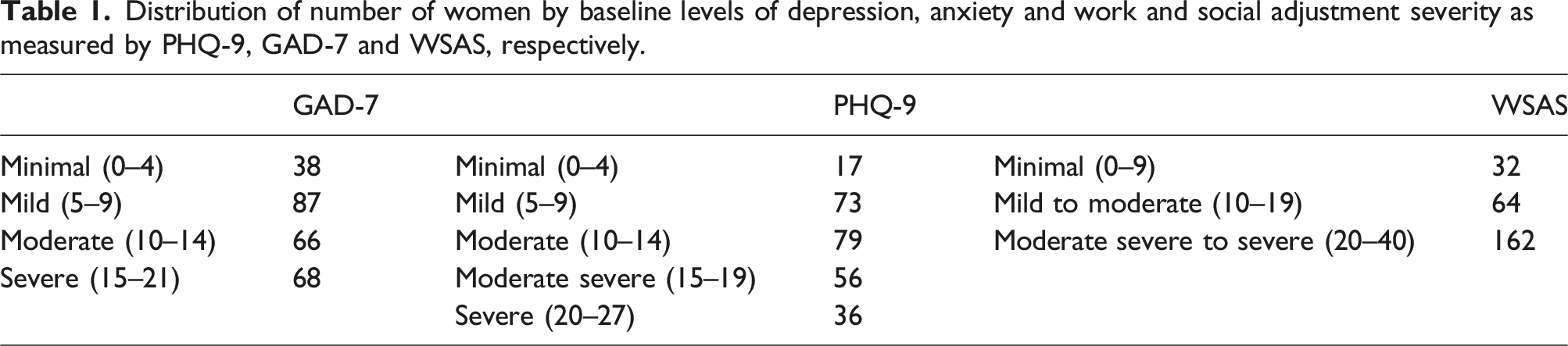
Mean GAD-7 (10.31, SD: 5.41), PHQ-9 (12.54, SD: 5.85) and WSAS (22.39, SD: 9.31) scores indicated moderate levels of anxiety and depression, and moderate/severe levels of functional impairment, respectively. 65.5% (171/261) and 64.0% (166/259) of women met the criteria for clinical levels of depression (>9 PHQ-9) and anxiety (>7 GAD-7), respectively.
Distribution of number of women by baseline levels of depression, anxiety and work and social adjustment severity as measured by PHQ-9, GAD-7 and WSAS, respectively.
‘Ended as planned’
104 women ‘ended as planned’. Linear mixed model demonstrated that HFRS frequency and problem-rating scores decreased over most weeks of the intervention period (p > .05).
‘Program completers’
HFRS scores at baseline and post-treatment.

Results also showed a statistically significant association between group (‘ended as planned vs. ‘completers’) and HFNS problem-rating improvement by 2 points or more: χ2 (1, N = 100) = 3.90, p = .048, φ=.20, indicating that a significantly greater proportion of women in the ‘completers’ group improved compared to women in the ‘ended as planned’ group.
Recovery and reliable improvement
Improvement rates for women with minimal-to-mild symptoms.

For women who had at least moderate levels of depression or anxiety at baseline, rates of recovery and reliable improvement were calculated. Individuals meet the criteria for recovery when they move from caseness (PHQ-9≥10; GAD-7≥8) to non-caseness (PHQ-9<10; GAD-7<8) post-intervention; for reliable improvement, when they show a decrease of ≥6-points on PHQ-9 or ≥4-points on GAD-7 scales at post-treatment.
Reliable improvement and recovery rates.

Platform engagement
Attrition rates by session.

Time spent (hours: minutes) on each session.

Feedback
Most women found the program helpful (82% of women rated the sessions as ‘very’ or ‘extremely helpful’) and easy to use (61% of women rated the sessions as ‘very’ or ‘extremely easy’ to use). Positive elements of the interventions included a sense of self-control and anonymity, CBT techniques and engaging, user-friendly content. What women reported liking the least were finding the program time-demanding, complicated, impersonal and not meeting their individual needs.
Discussion
Self-guided iCBT interventions have the potential to provide a person-centred environment where users take control and actively participate in the management of their care. However, such interventions have often been associated with lower compliance rates and smaller effects than therapist-guided interventions. 16 Indeed, in this study, almost one-quarter of women who activated their accounts completed the first four sessions (104/426 or 24.4%) and almost half of the women who accessed the first iCBT session (104/213 or 48.8%) went on to complete at least two more sessions, which also reflected the a priori–formulated minimally acceptable level of compliance. The activation rate in this study was also comparable to similar nation-wide digital CBT initiatives. 24
On average, 31% of women dropped out between sessions, which is higher than attrition reported in a recent RCT exploring the efficacy of iCBT for treatment-induced HFNS, 12 suggesting a lower level of engagement with the program. Although that trial included women with breast cancer treatment–induced symptoms, findings from our study could play a role in building scientific knowledge as part of iCBT programs for HFNS aiming to discover not only ‘what works’, but ‘why things work’. Moreover, RCTs include rigorous follow-up procedures to minimise attrition (e.g. eligibility criteria and monitoring strategies) compared to community-based studies where individuals may lack motivation to stay engaged. 25 Attrition is also comparable to reported rates from other self-guided iCBT programs ranging up to 50% and even 99%.26,27 Further studies are, therefore, needed for establishing and implementing effective retention strategies for improving compliance with and, thus, the efficacy of self-managed internet-based interventions. The average time spent per session ranged from 36 minutes to almost 2 hours, reflecting a high level of user engagement. This may suggest that when women accessed the content, they dedicated substantial time to reflect on, and interact with, it.
Program completion was associated with a significantly higher rate of improvement in HFNS problem-rating (than in the ‘ended as planned’ group), suggesting that higher adherence is linked to better outcomes.16,27 Moreover, for program completers, the proportion of those who transitioned to recovery in either depression or anxiety was 47%, similar to rates observed in UK IAPT services 28 ; consistent with this literature, rates of reliable improvement increased with higher levels of baseline severity, with highest rates of reliable improvement being observed in women experiencing severe levels of depression and anxiety at baseline. Rates of recovery may thus decrease as baseline severity increases, as women may require a higher magnitude of change to reach the threshold for recovery. 28 HFNS frequency and problem ratings were lower at baseline than those in the MENOS RCTs. 7 Nevertheless, no inclusion or exclusion criteria were applied in this study, as we wanted to capture all women’s experience and explore the intervention’s real-world applicability reflecting a naturalistic and diverse sampling approach.
Findings also support existing literature suggesting that during menopause, symptoms of anxiety and depression are common. 29 Program completers reported less problematic and less frequent HFNS, alongside reductions in anxiety, depression and functioning scores. Our efficacy results support previous studies in which CBT was effective in reducing the perceived impact of HFNS in menopausal women1,11 and cancer survivors.8–10 Findings from this study, therefore, suggest that iCBT may also be an acceptable and effective intervention for working menopausal women experiencing HFNS. Given the encouraging findings and practical insights gained from this study, future research (e.g. RCT) could also further evaluate the intervention’s efficacy (e.g. through comparison with a control group).
Footnotes
Declaration of conflicting interests
ES, SC, DL and JL are employees of Turning Point. The authors declare no other potential conflicts of interest with respect to the research, authorship, and/or publication of this article.
Funding
The author(s) received no financial support for the research, authorship, and/or publication of this article.
Guarantor
ES.
Contributorship
ES and SC were involved in data analysis. The first draft of the manuscript was written by ES, and all authors, commented on previous versions of the manuscript. All authors read and approved the final manuscript.
Ethical approval
Ethical approval was not required as this was a service evaluation study. All data were anonymised prior to analysis and protected in accordance with the Declaration of Helsinki and the UK Data Protection Act (2018).

Data availability statement
The datasets generated during and/or analysed during the current study are available from the corresponding author on reasonable request.