




Abstract
During the coronavirus 2019 (COVID-19) pandemic, outpatient visits for patients with atrial fibrillation (AF), were converted into teleconsultations. As a response to this, a novel mobile health (mHealth) intervention was developed to support these teleconsultations with AF patients: TeleCheck-AF. This approach incorporates three fundamental components: 1) “Tele”: A structured teleconsultation. 2) “Check”: An app-based on-demand heart rate and rhythm monitoring infrastructure. 3) “AF”: comprehensive AF management.
This report highlights the significant importance of coordination of the TeleCheck-AF approach at multiple levels and underlines the importance of streamlining care processes provided by a multidisciplinary team, using an mHealth intervention, during the COVID-19 pandemic. Moreover, this report reflects on how the TeleCheck-AF approach has contributed to strengthening the health system in maintaining management of this prevalent sustained cardiac arrhythmia, whilst keeping patients out of hospital, during the pandemic and beyond.
Background
Atrial fibrillation (AF) is the most prevalent sustained cardiac arrhythmia, associated with increased morbidity such as heart failure, thromboembolic complications, and mortality. Management of AF is a multifaceted process that goes beyond the treatment of the arrhythmia alone. In addition to controlling the arrhythmia (heart rate and rhythm control), assessment of stroke risk and the administration of appropriate anticoagulation to prevent strokes, the management of concomitant risk factors represents an important component of AF treatment as it can reduce AF symptom burden and may reverse the type and natural progression of AF. 1 A multidisciplinary team approach involving cardiologists, electrophysiologists, nurses, allied health professionals as well as primary care physicians, amongst others, should be in place, following a patient-centred approach which places the patient in a central role in decision-making. Integrated care has been identified as a suitable approach to implement comprehensive AF care within specialised AF outpatient clinics through face-to-face contacts.2,3 Significant improvements in the quality of care delivery 4 as well as in patient outcomes have been demonstrated when applying such specialized AF-Clinics in clinical practice.5–8
During the coronavirus 2019 (COVID-19) pandemic, traditional face-to-face consultations in AF outpatient clinics were constrainedly converted into teleconsultations. At the Maastricht University Medical Centre+ (MUMC+), Maastricht, the Netherlands, we developed a mobile health (mHealth) infrastructure to support teleconsultations with AF patients to guarantee the continuity of comprehensive AF management through teleconsultations during COVID-19: The TeleCheck-AF approach.9,10 In this article, we explain the coordination of the TeleCheck-AF approach and the implementation of this mHealth intervention in European centres.
TeleCheck-AF
TeleCheck-AF incorporates three important components (Figure 1): 1) a structured teleconsultation, which allows health care professionals to conduct remote patient consultations (‘Tele’), 2) an app-based on-demand heart rate and rhythm monitoring infrastructure based on a CE-marked mobile phone app: www.fibricheck.com (‘Check’) and 3) comprehensive AF management (‘AF’) consisting of four main domains: i) rate control for symptom management and preservation of left ventricular function, ii) rhythm control to improve symptoms, iii) prescribing appropriate oral anticoagulation according to stroke risk to prevent thromboembolic complications, and iv) management of precipitating factors (i.e. underlying cardiovascular conditions and modifiable risk factors) to reduce the cardiovascular burden. 11 The TeleCheck-AF approach is an on-demand mHealth intervention which is provided to patients for seven days prior to a scheduled teleconsultation. Patients are instructed to measure heart rate and rhythm and symptoms, three times a day and in case of symptoms using the FibriCheck® app. This app is based on photoplethysmography (PPG) technology using the built-in camera on the smartphone, allowing semi-continuously heart rate and rhythm monitoring of AF patients prior to the teleconsultation. This on-demand mHealth approach provides vital parameters and enables physicians to use heart rate and rhythm data for the decision-making process related to treatment and management AF patients.
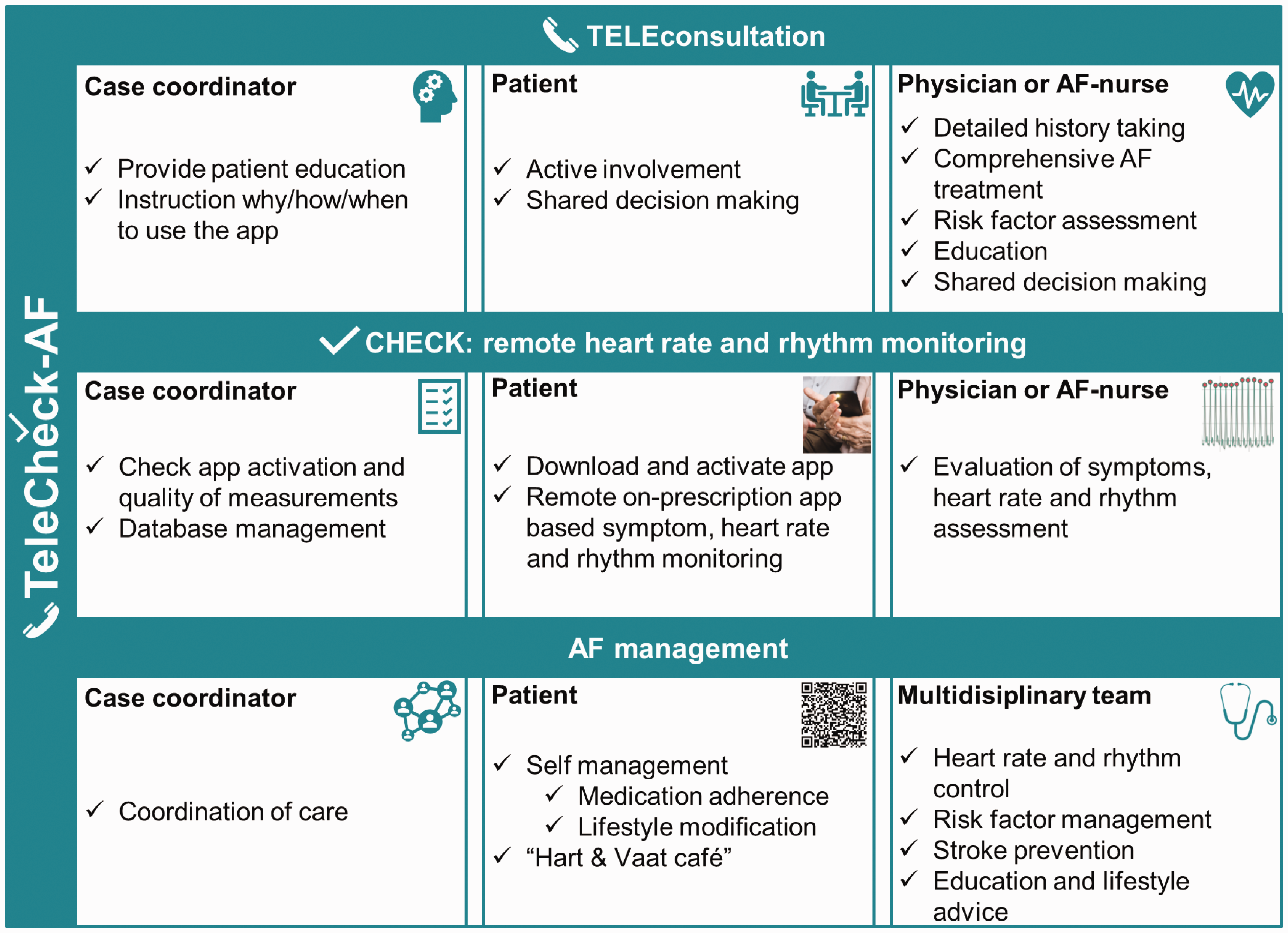
Multi-level care coordination within the TeleCheck-AF approach.
Care coordination
Coordination of AF care
Integrated care has been identified to manage patients with chronic conditions. The integrated care approach to manage AF, has been defined fusing four indispensable key elements to provide efficient and high-quality care aiming to improve outcomes. These elements are: 1) actively involving patients in their care (including patient education and instruction, and empowering patients to self-manage their condition), 2) a multidisciplinary team approach, 3) the use of technology to support integrated care, and 4) a comprehensive AF treatment approach. 1 This systematic approach was defined as a ‘coordinated patient-centred approach by interdisciplinary specialists to improve outcomes’. 12 Given the multifaceted character of AF treatment; involvement of the patient, their carers as well as multiple specialists; and potentially multiple institutions, coordination is crucial. 13 Specifically, this relates to multiple stages of coordination: 1) coordination of care that is required to be provided, including the specialists involved as well as the organization of a structured follow-up, 2) coordination of patients’ self-management and adherence to treatment regimen, and 3) coordination of the dissemination of the mHealth infrastructure.
Coordination of TeleCheck-AF and the role of a case coordinator
A case coordinator has a key role in the coordination of the TeleCheck-AF process. This role can be performed by admin staff or health care professionals. The case coordinator’s role is crucial during the first (telephone) contact with the patient in which the TeleCheck-AF approach is initiated, and the patient is provided with clear education and instruction about the use of the heart rate and rhythm monitoring application.9,10 The case coordinator facilitates the first telephone contact with patients to explain that due to the COVID-19 pandemic all traditional face-to-face consultations are converted into teleconsultations and standard 12-lead electrocardiogram (ECG) examination will be replaced by the mHealth application (FibriCheck®) for heart rate and rhythm analysis. Additionally, the case coordinator provides clear instructions to patients how and when to use the app and sends a manual by e-mail. Twenty-four hours after the initiation call, the case coordinator evaluates whether patients were able to activate the app and to perform measurements. The case coordinator would then re-contact the patient as well as if recordings were of insufficient quality, to provide patients with additional instructions. The number of individuals aged 65 and above owning a smartphone is currently increasing. 14 However, technological knowledge limitations may underlie slower adoption of new technology. Therefore, it is crucial to provide clear instruction to all patients involved. The case coordinator can also be contacted by the patients for further support or questions.
Coordination of patients’ self-management
TeleCheck-AF calls upon the responsibility of patients: this means that coordination of performing measures lies mainly with the patients themselves. Patients’ adherence and willingness to participate and perform the measures as prescribed is essential for the collection of measurements. In fact, a short intervention for only seven days may increase commitment and prevent mHealth fatigue. Clear education and empowerment by the case coordinator on the importance of the proper use of the mHealth prescription seems to be effective for most patients. In addition, the user-friendliness, daily notifications provided by the app, and the support of carers may increase adherence as well. The use of the mHealth intervention stimulates patients to take an active role in their self-management of AF. Moreover, patient experiences have been very positive, and some patients even register comments , or try to seek out situations in which they normally experience symptoms. They are eager to discuss these results with their physician and thereby take on a more active role during consultation. This provides an excellent opportunity for shared decision making, as the patients may feel more involved in their own care. The vast majority of patients indicates during teleconsultation that they would like to use the mHealth prescription for a longer period of time, since they find it comforting to be able to check their heart rhythm in case of symptoms.
An online webinar for patients and those interested, was organized to provide in-depth information about the TeleCheck-AF approach, but also to answer questions of attendees. 15 This ‘’Hart&Vaat Café’’ (Heart&Vascular Cafe) is normally hosted in a local café, where patients can get together to meet fellow patients. However, due to the COVID-19 pandemic the Café was organized online, which was the first time in the 10 year existence of this local initiative (Figure 2).
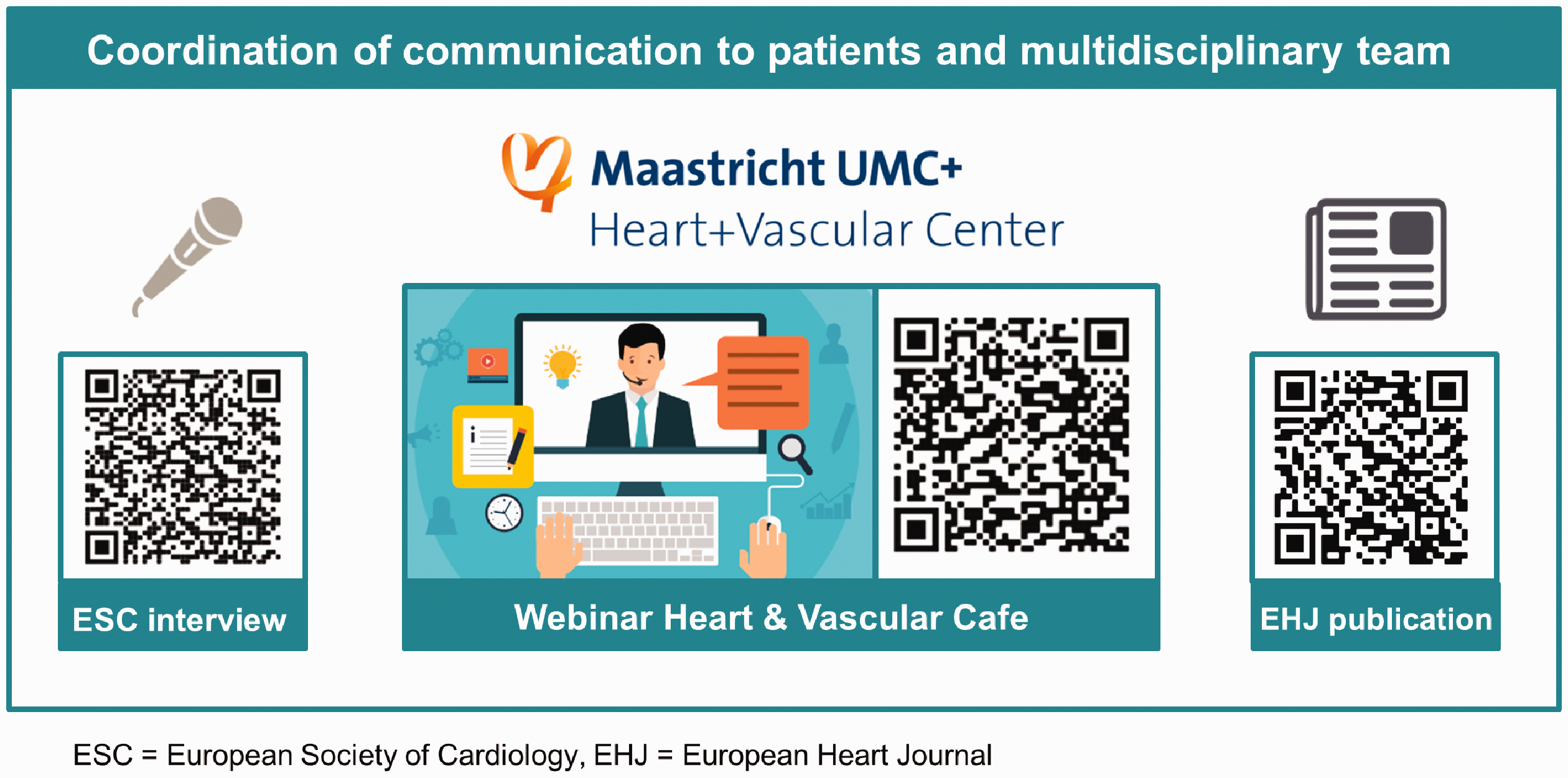
Coordination of communication to patients and multidisciplinary team
Coordination of infrastructures
One of the challenges to effectively implement the TeleCheck-AF approach in standard clinical care is the development and coordination of the mHealth infrastructure. Embedding the app in patient care requires a safe, reliable, patient-friendly, easy and non-time consuming to use infrastructure. Within TeleCheck-AF the mHealth infrastructure consists of the three important components (“Tele”, “Check”, “AF”). Standard operating procedure documents were developed to implement and standardize this approach for dissemination to other centres. 11 Experiences and feedback from patients and health care professionals were used to optimize the infrastructure and the coordination. Another important element for embedding this mHealth approach in clinical practices is the accessibility of the recordings by other healthcare professionals. For this, a connection with the patients’ Electronic Health Record (EHR), enabling automatic transmission of the recordings from the secured cloud to the EHR, is crucial and developments are currently guided by the Healthcare Innovation Lab of the Maastricht University Medical Centre+.
Implementation and initiation of TeleCheck-AF throughout hospitals in Europe
Currently, the TeleCheck-AF approach is implemented in 36 clinical centres throughout 12 European countries and this number is still growing. To allow this rapid expansion, we used social media (#TeleCheck-AF on Twitter and LinkedIn) to distribute information and experiences related to the project which stimulated and encouraged other centres to participate. The European Society of Cardiology featured TeleCheck-AF on its website. 16 We were invited for radio and television interviews and organized a video-conference to on-board new centres to explain how to use and set-up the TeleCheck-AF approach. The role of the initiating centre (MUMC+) is not only to familiarize the centres with TeleCheck-AF, but also to coordinate the project via weekly newsletters to provide updates to the participating centres and included patients, solve technical problems related to the mobile application, raise funds for project development and collect project information from various social media platforms to strengthen credibility.
Discussion
The TeleCheck-AF mHealth infrastructure has been developed to remotely assess information on heart rate and rhythm in patients with AF, to support teleconsultations during the COVID-19 pandemic. The approach has been rapidly embedded in the clinical setting and has been well adopted by patients and health care professionals. In fact, the TeleCeck-AF approach has been integrated in a way that it will remain even after the COVID-19 restrictions. However, it is crucial to evaluate the mHealth infrastructure and determine further utilization in the clinical pathway for arrhythmia patients. 17 The approach has potential to improve patient outcomes, increase access to health care providers whilst reducing health care utilization (i.e. outpatient visits and presentations to the emergency department) and decrease the burden on the health care system and cost. Despite these advantages, areas for improvement have been identified that should be considered in refining the TeleCheck-AF approach as part of the standard AF care.
Reimbursement is a barrier to more widespread adoption of mHealth in general. During the COVID-19 pandemic, technology and companies provided temporary support. Nevertheless, such support has limits and without a coherent funding system to cover such services, the application will be limited to those patients who may be willing to pay out-of-pocket for telemedicine solutions. In collaboration with the Healthcare Innovation Lab, Maastricht University Medical Centre+, discussions with government and health care insurers are ongoing to secure funding for the approach. Privacy and security of patient data is legitimate since patients may not exactly know who will be responding to and sharing their personal medical information. Reliable security and privacy legislation should be in place, and a robust privacy and security plan with identification of the data controller company (FibriCheck®) is essential. This should be communicated with patients and may increase patient confidence and reassurance.
As technology is advancing quickly, alternative media, e.g. short messages instead of email contact, may extend the communication between the case coordinator and the patient. In addition to just solving app-related technical problems and providing support, the coordinator’s role could be extended into coordination of the care process by means of collecting and assessing risk factors and provide additional material for lifestyle advices and disease self-management. This would ensure patient empowerment through engagement and providing personalised care.
After the COVID-19 pandemic, teleconsultations supported by the TeleCheck-AF approach could be provided as an alternative to traditional face-to-face visits in the outpatient department. Depending on patient preferences, the optimal strategy for each individual patient should be discussed between health care professional and patient and then selected in a shared decision making process. 18
The availability of new mHealth technologies and infrastructures such as the TeleCheck-AF approach may help to improve the quality of care, to increase access to the most optimal treatment tailored to the individual patient and to overcome equity issues related to demographics and socioeconomic status. More research is needed to develop and validate novel care pathways incorporating existing mHealth tools. One of the main requirements of future mHealth applications will be a flexible cloud infrastructure around it. This will allow the adaptation of the mHealth infrastructure to support the optimal care pathway instead of adapting the care pathways around an inflexible mHealth tool and infrastructure. Additionally, the mHealth end users, e.g. physicians and patients, should be involved from the early stages in the development and finetuning of future technologies. The TeleCheck-AF approach was initially developed in an AF outpatient clinic by close collaboration of a multidisciplinary team, including physicians and specialised AF-nurses together with secretaries who served as case coordinators. Along the track further development and refinement was undertaken based on valuable feedback from physicians, nurses, secretaries and patients, demonstrating the importance of a multidisciplinary approach. TeleCheck-AF represents an example of an on-demand health monitoring which can be tailored to the patient’s needs, values and preferences, and as such contributed significantly to the strengthening of AF services in responding to COVID-19.
Although the TeleCheck-AF approach is specifically designed for the management of AF, it has potential to be extended to comprehensive management of other conditions. As an example, it may be helpful to assess heart rate control in the treatment of heart failure. Moreover, the on-demand mHealth approach may serve as a basic principle which can be translated and tailored to the requirements of chronic conditions in which it is conceivable that the fundamental aspects of the approach will remain.
Conclusion
The TeleCheck-AF approach has been developed in the heat of the COVID-19 pandemic and was a significant source of support and reassurance for both patients and health care providers. Coordination appeared to be a key concept, intertwined with numerous aspects of the mHealth infrastructure: from empowering patients to self-manage the on-demand application, to implementation of the approach in clinical centres, aiming to strengthening the health system response to COVID-19. Nevertheless, despite the modes of care delivery, coordination of care will remain crucial to provide care that is responsive to individual patient values and preferences and aligns with evidence-based recommendations.
Footnotes
Declaration of conflicting interests
The author(s) declared no potential conflicts of interest with respect to the research, authorship, and/or publication of this article.
Funding
The author(s) received no financial support for the research, authorship, and/or publication of this article.
