




Abstract
This study focuses on the social inequalities embedded within chatbot-based customer service (CBCS) algorithms and those arising during their implementation, further examining users’ resistance strategies and their effectiveness. Using a netnographic approach and framed by critical algorithm studies and algorithmic resistance theory, this study analyzes discussions regarding CBCS use (N = 1081) from three major Chinese social media platforms, Weibo, Zhihu, and Xiaohongshu. The study identifies three mechanisms through which CBCS algorithms reproduce, intensify, and generate social inequality, namely barriers, stratification, and labor- and cost-shifting. These mechanisms operate across structurally distinct relationships, including among different user segments, between platforms and users, between platforms and human customer service staff, and between platforms and merchants, producing different forms of inequality in each relational context. Users’ resistance, whether within or beyond algorithmic frameworks, tends to be fragmented, structurally constrained, and limited in effectiveness, rarely translating into meaningful structural change. This study contributes to critical algorithm studies and algorithmic resistance research by identifying service mediation as a distinct mode of algorithmic power, developing a relational perspective on algorithmic inequality, and shifting the focus of resistance research from forms of resistance to their effectiveness in challenging structurally embedded inequalities.
Keywords
Introduction
With the rapid advancement of AI technologies, chatbot-based customer service (CBCS) has become increasingly mainstream across sectors such as e-commerce, social media, finance, logistics, education, and healthcare (Graham et al., 2025), and is widely promoted as an efficient and convenient default interface for service encounters (Zhang et al., 2023), particularly in China, where reported user exposure is widespread (iiMedia Research, 2025).
However, in sharp contrast to the widespread deployment of CBCS across platforms and their consistent portrayal by technology companies and media outlets as efficient and convenient, users have expressed strong dissatisfaction with their proliferation and with the replacement of human customer service staff (HCSS) (Chang and Hsiao, 2025; Huang et al., 2024). Many users report low service efficiency and frequent resolution failures (Sindermann et al., 2022). In China, CBCS-related complaints have consistently ranked second among all complaint categories (Ministry of Industry and Information Technology of the People's Republic of China, 2024a, 2024b, 2024c, 2025). Similar concerns are also evident globally, with one survey reporting that 39% of shoppers abandoned purchases following unsatisfactory CBCS interactions (Sophy, 2025).
More importantly, the continued deployment of CBCS has not slowed in response to technological immaturity, negative user feedback, or even formal complaints. On the contrary, CBCS has flooded the service market and is increasingly replacing HCSS (China Banking Association, 2023, 2024), making it more difficult for users to access HCSS when needed. This phenomenon suggests that what appears to be “service failure” is not merely a technological shortcoming, but may reflect a structural logic through which CBCS is strategically deployed to reproduce, intensify, and generate social inequality. Against this backdrop, the present study raises the following research questions:
Although existing studies on CBCS are relatively extensive (e.g. Graham et al., 2025), most focus on cultural differences in user acceptance (Liu et al., 2023) or design optimization (Xie et al., 2024; Yu and Zhao, 2024). In parallel, algorithmic resistance scholarship has primarily examined social media recommendation systems, where tactics target visibility (Bucher, 2017; Maris et al., 2025; Zhao, 2025a), and gig platforms, where individual or collective practices seek to mitigate algorithmic control and protect autonomy (McDaid et al., 2023; Veen et al., 2020). However, there remains a lack of in-depth inquiry into how inequality is reproduced in service-oriented algorithmic systems such as chatbots, and how users respond with resistance or compliance.
To address this gap, the present study adopts a netnographic approach, selecting Weibo, Zhihu, and Xiaohongshu as sites of online observation to collect public user discussions about CBCS. The analysis is guided by an integrated theoretical framework that combines algorithmic resistance theory with the perspective of critical algorithm studies. Algorithmic resistance refers to the strategic responses developed by users who, upon recognizing algorithmic bias, discrimination, and control, seek to resist, challenge, or subvert the power structures embedded within algorithmic systems (Velkova and Kaun, 2021; Zhao, 2025a). Critical algorithm studies, meanwhile, foreground the values and biases inscribed within algorithmic systems that may reproduce, exacerbate, or generate new forms of social inequalities (Airoldi, 2022; Burrell and Fourcade, 2021; Pellandini-Simányi, 2024; Tilly, 1998).
This study identifies three mechanisms through which CBCS systems reproduce, intensify, and generate social inequality, namely algorithms used as barriers, algorithms used for stratification, and algorithms used to shift labor and costs. These mechanisms operate across structurally distinct relationships, including among heterogeneous user segments, between platforms and users, between platforms and HCSS, and between platforms and merchants, producing different forms of inequality in each relational context. Against this backdrop, users’ resistance tends to be fragmented and structurally constrained, yielding at best limited, individualized relief rather than substantive change.
This study expands the scope of both critical algorithm studies and algorithmic resistance literature by offering an in-depth analytical focus on the understudied CBCS systems, identifying service mediation as a distinct mode of algorithmic power. Furthermore, by examining how inequality manifests differently across structurally distinct relationships within CBCS, this study develops a more context-sensitive perspective that moves beyond broad typologies of inequality reproduction and creation. More importantly, it calls for a shift in focus within resistance studies, moving beyond examinations of how users resist to assess whether such resistance is effective, to what extent, and under what conditions. In particular, the central question is whether resistance tactics merely address individual concerns or can meaningfully challenge structurally embedded algorithmic inequalities.
Literature review
Chatbots in online customer service
Empowered by large language models and characterized by 24/7 rapid responsiveness, CBCS has become an indispensable component embedded across platforms and industries. In China in particular, a society recognized as highly receptive and tolerant of new technologies (Liu et al., 2023), more than 95% of users have already encountered or interacted with CBCS (iiMedia Research, 2025), while the number of enterprises deploying such systems and the range of application domains continue to grow steadily (The First New Voice, 2024).
Against this backdrop, an increasing number of studies have focused on the effectiveness of CBCS and the factors influencing service outcomes. Findings suggest that despite the many advantages promoted by media and technology companies, CBCS, which remains at a relatively immature stage, often fails to meet ideal service standards in practice (Huang et al., 2024). On the one hand, CBCS performs well in handling simple queries but struggles with more complex issues (Graham et al., 2025; Xu et al., 2020), and service failures resulting from these complexities frequently require HCSS intervention (Xing et al., 2022). On the other hand, CBCS has a limited capacity to understand and respond to emotional concerns. Lacking human-like empathy, these systems tend to reduce user satisfaction and purchase-related outcomes, including repurchase intentions and acceptance of recommended services or products (Markovitch et al., 2024). More critically, CBCS is often ineffective in alleviating negative emotions such as anger and may even exacerbate conflict (Crolic et al., 2022). Consequently, CBCS-mediated interactions can impose losses on both users and companies, with users enduring poor service experiences and companies facing customer attrition (Sun, 2021) and reputational risks from negative word-of-mouth (Crisafulli and Singh, 2017).
While some progress has been made in improving CBCS's emotional responsiveness, such as using emojis, interjections, and other anthropomorphic design elements to enhance user satisfaction (Adam et al., 2021; Fan et al., 2024; Sheehan et al., 2024; Yu and Zhao, 2024), the effectiveness of these strategies remains contextually limited. For instance, while humor may improve user experience in casual, non-task-oriented conversations, it can distract users and lead to negative service outcomes in goal-oriented interactions (Xie et al., 2024). However, in terms of improving CBCS's capacity to handle complex issues, progress remains limited.
Paradoxically, despite CBCS's immaturity and frequent service failures, the number of HCSS has not been maintained at a level sufficient to address its limitations in handling complex issues. Instead, HCSS positions have been continually downsized (e.g. China Banking Association, 2023, 2024), further constraining users’ access to HCSS in CBCS-mediated service encounters. Although research on CBCS effectiveness and design optimization has been extensive, far less attention has been paid to the broader social implications of its large-scale deployment, including impacts on well-being and the reproduction, intensification, or generation of new forms of social inequality. How the values embedded in CBCS's algorithmic design shape these outcomes in practice remains underexamined.
Algorithms as sites of power and inequality
In an increasingly digitized society marked by the growing prevalence of intelligent systems and pervasive algorithmic interactions, both users and scholars have become more aware of the limitations inherent in viewing algorithms as purely objective technical tools (Chaudhuri, 2022; Seaver, 2014). Critical algorithm studies accordingly emphasize that algorithms are not neutral instruments but sociotechnical constructs shaped and maintained by humans, into which societal values are inscribed through processes such as data collection, variable selection, and model training (Gillespie, 2014; Kitchin, 2017; Kleinberg et al., 2018), enabling algorithms to regulate, classify, govern, and shape various aspects of everyday work, entertainment, and social life (Ziewitz, 2016).
Algorithms are thus more aptly conceptualized as sites of power. The social inequalities they produce are not accidental technical failures but structural consequences of societal values being systematically embedded in algorithmic classification and decision-making processes. Existing research suggests that algorithmic inequality encompasses both the reproduction and intensification of existing social inequalities, as well as the generation of new forms of inequality (Airoldi, 2022; Burrell and Fourcade, 2021; Pellandini-Simányi, 2024; Tilly, 1998). To this end, scholarly inquiry has explored multiple domains. Eubanks (2019), for example, examines automated public assistance systems and demonstrates how algorithmic bias disproportionately places poor and working-class families in the United States at risk. Noble (2018) analyzes how search engine algorithms reproduce and reinforce racial and gender stereotypes through the interplay of commercial and technical logics. In the domain of recommendation systems, Tofalvy and Koltai (2023) find that Spotify's recommendation algorithms tend to reproduce the existing core–periphery inequalities of the music industry, while Lin et al. (2024) show that news recommendation algorithms exert asymmetric effects on users with different usage motivations, exacerbating inequalities in information access and social capital accumulation.
Despite the breadth of research on algorithms and social inequality, the inequalities arising from CBCS remain largely unexplored. As CBCS increasingly mediates users’ attempts to seek help and lodge complaints, the algorithms embedded in these systems play a significant role in determining who is excluded and who receives preferential access. More importantly, prior research tends to examine algorithmic inequality within bounded domains and along single relational axes, without unpacking how a single system may simultaneously produce different forms of inequality across structurally distinct relationships. Existing frameworks that broadly distinguish between inequality reproduction and inequality creation therefore offer limited analytical purchase in such multi-relational contexts. This limitation is particularly salient in CBCS, which brings together interactions among heterogeneous user segments, platforms, HCSS, and merchants within a single algorithmic infrastructure. Responding to Kitchin's (2017) call to examine how algorithms operate in practice, this study moves beyond domain-level analyses to investigate how algorithmic inequality is differentially produced across relational contexts in the course of everyday system operation.
User agency in algorithmic resistance
Confronted with structural constraints imposed by opaque and often inequitable algorithmic systems, users do not passively accept marginalization but actively engage in resistance practices (Bucher, 2017; Zhao, 2025a). Algorithmic resistance refers to the strategic responses developed by users who recognize algorithmic bias, discrimination, and control, aiming to challenge, subvert, or bypass the power structures embedded within algorithms, both within and beyond algorithmic frameworks (Velkova and Kaun, 2021; Zhao, 2025a).
Much of the existing literature has focused on algorithmic resistance in content-centric environments such as social media platforms (e.g. Instagram, TikTok, YouTube) and search engines (e.g. Google). For social media platforms, studies emphasize how users engage in rule exploration to enhance and maintain their visibility (Cotter, 2019; Zhao, 2025a) or to avoid unwanted algorithmic push notifications (Bucher, 2017). For search engines, Velkova and Kaun (2021) analyze the White World Web campaign initiated by Swedish students to counter racialized search results. Parallel research on gig economies reveals a different dimension. Workers on platforms like Uber or food delivery platforms resist performance-based algorithmic management through informal tactics to protect their income and autonomy (McDaid et al., 2023; Veen et al., 2020).
While the body of work on algorithmic resistance is rich and expanding, relatively little attention has been paid to resistance in service-based algorithmic systems such as CBCS. Unlike recommendation or labor algorithms, CBCS regulates access to services and HCSS, making resistance fundamentally about contesting service responsiveness, problem resolution, and human intervention. Recent research identifies a phenomenon termed “gatekeeper aversion,” describing users’ reluctance to engage with an imperfect initial chatbot service stage that may require transfer to a human agent (Kagan et al., 2025), yet fewer studies investigate how users actively respond when compelled to interact with CBCS for problem resolution. Accordingly, the forms, strategies, and limits of algorithmic resistance in CBCS environments remain underexplored and warrant sustained scholarly attention.
Method
This study adopts a netnographic approach to investigate public discussions about CBCS across three major Chinese social media platforms, Weibo, Zhihu, and Xiaohongshu, China's microblogging, Q&A, and lifestyle-sharing platforms, roughly analogous to Twitter, Quora, and Instagram, respectively.
This methodological choice is grounded in three key considerations. First, the widespread deployment of CBCS in China has triggered significant public dissatisfaction, with critical coverage even appearing in the country's most authoritative news outlet, People's Daily (Lü, 2025). Online discussions on CBCS-related experiences are extensive, making netnography an ideal strategy to ensure both sufficient data volume and diversity of perspectives. Second, drawing on non-intrusive, naturally occurring expressions allows the collection of more authentic attitudes and behaviors, while avoiding typical limitations of interviews such as recall bias and social desirability effects (Althubaiti, 2016). Third, the selected platforms represent the primary venues for public discourse in China, enabling coverage across diverse demographic groups (Zhang, 2020; Zhao, 2025b). Cross-platform triangulation further enhances the robustness and credibility of the results.
Data were collected using Python-based scraping tools on each platform, employing keywords such as “自动回复” (auto-reply), “转人工” (transfer to human), “机器人客服” (robotic customer service), “AI客服” (AI customer service), and “客服机器人” (customer service chatbot). The unit of analysis consists of user-generated social media posts in which users describe and reflect on their experiences interacting with CBCS, rather than system logs or platform-provided interaction records. The posts included in the dataset were published between 2 January 2023 and 12 January 2025. Data collection was conducted between 24 October 2024 and 12 January 2025. After removing empty or irrelevant entries (e.g. cases where terms such as “robot reply” were used metaphorically to describe repetitive human conversations), a total of 1781 posts were retained for analysis, including 254 from Zhihu, 427 from Xiaohongshu, and 1100 from Weibo.
Prior to finalizing the sampling strategy, the author conducted an initial, preparatory screening of posts across platforms and developed a preliminary codebook through iterative memoing and pilot coding. These exploratory steps were undertaken solely to inform the sampling design and analytical scope, rather than to generate substantive findings. Given the substantially different data volumes across platforms, a mixed sampling strategy was adopted. All posts from Xiaohongshu (N = 427) and Zhihu (N = 254) were included due to their manageable size. For Weibo, where the number of relevant posts was considerably larger, a random sampling strategy was employed. An initial sample of 500 posts was selected to maintain approximate cross-platform comparability while ensuring feasibility for in-depth qualitative analysis, of which 400 posts were included in the main analysis, and 100 were reserved for saturation testing. As no new themes emerged during the saturation check, the final analytical dataset consisted of 1081 posts. Of these, 802 were posted by ordinary users, 167 by HCSS, and 112 by platform merchants. Actor classification was based on explicit self-disclosure within the post content (e.g. references to one's role as a customer service representative or merchant; otherwise, posts without occupational identifiers, typically describing users’ experiences interacting with AI customer service, were classified as ordinary users). Importantly, the analysis does not aim to estimate platform-level prevalence or proportional distributions of resistance practices. Instead, it focuses on identifying recurring types of resistance practices and analytical themes across platforms. Accordingly, the use of differential sampling strategies was considered appropriate for the analytical aims of the study.
Thematic coding was conducted collaboratively by the author and a trained research assistant, following Saldaña's (2016) multi-cycle coding model: (1) Both coders independently reviewed and familiarized themselves with the dataset; (2) Initial codes were developed through line-by-line analysis, guided by the frameworks of algorithmic resistance and critical algorithm studies, focusing on users’ explicit descriptions of resistance tactics, strategic actions, and articulated understandings of algorithmic systems; (3) The coders compared their initial codes, discussed discrepancies, and established a consensus-based coding protocol; (4) Drawing on the outcomes of this initial coding round, each coder independently conducted a second round of coding, aggregating first-cycle codes into higher-order conceptual categories and key analytical themes; (5) Further discussion and negotiation led to agreement on final themes; (6) To ensure consistency, both coders applied the finalized coding scheme to re-code the original dataset, and no further discrepancies were identified during this final round; (7) An additional 100 posts were used to test thematic saturation, with no new codes or themes emerging, indicating that thematic saturation had been reached. Table 1 presents the thematic framework that emerged from the coding process described above.
Thematic framework.
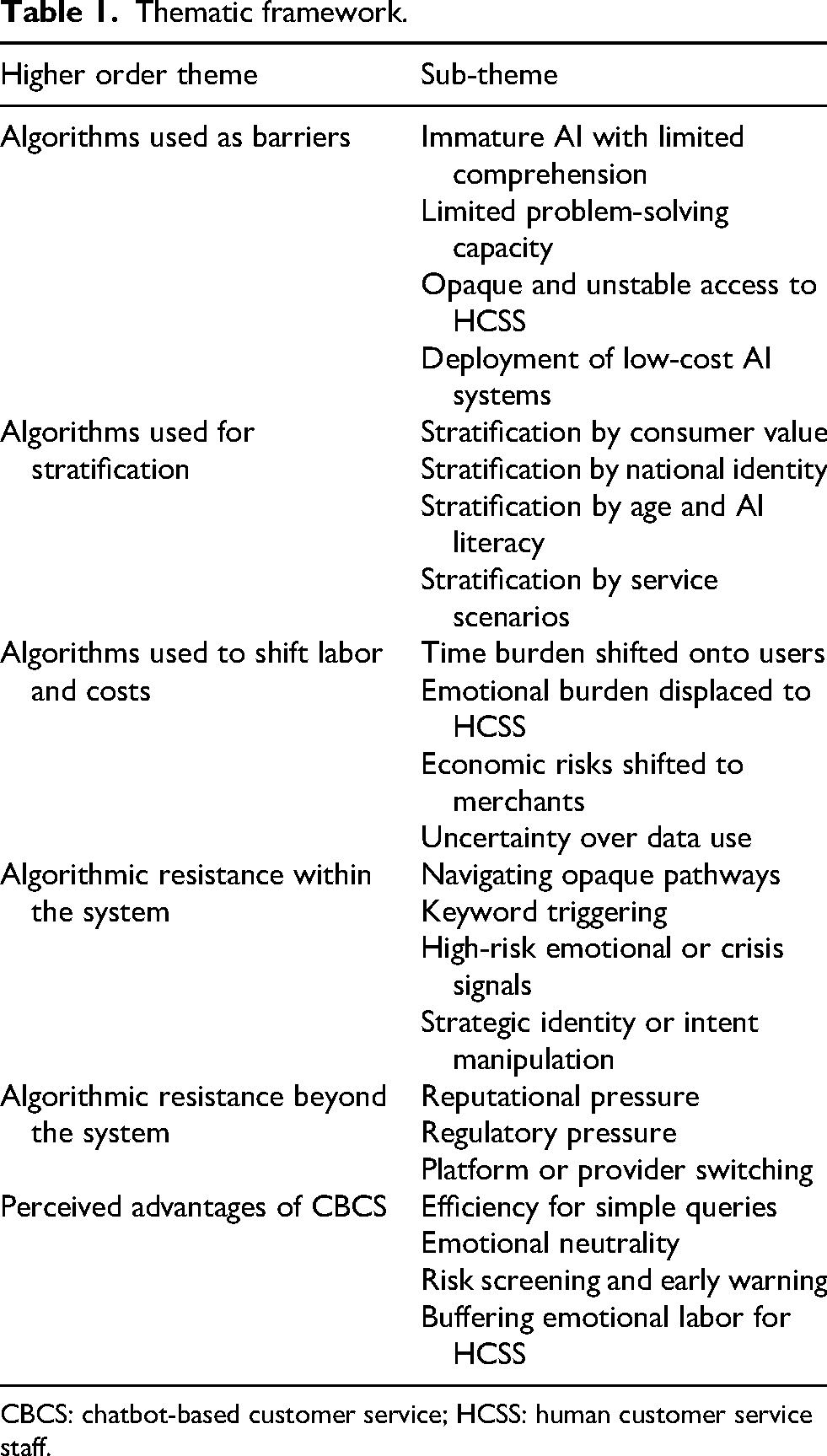
CBCS: chatbot-based customer service; HCSS: human customer service staff.
This study is informed by critical algorithm studies, which foreground issues of power, inequality, and user agency in algorithmic systems. This theoretical orientation may have shaped the analytical focus on resistance practices and structural constraints as articulated in users’ retrospective narratives of their interactions with CBCS. To mitigate the risk of over-interpretation or theoretical imposition, the coding process was conducted collaboratively by two coders, followed by iterative discussion, consensus-building, and re-coding of the dataset. Discrepancies were explicitly discussed, and analytical categories were grounded in users’ explicit narratives rather than pre-defined theoretical expectations.
In addition to collecting user-generated posts, the author conducted sustained online observation of user discussions related to CBCS on the selected platforms during the 6 months preceding data collection. Observation sessions were conducted on two non-consecutive days each month to capture variation across different periods. Detailed field notes were maintained throughout the observation period.
To further contextualize users’ narratives, the author also engaged in interactions with CBCS across different platforms. This experiential engagement was not included in the analytical dataset and was used solely to provide contextual background for interpreting users’ posts.
Ethical integrity was a central concern throughout this study. All data were drawn from publicly accessible sources in accordance with platform guidelines and digital research ethics standards (Buchanan and Zimmer, 2023). No personal identifiers (e.g. usernames, profile links, or real names) were retained in the analysis or reporting.
Findings and discussion
Before turning to the structural inequalities embedded in CBCS, it is essential to acknowledge the functional advantages that such systems have demonstrated in real-world applications. For users, CBCS is notably efficient at handling simple queries. Echoing previous research (Graham et al., 2025), many users note that CBCS “can handle basic problems quickly and effectively.” Moreover, the emotional neutrality of CBCS is considered an advantage because, unlike HCSS, chatbots do not exhibit sarcasm, impatience, or verbal retaliation, thereby reducing the likelihood of emotionally charged or hostile interactions during service encounters. 1
For merchants, CBCS offers operational advantages in both risk mitigation and commercial conversion. First, CBCS systems are equipped with alert mechanisms that flag potentially problematic users, such as those with low credit scores or frequent disputes, and prompt early handover to HCSS. Some merchants reported that the system could automatically issue warnings, halt interactions, and trigger early handover to HCSS, allowing them to respond more cautiously and mitigate potential losses. Second, CBCS improves efficiency by handling high volumes of inquiries simultaneously across platforms. One practitioner reported that integrating CBCS across seven new media accounts (e.g. Xiaohongshu, Douyin, and WeChat Video Channels) enabled seamless, real-time engagement without missed or misrouted queries, particularly during late-night hours when automated responses boosted conversion and retention. Beyond reactive service, CBCS also supports proactive outreach, including follow-ups and marketing, at a relatively low monthly cost of approximately 1000 RMB.
For HCSS, the integration of CBCS may even represent a form of technological care. Many former HCSS have shared their experiences of emotional burnout online, often recounting difficult interactions with unreasonable or abusive customers. As one commenter put it: “For hotline services, 12345
2
should be formal and authoritative enough. As far as I know, most 12345 call centers in major cities have ‘venting rooms’ … Their operators often have to act as psychological counselors … From a humanitarian standpoint, if machines can handle it, don’t involve humans. It's just too cruel.”
Algorithms used as barriers: immature and limited artificial intelligence capabilities in chatbot-based customer service and the concealment of access to human customer service staff
While advances in large language models have significantly enhanced the fluidity of human–AI interaction and even fostered a certain degree of human reliance on AI-powered conversational agents (Zhai et al., 2024), the performance of CBCS in everyday service encounters stands in stark contrast. Rather than offering seamless assistance, they often frustrate and irritate users. The reasons behind this paradox do not lie solely in technological underdevelopment, but also in design choices, such as the deployment of immature AI systems. Many CBCS systems operate as basic automation, relying on keyword matching and templated responses rather than robust language understanding. As one user put it, “I don’t even want to talk about that so-called AI that auto-replies to keywords. It's artificial stupidity.”
The prevalence of these systems is closely tied to economic considerations. Although deploying high-quality AI chatbots is technically feasible, doing so requires substantial financial investment in model training, infrastructure maintenance, and knowledge base construction. These costs often exceed the expense of hiring HCSS. As developers noted, “AI compute resources are still quite expensive.” They further added, “It's not cheaper to run AI customer service. It requires extensive training and building a large knowledge base, all of which costs money.” Another user reported: “The chatbot we use at work requires monthly subscription fees. Maintaining each customer service account actually costs more than paying human wages. Yes, it is intelligent, but far too expensive.”
In practice, immature AI systems demonstrate limited capacity for both understanding and resolution. Regarding comprehension, both voice-based CBCS systems’ recognition of dialects and text-based CBCS systems’ understanding of user queries are constrained by limited or outdated corpora (Li et al., 2024). As a result, users frequently receive generic replies such as: “Sorry, I didn’t understand your request. Could you rephrase it?” or “Sorry, XX is still learning and hasn’t yet understood your issue. Could you try saying it another way?” In such cases, users have no effective means of resistance and are forced to adapt to the communicative mode of CBCS, often unconsciously enunciating clearly or rephrasing their requests in a manner that the AI can understand. These interactions significantly diminish the user experience. Users report feeling as though they themselves have been forced to “speak like an AI” when interacting with CBCS.
In terms of problem-solving, due to comprehension errors and the lack of timely updates to training corpora, CBCS systems often provide irrelevant or misleading responses. For example, one user recounted online how they were misled by CBCS. They had inquired about the availability time for promotional coupons on a shopping platform, and the CBCS responded, “The official release times for beauty coupons are 10 a.m. and 8 p.m., but you can access the event site at midnight to prepare. That way, you’ll be able to grab the coupon more quickly when it's released.” Following this suggestion, the user stayed up until midnight to participate in the event, only to find that no coupons were issued, leading to considerable frustration.
More importantly, although CBCS has been widely implemented, many enterprises and institutions do not grant these systems the authority to actually resolve problems, given their limited capabilities. As a result, users must still rely on communication with HCSS to obtain satisfactory resolutions. However, rather than offering intelligent triage, CBCS often serves as a barrier to accessing HCSS.
Many platforms deliberately conceal or obscure pathways to HCSS. Transfer options may be deeply buried in menu trees, or the algorithmic sensitivity to keywords associated with HCSS transfer requests is intentionally low. Numerous users report that transferring to HCSS has become increasingly difficult. Some describe these methods as “known only to insiders familiar with internal procedures.” Others discovered that the pathway to HCSS was not only hidden but uncertain, stating, “Whether HCSS is activated depends on the system's judgment based on user identity and conversational context. The rules vary from person to person.” In many cases, users could not find any path to reach HCSS at all.
Taken together, these opaque and procedurally mediated barriers transform technical limitations into durable access constraints. In doing so, they reproduce and intensify existing inequalities between platforms and users, as algorithmic design systematically constrains users’ access to HCSS.
To resist these algorithmically imposed barriers, users have developed tactics within and beyond the algorithmic framework (see Table 2). Within the algorithmic framework, resistance is marked by considerable uncertainty, as none of the methods shared among users can ensure consistent success. For example, one widely adopted tactic involves sharing detailed step-by-step procedures for locating hidden options to “transfer to HCSS,” in an effort to make access pathways more transparent. Yet, this approach proves ineffective for some users, who are still unable to locate a viable entry point despite closely following the instructions. In addition, keyword-trigger mechanisms, in which users input specific terms such as “transfer to HCSS” and “complaint,” or express anger and offensive language, to prompt access to HCSS, have shown signs of declining effectiveness as such tactics become more widely used. More critically, this may pose risks to the timeliness of HCSS support in situations of genuine urgency. Indeed, widespread user experiences appear to confirm this concern. Many have reported that even when entering critical terms such as “suicide,” they did not receive timely support.
Resistance strategies and methods related to “transfer to HCSS.”
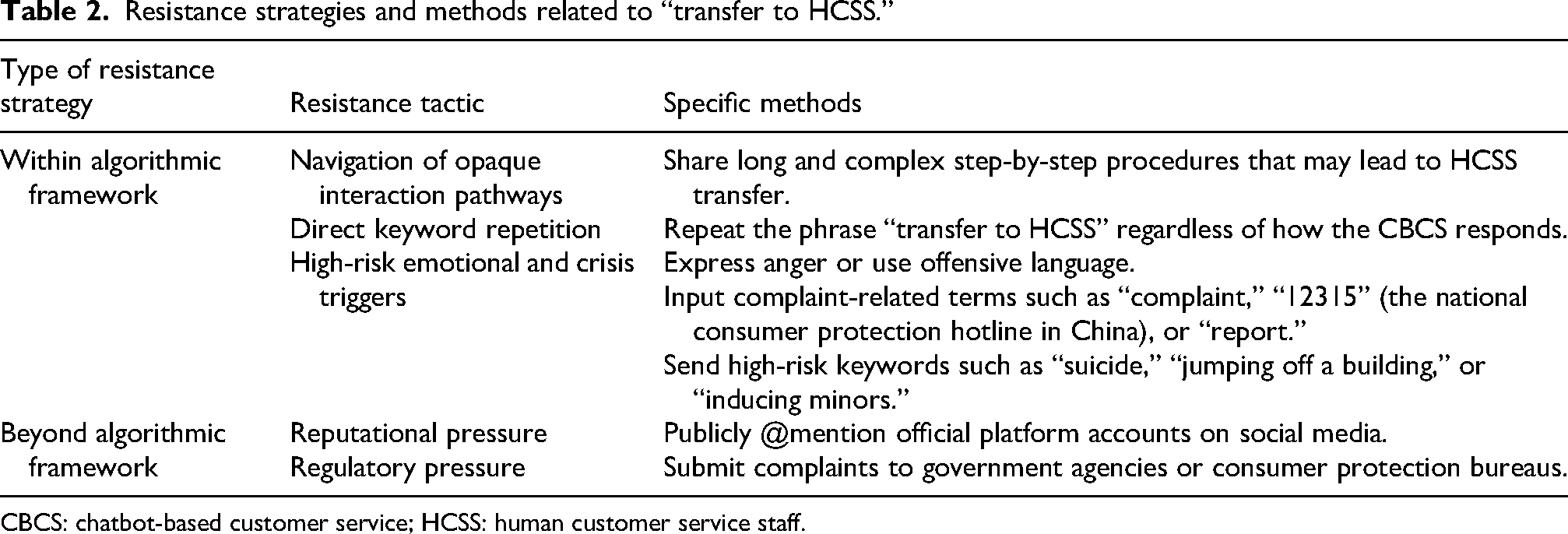
CBCS: chatbot-based customer service; HCSS: human customer service staff.
As for resistance tactics beyond the algorithmic framework, publicly tagging official accounts on social media has demonstrated limited effectiveness, as many users fail to receive timely responses. In contrast, filing complaints to exert regulatory pressure on relevant authorities appears to yield better results. Nonetheless, these measures tend to produce only sporadic case resolutions and do not fundamentally resolve the ongoing challenges associated with accessing HCSS support.
Algorithms used for stratification: allocating access to human customer service staff based on user value and service scenarios
The large-scale deployment of CBCS systems has been accompanied by a significant reduction in HCSS. In China's banking sector, for instance, the number of HCSS dropped from 50,200 in 2021 to 41,700 in 2024, representing a loss of 8500 jobs (Jiang and Cheng, 2024). The limited problem-solving capacity of CBCS, coupled with the diminishing availability of HCSS, has rendered HCSS a scarce resource. Moreover, platforms and enterprises increasingly rely on algorithmic systems to determine which users are granted priority access to HCSS, based on user attributes and service scenarios. In this process, CBCS-driven allocation mechanisms do not address long-standing disparities in access to HCSS but instead reproduce and intensify them by embedding differential access into routinized algorithmic decision-making. These mechanisms operate across multiple relational axes, including those among different user segments and between platforms and users more broadly.
First, stratification occurs along the axis of consumer value. Users with higher spending power or VIP status are typically granted prioritized access to HCSS via exclusive pathways, while regular users are compelled to engage in extended chatbot interactions and tolerate long delays. Many users report, “Black diamond members get dedicated HCSS,” or “Once you top up 100,000 yuan and reach Level 3 in the ‘Xinyue’ VIP system 3 , Tencent's HCSS will add your WeChat and chat with you at any time.” In contrast, ordinary users often report never having successfully reached HCSS. Faced with this value-based stratification, ordinary users have little recourse, as the required top-ups and membership thresholds are financially unattainable for many.
Beyond consumer value, stratification also operates along age and AI literacy. Particularly affected are older adults with low AI literacy (Kong and Wang, 2024), who struggle to distinguish between high-fidelity CBCS and real HCSS. Many are unable to navigate AI interactions independently and must rely on assistance from younger family members. For example, one user noted, “Online you are stuck looping with the chatbot, and on the phone you are stuck looping with automated voices. Defending your rights is really not easy. It's difficult even for young people. For older adults, it is even harder.” Another commented that “When dealing with this so-called ‘intelligent’ (but actually unintelligent) AI customer service, older family members simply cannot manage it on their own.” In the face of such algorithmically embedded inequality, users mostly resort to voicing their frustrations on social media, as few effective resistance tactics exist within or beyond the algorithmic framework.
Then, stratification appears along national lines. As shared on social media, some users found that customer service channels intended for international users more readily connected them to HCSS. Although the reasons for this phenomenon remain inconclusive in the collected data, users interpreted this as a form of unfair favoritism and expressed strong emotional discontent, stating, “It's absurd that a Chinese company, operating on Chinese soil and profiting from Chinese people, behaves like a foreign-worshipping enterprise.” To circumvent this perceived algorithmic gatekeeping, some users adopted strategic identity manipulation, a tactic within the algorithmic framework. When unable to connect with HCSS via domestic channels, they reported success by accessing English-language portals, initiating the conversation in English, and switching to Chinese once connected, thus enabling more efficient HCSS transfer.
Finally, stratification is also based on service scenarios. User reports across platforms suggest a recurring pattern in which access to HCSS appears easier in profit-oriented scenarios, such as marketing, while support in after-sales contexts is perceived as significantly more limited. Many users reported, “The difficulty is not in accessing HCSS support per se, but in doing so during after-sales processes.” To counter this, users again employed strategic intent manipulation tactics. By inputting terms related to business profits or potential losses, users were often able to access HCSS effectively. One shared, “Just click the one for advertising and you’ll be connected in one second.” Another noted, “Every time I want to talk to the platform's customer service, I type things like ‘undercharged amount’ or ‘freight underpaid’ or ‘commission underpaid.’”
In addition to the tactics within the algorithmic framework discussed above, users also pursue resistance strategies beyond it (see Table 3). Some opt to disengage from platforms whose algorithmic designs overtly privilege high-value users, choosing instead those perceived as more equitable. However, such efforts are often constrained by oligopolistic or monopolistic market structures. For instance, Tencent's WeChat has become deeply embedded in the fabric of Chinese digital life (Plantin and de Seta, 2019), leaving users with no viable alternatives despite growing dissatisfaction with its CBCS system. A similar situation exists in sectors such as food delivery (e.g. Meituan, Ele.me), logistics (e.g. SF Express, YTO, ZTO), and e-commerce (e.g. Taobao, JD.com), where CBCS algorithmic designs appear to be similar in users’ experience. Although users appear to have choices, these are often superficial, offering little meaningful differentiation in terms of service accessibility. Consequently, such strategies have limited capacity to reshape underlying algorithmic value orientations. Nevertheless, users continue to voice frustrations on social media, calling for alternative platforms to counter monopolistic control. They hope that enhanced competition might incentivize greater investment in HCSS. Yet such public appeals have done little to change the unequal allocation of access to HCSS.
Resistance strategies and methods for gaining priority access to HCSS.
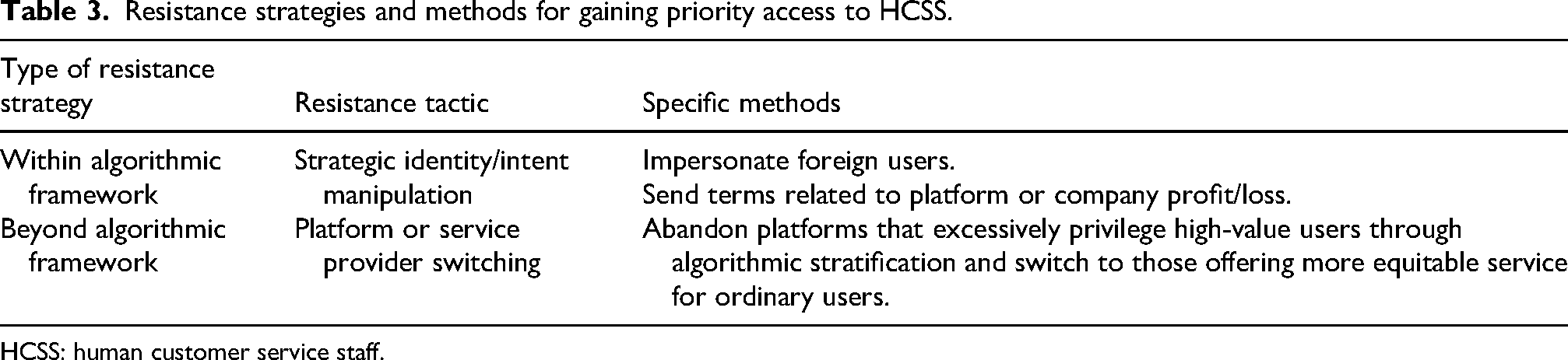
HCSS: human customer service staff.
Algorithms used to shift labor and costs: the triple exploitation of users, human customer service staff, and platform merchants
CBCS developers, service providers, and adopting platforms or enterprises often promote CBCS as offering 24/7 availability, rapid response, and cost efficiency. While these features may reflect technical strengths in some scenarios, the claimed efficiency is not purely technological but largely enabled by a redistribution of labor. In practice, CBCS is often not designed to resolve issues autonomously. Instead, it deflects burdens that would otherwise fall on platforms or companies onto users, HCSS, and third-party sellers. This transfer of time, emotional, and operational costs underpins the illusion of automation efficiency. Crucially, this redistribution operates across structurally distinct relationships, between platforms and users, between platforms and HCSS, and between platforms and merchants, each producing different forms of inequality. Through these processes, CBCS not only intensifies existing inequalities by redistributing time, emotional, and coordination burdens, but also generates new forms of inequality by reconfiguring labor relations and responsibility boundaries across users, HCSS, and merchants.
For users, the most salient form of exploitation lies in the extraction of time, a burden increasingly shifted onto them throughout the service interaction process. Within the current workflow, users are required to first interact with the CBCS system. If the issue is resolved, the conversation ends; if not, the system transfers the user to HCSS for more complex problems. During interactions with CBCS, users frequently report spending excessive time attempting to articulate their issues, often finding themselves caught in repetitive and irrelevant loops. These challenges intensify when users attempt to locate a pathway to HCSS. As one user shared on Weibo, they had to try all available options and navigate 15 steps before finally reaching HCSS. Even after entering the transfer stage, waiting times remain inconsistent and often lengthy. In the data collected for this study, reported waiting periods ranged widely, from “20 min” to “1 to 2 h.” Compounding this, users are expected to remain continuously engaged throughout the process. If the connection is interrupted, they must restart the entire procedure from the beginning. This cumbersome and fragmented workflow often leads users to disengage from the complaint process altogether, weakening the practical enforceability of their claims. Faced with such conditions, users have few effective means of resistance. Whether users comply with the algorithmically structured path or turn to formal complaints that, while bypassing CBCS, remain protracted, the time burden is ultimately redistributed onto them.
Beyond these user-initiated burdens, users also face platform-initiated disruptions that extract time and interfere with user routines. Users frequently report that CBCS systems are used for large-scale advertising outreach and customer follow-up interactions, particularly in outbound communication contexts. This practice is widely perceived as reducing reliance on HCSS and enabling high-volume operations to be carried out more efficiently. From the users’ perspective, this reflects a clear asymmetry in time investment. Enterprises can initiate thousands of outbound messages or calls through CBCS with minimal effort, while users must spend far more time responding. This form of invisible time exploitation often leaves users feeling disrespected. As one user lamented, “I really hate this. How can a robot take up the time of a living human being like me?” Moreover, to meet preset performance metrics, CBCS-driven marketing and follow-up tasks often ignore users’ availability, disrupting daily life. One user complained, “It took me ten calls to reach HCSS at China Telecom. Then they kept calling me over and over to ask for a satisfaction rating… I got nothing done for a whole hour… and now you want a five-star review?” Another reported that an Anhui Unicom CBCS called at 12:30 a.m. for a satisfaction survey. In response, many users adopt defensive tactics, such as hanging up upon detecting an AI-generated voice and refusing to engage. Yet realistic synthetic speech can blur the boundary between humans and bots. When users realize, often only after extended interaction, that they have been speaking with CBCS, they express deep frustration and powerlessness.
For HCSS, emotional labor exploitation is particularly salient. Although conversational chatbots have advanced in affective expression (Zhang et al., 2024), their performance in customer service remains limited (Castelo et al., 2023). Prior research suggests that CBCS's friendly tone and emoticons may enhance user experience in entertainment contexts, but in task-oriented service interactions they are less effective and can even trigger aversion, often perceived as “cold politeness” (Xie et al., 2024). Inaccurate or off-topic replies further escalate frustration (Crolic et al., 2022), leaving users without a meaningful outlet. As users described, “Arguing with an AI just makes me feel dumb,” or “It's like a cold and indifferent man silently watching me go hysterical.” Whether frustration is produced by the cumbersome transfer process or by CBCS responses, the emotional fallout is ultimately displaced onto HCSS. As one user put it, “By the time I get through to HCSS, I’ve lost all patience. How could I possibly be polite?” Another, an HCSS staff member, noted, “I don’t know what chatbots are for, other than irritating customers.” Thus, CBCS does not remove emotional labor so much as redistribute it, shifting both baseline workload and upstream-generated affective burdens onto HCSS, who currently lack effective strategies to resist or mitigate these pressures.
For merchants operating on large e-commerce platforms, CBCS can also undermine their interests. Losses arise when CBCS is deployed without merchants’ knowledge, generating inaccurate automated replies such as arbitrarily promising shipping times or compensation, and ceasing to alert merchants to new inquiries once it has responded automatically, which leads to missed messages, negative reviews, and reduced sales. Beyond these initial losses, CBCS's unauthorized intervention continues to generate costs even after HCSS takes over. The system may still auto-respond to keywords, forcing staff to explain that some messages are automated and should be disregarded. This is especially problematic in after-sales contexts where the system may automatically initiate compensation upon detecting an issue, resulting in financial losses for merchants. 4 As one merchant put it, “A wrong shipment had been agreed to be replaced directly. When the customer asked how to return the incorrect item, the CBCS automatically triggered a refund and return process. Consequently, the money was refunded, and the prior agreement for replacement became awkward, requiring the customer to place a new order.” Merchants express helplessness, noting that beyond advising customers to distinguish CBCS messages from human ones, they have found no effective strategies to resist or mitigate these impacts.
Finally, from the perspectives of users, HCSS, and merchants, all parties are, in a sense, engaged in uncompensated “ghost work” (Gray and Suri, 2019). The forced involvement of CBCS systems and their data collection practices constitutes a more concealed form of exploitation. Netnographic observations suggest that neither platforms nor companies typically offer stakeholders the option to opt out of CBCS systems prior to deployment, nor do they provide clear statements regarding privacy or the intended use of conversational data. Although there is no conclusive evidence that chat data from CBCS interactions is directly used for subsequent model training, the absence of disclosure has led many users to express skepticism. As Shin (2025a) emphasizes, algorithmic bias and trust cannot be examined purely as technical matters but must be understood through users’ relational and interpretive judgments about system intentions. In CBCS, the opacity surrounding data collection and the absence of meaningful disclosure substantially undermine this relational trust, thereby deepening users’ skepticism toward the system. This has, in turn, fueled resistance to CBCS, with some users explicitly stating that they refused to interact with it, saying they did not want to be used as “free AI training data.”
Conclusion
This study focuses on three interrelated questions concerning CBCS: how structural inequalities in users’ service experiences are manifested through the deployment and operation of CBCS, how these mechanisms are reproduced and reinforced through everyday user interactions, and what forms of resistance are adopted by users. Drawing on netnographic methods, the analysis is situated within the framework of critical algorithm studies and theories of algorithmic resistance. The study identifies three mechanisms through which CBCS systems reproduce and reinforce social inequality. First, immature CBCS technologies often operate as an additional procedural layer that restructures service pathways, making it difficult for users to resolve issues efficiently or to navigate toward HCSS when needed. Second, the large-scale deployment of CBCS reduces HCSS availability, contributing to conditions of constrained access to HCSS and stratifying service access across user profiles and service scenarios. Third, the system shifts labor and operational costs onto users, HCSS, and merchants, achieving its apparent efficiency not through automation alone but through reliance on others’ ghost work.
These findings reveal that algorithmic inequality in CBCS is not a singular phenomenon but manifests differently across distinct relational contexts. Between platforms and users, inequality primarily takes the form of access barriers and time exploitation. Among different user segments, it operates through value-based and identity-based stratification of HCSS access. Between platforms and HCSS, inequality manifests as the displacement of emotional labor. Between platforms and merchants, it emerges through unauthorized algorithmic intervention and the redistribution of economic risks.
In response to these systemic mechanisms, users often lack effective means of resistance and are compelled to accept the algorithmically structured service process. When resistance does occur, whether within the algorithmic framework (e.g. keyword manipulation or strategic identity performance) or beyond the algorithmic framework (e.g. public criticism or regulatory appeal), it tends to be fragmented and limited in effectiveness. Such efforts rarely exert structural influence over the design or implementation of CBCS. Compounding this limitation, although there is no direct evidence of intentional co-optation, users’ recurring reports that once-effective tactics gradually lose their utility suggest a dynamic in which, as CBCS systems evolve, the effectiveness of user-led resistance may decline over time. This pattern underscores the constrained leverage users can exert under structurally embedded algorithmic inequality.
At the theoretical level, this study first extends critical algorithm studies by identifying service mediation as a distinct mode of algorithmic power. In CBCS, algorithms intervene at critical moments when users seek help and problem resolution, determining not what users see or how they work, but whether and when they receive support. Compared with recommendation and labor platform algorithms, inequality in service mediation is experienced more directly due to its immediacy and situational urgency. CBCS should thus be understood not merely as a service technology, but as a site through which users experience and negotiate wider automated decision-making and communication infrastructures (Danaher et al., 2017; Katzenbach and Ulbricht, 2019; Shin, 2026). The study further demonstrates that algorithmic inequality is embedded not only in technical design but also in social implementation. Examining this emerging site of algorithmic governance provides early warnings about the governance risks associated with unreflective system design and deployment.
Second, the relational analysis presented in this study moves beyond existing typologies that broadly distinguish between inequality reproduction and inequality creation, demonstrating that a single algorithmic system can simultaneously produce different forms of inequality across structurally distinct relationships. This relational perspective offers a more context-sensitive framework for understanding algorithmic inequality in multi-stakeholder service environments.
Third, this study advances research on algorithmic resistance by moving beyond analyses of its forms and logics to examine its effectiveness. It raises further questions about whether user actions, organized or everyday (e.g. Maris et al., 2025; Velkova and Kaun, 2021) and situated within or beyond algorithmic frameworks (Zhao, 2025a), can meaningfully challenge structurally embedded algorithmic inequalities in practice, or may instead be absorbed, neutralized, or redirected through system operations. This line of inquiry remains underexplored but is crucial for understanding the limits of resistance under algorithmic governance.
At the practical level, this study has direct implications for policymakers in China and other countries where CBCS is expanding. Regulators should remain vigilant about the social inequalities embedded in CBCS and take proactive measures to mitigate them. First, algorithmic auditing of CBCS should be strengthened by combining expert assessment with systematic user feedback to identify and rectify inequitable outcomes. Second, accountability and supervisory governance should be reinforced to prevent platforms and companies from using CBCS to evade responsibility. This requires clear standards for CBCS deployment and accompanying HCSS provision, including tailored pathways for older adults and other users with limited AI literacy, as well as safeguards for users’ ability to opt out of digital-only service models. Noncompliant platforms and companies should face appropriate penalties to reinforce institutional accountability and promote service equity. Finally, the opacity of CBCS privacy policies and data practices should be addressed to protect users’ data security.
There are, however, a few limitations that warrant discussion. First, the analysis primarily draws on user-generated discussions from social media. While these provide rich insights into user experiences, they lack perspectives from technology companies and the platforms or enterprises that adopt CBCS systems. Given this limitation, the study is unable to examine structural interventions such as organizational design, governance mechanisms, or transparency frameworks that shape how CBCS systems are constructed and might be reformed (Shin, 2025b). Addressing these questions would offer a fuller understanding of whether CBCS systems may evolve in ways that promote greater social equity. Second, this study focuses predominantly on Chinese platforms. Whether the identified mechanisms are applicable across different geographic and sociotechnical contexts warrants further empirical investigation. Finally, because many user posts do not clearly indicate the specific interaction context or platform, this study focuses on cross-platform structural mechanisms rather than developing platform-level or scenario-specific typologies. Future research could incorporate platform-specific datasets or adopt multi-method designs to analyze more fine-grained variations in CBCS deployment and user resistance across different service environments, including differences across platforms and service scenarios.
More broadly, future research should move beyond documenting how users resist to systematically evaluating how effective these acts of resistance are across contexts. In particular, scholars should examine whether, how, and under what conditions user resistance can produce durable changes in structurally embedded algorithmic inequalities. This line of inquiry can generate actionable evidence by specifying the mechanisms, boundary conditions, and sociotechnical configurations under which resistance is more likely to translate into meaningful institutional or design-level transformations.
Footnotes
Acknowledgements
The author sincerely appreciates Editor-in-Chief Jennifer Gabrys, Associate Editor Matthew Zook, and the three anonymous reviewers for their thorough review and constructive feedback. Their insightful comments and patient guidance have significantly improved the quality of this paper.

Ethical approval and informed consent statements
There are no human participants in this article, and informed consent is not required.
Funding
The author received no financial support for the research, authorship, and/or publication of this article.
Declaration of conflicting interests
The author declared no potential conflicts of interest with respect to the research, authorship, and/or publication of this article.
Data availability statement
The datasets generated during and/or analyzed during the current study are available from the corresponding author on request.