




Abstract
Purpose:
Sexual and gender minorities (SGMs) experience inequities and harms in organ and tissue donation and transplantation (OTDT) systems. We surveyed OTDT health care workers (HCWs) to measure relevant self-reported practices, characterize opinions on potential equitable policy alternatives, and understand current capacities to provide SGM-specific care.
Methods:
We conducted a cross-sectional survey of Canadian OTDT HCWs (August to October 2024). Descriptive data are presented as counts and proportions. Sub-groups included organ donation, transplantation, and eye/tissue program respondents.
Results:
Of 600 eligible respondents, we analyzed responses from 123 (21%) completed surveys. Respondents were mainly coordinators (61%) and physicians (25%). Most respondents felt that the Health Canada policy that considers men who have sex with men (MSM) in the past 12 months at increased risk of transmitting human immunodeficiency virus (HIV) through donation and prohibits all tissue and organ donation except through an exceptional distribution process as discriminatory (97%, n = 119/123). Most respondents felt that gender-neutral, behavior-focused donor eligibility assessments would confer low or no risk for donor-derived infections in transplant recipients (77%, n = 95/123). Respondents had varied opinions on how HIV pre-exposure prophylaxis (PrEP) should influence donor risk assessments. Few respondents reported receiving any targeted training specific to cultural humility in the care of Two-Spirit, Lesbian, Gay, Bisexual, Transgender, Queer and more (2SLGBTQ+) patients in the organ or tissue donation system (11%, n = 14/123).
Conclusions:
Most respondents found current SGM-relevant OTDT policies to be unnecessarily discriminatory against SGMs and non-evidence-based, and they supported equitable policy revision. Respondents favor gender-neutral donor risk assessments that focus on behaviors specifically associated with an increased likelihood of HIV acquisition.
Implication Statement
In a survey of Canadian organ and tissue donation and transplantation (OTDT) health care workers (HCWs), most found current sexual and gender minority (SGM)-relevant OTDT policies to be unnecessarily discriminatory against SGMs, non-evidence-based, and supported equitable policy revision. Respondents favor gender-neutral donor risk assessments that focus on behaviors associated with human immunodeficiency virus (HIV) acquisition.
Background
Sexual and gender minorities (SGMs) experience inequities and harms in organ and tissue donation and transplantation (OTDT) systems.1-3 Comparisons between Canadian and US OTDT systems identify opportunities for equitable, data-driven policy revision. 4 Discriminatory OTDT policies for SGMs originated in response to the 1980s Human Immunodeficiency Virus (HIV) epidemic. Men who have sex with men (MSM) were labeled as increased infectious risk donors (IIRDs) regardless of their actual sexual behaviors and true likelihood for HIV transmission.5,6 With time and evolving research, we recognize these policies unnecessarily exclude and restrict potential organ and tissue donors based on their sexual orientation or gender identity rather than evidence-based behaviors associated with HIV transmission. 4 Current policies are stigmatizing to SGMs and effectively reduce the donor pool for all patients.1,7 The OTDT system inequities for SGMs extend beyond differential donor eligibility criteria, unnecessarily promote mistrust and harm, and therefore require re-evaluation to foster an inclusive OTDT health system.
Application of the IIRD label (as is currently required for MSM) is known to negatively influence organ utilization.8-11 Most centers in Canada are using “IIRD” organs for transplant, with higher uptake when viral nucleic acid testing is available. 5 All potential transplant recipients, regardless of sexual orientation or gender identity, have reduced access to lifesaving organs and vision-restoring tissues due to policies that inappropriately restrict the donor pool by systematically overestimating risk or completely excluding some SGMs. The SGMs face inequities in many parts of the health system where patients and professional societies have identified a need for enhanced health care worker (HCW) training in SGM medical care and cultural humility.2,3,12 We conducted this survey of OTDT HCWs to measure self-reported practices specific to SGM populations, explore perceptions of the equity and safety of current policies, characterize opinions on potential policy alternatives, and understand training and current competencies in providing SGM-specific care with cultural humility.
Methods
Study Design
This was a web-based, self-administered, cross-sectional survey.
Patient Engagement
An Advisory Team (n = 14) composed of SGM-identifying patients or caregivers with lived experience of the OTDT system were engaged from the outset as collaborators and partners.
Respondent Sample
We surveyed a Canadian sample of OTDT physicians, coordinators, and tissue bank directors. These key stakeholders and knowledge users were accessed via membership lists of the Canadian Society of Transplantation (CST) and Canadian Blood Services (CBS). There was a maximum of 600 eligible OTDT HCWs in Canada based on membership lists. We were unable to determine how many of those 600 may have been duplicates between organizations or inactive members due to privacy protections of the individuals within each network.
Survey Instrument
We created our questionnaire adherent to standard survey methods.13,14 We generated items iteratively through a combination of literature review and discussion with content experts and study team members, including our Patient/Caregiver Advisory Team, until thematic saturation. Item reduction was performed via a modified Delphi technique. Collaborators evaluated the questionnaire, providing feedback iteratively, and assessed face and content validity, comprehensiveness, and clarity. We pilot-tested the survey amongst collaborators and recorded the time required to complete the survey (~15 min). Following testing, the questionnaire was refined with minor changes to enhance flow, clarity, and response reliability. The survey was written in English and translated to French. It was available on an electronic platform (Interceptum, Aquiro Systems Inc, Gatineau, Quebec) optimized to be viewed on a variety of devices including smartphones, tablets, and computers. The survey instrument is appended (Supplemental Appendix 2).
Survey Administration and Dissemination
The CST and CBS disseminated our survey to their members, who represent the national OTDT HCW community. Potential respondents received an introductory e-mail communicating the objectives of the survey with an invitation to participate. We sent electronic reminders at three, four, and seven-week intervals via e-mail including a URL link to the questionnaire (August to October 2024). We verified the eligibility of potential respondents prior to survey completion with a qualification question to confirm their role in the OTDT system. Survey completion was voluntary, and respondent identities were not linked to responses.
Statistical Analysis
We present descriptive data as counts and proportions.
Ethics
The University of Manitoba Health Research Ethics Board (H2024:072) and CBS Research Ethics Board (2024.013) approved this study.
Results
After disseminating our survey, we received 124 completed questionnaires. We excluded one respondent due to an inability to identify their role in the OTDT system based on our qualification questions. We analyzed results from 123 respondents. This represents a minimum response rate of 21% (123/600), which may be an underestimate due to an inability to identify individuals with dual memberships in both the CST and CBS networks or inactive members (Figure 1). Key results are summarized in Figure 2.

Survey distribution.

Equity in organ and tissue donation.
Baseline Characteristics
Survey respondents included HCWs from organ donation (52%, n = 64/123), transplantation (27%, n = 33/123), and eye and tissue (21%, n = 26/123) clinical practices. In total, 31 (25%) were physicians, 75 (61%) were coordinators, and 10 (8%) had other roles in the OTDT system (eg, program managers, nurse specialists, quality assurance experts, etc). Respondents were from diverse OTDT programs across Canada, capturing eight of ten provinces (there are no transplant programs in the Yukon, Northwest Territories or Nunavut, patients from these jurisdictions receive transplantation care in southern provinces). Most respondents self-identified as women (71%, n = 88/123) and heterosexual (82%, n = 101/123). A minority identified as black, Indigenous, or person of color (13%, n = 16) (Table 1).
Baseline Characteristics.

Note. OD: organ donation, ODO: organ donation organization, TX: transplant, ET: eye and tissue.
Scope of practice was not mutually exclusive; proportions will not sum to 100%.
Men Who Have Sex with Men Increased Infectious Risk Donor Policy—Beliefs and Opinions
When presented with the Health Canada policy that MSM in the past 12 months are considered to have an increased risk of transmitting HIV through organ and tissue donation, they cannot donate organs except through an exceptional distribution process and they cannot donate tissues at all; most respondents reported this policy was discriminatory (97%, n = 119/123). Respondents rated the policy as highly (65%), moderately (20%), somewhat (12%), or not (3%) discriminatory (Table 2). Most respondents felt there was limited or no evidence (85%, n = 105/123) to justify the MSM IIRD criterion (Table 2). Most respondents also favored updating the MSM IIRD regulation to classify potential donors based on specific behaviors that increase the likelihood of HIV transmission (89%, n = 109/123) or removing the regulation entirely (8%, n = 10/123) (Table 2).
MSM IIRD Policy—Beliefs and Opinions.

Note. OTDT: organ and tissue donation and transplantation, OD: organ donation, TX: transplantation, ET: eye and tissue.
To classify potential donors based on behaviors that increase the risk of HIV or viral hepatitis transmission.
Current Men Who Have Sex with Men Screening Practices
Most respondents reported always asking specifically about sexual behaviors regardless of the gender of the donor’s partner (75%, n = 92/123), although 10% (n = 12/123) of respondents indicated if two men were in a relationship (eg, husbands, partners, boyfriends) that they would assume the two were sexually active without asking. Organ and tissue donation program respondents reported variable practice regarding contact with a potential donor’s sexual partner(s) or others for sexual histories when these were unknown by their substitute decision-maker with 37% (n = 33/90) not, 39% (n = 35/90) sometimes, and 14% (n = 13/90) always doing so. If MSM sexual history was ultimately unknown, most organ donation respondents reported proceeding with exceptional distribution of those organs (94%, n = 60/64). Among eye and tissue respondents, 58% (n = 15/26) said they would exclude this donor from eye or tissue donation, 19% (n = 5/26) said they would proceed with procurement of tissues in combination with nucleic acid amplification testing (NAAT), and 23% (n = 6/26) said they would consult another expert or that they didn’t know (Table 3).
Current MSM Screening Practices.

Note. OTDT: organ and tissue donation and transplantation, OD: organ donation, TX: transplantation, ET: eye and tissue, NAAT: nucleic acid amplification testing.
Gendered Application of Men Who Have Sex with Men Policy—Clinical Practice and Opinions
There was variability in reported practice regarding how the MSM criteria were applied to transgender or non-binary potential donors with 46% (n = 56/123) not knowing whether sex-assigned-at-birth vs gender identity should be used, 29% (n = 36/123) using sex-assigned-at-birth and 12% (n = 15/123) using gender identity (Table 4). Most felt that screening transgender or non-binary potential donors based on sex-assigned-at-birth rather than gender identity was discriminatory (84%, n = 103/123) and not medically justified (71%, n = 87/123). The vast majority (90%, n = 111/123) thought donation eligibility criteria should be revised to gender-neutral and behavior-focused criteria to address this practice gap (Table 4).
Gendered Application of MSM Policy—Clinical Practice and Opinions.

Note. OTDT: organ and tissue donation and transplantation, OD: organ donation, TX: transplantation, ET: eye and tissue, NAAT: nucleic acid amplification testing.
Health Care Worker Perspectives on Safety
Most respondents felt that gender-neutral behavior-focused donor eligibility assessments would confer low or no risk for donor-derived infections in transplant recipients (77%, n = 95/123). No respondents thought that health histories specific to current increased infectious risk behaviors (eg, MSM, injection drug use, sex with a person living with HIV, sex with a sex worker) when taken from a next of kin (as is typically required in deceased donation) were highly reliable. Respondents rated these histories as being not reliable (28%, n = 35/123), somewhat reliable (49%, n = 60/123), or moderately reliable (26%, n = 27/123). Respondents felt, however, that histories taken directly from potential living donors on their increased infectious risk behaviors were generally more reliable (Table 5).
Perspectives on Safety of Donor Risk Assessments.

Note. OTDT: organ and tissue donation and transplantation, OD: organ donation, TX: transplantation, ET: eye and tissue.
Risk Periods
Respondents were presented with a comparison between current Canadian and US organ donation regulations whereby in Canada, organ donors with MSM behavior within the last 12 months are considered at increased risk of HIV. In the United States, the increased risk period for MSM is 30 days (reflecting the window period for a falsely negative result using NAAT for HIV, hepatitis C, or hepatitis B). Most respondents (83%, n = 102/123) reported that a reduction in the increased risk period for MSM sexual contact from one year to 30 days prior to donation, along with the use of NAAT testing, would increase equity for SGMs. Most (74%, n = 91/123) also felt this policy change would increase the availability of organs and tissues for donation. The majority of respondents (89%, n = 109/123) felt this policy change would reduce or have no impact on the risk of transmission of HIV through donation (Table S1 in Supplemental Appendix 1).
Blood Donation Sexual Behavior-Based Screening
When asked if the OTDT system were to use the same gender-neutral questions as the blood donation system and stop asking about MSM, most respondents (93%, n = 114/123) felt that this would increase equity for SGMs. Similarly, two thirds (67%, n = 82/123) thought this would increase the availability of organs and tissues for donation. Most (89%, n = 109/123) believed this policy change would decrease or have no impact on the risk of transmission of HIV through donation (Table S2 in Supplemental Appendix 1).
Experience With Donor-Derived Human Immunodeficiency Virus Infections
Respondents were asked whether they had ever encountered a case of donor-derived HIV infection in a solid organ transplant recipient that was attributed to MSM sexual contact of the donor. No respondents (0%, n = 0/123) reported ever encountering such a case.
2SLGBTQ+ Cultural Humility Training
Few respondents reported receiving any targeted training specific to cultural humility in the care of 2SLGBTQ+ patients in the organ or tissue donation system (11%, n = 14/123) (Table S3 in Supplemental Appendix 1).
Human Immunodeficiency Virus Pre-Exposure Prophylaxis Policy Gap
Respondents demonstrated variation in their perspectives on the best way to address the absence of a policy on HIV pre-exposure prophylaxis (PrEP) use in potential organ or tissue donors. Over a third of respondents felt PrEP use should be considered as decreasing the risk of transmitting HIV, due to it being highly effective and requiring regular HIV screening for a prescription (36%, n = 44/123). Some felt there should be no policy on PrEP and use other risk factors to determine a potential donor’s risk of transmitting HIV (15%, n = 18/123). Others thought the OTDT system should have the same policy as the Canadian blood donation system with a four-month deferral period after PrEP use (19%, n = 23/123). Almost a quarter of respondents didn’t know what should be done about the PrEP policy gap in OTD (23%, n = 28/123). A few felt that PrEP use should be considered as increasing the risk of a potential donor transmitting HIV (8%, n = 10/123) (Table 6).
HIV PrEP Policy Gap.

Note. OTDT: organ and tissue donation and transplantation, OD: organ donation, TX: transplantation, ET: eye and tissue.
Transplant Subgroup
For respondents who manage transplant recipients, most have not offered HIV PrEP or post-exposure prophylaxis (PEP) to recipients who accept an organ from an IIRD (n = 21, 64%). If a recipient requests HIV PrEP/PEP to reduce their risk of acquiring HIV through transplantation, over half said they didn’t know or would consult others to determine if this was appropriate (n = 19, 57%). Some respondents (n = 3, 9%) said they would not prescribe HIV PrEP/PEP due to insufficient evidence for this indication, while twice as many (n = 6, 18%) said they would prescribe it if requested (Table 7).
HIV PrEP/PEP Practice.

Note. HIV: human immunodeficiency virus, PrEP: pre-exposure prophylaxis, PEP: post-exposure prophylaxis, ID: infectious diseases.
Eye and Tissue Subgroup
Approximately half of the respondents working in eye and tissue donation settings (n = 12, 46%) considered the risk of transmission of HIV via corneal donation to be lower compared to solid organ donation. None of the respondents thought the risk of infectious transmission would be higher with corneal donation compared to organ donation, although over a third (n = 10, 38%) said they did not know (Table S4 in Supplemental Appendix 1).
Additional results on practices relating to gender-affirming care and sexual and reproductive health in transplant settings will be described in a separate manuscript (Supplemental Appendix 2).
Discussion
In this national survey of OTDT HCWs, we measured self-reported practice specific to SGM populations, explored perceptions of equity and safety of current policies, and characterized opinions on potential policy alternatives. Respondents were mainly coordinators (61%) and physicians (25%) working in organ donation, transplantation, and eye and tissue programs from across Canada. Most respondents found current SGM-relevant OTDT policies to be discriminatory, non-evidence-based, and supported equitable policy revision. We summarize policy and practice recommendations in Figure 3.
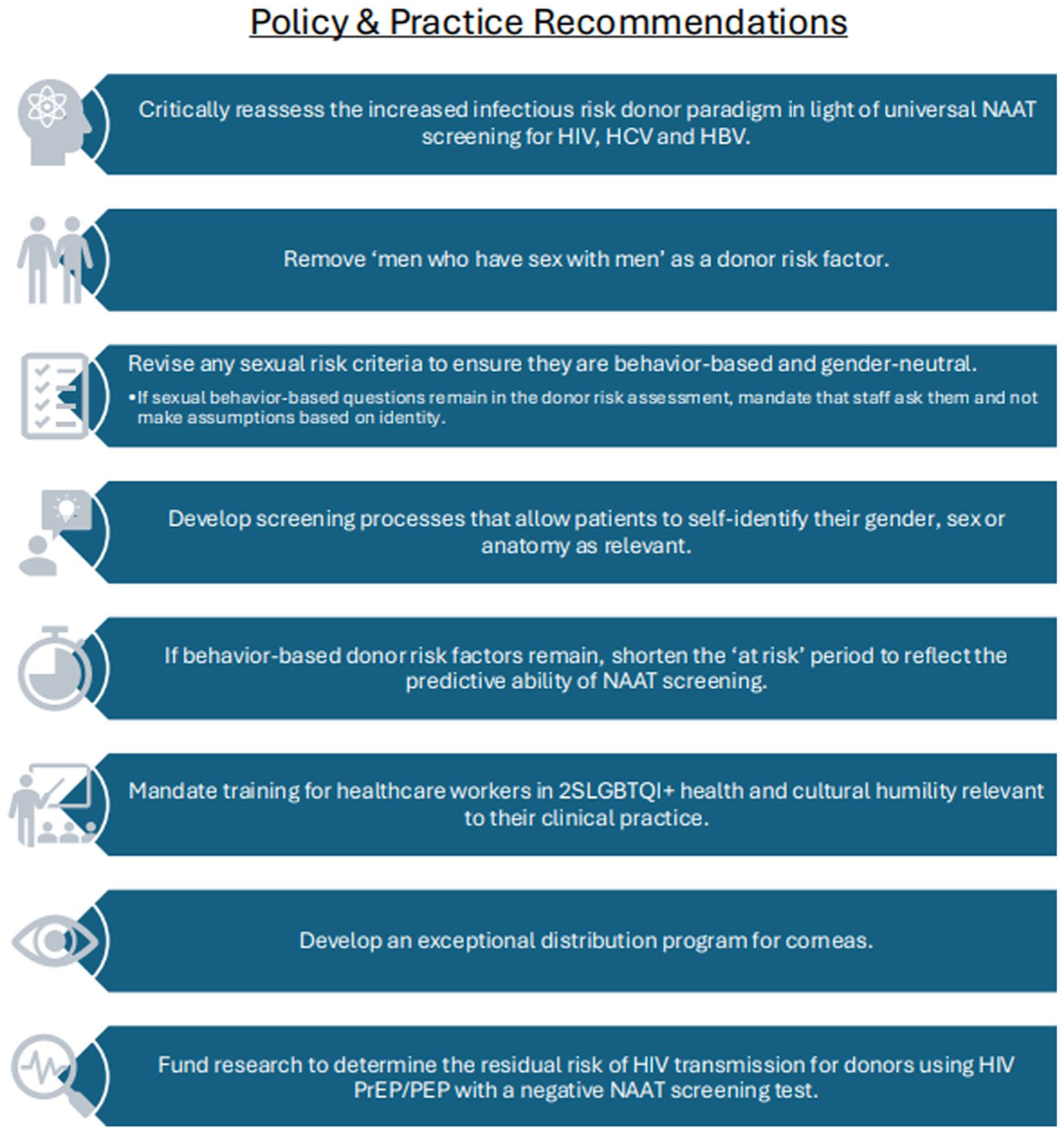
Policy and practice recommendations.
Men Who Have Sex with Men Increased Infectious Risk Donor Policy
We identified concerning inconsistencies in the application of MSM-related policies that included (1) identity-based assumptions about sexual behaviors, (2) differential application of exclusionary criteria, and (3) inconsistent use of sex-based policies in transgender and gender-diverse populations. The vast majority of respondents did not support the current regulations that classify all MSM as being at increased risk of transmitting HIV. Respondents found this policy to be discriminatory with limited or no evidence. Almost all felt this policy should be removed or updated to focus on evidence-based behaviors that increase the likelihood of HIV transmission. These findings add to previously published criticisms of the overly broad classification of all MSM as IIRDs by members of the scientific community 4 and SGM community-based organizations, 15 showing that OTDT HCWs also support equitable, data-driven policy revision. Blood donation policies in Canada and the United States have recently removed MSM from their donor risk assessments, now using gender-neutral, behavioral criteria.16,17 The CBS subsequently issued a public apology to the SGM community for the harms caused by their previous discriminatory criteria that unnecessarily stigmatized all MSM as having an increased risk of HIV. 18 In January 2025, the Food and Drug Administration (FDA) proposed new criteria to reduce the risk of transmission of HIV via tissue transplantation, which removes MSM as a risk factor from the screening process. 19 Most respondents felt that such gender-neutral, behavior-focused screening would be safe in organ and tissue donation in Canada and would have a neutral or positive impact on the available supply of organs and tissues for transplantation.
While gender-neutral, behavior-focused factors were favored over identity-based donor risk assessment criteria, the utility of behavioral screening, particularly in deceased donation, where disclosure of increased risk behaviors is via the next-of-kin of the deceased, has been called into question. Most respondents felt sexual behavioral screening, particularly when conducted with a surrogate for the patient, was unreliable. Evaluations of sexual behavior screening taken directly from blood donors have shown low rates of non-disclosure,20,21 but evaluations of the accuracy of sexual behavioral histories taken from the next-of-kin for deceased donors have not been published. Interviews of SGM patients and caregivers from the OTDT system identified instances where sexual behavior-based screening was variably applied in practice and suggested the likelihood of truthful disclosure for stigmatized behaviors may vary.2,3 It is intuitive that the positive predictive value of sexual behavior questions asked of next-of-kin of the deceased potential donor would be adequate; the negative predictive value, however, could be poor for numerous reasons (lack of knowledge regarding sexual behaviors in the deceased, fear of disclosure due to stigma, or competing priorities for caregivers wanting to facilitate donation to honor the deceased’s wishes vs truthfulness). Universal screening of all donors with NAAT (not just in those with identified increased risk behaviors, as is currently practiced in Canada) would enhance the detection and prevention of HIV through transplantation and was supported by our respondents. Health Canada has subsequently announced the implementation of mandatory universal NAAT screening for all donors to take effect February 23, 2026, offering a structural opportunity to recognize that all potential donors have some inherent risk and re-evaluate the utility, cost, and potential stigma of behavioral screening in the face of negative NAAT results.
Human Immunodeficiency Virus Pre-Exposure Prophylaxis Policy Gap
There is currently no policy on how HIV PrEP should impact an organ or tissue donor’s risk assessment in Canada. Respondents demonstrated wide uncertainty in how the OTDT PrEP policy gap should be addressed, clearly exposing a need for evidence-based recommendations. The HIV PrEP is highly effective (>99%) at preventing HIV transmission via sexual contact22-25 and transmission (>74%) via non-medical injection drug use.26-28 Blood donation systems in Canada and the United States have regulated the deferral of donations from people using PrEP with the supporting rationale that there is a theoretical risk of a false negative HIV test (even though the likelihood of acquiring HIV for a person using PrEP may be less than for many in the general population) and argue that routine HIV tests in these potential donors are insufficiently reliable.16,29 The FDA has signaled an intention to include a similar deferral for PrEP users offering to donate cells or tissues. 19
Donor risk assessment regulations exist to protect transplant recipients from the unintended transmission of diseases through transplantation. The risks to potential transplant recipients of restricting or rejecting donations from PrEP users must be quantified and considered. Canada and the United States have an insufficient supply of human organs to meet the demands of their populations; patients die while waiting for a needed transplantation every day.30,31 Evidence supports that potential recipients are more likely to die or deteriorate on the transplant wait list if they refuse an offer of an increased infectious risk organ.11,32 Stigmatizing criteria have been criticized as influencing some potential recipients to refuse offered organs based on their IIRD classification rather than considering a holistic risk/benefit assessment that balances the quality of the offered organ, the likelihood of deterioration if an organ offer is rejected, and infectious risks beyond HIV. 4 All transplanted human cells, tissues, and organs impart a risk of infectious disease transmission; it is the duty of the health system to quantify this risk through the resourcing of appropriate research and to enact policies that promote health rather than stigma. We believe it would be preferable for most patients on the transplant waitlist facing imminent death to receive an organ with a non-zero (but still exceptionally low) risk of HIV vs waiting and dying. Even in the case that an HIV infection was inadvertently transmitted via organ transplantation, the risk to patients has decreased with modern therapies; our best available evidence shows that solid organ transplant recipients living with HIV can have excellent health outcomes when adherent to therapy.33,34 Epidemiologic modeling studies to estimate the residual risk of an undetected HIV infection in a person taking HIV PrEP/PEP with a negative NAAT test are needed to inform data-driven policies for the assessment of potential organ and tissue donors on PrEP. Whether HIV PrEP/PEP has potential utility in recipients of increased infectious risk organs will require further research, but our respondents report willingness to consider this off-label use if requested by the patient.
Strengths and Limitations
This survey characterized novel perspectives and practices related to the care of SGMs in OTDT from a pool of respondents from across Canada. We sampled respondents with diversity in age, sex, gender, race, and professional roles. There were no self-identified gender minority respondents. Our response rate is a lower-bounds estimate due to the inability to further limit the pool of potential respondents by removing inactive members or duplicate members between CBS and the CST. Despite this, we achieved a response rate of at least 21%, 25% of which were physicians. Surveys that characterize practice via self-report are subject to potential biases and practices that deviate from official policy may be under-counted. Social acceptability bias might also have led respondents to answer questions according to what they believe they should say, rather than their actual beliefs or practices; to mitigate this, we ensured respondent anonymity. Additional qualitative interviews of OTDT HCWs would characterize perspectives in more detail. Patient and community perspectives have been captured in both national surveys of SGM Canadians (accepted for publication) and in-depth interviews.2,3
Conclusions
The OTDT HCWs felt current policies discriminated unnecessarily against SGM populations and were not data driven. Respondents favor gender-neutral donor risk assessments that focus on behaviors specifically associated with an increased likelihood of HIV acquisition. They felt risk periods for IIRD behaviors should be shortened to align with the predictive ability of contemporary NAAT tests. Respondents felt these changes would not increase infectious transmission and could increase the availability of organs and tissues for all Canadians who need them. Knowledge gaps regarding donor risk assessments in patients taking HIV PrEP/PEP require urgent attention to ensure new OTDT regulations are evidence-based and equitable.
Supplemental Material
sj-docx-1-cjk-10.1177_20543581251412804 – Supplemental material for Sexual and Gender Minorities in Organ and Tissue Donation and Transplantation (OTDT): A Survey of Canadian OTDT Health Care Workers
Supplemental material, sj-docx-1-cjk-10.1177_20543581251412804 for Sexual and Gender Minorities in Organ and Tissue Donation and Transplantation (OTDT): A Survey of Canadian OTDT Health Care Workers by Murdoch Leeies, Carmen Hrymak, Owen Mooney, Gloria Vazquez-Grande, Tricia Carta, Julie Ho, Emily Christie, Karen Doucette, Jennifer Chandler, Stephen Brodovsky, Sonny Dhanani, Matthew J. Weiss, Mark Gentile, Ken Sutha, Tzu-Hao Lee and David Collister in Canadian Journal of Kidney Health and Disease
Supplemental Material
sj-docx-2-cjk-10.1177_20543581251412804 – Supplemental material for Sexual and Gender Minorities in Organ and Tissue Donation and Transplantation (OTDT): A Survey of Canadian OTDT Health Care Workers
Supplemental material, sj-docx-2-cjk-10.1177_20543581251412804 for Sexual and Gender Minorities in Organ and Tissue Donation and Transplantation (OTDT): A Survey of Canadian OTDT Health Care Workers by Murdoch Leeies, Carmen Hrymak, Owen Mooney, Gloria Vazquez-Grande, Tricia Carta, Julie Ho, Emily Christie, Karen Doucette, Jennifer Chandler, Stephen Brodovsky, Sonny Dhanani, Matthew J. Weiss, Mark Gentile, Ken Sutha, Tzu-Hao Lee and David Collister in Canadian Journal of Kidney Health and Disease
Footnotes
Acknowledgements
We would like to acknowledge the invaluable contributions of the Sexual Orientation and Gender Identity Organ and Tissue Donation and Transplantation Patient and Caregiver Advisory Team, who were partners in this project. Their opinions and perspectives, informed by their lived experiences, have informed all phases of this work. We sincerely thank Jehan Lalani and Bailey Pigott from Canadian Blood Services for their contributions in survey dissemination to stakeholders, setting up the survey platform, and data management.

Author Contributions
M.L. led study conception, design, questionnaire development, administration and dissemination of the survey, interpretation of results, and writing of the manuscript. C.H. participated in study conception, questionnaire development, interpretation of results, and writing of the manuscript. O.M. participated in study conception, questionnaire development, interpretation of results, and writing of the manuscript. G.V.-G. participated in study conception, questionnaire development, interpretation of results, and writing of the manuscript. T.C. participated in study conception, questionnaire development, interpretation of results, and writing of the manuscript. J.H. participated in study conception, questionnaire development, interpretation of results, and writing of the manuscript. E.C. participated in study conception, questionnaire development, interpretation of results, and writing of the manuscript. K.D. participated in study conception, questionnaire development, interpretation of results, and writing of the manuscript. J.C. participated in study conception, questionnaire development, interpretation of results, and writing of the manuscript. S.B. participated in study conception, questionnaire development, interpretation of results, and writing of the manuscript. S.D. participated in study conception, questionnaire development, interpretation of results, and writing of the manuscript. M.J.W. participated in study conception, questionnaire development, interpretation of results, and writing of the manuscript. M.G. participated in study conception, questionnaire development, interpretation of results, and writing of the manuscript. K.S. participated in study conception, questionnaire development, interpretation of results, and writing of the manuscript. T.-H.L. participated in study conception, questionnaire development, interpretation of results, and writing of the manuscript. D.C. participated in study conception, questionnaire development, interpretation of results, and writing of the manuscript.
Funding
The authors disclosed receipt of the following financial support for the research, authorship, and/or publication of this article: This project was supported by a grant from the Health Canada Health Care Policy and Strategies Program. The views expressed in this manuscript do not necessarily represent the views of Health Canada.
Declaration of Conflicting Interests
The authors declared no potential conflicts of interest with respect to the research, authorship, and/or publication of this article.
Supplemental Material
Supplemental material for this article is available online.
References
Supplementary Material
Please find the following supplemental material available below.
For Open Access articles published under a Creative Commons License, all supplemental material carries the same license as the article it is associated with.
For non-Open Access articles published, all supplemental material carries a non-exclusive license, and permission requests for re-use of supplemental material or any part of supplemental material shall be sent directly to the copyright owner as specified in the copyright notice associated with the article.
