




Abstract
Objectives
As social media continues to rapidly evolve, understanding public participation in discourse and ensuring accurate interpretation has become increasingly vital. The widespread incidence of anterior cruciate ligament (ACL) injuries in female soccer players, including many high-profile athletes, has prompted calls for research into potential risk factors and preventative strategies. In response to this growing concern, on April 29, 2025, a research collaboration between the Fédération Internationale de Football Association (FIFA) and Kingston University was announced, aiming to examine the relationship between ACL injuries and the menstrual cycle in female soccer players.
Methods
This study utilizes framing theory to provide critical insight into the presentation and debate of public discourse regarding FIFA’s ACL-menstrual cycle study announcement and examine how those reactions were framed. Comments were exported from the collaborative post by ESPN, ESPNW, and ESPNFC on Instagram, X (formerly Twitter), and Facebook. Human coding was used to identify prominent frames by which each comment was then coded to fall under.
Results
The following frames were identified from the comments: Denial, Encouragement, Timeliness, and Male Centricity, with Denial encompassing the largest number of comments across all three datasets.
Conclusions
This study highlights the public discourse around sex-specific health topics and highlights the importance of intentional communication strategies when disseminating health information on social networking sites.
Background
In this article, we distinguish between the term’s social media and social networking sites/platforms, as they are often used interchangeably but carry distinct differences. Social media refers broadly to the various digital platforms and technologies that enable sharing and consumption of content.1,2 Social networking sites represent a subset of social media and are designed to facilitate connection and community by allowing users to construct profiles and engage with others. 3 As scholars and individuals in applied domains will often use these terms interchangeably, conceptual distinctions are important for theoretical clarity within the scope of this research. The following study will be abiding by this nomenclature throughout the text.
On April 29, 2025, ESPN, ESPNW, and ESPNFC collaborated on a cross-platform social networking site post (Instagram, X [formerly Twitter] and Facebook) that officially announced a research collaboration between the International Federation of Association Football (FIFA) and Kingston University in Thames, England.4–6 The project, funded by FIFA, aims to examine the relationship between anterior cruciate ligament (ACL) injuries and the menstrual cycle in female soccer players. This collaboration comes after a tough year for women’s soccer, as many notable, high-profile athletes including Janine Beckie (Canadian Women’s National Team), Christen Press (United States Women’s National Team), and Alexia Putellas (winner of The Best FIFA Women’s Player in 2021 and 2022, and winner of the Ballon d’Or Feminine in 2021), all suffered ACL injuries within the last few seasons. 7
ACL injuries represent one of the most detrimental musculoskeletal injuries in sport, carrying substantial long term affects for impacted athletes. Female soccer players are disproportionately affected, sustaining ACL injuries at approximately 2.5-3 times the rate of their male counterparts, with soccer consistently ranking among the highest-risk sports for ACL injury in women across both amateur and elite levels.8–10 Despite surgical advances, ACL reconstruction does not restore athletes to their preinjury state, as only 69% of athletes return to competitive sport. 8 Moreover, regardless of reconstruction surgery, approximately one in three athletes develop osteoarthritis, with rates increasing over 50% at 20 years post-reconstruction. 11 Therefore, as ACL injuries in female soccer players have become increasingly more common, 12 calls to action have been requested by organizations and soccer federations 13 to provide insight towards the potential risk factors and preventative strategies that can minimize the risk and increase the longevity of female soccer players. 14
Women’s soccer, ACL injuries, and the menstrual cycle
Female participation in organized soccer programs has steadily increased over the last several years, from 13.36 million in 2019 15 to 16.6 million as of 2023. 16 This uptake in participation has translated to record breaking viewership for women’s soccer, with the National Women’s Soccer League citing 2.5 million viewers over the 2024 National Women’s Soccer League Championship weekend, 17 and the 2023 FIFA Women’s World Cup final was 2023’s most-watched women’s sport event on television with 222.02 million viewers. 18 With the spotlight growing on women’s soccer, the media has also picked up on the steady rise of ACL injuries, not only at the professional level, but also at youth, collegiate, and recreational levels.12,19,20 It is worth noting, however, that this rise may reflect the growth in participation of women’s soccer, rather than a true increase, or that the rates are not increasing, but that they are failing to decrease despite the existence of preventative measures. Nonetheless, current literature suggests that female athletes have a two-to eight-times increase in incidence of ACL injuries in comparison to their male counterparts. 19 Research has confidently highlighted various anatomical (e.g., femoral anatomy 19 ), biomechanical (e.g., Q-angle differences 19 ), and neuromuscular factors (e.g., proprioceptive differences 19 ) that could contribute to the incidence of ACL injuries in female soccer players. However, over the last decade, research has investigated and considered hormonal cycles as a potential concern for increased injury risk, particularly ligament injuries.
As a result, FIFA’s announcement to fund research into ACL injuries among female soccer players marks a pivotal moment in advancing the scientific understanding of hormones in injury risk but also addresses the sex disparity in sport medicine research. This initiative signals acknowledgement that female athletes face distinct physiological and biomechanical risks, which have historically been overlooked, as most research is predominantly male-focused. Beyond the clinical implications, FIFA’s commitment paves the way towards prioritizing sex-specific health concerns and sets a precedent for more inclusive and equitable approaches to health and performance research.
Social media
Social media has fundamentally changed how people interact and connect, which has enabled increased accessibility and mobilization of information to broad audiences.21,22 This has revolutionized communication pathways and fosters public dialogue between those who may be separated from the conversation by space or thought. Alongside the rapid uptake in social media usage, social networking sites (i.e., Instagram, Facebook, and X [formerly Twitter]) have emerged as a primary source of news consumption, igniting not only dissemination of news media, but a catalyst for public discourse on current events.23,24 These platforms (i.e., Instagram, Facebook, and X) house a combined roughly 5.7 billion monthly users, 25 and many of these users report seeing news related content on their feeds (Instagram = 82%; Facebook = 91%; X = 92%). 26 Therefore, the sheer volume of public sentiment surrounding current event topics has encouraged researchers to move beyond surface-level content analyses and generate underlying frames that construct these public comments. 27
Social media plays an integral role in sport engagement, as social networking platforms act as virtual stadiums that engage users across all components of the sport experience. 28 High-profile sport media accounts, such as ESPN, play a significant role in amplifying narratives that shape public perception of athletes, teams, and events in the sport landscape.29,30 This amplification is particularly evident within society today, as social media acts as a catalyst for framing discussions around health, gender, and sport. For example, the United States Women’s National Soccer Team publicly advocated on social networking sites against the sex-wage discrepancy, utilizing emotion-driven language to articulate their position, which ultimately generated a narrative for public discourse. 31 Moreover, on social networking platforms, the intentional framing of health-related issues is prevalent, with individuals strategically highlighting certain aspects to evoke social comparison and heighten the sense of risk among specific populations.27,32 As such, understanding the perceptions surrounding current events can aid in the effective interpretation and acknowledgement of the reality of public discourse.
Gaps in literature
Despite a growing, and relatively recent, surge in media attention surrounding the potential link between ACL injuries in female athletes and the menstrual cycle, there remains a gap in our understanding of public reactions to this discourse. Much of the current discussion still focused on the scientific findings and the need for more research, rather than how the public is receiving or interpreting this information. Furthermore, the unique nature of this specific announcement, albeit only sharing publicly on the ESPN, ESPNW collaborative post, suggests that there is a lack of focus on dissemination strategy. This targeted approach, while reaching a dedicated audience interested in women’s sports, might limit broader public exposure, and consequently, the observable range of public sentiment. This highlights a critical void in the current research: the absence of comprehensive multi-platform analyses. 33 Research has highlighted how individuals use various social networking platforms to meet different needs, and that despite potential overlap between active users across these sites, ample findings suggest that the same person may behave differently across social networking platforms, emphasizing the importance of multi-platform analyses.34,35 Therefore, while individual studies may look at comments on a specific social networking site, a holistic understanding of public engagement necessitates examining reactions across diverse digital spaces.
Aim of study
As social media constantly evolves, there is a relevant need to understand how the general population participates in public discourse, alongside ensuring effective interpretation of the discourse across platforms. Moreover, using framing theory, this study offers critical insight into how sex-specific health topics are presented and debated across multiple social networking platforms. Understanding these framing processes is crucial for identifying how public discourse shapes perceptions of health issues that disproportionately affect different sexes, ultimately influencing policy and public understanding.
Hence, the aim of the study was to capture public discourse regarding FIFA’s ACL-menstrual cycle study announcement on various social networking platforms (i.e., Instagram, X, and Facebook) and examine how these reactions were framed. The first official press release and original source of the announcement, posted by ESPNW, was selected for analysis, as to our knowledge, no additional United States-based sports media platforms (e.g., Sportsnet and CBC Sports) posted a press release on their social networking accounts.
Methods
Exporting comments and data cleaning
Using Export Comments© (https://exportcomments.com) public comments posted in response to the official announcement by ESPNW were captured on the following social networking sites: Instagram, X [formerly Twitter] and Facebook. The URL of the social networking post was copied and pasted into the https://exportcomments.com portal. Comments were downloaded and exported as Excel files. Each comment was reviewed, and the data was cleaned, with comments excluded based on the following criteria: (a) comment was made in a language other than English, (b) comment was solely composed of emojis or tagging of another individual, and (c) comment was not relevant to the topic (e.g., promotional message). The collection of data took place on May 29th, 2025, and coding was completed in early June 2025.
Data analysis
Human coding to identify frames. The study applied the 4-step method for frame analysis outlined by Chong and Druckman, 24 which provides a systematic approach to defining, identifying, and evaluating frames in communication. Firstly, frames were defined in relation to the identified event, specifically the announcement of FIFA funding research focused on ACL and menstrual cycle associations in female soccer. Secondly, overall attitudes were isolated to understand the effect of public opinion and discourse. Thirdly, an initial set of frames were inductively identified and informed the development of a coding scheme used to code the public discourse surrounding the event. This process involved the authors familiarizing and immersing themselves with the data and examining how various additional sources of communication (i.e., academic and popular literature) had previously framed perceptions of ACL and sex-specific relationships.36–38 To ensure the ability for cross-comparison, the authors met to discuss and identify the coding scheme that would be used across all 3 datasets. To enhance scientific rigor, we utilized investigator triangulation through utilizing 2 independent coders to complete data collection and analysis; our coding team included an experienced qualitative researcher and social media research expert, alongside an experienced PhD candidate. These experts assigned codes to the exported comments, with the option to assign comments to more than 1 code. Finally, a content analysis was completed on the coded dataset; in which the authors conducted axial coding of all comments on each post and grouped the codes into relevant frames. 39
Ethical considerations
The collecting of data from Instagram, X, and Facebook was conducted by a third-party data gathering site, Export Comments©, that collects publicly accessible posts and comments from selected social networking sites. As such, this study does not meet the definition of human subjects’ research. Moreover, all social media content used in the study was publicly available at the time of data collection and did not require individual consent for use. Additionally, ESPNW is a public entity, and the use of their public information does not require their permission for use. Finally, the authors recognize that data collection took place in the United States (U.S.), on U.S.-based social networking platforms. Thus, the exported reactions reflect largely within a U.S. media and sociocultural context.
Results
Exporting comments and data cleaning
Sample characteristics of exported comments.

Note. Comments were exported from the same post that was posted by ESPN and ESPNW across all three social media platforms.
Human coding to identify frames
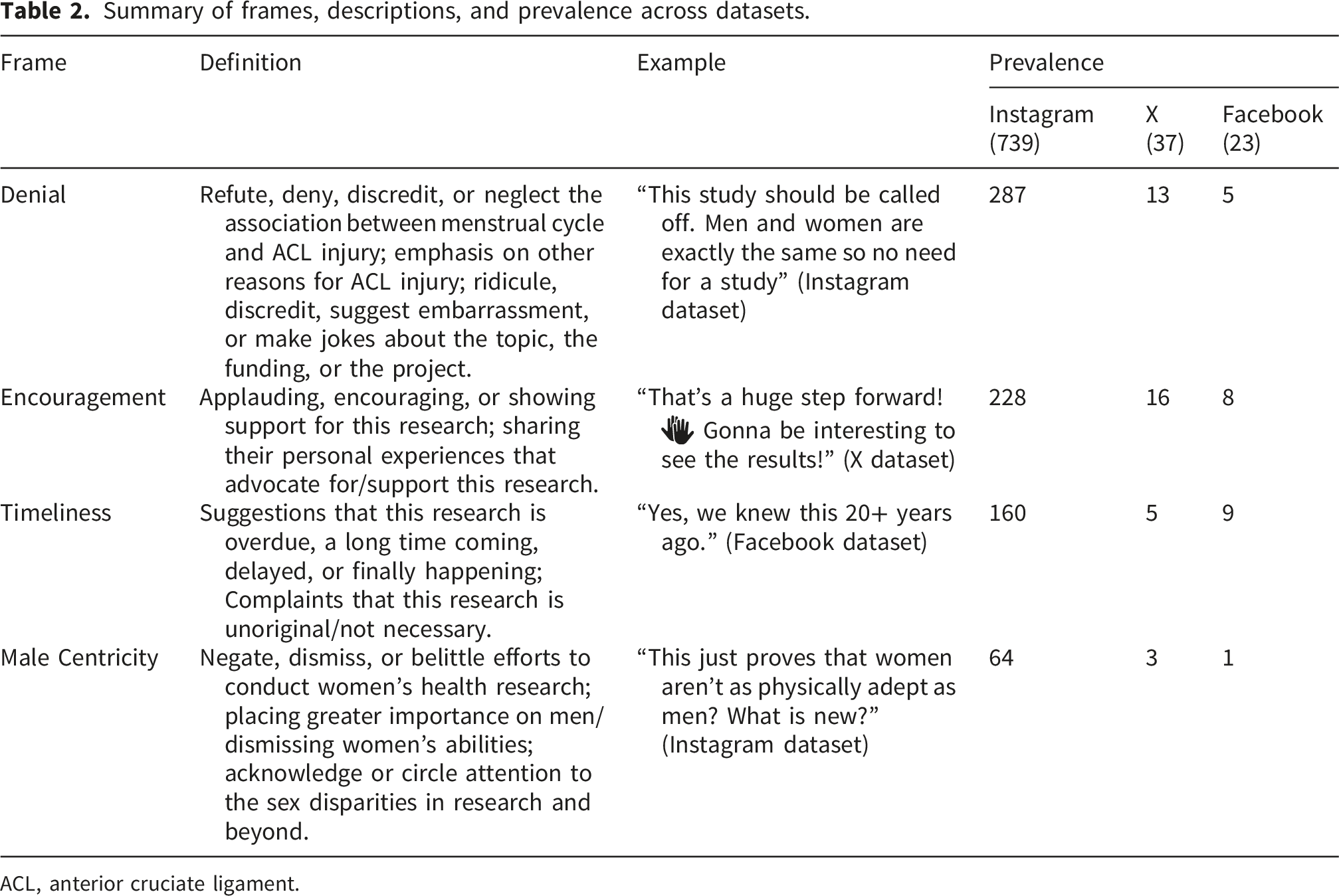
Summary of frames, descriptions, and prevalence across datasets.
ACL, anterior cruciate ligament.
Krippendorff’s alpha was employed to assess intercoder reliability of the coding scheme. 40 As each author independently coded the comments, the coded data were then inputted into the K-Alpha Calculator. 41 A reliability coefficient for the coding scheme was calculated with 95% confidence intervals (0.916-0.959). The observed Krippendorff’s alphas for each dataset were above minimum acceptable intercoder reliability (Instagram = 0.937; X = 1.0; Facebook = 1.0), acknowledging that the threshold for satisfactory is 0.80. Negotiated agreement was used to resolve any discrepancies in the codes and a final coded dataset was developed.
Denial. Comments under this frame combined messaging that refuted, denied, discredited, or neglected the link between the menstrual cycle and ACL injuries, with any ridicule, suggested embarrassment, or jokes directed at the topic, funding, or project itself. This frame was most prevalent in the Instagram dataset (n = 287; 40.4%), where many comments outright rejected the idea that hormones or menstrual cycles could influence ACL injury risk and provided alternative explanations. For example, a commenter stated, “It’s actually quite simple, women have wider hips therefore there [sic] legs/knees are at an angle, making knee injuries easier to occur” (Instagram dataset). Another commenter dismissed the idea and said, “It’s simply genetics not any damn menstrual cycles geez these talking heads just say anything nowadays rather than what it is” (Instagram dataset). These comments imply that women tear their ACLs for other reasons, and therefore, investing resources into the relationship between menstrual cycles or hormonal differences is unnecessary.
Other comments expressed satire and ridicule aimed at the topic, funding, or the project itself. For instance, one commenter said, “More likely, it contributes to fake flops on the pitch” (X dataset), while another declared, “nice job at wasting money” (Instagram dataset). A third commenter bluntly stated, “This is unbelievably misguided’ (Facebook dataset). These examples underscore the disrespectful and joking tone prevalent in much of the discourse across datasets.
Encouragement. Alternatively, a substantial number of comments applauded, encouraged, and supported the research project, alongside some sharing their personal experiences that advocate for or support this announcement. This frame was most common in the X dataset (n = 16; 35.6%) but had a significant number of comments in both the Instagram (n = 228; 32.1%) and Facebook (n = 8; 29.6%) datasets. For instance, one commenter said, “Great that they are looking into this more! We already know there is an increased [sic] in ligament laxity associated with hormonal changes, I’m very excited to see what their findings may be!” (Instagram dataset), while another stated, “That’s a huge step forward! [hands clapping emoji] Gonna be interesting to see the results!” (X dataset). Moreover, some commenters shared personal experiences that indicated support, including one commenter who explained, “When I tore my ACL playing soccer one of the first things my female doctor asked me was if I was menstruating when I tore it and I was. Coincidentally – while doing my PT [physical therapy] post ACL surgery I was complaining my knee felt ‘funny’ and she asked if I was pregnant. Went home took a test and sure enough, I was. Our bodies are amazing the tiny ways they shift during our cycles or pregnancy.” (Instagram dataset).
Timeliness. This frame includes comments that suggest this research is overdue, long-awaited, delayed, or finally happening, alongside complaints that it is unoriginal or unnecessary. These comments were most common in the Facebook dataset (n = 9; 33.3%), respectively. Many individuals affirmed the overdue perspective through comments such as, “About time!” (Instagram dataset) and “Finally” (Instagram dataset). Moreover, further frustration was conveyed, through comments such as, “Yes, we knew this 20+ years ago” (Facebook dataset), and “Dear FIFA you’re a little late to the party” (Instagram dataset). These perspectives suggest that while the public desires validation through research, there is also an expectation for findings to be both relevant and complementary to the current understanding, not merely a replica of what the literature already suggests.
Male Centricity. Within this frame, comments included negating, dismissing, or belittling efforts to conduct women’s health research, with some going further to elevate men’s needs or question women’s abilities. In contrast, a segment of comments in this frame recognized and acknowledged the prevalent sex-specific disparities in both research and broader contexts. Examples of comments in this frame include, “Wait, so we’re back to acknowledging the differences between men and women?!?” (Instagram dataset), “Wait… women are different?? Physiologically? Let’s not gloss over that new revelation.” (X dataset), and “How would this explain how it correlates to men tearing their ACL’s” (Facebook dataset). Additionally, it was common for comments in this frame to overlap with the Denial frame, as the male importance perspective often came through dismissing or discrediting satire. For instance, one commenter stated, “They are more likely to be injured because men are built a lot better for these sports” (Instagram dataset), while another explained, “You know where that wouldn’t happen?the kitchen” (Instagram dataset). This frame showcases the interplay of resistance and recognition: while some comments actively undermined women’s health research and capabilities, and others surprisingly acknowledged the very sex-specific disparities being highlighted. Ultimately, this frame reveals the biases that permeate discussions around sex and health.
Discussion
To understand public discourse, this study analyzed the framing of social networking reactions surrounding FIFA’s funding announcement for ACL-menstrual cycle research in female soccer players. The framing and analysis of comments helped achieve a more comprehensive understanding of public sentiment, highlighting not just what social networking users are saying, but how they are saying it. This deeper insight is critical when addressing sex-specific health topics and fostering productive conversations around these issues.
Manual coding suggests that the most prominent frame was Denial, as the dominant message across social networking sites was commenters negating or refuting any relationship between ACL injuries and menstrual cycles in female athletes. This discourse undermines the legitimacy of the research itself and decreases the need for research into a significant women’s health issue in sports. Ultimately, creating a challenging environment for future research and funding in this area. Previous literature has highlighted the limitations of accessing information on social media and networking platforms, as it is significantly more likely to be misinterpreted or misrepresented.42,43 Moreover, denial and refuting of medical study information is commonplace across social networking platforms, specifically X (formerly Twitter), yet is often pronounced in topics related to women’s health, 44 making this finding not surprising. As such, the dissemination of accurate health information may be hindered when a dominant narrative outshines the reality, as expert opinions and evidence-based discussions can be drowned out. Therefore, it may be significantly more difficult to access information about potential injury risks and preventative measures associated with hormonal cycles.
Alternatively, the second most prominent frame across all platforms was Encouragement, with commenters providing support and advocacy for the topic and overall funding of the project. The presence of this reinforcing dialogue is consistent with prior research showing that esteem support and encouragement are commonly expressed in online health dialogue.45,46 Such messages not only validate the importance of the issue, but contribute to its relevance within society, potentially translating to greater public engagement. 47 Moreover, when discussing sex-specific health topics, encouragement serves two functions: affirming the scientific value of female-focused research alongside emphasizing the underfunding of women’s health research. 48 The supportive discourse within the study’s context extends beyond merely affirmation and support but generates a sense of legitimacy within broader public and scientific conversations. Finally, this finding aligns with current literature emphasizing how online social discourse can amplify marginalized health topics.49,50
Since comments could be dual coded (i.e., coded into more than 1 frame), an interesting overlap was observed between Encouragement and Timeliness (n = 59, 13.3%). Despite the clear, defining differences between these frames, there are parallels in the sentiments. Encouragement reflects excitement and optimism surrounding the funding investment, while timeliness reflects the recognition of its overdue nature. The emphasis of urgency in female-focused ACL research highlights both appreciation and necessity. Together, these frames generate discourse that discusses responsiveness, acknowledgement, and momentum, where the funding is both celebrated and timely. This aligns with prior research indicating that encouragement is a central form of social support in online health communication, while timeliness significantly enhances perceptions of helpfulness.45,47,51 As such, it is commonplace for individuals to express encouragement through time-sensitive language (e.g., “finally!”), potentially explaining why these frames had consistent overlap and that pairing encouragement and time-sensitive framing is effective for advancing public discourse and advocacy around sex-specific health topics in online platforms. 51
Another interesting finding is that of the male-centric commentary seeming to be prevalent across all platforms. Often, these comments overlapped with those in the Denial frame, as discourse was satirical and witty, yet objective and negating. Such patterns are well documented across online platforms, as misogynistic or sexist content circulates widely on social networking sites. 52 Moreover, a large body of work shows that the satirical framing surrounding sexist humor creates a social norm that accepts prejudice, ultimately increasing tolerance for discriminatory language.53,54 As such, this commentary can translate to misinformation and feelings of distrust and confusion surrounding topics that are already littered with misconceptions. 49
The findings from this study lend insight to best practices for communicating sex-specific health information on online platforms. The presence of negating and denial sentiments could be due to the lack of contextual information provided within the original social networking post itself. Prior research indicates that limited or ambiguous information in online health communication can increase misinterpretation and skepticism. 49 As such, if FIFA had provided ESPN with a caption that included accurate, evidence-based information and broader context surrounding the intent, relevance, and importance of the funding decision, it is likely that individuals could engage with that material and share comments that align with encouragement or timeliness, rather than denial and male centricity. Additionally, source credibility is critical in shaping perceptions of online information, thus disseminating these types of announcements with health-focused platforms or organizations may enhance legitimacy and reduce the likelihood of dismissive and discrediting responses.44,55
Implications for stakeholders
From a broader perspective, this study holds significance for stakeholders, specifically FIFA and other soccer organizations, as the reality of online discourse signals a gap between the general public’s understanding and the clinical reality of ACL injuries in female soccer players. FIFA and other stakeholders can use these insights to inform evidence-based communications or formalized guidelines for reporting of sex-specific health messaging (e.g., discouraging minimizing language, providing necessary context). Moreover, organizations can invest in social media monitoring as a form of health surveillance. 56 Through tracking online narratives, the identification of misinformation, harmful discourse, or gaps in communication can be addressed and intervened with in real time.
Limitations
While this study offers several notable contributions, it is equally important to acknowledge its limitations. Due to the security and privacy laws for social networking platforms, the comments extracted were exclusively from public social networking accounts, meaning this is merely a snippet of the conversation happening on these various sites. As such, the findings should be interpreted as exploratory in nature. Furthermore, with the growing prevalence of artificial intelligence, there has been an increase in artificial intelligence-powered social bots engaging in harmful actions on social networking sites, including disseminating misinformation and escalating online conflicts. 57 This poses significant challenges not only for social networking users, but for researchers in the field, particularly in reliably discerning between human-generated and bot-generated content.
Conclusion
This study illustrates the dynamic nature of public discourse on a specific sex-specific health topic. By examining the ways in which comments are expressed, our results capture both the sentiment and linguistic strategies that shape online dialogue. Such an approach offers a more nuanced understanding of how individuals engage with public issues, particularly those at the intersection of sport, sex, and health. Additionally, this study highlights the need for thoughtful communication strategies that anticipate both the supportive and resistant discourse likely to exist. Ultimately, these findings highlight the value of framing analyses for guiding health communication messaging and fostering more inclusive and productive conversations around women’s health in sport. Future research should continue to explore how sex-specific health initiatives are framed across diverse social networking sites to deepen our understanding of public discourse and its implications for advancing equity in sport and health communication.
Footnotes
Acknowledgements
The author(s) wish to acknowledge the support of Stephanie Stebens, MLIS, AHIP, from the Sladen Library at Henry Ford Health for preparing the manuscript for submission.
Ethical considerations
The Henry Ford Health Institutional Review Board Administration Office has deemed this project not to be human subjects research (HSR).
Author Contributions
1: Conceptualization, methodology, investigation, formal analysis, writing - original draft preparation. 2: Methodology, investigation, writing – review and editing, 3: Investigation, writing – review and editing, 4: Conceptualization, methodology, formal analysis, writing – review and editing.
Funding
The author(s) declared that financial support was received for publication. This work was supported by the Department of Public Health Sciences at Henry Ford Health.
Declaration of conflicting interests
The authors declared no potential conflicts of interest with respect to the research, authorship, and/or publication of this article.
Data Availability Statement
The data that support the findings of this study are available from the corresponding author upon reasonable request.