




Abstract
Purpose
This study aims to systematically characterize the worldwide research profile of intelligent assistance operative adjuncts for unicompartmental knee arthroplasty, with particular attention to robotic-assisted systems, computer-assisted navigation, and patient-specific instruments (PSI). By clarifying the developmental trajectory of this field, the study seeks to inform future technological innovation and support evidence-based clinical translation.
Methods
Studies concerning intelligent assistance operative adjuncts for UKA were identified through the Web of Science Core Collection. The final dataset comprised 296 articles, from which information on authorship, publication characteristics, contributing countries and institutions, source journals, and citation records was extracted. Statistical evaluation combined with visual mapping was used to examine trends in publication output and citation activity, major research themes, influential author clusters, institutional collaboration patterns, and journal distribution.
Results
Between 2003 and 2025, the annual number of publications showed a continuous upward trajectory. The United States and the United Kingdom contributed the largest share of publications, while the Hospital for Special Surgery ranked first among institutions and Andrew D. Pearle was identified as the leading author by publication output. Among journals, The Journal of Arthroplasty received the highest citation frequency. Frequently occurring keywords included alignment, accuracy, outcome, and survivorship.
Conclusion
During the past two decades, robotics have evolved from “technical validation” to “evidence-based optimization,” becoming the dominant paradigm among intelligent assistance operative adjuncts. By contrast, navigation systems still exert substantial academic influence, whereas interest in PSI has declined. As alignment accuracy and survivorship are further validated, research has expanded toward long-term functional outcomes, patient satisfaction and cost-effectiveness, providing a basis for evaluation frameworks that integrate patient-reported outcome measures. Large-scale, robotic UKA are expected to further consolidate its role in evidence-based medicine and accelerate the integration of personalized, precision-based, and value-driven care for unicompartmental knee disease, ultimately benefiting a broader patient population.
Keywords
Introduction
Osteoarthritis (OA) is a chronic degenerative joint disease characterized by complex disorders of the whole synovial joint 1 including cartilage degradation, bone remodeling, osteophyte formation, joint inflammation and loss of normal joint function, which may lead to pain, disability, and reduced quality of life. 2 Knee osteoarthritis (KOA) is a major global public health problem. A recent analysis reported that the worldwide prevalence of KOA reached 374.7 million cases in 2021, with an age-standardized prevalence rate of 4,294.27 per 100,000 population. 3 As one of the most common disabling orthopedic conditions, KOA is associated with rising prevalence and imposes a substantial burden on both affected individuals and healthcare systems. 4 This burden is also reflected in its considerable economic impact at both the individual and societal levels. Direct OA-related costs account for about 1%–2.5% of gross national product in the United States, the United Kingdom, Canada, and Australia, and direct medical expenditures in the United States alone have been estimated at approximately 72 billion US dollars. 5 At the individual level, patients with KOA incur 7,707 US dollars higher annual total healthcare costs than controls, including 4,674 US dollars attributable to KOA-related care. 6 Beyond direct medical expenditures, KOA is also associated with major productivity losses, with its economic impact estimated at 424 billion Australian dollars in lost gross domestic product. 7
Unicompartmental knee arthroplasty (UKA) has been shown to be a successful treatment for end-stage knee osteoarthritis. 8 UKA offers several advantages over total knee arthroplasty (TKA): shorter hospitalization, fewer complications 9,10, better knee function, 11 beneficial for postoperative revision, 12 less blood loss, 13 greater early range of motion 5 and better postoperative knee kinematic symmetry. 14 Although UKA offers numerous benefits, it presents a higher technical challenge compared to TKA due to its greater demands for precision and restricted exposure. 15 The smaller incision and limited surgical exposure inherent to UKA increase reliance on surgeon expertise, as precise positioning of the components becomes more difficult to achieve. 16
The clinical outcomes of UKA are influenced by both hip-knee-ankle angles 12 and limb component alignment. 13 Technical shortcomings can limit UKA outcomes and may lead to early implant failure manifested as aseptic loosening, instability, or elevated dislocation rates. 17 Moreover, even favorable functional and quality-of-life outcomes do not always correlate with high patient satisfaction. 18 To enhance alignment and positioning accuracy, adjunct technologies such as computer-assisted navigation or robotic-assisted systems have been increasingly integrated into UKA procedures.19,20
In this study, we classify navigation systems, patient-specific instruments (PSI) and robotic systems as Intelligent Assistance Operative Adjuncts (IAOA), which use patient imaging and sensor data to compute individualized plans and real-time guidance, augmenting surgeon actions and improving alignment accuracy, reproducibility and safety margins in arthroplasty. Navigation systems assist surgeons in accurately executing preoperative plans by integrating imaging data with real-time anatomical positioning, enhancing surgical precision through visual feedback or mechanical constraint, depending on whether the system is passive or active, thereby improving implant placement accuracy and reducing the risk of technical errors. 21 Patient-specific instruments, which are simple tools designed from patient models and manufactured via 3D printing, replicate the surgical plan to accurately remove lesions before joint reconstruction and are valuable for treating bone and joint defects. 22 It can also effectively simulate the lower limb alignment. 23 Robot-assisted surgery leverages a pre-operative CT-based 3D model for implant planning. Intra-operatively, the robotic system functions as a trajectory safeguard, actively preventing the surgical tool from deviating beyond the intended region, thus ensuring precise osteotomy and optimal implant positioning. 24
Previous bibliometric research has shown a steady global increase in UKA studies. It also suggested that major research themes include prosthesis design, follow-up investigation, joint replacement registration, and computer navigation, and that computer-aided navigation may become a future hotspot. 25 Another bibliometric analysis showed that top-cited UKA studies came mainly from a few centers, were mostly low-level evidence, and focused on long-term outcomes, while patient satisfaction, navigation surgery, and robotics were identified as emerging trends. 26 Beyond bibliometric analyses, a systematic review of emerging arthroplasty technologies noted that PSI, computer-assisted and robotic-assisted techniques are all increasing, while their clinical value remains debated and more high-quality studies are still needed. 27
Therefore, such an analysis is needed because these adjuncts are often discussed separately, despite addressing a common clinical challenge in UKA, namely the need to improve component positioning, alignment accuracy, reproducibility, and ultimately patient-reported outcomes. To address this gap, our study assesses robotics, navigation, and PSI together within a unified UKA-specific framework, making it possible to compare how these adjuncts have evolved, where the main research hotspots now lie, and what evidence gaps remain for future clinical translation.
By identifying publication trends, key research hotspots, and collaborative networks, this study aims to identify future research directions and provide evidence-based insights to support clinical innovation and the integration of personalized, precision-based care.
Methods
Literature retrieval strategy
Publications were identified using a predefined topic-search equation. The query combined terms related to unicompartmental knee arthroplasty with terms describing patient-specific, navigational, robotic, three-dimensional printing, and computer-assisted techniques, as shown below: TS=(Unicompartmental Knee Arthroplasty OR Unicompartmental Knee Replacement OR Unicondylar Knee Arthroplasty OR Unicondylar Knee Replacement OR Partial Knee Arthroplasty OR Partial Knee Replacement OR UKA) AND TS=(customized implant OR PSI OR patient specific instrumentation OR patient specific implant OR 3D printing OR three-dimensional OR Guide plate OR navigated OR navigation OR robotic OR robot OR computer-assist).
Records concerning operative adjuncts for UKA were identified using the Web of Science Core Collection (WOSCC) database. This database was used because it employs more stringent inclusion criteria compared to other robust databases such as Scopus, thereby ensuring the high quality of the retrieved literature. Furthermore, WOSCC provides highly structured and comprehensive cited-reference metadata, which offers optimal compatibility with visualization software such as VOSviewer and the R package Bibliometrix, guaranteeing the accuracy of the network mapping. The inclusion criteria were limited to English-language articles and reviews. To ensure the reproducibility of this bibliometric study, the publication date range was defined from the inception of the database to March 27, 2025.
Study selection
The initial search yielded 673 records in WOSCC. Eligibility was assessed by reviewing abstracts and, when necessary, full texts to remove ineligible publications. The detailed selection procedure is presented in Figure 1 and 296 records were finally retained for analysis. Two authors independently performed the screening and subsequent data extraction. Any discrepancies were resolved through discussion with a third author until consensus was achieved. Publication identification and screening workflow.
Notably, among the 296 selected publications, 60 (approximately 20%) lacked author keywords. To minimize bias in the keyword co-occurrence analysis, keyword plus terms were used as substitutes for author keywords in these cases.28,29
Statistical analysis
Temporal change points in the publication and citation series were examined using the Mann–Kendall mutation test. Statistical significance was assessed with a two-sided criterion at α = 0.05. All analyses were conducted in R v4.4.3 (https://www.r-project.org/about.html).
Data visualization
Bar charts and line plots were prepared to summarize year-by-year changes in publication output and total citation counts, thereby characterizing research activity and scholarly impact in this field over time. Keyword co-occurrence in recent publications was examined using network and overlay visualizations to identify principal research topics and emerging directions. Author- and institution-level collaboration maps were also developed to depict patterns of academic cooperation. National research contributions were visualized on a map, with different colors used to distinguish countries and publication counts used to indicate their respective contributions. To support multidimensional visualization of the bibliometric dataset, the analysis used VOSviewer version 1.6.20 (https://www.vosviewer.com/), Charticulator (https://donghaoren.org/charticulator/app/index.html), and the R package Bibliometrix 4.3.2 (https://www.bibliometrix.org/).
Results
Temporal evolution of research output and citation impact
Figure 2 presents the yearly distribution of publications and citations for the articles included in this study, covering the period from 2003 to 2025. The number of IAOA-UKA-related publications began to increase steadily after 2013, and more than half of the included studies were published during the most recent five-year period. Citation counts peaked in 2019, followed by a gradual decline in subsequent years. Year-by-year changes in research output and citation activity.
From 2003 to 2015, the UF statistic remained below the zero line, then crossed the zero line around 2017, meaning the number of papers has been on the rise. By 2025, the UF statistic approached the α = 0.05 critical boundary. Around 2015, the UF and UB curves intersected, indicating a potential change point (Figure 3(A)). For citation counts, the UF and UB curves intersected around 2014, suggesting a potential change point, after which the UF statistic moved progressively upward from 2016 onward and indicated that citation activity had entered a growth phase (Figure 3(B)). Sequential Mann–Kendall analysis of (A) publication output and (B) citation counts. UF and UB denote the forward and backward trend statistics, respectively. At α = 0.05, ±1.96 was used as the critical boundary. Intersections between UF and UB within this range suggest potential change points, while UF values above 1.96 or below −1.96 indicate significant upward or downward trends, respectively.
Top publishing journals
Leading source journals by publication output.

Leading source journals by citation count.
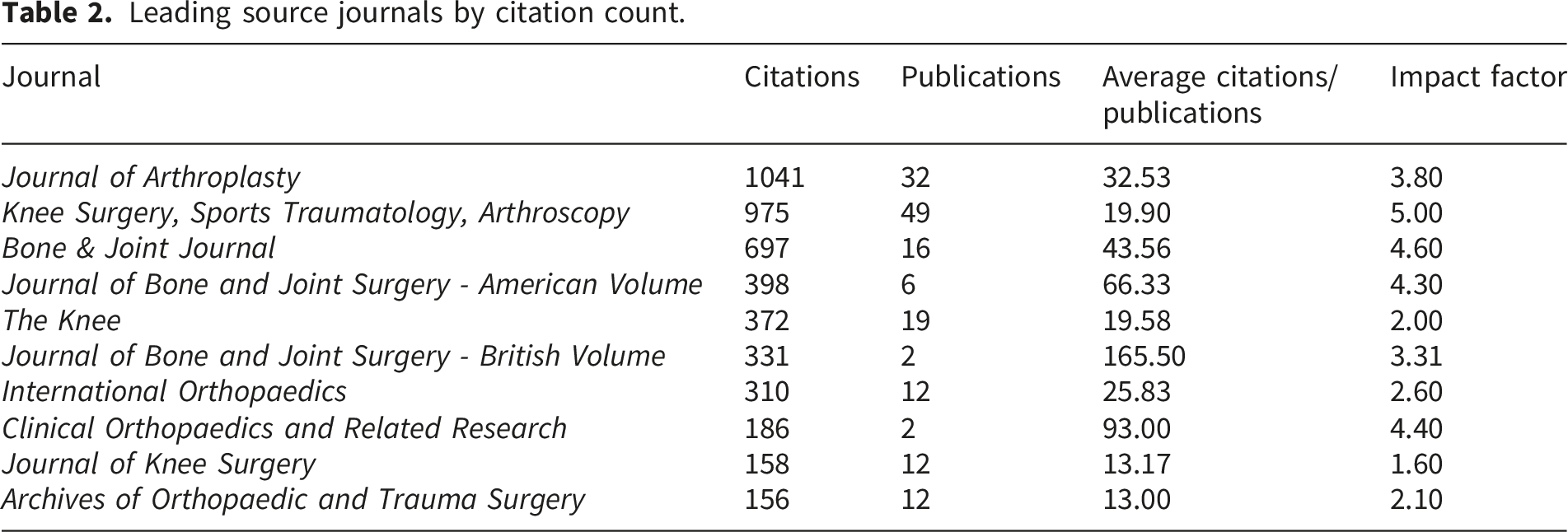
Knee Surgery, Sports Traumatology, Arthroscopy was the leading source journal, with 49 publications. The Journal of Arthroplasty achieved the most citations (1,041) with 32 publications. It is worth noting that both these 2 magazines ranked at the top in both tables,reflecting both significant productivity and influence.
Bone & Joint Journal, although publishing only 16 articles, demonstrated strong influence, yielding a mean citation rate of 43.56 per publication. Some journals, despite having fewer publications, exhibited high citation intensity. For Journal of Bone and Joint Surgery – American Volume, the mean citation rate was 66.33 per article; for Journal of Bone and Joint Surgery – British Volume, the corresponding value was 165.50 per article, underscoring their academic authority. And the top 10 cited papers were concentrated mainly in The Journal of Arthroplasty.
Core authors and collaboration networks
An international cooperation map analysis (Figure 4) was conducted among countries. Sector size represents publication output, and connecting ribbons indicate international collaborative links. Only countries with five or more publications are displayed; countries without ribbons showed no identified cross-national collaboration. Among them, only one country—China—was not involved in any international collaboration. Among all countries, the United States had the broadest cross-national collaboration profile, being connected with nine partner countries. International cooperation map.
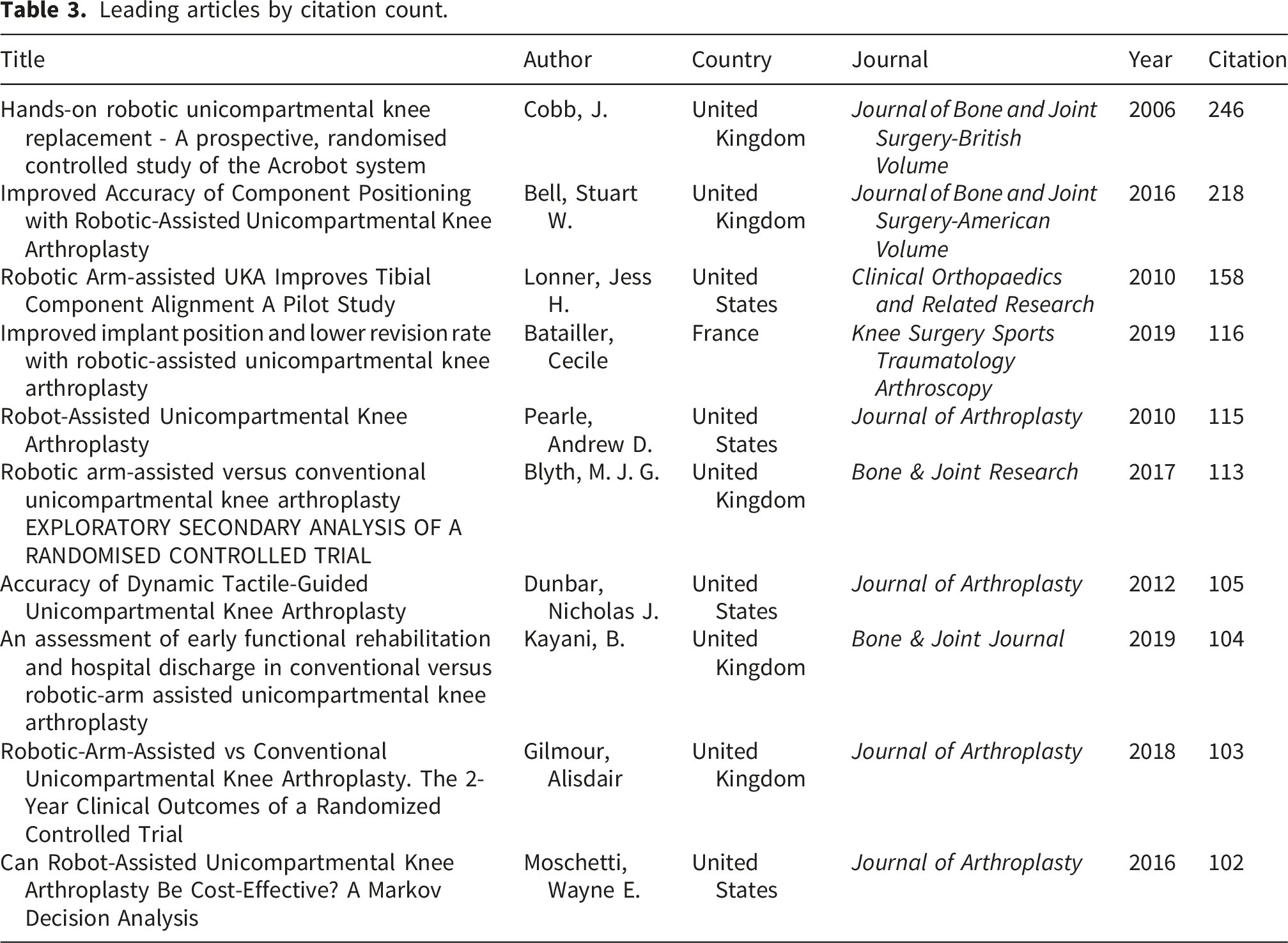
The publication set represented research contributions from 25 countries, including both developed and developing nations. Developed countries accounted for the majority of contributing countries (19/25) and constituted the main source of publication output (Figure 5). The United States accounted for 97 publications, followed by the United Kingdom with 36 and France with 26. Together, these three countries accounted for over 50% of the total publication output. Interestingly, as shown in Tables 2 and 3, the majority of first or corresponding authors also based in these three countries, suggesting that they not only have high research productivity but also exert substantial academic influence in this field. Geographical Distribution of countries/areas of publication. Leading articles by citation count.
The international co-authorship network (Figure 6) illustrates a centralized topology with the United States occupying the most central position, exhibiting extensive global linkages. Furthermore, a dense collaborative sub-network among European countries, including France and Italy, highlights robust intra-regional academic exchange. In contrast, China appears as an isolated node on the periphery; despite meeting the publication threshold, it lacks established international collaborative links within this specific dataset. Visualization of nations cooperation network (publications ≥ 5).
A collaboration network analysis (Figure 7) was conducted for institutions with at least five related publications. The 23 institutions were distributed across the United States, the United Kingdom, France, Australia, Italy, Japan, corresponding to six countries in total. Except for Thomas Jefferson University and the University of Tokyo, all other institutions have partnerships with other institutions. The leading institutional contributor was the Hospital for Special Surgery, with 26 articles. Croix Rousse University Hospital in France was the most frequently involved in collaborative efforts, while Glasgow Royal Infirmary in the United Kingdom recorded the highest total citation counts. Visualization of institutional cooperation network (publications ≥ 5).
Figure 8 presents an author-level co-authorship map of researchers with at least five publications. The network shows several geographically related clusters. Authors based in the United States were mainly grouped in the red cluster, reflecting a dense pattern of domestic collaboration, whereas the blue cluster was composed largely of authors from the United Kingdom. Cross-national links were more evident in the green and cyan clusters, which involved researchers from France and Italy and were consistent with the inter-institutional cooperation patterns described above. Within this network, AD Pearle was the most productive author, contributing 26 articles. Roche M, Lustig S, and Batailler C appeared to act as connectors between countries. Visualization of authorship cooperation networks (publications ≥ 5).
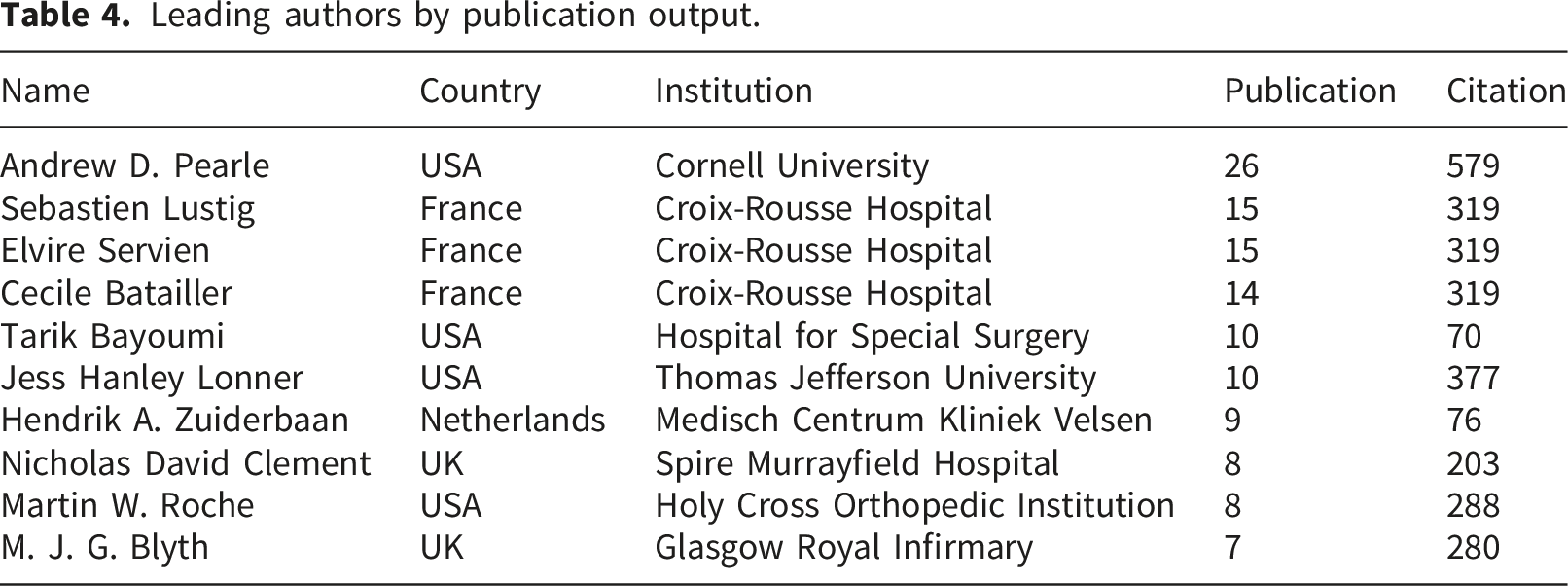
Leading authors by publication output.
Research interests
Keyword patterns were visualized to characterize the temporal distribution and thematic concentration of research attention in this field. Figure 9 shows the keyword co-occurrence results for terms appearing at least five times. In the visualization, node size corresponds to occurrence frequency, with larger nodes indicating more frequently used keywords. The most prominent terms included “alignment,” “accuracy,” “outcome,” and “survivorship,” suggesting that these topics represent major recurring themes in the literature. Keyword co-occurrence network (occurrences≥5).
Figure 10 presents the temporal overlay of keywords, in which darker shades correspond to earlier appearances and lighter shades denote more recent occurrences. This time-based visualization shows that research attention has changed across different periods, indicating an evolution in the thematic focus of the field. Early studies in the field primarily emphasized “alignment”, followed by increasing attention to “accuracy”. In recent years, “survivorship ” has emerged as a noticeable topic, along with “patient satisfaction”, both of which appeared as keywords only in recent publications, indicating growing interest in these outcomes. From a technological perspective, research on navigation peaked approximately a decade ago, while PSI became prominent around five years ago. In contrast, robotic surgery has gained significant attention in the past two years, reflecting the rapid technological advancement and iterative development of operative adjuncts in UKA procedures. Temporal distribution of keyword appearances (occurrences≥5).
Number of publications and citations of intelligent assistance operative adjuncts.

Discussion
Using bibliometric methods, this study delineated the research landscape of intelligent assistance operative adjuncts for UKA, providing a knowledge map and valuable reference for understanding the development and emerging trends in this field.
Our analysis showed a sustained increase in both publications and citations related to intelligent assistance operative adjuncts for UKA over the past decade. The Mann–Kendall trend test further indicated that publication output and citation frequency shifted from stable or declining patterns to an upward trajectory around 2014 and 2017, respectively. This pattern suggests growing research activity and academic attention in this field. The increase in publications is likely to be multifactorial rather than attributable to a single cause. As one upstream contextual factor, the rising burden of knee osteoarthritis may have expanded the potential clinical demand for IAOA-related technologies. Available epidemiological evidence generally supports this interpretation. From 1990 to 2020, the global number of OA cases increased by approximately 132.2%, with the knee being the most commonly affected site. Moreover, the number of knee OA cases is projected to continue rising in the future, suggesting a further increase in its clinical and health-system burden. 30 A population-based study from the United Kingdom similarly showed a gradual increase in OA prevalence between 1997 and 2017, with the knee consistently remaining the most commonly affected joint. 31 In addition, evidence from the United States suggests that the prevalence of knee OA has approximately doubled since the mid-20th century. 32 Compared with total knee arthroplasty, UKA preserves bone stock, requires less surgical exposure, and better restores native knee kinematics. 33 These advantages support the use of UKA in appropriately selected patients with isolated unicompartmental knee osteoarthritis and indicate that the clinical demand for UKA may increase as the burden of knee OA continues to rise. However,UKA appears to be underused, with studies reporting that 25%–47% of patients may be eligible, whereas only about 8% actually receive it. 34 A substantial proportion of patients who may be appropriate candidates for UKA still undergo TKA, suggesting that UKA remains underutilized in carefully selected populations. 35 The persistent underuse of UKA may partly reflect the fact that it is technically demanding, requiring precise alignment, accurate implant placement, and optimal soft-tissue balance, 36 which has in turn sustained interest in IAOA as tools to improve precision, reproducibility, and confidence in its broader adoption. More directly, robotic-assisted techniques, navigation systems, and PSI have been developed to improve surgical accuracy,20–23 and their continued refinement and broader clinical adoption may have further stimulated research activity in this area. This trend may also reflect the broader increase in the use of IAOA in UKA in recent years, which has been attributable to a better understanding of the indications and to the development of new technologies. 37 With increasing technological maturity, research on IAOA in UKA has gradually extended beyond early validation of surgical accuracy to broader assessments of clinical value. Across robotic-, navigation-, and PSI-assisted UKA, recent studies have extended beyond implantation accuracy to evaluate survivorship, clinical outcomes, and patient-reported outcomes, although the maturity of the evidence still varies among technologies38–40. This broadening of research questions may partly explain the parallel increase in both publications and citations in this field.
We further assessed the source journals of the included publications and the journals that contained highly cited articles. Most articles were concentrated in major orthopedic journals, including Knee Surgery, Sports Traumatology, Arthroscopy, The Journal of Arthroplasty, The Knee, The Bone & Joint Journal, Archives of Orthopaedic and Trauma Surgery, and International Orthopaedics. Further analysis of the data in Table 2 reveals a non-linear dual-track relationship between publication volume and academic impact. Specifically, high-volume journals like the Journal of Arthroplasty and Knee Surgery, Sports Traumatology, Arthroscopy drive total citation accumulation through consistent output and specialized focus. Conversely, a distinct “low-volume, high-impact” pattern is observed in prestigious journals such as Bone & Joint Journal, Journal of Bone and Joint Surgery - American Volume, Journal of Bone and Joint Surgery - British Volume and Clinical Orthopaedics and Related Research; despite having fewer publications in this field, they exhibit significantly higher average citations per article, underscoring their role in publishing cornerstone research with high evidence-based value. This also explains why high-quality research tends to be published in these journals. These journals are typically characterized by strong academic vitality, a large readership, high academic standing, a high degree of internationalization, and well-established collaboration networks—all of which help research findings reach a wider academic audience. These journals provide an important channel for researchers to follow recent developments in UKA, recognize broad research patterns and emerging hotspots, and strengthen scholarly communication and collaboration. In this way, they contribute to the continued development of the field.
The bibliometric results indicate a clear concentration of academic influence in the United States, the United Kingdom, and France, as these countries accounted for many of the highly cited articles and leading authors and also occupied prominent positions in international collaboration networks. The United States and the United Kingdom were particularly notable because they not only produced substantial publication output but also entered this research area relatively early, which may explain the presence of several high-impact studies from the initial stages of the field (Table 3). This advantage may be partly related to their well-developed clinical and academic infrastructure, including major hospitals, universities, and medical research institutes that support both high-quality and high-volume research. In addition, several intelligent assistance operative adjuncts for UKA, such as MAKO, NAVIO, Zimmer Biomet Persona® PSI, and Stryker Navigation, are closely associated with institutions or companies in the United States, suggesting that early exposure to these technologies may have contributed to the development of related clinical research. Although China has generated a considerable number of publications, its participation in broad international collaboration remains relatively limited, indicating that further efforts to strengthen global partnerships and multicenter research may be beneficial. By contrast, low- and middle-income countries may face greater barriers to the development and dissemination of IAOA-related research in UKA. These technologies are typically associated with high acquisition and maintenance costs, 41 substantial infrastructure requirements, and specialized training demands, 42 all of which may limit their uptake in resource-constrained settings. In addition, compared with high-income countries, low- and middle-income countries may have less established multicenter research networks, registries, and long-term follow-up systems, 43 which can restrict both high-quality evidence generation and participation in international collaboration. From a health-system perspective, the adoption of technologically intensive adjuncts may also be constrained by competing priorities for essential arthroplasty care. As a result, the current evidence base is still dominated by high-income countries, and its generalizability to lower-resource settings may remain limited.
With respect to authorship, Pearle, Andrew D. from Cornell University, USA, has emerged as a leading figure in this field. As shown in Figure 8 and Table 4, his research team not only demonstrates high productivity and substantial academic impact but also consistently remains at the forefront of comparative research, particularly in the area of robotic-assisted UKA. 44 Moreover, the co-authorship network analysis (Figure 8) reveals a fragmented pattern of international collaboration, characterized by several distinct clusters of researchers. These clusters exhibit strong internal cooperation but relatively limited cross-cluster interaction, suggesting constrained academic exchange across research communities. A similar trend is observed in the institutional collaboration network (Figure 7), further underscoring the lack of broad inter-institutional cooperation. These findings highlight the need to foster more extensive international and inter-institutional collaboration among researchers to accelerate knowledge exchange and drive innovation in this field.
In the keyword co-occurrence map (Figure 9), alignment, accuracy, outcome, and survivorship appeared as prominent nodes, suggesting that research on intelligent assistance operative adjuncts for UKA has mainly focused on surgical precision, clinical results, and long-term implant performance. As reported in the literature, precise implant alignment is critical for postoperative function and prosthesis survival rate in UKA. 11 Although the implementation of navigation systems, PSI and robotic has markedly facilitated UKA developments, several studies have suggested that manual UKA can also achieve favorable results in pain, range of motion, health status, and joint awareness. 45 Furthermore, a systematic literature review reported that robot-assisted UKA and manual UKA have similar clinical outcomes and revision rates in short-term follow-up. 46 The prominence of “survivorship” as a keyword reflects ongoing concerns regarding the long-term outcomes of UKA performed with intelligent assistance systems. This highlights the urgent need for high-quality, long-term studies to better assess complications, revision rates, and sustained clinical efficacy associated with these advanced surgical adjuncts.
The keyword overlay analysis (Figure 10) illustrates a temporal shift in research priorities—from a technology-centered focus on surgical techniques to a more patient-centered emphasis on clinical outcomes. This evolution suggests an increasing academic awareness of the importance of long-term benefits and humanistic care as surgical technologies mature. Notably, the current research trajectory is moving from short-term outcomes such as alignment and accuracy toward mid-to long-term endpoints, including survivorship and patient satisfaction. This transition highlights substantial untapped potential for future investigation into long-term clinical efficacy, quality of life, and revision-related outcomes. With continued technological advancements and the passage of time, these aspects are expected to receive increasing attention in subsequent research, contributing to a more holistic understanding of the clinical value of intelligent assistance in UKA. 37
As demonstrated in Table 5, robotic technology has emerged as the most extensively studied modality within the domain of intelligent assistance operative adjuncts, surpassing navigation and PSI in both publication volume and research visibility. This indicates that robotics represents a central research hotspot and holds substantial potential for future clinical application. Compared with other modalities, robotic systems offer distinctive advantages, as they can accurately correction of lower limb force lines. 21 Navigation systems also demonstrate considerable academic value. Although the number of publications is approximately half that of robotics, they exhibit a higher average number of citations per article, underscoring their scientific impact and research quality. In contrast, PSI currently accounts for a relatively small proportion of the literature, which may reflect its limited adoption in clinical practice. This suggests that PSI is no longer a mainstream research focus.
In this study, we provide a consolidated, quantitative overview of the global evidence base on intelligent assistance operative adjuncts in unicompartmental knee arthroplasty by integrating navigation systems, PSI, and robot-assisted surgery under a unified framework, termed Intelligent Assistance Operative Adjuncts (IAOA). By bibliometrically mapping 296 English-language articles and reviews from Web of Science, we characterize research productivity, collaboration patterns, and thematic evolution over time, revealing steadily increasing output since 2013, the dominant momentum of robotic UKA, the comparatively higher average citation impact of navigation-related work, and a waning emphasis on PSI. Importantly, our results highlight persistent fragmentation across countries and specialties, alongside critical gaps in long-term outcomes and cost-effectiveness, thereby offering actionable evidence to inform multicenter collaboration, trial design, technology assessment, and the translation of data-driven, patient-specific approaches into value-oriented clinical practice.
Several limitations should be acknowledged. First, the literature retrieval was restricted to the WOSCC, and relevant studies indexed only in other databases may therefore have been missed. However, WOSCC is widely recognized as one of the most comprehensive and authoritative databases for bibliometric research, covering a large volume of high-quality literature and reflecting the global research landscape22,47. Second, restricting the dataset to English publications may have reduced the representation of relevant studies reported in other languages. Third, citation metrics should be interpreted with caution because they are influenced by publication time; newly published studies, even when methodologically strong or clinically important, may not yet have had enough time to accrue citations. Finally, 15 articles focusing on UKA revision surgery were identified during screening but were excluded because this study was designed to focus on primary UKA. As a result, the bibliometric characteristics of revision UKA were not assessed and warrant separate investigation in future research.
Conclusion
This bibliometric analysis highlights a significant shift in UKA research from traditional surgical approaches to intelligent assistance operative adjuncts. Among these, robotic technology has emerged as the most extensively studied modality, indicating its status as a current research hotspot and a key driver of innovation in clinical practice. While navigation systems exhibit strong academic influence through high citation averages, research interest in PSI has declined and it is no longer a central topic in the field. Compared to conventional manual UKA, intelligent assistance techniques—especially robotics—demonstrate promising clinical value and are likely to shape the long-term trajectory of UKA research and practice.
Footnotes
Acknowledgments
Thank you to everyone who supported this work and shared helpful feedback during the preparation of this manuscript. Your time and help are greatly appreciated.

Ethical considerations
This article does not contain any studies with human or animal participants.
Consent to participate
As the study does not involve individual participants.
Author contributions
SR,AS,WJ and LD conceived the idea for this study.WZ,HT and FM collected and organized the data. SR and WJ contributed to statistical analysis.SR,CJ and HY performed figures and visualizations.AS provided financial support, and LG and LZ provided administrative assistance. SR, AS and LG drafted the initial manuscript.And AS,FM and LZ provided critical feedback and revisions to the final version.Each author took responsibility for every part of the work, ensuring that any issues concerning the accuracy or integrity of the study were properly examined and addressed.
Funding
The authors disclosed receipt of the following financial support for the research, authorship, and/or publication of this article: This work was supported by the Capital’s Funds for Health Improvement and Research(CFH2024-2-2015),the Xuanwu Hospital Elite Cultivation Program(YC20250201)and the Medical Science Research Project of Hebei Provincial Health Commission(20261349).
Declaration of conflicting interests
The authors declared no potential conflicts of interest with respect to the research, authorship, and/or publication of this article.
Data Availability Statement
The datasets used and/or analysed during the current study are available from the corresponding author on reasonable request.
Guarantor
Ruilin Shi, Shuai An.