



Abstract
Objective
This study aimed to map the intellectual structure and conceptual development of artificial intelligence (AI) research in older adult care by identifying current research fronts and emerging thematic priorities.
Methods
A bibliometric analysis was conducted using 5,214 English-language journal articles indexed in the Web of Science Core Collection between 2004 and 2025. Bibliographic records were analysed using VOSviewer. Bibliographic coupling was employed to identify contemporary research fronts based on shared reference patterns, while co-word analysis examined conceptual structures and emerging research themes through keyword co-occurrence.
Results
The field demonstrated substantial scholarly growth and influence, accumulating 79,858 citations, 74,375 non-self-citations, and an h-index of 102. Bibliographic coupling analysis identified five major research fronts: predictive health intelligence and assistive support; assistive robotics, cognitive support, and ageing-in-place technologies; fall detection, cognitive ageing, and assistive technologies for functional independence; service robots, smart environments, and human-AI acceptance; and rehabilitation, fall prevention, and age-friendly mobility environments. Co-word analysis revealed four dominant conceptual themes: health risk, frailty, and population-level ageing outcomes; AI-enabled care technologies and human-robot interaction; mobility, physical activity, and functional ageing; and machine learning, dementia, and cognitive impairment prediction.
Conclusions
AI research in older adult care has evolved from isolated technological applications toward integrated socio-technical care ecosystems that support prevention, monitoring, diagnosis, rehabilitation, mobility, and quality-of-life enhancement. Future advances will depend on the development of human-centred, clinically meaningful, ethically governed, and socially sustainable AI-enabled care systems that address the multidimensional needs of ageing populations.
Introduction
Population ageing is reshaping healthcare systems worldwide and increasing demand for long-term care, community-based support, age-friendly environments, and sustainable health services. Global demographic projections indicate that the number of people aged 65 years and above will continue to increase substantially over the coming decades, intensifying challenges associated with healthcare workforce shortages, rising healthcare expenditure, and growing demand for long-term care services.1,2 These demographic changes have stimulated growing interest in technological innovations that can support independent living, improve quality of life, enhance care coordination, and strengthen the efficiency of health and social care delivery systems. Among these innovations, artificial intelligence (AI) has emerged as a transformative technology with applications in health monitoring, fall detection, cognitive assessment, rehabilitation, social companionship, smart-home management, and predictive risk assessment for older adults.3,4
Recent advances in machine learning, deep learning, computer vision, wearable sensing, robotics, Internet of Things (IoT) technologies, and generative AI have accelerated the development of AI-enabled care for older adults. These technologies have moved the field beyond isolated assistive devices toward integrated and data-driven care ecosystems that support prevention, monitoring, diagnosis, intervention, and ageing in place.5,6AI-enabled systems can assist healthcare professionals and caregivers by supporting clinical decision-making, detecting health risks, monitoring functional decline, reducing caregiver burden, and improving care coordination.4,7 Consequently, AI is increasingly positioned as a strategic response to the growing imbalance between care demand and available healthcare resources in ageing societies.
However, AI-enabled care for older adults is not solely a technological phenomenon. Its successful implementation depends on complex interactions among technological capability, user acceptance, organisational readiness, ethical governance, and regulatory environments. This perspective aligns with Socio-Technical Systems Theory, which proposes that outcomes emerge from interactions among technological systems, human actors, organisational structures, and institutional contexts rather than from technology alone. In older adult care settings, AI applications operate within interconnected networks involving older adults, family caregivers, healthcare professionals, care organisations, technology developers, policymakers, and regulators. Therefore, the effectiveness and sustainability of AI-enabled care depend not only on technical performance but also on trust, usability, autonomy, privacy protection, ethical accountability, and integration into real-world care practices.
Consistent with this socio-technical perspective, research has shown that older adults’ willingness to adopt AI technologies is influenced by perceived usefulness, ease of use, trust, privacy, autonomy, and cultural expectations.8,9 While many older adults recognise the potential benefits of AI-supported care, concerns remain regarding surveillance, algorithmic decision-making, loss of human contact, and the possibility that intelligent systems may replace rather than complement human caregiving relationships.9,10 Trust is particularly important because acceptance depends not only on technical accuracy but also on confidence in the transparency, reliability, fairness, and ethical use of AI systems. 11
These concerns are especially important in applications involving AI-assisted cognitive assessment, dementia prediction, fall prevention, functional monitoring, and support for instrumental activities of daily living. AI technologies are increasingly used to detect cognitive decline, classify dementia risk, monitor frailty, assess mobility, and support personalised care planning for older adults. Although such applications offer opportunities for early intervention and targeted support, their adoption depends heavily on users’ willingness to share personal health data and trust AI-generated recommendations.4,12 Existing evidence suggests that perceived benefits often coexist with concerns regarding privacy, autonomy, accountability, digital exclusion, and the preservation of human-centred care relationships.9,12
Attitudes toward AI-enabled care also vary across cultural contexts. Studies indicate that perceptions of ageing, caregiving responsibility, technology adoption, and the appropriateness of AI-mediated care differ across societies.13,14 Cultural norms influence how older adults, caregivers, and healthcare professionals evaluate trustworthiness, autonomy, dignity, and the role of intelligent technologies in care delivery. In some contexts, AI is viewed as a means of promoting independence and supporting caregivers; in others, concerns arise regarding depersonalisation, reduced human interaction, and threats to dignity and autonomy. 14 These findings suggest that AI-enabled care for older adults must be understood within the broader social, ethical, cultural, and organisational environments in which technologies are developed and deployed.
Reflecting the growing importance of AI in ageing societies, research on AI-enabled care for older adults has expanded across healthcare, computer science, robotics, gerontology, digital health, rehabilitation, urban studies, and ethics. Existing reviews have examined specific applications such as dementia care, socially assistive robotics, smart-home monitoring, rehabilitation technologies, fall detection, and AI-supported healthcare delivery.3,12 Although these studies provide valuable insights, they often focus on particular technologies, clinical conditions, or care contexts rather than examining the broader AI-enabled older adult care ecosystem. Consequently, knowledge remains fragmented across technical, clinical, behavioural, environmental, and ethical domains.
Recent bibliometric studies have also documented the growth of AI research in older adult care and related domains, identifying themes such as robotics, smart homes, machine learning, digital health, and long-term care technologies.5,15,16 However, several limitations remain. First, existing bibliometric studies often focus on publication productivity, citation performance, or technology-specific themes, providing a limited understanding of how clinical risk prediction, assistive robotics, mobility support, dementia diagnosis, environmental design, and ethical governance collectively shape the field. Second, many studies rely mainly on descriptive keyword analyses or co-citation methods, which may identify established knowledge structures but provide limited differentiation between current research fronts and emerging conceptual trajectories. Third, existing bibliometric evidence has not sufficiently examined how technological innovation, human-centred adoption, clinical utility, digital inclusion, and ethical governance co-evolve within a unified socio-technical framework.
To address these gaps, the present study adopts a socio-technical systems perspective and uses complementary bibliometric techniques to map the intellectual and conceptual structure of AI research in older adult care. The study analyses 5,214 English-language journal articles indexed in the Web of Science Core Collection from 2004 to December 2025. Bibliographic coupling is used to identify contemporary research fronts through shared reference patterns among influential publications, while co-word analysis examines dominant concepts and emerging thematic directions through keyword co-occurrence patterns. This combined approach enables a more integrated understanding of how predictive health intelligence, assistive robotics, mobility support, dementia prediction, smart environments, and ethical care technologies interact within the evolving AI-enabled older-adult care ecosystem.
Accordingly, this study pursues two objectives: 1. To identify current research fronts in AI-enabled older adult care using bibliographic coupling analysis. 2. To identify dominant conceptual themes and emerging research priorities in AI-enabled older adult care using co-word analysis.
By integrating bibliographic coupling and co-word analysis within a socio-technical systems framework, this study advances current understanding of AI-enabled older adult care by mapping both its intellectual foundations and thematic priorities. In doing so, it provides a comprehensive overview of the field’s development and offers insights into future directions for AI-driven prevention, monitoring, diagnosis, mobility support, human-centred care, and ethical governance in ageing societies.
Literature review
Technological evolution of AI in older adult care
The development of AI in older adult care has evolved through several interconnected stages, reflecting a broader transformation from technology-centred solutions toward integrated socio-technical care ecosystems. Rather than representing isolated technological advances, these developments illustrate how innovations in robotics, machine learning, sensing technologies, digital health infrastructures, and generative AI have progressively reshaped care delivery for ageing populations. The evolution of AI in older adult care can be understood through four overlapping phases: assistive technologies and social robotics; intelligent monitoring and predictive care; integrated digital care ecosystems; and generative AI-driven personalised support.
The earliest phase focused primarily on assistive technologies and socially assistive robots designed to support specific care-related tasks. Research during this period emphasised companionship, social engagement, emotional support, and assistance with daily living for older adults living independently or in institutional care settings. Social robots were developed to reduce loneliness, facilitate communication, encourage activity, and enhance psychosocial well-being among older adults experiencing isolation or functional limitations.17,18 These early applications established an important foundation by demonstrating that successful technological interventions in older adult care depend not only on technical functionality but also on user acceptance, emotional engagement, trust, and meaningful human-technology interaction.
The second phase was characterised by the emergence of intelligent monitoring systems powered by machine learning, wearable sensors, computer vision, and smart-home technologies. This transition marked a shift from interaction-oriented support toward data-driven and predictive care models. Rather than responding only to immediate user needs, AI systems increasingly became capable of anticipating risks through continuous monitoring and predictive analytics. Advances in human activity recognition, fall detection, gait analysis, and health monitoring enabled unobtrusive assessment of physical and cognitive conditions among older adults.19,20 Deep learning algorithms further improved the accuracy of activity recognition, fall detection, and health prediction models, supporting real-time intervention and preventive care in domestic and community environments.4,21
The third phase emerged from the convergence of AI, IoT, cloud computing, smart-home platforms, and digital health infrastructure. During this stage, AI systems evolved from standalone devices to interconnected care ecosystems that support ageing in place through continuous monitoring, predictive analytics, remote caregiving, and coordinated service delivery.5,6 Sensors, healthcare information systems, monitoring platforms, and AI algorithms became integrated within ambient assisted living environments that support both older adults and caregivers. This transformation reflects a movement from device-centred interventions to ecosystem-level solutions in which multiple technologies interact to support personalised and scalable care. Reviews consistently indicate that the convergence of AI and digital health technologies has expanded healthcare systems’ capacity to deliver continuous support to ageing populations.3,4
More recently, a fourth phase has emerged through the integration of generative AI and large language models into older adult care applications. Unlike earlier systems that primarily focused on monitoring and automation, generative AI technologies enable contextual reasoning, personalised communication, adaptive assistance, and conversational engagement. AI-enhanced social robots and conversational agents increasingly demonstrate the ability to provide companionship, cognitive support, health coaching, and emotionally responsive interaction tailored to individual needs. 22 These developments broaden the scope of AI-enabled care beyond physical health monitoring to include psychological well-being, social participation, health communication, and personalised support. Nevertheless, evidence regarding long-term effectiveness, sustained adoption, safety, and large-scale implementation remains limited. Existing reviews continue to emphasise the need for interdisciplinary collaboration, participatory design, and user-centred development to ensure that technological innovation translates into meaningful care outcomes.3,12
Importantly, each stage of technological advancement has generated corresponding social, ethical, and organisational challenges. As AI systems become increasingly autonomous, data-intensive, and embedded in care environments, concerns about privacy, transparency, accountability, bias, user autonomy, and digital inclusion grow in significance. From a socio-technical perspective, technological innovation and ethical governance should be viewed as co-evolving dimensions of AI-enabled care for older adults. Understanding the field requires attention not only to technical developments but also to the social systems, care relationships, institutional structures, and governance mechanisms within which AI technologies operate.
Ethical governance and socio-technical challenges
As AI technologies have matured, ethical, organisational, and governance concerns have become increasingly central to older adult care research. Socio-Technical Systems Theory suggests that successful implementation depends not solely on technological effectiveness but also on alignment among users, care organisations, professional practices, and institutional governance frameworks. Consequently, ethical considerations have evolved from peripheral concerns into core determinants of adoption, trust, and long-term sustainability.
Early ethical discussions focused mainly on privacy and surveillance issues arising from data collection and monitoring technologies. The deployment of wearable devices, smart-home sensors, ambient monitoring systems, and IoT-enabled platforms has raised concerns about informed consent, data ownership, data security, and the potential erosion of privacy in domestic and institutional care environments.11,23 Although continuous monitoring offers benefits for health management, fall detection, and risk prevention, it also raises questions about how older adults negotiate the balance between privacy, safety, independence, and care support.
As AI systems became increasingly capable of supporting decision-making and clinical recommendations, ethical concerns expanded to include transparency, explainability, and accountability. Older adults, caregivers, and healthcare professionals must be able to understand, question, and appropriately use AI-generated recommendations, particularly when such recommendations influence diagnosis, treatment, care planning, or risk stratification. 11 Explainable AI has therefore become increasingly important because algorithmic opacity may undermine confidence in technologies that directly shape health-related decisions and care practices.
Issues of autonomy and dignity have also received increasing attention as AI systems assume more active roles in care delivery. Research on socially assistive robots, intelligent monitoring systems, automated care technologies, and dementia-related applications highlights concerns that excessive reliance on automation may reduce meaningful human interaction, diminish personal autonomy, or contribute to depersonalised forms of care.9,10 These concerns are particularly significant in dementia care, cognitive assessment, and rehabilitation settings, where users may have reduced capacity to evaluate or challenge algorithmic recommendations and care decisions. 23
More recently, scholarly attention has expanded toward fairness, inclusivity, digital ageism, and cultural responsiveness. Research demonstrates that perceptions of AI are influenced by cultural norms surrounding ageing, caregiving, autonomy, family responsibility, technology adoption, and human-machine interaction.13,14 Trust, acceptance, and perceived appropriateness may vary substantially across cultural contexts, suggesting that AI systems developed within one sociocultural setting may not transfer effectively to another. Researchers, therefore, increasingly advocate participatory and inclusive design approaches that involve older adults, caregivers, healthcare professionals, and community stakeholders throughout the development process to ensure alignment with diverse user needs, values, and expectations. 24
Viewed through a socio-technical lens, privacy, transparency, autonomy, fairness, cultural responsiveness, and accountability should not be regarded as isolated ethical concerns. Rather, they represent interconnected governance mechanisms that evolve alongside technological maturity. As AI becomes more deeply embedded in healthcare infrastructure and older adult care environments, ethical governance is a prerequisite for sustainable implementation, public trust, responsible innovation, and long-term societal acceptance.
Bibliometric insights into AI and older adult care research
The rapid growth of AI-enabled older adult care has generated growing interest in bibliometric research to understand the intellectual structure, thematic development, and future directions of the field. Existing studies consistently report substantial growth in publications since the mid-2010s, reflecting the increasing integration of AI technologies into healthcare, ageing research, long-term care, and digital health systems.5,15 However, recent bibliometric investigations differ considerably in scope, analytical focus, and methodological approach.
Chien et al., 5 for example, examined the application of AI, IoT, and edge intelligence in long-term care for older adults using bibliometric, content, and Google Trends analyses. Their findings highlighted the growing prominence of intelligent monitoring systems, digital health infrastructures, and long-term care technologies. However, the study focused primarily on technology adoption patterns and thematic development within long-term care settings rather than on the broader AI-enabled older-adult care ecosystem.
Similarly, Barbosa et al. 25 conducted a bibliometric analysis of service robots within transformative service research. Their work identified major research streams related to service robotics, value co-creation, and service innovation. While this provides valuable insight into socially assistive robotics and service contexts, it offers limited coverage of other AI-enabled applications, including machine learning-based risk prediction, dementia classification, mobility analytics, smart-home monitoring, rehabilitation technologies, and generative AI.
Zhu et al. 26 investigated global trends in AI-enabled healthcare technologies for older adults and identified dominant themes related to smart healthcare, machine learning, and digital health innovation. Although this study provided a broad overview of research development, its emphasis remained largely on publication growth and thematic prevalence rather than on the structural relationships that connect contemporary research fronts and emerging conceptual trajectories.
These studies show that existing bibliometric research has often adopted either technology-specific perspectives or descriptive performance-oriented approaches. As a result, the current understanding remains fragmented across the domains of robotics, digital health, intelligent monitoring, healthcare analytics, cognitive impairment, mobility support, and governance. Moreover, existing studies rarely distinguish clearly between active research fronts and emerging thematic priorities, limiting understanding of how the field is evolving and where future research directions are likely to emerge.
Addressing the current fragmentation in the literature requires complementary bibliometric approaches that capture both current intellectual structures and conceptual priorities. Bibliographic coupling identifies active research fronts through shared reference structures among contemporary publications, whereas co-word analysis reveals dominant and emerging thematic developments through keyword co-occurrence patterns. 27 The integration of these approaches enables a clearer distinction between established domains of scholarly convergence and developing areas of innovation. Such an approach is particularly valuable in AI-enabled care for older adults, where technological capability, user acceptance, clinical utility, ethical governance, and policy development are increasingly interconnected.
Viewed through the lens of Socio-Technical Systems Theory, the evolution of AI-enabled care for older adults reflects a growing interdependence among technological systems, older adults, caregivers, healthcare professionals, organisations, and governance structures. The present study, therefore, integrates bibliographic coupling and co-word analysis to provide a comprehensive and forward-looking mapping of AI research in older adult care. By examining technological, human, clinical, environmental, and governance dimensions together, the study extends existing bibliometric research and offers a richer understanding of how AI-enabled care for older adults is evolving in contemporary ageing societies.
Methods
Research design
This study employed a bibliometric research design to map the intellectual structure and conceptual development of AI research in older adult care. Bibliometric analysis enables the systematic, transparent, and reproducible synthesis of large bodies of literature through the quantitative examination of publication metadata, citation relationships, and conceptual linkages among scientific publications. 28 The study followed established bibliometric mapping procedures to ensure methodological rigour in database selection, search strategy development, data cleaning, network construction, and cluster interpretation. 27
Two complementary bibliometric techniques were used to address the study objectives. First, bibliographic coupling was conducted to identify current research fronts by clustering documents that share common references, thereby revealing contemporary thematic convergence and active intellectual communities.27,29 Second, co-word analysis was performed to identify the conceptual structure and emerging thematic priorities of the field through patterns of keyword co-occurrence.27,30
The integration of bibliographic coupling and co-word analysis was appropriate because the two techniques provide complementary perspectives on scientific development. Bibliographic coupling is particularly useful for identifying contemporary research alignments because it focuses on shared reference structures among publications. In contrast, co-word analysis reveals conceptual relationships and thematic directions by examining the frequency and co-occurrence of keywords. Together, these approaches enabled a comprehensive examination of both the current intellectual structure and evolving thematic landscape of AI-enabled older adult care research.27,31
Data source and search strategy
The Web of Science Core Collection (WoSCC) was selected as the sole data source due to its multidisciplinary coverage, rigorous journal selection standards, high-quality citation metadata, and widespread use in bibliometric research.27,32 Previous methodological studies have shown that WoSCC provides reliable citation relationships, standardised bibliographic information, and robust indexing structures suitable for science mapping and bibliometric network analyses. 33
The literature search was conducted on 14 June 2026 using the Topic (TS) search field, which indexes article titles, abstracts, author keywords, and Keywords Plus. The following Boolean search string was applied: (“artificial intelligence” OR robotic* OR “machine intelligence” OR “deep learning” OR “intelligent learning” OR “neural network*” OR “expert system*” OR “computer vision” OR “big data” OR “knowledge graph*”) AND (“elder care” OR “elderly care” OR “older adult*” OR “elder service*” OR “elder help” OR “elder support” OR “senior support”).
The search strategy combined AI-related terms with older-adult-care terminology to capture research on AI-enabled care, support, assistance, monitoring, and service provision for older populations. The term older adult was included to reflect contemporary terminology, while terms such as elder care and elderly care were retained because they remain widely used in the existing literature.
The initial search retrieved 8,386 records. The results were refined to include only journal articles, resulting in 6,133 records. Restricting the dataset to English-language publications produced 6,085 records. Because this study focused on literature published between 2004 and December 2025, records published in 2026 were excluded (n = 871). The final dataset comprised 5,214 English-language journal articles published between 2004 and 2025.
The screening and verification process was independently conducted by two researchers. Discrepancies were resolved through discussion and consensus. The inclusion criteria were: (a) English-language journal articles, (b) publications indexed in WoSCC between 2004 and 2025, and (c) publications retrieved using the predefined AI and older-adult-care search terms. Records were excluded if they were not journal articles, were not published in English, or were published outside the specified time frame. The study selection process is presented in Figures 1 and 2. Prisma flow diagram of study selection. Annual publication and citation trends in AI-enabled care for older adult research.

Data analysis procedure
All bibliographic records were exported from WoSCC in plain-text format and analysed using VOSviewer version 1.6.20, a widely used software package for constructing and visualising bibliometric networks. 34 Prior to analysis, data cleaning was conducted to standardise author names, merge synonymous keywords, and reduce inconsistencies in terminology. This preprocessing step improved network quality, reduced fragmentation, and enhanced the interpretability of bibliometric maps.27,35
Performance analysis was conducted to assess the field’s development and scholarly influence. Indicators included annual publication output, total citations, non-self-citations, average citations per publication, articles cited, articles cited excluding self-citations, and h-index. Reporting both citation and non-self-citation metrics provided a balanced assessment of scholarly impact.
Bibliographic coupling analysis was performed at the document level to identify current research fronts in AI-enabled care for older adults. A minimum citation threshold of 135 citations per document was applied, resulting in the retention of 53 publications for analysis. The resulting network generated five bibliographic coupling clusters representing the dominant contemporary research fronts in the field.
Co-word analysis was conducted to examine the conceptual structure and thematic priorities of AI research in older adult care. A minimum keyword occurrence threshold of 104 was applied, resulting in the retention of 60 keywords for analysis. The resulting keyword co-occurrence network generated four thematic clusters representing health vulnerability and frailty; AI-enabled care technologies and human-robot interaction; mobility and functional ageing; and dementia and cognitive impairment prediction.
Following network generation, cluster interpretation was conducted iteratively by examining node composition, keyword relationships, citation patterns, representative publications, and supporting literature. Cluster labels were assigned based on the dominant conceptual themes represented within each network. This approach is consistent with established bibliometric mapping procedures and ensures that cluster interpretations reflect the underlying intellectual structure and thematic development of the research domain. 27
Results
Performance analysis
The final dataset comprised 5,214 publications on AI in older adult care. These publications accumulated 79,858 citations, of which 74,375 were non-self-citations. The dataset achieved an h-index of 102, with an average of 15.32 citations per publication. In addition, the publications were cited by 61,114 articles, or 59,094 after excluding self-citations. These indicators demonstrate that AI-enabled services for older adults have become a substantial and highly influential research domain.
The annual publication trend indicates that research in this field emerged gradually before entering a period of rapid growth from the mid-2010s onward. Publication output increased sharply after 2018, with particularly strong growth from 2020 to 2025. This acceleration corresponds with broader advances in machine learning, deep learning, wearable sensing, smart-home technologies, socially assistive robotics, digital health systems, and IoT-enabled care infrastructures. The citation trend also shows a steep increase during the same period, suggesting that AI-enabled older adult care has gained growing scholarly visibility and influence across healthcare, computer science, robotics, gerontology, digital health, and ethics. Overall, the performance indicators confirm that the field has moved from an emerging research area into a rapidly expanding interdisciplinary domain with strong academic impact.
Bibliographic coupling analysis
Of the 5,214 documents included in the dataset, 53 met the minimum citation threshold of 135 citations per document and were included in the bibliographic coupling network. Bibliographic coupling identifies publications that share common references; therefore, documents positioned close to one another in the network draw on similar intellectual foundations and represent related contemporary research fronts.
Top 10 most cited publications in the bibliographic coupling network.

Overall, Table 1 suggests that the bibliographic coupling network is shaped by three overlapping intellectual streams: AI-enabled clinical and functional risk prediction, assistive and service robotics for older adult care, and environmental and cognitive determinants of healthy ageing.
Figure 3 presents the bibliographic coupling network generated using VOSviewer. In the network, node size represents citation influence, link thickness indicates the strength of bibliographic coupling between publications, colours represent thematic clusters, and spatial proximity reflects intellectual similarity. Publications located closer together are therefore more strongly connected by their shared reference base. Bibliographic coupling network of AI research in older adult care.
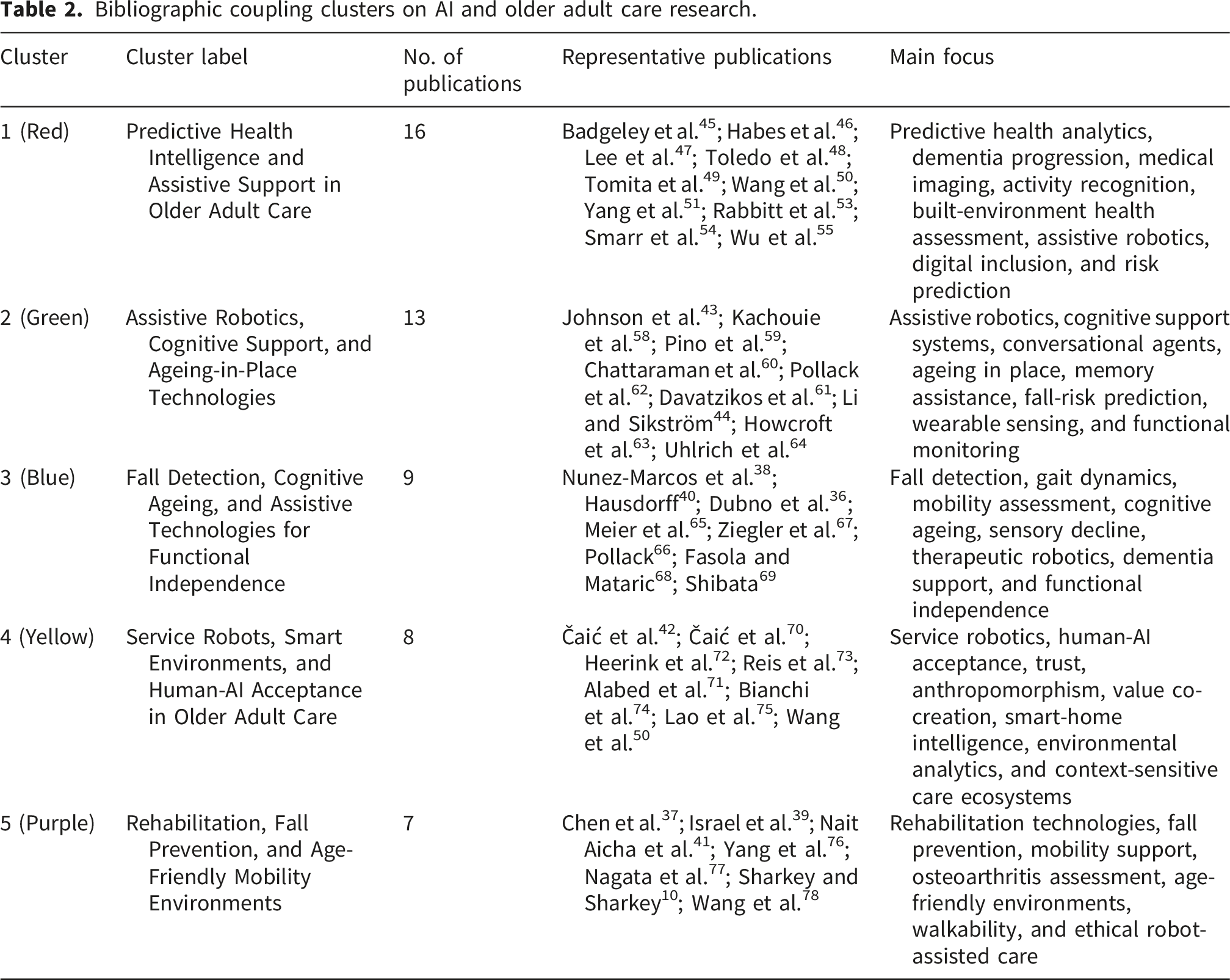
The bibliographic coupling analysis revealed five distinct clusters representing the current intellectual structure of AI research in older adult care. These clusters show that the field is no longer organised around a single technological domain. Instead, it is structured around interconnected research fronts involving predictive health intelligence, assistive robotics, cognitive support, smart environments, rehabilitation, fall prevention, and ethical care technologies.
Cluster 1: Predictive health intelligence and assistive support in older adult care
Cluster 1 represents a research front centred on the use of AI to predict, monitor, and support ageing-related health, cognitive, functional, and environmental outcomes. The publications in this cluster show that AI-enabled older adult care extends beyond robotics and smart-home monitoring to include predictive modelling, medical imaging, dementia progression, sleep assessment, activity recognition, built-environment analysis, and digital inclusion. A dominant theme is the application of deep learning and multimodal analytics to identify health risks, including hip fracture, osteoporotic vertebral fracture, brain ageing patterns, and Alzheimer’s disease progression.45–49 Other studies examine how built environments and street greenery influence health and walking behaviour among older adults using big data and deep learning approaches.50,51 The cluster also includes work on assistive robots, domestic robots, and socially assistive robotics, highlighting the importance of acceptance, trust, interaction quality, and user-centred design.52–55 Importantly, this cluster also raises concerns about measurement validity and digital ageism, emphasising that AI systems must remain inclusive, ethical, and sensitive to older adults’ lived experiences.56,57
Cluster 2: Assistive robotics, cognitive support, and ageing-in-place technologies
Cluster 2 represents a research front focused on assistive robotics, cognitive support systems, fall-risk prediction, and technologies that support ageing in place. The publications in this cluster show that AI-enabled care for older adults is increasingly concerned with how intelligent systems can assist with daily living, compensate for cognitive or functional decline, and improve independence among older adults. A major theme is the development and acceptance of socially assistive robots and service robots for elder care. Studies examine design requirements, affordability, task suitability, user attitudes, and the practical deployment of robots in assisted-living and care environments.43,58,59 Related work on conversational digital assistants further highlights the importance of interaction style, reciprocity, and task competence in shaping older adults’ engagement with AI systems. 60 Another theme concerns cognitive and functional support. Intelligent reminder systems and cognitive orthotic technologies have been developed to support people with memory impairment, while neurocomputational and neuroimaging studies examine cognitive ageing and the detection of prodromal Alzheimer’s disease.44,61,62 The cluster also includes wearable sensors and smartphone-based approaches for fall-risk prediction and movement analysis, supporting preventive care and functional monitoring.63,64 Overall, this cluster reflects the convergence of robotics, cognitive assistance, digital health, and ageing-in-place technologies.
Cluster 3: Fall detection, cognitive ageing, and assistive technologies for functional independence
Cluster 3 represents a research front focused on fall detection, cognitive ageing, assistive technologies, and functional support for older adults. The publications in this cluster show that AI-enabled care for older adults is strongly linked to preventing functional decline and to the development of intelligent systems that support independence, mobility, cognition, and well-being. A major theme is fall-related risk assessment and mobility analysis. Vision-based fall detection using convolutional neural networks and studies on gait dynamics demonstrate how AI and movement science contribute to the early identification of instability, fall risk, and age-related mobility changes.38,40 Another theme concerns cognitive and sensory ageing. Studies on white matter integrity, functional brain network reorganisation, age-related hearing loss, and AI-supported cognitive assistance show how ageing affects neurological, sensory, and cognitive functioning.36,65–67 The cluster also includes socially assistive and therapeutic robotics, highlighting the use of robots to motivate physical exercise, support dementia care, and improve older adults’ quality of life.68,69 Overall, this cluster reflects the integration of fall prevention, cognitive support, sensory ageing, and assistive technologies to promote functional independence among older adults.
Cluster 4: Service robots, smart environments, and Human-AI acceptance in older adult care
Cluster 4 represents a research front that links service robotics, smart-environment intelligence, human-AI acceptance, and environmental determinants of older adults’ well-being. The publications in this cluster suggest that AI-enabled care for older adults is increasingly understood as a service ecosystem in which technological performance, user experience, social cognition, and contextual fit interact. A key theme concerns the role of service robots in care and service networks. Studies show that robots may support value co-creation in elderly care by enhancing assistance, interaction, and service delivery, but they may also contribute to value co-destruction when poorly aligned with user expectations, care routines, or social norms.42,70 Related studies on AI anthropomorphism and robot service contexts further highlight the importance of perceived humanness, self-congruence, trust, and acceptance in shaping user engagement.71–73 A second theme involves AI-enabled sensing and environmental intelligence. Smart-home activity recognition, wearable sensors, and machine-learning-based brain-morphology analysis demonstrate how AI supports personalised monitoring, cognitive assessment, and health-related prediction.74,75 Environmental analytics also show how neighbourhood walkability and visual enclosure can influence older adults’ mental health. 50 Overall, this cluster reflects the convergence of service robotics, smart environments, AI acceptance, and context-sensitive care.
Cluster 5: Rehabilitation, fall prevention, and age-friendly mobility environments
Cluster 5 represents a research front focused on AI-enabled rehabilitation, fall prevention, mobility support, and age-friendly environments for older adults. The publications in this cluster show that care for older adults is increasingly concerned with maintaining physical function, supporting safe mobility, and reducing risks associated with frailty, falls, musculoskeletal decline, and environmental barriers. A major theme concerns the use of AI and sensor-based systems for clinical assessment and risk prediction. Deep neural networks have been applied to grade the severity of knee osteoarthritis, while daily-life accelerometry has been used to predict falls among older adults.37,41 Rehabilitation research also examines robotic and therapist-assisted walking, highlighting the role of robotic technologies in supporting functional recovery and mobility training. 39 A second theme concerns the relationship between mobility, built environments, and healthy ageing. Studies using streetscape greenery, semantic segmentation, and Google Street View images show how neighbourhood walkability and environmental design influence older adults’ walking behaviour and leisure mobility.76,77 The cluster also includes ethical and user-centred perspectives on robot care, especially for older adults with Alzheimer’s disease and their caregivers.10,78 Overall, this cluster highlights the convergence of rehabilitation technology, fall-risk analytics, environmental design, and ethical mobility support.
Comparative summary of bibliographic coupling clusters
The five bibliographic coupling clusters demonstrate that AI-enabled older adult care is organised around interconnected research fronts spanning predictive health intelligence, assistive technologies, rehabilitation, mobility support, and human-centred care. Clusters 1, 3, and 5 primarily focus on health monitoring, cognitive ageing, fall prevention, rehabilitation, and functional independence through AI-driven assessment and predictive analytics. In contrast, Clusters 2 and 4 emphasise assistive robotics, cognitive support, ageing-in-place technologies, service robots, smart environments, and human-AI acceptance.
These clusters reveal that the field is shaped by both technological and socio-technical perspectives. The technological dimension centres on machine learning, clinical imaging, sensor analytics, activity recognition, and predictive health monitoring, whereas the socio-technical dimension highlights human-robot interaction, trust, digital inclusion, ethical governance, and age-friendly care environments. Overall, the findings suggest that AI research in older adult care is evolving from isolated technological applications toward integrated care ecosystems that combine predictive intelligence, assistive technologies, rehabilitation, and human-centred implementation to support healthy ageing and quality of life.
Co-word analysis
Bibliographic coupling clusters on AI and older adult care research.
Top 15 most frequent keywords from the co-word analysis.
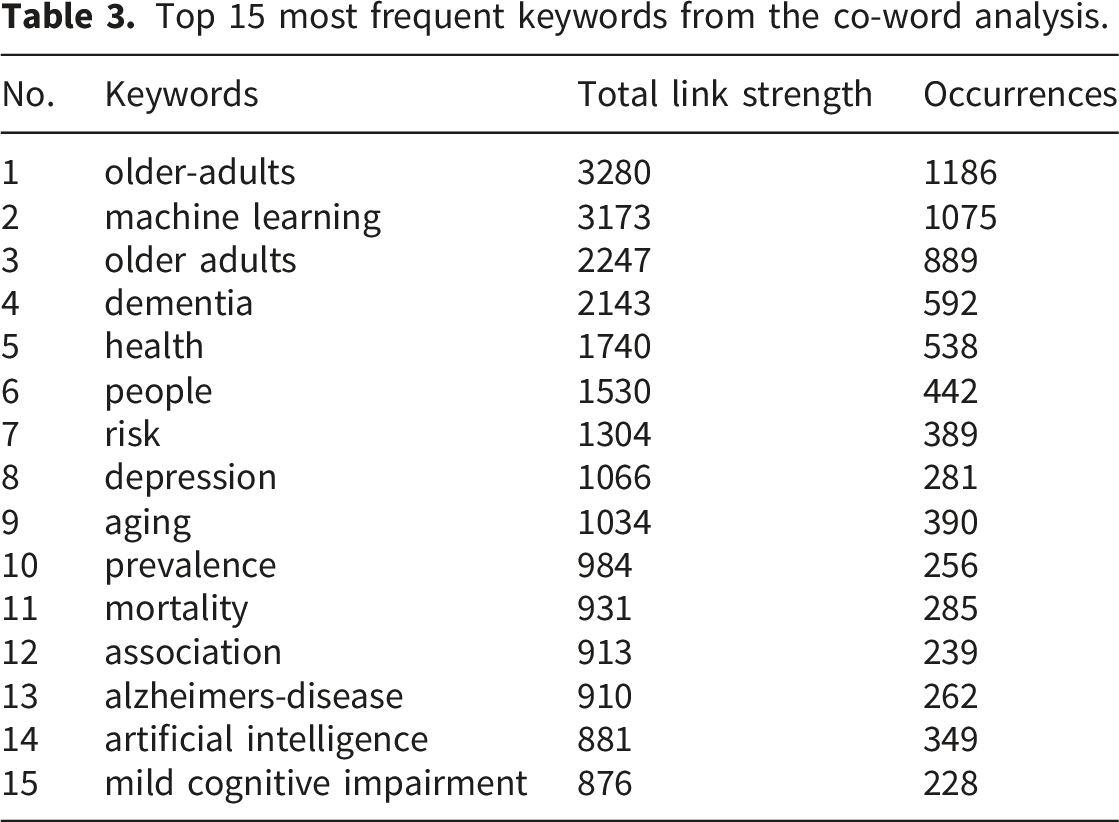
Figure 4 presents the keyword co-occurrence network generated using VOSviewer. In this network, node size represents keyword frequency, link thickness indicates the strength of co-occurrence between keywords, colours indicate thematic clusters, and spatial proximity reflects conceptual relatedness. The clustering algorithm identified four thematic clusters, indicating that AI-enabled older adult care is organised around health vulnerability, intelligent care technologies, mobility and functional ageing, and cognitive impairment. Co-word network of AI research in older adult care.
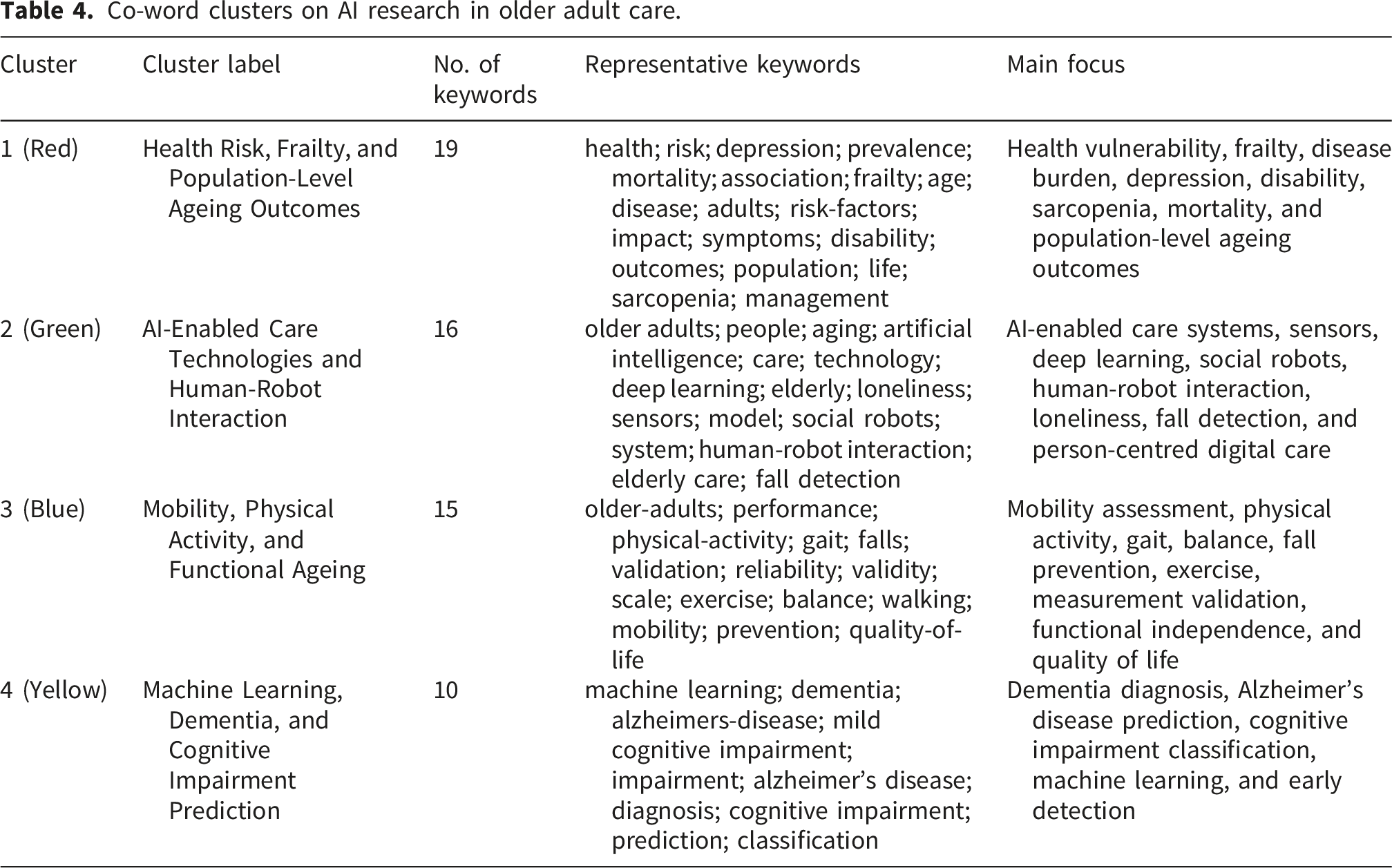
Cluster 1: Health risk, frailty, and population-level ageing outcomes
Cluster 1 focuses on health-related vulnerability among older adults and reflects the growing use of AI to identify, predict, and manage ageing-related risks. Keywords such as health, risk, depression, prevalence, mortality, frailty, disease, disability, sarcopenia, outcomes, and population suggest strong links to epidemiological and clinical research. Recent studies demonstrate the increasing use of machine learning and multidimensional health assessment data to predict frailty, sarcopenia progression, adverse health events, and long-term outcomes among older populations.79–81 Research has also focused on developing interpretable risk prediction models that support clinical decision-making and early intervention strategies. 82 Furthermore, emerging evidence highlights the integration of AI-based frailty assessment into broader geriatric care frameworks to reduce disability, improve resilience, and enhance population-level health outcomes. 83
Cluster 2: AI-enabled care technologies and human-robot interaction
Cluster 2 centres on the technological foundations of older adult care and represents the core AI, robotics, and digital health stream within the field. Keywords including artificial intelligence, technology, deep learning, sensors, systems, social robots, human-robot interaction, elderly care, and fall detection reflect the growing deployment of intelligent technologies to support care delivery. Recent studies show an increasing adoption of AI-powered monitoring systems, smart homes, wearable sensors, and Internet of Things platforms for health surveillance and fall prevention.84,85 At the same time, social robots and conversational AI systems are increasingly being used to address loneliness, companionship, emotional support, and social engagement among older adults.86,87 Broader reviews further suggest that AI technologies are becoming embedded within integrated models of geriatric care, extending beyond technical functionality to encompass relational, psychological, and quality-of-life dimensions. 3
Cluster 3: Mobility, physical activity, and functional ageing
Cluster 3 represents a functional ageing and mobility-oriented research stream focused on maintaining independence and physical functioning in later life. Keywords such as physical activity, gait, falls, exercise, balance, walking, mobility, prevention, quality of life, validation, reliability, and validity indicate substantial attention to movement assessment and fall prevention. Recent evidence shows that AI-enabled mobility assessment increasingly relies on wearable sensors, inertial measurement units, and machine learning techniques to detect mobility limitations, assess balance, and predict fall risk.88,89AI-assisted screening tools have also been developed to improve functional mobility assessment and support individualised intervention planning among older adults. 90 Furthermore, wearable technologies are increasingly used to monitor physical activity patterns and promote healthy ageing while providing objective measures of exercise outcomes and quality of life. 91 Research on fall-risk assessment technologies further demonstrates the importance of valid and reliable digital tools for supporting mobility preservation and independent living. 92
Cluster 4: Machine learning, dementia, and cognitive impairment prediction
Cluster 4 focuses on cognitive ageing and AI-based approaches to dementia diagnosis and prediction. Keywords including machine learning, dementia, Alzheimer’s disease, mild cognitive impairment, diagnosis, prediction, and classification indicate a rapidly expanding research area dedicated to early detection of cognitive decline. Recent studies demonstrate the growing use of machine learning and deep learning models to classify Alzheimer’s disease progression, identify mild cognitive impairment, and improve diagnostic accuracy using neuroimaging, clinical, and multimodal datasets.93,94 Systematic reviews further show increasing interest in AI-driven prediction models for dementia onset, disease progression, and risk stratification across diverse clinical settings.95,96 Beyond Alzheimer’s disease, machine learning approaches are also being applied to cognitive impairment associated with other neurological conditions, demonstrating the broad applicability of AI-based diagnostic frameworks. 97
Co-word clusters on AI research in older adult care.
Comparative summary of Co-Word clusters
The four co-word clusters show that AI research in older adult care is organised around interconnected health and technology priorities. Cluster 1 emphasises health vulnerability, including frailty, depression, sarcopenia, disability, mortality, and population-level ageing outcomes. Cluster 2 represents the technological and relational core of the field, focusing on AI, deep learning, sensors, social robots, human-robot interaction, loneliness, and care support. Cluster 3 highlights functional ageing through mobility, gait, falls, exercise, balance, prevention, and quality of life. Cluster 4 focuses on cognitive ageing, particularly dementia, Alzheimer’s disease, and mild cognitive impairment, as well as diagnosis, prediction, and classification.
These clusters suggest that AI-enabled older adult care is moving beyond isolated technological applications toward an integrated care model that combines risk prediction, intelligent care technologies, mobility support, and dementia-related diagnosis. Future research should strengthen links across these areas by developing AI systems that are clinically useful, socially acceptable, ethically governed, and responsive to older adults’ multidimensional care needs.
Discussion
This study mapped the intellectual and conceptual structure of AI research in older adult care by integrating bibliographic coupling and co-word analysis. Based on 5,214 English-language journal articles indexed in the Web of Science Core Collection between 2004 and 2025, the findings demonstrate that AI-enabled older adult care has evolved into a large, rapidly expanding, and highly interdisciplinary field. The bibliographic coupling analysis identified five contemporary research fronts encompassing predictive health intelligence, assistive robotics, cognitive support, ageing-in-place technologies, fall detection, rehabilitation, mobility support, smart environments, and human-AI acceptance. Complementing these findings, the co-word analysis revealed four dominant conceptual themes centred on health vulnerability and frailty; AI-enabled care technologies and human-robot interaction; mobility and functional ageing; and machine learning applications for dementia and cognitive impairment. These findings suggest that AI-enabled older adult care is no longer organised around isolated technological applications but is increasingly evolving toward integrated socio-technical care ecosystems that combine prediction, monitoring, diagnosis, rehabilitation, mobility support, social interaction, environmental design, and governance.
Socio-technical transition toward integrated care ecosystems
A central finding of this study is the transition from standalone AI technologies toward integrated socio-technical systems of care. Earlier research commonly focused on specific technological applications such as social robots, wearable sensors, fall-detection systems, activity-recognition models, and smart-home devices. In contrast, the current intellectual structure demonstrates an increasing integration of these technologies within broader care ecosystems that involve older adults, caregivers, healthcare professionals, care organisations, digital infrastructures, and regulatory actors. This shift is reflected in both the bibliographic coupling and co-word analyses, in which technological themes are consistently linked to concepts such as frailty, disability, mobility, quality of life, dementia, loneliness, and caregiving.
These findings align with recent evidence showing that AI, IoT technologies, wearable sensing, smart homes, and digital health platforms are increasingly deployed to support ageing in place, remote monitoring, long-term care, and personalised intervention.3–6 From a socio-technical systems perspective, the effectiveness of AI depends not only on technical accuracy but also on user trust, workflow integration, institutional readiness, and governance structures. Consistent with previous research, acceptance among older adults is influenced by perceived usefulness, ease of use, privacy, trust, autonomy, cultural expectations, and compatibility with existing care relationships.8,9,14 Consequently, future research should move beyond technological performance metrics and place greater emphasis on implementation processes, caregiver involvement, cultural adaptation, and long-term care outcomes.
Predictive health intelligence, mobility, and preventive care
The findings identify predictive health intelligence and preventive care as major research priorities in AI-enabled care for older adults. Bibliographic coupling revealed strong research streams involving clinical imaging, disease progression modelling, fracture prediction, activity recognition, and built-environment health, while co-word analysis highlighted themes related to frailty, depression, disability, mortality, sarcopenia, and population-level ageing outcomes. These patterns reflect a broader transition from reactive care models toward proactive and preventive approaches. Recent developments in machine learning and deep learning increasingly support the prediction of frailty, functional decline, depressive symptoms, hospitalisation, mortality, and other adverse health outcomes among older adults.79–83
Closely connected to this trend is the growing focus on mobility, rehabilitation, and functional independence. Research involving gait assessment, fall detection, physical activity monitoring, rehabilitation planning, and age-friendly environments demonstrates how AI is being used to maintain independence and reduce mobility-related risks. Emerging applications utilise wearable sensors, inertial measurement units, computer vision, and machine learning algorithms to assess balance, predict fall risk, and support rehabilitation interventions.88–92 Furthermore, studies examining walkability, neighbourhood design, and environmental characteristics indicate that AI is increasingly informing age-friendly urban planning and community-level interventions.50,76,77 Together, these findings suggest that AI should be viewed not only as a clinical monitoring tool but also as a mechanism for promoting healthy ageing, mobility, and quality of life across both healthcare and community settings.
Human-centred AI, dementia care, and adoption challenges
The findings also highlight the growing importance of human-centred AI within older adult care. Multiple bibliographic coupling clusters focused on social robots, conversational agents, human-robot interaction, service robots, trust, anthropomorphism, and user acceptance. Similarly, the co-word analysis identified a major conceptual cluster centred on social robots, loneliness, care, and human-robot interaction. These patterns indicate that the field increasingly recognises that successful adoption depends on how older adults perceive, experience, and interact with AI-enabled technologies rather than on technical performance alone.
This human-centred perspective is particularly evident in dementia and cognitive impairment research. Machine learning, dementia, Alzheimer’s disease, diagnosis, prediction, and classification emerged as a distinct conceptual cluster, reflecting growing efforts to improve early detection and disease management through AI-supported analysis of neuroimaging, behavioural, clinical, and multimodal datasets.93–97 While these developments offer significant potential for earlier intervention and personalised care planning, they also raise important concerns regarding autonomy, informed consent, privacy, accountability, and human oversight. Ethical analyses consistently emphasise that AI systems used in dementia care must preserve dignity, relational care, transparency, and professional judgement.11,12,23,98
Cultural factors further complicate implementation. Evidence suggests that attitudes toward AI-assisted assessment vary substantially across countries and populations. For example, Giannouli 99 reported that older Greek adults demonstrated limited understanding of AI technologies, expressed substantial distrust of AI-supported assessments, and strongly preferred evaluations conducted by healthcare professionals rather than fully automated systems. Such findings highlight that adoption depends not only on technological capability but also on trust, digital literacy, cultural expectations, and perceived preservation of autonomy. Future research should therefore prioritise participatory design, co-design approaches, long-term deployment studies, and cross-cultural evaluation to ensure that AI technologies remain aligned with the needs and preferences of older adults and their caregivers.
Ethical, legal, and governance implications
A major implication of this study is that ethical governance should be viewed as a foundational component of AI-enabled care for older adults rather than a secondary consideration. Although ethical governance did not emerge as a standalone cluster, concerns about privacy, autonomy, dignity, fairness, accountability, transparency, and trust were embedded throughout the field’s intellectual structure. Studies involving social robots, dementia care, smart-home monitoring, predictive analytics, and AI acceptance consistently emphasise the need for responsible implementation.10,11,14,56,98
The findings also suggest that legal and regulatory considerations are becoming increasingly important, particularly in dementia care and cognitive assessment. As AI systems become more involved in diagnosis, monitoring, decision support, and financial capacity assessment, questions arise regarding consent, liability, explainability, data governance, and professional accountability. Existing dementia care legislation and mental-capacity frameworks in many jurisdictions have yet to fully address the implications of AI-assisted decision-making. Consequently, future research should explore how health data governance, mental-capacity legislation, dementia care policies, and AI regulation can be integrated to protect cognitively vulnerable older adults while supporting innovation.
Overall, the findings indicate that the future of AI-enabled care for older adults will depend on striking an appropriate balance between technological advancement and human-centred implementation. Responsible innovation requires not only accurate and efficient AI systems but also transparency, inclusivity, cultural responsiveness, ethical governance, and sustained human oversight. Future research should therefore prioritise interdisciplinary collaboration among artificial intelligence, gerontology, healthcare, rehabilitation science, public health, law, and ethics to develop integrated care ecosystems that enhance healthy ageing, independence, dignity, and quality of life.
Implications
Theoretical implications
This study contributes to the theoretical development of AI-enabled older adult care research by showing that the field is increasingly structured around socio-technical relationships rather than isolated technological applications. The findings demonstrate that AI in older adult care is located at the intersection of computer science, healthcare, gerontology, robotics, rehabilitation, digital health, urban studies, ethics, and policy. This supports the relevance of Socio-Technical Systems Theory as a useful lens for explaining how technological systems, human users, care organisations, and governance environments interact in shaping AI-enabled care.
First, the study clarifies the multidisciplinary nature of AI-enabled care for older adults. Bibliographic coupling shows that contemporary research fronts combine predictive health intelligence, assistive robotics, fall prevention, cognitive support, service robotics, smart environments, rehabilitation, and age-friendly mobility environments. Co-word analysis further shows that the field is conceptually organised around health vulnerability, intelligent care technologies, functional ageing, and dementia-related prediction. These findings suggest that future theoretical models should move beyond technology-centred explanations and incorporate clinical, relational, environmental, organisational, and governance dimensions.
Second, this study extends theoretical discussions on human-centred AI. The prominence of human-robot interaction, social robots, loneliness, care, acceptance, and service robotics indicates that the effectiveness of AI systems depends not only on algorithmic performance but also on trust, usability, emotional fit, perceived dignity, and social integration. Future theoretical frameworks should therefore integrate technology acceptance, ageing psychology, relational care, digital health innovation, and socio-technical implementation.
Third, the study reinforces the need to theorise responsible AI as an integral part of care for older adults. Issues such as privacy protection, algorithmic transparency, autonomy, informed consent, fairness, digital ageism, and accountability become more important as AI systems are embedded within domestic, clinical, and institutional care settings. Future theoretical work should therefore explain not only how AI systems are developed and adopted but also how they are trusted, governed, legitimised, and sustained within ageing societies.
Practical implications
The findings offer practical implications for healthcare providers, care institutions, caregivers, technology developers, and service designers. First, AI-enabled monitoring and prediction systems should be designed to support preventive care, early risk detection, and safer ageing in place while minimising privacy risks. Technologies such as wearable sensors, smart-home platforms, fall detection systems, gait analysis tools, and machine learning-based risk models can assist in identifying frailty, mobility decline, fall risk, cognitive impairment, and adverse health outcomes. However, implementation should not be guided by predictive accuracy alone. Care providers should also consider whether these systems are explainable, usable, acceptable, culturally appropriate, and compatible with existing care routines.
Second, socially assistive robots, conversational agents, and AI-enabled companion technologies may support psychosocial well-being by addressing loneliness, communication needs, emotional support, and social engagement among older adults. Nevertheless, these systems should be implemented as complements to human caregiving rather than substitutes for relational care. Their success depends on whether older adults and caregivers perceive them as trustworthy, respectful, emotionally appropriate, and supportive of autonomy and dignity.
Third, the findings highlight the importance of co-design and participatory development. Older adults, family caregivers, healthcare professionals, rehabilitation specialists, and care managers should be involved throughout the design, testing, implementation, and evaluation of AI-enabled care technologies. Such involvement can improve usability, strengthen trust, reduce resistance, and ensure that AI technologies respond to real care needs rather than developer assumptions. Implementation should also be evaluated in real-world care environments through longitudinal studies that assess sustained adoption, workflow integration, caregiver burden, user experience, functional outcomes, and quality of life.
Fourth, the results suggest that AI-enabled care for older adults should be implemented through integrated service models. Predictive health analytics, mobility monitoring, dementia prediction, rehabilitation technologies, and social robots should not function as disconnected tools. Instead, they should be connected within coordinated care pathways that allow data to inform timely intervention, professional decision-making, caregiver support, and personalised care planning.
Policy implications
The findings provide important implications for policymakers, healthcare regulators, funding agencies, and public health planners. First, stronger governance frameworks are needed to guide the responsible deployment of AI in older adult care. As AI systems increasingly collect sensitive behavioural, health, cognitive, and domestic data, policies must address privacy protection, informed consent, algorithmic transparency, accountability, data security, and responsible data sharing. These safeguards are especially important in dementia care and other contexts involving older adults with reduced or fluctuating decision-making capacity.
Second, regulatory frameworks should ensure that AI-enabled care technologies are safe, explainable, inclusive, and ethically aligned before large-scale implementation. Policymakers should encourage standards for responsible AI design, bias auditing, privacy-preserving data practices, human oversight, and clear accountability mechanisms. Regulation should also clarify the responsibilities of developers, healthcare providers, caregivers, institutions, and service vendors when AI systems are used for monitoring, assessment, decision support, or care planning.
Third, the findings highlight the need to address inequities in access to AI-enabled care for older adults. Without inclusive policy intervention, AI technologies may widen existing disparities among older adults, particularly those in rural, low-income, digitally excluded, or under-resourced communities. Governments should invest in digital health infrastructure, caregiver and workforce training, AI literacy, affordable access to assistive technologies, and culturally responsive implementation strategies. Research funding agencies should also promote cross-national and cross-cultural collaboration to ensure that AI-enabled care reflects diverse ageing experiences, caregiving norms, and healthcare system capacities.13–16
Fourth, policy development should recognise that AI-enabled older adult care is not only a health technology issue but also a social care, ageing, disability, urban planning, and digital inclusion issue. The links between AI, mobility, age-friendly environments, dementia care, and population-level risk prediction suggest that future policy should integrate health, social care, housing, transport, digital infrastructure, and ethical governance.
Conclusion
Population ageing continues to place increasing pressure on healthcare systems, long-term care services, caregiver availability, and age-friendly support infrastructures. In response, AI has emerged as a promising approach for enhancing prevention, monitoring, diagnosis, rehabilitation, mobility support, and personalised care for older adults. However, research on AI-enabled care for older adults remains fragmented across clinical, technological, behavioural, environmental, and ethical domains. This study addressed this gap by mapping the intellectual and conceptual structure of the field using 5,214 journal articles indexed in the Web of Science Core Collection between 2004 and 2025.
The findings revealed five contemporary research fronts: predictive health intelligence and assistive support; assistive robotics and ageing-in-place technologies; fall detection and functional independence; service robots and human-AI acceptance; and rehabilitation and age-friendly mobility environments. Co-word analysis further identified four dominant conceptual themes: health risk and frailty; AI-enabled care technologies and human-robot interaction; mobility and functional ageing; and dementia-related prediction and diagnosis. Collectively, these findings indicate that AI-enabled care for older adults is evolving from isolated technological applications to integrated socio-technical care ecosystems that combine clinical intelligence, assistive technologies, mobility support, cognitive care, and human-centred implementation.
The study contributes theoretically by demonstrating the value of a socio-technical systems perspective in explaining how technological, clinical, organisational, human, and governance dimensions interact within older adult care. Practically, the findings highlight the importance of developing AI systems that are not only technically effective but also usable, trustworthy, explainable, and aligned with the needs of older adults and caregivers. From a policy perspective, the results emphasise the need for ethical governance, privacy protection, accountability, digital inclusion, and equitable access to AI-enabled care technologies.
Several limitations should be acknowledged. The study relied exclusively on the Web of Science Core Collection and included only English-language journal articles, potentially excluding relevant publications from other databases, languages, and publication formats. In addition, the threshold-based nature of bibliometric analysis may influence network structures and cluster composition. Furthermore, bibliometric methods identify knowledge patterns but do not evaluate the real-world effectiveness, safety, or implementation outcomes of AI technologies. Future research should therefore incorporate multiple databases, non-English literature, and complementary methodologies, including systematic reviews, meta-analyses, qualitative investigations, implementation studies, and longitudinal field evaluations. Particular attention should be given to explainable and privacy-preserving AI, culturally responsive design, digital inclusion, AI governance in dementia care, cross-national comparisons, bias auditing, long-term deployment of social robots, and the integration of AI with rehabilitation and mobility support. Ultimately, the future success of AI in older adult care will depend not only on technological advancement but also on the extent to which intelligent systems can be integrated into human-centred, ethically governed, and socially sustainable care ecosystems.
Footnotes

Author Contributions
Zhiming Wei contributed to the study’s conceptualization, conducted data collection and analysis, and prepared the initial manuscript draft. Walton Wider supervised the research process, provided methodological guidance, validated the bibliometric analyses, and critically revised the manuscript for theoretical coherence and academic rigour. Changhe Wu, Choon Kit Chan, Yong Xu, and Hao Wu contributed to the interpretation of the findings, the integration of the literature, and the editing of the manuscript. All authors read and approved the final version of the manuscript.
Funding
The research is supported by: Funding project for training objects of the “Qinglan Project” in Jiangsu colleges anduniversities, Teaching team for training talents in health and elderly care in 2025, (No. 202516).
Declaration of conflicting interests
The authors declared no potential conflicts of interest with respect to the research, authorship, and/or publication of this article.
Data Availability Statement
The bibliographic records analysed in this study were retrieved from the Web of Science Core Collection database. The processed dataset used for the bibliometric analysis is available from the corresponding author upon reasonable request.
Guarantor
Walton Wider, the corresponding author, serves as the guarantor of this study.