




Abstract
Grounded in Self-Determination Theory, the present study examined associations between motivational teaching styles and students’ engagement in Portuguese elementary classrooms, using a multilevel approach to account for both individual- and classroom-level effects. This cross-sectional study employed a convenience sample of 662 fourth-grade students, who completed items from the Engagement Versus Disaffection with Learning scale, and 42 teachers, who completed the Situations-in-School questionnaire. Hierarchical linear modeling accounted for the nested structure of the data and showed that autonomy-supportive (β = .10) and structuring (β = .12) teaching styles were positively associated with behavioral engagement, whereas emotional engagement was linked only to structuring (β = .13). Controlling and chaotic teaching styles were not significantly associated with student engagement. Most variance in engagement was observed at the individual level, with a smaller proportion attributable to classroom-level differences (ICCs = .02 to .06 across models). These findings underscore the importance of teachers providing structure and autonomy support, with practical implications for teacher training and the design of psychoeducational interventions that foster more motivating learning environments in the early years of schooling.
Introduction
According to Self-Determination Theory (SDT; Deci & Ryan, 2000; Ryan & Deci, 2020), student engagement (SE) emerges from the dynamic interplay between students’ intrinsic motivational resources and the conditions provided by the school environment. SDT assumes that all students possess a natural tendency toward learning and development, whose flourishing depends on the extent to which their basic psychological needs for autonomy, competence, and relatedness are supported. Within this dialectical framework, students’ inner motivational resources and classroom conditions, particularly teacher–student relationships, are viewed as mutually influential. Accordingly, SE is shaped by educational contexts that satisfy these fundamental psychological needs (Reeve et al., 2004). Among such contextual conditions, motivational teaching styles play a particularly influential role, as they function as external regulators that can either support and energize, or neglect and undermine, students’ psychological needs and intrinsic motivation (Reeve, 2012).
SE has been extensively explored by researchers and educators worldwide, largely due to its well-established link to academic achievement (e.g., Lei et al., 2018), its contribution to student well-being (Wong et al., 2024), and its potential to reduce dropout rates (e.g., Archambault et al., 2022). Studying SE in the early years of schooling is especially relevant from a developmental, preventive, and promotional perspective. Elementary school represents a sensitive period during which children’s beliefs about themselves as learners are formed (Bandura, 1997), and the foundations for future academic success are established (Allen et al., 2024). During this stage, students develop self-perceptions of academic competence, along with study habits and motivational profiles that influence persistence throughout schooling (Seligman, 1994). Importantly, research shows that early teacher–student relationships contribute to more positive motivational attitudes toward school later on (Heatly & Votruba-Drzal, 2019).
The structure of elementary schooling in Portugal further underscores the relevance of studying how teaching practices contribute to SE during this period. Unlike other educational levels, in grades 1 to 4, students typically spend most of the school day with a single teacher, often for four consecutive years. This prolonged interaction intensifies students’ exposure to teachers’ instructional and relational practices, thereby increasing their susceptibility to teacher influence (Brophy, 1986). External variables such as teacher gender or age, as well as school characteristics, may also shape this relational process. According to UNESCO (2025), teaching at elementary school is a predominantly female profession, reflecting cultural norms and gendered expectations regarding children’s education and care, which may reinforce social gender stereotypes.
Despite the critical role of SE, international evidence indicates that a substantial number of students show limited engagement in learning. According to the most recent Programme for International Student Assessment (PISA) report by the Organisation for Economic Co-operation and Development (OECD, 2024), only about half of students in OECD countries reported enjoying learning new things, and fewer—approximately 47%—reported enjoying challenging schoolwork. These findings highlight the need for further research on contextual factors that influence SE, particularly those related to teaching practices (Hofkens & Pianta, 2022). The literature consistently shows that teachers exert a pivotal influence on SE, motivation, and achievement (e.g., Gebre et al., 2025; Patzak et al., 2025; Roorda et al., 2017; Tao et al., 2022).
From a methodological perspective, most previous research on the relationship between motivational teaching styles and SE has focused on individual-level effects (e.g., Coterón et al., 2024). Such approaches may overlook the classroom as a shared social context, in which students and teachers interact and jointly shape learning experiences (Rucinski et al., 2018). To address this limitation, the present study employs hierarchical linear modeling (HLM) to examine associations between motivational teaching styles and students’ emotional and behavioral engagement at both the individual and classroom levels. Classroom-level effects capture how a shared motivational climate can either amplify or attenuate SE.
In addition, this study focuses on elementary school students, specifically fourth-grade students in general education classrooms. This focus addresses an important gap in the literature, as most prior research on motivational teaching styles has been conducted with middle and high school students and largely within physical education or sports contexts (e.g., De Meyer et al., 2016).
The relevance of the present study also stems from the well-established role of SE in predicting academic success, as well as the early identification of students at risk of academic failure (Archambault et al., 2022). Moreover, SE is malleable and responsive to contextual influences, including psychoeducational interventions (Fredricks et al., 2019). By examining how different motivational teaching styles relate to emotional and behavioral engagement in elementary classrooms, this study aims to contribute to a more nuanced understanding of early engagement processes and to inform educational practice and intervention in elementary school settings.
Student Engagement
SE is generally defined as “the quality of a student’s connection or involvement with the endeavor of schooling and hence with the people, activities, goals, values, and place that compose it” (E. A. Skinner et al., 2009, p. 494). Research with elementary school students has shown that SE significantly predicts academic achievement in mathematics (e.g., Darensbourg & Blake, 2013) and reading (e.g., Hughes & Kwok, 2007), and is longitudinally associated with high school graduation (O’Donnell, 2019). Although the literature has primarily emphasized the role of SE in academic performance, school completion (Archambault et al., 2019), and school adjustment (Basharpoor et al., 2022), SE is also associated with social and emotional outcomes, including subjective well-being (Wong et al., 2024).
In educational research, SE is commonly conceptualized as a multidimensional construct that includes emotional, behavioral, and cognitive components, which are interrelated and mutually supportive (Fredricks et al., 2004). The emotional dimension refers to the feelings students experience during learning activities, such as interest, enjoyment, or anxiety (E. A. Skinner & Belmont, 1993). The behavioral component captures students’ active participation in learning and includes observable actions such as effort, persistence, and concentration (E. A. Skinner et al., 2009). The cognitive dimension involves the use of deep learning strategies and self-regulation in academic tasks (Reeve, 2012). Studies targeting early elementary students often examine the emotional and behavioral facets of SE (e.g., E. A. Skinner & Belmont, 1993; E. A. Skinner et al., 2009), given that cognitive engagement draws on metacognitive processes that are still developing in children (Kuhn, 2000). Accordingly, this study focuses on the emotional and behavioral dimensions of SE in a sample of fourth-grade students, who are typically around 10 years old.
Motivational Teaching Styles
Formal learning takes place in the classroom, a distinct social and cultural context with its own environment and characteristics. The classroom constitutes a primary setting for both academic and personal development, where teachers play a central role in shaping the learning climate and fostering students’ motivation and engagement (Wentzel, 2009). In this context, motivational teaching styles refer to the patterns of behavior and instructional practices that teachers adopt to create conditions conducive to motivation, achievement, and well-being (Reeve, 2016).
Current literature identifies four motivational teaching styles: autonomy support, structure, control, and chaos. Autonomy support and structure are considered motivating teaching styles, as they support students’ psychological needs, whereas control and chaos are viewed as demotivating, as they are regarded as need-thwarting (Aelterman et al., 2019). Teaching styles were initially conceptualized as opposite ends of two spectrums: autonomy support versus control (Reeve, 2009) and structure versus chaos (Jang et al., 2010). However, contemporary perspectives regard them as distinct dimensions, since a low level in one style does not necessarily imply a high level in the other (Haerens et al., 2018).
Autonomy-supportive teaching entails a respectful stance toward students’ perspectives, practices that nurture their interests and preferences, and behaviors that promote internalization—such as providing explanatory rationales, acknowledging negative emotions, using invitational language, and demonstrating patience (Reeve & Cheon, 2021). When students experience opportunities for choice, acknowledgment of their perspectives, and non-pressuring guidance, they tend to appraise learning tasks as meaningful. This appraisal promotes positive emotions, such as enthusiasm (Ma, 2021), a central component of emotional engagement. Viewing learning activities as meaningful and personally relevant also contributes to the internalization of academic values (Niemiec & Ryan, 2009). When behavior is more autonomously motivated, students are more likely to invest effort, persist in tasks, and actively participate in classroom activities (Patall et al., 2018), which reflects the behavioral dimension of engagement. Consistent with these processes, autonomy-supportive teaching has been associated with a range of personal and academic benefits, including higher autonomous motivation (Haerens et al., 2015), greater resilience (Reeve et al., 2020), higher levels of engagement (Yang et al., 2022), better academic achievement (Fu et al., 2023), and enhanced well-being (Kleinkorres et al., 2023).
Structured teaching comprises three core elements: clearly communicating goals, rules, and expectations before a learning activity; providing support, guidance, and monitoring during the activity; and delivering constructive feedback afterward to help students progress toward meaningful learning outcomes (Jang et al., 2010). By providing structure, teachers create a predictable learning environment with clear directions, which can enhance behavioral engagement by helping students focus on tasks and sustain effort (Hospel & Galand, 2016). At the same time, structure clarifies how to succeed in learning activities, supporting students’ sense of competence and mastery (E. Skinner et al., 2008), which can foster emotional engagement. Structured teaching has been consistently associated with positive effects on students’ motivation, engagement, and learning outcomes (e.g., Sierens et al., 2009; Tilga et al., 2023).
Autonomy support fosters a sense of volition, while structure provides the clarity and guidance necessary for students to feel competent in their learning (E. A. Skinner & Belmont, 1993). Although theoretically distinct, Jang et al. (2010) argued that autonomy support and structure are complementary rather than antagonistic. When implemented together, these two styles create optimal classroom conditions that support students’ needs and enhance their engagement (Cheon et al., 2020). However, research has found different patterns of associations between these two motivating styles and the dimensions of SE. Hospel and Galand (2016) found that structure was positively associated with the three dimensions of SE, whereas autonomy support was specifically related to emotional engagement. Notably, a significant interaction between the two styles in predicting emotional engagement emerged, highlighting the value of their combined implementation. In a different study, the combination of autonomy support and structure was associated with higher behavioral engagement (Archambault et al., 2020). Although these findings indicate that teaching styles contribute to SE, the ways in which autonomy support and structure relate to specific dimensions of SE remain an area of ongoing exploration.
Regarding demotivating teaching styles, control is marked by the use of pressuring language, the imposition of the teacher’s perspective, and the suppression of student voice. Controlling teachers use their authority to pressure students to think, act, and feel according to their own standards (Reeve, 2009). Students tend to respond to a controlling teaching style with feelings of anger and anxiety, which frustrate their psychological needs and lead to controlled motivation and amotivation (Haerens et al., 2015), reduced effort and persistence (Assor et al., 2005), lower achievement (Vansteenkiste et al., 2005), and increased oppositional behavior (De Meyer et al., 2016).
Finally, chaotic teaching reflects a lack of structure and guidance, leaving students without the clarity and support they need to navigate tasks effectively (Jang et al., 2010). This teaching style is associated with lower student effort and enjoyment (Cents-Boonstra et al., 2021). Both control and chaos undermine students’ psychological needs, with detrimental consequences for motivation and learning (Aelterman et al., 2019; De Meyer et al., 2016). Although the relationship between these demotivating styles and specific dimensions of SE is also a topic of ongoing investigation, together this evidence suggests that controlling and chaotic teaching are associated with lower emotional and behavioral engagement.
The Present Study
Grounded in SDT (Deci & Ryan, 2000; Ryan & Deci, 2020) and empirical evidence, the present study examines multilevel associations between motivational teaching styles (autonomy support, structure, control, and chaos) and students’ emotional and behavioral engagement in elementary classrooms. The study contributes to the literature by providing evidence from Portuguese elementary students in general education settings while accounting for the nested structure of the data.
Investigating these processes in the early years of schooling is particularly relevant, as this developmental period lays the foundation for later academic success and motivational profiles (Allen et al., 2024; Seligman, 1994). Moreover, identifying teaching-related factors associated with SE is especially important given the malleability of engagement (Fredricks et al., 2004) and its responsiveness to teacher-focused interventions (Reeve & Cheon, 2021), with implications for fostering more motivating, inclusive, and equitable classroom climates that support both students’ learning and well-being and teachers’ professional functioning.
The following hypotheses are proposed:
H1: Motivating teaching styles—specifically autonomy support and structure (Level 2)—are positively associated with students’ emotional and behavioral engagement (Level 1).
H2: Demotivating teaching styles—specifically control and chaos (Level 2)—are negatively associated with students’ emotional and behavioral engagement (Level 1).
Method
Participants
The sample included 662 students and 42 teachers from Portuguese fourth-grade classes. Students’ ages ranged from 9 to 13 years (M = 9.41, SD = 0.61). In the Portuguese school system, the typical age for fourth-grade students is 9 to 10 years. In this sample, 20 students (3%) were aged 11–13 due to grade retention. Of the students, 50.2% were male and 49.8% were female. Concerning country of birth, 83.7% were born in Portugal, and 16.3% were born abroad. Among those born abroad, 47% were from Brazil, 12% from Angola, 6% from Cape Verde, 6% from São Tomé and Príncipe, 3% from Nepal, 3% from Ukraine, 2% from Spain, 2% from Gambia, and the remaining 19% from other countries.
Teachers were predominantly female (95%). Their ages ranged between 26 and 66 years (M = 47.15, SD = 7.73), with professional experience varying from 0 to 43 years (M = 20.88, SD = 10.05).
Class sizes ranged from 4 to 24 students. These classrooms were conveniently sampled from 17 schools (13 public and 4 private) located in the Lisbon metropolitan area. The study was limited to this region, where data collection was feasible through the researchers’ established collaborations with local schools.
Instruments
Students
Student Engagement
Students completed eight items assessing their engagement in class, focusing on behavioral (e.g., “I try hard to do well in school”) and emotional aspects (e.g., “I enjoy learning new things in class”), with four items per dimension. The scale was developed based on the items from the behavioral and emotional subscales of the Engagement Versus Disaffection with Learning scale (E. A. Skinner et al., 2009). Participants rated their responses on a three-point Likert scale (1 = A little, 2 = Somewhat, 3 = Very much). The choice of this format followed recommendations to adapt Likert scales for children by reducing the number of response options and using words that reflect the frequency of behaviors rather than numbers, thereby making the scale developmentally appropriate and easy to interpret (Mellor & Moore, 2014).
A confirmatory factor analysis (CFA) was conducted to assess the structure of the scale using the robust maximum likelihood (MLR) estimator. A first-order model with two correlated factors, corresponding to behavioral and emotional engagement, provided an adequate fit to the data (CFI = .93; TLI = .90; RMSEA = .09; SRMR = .05), indicating that the scale adequately captures the two dimensions of engagement. Both subscales showed adequate reliability in this study, with Cronbach’s alpha values ranging from .73 to .77.
Teachers
Motivational Teaching Styles
The Portuguese version of the Situations in School (SIS) questionnaire (Aelterman et al., 2019; Laranjeira & Teixeira, 2025) was used to assess four motivational teaching styles: autonomy support, structure, control, and chaos. This vignette-based instrument consists of 15 hypothetical classroom situations related to learning or behavior management, occurring at different instructional moments—before, during, or after lessons. Each vignette presents four possible teaching behaviors reflecting the four motivational styles, resulting in a total of 60 items. Teachers rate the extent to which each behavior represents their typical teaching approach using a 7-point Likert scale, ranging from 1 (Does not describe me at all) to 7 (Describes me extremely well). An example scenario is: “You would like to motivate students during class. You decide to. . .” followed by four possible reactions: “Minimize the lesson plan; let what happens happen in the lesson” (chaos); “Pound the desk and say loudly ‘Now it is time to pay attention!’” (control); “Offer help and guidance” (structure); “Identify the personal benefits of the learning material for students’ everyday lives” (autonomy support).
The original instrument demonstrated adequate internal consistency (α = 0.78–0.82) and provided evidence of internal, construct, and predictive validity. The Portuguese version of the SIS also showed good reliability estimates (α = 0.86–0.89).
Procedures
The study used a cross-sectional design and was approved by the Ethics and Deontology Committee of the authors’ university and conducted in accordance with the ethical principles of the Declaration of Helsinki. It also received approval from the Ethics Committee of the Portuguese Ministry of Education’s General Directorate of Education (DGE) through the School Environment Survey Monitoring (MIME).
School principals were contacted via email to invite their schools to participate. Parental informed consent was obtained prior to data collection through written consent forms sent to parents or legal guardians via head teachers. Approximately 50 guardians declined participation, and these students were provided with an alternative activity, a word search puzzle. Teachers also provided written informed consent to participate. The consent forms included information about the aims of the study, the voluntary nature of participation, confidentiality and anonymity of the data, and the right to withdraw at any time without consequences. Before data collection, students were also briefed orally on this information. No incentives were offered for participation, and no students or teachers refused to participate or withdrew.
Data were collected during the second semester of the 2022/2023 school year, specifically between February and June. The principal researcher administered the questionnaires in a single classroom session to both students and their head teachers. In addition to the main instruments, both teachers and students completed a sociodemographic questionnaire. Children received verbal instructions and completed the questionnaire independently, with the researcher reading items aloud when needed. The session lasted approximately 20 min.
Data Analysis
Data were analyzed using IBM SPSS Statistics and R Studio. In R Studio, the packages lme4 (Bates et al., 2015) and lmerTest (Kuznetsova et al., 2017) were used for HLM.
Missing responses were only found in the student items, ranging from 0.2% to 1.5%. Little’s MCAR test (Little, 1988) indicated that the data were missing completely at random, χ²(86) = 70.65, p = .76. Missing values were then estimated using the expectation–maximization (EM) algorithm, a widely recognized and robust method for handling missing data (Little & Rubin, 2019).
Descriptive statistics, including means, standard deviations, skewness, and kurtosis, were computed to examine the distribution of student and teacher variables.
To account for the nested structure of the data (students within classes), HLM was conducted using multilevel mixed-effects models with random intercepts. The use of HLM is justified by the hierarchical structure of the data, with students nested within classrooms, and by the fact that the predictors are classroom-level variables, specifically teachers’ reports of motivational teaching styles (Hox et al., 2017).
Null models were first estimated to assess the proportion of variance in student engagement attributable to class-level differences, as indicated by the intraclass correlation coefficients (ICCs). Subsequently, motivational teaching styles (autonomy support, structure, control, and chaos) were entered individually as predictors of students’ emotional and behavioral engagement. This approach was selected to avoid multicollinearity (Hox et al., 2017), as motivating styles are typically highly correlated with each other, as are demotivating styles (e.g., Laranjeira & Teixeira, 2025). When more than one (de)motivating teaching style emerged as a significant predictor of a given outcome, their interaction effect was also tested by including a multiplicative term in a separate model.
Level-2 predictors were grand-mean centered. Standardized regression coefficients (β) for fixed effects and ICCs for random effects were computed as effect size estimates (Lorah, 2018). All analyses used restricted maximum likelihood estimation, and statistical significance was evaluated at the .05 level.
Results
Descriptive Statistics
Table 1 presents the descriptive statistics for student and teacher variables. On average, students reported high levels of emotional and behavioral engagement. Regarding motivational teaching styles, teachers scored higher on structure and autonomy support, while reporting lower levels of control and chaos. Skewness and kurtosis values for all variables were within acceptable ranges, indicating no substantial deviations from normality.
Descriptive Statistics for Study Variables.
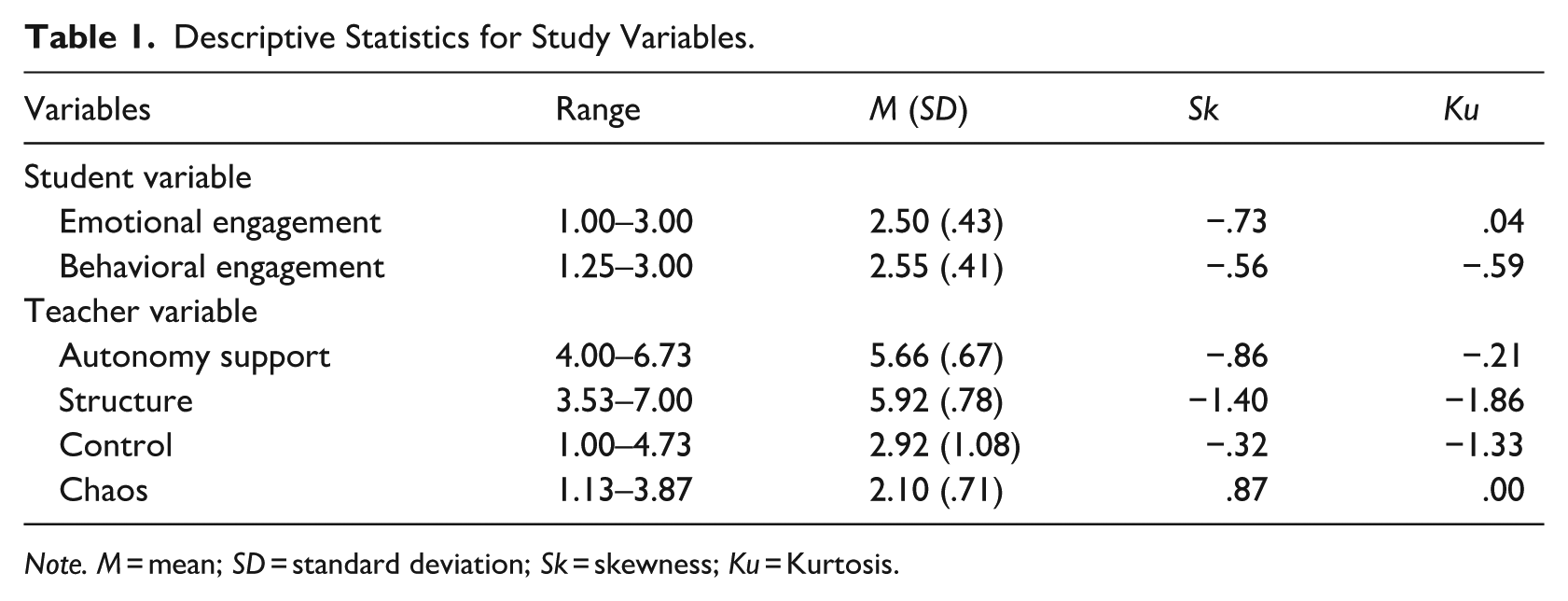
Note. M = mean; SD = standard deviation; Sk = skewness; Ku = Kurtosis.
Hierarchical Linear Modeling
Class Effects
The null models’ results showed significant differences in the variance of emotional engagement (t = 100.10, df = 40.52, p < .001) and behavioral engagement (t = 130.50, df = 38.59, p < .001) across classes. The ICC was .08 for emotional engagement and .03 for behavioral engagement, indicating that 8% and 3% of the variance, respectively, were attributable to the class students attended.
Multilevel Main Effects of Motivational Teaching Styles
Multilevel mixed-effects models with random intercepts were used to explore the relationships between teacher variables and SE, accounting for the hierarchical structure of the data (students within classes). Consistent with H1, when emotional engagement was the dependent variable, the structuring style emerged as a significant predictor (β = .13, p = .03). This indicates that students reported higher emotional engagement when their teachers provided clearer expectations and guidance. The intraclass correlation coefficient (ICC) was .06, meaning that 6% of the variability in students’ emotional engagement was explained by differences between teachers (Table 2).
Multilevel Mixed Effects Models of (De)Motivating Teaching Styles on Emotional Engagement.
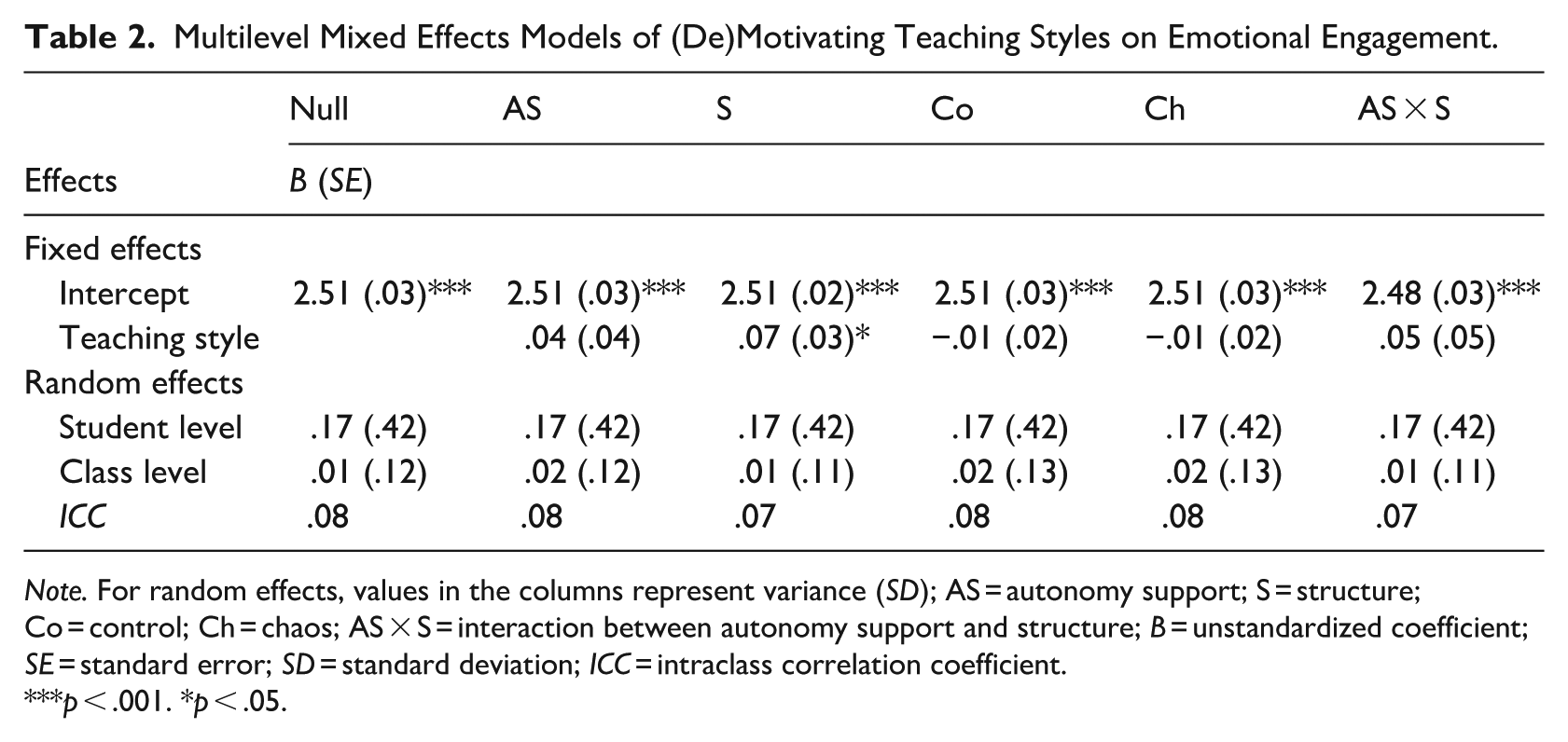
Note. For random effects, values in the columns represent variance (SD); AS = autonomy support; S = structure; Co = control; Ch = chaos; AS × S = interaction between autonomy support and structure; B = unstandardized coefficient; SE = standard error; SD = standard deviation; ICC = intraclass correlation coefficient.
p < .001. *p < .05.
For behavioral engagement, both autonomy support (β = .10, p = .03) and structure (β = .12, p = .01) were significant predictors, again supporting H1. In other words, students reported more active participation in classrooms where teachers were more autonomy-supportive and structuring. However, the interaction between these two teaching styles was not significant. The ICC values for these models were .03 and .02, indicating that 3% and 2% of the variance in behavioral engagement was explained by differences in teacher provision of autonomy support and structure across classes, respectively (Table 3).
Multilevel Mixed Effects Models of (De)Motivating Teaching Styles on Behavioral Engagement.
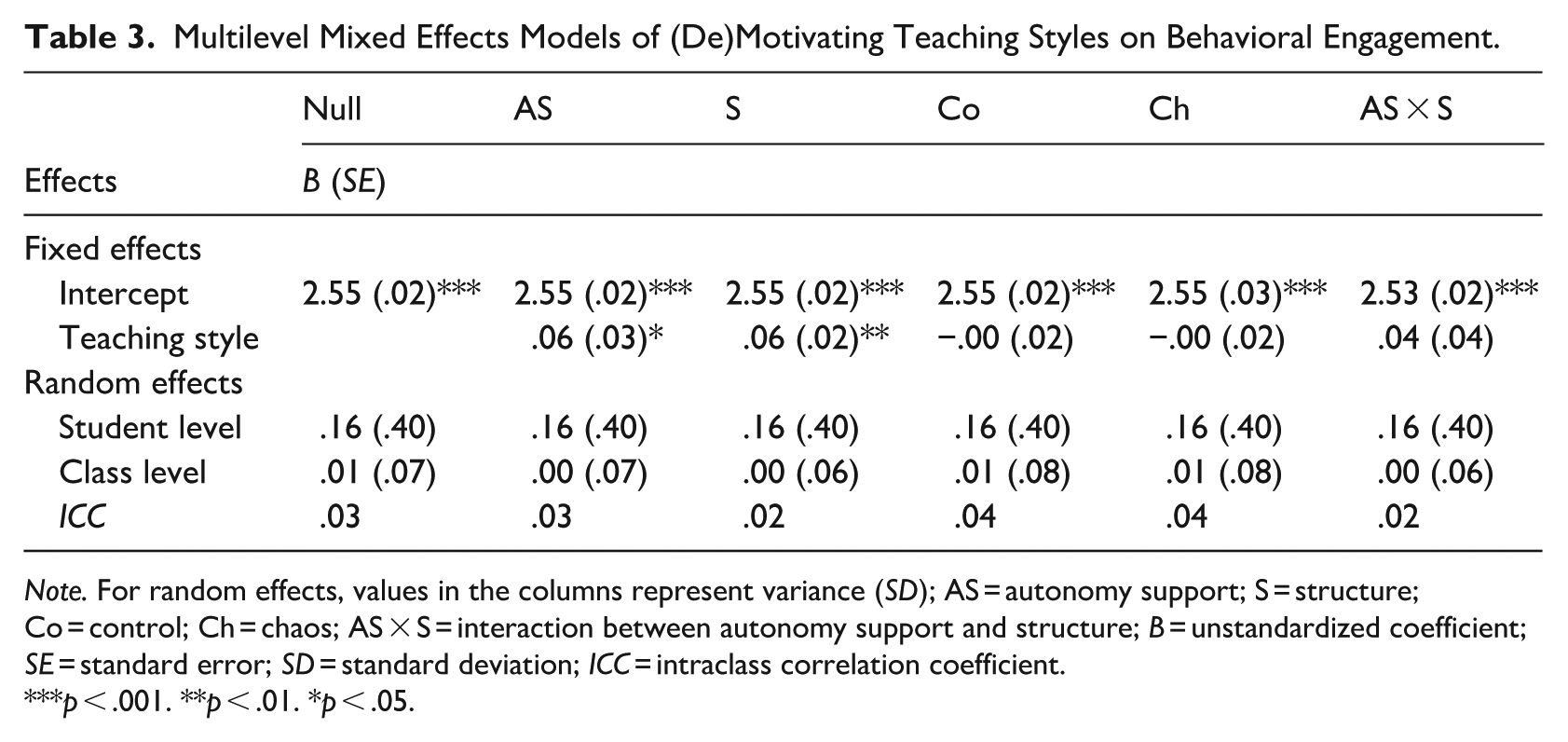
Note. For random effects, values in the columns represent variance (SD); AS = autonomy support; S = structure; Co = control; Ch = chaos; AS × S = interaction between autonomy support and structure; B = unstandardized coefficient; SE = standard error; SD = standard deviation; ICC = intraclass correlation coefficient.
p < .001. **p < .01. *p < .05.
No significant effects were found for demotivating teaching styles (control and chaos), providing no support for H2.
Discussion
This study examined how motivating and demotivating teaching styles are associated with fourth-grade students’ emotional and behavioral engagement at both the individual and classroom levels. The findings are broadly consistent with SDT and prior research, mostly conducted with middle and high school students and in physical education or sports contexts, which highlights the benefits of autonomy-supportive and structuring practices (e.g., Hospel & Galand, 2016). The present study extends prior work by focusing on younger children in general classroom settings and by applying HLM to account for the nested structure of the data.
The first hypothesis (H1) was partially supported. As expected, in this sample of elementary students, higher levels of both teacher structuring and autonomy-supportive styles were associated with greater behavioral engagement. This pattern indicates that students participate more actively in classrooms where teachers provide clear instructions, support, constructive feedback, and opportunities for choice. These findings align with previous research (e.g., Kiefer & Pennington, 2017; Wang & Eccles, 2013), which showed that both dimensions contribute independently and cumulatively to students’ behavioral engagement. The absence of a significant interaction effect suggests that the benefits of one teaching style on behavioral engagement do not depend on the presence of the other.
Concerning emotional engagement, only the structuring style showed a significant association. At this age, students’ positive emotions toward learning seem to be related to how clearly teachers communicate their expectations and how effectively they create a well-organized classroom environment. Younger children tend to rely more heavily on external regulation to feel confident during learning activities (Bandura, 1997; Pianta et al., 2012), so clear goals, predictable routines, and consistent feedback may help them perceive tasks as manageable and enjoyable. From an SDT perspective, structuring practices support students’ need for competence by clarifying what is expected and how success can be achieved (Jang et al., 2010). When children perceive that they can meet academic demands, they are more likely to experience positive emotions during learning (Liu et al., 2018). Empirical evidence with elementary students indicates that teacher positive feedback enhanced perceived competence and was associated with greater enjoyment in mathematics and native language classes (Laranjeira & Teixeira, 2024a). These results are also consistent with Erikson’s theory of psychosocial development, which places fourth-grade children in the stage of industry versus inferiority, during which they strive to develop skills and feel capable within their social and academic environments (Erikson, 1963). In this developmental phase, clear structure and constructive feedback may be especially important for positive emotional experiences at school.
These findings gain further relevance in light of national evidence indicating that elementary students show early difficulties in higher-order learning skills, such as inference-making, critical reasoning, and problem-solving (Portuguese National Education Council, 2025). In this context, the associations observed between autonomy-supportive and structuring teaching practices and students’ behavioral engagement, together with the specific role of structure in emotional engagement, suggest that early classroom environments should combine clear guidance with opportunities for active involvement. Clear, predictable, and supportive classrooms may therefore provide a foundational motivational and emotional basis that enables students to engage more effectively with increasingly demanding cognitive tasks.
By contrast, the absence of a significant association between autonomy-supportive teaching and emotional engagement may reflect developmental and contextual factors. Some evidence with adolescents suggests a link between autonomy support and positive emotions (e.g., Hospel & Galand, 2016), indicating that its benefits may emerge more clearly in older students, who are developmentally more capable of expressing their interests and preferences (Eccles & Roeser, 2013). Cultural characteristics of the Portuguese educational context may also contribute to this pattern. In Portugal, instructional practices tend to emphasize teacher guidance and command (Cothran et al., 2005), with fewer opportunities for student choice. Consequently, both teachers and students may be less familiar with autonomy-supportive approaches, which could attenuate or delay the emergence of their emotional benefits.
Approximately 6% of the variance in emotional engagement and 3% in behavioral engagement was attributed to the classroom level. This suggests that aspects of shared interpersonal teaching style are reflected at the group level, underscoring the importance of teachers being intentional and reflective in their use of motivational practices. Still, the largest proportion of the effects was explained at the individual level, corroborating findings from previous studies (e.g., Domen et al., 2020). Although teaching practices were reported at the classroom level, students’ responses may vary depending on how they individually perceive and experience these shared practices. This aligns with prior research showing that students do not respond uniformly to the same classroom environment (e.g., E. Skinner et al., 2008).
The second hypothesis (H2) was not supported. Neither controlling nor chaotic teaching styles were significantly associated with students’ emotional or behavioral engagement. Two possible explanations may account for this finding. First, the relatively low mean levels of control and chaos reported by teachers may have limited the variability needed to detect significant effects. This limited variability may be partly related to the characteristics of the sample, which was predominantly female. In a previous study with Portuguese teachers, female teachers reported lower use of controlling and chaotic styles compared with their male counterparts (Laranjeira & Teixeira, 2024b). A more gender-diverse sample might therefore allow for greater variability in demotivating styles, potentially enabling the detection of associations with SE that were not observable in the current study. Second, some evidence suggests that the effects of (de)motivating teaching styles operate through two distinct pathways: a “bright” path, in which motivating styles foster positive motivational outcomes by satisfying students’ psychological needs, and a “dark” path, in which demotivating styles lead to maladaptive outcomes by frustrating those needs (Haerens et al., 2015). Accordingly, the detrimental associations of need-thwarting teaching may be more evident when examining student disengagement, as opposed to engagement (Van den Berghe et al., 2016).
Limitations and Directions for Future Research
This study has limitations that should be considered when interpreting the findings. First, its cross-sectional design restricts the ability to draw conclusions about causality or the directionality of the relationships observed. While teachers’ behaviors influence SE, students’ active involvement in classroom activities also shapes teachers’ practices (Van den Berghe et al., 2016). Future research employing longitudinal or experimental designs would be valuable to better examine these bidirectional links between motivational teaching styles and SE.
Second, although using two different informants (teachers and students) helps reduce common method biases (Podsakoff et al., 2003), self-report measures remain vulnerable to other sources of bias, such as social desirability. Teachers tend to report their motivational practices more positively than students perceive them (Aelterman et al., 2019), which may have reduced the strength of associations or even prevented the detection of some expected relationships between variables, such as the effects of demotivating styles on SE. Moreover, while HLM accounts for the nested structure of data and captures between-classroom effects, it does not reflect potential within-classroom variation in how teachers interact with individual students. Research indicates that teachers often adjust their motivational practices based on their perceptions of students’ characteristics, such as ability or motivation (e.g., Hornstra et al., 2015; Sarrazin et al., 2006). For example, Hornstra et al. (2020) found that primary school teachers provided more autonomy support to students they perceived as more intellectually capable. Therefore, future studies would benefit from comparing teachers’ and students’ perceptions and complementing self-reports with observational data.
Third, although large, the convenience sample is confined to the metropolitan area of Lisbon and is not representative of the elementary school population in Portugal. Given the specific characteristics of this urban area, which includes schools with substantial socioeconomic and cultural diversity among students, the results may not apply to other regions of the country, such as rural areas. This limitation could be addressed by employing random sampling methods to enhance generalizability. Additionally, as teaching styles are culturally embedded (Reeve et al., 2014), the findings should be interpreted within the Portuguese educational context.
Fourth, the teacher sample presented a wide age range and substantial variability in professional experience. Such heterogeneity may reflect differences in career stage and pedagogical approaches, potentially influencing the ways teachers motivate students in the classroom. Previous research has suggested that teaching experience is associated with variations in motivational teaching approaches (García-Cazorla et al., 2024). Future studies could address this limitation by including teachers’ age or years of experience as potential moderators in the analysis.
Finally, the teacher sample was predominantly female, reflecting the composition of the Portuguese teaching workforce (OECD, 2025). Although this mirrors both national and international trends, it may influence the mean levels of motivational teaching styles, particularly demotivating ones, and limits the ability to examine potential gender effects on the relationship between motivational teaching styles and SE. Future studies should include more gender-balanced samples and consider teacher gender as a potential moderator of these associations.
Future research could explore these relationships in other educational settings and grade levels, and also examine additional outcomes of motivational teaching practices. In particular, it would be valuable to investigate how such practices support the development of key 21st-century skills, such as critical thinking, creativity, collaboration, and communication, and how motivating styles respond to the diverse needs of students in inclusive and multicultural educational contexts.
Practical Implications
This study offers relevant insights for both researchers and practitioners working in elementary school contexts, including teachers, school psychologists, and counselors.
Motivating teaching styles were positively associated with SE, highlighting the importance of embedding motivational principles into teacher education and ongoing professional development. Programs should support teachers in implementing structure and autonomy support in a complementary manner (Jang et al., 2010), with particular emphasis on the role of structure during the early years of schooling. For elementary school children, strategies such as providing optimal challenges, praising improvement and effort, clarifying expectations, and offering explicit guidance (Ahmadi et al., 2023) may be especially important in supporting their need for competence.
Beyond implications for teachers, these findings are also relevant for school psychologists and counselors. Understanding how different teaching styles relate to elementary students’ emotional and behavioral engagement can inform assessment practices, consultation with teachers, and the design of school-based interventions aimed at supporting teachers in adopting more motivating practices. In this regard, the SIS questionnaire may be used as an assessment tool to examine perceived teaching practices, identify areas in need of support, and guide collaborative reflection between teachers and psychological services within elementary schools.
Although several intervention programs have been developed internationally, particularly in South Korea and the United States, such efforts remain less common in European countries. In Portugal, to the best of our knowledge, there is an absence of empirically designed and validated interventions specifically aimed at promoting motivating teaching practices (Reeve & Cheon, 2021). These findings highlight the opportunity and need to develop culturally relevant, evidence-based programs that involve collaboration between teachers, psychologists, and counselors to foster more engaging, motivating, and effective classroom climates.
Conclusion
This study advances our understanding of how motivational teaching styles relate to SE in the formative years of elementary school, with implications for learning, motivation, and multilevel interventions. While most variance was observed at the individual level, classroom-level effects indicate a shared motivational climate. By highlighting the role of structure and autonomy support, the findings emphasize how daily teacher–student interactions contribute to creating engaging and meaningful learning experiences.
Practically, these results underscore the importance of integrating motivational principles into teacher training and professional development. They also have direct implications for the work of school psychologists and counselors, who can support teachers in implementing structured and autonomy-supportive practices. Such collaboration helps create more inclusive, engaging, and equitable classrooms, benefiting both students and the wider school community.
Footnotes

Ethical Considerations
The study received approval from the Ethics and Deontology Commission of the Faculty of Psychology, University of Lisbon, under reference RAPI20221007macl, and by the Ethics Committee of the Portuguese Ministry of Education’s General Directorate of Education (DGE), through the School Environment Survey Monitoring (MIME), under approval number 0858300001. Written informed consent to participate in this study was provided by the participants’ legal guardians.
Funding
The authors disclosed receipt of the following financial support for the research, authorship, and/or publication of this article: This work received Portuguese national funding from FCT – Fundação para a Ciência e a Tecnologia, I.P, under a PhD grant (2020.06562.BD) assigned to the first author. The work was also supported by the FCT – Fundação para a Ciência e a Tecnologia, I. P, through the Research Center for Psychological Science of the Faculty of Psychology, University of Lisbon (UIDB/04527/2020; UIDP/04527/2020). For the purpose of Open Access, the author has applied a CC-BY public copyright license to any Author’s Accepted Manuscript (AAM) version arising from this submission.
Declaration of Conflicting Interests
The authors declared no potential conflicts of interest with respect to the research, authorship, and/or publication of this article.
Data Availability Statement
The data that support the findings of this study are available from the corresponding author, upon reasonable request.