




Abstract
We make two interventions in two evolving scholarly literatures. First, we show how fractal metaphors escape a recurring dichotomy in Christian pedagogical scholarship, the either/or of alienation from one’s object of study versus union with it in “an act of love.” Second, we try to replace recent interdisciplinary work’s emphasis on “complexity” with “irreducibility.” Fractals allow us to define these concepts and develop alternative “ways of knowing” with greater rigor. Both interventions bear directly on Christian formation, and so we derive five ways the Christian classroom can combat spiritual alienation and instead cultivate the “fractal imagination” of our students.
Introduction
Fractals have captured imaginations since their discovery a generation ago. They have migrated beyond mathematics and the natural sciences to fields as diverse as business, architecture, and economics. Still, their intersection with Christianity is undeveloped: famous fractals resemble Celtic crosses and Gothic stained glass, and their orderliness points us toward God, but we are unaware of much work that goes beyond celebrating such beauty. Here, we propose to put the conceptual resources of fractals to work serving Christian research and Christian pedagogy.
Christian education aims at two goals which, for various culturally relative reasons, are now difficult to achieve together: The Whole: a Christian should see the world as a whole, with its disparate parts and our disparate disciplines somehow unified and ordered to God. Such a vision requires, necessarily, situating oneself inside the narrative of God’s creation. The Parts: an educated Christian should have some practical command of a distinct subject; she should also possess critical tools/habits to observe and investigate things objectively. Such study stands outside the parts to be mastered.
This divide could be rephrased in many ways: we want to form students to have practical skills and an appreciation for the impractical; we want them to be critical thinkers, but not mere critics of their communities; we want them to have instrumental knowledge, but not see all things as mere instruments; to be “healthy, prayerful actors and not merely...spectators” (Smith, 2017: 61). We can put it best, perhaps, by saying that we want our students to stand inside and outside at the same time.
Living both inside and outside is difficult because it seems impossible. One seems to come at the expense of the other. 1 The outside is associated with objectivity and an instrumental view of knowledge, the inside with subjectivity and a communal one. In practice, those interested in logic and empirical investigation prioritize the outside, and those interested in meaning and community prioritize the inside. Both stances seem worthwhile, and they also seem contradictory. How can they be reconciled? T.S. Eliot thought it impossible (Eliot, 1948: 114; see also Holston, 2018). C.S. Lewis recognized the need for both—in his famous image, we must look at the beam of light (stand outside) and along it (stand inside)—but he doesn’t say much about how to cultivate both together (Lewis, 1970: 215).
We write this article in part to respond to a growing trend in Christian scholarship that seems, like Eliot, to despair that the outside and the inside can be reconciled. A recent post at the Christian Scholar’s Review criticizes the tendency to treat friends like “objectified fractals of persons,” and then juxtaposes impersonal objectivity and personal love as somehow incompatible (Franzen, 2023). Many Christian scholars find Parker Palmer’s anti-objectivism attractive, so that knowledge becomes “what is good for the community.” For instance, in his celebrated Exiles from Eden, Mark Schwehn (1993: 25–26) writes Palmer’s indictment of objectivism stems from his insight that epistemologies have moral trajectories, that ways of knowing are not morally neutral but morally directive. Objectivism, he demonstrates, places the would-be knower in an alienated, even an antagonistic position over and against the known world. Impelled by curiosity and the mania for control, objectivism fractures the bonds of community and tends inherently toward violence… ‘we must,’ Palmer argues, ‘recover from our spiritual tradition the models and methods of knowing as an act of love.’
As he rejects a Weberian instrumental view of knowledge, Schwehn seems to conclude, with Palmer, that “truth is what is good for us to believe” (Schwehn, 1993: 25–6). More widely, many Christian scholars and theologians are rejecting a “hermeneutic of suspicion” as “proprietary and libidinal,” favoring instead “‘participation’ rather than analytic detachment” (Pfau, 2022: xvii, 25, 51). We join such scholars in emphasizing participation, but we emphatically reject the “rather than” of their position. Our goal is to show that reviving more communal understandings of knowledge and education should not come at the expense of “analytic detachment.” The two, though apparently at odds, are in fact perfectly reconcilable.
We believe that the practical cultivation of a “fractal imagination” can help reconcile these goals of Christian formation. We argue that a Christian scholar should embrace knowledge as both instrumental and love-filled. She does not need to choose between them. As von Balthasar remarks, these seemingly contradictory stances are reconciled by recognizing that “in Jesus, the ‘fragment’ is the whole;” his recognition allows us to escape “the false dialectic” that forces a false choice between the “pseudo-objectivity” of a “hermeneutic of suspicion” or the “latent atheism” in a “‘turn to the subject’” (Chapp, 2004: 12–14). Ultimately, we argue that God’s self-expression in creation is a fractal self-expression, in which something of God’s infinite nature is contained in the whole created order and in every part of it. The Whole is not an undifferentiated One but a fractal Whole, and its complexity is a self-similar, fractal complexity, not random fragments. But developing the eyes to see the world as fractally unified and ordered to God requires—for most of us, anyway—participation in a community of inquirers who share certain kinds of mutual knowledge, which we will call a fractal community.
Our essay is structured around these three themes: I. Fractal Wholes, II. Fractal Complexity, III. Fractal Communities. Part I draws attention to a developing field which manifests and formalizes older Christian ideas about art, science, and community, wherein creation’s awe-inspiring diversity is simultaneously a God-imaging unity. Part II proposes the “fractal imagination” as a foundation for interdisciplinary cooperation between the humanities and social sciences, including in the classroom. Part III sketches how certain practices create fractal community. Each section ends with a practical implication for Christian formation.
Fractal wholes
A fractal is a pattern that is irregular at all scales (Edgar, 1990). More intuitively, fractals are loosely defined as a pattern that repeats itself in theory at infinitely many scales, and in practice at many scales. Where ordinary patterns can be broken down into basic components, such as a square into four lines and four right angles, a fractal pattern is irreducible, because each of its basic components is the pattern itself. In nature, fractals include things like leaves, clouds, and cauliflower. In human relations, fractals include social patterns that repeat at larger and larger social scales (e.g., labor disputes within countries tend to resemble border disputes between them).
Part of the Incarnation’s mystery is that the eternal and infinite God comes to be located in a particular human being, Jesus Christ (Col. 2:9)—“eternity shut in a span,” in Richard Crashaw’s immortal line. Christians rightly regard Jesus Christ as the most perfect manifestation or “icon” of God (Col. 1:15), even as we acknowledge that all other human beings are images of God, too: not the perfect image that Christ is, but a likeness nonetheless.
Indeed, all creatures resemble God to some extent. Theologians ancient and modern have speculated that God’s Word, the Son, is the exemplar of creation. A modern author writes, “the Son is the very imagination of God, the model, the agent, and the purpose of all creation” (Veith and Ristuccia, 2015: 36). Centuries before, Maximos the Confessor (2014) declared in Ambiguum 7.19 that the one Logos contains so many logoi, each one the archetype of a creature God will make. Each and every creaturely reality, then, speaks something of what God is. The total created reality—everything God has made taken together—that too is a likeness of God. And Christ is, so to speak, so perfect an image of God that He is God.
The revealed, biblical doctrine of God’s incarnation in Christ is a clue about, and perhaps an invitation to seek, God’s infinitude hidden in the finite things He has made. Since God is infinite all through and not by an addition of infinitely many finite parts or aspects, we may hope to find the familiar but ever-mysterious pattern repeated in all things. In this way, God’s creative self-expression is the grounds for the real and not merely conventional or projected unity of the cosmos. Of course, any particular creature, or even the whole created order, is not a perfect image of God, and so something of God is left out; but the repetition up and down Creation’s chain of being can still reveal to us, at whichever level we can most access, the same divine fingerprint, which would be lost to us at scales too large or too small for us to see.
Samuel Taylor Coleridge defined the primary imagination as “a repetition in the finite mind of the eternal act of creation in the infinite I AM” (Coleridge 1907: 304–5). 2 From this definition, it follows that, because all Creation exists in the mind of God, as we become more imaginatively Christlike in our finite lives, we also come to repeat the fullness of the creation around us—we “effoliate” God’s Tree of Tales (Tolkien, 2008: 371). Therefore, just as the origin of all things from the mind of God is the theological guarantee that the world bears “God’s fingerprint” all the way down, so too, in the development and activity of our own imaginative powers, we can strive to think God’s thoughts after him and increase our measure of Christlikeness: “we all, with unveiled face, beholding the glory of the Lord, are being transformed into the same image from one degree of glory to another” (II Cor 3:18).
One of the most conspicuous and awe-inspiring properties of fractals is self-similarity, whereby a part of the fractal literally contains the fullness of the whole. (See Figure 1.) This property lets us recognize how an infinitely complex shape, including a shape with an infinitely long border, can be contained within a simple and finite one. It also lets us visualize how to stand inside and outside the same thing at the same time: since the entire object is contained within itself, then one can stand objectively outside a self-similar whole (studying it as a part) while also standing inside its larger scale (beholding it as a whole)—such as the dot on Figure 1. The Sierpinski gasket (from Wikimedia Commons).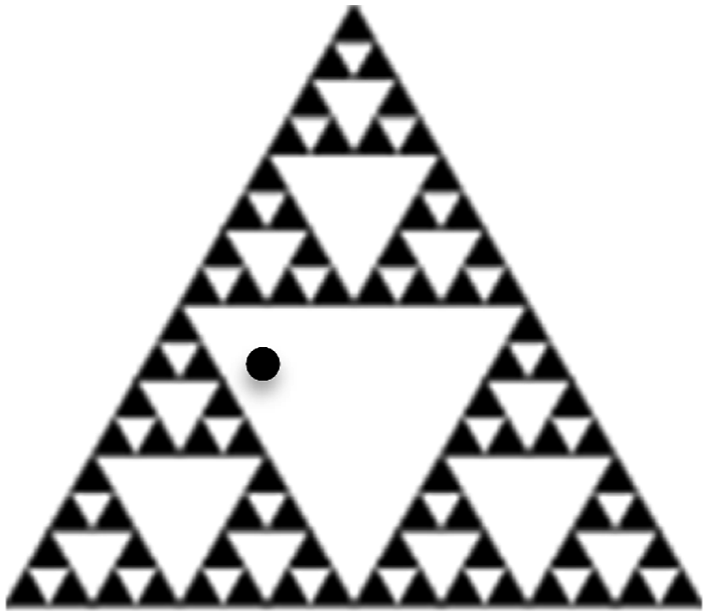
By fractal imagination, we mean this ability to inhabit a whole while simultaneously standing outside it. This capacity is fractal, because it requires reproducing a complex system at different scales without compromising its integrity, and imaginative, because it requires holding in the mind an object not actually present to the senses. The fractal imagination seeks to reproduce a pattern and then describe the scales at which the pattern repeats. It suggests how objective and subjective knowledge—the outside and inside, respectively—might be reconciled; we believe this reconciliation offers the best path forward for interdisciplinary research, as we discuss in the next section. We also believe it offers a way to fortify our students against the spiritual alienation they encounter as part of modern life.
The Medievals profoundly expressed the fractal imagination. Their art and their philosophy enjoyed a fundamental integrity, a “resplendence of form,” which “meant discerning in the concrete object an ontological reflection of, and participation in, the being and power of God” (Eco, 1986: 15, 25). At all levels, every part both connected to and reproduced the whole, so that “microcosm and macrocosm [were] tied by the same knot, simultaneously mathematical and aesthetic;” likewise, their idea of the “music of the spheres” centered on reproducing the entire cosmic whole at multiple levels of scale (Eco, 1986: 31, 77). Fittingly, as Mandelbrot (1977: C1) introduced fractals to the world, he singled out three artists: Katsushika Hokusai, Leonardo Da Vinci, and the anonymous illustrator(s) of a Medieval Bible Moralisee; the last he captioned, “God creates circles, waves, and fractals.”
This integrated cosmic vision was, of course, lost. (“I can connect Nothing with nothing,” laments The Waste Land.) Modernity is irreparably fragmented, and with it the modern university—and so a place which ought to offer an integrated vision, has instead devolved into a “polyversity” (Davis, 2020: 347; see also De Muynck et al., 2023; Jones, 2018: 262). An understandable Christian impulse recoils from this fragmentation, but we cannot return to a lost Eden. The fractal imagination can, though, help redeem the brokenness of modern life.
Fractals are commonly associated with chaos. This term should not mislead: fractals do not confirm chaos but reveal how apparent chaos has a fundamental orderliness. Likewise, when applied to spiritual chaos, they can help redeem meaning out of meaninglessness. For this reason, they are especially valuable to the modern student. Their attention to wholes, rather than fragments, is healing (Alexander, 2004: 261).
Part of modern alienation arises because “we live our lives microscopically while we are able to view the scene in which we live telescopically” (Niebuhr, 2015: 4). Rebecca DeYoung (2011: 28) puts it more pithily as “the problem of the too big and the too small.” Dykstra (2005: 67) asks, how are we supposed to educate students to know God and love His Creation, when “we can’t tell what larger wholes these smaller pieces [including us] are parts of.” Moreover, technological and scientific advances have enabled us to describe worlds and watch socioeconomic developments on a grand scale, but nothing links us small hominids to these cosmic forces. The human scale (the microscopic) is alienated from the larger scale (the telescopic). Is it any wonder our students feel “non-embedded” (Okpaleke, 2021)? A better kind of learning, Christian authors seem to be realizing, is integrated so that everything connects to everything else (Bilbro and Baker, 2018: 56). This approach, often self-consciously, hearkens to that of Comenius, who urged “all things that are naturally connected ought to be taught in combination” (Comenius, 1967: 71; see also Smith, 2017: 48).
For the Christian educator, a simple way to practice this kind of learning is to teach manageable wholes. Eliot (1948: 163) made exactly this point when he advocated studying the Greeks: theirs is a fundamentally manageable world, small and self-contained, whose patterns recur throughout history. The “whole books” movement gaining ground in homeschooling circles may be operating from similar principles. For professors, this might mean teaching cases and topics from a circumscribed region or period, for example, teaching intrastate conflict primarily through a single manageable case (like Colombia) rather than a smattering of examples from Africa, Latin America, and Asia. As we discuss later, fiction is another kind of manageable whole a Christian might incorporate into a syllabus. And, of course, somewhere in their college careers, students ought to be reading Plato.
Still, as we try to repair something of modern fragmentation, we should be careful. Job’s comforters sinned when they tried to repair the relationship between God and man on the wrong terms; Job’s brokenness was better. Modernity was fragmented, perhaps by the Enlightenment, perhaps by the World Wars, but in any case by something. Its fragmentation is brutal, but it is also revealing, and we cannot turn back from what we have learned. We are not going back to a pre-objectivist world; we don’t think Christians can (or should) cure modern man of seeing knowledge as a tool. At the same time, even non-Christian scholars seem to long more and more for a new approach—an interdisciplinary, humanistic science—to assay the complexity we meet on a daily basis. We think the fractal imagination offers a way forward.
Fractal complexity
A common justification for a more humane economics, political science, and sociology, is that human beings are “irreducibly complex,” and this complexity forecloses the analytical and empirical methods of the sciences. But what, exactly, this phrase means is generally left undefined: as Fish (2013) complained, “the key words—‘framework,’ ‘context,’ ‘complex,’ ‘meaningfully,’…—are spectacularly empty; just where specificity is needed, sonorous abstraction blunts the edge of what is being asserted.” Whatever the phrase means, humanists catapult from irreducible complexity to the futility of social “science”—or at least, that such a science’s proper sphere is very narrow (with its proper sphere also left rather vague). This criticism recurs over the past 150 years, but it has never slowed the march of social science nor dented its self-assurance.
We want to rescue this critique by shifting its emphasis. Protesting that human beings are complex is unpersuasive. It is hard to argue that the origins of World War II are more obscure than those of the universe. Einstein may have quipped that politics is harder than physics, but in many areas his remark simply isn’t true. No, the soul of the issue does not seem to be complexity but irreducibility. Certain human patterns, it seems, cannot be studied by breaking them apart.
Consider a three-body problem from physics and a three-body problem from the humanities. In physics, no general solution exists to describe the motions of three bodies which obey Newton’s laws—even though the underlying laws and all the relevant particulars are known. The problem is too complex. So, in the classic example of the sun, earth, and moon, an observer reduces the triple to two pairs and models them independently; he then combines the two models to yield a workable approximation of the whole. The system, while intractably complex, exhibits a complexity that can be reduced (decomposed) without compromising its essential properties.
Now contrast this complexity with another three-body problem: a love triangle. In many ways, a love triangle is much simpler than the orbital patterns of astral bodies. Nonetheless, to reduce the triangle to its subrelations X-Y, Y-Z, and Z-X (let alone to the neuroses of X, Y, or Z) is vain, because such a reduction leaves out the very relationship that made it a love triangle; no single relationship can be understood without understanding the whole.
Confusion about the nature of complexity has led many Christian and humanistic scholars to offer unsound foundations for interdisciplinary work. Some emphasize “radical uncertainty” as a reason to turn to novels rather than equations, but of course radical uncertainty is a mainstay of modern physics (Morson and Shapiro, 2017: 47). Others emphasize “contingency,” seemingly unaware the whole rational-choice tradition is built on faith in human agency. In fact, a radically random process can produce a deterministic outcome, and a highly contingent process can be one in which there is no deviant behavior. Nothing in such complexities resists mathematization, prediction, or science. 3
The humanities stand on firmer ground when they turn from complexity and stress irreducibility. As an added benefit—crucial for Christian formation—this move returns our attention to the irreducibility of human beings. It defends a student against reducing herself to appetites and synapses. It also equips her to see herself and others as intrinsically valuable: after all, “any claim for human rights has to be based on some understanding of the human being that persuasively defends his claim for irreducible uniqueness and irreplaceability” (Lawler, 2010: 87).
When scholars talk of irreducible complexity, we believe they actually mean fractal complexity—and, note, fractal simplicity. Fractals resist classical geometry because they are irregular at all magnifications, that is, no matter how much you “zoom in” the shape still isn’t smooth. This complexity does not mean, though, that they resist simplification. Everything must be simplified to be understood; human beings are no different. To understand a love triangle, the humanities ask—how can I understand it without breaking it in pieces (as science does) or experiencing it myself (which is time-consuming and emotionally taxing)? The answer, of course, is obvious: I read Gone with the Wind.
Fiction succeeds only because human relations can be condensed. Not decomposed: condensed, that is, preserved on a smaller scale. Fiction must be “truer than fact;” it must also offer a complete whole, even though it omits a lot of life (“all the boring bits,” as Wilde cracked). 4 To do so, it must condense human situations to fewer characters, fewer actions, and fewer hours without compromising their integrity. This is an extreme simplification, but a different kind of simplification than scientific dissection. It seems reasonable that, where dismemberment fails, another kind of simplification might succeed. If a pattern, by its fractal nature, cannot be cut apart, then our analytical tools will need to experiment upon it from the outside while living within it from the inside.
By stressing that a problem is irreducible rather than complex, we can better see how interdisciplinary work can solve it. The humanities all simplify by condensing, and the best works can be condensed no further (O’Connor, 1969: 108). They train us in prudence by helping us inhabit archetypal wholes, a feature exploited by the CIA to train its operatives and analysts (Dulles, 1963: 179–80). The fractal imagination shows us how to simplify human complexity by inhabiting condensed wholes rather than trying to dissect them.
To justify this approach, we must have confidence that the subcreated wholes we inhabit (novels, dialogues, symphonies, myths) faithfully reproduce the larger system—are fractals. This justification, though, is not self-evident. Plenty of novels are trash, and an English teacher who relies only on his own taste abuses his trust. Moreover, literature is as much a temptation as a source of wisdom (see: Paolo and Francesca), and students could easily find their imaginations malformed by dwelling too much in these unrealities. Many political philosophers have located the origins of 20th century totalitarianism in French and German romanticism (Babbitt, 1925; Ryn, 1986), Plato excluded poets from his republic, and great Christians have written ferociously against the theater. But the danger here is not in fiction per se, but in fiction that is a lie: in fiction that is not in fact a fractal, because it does not faithfully reproduce a complex system in a compressed space. To justify dwelling in fiction and other condensed wholes, we must test them. And such a test is the province of the sciences.
Ideally, the scientific method tests hypotheses derived from a set of premises. An irreducibly complex system can make this approach unfeasible if the process of logical deduction (even by a computer) would take an impossibly long time. The fractal imagination instead turns to a kind of reasoning-by-analogy. In the case of human relations, it inhabits a condensed, self-contained system—a system whose logical principles cannot be enumerated but can be witnessed—and then tests whether the same patterns repeat on larger scales. Is a single man, in possession of a good fortune, truly in want of a wife? Such a prediction, though not derivable from any ordinary assumptions, is perfectly testable with basic statistical tools (Goñi, 2022). A mutual dependence emerges, or perhaps better, an infinite ladder, in which humane insights are held to account by an external science, and that science is then situated within a larger humanistic whole, which is then tested by an external science, which...and so forth, with a fractal repetition at every level up and down Creation’s chain of being. Neither science nor the liberal arts should ever be seen as ultimate: living “inside and outside” instead suggests that each must perpetually submit to the other.
Above, we used the word “inhabit,” but a better word might be play. A child plays games, and in his games a child learns about the larger world. Others have written on the origins of play in human finitude, especially the human need to step away from utilitarian tasks (Treier, 2019: 383, 386). Here, we suggest that, in addition, human finitude means that certain patterns will defy human objectivity, and perhaps the only way to apprehend these patterns is by stepping inside them. Play is necessary, not just to escape our labors, but to complete them; it is sometimes the only way to learn about the world.
To sum up: the fractal imagination allows us to understand human problems that we cannot simplify by breaking apart; self-similar systems are a gateway for interdisciplinary research. These situations are too complex for the scientist to derive testable predictions deductively from a set of premises. They can, though, be condensed and then inhabited. Nonetheless, the wisdom gained from such an education does not justify itself: it must be tested against the larger reality it purports to represent, and this testing must occur objectively—that is, with the methods of science. So, the humanities supply the predictions social science cannot deduce, and social science tests the wisdom the humanities take for granted.
We come here to a central dilemma, not just of interdisciplinary research, but of epistemology: if knowledge requires objectivity, but human beings are fundamentally subjective and social, then how is knowledge possible? Of course, we cannot even begin to survey that literature here. Instead, we will simply note two opposite answers: one forsakes objectivity and reduces knowledge to a kind of communal wisdom; another dismisses subjectivity as philosophical wordplay and instead focuses on “what works.” The answer is not a watery mean but a radical both, and.
T.S. Eliot approached, but did not reach, such an answer. Unlike many Christian critics of modern universities, Eliot did not object to utilitarian education; nevertheless, unable to resolve the dilemma, he finally decided that “one cannot be outside and inside at the same time” and so endorsed the latter (Eliot, 1948: 77, 114, 174). His observation seems self-evident, yet it is false, and in fact expresses the conundrum the humanities and social sciences must solve for interdisciplinary work to succeed. The humanities are at their strongest inside a novel’s plot or a philosopher’s dialogue, and they are weakest when they try to stand outside them; the social sciences, though, necessarily stand outside their subject to nudge it, test it, and experiment upon it as objectively as possible. The social sciences fault the humanities for a lack of rigor, where anything goes and jargon often hides vacuity. The humanities fault the social sciences for a pretension to understand human beings by dissecting them—forgetting that “he that breaks a thing to find out what it is has left the path of wisdom” (Tolkien, 2004: 259). Or, as Plato puts it in the Sophist (259e), “to dissociate each thing from everything else is to destroy totally everything there is to say (Plato, 1997).”
Fractals prove the paradox is not a contradiction: if a part can contain the whole, then it is possible to stand both inside and outside the same system. Objectivism and subjectivism somehow coexist without contradiction, and, however, bounded our minds, we can still gain “critical distance” on objective reality. Indeed, it is this combination of “critical distance” and communal indwelling that makes true creativity possible (Smith, 2003: 29). The fractal imagination also suggests that, in gaining this epistemic distance, mythmaking and storytelling may be far more important than we recognize. 5
At the intersection of politics, philosophy, and ecology, Leopold (1947) founded a “land ethic” on this kind of fractal imagination: on a recognition that we are part of an ecology as well as its steward. Anticipating the concept we have called fractal imagination, Leopold (1949: 175–6) insisted that “by learning how some small part of the biota ticks, we can guess how the whole mechanism ticks.” We think such an intuition may ground the movement among Christian professors, including Stanley Hauerwas, to shift the way we teach ethics, including to a more “ecological” pedagogy (Dykstra, 2005: 130–1; Schultze, 2004). A reconciliation of “inside and outside” echoes a Christian epistemology of knowledge-as-eros: knowledge that is neither brutishly possessive (as curiositas becomes; see Griffiths, 2011: 107–109) nor subsumed oblivion. It is the old Christian mystery, yet again, of how we must be united to a thing and yet somehow still ourselves. If we want to form students into truly ethical actors, we need to teach them to live entirely within other lives and to stand outside those lives and judge them according to standards (Gardner, 1978).
For the Christian teacher, the above points suggest a simple imperative: teach at a human scale (Veith and Ristuccia, 2015; Wilson, 2017: 225). Most obviously, we can assign novels, including in political science, sociology, and economics courses. Anecdotally, we have experience teaching fiction in such courses in both intimate settings (fewer than 10 students) and massive ones (over 200 students), and we can testify that the students remembered and responded to the fiction better than any other readings. Teaching at a human scale enables students to grasp the whole in every part. It also helps them appreciate their part in the greater whole: while no one can experience his own life as a whole, anyone can do so from within a story, and this vantage heals modern fragmentation by giving students confidence in the wholeness of their own lives, as well. 6
For the Christian scholar, the fractal imagination has two implications. First, it means that we should look up or down when a subject proves intractable. For instance, if we cannot get good data to study bargaining during nuclear crises (because there aren’t very many), then we should look down the scale at bargaining among organized crime (Schelling, 1966). Gaddis (2002: 117), the distinguished Cold War historian, goes further: invoking fractals, he believes that the inescapable complexity of human affairs means that much of history and almost all social science should primarily study the ways patterns repeat “as one moves from micro-to macro-levels of analysis, and back again.” Similar to our argument here, Gaddis (2002: 83) also uses the self-similarity of human behavior across scales to attack relativism, since fractals allow the historian’s work to be both subjective and objective.
Second, the fractal imagination means that those who study human beings should look to the humanities when constructing causal explanations and to the social sciences when evaluating them: to the humanities, because the situation is irreducibly complex and so hypotheses can’t be logically deduced; to the social sciences, because the compressed wholes which purport to represent the whole from which they’re drawn, are not always faithful. For instance, an English professor, an historian, and an economist would make an ideal triple to study poverty in the nineteenth century: if the historian wishes to describe, accurately, the typical causes acting upon the behavior of British poor, then he needs literature to understand the complex environment in which the impoverished lived; and where the English professor’s judgment might be distorted by Little Nell stories, or the historian’s by ideological historiography, the economist can hold them both to account against the data, though he must depend upon them for the causal arguments he tests. In short, the causal stories the historian tells would be guided by literature as weeded by an economist. 7
Fractal community
How does a classroom become a community? The question is familiar to every Christian educator, though for all its familiarity it can still baffle us. Above, we showed how the fractal imagination, as part of Christian formation, can address students’ feelings of alienation, train them in prudence, and encourage them with a sense of their lives’ wholeness. In this final section, we want to discuss how fractal community structures can strengthen spiritual formation in the classroom. To do so, we connect recent advances in economics to Christian ideas of “shared imagination” (Smith, 2018: 12).
In the economic literature on knowledge formation, Chwe (2001) has forcefully argued that communities are fundamentally about “common knowledge.” This phrase is a technical term, but its meaning is intuitive: X is commonly known if everyone knows X, and everyone knows that everyone knows X, and so on. The self-reflexivity of common knowledge gives it a fractal-like structure, so that each level of awareness contains itself. This kaleidoscopic meta-knowledge is, Chwe shows, necessary (and sometimes sufficient) to form a community. A community emerges when shared knowledge becomes self-reflective.
Such meta-knowledge is not as difficult to create as it sounds. Eye contact is the most obvious way: I see you; and I see that you see me, seeing you; and I see that you see that I see...and so forth. Shared rituals, argues Chwe, are another. His examples will be familiar to any Christian professor, especially call-and-response and repetition—basically, anything that allows everyone to observe everyone else observing everyone else can create common knowledge. 8
In essence, Chwe and scholars like him are—somewhat unwittingly—explaining how fractal knowledge structures overcome the spiritual alienation that modern fragmentation breeds. They create bonds between people by extending knowledge into a fractal-like meta-knowledge, creating an imaginative, mutual awareness of shared ideas/experiences. And they bridge the “microscopic” and “telescopic” by creating intervening, self-similar scales, so that the smallest person can, by an unbroken chain, link himself to the highest spheres.
The implications of this economic approach to ritual are less obvious but no less crucial. Consider two kinds of networks: strong-link, in which a person’s friends tend to know each other, and weak-link, in which they tend to know other people. A weak-link network will tend to look like a web, with many crisscrossing lines, while a strong-link network will tend to look like a rose window, with dense subgroups nested within larger subgroups. Surprisingly, researchers have discovered that strong-link networks are better at fostering widespread coordination than weak-link networks. This result is surprising—but borne out by the data (Valente, 1995)—because it means, on average, that knowledge takes longer to traverse a network (because it tends to cycle in small cliques rather than disseminate). Apparently “spontaneous” action tends, in fact, to be highly evolved coordination through community networks linking dense subordinate groups (Scott, 1990: 151). Chwe (2001: 66) summarizes: What makes a community? If we apply the logic of common knowledge, then a community is not like a city center, in which each person has many scattered relationships, but more like a neighborhood, in which each person might have fewer friends but in which one’s friends tend to know each other.
Building on Chwe’s groundbreaking work, many scholars have applied this economic understanding of “common knowledge” to religious life. For instance, Chaves (2004) uses it to help explain patterns in contemporary American worship, and Luomanen et al. (2007) use it to explain the significance of shared meals to the spread of early Christianity. It has become a standard text when discussing the ways religion can influence politics (see Grzymala-Busse, 2016), and Rydgen (2011) treats it as one of the foundational concepts to understanding belief formation and influence from wider groups. With well over 1000 citations and counting, Chwe’s ideas about creating common knowledge have spread widely within the social sciences. It has even helped define the concept of “Cooperative AI” (Dafoe et al., 2020).
For the teacher, the fractal structure of communal knowledge has some encouraging implications. While the implications we draw out here are straightforward, they allow us to ground familiar teaching techniques on a more rigorous theoretical foundation. Doing so allows us to better understand how some familiar devices (like lecturing) can and cannot succeed at creating communal knowledge.
First, fractal community suggests that we should grow larger groups from smaller, stable ones. Classroom communities may be easier to build from small neighborhoods of students than from a crisscrossing social network. If strong communities grow from dense neighborhoods, then, as a general rule, we should not frequently reshuffle large classrooms so that “everyone gets to know each other,” though we might do so once or twice a semester. As in real life, vibrant neighborhoods are ones with stable residents. Shuffling students creates a weak-link network, but strong-link networks build more meta-knowledge by providing the dense subgroups, each with many levels of mutual knowledge, that community requires. For example, drawing explicitly on Chwe’s work, Lee (2007) shows how small, stable, tightly knit study groups were crucial in driving the eventual, widespread movements that democratized South Korea; indeed, these groups deliberately used practices like singalongs to create tighter communal knowledge structures.
Second, it means we should not fear to lecture, so long as we deliberately embrace the opportunities it offers for active, engaged learning. Many strengths of lecturing center on its pronounced ability to create common knowledge. Past critiques of lecturing, even the most scientifically rigorous, tend to lump together all lecturing as passive, that is, they tend to conflate student-centered learning with active learning (Dietrich and Evans, 2022: 277–8). But lecturing need not be passive, and conflating the two can lead to a catastrophic under-emphasis on teacher guidance (Kirschner et al., 2006). Many Christian scholars have shown how liturgical practices incorporated into a lecture can create meta-knowledge (Smith, 2009). These techniques overlap many of the ones Chwe and others identify as optimized for creating common knowledge and, thus, community. Of these techniques, the most familiar are probably call-and-response and similar tools like “communal reading” and “common rhythms” (Smith and Felch, 2016: 183–188). These techniques can succeed even when quite ordinary: for instance, a professor might have the room, in unison, complete a famous quotation that has recurred in course material. The essential point is to create a kind of group eye-contact, so that participating in a shared ritual creates a mutual awareness at multiple levels that we all learned X.
We can go even further. The difference between a lecture that strengthens community, and a lecture that undermines it, can often turn on small things, like the level of lighting or the layout and height of desks. The key difference is meta-knowledge: ensuring not just that everyone learned X, but that everyone learned that everyone learned X. Lecturing in dim lighting might reduce distractions, but it also reduces students’ mutual awareness, and so reduces meta-knowledge. Likewise, lecturing to rows of desks means students in the back cannot see the reactions of those in front, but lecturing to a hemisphere of graduated desks can create more community even than small groups or think-pair-share (Chwe, 2001: 30–31). This last point has implications beyond university education: building on Chwe’s work, Ober (2008) traces the success of Athenian democracy to its “inward-facing public spaces,” like amphitheaters, and their associated rituals which were uniquely effective at creating common knowledge and, thus, effective citizens. For the teacher, lecturing can be a powerful tool to create community—so long as we saturate it with exercises to create meta-knowledge, rather than use the lectern as an excuse to pontificate to disengaged and vacant-eyed students.
Finally, fractals’ mnemonic power builds community. For teaching, the beauty of fractals is immediately practical: it aids memory. A cascade of self-similar images is infinitely complex and yet easy to remember. Fractals efficiently encode information (a fact exploited by modern computer science). Architecture has long used this mnemonic power to create a sense of peace; indeed, Frank Lloyd Wright, as well as many other modern architects whom we might expect to reject ornamentation, instead embrace it on fractal grounds, as a way to link different scales that would otherwise be disconnected (Bovill, 1996: 143; Salingaros, 2006: 146). Incorporating fractal patterns into teaching similarly reinforces student learning. When presenting course material, we can strive to show students how the same patterns repeat at multiple scales of human affairs. For instance, when lecturing on the foreign policy of Louis XIV, it would make sense to show students how French grandeur and ambition manifested in daily life (the human level), in public architecture (one level above the individual), in bureaucratic organization (another level higher), and finally in his wars against other nations (the highest scale). These intervening levels form bridges in students’ minds, improving recall and comprehension; they also help students relate more effectively to the world of which they’re a part, by using intervening scales to link students to larger structures from which they otherwise feel divorced. In our experience, they are among the best-spent 5 minutes in every class.
Conclusion
Blake’s “Auguries of Innocence” begins with “a world in a grain of sand.” That wonder-filled gaze is God’s gift to us, his creaturely subcreators, and it should also be our gift to our students. To make this imperative practical, we made five suggestions: (1) Teach manageable wholes (part I) (2) Teach at a human scale (part II) (3) Don’t fear to lecture, but create meta-knowledge as well as knowledge (part III) (4) Grow larger groups from smaller, stable ones (part III) (5) “Ornament” a lecture with intervening scales to connect the micro (human) scale to macro ones (part III)
If the reader takes away nothing else from this piece, we hope to have shown that a healthy Christian imagination is, in some fundamental and inescapable sense, a fractal imagination—“the blending of passion with order that constitutes perfection” (Coleridge, 1856: 70). We hope it offers another tool in our common theological and pedagogical mission of Christian formation.
Footnotes
Declaration of conflicting interests
The author(s) declared no potential conflicts of interest with respect to the research, authorship, and/or publication of this article.
Funding
The author(s) received no financial support for the research, authorship, and/or publication of this article.
