




Abstract
Existing framing analysis has centered on the internal dynamics of framing, focusing on the relationship between collective action frames and the ‘interpretative schema’ of individual participants. The external relationship of framing to the broader cultural context has largely been neglected. How does the cultural context influence the forming and transforming of collective action frames? This study addresses this question by analyzing the framing process of the anti-express-rail-link movement in Hong Kong. Its findings indicate that the cultural context affects the efficiency of collective action frames. On the one hand, collective action frames that align with mainstream values of the cultural context may mobilize more participants than those associated with marginal values. On the other hand, marginal cultural values that participants managed to bring forward into public discourse via the actions of a movement may, in turn, further transform the existing cultural context. Thus, while cultural context affects the formation of a collective action frame, the latter also plays a constructive role for the former.
Introduction
Why do people participate in social movements, and how are they mobilized? These are the key questions that studies of social movements address. Existing studies have provided three different approaches to answering these questions. The structuralist approach posits that a specific configuration of the political power structure and political process (i.e. certain policies) at a certain time provides important political opportunities for activists to mobilize supporters to participate (Jenkins and Perrow, 1977; McAdam, 1982; Tilly, 1978). The rationalist approach, on the other hand, looks at social movements as a form of collective action. This approach looks exclusively into the processes of social movements and addresses the question posed by Olson’s famous ‘paradox of collective action’ as to why rational individuals participate in collective action. It suggests that both formal organization and informal personal networks can lower the costs for individuals to participate in collective action, thus providing important resources for activists to mobilize participants. Resource mobilization theory is developed from this proposition (McCarthy and Zald, 1977), and has generated heated scholarly discussion among students of contentious politics. Finally, the culturalist approach differs from both the structuralist and the rationalist orientations. This approach understands social movements as forms of cultural activity and discursive practice. Scholars who favor the culturalist perspective apply framing theory in media studies to explore how activists construct movement discourse to mobilize potential supporters, sympathizers, and bystanders (Benford and Snow, 2000; Snow and Benford, 1992; Snow et al., 1986). A smaller group of culturalists (mainly from the European continent) have turned to examining the role of emotion in mobilization (Goodwin et al., 2001).
These three approaches—structuralist, rationalist, and culturalist—have been developed mostly from Western contentious politics. In recent years, students of Chinese contentious politics have been applying them, especially the first two approaches, to analyzing cases of collective action in China. They try to explore how different social groups strategically utilize factors such as grievances, political opportunity structures, personal networks, and media to mobilize. 1 Amongst these studies, culturalist analyses are relatively underdeveloped (but see Cheng, 2012; Gao, 2009; Liu, 2010; Xie, 2012; Zhou and Zeng, 2011). Yet cultural activities, such as discursive practices, are virtually prevalent in the processes of social movements. Mobilization itself is done through the mechanism of discursive practices such as metaphors, and symbols that appear in the course of the mobilization. To mobilize, social movement activists need to give meaning to specific events, problems, and actions. The meaning is conveyed to potential participants through the discourses that activists engage in and the metaphors and symbols they use. The processes by which activists construct the meaning of action and convey this meaning to potential supporters in order to mobilize them to participate constitute the process of framing. As a cultural activity, social movement framing is inherently embedded within a broader cultural context. When activists construct collective action frames, their mindset has already been more or less structured by the cultural context.
The pertinent questions are: How does the cultural context influence the formation and transformation of collective action frames? And how do collective action frames reconstruct the cultural context? These questions are under-addressed in the existing framing literature. The mainstream wisdom usually considers cultural context to be a constant. Although some scholars have pointed out that cultural context provides tools or resources for social activists to decide on a collective action frame (Swidler, 1986; Williams and Williams, 1995), they have not dealt with the specific mechanisms through which cultural context affects the formation and transformation of collective action frames.
This study aims to provide a detailed portrait of this mechanism by studying a social movement case in which the collective action frame underwent an obvious change. The two collective action frames constructed by social movement activists appeal to different elements of the broader cultural context and yield totally different mobilization results. The major empirical materials this study relies on include various forms of discourse by the activists, interviews with the activists and participants, and public commentaries written by the activists.
Collective action frames and cultural context
A social movement is not only a structural process, but also a cultural phenomenon (Tilly, 1978, 1986, 1993; Zhao, 2006: 235–240). Factors that can affect the mobilization process are not limited to political opportunity and mobilization structure as emphasized by the mainstream studies of social movements. Mediating between opportunity, organization, and action are the shared meanings and definitions that people bring to their situation (McAdam et al., 1996: 5). Social movement actors construct the meaning for action with various forms of discursive practice. Through these discursive practices, movement actors convey important messages regarding the target of protest and the reasons for action to potential participants, supporters, and bystanders, and other actors such as media and political authorities (Snow and Benford, 1988). By collective action framing, social movement organizations or actors render the event or occurrence meaningful and ultimately mobilize potential adherents and constituents, garner bystander support, and demobilize antagonists (Snow and Benford, 1988: 198).
The concept of frame was primarily derived from the work of Goffman, who defined frames as the ‘schemata of interpretation’ that enable individuals ‘to locate, perceive, identify, and label’ (Goffman, 1974: 21) occurrences within their life space and the world at large. Goffman’s ‘frame’ is a psychological concept applied to analyze micro-individual-level phenomena. Gamson and Modigliani (1989) applied this concept to the study of social movements and developed the concept of ‘schemata of interpretation’ for individuals into that of ‘interpretative package’ for collective action. According to Benford and Snow’s (2000: 614) definition, collective action frames are action-oriented sets of beliefs and meanings that inspire and legitimate the activities and campaigns of a social movement organization. A crucial feature that distinguishes the concept of collective action frames from the psychological concept of ‘schemata’ is that collective action frames are not merely aggregations of individual attitudes and perceptions, but also the outcomes of negotiating shared meanings (Gamson, 1992: 111).
The major question that framing analysis intends to answer concerns why individuals participate in social movements. While structural theories such as political opportunity and mobilization structure also focus on answering this question, framing analysis offers a culturalist approach to answering it. Basically, a ‘cultural turn’ in framing analysis refers to researchers’ interest in studying the ways in which movements have used symbols, language, discourse, identity, and other dimensions of culture to recruit, retain, mobilize, and motivate members (Williams, 2004: 93). Most framing analysis has focused on the internal dimensions of movement culture, that is, the norms, beliefs, symbols, identities, stories, and the like that produce solidarity, motivate participants, and maintain collective action (Williams, 1995).
Students of framing analysis have mainly concentrated on studying cases of successful framing and summarizing the empirical experiences as the elements of effective framing. For instance, Snow and Benford (1988) posit that effective framing should fulfill the following three core tasks: diagnostic framing, which refers to problem identification and attributions; prognostic framing, which involves the articulation of a proposed solution to the problem; and motivational framing, which provides a rationale for engaging in ameliorative collective action, including the construction of appropriate vocabularies of motive. Klandermans (1984) further distinguished consensus mobilization from action mobilization, positing that the former refers to the endeavor of constructing a collective good to obtain support for one’s viewpoints, and the latter involves motivating people to participate. Consensus mobilization paves the way for motivational mobilization. Still others define various types of framing based on empirical cases of successful framing (e.g. Benford, 1997: 414–415).
As most of the existing studies are based on cases of effective framing, they are inadequate when it comes to answering one fundamental question, which is how movement actors decide whether or not the frame they are applying is capable of resonating with the target groups. As Donati (1992) has mentioned, the conventional wisdom has implicitly assumed that social movement organization or actors can independently determine the content of their collective action frame and can always achieve successful mobilization by strategic framing. However, the external relationship between a collective action frame and outside factors such as the role of culture in cultivating framing and the target group’s understanding of the frame are not yet fully understood, and it is very possible that the target groups perceive the frame totally differently from how movement actors perceive it.
One important fact that most existing studies do not consider is that both the actors and their target groups are inevitably situated within the broader cultural context (d’Anjou and van Male, 1998). As the interpretative schemata of reality and event, the collective action frame must align with existing cultural narratives to mobilize supporters. Two pertinent questions then emerge: how cultural context affects framing, and how movement actors select and utilize certain cultural elements from the toolbox of the existing cultural context.
For the actors, culture serves as a toolbox or resource pool of public discourse, from which they strategically select certain meanings or values to construct their collective action frame. Whether they have selected the right meaning or value relates directly to the results of mobilization (Swidler, 1986; Williams, 1995). Social movement actors often express themselves and struggle over marginal or at least non-dominant demands on behalf of socially marginal groups (d’Anjou, 1996). However, a frame ought not to challenge the dominant value, as this can make it difficult to mobilize potential supporters (Harding, 1984). Some frame packages are more potent than others, usually because their ideas and language resonate with larger cultural themes. Such resonances increase the appeal of a package, making it appear natural and familiar (Gamson and Modigliani, 1989: 5). Snow and Benford (1988) made a similar argument, using the term ‘narrative fidelity’ in connection with a frame. They posited that some frames resonate with cultural narrations, that is, with the stories, myths, and folk tales that are part and parcel of a cultural heritage. In short, in order to gain the sympathy and support of the target group, the interpretative package must align with generally accepted and valued notions (d’Anjou, 1996).
Movement actors are thus faced with two contradictory tasks. On the one hand, they must frame their challenges in interpretive packages that are contrary to those of the dominant culture. On the other hand, they struggle to make these contrary views part of the dominant culture (d’Anjou and van Male, 1998). These contradictory tasks are prominent in the case of the anti-express-rail-link (XRL) movement. The movement started as small protests by a remote village against demolition due to the government’s plan to construct an XRL. At the beginning of the movement, local society generally welcomed the rail link because it was said that it would provide Hong Kong with enormous economic benefits. The estimated economic value of an XRL was associated with the dominant materialistic culture in the local society.
The political culture in Hong Kong is defined in the existing studies as being materialistic, individualistic, pragmatic, and apolitical, while Hongkongers are depicted as caring only about individual and family interests while ignoring public interests and the need for political participation (Lau, 1982; Lau and Kuan, 1988). The local government is viewed as constructing a citizen-subject of the enterprising individual whose specific ethics emphasize self-enterprise and self-help (Ku and Pun, 2004). Such an individual is always on the lookout for resources and new opportunities to enhance his or her income, power, life changes, and quality of life in order to take advantage of the rapid changes of economy and society (Ku and Pun, 2004: 2).
Within such a cultural context, the XRL, which the government linked to dominant themes such as economic value and developmentalism, was widely accepted and supported by the local society. The villagers’ protest against the project documents an uneasy challenge of marginal value to the dominant culture. Strategic framing to associate the collective action frame with the dominant culture becomes a major task of social movement actors in order to achieve successful mobilization.
From anti-demolition to anti-XRL: The trajectory of the anti-XRL movement in Hong Kong
The anti-XRL movement started with a small protest in a remote village in Hong Kong’s New Territory district. In 2008, the local government started public consultations regarding the mega-infrastructure project of building an express railway linking Hong Kong to its bordering mainland city, Shenzhen. As part of the construction plan, Choi Yuen (CY) village had to be demolished, as it was located on the proposed rail line.
The government, however, had not completed any public consultations with the villagers regarding the demolition plan, maintaining that the current villagers were only residents in the village but not owners of the land. The land belonged to inhabitants of the village who had moved out decades ago. The government did solicit landowners’ opinions on the demolition plan and received their consent, but those who actually resided in the village were unaware of the demolition plan until the government sent workers to the village to start the pre-demolition work. These residents were quite unsatisfied with the government’s way of deciding to demolish their village without even informing them and thus started a protest against the demolition plan.
The protests went through two different stages. While the overall demand of ‘no demolition, no relocation’ persisted throughout both stages, the specific demands changed from protecting the village from demolition per se in the first stage to the second stage of opposing the express railway plus protecting the village from demolition. Besides the precise demands, the two stages of protests also differed in many other respects, such as the major participants, the scale of the protest, and the mobilization strategy.
The initial stage of the protest started at the end of 2008 with the villagers’ dissenting movement against the government’s proposal to construct the express railway at the cost of demolishing the entire CY village. Several non-villager activists joined the protest and mobilization during the public consultations regarding the government’s construction proposal for the express railway. The protestors intended to pressure the government to revise its construction proposal so as to save CY village from being demolished. The mainstream public discourse at that time, however, was overwhelmingly supportive of the express railway project. The protestors thus tried hard not to place their demands to protect the village in opposition to the railway project. The major target of their protests was the local government’s mismanagement when forming such a mega-infrastructure policy proposal. They criticized the government for ‘lack of consultation’ and ‘unfair policy-making procedures’. 2
The aim of the protest in the first stage was to urge the government to revise its railway construction proposal and save CY village from being demolished without influencing the whole construction plan for the express railway. Protestors clearly and consistently expressed this aim when protesting and mobilizing. They made up slogans, such as ‘no demolition, no relocation’ and ‘re-consult the public, and relocate the proposed rail line’ and presented them on every possible occasion to raise public awareness. On 30 April 2009, the protestors initiated a petition movement against the government’s express railway proposal. In a statement that they used to mobilize support, the protestors explained their reasons for opposing the proposal during consultation and also stated the major demand of their protests: (Why do we oppose the Guangzhou-Shenzhen-Hong Kong express railway plan? This is because …) First, this plan forced the Choi Yuen villagers to move without consulting them. Second, it damages the farmland in the New Territory district. Third, it damages rivers along the proposed rail line. Fourth, it damages the underground pipelines and thus harms a natural water resource. Fifth, it discriminates against residents in the New Territory district. Sixth, it did not take citizens’ opinions into consideration. Seventh, it is a typical example of rebuilding that wastes limited public resources … We need the support of legislators, government officials and citizens who have a sense of justice. We propose that an investigation group be formed to look into this case. We aim to make sure that the land is used properly, the interests of the citizens are guaranteed (to be specific, ‘no demolition, no relocation’ of the Choi Yuen village), and, finally, that the express railway be built. (Yip, 2009)
The activists had already realized the challenges of their mobilization. One movement leader recalled in the interview that After the 1 May demonstration, we gradually realized that it would be almost impossible for us to mobilize more people. [Author’s note: the author then asked the informant what kind of people the activists had managed to mobilize.] Besides villagers, almost all the people we mobilized were our friends who were active in the local social movement enterprise … We thus held a meeting to review our mobilization strategy carefully. We agreed that we could no longer simply concentrate on Choi Yuen village, but should shift our target to the XRL. Choi Yuen village was such a small issue. We needed to develop the bigger story of the XRL. (Author’s interview with Activist L, conducted on 11 September 2013) The two stages of the anti-express-rail-link movements. CY: Choi Yuen.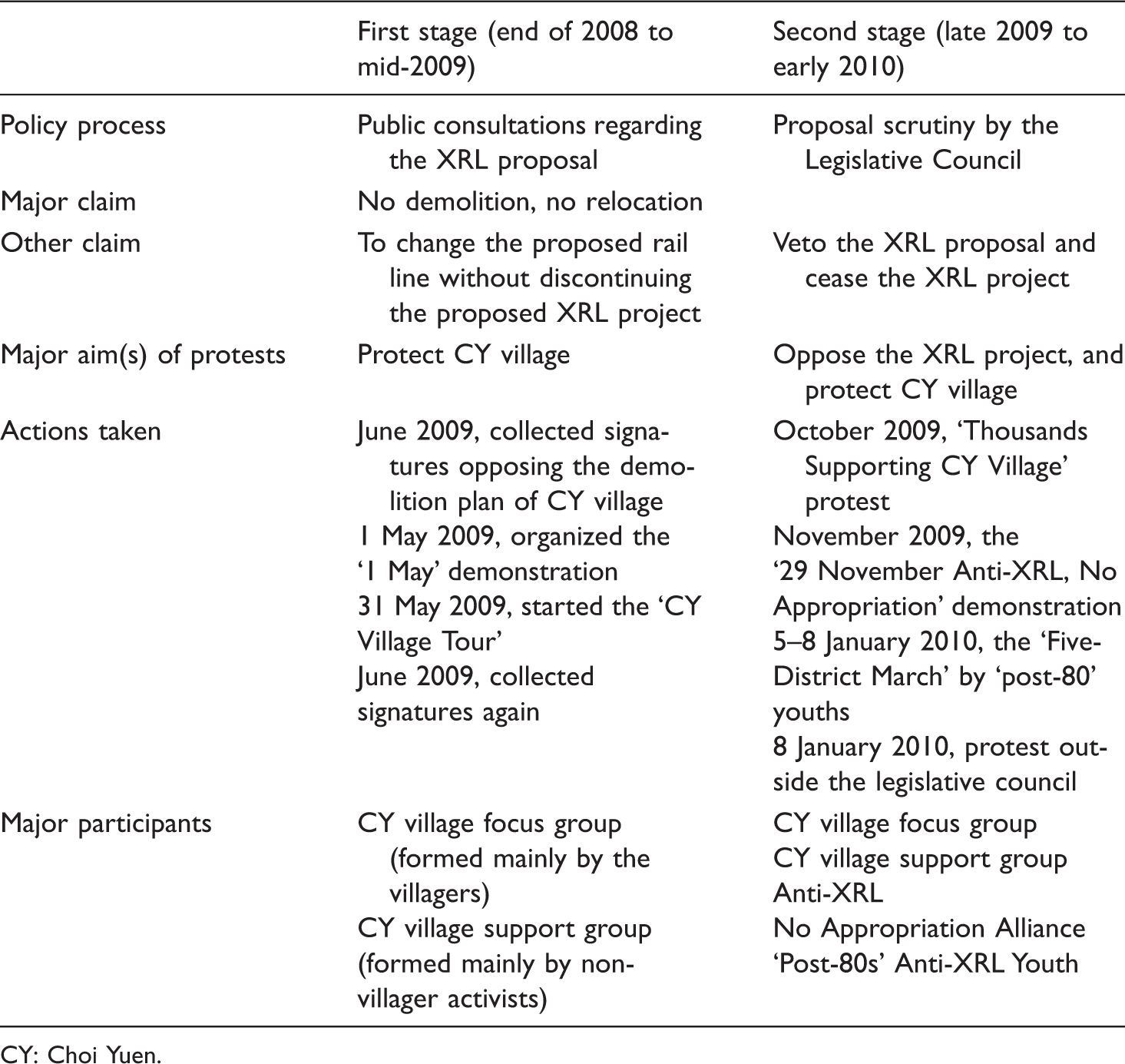
From marginal to mainstream: The changing of collective action frames
During the two stages of the anti-express-rail-link movement, protestors expressed their major goals clearly, which changed from merely protecting the village without opposing the XRL to directly opposing it. It is important to note that movement goals do sometimes change. Social movement activists must explain, in the course of their movement, the reasons, values, and beliefs underlying their specific claims. A shared understanding of the particular reasons, values, and beliefs attached to actions is what really mobilizes people, and the construction of this shared understanding constitutes the major task of framing. In the case under study, along with the change in major goals, the collective action frame underwent an obvious change. As the following analysis will reveal, this change was a strategic adaptation by the activists in order to mobilize more people to take action, rather than an autonomous shift.
The protestors’ major demand in the earlier stage of the movement was ‘no demolition and no relocation’ of CY village. In the initial stage of the movement, protestors lacked mobilization resources. They launched several protests, but very few people outside the village participated. 3 The protests failed to attract the attention of the local media. Activists soon realized that, in the absence of both organizational resources and personal networks, the only feasible way to quickly publicize the dissent of the villagers and mobilize public support was through the information network. They quickly adjusted the mobilization strategy from directly launching protests to systematically disseminating information about the problems that CY villagers were facing. An interview with the key activist, Mr Chu Hoi-dick, revealed this strategic shift. In this interview, the activist stated that the new strategy they had adopted was to ‘publicize the event with continuous independent reports so as to construct the framework for public discussion over the event … Only by combining action with information can we mobilize tremendous support' (Tang, 2011). This was an example of ‘information mobilization’ (zixun dongyuan), as the activist called it.
While the mainstream local media showed no interest in reporting on the events in CY village, the activists nonetheless found other methods of putting events under the spotlight of public discussion. The first method they found was to publicize a series of reports and commentaries on the CY events on In-Media, a local independent online newspaper that had been very active in supporting previous social movements (Ip, 2007). With the social movement activists acting as editors and journalists, In-Media functioned as a network cluster of social movement activists, and especially of younger activists. As the founder described it, In-Media functioned as a bulletin board for activities and a forum for public discussion (Ip, 2007: 7). The major activist helping out the villagers with the protests was the editor and journalist of In-Media. In-Media thus became actively involved in the event from the time when the protests started. It served as the most important arena where the activists posted information and constructed meaning for their actions.
The second platform that the activists relied on was social media, such as Facebook. The activists used Facebook to distribute information on actions and to reach supporters and bystanders. In-Media and Facebook performed different functions during the movement. In-Media provided the activists with a discursive arena to define in detail the problem under protest, the reasons for action, and the meaning underlying the actions. In contrast, the information appearing on Facebook was much briefer and more precise, and was the mobilization medium for certain collective actions.
The third discursive arena comprised several publications created by the protestors. Since February 2009, activists have edited two publications—the Special Issue on Choi Yuen Village and News on Choi Yuen Village Protests—to report the latest progress of CY protests. Editions of these two publications were published on In-Media and also posted and distributed on Facebook. Meanwhile, activists also printed out the publications and directly distributed them to the public. For instance, when collecting signatures urging the government to revise the XRL proposal, the activists printed out 50,000 copies of the June edition of Special Issue on Choi Yuen Village and distributed them in the streets.
In the later stage of the movement, the activists managed to mobilize a significant number of participants, who together escalated collective actions against the XRL proposal. The movement received tremendous media coverage. Both mainstream media and independent social media closely followed the actions of the anti-XRL activists. With such high media exposure, the activists found it much easier to publicize and distribute their demands, values, and beliefs through waves of action. The messages they intended to spread were prevalent in their discursive practices during action, such as movement slogans as well as various public speeches the activists made during the demonstration. In a nutshell, the discursive practices in the first stage were mainly online, while in the second stage, along with the proliferation of the movement, discursive practices were dispersed in the actions taken by the protestors.
The first stage: Marginal culture as collective action frame
The two major collective action frames in the first stage of the movement, those of ‘community’ and ‘land/agriculture’, reflected the activists’ previous protest experiences and their new reflections upon the case of CY village.
At the very beginning of the movement, the activists focused on the frame of community, which emphasized a sense of belonging and attachment of individuals to the community through shared life experiences, and the intimate relationships between individual members within the community. The activists applied the frame of community to define the grievances of the villagers in such a way that the demolition plan would destroy the intimate connections of the villagers to the decades-old community of CY village.
In order to publicize the importance of the community value, activists began to document the oral history of CY village. Starting in February 2009, they interviewed villagers about their personal life experiences in the village. The interview scripts were written up as stories and published on In-Media and later in a self-made publication called guangshengang gaotie shigang caiyuancun xilie [The Guangzhou-Shenzhen-Hong Kong Express Rail Link and Choi Yuen Village Stories] as well as in some mainstream local newspapers (Tang, 2011). In May 2009, activists initiated a regular Choi Yuen Village Tour Program to invite people to visit CY village, while the villagers and activists introduced stories of living in CY village to the visitors. By presenting the oral history of the village and developing the village tour program, activists attempted to show the public the life experiences of villagers within this small, but intimate, community. They intended to highlight the unique and irreplaceable value of CY village as an intimate community. The emphasis on community was also prominent in villagers’ protests in the first stage, during which slogans carrying the words ‘protecting our home to the end’ and ‘do not destroy our home’ were highlighted.
In fact, the emphasis on community reflects continuity between the core activists and their previous protest experiences. The non-villager activists who became involved in the anti-XRL movement were the core activists in the local social movement enterprise. Most of them had previously devoted themselves to protecting historical sites and old communities in Hong Kong in actions such as the protest against the demolition of Star Ferry and Queen’s Ferry during 2006–2007. As a result of the experiences of these protests, activists had built an obvious frame of community, and their actions were widely regarded as both a symbol and an expression of the local identity of Hong Kong people (Ip, 2007; Ku, 2012; So, 2011). The existing frame of community formed in previous protests was adopted by the activists in the protests in CY village. As one activist specified during the interview: When the protest started, the major frame we relied on was ‘community’. This frame was developed in previous movements. From the protests against the demolition of Lee Tung Street to the protests against the demolition of Star Ferry and the Queen’s Ferry in the years 2006–2007, we gradually established the concept of community … we tried to … tell the public that the removal of an old street is simultaneously the destruction of an intimate community that has been built upon that street for decades. When people protest against demolition, they are actually expressing their attachment to intimacy among community members. Money is not always their major motive. When we got involved in the controversy in Choi Yuen village, we applied the community frame directly. (Interview with activist W, 1 February 2009) Choi Yuen village has given us the opportunity to learn about the difficulties of sustainable land-use development in Hong Kong. It has also broadened our imaginations regarding villagers’ lives. (Chu, 2009) Village communities nurture the land of the New Territory … they demonstrate to Hong Kong society respect to the land and belief in sustainable development. Sadly, the Hong Kong government is going to destroy this land by adding a giant infrastructure that is useless to the New Territory at the expense of the farmland and the future of sustainable development. Should we really be happy about this? (Chu, 2009) The legislative council’s committee on railway issues has invited the public to express their opinions about the construction of the XRL at 4:30 pm on 4 May 2009 in the council’s meeting room … Please do not miss this opportunity! Please join us in fighting for the future of Hong Kong. Let’s protect the land in the New Territory together! (In-Media, 2009a) The values that we are articulating are the right to independently select an appropriate lifestyle and living place, the intimate network of a community, local agriculture, and the right to participate in the policy-making process regarding a mega infrastructure project. (In-Media, 2009b)
Activists in the first stage had intended to publicize, through actions and discourse, values that were familiar to them but barely known to the general public. They assumed that the values they cherished would also invoke sympathy and resonate with other Hongkongers. The result, however, was not at all what they expected. In a society that had long been dominated by an ideology of developmentalism and materialism, the public was generally insensitive to the injustice inflicted on a remote village. Furthermore, the language of mobilization was confined to the specific problem encountered by CY villagers. It failed to relate this specific event to some broader public issue that might attract the attention of other Hong Kong people.
In a nutshell, the frame applied in the first stage reflected the activists’ own preferences, which happened to be based on marginal values irrelevant to the personal experiences of the general public. The disconnection of the frame from the target group thus resulted in ineffective mobilization.
The second stage: The strategic changing of the collective action frame
Bringing in the mainstream value
As mentioned earlier, after the 1 May demonstration, activists realized the limitations of the action and mobilization strategies of the first stage. They started to discuss adjusting the frame to mobilize more people. A consensus was soon reached, which was to shift the major goal from merely protecting the village to challenging the express railway. However, how to construct a new frame for mobilizing people to take action to achieve this goal was largely unclear.
While the activists were still searching for ways to adjust the mobilization frame, one important message from the local government caught their attention and later formed the basis for a breakthrough of frame transformation. On 28 May 2009, the Hong Kong Economic Daily revealed that the cost of building the XRL might be almost doubled, from HK$39.5bn as estimated in the government proposal to HK$63bn. With an additional HK$3.9bn already used for a land and rail-line survey, the overall cost of the XRL amounted to more than HK$66.9bn. This piece of news excited the activists: We were very excited [to read this report]. The timing of ‘HK$66.9bn’ being released was so ideal that our just making up stories about this exorbitant price would be enough [to mobilize the public] … This cost was unbelievably high, and it was consuming the public finance. Hong Kong people would be very skeptical about it. (Interview with Activist C on 2 December 2010)
In the four major anti-XRL demonstrations when the legislative council was scrutinizing the XRL proposal, slogans containing the words ‘66.9 billion’ were very visibly displayed and emphasized repeatedly by the activists. The phrase was interpreted by the activists in various ways as closely related to the concrete interests of different social groups, whether they had heard about the XRL proposal or not. For instance, in a large-scale march held on 29 November 2009, the activists framed ‘66.9 billion’ as ‘our Hongkongers’ money’. They also criticized the government for wasting ‘the public fortune that ordinary Hongkongers saved cent-by-cent’
4
on a luxurious express rail link that did not directly favor the interests of the general public. The following is a quote from one of the mobilization handouts distributed by the activists when protesting on 29 November: Hong Kong has a ‘No.1’ reputation concerning various aspects of life. However, there are things we do not want: we do not want the highest real estate prices in the world; we do not want the worst inequality among the advanced economies; we do not want to use a 66.9 billion public budget to build up the most expensive rail link in the world … 66.9 billion could have been used to serve the benefits of the Hongkongers, for example, to improve medical services and education, curb air pollution, alleviate poverty problems, and increase elderly services. Please join our demonstration outside the Legislative Council. Prevent the government from laundering the money … These tens of legislators inside the room were deciding how my money was used, and how my city was developed. Why do you need to oppose the XRL project? Because it is a total waste of 66.9 billion HK dollars! … The 66.9 billion was taken from the public budget. The government was so determined to waste this money on a useless rail link. This huge amount of money could have been used to solve many important social problems. For years, Hong Kong people have been hoping that the government would increase the quota of students enrolled in the public universities, rebuild public houses, and improve the quality of medical care and other social services, but the Hong Kong government just turned a blind eye to these demands. Now it is going to sacrifice all the benefits that Hongkongers might be given for a 26 km railway.
These quotes show very clearly the activists’ intention to relate the ‘66.9 billion’ to the concrete interests of individual Hongkongers, especially those without power. After questioning the estimated economic returns of the XRL, activists further represented XRL as serving the interests of the wealthy and the powerful class, while sacrificing the interests of ordinary Hongkongers, who have to pay the extremely high construction costs. They further framed the XRL project as the outcome of an alliance between the undemocratic, yet business-friendly, government and local business tycoons. CY village, in contrast, was presented as symbolizing ordinary Hongkongers who were oppressed by the powerful government–business hegemony. By framing the XRL and CY village in this way, the activists managed to define an oppositional relationship between the undemocratic government/capitalist class and the general public in Hong Kong. In one mobilization handout, it was written that: The XRL is the kind of infrastructure that is more beneficial to the wealthy than to ordinary people. It saves commuter time for businessmen, senior administrators, and professionals, thus enabling them to earn more money. What the government is trying to do now is to use public financing to save money for wealthy people and meanwhile take away, as much as possible, the time and opportunities for us to learn, to debate and to oppose the XRL proposal. The XRL will make it convenient for the wealthy to develop other places in the Greater China area. The majority of Hongkongers, then, are left out as marginal groups that cannot be engaged in the promising future of the Greater China prosperity. (Anti-XRL Alliance, 2009)
Restoring marginal cultural values
The strategic revision of the frame enabled the activists to mobilize many more Hongkongers to pay attention to the XRL controversy and even participate in the resistance movement against the project. The widespread resistance soon attracted tremendous media coverage, which brought the XRL controversy into the spotlight. While still relying on the material interest frame, the activists again brought in the former frames of community and land/agriculture values. They intended to sell these marginal cultural values to the followers, sympathizers, and bystanders of the movement. When the movement escalated, these marginal values were widely distributed and accepted. In the later stage of the movement, messages showing the sentiments of respect for and devotion to the land and agriculture even became the mainstream discourse of the movement. Even after the anti-XRL movement ended, values such as the land and agriculture were still accepted and acted upon by a group of young Hongkongers.
The expression and pursuit of these marginal cultural values occurred on many different occasions. In the demonstration at CY village on 18 October 2009, which was organized by the ‘Choi Yuen Village Focus Group’, thousands of Hongkongers gathered at CY village to protest the undemocratic and unfair policy-making procedures of the XRL project. While the major theme of this demonstration was to urge the government to withdraw the existing XRL proposal and save CY village, the sentiments of attachment to the land, community, and village life were expressed and emphasized. These marginal values were prominently and systematically discussed in later campaigns, especially the ‘penance’ movement organized by ‘post-80’ activists. The theme of this movement was that, in contrast with the dominant developmental way of life based only on efficient, materialistic logic, an alternative lifestyle attached to the land, the community, and the obligation to others should be rethought and respected. In the anti-XRL statement of the ‘penance’ movement, the activists specified that: The traditional mode of development has destroyed the diversity of communities. It cuts off the connection between the people and the land. It rudely ignores people’s lives, which are deeply rooted in the land … The 66.9 billion in public money was saved cent-by-cent by ordinary Hongkongers, and the government should value it and use it properly. It should preserve Choi Yuen village—an old village that has been rooted in the land of Hong Kong for fifty years, and the villagers’ lifestyles that are so close to nature. (Chu, 2010) On 8 January 2010, let’s light up the hope, and together rebuild this land that has been destroyed. Our aim: to demonstrate the voluntary community economy, which is composed of the people, the land, and the attachment between them, and to demonstrate how we activate the potential of the community economy based on existing conditions. (Anti-XRL Alliance, 2010) A more systematic movement for independent life is underway! … With the provision of Choi Yuen village’s land and humanity, we learn to do organic planting by ourselves; we hold exhibitions and workshops; we connect to individuals and communities from various walks of life; we rebuild the life-world that is full of benevolence and intimately tied to the land. The Choi Yuen Village Life House is the laboratory for us to explore and practice new values for living … We hope to know more and think more about the relationships between cities and villages. (Anti-XRL Activists, 2010)
As a byproduct of the anti-XRL movement, formerly marginal cultural values such as respect for community and land/agriculture were eventually made known to the greater society and attracted a considerable number of adherents. These values developed from fragments of vague and implicit sentiment into an explicit package of clearly and systematically defined cultural values. Although emerging from the anti-XRL movement, they have not stopped influencing the political behavior of a certain group of Hongkongers. They have become part of the overall cultural context, together with other existing cultural elements structuring the dynamics of future political circumstances.
Discussion and conclusions
This study examines the change of collective action frame during the anti-XRL movement in Hong Kong and discusses the mechanisms by which the cultural context has affected the selection of collective action frames and the effectiveness of mobilization. The anti-XRL movement progressed roughly through two different stages. In the earlier stage, activists used the community/land/agriculture frame to publicize the controversy and mobilize support. However, the frame as such appealed to marginal cultural values that were unfamiliar to most Hongkongers. It was thus not able to resonate with Hongkongers and failed to mobilize them.
Meanwhile, the counter-movement frame by the local government to convince people of the necessity and the importance of the XRL was apparently much stronger. This counter-movement frame stressed the anticipated economic value of the XRL. For instance, in the 2007–08 Policy Address, the then Chief Executive, Sir Donald Tsang Yam-kuen provided the following reasons to build the XRL: it will connect Hong Kong to the national express railway system on the mainland, thus facilitating the construction of the ‘one-hour life circle of the Pearl River Delta’, enhancing the integration of Hong Kong and Guangdong, and avoiding the marginalization of Hong Kong in the national project of economic development (Tsang, 2007); it will provide 19,000 job opportunities to Hongkongers; it can transport 99,000 people every day, and save Hongkongers 40 million hours of commuting time; it will raise about 83 billion Hong Kong dollars in the next fifty years. (Sing Tao Daily, 2009)
The media’s exposure of the significant increase in the XRL’s construction costs led directly to the strategic frame readjustment in mid-2009. Activists repeatedly related the huge construction cost of ‘66.9 billion’ to the concrete material interests of individual Hongkongers, and reinterpreted the XRL as a violation of each Hongkonger’s personal interests instead of merely as a misfortune for CY villagers. The new frame attracted the mainstream materialistic element of the local political culture, which aroused the attention, and later the sympathy, of individual Hongkongers.
While the collective action frame obviously changed in the second phase of the movement, the counter-movement frame of the government remained unchanged. Meanwhile, the activists concentrated on questioning the existing reasons that the government provided to justify the XRL project. They accused the government of fundamentally miscalculating the estimated economic value of the XRL in at least two ways. First, quoting the estimates made by local economists, the activists said that it would be almost impossible for the local government to make any profits from the XRL after making such a huge investment as HK$66.9bn, but that instead the government would have to continually subsidize the project. 9 Second, a ticket for the XRL would be much more expensive than a ticket for an ordinary train and thus unaffordable for the average Hongkonger. The XRL would therefore only serve the needs of wealthy elites instead of the needs of the majority. 10 In response to this ‘counter-counter-movement frame’ discourse, public attitudes towards the XRL shifted from overwhelmingly supportive to questioning its necessity and the government’s estimates of its future economic value.
As the anti-XRL movement reveals, within a social movement, activists or social movement organizations are not the only frame-makers. Other actors, such as the government, are also involved in constructing frames that compete with or run counter to the collective action frame (McCarthy et al., 1996). While the frame for collective action is meant to mobilize people to participate in collective action, the counter-movement frame is devoted to demobilization. Thus, to obtain successful mobilization, the collective action frame has to be more appealing to the everyday experiences and preferences of the target group than the counter-movement frame is (Benford, 1993; Snow and Benford, 1988). In the anti-XRL movement, the counter-movement frame by the local government emphasized the economic value of the XRL, which is consistent with the Hong Kong general public’s materialistic values. In contrast, the collective action frame in the first stage stressed the values of community and land/agriculture, values that were unfamiliar to the highly capitalistic Hongkongers. Hence, the demobilization effect of the government’s counter-movement frame was quite obvious in the first stage of the movement.
In the second stage of the movement, the activists intentionally applied mainstream cultural values to adjusting the collective action frame and attacking the government’s counter-movement frame. In spite of the activists’ criticisms, the local government kept the counter-movement frame the same without responding at all to the opposition. The new collective action frame soon defeated the counter-movement frame and attracted more support from the overall society. During this process, important resources that contrasting frames compete for, such as the supportive discourse of media and experts (Manheim, 1993), drifted from the government to the protestors. This change redirected the public discourse from supporting the XRL project to opposing it, which in the end made successful mobilization possible.
The metamorphosis of collective action frames as exemplified by the anti-XRL movement demonstrates the role of cultural context in structuring the formation of a collective action frame. In a general sense, culture could be understood as the shared values and norms that are deeply rooted in a society and widely accepted by the public (Almond and Verba, 1965; Devine, 1972). As a discursive activity, a social movement itself is deeply embedded within the concrete cultural context. To get the sympathy of the target group and thus mobilize them, the collective action frame has to align itself with that group’s shared values and norms. Thus, the culturalist approach in studying social movements is not only about studying the internal cultural activities within a particular social movement, that is, how social movement activists construct collective action frames to mobilize the individuals. It is also about studying the external relationship between the social movement and its broader cultural context. This external relationship is twofold. On the one hand, a collective action frame is inherently structured by its broader cultural context as the latter provides essential cultural elements from which the activists can construct an effective frame. On the other hand, successful mobilization also brings new values to the forefront, which may partially reshape the existing configuration of the cultural context.
The influence of the collective action frame on the cultural context was also prominent in the anti-XRL movement. In the later stage of the movement, the new frame that applied mainstream cultural values achieved effective mobilization. Activists soon brought back the marginal values that they had used in constructing their collective action frame in the earlier stage of mobilization. While the movement escalated, the marginal values became more widespread via the movement and the public discourse in the society as a whole (Rochon, 1998), which added new values to the existing cultural context and thus reshaped it. Formerly marginal values, such as community and land/agriculture that used to be unfamiliar or even unknown to local society, later became widely discussed in the local political discourse. Adherents to these values continued to promote and practice them after the anti-XRL movement had ended. A new political group was formed and continuous struggles began, which reshaped the local cultural context as well as the political ecology.
Footnotes
Funding
This research received no specific grant from any funding agency in the public, commercial, or not-for-profit sectors.