




Abstract
This paper seeks to identify the major sources of unequal cognitive development of middle school students in China’s current rural–urban migration era. Under a framework that integrates theories of social stratification, migration, and sociology of education, we utilize data on a nationally representative sample of 9th graders and a standardized cognitive test to provide valid population patterns and explanations of cognitive development inequality. Our regression decomposition helps disentangle the sources of group disparities between the predictor levels and the predictor effects. Our analysis reveals that the old order of inequality created by household registration (hukou) has been complicated by rural–urban migration. Inequality has increased for rural-hukou students, with the most dramatic differences occurring among children of migrants, depending upon the child’s migrant status. Our regression decomposition analysis results point to the effectiveness of the school learning environment as the chief source of cognitive development inequality. We discuss implications for policy interventions to foster and ensure an equal education for all students.
Keywords
Introduction
From the mid-1980s to 2010, China’s stock of internal migrants amounted to 221 million, of whom over 80% moved from rural to urban environments (Chinese National Bureau of Statistics, 2013). This largest single migration in human history has attracted much scholarly and public attention, particularly to the secondary citizenship of rural migrants living in urban residences. Given the gulf between rural and urban development and the entrenched rural–urban household registration (hukou) system, both of which limit rural children’s access to equal educational opportunities (Wu and Treiman, 2004), one key motivation of rural–urban migrants has been to better their children’s educational opportunities. This goal may be hard to reach, however, because of a host of factors from the hukou system to education policies to the school institution.
The half-century-long inequality stemming from the hukou system and the two-decade-long rural–urban migration interact and create unique family and school circumstances for children of rural migrants in complex ways. The coupling of rural and non-local hukou creates obstacles to children of rural migrants attending urban public schools. As a result, two distinct living arrangements for children of rural migrants are common: some children are left behind in their home villages (left-behind), while others are brought along by migrant parents to live in the urban destination (brought-along). These rural–urban, spatially separate living arrangements mean that children of migrants attend segregated schools in urban and rural areas. In general, urban schools are much better developed than rural schools.
Guided by theories of social stratification, sociology of education, and migrant integration, this paper exploits data from a nationally representative survey of over 9000 ninth graders, the highest grade in China’s compulsory education system. The primary objective is to undertake a comprehensive examination of the major sources of unequal child development at grade 9 among brought-along children, left-behind children, children of rural non-migrants, and urban-hukou children. In particular, we investigate the complicated ways in which differences in the levels and effects of family socioeconomic status (SES), child demographics, school admission policy, and school learning environment lead to seemingly greater variations in developmental outcomes along the emerging social lines defined by hukou and migration status. Applying and extending the counterfactual decomposition technique (Blinder, 1973; Oaxaca, 1973), our regression decomposition analysis disentangles the contribution of the group differences in the levels of predictors in demographics and SES, admission policy, and school learning environment from the group differences in the coefficients of the same blocks of predictors. This study will enhance our understanding of the sources of unequal developmental outcomes along emerging social lines in the rural–urban migration era.
Rural–urban divide and rural–urban migration
China’s development can be characterized as ‘one country, two societies' (Whyte, 2010). The rural–urban disparity in adjusted annual income per capita grew from 3974 yuan in 2000 to 16,195 yuan in 2010 (Chinese National Bureau of Statistics, 2013). Rural–urban differences in educational systems have explained inequality in educational attainment levels and trajectories (Hannum et al., 2007; Hao et al., 2014).
China’s education, a key aspect of development, has experienced both massive expansion and recurrent rural–urban inequality. Compulsory education expanded to nine years in the Compulsory Education Law of 1986. The ratio of the nation’s 7–9 graders to the population aged 12–14 increased steadily from 0.755 in 2000 to 0.978 in 2010 (UNESCO Databank, 2015), reflecting the quantitative achievement of compulsory education in rural areas. Since the 1990s, however, an overwhelming majority of urban students (but not rural students) have completed 12-year educations, thus enlarging the rural–urban gap in the likelihood of transition to college (Wu and Zhang, 2010).
The rural–urban development imbalance has been reinforced by the hukou system, which has been perhaps the most stable institution in China since the 1950s despite radical social change. Established in 1955, hukou has been persistently used to dichotomize citizenship: people with urban hukou are eligible for urban education, employment, and a social safety net, while people with rural hukou do not have access to those benefits (Chan et al., 1999). When the geographic mobility of rural people was restricted, secondary citizenship could be dismissed as merely one aspect of rural–urban development gaps. In the large-scale rural–urban migration era, however, secondary citizenship for rural migrants and their children residing in urban areas has emerged as a major issue.
The fact that left-behind school-age children account for about two-thirds of all school-age children of rural migrants indicates a serious violation of the principle of equal opportunity of education (Duan et al., 2003). Leaving children behind is largely responsible for migrant parents’ failure to enroll their children in urban public schools, not parental choice. With parents being away from a few months to a year, left-behind children’s education is in jeopardy without parental supervision and emotional support, and poorly resourced rural schools provide little assistance. In a review of policies pertaining to the education of children from rural–urban migrant families, Hao and Yu (2015) sketched the evolution of policy guidelines to accommodate brought-along children in urban public schools during the 2000s. Starting in 2001, the central government mandated that the local governments of receiving areas should take responsibility for providing brought-along children with compulsory education and that local public schools should admit brought-along children. This directive was reclaimed and reemphasized in a series of policies from 2003 to 2013. In 2006, the equal right to compulsory education for brought-along children in receiving areas was written into the Amendment to the Compulsory Education Law. In 2008, the central government created sanctions against collecting tuitions and miscellaneous fees from brought-along children. Policy guidelines are not necessarily local government policies, however, and the fidelity of policy implementation is questionable. In addition, virtually no policies addressed left-behind children during that period.
Previous research on children of migrants
Research on children of rural migrants in China has been fast growing. The literature in this area, however, has not fully considered the broad-ranging responsible government, school and family institutions. It also lacks empirical studies using a large probability national sample of the grade-specific student population to capture precise representative disparities in child development and their sources. Most existing research has been based on relatively small local samples. For example, using a provincial rural local sample, Wen and Lin (2012) examined health and social–behavioral outcomes among left-behind children compared to those from non-migrant families and found that left-behind children were disadvantaged in health behavior and school engagement. As exceptions, Ren and Treiman (2013) and Xu and Xie (2015) examined data collected from a national panel survey of families with standardized achievement tests administered to children in the sampled families. They investigated the impact of rural–urban migration on child outcomes. The child sample size (about 4000), however, was small relative to its age range (ages 10–15), and information about schools was limited.
China’s rural–urban migration can be viewed as migration from developing areas to developed areas, and this has implications for children of international migrants from developing countries to developed countries. The US literature has documented that children of immigrants outperform children of natives in academic achievement with the same family SES (Kao and Tienda, 1995; Portes and Rumbaut, 2001; White and Glick, 2009). Scholars have attributed this immigrant advantage to immigrant optimism stemming from the migratory motivation to enhance children’s life chances (Kao and Tienda, 1995), parent–child consonance on an educational expectation for high academic attainment (Hao and Bonstead-Bruns, 1998), and cultural between-ness of the home and host cultures helping children to navigate the educational system (Kasinitz et al., 2008). In their comparative studies between the United States and five Western European countries, Alba and Holdaway (2013) shed new light on the integration of immigrant-origin children into the mainstreams of wealthy countries. The authors have emphasized institutional mechanisms of educational systems, such as inequalities across school systems and tracking and selection within them, as responses to educational policy shifts. At the same time, researchers have started to examine children left behind by international migrant parents. These children seemed to suffer from parent–child separation, an experience which could not be offset by remittances (Dreby, 2010; Lu, 2012). It is nearly impossible, however, to compare brought-along and left-behind children from the same immigrant population, because it is rare to have the same data source on both brought-along and left-behind children of international migrants within a binational system.
The empirical literatures on children of internal and international migrants laid a solid foundation on which our study is built. Most past studies on children of internal or international migrants have made one comparison – brought-along versus urban-local, left-behind versus rural-local, or brought-along children versus rural-local – but very few have made more than one comparison. In our view, a comprehensive design to make comparisons among brought-along, left-behind, urban-local, and rural-local children would more effectively identify the influences of structural and institutional factors than single comparisons in separate studies can. Our study exploits newly available data from a nationally representative survey of junior-high students in China.
Theoretical framework and hypotheses
We develop a theoretical framework to address how rural–urban migration complicates educational inequality and how the school institution responds to the demographic shift and policy evolution in the rural–urban migration era. We benefited from three theoretical strands: social stratification; sociology of education; and migrant integration. In this conceptual development, we pay special attention to China’s context and modify the Western theories accordingly. From this discussion, we derived three hypotheses to be tested in our empirical analysis.
When the 1986 Compulsory Education Law stipulated nine years of education for the nation’s children, the rural–urban divide, which largely overlapped with the rural–urban hukou identifier, contributed to what Raftery and Hout (1993) termed ‘maximally maintained inequality.' Opportunities to obtain the expanded level of compulsory education favored urban children over rural children. By 2010, when almost all age-appropriate children completed their nine-year compulsory education, many urban children moved ahead to complete 12 years of schooling. The net effect of this has been little change in educational inequality between rural and urban children, although the level of education has improved for all children. Qualitative differences in schooling have become more consequential, as the ‘effectively maintained inequality' thesis argues (Lucas, 2001). The qualitative differences in 9th grades between rural and urban schools have widened, as the urban educational mission aims at college education while the rural educational mission aims at the low-skilled labor market and agricultural production. Thus, hukou stratification is the distal cause of developmental disparities between urban-hukou students and rural-hukou children of non-migrants (Hypothesis 1).
As the number of brought-along children has continued to grow over years of mass education expansions, significant demographic shifts have led to an increase in both the size and the heterogeneity of the child populations in urban areas. This demographic shift has clashed with the exclusive access to urban public schools of urban-hukou students, prompting changes in central government educational policy guidelines. Local governments have responded to national directives with inertia, maintaining the existing inequality order and designing policies that restrict public school admission of migrant children on the basis of their migrant parents’ SES. These institutional practices essentially select children of higher SES migrants into urban schools while rejecting children of lower-SES migrants, who must leave their children behind to attend rural schools in their home villages. Consequently, China’s compulsory education inequality is spatially redistributed so long as rural–urban migration continues.
The degree to which local education policies pertaining to migrant children are beneficial for children of rural migrants creates different integration models that are responsible for disparities in compulsory education between local and migrant children. Perspectives on cross-national differences in integration models see native/immigrant inequalities as a consequence of jus soli versus jus sanguinis citizenship (Brubaker, 1992). According to the modes of incorporation thesis (Portes and Rumbaut, 1990), we consider multidimensional conditions responsible for the incorporation of immigrant generations, including policy, labor market, and community. Urban schools have adopted ‘point systems' in terms of migrant parents’ SES to determine whether their children are accepted (Zhang, 2012). We posit that this point-system-like policy is a type of institutional selection that allows migrant parents who managed to achieve a higher SES to bring children along while selecting out migrant parents of lower SES, who have to leave their children behind. Thus, point-system-like admission policies select brought-along children on the basis of their parents’ SES.
Consequently, while brought-along children are attending urban public schools, these schools are likely to be recently expanded or newly founded urban schools of lower quality. In other words, we expect that parent–child migration may enhance brought-along children’s developmental outcomes to some but not a sufficiently large degree as compared to children of rural non-migrants due to school admissions policy selections and their attending urban public schools (Hypothesis 2a). Left-behind children not only have no access to urban public schools but also suffer from generally low-quality rural schools, which are not equipped to serve students experiencing long separations from their parents. Thus, parental migration without bringing children along does not benefit left-behind children, who may even fare worse than children of non-migrants (Hypothesis 2b).
In addition to the policy institution, the school institution is a key building block of our framework. The education of migrant children reinforces a fundamental tension at the core of the educational mission between reproducing the existing social order (Bowls, 1976; Bowls and Gintis, 2002) and providing upward mobility opportunities for children from disadvantaged backgrounds (Alexander et al., 2007; Coleman, 1966). Sociology of education theories explain the underlying institutional mechanisms that resist policy change in terms of the ‘Third Law of Educational Inequality,' which holds that for every initiative to reduce inequality, there is an opposing reaction to preserve it (Alba and Holdaway, 2013: 258). Schools with a differentiated curriculum structure, low academic standards, and weak educator–student bonds resist policies of reducing inequality (Bryk et al., 1993; Downey et al., 2004; Gamoran, 1992; Lee and Smith, 1997; Stanton-Salazar and Dornbusch, 1995). We hypothesize that developmental disparities among updated social groups in terms of hukou and migration are largely occurring through the school institution. For example, brought-along children are likely to attend schools with greater resistance to reduced inequality and have poorer learning opportunities than urban-hukou children do. Therefore, exposure to different school learning environments may be one important causal mechanism linking social groups and developmental outcomes (Hypothesis 3).
While sharing two fundamental characteristics – rural hukou and parent migrant status – brought-along and left-behind children diverge in developmental outcomes. We hypothesize that the developmental gap between brought-along and left-behind children arises from school admissions policy selection and disinvestment in rural schools, which ironically shoulder the most difficult task of helping left-behind children with problems stemming from parent–child separation (Hypothesis 4).
Data and methods
Our analysis draws its data on 9th graders from the China Education Panel Survey (CEPS). 1 The CEPS is a national longitudinal survey of 19,487 7th and 9th graders conducted during the 2013–2014 academic year. The CEPS employed stratified, multistage sampling with probability proportional to size. The CEPS administered five different questionnaires to the sample students and their parents, homeroom teachers, main subject teachers, and principals. A grade-specific, standardized cognitive ability test was administered to this national sample of students. The 7th graders were followed annually twice until 9th grade while the 9th graders were not followed. This study draws on the baseline survey data on the 9208 9th graders in 217 classrooms of 112 schools.
Measurement
The dependent variable is cognitive development. The CEPS provides item response theory (IRT) scale scores to measure cognitive ability. In the baseline year, the sample of 9th graders took the standardized cognitive ability test, consisting of 22 items in 15 minutes of a class period. These items were designed to reflect the knowledge level of 9th graders independent of the curriculum content. The test evaluates students’ logical reasoning in language, Math, and graphical forms. The cognitive ability t-scores have a mean of 50 and a standard deviation (SD) of 10, created using the three-parameter logistic model under IRT. The distribution of the cognitive ability scores shows stable, nice psychometric properties.
Groups, grouping variables, and group sample size.
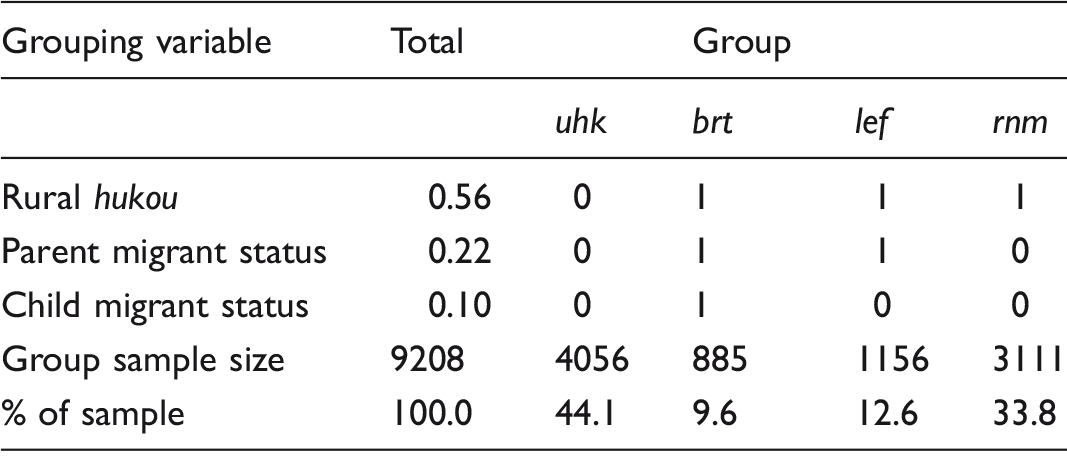
Source: baseline (2013–2014) 9th-grader sample of the China Education Panel Survey. uhk: urban-hukou students; brt: brought-along children of migrants; lef: left-behind children of migrants; rnm: children of rural non-migrants.
We measure family SES by the highest parental years of education and highest parental occupation (white-collar, blue-collar, service/self-employed, and farming). Students’ demographic characteristics include the only-child indicator and gender. The only-child status mainly captures greater parental investment relative to investment in students who have siblings. The rural population exhibits a low rate of only children. Gender may also capture the traditionally greater investment in sons than in daughters.
We measure school admission policy using the number of alternative documents required for school admission from the parent questionnaire. All students are required to show their local permanent hukou. In the absence of a local hukou, migrant children must show their parents’ temporary residency permit, local homeownership or housing lease, proof of local employment or business license, local social insurance, and compliance with the family planning policy, and some localities have gone so far as to set a threshold for an explicit point system based on parental education and occupational prestige. This variable ranges from 0 to 6.
We conceptualize school learning environment using seven variables: (1) school academic standard can be encapsulated by the school’s reputation rank within the county/district (1 for top and 0 for non-top); (2) a school’s physical resources are measured by the number of school facility types, such as library, science laboratory, computer classroom, field track, music room, and counseling room (ranging from 1 to 7); (3) to flip class size such that a larger value indicates better learning opportunities, we created a scale around 1 using the ratio of mean class size to the specific class size; (4) the faculty credential is measured by the proportion of teachers with a bachelor’s or higher degree; (5) the proportion of teachers with five or more years of teaching experience captures the faculty’s teaching experience; (6) the teacher–student bond is a scale based on seven items from students’ perspectives about the encouragement or discouragement they received from the homeroom teacher and teachers teaching Chinese, Math, and English (z scores with Cronbach’s alpha at 0.89); and (7) school climate is a scale based on three items evaluated by the three main subject teachers regarding their perceptions of students’ morality, the school learning environment, and the management of students (z scores with Cronbach’s alpha at 0.81).
Analytic strategies
The CEPS’s group-administered survey in classrooms and inspection and collection of questionnaires within the same day led to high response rates for the multiple questionnaires. The item response rates for questions used to create the variables in the current study ranged from 94.5% to 100%. Despite these high item response rates, a total of 14% of the student sample missed at least one of the 18 variables used in the analysis model. Assuming missing at random and ignorable missing mechanisms (through seven variables), we performed multiple imputations using the chain equation method and a total of 25 variables. The resulting 10 versions of the complete data for a full sample of 9208 9th graders yield 99% efficiency. The results of our analyses are based on the 10 versions of complete data using Rubin’s rule (Rubin, 1987) to obtain the point estimates and their standard errors that take into account two sources of uncertainty.
We are interested in the relative importance of three blocks of predictors: family SES/demographics; school admissions policies; and school learning environment. We wish to distinguish between the contribution of predictor levels and the contribution of coefficients of these predictors in shaping 9th graders’ cognitive development. We regressed the developmental outcome on the three blocks of predictors using the pooled sample and then separately for each of the four groups. We applied the counterfactual decomposition method and further partitioned the predictors into the three blocks (SES/demographics, admission policy, and school environment). We measured predictors in such a manner that they have a positive relationship with the cognitive outcome (e.g. smaller class sizes promote student outcomes). The total predicted group disparity in cognitive ability is the sum of seven components, including three predictor level effects, three coefficient effects for the three blocks of covariates, and the difference between the two intercepts (see Technical appendix for more details). Our detailed regression decomposition method allows us to test our hypotheses.
Results
This section first examines the observed group disparities in child cognitive development, and then looks at group differences in SES/demographics, admission policies, and school learning environment. We then move on to consider the multivariate results by first looking at the regression estimates of cognitive development for the whole sample and separately for the four groups, and then discussing the results from our regression decomposition analysis.
Descriptive patterns
Weighted descriptive statistics of variables used in analysis.
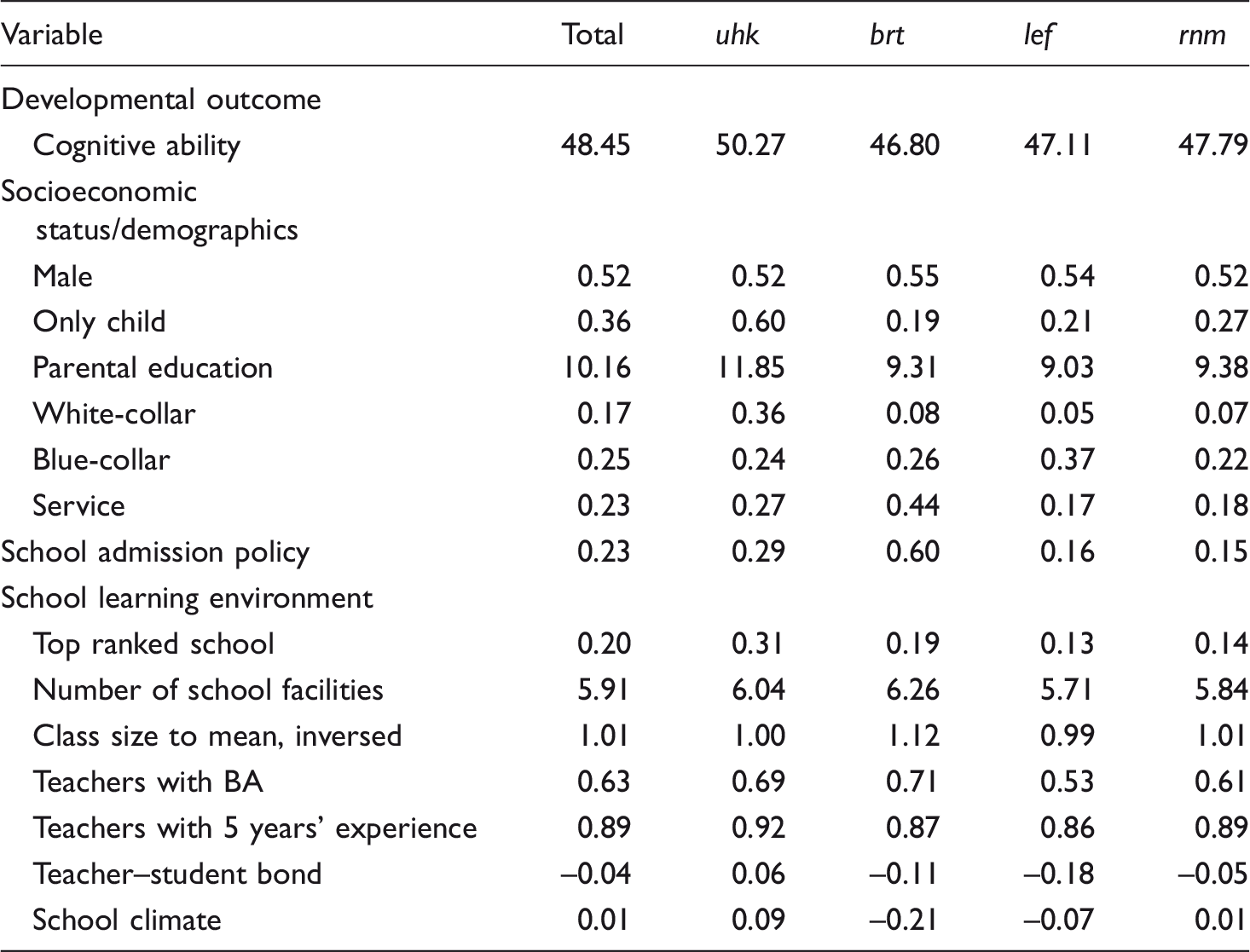
Source: baseline (2013–2014) 9th-grader sample of the China Education Panel Survey. uhk: urban-hukou students; brt: brought-along children of migrants; lef: left-behind children of migrants; rnm: children of rural non-migrants.
Examining the weighted distribution of SES and demographic characteristics across the four groups, we see striking group differences between uhk and all rural-origin in parental education, parental white-collar occupation, and only-child status, which capture parental investment in children. It is interesting to observe, however, the substantially high percentages of parental blue-collar jobs for lef and service/self-employed jobs for brt due to migrants’ occupational upward mobility.
The admission policy variable, the average number of alternative documents required for school admission, is directly relevant for brought-along children (brt) but less so for the other three groups. The average number of alternative documents for brt is high at 0.60. A closer look at the data shows that 25% of inter-provincial migrants’ children submitted 2–6 additional documents and that the corresponding number was 15% for intra-provincial migrants’ children. Because admission policies serve as an institutional selector of better-off migrants’ children, we interpret this variable as a further measure of migrant parents’ SES. The mean at 0.29 for uhk reflects the fact that uhk attend schools admitting brt. The average number of additional documents is understandably small for left-behind (lef) and rural reference (rnm) children.
Even when they are able to satisfy the point-system-like requirements for school admission, brought-along children of rural migrants continue to face unequal learning opportunities as measured by school variables. Perhaps the most salient gap is among top-ranked schools within counties/districts between uhk and brt. While 31% of uhk were in top-ranked schools, only 19% of brt were admitted to such schools. Thus, schools additionally select rural–urban migrants’ children into lower-ranked schools. Second, having a strong teacher–student bond is an essential learning condition. Our data show a significantly weaker bond for all rural-origin students than for uhk. Measured as z scores, uhk exhibited bonds at 0.06. In contrast, the group mean of the teacher–student bond is as low as –0.18 for lef and –0.11 for brt. Third, the school climate for student learning is markedly favorable for uhk at 0.09 (z-score) but unfavorable for rural-origin students, particularly for brt at –0.21. The uhk also enjoy the privilege of having more experienced teachers than other groups. Overall, rural-origin groups (brt, lef, and rnm) lag behind in key aspects of the school learning environment. Parents’ rural–urban migration and the fact that children attend urban schools after being selected by the point system do not enhance key aspects of the school learning environment for brought-along children. This suggests that the hukou system continues to stratify students, even as policies progressively relax the barriers for rural migrant children to receive compulsory education in urban destinations.
The good news is that brought-along children do not face blanket disadvantages in all measures of school environment. For example, the schools that brought-along children were attending had slightly more facilities, smaller class sizes, and teachers with higher credentials. These better indicators may reflect the conditions of newly founded or recently expanded urban schools to meet the demands of the growing brought-along student body in urban areas, whereas the existing, long-established urban schools do not usually catch up with indicators such as quality of facilities and credentials of teachers. It is possible that newly founded schools need time to foster excellent learning environments.
Multivariate results
Regression estimates: pooled and separate for groups.
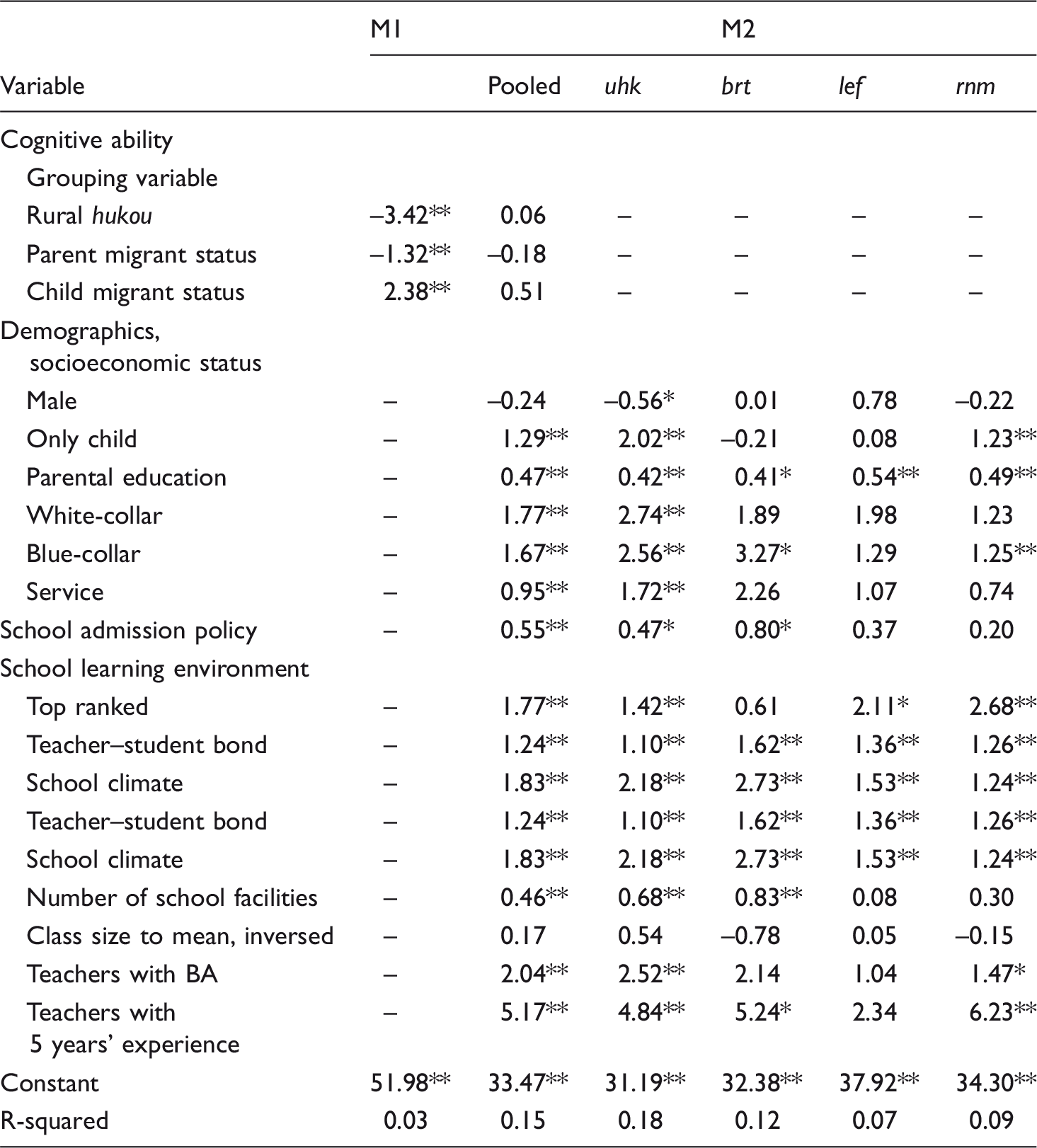
Source: baseline (2013–2014) 9th-grader sample of the China Education Panel Survey. uhk: urban-hukou students; brt: brought-along children of migrants; lef: left-behind children of migrants; rnm: children of rural non-migrants.
p < 0.05; ** p < 0.01.
Regression decomposition of group disparities in cognitive development.
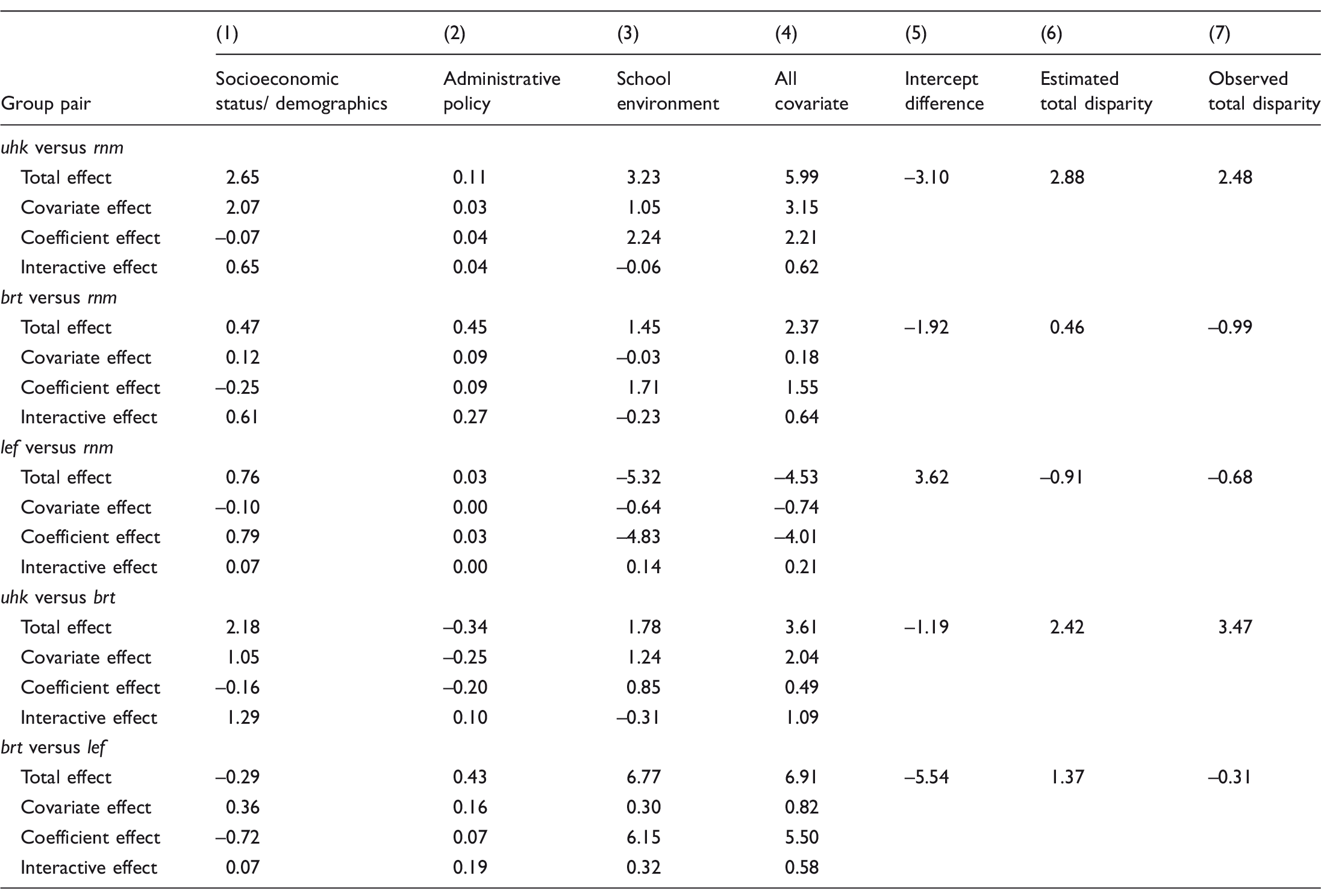
Source: baseline (2013–2014) 9th-grader sample of the China Education Panel Survey. uhk: urban-hukou students; brt: brought-along children of migrants; lef: left-behind children of migrants; rnm: children of rural non-migrants.
Group membership effects manifested in regression predictors
In the regression analysis, Model 1 (M1) specifies cognitive ability as a function of three variables: rural hukou; parent migrant status; and child migrant status (see Column 1 of Table 3). The urban-hukou students (uhk) lack these three conditions and thus serve as the reference group. The M1 results show that having a rural hukou status while neither the parent nor the child migrated (rnm) has a significant strong negative effect on cognitive development. Compared to uhk, rnm suffer a reduction of 3.42 points (34.2% of a SD of the t-standardized cognitive test score). The next indicator is parent migrant status. Left-behind children (lef) have rural hukou and one or two parents migrated, and therefore, the estimated lef effect is –3.42 – 1.32 = –4.74 (a reduction of almost one-half of an SD) of the cognitive test score, as compared to the uhk effect. The last grouping variable indicates child migrant status. Brought-along children (brt) are characterized as having rural hukou with parents who are migrants and the children also being migrants themselves. Therefore, the brt group effect is to reduce cognitive test score by –3.42 – 1.32 + 2.38 = 2.36 (23.6% of an SD) as compared to the uhk effect. Overall, M1 shows significant negative membership effects for rural-hukou students (rnm, lef, and brt) as compared to their urban-hukou counterparts. At the same time, there are vast differences among rural-hukou students due to parent alone or parent–child migrant statuses. It appears that among rural-hukou students, lef fare the worst followed by rnm and then brt, suggesting that rural–urban migrants of both parent and child yield a better outcome than rural-hukou non-migrants.
We estimated Model 2 (M2), the full model, based on the pooled sample (see estimates in Column 2 of Table 3). The effects of rural hukou and parent and child migrant statuses are completely explained away by the three blocks of predictors. For children of rural non-migrants (rnm), the rural hukou indicator is primarily manifested in SES (parental education and occupation) and only-child status as rural-hukou parents have more children due to their relying on a son’s provision of old-age support. School admission policy is irrelevant for rnm. School learning environment is much better in urban schools than in rural schools, affecting rnm. These rationales explain why the rnm membership effects are manifested in the predictors’ effects.
More subtly, parent migrant status in the absence of child migrant status for left-behind children (lef) is largely due to the parent’s failure to meet the admission requirements in order to enroll the child in an urban school. As we see from the descriptive pattern, parents of left-behind children are concentrated in blue-collar worker occupations; in contrast, rnm have parental occupations widely ranging from white-collar to farming, whereas brt have parental occupations concentrated in service and self-employment. Because the admissions policy per se measures the attending school’s policy, this variable is irrelevant for left-behind children (lef) who were currently attending a rural school. Instead, not only do rural schools have poorer learning environments, the disinvestment in rural schools dictates that they are incapable of handling left-behind children’s problems stemming from parent–child separation and the lack of parental control and support. Thus, SES, demographics and school environment absorb the parent migrant status effect.
Child migrant status is absorbed by all three sets of predictors. Brought-along children (brt) have parents’ occupations concentrated in blue-collar and service jobs and self-employment; their parents managed to have satisfied the school admission requirements such that the school admission policy variable directly reflects this rationale. In addition, urban schools admitting brt may respond to the policy with inertia by providing less favorable learning environments for brt. In effect, all three sets of predictors explain away the child migration status effect.
We continue to examine how the predictors influence children’s cognitive outcomes. The SES and demographic variables strongly influence cognitive development. For example, only-child status, capturing greater parental investment, increases cognitive ability by 12.9% of an SD; if parental education increases from junior high to college, the increase in cognitive ability is 0.47 × 7 = 3.29 (32.9% of an SD); all non-farm occupations promote cognitive development, with white-collar and blue-collar jobs having a greater effect; the school admission policy effect can be as large as 0.55 × 6 = 3.3 points for a school requiring six alternative documents in contrast with a school requiring no additional documents. Among the measures of school environment, all teachers having five or more years of teaching experience can benefit students by 5.17 points (more than one half of an SD). Other school variables, such as school reputation, facilities, teacher credentials, teacher–student bonds, and school climate all have sizable effects. The only variable that has no significant effect is class size because the better schools are more crowded in China.
The rest of Table 3 presents the separate regression estimates for the four groups. We summarize the significant estimates within sets of predictors for group pairs in regression decomposition analysis later. For cognitive development, parental education is the major driver within the demographics and SES block for all group pairs; school admission policy matters only for the uhk versus brt comparison; teacher–student bond and school climate are major conditions for all group pairs; and teaching experience also accounts for three out of five pairs of comparisons within the school environment block. These patterns will inform our interpretations of the decomposition analysis results.
Regression decomposition results
Our regression decomposition inquires about the relative contributions between the covariate effects and the coefficient effects of different blocks of predictors. We present the results in Table 4. The five group pairs are formed to inform our hypotheses testing with respect to how group disparities are contributed by the covariate effects versus the coefficient effects of predictors. The first three columns show the contributions by each block of predictors; Column 4 shows the contributions of all predictors; Column 5 records the differences in the two intercepts; Column 6 shows the estimated total group disparities; and Column 7 lists the observed group disparities.
In theory, if the separate model for each group holds, then Columns 6 and 7 should be similar because the disturbances for each group member should sum to zero. Misspecification problems may arise. For example, what school a child attends may be endogenous to SES, school admission policy, and the child’s previous cognitive ability, particularly for brt and lef. We see from Columns 6 and 7 that estimated and observed group disparities do not align with each other for brt versus rnm and brt versus lef, which involve brt and lef. In addition, the R-squared statistics reported in Table 3 ranging from 0.07 for lef to 0.18 for uhk suggest differential predicting power, giving rise to the large intercept differences in Column 5. The intercept is the adjusted group mean when all predictors take the value of zero. A model with greater R-squared in our case should have a smaller intercept than a model with smaller R-squared. Table 3 shows that the intercept is 31.19 for uhk and 34.30 for rnm, even though the observed group mean of cognitive ability is higher for uhk than for rnm. As a consequence, the uhk versus rnm intercept difference is –3.10, listed in Column 5 of Table 4. In our regression decomposition analysis, we focus on the role of predictors, and hence Columns 1–4 in Table 4. We use a simple practical criterion in the following discussion: we discuss only effects greater than 10% of an SD of cognitive test scores with respect to hypothesis testing.
For each row of Table 4, the relationships of the entries are: (1) + (2) + (3) = (4); and (4) + (5) = (6). Vertically within each group pair, the relationship is (total effect) = (covariate effect) + (coefficient effect) + (interactive effect). We explain these effects in concrete comparisons below.
uhk versus rnm. We use the group comparison between urban-hukou students and rural-hukou students without parent or child migration (uhk versus rnm) to show how to read and interpret the three-fold regression decomposition results. First, the estimated total effect of all predictors amounts to 5.99 points (see Column 4), meaning that if rnm had uhk’s predictor levels and coefficients, then rnm would be 5.99 points higher than they are in reality. Summing up the total effects of the three blocks of predictors (2.65 + 0.11 + 3.23 in Columns 1–3 of Table 4) equals 5.99. The difference between the two intercepts is -3.10. Summing up the total effects of all predictors and the intercept difference is the estimated total group disparity at 2.88 points.
The relative importance among the three blocks of predictors can be seen in the first row of Table 4: the total effect of SES and demographic predictors is 2.65, accounting for 44% of the total predictor effect at 5.99. The admissions policy effect is negligible because it is irrelevant for these two groups (see Table 3). The school environment predictors have a total effect of 3.23, accounting for 56% of the total predictor effect.
The next three rows of Table 4 show the decomposition results. We focus on the covariate effect and the coefficient effect, as the interactive effect is relatively small. For SES/demographics, the covariate effect dominates. In other words, the group disparity in cognitive development is due mainly to lower SES level and lower likelihood of being an only child for rnm than for uhk. In contrast, the greater coefficients for school environment variables for uhk than for rnm contribute to 2/3 of the total effect of school environment. Compared to rural schools, urban schools are generally more effective, thereby yielding better student outcomes.
Our Hypothesis 1 posits that hukou stratification is the distal cause of developmental disparities between urban-hukou children and rural-hukou children of non-migrants. The lower levels of SES, only-child status, and school learning environment and the lower effectiveness of school environment for rnm than for uhk can be seen as manifestations of hukou stratification. These decomposition contributions to the substantial group disparity (especially when excluding the intercept) lend evidence to support Hypothesis 1.
brt versus rnm. Our Hypothesis 2a concerns the parent–child migration effect. We expect that parent–child migration may enhance brought-along children’s cognitive development to some but not a sufficiently large degree as compared to children of rural non-migrants. Compared to rnm, brt have high SES by the point-system-like policy selection as well as attending urban public schools that are better than rural schools. The decomposition results show that if rnm had the same predictor levels and coefficients as brt, the cognitive score would increase by 2.37 points. This potential increase is primarily contributed by the greater coefficients of school environment variables for brt than for rnm, again because of the average higher effectiveness of urban schools relative to that of rural schools. Thus, parent–child migration is mildly gainful, supporting our Hypothesis 2a.
lef versus rnm. Our Hypothesis 2b concerns the effect of parental migration without child migration. It states that parental migration without accompanying children does not benefit left-behind children, who may even fare worse than children of non-migrants. The third section of Table 4 shows that if rnm had the predictor levels and coefficients for lef, the cognitive ability of rnm will decrease by 4.53 points. This decrease is mostly contributed by coefficient effect of school environment predictors (–4.83), providing strong support for Hypothesis 2b that parental migration while leaving school-age children behind is more harmful than non-migration, mainly because of the schools’ incapability of helping left-behind children.
uhk versus brt. Our Hypothesis 3 concerns the incorporation of brought-along children in urban schools. It states that lower SES, lower likelihood of being an only child, and lower quality school environment are core obstacles. It postulates that urban schools’ differential treatment of brt may be an institutional reaction to the policy mandate of admitting children of migrants. This may constitute an institutional mechanism by which brought-along children are hard to integrate in urban schools because they are persistently lower in cognitive ability. The 4th section of Table 4 shows that brt would be 3.61 points higher in cognitive ability if they had all predictors’ levels and coefficients for uhk. This increase is largely due to the level of SES/demographic predictors (1.05) and the levels of school environment variables (1.24), plus the fact that the coefficients of school variables are also mildly stronger for uhk than for brt (0.85). The uhk versus brt comparison is the only case showing a substantial interactive effect for SES/demographic variables at 1.29. That is, the group differences in SES/demographics predictor levels and coefficients exist simultaneously and interact with each other, perhaps through the school admission process. The above results provide evidence to support our Hypothesis 3 that the inferior outcome in cognitive development for brt relative to the outcome for uhk is rooted in hierarchical social positions and differential treatment of the school institution.
brt versus lef. Our Hypothesis 4 states that the developmental gap between brought-along and left-behind children arises from school admissions policy selections and disinvestment in rural schools, which ironically shoulder the most difficult task of helping left-behind children with problems stemming from parent–child separation. The last section of Table 4 reveals the largest gap estimated in this study: if lef had all predictor levels and coefficient for brt, the cognitive score would increase by 6.91 points (greater than the 5.99 points for the uhk versus rnm comparison). The chief contributor is the coefficients of school environment predictors, that is, if lef had the coefficients for school variables for brt, their cognitive ability score would increase by 6.15 points. The results show only a slight effect from admissions policy (0.43). This finding supports our Hypothesis 4 regarding the disinvestment of rural schools serving left-behind children being the core reason why child migrant status penalizes children of rural–urban migrants.
In sum, our regression decomposition analysis provides nuanced findings to help dissect the sources of inequality in the cognitive development of 9th graders. All results point to the relative importance of the school institution’s role. Although it is well known that rural schools have fewer resources than urban schools do, it is less known that the effectiveness of the same school quality could be different for students of different social groups.
Conclusions
This paper seeks to attain a comprehensive understanding of the sources of cognitive development inequality among students under compulsory education in China’s rural–urban migration era. The massive rural–urban migration has reshaped the spatial distribution of compulsory education, prolonged the maximally maintained inequality in the midst of compulsory education expansion, and further differentiated the inequality order in both urban and rural areas.
This paper advances the literature on China’s contemporary educational inequality in three ways. First, we apply the reformulated and integrated theories of social stratification, migration, and sociology of education to the developmental inequality among students in the final year of compulsory education in the context of large-scale rural–urban migration. Second, we utilize the unique national data on 9th graders, providing population inferences of patterns of developmental inequality and their sources. Third, the national standardized cognitive test of the CEPS enables a valid description of and explanations for the cognitive development disparities of the 9th-grader population, overcoming the inherited invalidity problem in any academic achievement tests at local levels, such as the school district standardized tests during regular academic semesters, the county-level senior-high entrance exam, and the province-level college entrance exam. Although school district (or county, province) fixed effects models allow for within-unit analysis, these models are inappropriate for comparing groups of students segregated spatially, whether the comparison is between urban-hukou children in cities and children of rural non-migrants in villages or between brought-along children in urban schools and left-behind children in rural schools. Lastly, we apply rigorous regression decomposition methods to tease out the sources of group disparities, first by theory-driven blocks of predictors, and then within blocks of predictors whether the levels or the coefficients of the predictors are the major drivers of group disparities in cognitive development.
This study uses data on the 9th graders from the CEPS, which were collected at one point in time. The 9th grade is a critical grade given the prospective transitions after compulsory education into different paths at the next life-course stage. Most 9th graders attend the same junior-high school from at least 8th grade, making the school environment variables valid predictors for students’ cognitive development measured in the 9th grade. Other stable predictors include the stringency of school admission policy, parental SES, and only-child status. This reality in China gives us greater confidence in our modeling of cognitive development as a function of the three blocks of predictors based on the cross-sectional data on 9th graders.
With this caveat, the strengths of our analysis facilitate a number of important findings. First, hukou stratification is the distal cause for why rural-origin children, a majority of the child population, fare worse than urban-hukou children, through not only the usual suspects of parental SES and resource poverty of rural schools, but more importantly, the ineffectiveness of the learning environment in rural schools. Second, rural–urban migration benefits school-age children only if these children also migrate with their parents compared to children of rural non-migrants. We find that this benefit stems from not only the better resources of schools but also the greater effectiveness of learning environment in urban schools. Third, our evidence suggests that rural–urban migration actually harms left-behind children in contrast with children of rural non-migrants. The chief reason lies in rural schools’ incapability of helping these students. Fourth, our evidence supports the lower cognitive development for brought-along children than for urban-hukou students. This low level of incorporation of children of migrants is rooted in their low positions in the social hierarchy and the differential treatment of the school institution. Finally, we find the disinvestment in rural schools serving left-behind children to be the core reason why left-behind children are also far behind their brought-along counterparts in cognitive development.
A clear message from these findings for policy-makers and the public is that the school institution, which is policy malleable, plays a vital role in maintaining and reshaping child development inequality in the context of large-scale rural–urban migration. Differential treatments for students classified by the emerging social groups defined by cross-classifying hukou, parent migrant status, and child migrant status prevent the effectiveness of the school learning environment, even when school resources are sufficient. Policies and program interventions should be designed and implemented to mandate and facilitate the equal treatment of all students regardless of social grouping. These needs are urgent, given that not only individuals and families but also the whole nation will pay an incredibly high cost for the loss of future productivity and competitiveness due to the low cognitive development of a majority of the current children population.
Footnotes
Funding
This research was supported by US National Science Foundation grant SES-1259530.