



Abstract
China has long held the belief that “raising sons prevents hardships in old age”, which constitutes the financial incentive for the son preference that still prevails in some Asian nations. Using the 2012 China Longitudinal Aging Social Survey, this research examines the current state of the elderly's patrilineal beliefs regarding old-age security and how they are shaped by several transformations within the family. This study yields three significant findings. First, elderly parents who have sons asking for too much help and support tend to believe that “having daughters is best for one's old age”. Second, having more living sons lowers the likelihood of abandoning patrilineal beliefs regarding old-age security, while being sonless raises the likelihood. Finally, daughters’ growing commitment to their parents’ well-being increases the likelihood of non-customary beliefs with regard to old-age security. As a result, this study emphasizes the significance of women's active role in old-age support and low fertility in fostering gender equality and undermining patrilineality.
Introduction
The assumption that sons are more important than daughters is referred to as son preference (Clark, 2000). This mindset is most prevalent in South, Central, and East Asian nations (Das Gupta and Bhat, 1997; Guilmoto, 2012, 2015; Yoo et al., 2017), and one of the economic incentives for having sons in Asian nations with strict patrilineality is to be cared for in one's old age (Cameron and Cobb-Clark, 2001; Choi and Hwang, 2020; Das Gupta et al., 2003; Ebenstein and Leung, 2010; Kabir et al., 1994; Kadoya and Khan, 2017; Larsen et al., 1998; Li and Lavely, 2003; Tafuro, 2020). This is specifically how things work in China, where son-based elder support under the patrilineal and patrilocal family system has shaped the conviction that, in general, sons are more suitable or are preferred for support during one's old age.
This conviction can be related to, but is distinct from, one's desired caregiver (Hu and Chen, 2019) and one's expected caregiver (Allendorf, 2020). The reason for this is that the belief “having sons (rather than daughters) prevents hardship in old age” is a cultural construction (Das Gupta et al., 2003), whose changes may lag behind the real-world understanding and established settings (Alesina and Giuliano, 2015; DiMaggio, 1997). Yet, contrary to the emphasis from DiMaggio (1994) that cultural values persist despite economic changes and conditions, this patrilineal belief may no longer be shared by the majority of modern Chinese as son preference in fertility is decreasing (Jiang et al., 2017; Zhou et al., 2013). Thus, by examining the association between social change and patrilineal ideation in the context of elder security, this study may add evidence and support to another school of thought addressing the question of modernization theory, which insists on the convergence of traditional values under economic and political forces (Inglehart and Baker, 2000).
Additionally, prior research has extensively documented the son preference in fertility (Arnold and Liu, 1986; Clark, 2000; Haughton and Haughton, 1995) and how certain social factors result in varied patterns of sex ratios at birth on the basis of how these factors have an effect on the motives for son preference (Chung and Das Gupta, 2007; Ebenstein and Leung, 2010). Yet, the focus of the association between the manifestation of son preference and social factors may lead to fallacies when the suppositions are generalized to other social contexts. The reason is that there are multiple motives for son preference, and the combination of motives varies from nation to nation. Consequently, adopting a more direct approach—addressing the mechanism through which motives for son preference are changed by social forces—may help us appreciate more properly how gender preferences have shifted in contemporary China and other Asian countries.
This study seeks to examine how the conventional belief that “having sons is good for old age” can evolve with the development of Chinese families and society by analyzing the 2012 China Longitudinal Aging Social Survey (CLASS2012). Findings from this study also significantly extend prior research in four ways. First, using recent data, the current status of beliefs held by Chinese elderly people regarding old-age security (i.e., offspring of which sex is the best for ensuring old-age security) is shown. Second, this study shows that the shift in the direction of intergenerational exchange, from upward to downward, can interfere with patrilineal beliefs. Third, this article shows the prominent role of adult women in initiating major shifts in traditional patrilineal ideations. Fourth, the significant effect of offspring sex composition on parents’ patrilineal beliefs is confirmed.
In the remainder of this study, I first review the theoretical accounts and critical findings in previous research on several social transformations that China has been through or is undergoing. I then propose how these changes induce shifts in the belief that “having sons is best for old age”. The data and research design used for empirical analysis are introduced in the following section. After this, I examine the ways in which the changes discussed are associated with individuals’ types of ideations with regard to elder security by using a recent social survey. In the final part of the article, I conclude and discuss what these shifts mean for Chinese society and how they can be expected to evolve under persistent low fertility.
Background
The conventional Chinese family system is patrilineal and patrilocal, with daughters joining their husband's extended families upon marriage, whereas sons are lifelong members of the natal family (Luo and Zhan, 2012). Also, sons generally inherit the family's property, while daughters are entitled to only a minor share of it, classified as their dowry (Greenhalgh, 1985). Hence, although unmarried daughters are expected to commit themselves to their natal families, upon marriage women's duties are transferred to their husbands' households. This implies that support of elderly parents by grown children is evidently gender specific, with sons rather than daughters having the obligation of offering support to parents in old age (Xie and Zhu, 2009), which further gave root to the universal belief that “having sons is best for old age” (Das Gupta et al., 2003).
Nonetheless, with increasing gender equity and the transformation of Chinese families and society, it is reasonable to predict that the elderly's patrilineal convictions regarding elder support have been transformed into “having both sons and daughters is best for old age”. Furthermore, since matrilocal residence has become more prevalent in China (Chu et al., 2011), the ideation of “having daughters is best for old age” may have already arisen, even though this type of belief is still uncommon.
Resource transfer from parents to offspring
Traditionally, intergenerational relations in China operate on a feedback model: children must reward their parents for bringing them up (Fei, 1983). In this model, parents need to fulfill their parenting responsibilities before their children start a new family, including meeting the expenses of their children's marriages: the cost of building and furnishing a new house for sons, expenditure on sons’ and daughters’ weddings, sons’ bride price, and daughters’ dowry. After all sons are married, the family division (fenjia) occurs, which heralds the completion of parental responsibilities for upbringing. At that time, relatives from both the paternal and maternal sides of the family will be present to witness the equal division of properties between male descendants and also the equivalent distribution of responsibilities for supporting parents (Fei, 1983). In the period after this, children do not need their parents to raise them, and the parents do not yet need their children to support them (Xu, 2017). Therefore, the intergenerational exchange between parents and children largely ceases in the phase between parenting and old-age support.
As is implied by this, the survival of the feedback model depends on the inheritance left to sons and the lineage framework (Cohen, 1976; Cong and Silverstein, 2012; Shiga, 1978). That being said, in the initial decades of the People's Republic of China, that is, the period of the cooperatives, the people's communes, and the Great Leap Forward, private property was transformed into collective property (Guo, 2001; Yan, 2003). While collective property has since been converted back into private property as a result of economic reform, the role of the predominant breadwinner has passed from the parental generation to the offspring generation. Thus, family assets are amassed by adult children, and aging parents do not have much inheritance to pass down to the next generation (Guo, 2001; Yan, 2003). Along with the breakdown of lineage, the power relationship between parents and offspring has been reversed, and the unconditional rewards that the elderly traditionally expect, have had to give way to conditional rewards approved of by the younger generation (Guo, 2001). That is, the logic of intergenerational transfer has been modified into an exchange model: whether elder parents are supported depends on whether they consistently provide assistance for adult children (Guo, 2001; Xu, 2017). Yet, if sons make excessive demands on their parents, this can result in parents experiencing and recognizing that “parents are the bones on which sons sharpen their teeth”, rather than sons being the ones who at least give them commensurable rewards, thereby leading to the discarding of patrilineal ideation regarding elder security. In turn, parents may possess the belief that “only daughters are the best support in old age”.
Moreover, I do not expect the scenario to be substantial in the other direction because daughters are less likely to receive parental assistance than sons (Hu, 2017; Xu, 2017). The old adage “married daughters are comparable with spilled water” aptly illustrates the stereotypical image of daughters being rigidly part of their husband's household after they are married, and that the transfer of resources is unidirectional from their parents' household to their husband's kin (Das Gupta, 1987; Raut, 1996). Notwithstanding that daughters today have a stronger attachment to their natal family and make larger contributions to it than in the past (Zhang, 2009), elderly parents are still prejudiced by the traditional patrilineal family structure when deciding which offspring to assist and to whom to leave an inheritance (Hu, 2017; Shen, 2016; Xu, 2017). On the other hand, as Chinese daughters regard parental assistance as a gift rather than a right, denying daughters’ demands does not have a significant impact on upward exchanges between daughters and elderly parents (Xu, 2017). As a result, parents tend to reject daughters’ excessive demands, while they are more likely to bear sons’ excessive requests. As long as daughters’ demands will not result in significant loss to parents, daughters’ excessive requests may possibly not affect parents’ belief in elder security.
Support for parents from children
Currently, the ties between married daughters and their natal families are becoming stronger, and a large part of the credit goes to the one-child policy (OCP) (Zhang, 2009), under which the decline in fertility has led to a rising proportion of sonless families (Roshan and Allendorf, 2022). Within sonless households, the patriarchal family system is weakened because the family cannot take part in patriarchal traditions, and daughters are expected to carry on sons’ positions and duties, making daughters identical to sons (Allendorf, 2015, 2020). Along with women's elevated socioeconomic status, the more widespread gender balance in family life, the declining Confucian patrilineal family tradition, and the revival of the patriarchal division of labor (Hu, 2017), a growing number of married daughters are offering emotional, instrumental, and monetary assistance to their parents (Zeng et al., 2016; Zhan and Montgomery, 2003), and in many cases they even offer more assistance to parents than do sons (Cong and Silverstein, 2012; Xie and Zhu, 2009). Since the conventional belief that “having sons is best for old age” is based primarily on sons’ predominant role in maintaining their parents’ welfare (Raut, 1996), the rise in daughters’ elder support may trigger changes in parents’ patrilineal beliefs regarding elder security (Li et al., 2004).
Furthermore, some research has shown that parents are more contented with their daughters’ old-age support (Zhang and Wang, 2010), as they will naturally get assistance from daughters out of love rather than mere mercy (Chen and Short, 2008). As a result, parents who receive support from daughters may turn to view daughters rather than both sons and daughters as the best source of elder support. While it can be said that parents who believe “having daughters is best for old age” are more likely to receive elder support from their daughters, it should be noted that this belief is still uncommon under the predominant Confucian model in China. In China, the sex ratio at birth soared above 115 boys for every 100 girls in the 1990s, and it remained at a high level of 111 boys for every 100 girls in 2012 (Guilmoto, 2009; Huang et al., 2016). Besides, it is reasonable to suspect that parents’ patrilineal behaviors during their offspring’s childhood, rather than in the present day, are more likely to determine children's support in old age (Suitor et al., 2009), and the elderly people in this study may still have adhered to the patrilineal family system while parenting children.
Meanwhile, to this day, sons still offer elder support as they have done historically, which may reduce their parents’ propensity to abandon patrilineal beliefs regarding elder security. In addition, many married children also live in the same home with parents from the husband's side (Chen, 2005; Gruijters and Ermisch, 2019). Bearing in mind the amount of elder care, and the building of emotional bonds that comes with living together (Tennstedt et al., 1993), patrilocal residence may lead to resilient inertia for patrilineal beliefs with regard to elder security. Meanwhile, while matrilocal residence has recently become more prevalent (Chu et al., 2011), since matrilocal residence does not usually happen if not necessary, that is, in cases of parents with no living sons (Gruijters and Ermisch, 2019), it may only provoke the belief that “having daughters makes one's old-age secure” rather than concurrently leading to the belief that “both sons and daughters are best for old-age security”.
Finally, the elder support provided by offspring is of different types, for instance, financial, instrumental, and emotional (Chen and Silverstein, 2000). Previous research has documented that sons are preferred mainly for their financial assistance, whereas daughters are primarily preferred for their help with domestic chores, and companionship (Arnold and Kuo, 1984; Fuse, 2013). Therefore, while daughters’ support may prompt their parents’ beliefs regarding elder security to turn toward the importance of daughters, in terms of types of support rendered, instrumental support and emotional support may be more substantial or significant in effecting this change. On the other hand, in terms of sons’ old-age support having a positive effect on their parents’ patrilineal beliefs, the influence of their financial support may be more significant compared with their instrumental and emotional support.
Changing family structure under fertility decline
To mitigate the negative impact of a rapidly rising population on socioeconomic growth, China implemented the OCP in 1979. (This scheme was subsequently amended to the “one-and-half children policy”, since minority groups, families in which the firstborn was disabled, and rural parents whose first child was a daughter were permitted to give birth to more than one child (Short and Zhai, 1998); hereafter the term OCP will be used throughout.) Although the OCP was only in effect for 36 years, single-child households are common in China (Wang, 2013). Also, its implementation may have accelerated the demographic transition (Zhang, 2017)—the total fertility rate calculated from the 2015 census was far lower than the replacement level (Guo et al., 2019). Therefore, many Chinese citizens likely ended up with just one or two children, significantly reducing their chances of having a son (Guilmoto, 2009). In fact, from 1975 to 2015, within Chinese families whose mothers were aged 40 to 49, the share of families having daughters only rose from 5.3% to 28.3%, although this percentage is still lower than that of having sons only, which increased from 9.4% to 40.1% (Roshan and Allendorf, 2022).
Even among the elderly in this study, the fertility of some of them was limited by the OCP, as women's reproductive ages range from 15 to 49. In fact, 13.41% of all CLASS2012 respondents and 12.11% of female CLASS2012 respondents had their firstborn during the enforcement of the OCP. Although prenatal sex-testing technologies became widespread in the early 1980s (Hesketh et al., 2011), certain people may have chosen not to use them and become sonless because sex-selective abortion may have been unethical, costly, and inaccessible (Guilmoto, 2009). While some of the elderly people in this study may have given birth to at least one son, the number of living sons may steadily decline over time because of mortality, and some of them will ultimately become sonless.
Past research has already shown that sonless mothers tend to give up patriarchal expectations and turn to daughters for support (Allendorf, 2020). Yet, parents’ patrilineal ideation may not be swayed by the options provided. Nonetheless, it is also reasonable to expect parents to change their patrilineal ideation in response to having no son. To discuss this in further detail, sonless parents may be more able to appreciate the old-age support provided by their daughters and its merits. This greater value placed on daughters’ support and its merits may lead to the impairment of patrilineal ideation with regard to old-age security. Meanwhile, sonless parents may turn to daughters due to their desire, under a perceived universal son preference, to persuade others as well as themselves that it is acceptable and even better to bear daughters. As such, sonless parents may embrace the belief that “having daughters is best for old age” rather than leaning toward “both sons and daughters are the best for old age”. Additionally, as previously stated, matrilocal residence usually indicates parents did not give birth to any son and have no alternative but to depend on their daughters (Gruijters and Ermisch, 2019). Thus, when parents have any living son taken into account, the impact of matrilocal residence may be negligible.
Families with a large number of living sons, on the other hand, may contribute to the preservation of patriarchal ideations. The reason is that the increase in the number of male descendants may increase the possibility of the family being able to engage in patrilineal practices. To be more specific, sons will be criticized for failing to support their parents as the custom of sons being obliged to support their elderly parents is longstanding in China (Xie and Zhu, 2009). In the meantime, with more male offspring that parents can pay attention to and rely on, parents may be less likely to value the support provided by daughters, and daughters’ support will be less likely to be considered primary or essential. As a result, the more male offspring parents have, the more likely parents are to continue to uphold the patrilineal belief that “having sons is best for old age”.
To summarize, although the belief that “raising sons is best for old age” has long existed in China, the circumstances that nurtured the son preference in elder support have now been undermined by several developments within the family. With fertility decline and economic reform, married women may stay close to their natal family while performing parallel roles to sons. The logic of intergenerational transfer is now one in which sons provide support to parents only in return for parents’ help during their adulthood instead of in return for the nurture the older generation provided during their childhood. Nonetheless, their parents may be frustrated by their excessive requests. Meanwhile, China is undergoing a demographic change that lowers the likelihood of having a son. Families who are sonless from the start and households that eventually lose all sons due to mortality may be more capable of valuing and appreciating the support from daughters and may also covet a justification for their fertility outcomes. In the following analysis, this study shows how these shifts within the patriarchal family system could have collectively led to a transformation in elderly people's beliefs regarding old-age support, from the belief that “bringing up sons is best for old age” to “raising daughters is best for old age”.
Data and methods
Data
The data for this study are drawn from the 2012 pilot survey of CLASS, which is a nationwide, large-scale social survey aimed at the elderly and conducted by the National Survey Research Center at Renmin University of China. All samples were collected using a multi-stage, multi-level sampling scheme: the primary sampling unit is the district/county, the secondary sampling unit is the village/residential council, and the sampling frame of residences was further drawn using address-based sampling. Finally, an individual aged 60 or over was randomly selected as a respondent from the chosen address. Respondents were asked to report detailed information on sociodemographic attributes, health status, economic status, social security status, and their interactions with each child.
In 2011 and 2012, CLASS conducted two pilot surveys. The first nationwide baseline survey of CLASS was actually implemented in 2014, followed by a follow-up survey every two years. For the data that have been released, only CLASS2012 used questions that could be used to reconstruct different types of beliefs with regard to old-age security. For instance, CLASS2011 did not ask any questions about old-age security beliefs, whereas CLASS2014 and CLASS2016 only asked respondents whether they agreed with the view that “having sons is best for old age”. In order to probe into not only the decline of patrilineal ideation with regard to old-age security but also how it has turned to “both sons and daughters are best” or “daughters are best”, this article chose CLASS2012 as the data source. The sample in 2012 covered 17 provincial-level administrative units, with a response rate of 91.22% and a cumulative sample size of 1126.
I restricted the sample to elderly people aged 60 or over and with at least one living child, resulting in 1063 people. I later omitted those who did not state whether they agreed with the statement “only sons are the best support for parents in their old age” (n = 38) or “only daughters are the best support for parents in their old age” (n = 47). I excluded those who did not report their gender (n = 3), education level (n = 1), occupation (n = 4), marital status (n = 2), whether having difficulties in daily activities (n = 11), or whether having basic pension insurance (n = 11). I also excluded those who did not report their offspring's sex (n = 1), financial support (n = 7), instrumental support (n = 7), or emotional support (n = 10). Further, I dropped those who did not report whether they were currently living with a specific child (n = 10) or whether they felt the specific child asked for too much help and support (n = 7). The final sample consisted of 958 elderly people.
Variables
The key outcome variable was coded into three categories, each representing a different type of belief regarding old-age security: “having sons is best for old age”, “having daughters is best for old age”, and “having sons or daughters is best for old age”. In the questionnaire, respondents were first asked whether they agreed with the statement “only sons are the best support for parents in their old age” and were subsequently asked whether they agreed with the statement “only daughters are the best support for parents in their old age”. Both questions had only two response options: “agree” and “disagree”. Agreeing with the former and disagreeing with the latter was defined as believing that “having sons is best for old age”, and vice versa, as believing that “having daughters is best for old age”. Agreeing or disagreeing with both statements was labeled as believing that “having sons or daughters is best for old age”. The reasoning for this is that these two questions were located in the section of the survey on filial piety and were asked after other agree or disagree statements such as “to assist elderly parents, adult children should reside close to them”. Furthermore, drastic social transformations, such as marketization and modernization, have not altered the trend of offspring being parents’ primary caregivers (Sun, 2002; Xie et al., 2017), not to mention that 15.14% of the elderly people in our sample did not enjoy any basic pension insurance provided by the local government and might have to depend entirely on assistance from their children.
The explanatory variables of interest are as follows: whether respondents feel excessively subjected to demands by sons or daughters; the financial, instrumental, and emotional support provided by sons or daughters; respondents’ living arrangements and family structure; and the number of sons or daughters. Of note is that independent variables were constructed in pairs except for living arrangements and family structure. In more detail, whereas the family structure is one variable, the financial support provided by sons or daughters is two variables: the financial support from sons and the financial support from daughters.
CLASS2012 includes a battery of questions assessing each offspring's old-age support, which can be classified as financial, instrumental, and emotional. For financial support, the following yes or no question was used: “Over the past 12 months, have you (or the spouse living with you) been given any money, food, or gifts by this child?” A subsequent inquiry asked about the value of those items; however, over one-third of the values for this question were missing. As a result, this study's sole consideration is if the interviewees’ sons or daughters have ever given any financial support to them in the previous 12 months. The evaluation of instrumental support was provided through the following question: “How often has this child helped you with household chores in the past year?” Five response options were given: “rarely” (reference group), “multiple occasions per year”, “a minimum of once a month”, “no less than once a week”, and “nearly on a daily basis”. With regard to emotional support, two questions were adopted: “How often have you met this child in the past year?” and “How often have you talked to this child on the phone in the past year?” As far as instrumental support was concerned, five response options were provided for the frequency of phone calls, whereas six response options were provided for the frequency of in-person meetings. Here, I collapsed the frequency of in-person meeting response options of “once a month” and “a few times a month” into “a minimum of once a month” to recreate a five-point scale consistent with the other questions. Since people who visit their parents regularly are less likely to call their parents and vice versa, I developed the variable of “emotional support” by adding up the frequency of in-person meetings and phone calls.
Meanwhile, the excessive demands variable was obtained by the question: “Do you think this child has asked you for too much help and support in the past 12 months (e.g., asking for too much money, assistance with farm work, grandparenting, or household chores)?” Response options were recoded into 1 (occasionally, sometimes, frequently) and 0 (never) to indicate only whether the offspring has ever asked the respondent for too much assistance, as few respondents chose the option of “sometimes” and “frequently”. It is worth mentioning that the construction of excessive demands from sons or daughters, and the financial, instrumental, and emotional support they offer is complicated because respondents might have several sons and daughters, but their ideation regarding which sex is best for old age is a general belief. This study adopted the most assistance given by sons or daughters to tackle this dilemma. 1 For binary variables such as excessive demand and financial support, if several sons or daughters asked for too much support or provided financial support, they were coded as 1. For instrumental support and emotional support, if several sons or daughters provided equal amounts of support, all at the maximum possible, I coded this support using the quantity from one of them. Additionally, nested models have been performed to ascertain if the ordinal variables—instrumental support and emotional support—can be processed as interval variables when regressing, and the result was insignificant. Therefore, this article treated them as interval variables as in previous studies (e.g., Xu, 2017).
Respondents’ living arrangements (not living with any son or daughter, matrilocal residence, patrilocal residence) were derived from one of the questions asking detailed information about each offspring: “Are you currently living with this offspring?” If the respondents were currently living with a male child, this was defined as patrilocal residence. Conversely, if respondents were currently living with a female offspring, this was defined as matrilocal residence. The remaining respondents who were not living with sons and also not living with daughters were defined as “not living with any son or daughter”. Noticeably, 21 respondents in our sample lived with not only sons but also daughters. Since patrilocal residence is more mainstream in Chinese society, this was classified as patrilocal residence.
The independent variable of family structure (having both sons and daughters, sonless, daughterless) was created using the respondents’ number of living sons and daughters. These two numbers are also controlled for in the model and could be obtained using questions asking detailed information about the respondents’ descendants, including their sex and whether they were living or not. Once the respondents had no living son, they were defined as sonless. Conversely, if respondents had no living daughter, they were defined as daughterless. The rest of the respondents were classified as “having both sons and daughters”.
This study also contains several control variables that may be related to one's likelihood of having patrilineal ideation with regard to old-age security. I controlled for respondents’ gender, age, educational attainment, hukou (household registration) status, marital status, whether having difficulties in daily activities, health status, and whether they were without basic pension insurance.
Men, for example, have been observed to have a higher preference for sons than women (Williamson, 1976). Thus, I recoded gender with females coded 0 and males coded 1. Similarly, son preference in fertility is higher among women who are older, less educated, and live in less developed areas because they are more deeply immersed in patriarchal culture practices, as well as having less exposure to national gender equality advocacy (Cooney et al., 1991; Larsen, 1990; Lin, 2009; Lu and Tao, 2015). Therefore, the abandonment of the belief that “having sons is best for old age” may be more common among elders who are younger, well educated, and have urban hukou. Age was divided into four cohorts: >74 (reference group), 70–74, 65–69, and 60–64. Education was recoded into four categories: primary school and below (reference group), junior high school, senior high school, and college or above. Hukou status was not directly collected in CLASS2012, but the original occupation of the interviewees was asked. Since the household registration system is an institution that governs rural-to-urban migration and job mobility directly (Wu and Treiman, 2007), respondents’ occupations are largely constrained by their hukou status. Hence, this study reconstructed the variable of occupation into “rural-related” (reference group), “urban-related”, and “retired/unemployed/other” to identify the respondents’ hukou status proximally. Farmers and rural migrant workers were included in the rural-related occupations; administrators and employees of state departments and organizations, middle and senior managers of enterprises/companies, physicians and teachers, other skilled and technical personnel, general employees in business and service industries, and general employees in production and heavy industries were included in the urban-related occupations; other professions including self-employed persons and freelancers were categorized as retired/unemployed/other.
Moreover, considering the critical role daughters play in companionship and instrumental help (Ng et al., 2002; Sun, 2002), elders with no spouse, having difficulties with daily activities, and poor health conditions may tend to consider daughters as the best support for parents in old age. For the measure of marital status, cohabiting and married were collapsed into “with spouse” and used as the reference group, whereas the rest were collapsed into “without spouse”. I constructed whether having difficulties with daily activities as a dummy variable (yes = 1) indicating whether the respondents felt that it was somewhat difficult or completely impossible to complete any of the listed 15 daily activities, including washing, dressing, cooking, shopping, etc. Health status was denoted by self-reported health, and I recoded the responses into three categories: “healthy” (reference group), “fair”, and “unhealthy”.
Furthermore, sons have long been identified as the primary source of social security for parents in their old age under patrilineality (Pei and Pillai, 1999). While this norm has been undermined by the dramatic social changes within Chinese society (Xie and Zhu, 2009), elderly people with poor financial status may still be less likely to turn to daughters for old-age security. Here, I used whether the respondent was without basic pension insurance instead of annual income to denote financial status. The reason is that annual income may be entangled with the financial support from offspring. In fact, 11.19% of respondents acknowledged the main source of their annual income to be money given by children or other relatives. Besides, whether having basic pension insurance may be more indicative of the extent to which parents have to rely on offspring, which accordingly shapes their beliefs regarding old-age security, since it is an important indicator of one's economic prospects. I coded whether a respondent was without basic pension insurance dichotomously, with having Basic Old-Age Insurance for Town Employees, Social Insurance of the Old-Age Pension for Urban Residents, or New Rural Social Insurance of the Old-Age Pension being 0 and none of the above as 1.
In the following sections, multinomial logistic regressions were applied to estimate the type of belief in old-age security as the dependent variable is trichotomous. Other than that, the -suest- test was conducted in Stata to test the assumption of independence of irrelevant alternatives (IIA), and the results indicated that the IIA condition is satisfied. This article reports the relative risk ratios reflecting the odds of believing: (a) having sons or daughters versus sons; (b) daughters versus sons; and (c) daughters versus sons or daughters; for old age.
Results
In Table 1, the means or percentages of the variables are shown separately by type of belief (having which sex of offspring is best for old age). On average, a significant proportion of the respondents (60.96%) believed that “having sons or daughters is best for old age”. In comparison, 27.77% hold the patrilineal view that “having sons is best for old age”, and 11.27% believe that “having daughters is best for old age”. While most respondents possess a more gender-equal and open view of old-age security, respondents who have shifted to viewing daughters as being best remain a minority. For those minority respondents, daughters appear to provide more assistance than sons, as well as providing more than daughters of respondents who hold either of the other two types of belief, and more than a quarter of them are engaged in matrilocal residence. In addition, these elderly parents are more likely to be subjected to excessive requests for help and support from their sons compared with daughters. Meanwhile, among this group, the proportion of those perceiving daughters as imposing excessive demands is only marginally higher than that of respondents holding either of the other two forms of ideation.
Means and percentage distribution by types of belief (having which sex of offspring is best for old age) according to selected characteristics.
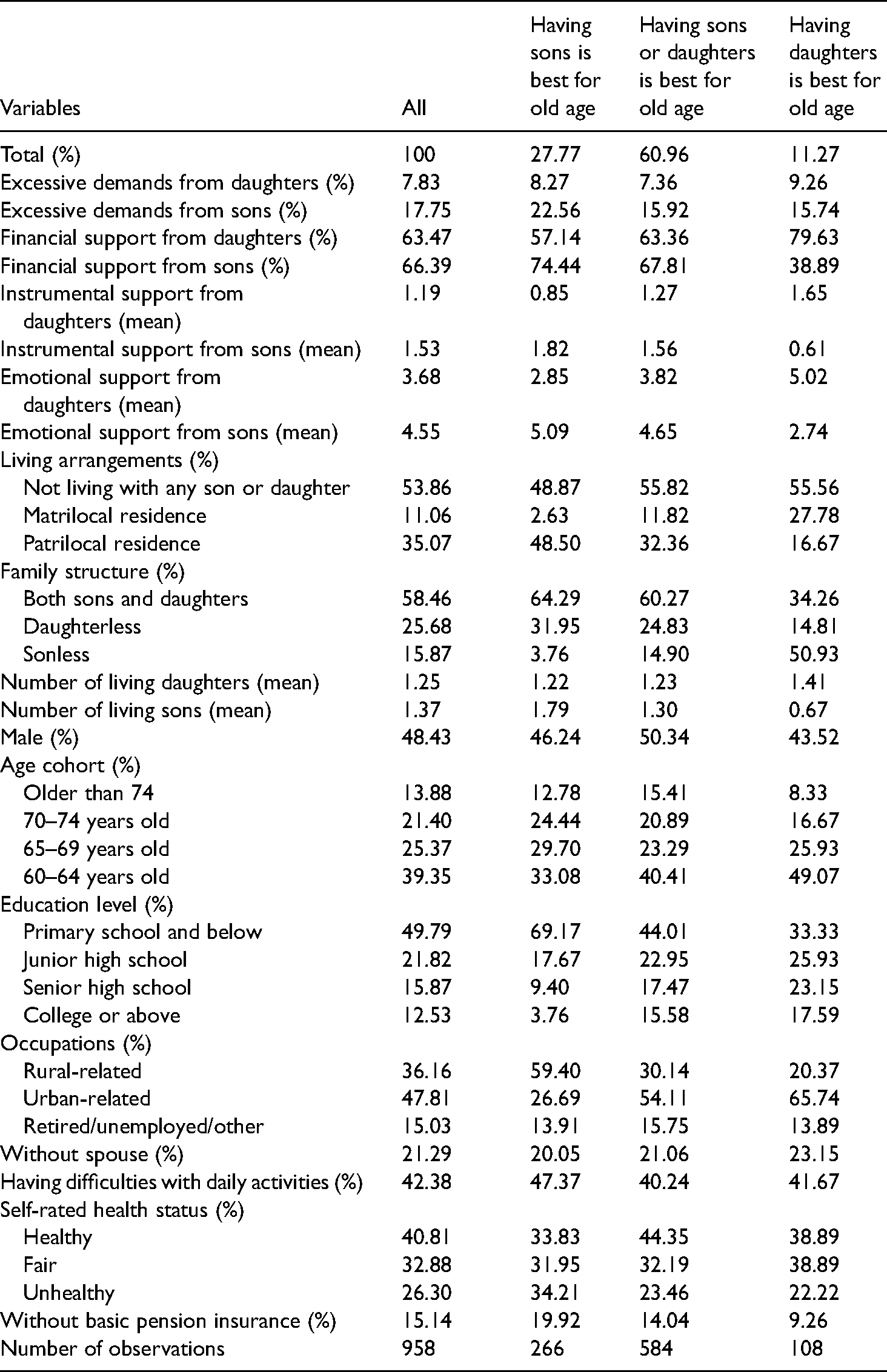
Besides that, respondents who believe that “having daughters is best for old age” seem to have fewer living sons, while respondents who believe that “having sons is best for old age” tend to have more living male offspring, and the average numbers of living sons and living daughters are quite similar for elderly people who believe that both sons and daughters are best. Furthermore, approximately 50% of respondents who hold the belief that “having daughters is best for old age” have no living male offspring, while only a tiny fraction of respondents who believe that “having sons is best for old age” are sonless.
Table 2 presents the multinominal logistic regression models estimating types of belief (having which sex of offspring is best for old age). It is predicted by Hypothesis 1 that elderly parents who have been subjected to excessive demands by male offspring would probably hold the belief that “having daughters is best for old age”. This hypothesis is supported by the results obtained. The odds of respondents who are subjected to excessive requests for help and support by sons believing that “having daughters is best for old age” are 2.125 times and 2.45 times higher than believing “having sons is best for old age” and “having sons or daughters is best for old age”, respectively. On the other hand, excessive demands from daughters lack significant positive effects on patrilineal beliefs regarding old-age security. While excessive demands from daughters decreased the odds of believing that “having sons or daughters is best for old age” by 30.4%, and the odds of believing that “having daughters is best for old age” by 51.8%, these decreases do not significantly differ from zero at the 0.1 significance level. This is probably a result of the previously discussed factor that the quantity of support provided by parents is gendered (Hu, 2017; Xu, 2017).
Relative risk ratios for multinominal logistic model predicting types of belief (having which sex of offspring is best for old age).
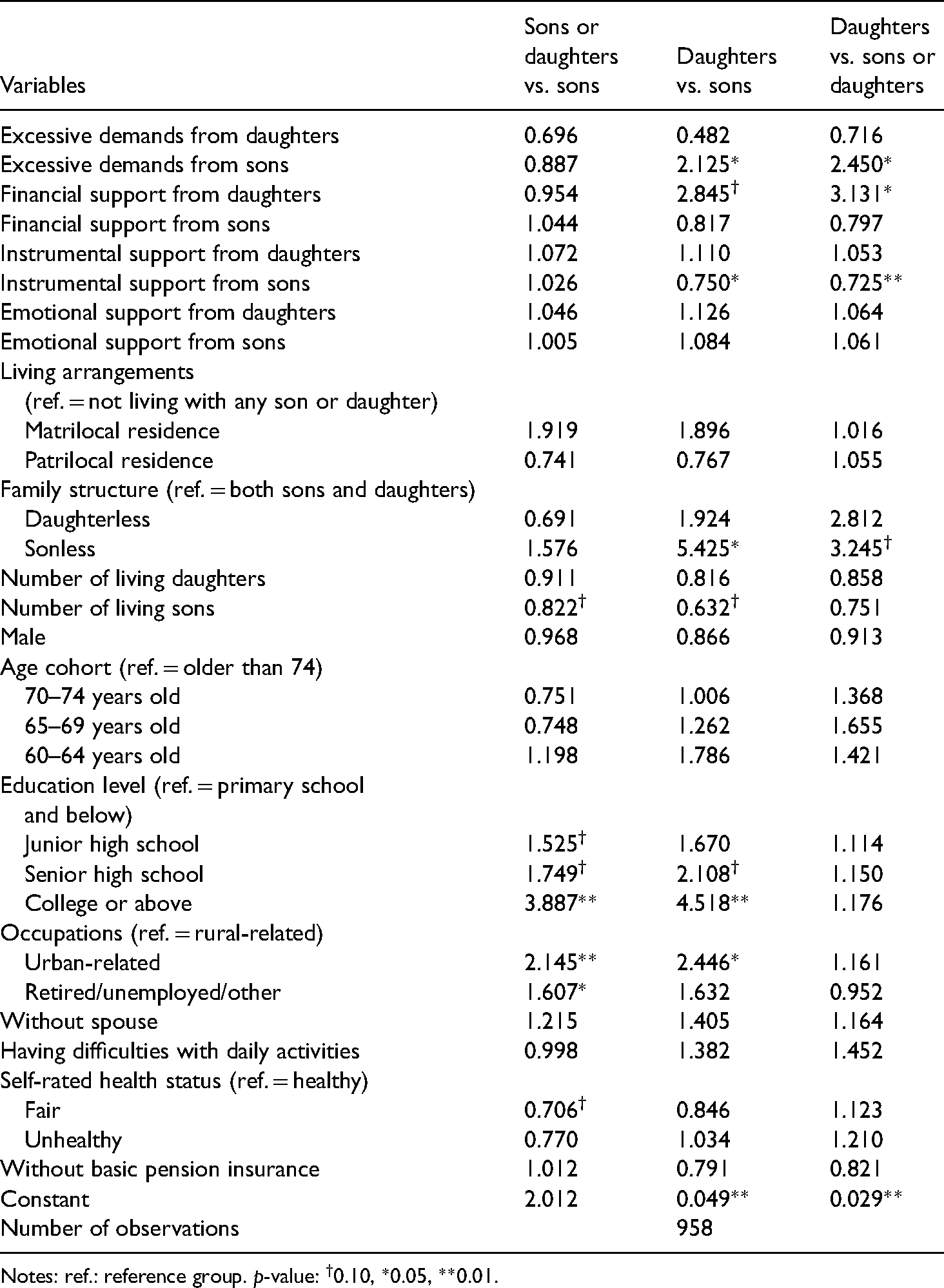
Notes: ref.: reference group. p-value: †0.10, *0.05, **0.01.
With more living sons, the chances of respondents abandoning patrilineal beliefs regarding old-age security are lower. To be more specific, compared with holding the belief that sons are best for old age, one additional son reduces the odds of holding the belief that “having sons or daughters is best for old age” by 17.8%, while reducing the odds of having the belief that “having daughters is best for old age” by 36.8%. This means that patrilineal ideations and values will survive and thrive in families with a number of sons, lending support to Hypothesis 4b. Hypothesis 4a is also supported—being sonless is correlated with a 5.425 times and 3.245 times higher predicted risk of believing that “having daughters is best for old age”, relative to believing that “having sons is best for old age” and “having sons or daughters is best for old age”, respectively. Having no male descendant may, over time, lead to a greater appreciation of daughters’ support and more value being placed on it (Allendorf, 2012), and induce the desire to justify one's fertility outcomes. As a consequence, some parents change their patrilineal ideations in reaction to being sonless.
With daughters providing financial assistance, the odds of respondents believing that “having daughters is best for old age” are 2.8 times and 3.1 times higher than believing that “having sons is best for old age” and “having sons or daughters is best for old age”, respectively. Receiving more instrumental support from sons, on the other hand, is significantly correlated with a 25% and 27.5% lower risk of believing that “having daughters is best for old age”, relative to the belief that “having sons is best for old age” and “having sons or daughters is best for old age”, respectively. Yet, at the 0.1 significance level, the impacts of emotional support and co-residence are insignificant. To summarize, the support provided by daughters was prioritized according to the financial aspect, while the support provided by sons was prioritized according to the instrumental aspect. These findings are in sharp contrast to the predictions in Hypotheses 3a and 3b. The reason might be that parents only consider daughters to be the best source of old-age support when their daughters are able to be a substitute for the traditional gender role of sons. In contrast, when sons provide significant help with housework, parents still recognize them as the best source of support in old age because this area is conventionally regarded as daughters’ domain. Overall, these findings do provide some support for Hypotheses 2a and 2b, and one of them shows that as daughters play a more crucial role in old-age support, the elderly in China may increasingly adopt the view that “raising daughters for old age”.
As expected, the relative risk of abandoning patrilineal beliefs regarding elder security as opposed to retaining them is significantly increased according to levels of education and employment in urban-related occupations. Therefore, as China continuously experiences development and urbanization, beliefs with regard to support in old age as they relate to children's gender may continue to shift, and turning to daughters for support may become more common. In the meantime, the belief as to which sex of children it is best to raise for old age is not significantly influenced by gender, age, marital status, or health status. Noticeably, having or not having basic pension insurance also has no significant influence on elders’ type of belief in elder security, probably due to the fact that the current pension insurance is still not enough to be seniors’ primary source of support.
Discussion
Son preference has long existed in South, Central, and East Asian nations, and one of its economic incentives—son-based old-age support—prevails in some of these nations, for example, India, Korea, and Vietnam (Chung and Das Gupta, 2007; Haughton and Haughton, 1995; Oldenburg, 1992). Although the presence and consequences of son preference have been well studied, current beliefs with regard to its underlying incentives and how they are shaped by social changes have been overlooked in previous studies. Using CLASS2012, this study elaborates on previous research on son preference by describing the current strength of the belief that “raising sons is best for old age” in China. It also advances our knowledge in relation to how this incentive to raise sons may be weakened by several transformations within the family: the partial shift of authority from parents to children, the rise in daughters giving support to the elderly, and the increasing number of sonless families, as well as the decreasing number of male descendants under the general conditions of fertility decline. Along woth other unchanged aspects, such as universal son preference, has further encouraged the rise of the non-traditional belief that “having daughters is best for old age”. Hence, this study goes against what theorists like Max Weber and Samuel Huntington have argued—that cultural values would not alter under economic change—and provides strong evidence in support of theories from the likes of Karl Marx and Daniel Bell that modernization may cause shifts in cultural values (for a general overview, including detailed citations for Marx, Bell, Weber, and Huntington, see Inglehart and Baker, 2000).
Despite this study only focusing on elderly people, these emerging non-customary beliefs may extend to the younger population as they become more common and accepted, thereby posing significant challenges for son preference and the patrilineal family system. Further, Chinese grandparents may be involved in families’ choice of their offspring's sex since parent–grandparent co-parenting is near universal in China (Nakazawa et al., 2017), and the likelihood of grandparenting may be determined by the baby's sex (Sun et al., 2019). Thus, it is rational to believe that the stated shifts within the family account for the normalizing sex ratios at birth witnessed in China (Jiang et al., 2017), as well as in other Asian nations where the patrilineal family system has experienced similar changes. In addition, whereas Hu (2017) accentuates the adherence of older populations to patrilineal culture, this study finds that the modernization of family life still has an effect on their traditional customs, beliefs, and values.
Besides that, this study reveals that the support offered by daughters to the elderly influences elderly parents’ patrilineal beliefs and could even result in the belief that “raising daughters for old age” is important. This revelation is consistent with Das Gupta et al.’s (2003) argument that insofar as female offspring remain members of the natal family even after marriage, women's involvement in the labor force will enable them to contribute to their parents’ well-being, further challenging the cultural stereotype that sons are the best source of old-age security. To go a step further, daughters, as the providers of support for their parents, are the ones who are most aware of their commitment to their parents' well-being. Therefore, as noted by Ahmed and Bould (2004), we can anticipate that the younger generation of women who bear children will have substantially altered their son preference as a result of their own practices.
Nevertheless, it is essential to note that women are suffering from the pattern of “providing more and getting less”, as documented by Hu (2017). This pattern suggests that the shifting patterns in parents’ beliefs regarding old-age security in that they now turn to daughters are not solely because daughters’ support is out of love rather than mercy (Chen and Short, 2008), but are also built on the idea that they can receive assistance from daughters without being expected to offer any short-term help in return (Hu, 2017). Hence, although old-age support provided by women may work to undermine the prevalence of patrilineal ideation and ameliorate the challenge of “missing women”, daughters’ support for the elderly without commensurate rewards can lead to the exploitation of daughters and the reversing of the intergenerational resource movement from the novel downward direction to the customary upward direction (Chen and Li, 2014).
That being said, I do not foresee this oppression and backwardness to continue or increase in magnitude. China has already completed the fertility transition to the replacement level (Atoh et al., 2004). While parents’ rejections of daughters’ demands could still be costless because daughters’ assistance will only become more widespread and indispensable in the face of low fertility and the state's continuing weak role in elder welfare, the decline in the number of offspring, particularly the increase in sonless families, could lead to a rise in the assistance given to daughters (Desai, 1995; Hu, 2017). Accordingly, although some studies have found that low fertility increases prejudice against girls (Das Gupta and Bhat, 1997), it has also been found that low fertility can subsequently be advantageous to females (Allendorf, 2012, 2015). With parents more likely to respond to daughters’ requests, daughters’ excessive demands on parents would also reduce parents’ propensity to believe that “having daughters is best for old age”.
As to the effect of sons’ excessive demands, my proposition is developed from Zhu and Xie's (2017) and Xu's (2017) findings that the intergenerational resource flow has shifted from “from children to parents” to “from parents to children”. The findings of this study further point out that this upward to downward shift is not without repercussions or totally of parents’ own accord. Indeed, when it exceeds their expectations, parents may inwardly resent this downward resource flow, which may cause them to alter their patrilineal beliefs.
Additionally, consistent with previous research that has documented how parents’ expectations of old-age support may turn to daughters in response to having no son as patrilineal practices are challenging to sustain (Allendorf, 2012, 2015), sonless families and fewer sons under low fertility can also diminish patrilineal beliefs regarding old-age security. While the patrilineal family system may still persist in some families with several children, patrilineal traditions and values will eventually move from mainstream to peripheral against the backdrop of demographic transition. Also, while sonless parents may switch to thinking that “having daughters is best for old age” rather than “having sons or daughters is best for old age” as a kind of consolation, the tendency to turn to daughters instead may shift into the tendency of turning to both sons and daughters as more families become sonless under low fertility. Consequently, while the changes within the family described above may currently give rise to the belief that “having daughters is best for old age”, low fertility may continue to trigger more profound and extensive change within the gender system as well as in the patrilineal family system (Allendorf, 2012, 2015, 2020). As a result, such changes would ultimately lead to the predominance of the belief that “having sons or daughters is best for old age”, rather than daughters only.
However, there are some drawbacks to this study. First and foremost, this research focuses solely on Chinese elderly people's patrilineal beliefs regarding old-age security. The status of elderly people's patrilineal beliefs with regard to elder security and the factors contributing to these likely differ from those of people who have not yet reached old age. Hence, elderly people's response to the question “Which sex of offspring is the best for old-age support?” could be inaccurate when forecasting patterns across the entire Chinese population. Another major limitation of this study is that due to missing values, it is unable to measure the effect of daughters’ financial support on parents’ patrilineal beliefs regarding old-age security by explicitly taking into account the amount of money and gifts provided by daughters. Third, since CLASS2012 only collected information on interactions with living offspring, as well as interactions during the past year, this study is unable to investigate how previous interactions with deceased children and interactions more than a year ago influenced elderly parents’ patrilineal beliefs regarding old-age security. Ultimately, since an individual can have several children, it is difficult to take into account the interactions with each one. This study could only apply two solutions (the first solution is presented in the Results section, while the second one is shown in the Appendix) for the purposes of obtaining these values approximately.
Footnotes
Acknowledgments
The author would like to thank the National Survey Research Center at Renmin University of China for providing data for public use. I appreciate the comments from Professors Keera Allendorf, Tim Futing Liao, and Jia Yu on the earlier versions of this article. I would also like to thank two anonymous reviewers for their constructive comments on the manuscript. Any mistakes are my own.
Declaration of conflicting interests
The author declares no conflicts of interest.
Funding
The author received no financial support for the research, authorship, and/or publication of this article.

Notes
Appendix
Relative risk ratios for multinominal logistic model predicting types of belief (having which sex of offspring is best for old age).

| Variables | Sons or daughters vs. sons | Daughters vs. sons | Daughters vs. sons or daughters |
|---|---|---|---|
| Excessive demands from daughters | 0.757 | 0.477 | 0.642 |
| Excessive demands from sons | 0.847 | 2.171† | 2.682* |
| Financial support from daughters | 0.865 | 2.664† | 3.271* |
| Financial support from sons | 1.133 | 0.889 | 0.810 |
| Instrumental support from daughters | 1.046 | 1.045 | 1.026 |
| Instrumental support from sons | 1.026 | 0.758* | 0.729* |
| Emotional support from daughters | 1.032 | 1.119 | 1.071 |
| Emotional support from sons | 1.024 | 1.035 | 1.000 |
| Living arrangements (ref. = not living with any son or daughter) | |||
| Matrilocal residence | 2.106† | 2.254 | 1.092 |
| Patrilocal residence | 0.738 | 0.793 | 1.073 |
| Family structure (ref. = both sons and daughters) | |||
| Daughterless | 0.601 | 1.807 | 3.065 |
| Sonless | 1.851 | 4.543† | 2.380 |
| Number of living daughters | 0.928 | 0.873 | 0.905 |
| Number of living sons | 0.830† | 0.619† | 0.725 |
| Male | 0.977 | 0.865 | 0.907 |
| Age cohort (ref. = older than 74) | |||
| 70–74 years old | 0.750 | 1.037 | 1.413 |
| 65–69 years old | 0.742 | 1.315 | 1.763 |
| 60–64 years old | 1.198 | 1.821 | 1.461 |
| Education level (ref. = primary school and below) | |||
| Junior high school | 1.509† | 1.620 | 1.081 |
| Senior high school | 1.718† | 2.022 | 1.111 |
| College or above | 3.806** | 4.391** | 1.151 |
| Occupations (ref. = rural-related) | |||
| Urban-related | 2.165** | 2.617* | 1.230 |
| Retired/unemployed/other | 1.613† | 1.649 | 0.954 |
| Without spouse | 1.230 | 1.372 | 1.120 |
| Having difficulties with daily activities | 0.995 | 1.432 | 1.510 |
| Self-rated health status (ref. = healthy) | |||
| Fair | 0.708† | 0.835 | 1.110 |
| Unhealthy | 0.768 | 1.018 | 1.184 |
| Without basic pension insurance | 1.011 | 0.812 | 0.823 |
| Constant | 1.971 | 0.060* | 0.034** |
| Number of observations | 958 | ||
Notes: ref.: reference group. p-value: †0.10, *0.05, **0.01.