



Abstract
The motherhood penalty is an important issue in the field of family and gender inequality research. China has experienced rapid economic growth and drastic social change in recent decades, but existing studies fail to provide an overview of changes in the effect of the motherhood penalty during this period. This article uses data from the China Health and Nutrition Survey from 1989 to 2015 and applies a multi-layer mixed-effects model to study the severity of the motherhood penalty and the various mechanisms affecting it over that period. This study shows the following: (a) childbirth has a negative impact on women's wages and the severity of this impact continues to increase, showing that the effect of the motherhood penalty has become harsher over time; (b) although the motherhood penalty was initially lower for single mothers than for married ones, it has increased for both groups of women over the period and the rate of growth has been much faster for single mothers and, thus, the difference between the two groups in terms of the effect of the motherhood penalty has narrowed gradually over the period; (c) the long-term effect of the motherhood penalty is normally less pronounced than the short-term effect, but the long-term effect has grown at a much quicker rate over recent years compared with the short-term effect, and in more recent years these two effects are almost the same; (d) the higher the education level of women, the lower the effect of the motherhood penalty, but as the effect of the penalty has intensified over the period of study, the difference across different education levels has decreased; and (e) the effect of the motherhood penalty on female employees in the non-state sector is greater than that on female employees in the state sector, and the effect of the motherhood penalty on female employees in the non-state sector has increased rapidly, while the change has remained slow in the state sector, resulting in a widening gap between the two sectors. This study shows that the dramatic social and economic change in recent decades has subjected women to greater and greater maternal responsibilities but has afforded them disproportionately fewer benefits in relation to economic development.
Introduction
In the past three decades, China has undergone a transformation from a planned economic system to a market economic system. Along with the opening of society and rapid economic growth, personal incomes have also undergone rapid growth. According to statistics issued by the National Bureau of Statistics of China, the nominal per capita disposable income of urban residents in China increased from 1373 yuan in 1989 to 42,359 yuan in 2019, an average annual increase of 12.1%. With the rapid upsurge in income, income disparity has also become apparent. Research on regional, rural–urban, industry, and gender-based income disparities has produced fruitful results. Among the studies on income disparity in terms of gender, experts tend to study the influencing factors on gender disparity from the perspective of the labor force market to include topics like human capital, occupational gender segregation, and gender discrimination (Gustafsson and Li, 2000; Li and Gustafsson, 2008; Li et al., 2014; Li and Li, 2008; He and Wu, 2015; Qing, 2019; Wang et al., 2008; Wu and Wu, 2009). In recent years, some studies began to show concern for gender disparities in the labor force market from the perspective of employment–family conflict. These studies show that family is an important factor that influences women's income and labor force participation. Among the female population, married women are the main sufferers from income and employment disadvantages (Liu et al., 2010b; Maurer-Fazio et al., 2011; Maurer-Fazio and Hughes, 2002; Yu and Xie, 2018; Zhang et al., 2008; Zhang and Hannum, 2013, 2015).
Maternal care behavior, like childbirth and family care, is an important social characteristic that distinguishes women from men. Compared with men, the fact that the majority of responsibility for childbirth and family care is placed on women is an important factor in explaining gender pay gaps (Becker, 1985; Mincer and Polachek, 1974), as it has been shown that childbirth (or number of children) has a significant impact on women's income. A great many foreign (especially Western) studies have shown that the effect of the motherhood penalty on income is an important factor influencing income disparities among women (Anderson et al., 2002, 2003; Amuendo-Dorantes and Kimmel, 2005; Avellar and Smock, 2003; Budig and England, 2001; Budig and Hodges, 2010; Correll et al., 2007; England et al., 2016; Gangl and Ziefle, 2009; Glauber, 2007; Lundberg and Rose, 2000; Petersen et al., 2014; Waldfogel, 1997; Wilde et al., 2010). The survey data used in this article also show that in China the average annual growth rate in the gap between the wages of mothers and non-mothers was 1.6% from 1989 to 2015.
With the institutional reform from a planned economy to a market economy, labor and education policies related to child rearing, the labor market structure and employment structure faced by women, and the specific content of maternal duties in private life have all undergone tremendous changes. Through research on social transformation and the reshaping of women's roles, it is generally believed in academic circles that China's economic transformation and changes in economic structure have exacerbated the conflicts between work and family responsibilities faced by women (Dong, 2009; Jin, 2013; Liu et al., 2010a; Tong and Chen, 2019). At different stages, women face different pressures and have different available resources at work and at home. Therefore, we expect that the severity of the motherhood penalty and the mechanisms affecting it will also change over time.
Specifically, we divide this research into the following questions. First, in the context of economic and social transformation in China over the past three decades, how great is the income inequality for women due to childbirth, that is, how severe is the motherhood penalty? How has it changed with time? Second, what are the factors that affect the severity of the motherhood penalty, and how does the impact change over time? To answer the questions above, we utilize data from 10 years distributed evenly between 1989 and 2015, and establish a regression equation for women's income by applying a multi-layer mixed-effects model to identify the effect of the motherhood penalty on women's income. Finally, taking into account the specific mechanisms affecting the motherhood penalty (marriage, age of children, educational background, work sectors, etc.), through interaction analysis, the patterns of manifestation of these mechanisms at different periods and the variation trend over time are explored. The 26 years covered by this study include most of the periods of the initial stage of the reform and opening up policy in China and transformation of the market economy, offering significant reference value for research on the evolution of the motherhood penalty in China and the trends in factors influencing the motherhood penalty over time.
Theoretical framework and literature review
The market economy reform and its social transformations in China were launched at the beginning of the 1980s, and the reform was accelerated in the middle of the 1990s. In the mid-to-late 1990s, studies focusing on the issue of gender income disparity emerged; however, since the disparity was not high at that time, this field did not receive much attention. With regard to women, there are few relevant studies on the income penalty for women brought about by motherhood. During the same period, there were a great number of studies in the world claiming to have found the existence of the motherhood penalty. Korenman and Neumark (1992) reviewed the literature on the relationship between marriage, children, and women's income in the 1970s and 1980s, and found that the number of children did not have a direct impact on women's income; however, a number of subsequent studies made by Korenman concluded that results supporting the motherhood income penalty were statistically significant: the wage rate of a woman who had given birth to one child was 3%—10% lower than a woman who did not have any children; the wage rate of a woman who had given birth to two or more children was 6%—20% lower than a woman who did not have any children; and every extra child born to a mother reduced her wage rate by 3.7%—7.3% (Anderson et al., 2002; Budig and England, 2001; Lundberg and Rose, 2000; Waldfogel, 1997, 1998b). In addition, researchers also compared the differences in the motherhood penalty among different countries (mainly Western countries) and the causes for such differences (Gangl and Ziefle, 2009; Harkness and Waldfogel, 2003; Waldfogel, 1998a).
Chinese researchers started to focus on the topic of the motherhood penalty around 2008; before this time, existing studies were mainly focused on the impact of childbirth on the working patterns of Chinese women (Entwisle and Chen, 2002). Some scholars found that whether a woman has children or not explains income disparities to some extent, demonstrating the existence of the motherhood penalty from this perspective (Zhang et al., 2008). Zhang and Hannum (2015) used China Health and Nutrition Survey (CHNS) data to estimate the gender pay gap among different groups, finding that for single women their income was no different from that of men while for mothers their income was significantly lower than that of men; hence, Zhang and Hannum argue that the motherhood penalty is one of the reasons for the widening of the gender pay gap. Also using CHNS data, some scholars have studied the impact of childbirth on women's wage rates. Jia and Dong (2013) estimated that a woman who has one child may reduce her wage rate by about 20%; Yu and Xie (2014) discovered that for every additional child that a woman gives birth to her wage rate will reduce by about 7%, and it declines more with an increasing of number of children. Jia et al. (2013) also discovered that the negative wage impact for women in informal employment during the year of childbirth was as high as 18%.
Existing studies on the motherhood penalty have confirmed the mechanisms affecting the penalty, mainly human capital, job characteristics, working performance, employer discrimination, and family structure.
According to classic human capital theory, training and experience at work can accelerate workers’ productivity, and working experience has a positive effect on income (Mincer, 1974). The differences in human capital between mothers and non-mothers will therefore result in income differences. Mothers may suffer from a lack of accumulated work experience due to caring for children, or may have to cut down their investment in education and vocational training, resulting in their income being lower than that of non-mothers. The explanation of the motherhood penalty from the perspective of human capital can be summarized by the following three factors. First, different studies found that there are great discrepancies in the explanatory power of working experience. Some scholars found that controlling for work experience has no impact on the motherhood penalty (Gangl and Ziefle, 2009); other scholars found that controlling for work experience can explain some cases of the motherhood penalty (Budig and England, 2001; Waldfogel, 1997); some other scholars found that the motherhood penalty disappeared after controlling for work experience and tenure (Hill, 1979). Second, the fact that mothers have to break off their education and non-mothers do not can explain some cases of the motherhood penalty (Staff and Mortimer, 2012). Third, in the regression equation for women's income, work experience might be an endogenous variable, rather than an exogenous variable (Korenman and Neumark, 1992). Mothers’ wages are not reduced by childbirth through the negative impact on mothers’ work experience; on the contrary, childbirth results in a reduction of mothers’ wages, while lower wages drive mothers to reduce their accumulation of work experience. In addition, a great number of studies show that the motherhood penalty is less significant for women who have received higher education, since their work is generally more flexible and they have the ability to purchase childcare services (Amuendo-Dorantes and Kimmel, 2005; Anderson et al., 2003; Taniguchi, 1999; Todd, 2001). Amuendo-Dorantes and Kimmel (2005) found that mothers who are well educated have higher wages than non-mothers, and mothers can increase such an advantage through putting off childbirth. On the contrary, Wilde et al. (2010) show that women having higher levels of skill suffer from a greater motherhood penalty. England et al. (2016) found that the total impact of the motherhood penalty on women who have received higher education is greater, while the net impact of the motherhood penalty on less-educated women is higher.
The theory of “compensating differentials” in neoclassical economics holds that mothers tend to choose “family-friendly” jobs, which may affect their income. For example, Becker (1991) mentioned that mothers may choose jobs that require less energy, have shorter working hours with more flexibility, involve fewer business trips, allow them to take care of their children during the day, and involve not having to work at night and at weekends. Although such jobs are paid less, they could provide other benefits or working environment advantages to compensate for the lower wages (Filer, 1985). The explanation of the motherhood penalty from the perspective of job characteristics can be summarized by the following three factors: First, Budig and England (2001) and Gangl and Ziefle (2009) brought a series of job characteristics for “family-friendly” jobs into the model, for example, sex segregation at work, autonomy at work, work sectors, work intensity, etc., and found that such characteristics had no impact on the severity of the motherhood penalty. Second, most studies show that full-time versus part-time work has a significant impact on the motherhood penalty (Waldfogel, 1997), and working hours were brought into the regression equation for women's income to test their explanatory power with regard to the motherhood penalty (Budig and Hodges, 2010; England et al., 2016). Third, self-employment is a common strategy taken by women in balancing work and family duties, and Budig (2006) found that such groups of women suffer most from the motherhood penalty.
The studies above on the effect of job characteristics on the motherhood penalty are based on the experiences of women in developed countries (especially the USA), but things are different in China. First, compared with developed countries, China, as a developing country and the “world's factory” has few available flexible jobs. Second, because of the rapid growth of the Chinese economy, working hours are generally long. In the survey data used in this article, most mothers are engaged in full-time jobs. A very low proportion of mothers work less than 25 hours per week, and most mothers work over 40 hours per week. Jia and Dong (2013) found that whether mothers and non-mothers work full-time or not can explain some cases of the motherhood penalty, and mothers’ average working hours are higher than non-mothers’. Third, the process of reform of ownership structures and property rights during the Chinese market transition has molded a socio-economic structure in which state-owned and non-state-owned systems co-exist. Childbirth has no significant impact on women's wages in the state-owned sector, but has a significant negative impact on women's wages in the non-state sector (Jia and Dong, 2013; Jia et al., 2013). Compared with the state sector, the gender income disparity in the non-state sector is larger, and such income disparities primarily manifest themselves in relation to parents rather than non-parents (Zhang and Hannum, 2015). In addition, there are institutional barriers between the state and non-state sectors, and it is very difficult for workers to flow freely between the two sectors (Zhou and Xie, 2019).
Family structure and resources may also affect the motherhood penalty. First, existing studies have shown that marriage is an important mechanism affecting the motherhood penalty (Budig and England, 2001; Budig and Hodges, 2010; Glauber, 2007; Misra et al., 2007). Second, the motherhood penalty is related to the age of children. Most studies show that the motherhood penalty is high for women who have just given birth, and the impact of motherhood on women's wages, employment, and occupational status gradually decreases after children grow up and become independent (Anderson et al., 2003; Avellar and Smock, 2003; Leibowitz and Klerman, 1995; Kahn et al., 2014). However, there are also some studies holding that the severity of the motherhood penalty increases as children grow up (Blackburn et al., 1993; Loughran and Zissimopoulos, 2008). Additionally, living arrangements also affect the motherhood penalty (Yu and Xie, 2018).
Other than working hours, which quantify the working output of mothers, there are some other characteristics that cannot or can hardly be quantified. For example, mothers invest more energy in caring for children and, as such, their investment of energy in work is less than non-mothers’, resulting in lower working efficiency and productivity and poorer working performance; hence, they are possibly downgraded to minor posts (Becker, 1991). However, in practice, it is very difficult to measure the differences in work efficiency and productivity between mothers and non-mothers directly.
Employer discrimination is also one of the causes of the motherhood penalty, and this too cannot be quantified. Studies have shown that even if some mothers do not experience lower work efficiency and a lower sense of commitment due to childbirth, “normative discrimination” may nonetheless lead to cognitive diminution of their work performance and leadership ability (Benard and Correll, 2010). The cultural definition of a “good mother” is in conflict with an “ideal worker”, and biases related to motherhood specifically might be more discriminatory compared with those related to gender differences more generally (Ridgeway, 2004, 2011). Economists divide discrimination into taste-based discrimination and statistical discrimination. In the taste-based model, employers do not offer lower wages to mothers due to their lower working efficiency, but simply because they do not like to employ mothers, or their employees or customers have no taste for it; hence, they pay lower wages to mothers. Statistical discrimination refers to the fact that employers cannot fully understand the abilities of their employees and obtaining employee-related information requires expenditure; hence, when hiring and evaluating employees’ performance, judgments are made based on the average status of the group (such as working mothers). When employers pre-estimate based on past experiences and observation that mothers will invest more time and energy in family and, thus, show lower working efficiency and commitment, they might pay non-mothers higher wages (Aigner and Cain, 1977; Phelps, 1972). Wage discrimination reflects employers’ independent decision making, rational calculation, and pursuit of efficiency. With China’s transformation from a planned economy to a market economy, the government gradually loosened its intervention in employment in the state sector, while the non-state sector has virtual autonomy in employment practices. The pressures generated by this structural transition from the public sector to the private sector has resulted in ever-increasing employer discrimination in the labor market.
The existing literature has clearly confirmed the existence of the motherhood penalty and made specific analyses of the mechanisms affecting it; however, there are still two limitations in the Chinese context. First, research on the motherhood penalty in China is primarily reliant on data collected before 2006 and there is a lack of analysis on the status of the motherhood penalty in China in the past 10 years. Second, whether using least-squares estimation, fixed-effects models, or the first-order difference method, existing studies do not present the impact of time, and the studies do not reflect how the motherhood penalty and its formation mechanisms change over time. In the context of the rapid transformation of the Chinese economy and society, research addressing changes in the mechanisms influencing the motherhood penalty in different periods over time is of vital significance.
Social background and research hypothesis
As has been discussed above, the drastic transformation of the macroscopic system and social structure in China also brought about huge changes in Chinese women's work and family duties.
First, childcare duties have gradually been further imposed on families and women and have become more intensive and demanding. During the period of the planned economy, China adopted a work unit-based social welfare system taking the state as the main body and integrating production and life (Tong, 2017). Work units provide workers with social welfare, including paid maternity leave, canteens, nursery schools, and childcare centers, shifting childcare duties originally shouldered by women to a status as public responsibilities. However, the deepening market reform has changed the original relationship between the state, work units, and individuals. The government has gradually disengaged itself from childcare, and public services related to childcare have gradually shrunk (Zhang and Maclean, 2012). This portion of caring duties has either been transferred to families or to the market where families can pay for such services. However, the latter method is difficult to realize for women in low-income families (Cook and Dong, 2011; Zuo and Jiang, 2012). Meanwhile, childcare duties have also become more demanding, and people's expectations of mothers’ involvement in raising children are getting higher and higher (Chen, 2018; Tao, 2015, 2018; Tong and Chen, 2019). In addition, mothers are now expected not only to take care of children physiologically but also to get more deeply involved in their social upbringing, such as education; hence, among motherhood duties, education has gradually been assuming greater proportions (Jin and Yang, 2015; Xiao, 2014; Wu et al., 2019; Yang, 2018).
Second, the restructuring of state-owned and private enterprises in terms of ownership has intensified labor force marketization. The tide of state-owned enterprise restructuring since the 1990s significantly changed the ownership structure of a large number of public institutions and state-owned enterprises. Meanwhile, the emergence of the market economy also gave rise to a lot of private enterprises and attracted many foreign-funded enterprises to start conducting business in China. On the one hand, enterprises have greater autonomy in employing workers; on the other hand, the wage determination mechanism has become more market oriented. In the environment of fierce market competition, the disadvantages of mothers compared with non-mothers are becoming more and more apparent, exacerbating the motherhood penalty effect.
On the basis of the theoretical background outlined above, with the intensifying childcare burdens on mothers and the fiercer competition in the labor market, the conflict between work and family for mothers has been sharpened. On this basis, we propose the following hypothesis:
Other than studying overall variation in the motherhood penalty effect (main effect), it is necessary for us to analyze further the interaction effects between childbirth and other influencing factors, as well as changes in the main effect and interaction effects over time. To this end, this article proposes Hypotheses 2 to 5, covering the four aspects of marriage, children's age, educational background, and work sector.
First, marital status affects the motherhood penalty. Husbands can provide wives with two resources: income support and caring support. Hence, marital status might affect women's distribution of time and energy between work and children. Compared with single mothers, on the one hand, husbands can offer economic support to mothers in marriage so they can spend more time and energy on childcare, lowering mothers’ investment in work and exacerbating the motherhood penalty; on the other hand, husbands can share childcare duties with wives and let mothers in marriage spend more time and energy on work, alleviating the motherhood penalty. Due to the existence of the two mechanisms, the direction of the motherhood penalty effect according to marital status is uncertain. In other words, controlling for other variables, married mothers may or may not suffer a greater motherhood penalty compared with single mothers. Hence, we propose the following two alternative hypotheses:
With increasing motherhood burdens, the effect of the motherhood penalty on women has constantly increased in the past three decades. Compared with married mothers, work–family conflicts faced by single mothers who lack spousal support are becoming more prominent, and it is increasingly difficult for them to demonstrate strong competitiveness in the increasingly competitive labor market, causing the severity of the motherhood penalty to increase rapidly over time. In contrast, the husband of a married mother can share some of the caregiving labor or provide economic resources to purchase caregiving labor to reduce the burden of motherhood. Existing studies have found that about one-third of urban couples choose to co-operate with each other in doing housework, while some husbands have started to get involved in childcare, and some have even become the main caregiver for their children (Cai and Peng, 2016; Tong and Liu, 2015; Zhang, 2016). Hence, although the motherhood penalty for married mothers will have been exacerbated alongside social change in China over the past 30 years, the effect will be less for single mothers. Based on the analysis above, we propose the following hypothesis:
Second, in terms of time, the motherhood penalty is manifested in two dimensions, that is, the short-term effect and the long-term effect. It is generally believed that the penalty effect on mothers immediately after childbirth is the highest, as in this period mothers endure heavy childcare duties and easily get physically and mentally exhausted due to caring for an infant. When children grow up (especially after they reach school age), they can take care of themselves to some extent, and mothers spend less time caring for children, freeing their energy for work. Therefore, the motherhood penalty is mainly reflected in the short-term effect, and the long-term effect is less pronounced. However, the long-term effect of the motherhood penalty has potentially been on the rise of late. On the one hand, childcare by mothers in China shows an increasingly intensified and long-term trend, especially as the drastic transition in education has deepened parents’ intervention in children's education, including academic performance, classroom performance, psychological condition, and interpersonal relationships (Shen, 2020), and because mothers play a pivotal role in integrating all levels of educational resources (Yang, 2018). Mothers’ raising and daily care of children has some substitutability (e.g., by grandparents or babysitters); however, due to the knowledge required, children’s education is mainly managed and carried out by mothers themselves (Jin and Yang, 2015). Hence, the importance of education in motherhood duties has gradually increased, manifested in the expansion of motherhood duties and the intensification of responsibilities with the accumulation of more duties. On the other hand, the potential impact of childbirth on women's career progression is not fully shown right after childbirth. The negative effect caused by motherhood duties such as loss of human capital, poor work performance, and discrimination might be long term rather than short term. In China, with the intensifying competition in the labor market, such a negative effect will be exacerbated, making the long-term effect of the motherhood penalty more prominent. In contrast, various mechanisms that give rise to the short-term effects of the motherhood penalty always exist, and the changes in the impact of the short-term effect may therefore not be very drastic. For this reason, we propose the following hypotheses:
Furthermore, as educational background is one of the main sources of population heterogeneity, are there any differences in the effect of the motherhood penalty among women with different educational backgrounds? How do such differences change over time? In China, obtaining a higher education diploma is the most important criterion for a worker to enter the high-end labor market (Wu, 2011). Women with higher education are more likely to enter the high-end labor market to obtain relatively higher wages, better working conditions, more promotion opportunities, more standardized work management systems, more stable jobs, and better welfare guarantees. Besides, studies have shown that work organizations in such labor markets tend to be more employee-tolerant. Even if employees arrive late, leave early, are slow in their work, or are absent from work, employers are less likely to simply dismiss them (Li et al., 2016). In comparison, women with lower education levels usually find work in the low-end labor market, with low pay, high work intensity, poor working environments, lack of promotion opportunities, unstable and irregular employment relationships, and lack of welfare guarantees. Therefore, the motherhood penalty effect may be more apparent in women with lower education levels.
With the deepening of market-oriented reform, Chinese economic development has entered a stage of high-speed growth. The market is playing a more and more vital role in resource and opportunity distribution, forming an increasingly free-flowing labor market. For women with higher education levels, a free labor market brings about two important changes: first, with the deepening segmentation of the labor market, the high-end labor market generates higher human capital returns, but the competition for human capital has also become fiercer (Wang, 2010); second, more and more highly educated women have chosen to enter the non-state sector and leave the shelter of the “system”. Due to fiercer competition, highly educated women will suffer greater negative effects because of human capital loss, decline of working efficiency, and discrimination due to motherhood duties compared with less-educated women. The reasons for this are as follows. First, as the less-educated experience higher returns on human capital, losing only a little human capital (including vocational training, investment in education, and overseas work experience) will also result in a greater penalty effect. With the increasingly fierce human capital competition, the penalty effect due to the loss of human capital will also become higher and higher. Second, the enormous energy consumed in taking care of children will affect mothers’ work performance and efficiency. For posts offering high wages but long working hours and high labor intensity, mothers are at an even more pronounced disadvantage. Third, the competition is more intense for high-end jobs. The discrimination brought about by motherhood might hinder the transition of highly educated women to elite positions; hence, the effect of the motherhood penalty on highly educated women would quickly increase over time. On the contrary, because less-educated women are always in a low-end labor market with a high degree of competition, the room for further worsening of the effect of the motherhood penalty on them is relatively limited. Hence, we propose the following hypotheses:
Finally, the evolution of the ownership structure of enterprises in China and property rights reform have jointly shaped the dual labor market structure of the state sector and the non-state sector. After the market-oriented reform, although many functions of the state sector have become more market-oriented, they have still inherited many characteristics of the work unit system during the period of redistribution (Li, 2008; Li, 2009, 2013). Women in the state sector have enjoyed more state-guaranteed benefits. Conversely, some employers in the non-state sector may look to minimize costs relating to women's reproduction and childrearing by undermining women's rights to enjoy complete maternity leave and breastfeeding leave (Pan, 2003). Besides, existing studies have shown that the average working hours of women in the state sector are far less than those of their counterparts working in the non-state sector, while women employed in the state sector experience fewer conflicts between work and family and enjoy a higher degree of subjective well-being (Wu et al., 2015). Over the past few decades, on the one hand, the reform of traditional economic sectors, such as state-owned enterprises, drove a great deal of workers away from their original jobs; on the other hand, with increasing urbanization, tens of millions of workers swamped cities. Such changes offered an abundant labor force for the non-state sector, leading the labor market to become an employer-friendly one (Liu, 2006). In such a market environment, compared with non-mothers, mothers who shoulder more family duties are at an increasingly pronounced disadvantage in terms of time and physical energy; hence, the effect of the motherhood penalty is exacerbated. Although human resource management in the non-state sector has become more market oriented, due to the existence of state regulation, the logic of the market mechanism that takes efficiency as the foremost value is not fully manifested in the state sector; hence, the effect of the motherhood penalty has not deepened as quickly as in the non-state sector. On this basis, we propose the following hypotheses:
Data, variables, and model
Data
The data used in this study come from the CHNS, which is carried out jointly by the National Institute for Nutrition and Health at the Chinese Center for Disease Control and Prevention and the Carolina Population Center at the University of North Carolina. The CHNS has special advantages for studying the effect of the motherhood penalty on Chinese women. First, it is a comprehensive, nationwide tracking survey program, which uses multi-stage cluster random sampling to take samples. Since 1989, follow-up surveys have been conducted on the same sample population, and 10 surveys had been conducted by 2015, the data from which can be used for long-term longitudinal research. Second, the CHNS collected demographic, economic, and family-life information about women and their households, and the supplementary survey also collected detailed data on the childbearing history of women.
The survey data from the CHNS cover 12 provinces and municipalities directly under the control of the central government; 10 waves in total cover a period of 26 years, that is, in 1989, 1991, 1993, 1997, 2000, 2004, 2006, 2009, 2011, and 2015. Women aged 20—45 at the time of the survey and who had an income in the previous year were taken as the analytical sample. After screening observations with missing values and invalid data, a total sample of 14,835 person-year data points was produced.
These 14,835 data points are not strictly panel data, since the CHNS will lose some tracked subjects every time it surveys, and at the same time, new subjects will be added continually. With each wave, the lost and newly added survey subjects in the CHNS accounted for a large proportion of the total sample, and finally formed an unbalanced panel data set, as shown in Table 1.
Descriptive statistics for mothers and non-mothers.

Source: CHNS data obtained for 1989, 1991, 1993, 1997, 2000, 2004, 2006, 2009, 2011, and 2015.
Variables and descriptive statistics
This study is concerned with the impact of the number of children on women's income, so the dependent variable is women's income. The CHNS provides the monthly salary of the first and second occupations of the respondent, and all the bonuses (including monthly, quarterly, year-end, and holiday) received in the year prior to the survey. In this way, the total annual income of the person surveyed can be obtained. The original data from the CHNS provide the nominal income of the respondent in the year prior to the survey without considering the impact of inflation on income; hence, according to the Consumer Price Index (CPI) published by the National Bureau of Statistics over the years, the income of the previous years was adjusted, taking 2015 as the benchmark. Meanwhile, the CHNS provides the average number of working days per week and working hours per day for the respondent. Assuming that the respondent works 4.5 weeks per month, the annual working hours of the respondent can be calculated, and then the hourly wage (wage rate) can be obtained as the dependent variable of the analysis. Taking the logarithm of the wage rate to make it closer to the normal distribution, the distribution range is transformed from (0, + ∞) to (-∞, + ∞) (Figure 1).
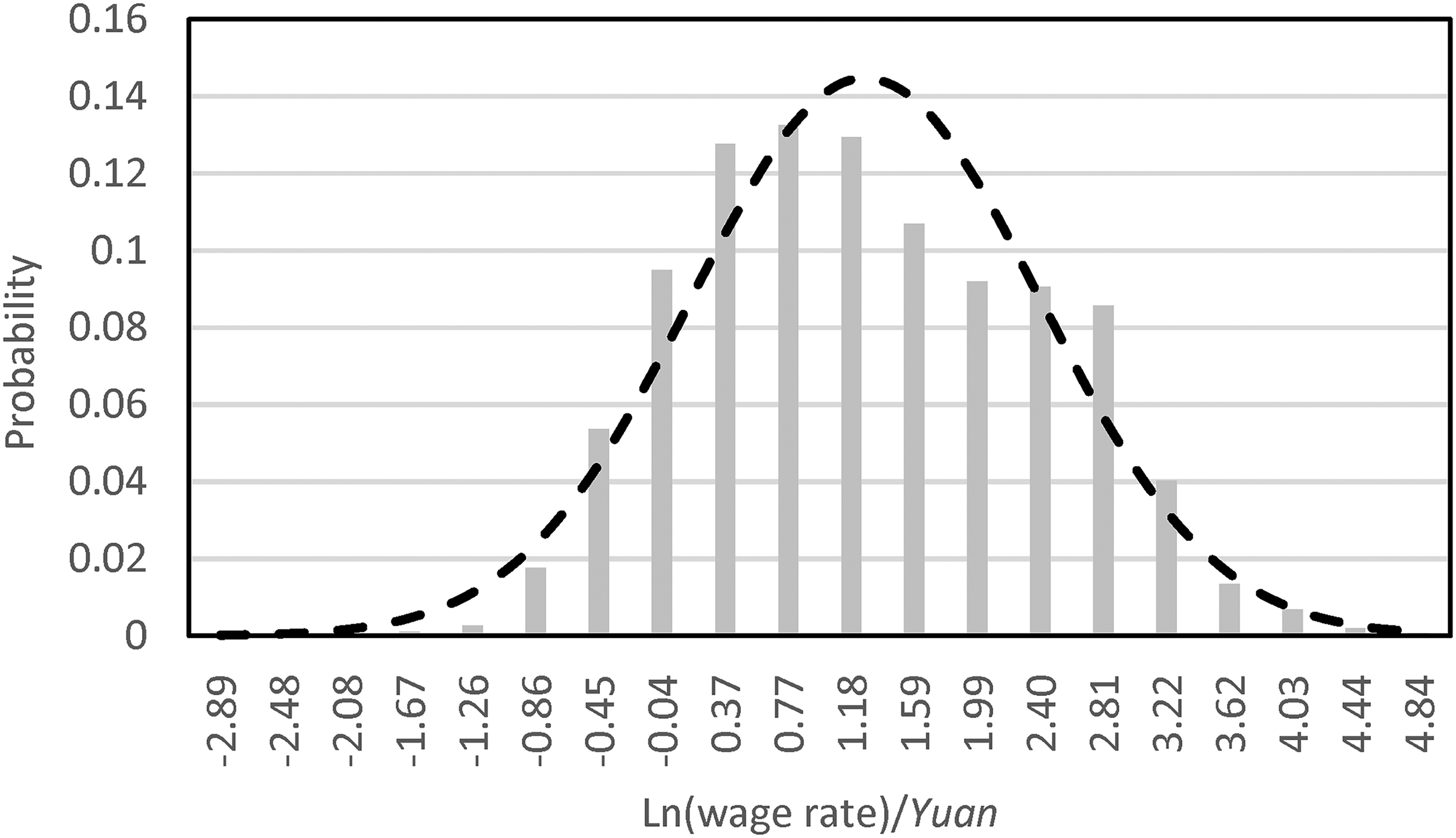
Distribution of logarithmic wage rates for total sample (basically normal, slightly skewed to the left).
It can be observed in Table 1 that the average wage rate for non-mothers is 7.60 yuan, and the average wage rate for mothers is 7.40 yuan, which is 2.63% lower than that of non-mothers. But this does not mean that the wage levels of mothers and non-mothers are essentially equal. The analysis below will show that after controlling for variables such as the number of children, family structure, educational background, and job characteristics, motherhood duties have a significantly negative impact on women's wages, and the severity of this impact and its underlying mechanisms have undergone systematic changes over time.
The key independent variable in the research on the motherhood penalty is number of children, which is taken as the interval variable in this study. The CHNS has made a detailed record of the childbearing history of all married women under the age of 52, and the number of children the respondents had at the time of the survey and the age of each child can be obtained. However, the number of children is an interval variable with a very narrow range of variation, especially due to the state family planning policy (i.e. the “one child policy”), as a result of which most families have only one child. Taking the data in this article as an example, 79.93% of mothers have one child, 17.61% have two children, and only 2.46% have three or more children. Previous studies have used the number of children as the interval variable and categorical variable to reflect the non-linear relationship between the number of children and the effect of the motherhood penalty better (Budig and England, 2001; Glauber, 2007). To this end, a robustness test was conducted in this study by replacing the number of children with categorical variables (“one child”, “two children”, “three children or more”) and testing the differences of the effect of the motherhood penalty under the two variable definitions. The demographic variables, such as region (province) and age (continuous variable), are included in the model as the control variables. There are 12 provincial level variables (Beijing, Liaoning, Heilongjiang, Shanghai, Jiangsu, Shandong, Henan, Hubei, Hunan, Guangxi, Guizhou, and Chongqing, with Beijing as the reference group), all of which are added to the baseline model as demographic control variables in the form of dummy variables.
To test the evolution of the mechanisms affecting the motherhood penalty, three groups of variables are included in the regression equation for income, one after another: “family structure”, “human capital”, and “job characteristics”. Family structure includes three operable measurement indicators: “marital status” (“unmarried”, “married”, “divorced or separated”, and “widowed”, with “unmarried” taken as the reference group); “family living arrangements” (“not living with parents”, “living with one's own parents”, and “living with parents-in-law”, with “not living with parents” taken as the reference group); and “having children under six years old or not”. The reason for including the variable “having children under six years old or not” is that the impact of the motherhood penalty on women is known to change over time. Previous studies have shown that at different stages after childbirth the impact of the motherhood penalty on women has different levels of severity. Children over six will enter primary school and will have higher self-care ability, alleviating mothers’ childcare duties, and the post-childbirth motherhood penalty will be mitigated. Therefore, this article attempts to control for the heterogeneity of women at different stages after childbirth by adding the variable “having children under six years of age or not”.
Human capital only includes a group of categorical variables: educational background, which is “primary school and below” (reference group); “junior high school”; “senior high school” (including technical secondary school); and “college or above”.
Job characteristics include three operable measurement indicators: “occupation type” (“agriculture-related”, “unskilled workers”, “employees, salespersons, and service staff”, “managers, senior technicians”, and “other”, with “agriculture-related” as the reference group); “work sectors” (“private enterprises”, “state-owned enterprises or public institutions”, “collective enterprises”, and “other”, with “private enterprises” as the reference group); and “job type” (“full-time job” and “part-time job”, with “part-time job” as the reference group).
Statistical model
The logarithmic wage rate is grouped by different years to draw a box chart (Figure 2). The results show that the distribution of the logarithmic wage rate moves upward as a whole over time, indicating that the logarithmic wage rates of different years have a systematic difference, which might be caused by a certain kind of environmental factor that changes significantly over time. Based on the social development status between 1989 and 2015 in China, it is not difficult to infer that this environmental factor is China's rapid economic growth during this period. It can be assumed that the income disparity between individuals not only depends on individual characteristics at the micro level, but is also affected by economic growth at the macro level. A multi-layer mixed-effects model can be used to identify the influencing factors at both the micro and macro levels. Hence, a multi-layer mixed-effects model was adopted as the tool of analysis in this study, in which the individual is at the first level and the year is at the second level.

Distribution of logarithmic wage rates in different years.
A multi-layer linear model can disintegrate the influencing factors of the dependent variable to different layers, and gives out a quantitative index to express the proportion of differences between different layers in the total differences. First, a null model of a multi-layer linear model was used to disintegrate the intra-layer and inter-layer differences. The model is as follows, where i represents the individual, j represents the year, and k represents the explanatory variable:
First-layer model: logincij = β0j + ɛij (1)
Second-layer model: β0j = γ00 + μ0j (2)
The intra-group correlation coefficient of the null model is equal to 0.72 (the detailed calculation process is omitted; specific calculation process available upon request). It is suggested in academic circles that a correlation coefficient above 0.059 be taken as the criterion for adopting a multi-layer linear model (Cohen, 1988). The intra-group correlation coefficient in this study is much higher than 0.059 and, as such, a multi-layer linear model should be adopted for analysis.
Since 1989, the greatest macro element in China over time has been the rapid economic growth; hence, gross domestic product (GDP) is taken as the explanatory variable of the second layer of the model. Similar to income, GDP is also adjusted using the CPI published by the National Bureau of Statistics with 2015 as the baseline. For comparison, we include GDP and logarithmic GDP as explanatory variables in the model of the second layer, and establish a regression equation for the intercept term in the model of the first layer, namely:
Second-layer model: β0j = γ00 + γ01 GDPj + μ0j
Or β0j = γ00 + γ01 lnGDPj + μ0j (3)
The results show that the R2 of the regression equation taking GDP as the explanatory variable is 0.8771, and the R2 of the regression equation taking logarithmic GDP (lnGDP) as the explanatory variable is as high as 0.9855 (Figures 3 and 4). Adopting lnGDP can achieve a better fitting effect; thus, in the subsequent models of this study, lnGDP is taken as the explanatory variable of the second layer.
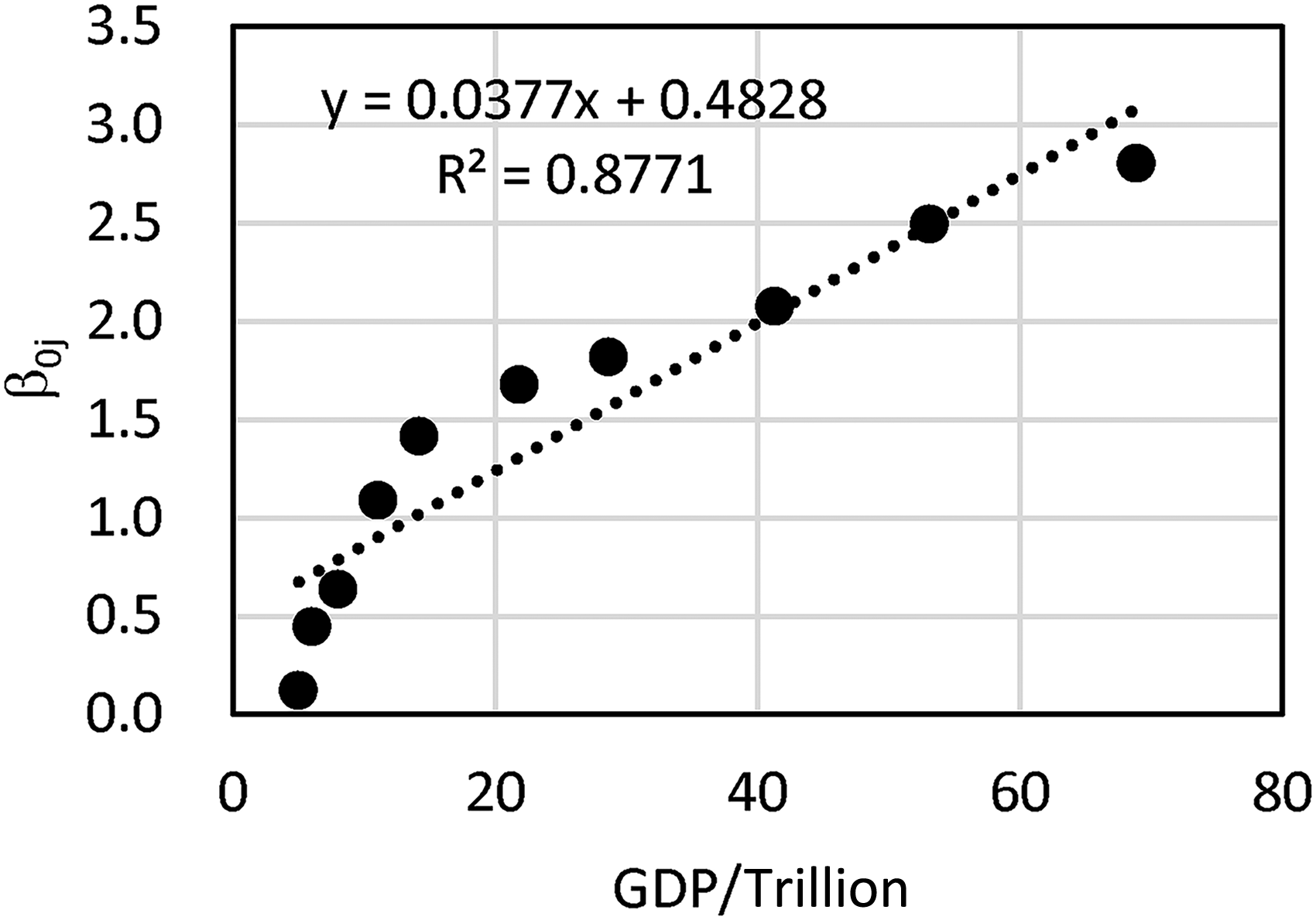
Regression equation for the intercept model (taking GDP as the explanatory variable).

Regression equation for the intercept model (taking LnGDP as the explanatory variable).
A multi-layer model was used in this study to discuss the following two questions: What are the trends in the variation in the severity of the motherhood penalty in Chinese society over time? What are the trends in the variation in the mechanisms influencing the motherhood penalty? The first layer is an individual hierarchical model, whose dependent variable is logarithmic wage rate, and independent variables include the following:
(a) baseline model variables: number of children, age, region; (b) family structure variables: marital status, living arrangements, having children under six years old or not; (c) human capital variable: educational background; (d) job characteristics variables: occupation type, work sector, job type.
In the subsequent study, taking the baseline model as the standard, the variables of family structure, human capital, and job characteristics were successively added to the model, and the following complete model below was finally formed:
logincij = β0j + β1j childrenij + β2j age + β3j married + β4j childunder6
+ β5j fulltime + ∑βkj (education) + ∑βkj (occupation)
+ ∑βkj (work sector) + ∑βkj (living arrangement)
+ ∑βkj (region) + ɛij (4)
The second layer is a hierarchical model of time, whose dependent variables are the regression coefficients of the model of the first layer, and whose independent variable is lnGDP. Region as the control variable is not the focus of this article; hence, the regression coefficients before region do not include the second-layer model. The second-layer model is as follows:
βkj = γk0 + γk1lnGDPj + μkj, where k = the subscript of the first-layer variable other than region.(5)
Results analysis
Variation trends in the motherhood penalty
Table 2 shows the regression coefficient of number of children on women's logarithmic wage rate in the four nested models in different years (hereinafter referred to as “the motherhood penalty coefficient”), which is β1j. As shown in equation (5), when the second-layer model is added, other than the variable of region, the regression coefficient of each independent variable is composed of γk0, the effect that does not change with time, and γ k 1 lnGDP, the effect that does change with time. For example, the regression coefficient in the baseline model in 2015 is -0.2023 = -0.0349 + 4.2325 × (-0.0396), indicating that for every extra child, a woman's logarithmic wage rate drops by 0.2023.
The regression coefficient of number of children in the baseline model represents the overall effect of number of children on logarithmic wage rate. As shown in Table 2, in 1989 and 2015, the number of children had a corresponding negative effect on women's wage rate. That is to say, the effect of childbearing on mothers’ income has always been represented by a kind of penalty effect; moreover, the severity of the penalty effect continued to increase over time, showing that the phenomenon of the motherhood penalty has intensified in recent years. Specifically, in 1989, for every extra child, women's wage rate would drop by 9.41% (1-e-0.0989); by 2015, each extra child reduced women's wage rate by 17.47% (1-e-0.2023), about twice that of 1989. The regression coefficient of Model 4 in Table 2 represents the net impact of the motherhood penalty after controlling for other variables, that is, the part that cannot be explained by the independent variable in this study. It can be seen that the net impact of the motherhood penalty also increased greatly over time: in 1989, each extra child led to a reduction in women's wage rate by 8.79%, while by 2015 each extra child led to a reduction in women's wage rate by 12.77%.
The motherhood penalty coefficients for different models.

Notes: Model 1 includes number of children, age, and region; Model 2 adds marital status, living arrangements, and having children under six years old or not to the baseline model; Model 3 adds educational background to Model 2; Model 4 adds career type, work sector, and having a part-time job or not to Model 3. The number in brackets indicates the variation in the motherhood penalty coefficient compared with the previous model.
*p ≤ 0.05; ***p ≤ 0.001.
By drawing the motherhood penalty coefficients in Table 2, Figure 5 is obtained. It can be seen that after adding the variables of family structure, educational background, and job characteristics successively on the basis of the baseline model, the motherhood penalty coefficients have undergone an obvious change. First, in all models, the severity of the motherhood penalty increases over time. Second, during 1989 and 1993, the curve distributions of different models are similar to one another, showing insignificant differences in the severity of the motherhood penalty; after 1997, it can be clearly seen that the severity of the motherhood penalty reduces with the addition of new variables (in the form of the upward movement of the curve and a reduction in the absolute values of the coefficients), and educational background has the greatest impact on the variation in the motherhood penalty coefficient. Through the following analysis, it can be seen that the motherhood penalty is a comprehensive phenomenon manifested by the joint effect of multiple mechanisms, whose variation tendency and severity in different periods are the reasons for the systematic change that gives rise to it. Finally, the remainder coefficients can be regarded as the net impact of the motherhood penalty, representing the impact of workplace discrimination and other unidentified elements. The above data all support Hypothesis 1.
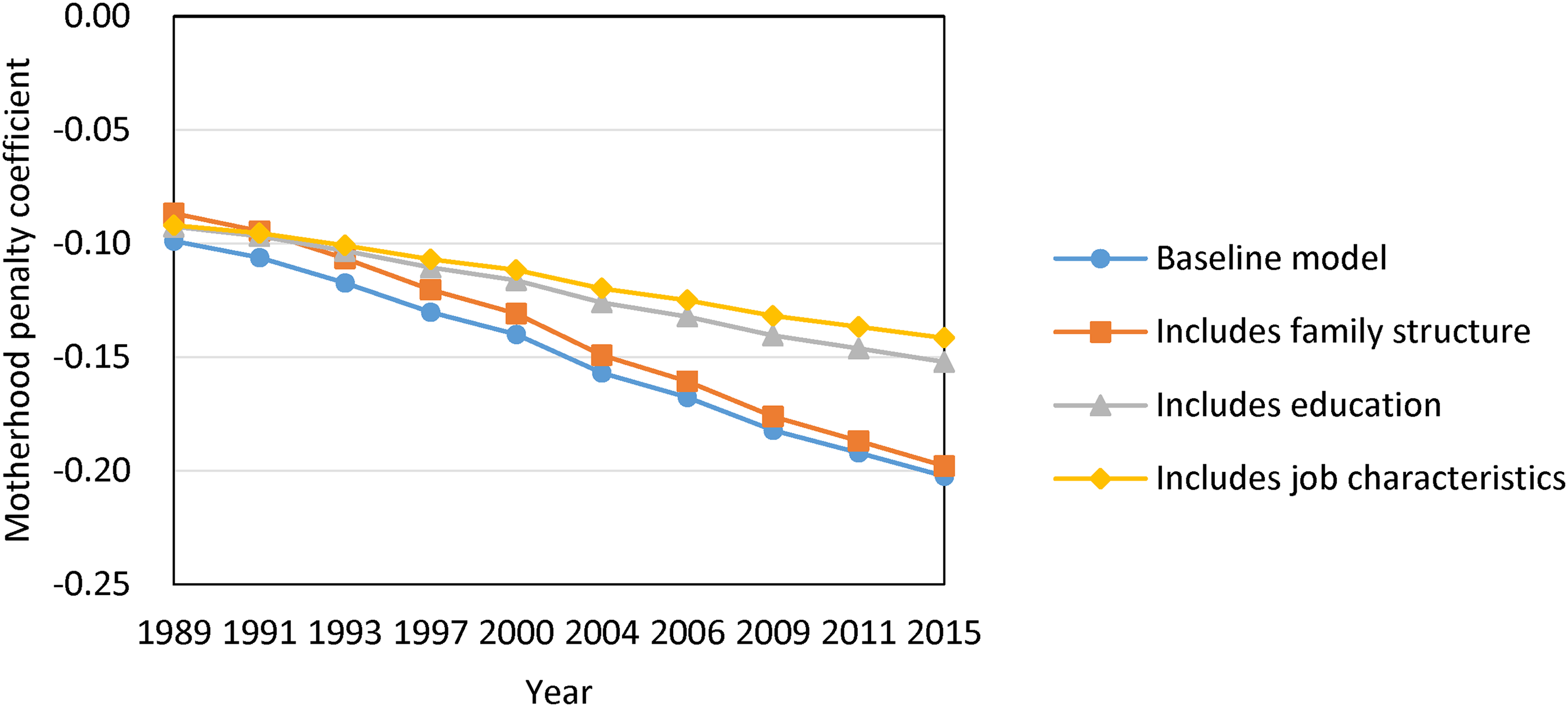
Motherhood penalty coefficients for different models.
Robustness analysis
Taking into account the demographic transition that has resulted in the rapid decline of China's female fertility rate under the family planning policy, the differential choice between motherhood and women’s wages may be stronger (i.e., women with low potential income may have more children). Meanwhile, the penalty effect on women after childbearing might be non-linear. In order to measure the hierarchical effect of different numbers of children better, the author replaced the number of children as an interval variable with a categorical variable, and carried out a regression analysis on the baseline model and the complete model (shown in Figure 6(a) and 6(b)). Here, child1, child2, and child3 are the regression coefficients using the categorical variable, indicating “one child”, “two children”, and “three children and above”; “children” is the regression coefficient using the interval variable, and “children*2” and “children*3” are the regression coefficients of “children” multiplied by two and three, respectively.

(a) Robustness test on the number of children in the baseline model; (b) Robustness test on the number of children in the full models.
As shown in Figure 6(a), in the baseline model, the non-linear relationship between number of children and the effect of the motherhood penalty can be observed by adopting the categorical variable. The penalty effect on mothers having two children is about twice that on those having only one child, but the penalty effect on mothers having three children is obviously less than on those having only one child. That is to say, the penalty effect of childbearing does not increase proportionally with an increase in the number of children. The higher the number of children, the slower the increase in the penalty effect. However, in the complete model, the effect of the motherhood penalty in relation to the number of children is more like a proportional increase, demonstrating that the regression coefficients obtained by using the categorical variable and the interval variable are basically consistent in each year.
For convenience in comparing the effects of the motherhood penalty among different groups, in the following interaction analysis, an interval variable (number of children) was adopted to establish a regression model. Although we cannot fully reflect the hierarchical effect and the non-linear relationship of the number of children, we still believe that the choice is reasonable for the following reasons: (a) whether in the baseline model or in the complete model, the values of the regression variables obtained by the categorical variable and the interval variable fit well, indicating that the regression model and variables adopted in this article are robust; (b) when the number of children does not exceed two, the effect of the motherhood penalty and number of children basically keeps a linear relationship, and the non-linearity between them is mainly reflected when the number of children is three or more. However, mothers having three children or more only represent a small proportion of the sample, that is, 2.46% of all mothers and 0.79% of all samples, and will not produce any significant impact on research results; and (c) compared with absolute values, this research is more concerned with the long-term variation tendency in the effect of the motherhood penalty and the relative strength of the motherhood penalty among different groups and its evolution. The non-linearity between number of children and the effect of the motherhood penalty does not affect the analysis conclusions about the long-term trend found in this study.
Interaction effect of family structure and childbirth
As can be seen in Figure 5, after adding the variable of family structure to the baseline model, the effect of the motherhood penalty in all years goes down, and the extent of the reduction is the highest in 1989; moreover, the change over time gradually decreases. Compared with Model 1, the effect of the motherhood penalty in Model 2 reduced by 12.31% in 1989, while the reduction in 2015 was only 2.21%. Family structure includes three variables: marital status; having children under six years old or not; and living arrangements. In order to verify Hypothesis 2 in this article, we analyzed the interaction effect on marital status and the motherhood penalty, and tested the different effects of the motherhood penalty on married and single mothers, and the variation tendency of such difference over time.
Figure 7 shows the evolution of the motherhood penalty coefficients of married and single mothers over time after controlling for the variables of educational background and job characteristics. Since there are very few women giving birth out of wedlock in China, the single mothers in the sample are basically all divorced or widowed mothers. Results show that the motherhood penalty effect on married mothers in all years is significantly higher than that on single mothers, and Hypothesis 2a-1 is supported.
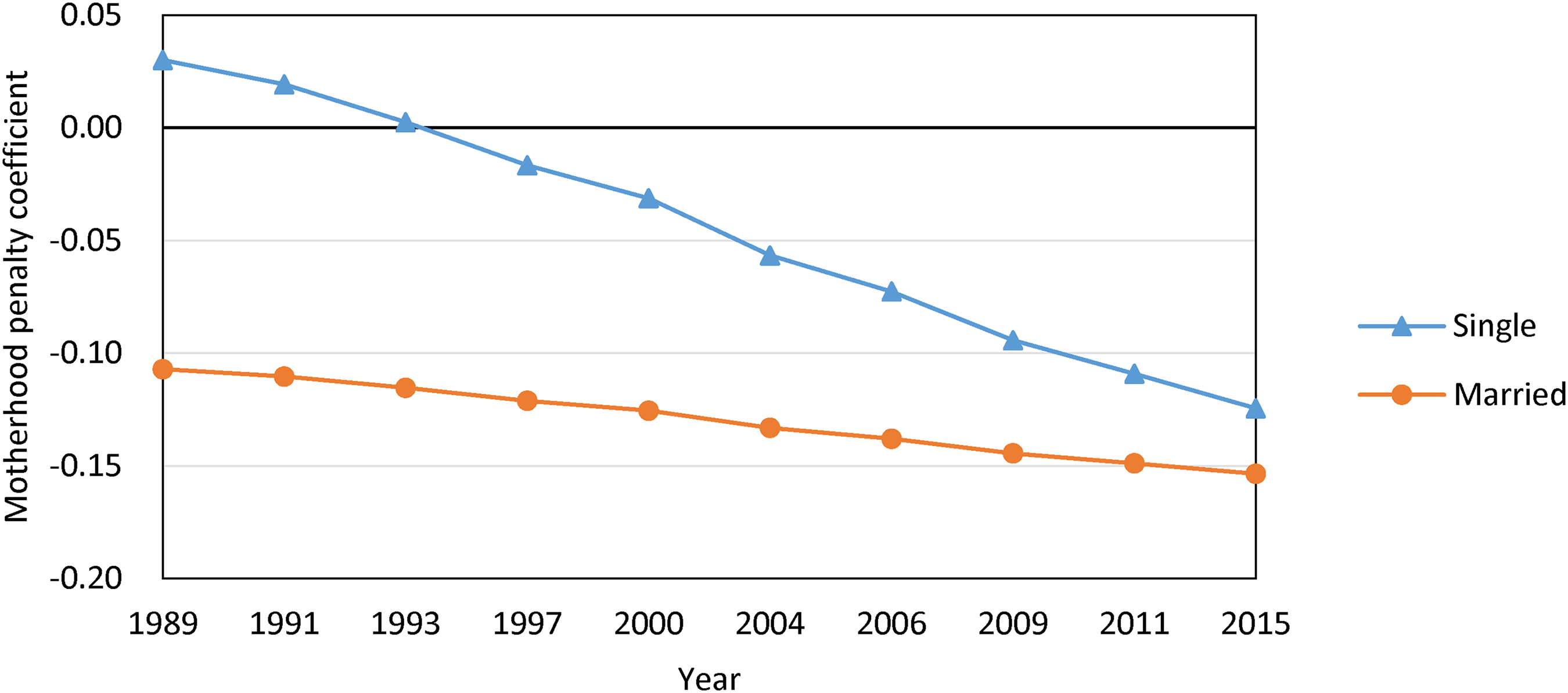
The interaction effect between marital status and the motherhood penalty.
Second, the difference between married and single mothers with regard to the motherhood penalty effect rapidly shrank over time. In 1989, the impact of every extra child on a married mother was 14.3% higher than for a single mother; in 2015, the difference between the impact on a married mother and a single mother reduced by 3.34%. On the basis of these statistical results it can be stated that although the motherhood penalty effect on married mothers increased to some extent, the variation tendency is relatively flat, and the narrowed gap between married mothers and single mothers is due to a rapid increase in the motherhood penalty effect on single mothers. This variation trend is in line with Hypothesis 2b. In the past, single mothers lost much competitiveness in the labor market due to childcare. Since childcare has become more family led and demanding, mothers have invested more energy in caring for their children. Compared with married mothers, because of a lack of social support, single mothers apparently need to undertake more childcare duties, which greatly weakens their competitiveness in the labor market, and increases the effect the motherhood penalty has on them.
In order to further test the change in childcare responsibilities over time, we carried out an interaction analysis on age of children and the motherhood penalty. Figure 8 shows the evolution of the motherhood penalty on women with or without children under the age of six after controlling for other variables. If a mother has a child under the age of six, then she has last borne a child in the past six years; at this time, the regression coefficients for number of children can be regarded as the short-term effect of the motherhood penalty, whereas it can be regarded as the long-term effect of the motherhood penalty.
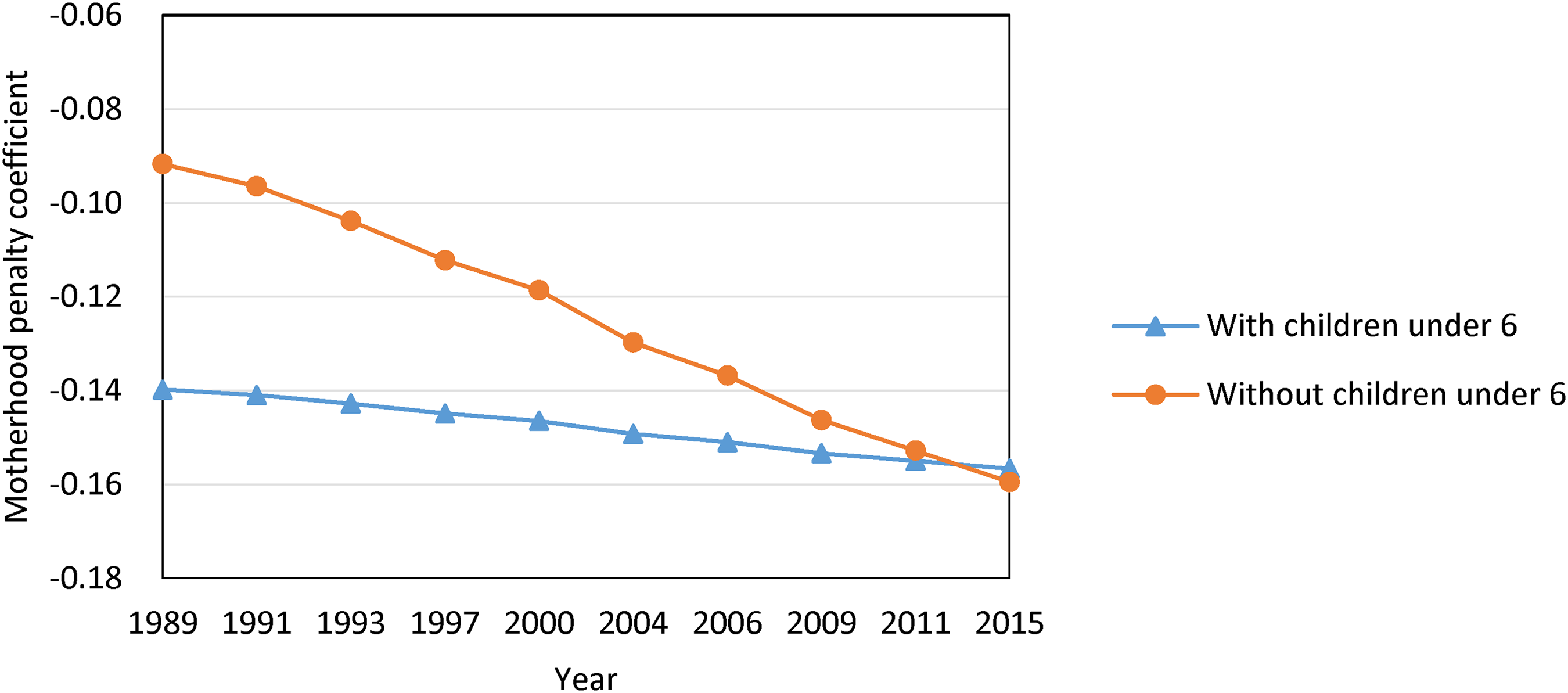
The interaction effect between children's age and the motherhood penalty.
Figure 8 shows that the short-term effect of the motherhood penalty is always higher than the long-term effect, indicating that women suffer the greatest motherhood penalty effect just after childbirth. As time passes, the effect of the motherhood penalty gradually weakens, which is consistent with Hypothesis 3a. Figure 8 also shows that the short-term effect of the motherhood penalty slowly rises over time, increasing by 12.5% from 1989 to 2015. The long-term effect of the motherhood penalty in 1989 was significantly lower than the short-term effect, being only 65.6% of the short-term effect. However, the long-term penalty effect has grown more rapidly over time, rising by 73.9% from 1989 to 2105, and its severity continues to grow in line with the short-term penalty effect. This indicates that since childcare has become a more demanding and long-term undertaking, the motherhood penalty effect has become more apparent, and Hypothesis 3b is supported.
Interaction effect between education and childbirth
The data in Table 2 and Figure 5 show that after further controlling for the variable of educational background (Model 3) based on Model 2, the motherhood penalty effect in 1989 and 1991 increased by 6.8% and 2.4%, respectively. In the years after 1991, the motherhood penalty effect decreased, and the extent of decline increased rapidly over time. In 2015, after controlling for the variable of educational background, the motherhood penalty effect was reduced by 23.1%. The data above show that the impact of education on the motherhood penalty has been increasing. In order to explore further how the motherhood penalty effect on women with different educational backgrounds evolves, we conducted an interaction analysis between educational background and the motherhood penalty. In the interaction analysis, we merged “primary school and below” and “junior high school” into “junior high school and below”, for the following two reasons: first, women with an educational background of “primary school and below” accounted for only around 10% of the total sample and the results based on such a small sample will likely cause problems such as high dispersion and insignificant statistics; and second, both “primary school and below” and “junior high school” belong to the relatively elementary education stage. In the entire society, a woman with a junior high school degree does not have any obvious advantage over a woman with a primary school degree. Therefore, it is reasonable to merge the two categories.
Figure 9 shows the variation in the motherhood penalty effect on women according to “junior high school and below”, “senior high school” (including technical secondary school), and “university and above”. The results show that in any year, the lower the educational background of a woman, the higher the motherhood penalty effect and, as such, Hypothesis 4a is verified. At the same time, among women with different educational backgrounds, the variation in the motherhood penalty effect has two prominent characteristics. First, across all educational backgrounds, the motherhood penalty effect rises over time, demonstrated by the statistical significance of the interaction effect between the motherhood penalty effect and time. Second, the ranges of variation in the motherhood penalty effect on women with different educational backgrounds are different. The higher the educational background, the quicker the rate of increase in the motherhood penalty. In 1989, by controlling for other variables, women with a college degree and above suffered a motherhood penalty effect of only 2% for each extra child; in contrast, women with a junior high school degree and below faced a wage rate reduction of 10.2% for each extra child, which is about five times that of the former group. From 1989 to 2015, the motherhood penalty coefficient for women with a college degree and above increased from 2.0% in 1989 to 11.7% in 2015, while the motherhood penalty coefficient for women with a junior high school degree and below only increased from 10.2% in 1989 to 13.4% in 2015. The motherhood penalty variation trend for women with a senior high school (including technical secondary school) degree falls in between women with “junior high school and below” and “college and above”. When controlling for other variables, each extra child would lead to a reduction in the wage rate of 5.8% and 12.8% in 1989 and 2015, respectively. By 2015, the effect of the motherhood penalty on women is basically at the same level across the three education categories. As such, Hypothesis 4b is supported by the data.
This study also finds that the influence of educational background on the motherhood penalty has been on the rise. On the one hand, the motherhood penalty suffered by women with high levels of education is increasing; on the other hand, women with higher levels of education take up a larger proportion of the total sample. Figure 10 shows the variation trend for educational background for mothers and non-mothers: the solid line represents mothers and the dotted line represents non-mothers. In this figure, the data point for mothers in 1989 is missing. The reason for this is that in the 1989 sample, the number of mothers is very small, leading to abnormal data; thus, the data for mothers in this year were deleted. It can be seen that for both mothers and non-mothers, the proportion of women with an education level of junior high school and below has experienced a dramatic decline, falling from 60% in 1989 to 30% in 2015. On the contrary, the proportion of women with a college degree and above experienced huge growth, from 5% in 1989 to 45% in 2015. The proportion of women with a senior high school (including technical secondary school) education experienced a rise followed by a fall over the time period of this study, which exactly corresponds to the two stages in the evolution of women's educational opportunities. The first stage was from 1989 to 2004, when the proportion of women with a senior high school (including technical secondary school) degree gradually increased. During the same period, the proportion of women with a junior high school degree and below gradually declined, while the proportion of those with a college degree and above slowly went up. This shows that the education level of women improved during this period, and more and more women made the transition from just having a junior high school education and below to being able to complete senior high school (including technical secondary school) studies. It is worth noting that at this stage, there were still very few women who had obtained a college degree and above; as of 2004 only 10.6% of mothers and 14% of non-mothers had a college degree and above, and the proportion of non-mothers with a higher education degree was slightly higher than mothers. The second stage was after 2004, when the proportion of women with a senior high school (including technical secondary school) education declined, while at the same time the proportion of women with a junior high school education and below also declined, while the proportion of women with a college degree and above rose rapidly. It shows that during this period, more and more women continued to receive higher education after completing senior high school (including technical secondary school), and the overall education level of women shot up. Moreover, after 2011, it can be clearly observed that the education level of non-mothers is higher than that of mothers, which shows that the proportion of non-mothers who have a college degree and above and a senior high school (including technical secondary school) education is higher than that of mothers, and the proportion of non-mothers with a primary school education and below is lower than that of mothers.
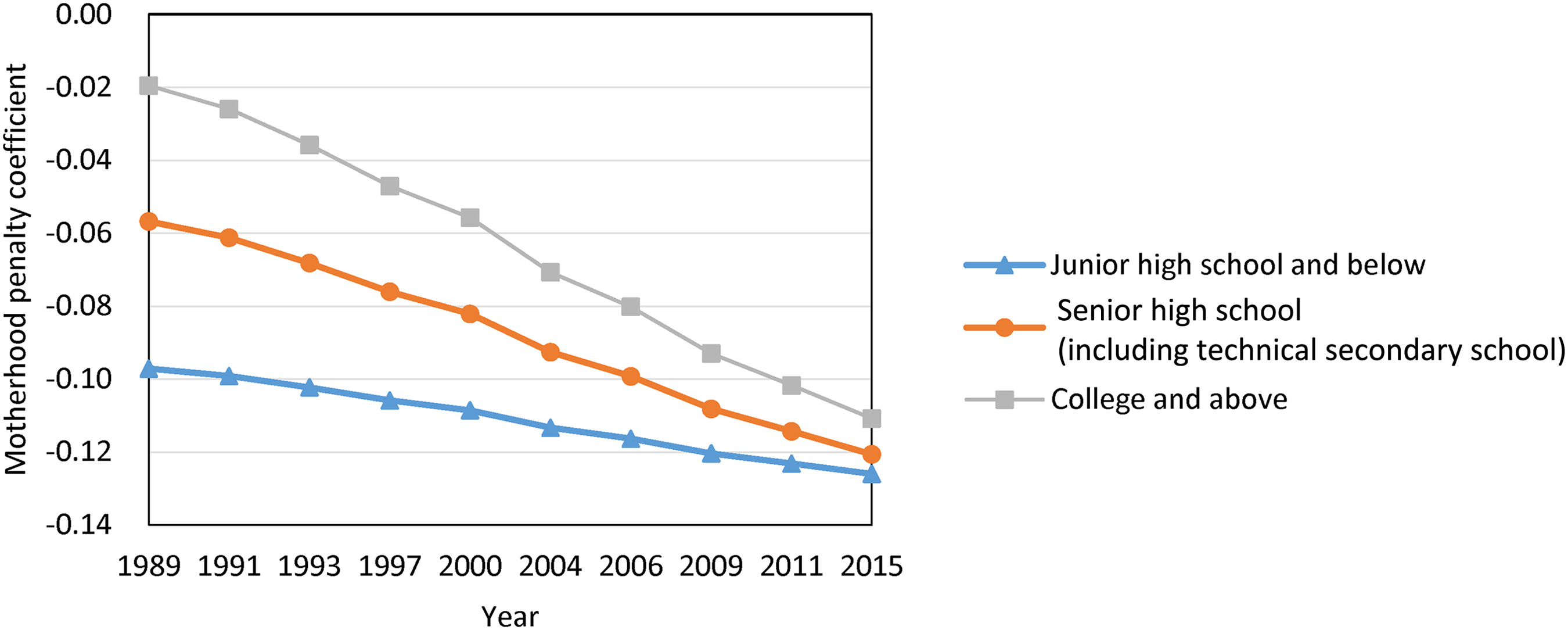
The interaction effect between education and the motherhood penalty.
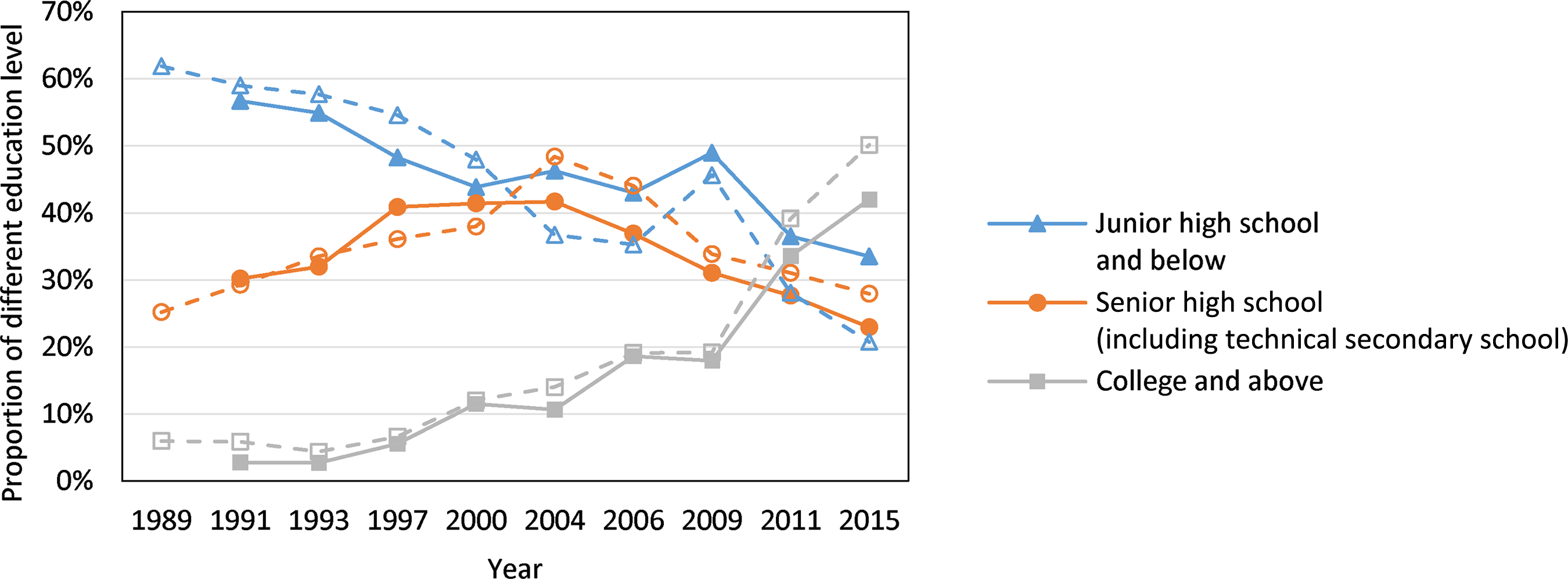
Evolution of educational background of mothers and non-mothers (solid line: mothers; dotted line: non-mothers).
On the basis of the above analysis, we find that another reason for the increasing effect of the motherhood penalty on women with higher levels of education is that education level is a very important means of securing human capital. In the past, when women's education level was generally low, women with high levels of education had more pronounced advantages. Even if they had children, since women with higher education were more irreplaceable in their jobs, they could still compete strongly in the labor market and would not suffer an excessive motherhood penalty. With the passage of time, as the education level of women has generally been elevated, the relative advantage of women with higher education levels has dropped sharply. At this time, the penalty effect of childbirth has also increased drastically.
Interaction effect between job characteristics and childbirth
After further controlling for the job characteristics variables on the basis of Model 3, the effect of the motherhood penalty in all years is reduced. In 1989, the reduction in the motherhood penalty effect was 0.6%, and the reduction has gradually increased since then, rising to 6.9% in 2015 (see Table 2). As mentioned earlier, job characteristics include three sets of variables: work sector; occupation type; and job type (full-time or part-time). We found in the supplementary analysis that among the three sets of variables, work sector has the greatest influence on the motherhood penalty; hence, we take work sector as a key variable in this study.
Beginning in the 1990s, China's socialist market economy transformation began to accelerate. A major feature reflected in the labor market is that more and more people were leaving state sector work units, such as party and government agencies, state-owned enterprises, and public institutions, to turn to the market-oriented non-state sector, such as private enterprises, foreign enterprises, and self-employment. On the one hand, the redistribution of the labor force among different sectors came from individuals’ active choice; on the other hand, this was a passive choice caused by being laid off and being forced to seek re-employment because of the restructuring of state-owned enterprises. We define party and government agencies and public institutions as the “state-owned sector”, and all the other sectors collectively as the “non-state sector”. Figure 11 shows the proportion of women who have received higher education in each year and the percentage of women working in non-state sectors as proportions of the total sample. It can be seen that the proportion of women working in the non-state sector has increased significantly since 1989. At the beginning of the 1990s, about 15% of all women worked in the non-state sector, while in 2015, the number had reached about 55%. The proportion of women with higher education working in the non-state sector has always been lower than that of all women. Generally speaking, the higher the education level, the more competitive women are in the labor market and, as such, they have more room for independent choice. Statistics show that this group of women are more inclined to work in the state-owned sector, indicating that compared with the state-owned sector the non-state sector is the “second-best” choice for women, probably because of lower wages and welfare guarantees.

Proportion of women working in the non-state sector and its evolution.
However, we also found that for women with high levels of education, their capacity to choose a job independently has been shrinking rapidly. First, the proportion of women with a high level of education who have accepted work in the non-state sector has risen rapidly, from 5% at the beginning of the 1990s to 35% in 2015. Second, the relative advantage of women with high levels of education among all women has declined rapidly. The broken line in Figure 11 (right axis) represents the ratio of the proportions of the two samples working in the non-state sector. The larger the ratio, the lower the relative advantage of women with high levels of education. If we ignore the abnormal data in 1989, it can be seen that the ratio in 1991 was only 0.05, but it surged to 0.61 in 2015.
The statistics above show that between 1989 and 2015, the proportion of women in the various work sectors experienced structural change; hence, it is necessary to check the interaction effect between the work sector and the motherhood penalty. Figure 12 shows the evolution of the motherhood penalty coefficient in the state-owned sector and the non-state sector. First, in all years, the motherhood penalty effect in the non-state sector was higher than that in the state-owned sector, which further demonstrates the fiercer competition and poorer welfare guarantees in the non-state sector. This result is in line with Hypothesis 5a. In addition, the motherhood penalty effect in the state-owned sector only increased slightly from 1989 to 2015. Under the premise of controlling for other variables, the reduction in the wage rate for having each additional child increased from 9.8% in 1989 to 11.4% in 2015. However, the motherhood penalty effect in the non-state sector increased rapidly with time: in 1989, every additional child caused a reduction in the wage rate of 10.6%, but by 2015 this had risen to 19.4%, indirectly rapidly increasing the difference in the motherhood penalty effect between the non-state sector and the state-owned sector. On this basis we can say that Hypothesis 5b is supported.
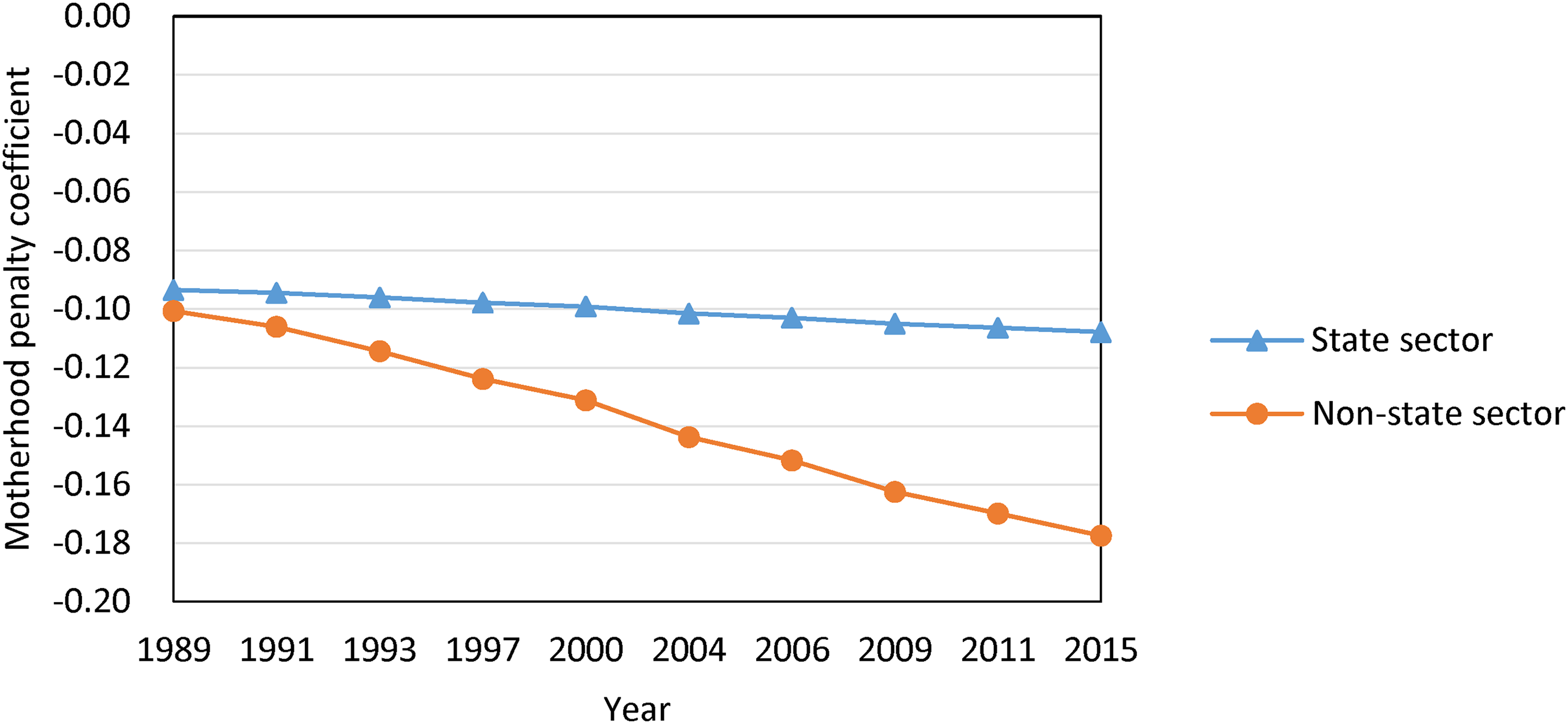
The interaction effect between work sector and the motherhood penalty.
Conclusion and discussion
Since childbirth is an important social characteristic that distinguishes women from men, studying the effect of childbirth on women's income is of great significance for exploring the issue of gender income inequality. Although there are a large number of studies on the effect of the motherhood penalty on income in China and abroad, almost all such studies analyze the severity of the motherhood penalty and the mechanisms by which it is generated from a static perspective. However, China has experienced rapid economic growth and drastic social change in the past 30 years. As such, the severity of the motherhood penalty and the explanatory mechanisms underlying it in different periods are different. Static research is not enough for us to be able to understand its evolution. In this study, a multi-layer mixed-effects model was applied to data from the CHNS from 1989 to 2015 in a new attempt to gauge the severity of the motherhood penalty and the various mechanisms that affect it.
The research found that first, during the 26 years from 1989 to 2015, the average wage growth rate of mothers was 1.6% lower than that of non-mothers. Second, from 1989 to 2015, the number of children had a significant negative effect on women's income. The effect of childbearing on mothers’ income has always been represented by a kind of penalty effect; moreover, the severity of the penalty effect continued to increase over time, showing that the phenomenon of the motherhood penalty has been intensified in recent years. After controlling for age and region, in 1989, each extra child led to a reduction in women's wage rate of 9.41%, while by 2015, each extra child led to a reduction in women's wage rate of 17.47%. Third, after controlling for family structure, educational background, and job characteristics, the net impact of the motherhood penalty also increased over time; each extra child led to a drop in the wage rate from 8.79% in 1989 to 12.77% in 2015.
A multi-layer mixed-effects model was adopted in this article to study the trend in the mechanisms affecting the motherhood penalty over time. The results show that first, the effect of the motherhood penalty on married mothers is significantly higher than for single mothers in all years. However, with the passage of time, the difference between married mothers and single mothers in terms of the motherhood penalty has been reduced. Although the motherhood penalty effect on married mothers has increased to some extent, the variation tendency is relatively flat, and the narrowed gap between married mothers and single mothers is due to a rapid increase in the motherhood penalty effect on single mothers.
Second, the short-term effect of the motherhood penalty is always greater than the long-term effect, indicating that women suffer the greatest motherhood penalty just after childbirth. The short-term effect of the motherhood penalty increased slowly over the period covered by this study. The reason for this is that the physiological burden of childcare has not increased significantly over the past three decades. Compared with the short-term effect, the long-term penalty effect increased rapidly with time, indicating that the social burden of childcare (mainly that of education) has increased significantly. Around 2015, the long-term penalty effect had become basically the same as the short-term penalty effect, and the trend indicates that it will increase further in the future.
Third, we found that across all of the years for which we have data, the lower the level of education, the greater the effect of the motherhood penalty on women. Across all levels of education, the motherhood penalty effect rose over time, indicating that the interaction effect between the motherhood penalty and time is significant. The motherhood penalty effect varies for women with different levels of education. The effect of the motherhood penalty increased most rapidly for highly educated women. Among them, women with a college degree and above experience the fastest growth in the effect of the motherhood penalty. The difference in the effect of the motherhood penalty on women with high and low levels of education is narrowing over time.
Finally, from 1989 to 2015, structural changes occurred in women's work sectors. The motherhood penalty effect in the non-state sector was higher than that in the state-owned sector in all years, other than 1989 when the difference was insignificant. However, the motherhood penalty effect in the state-owned sector only increased slightly from 1989 to 2015, while in the non-state sector it increased rapidly over time, quickly increasing the difference in the motherhood penalty effect between state-owned and non-state sectors.
In conclusion, while academia has been concerned with the impact of family on gender inequality, less attention has been paid to the cost of maternal duties such as childbirth and family care in the process of market reform. While mothers are shouldering an ever-increasing motherhood burden, they are also subject to greater discrimination and competitive pressure in the workplace. This study has shown that since the reform and opening up policy, and in the context of the rapid acceleration of urbanization and economic growth, women are paying a higher and higher price for engaging in family care and childbirth, especially single women, women with high levels of education, and women working in the non-state sector. This study shows that the dramatic social and economic change in recent decades has subjected women to greater and greater maternal responsibilities but has afforded them disproportionately fewer of the benefits of economic development. We hope that the issues and trends highlighted in our research will draw public attention from all sectors of society.
Footnotes
Acknowledgments
I would like to thank the anonymous peer reviewers from the Chinese Journal of Sociology (Chinese version) for their comments. The author takes sole responsibility for the paper.
Declaration of conflicting interests
The author has no conflicts of interest to declare.
Funding
The author received no financial support for the research, authorship, and/or publication of this article.