



Abstract
This article tests hypotheses of the clientelist theory of political participation using both individual level cross sectional survey data and aggregate level data from all 76 provinces in Thailand for the 1996, 2001 and the 2005 General Election timeframes. According to the clientelist theory of political participation, we would expect higher participation among those with fewer resources when there is an incentive for a patron to buy participation, and lower participation where there is no incentive. I use linear and logistical regression to test hypotheses derived from this theory and find there is support enough to suggest clientelism as a cause of political participation during the democratic period of Thailand. The results have important implications for understanding clientelism, regime legitimacy and the prospects for a return to democracy.
Introduction
Political clientelism has long been considered a cause of political participation. Clientelism seems to be injected as the explanation for participation all across the globe—from Argentina, Armenia, Belize, Cambodia and France to Russia, Sweden, Taiwan, the United States, Yemen, Zambia and many other places. This occurs even though clientelism is typically illegal, elusive and extremely difficult to measure (Piattoni, 2001; Schaffer, 2007; Stefes, 2006; Stokes, 2007). Where clientelism has been measured, the empirical evidence, while necessary, lacks sufficiency to convincingly demonstrate its effect on participation. Given the illegal, elusive and subjective nature of clientelism, it is not difficult to understand the nature of this insufficiency.
In this study, I propose a clientelist model to take a necessary step towards scientific testing at the macro (state) level of this elusive, illegal and subjective informal institution. More specifically, I propose a model that potentially captures the effect of clientelism on participation indirectly through testing hypotheses that may be suggestive of clientelism. Clientelism in this study is defined as a transactional relationship between patrons and clients where patrons use incentives for the sole purpose of motivating clients to participate in politics on their behalf. Because clientelism is elusive and illegal, capturing the effect of clientelism directly can be a daunting task, to say the least. Others have utilized creative approaches to gauge clientelism at the micro (individual, group, community, etc.) level; however, very little movement has been made in measuring clientelism at the macro level in the quantitative realm. Given the nature of clientelism, it is not difficult to understand why.
It is widely accepted that individual resources such as socioeconomic status
1
(SES)—both education and income—civic skills, leisure time, occupations and urbanization are essential indicators of participation in developed democracies. More specifically, individuals with resources are better equipped to participate in politics because they are more likely to understand both the importance of participating and the consequences of not participating in politics than their less equipped counterparts (Brady et al., 1995). Jackson (2003: 340) found this to be the case, as: Citizens at higher levels of socioeconomic status have the civic skills (including the ability to engage and process political information), the participatory attitudes (e.g., a sense of civic duty and of political efficacy), and the time and money that facilitate political participation.
In this study, I look specifically at participation in Thailand during the democratic period to understand the potential effect of clientelism on participation. While it is clear—from my experiences in the field interviewing and communicating with Thai voters and elites 2 and the plethora of studies 3 on Thai clientelism—that clientelism exists in Thailand, the overall effect of clientelism on participation is unknown. To varying degrees, some have attempted to sum up the overall effect of clientelism on participation. On the one hand, clientelism may account for the high voter turnout levels—this may be the case for not only for the 2001 and 2005 General Election periods but also the entire democratic period (Arghiros, 1995; Beeson, 2002; Chantornvong, 1992; Gomolpelin, 1998; Hicken, 2002; Phatharathananunth, 2008). Others, however, have more conservative estimates. For instance, Albritton (1996) concedes that clientelism may be utilized on occasion, but it is not widespread enough to be a significant concern. Given the variation in these explanations, it is difficult to discern the effect of clientelism on participation.
Some have used survey data to potentially understand clientelism. In a survey conducted in the last quarter of 1999 of just over 4000 heads of household, Phongpaichit et al. (2000: 63) found that almost a third of the households sampled in a survey were offered compensation for their votes, but they stipulate that “these figures are probably highly underestimated … [as] other estimates of the proportion of voters offered money at general elections have run as high as 70 percent.” In other words, the authors do not have confidence in this finding. Their claimed major finding regarding clientelism is that people believe it is becoming more of a problem, perhaps across all elections (Phongpaichit et al., 2000). In another survey study, Gaowpradap (2003) found that 12 percent reported they would be willing to act as clients, in addition to 56 percent reporting they believe clientelism to be a concern during elections. In a survey conducted in the latter part of 2007 with over 3000 voters, almost 65 percent of the respondents reported they would become clients if the opportunity presented itself (Sullivan, 2007). Collectively, these are interesting findings; however, the effect of clientelism on participation still remains quite elusive. Moreover, the causal effect of clientelism on participation across the Thai state is simply unknown, necessitating the need for measurement.
It is therefore reasonable to infer that clientelism is a concern for participation in Thailand and the issue is not whether clientelism is present or not, but how do we begin to understand how it actually impacts participation. In other words, how can we measure clientelism when in fact it is illegal, elusive and subjective? In an earlier study, Owen (2009) presented a model of clientelism built on the resources of SES and concluded that clientelism is the most likely explanation for the poorly educated voting as much as their educated counterparts in the 2005 General Election. The current study aims to add to the already rich collection of empirical studies on clientelism by further specifying Owen’s (2009) clientelist model and conducting a more comprehensive test across the Thai democratic period. This is a necessary step in measuring the effect of clientelism on political participation. The purpose of this study is therefore not to deprive certain individuals of agency in the political process. On the contrary, the purpose is to devise a meaningful way of measuring an obstacle that likely impedes a democratic consolidation. Others have identified it and I have even spoken at length with Thai voters and elites about clientelism in the political processes. It is clear to me that clientelism is present and finding a practical way to measure clientelism is the goal of this study. This test is therefore timely, relevant and necessary to understanding the impact of clientelism on participation throughout the entire Thai state.
The main questions guiding this study are can clientelism be suggested as a cause of political participation in Thailand and if so, what are the likely causal effects of clientelism on political participation? I address these questions empirically by analyzing the impact of individual resources on political participation—that is, boycotts, demonstrations, petitions and turnout. For boycotts, demonstrations and petitions, I use individual level cross-sectional public opinion data from the 2007 Asian Barometer. For voter turnout, I use individual level cross-sectional public opinion data from the 2004 and 2007 Asian Barometers across the national and local election levels and provincial level aggregate data from government sources across the 1996, 2001 and 2005 General Elections timeframes. The structure of this study is as follows. First of all, I discuss the clientelist theory of political participation. Second, I discuss the data, methods and results of this study in the data and testing section. The results are suggestive of clientelism; I find that where there is an incentive to buy participation, resources offer a much less compelling explanation. I conclude with a discussion of the important implications of this study.
Theory of political clientelism
The theory of political clientelism has been injected as an explanation for participation on many occasions, especially in the developing democratic context (Berg-Schlosser, 1982; DiFranceisco and Gitelman, 1984; Escobar, 2002; Fox, 1994; Huber et al., 1997; Klesner and Lawson, 2001; Lemarchand, 1977; Muller et al., 1987; Owen, 2009, 2013a; Sobrado Chaves, 2002; Wampler and Avritzer, 2004). As stated above, clientelism is difficult to measure because it is elusive and illegal and because accounts are usually quite subjective; however, clientelism is still invoked as an explanation for participation. Simply put, we understand that clientelism exists in the participation realm, but we have so far been unable to capture its effect specifically because of its elusive, illegal and quite subjective nature.
In order to build a clientelist model of political participation, it is first important to understand the role of resources in the absence of clientelism. In short, the more resources—such as education, 4 income, civic skills, occupations, leisure time and urbanization—an individual possesses, the more likely that individual is to participate in politics. This is the essence of the resource theory of political participation, which has maintained a good track record in explaining participation in many states, especially developed democracies (Brady et al., 1995; Busch and Reinhardt, 2005; Filer et al., 1993; Jackson, 2003; Kenney and Rice, 1985; Lassen, 2005; Reiter, 1979; Tavits, 2009; Verba, 2003; Verba and Nie, 1972; Verba et al., 1978; Wolfinger and Rosenstone, 1980). The underlying rationale is that the greater the resources of an individual, the greater the likelihood that individual is to understand the importance of participating in politics and the consequences of not participating in politics (Brady et al., 1995). Therefore, in the absence of clientelism, individual resources are indicative of participation (Brady et al., 1995; Bratton and Van de Walle, 1997; Kilani, 2003; Leighley, 1995).
In the presence of clientelism, however, the resource calculus is altered. Clientelism would primarily drive those with fewer resources—especially SES—to participate, for at least a few important reasons (Owen, 2013a). First, they are not as likely as their higher SES counterparts to participate in politics voluntarily because they are less likely to understand the importance of participating or the consequences of not participating. This is not necessarily due to any shortcoming within their control. On the contrary, the reason likely revolves around the nature of being poor and undereducated. This likely negates the importance of participating in politics. Moreover, the consequences of not participating are likely much less because they have a smaller stake in the political outcome. In other words, they have far less to lose than their higher SES counterparts. It is also worth mentioning that it is reasonable to assume that many of them are simply forgotten about in the political process, unlike their higher SES counterparts.
Clients are more likely from the lower SES specifically because of individual needs and the expected rewards through clientelism (Brusco et al., 2004; Desposato, 2007; Dixit and Londregan, 1996; Gay, 1990b; Lehoucq, 2007; Magaloni et al., 2007; Munro, 2001; Penfold-Becerra, 2007; Schaffer, 2007; Stokes, 2007; Weyland, 1996). Then there are also some who are enticed into clientelist relations specifically because of the financial incentives, especially in the case of vote-buying. Vote-buying through clientelist networks involves the exchange of goods, usually money, from the patron for a vote from the client (Gay, 1990a; Owen, 2009; Scott, 1972). It is more difficult to buy votes of the educated “because they know that if they take the money they don’t need to vote for vote-buyers,” says Sumit Sundaravej, Party Leader of the Prachagan Thai Party in Thailand. 5 Conversely, the poor need money. “Thailand still has a lot of poor people and those who want to buy votes go to the people who need the money,” says Sumit, “mostly, the poor, have a lot of mouths to feed in the family.” This is a captive audience for a willing patron, suggests Sumit, who seems to sympathize with these clients. Gay (1990b) contends that clientelism thrives in Brazil because much of the population lives in poverty and they are simply in greater need of the benefits provided by patrons. The Philippines and Venezuela are very similar (Penfold-Becerra, 2007; Schaffer, 2007). In other words, the poor have a greater need for the compensation provided by clientelism than their wealthier counterparts (Brusco et al., 2004). Poverty may then be the explanation of why clients participate in the patron’s clientelist networks (Weyland, 1996).
Clientelist networks are likely more prevalent in the rural areas where there is usually a larger concentration of lower SES individuals (Auyero, 2000; Bosco, 1994; Gay, 1990a; Hicken, 2007; Jeffrey, 2002; Ockey, 1994; O’Donnell, 1997; Owen, 2013a; Robertson, 1996; Tang, 2003). There are a few important reasons for this geographic preference. First, rural areas typically have more impoverished individuals, potentially offering patrons a more captive audience and a more lucrative market for clientelism (Arghiros, 1995; Hicken, 2002). Oftentimes it is difficult for people in the countryside to get to the polls to cast their votes; clientelist networks would effectively alleviate this problem as patrons provide the means for clients to get to the polls (Owen, 2013a). Clientelism therefore potentially places a significant amount of money in the hands of those who need it the most—that is, the rural poor (King, 1992). Perhaps clientelism gives the rural poor “one of the things that they have long sought – recognition” (Nicro, 1993: 181). Recognition may be quite important as the rural poor in Thailand have historically been ignored in the political processes by the political elites (Owen, 2013a). Therefore, they are more likely to concern themselves with more immediate issues such as survival and providing the basic necessities for themselves and their families—that is, issues the elected officials usually ignore. In addition to lower SES individuals living in the rural areas of Thailand, elections are more difficult to monitor in the rural areas because the density of people is far less than in urban areas, usually spanning over larger geographic territories, contends Ruangrot Jaumseub, Director of Public Information at the Election Commission of Thailand. 6
Clientelism may be appealing to those in the countryside because of the uncertainty associated with long-term public projects, which hardly ever actually materialize for them (Hicken, 2007). Perhaps the rural poor are sophisticated enough to understand they can benefit from the process. Clientelism may also have a particularly strong foothold in the countryside because it persisted through the democratic transition (Battersby, 1998–1999). 7 Therefore, clientelistic networks may actually function in rural areas without much challenge from other, more formalized, institutions. Clientelist networks may therefore be thoroughly ingrained in the countryside for resource distribution as they provide clients with a sense of security (Robertson, 1996). Because of this, clientelism may actually be ingrained in the political processes and may be far more meaningful than candidates or party affiliation (Hicken, 2007; Nicro, 1993).
Conversely, clientelism is much less likely to be an effective strategy in the capital city for a few important reasons. First, those in the capital city are much more likely to be affluent and maintain a higher standard of living and stronger dislike for patrons (Bunbongkarn, 1993; Ockey, 1994). In the capital cities we are more likely to see more campaigns against clientelism as the political processes are on display for the world to see, especially in developing democracies. Moreover, movements towards transparent governance and political processes are likely to be a norm in capital cities. As a direct consequence, those in the capital city are much more likely to dislike clientelism (Phomphat, 2008). Transparency efforts are likely much less of an obstacle to clientelist networks outside of the capital city, including both urban and rural areas. This may result in clientelism being far more pervasive outside the capital city—perhaps more pervasive in the rural countryside than urban centers, but still pervasive nonetheless. Because urban centers outside the capital city are likely less affluent, clientelism is likely to flourish unabated for the most part.
Clientelism is also likely to be correlated with certain occupation types. More specifically, those with lower education and income levels are more likely to hold occupations that require less education and have lower compensation rates. These occupations can broadly be classified as working class occupations, inclusive of both manual and routine non-manual labor. Broadly, these occupations typically lack authority to direct others in the context of their daily jobs and require lower education levels; however, the routine non-manual labor, primarily nonsupervisory office staff, typically have higher education levels than manual labor (Andersen and Fetner, 2008; Hout et al., 1999; Owen, 2013b). Since lower SES individuals are more susceptible to clientelism and since lower SES individuals are most likely to populate the working class occupations, it is likely that these occupations would be a good measure of clientelism.
Employment is a necessary component of civic skills, another important individual resource. Civic skills are broadly considered the communication skills that are attained throughout an individual’s childhood, school, home, and other environments conducive to social gatherings and adulthood. They are important skills for increasing participation and interaction with others, regardless if the skills are attained in political or non-political contexts; those developed in the non-political context can be as simple as writing a letter or email in the workplace (Brady et al., 1995). Civic skills are therefore important for developing the skills essential for participating in politics and unnecessary for clientelism. Those in occupations most susceptible to clientelism likely do not have well developed civic skills. Clients are also unlikely to have much leisure time either, perhaps because they spend much of their time focused on providing subsistence and paying bills.
Finally, clientelism is more likely to appeal to older individuals than their younger counterparts. A primary reason can be found in the political enculturation process—that is, older individuals were accustomed to clientelism as the method of obtaining public goods and services. Clientelism was just one of the informal institutions from the pre-democratic era that persists in the democratic period, especially in newly democratized states (Sudsawad, 1992). Younger individuals, however, are more likely to be exposed to anti-clientelist campaigns at an early age and therefore view clientelism not as a source of resource allocation, but as a form of corruption. Sudsawad (1992) made this exact claim regarding clientelism in Chiang Mai, Thailand, as the younger Thais typically held negative views towards clientelism while their older counterparts seem to view it as a normal part of the Thai political process. Phomphat (2008) made a similar claim in a more recent study.
In order to parse out the possible impact of clientelism on political participation, participation is separated into two broader categories: The types with a discernable incentive to buy participation and the types without the apparent incentive to buy participation. In the cases where there is an incentive to buy the participation of an individual, there should be an expected benefit for the patron. This benefit should be so great that the patron is willing to incur the inherent risk and expense of buying participation. Conversely, in the cases where there is no apparent incentive to buy participation, there is likely little expected benefit for the patron and therefore no reason to expect the patron to incur the potential risk and expense of buying participation.
The primary types of participation where there is a discernable incentive to buy participation on the patron’s behalf would be voter turnout and demonstrations, as stated in Table 1. The most discussed type of participation with an incentive to buy is voting as the patron has the incentive of directly receiving votes from clients. If the patron can buy enough votes, perhaps an election win can be secured (Bosco, 1994; Christensen, 1996; Comsook, 1989; Phomphat, 2008). To buy a vote—an illegal transaction—the patron must incur a significant amount of risk. For instance, in Thailand, the risk can range from a warning to being banned from competing for public office and party dissolution (Office of the Election Commission of Thailand, 1997; Secretariat of the House of Representatives, 2007). In the event of compulsory voting, it is unlikely that purchasing votes would be an inexpensive endeavor as many votes must be secured (Office of the Election Commission of Thailand, 1997). Therefore, patrons knowingly incur the risks and expenses of buying votes because the potential payoffs include gathering votes and possibly winning an election.
Political participation based on incentive to buy participation.

The other type of participation where there is an apparent incentive to engage in clientelism is demonstrating. This is especially the case in a parliamentary system as demonstrations can be used to dissolve parliament and call for new elections; new elections may result in more vote-buying (Bratton and Van de Walle, 1997; Daily Mail, 2010; Trin 2010). In the case of the dissolution of parliament, patrons not currently in office may benefit the most. If parliament is dissolved and new elections are held, patrons can then use clientelism as a vote-gathering strategy to gather enough votes to possibly win an election. Therefore, demonstrations may potentially provide an indirect path to new elections where buying votes through clientelist networks may then be used to win that election.
Clientelism has actually been suggested as a cause of demonstrating in Thailand. During the 2010 red shirt demonstrations, protests turned violent and allegations of demonstrators receiving compensation from opposition party members were prevalent ( Boston Globe, 2010; CNN, 2010). Some of these demonstrators were rumored to be funded by ex-prime minister Thaksin Shinawat and his cronies, and there were calls for the dissolution of parliament and new elections (Ehrlich, 2010). Recent interviews conducted by the author revealed that some demonstrators from the rural countryside were compensated. Som, 8 a 37 year old female rap jang 9 from Surin province, maintains that the red shirt demonstrators in her province received 30 baht per day to participate in the protests all around the country. She further posits that, in addition to the money, they were provided a red shirt to wear, food to eat and transportation to selective destinations to demonstrate. Som believes that both red and yellow shirts were paid to demonstrate and those who accepted the money did not really know where they were going to demonstrate or why; they just knew they were demonstrating for the money! Chang, 10 a 54 year old male business owner, also from Surin, confirms Som’s notion and notes that the poor in Surin are paid to travel around the country to demonstrate and cause chaos. He recalls that a few years earlier, many of the poor in Surin were paid to wear red shirts and go to Pattaya to break windows and cause chaos during an important international meeting. Arak Kakanat, 11 senior editor at the Matichon newspaper, also contends it is likely some of these demonstrators were paid to demonstrate.
As shown in Table 1, the two types of participation where there is significantly less of an incentive to buy participation are joining boycotts and signing petitions. Unlike demonstrations, which may result in dissolution of parliament, it is unusual for boycotts to do so. Moreover, boycotts are likely supported by those with greater resources because they are more likely to hold views similar to the purpose of the boycott or the political agenda pursued with a boycott, such as the boycotting of foreign products (Kilani, 2003). It is therefore less likely that patrons would incur the risk and expense of purchasing participation in boycotts, at least in the political context, when the expected gains are so low.
The other type of participation where there is little apparent clientelist incentive is signing a petition. In the democratic context, petitions, just as boycotts, typically do not result in dissolution of parliament or another path to promoting the patron’s political ambitions. It is therefore more likely that individuals with greater resources will sign petitions than their counterparts because of an interest in the agenda represented in the petition. One reason is that not all citizens may even be asked to sign a petition; those in more affluent areas are usually contacted more often to sign petitions (Leighley, 1995, 2008). Even though there is no apparent incentive for patrons to enter into a transactional relationship with individuals regarding these types of participation, perhaps it could theoretically occur under certain conditions with petition signing. For instance, petitions could conceivably be part of a broad strategy inclusive of demonstrations to call for the dissolution of parliament. Just as with boycotts, it is unlikely that patrons would be willing to assume the risk and expense of purchasing participation in petition signing when the expected gains are so low.
Therefore, in the case of boycotts and petitions, there is so little expected gain for the patron in the political context that there is no reason to expect individuals to become clients. Without an expected gain for the patron, there is no apparent reason for the patron to incur the risk and expense of purchasing an individual’s participation in a boycott or petition. Unlike purchasing votes and demonstrations, neither boycotts nor petitions would be expected to lead a patron towards achieving a political office directly or indirectly. Therefore, in the case of boycotts and petitions, resources likely matter more.
In conclusion, to find support for the clientelist theory, I should find that the forms of participation where there is an incentive for the patron to buy participation will have less association with resources than the forms of participation where there is no apparent incentive to buy participation. Moreover, because clientelistic networks are more likely to thrive in rural areas, I should find a positive association between rural living and participation where there is an incentive to buy the participation of individuals. Conversely, I should also find a negative association between Bangkok, the capital city, and participation where there is an incentive to buy the participation of individuals. I should also find a positive association between the working class occupations and participation where there is an incentive to buy the participation of individuals. Moreover, civic skills and leisure time should be negatively associated with participation where there is an incentive to buy the participation of individuals. Finally, I should find a positive association between age and participation where there is an incentive to buy the participation of individuals as older individuals are more likely to participate in clientelism. Collectively, these findings point to clientelism as a cause of participation.
Data and testing
In this study, I test the hypotheses of the theory of political clientelism as outlined above. I hypothesize that clientelism drives those with fewer resources to participate in politics where there is an incentive for the patron to engage clients. To test these hypotheses, I assembled data from the 2004 and 2007 waves of the Asian Barometer at the individual level and Thai governmental sources at the aggregate level for the 1996, 2001 and 2005 General Election periods. Regarding the individual level data from the Asian Barometer, the unit of analysis is the individual: 775 to 776 individuals surveyed in the 2004 wave and 986 to 991 individuals surveyed in the 2007 wave. 12 For the aggregate level data, the unit of analysis is the province and all 76 provinces for all three election periods are present in this study. The sample sizes are large enough to allow for a precise estimation of the effect of the clientelist measures on participation in Thailand. These waves are the optimal source of data for this study, as the data collection occurred during the democratic period which lasted between September 1992 and September 2006 and cover most of this period (Owen, 2009, 2013a). 13 Moreover, given the elusive, illegal and subjective nature of clientelism, variation in data timeframe and level of analysis is necessary for a rigorous scientific test.
This study includes the following variables. I assemble the age, Bangkok, boycott, business owner, demonstration, education, email, female, income, leisure time, living standard, local turnout, manager, manual working class, national turnout, petition, professional, routine non-manual labor, rural dwelling and social capital variables from cross-sectional public opinion survey data on Thailand from the 2007 Asian Barometer. The variables for the 2004 Asian Barometer are the same except the boycott, demonstration and petition variables are missing because no observations were included in the dataset. I assemble age, Bangkok, education, female, income and voter turnout variables from province level data for 2005; 1996 and 2001 are the same except the female variable is missing because no observations were included in the dataset. (See Appendix A for the descriptive statistics of the variables.)
I use four important dependent measures for participation: boycotts, demonstrations, petitions and voter turnout. According to the clientelist theory, the types of participation with clientelist incentives are voter turnout and demonstrations; those types without an apparent incentive for the patron are boycotts and petitions. Voter turnout is measured across election level and time. The national and local level voter turnout measures are from the 2004 and 2007 waves of the Asian Barometer at the individual level and measure how individuals report their previous experiences with voting at both national and local levels. They are measured on a five-point scale from never voted to vote in every election. Voter turnout across time—that is, the 1996, 2001 and 2005 General Election periods—is coded as the percentage of the eligible voting population by province that turned out to vote from the Department of Local Administration for 1996 and the Election Commission of Thailand for 2001 and 2005. The boycott, demonstration and petition measures are from the 2007 wave of the Asian Barometer at the individual level and measure how individuals report experiences with participating on a major public opinion survey. These participation variables are coded as dichotomous variables: have participated (coded as 1) or have not participated (coded as 0).
The independent variables in this study broadly constitute the resources necessary to capture the effect of clientelism on participation; these resources include SES, rural dwelling and working class occupations. First, the SES measures of education and income are included and the categories are ordered from least to highest. This survey measures how people report their education and income on a major public opinion survey by asking them to state their education and income. Next, the dwelling in the rural part of Thailand measure is included and the categories are dichotomous: rural dwelling (coded as 1) or not (coded as 0). This survey measures how people report whether they dwell in a rural area or not on a major public opinion survey by asking them to state their residence. Finally, the working class occupations are included in two broad categories: non-manual—office worker, non-supervisory (coded as routine non-manual labor); and skilled manual worker, semi-skilled manual worker, unskilled manual worker and agricultural worker (coded as manual working class). The former typically have more education than the latter, though both lack the authority to direct others (Andersen and Fetner, 2008; Hout, et al., 1999; Owen, 2013b). I follow the lead of Andersen and Fetner (2008), Hout et al. (1999) and Owen (2013b) by constructing dummy variables for both of these occupational categories: clerical worker and sales constitute the routine non-manual labor; and the manual worker, self-employed in agriculture, forestry and fisheries, vendor and street traders and drivers constitute the manual working class. These working class Thais are typically lower SES; therefore, these occupations are likely a reasonable gauge of clientelism. This survey measures how people report their occupation on a major public opinion survey by asking them to state their occupation.
This study also controls for important variables that have been found to explain participation. First, age is associated with clientelism in that older Thais likely perceive clientelism as part of the political process while younger Thais view it as corruption. Age is included and the categories are ordered from least to highest. This survey measures how people report their age on a major public opinion survey by asking them to state their age. Also, dwelling in Bangkok, the capital city, is indicative of a more affluent voting population as costs of living are much greater than around the rest of the Thai state. According to clientelist theory, those residing in the rural parts of Thailand should participate in the forms of participation with patron incentives at least on a par with, if not more than, those in Bangkok. Just as with dwelling in the rural part of Thailand, the dwelling in Bangkok measure is included and the categories are dichotomous: dwelling (coded as 1) or not (coded as 0). This survey measures how people report whether they dwell in Bangkok or not on a major public opinion survey by asking them to state their residence.
Other individual resources such as leisure time and civic skills have been thought to impact participation (Jackson, 2003; Owen, 2009). First, leisure time is usually possessed by those with greater financial resources and is oftentimes viewed as a resource in itself. Those with greater amounts of leisure time usually have the time to pursue their own interests, including their political interest. Therefore, clients in clientelist networks typically possess limited amounts of leisure time. Leisure time is included and the categories are ordered from least to highest. This survey measures how people report their leisure time on a major public opinion survey by asking them to state their satisfaction with leisure time. Next, civic skills are the skills related to citizenship that are necessary to being a responsible citizen. These skills are broadly characteristic of certain employed individuals who wrote letters in a nonpolitical context who would likely do so in the political context. It is reasonable to conclude that writing emails is the present-day equivalent of writing letters. However, not all employed individuals are likely to have developed civic skills. Those in working class occupations are not as likely as their counterparts with greater resources to have developed civic skills; ergo, those in working class occupations are more likely to participate as clients in clientelist networks. According to clientelist theory, those with fewer civic skills should participate in the forms of participation with patron incentives at least on a par with, if not more than, individuals with greater civic skills. This study uses two measures to represent civic skills, employed in at least middle class occupations—that is, business ownership, management and professional occupations—and email. Together, they best capture civic skills in the Asian Barometer. These occupations are measured in the Asian Barometer as follows: business owner in mining, manufacturing and retail (coded as business owner); manager of an organization with more than 31 employees and senior manager (coded as manager); and self-employed professionals and employed professionals (coded as professional). This categorization and coding follows the lead set forth by others, namely Andersen and Fetner (2008), Hout et al. (1999) and Owen (2013b). The categories for emails are ordered on a frequency scale from least to highest. This survey measures how people report their civic skills on a major public opinion survey by asking them to state their occupation and email frequency.
This study controls for a few other variables that are known to impact participation. First, living standards have offered insight into participation. For instance, Milbrath and Goel (1977) found that living standards consistently maintain a positive association with participation in that individuals with higher living standards are more likely to participate than their counterparts. Next, social capital has been known to positively enhance participation. The primary reason is when individuals hold the community in high regard they act in ways to protect the community or embrace community values. Oftentimes, participating in politics is a direct way of protecting the community (Lake and Huckfeldt, 1998). According to clientelist theory, social capital would have very little effect on participation. Finally, gender has provided insight into participation, even in the developing democratic context, as males traditionally participate more than their female counterparts (Gleason, 2001). Gender is measured as female (coded as 1; male is coded as 0). This survey measures how people report their living standards, social capital and gender on a major public opinion survey by asking them to state their living standard, social capital and gender.
Methods and results
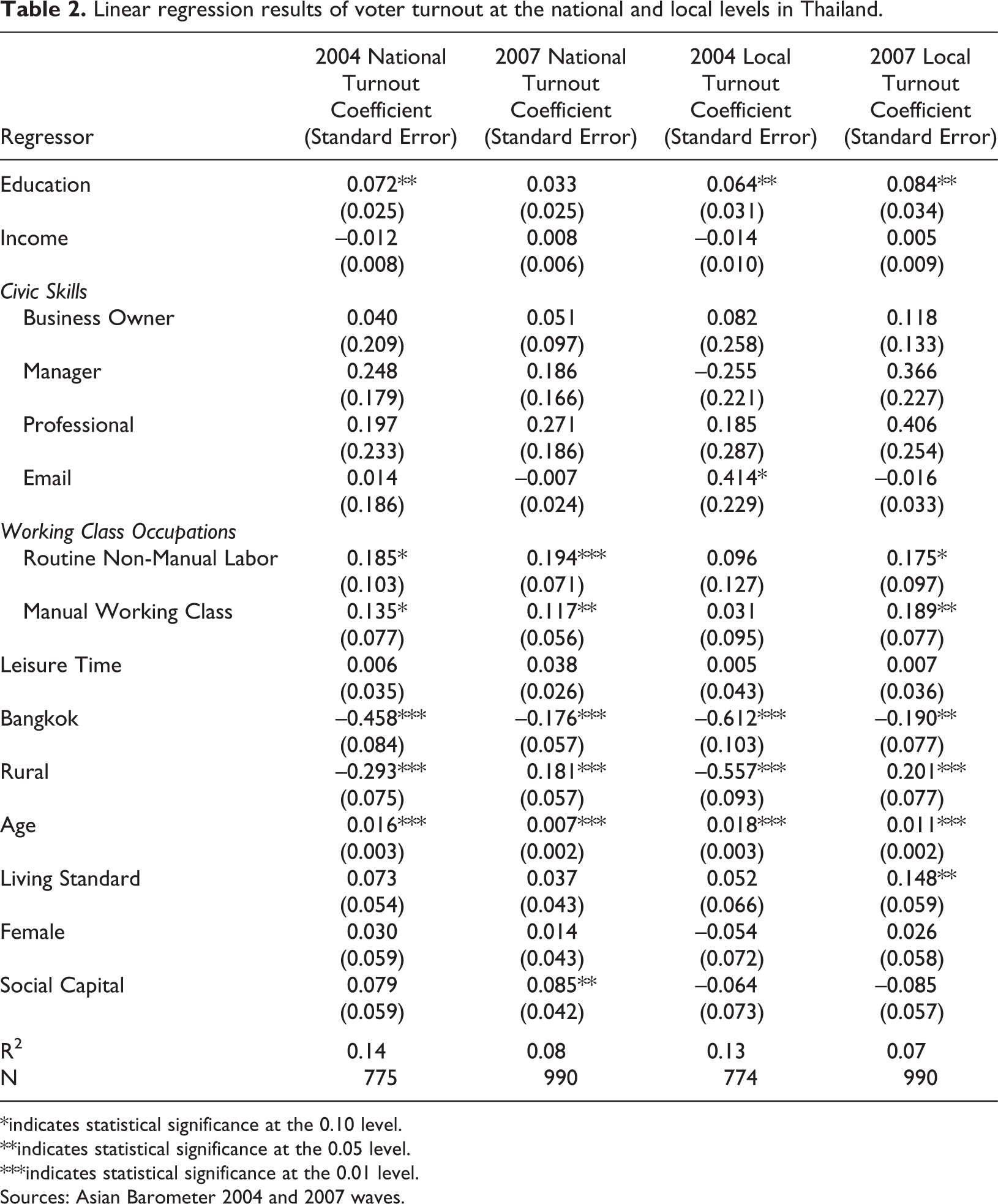
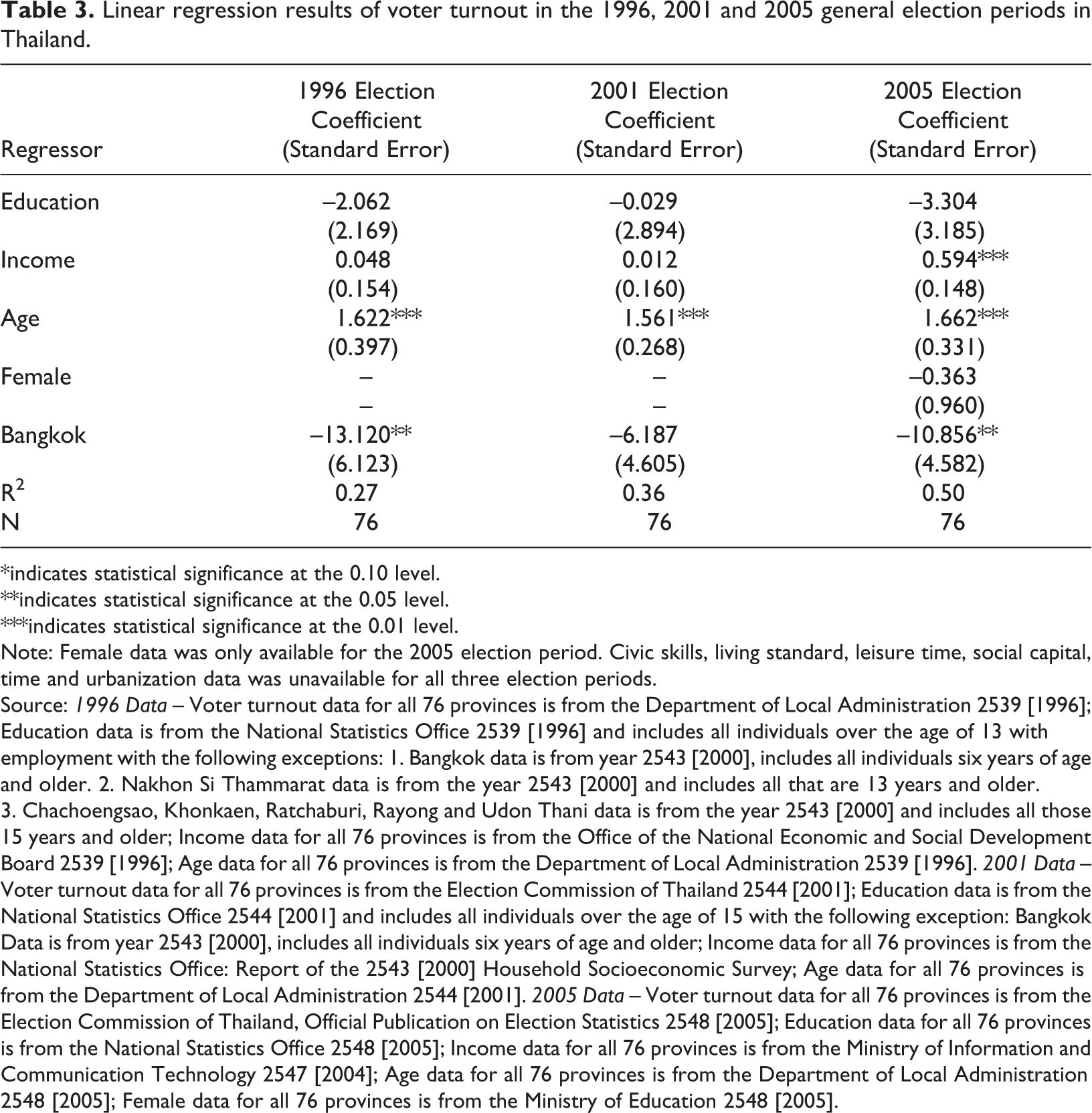
Due to the nature of the dependent variables across datasets, both logistical and linear regression are employed. Logistical regression is most appropriate for the analyses with boycotts, demonstrations and petitions because there are two categories on each of the dependent variables and linear regression is most appropriate for the turnout analyses as there are at least five categories on the dependent variables. Across the turnout measures, those with fewer resources vote at least as much as those with greater resources. Regarding the SES measures, even though education is statistically significant across the turnout measures for 2004 and the local turnout level in 2007 (see Table 2), it is not statistically significant across any of the election periods, demonstrating that provinces with lower average education levels have just as much voting as those provinces with higher average education levels in all three elections. As stated in Table 2, education is statistically significant for the 2004 national turnout level, the 2004 local turnout level and the 2007 local turnout level as a one increment increase in education causes 0.072, 0.064 and 0.084 point increases in expected turnout respectively. The effect of education on local voter turnout is therefore greater than on national voter turnout. As a matter of fact, across the five measures of national turnout—2004 and 2007 at the individual level and 1996, 2001 and 2005 at the province level—only one of the five has statistical significance (see Tables 2 and 3). A possible explanation for this is that the higher stakes of national offices bring a greater willingness of patrons to endure the higher risk and expense associated with clientelism. Overall it is clear that those with less education are voting at least as much as their higher educated counterparts across national elections.
Linear regression results of voter turnout at the national and local levels in Thailand.
*indicates statistical significance at the 0.10 level.
**indicates statistical significance at the 0.05 level.
***indicates statistical significance at the 0.01 level.
Sources: Asian Barometer 2004 and 2007 waves.
Linear regression results of voter turnout in the 1996, 2001 and 2005 general election periods in Thailand.
*indicates statistical significance at the 0.10 level.
**indicates statistical significance at the 0.05 level.
***indicates statistical significance at the 0.01 level.
Note: Female data was only available for the 2005 election period. Civic skills, living standard, leisure time, social capital, time and urbanization data was unavailable for all three election periods.
Source: 1996 Data – Voter turnout data for all 76 provinces is from the Department of Local Administration 2539 [1996]; Education data is from the National Statistics Office 2539 [1996] and includes all individuals over the age of 13 with employment with the following exceptions: 1. Bangkok data is from year 2543 [2000], includes all individuals six years of age and older. 2. Nakhon Si Thammarat data is from the year 2543 [2000] and includes all that are 13 years and older. 3. Chachoengsao, Khonkaen, Ratchaburi, Rayong and Udon Thani data is from the year 2543 [2000] and includes all those 15 years and older; Income data for all 76 provinces is from the Office of the National Economic and Social Development Board 2539 [1996]; Age data for all 76 provinces is from the Department of Local Administration 2539 [1996]. 2001 Data – Voter turnout data for all 76 provinces is from the Election Commission of Thailand 2544 [2001]; Education data is from the National Statistics Office 2544 [2001] and includes all individuals over the age of 15 with the following exception: Bangkok Data is from year 2543 [2000], includes all individuals six years of age and older; Income data for all 76 provinces is from the National Statistics Office: Report of the 2543 [2000] Household Socioeconomic Survey; Age data for all 76 provinces is from the Department of Local Administration 2544 [2001]. 2005 Data – Voter turnout data for all 76 provinces is from the Election Commission of Thailand, Official Publication on Election Statistics 2548 [2005]; Education data for all 76 provinces is from the National Statistics Office 2548 [2005]; Income data for all 76 provinces is from the Ministry of Information and Communication Technology 2547 [2004]; Age data for all 76 provinces is from the Department of Local Administration 2548 [2005]; Female data for all 76 provinces is from the Ministry of Education 2548 [2005].
The other SES measure, income, is not statistically significant across any of the election levels, though it is statistically significant at one point in time, 2005, as a 10,000 baht increase in income across the province causes just over a half point increase in expected turnout. While the richer provinces sustained more voting than the poorer provinces in 2005, this is not the case in 1996 and 2001 or across the election levels. Differentiation across income levels seems to be even less prominent than education as income is only statistically significant on one of the seven turnout measures. Poorer Thais voted on par with their wealthier counterparts in almost every election, with the exception of one; clientelism seems to be a solid explanation for their participation. It seems that SES has very little to do with voting, suggesting clientelism may be a better explanation.
There is more to the clientelist explanation of voter turnout. First, both the routine non-manual labor and manual working class voted at the national level in 2004 and 2007 and at the local level in 2007 more than their counterparts. As stated in Table 2, routine non-manual labor is statistically significant as a one increment movement in this occupation causes 0.185, 0.194 and 0.175 point increase in the 2004 national turnout level, the 2007 national turnout level and the 2007 local turnout level respectively. Moreover, manual working class is statistically significant as a one increment movement in this occupation causes 0.135, 0.117 and 0.189 point increase in the 2004 national turnout level, the 2007 national turnout level and the 2007 local turnout level respectively. Given that these are the occupations of the broader working class, those of lower SES compared to their middle class counterparts, the clientelist explanation garners further support.
Next, those outside of Bangkok are clearly voting more than the Bangkokians; a one increment increase in being from Bangkok causes 0.458, 0.176, 0.612 and 0.190 point decreases in the 2004 national turnout level, the 2007 national turnout level, the 2004 local turnout level and the 2007 local turnout level respectively. It is the same story across the democratic period; a one increment increase in being from Bangkok causes 13.120 and 10.856 point decreases in expected turnout in 1996 and 2005 respectively. Even though Bangkok is statistically insignificant for 2001, the coefficient is high and negative; taken in the context of the broader Bangkok findings, it is suggestive of a pattern across the democratic period. Moreover, even though these voters were predominantly from urban centers outside of Bangkok in 2004, there is a movement towards the countryside by 2007. In 2004, a one increment increase in being from the countryside causes 0.293 and 0.557 point decreases in national and local turnout respectively while in 2007 it causes 0.181 and 0.201 point increases in national and local turnout respectively.
Across the turnout measures, Bangkok is statistically significant with a negative coefficient. Given the statistical significance of the other participation measures and positive correlations, there is a clear divide between the types of participation and Bangkok. A probable explanation for these findings is that Bangkokians are well aware that clientelism likely drives those outside the capital city to vote and may even alter the outcome of elections—that is, Bangkokians may realize that candidates likely represent their own corrupt self-interests and not the interests of those who vote for them. Several, including Arak, have suggested as much. If this is the case, then it may be that Bangkokians are abstaining from voting because they feel elections are just too corrupt.
Finally, as expected, older Thais are voting more than their younger counterparts. A one year increase in age causes 0.016, 0.007, 0.018 and 0.011 point increases in the 2004 national turnout level, the 2007 national turnout level, the 2004 local turnout level and the 2007 local turnout level respectively. Also a one year increase in age across the province causes 1.622, 1.561 and 1.662 point increases in expected turnout in 1996, 2001 and 2005 respectively. That older Thais, who are not necessarily educated and do not necessarily have a great sum of income, participate more is not surprising. Owen (2013a) offered a few reasons that support these findings. Specifically, they were acclimated to clientelism at an early age and they have a greater need for the compensation. Older Thais may simply lack financial security in their elder years and therefore must depend on their offspring for financial support. Considering that this financial support may not be dependable—perhaps because the children are residing far away in urban locales such as Bangkok and have difficulty finding time to return home—older Thais may be less difficult to entice as clients (Owen, 2013a). This notion has been suggested by others, including Phomphat (2008) and Sudsawad (1992).
Resources such as civic skills and leisure time, those usually enjoyed by the affluent, simply provide very little insight into voter turnout, though email is statistically significant for the 2004 local turnout. Other factors, such as living standards, gender and social capital, seem to only matter a little, suggesting that Thais from all living standards, both genders and all degrees of social capital participate at a similar level. Perhaps this is further support for clientelist theory.
Support for the clientelist theory extends beyond voter turnout. First, regarding demonstrations, the other incentivized clientelist form of participation, the only statistically significant resource is education; as stated in Table 4, education increases the likelihood of demonstrating by 1.506 times. Unlike voter turnout, participation in demonstrations occurs in Bangkok; being from Bangkok increases the likelihood of demonstrating 2.186 times. Next, resources tend to explain a bit more about boycotting. Education, leisure time and being from Bangkok are important attributes of boycotting as they increase the likelihood of boycotting by 1.730, 1.634 and 2.852 times respectively. Moreover, the routine non-manual labor is not likely to boycott as working in this occupational context decreases the likelihood of boycotting by 0.252 times, along with males boycotting more than females as being female decreases the likelihood of boycotting by 0.498 times. Finally, those who petition tend to only be differentiated by education which increases the likelihood of petitioning by 1.458 times.
Logistic regression results of political participation in Thailand.

*indicates statistical significance at the 0.10 level.
**indicates statistical significance at the 0.05 level.
***indicates statistical significance at the 0.01 level.
Source: Asian Barometer 2007. The 2004 wave of the Asian Barometer did not include observations for these dependent variables.
The findings suggest, just as this clientelist theory predicted, that clientelism may be driving some to participate in politics. First, those with fewer individual resources vote at least as much as those with resources. Clientelist theory is further supported by the fact that the older working class individuals outside the capital city vote more than their more affluent Bangkokian counterparts. An important point to unpack from these findings is that the poor are just as likely to vote as the rich, with clientelism offering a compelling explanation for the former’s participation. The findings at the aggregate level are especially interesting as they offer strong support for the individual level findings, even in the absence of several control measures. Moreover, neither civic skills nor leisure time are important for understanding voter turnout. Next, those with fewer individual resources demonstrate at least as much as those with resources, though more in Bangkok than elsewhere. Finally, individual resources offer more insight into boycotting than other forms of participation as education, leisure time and Bangkok residence in other than working class occupations increase boycotting. Resources do matter for petitioning.
Implications
While the findings of this study may be suggestive of clientelism driving some to participate, it is still not clear how these individuals vote once at the polls. Does clientelism drive clients to vote in a manner that is conducive to the desires of the patron? Unfortunately there is not a simple answer to this question. On the one hand, clients may cast their votes for the patron because of a preexisting trust relationship or simply out of a sense of obligation (Callahan, 2000; Gomolpelin, 1998).
On the other hand, clients may be in the process of learning that they do not have to cast their votes in a manner consistent with the demands of the patron. For instance, clients may be in the midst of learning about their right to choose and understanding they can benefit from the political process. Or perhaps they may be in the midst of demanding good leadership or maybe the performance of the incumbent matters (Owen, 2013a). Sumit stated as much as he has even told poor voters to “take the money from vote-buyers if you must, but vote for the better candidate.” Anne,
14
a politician and economic forecaster with the Puea Thai Party, does not believe clientelist networks result in votes for patrons. She maintains that voters in the democratic age may be accepting compensation for their votes, but they may actually be voting for who they want, not how they were paid. She explains. Before, the traditional Thai way of vote-buying was for people to take the money for their votes and commit to that candidate, but not these days. Nowadays people understand that they can take the money and vote for someone else. This is the impact of education, being educated from experiences of past circumstances. Oh, this guy bought votes, but during the four years in office, he never worked for us. This is because they buy the people, buy the position, then they focus on getting their money back once in office through corrupt practices. Nowadays people really know what’s going on with these corrupt practices. There is no need to commit to a candidate who buys votes. We tell voters that patrons give you money and they will find a way to get that money back. Why would they give you money for free? So you must choose the people who will work for you, not those who buy you. You see and select the good candidate, not the bad one, but decide for yourself. Whichever party provides the policies that benefit you and your family, vote for that one.
This study may also provide necessary insight into a potential cause of the political turmoil that has plagued Thailand since its movement away from democracy. In September 2006, the military ousted the prime minister; the military coup was peaceful in nature and caused very little disruption. Since then Thailand has yet to return to democracy—that is, while there may have been elections, contestation is questionable, governments have been appointed and another military takeover occurred in 2014. The virtual peaceful nature of military occupation and passivity of the Thai population may be a product of pervasive clientelism. It may be the case that the military realizes clientelism drives voter turnout specifically and the candidates simply do not represent the interests of the Thai people. Therefore, the military likely does not expect citizens to rise up against military intervention because those taken out of power do not represent the interests of the people anyhow. Many Thais are likely quite tired of corrupt practices like clientelism leading to corrupt politicians and when the military makes the argument that it intervenes to save democracy, this likely pacifies many, at least in the short term.
Clientelism must be combated and elected leaders need to become more aware of issues important to Thais and concerned about the general welfare of the Thai people. As Thais attain more agency and become more empowered, they can hold elected leaders more accountable and issues important to the Thai people can finally begin to surface. Combatting clientelism is essential to not only giving voice to voters, but also transitioning to democracy on a pathway that may finally bring about a consolidated democracy.
While it is not clear whether Thailand will become democratic once again—and, if so, if corrupt practices like clientelism will continue to plague democracy—or whether it will continue down this authoritarian pathway of uncertainty, it is clear that clientelism is a concern for the prospects of a democratic return, legitimacy and potential consolidation. Clientelism may be one of the primary reasons Thailand continues to fail at consolidating its democracy, which may also be responsible for the recent military coups. This study takes a necessary step forward in understanding the effect of clientelism on political participation, in addition to specifying the theory of clientelism in a model that can be empirically tested. Even so, more work is necessary. While this study is a necessary step towards sufficiency, further specification of clientelism is needed as it is somewhat possible this model may exclude, in a limited capacity, certain clientelist activity and capture, in a limited capacity, non-clientelist activity. 15 This model of clientelism should therefore be conceived as a living model that needs further testing nationally and cross-nationally. I suspect this model will continue to evolve as more tests are conducted. It is my hope that this study inspires other quantitative methodologists to engage the study of clientelism not just in Thailand but in the broader developing world. Also, investigation into how clients cast their votes after showing up at the polls needs to commence.
Footnotes
Appendix A
Acknowledgements
The author would like to express sincere thanks to the following individuals for their helpful comments: Robert Albritton, Stephen Bloom, Ryan Burge, Yong Cai, J Tobin Grant, Apinya Owen, Stephen Shulman, Frederick Solt, Ayako Toyama, Vincent Wei-Cheng Wang, David L Wilson, Thongchai Winichakul and the anonymous reviewers. The author appreciates the assistance in providing data from the East Asia Barometer Project (2001–2003), the Asian Barometer Project (2005–2008), Profs. Fu Hu and Yun-han Chu, and the Asian Barometer Project Office. The views expressed are the author’s own. All errors remain the responsibility of the author.
Declaration of conflicting interests
The author(s) declared no potential conflicts of interest with respect to the research, authorship and/or publication of this article.
Funding
Data analyzed in this article were collected by the East Asia Barometer Project (2001–2003) and the Asian Barometer Project (2005–2008), which was co-directed by Profs. Fu Hu and Yun-han Chu and received major funding support from Taiwan’s Ministry of Education, Academia Sinica and National Taiwan University. The Asian Barometer Project Office ( ) is solely responsible for the data distribution.