



Abstract
This study examines the effect of the demographic trend on the breakdown of authoritarian regimes in the Middle East. Several scholars have pointed out that the combination of youth’s disproportionate share of the total population, the “youth bulge,” and high unemployment throws a society into turmoil. The demographic change determines not only how human activities are conducted but also how a society embarks on a political transition, such as a revolution, a state breakdown, or a regime change.
I conduct two levels of empirical analysis of the political implications of the demographic dynamics in the Middle East. First, the macro-level analysis is based on cross-sectional data over two decades. This analysis will clarify whether the youth population had a significant effect on the Arab uprisings. Second, the micro-level analysis uses survey data from the Arab Democracy Barometer wave III to examine whether there is a significant correlation between youth and participation in protest. This analytical approach integrates the macro level with the micro level in order to avoid an ecological inference.
My empirical analysis finds evidence to support Jack Goldstone’s revolution theory: it is built on demographic changes accompanied by rising food prices. The hypothesis is tested by examining the interactive effect of youth bulge and the deteriorating economic situation in the two decades following the end of the Cold War. The empirical tests at both the macro and micro levels identify a statistically significant effect.
In early 2011, the uprisings of Arab peoples led to the breakdown of, first, the regimes in Tunisia and Egypt, and then, later in that year, the regimes in Libya and Yemen. Since unrest in Syria turned into a state of civil war, by late July 2015 over 250,000 people have died and approximately four million people abroad and 6.5 million inside the country have been internally displaced or made refugees. 1 Libya and Yemen are also in a de facto state of civil war, and their new leaderships have been unable to create unified political order in the countries. The sequence of uprisings known as the Arab Spring and the subsequent turmoil called the “Arab Winter” originated in the social and political implications of certain demographic trends, especially the existence of an extensive younger generation in the Arab world. As Ragui Assaad puts it, “demographics, simply by having large numbers of people who are very frustrated at their inability to turn their education into productive jobs, has really exacerbated the problems” (Assaad, 2011: 237).
Emmanuel Todd and Youssef Courbage suggest that the fundamental transformations of the Arab and Islamic societies are due to the concurrence of an increasing literacy rate and decreasing birth rate. These demographic transformations have brought tremendous political turmoil and social instability (Todd and Courbage, 2011). Todd indicated the validity of his argument at the time of the Arab Spring (Todd, 2011). Yamauchi Masayuki, a historian of the Ottoman Empire, describes the Arab uprisings as “the youth bulge question.” The youth bulge is the peculiar demographic trend that a society faces when the young generation constitutes the largest share of its population. Yamauchi interprets the revolts in the Arab world as an insurgency caused by a demographic “time bomb” (Yamauchi, 2012: 40–48).
This study examines the effect of this demographic trend on the breakdown of authoritarian regimes in the Middle East. In addition to Assaad and Todd, scholars have pointed out that the combination of youth’s disproportionate share of the total population, the “youth bulge,” and high unemployment throws a society into turmoil (Amin et al., 2012; Campante and Chor, 2012; Courbage, 2015; Haas and Lesch, 2012; Hoffman and Jamal, 2012; Matthijs et al., 2015; Singerman, 2013). Tsunekawa (2012) argues that a sense of grievance among highly educated jobless youth was one of the five major causes of the Arab uprisings. The demographic change determines not only how human activities are conducted but also whether a society embarks on a political transition, such as a revolution, a state breakdown, or a regime change.
The Middle Eastern countries had never faced a wave of democratization until the Arab Spring. The political regimes in most developing countries were democratized in the late 20th century, by what Samuel Huntington has called the “Third Wave” of democratization (Huntington, 1991). Since Arab authoritarianism had strength and robustness at that time, the notion of Arab exceptionalism became a popular explanation for the phenomenon. Here, there is a reason to overcome the exception and ask the question: Why did the breakdown of four Arab regimes happen over 20 years after the Third Wave?
In the following section, we explain the theory of youth bulges and examine its theoretical compatibility with the Arab Spring. The second section is a literature review to outline the puzzle of the link between demographic change and revolution. The third section describes our analytical strategy with a macro dataset and micro data from the 12-country survey of the Arab Democracy Barometer wave III. The fourth section shows our empirical results both in the macro- and the micro-level analysis. The final section discusses the results and indicates some theoretical implications.
The theory of youth bulges and revolutions
This study focuses on the Arab Spring as a political result of demographic change in the Middle East. Several scholars regard the mass demonstrations that led to regime breakdowns in the Middle East, especially in Tunisia and Egypt, as modern revolutions (Amin, 2013; Courbage and Puschmann, 2015; Diwan, 2014; Gunning and Baron, 2013; Haddad et al., 2012; Khalil, 2012; Urdal, 2012). Jack A Goldstone, a leading theorist on the role of youth in revolutions, suggests that the Arab revolts resulted from the combination of a large proportion of highly educated young people and high unemployment (Goldstone, 2011). 2 In this study, I follow Goldstone’s (2014: 3) definition of revolution as “a forcible change in government, mass participation, and a change of institutions.” Thus, revolutions are rare events, occurring only when rulers are weak and isolated from their power base. Goldstone claims that most political scientists and historians would agree with his definition. Revolutions have the characteristics of uncoordinated popular actions aimed at changing political structures.
It is noteworthy that Goldstone’s (1991) revolution theory is built on demographic change, especially the observation of the expansion of youth cohorts accompanied by falling real wages, rising food prices, or deteriorating living conditions. According to his argument, population growth was coincident with relatively high food prices and low wages because, “if population size moved for its own reasons and food supplies were relatively stable, then a growing population and rising demand would lead to higher prices” (Goldstone, 1991: 28). The population dynamics, a long-term cumulative phenomenon of an increasing youth share, would put pressure on the existing social and political structures and then lead to a sudden rebellion, similar to the geological pressures that lead to an earthquake. The characteristics of institutions are important with regard to whether rebellion can be avoided. As Goldstone (1991: 36) explains: Where institutions are flexible, as in modern democratic states, pressures can usually be absorbed through electoral realignments and policy changes. Where institutions are relatively inflexible, as in hereditary monarchies or empires with traditional systems of taxation, elite recruitment, and economic organization, the result is more likely to be revolution or rebellion.
The puzzle
In this section, we look at the statistical data on the peculiar demographic trend. Figure 1 illustrates the two measures of youth bulge for Egypt, Tunisia, and Syria during the 60-year period 1950–2010. The first measure is the ratio of the cohort aged 15–29 to the total population; this is the measure of the youth bulge that is often used in the literature (Assaad, 2011; Collier, 2009; Collier et al., 2011). The second measure is the ratio of the cohort aged 15–24 to the total adult population (aged 15 and above), 3 which is intended to avoid underestimation of the demographic effect of young people in a society (Fearon and Laitin, 2003). This measure presents a theoretical perspective regarding youth revolt as a violent phenomenon originating from competition between younger groups and older groups (Urdal, 2006: 615; Urdal, 2012: 7). Some researchers have, ambitiously, proposed a threshold level above which youth bulges are associated with political violence. Huntington (1998: 117–118) indicates that the violence of “Islamic fundamentalism” appeared sporadically and was synchronized with the share of youth, the group aged 15–24, exceeding 20% of the total population. Gunnar Heinsohn (2003) suggests that youth bulges appear and contribute to civil unrest when the ratio of youth aged 15–24 to the total population exceeds 20%, or the ratio of youth under age 15 exceeds 30% of the total population.
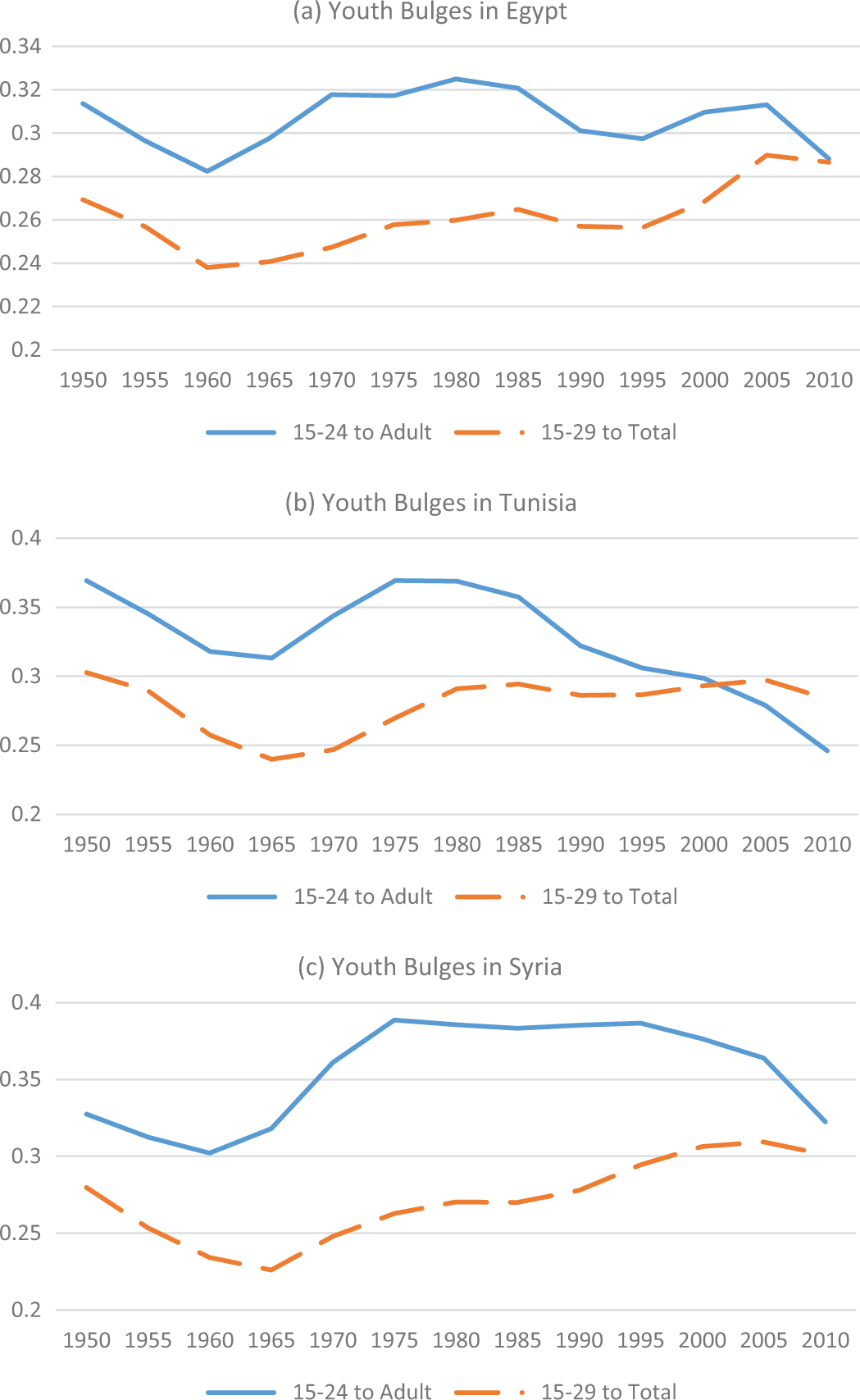
Youth bulges and dependency ratio.
Figure 1, panel (a) shows a growing trend in Egypt toward 30% for the group aged 15–29 as a share of total population, and a consistently greater than 28% ratio of youth aged 15–24 to the adult population. This means that the youth population will continue to supply a sufficiently large group for future political violence. The Egyptian rebel movements, including the Muslim Brotherhood, Jama’a Islamiya, some liberal parties, and terrorist organizations such as ISIS, will be free from worry about recruiting new members. Panel (b) shows that Tunisia has had a steady stream during the past 30 years of the group aged 15–29 constituting approximately 29% of the total population and a declining trend in the group aged 15–24 as a share of the adult population during the past 35 years. The declining trend of the ratio of younger people to the adult population, the second measure of a youth bulge, may indicate that Tunisia is following the route taken by developed countries. 4 Panel (c), for Syria, shows the first measure of a youth bulge increasing since 1965 and the second measure decreasing since 1995. If Huntington and Heinsohn are correct about a relationship between demographic trends and revolt, the data shown in Figure 1 would support their theory that the youth bulges are the underlying cause of the Arab revolutions.
The empirical results of Henrik Urdal, however, do not support the existence of such a threshold. He claims that “[t]here is no support for Huntington’s expectation that there is a threshold level for youth bulges to generate domestic armed conflict” (Urdal, 2006: 619). Brownlee, Masoud, and Reynolds (2015: 35) perform a simple statistical check: a “look at the data across the cases that had major uprisings and those that did not, however, reveals there is not a statistically significant difference in median age between the two groups.” Figure 1 also shows no drastic change in the demographics of the three countries after the turn of the century. Rather, the dynamics of the youth bulges in the countries vary and are not congruent among the countries that experienced major rebellions. Courbage and Puschmann (2015: 214) indicate that the peak of the youth bulge in the Arab countries appeared before the onset of the Arab Spring. Although the size of the youth population seems to be one of the causes effecting enormous political change, it is just a prerequisite. Iwasaki (2012: 114) makes a similar point specific to the case of Egypt: the phenomenon of a large share of youth in the population is not unique to recent years. We can, therefore, conclude that the demographic trend of young generations in the Middle East is not the only cause of the Arab uprisings.
In the early stages of discussions about the Arab revolts, some scholars (Gana, 2012; Khraif et al., 2015; Korotayev and Zinkina, 2011; Lagi et al., 2011, 2012) emphasized the rise of international food prices as a cause. Lagi and his colleagues found a pattern between the frequency of social unrest and peaks in international food prices. They indicated that the Arab uprisings followed the historical pattern of food riots. From a theoretical perspective, the determinant of the rebellions in the Arab world would seem to be the price shock of food combined with the demographic foundation of a continuous expansion of the youth population (LaGraffe, 2012; Mirkin, 2013; Mulderig, 2013). The hypothesis is that the youth bulge and rising food prices interactively affected popular uprisings in the Middle East after the first decade of the 21st century.
Theoretical discussions of revolutions and major rebellions have proposed an alternative explanation, however: the effect of inequality. Acemoglu and Robinson (2006) is representative of recent literature in the applied game theory approach and insists on an inverted U-shaped relationship between rich–poor inequality and the likelihood of democratic transition. Boix (2003) builds a formal theory of political transition based on two players, one rich and one poor, and with the objective of an optimal redistribution policy in a strategic situation. Ansell and Samuels (2014) is a representative recent study focused on changing inequality in democratization, modeled as an elite competition game. In this study, I introduce a hypothesis that the youth bulge and increasing inequality were involved in the people’s revolt in the Arab world.
I conduct two levels of empirical analysis of the political implications of the demographic dynamics in the Middle East. First, the macro-level analysis is based on cross-sectional data over two decades. This analysis will clarify whether the youth population had a significant effect on the Arab uprisings. Second, the micro-level analysis uses survey data in the Arab Democracy Barometer wave III to examine whether there is a significant correlation between youth and participation in protest. This analytical approach integrates the macro level with the micro level in order to avoid an ecological inference.
Methods and data
Macro-level analysis
To test the hypothesis about the effect of demographic change on the Arab Spring, I use cross-sectional time series (CSTS) regression of an ordered logit model of breakdowns in autocracy. This method is the same statistical model as was used in my previous study of regime transition (Hamanaka, 2014). The data are divided into two periods, from 1990 to 2000 and from 2001 to 2011, and are observed as a binary time series. The dependent variable is a categorical measure of regime type in Middle Eastern countries, based on the Polity IV Project: open anocracy (1), closed anocracy (2), and autocracy (3). The Polity IV Project team defined anocracy as an intermediate regime between democracy and autocracy. We cannot compile 1990–2011 country–year type data owing to the many unobservable missing values in some variables.
One of the independent variables is an operationalized measure of youth bulge, measured as the 10-year average share of the cohort aged 15–30 relative to the total population. Data originate from the World Bank’s World Development Indicators. The other independent variable is the effect of international food price on demonstrations that cause regime breakdowns. I operationalize this variable as the international food price index (IFP index) and imports share of GDP. Data on the IFP index were collected from the annual deflated Food Price Index produced by the Food and Agriculture Organization of the United Nations (FAO). In this study I also examine the interaction of youth bulges and international food price with regard to anti-regime demonstrations. To examine another hypothesis, the effect of inequality on regime transition, I operationalize it as the 10-year average of Gini index from the 2008 Estimated Household Income Inequality (EHII) dataset produced by the University of Texas Inequality Project. Since the 2008 EHII dataset is missing data for oil-rich countries, data from Bibi and Nabli (2010: 93) are used for the missing Arab countries, and the index of income inequality in the Gulf countries is calculated on the basis of oil-wealth data from the World Values Survey.
The main control variables 5 for the macro-level analysis are the same as those used in my earlier study (Hamanaka, 2014): GDP per capita, the ratio of oil rent to GDP, and a republican dummy. The level of economic development, represented by GDP per capita, has a strong effect on the probability of a democratic transition and consolidation (Boix and Stokes, 2003; Dahl, 1971; Epstein et al., 2006; Lipset, 1959) and also makes a significant contribution to the survival of an existing democratic regime (Przeworski, 2000). In contrast, the extent of oil rent of the national economy significantly promotes the survival of an existing authoritarian regime. Patterns of oil income, regardless of the country’s wealth, help us to understand the robustness of authoritarianism, whether in a monarchy or a republic, in the Middle East (Hamanaka, 2007; Matsuo, 2010; Ross, 2012; Smith, 2007). Regime type – republic or monarchy – represented the degree of legitimacy against the volatile mass demonstrations (Brynen et al., 2012: 186; Hudson, 1977: 165–229). Hamanaka and Shiratani (2015) investigate the legitimacy of an Arab monarchy with no oil rents and no dynastic monarchy 6 as a stabilizer mechanism in the case of Morocco. The study clarifies that a mechanism behind the regime stability of the Moroccan monarchy is voters’ recognition of party politics in the legislature as effective “democracy.”
Micro-level analysis
To test the hypothesis about youth and participation in protest, at an individual level, I use regression analyses of logit and rare event logit models of participation in demonstrations against Arab authoritarian regimes. Both regression methods are preferable for binomial data, and the components of dependent, independent, and control variables in these models were also similar to those in my previous research on the “Internet revolution” (Hamanaka, 2015).
The dependent variable is participation in the demonstrations against the authoritarian regimes during the Arab Spring, and is observed as a binary outcome based on data from the Arab Democracy Barometer wave III conducted in 12 Arab countries from late 2012 to the spring of 2014. The survey data were collected via face-to-face interviews in Arabic with a representative national sample of the population aged 18 and above. The sample of 14,809 citizens was drawn up based on strata defined by current census characteristics such as residential neighborhood and gender.
The plan of the micro-level analysis in this study is to analyze the survey data to examine the influence, at the level of an individual citizen, of youth bulges and poor economic situation (e.g. rising prices, gap between rich and poor, and unemployment) and political reasons (e.g. civil and political freedoms and emancipation from oppression) on the size of the anti-regime demonstrations. To test the youth-bulge hypothesis, age and gender are used as independent variables. Young and strong men are suitable demonstrators against the police or security corps on the streets (Hoffman and Jamal, 2012). To examine another hypothesis, the effect of economic situation and political reasons on regime transitions, I include response combination variables. The Arab Democracy Barometer asked respondents for the three main reasons that led to the Arab Spring. We can recode the response combination because the respondents could put their three choices in arbitrary order. The combination type-I is the set of “betterment of the economic situation” as the first reason and “fighting corruption” as the second reason that led to the Arab Spring. The combination type-II means that the first choice of the respondents is “political reasons” and the second choice is “economic situation,” chosen from the set of reasons for widespread mass demonstrations in the Arab Spring. 7
The control variables for the micro-level analysis are similar to those used in my earlier study (Hamanaka, 2015; Hamanaka and Shiratani, 2015): social media, political psychological factors, and ideological issues of political religion. Many journalists, commentators, and specialists regarded the mass demonstrations against Ben Ali, Mubarak, Qaddafi, Saleh, and Bashar al-Assad as the “Internet Revolutions” in the Middle East. They underscored the significant role played by Facebook, Twitter, and other social media networks in the diffusion of information that contributed to breaking down the authoritarian regimes (Brym et al., 2014; Howard and Hussain, 2013; Tufekci and Wilson, 2012; Wolfsfeld et al., 2013).
The psychological factors of politics include feelings of grievance, dissatisfaction, and anger at the political leadership due to poor performance in terms of nepotism (wasta in Arabic) or unlawful procedures in criminal and security issues (Brym et al., 2014; Davis, 1962; Wolfsfeld et al., 2013). During the revolutions, the public showed their indignation at the dictatorships’ corruption and offenses against human dignity. The people took to the streets and called for justice and freedom (Haddad et al., 2012).
Religion, especially Islam, has an important role in Middle East politics. After the Arab revolutions, Islamic political parties, for example the Justice and Development Party in Egypt or An-Nahda in Tunisia, won power in national elections. Since they were previously the only organizational oppositions that were repressed by the former authoritarian regimes, people often regard the Islamic parties as the alternative political power following the removal of the dictators. Islam is also the ideology of the establishment in maintaining monarchies in Saudi Arabia, Oman, Jordan, and Morocco. Some monarchs instrumentalized themselves as descendants of Muhammad in order to legitimize their political regimes. My earlier study (Hamanaka and Shiratani, 2015) selected some ideological variables of political Islam and secularism to be contained as a part of the control variables in the econometric models. This study follows it to control the models for getting unbiased estimations. To control the specific effect of each country, we include 12 country dummy variables into the micro-level regression models.
Results
Macro-level analysis
Table 1 presents the results of cross-sectional time series regressions in the ordered logit model. The results of Model 1 show that youth bulge is insignificant but that the food price indicator (the IFP index × imports share of GDP) is significant at the 0.05 level on the categorical measure of regime type in the Middle East. The results of Model 2 indicate that by itself youth bulge has no statistical significance but that the interaction term for youth bulge and food price is statistically significant at the 0.10 level with regard to regime change. An increase of one percentage point in the youth bulge is associated with a greater than 2% increase in the likelihood of regime transformation, and countries experiencing youth bulges of 40% or greater run a 27% higher risk of regime change than do countries with youth bulges of 30%, given all other variables at their means (Model 2). 8 In both Model 1 and Model 2 the republican dummy variable is statistically significant at the 0.01 level. The results are congruent with the fact that only the republics – Tunisia, Egypt, Libya, Yemen – experienced political regime change as a result of the Arab revolt.
Macro level analysis.
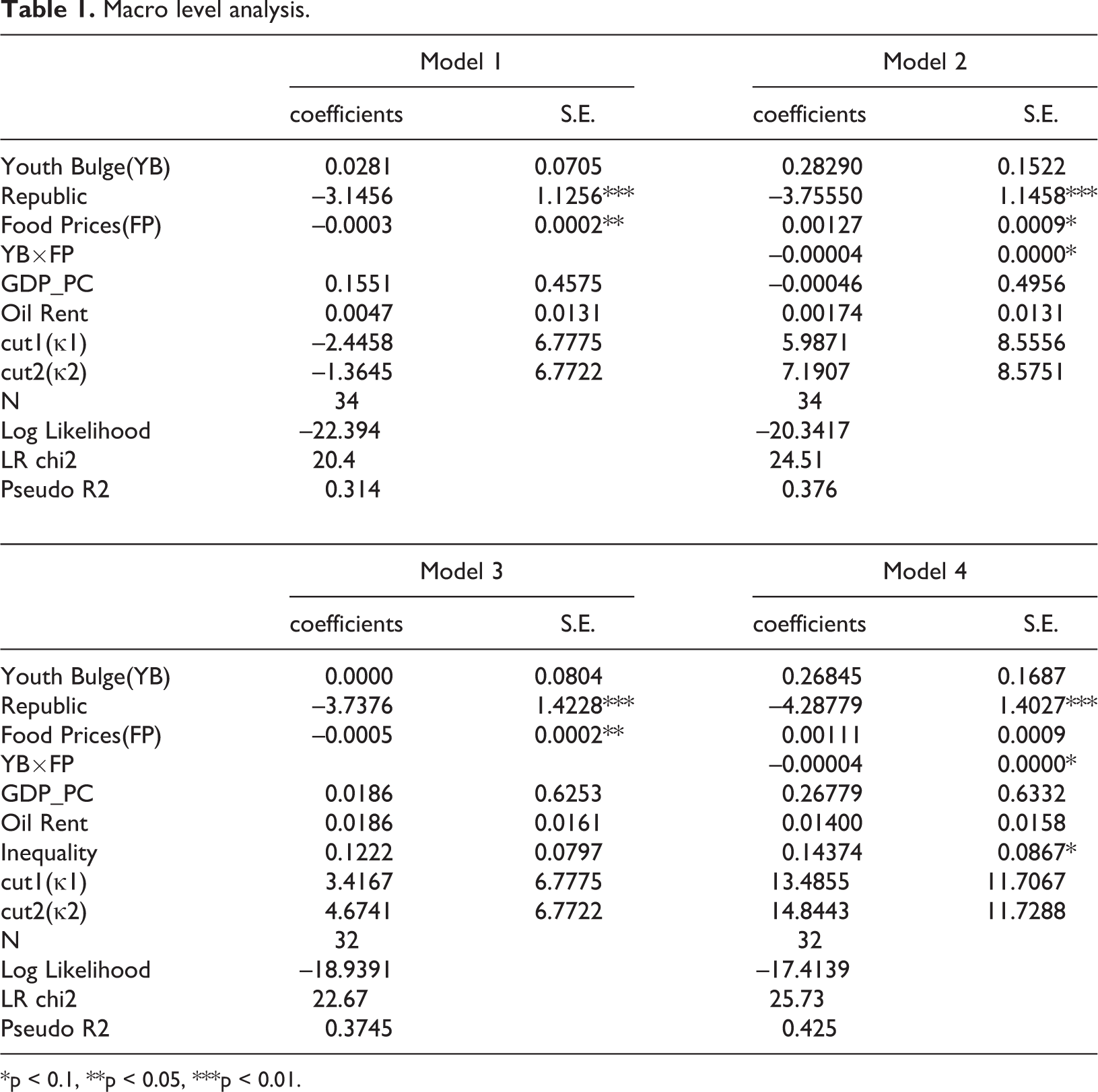
*p < 0.1, **p < 0.05, ***p < 0.01.
Model 3 displays results similar to those of Model 1; however, the results of Model 4, which contains the interaction term for youth bulge and the food price indicator, indicate a remarkable finding of inequality. The effect of the gap between rich and poor is statistically significant at the 0.10 level with systemic robustness. Thus, a high degree of inequality stabilizes authoritarian regimes in the Arab world. Model 4 also shows a significant result for this interaction term; thus, the logic of the combination of demographic features, rising food prices, and inequality is a potential explanation for the major rebellions against authoritarian regimes. The results integrate the hypothesis of youth bulge and food price shock with the alternative theory of inequality, although the statistical analysis provides only rough estimations.
Figure 2 shows the predicted probability of transition to open anocracy at various levels of the interaction term (youth bulge × the food price indicator) by holding the control variables in Model 2 at their means. Figure 2 includes only republican cases, because none of the Arab monarchies experienced regime transition. As shown in the figure, the probability of breakdown increases as the interaction term increases. For example, in Egypt’s Mubarak regime the 10-year average of the youth bulge decreased from 41.8% in the 1990s to 38.8% in the 2000s, but the food price indicator increased by approximately 50%. The probability of political transformation in 2011, when the interaction term was 18,000, was approximately 40%, which is four times higher than it was in 2000 when the interaction term was 13,000. The estimated probability of a breakdown in the Ben Ali regime in Tunisia was over 80% in 2011, because the interaction term was about 28,000 despite a youth bulge of 34%.
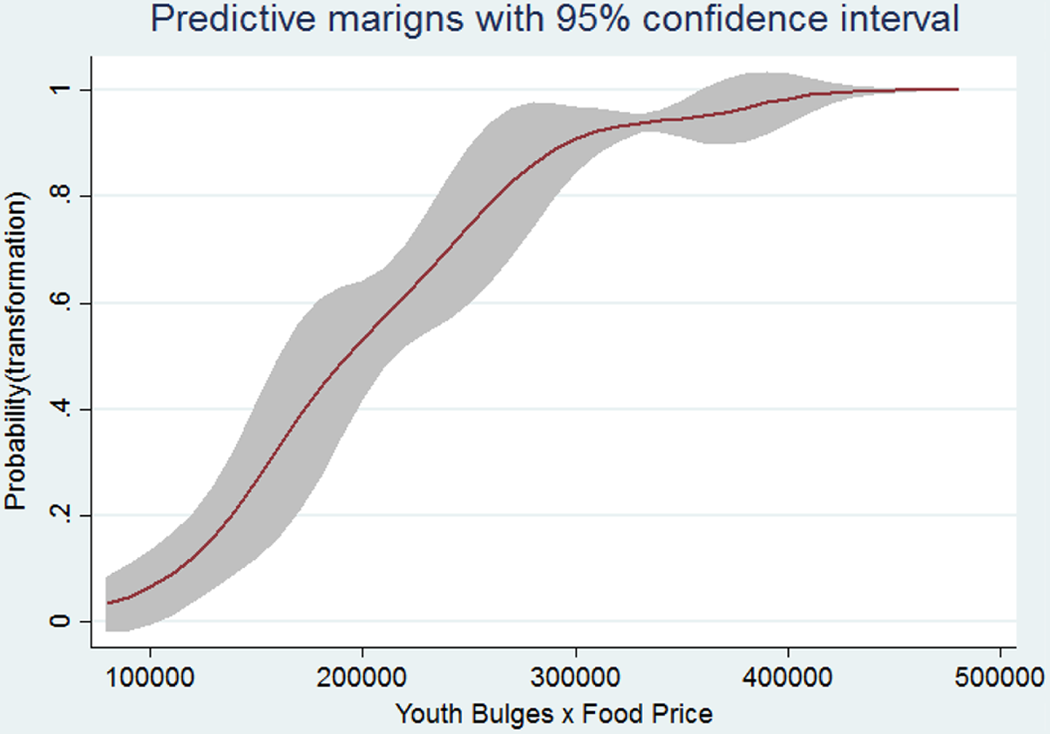
Effect of the interaction on regime transition (Model 2).
Micro-level analysis
Table 2 presents the results of binary regression of participation in street demonstrations in the Arab world. 9 The results of Model 5, the baseline model containing only demographic variables, show that both age and gender are statistically significant at the 0.01 level. In other words, the younger the male population, the more likely they were to participate in the street protests. The result is coincident with the image of youth bulge theory. Model 6, the model containing two types of reason in combination for the Arab revolutions on the baseline, provides that only type-II independent is significant at the 0.01 level with regard to the probability of an individual taking part in the protests. The citizens who propose “political reasons” first and “betterment of economic situation” second have a tendency to participate in demonstrations against Arab authoritarianism.
Micro level analysis.
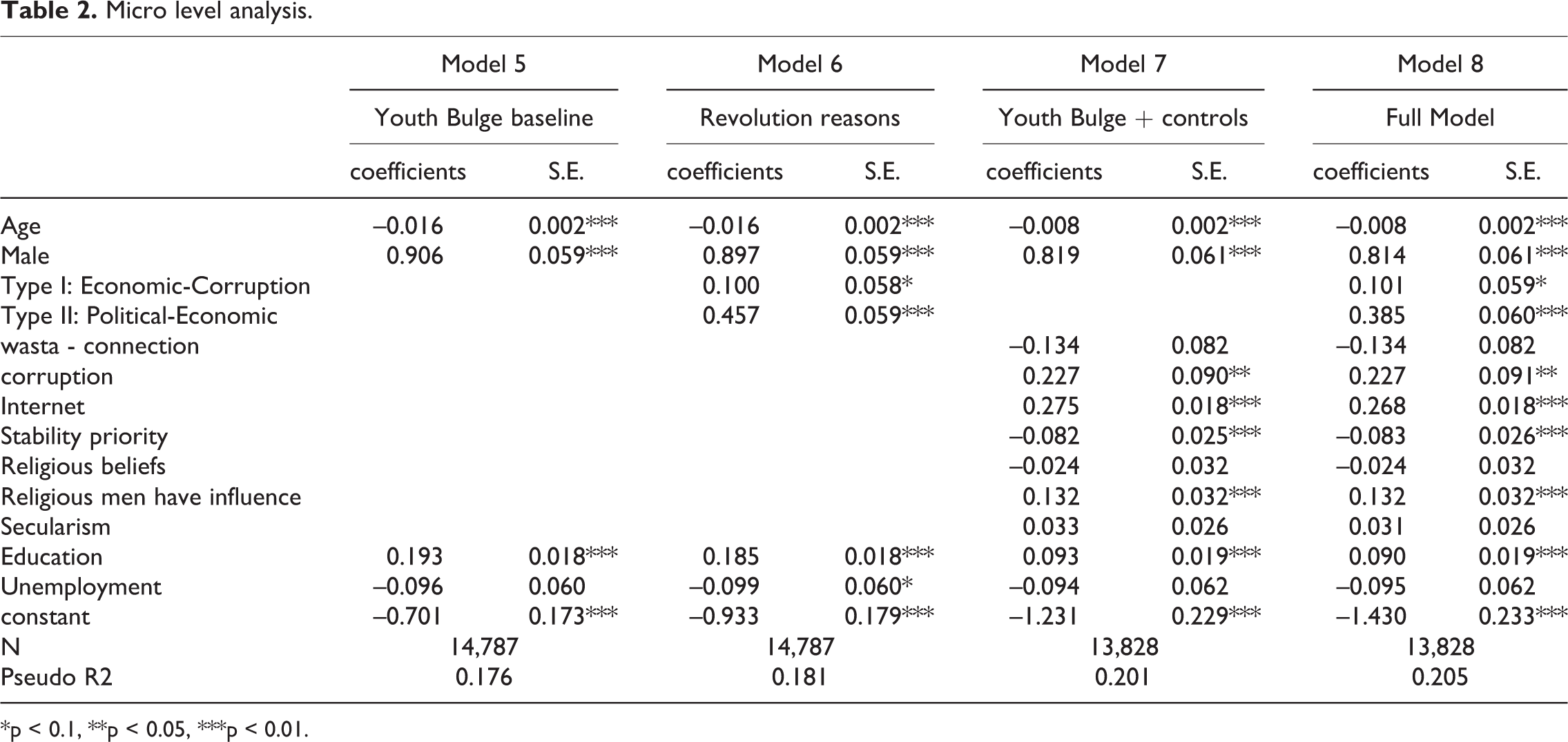
*p < 0.1, **p < 0.05, ***p < 0.01.
Model 7 is the model with several control variables on the youth bulge baseline. Model 8 is the full model including all independent as well as control variables. The result of the model is similar to the results of Model 6 and Model 7. All results in Table 2 are consistent with the fact that most of the demonstrators were young men against the police forces and security units. Model 6 and Model 8 statistically support the fact that rising prices and social inequality were at least secondary reasons that led to the Arab revolutions. In other words, there is a difference between protest participants and non-participants in their recognition of the importance of the economic situation on the Arab uprising. Such results are compatible with the alternative explanation of rising prices and inequality being a determinant of revolution. The empirical results of the Arab Democracy Barometer are congruent with the findings in the macro level.
Figure 3 displays the estimated probability of male and female individuals’ participation in the street protests, at various ages, by holding control variables in Model 8, the logit model, at their means. The probability of participation decreases monotonically as the male individual’s age increases. According to Figure 3, a 20-year-old male citizen’s probability of taking part in the protest would be 19%. For a female of the same age, the probability of becoming a demonstrator would be only 12%. Figure 3 would imply that more than 18% of the Arab youth bulge, the cohort aged 18–30, would participate in the protests, ceteris paribus.
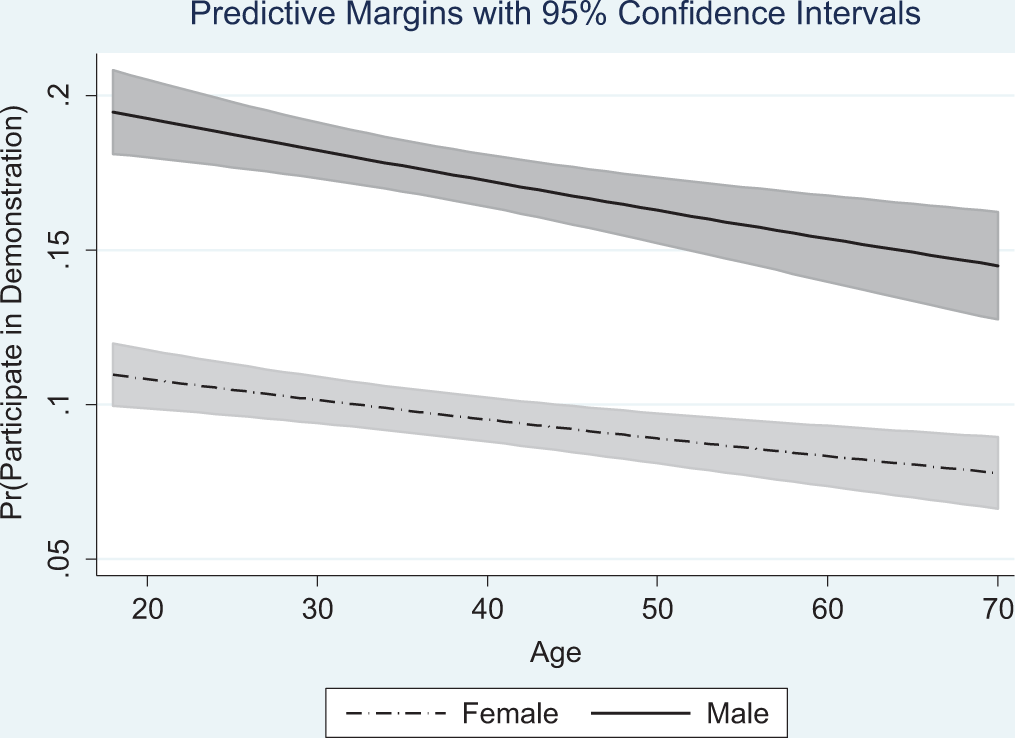
Effect of youth bulges on the demonstrations (Model 8).
Conclusion
This study identifies the Arab revolutions, or the Arab unrest, as a social and political result of demographic changes. The existence of an enormous youth cohort in the populations of the Arab world has been regarded as a time bomb for Arab leaderships. Nobody knows exactly when the youth cohorts will put pressure on the authoritarian governments. This is a puzzle concerning the youth bulges in the studies of the Arab Spring: Why did the uprisings happen in early 2011 rather than at another time? The youth bulge theory alone cannot solve the puzzle, because the youth share of populations without a commodity price shock, as in Tunisia, Egypt, and Syria, has not supported the demographic changes increase the likelihood of authoritarian breakdown during the 60-year period 1950–2010. In summary, the Arab societies’ high share of youth in the population seems to represent a steady state. Although the theory of youth bulge may provide a prerequisite for political transition, it does not explain the exact timing of the Arab Spring. This is similar to the circumstance of studies in forecasting an earthquake (Courbage and Puschmann, 2015: 218).
Rather, the answer is rising international food prices. Goldstone’s revolution theory is built on demographic changes accompanied by rising food prices. The hypothesis is tested by examining the interactive effect of youth bulge and food price shock in the two decades following the Cold War. The empirical tests at both the macro and micro levels identify a statistically significant effect, albeit with only rough estimations. The results of the comparative CSTS data and the Arab Democracy Barometer support the hypothesis that revolutionary uprisings are determined by youth bulge combined with food price shock. I recognize the validity and the broader perspective of Goldstone’s revolution theory for use in analyzing the Arab uprisings. This study also considers an alternative theory for the driver of the Arab revolts, one in which the poor economic performance, i.e. inflation and inequality, determines the robustness of the Arab dictatorships. The results are congruent with the argument of Acemoglu and Robinson that there exists an inverted U-shaped relationship between wealth gap and regime transition. I have identified a decreasing probability of revolution in a phase of increasing inequality beginning from a medium position. This interpretation of the results in the comparative analysis is consistent with the results of the micro-level analysis. Based on the poll responses, the recognition of the economic disaster as the secondary reason determines whether or not people participate in the mass demonstrations.
Lastly, I must acknowledge that the empirical results include a few problems. First, the macro-level analysis is constrained by the quality of the dataset due to governmental confidentiality. The Arab authoritarian governments provide insufficient information about their governance. The Gulf States, especially, are accustomed to hiding demographic and financial information from the public. Second, omitted variable bias may exist in our empirical analysis. In other words, the regression models shown in Table 1 may provide biased estimations, because they do not contain certain important but unobserved variables. Finally, the estimations based on the CSTS data are rough at the 0.10 significance level and may not be robust due to the small number of observations. However, time will take care of the rest of the technical problems. Despite some notable limitations, our study will contribute to better understanding of the effect of the demographic trend on the breakdown of political regimes. Further studies in future will explore some of the issues identified in our study and overcome the limitations by using updated higher-quality data, as well as applying newly developed statistical methods.
Footnotes
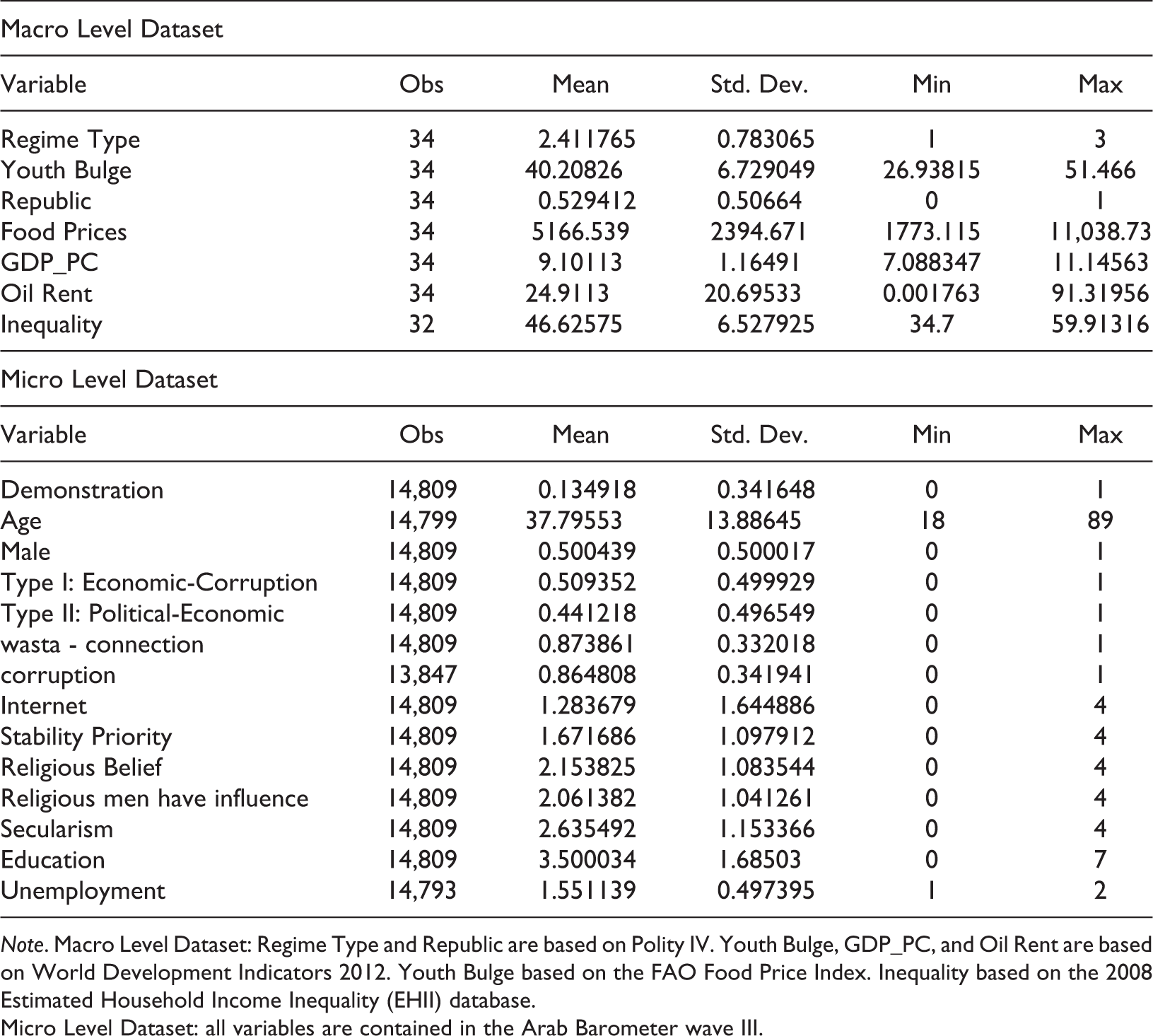
Appendix: Summary of datasets
| Macro Level Dataset | |||||
|---|---|---|---|---|---|
| Variable | Obs | Mean | Std. Dev. | Min | Max |
| Regime Type | 34 | 2.411765 | 0.783065 | 1 | 3 |
| Youth Bulge | 34 | 40.20826 | 6.729049 | 26.93815 | 51.466 |
| Republic | 34 | 0.529412 | 0.50664 | 0 | 1 |
| Food Prices | 34 | 5166.539 | 2394.671 | 1773.115 | 11,038.73 |
| GDP_PC | 34 | 9.10113 | 1.16491 | 7.088347 | 11.14563 |
| Oil Rent | 34 | 24.9113 | 20.69533 | 0.001763 | 91.31956 |
| Inequality | 32 | 46.62575 | 6.527925 | 34.7 | 59.91316 |
| Micro Level Dataset | |||||
| Variable | Obs | Mean | Std. Dev. | Min | Max |
| Demonstration | 14,809 | 0.134918 | 0.341648 | 0 | 1 |
| Age | 14,799 | 37.79553 | 13.88645 | 18 | 89 |
| Male | 14,809 | 0.500439 | 0.500017 | 0 | 1 |
| Type I: Economic-Corruption | 14,809 | 0.509352 | 0.499929 | 0 | 1 |
| Type II: Political-Economic | 14,809 | 0.441218 | 0.496549 | 0 | 1 |
| wasta - connection | 14,809 | 0.873861 | 0.332018 | 0 | 1 |
| corruption | 13,847 | 0.864808 | 0.341941 | 0 | 1 |
| Internet | 14,809 | 1.283679 | 1.644886 | 0 | 4 |
| Stability Priority | 14,809 | 1.671686 | 1.097912 | 0 | 4 |
| Religious Belief | 14,809 | 2.153825 | 1.083544 | 0 | 4 |
| Religious men have influence | 14,809 | 2.061382 | 1.041261 | 0 | 4 |
| Secularism | 14,809 | 2.635492 | 1.153366 | 0 | 4 |
| Education | 14,809 | 3.500034 | 1.68503 | 0 | 7 |
| Unemployment | 14,793 | 1.551139 | 0.497395 | 1 | 2 |
Note. Macro Level Dataset: Regime Type and Republic are based on Polity IV. Youth Bulge, GDP_PC, and Oil Rent are based on World Development Indicators 2012. Youth Bulge based on the FAO Food Price Index. Inequality based on the 2008 Estimated Household Income Inequality (EHII) database.
Micro Level Dataset: all variables are contained in the Arab Barometer wave III.
Declaration of conflicting interests
The author(s) declared no potential conflicts of interest with respect to the research, authorship, and/or publication of this article.
Funding
The author(s) disclosed receipt of the following financial support for the research, authorship, and/or publication of this article: This research was supported by a research grant from the Okawa Foundation for Information and Telecommunications, and JSPS KAKENHI (Grants-in-Aid for Scientific Research) 25301016, and 15H03308.