



Abstract
Critics of Philippine democracy have pointed out that the unitary system employed since the country became a sovereign state in 1946 led to the prolonged underdevelopment of sub-national regions (provinces). Hence, policy makers have put forward the argument that a shift to a Federal system is necessary because of the imperial Manila syndrome. This is the notion that political, economic, and social underdevelopment is more prevalent the farther away a province is from the capital, Metro-Manila, which has been a longstanding theory of ‘core-periphery’ dynamics in political geography. Using sub-national data derived from Philippine provinces, the study finds that provinces farther away from Manila in terms of geodesic distance are indeed disadvantaged not only in terms of economic, poverty, and human development indicators, but also in terms of dependence on internal revenue allotments which inhibits local growth. Physical distance from the capital also decreases rural funds for provincial development. The implications suggest that a Federal arrangement can promote peripheral growth and development, but it certainly is not a panacea.
Keywords
Introduction
Do political institutions and geographic distance affect economic, political, and social development in peripheral regions? This is a perennial question that has confounded the minds of scholars of Philippine politics. In 2018, these fundamental questions are being debated in the Philippine Congress where lawmakers are considering changing the constitution to shift the form of government from a unitary to a Federal system. The consensus among Philippine lawmakers is that institutional engineering can address underdevelopment in the provinces ( Straits Times, 2018). This clarion call for a drastic shift in governance is based on the notion that the unitary system in place since the country became a sovereign state is the reason that far-flung regions outside the capital have remained economically backward, due to what has been recognized as the ‘imperial Manila syndrome’. This term refers to how the developmental agenda of the nation has been held captive by the capital of the country, such that the national government and legislators have prioritized the economic development of the capital and the surrounding provinces adjacent to it, much to the deterioration of the provinces that are far away from the capital (Boquet, 2017; Joaquin, 1990; Lambatin, 2018; Martinez, 2004). This syndrome is manifested in how the strong presidential form of government allowed the national government to fully concentrate economic and financial resources within the core (the capital), such that public finances controlled at the top do not redound to the benefit of the geographically distant rural provinces, generating “bad center-periphery politics and undermin[ing] the spirit of decentralized political power in the country” (Mendoza and Ocampo, 2017: 3). This led provincial politicians to demand adoption of the Federal system of government because “the overly centralized grip of the national government in Manila over the provinces has created an imbalanced distribution of power and wealth since the birth of the Republic” ( Manila Standard, 2018).
The persistence of “core-periphery” unbalanced development also led some Philippine politicians to call for the decongestion of the current capital and to create new urban centers that can reduce the agglomeration of economic, human, and political activity within imperial Manila and its adjacent provinces, following the Brasilia and Canberra model of naming a new capital to induce nationwide economic growth. By adopting this framework in tandem with introducing Federalism, there is optimism that inclusive growth can occur and that provinces that are geographically distant from the core can reach economic parity with Manila and its surrounding provinces (Boquet, 2017: 647).
The current Philippine president, Rodrigo Duterte, supports a constitutional convention to address the imperial Manila syndrome, leading him to issue an Executive Order in 2016 mandating the creation of a consultative committee with the task of educating the population about the flaws of the unitary system that has been put in place. Duterte explained that adopting a Federal system will empower provinces, as they “will be largely autonomous and be allowed to retain most of their income, rather than remitting it to the central government” ( Philippine Daily Inquirer, 2016: 1). Duterte also argues that when provinces are allowed to tax their citizens and retain the revenues they earn from the natural resources that arise from their jurisdictions they can experience “economic parity” with other provinces adjacent to Manila.
As the policy debate continues about institutional reform, it is imperative to systematically assess whether or not the proponents of Federalism have a legitimate claim that can be empirically evaluated. Considering that the Philippines has had a unitary-centralized political system since independence, it is expected that developmental trajectories are concentrated within the capital and that as distance from the capital grows underdevelopment worsens. This is because unitary-centralized states allocate all political, economic, and social power at the center. Further, most unitary-centralized states only possess one core area that constrains growth to the periphery (Glassner and Fahrer, 2004). If development is to occur, such unitary-centralized states must restrict economic growth in adjacent concentric spheres near the capital (core), and regions that are furthest from the capital will suffer from neglect and abandonment by the national government. Since political power is amassed in a strong national government, sub-national units that lack self-determination are shackled to subordination and servitude based on the whims of political leaders that only serve the interests of the citizens in the capital, which remains hierarchical and top-down (Elazar, 1997).Thus, as distance grows from the center, it is expected that the delivery of public goods and services, disaster-response efforts, anti-poverty programs, financial assistance, and basic infrastructure programs will deteriorate (Lambatin, 2018). To address if these claims are valid, this empirical study addresses the following longstanding questions (which to date remain anecdotal): Does geographic distance promote regional underdevelopment and the persistence of poverty in the Philippines? Is geographic distance from the capital a major variable that prohibits provinces from increasing their revenue potential? Does geographic remoteness disadvantage a country’s sub-national units by not targeting them with developmental aid in terms of rural priority funds? Lastly, does a centralized state also promote financial dependence on national-level “fiscal transfers” that prohibits growth in far-flung regions? 1
Based on a time-series analysis of Philippine provinces across time, it is found that provinces that are farther away from the capital in terms of its geodesic distance are more likely to experience higher rates of poverty, and economic, social, and political underdevelopment. Further, a province’s geodesic distance away from the capital is also correlated to lower levels of provincial revenues and receiving lower levels of developmental aid from the national government. Finally, it is also shown that geodesic distance away from the capital promotes financial dependence on the national government through “Internal Revenue Allotments” (IRAs hereafter), which spurs and prolongs systemic poverty and underdevelopment. The results conveyed in this study affirm that theories calling for a shift to a Federal structure have merit. State centralization that has been practiced in the Philippines since it gained its independence contributes to rural underdevelopment. Thus, institutional debates concerning changing the form of government or attempts on further political and fiscal decentralization are on justifiable grounds, although the shift to a Federal system may not entirely be a panacea.
The study proceeds as follows. First, I elaborate on the arguments of those who believe that the Philippines’ ascent towards economic growth has been obstructed by the ‘imperial Manila syndrome’, which validates the call for constitutional changes that would lead to the adoption of Federalism. The second part will provide an important discussion on how the state centralization implicit in the Philippine polity is a manifestation of established theories on core-periphery dynamics that have been articulated in the past by scholars in political geography. This is to be followed by a brief discussion of other empirical cross-national studies that explore how distance from core ‘cities’ or ‘capitals’ affects peripheral development, which comports with the theoretical lens of the study being conducted. This is to be followed by several case studies to supplement the causal argument that distance from the capital affects provincial development. The latter part of the article then operationalizes the hypotheses and the independent and dependent variables, and discusses the research method that is employed. The last section presents the results and discusses the implications of the study.
Is there an imperial Manila syndrome?
One reason why underdevelopment in the periphery persists in the Philippines is the existence of super-presidentialism. Since the unitary system favors the development of the core, the executive branch in the Philippines amassed extraordinary political power over the years, thus eroding any political clout that other institutions have as it pertains to separation of powers and checks and balances. To substantiate, the Philippines is labelled as a quintessential example of a delegative democracy where the unitary executive is capable of implementing policy without much policy input or cooperation from other branches or regional governments (Croissant, 2003). Furthermore, the unitary system that evolved favored the creation of an upper chamber (The Senate) that does not represent the country’s regions or provinces; rather, it evolved as a chamber where its individual members run as national-level candidates wherein the whole country represented a large national district since 1916. This influenced the development of weak political parties early in the history of the Philippines, because candidates who sought a Senate seat only had to rely on the machinery of their popularity, name recognition, and social networks with the president—doing away with the need for ideologically based parties (Manacsa and Tan, 2005). Since the Philippine Senate did not entirely serve constituents based on regional representation, senators that win elections and serve do not bring in provincial concerns in the legislation process; rather, their platforms and sponsored legislation mostly focused on national-level concerns that are largely popular in Metro-Manila and its surrounding areas, neglecting the economic and political concerns of the periphery (Kasuya, 2009).
Furthermore, a long history of state centralization sustained the stability of a super-presidential system where the executive branch is largely in charge of formulating the budget, allocating it to members of the House of Representatives through pork-barrel allocations and coercing the legislature to pass the general annual appropriations bill without much opposition. Thus, it is very common for incumbent members of both the House and Senate to switch political parties as a way to enhance their capacity to curry favor and establish patronage ties with a newly elected president who controls general appropriations for rural development (Teehankee, 2012). Considering that the president also has a line-item veto (which is rarely used) that can overrule legislative amendments on budget appropriations, the disbursement of cash or financial assistance for rural development is largely controlled by a very powerful executive, and the legislature lacks any influence to direct such spending to regions of the country that are in deepest need of financial assistance (Yusingco, 2018).
It also is very important to note that the Philippine president is not re-elected, as he/she is prohibited from seeking re-election by the 1986 constitution; thus the system is beholden to a very powerful president who cannot be held accountable for the neglect or favoring of some regions over others based on regional loyalties, client patronage, or personal ties with local government officials like mayors, governors, and house members. Hence, many scholars regard these instrumental flaws as systematic evidence of an imperial Manila syndrome, the phenomenon where Philippine presidents have only focused on sponsoring developmental programs and directed key financial disbursements in Manila and its surrounding provinces because it is the locus of national commerce and the epicenter of national economic activity, which puts provinces outside the “hub of economic and political” activity at a great disadvantage (Yusingco, 2018). In sum, the extent to which provinces that are furthest away from Manila are affected by the imperial Manila syndrome is based on how: The president has a direct hand in all matters of government. From public housing to agriculture to solid waste management to foreign investment to tax collection to sports to water management to foreign trade and affairs, and so forth. In all these public functions, the president plays a very prominent role. Crucially, control over and dispersal of public funds is also heavily concentrated in his office. (Yusingco, 2018: 2)
In fact, the pervasive poverty that affected Mindanao has been blamed on the persistence of neo-colonialism in the form of how imperial Manila deprived Muslims of their opportunity to develop their own economic structures and how their natural resources (in terms of agricultural land and precious mines) have been exploited by a unitary system that utilized the resources of the south (Mindanao) to subsidize the north’s ever-expanding industries (Martinez, 2004). To substantiate, three of the very poorest provinces in the Philippines are the ones farthest away from Manila which also have the largest Muslim populations, where the poverty incidence rates are above 50 percent—Tawi-Tawi, Maguindanao, and Lanao del Sur ( GMA News, 2008). Furthermore, these statistics are corroborated by public opinion polls, in which most citizens in Mindanao recognize that imperial Manila is the source of their province’s current state of underdevelopment, close to 70% agree that a Federal system will change their lives for the better, and 63% believe that a new Federal system will be beneficial to their region politically in terms of improving their quality of life (Bueza, 2017).
Critics of the centralized system also recognize that rural underdevelopment is attributed to provinces’ chronic dependence on imperial Manila through the IRAs. Based on the Local Government Code of the Philippines which was implemented in 1991, all of the revenues used by provinces for general spending, ranging from infrastructure development and social welfare programs to poverty alleviation schemes and policing, come from the national government based on an equity sharing formula that takes into consideration the raw population and land area of each province (Republic of the Philippines, 1991; Salvador, 2010). These are annual financial disbursements to provinces that come from the national government which are used by presidents as mechanisms to foment client-patron ties with local office-holders at the city, municipal, and provincial levels. These disbursements have increasingly become controversial because they create a culture of dependence where the national government may withhold or suspend the release of funds to provinces which are deemed to have irresponsible financial management styles normally based on the discretion of a president wanting to buy loyalty and deference from local politicians (De Dios, 2007; Gatmaytan, 2000). Thus, the system of uneven disbursements (and not abiding by the standardized formula) has increasingly been politicized by past presidents since after the Marcos dictatorship. Further, such IRA disbursements bolster the power of the unitary state by perpetuating dense urban patronage networks that curtail political accountability—thus promoting corruption. A culture of dependence also occurs through providing incentives for provinces not to consider other economic outlets or mechanisms to generate local revenues by harnessing revenue streams from provincial or municipal property taxes, local licensing fees, and local business permits which are allowed by the constitution.
Research has also indicated that such lump-sum inter-governmental fiscal transfers often lead local governments to overspend and to amass wayward expenditures over time, which can lead to deficit spending, generating a fiscal trap that discourages provincial savings and local budgetary surpluses that can stimulate long-term economic growth (Lange, 2010). In sum, the primacy of these national fiscal transfers enhances the power of the national government to prevent provinces from generating their own developmental projects and economic potential, as they become dependent on these “dole-outs” (Yusingco, 2015). Philippine economists reiterate that the provinces that are most dependent on IRA funds are also most likely to suffer from negative externalities, such as an inability to regularly collect local taxes or to provide basic public services, and to experience deficiencies in terms of good governance, which affects political accountability (Pamintuan, 2012). Since they were implemented in 1991, such fiscal transfers have not improved the revenue streams of provinces, as they have promoted lopsided and disproportionate economic growth, generating income disparities and exacerbating poverty rate differences between provinces (Silva, 2005).
Lastly, there is also an explicit “Metro-Manila” bias, where the nation’s capital and its surrounding provinces in Luzon, which already have higher levels of local revenue streams that allow them to sustain social programs over time, also receive the largest share of IRA disbursements, perpetuating the marginalization and economic backwardness of provinces further away from Manila, as disbursements in these far-flung regions have also declined over time (Ordinario, 2010). Thus, proponents of a new Federal system believe that these fiscal transfers from imperial Manila promote a culture of corruption, fiscal dependence, and economic stagnation that should be abolished outright. 2
The politics of distance and development
As discussed, the drive towards changing the unitary form of government to a Federal system is hinged on theoretical grounds that centralized unitarism has promoted rural underdevelopment in Philippine provinces. But why is a centralized-unitary state prone to low levels of human development? Why do unitary states disadvantage regions that are far away from capital cities in terms of promoting and prolonging economic stagnation? The theoretical underpinning behind this can be derived from the classical core-periphery theories advanced by Myrdal (1957) and Hirschmann (1959), who posit that a natural imbalance would occur between the core (normally the country’s capital) and the periphery (its subnational units). Nation-states that have adopted a unitary state are likely to strategically favor the development of their state capital where it will be granted inordinate amounts of economic power—such that it will have a monopoly on domestic and international investment opportunities and resources. Therefore, the locus of growth remains within the core and economic activity will largely be constrained within the close proximity of the capital. Adjacent regions will likely experience economic growth as a function of geographic proximity or spillover effects. However, since market forces and domestic investments are mostly constrained within the core, regions further away from the capital in terms of physical distance are likely to experience lower levels of economic development, which is construed as backwash effects. Even if far-flung regions away from the core are likely to produce raw materials or natural resources which should amount to a windfall in local investment and profits, these largely redound to the benefit of the capital or core city as they become the epicenter for manufacturing and the mass production of domestic and international exports.
Capital cities in centralized states therefore become extractive agents that push distant regions to economic marginalization, where great imbalances exist in terms of the economic productivity of the powerful capital and the subservient and dependent periphery. Friedmann’s (1966) work also identifies this as a manifestation where capital cities, because of their strategic position (whether it is based on access to the ocean/trade routes/natural resources or historical development as a center of trade and commerce during the colonial era), become the locus of uninterrupted economic growth and capital accumulation that convert other regions farther away from the core as mere political and economic tributaries. Thus, the spread of economic growth becomes uneven and unbalanced, as state policies will likely favor the advancement of the economic interests of the core while largely neglecting the developmental needs of regions away from capital cities. The burgeoning economic growth of the capital city also creates growth poles in adjacent concentric bands, where a greater distance away from such growth poles is likely to lead to lower investments in trade, labor, and human resource development. Over time, firms and markets will refuse to move or relocate to other areas of a nation-state, especially in distant rural regions, as this will entail high costs—especially since the capital city already provides a well-established infrastructure, a well-developed/mature market for goods and services, and a high supply of labor potential due to the outward migration of workers from the periphery to the center.
Furthermore, it is also anticipated that peripheral regions away from the capital are deemed to suffer from an agglomeration of economic misfortunes, as the spread-effects of wealth and development will largely dissipate the farther away a region is from a nation-state’s capital (Friedmann and Wolff, 1976, 1982). In other words, the greater the distance of a region from the capital, the greater the likelihood that such regions remain economically backward. Relatedly, it is also found that “Geographic distance can hinder both product and factor market exchange between urban and rural areas, isolating rural businesses and residents from the rewards of urban agglomeration in the center” (Partridge and Rickman, 2007: 431). In the context of the United States, for example, it is found that rural areas closer to or adjacent to cities of scale are more likely to experience higher levels of economic development and lower incidences of poverty, because of lower transportation costs of goods and services and lower costs in terms of extrapolating or forecasting supply and demand conditions.
Unitary systems that are very centralized further exacerbate the marginalization of the periphery by creating policies that largely abandon its concerns. For example, in the context of the Philippines, it is discovered that spatial disparities based on geographic distance explain why some provinces are poorer than others. Based on a comparative analysis of three provinces from 2003 to 2012, it is found that the province closest to Manila (Pangasinan) has higher levels of economic investments and human development and the lowest level of poverty incidence compared to another two provinces that are furthest away from Manila (Eastern Samar in the Visayas region and Maguindanao in the region of Mindanao). This is due to a spatial disparities effect, where distance from the capital has a spread effect in terms of positive externalities due to unprecedented economic growth in Manila, but then such positive effects dissipate as the distance from Manila grows (Mendoza et al., 2017). The study also finds that the country’s archipelagic status, composed as it is of 7107 islands, proves to be a challenge in promoting a level playing field. Historically, government policies did not favor infrastructure development in provinces away from Manila in terms of building high quality highways, sea-ports, airports, bridges, and farm-to-market roads, generating economic growth patterns that are not inclusive. In other words, “Spatial economic disparities could also lead to spatial disparities in welfare, as the areas in the Philippines that are ‘spatially’ disconnected tend to have worse human development outcomes” (Mendoza et al., 2017: 24). For example, such provinces that are geographically distant from Manila all share the following characteristics: low employment skills and educational attainment, high vulnerability to economic and natural disaster shocks like typhoons, floods, and earthquakes, limited connectivity to markets, lack of job opportunities, and inefficient governance (Mendoza et al., 2017: 30–36).
Provinces physically removed from Manila are also likely to experience the long-term effects of geographic isolation and economic marginalization, such that economic organizations in remote provinces are replaced by informal social and cultural networks that can justify the national government neglecting social spending through opportunistic shirking. International and domestic investments are also curtailed because of the lack of stable markets in these remote areas. Private industries may be wary of making solid investments in rural provinces because of unsound private and public institutions that do not comply with national laws or the rule of law. Client patronage and corruption are more predominant in provinces away from Manila, which precludes the relocation or establishment of businesses because local politicians may demand bribes and economic incentives that can be costly. Thus, we should expect that a province’s increasing physical distance from Manila becomes a geographic curse (Boquet, 2017).
Cross-national work also empirically validates the correlation between geographic distance from the capital and peripheral economic development, corroborating earlier theories on core-periphery dynamics. For example, among developing states, the physical distance of cities from core economies is found to be inimical to their economic growth (Gallup et al., 1999). In the context of Eastern Europe, which includes the Czech Republic, Hungary, Poland, Slovakia, and Slovenia (nation-states with unitary systems), Brülhart and Koenig (2006) find that real wages and economic growth decline in regions that are farther away from their capitals, mostly because capitals restrict the mobility of labor and firms across all regions and sectors based on physical distance. In the United States, Hanson (2001) finds that economic growth tends to cluster close to geographic areas closest to metropolitan areas that have economies of scale, while such positive externalities decrease with physical distance. Chen, Lu, and Xu’s (2008) empirical study of economic development in China’s rural areas from 1990 to 2006 finds that areas of growth and investments are likely to be determined based on physical distance from the national urban hubs of the country like Beijing, Shanghai, Hong-Kong, and Guangzhou. More recently, Surd, Kantor and Pacurar (2015) found that underdevelopment in the rural regions of Romania widened over time since it transitioned to democracy, which can mostly be attributed to political decisions made by the unitary state that kept provinces distant from Bucharest poorer with limited infrastructure.
Illustrative cases
To substantiate how physical distance may affect different levels of political, social, and economic development, I employ a mixed-method strategy of selecting four regions (out of 17) of the Philippines that have varying distances from Manila and their affiliated levels of development and ordinal rankings (in parentheses), as presented in Table 1. The selection of cases is in line with Lieberman’s (2005) nested analysis approach which can substantially explain causal pathways and supplement the results of the Large-N analysis that will be presented later. These regions are administrative divisions categorized by the Philippine government which are composed of a cluster of provinces that are physically adjacent geographically (in such a way that the provinces share a physical or maritime border) and have analogous population sizes. Each region has no local government or administrative apparatus, but they have affinity in terms of linguistic/ethnic group similarities (Department of Interior and Local Government, 2017). What we see in Table 1A is that a region’s increasing distance away from Manila is associated with lower levels of human development, higher poverty incidence rates (proportion of individuals with per capita income less than the per capita poverty threshold), and lower average annual incomes. To unpack the possible causal mechanisms at hand, four cases are presented to identify specific processes of how physical distance away from Manila disadvantages provinces.
Disparities in development and governance by selected Philippine regions.
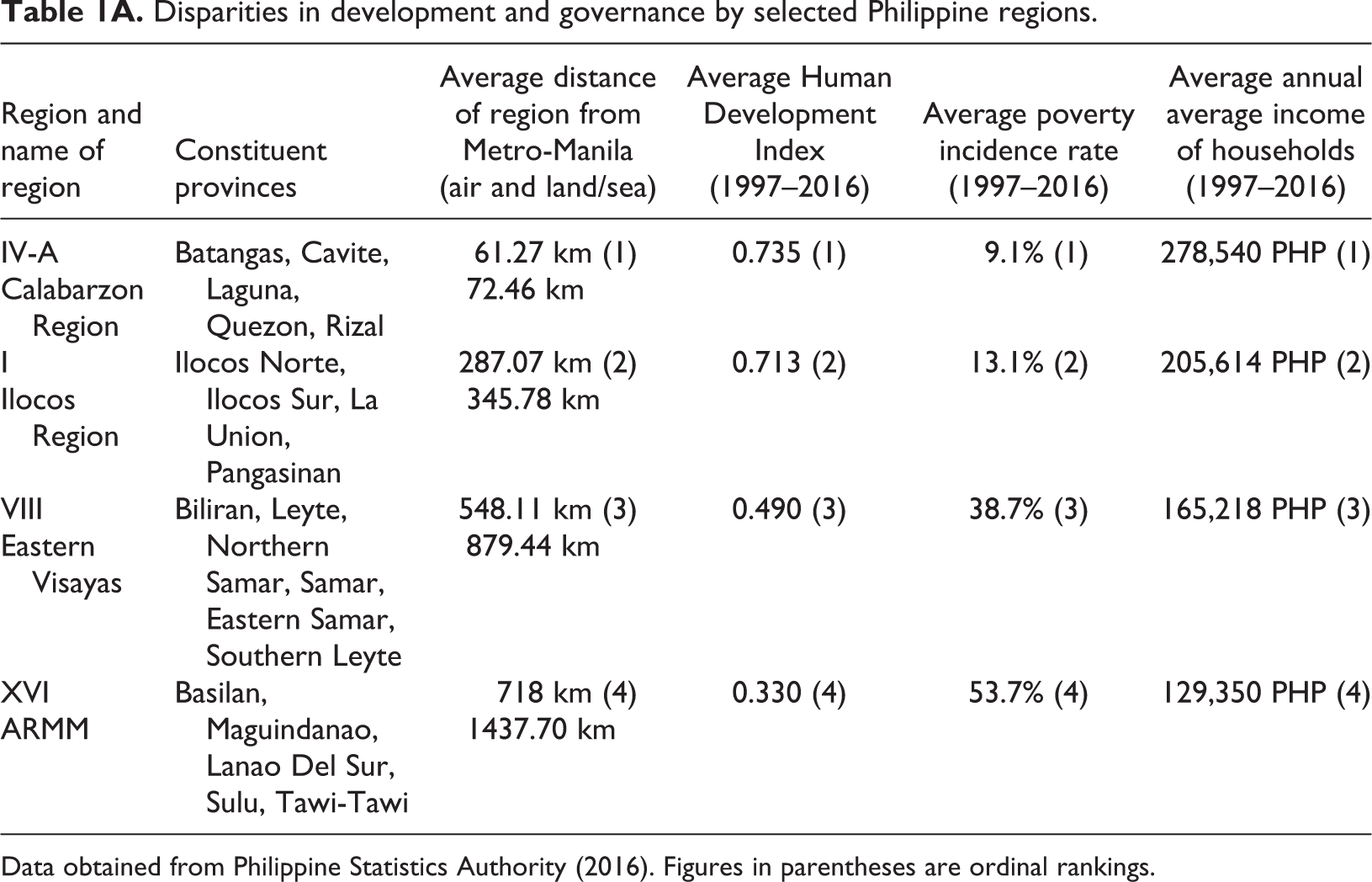
Data obtained from Philippine Statistics Authority (2016). Figures in parentheses are ordinal rankings.
The Calabarzon region
Region IV-A, also known as Calabarzon, is considered to be the most prosperous region of the Philippines (Dy, 2018). All its five provinces constitute the industrial corridor of the Philippines, complemented by an abundance of natural resources and agricultural output that makes their local economies competitive. The region also has the lowest poverty incidence rates in the Philippines, registering at 9.1% (Fiestada et al., 2018). Its average distance from Manila is a mere 61.27 kilometers by land, which provides a strategic advantage in terms of being a beneficiary of spillover effects from the continued economic growth in Manila (Boquet, 2017). In the past decade, the region has seen an expansion in the middle-class sector, as transportation hubs have allowed the labor force in Manila to live in these provinces, thus increasing demand for housing development, service industries, and industrial zones. The region is considered to be a growth pole that can enhance sustained development into provinces further into central Luzon. In effect, the region has outperformed other regions in terms of “its close proximity to Metro Manila and its strategic location serving as Luzon’s gateway to the south” (Philippine News Agency, 2018a). It is also noted that being close to Manila has allowed the local government officials of Calabarzon to have close proximity to the office of the president, allowing lobbying for larger pork barrel allocations and Priority Development Assistance Funds, which may explain how the region benefitted from more developmental assistance vis a vis other regions (Martinez, 2004). Thus, this is a reflection of how state centralization concentrates political, economic, and social development within adjacent geographic concentric spheres, where growth poles are specifically expanded solely in regions adjacent to capital cities (Glassner and Fahrer, 2004).
The Ilocos region
Region 1, in northern Philippines, has also benefitted from stellar economic growth rates compared to its regional counterparts since the 1980s. For the past 20 years, the region has recorded low poverty rates, attributed to its strong agrarian economy and the consequent development of roads and transportation links with the capital (Boquet, 2017: 456). Many of its provinces also have access to the sea (the South China Sea and the Luzon Strait), which has allowed it to develop its fishing industry—making the region the major supplier of milkfish (a major seafood staple of Filipinos) for national consumption ( Philippine Daily Inquirer, 2012). The strategic location of the province, with a distance of just 287.07 km by air and 345.78 km by land from Manila, also led to its status as an economic growth pole in Northern Luzon, with many multinational corporations expanding their operations in the region, such as Accenture, Expert Global Solutions, and Star Cruises ( Philippine News Agency, 2018b). Increasingly, the region was selected as an economic hub for Business Process Outsourcing, focused on service delivery, where call-center companies have hired thousands of Ilocanos for the past several years, strengthening the annual average income of households in the region (Domingo, 2015). To illustrate the economic success of the region, Ilocos Sur province has also invested in renewable energy by building biomass power generating plants that will convert 86 tons of municipal waste and 200 tons of agricultural waste into usable electricity ( Business World, 2017). Its neighboring province, Ilocos Norte, has also relied on renewable wind and solar energy, making it one of the few provinces not to experience rolling blackouts which can obstruct economic productivity (Boquet, 2017: 347). Thus, the success of the region demonstrated by making these expensive investments is contingent on agglomeration spatial effects due to its close geographic proximity to Manila. Lastly, some claim that many of the provincial governors of the region took advantage of the region’s proximity to imperial Manila to generate client-patron relations with presidents since the restoration of democracy in 1986. The close distance to the capital made it easier for such regional governors to travel to the presidential palace to ask favors of and deliver votes for the executive branch. As a result, the provinces of the north benefitted from a higher share of congressional earmarking for developmental projects over time. For example, Chavit Singson, Ilocos Sur’s provincial governor for many years, has been a stalwart kingmaker—developing close ties with incumbent presidents while bequeathing his province with numerous pork barrel allocations and infrastructure projects, despite his ties with gambling and criminality. Other local provincial officials in the region that established closed ties with the national government include the Crisologos of Ilocos Sur and the Farinas family of Ilocos Norte (McCoy, 2009).
The Eastern Visayas region
Far removed from the capital, the region of Eastern Visayas (Region VIII), which is 879.44 km away from Manila, is considered to be one of the poorest in the Philippines, with an average poverty incidence rate of 38.7%—the third highest among the 17 regions of the country (Fiestada et al., 2018). The region is composed mostly of island provinces that are prone to destructive typhoons, and its failure to expand economically beyond its reliance on agricultural production or to diversify into other industrial sectors is attributed to its geographic isolation from the core (Boquet, 2017). For example, the poorest province in the region, Eastern Samar, suffers from its own geographic “disconnectedness,” where its economic mobility is obstructed by its substandard transportation and road networks, curtailing its ability to expand its market share of domestic agricultural exports to the capital and the rest of the nation (Mendoza et al., 2017: 33). Further, the failure of the national government to render immediate financial and emergency assistance to the region after destructive typhoons, mudslides, and earthquakes (because of the region’s immense distance from Manila) concomitantly harms the region’s developmental trajectory because of dilapidated infrastructure that is in a state of perpetual disrepair. To substantiate, Eastern Samar’s remoteness from the core led to “the lack of supporting resilient infrastructure that increases business costs among the entrepreneurs in the province as it also hinders potential private investment into the province” (Mendoza et al., 2017: 36). The substantial lack of farm-to-market roads in Eastern Samar is also symbolic of bad local governance. However, at the crux of the economic crisis in the province is the inability of the national government to make sound investments in the province of a region that is far-removed from the capital and one that is also prone to exogenous shocks. It makes logical sense for the national government to make investments and render financial assistance to geographically adjacent regions because such prospective financial dole-outs to Eastern Visayas do not guarantee a return on investments.
As a result of the severity of underdevelopment, local government officials from Eastern Visayas are adamant about a shift from a unitary to a Federal system because the region has immensely suffered under imperial Manila. For example, local politicians decried the limited budget allocated to the region since the restoration of democracy in 1986, which led to less national funding and development assistance for “healthcare, education, infrastructure, and other social services needed for the region’s population,” because the national government had given the region “less than half of what people of Eastern Visayas are entitled to receive” ( Manila Standard, 2018). For example, the region only gets less than 2% of the annual government expenditures ( Manila Standard, 2018). Regional governors from Eastern Visayas also lamented the region’s exclusion from representation in national institutions, specifically the Senate. They have not been included in budget deliberations, effectively shutting the region out from much needed development assistance.
The ARMM region
The region with the highest poverty incidence rate in the Philippines is the Autonomous Region of Muslim Mindanao (ARMM), where 53.7 percent of the region’s population have per capita incomes less than the per capita poverty threshold (Fiestada et al., 2018). The region is also the farthest away from the capital, with a mean land/sea distance of 1437 km. It is also distinct from other regions of the Philippines because it has the largest Muslim population. As a result, the region has been given de facto autonomy through a 1989 plebiscite. The regional government that was established since then, however, failed to bear fruition and self-rule was not realized. For most of its history, the region was under the dominion of the Philippine national government and is considered to be one of the regions that is highly dependent on Internal Revenue Allotments and national fiscal transfers (as a percentage of its total current operating income), especially concerning infrastructure development ( Business World, 2018). Thus, its autonomy status is clearly symbolic and has not been enforced for many years, which explains why anti-state groups like the Moro Nationalist Liberation Front (MNLF) have called for secessionism (Abinales, 2011). Demands for Federalism in the region are highest among citizens and local leaders, culminating in the recent passage of the Bangsamoro Organic Law in 2018 that will give the current regional government in the ARMM more political autonomy and the capacity to exercise self-rule by specifying in an organic document self-determination rights granted to the regions’ citizens (Marcelo, 2018).
The region’s largest province, Maguindanao, is the epitome of how the immense geographic distance of the province from Manila led to its worsening economic conditions, which have not abated even if the region has fertile soil capable of transforming it into an agricultural powerhouse. The provinces’ official statistics on development convey a dilapidated economy and infrastructure incapable of self-governance: 80% of the roads are of inferior quality; only 50% of residents have access to electricity because of the absence of electric power-grids (based on 2010 figures); incessant violence through clan-based killings are commonplace; large-scale investments in health care are lacking; small scale businesses are trapped in areas where transaction costs are high; its labor force is mostly under-skilled, with no marketable skills; and a large percentage of the population is uneducated, as it has one of the lowest high-school completion rates in the country (Mendoza et al., 2017). The national government has also used the region’s de facto autonomy to legitimize its autarkic status by depriving it of much needed financial assistance even when the province is subject to political instability, terror attacks, and exogenous shocks related to the extreme weather conditions and natural disasters. This is compounded by the fact that state centralization is conflated by residents with an imperial Christian Manila syndrome: the belief that developmental aid is deprived to the province because of the perception that the Christian-majority nation has an inherent bias or resentment against Muslims attributed to a history dictated by occupation, colonization, and subjugation (Abinales, 2011; Martinez, 2004).
But how are these dismal statistics on development related to geographic distance from the core? Scholars point out how the ARMM region has been beset by internecine conflict between the national government and Muslim secessionist rebels which compelled secessionist groups like the MNLF to put down arms and devolve powers to local politicians. This led to the creation of clan-based politics and political dynasties. These clan-based political elites, who ruled most of the provinces of the region, were free to govern with limited or no interference from the capital and national leaders (as a function of physical distance). With very little contact or correspondence with national leaders, the political elites of ARMM engaged in malfeasant acts ranging from patronage politics, shadow economies, and elite capture to political assassinations and an ongoing illicit weapons trade, which have curtailed good governance and further entrenched underdevelopment and corruption (Hutchcroft, 2018; Lara, 2014). In short, the great physical distance from imperial Manila gave clan-based elites the ability to govern the provinces as personal fiefdoms without any oversight or censure from national political elites, often obviating the rule of law as they drove the ARMM provinces to the path of underdevelopment and political instability. Scholars contend that increased devolution to the ARMM region through the Bangsamoro Basic Law or the implementation of a Federal system will intensify clan-based warfare and dynastic political systems that could further worsen the region’s poverty rates and levels of socio-economic underdevelopment (Banaag et al., 2018)
Empirical strategy: Hypotheses, operationalization of variables, and research design
Hypotheses
Based on the aforementioned theories about the negative effects of state centralization on Philippine provinces and the illustrative case studies presented, I formalize that the institutional dynamics at play are as follows. I argue that physical distance from Manila has a long-term deleterious effect on five levels of provincial development: a) substandard human development, b) the persistence of poverty, c) lower levels of state capacity, d) lack of developmental assistance from the national government, and e) prolonged institutional dependence on internal revenues from the national government that generates disincentives to become financially autonomous. Thus, the following hypotheses are formulated:
The effect on human development (political, economic, and social)
H1: Philippine provinces that are farther away from Metro-Manila in terms of geodesic distance are more likely to have lower scores on the Human Development Index
The effect on poverty
H2: Philippine provinces that are farther away from Metro-Manila in terms of geodesic distance are more likely to have a higher prevalence of Poverty Incidence H3: Philippine provinces that are farther away from Metro-Manila in terms of geodesic distance are more likely to have lower Average Family Incomes
The effect on local revenue generation/state capacity
H4: Philippine provinces that are farther away from Metro-Manila in terms of geodesic distance are more likely to have lower Annual Regular Incomes (which translates to lower state capacity)
The effect on developmental aid
H5: Philippine provinces that are farther away from Metro-Manila in terms of geodesic distance are more likely to receive less in Priority Development Assistance Funds from the national government over time
The effect on financial dependence
H6: Philippine provinces that are farther away from Metro-Manila in terms of geodesic distance are more likely to be overly dependent on Internal Revenue Allotments from the national government over time.
Independent variables
Overall, these hypotheses comport with the movement behind changing the Philippine constitution to address the institutional failures of the unitary state. Since the unitary system has produced spread effects of wealth generation in the provinces within a close proximity to Metro-Manila and since the backwash effects of underdevelopment are contingent based on how far away a province is from the nation’s capital, it is imperative that we assess physical distance based on the notion that spatial and geographic dynamics promote the pernicious effect of unitarism on economic, political, and social development. To do so, the main independent variables are derived by calculating the geodesic distance of provincial capitals from Manila. This data is obtained from the program Arc-GIS pro, 3 which has the capacity to measure in kilometers the distance of Manila’s Central Business District from each of the capitals of the provinces of the Philippines. Since the Philippines is an archipelago with more than 7107 islands, a majority of the provinces cannot be reached via roads. In fact, to this day, most goods, services, and food provisions reach remote provinces through the “Ro-Ro” (roll on/roll off) system, where trucks, trailers, and cargo compartments are wheeled from Manila (or other urban centers close to the capital) into ships that carry them to the seaports of remote, distant provinces. Thus, I calculate the physical distances in terms of both land/sea and air, which are then converted to their natural log because of the skewed distribution of the data. The list of provinces, their respective capitals, and physical distances from Manila are presented in Table 1B.
List of provinces, capitals, and distance from Manila.

Dependent variables
The key dependent variable for capturing human development is derived from the Human Development Index for each province, which has been collected in three-year intervals by the Philippine Statistical Authority from 1997 to 2016. 4 This measure aggregates summary indices on development, which include life expectancy, mean and expected years of schooling of children, and the per capita income of provincial households. 5 To measure the pervasiveness of poverty, I utilize two variables also derived from the Philippine Statistics Authority which are based on the incidence of poverty in each provincial household 6 and the average family incomes of each province. 7 These figures, similar to the Human Development Index, are also available in three-year intervals from 1997 to 2016. To approximate the state capacity of each province, I use the measure made available by the Philippines Department of Finance known as the Annual Regular Income of each province from 2011 to 2016, based on the local revenues raised in each province (in Philippine Pesos) from local property taxes, license fees, and other local revenue schemes, except collective provincial tax which is outlawed by the Philippine constitution. 8 These locally raised revenues are used by each province to develop rural empowerment projects, which are a proxy for self-sufficiency and financial autonomy. To approximate the degree to which the Philippine national government grants rural assistance to its provinces, I use the Priority Development Assistance Funds. These are discretionary funds that the office of the president distributes to members of Congress, which contribute towards infrastructure development and poverty alleviation programs in provinces. These funds are therefore subject to client-patron networks, which have been the subject of criticism as their distribution is not equitable and are subject to corruption. Research by Punongbayan (2014) finds that these funds in fact have not led to mitigating the fiscal and income inequalities among provinces and do not have the capacity to usher in regional development. The total amount of discretionary funds received by each province is taken from the Philippines Department of Budget and Management (n.d.), which has data available for 2009 to 2013. Lastly, to assess the degree of dependence each province has on Internal Revenue Allotments (which provide disincentives to becoming financially autonomous from the unitary state), I use the IRA dependency ratio, which is the extent to which each province’s total general expenditures are derived from the annual disbursements and fiscal transfers from the national government. The data for this dependency ratio is provided by the Philippines Department of Finance (2007), and is available for 2011 to 2016.
Controls
To ensure that the empirical analysis does not suffer from omitted variables bias, I utilize a set of control variables that may cause variations on levels of development. Thus, I control for each province’s raw population converted to its natural log and the amount of fiscal transfers each province receives from the national government which are Internal Revenue Allotment disbursements (in Philippine Pesos) as a ratio of provincial population. 9 Considering that political stability can affect economic, political, and social development (Goldsmith, 1987), I control for the extent of historical armed conflict in each province from 2001 to 2007, which is the number of armed encounters in each province between Philippine state authorities and insurgent groups like the Communist Party of the Philippines (the New People’s Army) and the Moro National Liberation Front/Moro Islamic Liberation Front. 10 Each province is given a minimum score of 1, signifying low-conflict provinces (0–100 attacks), to a maximum of 4, connoting high-conflict provinces (400–2000 attacks) in a seven-year period. Thus, this variable is a proxy for the historical institutionalization of political instability in each province, and we should expect that this ordinal variable should exert a negative effect on all levels of provincial development. Further, I also control for the percentage of the Muslim population in each province, considering how the national government is perceived as neglecting the plight of provinces with a substantial Muslim population in the context of how the country is largely Christian—invoking that poverty in Muslim provinces is a function of neo-colonialism and a manifestation of religious-based discrimination from imperial Christian Manila ( GMA News, 2008). 11 Weather patterns through rainfall have also been determined as having a destabilizing effect on development in the developing world (Barrios et al., 2010), thus I incorporate in the statistical modeling the amount of yearly rainfall and its squared value (to account for rainfall shocks of droughts and floods) in each province measured in millimeters, provided by the Philippine Atmospheric Geophysical and Astronomical Services Administration. 12 The developmental trajectory of Philippine provinces can also be a function of the development of long-term state capacity and the historical evolution of economic organizations that are more likely to be well-developed in provinces whose charter to exist and provincehood pre-dated Philippine independence. For example, provinces whose charters were established by Spanish and American colonial rule would naturally have inherent advantages in infrastructure development and economic modernization compared to cities that were founded post-independence through a later act of Congress. Thus, I control for the year each province was officially founded based on its founding charter being either established by colonial authorities or by a Republic Act of the Philippine Congress. 13 Additionally, the Philippines also has an abundance of island provinces that have poor infrastructure in terms of bad quality ports, airports, and roads. These provinces are usually cut off from transportation and urban network hubs, have fewer farm-to-market roads, and have to import most of their petroleum and food from wealthier provinces which are located in the resource-rich regions of Luzon and Mindanao. Thus, it is expected that such island provinces should have lower levels of development comparable to island nation-states that have economic vulnerabilities associated with geographic remoteness, lack of economic diversification, proneness to catastrophic natural disasters, and dependence on tourism which is not a sustainable industry that can promote long-term growth (Briguglio, 1995, Scheyvens and Momsen, 2008). Therefore, I employ a dummy variable that proxies its existence, where island provinces in the Philippines are coded as 1, and everything is coded as 0. 14 Lastly, Philippine provinces are also dominated by political dynasties at all levels of governance from governors, mayors of cities, and district members from the House of Representatives. Empirical research has found that the presence of such dynasties promotes inefficient governance and poverty because of elite capture and the perpetuation of patronage networks that forbids the electoral entry of reform-oriented challengers (Mendoza et. al., 2016). Thus, I account in the empirical models for the average proportion of elected local government positions occupied by political dynasties in each province. 15
Research design
Panel data is utilized in the study where the time-series cross-sectional analyses presented are arrayed by province and year. The unit of analysis is all the provinces of the Philippines that have available data, which are the chief administrative sub-national regions of the country (according to the Local Government Code of 1991). These provinces are considered to be the highest level of local government that has the authority to manage, supervise, and implement educational, healthcare, infrastructure, policing, and social-development policies for its citizens (Republic of the Philippines, 1991). 16 As a way to mitigate potential disturbances from serial auto-correlation across panels and heteroskedastic tendencies that afflict panel time-series analysis, I employ a regression estimation with Panel Corrected Standard Errors (PCSE) and a panel-specific AR-1 autocorrelation function (Harris and Sollis, 2003; Stata, 2015). To ensure that there is no multi-collinearity in the modelling, several tests are performed: Variance Inflation Factor scores are well below the threshold value of 2.500 and Tolerance values are also within normal ranges of between 0.656 and 0.828, showing no collinear estimators on the right-hand side of the regression equations (Draper and Smith, 2014). To ensure robustness of results, I also employ a base OLS model with robust standard errors clustered (by province) and a Generalized Least Squares model to account for the possibility of correlation between residuals in the original OLS base model. These alternative models mimic the OLS PCSE models presented, and the main independent variables of interest show statistical significance in the expected direction (results not shown here because of space restraints).
Since the modelling employs distance between provincial capitals and the national capital, it is important to control for its potential curvilinear effect. For example, it is feasible that a U-shaped distribution exists: provinces that are closest to Manila and those that are farthest from Manila may exhibit higher levels of economic and human development. For example, it is known that areas or regions that are farthest from highly urbanized areas may develop their own economic sectors and achieve high levels of growth as a function of autarky and self-sufficiency. Likewise, regions near the capital or other urban areas may exhibit higher levels of development as a function of spread effects, as argued by Myrdal (1957) and validated by Partridge et al. (2007), and this effect dissipates as physical distance increases. To resolve this potential curvilinear U-shaped tendency, I run each model with a squared function of the distance variables. The results across all model specifications convey that there are no curvilinear manifestations in the statistical modelling, as the squared term is statistically insignificant at conventional levels. Rainfall may also prove to have curvilinear effects as a function of extreme shocks. However, the squared term also shows no statistical significance at conventional levels of statistical significance.
Results
What is the relationship between the geodesic distance of each province from Manila on levels of human development? Table 2.1 presents results that comport with core-periphery theories regarding the backwash effects of physical distance on the Human Development Index of provinces. The multivariate results, as shown in Table 2.1, show how physical distance (both by air and land/sea) is negatively correlated to the HDI index which is statistically significant at p < 0.01. Thus, the farther away a province is from Manila, the greater the likelihood that it will have lower levels of human development. The models also include testing for a possible U-shaped curvilinear relationship by squaring the distance variable, but the squared function does not reach statistical significance, indicating that the relationship is evidently linear. To substantively capture the deleterious effect distance has on development, marginal effects shown in Figure 1 depict a distinct negative linear relationship, such that as the distance by air increases from a minimum of 10 kilometers to a maximum of 1000 kilometers it is expected that the HDI index decreases from 0.640 to 0.460, while holding all the control variables constant at their means and modes. What this result conveys is that the unitary system that has been in place for years plays a role in uneven human development—the quality of life of Filipinos decreases depending on their geographic location. Provinces closer to Manila have higher life expectancies, better quality healthcare facilities, better educational attainment, and higher per capita incomes, while those farther away from the nation’s capital experience substandard development.
The effect of distance on human development and poverty incidences among Philippine provinces. OLS Regressions with PCSE.

Unstandardized coefficients are presented and panel corrected standard errors are in parentheses based on a two-tailed test. Significance levels: *p < 0.10; **p < 0.05; ***p < 0.01.
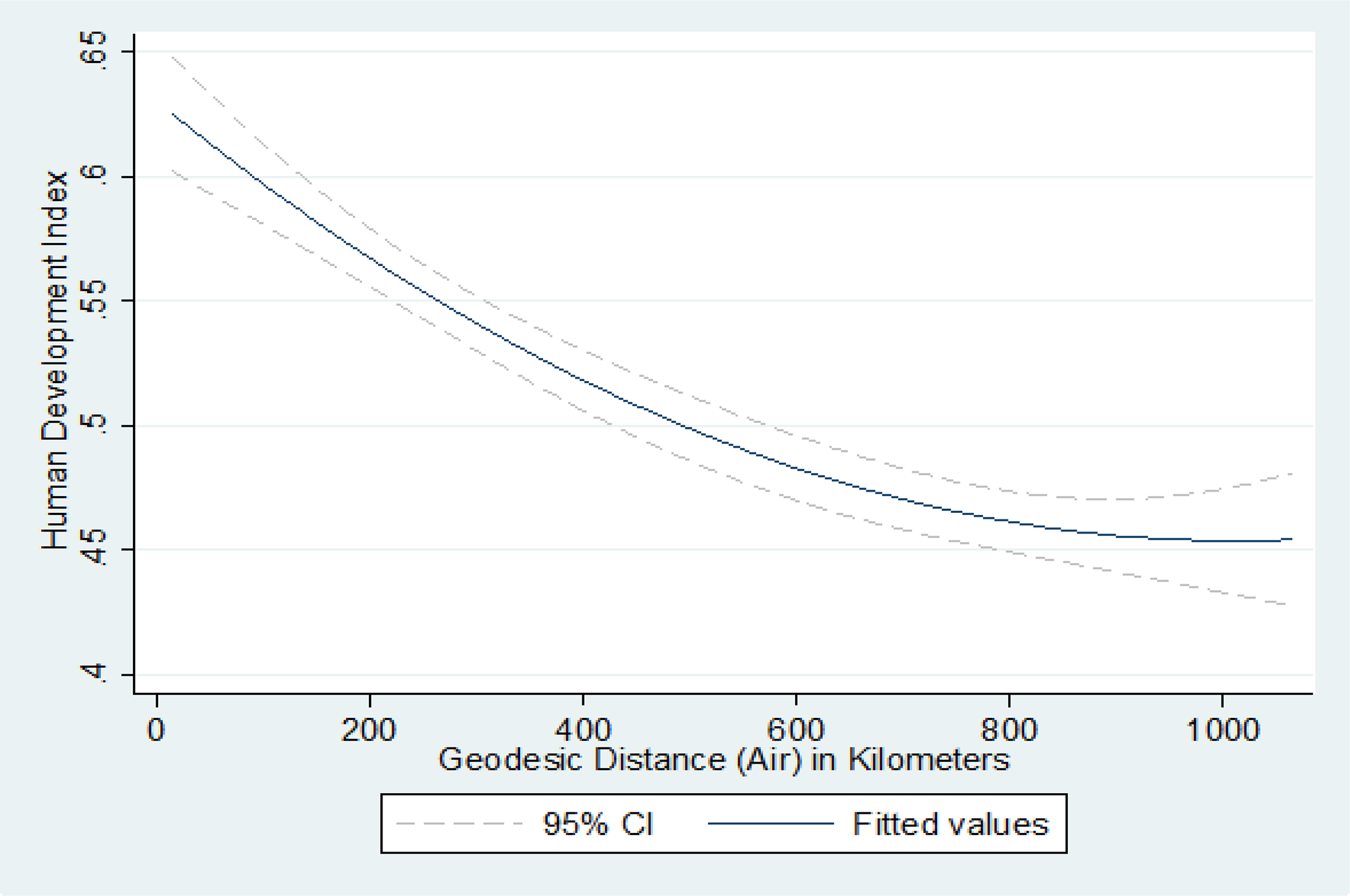
The effect of distance on the Human Development Index.
Relatedly, the association between the geodesic distance of provinces from Manila on the poverty indicators selected confirms that the unitary state has a deleterious impact in promoting poverty in the periphery. For example, as shown in Tables 2.2 and 2.3, the physical distance of provinces from Manila (by both air and land/sea) is both positively correlated with poverty incidence rates and negatively correlated with Average Family Income which attains statistical significance at p < 0.01. Again, these associations tend to be linear, as the squared function of the distance variable does not elicit statistical significance at conventional levels. These indicate that the rampant economic development within Manila has come at the expense of the poverty-stricken provinces in the periphery that have very limited access to a labor force that can grow capital. The results here also convey that the policies of the unitary state have disadvantaged distant provinces and relegated them to higher levels of poverty because access to markets, industries, and capital is scarce as it seems to gravitate towards and within imperial Manila and its adjacent provinces. Hence, the farther away a province is from the locus of economic activity (Manila), the greater the likelihood that the standard of living is lower, that employment opportunities are scarce, and that household disposable incomes are lower. The results here validate the justification for the need to decentralize the locus of political and economic power away from Manila through institutional engineering by ensuring that urban economic hubs are developed throughout the nation to foster inclusive development. Based on marginal effects as depicted in Figure 2, as the distance (by air) shifts from its minimum of 10 kilometers to 1000 kilometers, the incidence of poverty increases from 12% to 33%. Likewise, the same distance shift by 900 kilometers from Manila also decreases the Average Family Income of provincial households from 160,000 to 84,000, which is a 76,000 difference (in Philippine pesos), while holding constant all the control variables at their means and modes, as shown in Figure 3. It is important to note here that one control variable shows statistical significance consistently across all model specifications. This variable is the year that a province is founded based on its official charter, which is positively correlated with poverty incidence rates while negatively correlated with Average Family Income, yielding statistical significance at p < 0.01. This conveys that younger provinces are likely to have higher poverty incidence rates and lower average family incomes—largely confirming extant theories on how early statehood or state antiquity produces early markets and capital accumulation that accrue over time (Bockstette et al., 2002). Thus, older provinces are expected to have higher levels of state capacity that enables them to achieve higher per-capita incomes compared to provinces that achieved late provincehood that drastically impacts nation-building, state-capacity, and development for the long-term.
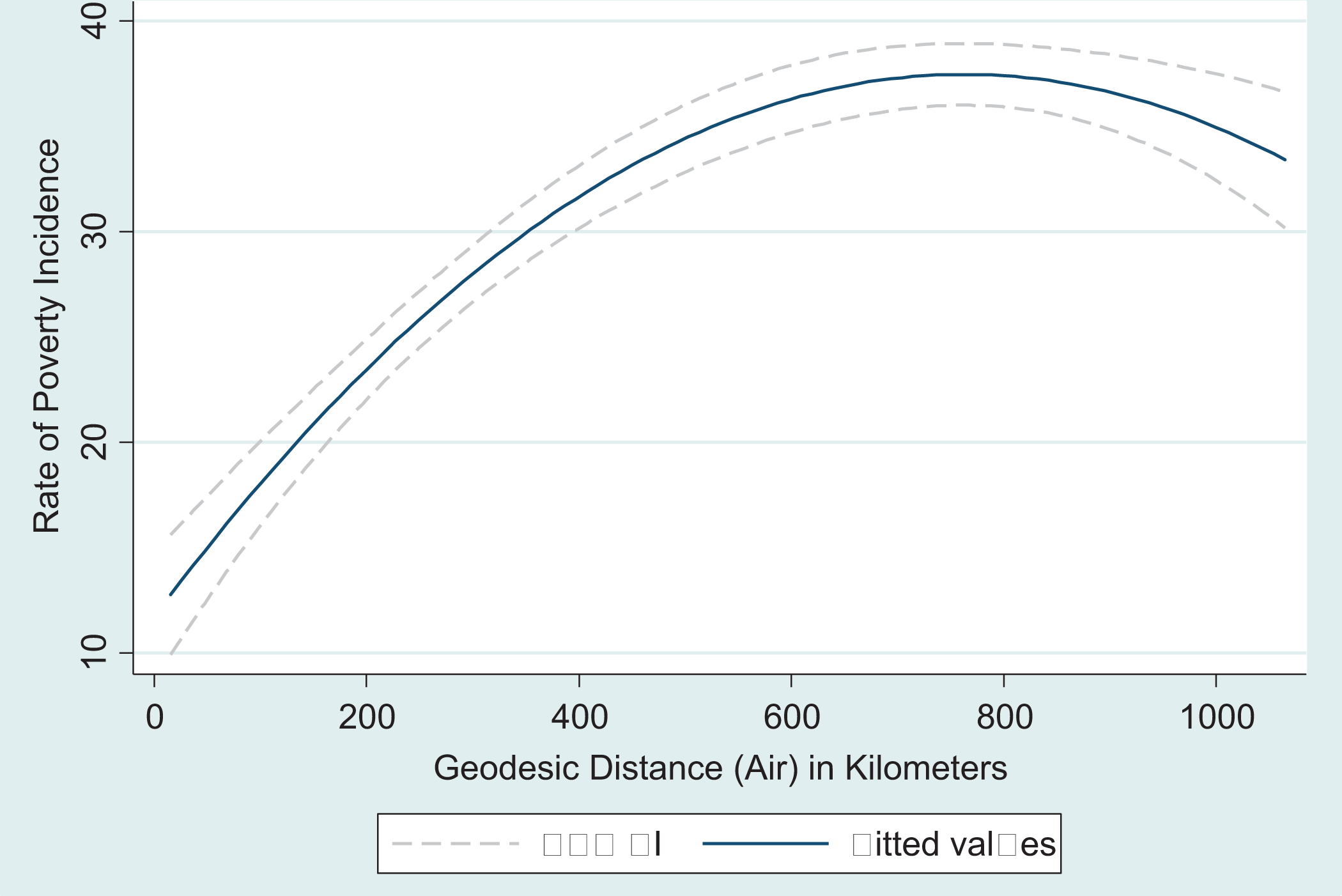
The effect of distance on Poverty Incidence.
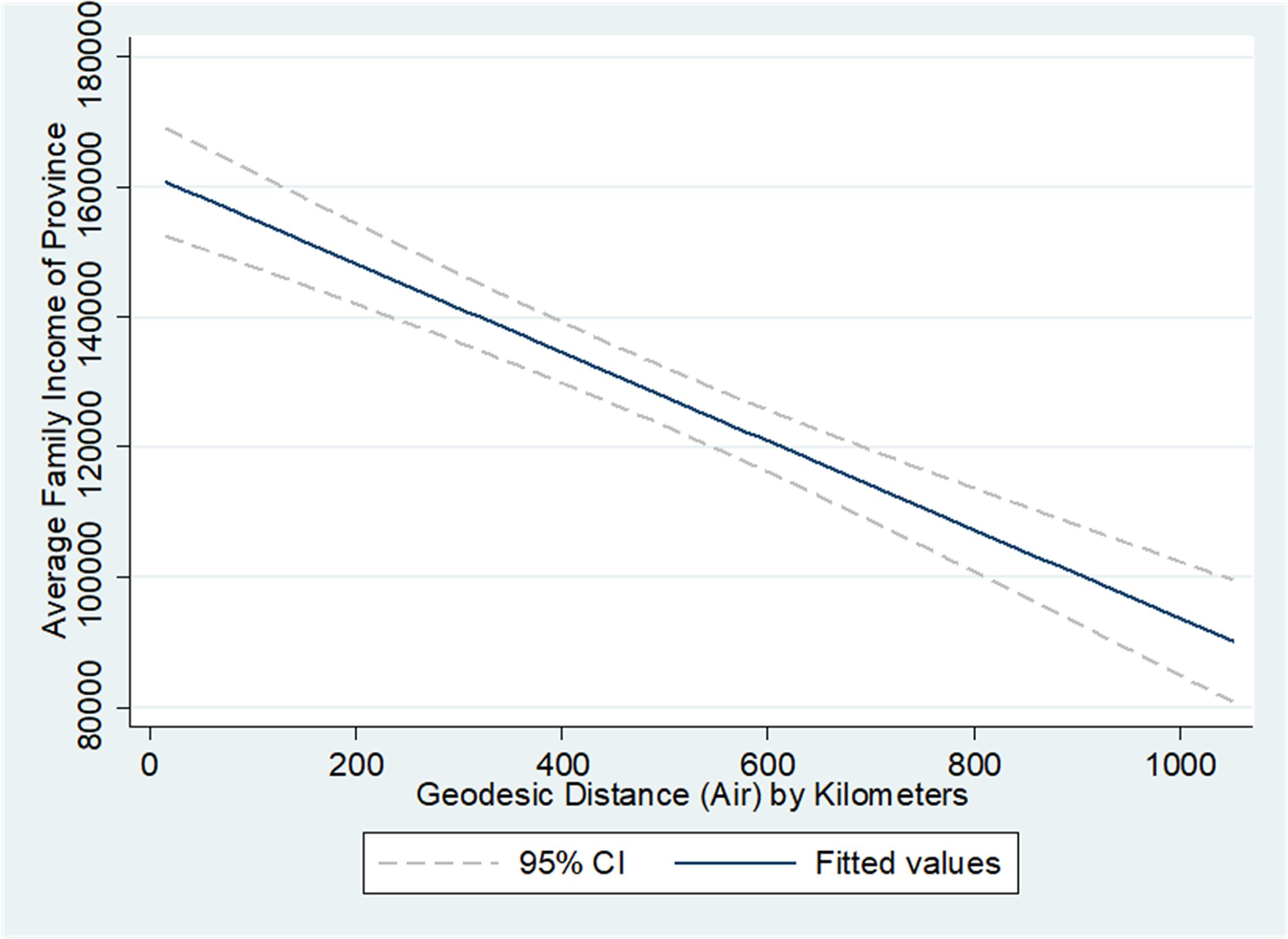
The effect of distance on Average Family Income.
Critics of the unitary state have also linked the persistence of economic underdevelopment, poverty, and low growth economies in the provinces to how the national government have made the provinces highly dependent on national level fiscal transfers (IRAs) that prohibit them from raising their own local revenues. Thus, there are no incentives for provinces to achieve self-sufficiency, even if the Local Government Code of 1991 has granted provinces more leeway to collect formalized revenues through property taxes and licensing fees short of an actual provincial income tax. Are these anecdotal assessments valid? Results presented in Tables 3 and 4 confirm that provinces that are farthest away from Manila are more dependent on such fiscal transfers (significant at p < 0.01), which also makes them less likely to generate locally sourced revenues through their Annual Regular Incomes (significant at p < 0.01). Thus, the unitary Philippine state has strengthened the core-periphery dynamics at play such that the political dominance of the national government is accentuated by the fiscal subservience of the provinces. This “dole out” effect has immense consequences because provinces that rely mostly on fiscal transfers are unable to diversify their economies. This allows the national government in Manila to continue to subjugate them into servitude because they are not given the opportunity to control their fiscal activities or shape their developmental agendas and initiatives, and do not have extra funds that can be used to enhance infrastructure development or to assist at times of exogenous shocks like natural disasters such as typhoons, floods, and earthquakes. Furthermore, such dependence is systemic of what Filipino scholars deem as the entrenchment of client patronage, where provincial governors remain at the mercy of the national government for the economic development needs of their constituents. Furthermore, this dependency is also seen as an anomaly that promotes political dynasties, corruption, and inefficient governance (Yusingco, 2015). Supporters of the move towards a Federal Philippines point out that through decentralization, local provinces will be able to have more control of their economic sectors and harness natural resources within their jurisdictions to supplement their annual regular incomes. This will allow them to cut the so-called umbilical cord from imperial Manila. However, a deeper question remains as to how a new Federalism system can empower remote and isolated provinces if they do not have the economic foundations to sustain markets and a labor force due to the absence of state capacity attributed to the lack of economic diversification through continued reliance on national fiscal transfers. Thus, how can provinces become autonomous when they do not have the capacity to generate markets and are not economically sovereign to begin with?
The effect of distance on Internal Revenue Allotment dependence (dependence on the national government) among Philippine provinces. OLS regressions with PCSE.
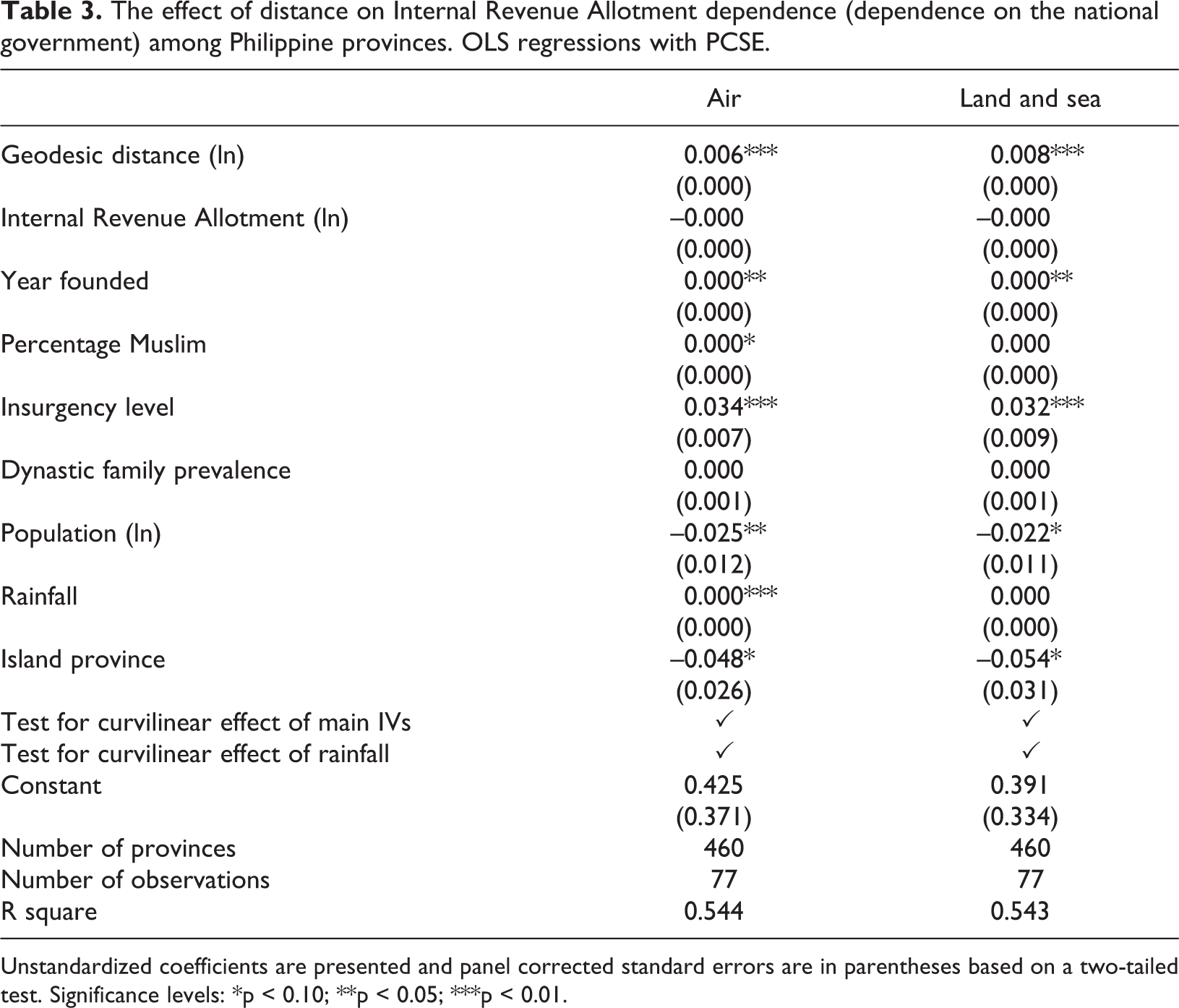
Unstandardized coefficients are presented and panel corrected standard errors are in parentheses based on a two-tailed test. Significance levels: *p < 0.10; **p < 0.05; ***p < 0.01.
The effect of distance on annual regular income of province (locally sourced revenues) among Philippine provinces. OLS regressions with PCSE.
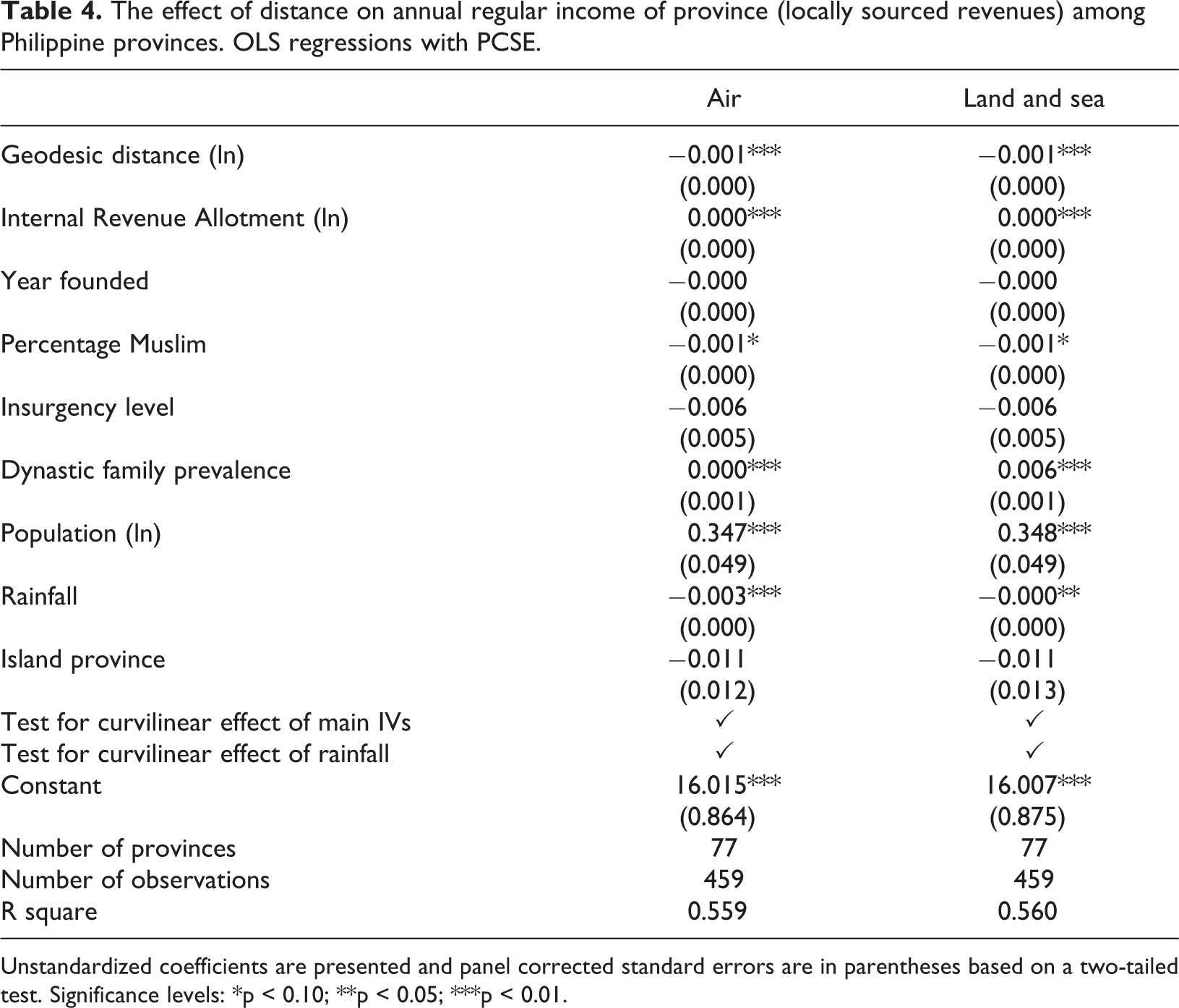
Unstandardized coefficients are presented and panel corrected standard errors are in parentheses based on a two-tailed test. Significance levels: *p < 0.10; **p < 0.05; ***p < 0.01.
To substantiate the extent of how physical distance promotes dependency on fiscal transfers, the marginal effect plot in Figure 4 conveys that as the provincial distance from Manila increases from a minimum of 10 kilometers to a maximum of 1000 kilometers, the IRA dependency ratio grows from 77% to 93%, a marked 16% increase. Relatedly, as shown in Figure 5, physical distance also affects the ability of provinces to raise local revenues, because as we shift provincial distance from Manila from 10 kilometers to 1000 kilometers, the Annual Regular Income of provinces drops substantially by more than 10%.

The effect of distance (air) on Internal Revenue Allotment dependence.

The effect of distance on annual regular income (locally sourced revenues).
Finally, what long-term effect does distance have on the national government’s fiscal priorities when it pertains to development assistance to the provinces? Does unitarism lead to unequal and unbalanced assistance in terms of how priority funds for rural development, poverty alleviation programs, and out of budget infrastructure projects are targeted to provinces that are closer to Manila? Results depicted in Table 5 show that provinces that are farther away from Manila receive less Priority Development Assistance Funds from the national government (significant at p < 0.01). We also see that in terms of the marginal effect plot in Figure 6, the greater the physical distance a province is from Manila, the lower the likelihood that it will receive an increase in development funds. This comports with the assessment of scholars of Philippine politics that such pork money is used as a political tool by the president to buy favors from local politicians or to enhance existing patronage networks, and is not targeted to provinces based on financial need. Further, such rural funds are more likely to be extended to provinces closer to Manila that account for a larger share of votes in terms of electoral politics. Thus, the distribution of funds is not targeted to poor provinces but is routed to “regional bailiwicks” that can win votes for political incumbents supported by the sitting president (Ilagan, 2012). These electoral bailiwicks that receive the largest amount of developmental assistance are largely in provinces in Luzon (closer to Manila by physical distance), largely neglecting the provinces in the Visayas and Mindanao (Mangahas and Caronan, 2012).
The effect of distance on priority development assistance funds (PDAF) among Philippine provinces. OLS Regressions with PCSE.
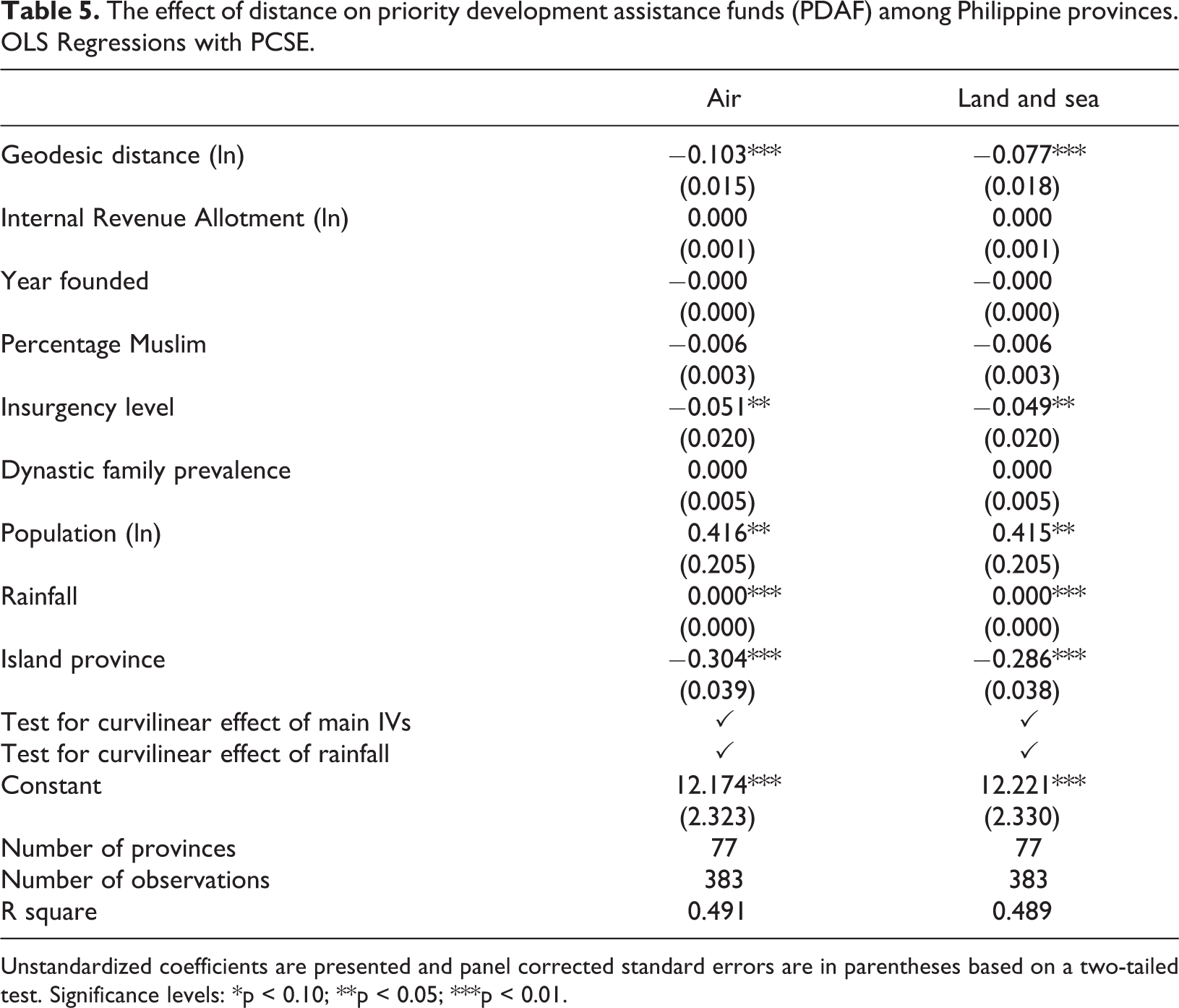
Unstandardized coefficients are presented and panel corrected standard errors are in parentheses based on a two-tailed test. Significance levels: *p < 0.10; **p < 0.05; ***p < 0.01.
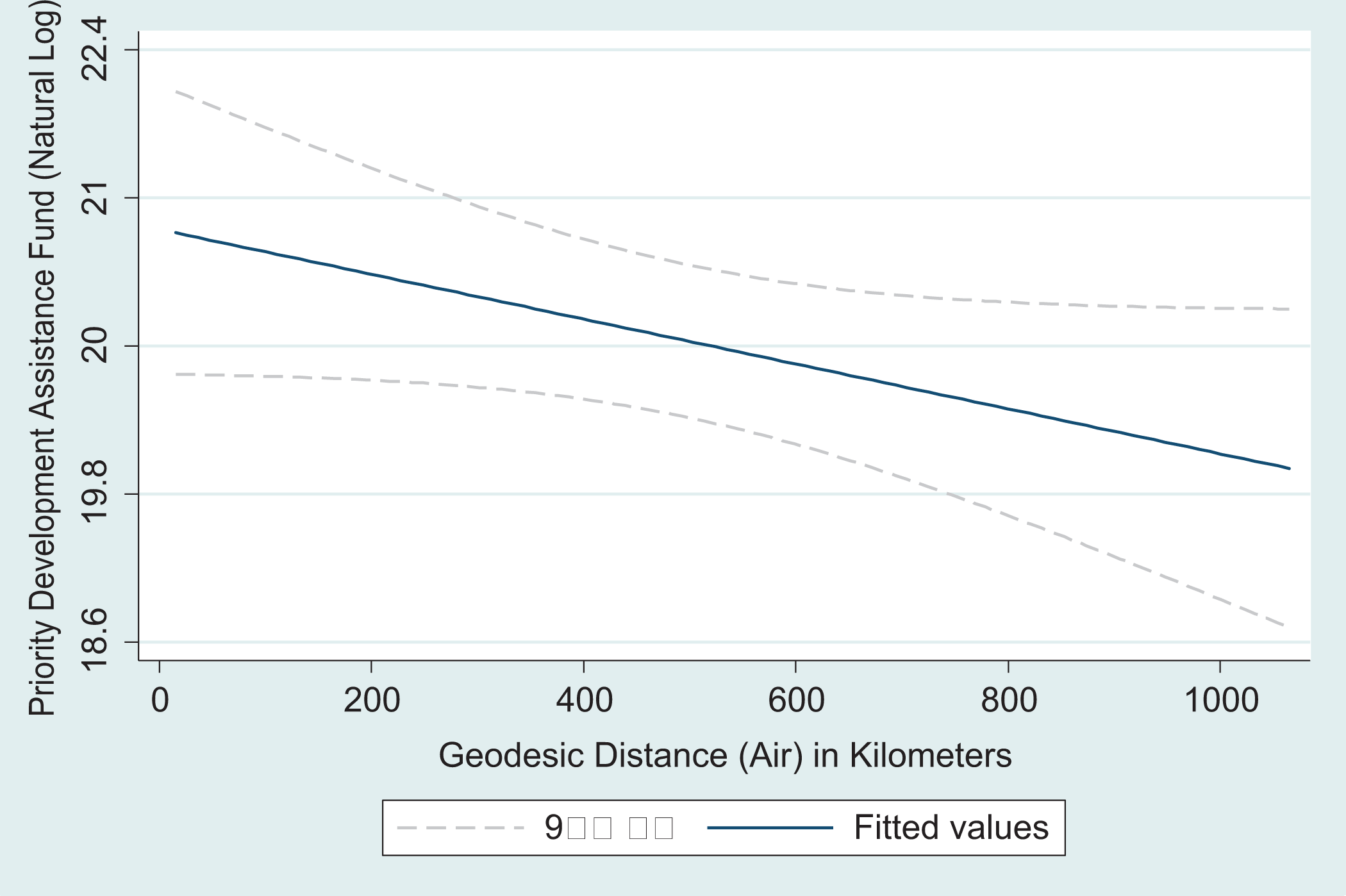
The effect of distance on Priority Development Assistance Funds.
Robustness check
It is possible that what is driving sharp variations on levels of development among Philippine provinces is the urban/rural divide. To account for the urban/rural divide for each province, I employ a measure known as the raw number of barangays for each province (which are administrative districts, wards, and municipalities in each province capable of self-governance according to the Local Government Code of 1991). 17 Thus, the number of barangays in each province serves as a proxy for the level of urbanization in each province (Philippine Statistics Authority, 2016). Since the number of barangays in each province is highly correlated with the natural log of the raw population of each province based on a Pearson’s r value of 0.8824, they cannot be used in the same regression model due to multi-collinearity (Gujarati, D. N., 2009). Thus, I employ separate regression models by solely including the number of barangays in each province (to substitute for population) in the multivariate models presented in the appendix. The results (shown in Appendix A–D) indicate that even with the inclusion of level of urbanization, the strong effect of geographic distance on all measures of political and economic development remains statistically significant in the expected direction—in all model specifications. Thus, physical distance away from Manila has a strong negative effect on the various measures of development, even when controlling for the urban/rural effect.
Discussion and conclusion
Overall, the major findings of this study suggest that the Philippines government’s insistence on centralized rule has led to an imperial Manila syndrome. Economic and social development among Philippine provinces is influenced by geographic distance from the country’s capital, which comports with theories on core-periphery dynamics. The results also corroborate generalized concerns raised by scholars that constitutional engineering is a necessity to mitigate the uneven and unbalanced development in the archipelago nation. For example, it is found that distance from Manila also affects the amount of financial assistance provinces receive from the national government in terms of rural development and that distance away from the capital precipitates dependency on fiscal transfers from the centralized state that curtails provincial efforts to find added local revenues to facilitate fiscal autonomy.
Indeed, a larger question that should be asked is this: is Federalism a panacea that can empower provinces in terms of economic and social development? Clearly, there are several advantages that Federalism can generate—such as economic competition among provinces that can facilitate economic growth; respecting linguistic and religious differences by allowing provinces to retain their cultural distinctiveness that can prevent protracted social conflict; provincial autonomy in raising revenue and ownership of resources that fall in their geographic boundaries that can be used to facilitate a local, diversified economy; and helping to decongest the core by spreading out economic hubs in the country, facilitating the spread of labor, capital, and markets that can also prevent a brain-drain from affecting the periphery. Federalism can also facilitate political engagement as the sub-national regions become laboratories of democracy. As such, provincial citizens will have more political “ownership” of their civic lives. Federalism can also promote unity in diversity and allow religious and ethnic minorities in the country to pass innovative laws in their local legislatures that ensure local self-rule and prevent armed conflict with a national government that has been historically perceived to be tyrannical (Nivola, 2005).
However, it is important to note that the push for a Federal Philippines carries a lot of risks and may generate inadvertent unintended consequences. First, if the underlying principle behind the shift to Federalism is to empower the provinces, such a sudden shift may prove to be inconsequential and cosmetic. For example, because of years of dependence on fiscal transfers and being dominated by centralized politics, many of the provinces lack the basic infrastructure to become politically and fiscally autonomous. Because many provinces and regions do not have diversified economies and industries, the transition towards Federalism will generate provinces that will likely depend on the national government for fiscal solvency—a situation where the national government will have to bail out the sagging economies of poor provinces, much to the resentment of the wealthier regions which will have to bear the brunt of an immense financial burden. As empirical research has suggested, Federated states in the developing world are usually driven towards a fiscal trap, where sub-national regions will likely force the national government to overspend as the fiscal ceiling is breached because of the strong push to ensure equalized development (Rodden and Wibbels, 2002; Wibbels, 2000). Thus, the new Federal structure will likely continue the old practices of the past where the national government dominates economically and the periphery will be overly dependent on fiscal transfers for regional empowerment. Such an asymmetric distribution of power and economic resources can further accentuate uneven development. Therefore, the core-periphery dynamics that perpetuated the poverty and economic marginalization that were entrenched under a unitary state will remain unabated even if Federalism is introduced. Second, there is growing concern that because of the lack of the rule of law and institutionalized political parties in the Philippine polity, introducing political autonomy in the provinces through Federalism will only empower political dynasties. Such political clans will likely contest local electoral politics through violence as politics becomes more familial and less ideological (McCoy, 2009).
Since the provinces are disadvantaged by geographic distance from the capital, other alternative institutional arrangements need to be considered. For example, the Philippines may pursue further fiscal and political decentralization under the current unitary system by amending the Local Government Act of 1991, paving the way for provinces to tax their citizens and businesses directly to help ensure a steady stream of local revenues that can build on local state capacity. Further, the Philippine government can emulate Indonesia’s attempt at decentralization by imposing a fiscal equalization scheme (while maintaining its unitary system) that has been lauded by the international community as a successful process of political decentralization (Nasution, 2017). This is confirmed by a former Chief Justice of the Philippine Supreme Court, who claims that to ensure inclusive economic growth, “the appropriate tool is decentralization, which is a managerial concept involving the delegation of administrative powers to local governments while keeping the determination of policies in the central government” (Bajo, 2017). Thus, the sudden imposition of Federalism in the absence of necessary institutional prerequisites can prove to be a bane rather than a boon in terms of ending the “imperial Manila syndrome.” Federalism adopted with such haste will likely not mitigate the political, economic, and social marginalization of the provinces.
Footnotes
Acknowledgements
This article was originally presented as a paper at the 25th World Congress Meeting of the International Political Science Association, Brisbane, Australia (July 25, 2018). The author would like to acknowledge Lily Adjei for research assistance and Kanishka Jayasuriya, Veena Kulkarni, and Roberto Makalintal for their comments and suggestions on an earlier draft of the manuscript.
Declaration of conflicting interests
The author(s) declared no potential conflicts of interest with respect to the research, authorship, and/or publication of this article.
Funding
The author(s) received no financial support for the research, authorship, and/or publication of this article.
Notes
Appendix
OLS regressions with PCSE (controlling for level of urbanization in each province, which is substituted for the natural log of population)