



Abstract
This article, which is based on a comparative telephone survey conducted in 2016, examines the relationship between social mobility experience and the life satisfaction of people aged 18 to 35 in Taiwan and Hong Kong. Using both objective and subjective measures of social mobility, we found that young people’s perceptions of their own social mobility and that of the entire youth population correlated positively with life satisfaction. However, the objective upward experiences of intragenerational and intergenerational mobility did not have a significant effect on life satisfaction. In addition, the objective upward experiences of individuals were found to be uncorrelated with the perceptions of their own social mobility and that of the entire youth population. These findings suggest that young people will not become more satisfied even if they themselves have actually experienced upward mobility, because their positive perception of social mobility depends on whether they can move upward to their desired status. It is the expected social mobility and the competence to achieve rather than the actual past mobility experience that could affect the life satisfaction of the young generation in Taiwan and Hong Kong.
Introduction
It is widely believed that upward social mobility can increase an individual’s level of life satisfaction by raising that person’s level of resources, which can help him/her to achieve a particular goal and contribute to upward social comparisons (Ormel et al., 1999; Samuel et al., 2013). This argument has spurred a research discourse on the relationship between social mobility and life satisfaction. Most previous related empirical studies have focused on the effects of objective social mobility, particularly income mobility (Ball and Chernova, 2008; Easterlin, 1974; Nikolaev and Burns, 2014; Rojas, 2007; Tran et al., 2018; Veenhoven, 1991). 1
Recent studies have found a gap between objective social mobility and subjective assessments of upward mobility, and have suggested that the perception of mobility may have a stronger explanatory power for life satisfaction than the objective experience of upward mobility (Dolan et al., 2008; Graham and Pettinato, 2002; Haller and Hadler, 2006; Johnson and Krueger, 2006). In our study, we attempted to overcome this drawback by extending the measurement of social mobility to both the objective experience of mobility and the subjective perception of mobility.
Most existing empirical studies used survey datasets collected in the United States and Europe to investigate the relationship between social mobility and life satisfaction. In Asia, such cross-country analyses on the effect of mobility using comparable microdata are seriously lacking, although many studies on subjective well-being in Asia have been conducted (e.g. Liao et al., 2005; Yi, 2013). Attention is increasingly being paid to the impact of economic growth on life satisfaction, given the rapid economic growth that has occurred in Asia in recent decades (Oshio et al., 2011). We conducted a comparative survey in 2016 in two developed capitalist ethnic Chinese societies with different political systems, i.e. Taiwan and Hong Kong, 2 where the cultural, social, and economic situations are different from those in Western countries; then used the survey data to analyze this relationship in the two societies.
The relationship between social mobility and life satisfaction is not merely of academic interest but is also of practical significance to governments and political parties alike. The public’s support for political institutions is always related to life satisfaction in society (Chen and Dickson, 2008). In 2014, large-scale student-led social movements erupted first in Taiwan, then in Hong Kong. In this wave of contentious movements, strong dissatisfaction was expressed with the government’s performance, combined with a pro-democracy sentiment (Hsiao and Wan, 2018). It seems that young people are becoming more pessimistic, frustrated, and anxious about their future because of decreasing chances of upward mobility, despite significant improvements in education. The youth problem is undoubtedly a key social problem in these ethnic Chinese societies. Studying the relationship between social mobility and the life satisfaction of young people will help to shed light on the problem.
The aim of this article is to examine the relationship between social mobility and the life satisfaction of young people in Taiwan and Hong Kong. The innovative potential of our study lies in the fact that it takes into consideration both objective and subjective measures of social mobility, and employs a comparative survey involving two major capitalist societies with different political systems in the greater ethnic Chinese region. Our article is organized as follows. First, we review literature on the relationship between social mobility and life satisfaction. Then, we introduce our dataset, measures of variables, and analytical strategy. Finally, we present our findings and conclude the article with a discussion of the research implications.
Literature review
Impacts of the experience of mobility
According to the social production function theory, well-being, including both physical and social well-being, is the central goal of human activity. People produce their own well-being by optimizing the achievement of instrumental goals, including stimulation, comfort, status, behavioral confirmation, and affection (Lindenberg, 1996; Ormel et al., 1999).
Upward mobility as a desirable life change is believed to reduce the relative cost of achieving instrumental goals in terms of resources and constraints. This increases the opportunity for individuals to produce well-being and gratify their innate bio-psychological needs, and thus improves their evaluation of their life (Veenhoven, 1991). This absolute utility theory, which emphasizes the positive relationship between economic growth and life satisfaction, is supported by many empirical studies (Ball and Chernova, 2008; Diener and Biswas-Diener, 2002; Frijters et al., 2004; Hagerty and Veenhoven, 2003; Nikolaev and Burns, 2014).
However, the absolute argument is challenged by the relative theory, which posits that an individual’s life satisfaction is determined by that individual’s comparisons of his/her standing (Campbell et al., 1976; Easterlin, 1974, 1995). Standards of comparison may vary between individuals and be influenced by an individual’s needs, goals, and culture (Diener and Lucas, 2000). Hence, the same objective conditions may lead to different levels of life satisfaction for different persons. The relative theory assumes that the relationship between objective conditions and life satisfaction will be weak.
There are many standards of comparison (Michalos, 1985; Rojas, 2007). The reference proposition presumes that life satisfaction is related to comparing oneself with others, especially with those who share similar socio-economic characteristics (Clark and Oswald, 1996). Individuals will be more satisfied if they move up to a higher status than their reference group, namely those with similar socio-economic characteristics (Caporale et al., 2009; Oshio et al., 2011).
Unlike the reference proposition, the aspiration proposition emphasizes the impact of comparison with an individual’s desires. The degree of life evaluation experienced by an individual is subject to the ratio of his/her satisfaction to his/her total desires. It suggests that, for example, life satisfaction does not depend on income level, but on the difference between one’s actual income and aspired income (Fuentes and Rojas, 2001; Stutzer, 2004).
The findings on relative theory (including the reference proposition and the aspiration proposition) highlight the importance of relative rather than absolute mobility in terms of income to the improvement of life satisfaction, indicating the possible difference between objective and subjective mobility. It is probable that individuals who have experienced upward mobility are not more satisfied than before because they do not perceive themselves to be upwardly mobile.
Impacts of the perception of mobility
As many studies have suggested that the relationship between wealth and life satisfaction is not a straightforward one, scholars researching the impact of social mobility on life satisfaction have begun to focus on subjective evaluations of social mobility and have suggested that one’s perception of social mobility is a stronger predicator of life satisfaction than one’s actual mobility experience (Dolan et al., 2008; Graham and Pettinato, 2001, 2002; Haller and Hadler, 2006; Johnson and Krueger, 2006; Nikolaev and Burns, 2014; Zhao, 2012). They have explained that perceived social status is more closely related to one’s life satisfaction than objective social status. Also it has been found that perceptions of an improvement in socio-economic status have a positive effect on an individual’s life satisfaction, independent of that person’s objective economic well-being.
In recent years, researchers have increasingly also been focusing on opportunities for upward mobility in society. Inequality is always perceived as a social evil. The effect of income inequality on life satisfaction may vary according to perceptions of mobility (Schneider, 2016). Inequality has been found to have a more negative impact when the level of mobility in a society is perceived to have declined (Dolan et al., 2008). Alesina et al. (2004) argued that people are more willing to tolerate inequality as long as they perceive that everyone has a reasonable opportunity to move upward and that an individual’s status is the result of his/her effort and talent.
In addition, Hirschman’s tunnel effect conjecture presumes that in uncertain and adverse situations people often interpret any positive signals that they can observe around them as an indication that their own situation will improve sooner or later (Hirschman and Rothschild, 1973).
The mobility of young people in Taiwan and Hong Kong
A recent empirical study found that most young people in Taiwan and Hong Kong perceived that they had not achieved upward mobility, and believed that opportunities for upward mobility were not as plentiful nowadays as in the past and would not increase in the future (Zheng et al., 2016).
However, the actual mobility experiences of young people in the two societies are not as negative as they perceive. Figure 1 shows the trend in the growth of the proportion of youth managers, administrators, and professionals. 3 In Taiwan, in 1998, 4.6% of the young cohort aged 25 to 29 had moved up to work as managers, administrators, and professionals in the last five years. This proportion increased to 11.9% in 2015. Although it deceased to 7.2% in 2017, the proportion was still higher than in 1998. In Hong Kong, this proportion had increased from 8.9% in 1998 to 13.6% in 2015 and 10.1% in 2017.
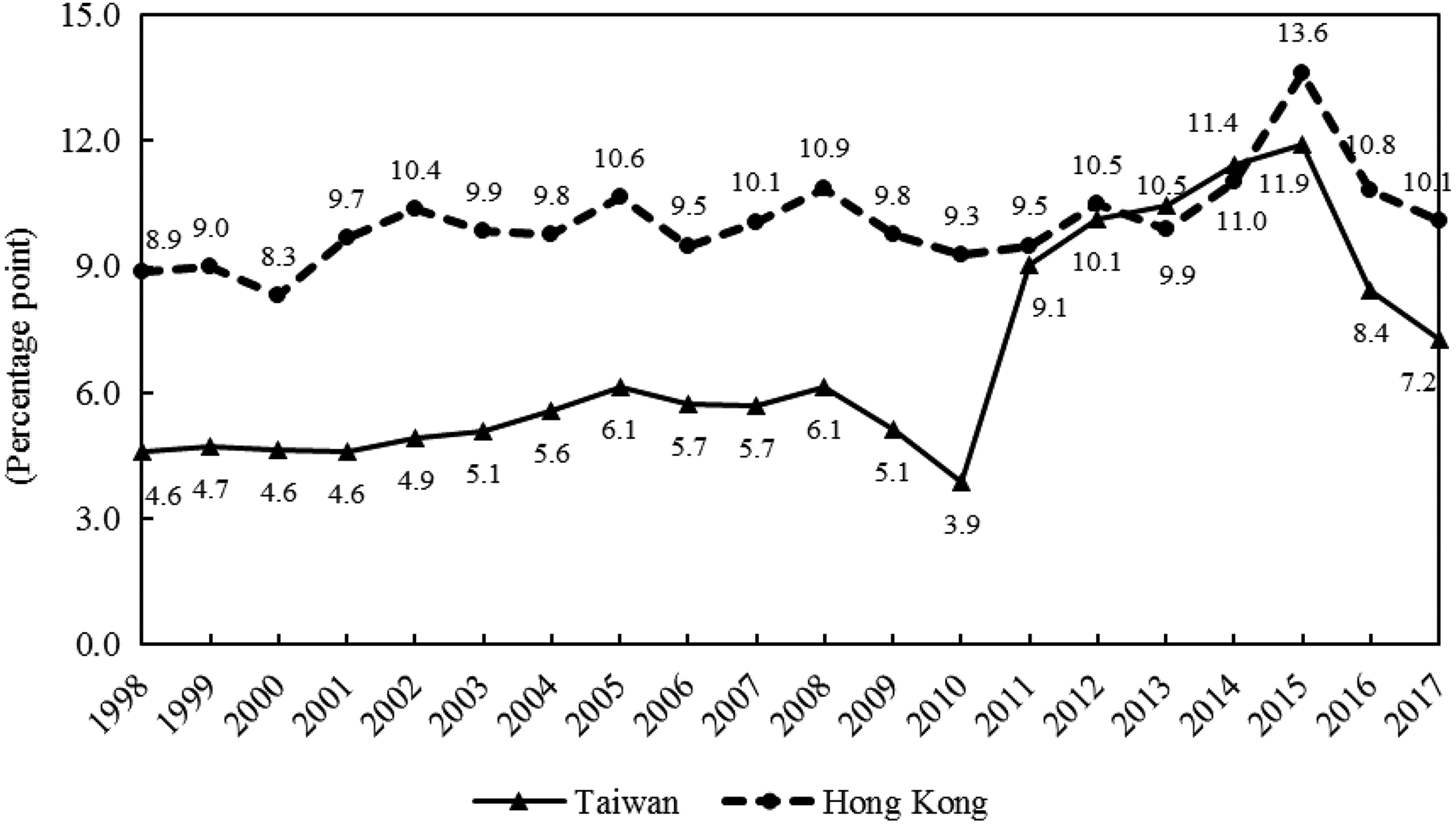
Growth in the proportion of youth managers, administrators, and professionals. Sources: Hong Kong: General Household Survey of the Census and Statistics Department (internal data); Taiwan: Directorate-General of Budget, Accounting and Statistics (various years).
Figure 2 displays the growth in young people’s employment income at a fixed price in the two societies. 4 In Taiwan, in 2002, the real median monthly employment income of the employed young cohort aged 25 to 29 had increased by 26.7% in the previous five years. Although the growth rate decreased to 11.0% in 2011, it increased again to 27.0% in 2017. In Hong Kong, the growth rate in the real income of the youth cohort aged 25 to 29 was 25.6% in 1998, increasing to 52.4% in 2017. This suggests that in the two societies, opportunities for upward mobility for young people in terms of income had not deteriorated in recent years.
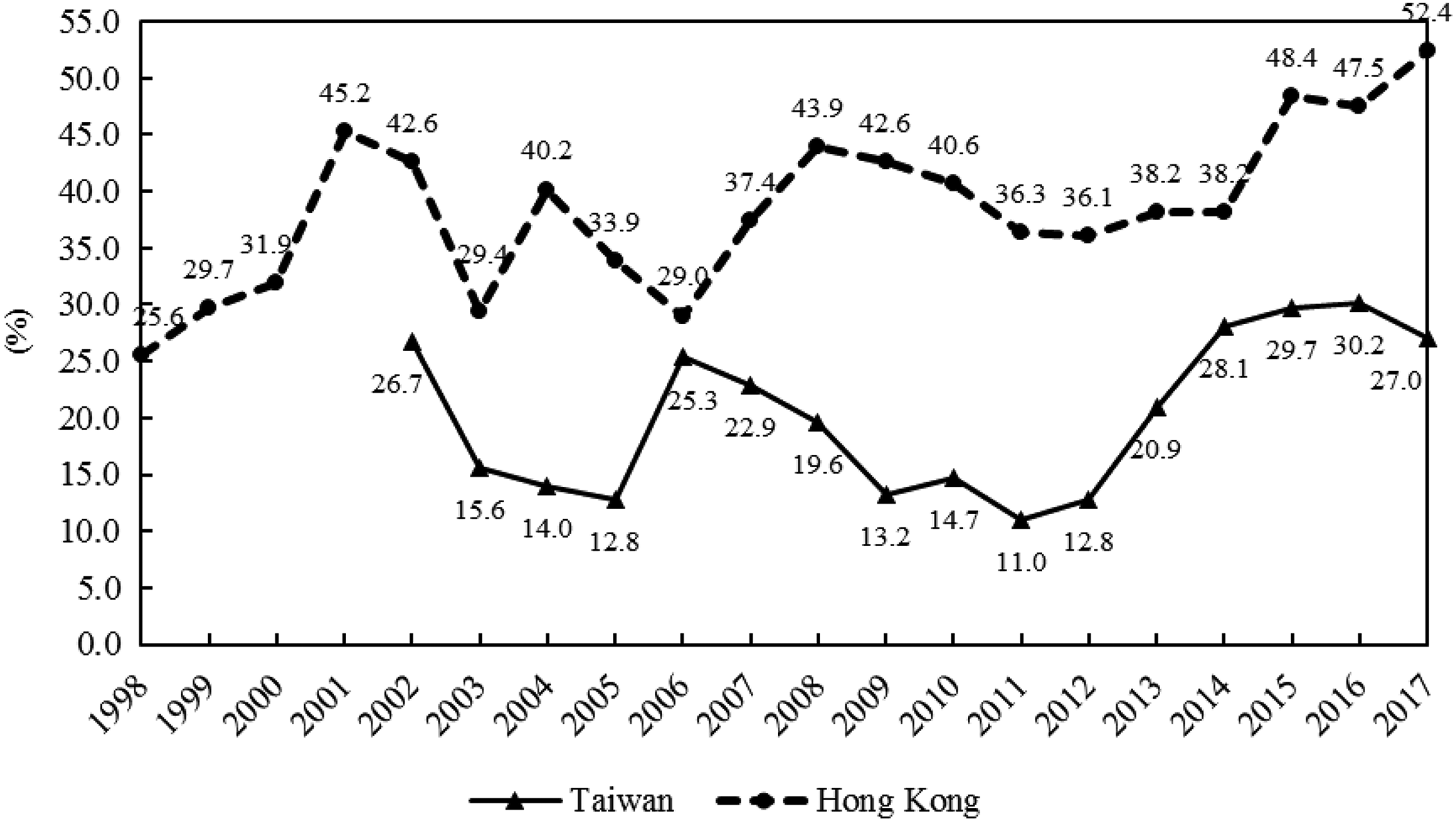
Growth in the real income of employed youth. Sources: Hong Kong: Census and Statistics Department (various years) and General Household Survey of the Census and Statistics Department (internal data); Taiwan: Manpower Utilization Survey of the Directorate-General of Budget, Accounting and Statistics (internal data) and National Statistics (2018).
These findings do suggest that there is a gap between the experience and the perception of social mobility of young people in both Taiwan and Hong Kong, and imply that some young people who have experienced upward mobility may not perceive themselves as being upwardly mobile. According to the relative theory, objective social mobility can affect life satisfaction only via perceived social mobility. Hence, we presume that in these two societies the relationship between the mobility experience and life satisfaction of young people is weak, and that only perceived mobility and not mobility experience is correlated with life satisfaction.
Data and variables
In April 2016, we conducted a comparative telephone survey simultaneously in Taiwan and Hong Kong. The target population was young people aged 18 to 35 who had a home landline telephone. The survey adopted a two-stage probability sampling. First, a fixed set of landline telephone numbers was randomly selected. Second, an eligible household member was randomly chosen for an interview. About 1000 people in each society were successfully interviewed. 5 The response rate was 31.6% for Taiwan and 37.8% for Hong Kong. The respective margin of error in sampling was ±3.07 and ±3.09 percentage points at a 95% level of confidence. The aim of this survey was to collect information on the social mobility and socio-political attitudes of young people in the two societies. Therefore, the dataset is well suited for an empirical test of the relationship between social mobility and life satisfaction.
In this article, objective social mobility was operationalized as the respondents’ experience of class mobility, which was derived from information on their occupation. Hence, the following cases were excluded from the analysis: students, housewives, retired people, the never employed, and those with information missing on their occupations. However, the unemployed were included because these cases are classified as instances of downward mobility. Cases with missing information on the father’s occupation were only kept in the regression analysis, because these cases can be used to examine the effect of intergenerational mobility on life satisfaction. In addition, cases with missing information on other variables used in the statistical analysis were eliminated. In the end, 758 cases for Taiwan and 551 cases for Hong Kong were retained for analysis.
Social mobility is the independent variable in our study. As mentioned before, we employed both objective and subjective measures of social mobility. In order to objectively measure the mobility experience of the respondents, we first categorized the respondents into several class groups according to the information on their occupation, based on the Erikson-Goldthorpe-Portocarero (EGP) class scheme (Erikson et al., 1979). The categories in the original EGP class scheme are not strictly hierarchical, so it is difficult to define the direction of the mobility (Zhao et al., 2017). Hence, with some amendments based on the social characteristics of the two societies, class groups were further collapsed into five hierarchical categories: (1) large enterprise managers and professionals (top position); (2) small and medium-sized enterprise (SME) managers and semi-professionals; (3) clerks, service workers, and the self-employed; (4) workers and farmers; and (5) the unemployed (lowest position). 6
This study also focuses on the effect of both intragenerational and intergenerational mobility. The former is an indication of the development of one’s career and the latter is the change relative to the class position of one’s father. Hence, intragenerational mobility experience was measured by comparing the respondent’s current class with that of his/her first job. Intergenerational mobility was measured by comparing the respondent’s current class with his/her father’s class when the respondent was 15 years old. Upward mobility infers that the respondent’s current class position is higher than his/her original class position or father’s class position. Downward mobility indicates that one’s current class position has become lower. Immobile describes those whose class position remained unchanged. We selected the immobile group as the reference group. 7
Subjective measures of social mobility can be conceptualized into perceptions of social mobility at both the individual and societal levels. The perception of social mobility at the individual level refers to how individuals perceive their own condition of mobility. We selected the respondent’s perception of his/her past mobility as a proxy for the perception of social mobility at the individual level. This was based on the respondent’s answer to the question of whether he/she has moved upward compared to five years ago (1 = downward, 2 = immobile, 3 = upward).
The perception of social mobility at the societal level was captured using the perception of opportunities for young people to move upward. This was based on the respondent’s answer to the question of whether he/she thinks that there are sufficient opportunities in society for young people to move upward (1 = very insufficient, 2 = insufficient, 3 = sufficient, 4 = very sufficient). The question focuses on the perceived condition of mobility for young people only, not for the population as a whole, because the mobility of young people relates more to the life satisfaction of young people than to that of the whole population.
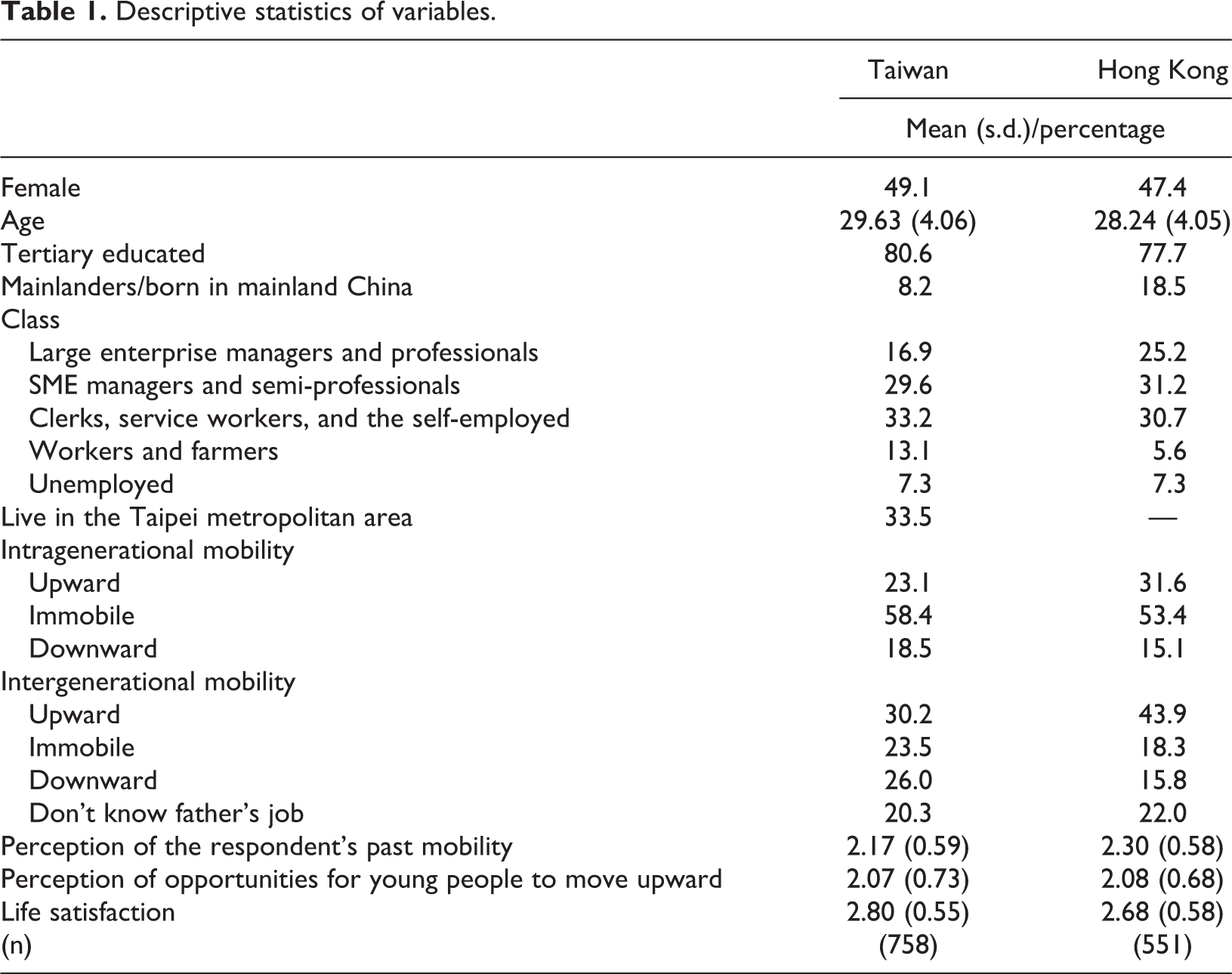
Life satisfaction is the dependent variable, which was measured by asking the respondent how satisfied he/she was with his/her life as a whole (1 = very dissatisfied, 2 = dissatisfied, 3 = satisfied, 4 = very satisfied). The following socio-demographic attributes were selected as the control variables: gender (0 = male, 1 = female), age, education (0 = non-tertiary educated, 1 = tertiary educated), birthplace (0 = not born in mainland China, 1 = born in mainland China) for the Hong Kong respondents, ancestral home (0 = Benshengren/local Taiwanese and others, 1 = Mainlanders) for the Taiwan respondents, 8 and current class position. In addition, we added a living place dummy for Taiwan (0 = not Taipei metropolitan area, 1 = Taipei metropolitan area). Unlike Hong Kong, Taiwan is not a city-state; thus, there may be variations in mobility experiences and social attitudes among people from the various areas. As the Taipei metropolitan area is the largest metropolitan area in Taiwan, the people who live there would have more opportunities for upward mobility and different perceptions of social mobility. Table 1 contains descriptive statistics of the variables used in the statistical analysis.
Descriptive statistics of variables.
Results
Regression on life satisfaction
We ran OLS regressions to test the relationship between social mobility and life satisfaction for Taiwan and Hong Kong separately. 9 For robustness, we also ran the analyses with ordinal logit regressions and obtained consistent findings with OLS regressions. 10 Hence, we present only the results of OLS regressions.
The first three models were set up to examine the effect of objective experiences of mobility. In model 1, a series of intragenerational mobility dummies were added as independent variables to examine the effects of intragenerational mobility. Immobile was selected as the reference group, so as to discretely investigate the effects of different types of mobility. In model 2, intergenerational mobility dummies were added instead of intragenerational mobility dummies to examine the effects of intergenerational mobility on life satisfaction. In model 3, we added dummies for both intragenerational mobility and intergenerational mobility to test the independent effects of two upward mobility experiences because these two experiences are significantly correlated (Tables 2 and 3).
OLS regressions on the life satisfaction of young people in Taiwan with selected variables.
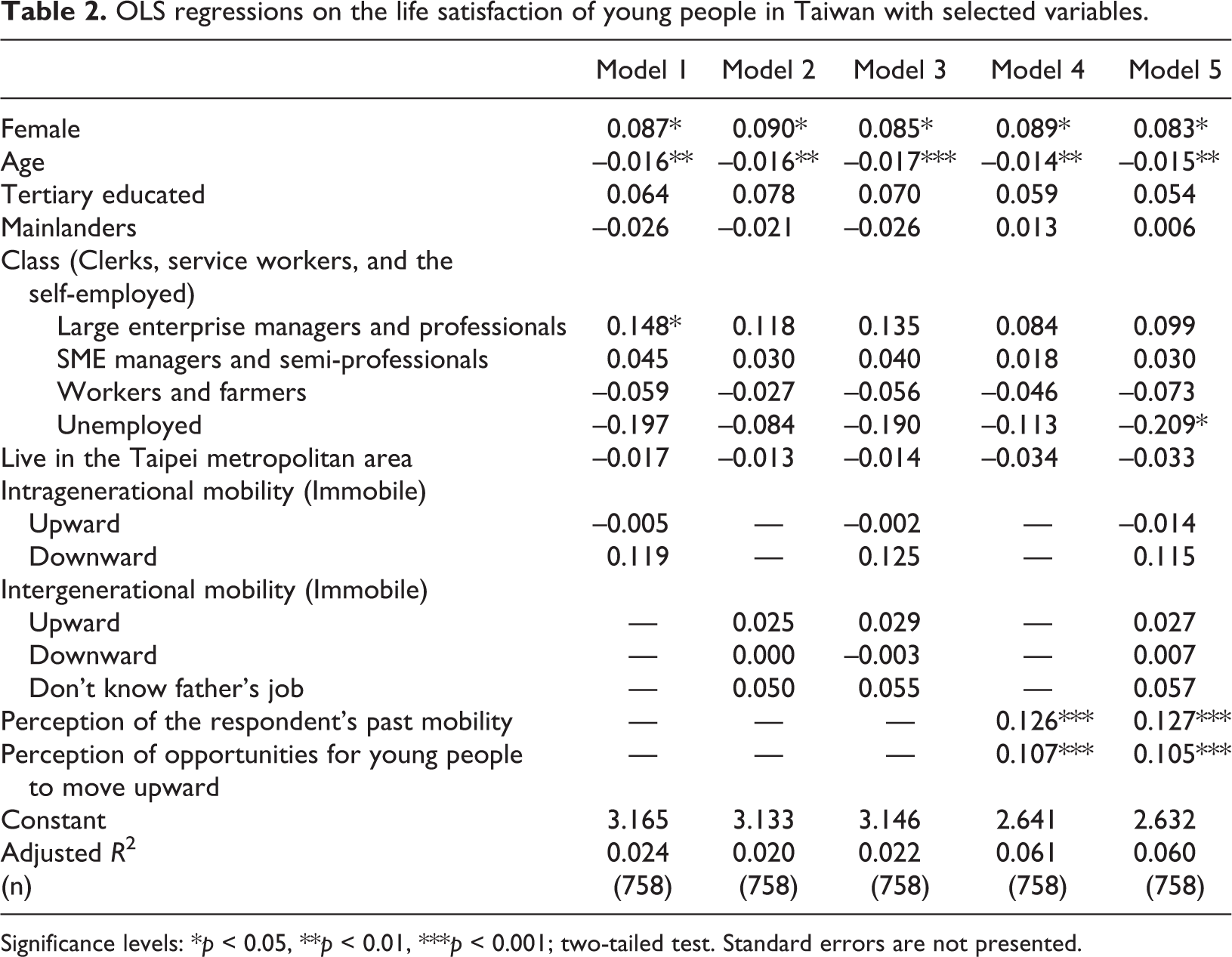
Significance levels: *p < 0.05, **p < 0.01, ***p < 0.001; two-tailed test. Standard errors are not presented.
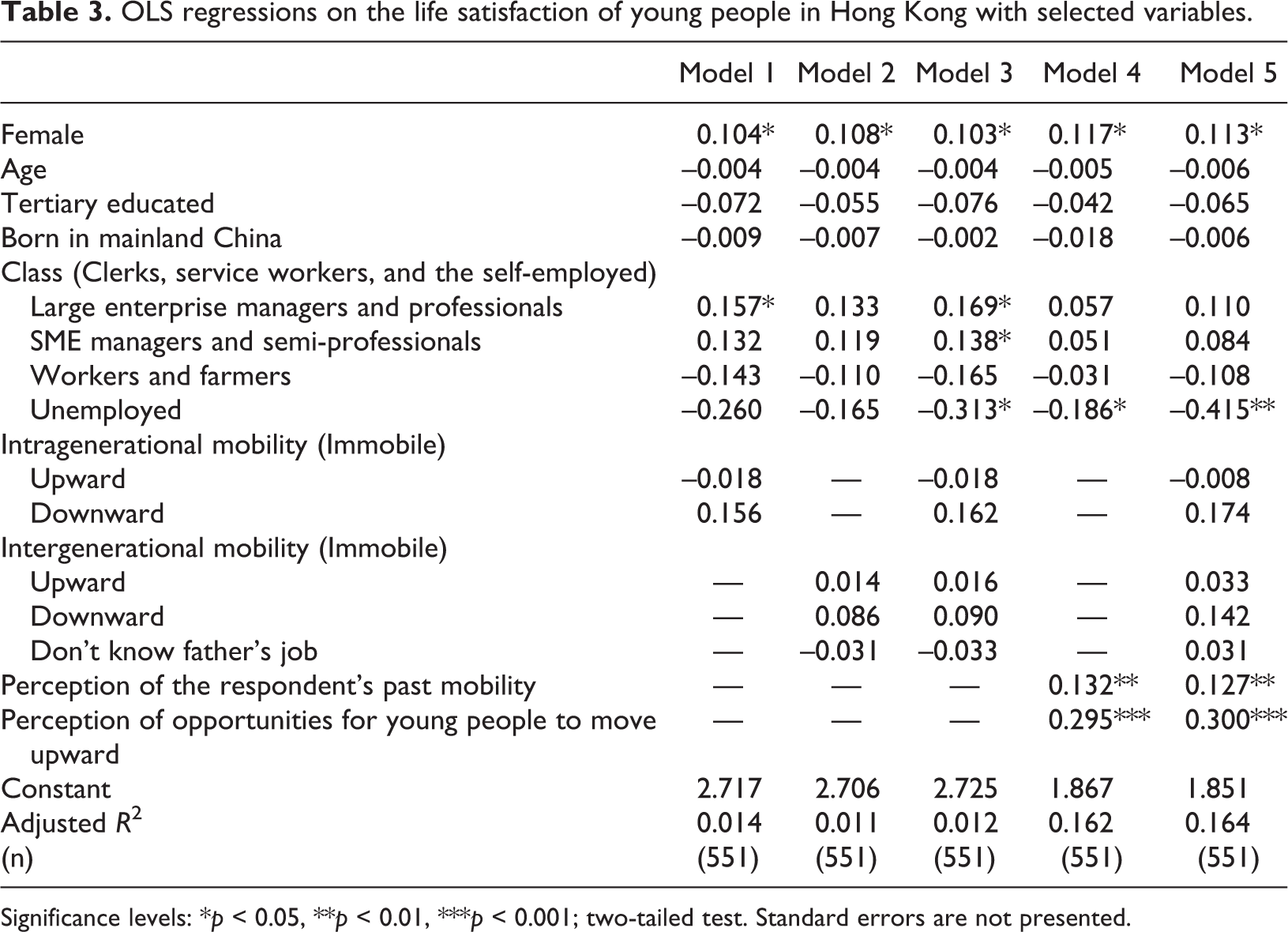
OLS regressions on the life satisfaction of young people in Hong Kong with selected variables.
Significance levels: *p < 0.05, **p < 0.01, ***p < 0.001; two-tailed test. Standard errors are not presented.
In model 4, we addressed the effect of the perception of social mobility. The two indicators of the perception of social mobility at the individual and societal levels were selected as independent variables. In model 5, we added objective social mobility dummies and indicators of the perception of social mobility. If the experience of mobility does not have a direct effect on life satisfaction independent of self-perception, which is independent from the perception of mobility, the coefficients of the upward mobility dummies should be statistically insignificant when the indicators of the perception of social mobility are controlled for. The results for Taiwan and Hong Kong are presented accordingly in the following subsections.
Taiwan
Table 2 presents the results for young people in Taiwan. In model 1, all of the intragenerational mobility dummies failed to pass the level of significance. In model 2, all of the intergenerational mobility dummies were found to be insignificant. In model 3, the results of the mobility experiences have not changed. The intragenerational and intergenerational mobility dummies are statistically insignificant, indicating that both objective intragenerational and intergenerational mobility experiences are not related to life satisfaction for young people in Taiwan.
It was, however, found in model 4 that perceptions of mobility at the individual and societal levels are positively correlated with life satisfaction. The coefficients of the perception of the respondent’s past mobility and the perception of opportunities for young people to move upward are positive and statistically significant. These findings suggest that people who have a more positive perception of their mobility experience and who think that there are sufficient opportunities for youth to move upward are more satisfied with their lives than those who think otherwise.
According to the tunnel effect conjecture, positive attitudes towards opportunities for upward mobility in a society can increase life satisfaction because they are an indication that there is a good chance that an individual will be able to improve his/her own condition of mobility. Our findings in Taiwan reject this hypothesis. The coefficient of the perception of opportunities for young people to move upward is positive and statistically significant while the perception of social mobility at the individual level is controlled for. This shows that the correlation of the perception of social mobility at the societal level is independent of that at the individual level. The positive correlation between the perception of social mobility at the societal level and life satisfaction is due not only to the tunnel effect, but also to the fact that social mobility is itself a matter of social justice in general and of equality of opportunity in particular, and helps to legitimize social evils such as income inequality (Wisman and Smith, 2011).
In model 5, the coefficients of the perception of the respondent’s past mobility and the perception of opportunities for young people to move upward are still positive and statistically significant after controlling for an objective experience of mobility. This suggests that the correlations between the perception of social mobility and life satisfaction are independent of the objective experience of social mobility. On the other hand, the upward intragenerational and intergenerational mobility dummies are still insignificant. This shows that objective experiences of social mobility and perceptions of social mobility have different correlations with life satisfaction in Taiwan. Young people are more satisfied with their lives when they have a more positive perception of social mobility. However, young people may not necessarily be more satisfied when they move up to an upper class.
Hong Kong
Table 3 shows the results of the regression on the life satisfaction of young people in Hong Kong. The findings in models 1, 2, and 3 do not support the argument that upwardly mobile people have a higher level of life satisfaction than immobile people. The coefficients for upward intragenerational and intergenerational mobility failed to pass the level of significance. There is no statistically significant difference in life satisfaction between those who have moved upward and those who have remained immobile.
It was found in model 4 that the perception of the respondent’s past mobility is positively correlated with life satisfaction. Young people who perceive themselves as upwardly mobile are more satisfied with their lives than those who perceive themselves as immobile or downwardly mobile. The perception of social mobility at the individual level is positively correlated with life satisfaction. In addition, the coefficient of the perception of opportunities for young people to move upward is positive and statistically significant. The perception of mobility at the societal level is positively correlated with life satisfaction when the perception of social mobility at the individual level is controlled for. This correlation is independent of the perception of social mobility at the individual level, suggesting that in Hong Kong the tunnel effect plays a limited role in the relationship between the perception of mobility at the societal level and life satisfaction.
In model 5, the results of the perception of a respondent’s past mobility and that of opportunities for young people to move upward are consistent with those in model 4. These indicators of the perception of social mobility at the individual and societal levels respectively continue to be positive and statistically significant after controlling for the objective experience of mobility. This implies that the correlations of the perception of social mobility at the individual and societal levels with life satisfaction are independent of the objective experience of mobility. The upward intragenerational and intergenerational mobility dummies remain statistically insignificant. There is no difference in life satisfaction between the upwardly mobile and the immobile people.
The objective experience and the subjective perception of mobility
It was found in both Taiwan and Hong Kong that young people who have experienced either upward intragenerational or intergenerational mobility are not necessarily more satisfied with their lives. These findings support the notion of relative theory that the relationship between absolute upward mobility and life satisfaction may be weak because individuals who have moved up to a higher status do not necessarily perceive themselves to be upwardly mobile. An individual’s view of his/her own situation of mobility is determined by relative rather than absolute mobility. Individuals would be more likely to perceive themselves as upwardly mobile and would be more satisfied with their lives when they have moved upward compared to their standing. A smaller and narrower gap between one’s condition and one’s standard will cause an individual to have a more positive perception of his/her own past mobility and thus to have a higher level of life satisfaction.
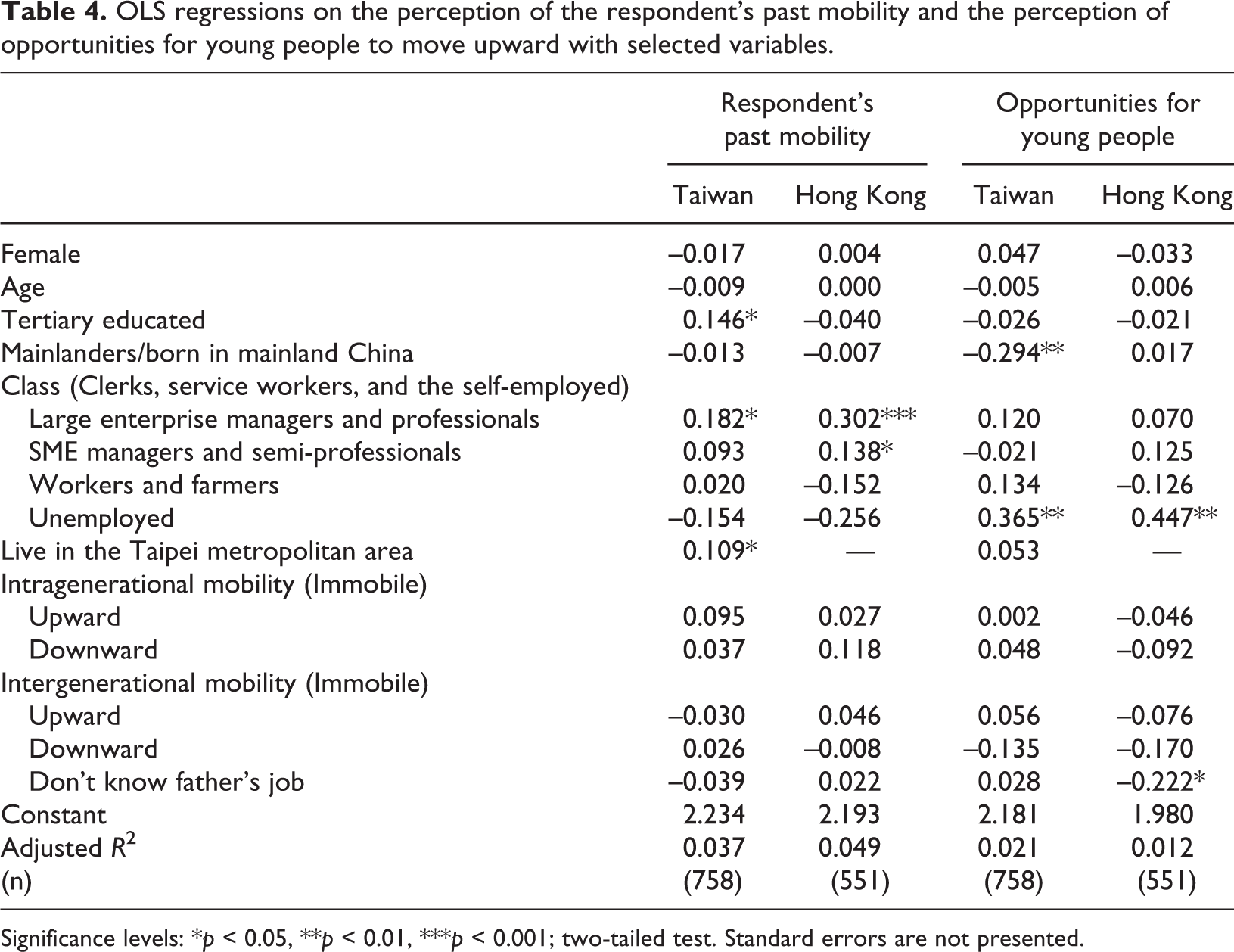
In order to better understand why the objective experience of upward mobility does not have a significant impact on life satisfaction, we ran an OLS regression analysis on the perception of mobility. The perception of the respondent’s past mobility and the perception of opportunities for young people to move upward were selected as the dependent variables. Intragenerational and intergenerational mobility experiences were selected as the independent variables. Socio-demographic attributes, including gender, age, education, birthplace or ancestral home, and current class position (and living place for Taiwan only), were added as the control variables. The results are shown in Table 4.
OLS regressions on the perception of the respondent’s past mobility and the perception of opportunities for young people to move upward with selected variables.
Significance levels: *p < 0.05, **p < 0.01, ***p < 0.001; two-tailed test. Standard errors are not presented.
For the perception of the respondent’s past mobility, the coefficients of intragenerational and intergenerational mobility are statistically insignificant in both Taiwan and Hong Kong. Young people who experienced either intragenerational or intergenerational upward mobility do not have a more positive perception of their mobility experience than the immobile. Absolute mobility experience does not necessarily increase the level of perceived social mobility, once again supporting the relative theory’s presumption.
Class dummies passed the level of statistical significance in both Taiwan and Hong Kong. In both societies, large enterprise managers and professionals were found to have a more positive perception of their mobility experience than clerks, service workers, and the self-employed. Young people at the top of the class scheme tend to perceive themselves as upwardly mobile, whether or not they have really moved upward. In Hong Kong, the coefficient of SME managers and semi-professionals is positive and statistically significant. They, too, have a more positive perception of their mobility experience.
According to the reference proposition, individuals will perceive upward mobility as moving up to a higher status than their reference group, which is those who share similar socio-economic attributes such as age. The aspiration proposition proposes that individuals will perceive themselves as upwardly mobile if they move up to their desired class. Our findings also support the notions of both propositions, in that large enterprise managers and professionals are at the top of the class scheme and should be the most desired class category for young people in both societies.
With regard to the perception of opportunities for young people to move upward, the results of intragenerational and intergenerational mobility are consistent with those for the perception of the respondent’s past mobility. In Taiwan and Hong Kong, the coefficients of intragenerational and intergenerational mobility are statistically insignificant, suggesting that young people who experienced either intragenerational or intergenerational upward mobility do not necessarily have a more positive perception of opportunities for young people in general to move upward.
Insignificant correlations between two upward mobility dummies and two dummies for the perception of social mobility at the individual and societal levels indicate a gap between objective social mobility and subjective assessments of upward mobility. This is a possible explanation for the insignificant correlations between the objective experience of upward mobility and life satisfaction in Taiwan and Hong Kong.
Finally, in both societies, the coefficients of the unemployed are statistically significant and positive, while the coefficients of other dummies have been found to be statistically insignificant. This suggests that the unemployed have a more positive perception of opportunities for young people to move upward in general than do clerks, service workers, and the self-employed, and that there are no significant differences among the employed class groups in their perception of the opportunities available to young people. These findings will be discussed in the next section.
Discussion and conclusion
The aim of this article was to examine the relationship between social mobility and the life satisfaction of young people in Taiwan and Hong Kong. Drawing on data from a representative survey of these two developed capitalist Chinese societies, for which a standardized questionnaire was used, we used both objective and subjective measures of social mobility. The perception of the respondent’s past mobility was found to be positively correlated with life satisfaction. This result indicates that people will be more satisfied if they have a more positive view of their own social mobility.
The perception of mobility opportunities at the societal level was also found to be positively correlated with life satisfaction in Taiwan and Hong Kong. In both societies, the perception of opportunities for young people to move upward correlated positively with life satisfaction. It is important to note that this positive correlation is independent of attitudes towards individual mobility. This implies that young people in Taiwan and Hong Kong are more satisfied when they have a more positive view of the condition of social mobility for all young people in society. This is not only due to the tunnel effect, whereby sufficient opportunities for young people to move upward are interpreted as a positive signal that they themselves will move upward sooner or later, but is also because social mobility is itself a matter of social justice and helps to legitimize (minimize) social evils.
We found no evidence in Taiwan and Hong Kong that the experience of upward intragenerational and intergenerational mobility can increase life satisfaction. Insignificant correlations between the objective experience of social mobility and life satisfaction may due to a gap between the objective experience and the subjective perception. According to the relative theory, individuals who have moved up to a higher status do not necessarily perceive themselves as upwardly mobile. There was no significant difference in perception of social mobility between the upwardly mobile and immobile groups in the two societies. Large enterprise managers and professionals who are at the top of the class scheme and should be the most desired class category for the young people in both societies were found to be more satisfied with their life. An individual’s perception of his/her own social mobility was found to be determined by his/her social status instead of his/her experience of social mobility, supporting the relative theory’s presumption that simply absolute upward mobility does not necessarily increase the level of perceived social mobility and then life satisfaction, but that upward mobility to the desired level does.
In both societies, the unemployed were found to have a more positive perception than employed class groups of the opportunities for young people to move upward in general. This may be because, compared with employed class groups, unemployed young people have more limited experience in the job market and more limited information on the career development of young people as a whole. Poor career development causes the unemployed to believe that employed groups have more opportunities for upward mobility than they have, and that only they and not other young people are encountering problems with achieving upward mobility. Hence, this unemployed group would have a more positive perception of upward opportunity for young people as a whole. Moreover, personal work experience does not necessarily help to improve perceptions of opportunities for upward mobility for young people, because many employed young people are immobile or even downwardly mobile and have seen that many of their colleagues do not have better experiences with mobility than themselves.
However, this study is not without its limitations. Our analyses focused on life satisfaction, which is one important component of subjective well-being. Other components of subjective well-being have been excluded from this research. Although previous studies found a high level of consistency between life satisfaction and happiness, it is beyond the scope of this article to conclude that the experience of upward mobility cannot lead to an increase in the levels of other aspects of subjective well-being. In further studies, other components of subjective well-being can be employed as dependent variables. In addition, our operationalization of objective experiences of mobility was based on class. There are alternative measurements of objective experiences of mobility, such as those based on income. However, many young people did not know their father’s income and hesitated to give a precise figure on their own income, making it very difficult to measure their mobility experience based on income. 11 It would be beneficial to employ alternative measurements to conduct tests of robustness if the relevant data are available.
Despite these limitations, this study makes some important contributions. We examined a number of different indicators of social mobility, including not only intragenerational and intergenerational experiences of mobility, but also subjective perceptions of social mobility at both the individual and societal levels, while most previous studies focused only on one level or the other. We also took a further step to examine the relationship between mobility experiences and perceptions of mobility. Providing new evidence about the relationships among objective experiences of mobility, subjective assessments of social mobility, and life satisfaction in Taiwan and Hong Kong enriches the literature. The results suggest that perceptions of social mobility should be scrutinized in future studies to better understand the relationship between the experience of social mobility and subjective well-being.
This study also offers a supplementary review of the life satisfaction of young people in two major East Asian societies. The large research project of Yi (2013) provided a comprehensive empirical study of the well-being of East Asian young people during the transition from early adolescence to young adulthood in the early 2000s in many different social contexts, including family, school, and early employment. This article attempts to extend our understanding by examining how the mobility experience of young people in the job market correlates with their life satisfaction, and by offering an up-to-date review of the life satisfaction of young people in 2016, after the large-scale social movements led by young people in Taiwan (the “Sunflower Movement”) and Hong Kong (the “Occupy Central Movement”) in 2014.
Lastly, this study offers meaningful policy implications. There has been a rapid expansion of higher education in the two societies in recent decades, which has undoubtedly strengthened the new generation’s power to compete in the job market. However, for the following reasons, this has not necessarily helped young people to obtain their desired job. First, higher educational qualifications have also increased young people’s expectations of the level of job that they can get. Second, the growth in the job market in the two societies has failed to match the rapid expansion of higher education. The weak economic growth in the two economies in the past decades has meant that not enough desirable jobs—those offering a good salary and prospects—could be generated for the number of young people holding university degrees. As such, these young people might feel that their path to upward mobility has been blocked, which would naturally breed discontent toward their government and society. Looked at from this perspective, the rapid expansion of higher education, which has outpaced the number of good jobs that have been created, may lead to negative outcomes that both societies need to address. The governments of the two societies should pay attention to the mismatch between higher education policies and labor market demand. For the new generation, the issue is not only about their own personal career development, but also about social justice, because mobility is a sign of equal opportunity, which is a key element of a good society.
Footnotes
Declaration of conflicting interests
The author(s) declared no potential conflicts of interest with respect to the research, authorship, and/or publication of this article.
Funding
The author(s) disclosed receipt of the following financial support for the research, authorship, and/or publication of this article: This research project was funded by the Public Policy Research Funding Scheme from the Central Policy Unit of the HKSAR Government.
